THE STATUS OF WOMEN
Reading edition
Undomestic Daughters
The history of modern England as set forth in the files of Punch is largely a record of the education of the average man; and there are few, if any, aspects of this education during the period under review in this volume in which greater changes are observable than in Punch's altered view of the status of women. Even in his earliest days he had "rounded Cape Turk"; he had never favoured an Oriental seclusion of his womankind. But an element of condescension and patronage mingled with his chivalry. Their efforts to emerge from the sphere of domestic duties met for the most part with amused ridicule. For the rest the phrase "pretty dears" fairly sums up Punch's earlier view of the place of women in the universe. This view had already been largely modified. We have seen how he had been shaken over the question of the suffrage, how he had been converted to women's invasion of the medical and other professions, and to their election to the London School Board. The progress of this recognition continues throughout this period; the competition of women sometimes excites chaff, sometimes misgiving, but it is no longer regarded as futile. Their solid achievements in a variety of spheres of activity are handsomely acknowledged. We hear less of the "pretty dears" and "ducks"; they are increasingly credited with the capacity to hold their own intellectually with the lords of creation. A conspicuous proof of this altered view is to be found in the texts which accompany the "social cuts" in the 'eighties and 'nineties. It has been said that "the ball of repartee cannot be kept up without constant repercussion," but in the days of Leech the repercussive quality was denied to the fair sex. This defect has now been so completely redressed that the balance inclines rather to the other side, and in Du Maurier's pictures the "score" is generally given to the women. The day of the domestic "doormat" was passing, and grown-up girls are no longer at the mercy of pert or tyrannous schoolboy brothers. True, this self-assertion was far from complete. The solidarity and cohesion of the family circle was substantially unimpaired. Bachelor girls and revolting daughters were a negligible minority; and in the 'eighties the number of professional women was so small that unmarried aunts still played a considerable part in the domestic system, and are frequently found in charge of their small nephews and nieces. It was not until 1890 that Punch included in his series of "Modern Types" that of "The Undomestic Daughter"; and even then her self-expression is circumscribed by lack of opportunity and, in the portrait given, can only find vent in fussy and futile philanthropy. She is a dreary rebel, with a genius for discomfort, who neglects her family when they need her most, ultimately contracts an unromantic marriage, and ends up as a domestic tyrant—a sort of variant on Mrs. Jellyby, but hardly recognizable as a forerunner of the emancipated daughter of to-day.
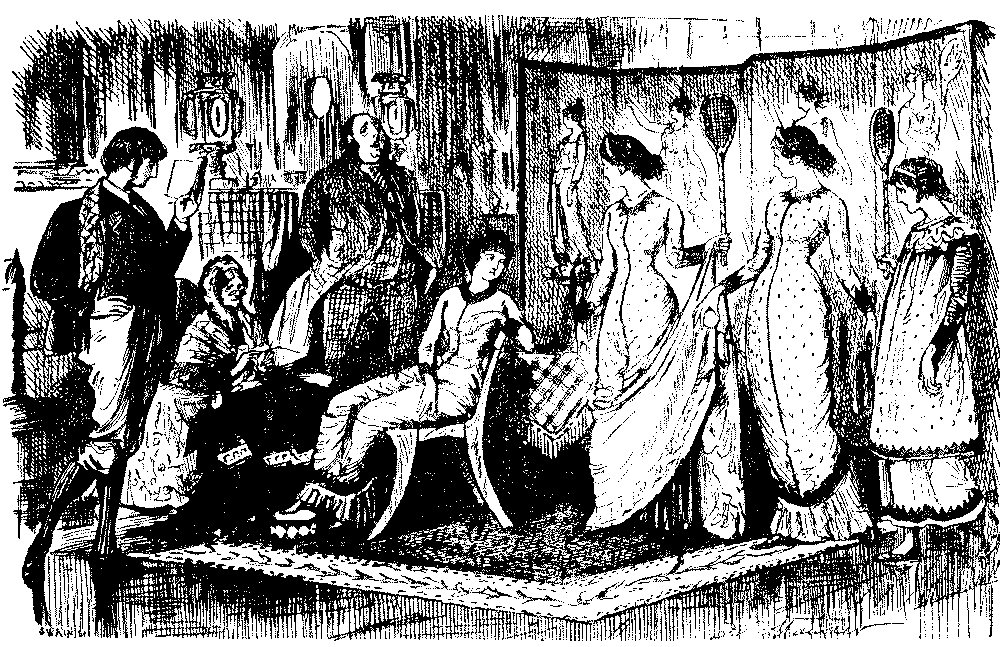
MODERN ÆSTHETICS
Materfamilias: "Where have you been all the morning, girls?"
Sophronia Cassandra: "We've been practising old Greek attitudes at lawn-tennis, mamma!"
Papa (who is not æsthetic): "Ah! hope you like it, I'm sure!"
Sophronia Cassandra: "Very much, papa—only we never hit the ball!"
Punch was already a convert to the higher education of women within certain limits. His reservations are shown in 1875 in an interview between Professor Punch and an ideal candidate for the Ladies' University as it should be. Domestic economy comes first in the curriculum, the humanities second. A picture in the following year would seem to indicate that Punch's ideal was inverted, for one Girton student is shown reading to another a valentine headed with the famous lines from the Antigone of Sophocles beginning Ερωϛ ἁνἱκατε μἁχαντ.[3] "How much jollier," she observes, "than those silly English verses fellows used to send!" Classics were still the predominant partner, and in 1878 Punch notes and resents the attempted revival of classical costume inaugurated by a fashionable poetess. 'Arry's tirade against the higher education of women in 1879, blaspheming against the whole movement as ridiculous and unnatural, is heavily ironical, for in the same year Punch has some friendly verses on the extension of Girton and Newnham, and in 1880 congratulates Miss Scott on being bracketed eighth Wrangler. Punch simultaneously congratulated Mrs., afterwards Lady Butler, on being elected an A.R.A., and rejoiced that the doors of the Academy had been reopened to the sex once honoured in the days of Sir Joshua:—
Mrs. Butler, née Elizabeth Thompson, Punch takes off his hat to you as the first Lady Associate. Your predecessors, Angelica Kauffmann and Mary Moser, sprang into being full-blown R.A.'s.
This is as it should be. At last Punch may say, and with pride he says it, the Ladies are looking up—looking up to the high places of Science and Art, which should never have been held beyond their reach, and which will be graced by their occupancy.
But when the Academy doors are reopened to the Ladies, let them be opened to their full width. Let us not hear of any petty restrictions or exclusions from this or that function or privilege of R.A. What these letters bring men let them bring to women.
Punch's congratulations were premature. Forty years have elapsed, and no women have yet been elected Associates.
A Song of Degrees
It was in 1880 again that Punch backed the appeal of Girton for funds to carry out the extension scheme and supported the petition of women for university degrees. Here he represents the would-be woman graduate as Vivien endeavouring to win over the recalcitrant academic Merlin:—
In Arts, if once examiners be ours, To take degrees we must have equal powers; The loss of these is as the loss of all. It is the little rift within the lute, That soon will leave the Girton lecturer mute; And, slowly emptying, silence Newnham Hall. The little rift in academic lute, The speck of discontent in hard-earned fruit, That, eating inwards, turns it into gall. It is not worth the keeping; let it go: But shall it? Answer fairly, answer no; And take us all in all or not at all.
The decision of Durham University to grant women the B.A. degree in 1881 is cordially applauded, though the welcome is impaired by the facetious heading, "'Ducks' at Durham"; and the liberality of Cambridge in admitting women to the Tripos Examination is contrasted with the churlishness of Oxford. As I write the tables have been turned and Oxford is the paradise of the girl graduate.
In his earlier days Punch never wearied of insisting on the importance of cookery, but a set of verses in 1881 marks an altered mood towards the old "woman in the kitchen" cry. Here the suggestion is even made that men would be benefited by a course of lessons in cooking, and there is obvious irony in the concluding lines:—
This is woman's true position— In the kitchen's inmost nook; And a lady's noblest mission Is to cook.
The two moods are subtly combined in Du Maurier's famous and unforgettable picture of the cynical widow advising a wife of two years' standing to "feed the brute."
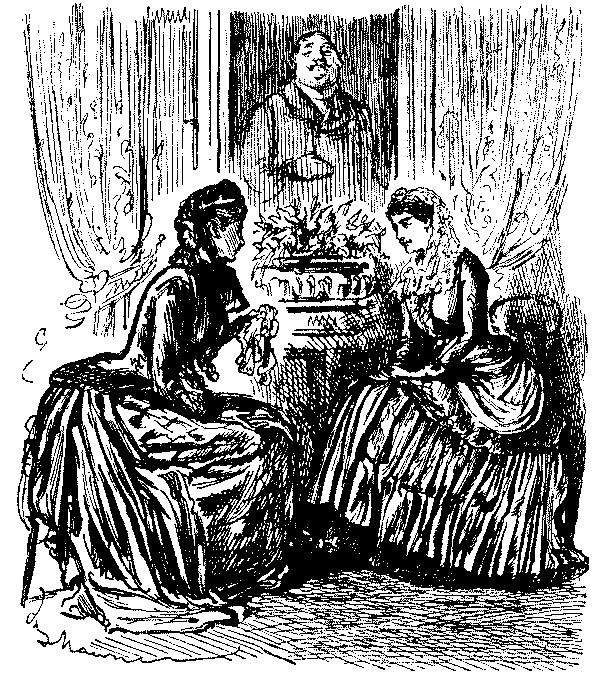
EXPERIENTIA DOCET
Wife of Two Years' Standing: "Oh yes! I'm sure he's not so fond of me as at first. He's away so much, neglects me dreadfully, and he's so cross when he comes home. What shall I do?"
Widow: "Feed the brute!"
"Punch's" Misgivings
From the 'eighties onward physical culture plays an ever-increasing part in the education of girls. Punch went astray in assuming in 1883 that bicycling was impossible for women, but in this and the next year we find him encouraging gymnastics for girls, though there is a touch of satire in Du Maurier's fashionable mother, who boasts to an eligible aspirant that every one of her daughters can knock their father down. The invasion of the domain of pastime and athletics by women and girls will be noted later on. For the moment I am concerned with their intellectual rather than their physical development. Little is said of girls' schools, though an interesting sidelight is shed on the methods of the old-fashioned boarding-school in the picture of the charming girl who explains to a Frenchman her fluency in his tongue: "At school the girl who sat next me at dinner used to eat my fat, and I used to do her French exercise for her; so I got lots of practice." Girls were becoming more studious, more highly educated, but they were not all female Admirable Crichtons. In 1885 Punch chronicles the ingenuous remark of a young lady to her friend, "Only fancy! As You Like It is by Shakespeare!" He welcomed the admission of lady graduates to the Convocation of the University of London in 1884, but misgiving mingles with admiration in his forecast of the omniscient "Woman of the Future" in the same year:—
The Woman of the Future! She'll be deeply read, that's certain, With all the education gained at Newnham or at Girton; She'll puzzle men in Algebra with horrible quadratics, Dynamics, and the mysteries of higher mathematics; Or, if she turns to classic tomes a literary roamer, She'll give you bits of Horace or sonorous lines from Homer. You take a maiden in to dine, and find, with consternation, She scorns the light frivolities of modern conversation; And not for her the latest bit of fashionable chatter, Her pretty head is wellnigh full of more important matter; You talk of Drama or Burlesque, theatric themes pursuing, She only thinks of what the Dons at Oxford may be doing.
The Woman of the Future may be very learned-looking, But dare we ask if she'll know aught of housekeeping or cooking? She'll read far more, and that is well, than empty-headed beauties, But has she studied with it all a woman's chiefest duties? We wot she'll ne'er acknowledge, till her heated brain grows cooler, That Woman, not the Irishman, should be the true home-ruler. O pedants of these later days, who go on undiscerning To overload a woman's brain and cram our girls with learning, You'll make a woman half a man, the souls of parents vexing, To find that all the gentle sex this process is unsexing. Leave one or two nice girls before the sex your system smothers, Or what on earth will poor men do for sweethearts, wives, and mothers?
Here we find Punch reverting to his earlier attitude. Moreover, as I have shown elsewhere, in the middle 'eighties he was in a decidedly pessimistic frame of mind, and inclined, like Porson, to "damn the scheme of things in general." The dismal mood passed, and Punch is himself again and obviously rejoicing in his own malice in the verses on an imaginary episode at Girton, where a breakdown in health, attributed to the excessive study of Browning, is traced to over-indulgence in chocolate creams by the members of the Browning Club. Punch's claim to be regarded as an expert authority where women's colleges are concerned is seriously invalidated by his confusing the sites of Newnham and Girton and, worse still, by calling the former "Nuneham" in the same year. But he redeemed himself triumphantly in his study of "The Girton Girl" (No. IX, and by far the best, of his series of "Studies from Mr. Punch's Studio") in December, 1886. I have the testimony of a distinguished Girton student of nearly twenty years later that Punch's sketch remained even then a masterly dissection of the "mentality" of the Girton Girl, and reveals an inside knowledge, both of generalities and details, which no mere man could have attained. The Girton Girl of fact is carefully distinguished from the Girton Girl of superstition. The latter is fast becoming as extinct as the Dodo:—
The Girton Girl in 1886
The modern schoolgirl is taking her place, no longer the giggling, flirting maiden of fiction, but an ascetic and hard-working young woman. Work has been her lot since the day when she stepped out of her cradle to combine education and amusement in the arrangement of alphabet bricks; and she looks back with a wistful incredulity to the time when the mystic letters, B.A., were to her nothing worse than the voice of the black sheep in the nursery rhyme. She inclines by instinct towards æstheticism in dress, affecting the limpest materials and the strangest hues, and making a compromise in the matter of collar and cuffs by wearing at neck and wrists a piece of very écru lace, turned down the wrong way. Her boots are the terror of stray blackbeetles, for a course of lectures on Hygienic clothing early taught her to view with horror and distrust a slim ankle and a pointed toe. She has a scholarly touch of shortsightedness, which she corrects by free use of the tortoiseshell pince-nez that dangles from her neck.
Her sense of duty is remarkable, and appalling. She virtuously accepts the onerous office of secretary to innumerable societies. Countless notices, in her bold and clear handwriting, may be seen day after day upon the College notice-boards, some of them of a sufficiently pathetic character. "Will the following members be so very good as to pay their subscriptions due the term before last to the 'Society for promoting Masculine Intelligence'?" She does not even resent her appointment as sub-officer of the Fire Brigade, the duties of which position involve a constant personal supervision of two or three repulsively oily little hand-engines, which she tends and lubricates with loving care, till she has reduced her hands and face to the colour of the brown holland apron which enshrouds the rest of her person. Not even the horrors of an alarm practice can daunt her, though she may just have settled herself to revel for an hour in the pleasant byways of Professor Sidgwick's Ethics, when screams of "Fire!" rushing footsteps, and an alarm-rattle, such as heralds a bump in the May races, compel her to leave her books, and fly to the Hall. Then the canvas buckets must be produced, her corps arranged in alphabetical order, and marched off to the supposed scene of action. All this she does in an incredibly short time; and when, at the discretion of the head captain, the pumping of engines and passing of buckets is allowed to stop, she returns to her work with fortitude and resignation past belief.
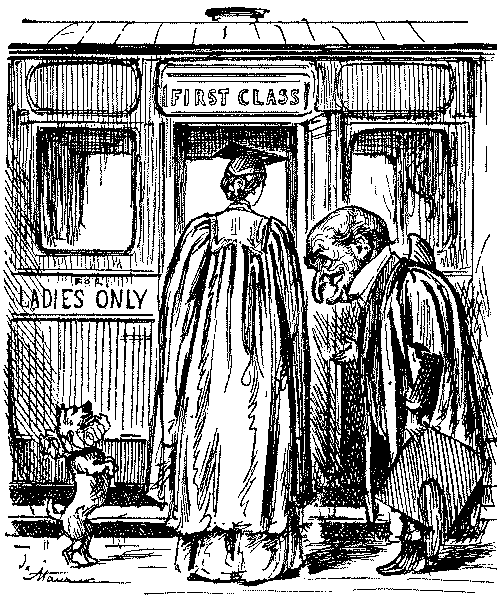
HONOUR TO AGNETA FRANCES RAMSAY!
(Cambridge, June, 1887)
Yet in spite of her multifarious and strenuous activities the Girton Girl is not inhuman or immune to the appeal of her less serious-minded fellow students, and the sketch ends with a really charming portrait of a witty, incorrigibly frivolous, generously hospitable and irresistibly popular member of the college. At once critical, judicial, and genial, the study is a little masterpiece of its kind. The verses, published some months earlier, on a young Spanish lady who took her doctor's degree at Barcelona at the age of nineteen, are appropriately cast in Swinburne's "Dolores" stanza (as that was her Christian name) with the refrain, "Our M.D. of Spain," but are not remarkable either as a parody or an appreciation. Much happier in every way is the well-known picture of Miss Ramsay (afterwards Mrs. Montagu Butler) entering a first-class carriage "For Ladies Only" on the occasion of her being placed Senior Classic in 1887, an exploit which caused Punch once more to raise his voice on behalf of the bestowal of degrees on women.
An even more remarkable success was achieved by Miss Philippa Fawcett, who in 1890 was declared to be "above the Senior Wrangler," and Punch, in "Topping the Tripos, or Something like a Score for the Sex," while congratulating the daughter, did not forget her father, always one of his heroes:—
Above the Senior Wrangler! Pheugh! Where now are male reactionaries Who flout the feminine, and pooh-pooh Sweet Mathematic Megs and Maries? Who says a girl is only fit To be a dainty, dancing dangler? Here's girlhood's prompt reply to it: Miss Fawcett tops the Senior Wrangler! Would it not have rejoiced the heart Of her stout sire, the brave Professor? Agneta Ramsay made good start, But here's a shining she-successor! Many a male who failed to pass Will hear it with flushed face and jaw set, But Mr. Punch brims high his glass, And drinks your health, Miss P. G. Fawcett!
The Eternal Feminine
Yet along with his acknowledgment of these scholastic triumphs, Punch was equally ready to welcome evidences of feminine weakness in the haunts of austere study. In 1888 Miss Helen Gladstone recalled the fact that when she was at Newnham, a motion had been brought forward at the Debating Society that "life without gossip was not worth living" and carried by a large majority, and Punch alluded to the incident under the heading, "Nous at Newnham."
To round off Punch's educational record in this period, I may add that in 1892 he alludes to that irrepressible controversialist, Sir James Crichton-Browne, the champion of mutton chops, and common sense, who had condemned the higher education of women from the medical point of view. Punch professes himself converted by a young Amazon who reduces him to pulp and humiliation by her prowess at games of all sorts.
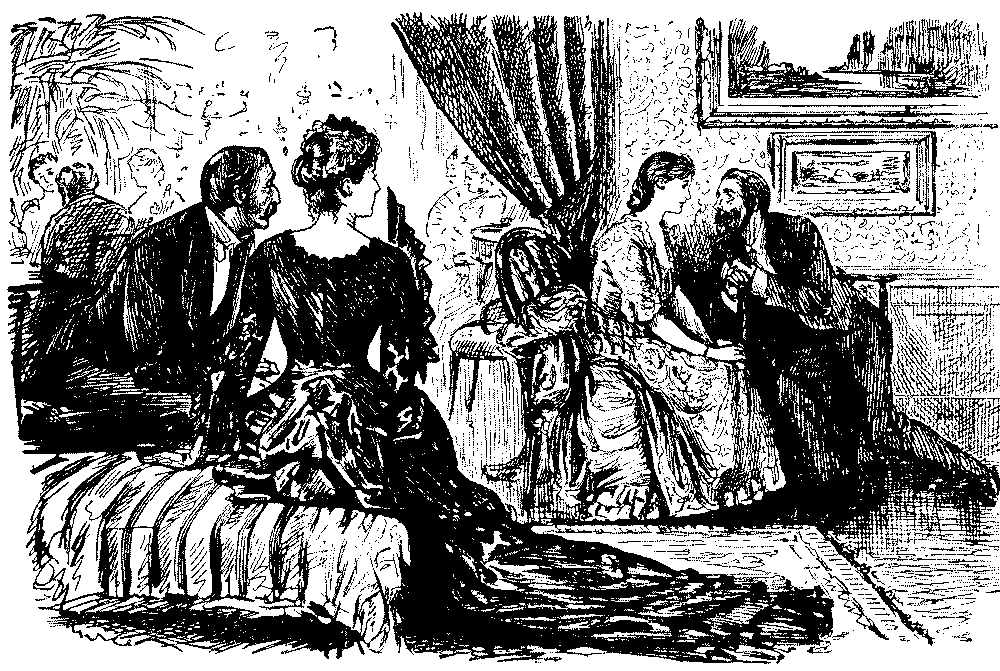
THE OLD, OLD STORY
The Colonel: "Yes, He was Senior Wrangler of his Year, and She took a Mathematical Scholarship at Girton; and now they're Engaged!"
Mrs. Jones: "Dear me, how interesting! And oh, how different their Conversation must be from the insipid twaddle of Ordinary Lovers!"
THEIR CONVERSATION
He: "And what would Dovey do if Lovey were to die?"
She: "Oh, Dovey would die too!"
The entrance of women into existing professions or the creation by them of new callings is in the main viewed with sympathy and benevolence. In the controversy that arose in 1875 between Mrs. Nassau Senior, who had been appointed an inspector of Female Pauper Schools, and Mr. Tufnell, an official of the L.G.B., Punch espoused the side of the lady, who, he considers, had the best of it both in temper and argument. The statement in April of the same year that a lady had been engaged by a firm of solicitors as consulting counsel at a high salary, quoted from a Liverpool paper, was probably apocryphal; but it prompted Punch to observe that the more employments fit for gentlemen that are opened to ladies the better. Any such calling is better than marriage accepted merely as a situation.
"Jills in Office"
Unfortunately some doubt is thrown on the sincerity of this testimonial by the sketch "Portia in Petticoats" in 1882—a burlesque description of a solicitor's office where only women clerks are employed. After a week's absence the head of the firm returns to find that they have mostly disappeared, eloped or got married. The election of Miss Maude Stanley, a cousin of the Dean, as a Guardian in 1877 is the subject of a friendly notice at the expense of Bumble, who regards it as a "most unporochial innowation." In the same year Punch views with admiration the beneficent work of the Ladies' Sanitary Association, established twenty years earlier to inculcate the value of healthy, sensible habits by means of lectures, tracts and handbooks. The suggestion made by a Hastings doctor in 1879 that women might be employed as dispensers is praised, though not without some reserves, in "Girls among the Gallipots," and the new "Ladies' Association for the Promotion of Horticulture and Minor Food Production" founded in the same year by Mrs. Thorne meets with Punch's unqualified approval. This is the first mention that I have met in Punch of a movement which led to the establishment of the horticultural schools at Swanley and elsewhere and the numerous poultry farms run by women all over the country. The institution of the "Royal Red Cross" decoration for nurses in 1883 is welcomed in friendly doggerel. As Bumble had condemned women guardians, so Mrs. Gamp is now represented as very indignant and contemptuous of the "nursing sisters," their position and recognition. But Punch had no use here for amateurs. There is excellent point in Du Maurier's picture of the applicant for the post of matron or head nurse to a hospital who based her claim on being "not trained but gifted." By 1885 the female commercial traveller was apparently already in existence, but Punch treated this innovation with jocular suspicion:—
I know a Maiden with a bag, Take care! She carries samples in a drag, Beware! beware! O Draper fond, She is fooling thee! She has the true "Commercial" style, Take care! To which she addeth woman's guile, Beware! beware! O Grocer goose, She is plucking thee!
And so on with other shopkeepers.
On the efficiency of female clerks Punch speaks with two voices in 1887, under the heading "Jills in Office." First of all we have an unflattering picture of the rudeness and inattention of the girls in one of those joint establishments—half shop and half post-office. In the next number we are given the reverse of the medal; the public are the offenders, and the girls act up to their names—Miss Goodchild, Miss Meekin and Miss Mannerly. The announcement in the same year that ladies were to be allowed to take diplomas in dentistry prompts Punch to some frigid pleasantries; but this is a subject on which it has always been difficult to joke with discretion. Punch found a happier theme in the institution of the "Lady Guide Association" in 1888. He applauds the scheme which aimed at "providing remuneration and employment for intelligent gentlewomen debarred by the present overcrowded labour market from earning a livelihood," but he recognized that the guides would have to be very formidably accomplished persons, since their duties comprised the giving advice and information to newcomers on every possible subject. As a "preliminary examination" was spoken of, Punch supplied a test paper containing, inter alia, the following questions:—
1. A four-wheeled cab, containing five inside passengers, two children on the box, and seven trunks on the roof, is taken from Liverpool Street Station to the extreme end of Hammersmith, and the Lady who has secured your services as guide, after having made the cabman carry the seven trunks up to the third storey offers him, as his fare, two and ninepence, which he indignantly refuses. On his subsequently claiming thirteen and sixpence, and taking off his coat and offering to fight the gentleman of the party for that amount on the steps of the house in the presence of a sympathizing crowd, what speedy measures, if any, should you adopt to effect a compromise?
2. You are engaged to conduct an intelligent, scientific, and inquiring party of sixteen people over Windsor Castle, the Marylebone Workhouse, the Thames Tunnel, Hanwell Lunatic Asylum, the National Gallery, the British Museum, and the London Docks. Do you think that your thorough knowledge of English history, your acquaintance with the working of the Poor Laws, your grasp of the progress of European Art, and your general familiarity with all the great political, commercial, engineering, economic and other problems of the hour are such as to warrant you in facing the coming ordeal with a jaunty confidence?
3. You are required by an economical Duke to provide a cheap wedding for his only daughter, and he has stipulated that the breakfast shall not, at the outside, cost more than ninepence a head. With a four-and-sixpenny bridal cake, and a sound champagne that must not exceed fifteen shillings a dozen, how do you propose to make the thing go off with éclat?
In 1890 the "Dorothy" Restaurant was started for "Ladies Only," but this condition, though the raison d'être of the venture, was soon modified: men were admitted from 6.30 to 10 p.m., and Punch was unchivalrous enough to make humorous capital out of the concession.
In regard to the suffrage and "Women's Rights" Punch remained on the side of the fence where he had got down after a good deal of vacillation. In 1879 he publishes what is apparently a bonâ fide letter from "A Lancashire Witch" protesting against Miss Lydia Becker's claim to represent the general feeling of the district. "I assure you," she writes, "that Miss Becker's followers are chiefly ladies of her own pronounced politics, or semi-foreigners, and not Englishwomen pur sang." Punch observes that "no Lancashire Witch need fear to be mixed up with the Representative Gathering of vote-claiming Spinsters which Miss Lydia Becker threatens to bring down on the Free Trade Hall. Witches who know whence comes the real potency of their charms will certainly not seek to mix voting-powder in the cauldron." This was not friendly to the Suffragists, but the tone is preferable to that of 'Arry's views on Women's Rights in 1881 after attending a lecture. There is a certain admixture of shrewd commonplace in his remarks, but the verses are chiefly remarkable as a storehouse of cad-slang, fortunately mostly obsolete. Female emigration comes up for comment in the same year, but, as the object was avowedly matrimonial, the scheme had no political significance. The picture of the large, self-indulgent, sultanic brother advising his adoring sisters, cousins and aunts to assert their rights by learning to be more independent of men is purely ironical and has no bearing on the problem of women's economic dependence. The dialogue in two scenes between Edwin and Angelina in 1883 on the working of the new Married Women's Property Act is a rather cynical burlesque. The first scene shows the Act as it is expected to work, to the advantage of women; in the second we see it as it is sure to work—to the confirmation of the status quo, the woman continuing to leave her money affairs entirely in her husband's hands.
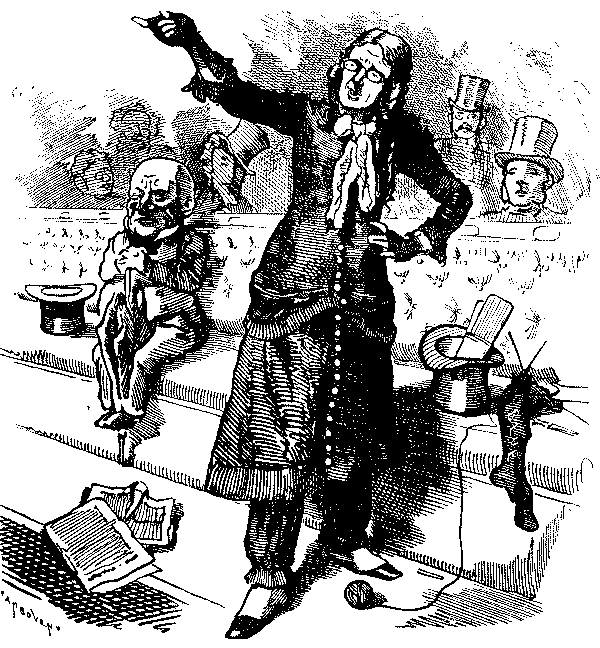
"THE ANGEL IN 'THE HOUSE'": OR, THE RESULT OF FEMALE SUFFRAGE
(A Troubled Dream of the Future)
Women Jurors
Sambourne's prophetic picture of "The Angel in 'the House'" in 1884 is an improvement on Punch's earlier fancy portraits of women legislators, but it does not render prophetic justice either to Lady Astor or Mrs. Wintringham. Punch refers more than once in 1885 to the Parliamentary candidature of Miss Helen Taylor who stood for Camberwell, but her nomination papers were not accepted. Punch offers "Helen of Camberwell" his condolences, but they are shorn of all grace by his previous comparison of her to the Three Tailors of Tooley Street and other acidulated puns. Du Maurier's picture in 1887 of a Jury of Women antedates reality by more than thirty years; while the tension of party feeling in 1888 is illustrated by the genuine advertisement of a governess seeking work who had been "dismissed from a Conservative Clergyman's family for her Gladstonian views." Lady canvassers were already beginning to make their influence felt, and Punch recognizes their value in a "lay" which gives an entertaining account of their "unscrupulous, seductive, siren ways." At any rate they could not be ignored. The temper of "The Political Woman"—one of the "Modern Types" series—in 1890 is acid and disparaging throughout:—
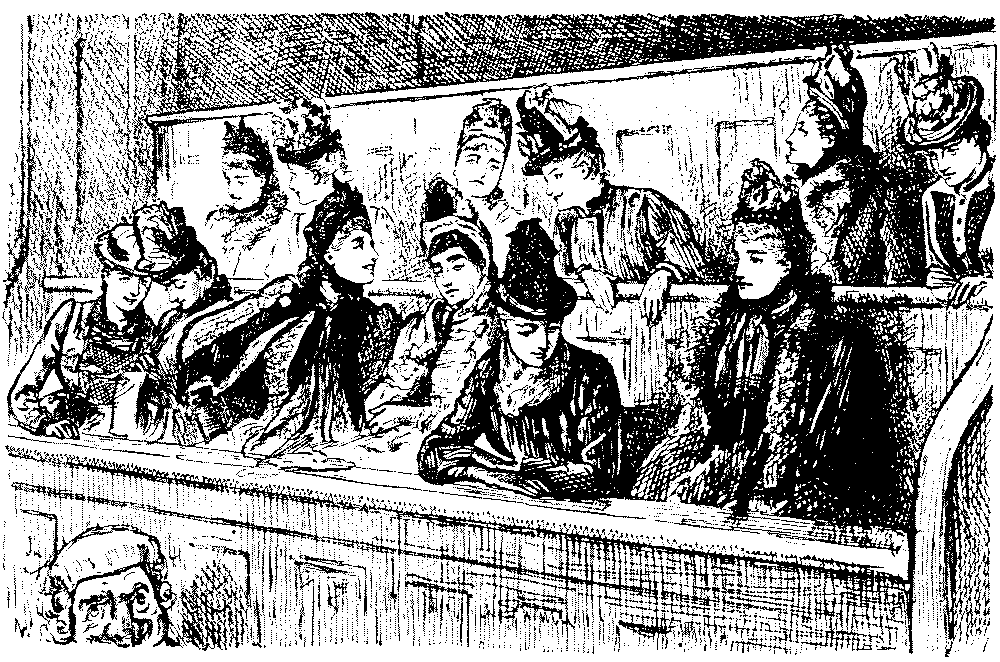
"A FAIR JURY, AND ALL HOME-RULERS"
Having left school with an ill-assorted mass of miscellaneous knowledge, she will show her contempt for ordinary feminine accomplishments by refusing to attend dances, and by crushing mild young men whom misfortune may have thrown in her way. Having discovered from one of these that he imagines the Rebecca Riots to be an incident of Old Testament History, and has no definite views upon the currency question, she will observe in a tone of some bitterness, that "These are our Governors!" and, having left him in a state of collapse, will scale the ramparts of political discussion, in company with a Professor, who happens to be unmarried and a Member of Parliament. After making love for some months, by means of an interchange of political tracts, these two will be married in a registrar's office and will spend their honeymoon in investigating the social requirements of Italian organ-grinders.
Thenceforward she exists chiefly as a member or president of innumerable committees; she neglects her husband and the son "whom, in a moment of regrettable absent-mindedness, she bore to the professor and brings up on Spartan principles and little else." Her home is a centre of slatternly discomfort:—
She will eventually fail to be elected a member of the School Board, and having written a strong book on a delicate social question, will die of the shock of seeing it adversely reviewed in The Spectator.
Sir Albert Rollit's Bill for extending the franchise to women was introduced in the early summer of 1892, and defeated on the second reading by only twenty-three votes. Punch, in his "Essence of Parliament," refers to an uproarious meeting in St. James's Hall, and to Mr. Asquith's "merciless logic" in demolishing the Bill. The Women's Liberal Federation had declared for the suffrage, and Punch illustrated the situation in a picture of two political lady cricketers appealing to the G.O.M. at the wicket: "A team of our own? I should think so! If we're good enough to scout [i.e. field] for you, why shouldn't we take a turn at the bat?"
Women's clubs increased in numbers throughout this period, but met with little encouragement from Punch. In 1877 they are satirized as enemies to domestic life; as the haunts of semi-detached, smart women—types which Punch portrayed in his "Dream of Queer Women" (after Tennyson) in the same year, wherein mention is made of the "shrieking sisterhood," realistic novelists, "art-beauties," shrewish suffragists and shady adventuresses. When the project of a Women's University Club was mooted in 1886, Punch takes a less lurid view of its possibilities. Smoking, card-playing and billiards are indicated, but at worst the ladies will only be mild, if sedulous apes of the male clubman. Gossip will predominate, and Punch suggests that the new venture should be called "The Blue-Stocking." As for smoking, in 1888 Punch registered a protest under the title, "To a Fair Nicotian," in which the Laureate remonstrates with Lady Clara. He likes his own yard-long Broseley clay pipe, but disapproves even of a cigarette in the lips of lovely woman.
The Athletic Woman
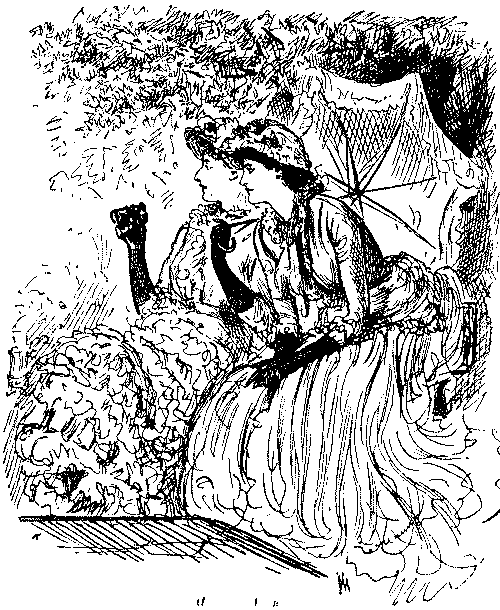
AT "LORD'S"
(It is always well to be well informed)
Clara (pointing to the Umpires): "Who are the two men in billycock hats and white coats?"
Matilda: "Oh, don't you know? Those are the headmasters of Eton and Harrow!"
Towards the athletic woman Punch was, on the whole, more benevolent. In 1883 he pays graceful homage to a woman with the engaging name of Jessie Ace who had saved a man from drowning. In the same year young ladies are gently chaffed for beginning to affect a knowledge of the technicalities of pastime and sport. But if Punch is to be believed, it was still sketchy. Rugby and Association football are mixed up with cricket, and the two charming girls at the Eton and Harrow match at Lord's mistake the two umpires for the two headmasters. The slightly more serious view taken in 1884, when several cricket matches were played by women, is noted elsewhere. Fencing and boxing for women, under male instructors, French and British, are depicted by Du Maurier as "the last new fad" in 1886. The former, at any rate, came to stay and deserved to. Ladies had long figured in lawn tennis tournaments, but in his "Caution to Championesses" in 1887, Punch displayed some misgiving as to the development of this competition. Nor did he approve of the novelty of women riding astride in 1890, begging them to do anything but that, and rewriting the old nursery rhyme for these new Amazons:—
Ride a cock-horse, To Banbury Cross To see a young lady A-straddle o' course!
The Almanack for the same year gives four types of model middle-class wives. The French keeps her husband's accounts; the German is the Hausfrau and cook; the American is an intellectual; the English plays lawn tennis. The "Manly Maiden" (No. XXII in Punch's "Modern Types") described in December, 1890, is less closely observed and far less interesting than Punch's "Model Fast Lady" of forty years earlier. The sketch is a rather cruel caricature of the persevering but inefficient sportswoman who is always in the way, and is destined to "develop from a would-be hard-riding maiden into a genuinely hard-featured old maid." In agreeable contrast to this acid study is Punch's homage to the exploits of a Guernsey rifle-woman, Miss Leale, at Bisley in 1891, and his welcome to Mrs. Sheldon, the American traveller, on her return from her travels in Africa, in which he suggests that in time to come Stanley may be known as "the male Mrs. Sheldon." The exaggeration may be ironical, but the irony is so well veiled as to be almost imperceptible. In the years that were to come the achievements of Mary Kingsley and Gertrude Bell were beyond the reach of the most subtle disparagement.
Women Workers
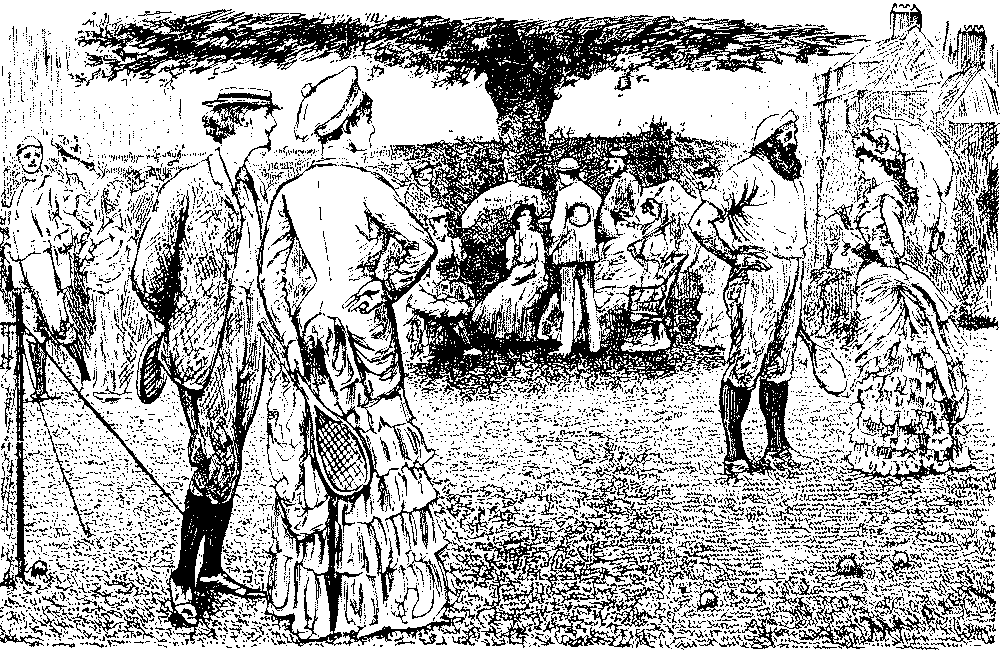
A NEW TASTE IN MEN AND WOMEN
She: "What a fine-looking man Mr. O'Brien is!"
He: "H'm—hah—rather rough-hewn, I think. Can't say I admire that loud-laughing, strong-voiced, robust kind of man. Now that's a fine-looking woman he's talking to!"
She: "Well—er—somewhat effeminate, you know. Confess I don't admire effeminate women!"
On the subject of women workers Punch's utterances are apparently but not really irreconcilable. The "Wail of the Male; being a British workman's view of the cheap female labour question, respectfully submitted to the Trade Union Congress" in 1887, is a protest against women undercutting men in the labour market. But the voice is the voice of 'Arry, not of Punch—shrewd, glib and entirely selfish. The speaker has just got the "bullet"—having been sacked without notice—and speculates on further possibilities:—
Look here, Bill! If they shunt You and me, and our like, as they're doing all round, Because Women are cheap, and there's heaps to be found, Won't it come to this, sooner or later, my boy, That the most of us chaps will be out of employ, Whilst the Women will do all the work there's to do, And keep us, and the kids, on about half our "screw"? Who's a-going to gain by that there but the boss? And for everyone else it is bound to be loss. A nice pooty look-out! Oh, I know what they say— That the women work better than us for less pay, And are much less the slaves of the pint and the pot, What's that got to do with it? All tommy rot! We have all got to live, and if women-folk choose To collar our cribs or to cut down our screws, They will have to be bread-winners, leaving us chaps To darn stockings at home with the kids on our laps. Well, I hope as they'll like it. I tell you what, neighbour, The world's being ruined by petticoat labour. Besides, Mate, in spite of this Woman's Rights fuss, Work don't make 'em better as women, but wuss. It mucks 'em for marriage, and spiles 'em for home, 'Cos their notion of life is to racket and roam. Just look at that work-girl there, her with the fringe! She's a nice pooty specimen! Makes a chap cringe To think of that flashy young chit as a wife. That's what cheap woman labour will do for our life. Oh, give 'em the Vote, and the breeks, while you're at it, Make 'em soldiers, and Bobbies, and bosses. But, drat it, If this blessed new-fangled game's to prewail, I pities the beggar who's born a poor Male!
Against these arguments, illustrative of a certain habit of mind, which at best excite a grudging acknowledgment of their coarse common sense, one may set the "Dream of Unfairly Treated Women" (after Tennyson) in 1890, describing the hardships of sempstresses, governesses, "slaveys" and shop-girls, the victims of sweating, greed, and worse, which unhappily were all too prevalent so recently as thirty years ago.
Punch, in fine, exhibits through this period a progressive acknowledgment of women's claims to be regarded as an intelligent being, tempered by moments of reaction. In 1875 he has a picture of an evening party at which all the men are anxious to be introduced to the wonderful Miss Pynke, that rara avis "who has never written a novel or contributed to a magazine." In 1887 the "score" is given to the professor in his retort to the "high-brow" lady:—
Miss Hypatia: "Yes, now that we are gradually educating ourselves up to your level, you Men ought at least to meet us halfway."
The Professor: "Meet you halfway? How? By gradually uneducating ourselves down to yours?"
Feline Amenities
In 1890, again, the amusing series of "Feline amenities" continued for some years, though they are a tribute to the wit of women, are invariably based on a denial of the quality of magnanimity. In this context I am minded to include a curiosity, dating from the year 1886, in the shape of an imaginary letter signed "Elizabeth Fry Romper," which is of interest as showing the change in the attitude of philanthropic women during the century. The writer describes how "of course on the hottest day of the whole summer" she was told off to take a lot of Sunday school girls for "a day in the country" to Greenwich, "which is supposed to have an elevating effect upon them for the rest of the year." Of all the disagreeable things she ever has to do, this is "far the worst." The picture given is decidedly realistic:—
It is no joke waiting for an hour at a suburban station, with eighty "young girls"—real young girls—pouring in by detachments, all in the wildest state of excitement, and decked with the entire contents of their jewel-cases. Of course, the first thing they did was to rush, helter-skelter, into a wrong train, and all the railway staff hardly sufficed to pull them out again before the train started. I had a whole compartment to look after, and felt rather nervous at the thought that the next one was filled with men—smoking shocking tobacco, by the way—and that the talk was distinctly audible.
I was truly thankful to reach Greenwich, and trusted that the girls might be fully occupied in getting tea, and that the heavy cake might calm down their excitement a little. So we all set to with a great deal of unnecessary bustle, and were flattering our elderly hearts that everything was going off splendidly, when, on the bell being rung—we had brought one on purpose—for the girls to be seated, the Superintendent looked round for the head girl to lead the singing grace. Instead of pious music of any sort, our ears were greeted with a shout of discordant laughter, which was found to proceed from some broken ground in the distance, where the whole of our first class were engaged in playing Kiss in the Ring with a party of soldiers from the neighbouring barracks. My dear, if you could have seen the picture, you would never have forgotten it. I thought I should have died of laughing on the spot. The hot, dishevelled, romping girls, and the smart soldiers, quite unconscious of the awful face of the Superintendent, as she advanced towards them, and the way the damsels scuttered off as she let fall a few words of rebuke—it was the funniest thing I ever saw. She succeeded in driving her flock, sheepish but giggling, before her; all but one, who stoutly declined to leave her soldier, declaring she didn't want no tea, but would 'ave a spree in the merry-go-round with 'im. A separation was ultimately effected, but the gloom that hung over that meal I never shall forget. It was a mercy everyone else took it so seriously, or I couldn't have held out; as it was, when I got home, I laughed myself nearly into a fit.
The combination of duty, detachment and a sense of humour is not commonly credited to Victorian girls. But the problems that had to be tackled were very much the same, and so was human nature.