EDUCATION
Reading edition
Hasty generalizations from the study of Punch throughout this period might easily lead one to the conclusion that the two great evils in national education were the craze for athletics in Public and Preparatory, and over-pressure in Board and Elementary, Schools. A more detailed examination of his pages tends to correct or modify this view. Punch was in the main a firm believer in the public school system as an instrument of character-building, and he was no enemy of the ladder of learning which had been erected by Forster's Act of 1871. But while he detested snobbery, extravagance and complacent Philistinism, he was by no means satisfied that the State was getting good value for its constantly increasing expenditure on education. Thus to take the Elementary schools first, we find continual references, mostly unfavourable, to the administration and working of the Board School System. In 1875 he falls foul of the pedantry of over-zealous officials—the red-tape methods of inspectors, and the action of visitors who sent children back to school before they were free from infection. These inquisitorial activities roused Punch's old democratic sympathies, and some ten years later we find him suggesting that a similar method might fairly be applied to the upper and upper middle classes—that what was sauce for the goose in the slums might be served up to the gander in the squares.
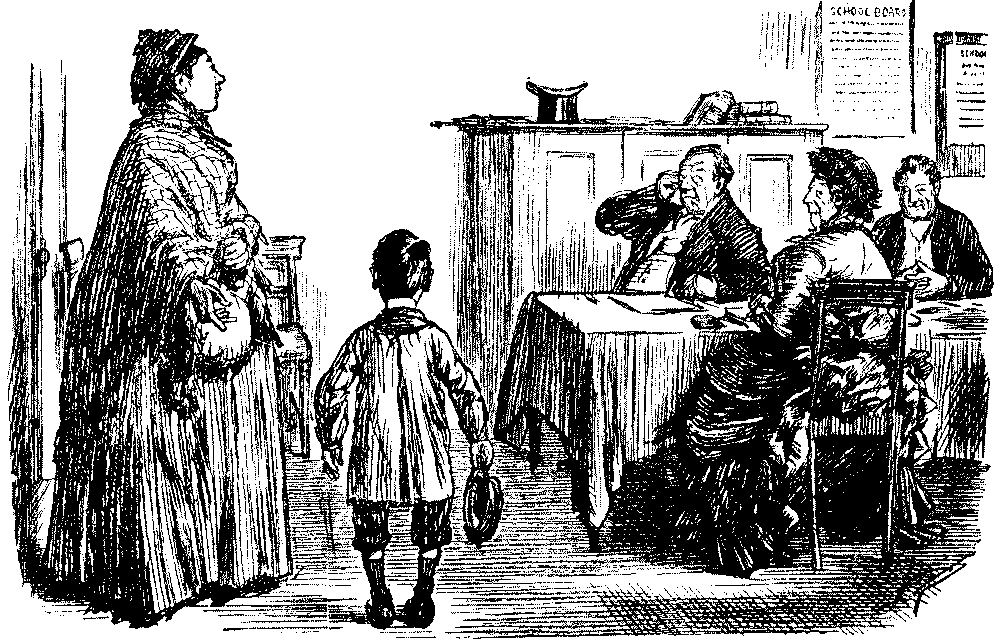
PREDESTINED!
Northern Matron (before the School Board): "I'm not against Eddication, Ladies and Gen'l'men. I al'ays make him take his Book o' nights. But reelly I calls it a flyin' in the face o' Providence to be keepin' a Boy out o' the Stables with such a pair o' Legs as his'n!!"
In the series of articles on "Education Made Easy" in 1887, Punch sympathizes with the mothers who were constantly harried by "attendance officers" for neglecting to send their children to the Board Schools. Ignorance was a great evil, but the Board Schools were attempting too much. The essentials were not thoroughly taught; pupil-teachers were overworked; there was too much of the 'ologies, and the three R's were in danger of going to the wall. The reactionary protest against the teaching of music—"We don't want Grisis at Board Schools"—is ironical; but Punch espoused the cause of those who condemned over-cramming in Board Schools, and based their crusade on Sir James Crichton-Browne's Report on over-pressure in 1884. But his great point was that there was too much teaching of the things that did not matter. His "Indignant Ratepayer" in 1887 welcomes the decision of the London School Board to hold an inquiry into the curriculum of their schools. The special committee were also to report "whether such changes can be made as shall secure that children leaving school shall be more fitted than they now are to perform the duties and work of life before them." One of the speakers had declared that "the boys educated in public elementary schools scorned all handicraft work, and wanted to be clerks, while girls in like-manner scorned all domestic service." The "Indignant Ratepayer" congratulated the School Board on turning over a new leaf, though it had taken them sixteen years to realize that they were on the wrong tack.
Indignant Ratepayers
A week later Punch published another letter from another "Indignant Ratepayer," deprecating the congratulations as premature and indiscreet:—
I, too, Mr. Punch, am a ratepayer; I have seen my rates trebled since the creation of the School Board; and I am now told that I ought to thank my stars that, after sixteen years' work, they have at length displayed a glimmering of common sense. There seems to be something ominous in this term of sixteen years, for it appears that it is just for this period that we have been supplying the Army with bayonets that won't stab, and the Navy with cutlasses that won't cut. We are always calling ourselves, though nobody else does, a practical people. But what care we for the opinion of our neighbours, so long as we are happy in the calm contemplation of our superiority?
"The unexpected always happens," so said Beaconsfield, and it seems he was right, for who would have ever dreamed that the School Board would have ever made such a confession? But although they confessed much, they did not confess all. They said nothing of the numberless half-starved children whose health has been impaired or ruined by the tasks imposed upon them. Nothing of the hundreds of thousands spent in bullying and worrying their poor parents. Nothing of the money spent in endless litigation. On all such subjects the Board are discreetly silent. They draw attention only to the outcome of their labours, namely the boys and girls whose education has been completed—the survival of the fittest in short—but who are fit for nothing.
"No handicraft work for the boys, no domestic service for the girls." The boys all want to be clerks; what the girls want to be we are not informed, but domestic service is not to be thought of, so the sooner my wife and daughters take to such work the better. And for this have I paid trebled rates. For this have we been passing Code after Code, and fixing Standard after Standard, to find at last that the whole work must be begun afresh. I too am indignant, as well as your Correspondent, not that the School Board have been telling the truth, but that they have been so long in telling it.
I protest against my money having been spent in injuring the health of half the poor children of London, and of injuring the morals of the other half.
Punch was ready to give a hearing to economists who really felt the burden, but he had no sympathy with the "old gang" of City Fathers who were frankly obscurantist on the subject of education, while they were proud of having dined and wined themselves into the possession of "first class stomachs":—
"WHERE IGNORANCE IS BLISS," Etc.
That not particularly learned body which rejoices in the name of the Commissioners of Sewers of the City of London, held a Special Meeting at the Guildhall last week, to discuss the terribly extravagant conduct of the London School Board in adding one penny in the pound to the amount of the rate to be levied in the wealthy City of London for the ensuing year. Much burning eloquence, of the peculiar City type, was used on the occasion, and a statement by one highly excited member that there were no fewer than 313 Board Schools in the Metropolis in which the great work of education was being successfully carried on, and that the cry was still for more, was received with as terrible a groan of horror as if it had been announced, on authority, that there were to be no more "Cakes and Ale" for the Sewage Commissioners.
In vain was it stated by those who, apparently, love light rather than darkness, that whereas the population of London some ten or twenty years ago was one of the most ignorant of any capital of Europe, it was now, thanks to the School Board, assuming its proper place in this respect, by giving all its children a good education. They were met by a shout of derision from an angry Commissioner, who demanded to know "why they didn't try to teach a cow to win the Derby," which brilliant interrogation elicited great applause.
In vain was it suggested that this sudden affectation of sympathy with the poor Ratepayer for having to pay this additional penny for education, was but a blind to screen their own increased rate of double the amount, for a purpose of not one-tenth the importance. The Sewage Commissioners listened with impatience, reserving their enthusiastic approbation for the very demonstrative gentleman who addressed them after their own heart; and in language that all could understand and thoroughly sympathise with. He was quite willing, generous soul, that the poor children should have bread, but what he objected to was rumpsteaks! and he concluded his brilliant oration with the following magnificent peroration:—"Everybody should have his meal, but he must have a stomach of the highest class before they could give him turtle soup and port wine!"
Who but a member of the City Corporation could have contrived, when discussing the question of the education of the Poor, to have brought in those two gods of his idolatry, turtle soup and port wine? And in combination too!
Under-feeding and Under-housing
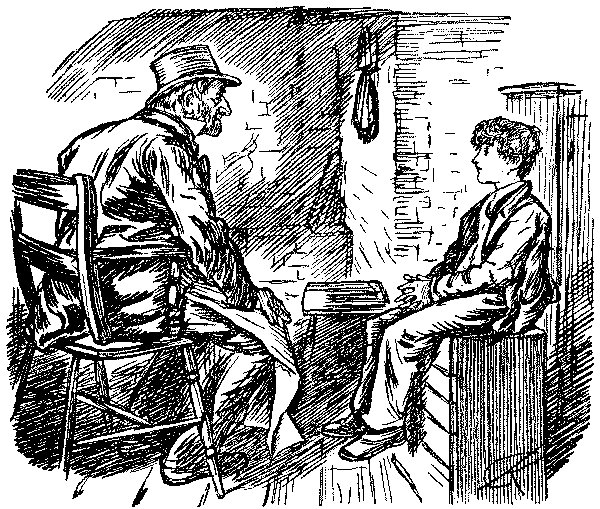
PROGRESS
Young Rustic: "Gran'fa'r, who was Shylock?"
Senior (after a pause): "Lauk a' mussy, boy, yeou goo to Sunday Skewl, and don't know that!"
This well-merited castigation preceded the protests of the "Indignant Ratepayers" by a couple of years, but it is more truly representative of Punch's convictions on the main question. We had to educate our masters, and we must not squeal over the bill—provided the education was sound. On that point Punch was by no means satisfied, and in 1887 he invokes the testimony of the British workmen, who is made to protest against the unpractical nature of modern education, and the undue prominence assigned to the 'ologies and 'ometries. A cartoon in 1888 represents Education betrayed by its "friends"—pedantry and jobbery. Over-pressure was aggravated by under-feeding and under-housing. As for the former, Punch prints an East End remonstrance against the penny rate: "When we wants daily bread it ain't any good saying you only wants 'that there penny.'" But the steady growth of State expenditure on education is resented on the ground that it was devoted to inappropriate or unnecessary objects. In 1891 Punch publishes a forecast of the Exasperated Public protesting against the ever-increasing extravagance of the London School Board, who have taken to building observatories and raised the salaries of elementary teachers to £2,500 a year.
This is burlesque, but there is criticism and dissatisfaction at the back of it. So when the Bill providing for "assisted" (i.e. Free) Education, for which the Budget surplus of £2,000,000 was to be devoted, was introduced in the same year, Punch represented the cross-currents of the Unionist Party in his cartoon. Mother Goschen, the Chancellor of the Exchequer, is seen introducing her adopted child (Free Education), whom she had found in Birmingham, to the Old Tory Party (Mrs. Gamp), who doesn't like the looks of him at all. But Goschen carried his point—that the Government were pledged to alleviate the burden which compulsory education had, in recent years, imposed upon the poorer portion of the people; and by September 1 the free education proposals of the Government were generally adopted throughout the country by both Board and Voluntary Schools.
The old question of corporal punishment comes up in 1880 and 1881, but in a new light. There was "one law for the rich and another for the poor," but here, at any rate, it could not be maintained that the poor were oppressed. Already flogging was only commonly resorted to in the schools for the upper classes, and Punch emphasizes the contrast in his dialogue between the Peer and the Peasant. The Peasant observes that when he is tapped over the head with a cane, his mother goes and bashes the teacher over the head with the poker and gets him fired for assaulting her son. The Peer, on the other hand, owns to having been "swished" four times in a fortnight without attempting reprisals. Whereupon the Peasant suggests that he should have sent his mother to go and bang his old master. If Punch is to be believed, conflicts between teachers and parents were pretty frequent at this time. They are not unknown even to-day; but parents are less inclined to take the law into their own hands.
Literature and Crime
The education of the million, however, was not confined to school hours, and with the decline of illiteracy the growth of the reading habit brought its perils as well as its privileges. Juvenile criminality was no longer the result of ignorance and neglect—at least to the same extent. Punch was inclined to trace the evil largely to the low tone of the cheap literature provided for the young. In the Diary of a Boy Burglar in 1886, his downfall is ascribed to his putting into practice the principles imbibed by a perusal of Jack Sheppard. A somewhat alarmist article in the Fortnightly Review on "What Boys Read" declared that while many boys' books were healthy and helpful, the majority of the journals supplied for the children of the working classes were devoid of every element of sweetness and light. "They are filled with stories of blood and revenge, of passion and cruelty, as improbable and almost impossible in plot as they are contemptible in literary execution."
The solution of the matter by Press censorship, advocated by the writer, presented difficulties which Punch did not shirk, and his own views, though strong, are tempered by sound common sense:—
Ainsworth's story may serve the turn of an Opéra-bouffe Librettist, and the scamp himself be played by a sprightly actress without much harm being done to anybody. Jack Sheppard, for instance, ought not to be sanctioned by the Licenser any more than Claude Duval, Dick Turpin, or any other drama of a like kind, of which the recognized motive is the veiled incentive to crime. Still, a raid on Harrison Ainsworth, notwithstanding the acknowledged mischief that has been done to the young and ignorant by a perusal of his cracksman's romance, would scarcely be the same thing, and yet the cases are sufficiently parallel to admit at least of argument. We should be inclined to suppress such romances as Jack Sheppard, Rookwood, Bulwer's Claude Duval, and also Eugene Aram, which was so severely and so justly satirized by Thackeray in Mr. Punch's pages. For the truth about Jack Sheppard our readers have only to refer to one of the earliest volumes of Mr. Punch's series, where they will find his character as described by Ainsworth, and his true character as given in the Newgate Calendar, displayed side by side in parallel columns. There was no sort of romance about the real Jack Sheppard.
Meantime, for want of a better remedy to meet the evil, let parents and guardians, and those who have charge and direction of the young idea, keep their eyes open and have a special regard to the direction in which it shows inclination to shoot. It is just as ready to derive its nutriment from the "penny healthful," as from the "penny dreadful," and as a mere matter of commercial enterprise, the former could be as easily forthcoming and available as the latter. Philanthropy is continually actively busying itself about the education of the young—here is something practical for it to do—let it look to the quality of its Magazine literature. It wants some energy and some capital, but both in these days ought to be forthcoming. To drive the penny dreadful out of the literary field is not a task beyond the powers of organization and enterprise. And it is in this direction that the first steps will be taken in the material and moral amelioration of "What boys read."
The subject recurs in 1889 and 1890, when sensational juvenile literature is again denounced; but the new stories are more vigorously condemned than the old, and the Ghost of Jack Sheppard, in a conversation with the Shade of Dick Turpin, scouts the notion that they could upset the minds of the young. Why, they weren't in it with the papers read by everyone everywhere! Punch vigorously supported the efforts of those who sought to abate the evils of child insurance, and welcomed the intervention of Magee, then Archbishop of York, who died while on a visit to London to attend a Committee of the House of Lords on his Infant Insurance Bill, in May, 1891. But when the Prevention of Cruelty Bill was in Committee in the summer of 1887, Punch strongly supported the Attorney-General's amendment to omit from the Bill the words prohibiting the employment of children under ten in theatres and licensed places of public entertainment. Mr. Mundella, who was in charge of the Bill, accepted the amendment, but "Dick Temple, Sam Smith and other superlatively good people objected," and it was defeated both in the Committee and the Report stages, to Punch's undisguised annoyance. After the Bill became law in July, he added "one word more," and his arguments, if not convincing, are at least consistent with his life-long sympathy with the professional actor:—
The Stage and Education
Well-intentioned persons do a heap of mischief, and talk and write a lot of nonsense about what they don't understand. There are dangers to morality ("who deniges of it?") in the Theatrical Profession, as in every other profession; but these affect the amateur, and those who go on the stage late in life, not those who are to the manner born. The loves of poor, honest, hard-working theatrical families, where the sons and daughters obtain theatrical employment at an early age, are thoroughly respectable. Their stage-work is not only compatible with their receiving a sound education, but is a complement of it. Habits of strict discipline, cleanliness, and domestic thrift are inculcated; the little children, from the biggest down to "the Widow's Mites" engaged in a Pantomime, are seldom sick, and never sorry, but do their work with pleasure, and would probably be willing to undertake even "more study," rather than be deprived of their theatrical employment which brings in the money, pays the school, and helps to keep a happy family together under one roof, which, "be it never so 'umble," is styled by that dear old English word "home"—and there is no place like it. The efforts of those who would exclude children under ten from theatrical work may cause great misery and break up many such happy homes. We say this in serious earnest, and, from practical experience, we do know what we are talking about.
Punch resented pedantic, official, or fussy interference with children whether at work or play. A Children's Party at the Mansion House in January, 1881, provokes well-merited ridicule. No mixed dancing was allowed; the only diversion was provided by some "hideous negro entertainers" and, by way of compensation, a sermon by Mr. Spurgeon! After 11.30 p.m. young ladies were allowed to dance, but only with young ladies; and the young gentlemen with young gentlemen. At the same time Punch was a believer in the cane, when administered with discretion, and a resolute discourager of precocity. The full-page illustration in the Almanack of 1884, "Education's Frankenstein," representing the omniscient child of the future, ruining all professions, as everyone can do everything, is an extravagant burlesque, but it foreshadows the complaints we have had of late of the "unfair competition" of the infant author and artist with the adult practitioner. In 1885 Du Maurier's Child of the Period gravely rebukes her grandmother who speaks of a "puff-puff"—"The locomotive, I suppose you mean, grandmamma." But this is a form of joke which recurs throughout the ages.
Punch's "Winter Exhibition of the Works of Young Masters" in 1888 is a really illuminating piece of prophetic satire. The exhibitors are all children, and the works shown all belong to the Nursery Period. We may take one example:—
Billy Bolaine, born 1868, flourished 1880-2. No. 3. Landscape, with horse, ducks and figures. Silvery effect of about eight o'clock in the morning anywhere. The animals have given rise to some discussion, but the general impression seems to be that the artist, who never depicted anything without a subtle meaning, originally intended at least one of them for a cow.
Altogether this is an excellent skit on the critics who greet all the efforts of the young with a foolish voice of praise. Self-conscious, aggressive and complacent precocity Punch could not endure; the small American child who treats a bishop, who had endeavoured to repress him, as a back number, is clearly regarded as a nuisance. But in his plea for the unhappy infant prodigy Punch recognized it as a real grievance that child performers were overworked by over-practising and continual travelling. In 1888 it was borne in upon him that, whether from the engrossing nature of modern girls' and boys' occupations, or their preference for contemporary and realistic fiction, the study of Fairy Tales and Nursery Lore was fast falling into neglect if not into positive contempt. To avert what he considered a national calamity, he felt it his duty to suggest to parents that no child should be allowed on any pretext in future to leave the Nursery for School until it had passed an examination in these subjects.
Fairy Tale Test Papers
Punch's test papers are all excellent, but I can only find room for the General and the Pantomime Papers:—
CRITICAL AND GENERAL.
1. What is your opinion of the intelligence of Giants as a race? Of what substance were they in the habit of making their bread? Would you draw any and what distinction between (a) Giants and Giantesses, (b) Ogres and Ogresses, (c) a Mamma Ogress and her daughters?
2. What is a Roc? What do Rocs feed on? If you were on the edge of steep cliffs surrounding an inaccessible valley, strewn with diamonds and visited by Rocs—how would you proceed in order to obtain some of those diamonds? Give the reply of the Slave of the Lamp to Aladdin's request that a Roc's egg should be hung up in his dome.
3. Mention instances when (a) a Wolf, (b) a Bear, (c) a Cat, (d) a Harp, are recorded to have spoken, and give the substance of their remarks, when possible, in each case.
4. Write down the name of any hero you can remember who suffered inconvenience from (a) the imprudence, (b) the disobedience, of his wife.
5. How would you act if you were invited to go to a party on the opposite side of the way, and had nothing to go in but a pair of Seven-Leagued Boots? Compare the drawbacks and advantages of going to a State Ball in glass slippers.
6. State which family you would rather belong to: One in which there was (i.) a Wicked Uncle, (ii.) an Envious Sister, (iii.) a Jealous Brother, or (iv.) a Cruel Stepmother? Give your reasons, and illustrate them by examples. How many Wicked Uncles do you remember to have read of? Are Wicked Uncles ever sorry, and, if so, when?
7. Give any instances that occur to you where it is stated that the chief personages of the story "all lived happily ever afterwards." Are there any exceptions to this rule?
PANTOMIME PAPER.
(Optional, and for those Students only who may decide to "take up" this branch of the subject.)
1. Did the manners, language, and general deportment of the various Kings and Queens you have seen in Pantomimes correspond at all with what you had expected them to be from the books?
2. Mention any fairy tale in which (1) long ballets, (2) allusions to subjects in last year's papers, (3) jokes about "drinks" and "pawn-tickets," (4) comic duets which you didn't quite understand, and (5) men dressed up in women's clothes, occur. Mention (if you can) any Pantomime in which they do not.
3. Were you surprised to hear at Drury Lane that the King who befriended the Marquis of Carabas was originally a Potman? Do you remember this in the original text?
4. Why do you suppose that the Wicked Brothers in this year's Pantomime were frightened by green snakes, pink lizards, and enormous frogs? Did their own explanation that they had "the jumps" convey much to your mind? Did this scene make you laugh?
5. Give as clear and intelligible an account as you are able of the story of any one Pantomime you have been to, mentioning where—if at all—it departed from the version you have studied, and whether or not you considered such departures (if any) to be improvements.
6. Investigate the principal peculiarities of Pantomime Animals. How do they chiefly differ from other animals? Describe the effect of kindness upon a Pantomime Donkey, and account for it.
N.B.—Not more than four questions need be attempted in each of the above papers. Candidates are advised not to leave any question unattempted from a mere inability to answer every part of such question.
The Pantomime Paper conveys some excellent dramatic criticism, which is needed as much to-day as thirty years ago, but it may be permitted to stand in this educational context. As a counterblast to the charge of indifference towards fairy tales on the part of the modern child, it is only right to add that in 1892 Du Maurier's picture, "A Warning," shows a touching belief in the actuality of Bluebeard:—
Archie (to his Sister, who has been reading him Fairy Tales): "Won't there be a lot of Us, if none of us go and get married? Worse than Hop-o'-my-Thumb!"
Sister: "Yes; but you know I mean to be married!"
Archie: "Do you mean to say you'd go and live alone with a Man after reading Bluebeard?"
When we turn to the Public and Preparatory Schools we find that Punch's criticisms resolve themselves into a triple indictment of their costliness, their curriculum and their undue exaltation of athletics. The attack on the athletic craze begins in 1875, when Punch published an imaginary Report of a boy's work for 1895 at St. Paul's, Eastminster, which deals with nothing but his progress at games and sports.
The Fetish of Games
The charge had a good deal to justify it, but the choice of a name was not happy, since Colet's famous foundation has in its recent phase never invited criticism on the score of any slackness in studious industry. Punch renews the attack more than once. In 1880, in a burlesque account of a Prize Day, brain-work is just tolerated; athletic prowess is the only thing really encouraged and rewarded. Yet simultaneously we encounter Master Freddy from Eton, who considers that energy of any sort is "bad form." "Good form," in Punch's view, might easily degenerate into a snobbish fetish, and in one of his "International Comparisons," in the Almanack of 1879, he emphasizes the comprehensiveness of French public schools as contrasted with the class distinctions observed in England. It was in the same year that an inquiry was held into the administration of Wellington College and the alleged departure from the intentions of the founders. Punch took the line that what was meant to be a military orphanage had become a rather costly public school of the common type, and noted that Mr. Gladstone defended the change because Benson, his son-in-law, was head master. This was a partial error. Gladstone's son-in-law was Wickham, who had succeeded Benson as head master. But the sting remained. Punch, it may be added, was thoroughly consistent in his attitude of antagonism to the diversion of old foundations from their original aims.
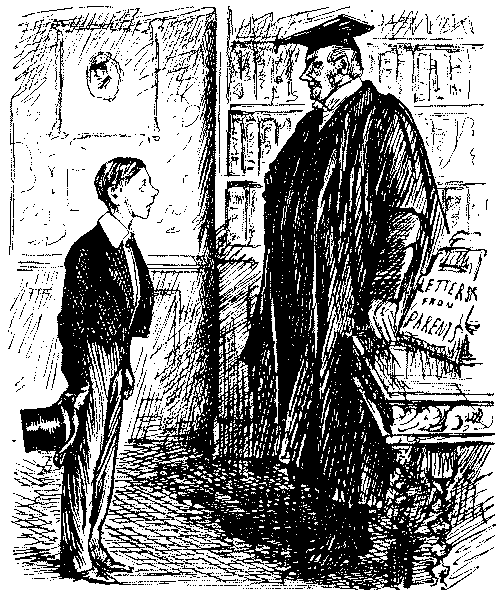
THE NEW TYRANNY
"Of course you needn't Work, Fitzmilksoppe; but Play you must and shall."
The costly inefficiency of the public schools came up again in 1880, à propos of a correspondence in The Times, in which a "disappointed mother" recounted the experience of her two sons who, on leaving a public school at the age of nineteen, had forgotten all they knew before they went there:—
Hence a justly "Disappointed Mother" naturally enough concludes that "Our great schools want inspection sadly." Experience has certainly given her some cause to compare them unfavourably with private schools; although as to the latter she generalizes rather widely in saying that they "must teach, or close." Too many of them do neither.
Her boys, at any rate, both of them learned at a Private Boarding School enough to enable them to pass the Junior Oxford Local Examination at an early age. Unquestionably they were taught so much; but then how were they taught it? In such a style that they have now, at an adult age, to be taught it over again.
So it seems that a "Disappointed Mother's" two sons were educated at the Private Boarding School as the bottles are aërated in a soda-water manufactory. Information must have been forced into the former as carbonic acid gas is pumped into the latter. The gas is retained in the bottles whilst corked down, but escapes on the removal of pressure; so, if the boyish minds are left open, their school-learning, set free from forcible compression, goes off in youthful effervescence. Admirable system, by which our youth at an early age are enabled to pass the examinations, for which at maturer years they have to be crammed all over again!
Classics v. Commerce
The inspection of public schools has remained a subject of acute controversy ever since; and it is not clear whether Punch's approval would have extended to Government inspection. It was in the same year, by the way, that Du Maurier illustrated the dialogue between Sir Gorgius Midas and an aristocratic Colonel. Sir Gorgius's main regret was that he had never been at a public school; the Colonel, who was once at Eton, laments that he suffers from a neglected education. Burnand, who succeeded to the editorship of Punch in 1880, was also an old Etonian, but was not on that account prepared to grant his old school a complete immunity from criticism. The "Diary of a Present Etonian," which appeared in 1885, is in the main jocularly descriptive, but illustrates a prevalent Philistinism, the habits of ragging and borrowing money, and tells of a week with only one whole school-day and two whole holidays. Yet while fully alive to the waste of time and money which went on at the public schools, Punch was very far from embracing the creed of the revolutionary utilitarians who would scrap the old curriculum wholesale. In 1887 he printed an ironic account of the "Public School of the Future," thoroughly impregnated with the Commercial Spirit. The hero, the new "Tom Brown," develops a talent for finance so remarkable that his father longs to see him loose on the Stock Exchange.
Punch did not believe in compulsory classics, because he disliked dons, pedants and academics; but in his parody of "The Isles of Greece" from the point of view of a British schoolboy, he made it abundantly clear that he had no love of the purely commercial "bread-study" view of Education:—
Oh feed me not on mythic lore, But Science and the Modern Fact; Teach me Electric Fires to store, The difference 'twixt "Bill" and "Act." Why should a Cockney care a "cuss" For Homer or for Æschylus? For who are they? But what art thou, My Country? On thy fertile shore The heroic lyre is tuneless now; To scheme for dividends, dig for ore, These are the things we hold divine, Not Homer's long-resounding line.
In dealing with University Education Punch maintained his attitude of a moderate reformer. Keble College, Oxford, dates from 1870; in 1878 Punch twice over displays a keen hostility to the Anglican spirit of its founders and the "gingerbread and gilt" of Butterfield's architecture. He seizes the occasion to belittle Keble's poetry, to attack Pusey, Burgon and Liddon, and to describe the college in the following contemptuous quatrain:—
Half withdrawn in ways ascetic, Half with modern notions stirring; Half athletic, half æsthetic, Neither fish, flesh nor red herring.
Punch did not share the late Canon Liddon's pessimism over the new Science degree at Oxford in 1879. Liddon is quoted as saying that without the habits of exactness and precision acquired by classical studies it was impossible to reach the higher characteristics of an educated man. The argument was naturally resented by those who maintained that "exactness and precision" were precisely the qualities inculcated by scientific training, and in an ironical dialogue Punch derides specialization as compared with the "humanities." In 1885 the neglect of English literature at the older Universities is satirized in the picture of the undergraduate reading out his illiterate letter, in which the first and third persons are hopelessly mixed up.
In 1886 the spread of free education to the Universities is foreshadowed in a description of the Slade Professor at Oxford lecturing to a mixed audience of coal-heavers and undergraduates; and the "Progressists' Calendar" indicates a revolt of Ratepayers against their new burdens. In the same year the "Studies from Punch's Studio" include a portrait of the new type of University don. "Wyckham of Jude's," who displays much versatile energy and a wide range of interests—athletics, music, philosophy, Browning and psychical research—ultimately goes to Australia as a Professor of Greek. The reference to "Eleutheria Hall" foreshadows Ruskin College, which was founded in 1899, and in other ways Punch's fancy portraiture illustrates the changes which had come over the spirit of Oxford's dream. We note, for example, the allusion to the new cosmopolitanism—the invasion of foreigners, white and coloured, anticipating the time some thirty years later which gave birth to one of the best of modern Oxford anecdotes. A film was being exhibited showing a large canoe manned by Hawaiian natives, whereon a voice arose from the audience, "Well rowed, Balliol!"
The Value of Modern Languages
The proposal, since realized, to introduce Agriculture as a subject for study at Oxford is jocularly treated early in 1887 in the form of a diary of a candidate who is ploughed for his unorthodox views on potato culture. As for modern languages, the advantages of a foreign education—social and artistic as well as commercial—are excellently summed up in the same year in Du Maurier's picture of the industrious and accomplished young man from Hamburg, who is not only a skilled pianist but can speak six languages, live on a pound a week, work eighteen hours out of the twenty-four, and do without a holiday!
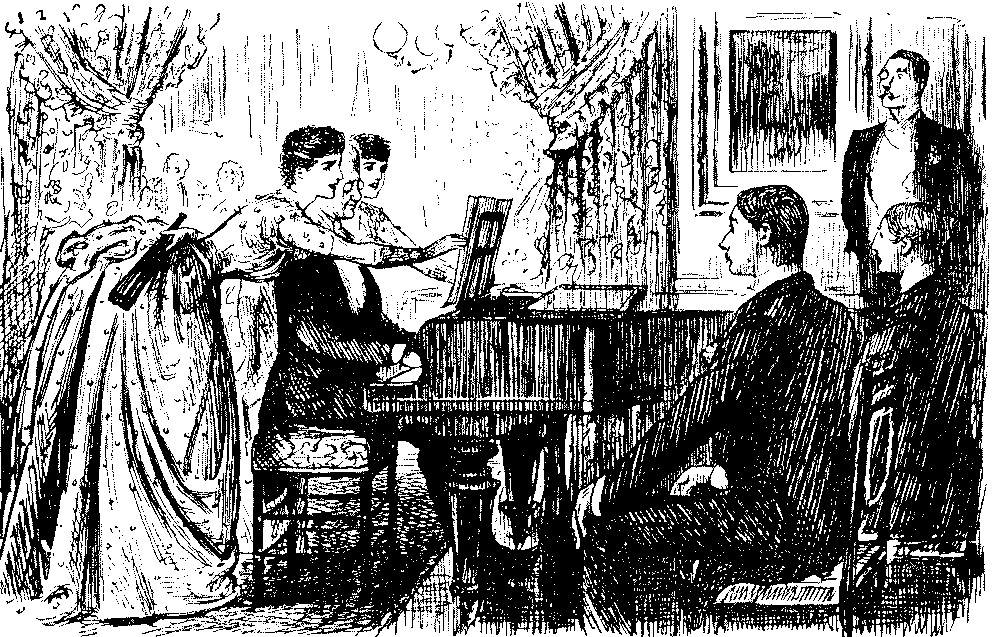
ADVANTAGES OF A FOREIGN EDUCATION
Young Müller (from Hamburg) accompanies the Miss Goldmores in some of Rubinstein's lovely duets—to the envy and disgust of Brown, Jones, and Robinson. (N.B.—Young Müller can also speak six languages, live on a pound a week, work eighteen hours out of twenty-four, and do without a holiday.)
In 1875 Punch dwelt sympathetically on the still surviving prevalence of classical learning amongst statesmen. The occasion was furnished by Disraeli's florid eulogy of the imagination of the English School of Art at the Royal Academy banquet:—
"HE TOO WAS BORN IN ARCADIA"
(Matthew Arnold on Disraeli at the R.A. Dinner).
Born in Arcadia! Ay, he knew Pan's cloven foot-print on the dew, And heard, the mystic woods across, Aigipodē, Philokrotos, "The bright-haired god of pastoral,"[4] With pipings to his wood-nymphs call. Yes, but a nobler sound there came— The clarion of imperial Fame, By which our greatest are withdrawn From the serene Arcadian lawn. Derby and Gladstone felt the breeze That urged their sails to Homer's seas; Yet in the Senate found their fate, And drank the hot wine of debate. Perish the thought that England's realm Should e'er have dullards at the helm! Far from us be the stolid serf Who ne'er has trod Arcadian turf, Nor heard, amid the glimmering trees, Pan's happy Orestiades.
Probably the exigencies of the metre are responsible for the strange lapse which made Punch substitute "Orestiades" for "Oreades." Greek was not then in the "last ditch," though the following advertisement, which Punch reproduces in the same year, seems to show that its study did not conduce to opulence:—
A Bachelor, elderly and somewhat infirm, having a moderate acquaintance with the Latin and Greek languages and who is likewise expert with a weeding hoe, seeks a Home and Employment. A bracing air and easy access to the services of the Church indispensable.—Address, &c.
Nowadays one of our leading literary weeklies talks of the "Hyperion Spring." But as early as 1891 the question of Compulsory Greek was attracting a good deal of attention, and Punch sided with The Times in expressing his disbelief in "protected studies." He also took occasion to criticize the narrowness of the old curriculum in his picture deriding the ignorance of Dante shown by classical students. It is just as well that he heads the picture "Too much Greek," for no good Virgilian would ever have laid himself open to such a charge.
Too Much Greek
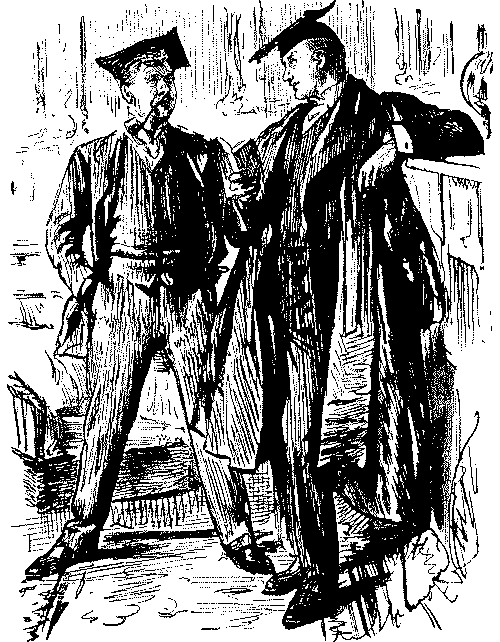
THE RESULT OF TOO MUCH GREEK
First Classic: "By the way, hadn't Dante got another Name?"
Second Classic: "Yes; Alfieri, I think—or else Alighieri."
First Classic: "Ah, perhaps you're right. I had a notion it was Gabriel Rossetti, or something!"
At the beginning of this period Punch undoubtedly showed a good deal of mistrust of the new methods of elementary education, in so far as they encouraged literary aspirations among the masses and tended to convert the artisan into the clerk. At its close he strikes a different and decidedly more democratic note in his ironical proposed "inscription for a Free Public Library" under the heading, "Laissez Faire":—
Here is an Institution doomed to scare The furious devotees of Laissez Faire. What mental shock, indeed, could prove immenser To Mumbo Jumbo—or to Herbert Spencer? Free Books? Reading provided from the Rates? Oh, that means Freedom's ruin, and the State's! Self-help's all right—e'en if you rob a brother— But human creatures must not help each other! The "Self-made Man," whom Samuel Smiles so praises, Who on his fellows' necks his footing raises, The systematic "Sweater," who sucks wealth From toiling crowds by cunning and by stealth— He is all right, he has no maudlin twist, He does not shock the Individualist! But rate yourselves to give the poor free reading? The Pelican to warm her nestlings bleeding, Was no such monument of feeble folly. Let folks alone, and all will then be jolly. Let the poor perish, let the ignorant sink, The tempted tumble, and the drunkard drink! Let—no, don't let the low-born robber rob, Because—well, that would rather spoil the job. If footpad-freedom brooked no interference, Of Capital there might be a great clearance; But, Wealth well-guarded, let all else alone, 'Tis thus our race hath to true manhood grown: To make the general good the common care, Breaks through the sacred law of Laissez Faire!
Laissez Faire in the family circle was another matter. The authority of the father in domestic affairs is represented as still unquestioned even by the mother as late as 1879. But, just as you can always find proverbs which are mutually contradictory the one of the other, so the pages of Punch constantly provide simultaneous illustrations of opposing tendencies. In the very same year in which the doctrine of patriarchal rule is shown to be still firmly established, Punch exhibits a highly modern aspect of the relations between the two generations. Squire Quiverfull's son, who pays 60s. a hundred for his cigars, rebukes his father for paying 3d. each for his: "If I had as many children to provide for as you, I wouldn't smoke at all."