LETTERS AND JOURNALISM: DRAMA AND MUSIC (continued 2)
Reading edition
If for every pun I shed I were to be punishèd, I could not find a puny shed Wherein to hide my punnish head.
The Plague of Prodigies
London has never been free from the plague of prodigies, but the epidemic was acute in 1888, and Punch treated the matter in a style which has a strangely familiar ring—when allowance is made for the usual puns:—
That there is a regular flood of these musical prodigies threatening to sweep over every concert-hall platform, there is not a doubt; and while the public rush in applauding crowds to welcome them, it is not easy to see where it is to stop. As long as the fever lasts, their parents, whatever their weight, may be counted upon to keep hurrying them to the "scales," and set them down to the key-board practising till they are often literally laid on their Bachs. Meantime, while the infants struggle, it is becoming a serious question for the regular adult performers, who will find their occupation gone, and certainly not know what to do with themselves, if the former are to have it all their own way. For them, whatever the public may think of it, the matter will undoubtedly be no mere "child's play," and they will surely hail any signs indicating that this recent determined invasion of the concert-room by the nursery is at all on the wane, with every expression of unfeigned delight.
The subject is handled more judiciously in one of the admirable "Voces Populi" series; best of all in Du Maurier's "Happy Thought":—
Mrs. Triplets: "And how is your concert getting on, Herr Pfeiffer?"
Eminent Violinist: "Pudiful, as far as de Brogramme is goncerned—Beethoven—Schumann—Brahms! But ze dickets don't zell!! Ach! Py ze vay, Mrs. Triplets, you don't happen to haf zoch a zing as a Moozicalish Infantile Venomenon apout you zat you could lend me for ze occasion. Ja? Gonzertina! Pantscho! Pones! Gomb! Anyzing vill blease ze Pritish Boblic, if ze berformer is onter vife years olt!"
Punch was in his element when Eduard Strauss—son of Johann the elder, and brother of the most famous of all the Viennese Waltz-Kings, Johann Strauss of the Blue Danube and the Fledermaus—brought his band to the Inventions Exhibition in 1885. In these days waltzing was still popular, and on the page overleaf I give two phases in its evolution as recorded by the pen of Du Maurier. Eduard Strauss wrote many delightful waltzes, and was an inspiring if somewhat exuberant conductor. Punch, who had sat under Jullien in his boyhood, compares the methods of the two, and pronounces the performance of dance-music by Strauss's band to be a revelation. "It unvulgarizes even the polka, and, from time to time, imparts an elevating tone to that ungraceful and prosaic dance." Finally Punch rewrites C. F. Adams's "Leedle Yawcob Strauss" in honour of the Waltz-King:—
He hops und schumps und marks der time, Und shows such taste and nous, Dot dere's to equal him no vun, Mine clever Eduard Strauss.
He dakes der viddle in his hands, Und he schust blay it, too! He dake der schtick to beat der time, Mine gracious, dot vos drue. Und ven der beeble hear dot band Dey at each oder glance, Den vag deir heads, den move deir veet, Und vish dot dey might dance. Und ven dey blay der "Danube Blue," Vich vos vor an encore, Dey velcome it as zomtings new, Und call for it vonce more. Der beeble listen as dey blay As guiet as a mouse, Dere's none vor dance tunes any day Like leedle Eduard Strauss.
The cult of Berlioz, started by Hallé at Manchester in 1880, was now in full swing, and his Faust figures constantly in the programmes of choral concerts and festivals, with Henschel and Santley (who had abandoned opera for oratorio), Mary Davies and Edward Lloyd in the principal rôles. Punch did not overlook the provincial festivals in the days when the standard quartet was made up of Mmes. Albani and Patey—whose likeness to Handel was noted by Samuel Butler—Edward Lloyd and Santley. He was present at Leeds in 1886 when Sir Arthur Sullivan conducted his Golden Legend, and Stanford his exhilarating Revenge. Sullivan is saluted as "the English Offenbach," a somewhat two-edged compliment, though meant sincerely. At Gloucester, in 1889, Punch praises the music of Parry's Judith, but damns the libretto: "Punch and Judith can never agree." No subject, sacred or profane, was secure from Punch's puns. The Golden Legend and The Prodigal Son, both by Sullivan, were included in the programme at Gloucester, and are turned to characteristic account in the following comment:—
The Golden Legend is a traditional tale of a fortune amassed at Gloucester by an hotel-keeper during the Festival week; while The Prodigal Son is the sad story of a young man who, in spite of his father's warnings, lived an entire week at a Gloucester Inn.
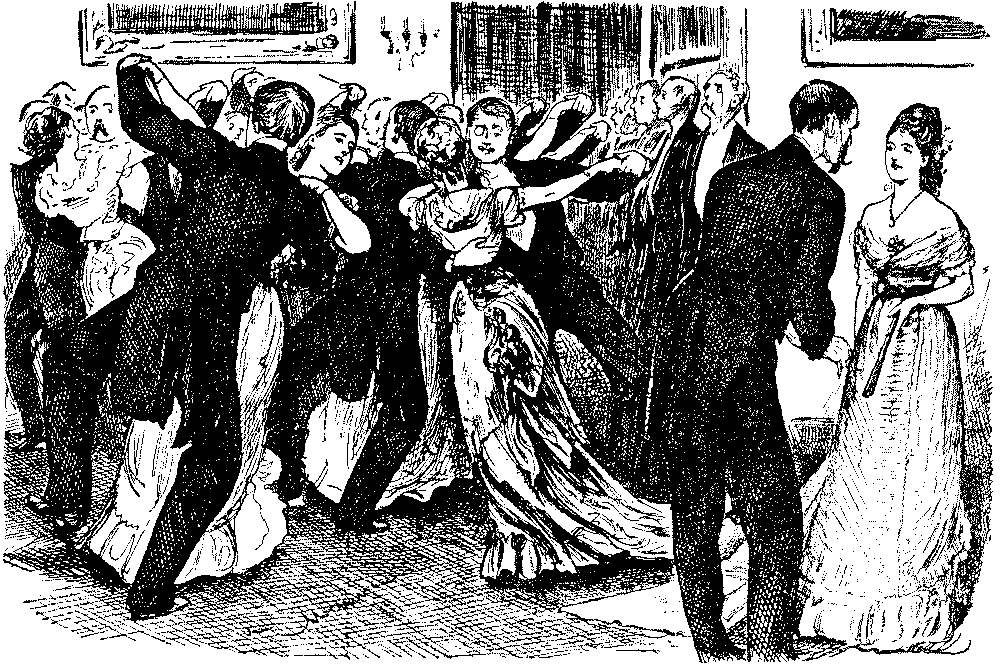
WHAT OUR WALTZING IS COMING TO
Distinguished Foreigner: "Voulez-vous me faire l'honneur de Danser cette Valse avec moi, Meess Matilde?"
Miss Matilda (an accomplished waltzer): "Avec plaiseer, Monsieur. Quelle est voter Forme—le 'Lurch de Liverpool,' le 'Dip de Boston,' ou le 'Kick de Ratcliffe Highway'?"
(We have feebly tried to represent the "Ratcliffe Highway Kick," which at present is only danced in the very best society, and confers a great air of distinction on the performers.)
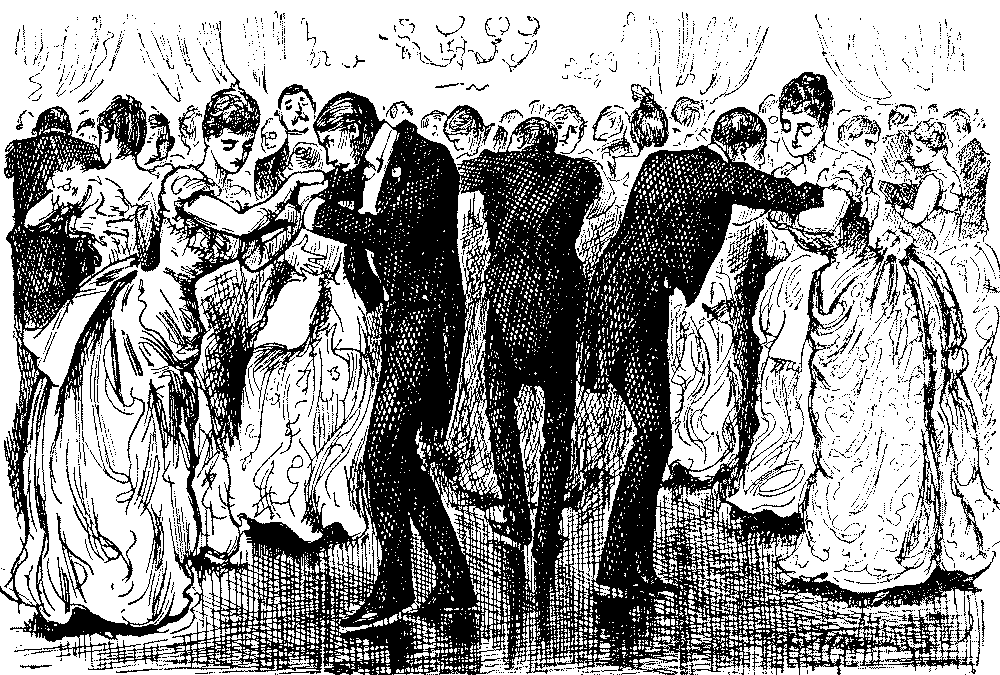
STUDIES IN EVOLUTION
This is not an example of the Struggle for Existence—it is merely "The Valse," as we have lately seen it danced at Suburban Subscription Balls, etc.
The Royal College of Music was founded in 1882. George Grove, the first director, the "dear 'G'" of countless friends in all walks of life, was an old ally, and the venture, in which the Prince of Wales took from the very outset an active and energetic part, received Punch's benediction, though an element of genial chaff is not absent in the picture of the Prince conducting his orchestra of royal and noble minstrels, with the Duke of Edinburgh as first violin. Punch showed a truer insight into the potentialities of the new institution when he suggested that it might help to solve the problem of National Opera. By its annual operatic performances so admirably directed for some thirty years by Sir Charles Stanford, and by the training of first-class instrumentalists and singers, the R.C.M. has done an amount of spade-work which has more than fulfilled Punch's prediction.
Popular Songs
On the educative value of the music-halls Punch in earlier years had maintained an attitude of scepticism, not to say hostility. He had been careful to draw invidious distinctions between the vulgarity of music-hall comedians and the entertainments provided by the German Reeds and Corney Grain, in whom he recognized "one in ten thousand" and a true follower of John Parry, the father and perhaps the greatest of all musical entertainers, whose vis comica, allied to unfailing good taste and reinforced by remarkable musicianship, had won the admiration of Lablache and Malibran. I have noted elsewhere Punch's disparagement of the efforts to improve the music-halls. He displays a certain lukewarm approval of the prospectus of the "Coffee Music Hall Company, Limited," issued in 1879 under the auspices of Lord and Lady Cowper, Mr. and Mrs. Cowper-Temple, Sir Charles Trevelyan and Canon Duckworth; the names of Mr. and Mrs. German Reed and Sir Jules Benedict, however, inspired him with more confidence than their aristocratic co-patrons.
The popular songs of the hour seldom failed to attract Punch's vigilant censure. In 1887 "Two Lovely Black Eyes" enchanted the million. It was well parodied in the series of "Popular Songs Resung" by "Miss Virginia Bowdler" in 1891, and in 1889 Punch published his excellent "Model Music-Hall Songs." The song that broke his heart in 1891 was "Hi-tiddly-hi-ti"; in 1892 a "Melancholy Muser" is plunged into despair by the "Ta-ra-ra" boom:—
I am shrouded in impenetrable gloom-de-ay, For I feel I'm being driven to my doom-de-ay, By an aggravating ditty Which I don't consider witty; And they call the horrid thing, "Ta-ra-ra-boom-de-ay!" Every 'bus-conductor, errand-boy, and groom-de-ay, City clerk, and cheeky crossing-sweep with broom-de-ay Makes my nervous system bristle As he tries to sing or whistle That atrocious and absurd "Ta-ra-ra-boom-de-ay!" So I sit in the seclusion of my room-de-ay, And deny myself to all—no matter whom-de-ay— For I dread a creature coming Whose involuntary humming May assume the fatal form, "Ta-ra-ra-boom-de-ay!" Oh, I fear that when the Summer roses bloom-de-ay, You will read upon a well-appointed tomb-de-ay: "Influenza never lick'd him, But he fell an easy victim To that universal scourge—'Ta-ra-ra-boom-de-ay!'"
The amazing popularity of Mr. Albert Chevalier's coster songs is acknowledged in 1892, but Punch hardly does justice to the talents of the creator of what was virtually a new and specialized type of comic song heavily larded with sentiment.