SOCIETY
Reading edition
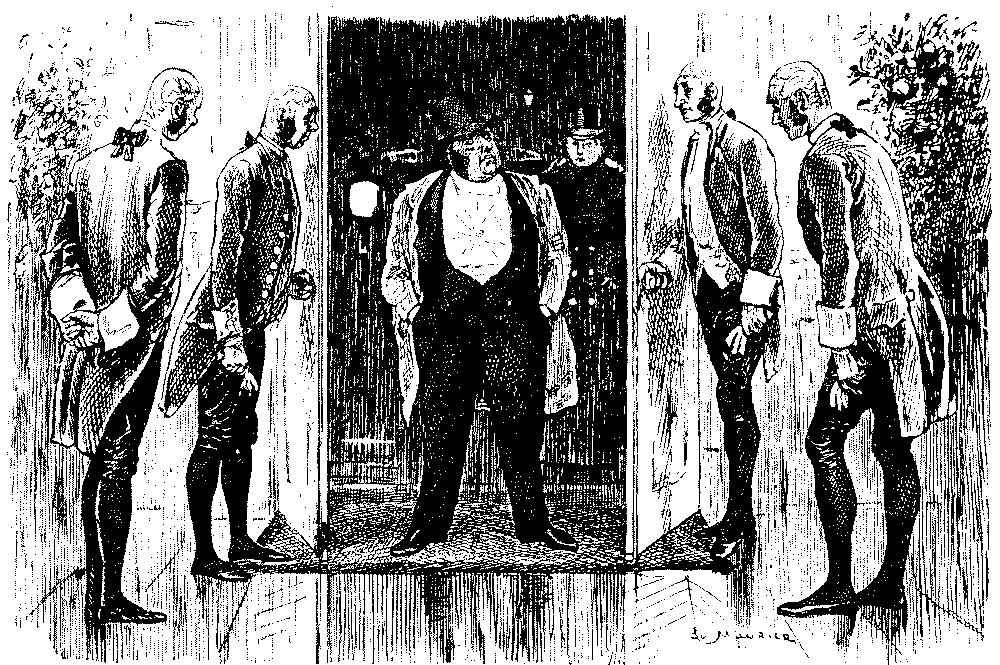
THE HEIGHT OF MAGNIFICENCE
Sir Gorgius Midas: "Hullo! Where's all the rest of yer gone to?"
Head Footman: "If you please, Sir Gorgius, as it was past two o'clock, and we didn't know for certain whether you was coming back here, or going to sleep in the City, the hother footmen thought they might go to bed——"
Sir Gorgius: "'Thought they might go to bed,' did they? A pretty state of things, indeed! So that if I'd 'a 'appened to brought 'ome a friend, there'd 'a only been you four to let us hin, hay!"
Critics and satirists of fashionable English society in the early and middle periods of the Victorian age were mainly concerned with its arrogance and exclusiveness. As we reach the 'seventies, with the breaking down of the old caste barriers and the intrusion of the new plutocracy, the ground of attack is shifted; the "old nobility," dislodged from their Olympian fastnesses, are exhibited as not merely accepting but paying court to underbred millionaires, and eking out their reduced incomes by an irregular and undignified competition with journalists, shopkeepers, and even actors. Society had ceased to be exclusive; it was becoming "smart," and had taken to self-advertisement. Wealth without manners had invaded Mayfair.
Woes of the Country Squire
These days ushered in the age of Society journals, of Society beauties, of vulgarity in high places, of parasitic peers, of the invasion of society by American heiresses, of the beginning of the end of the chaperon, the dawn of the gospel of "self-expression," and the rebellion of sons and daughters. Money, or the lack of it, was at the root of all, or nearly all, these changes. Dukes had already begun to sell their libraries and art treasures, and the wail of the old landed aristocracy was not unfairly vocalized in "The Song of the Country Squire," to the air of "The Fine old English Gentleman," and published by Punch in the autumn of 1882:—
The fine Old English Gentleman once held a fine estate, Of a few thousand acres of farm and forest land, with polite and punctually-paying tenants, excellent shooting, ancestral oaks, immemorial elms, and all that sort of thing. But it hasn't been so of late; For the rents have gone down about twenty per cent., lots of acres are laid down in grass, And the person who imagines that the Squire of whom Washington Irving and Mounseer Montalembert wrote all sorts of pretty things has a jolly good time of it in these de—testable days, Is a sentimental ass, Says the fine Old Country Gentleman, one of the present time. The fine Old Country Gentleman has an Elizabethan mansion, But what the dickens is the good of that if his means continually narrow in proportion to His family's expansion? If he gives up his deer, and sells his timber, dismisses his servants, and thinks of advertising his house for a grammar school, Or a lunatic asylum (As he often has to do), what is there in his lot to excite the jealousy of those darned Radicals, though the common comfort of that poor caput lupinum, the Land Owner, on however little a scale Seems invariably to rile 'em? Asks the fine Old Country Gentleman, one of the modern time. With an encumbered property, diminishing rent-roll, and expenses beyond his income, The question which confronts him at every corner is, whence will the needful "tin" come? And when they prate to us about our "improvidence," and advise us to "cut down" and economize, why, where, in the name of patience, I ask'll Be the pull of being a Country Gentleman at all, if one has to live like a retired pork-butcher or prosperous publican, and perhaps you will answer That question, Mr. Charles Milnes Gaskell![8] Of the fine Old Country Gentleman, one of the modern time.
The "profiteer" was already in Society and on the moors; Punch reviled him in "My 'art's in the 'Ighlands," and in a picture of an opulent Semite swearing that he hasn't "a drop of Hebrew blood in ma veinth, 'thelp me." Du Maurier created Sir Gorgius Midas as typical of the New Plutocracy—a gross, bediamonded figure, surrounded by flunkeys, with Dukes and Duchesses as his pensioners. The alleged poverty-stricken condition of the aristocracy is a frequent theme: one ducal family can only afford to go to the opera when Sir Gorgius lends them his box. But the Dukes still had their uses. The Beresford Midases put their boy's name down both for Eton and Harrow, and decided to send him to whichever has most "dooks" when the time comes. The New Rich show themselves apt pupils in all the snobbery of rank. For example, Sir Gorgius is shocked at the innovation of ladies and gentlemen riding in or on omnibuses. This is not documentary evidence, of course, but it was perfectly legitimate caricature. Du Maurier was not attacking the self-made man whose creed is summed up in the Lancashire saying: "Them as 'as brass don't care a damn what them as 'asn't thinks on 'em." He bestowed his ridicule impartially on the servile plutocrats who aped the customs of the titled classes, and the aristocrats who were unable to grow poor with dignity. Du Maurier's contribution to the social history of the middle and later Victorian age was invaluable on its critical and satirical side. But he was emphatically an aristocrat in the sense that he believed in good manners and fine physique: he set beauty above rank or riches, and was an early apostle of Eugenics. Long before the cult of athletics had begun to affect the stature and build of English girls, he devoted his pencil to glorifying the Junoesque type of English beauty. And while none of Punch's artists ever paid more consistent homage to elegance and distinction of feature and figure, he could be on occasion a merciless satirist of the physical deterioration brought about by intermarriage amongst the old nobility. Thus in 1880 he showed a ridiculous little degenerate affectionately rebuking his effete parents for "interfering in his affairs," with the result that he is "under 5 feet 1 inch, can't say Boh to a goose, and justly passes for the gweatest guy in the whole county."
The same spirit is shown in the fantastic contrast between the aristocracies of the past and the future. The scene is "an island in British Oceana"; the time 1989, a hundred years later than the date of the picture:—
His Highness the Grand Duke of Gerolstein: "Ach! Miss Prown—in your lôfly bresence I forket my zixty-vour kvarterings. I lay my Ditle at your Veet. Bitte! pecome ze Crant Tochess of Gerolstein!"
Miss Brown: "Your Highness also forgets that I have sixty-four Quarterings!"
His Highness: "Ach! How is dat, Miss Prown?"
Miss Brown: "Why, my father and mother, my four grandparents, my eight great-grandparents, my sixteen great-great-grandparents, and my thirty-two great-great-great-grandparents were all certified over six foot six inches, perfect in form and feature, and with health and minds and manners to match, or they would not have been allowed to marry. And though I'm the shortest and plainest girl in the colony, I should never be allowed to marry anyone so very much beneath myself as your Highness!"
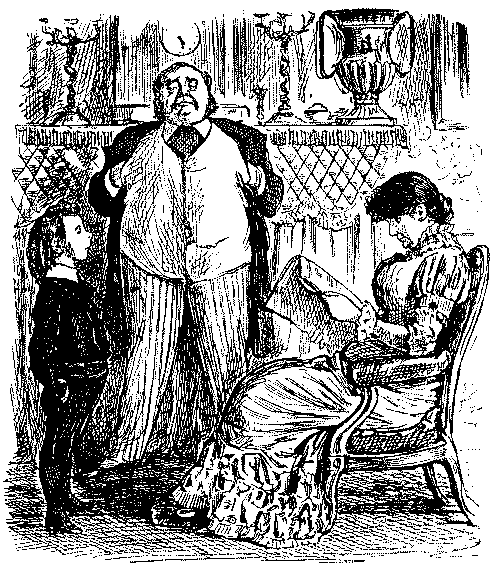
THE CHOICE OF A SCHOOL
Mrs. Beresford Midas: "I'm so glad we've put down Plantagenet's name for Eton, Beresford! Here, the newspaper says there are more Lords and Baronets there than ever!"
Beresford Midas, Esq., J.P. (Brother and Junior Partner of Sir Gorgius): "Ah, but only one Dook! Pity there ain't a few more Dooks, Maria!"
Mrs. Beresford Midas: "Perhaps there will be when Plantagenet's of an age to go there."
Mr. Beresford Midas: "Let's 'ope so! At all events, we'll put down his name for 'Arrow as well; and whichever 'as most Dooks when the time comes, we'll choose that, yer know!"
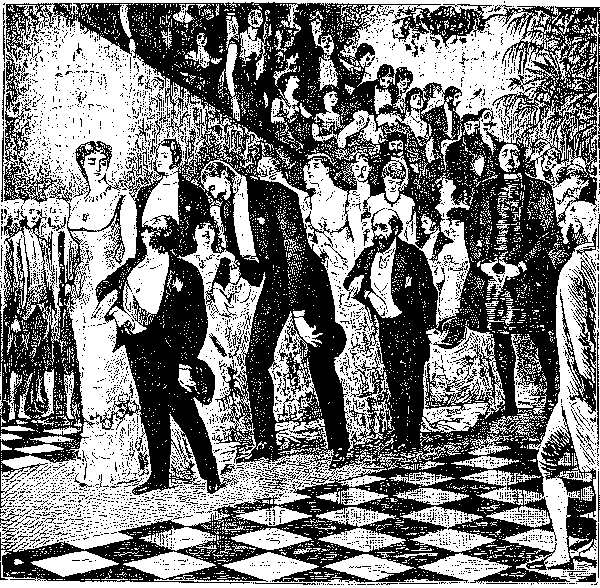
THE SURVIVAL OF THE FITTEST
Our prophetic instinct enables us to foresee that the British Aristocracy of the future will consist of two distinct parties—not the Tories and the Whigs—but the handsome people and the clever people. The former will be the highly developed descendants of the athletes and the beauties, the splendid cricketers and lawn tennis players of our day. The latter will be the offspring, not of modern æsthetes—oh, dear, no! but of a tougher and more prolific race, one that hasteth not, nor resteth; and for whom there is a good time coming. The above design is intended to represent a fashionable gathering at Lord Zachariah Mosely's, let us say, in the year two thousand and whatever-you-like.
N.B.—The happy thought has just occurred to His Lordship that a fusion of the two parties into one by means of intermarriage, would conduce to their mutual welfare and to that of their common progeny.
Mrs. Ponsonby de Tomkyns
In illustrating the falling away of the titled classes from the maxim noblesse oblige on its physical side, Du Maurier occupied an exceptional position on Punch; but he was not less active than other artists and writers in exposing the "moral and intellectual damage" which they inflicted on the community. In 1878 the vogue of "Fancy Fairs" evokes a vigorous protest against the vanity, bad taste, forwardness and free-and-easiness of society women who made themselves cheap in order to sell dear to 'Arries. From this date onwards the vagaries of Mrs. Ponsonby de Tomkyns, in whom Du Maurier incarnated all the pushfulness of the thrusting woman of fashion, are a constant source of entertainment. One of her earliest exploits as a Lion-hunter was to invite Monsieur de Paris to one of her receptions. Her husband thought she meant the Comte de Paris, but she speedily undeceives him. It was the headsman she was pursuing, not the Prince. "All the world" came, but the faithless executioner went to visit the Chamber of Horrors at Madame Tussaud's instead! Later on, as the social mentor, guide, philosopher and friend of Lady Midas, we find her warning her pupil against inviting the aristocracy to meet each other. A music-hall celebrity must be provided as a "draw," and Mrs. Ponsonby de Tomkyns recommends Nellie Micklemash and her banjo. "She is not respectable, but she is amusing, and that is everything." So when the Tichborne Claimant was released in 1884, Mrs. Ponsonby de Tomkyns contemplates inviting him to dinner: "Surely there are still some decent people who would like to meet him." Elsewhere and in more serious vein Punch denounces the undue publicity given to this impostor's movements in the Press—one leading paper having stultified itself by condemning the practice in a leading article and simultaneously publishing an advertisement of the Claimant's appearance at a music-hall. This dualism, however, was no monopoly of the 'eighties and has become common form in the Georgian Press.
Mrs. Ponsonby de Tomkyns acts as a bridge between the old and the new régime in her ceaseless and indiscriminate worship of celebrities and notorieties. She is the descendant of Mrs. Leo Hunter, but adds the shrewdness and cynicism of the go-between to the simple silliness of her ancestress. Todeson, another familiar figure in Du Maurier's gallery, attaches himself exclusively to the old nobility, but is always putting his foot in it by being plus royaliste que le roi, or more ducal than the duchess. For in the slightly distorting mirror of Du Maurier's genius we see, as an evidence of the spread of liberal ideas, a Duke dining with his tailor and being kept in very good order by him; and a musical Duchess learning to sing Parisian chansonnettes from a French expert in the franchement canaille manner. The craze for the stage among "Society people" had now reached formidable dimensions. They were no longer content with amateur theatricals, but had begun to enter into competition with the professionals.
The invasion of journalism by the same class Punch took much more seriously. Hazlitt, some fifty years earlier, had written in his essay "On the Conversation of Lords": "The Press is so entirely monopolized by beauty, birth or importance in the State, that an author by profession resigns the field to the crowd of well-dressed competitors, out of modesty or pride." But this was written when the mania for fashionable novels by Noble Authors was at its height, and Hazlitt uses the word Press of the printing press generally. In the early 'eighties the competition of titled amateurs was mainly confined to Society journals, a characteristic product of the new fusion of classes. As one of their ablest and most cynical editors said of his own paper, they were "written by and for nobs and snobs." They are now practically dead, owing to the absorption in the daily Press of the special features—above all the "personal note"—then peculiar to these weekly chronicles of high life. Punch ascribed the invasion of the Street of Ink by the amateurs to the penurious condition of the aristocracy and their ignoble readiness to turn their social opportunities into "copy" and cash. Under the heading of "Labor Omnia Vincit, or How Some of 'em try to live now," Punch published a satiric sketch of the new activities of Mayfair. The scene is laid in the boudoir of Lady Skribeler, a successful contributor to various Society journals. The scene opens with the arrival of her friend the Hon. Mrs. Hardup, who gives a pathetic account of her disastrous ventures in business and her failure to secure an engagement on the stage. Why, asks Lady Skribeler, had she not made her husband go into trade or keep a shop, or sell wine?—
Titled Professionals
Mrs. Hardup: "Oh, he has done that. He was Chairman of that Thuringian Claret Company; and we got ever so many people about us to take a quantity. But it fermented—or did something stupid; and they do say it killed the poor Duke, who was very kind to Harry, you know, and took a hundred dozen at once. And now, of course, there's no sale—or whatever they call it; and Harry says if it can't be got rid of to a firm of Blue Ink Makers, who are inquiring about it, it will have to go out to the Colonies as Château Margaux—at a dreadful loss. [Summing up.] I don't believe the men understand trade a bit, dear. So I'm going to do something for myself."
The sequel describes her initiation into the tricks of the trade by Lady Skribeler:—
Profiting by the morning's conversation, Mrs. Hardup besieges unprotected Editors, contributes to the literature of her country most interesting weekly accounts of the doings of her friends and acquaintances, and, it is to be hoped, practically solves, to her own satisfaction, the secret of the way in which a good many of us manage to live now.
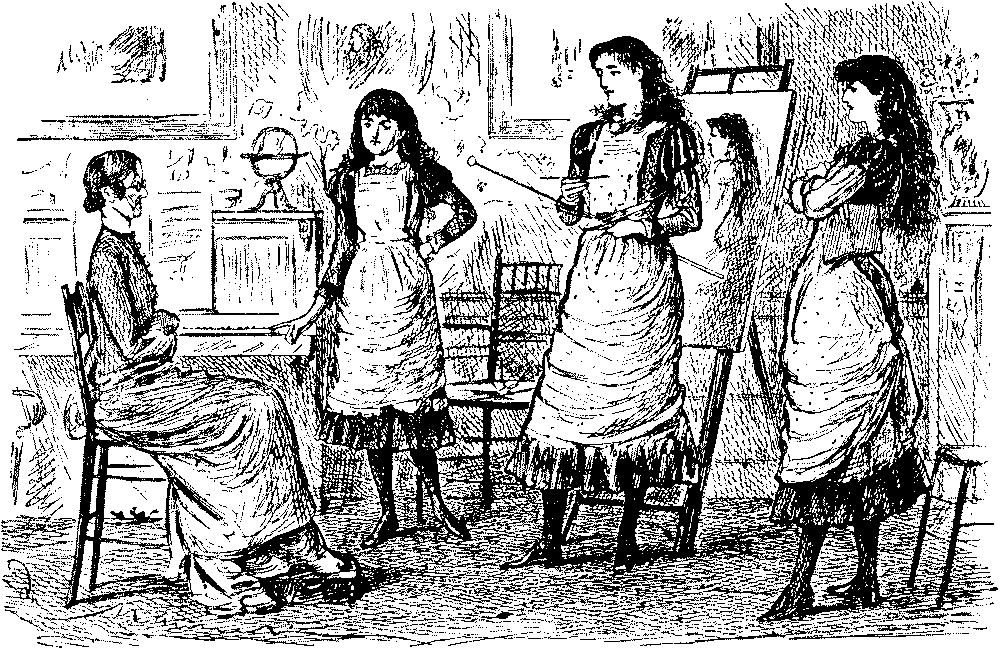
REMOVAL OF ANCIENT LANDMARKS
Lady Gwendoline: "Papa says I'm to be a great artist, and exhibit at the Royal Academy!"
Lady Yseulte: "And papa says I'm to be a great pianist, and play at the Monday Pops!"
Lady Edelgitha: "And I'm going to be a famous actress, and act Ophelia, and cut out Miss Ellen Terry! Papa says I may—that is, if I can, you know!"
The New Governess: "Goodness gracious, young ladies! Is it possible His Grace can allow you even to think of such things! Why, my Papa was only a poor half-pay officer, but the bare thought of my ever playing in public or painting for hire, would have simply horrified him—and as for acting Ophelia or anything else—gracious goodness, you take my breath away!"
For success in this walk of journalism, "literary culture must be eschewed, for with literary culture come taste and discrimination—qualities which might fatally obstruct the path of the journalistic aspirant." It was not by any means monopolized by amateurs, and Punch, in his series of "Modern Types" a few years later, traces, under the heading "The Jack of all Journalisms," the rise to power and influence of a humble but unscrupulous scribe, successively venal musical and dramatic critic, interviewer and picturesque social reporter, but always "the blatant, cringing, insolent, able, disreputable wielder of a pen which draws much of its sting and its profit from the vanities and fears of his fellow-creatures." The sketch is an ingenious composite photograph, in which those familiar with London journalism in the 'eighties and 'nineties will recognize in almost every paragraph the lineaments of one or other of the most notorious and poisonous representatives of the Society Press.
As we have seen, journalism was only one field for the commercial instincts of penurious "Society people." In 1887 Punch takes for his text the following paragraph from a daily paper:—
"One well-known West End Milliner is a graduate of Girton; another bears a title; a third conceals a name not unknown to Burke under a pseudonym.... Many of the best women of all classes are ready to do anything by which the honest penny may be earned."
Punch was somewhat sceptical as to the honesty of their intentions; the only way, he tells us, to get an invitation to the dances given by one titled shopkeeper was to buy one of her bonnets. This may have been a malicious invention, but he was fairly entitled to make game of the advertisement which appeared in the Manchester Evening Times in the spring of 1887:—
"To Christian Widowers.—A Nobleman's Widow, of good birth, about 40, no family, left with small income, pleasing, sweet-tempered, cultured, domesticated, fond of children, desires Settled Home and a high-minded Protestant Husband of 50, or older, seeking domestic happiness with a devoted, loving Christian wife.—Address——"
The American Invasion
The lady shopkeeper had become such an institution that Punch included her in one of his series of "Modern Types" in 1891. The portrait is not exactly flattering, though he admitted that she sometimes possessed other than purely social qualifications for success:—
At first everything will go swimmingly. Friends will rally round her, and she may perhaps discover with a touching surprise that the staunchest and truest are those of whom, in her days of brilliant prosperity, she thought the least. But a succès d'estime is soon exhausted. Unless she conducts her business on purely business lines, delivers her goods when they are wanted, and, for her own protection, sends in her accounts as they fall due, and looks carefully after their payment, her customers and her profits will fall away. But if she attends strictly to business herself, or engages a good business woman to assist her, and orders her affairs in accordance with the dictates of a proper self-interest, she is almost certain to do well, and to reap the reward of those who face the world without flinching, and fight the battle of life sturdily and with an honest purpose.
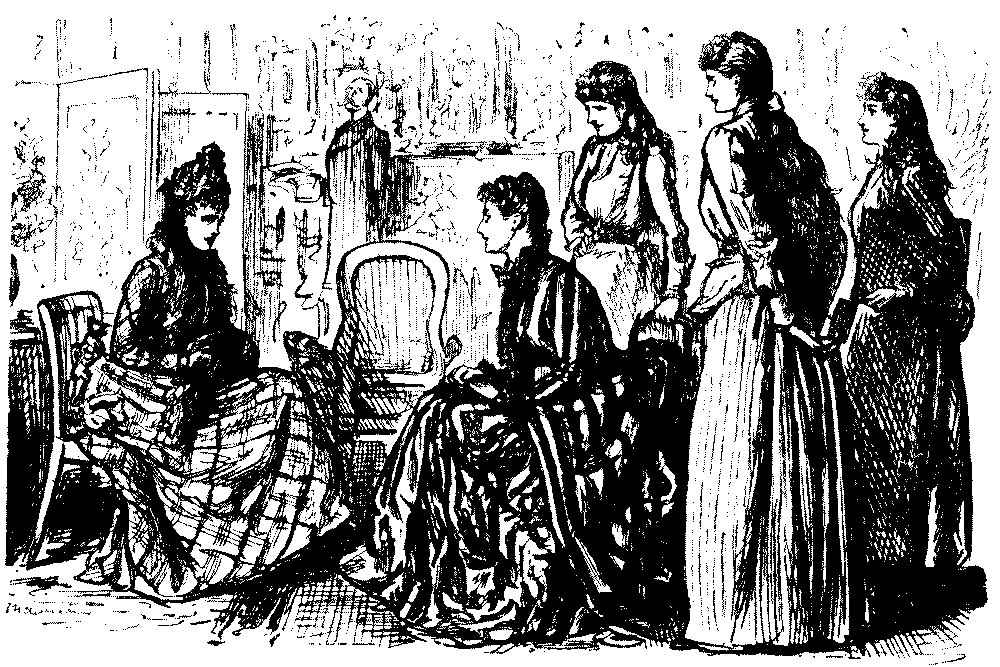
THE NEW SOCIETY CRAZE!
The New Governess (through her pretty nose): "Waall—I come right slick away from Ne' York City, an' I ain't had much time for foolin' around in Europe—you bet! So I can't fix up your gals in the Eu-ropean Languages no-how!"
Belgravian Mamma (who knows there's a Duke or two still left in the Matrimonial Market): "Oh, that's of no consequence. I want my daughters to acquire the American accent in all its purity—and the idioms, and all that. Now I'm sure you will do admirably!"
Millinery was the favourite field of enterprise, but the duchess who rebuked the indiscreet Todeson for his condemnation of trade as unworthy of the nobility, mentioned that her husband had gone in for bric-à-brac and her mother for confectionery. "Society people," in short, were dabbling extensively in trade, but it was mainly confined to the luxury trades. Punch does not mention, however, what was generally believed to be true, that a well-known peer was a partner in a firm of money-lenders, trading under a name most literally suggestive of blood-sucking. Commercialism in high places is illustrated indirectly but pointedly by the invasion of American heiresses. Dowagers with large families of daughters—for large families were still frequent and fashionable—found themselves seriously affected by the "unfair competition" of these wealthy and vivacious beauties. In 1888 Punch satirized their misfortunes in a picture representing English society mothers engaging American governesses so that their daughters might be instructed how to hold their own against American girls in attracting eligible dukes. So again in the Almanack of 1889, under the title "Social Diagnosis," a French baron identifies a certain lady as an English duchess on the evidence of her indisputably American origin, and in the same year, in a sardonic article, Punch exposes the American tendency to gloat over evidences of class distinctions in English society, while pretending to denounce them. This was inspired by the activities of certain American correspondents and "G. W. S." (the late Mr. Smalley) in particular, who is described as "too intimate with the 'hupper suckles' to think much of them." It was he, by the way, whose favourite form of social entertainment was described as not a "small and early" but an "Earl and Smalley." The hardest thing that Punch said of the American heiresses was put into the mouth of one of their number. In 1890 he published a picture of three fair New Yorkers conversing with a young Englishman. When he asks whether their father had come with them to Europe, one of them replies: "Pa's much too vulgar to be with us. It's as much as we can do to stand Ma." But the verses on "The American Girl" in the same year wind up on a note of reluctant admiration:—
Mayfair's New Idols
THE AMERICAN GIRL.
(An American Correspondent of The Galignani Messenger is very severe on the manners of his fair countrywomen.)
She "guesses" and she "calculates," she wears all sorts o' collars, Her yellow hair is not without suspicion of a dye; Her "Poppa" is a dull old man who turned pork into dollars, But everyone admits that she's indubitably spry. She did Rome in a swift two days, gave half the time to Venice, But vows that she saw everything, although in awful haste; She's fond of dancing, but she seems to fight shy of lawn tennis Because it might endanger the proportions of her waist. Her manner might be well defined as elegantly skittish; She loves a Lord as only a Republican can do; And quite the best of titles she's persuaded are the British, And well she knows the Peerage, for she reads it through and through. She's bediamonded superbly, and shines like a constellation, You scarce can see her fingers for the multitude of rings; She's just a shade too conscious, so it seems, of admiration, With irritating tendencies to wriggle when she sings. She owns she is "Amur'can," and her accent is alarming; Her birthplace has an awful name you pray you may forget; Yet, after all, we own La Belle Américaine is charming, So let us hope she'll win at last her long-sought coronet.
An heroic attempt was made in 1882 by that devoted apostle of the (socially) Sublime and Beautiful, Mr. Gillett, to revive Almack's. But, as Punch had frankly and even cheerfully recognized in connexion with a previous attempt, the time had gone by for the oligarchical control of the entertainments of the fashionable world.
Society had ceased to be small, select and exclusive; it was becoming increasingly mixed, cosmopolitan and plutocratic. The horizon was enlarged and the range of interests multiplied, but the desire to be in the movement was not always indulged in with dignity or discretion. Mayfair worshipped at new shrines and erected new idols. It was an age of strange crazes and pets and favourites. The great ladies of the 'thirties and 'forties may have been arrogant, but they seldom exploited their personalities, or cultivated a limelight notoriety. There is shrewd criticism in the legend of one of the earliest of the "Things one would have rather left unsaid," illustrated by Du Maurier in 1888:—
Aunt Jane: "Ugh! When I was your age, Matilda, Ladies of Rank and Position didn't have their photographs exposed in the shop windows."
Matilda (always anxious to agree): "Of course not, Aunt Jane. I suppose photography wasn't invented then?"
Old Bailey Ladies
Photography has much to answer for; and certainly played its part in luring the titled classes from their ivory towers, and creating the professional beauty. The "Giddy Society Lady," as portrayed by Punch in 1890, is a new version of the "Model Fast Lady" he described some forty years earlier, and though less mannish in her deportment, is much more flashy, vulgar and selfish than her predecessor. Tailor-made by day, excessively décolletée at night, and preferring Bessie Bellwood to Beethoven, this semi-detached and expensive wife as delineated by Punch is not an attractive figure. Yet with very few changes the portrait might stand for the modern society Maenad. Cigarette-smoking, it should be noted, was still considered "fast." Another recurrent type of unlovely womanhood much in evidence in these years is the "old Bailey lady" as Punch christened her many years before. In 1886 the writer of "A Bad Woman's Diary" expressly states that she would not go to a theatre in Lent, though she spends all her spare time attending murder trials. Punch did not spare the judges who lent themselves to this abuse, as may be gathered from the following dialogue:—
Her Grace: "Thank you so much for keeping such nice places for us, Judge! It was quite a treat! What romantic looking creatures they are, those four pirates! I suppose they really did cut the Captain and Mate and Cook into bits, and there's no doubt about the Verdict?"
Sir Draco: "Very little indeed, I fear!"
Her Grace: "Poor Dears! I suppose if I and the girls get there between five and six to-morrow, we shall be in time to see you pass the sentence? Sorry to miss your summing-up, but we've got an afternoon concert, you know!"
Sir Draco: "I'll take care that it shall be all right for you, Duchess!"
So, again, under the sarcastic heading, "True Feminine Delicacy of Feeling," this morbid curiosity is scarified in the conversation of two ladies in 1889:—
Emily (who has called to take Lizzie to the great Murder Trial): "What, deep black, dearest?"
Lizzie: "Yes. I thought it would be only decent, as the poor wretch is sure to be found guilty."
Emily: "Ah! Where I was dining last night, it was even betting which way the verdict would go, so I only put on half mourning!"
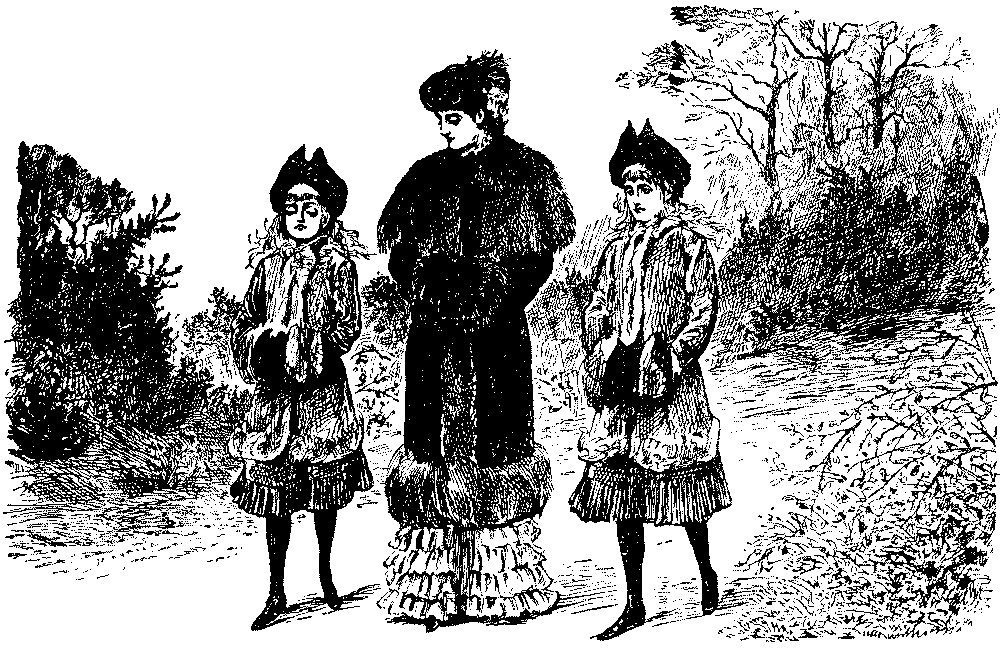
TAKING TIME BY THE FORELOCK
Gwendoline: "Uncle George says every woman ought to have a profession, and I think he's quite right!"
Mamma: "Indeed! And what profession do you mean to choose?"
Gwendoline: "I mean to be a professional beauty!"
It was in the same year that Punch published a double cut, showing the tricoteuses under the guillotine at the French Revolution, and, as a pendant, society ladies in a modern English Court of Justice.
The Terrors of Reminiscence
The fashionable craze for "slumming," which set in early in the 'eighties, was less objectionable; it was at worst an excrescence on the genuine interest taken in the housing question by serious reformers. But as practised by Mayfair it was ridiculed by Punch as a mere excuse for excitement; Du Maurier reduced it to an absurdity by his picture of society ladies going slumming in mackintoshes to avoid infection; and by another of Todeson, who had taken part in one of these excursions, being disillusioned by contact with real workers, and self-sacrificing East End clergymen. I have not been able to ascertain whether the same artist's picture of professional pugilists being fêted by society in 1887 was a mere piece of burlesque or not; but it was, at any rate, a good example of intelligent anticipation. His satire of "Society's new pet—the artist's model," in a picture of a handsome Junonian girl surrounded by infatuated Duchesses, drinking in her artless and h-less confidences, is probably only a fantastic caricature of aristocratic commercialism, as one of the great ladies is represented as thinking of letting her daughter become a model as a means of social advancement. Mention has been made of the invasion of journalism by society people. But students of foretastes and parallels will find a really remarkable anticipation of the terrors of modern Diaritis—not to use a more vulgar word—in the burlesque review of A Modern Memoir—the Autobiography and Letters of Miss Skimley Harpole, published by Messrs. Rakings & Co.:—
Seldom have we perused a book with so much interest as has thrilled us during our reading of these two handsome volumes. Situate as Miss Harpole was, the daughter of a famous bishop, claiming for mother a lady whose good deeds are remembered to this day, sister of one of the most brilliant female leaders of society, and herself popular, fêted and caressed, there is small room for wonder that even the bare details of Miss Harpole's everyday life would prove interesting, but when told in a charmingly frank style her book becomes a model of what a Memoir should be. In a few short simple sentences she, with delicious naïveté, relates her home life, and so clearly is the picture put before us that we cannot resist quoting the fragment:
"Take us at home of a night! The Bishop in an easy chair, with his gaitered legs crossed, and elevated on the back of another, with a short clay pipe in his mouth, is vaguely mixing his eleventh tumbler of hot gin-and-water, causing us girls great pain to conceal our titters, when, as happens very often at this period of the evening, he deposits the greater part of the hot water on the tablecloth or himself. My mother, regardless of him, sits, carefully studying a sporting paper, and the Racing Calendar, and making her selections for the next day's horse-race. For a heavy gambler is my mother, as is my brother, who, when at home—which is seldom—is either delighted at having won, or in the sulks because he has lost money to his fellow legal students at billiards. As a rule he is delighted, and always carries a lump of chalk in his pocket. My sister is writing notes to Men about Town, Peers and Guardsmen, her lovely features only losing their serenity when lit up by an arch look of wonderment whether she has made appointments with two different men at the same hour and place, while I am sitting, in my school-girlish way, by myself, making notes, so as to tell the world some day the true story of my life."
Space forbids us to say any more of the merits of this charming work, but we cannot resist one extract which shows how true was the estimate of the Bishop's noble character:—
"We were one night at the Italian opera, of which my father was passionately fond, and during the ballet our attention was drawn to a singularly lovely girl on the stage. 'Alas!' said the Colonel, 'she is as bad as she is beautiful.' The Bishop immediately avowed his readiness to investigate the case at the earliest opportunity. He was always thinking of others, despite Mamma's occasionally stubborn opposition."
This concludes our notice. In brief, the book is a most excellent specimen of the modern style of Memoir, conceived with kindliness of heart and charity of remembrance and executed with literary taste, skill and polish.
This was fiction, based on what purported to be truth, and in turn was destined to be easily eclipsed by the actual reminiscences of a later generation. It may be noted in this context that the "blazing indiscretions" in the "Life of Bishop Wilberforce," published in 1883, and the letters of protest which they evoked, had already prompted the satire and sympathy of Punch.
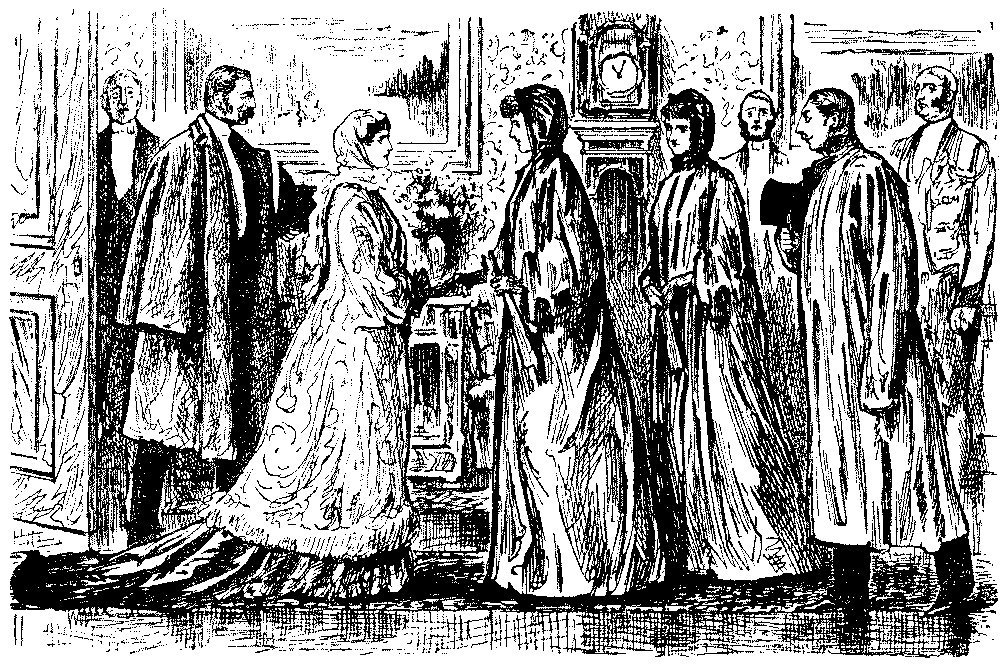
OVERDOING IT
"What? Going already? And in Mackintoshes? Surely you are not going to Walk?"
"Oh, dear no! Lord Archibald is going to take us to a dear little Slum he's found out near the Minories—such a fearful place! Fourteen poor Things in One Bed, and no Window—and the Mackintoshes are to keep out Infection, you know, and hide one's Diamonds, and all that!"
Thought-Reading and Theosophy
The fashionable quest of the unseen world took no new forms in the 'seventies and 'eighties. We hear much less of Spiritualism under that name. This was no doubt in part due to the success of Maskelyne and Cook in outdoing the "manifestations" of mediums, a success so remarkable that they were actually claimed as spiritualists by some of the fraternity. In 1874 Punch waxes facetious at the statement that additional help had been obtained in the working of certain mines by ghostly assistants. Later on there are references to the activities of palmists and Society Sibyls, but the study of the Unseen and the Occult in the 'eighties entered on a new and formidable phase with the advent of thought-readers, theosophists and psychical researchers. Punch devotes a good deal of space to an exhibition of his powers by Irving Bishop, a well-known thought-reader of the time, at which politicians were impressed and sceptics—represented by Ray Lankester—were unconvinced. The pin-finding business was certainly much less impressive than the exploits of the Zancigs some thirty years later. The invasion of the drawing-room by pseudo-science met with little sympathy from Punch, who summed up his view in the phrase, "modish science is a sciolist"; and in 1891 he expressed his resentment against the new mysticism and the jargon of Theosophy in a comprehensive denunciation of "useless knowledge." The verses are worth quoting, not for their poetic quality but for the list of names quoted:—
OUR REAL DESIDERATUM
(By a "Well-informed" Fool)
Ah! I was fogged by the Materialistic, By Huxley and by Zola, Koch and Moore; And now there comes a Maëlstrom of the Mystic To whirl me further yet from sense's shore. Microbes were much too much for me, bacilli Bewildered me, and phagocytes did daze, But now the author 'cute of Piccadilly, Harris the Prophet, the Blavatsky craze, Thibet, Theosophy, and Bounding Brothers— No, Mystic Ones—Mahatmas I should say, But really they seem so much like the others In slippery agility!—day by day Mystify me yet more. Those germs were bad enough, But what are they compared with Astral Bodies? Of Useless Knowledge I have almost had enough, I really envy uninquiring noddies. I would not be a Chela if I could. I have a horror of the Esoterical. Besant and Olcott may be wise and good, They seem to me pursuing the chimerical. Maddened by mysteries of "Precipitation," The Occult Dream and the Bacillus-Dance; We need Societies for the propagation Of Useful—Ignorance!
This bracketing of Huxley with Zola is decidedly unfair, and the juxtaposition of Koch the famous physiologist and of Mr. George Moore—already known for his realistic romances—borders on the grotesque. Piccadilly is, of course, the brilliant novel by Laurence Oliphant, diplomatist, man of the world and mystic, who became the disciple of the American "prophet" Harris, spiritualist and founder of the "Brotherhood of the New Life"; and Blavatsky is the amazing Russian lady who brought a new religion from the Far East as another woman, Mrs. Eddy, brought another from the Far West. Madame Blavatsky is no more, but Mrs. Besant is still very much with us, and Theosophy and Christian Science are firmly established in a country which, as the French cynic remarked, boasts a hundred and fifty religions but only one sauce.
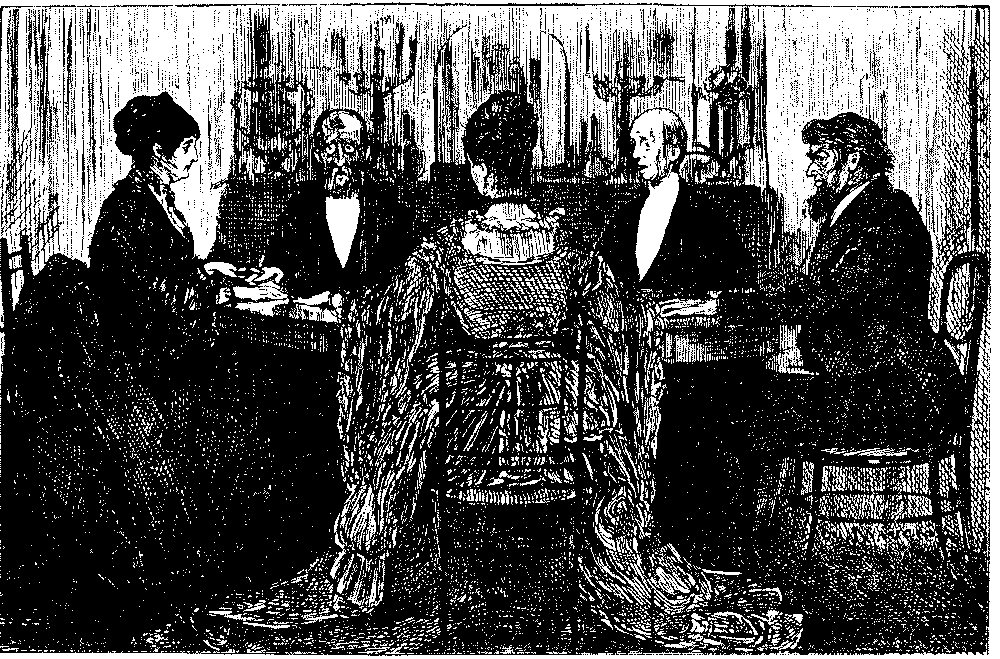
LAST NEWS FROM THE SPIRIT-WORLD
Medium: "The spirit of the late Mr. Jones is present."
Jones's Widow (with emotion): "I hope you are happy, Jones!"
Jones (raps out): "Far happier than I ever was on earth!"
Jones's Widow: "Oh, Jones! Then you must be in Heaven!"
Jones: "On the contrary!"
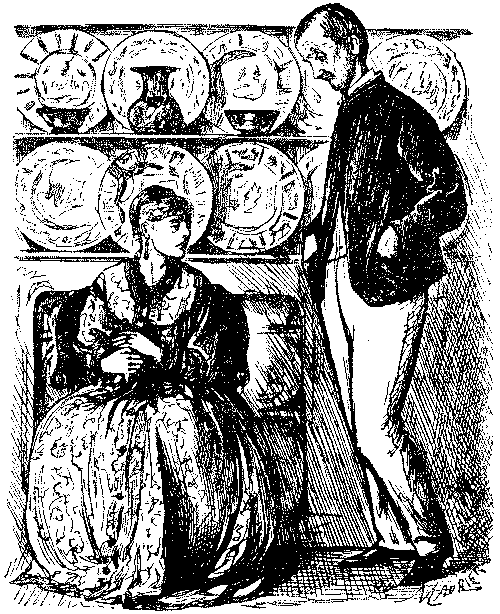
THE PASSION FOR OLD CHINA
Husband: "I think you might let me nurse that teapot a little now, Margery! You've had it to yourself all the morning you know!"
The Æsthetic Movement
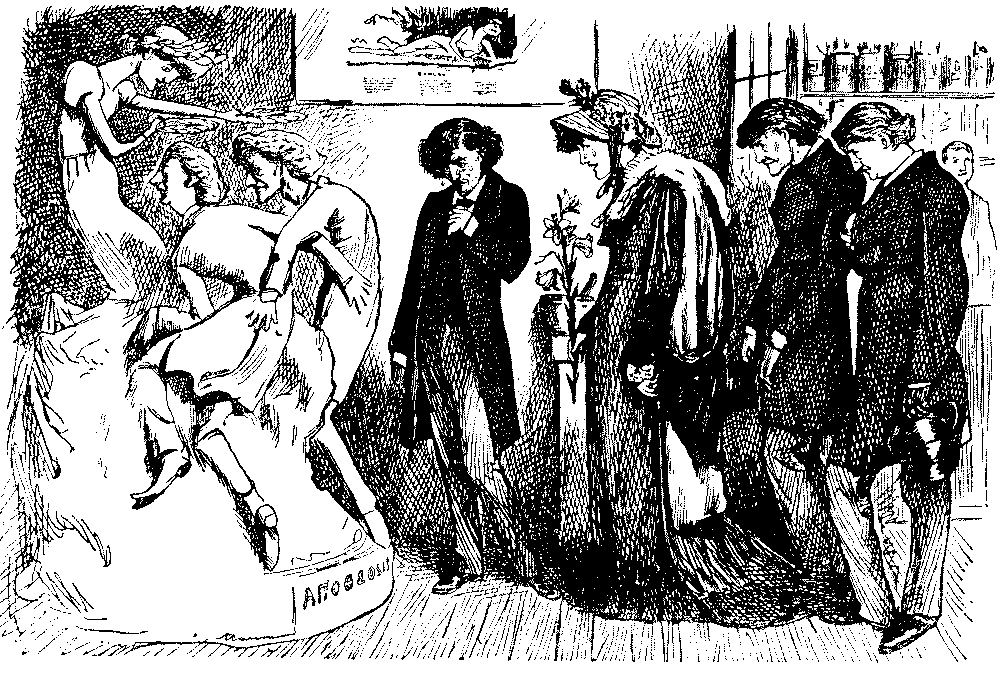
AFFILIATING AN ÆSTHETE
Pilcox, a promising young Pharmaceutical Chemist, has modelled from memory an Heroic Group, in which Mrs. Cimabue Brown is represented as the Muse of this Century, crowning Postlethwaite and Maudle as the Twin Gods of its Poetry and Art.
Postlethwaite: "No loftiah theme has evah employed the sculptah's chisel!"
Maudle: "Distinctly so. Only work on in this reverent spirit, Mr. Pilcox, and you will achieve the Truly Great!"
Mrs. Cimabue Brown: "Nay, you have achieved it! Oh, my young friend, do you not know that you are a HEAVEN-BORN GENIUS?"
Poor Pilcox: "I do!"
(Gives up his pestle and mortar, and becomes a hopeless Nincompoop for life.)
The Chief Æsthete
But of all the Society crazes of this period the Æsthetic movement created the most resounding stir. Æstheticism on its social side was an excrescence on, and a perversion of, doctrines and principles to which English art and decorative design and letters owed a real and lasting debt. It is enough to mention the names of Rossetti and Morris, the Pre-Raphaelite Brotherhood, and Ruskin to realize how far the fashionable æsthetes disimproved on their masters. Ruskin was in particular unfortunate, since many of their catchwords were borrowed from him and distorted to serve other ends. For while Ruskin deplored the fetish-worship of athletics, he believed in honest manual labour, and never subscribed to the maxim of art for art's sake, which, by the way, was anathema to Watts. Morris was essentially manly and a worker. The æsthetes were neither. In life and letters they cultivated languor, eccentricity, paradox, and extravagance of speech and dress. It was their aim to exploit, as a social asset and a means to the achievement of notoriety, the creed of artistic emotion which had been formulated by Pater. For Oxford, it must be regretfully admitted, was the "spiritual home" of the æsthetes. The word "æsthetic," as we have seen, in its modern cant sense dates back to the 'sixties, but it was not until the middle 'seventies that it began seriously to attract the attention of Punch. To 1874 belongs Du Maurier's picture of the effete-looking artist begging his wife to let him nurse the china teapot she had monopolized all the morning. In 1876 we read of the damping of "Mr. Boniface Brasenose's" enthusiasm by a fashionable lady. But the fashionable ladies soon succumbed to the craze, and became adepts in the lingo of intensity. Punch attacked the æsthetes alternately with the rapier and the bludgeon, using the former in the delicate raillery of Du Maurier's pictures, the latter in prose and verse comments on their eccentricities and extravagance. Here his attitude is invariably that of the healthy Philistine. But when we speak of "æsthetes" it would be more precise to use the singular. Maudle and Postlethwaite and all the other types satirized by Du Maurier are only variants on the chief priest of the new cult, Oscar Wilde, whom Punch attacked directly and indirectly with all the weapons at his disposal. Punch's ridicule was often trenchant and effective, but undoubtedly it helped to advertise one who was avid of notoriety, and infinitely preferred abuse to neglect. Punch's feelings towards him were all through of a piece with those of the witty Fellow of All Souls who, when a friend of Wilde's indignantly remarked that the men who had ducked him in the Cherwell ought to be prosecuted, interposed with the biting comment, "I suppose you mean under the Rivers' Pollution Act." For more than a year and a half, from the spring of 1881 to the end of 1882, there was seldom a number without a picture or a poem or a prose article in which the chief æsthete was held up to derision. Sambourne's drawing in June, 1881, is called a "fancy portrait," but it is quite a realistic likeness. "A Maudle-in Ballad, to the Lily," had appeared in April:—
My lank limp lily, my long lithe lily, My languid lily-love, fragile and thin, With dank leaves dangling and flower-flap chilly, That shines like the shin of a Highland gilly! Mottled and moist as a cold toad's skin! Lustrous and leper-white, splendid and splay! Art thou not Utter? and wholly akin To my own wan soul and my own wan chin, And my own wan nose-tip, tilted to sway The peacock's feather, sweeter than sin, That I bought for a halfpenny, yesterday? My long lithe lily, my languid lily, My lank limp lily-love, how shall I win— Woo thee to wink at me? Silver lily, How shall I sing to thee, softly, or shrilly? What shall I weave for thee—which shall I spin— Rondel, or rondeau, or virelay? Shall I buzz like a bee, with my face thrust in Thy choice, chaste chalice, or choose me a tin Trumpet, or touchingly, tenderly play On the weird bird-whistle, sweeter than sin, That I bought for a halfpenny, yesterday?
Other parodies by "Oscuro Wildegoose" followed, and Wilde's poems are "slated" in the Bludyer vein under the heading "Swinburne and Water." A good deal of Wilde's verse was derivative—even tertiary deposit—and Punch made fair game of the Swinburnian echoes and phrases such as "argent body," "pulse of sin," and "kosmic soul." But his literary criticism is somewhat heavy-handed. He is much happier in "Oscuro Wildegoose's" burlesque sonnet lamenting the unenlightened Philistinism of Grahamstown, in South Africa, where the Town Council did not know what a dado was, and conjectured that it was an ecclesiastical term! Wilde's visit to America in 1882 let loose a cascade of ridicule beginning with a bogus interview, followed up by a cartoon "Ariadne in Naxos," representing (in the manner of W. B. Richmond) the grief of Æstheticism at the departure of her hierophant. When Wilde lectured at Boston sixty students appeared in white waistcoats and knee-breeches, with sun-flowers in their buttonholes, and Punch welcomed the attention as a reductio ad absurdum of Wilde's efforts to revolutionize costume. Later on occurred the episode—which caused Punch unfeigned delight—of a letter addressed to "Oscar Wilde, Poet, London," being returned as "Not known." But the craze was passing. Gilbert's Patience, produced in 1881, had been largely instrumental in reducing the pose of preciosity to its true proportions, and by the summer of 1883 we find Punch coupling "Oscar" and "Jumbo" (the elephant) together as overrated lions. From this point onward the campaign slackens. In some acid verses on the Zeit-Geist in the spring of 1884, which we quote later on, a would-be Juvenal denounces vulgarity as the dominant feature of the time; and in his list of nuisances and impostors no room is found for the æsthete. At the close of the same year, however, to judge by another set of pessimistic verses, he was still active if not exactly rampant:—
The "culture," too, of the æsthetes, with all its flaccid flams, Its turgid affectations and its silly sickly shams, Is but as dross of Brummagem compared with virgin gold, When matched against the vigorous realities of old.
The Cult of Intensity
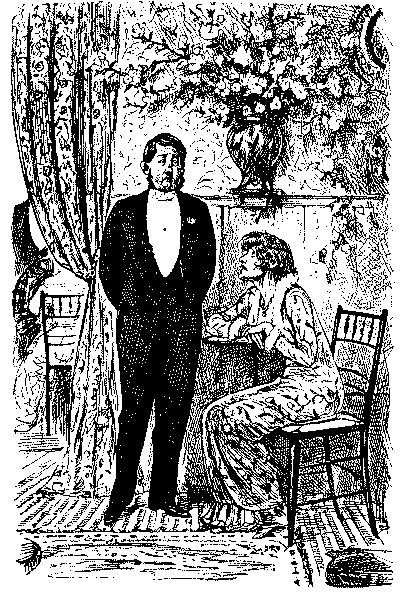
REFINEMENTS OF MODERN SPEECH
Scene—A drawing-room in "Passionate Brompton."
Fair Æsthetic (suddenly, and in deepest tones, to Smith, who has just been introduced to take her in to dinner): "Are you intense?"
The "Dilettante" satirized in a rather ponderous article—one of the series of "Modern Types"—in 1890 represents a later stage of pseudo-culture, in which a contempt for everything characteristically English is the leading trait. He warbles French chansonnettes, defies all the rules of English grammar and metre in his poetry, is much in request at charitable concerts in aristocratic drawing-rooms, affects a mincing delicacy in gait and manner, paints his face in middle age, talks habitually in an artistic jargon, and passes away in an odour of pastilles. The type existed and exists, but hardly deserved such detailed and elaborate portraiture. There is more interest in the verses on the over-cultured undergraduate in 1891—one of a series entitled "Men who have taken me in—to dinner," by a Dinner Belle:—
He stood, as if posed by a column, Awaiting our hostess' advance; Complacently pallid and solemn, He deigned an Olympian glance. Icy cool, in a room like a crater, He silently marched me downstairs, And Mont Blanc could not freeze with a greater Assurance of grandeur and airs. I questioned if Balliol was jolly— "Your epithet," sighed he, "means noise, Vile noise!" At his age it were folly To revel with Philistine boys. Competition, the century's vulture, Devoured academical fools; For himself, utter pilgrim of Culture, He countenanced none of the schools. Exams. were a Brummagem fashion Of mobs and inferior taste; They withered "Translucence" and "Passion," They vulgarized leisure by haste. Self to realize—that was the question, Inscrutable still while the cooks Of our Colleges preached indigestion, Their Dons indigestible books. Two volumes alone were not bathos, The one by an early Chinese, The other, of infinite pathos, Our Nursery Rhymes, if you please. He was lost, he avowed, in this era; His spirit was seared by the West, But he deemed to be Monk in Madeira Would probably suit him the best.
Preciosity and Self-Expression
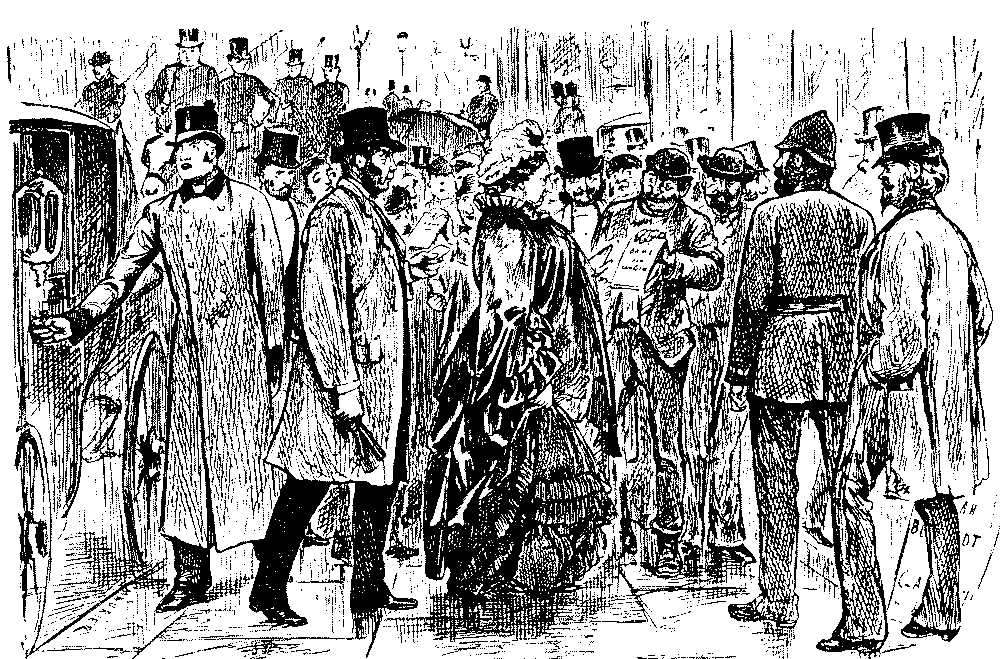
BRITISH PROPRIETY
Hawker: "Book o' the words, my Lady. Hortherized copy. The Dam o' Cameleers!"
Mrs. Jones (for the benefit of the bystanders): "Oh no, thank you. We've come to see the acting, we do not wish to understand the play!"
It is not a bad picture of Oxford preciosity in the early 'nineties—the age of the Yellow Book—and contains the first reference in Punch to the new educational gospel of self-realization, or "self-expression," as it is now called. The mention of early Chinese poetry was probably only a piece of "intelligent anticipation," for its vogue only began yesterday. So too with the Nursery Rhymes which some of the Georgian poets assiduously cultivate. But there is no foreshadowing of the characteristic Balliol product of some ten years later, the "intellectual blood" who combined hard and free living with hard work for his schools—who was at once dissipated and distinguished. The new worship of intellect—a sort of inverted snobbery—had already been satirized by Du Maurier in his sketch of the new parvenu, foreshadowing the "coming aristocracy of mind":—
He: "Charming youth, that young Bellamy—such a refined and cultivated intellect! When you think what he's risen from, poor fellow, it really does him credit!"
She: "Why, were his people—a—inferiah?"
He: "Well, yes. His Grandfather's an Earl, you know, and his Uncle's a Bishop; and he himself is Heir to an old Baronetcy with eighty thousand a year!"
Manners were in a state of transition and flux. As late as 1883 smoking in the presence of ladies was still taboo and severely restricted even at clubs, and Punch contrasts the "bereavement" of gentlemen by the disappearance of ladies after dessert with the "consolation" afforded by the cigarette. It was not until 1884 that smoking was allowed for the first time after dinners at the Mansion House, an innovation deplored in the wail of an "Old Fogey." Punch had no love of the old proprieties where they were insincere, as, for example, when in 1881 he represented Mrs. Jones declining the offer of a "hortherized copy" of the book of words of the Dam o' Cameleers from a hawker: "Oh no, thank you. We've come to see the acting, we do not wish to understand the play." But he resented the curt colloquialisms, an outcome of the general speeding-up of life, which in his view impaired the courtesies of social intercourse between the sexes; while on the other hand modish artificialities, whether new or old, always excited his ire. Twice over in 1884 he was moved to protest against the excessive use of cosmetics, in the verses to a "Painted Lady" (prompted by Malcolm Morris's address at the Health Exhibition), in which the writer looks forward to the time when it will be fashionable to be healthy, and a few months later, in "A Few Home Truths," we read:—
High-handed Greetings
Our matrons and our girls "make up" with powder, bismuth, dye— Figures as well as frocks, obliging milliners supply— Alas! the fairest cheeks are stained with artificial hue: 'Tis true—'tis pity; pity 'tis, 'tis true!
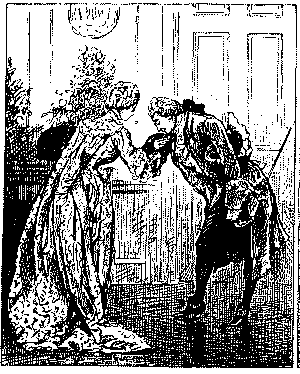
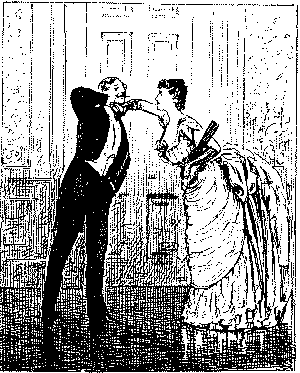
17871887"
"HERE'S A HOW-D'Y'-DO!"
A Chapter on the Evolution of Deportment.
Nowadays young ladies begin making-up rather earlier, but, if Punch is to be believed, we can draw consolation from the fact that they are little worse in this respect than their modish mothers or grandmothers. Another of Punch's pet aversions was the fashionable high hand-shake introduced in the 'nineties:—
HANDS AS THEY ARE SHOOK
(New Style)
In healthier times, when friends would meet Their friends in chamber, park, or street, Each, as hereunder, each would greet. Your level hand went forth; you clasped Your crony's; each his comrade's grasped— If roughly, neither friend was rasped. Such was the good old-fashioned cue Of honest British "How d'ye do?" I think it manly still—don't you? But now, when smug acquaintance hails A set that would be "smart," but fails, Another principle prevails. The arm, in lifted curve displayed, Droops limply o'er the shoulder-blade, As needing some chirurgeon's aid.
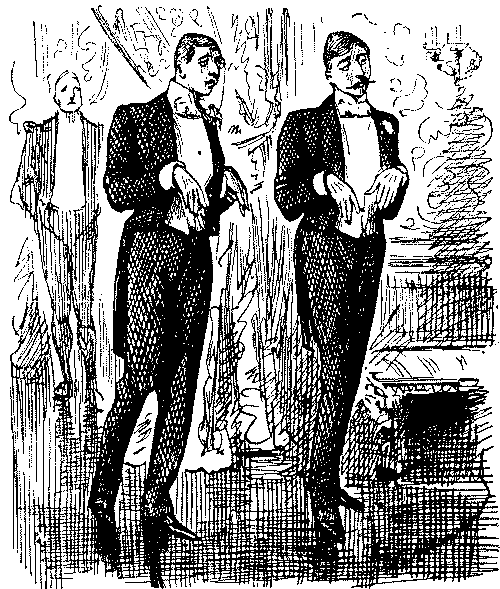
THE EARLSWOOD TOTTER
Our Mashers are still improving. They no longer enter the Ball Room with their Hands in their Pockets. They have adopted a Mode of Progression more in harmony with their Mental Structure.
The Decline of the Chaperon
The offenders here castigated are young men, but the ladies excelled in the new greeting. Languor was the distinguishing note of the young men of fashion in the 'eighties and 'nineties. It was the age of the "masher"—dreadful word—of the "Johnnie" and the "Chappie." In 1883 Punch published a poem entitled "Child Chappie's Pilgrimage," a modern Rake's Progress. Later on he satirized the studied imbecility of deportment of young dandies entering a ballroom as "The Earlswood Totter." Students of slang will note with interest the emergence of the word "bounder" in the year 1887. Punch's verses on the type thus designated indicate a much harsher view than now prevails. Nowadays we admit that a "bounder," though socially "impossible," may be a "stout fellow." Punch's portrait, in which the "bounder" is represented as a bilker and a blackmailer, corresponds with the "cad" in the worst sense which we now attribute to that word. Mention has been made of the decline of the chaperon. Here Punch virtually sides with the "little flirt" who boldly enunciates the doctrine that "in future a girl is her own chaperon." At the same time he clearly disapproved of the new habit of dispensing with introductions, and its logical outcome, satirized in one of Du Maurier's most graceful pictures—entertainments at which the hostess was ignorant of the very names of her guests.
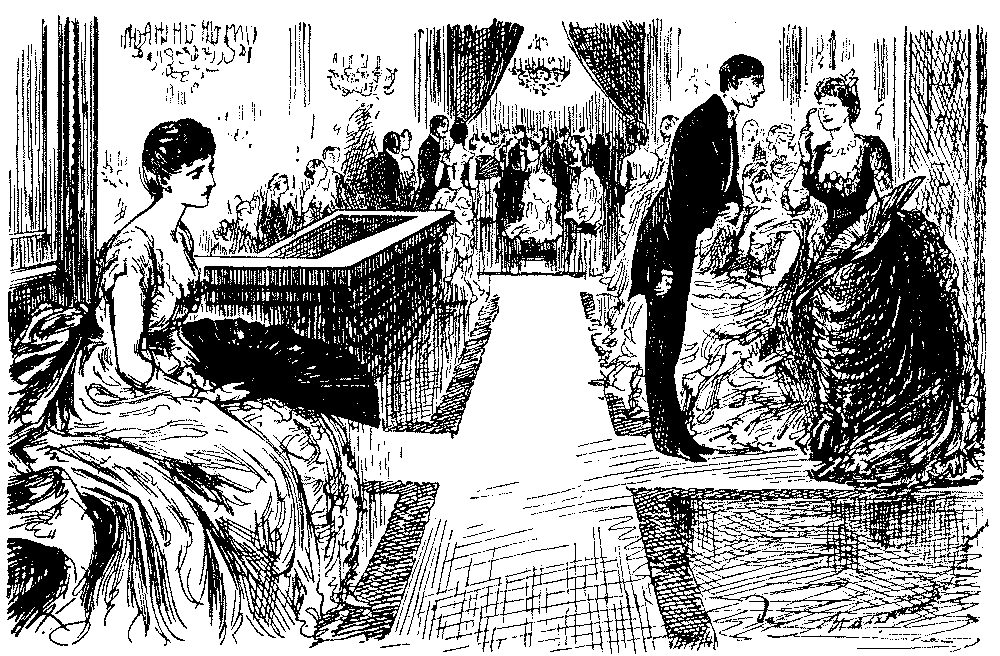
MODERN SOCIAL PROBLEMS
Susceptible Youth: "Would you present Me to that Young Lady with the Black Fan?"
Hostess: "With pleasure, if you will tell me her Name—and Yours!"
The Roller-Skating craze, which attained the dimensions of an epidemic in 1875 and 1876, is treated by Punch rather as a form of social recreation fraught with matrimonial possibilities than an athletic pastime.
The year 1876 was also noteworthy for an epidemic of Fancy Dress Balls and Spelling Bees. The latter were never popular in Mayfair; spelling had never been a strong point with the British aristocracy. But in less exalted circles Spelling Bees flourished exceedingly for a while, and the prizes awarded may well have conduced to an improvement in the orthography of the upper middle classes. Punch's references to the craze are copious. It may suffice, however, to quote his "Dream of a Spelling-Bee," an engaging piece of dictionary-made nonsense verse:—
Menageries where sleuth-hounds caracole, Where jaguar phalanx and phlegmatic gnu Fright ptarmigan and kestrels cheek by jowl With peewit and precocious cockatoo: Gaunt seneschals, in crochety cockades, With seine-nets trawl for porpoise in lagoons; While scullions gauge erratic escapades Of madrepores in water-logged galleons: Flamboyant triptychs groined with gherkins green, In reckless fracas with coquettish bream, Ecstatic gurgoyles, with grotesque chagrin, Garnish the gruesome nightmare of my dream!
Suburban Sentiment
The Spelling Bee was a solace of the suburbs, which were steadily rising into prominence, owing to increased facilities of communication with the centre of London, and the "Suburban Love Song" which Punch printed in May, 1889, marks the emergence of a class of society hitherto neglected in his pages—a class quite well-educated and not vulgar, but essentially bourgeois and sentimental:—
The blacks float down with a lazy grace, Hey, how the twirtle-birds twitter! And softly settle on hands and face; And the shards in the rockery glitter. The boughs are black and the buds are green— Hey, how the twitter-birds twirtle! And Cicely over the trellis-screen Is bleaching her summer kirtle. The mustard and cress (can they grow apart— Those twin-souls, cress and mustard?) Are springing apace: they have made such a start That the pattern is rather fluster'd: For I made a device in the moist dark mould, In the shape of A's and S's, In capital letters, firm and bold, I sow'd my mustard and cresses. Here comes no nymph where the blue waves lisp On the white sands' gleaming level, Where the sharp light strikes on the laurel crisp, And flowers in the cool shade revel. But the garden shrubs are as fair to me As pine and arbutus and myrtle That grow by the shores of the Grecian sea, Where deathless nightingales twirtle. And the little house, with its suites complete, And the manifold anti-macassar, And the chalet cage, whence he greets the street— Meae puellae passer— Are fairer than aught that the sun is above In the world as much as I've seen of it; For the little house is the realm of love, And my sweet little girl is the queen of it.
Foreign Travel Popularized
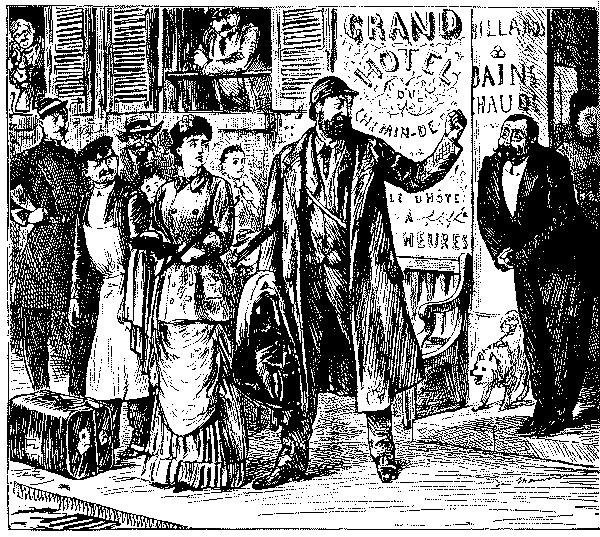
THE TIME-HONOURED BRITISH THREAT
Indignant Anglo-Saxon (to Provincial French Innkeeper, who is bowing his thanks for the final settlement of his exorbitant and much-disputed account): "Oh, oui, Mossoo! pour le matière de ça, je paye! Mais juste vous regardez ici, mon ami! et juste-vous-marquez-mes-mots! Je paye—mais je mette le dans la 'Times'!"
For another view of the suburbs one may turn to the drab and depressing realism of George Gissing's novels. Punch himself did not always look at them through rose-coloured spectacles, and a year later, under the heading "Green Pastures or Piccadilly?" (adapted from a book by William Black), emphasizes the drawbacks of a bad train service, exorbitant tradesmen, imperfect drainage, and the desolation of a region in which, from 9 A.M.. to 6 P.M.., "not a single male human being is visible, all of them being in town."
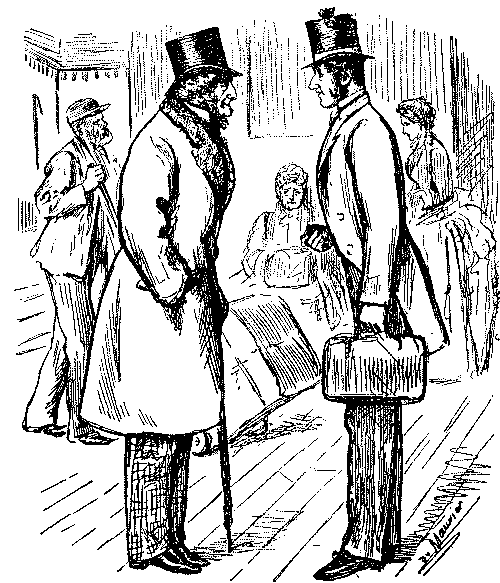
ABOLITION OF SECOND-CLASS CARRIAGES
"Are there any second-class carriages on this line, Rogers?"
"No, my lord."
"Ah! Then take two first-class tickets and two third."
"Beg pardon, my lord! But is me and Mrs. Parker expected to go third-class?"
"Gracious heavens! No, Rogers! Not for the world! The third-class tickets are for my lady and me!"
At the beginning of this period foreign travel had ceased to be the exclusive privilege of the "classes." The days of cheap trips to "Lovely Lucerne" were yet to come, but Cook was already a power in the land, and as early as the close of 1874 we find Punch frankly expressing his opinion that travel agencies had assisted to "lower middle-class-Englishize the Continent." The value of travel as a corrective of insularity and a means of promoting a better understanding of our foreign neighbours is not recognized. Residence on the Continent was another matter, and the series of articles, "Elizabeth's residence in a French country house," indicate the possibilities of enlightenment on various points. In particular stress is laid on the fact that there was no spoiling of women in France; in that country they were the real workers. At home the increase of excursion trains only served to excite Punch's wrath against their discomfort and overcrowding and the greed of directors. Yet these drawbacks did not prevent impecunious or economical aristocrats from travelling third class, though their domestics had to go first.
The everlasting servant problem recurs again and again in the 'eighties. Complaints of inadequate wages are seldom heard. In 1876 Punch refers to a letter of Charles Reade on the comparative luxury of the lives of servants contrasted with those of dressmakers. In 1875 Mrs. Crawshay, of Cyfarthfa, had read a paper before the British Association advocating the introduction of "Lady Helps," but Punch was not convinced by her arguments, and turned the suggestion to something like ridicule in his burlesque extension of the idea in a series of advertisements of "Gentlemen Helps." "Jeames" was still a target, but a dwindling target of Punch's satire. When the Morning Post was reduced to a penny in 1881, "Jeames" tells the policeman that on hearing the news "you might have knocked me down with a peacock's feather." As of old, Punch found the real root of flunkeyism in the snobbery of masters and mistresses, and the worst offenders in this period were the parvenus, like Sir Gorgius Midas, who surrounded themselves with flunkeys even at picnics, and exaggerated the ostentation of the class whose manners they crudely aped. The shabbily dressed peer is contrasted with the bediamonded parvenu, and in one of Du Maurier's "Social Problem" pictures the problem is to tell the butler from the lord, the former being a most aristocratic-looking person, while his master—a new creation—is an unmistakable "bounder." Towards the growing self-assertion of female servants Punch was much more tolerant. In 1877, when the problem was already acute, he praises an independent attitude in a servant as being merely business-like, and later on sides with Mary Ann against despotic mistresses who advertised for parlourmaids and cooks who must not wear fringes. In 1891 Punch published a set of verses inspired by the dismissal, after nine days, of a maid who refused to wear a cap. But the extremists who would make the mistress the "woman" and the servant the "lady" found no favour in his sight; he was no more a supporter of tyrannical servants than of exacting mistresses, and in 1884 our sympathies are distinctly enlisted on the side of the graceful young wife, terrified at the prospect of having to give warning to a formidable cook, and begging the page-boy to stand by during the ordeal.
Mistress and Maid
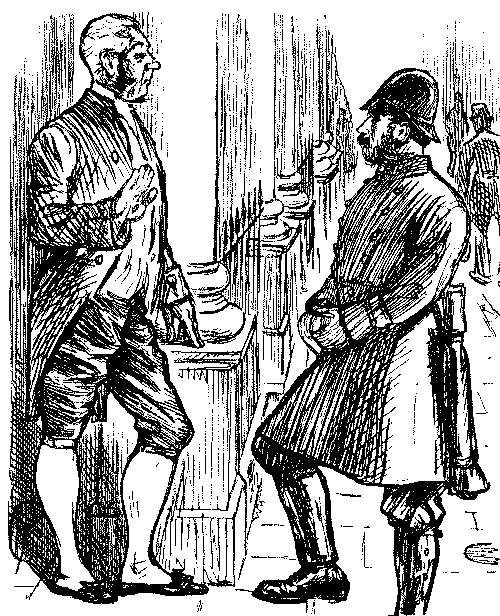
Jeames: "They tells me as the Mornin' Post is comin' to a penny! When I fust heard of it, constable, you might 'ave knocked me down with a peacock's feather!!"
In 1886 Punch discussed the formation of an Anti-Tipping League, but came to the shrewd conclusion, verified by experience, that it called for too much courage to prove successful. A year before, in a series of papers on "Public Grievances," he had published a set of letters written from different points of view, showing that mistresses and maids were both at fault. The sketch of "My Housemaid" in 1892 reverts to the old complaints of destructiveness and "followers," and notices, as special traits, a love of funerals and Exeter Hall.
Nine years earlier the Daily Telegraph had published a sensational report of the impending importation of Chinese labour for domestic service. Punch was not inclined to take the report seriously, but it cropped up again in 1882 in the St. James's Gazette:—
Domestic servants will view with well-grounded anxiety a decision arrived at by the Chinese merchants who met in conference a few days ago in London. It was resolved, among other things, to send letters to various Clubs in China, recommending emigration to England. If this recommendation is acted on, we may be on the eve of a great domestic and social revolution. There will, no doubt, be a prejudice at first in some households against the introduction into the family circle of the "heathen Chinee." But when his merits are discovered, it is not impossible he may be warmly welcomed as a valuable acquisition, meeting one of the most pressing requirements of the day.
Punch contented himself with publishing a mock protest from "John Thomas" of Belgravia against this "rediklus" proposal:—
The "St. Jeames's" takes a Lo view of the Domestic's Posishon. As if Work was the one thing Needfull. Whereas the fact is that a Footman in Good Societa is requier'd not only for Use but much more still for horniment. Look at a Chinee's legs. Look at his shoalders. Where's the bredth of the Won and the Carves of the Huther? Compare our ites mine and his. Six foot to sixpennuth of apence. Ow can I and sitch as me think of bein jellus of a Beger like that? If we was we mite petition for a additional Dooty on Forren Men Servants; but we don't want No sich Protection for Native Industry agin Imports.
The Doctors' Dilemma
In the same vein is a picture of a policeman paralysed by the appearance of a male Chinese cook in the area. But a somewhat different note is sounded in the Rip Van Winkle survey of England in 1932, published in the same number as John Thomas's protest, showing the British workman crowded out of every sort of employment by his laziness and greed and forced to take refuge in the workhouse, while the work of the country is wholly done by industrious aliens.
The scandal of underpaid governesses practically disappears from Punch's pages in this period. The evil was not extinct, but "superfluous women" were beginning to find other occupations, and the growing popularity of girls' schools undoubtedly diminished the demand for governesses.
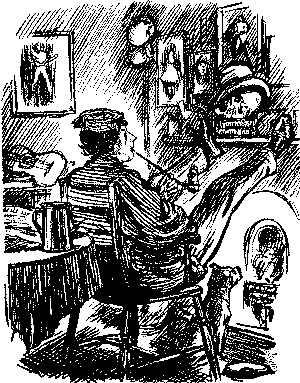
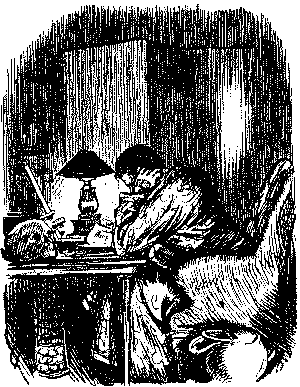
18461886
OUR MEDICAL STUDENTS
In regard to inequalities of remuneration, Punch proved himself a sturdy champion of the medical profession. A lecture by Mr. Richard Davy at the Westminster Hospital in the autumn of 1875 took a decidedly pessimistic view of the professional prospects of medical students:—
Their salaries were simply miserable; hospital physicians and surgeons were, for the most part, unpaid. Poor Law Officers most piteously; surgeons in the services very badly, and young practitioners not at all. For seven years' hard work in the Marylebone Dispensary he had received one guinea, and a very distinguished London assistant physician had found that his salary equalled that of the man who put the skid on the omnibus wheels at Holborn Hill.
He advised every one to resign at once any and every thought of becoming a medical man unless he possessed three qualifications:—First, independence; second, an aptitude and love for the profession; third, the readiness to pay a heavy premium in this world for his prospects of reward in the next.
Punch expressed righteous indignation at the "generosity" with which an appreciative Government and a grateful Public were accustomed to requite the services of medical men. But the disparities of which Mr. Davy legitimately complained were nothing to those which have been common of late years. In 1920 the demonstrators in science at Oxford were getting just about the same pay as the Oxford road-sweepers. Attempts to disparage the social status of doctors were invariably resented by Punch, and when, in November, 1880, the Bishop of Liverpool, in a speech to medical men, observed "I am not ashamed to say I have a son a doctor," Punch promptly retorted in the following epigram:—
How kind of the Bishop, and how patronizing, And yet to his Punch 'tis a little surprising, That speaking to medical men there in session, He dared speak of shame and a noble profession. A Bishop looks after our souls, but how odd is The sneer that's implied at the curers of bodies. For surely it would be no hard task to fish up, A hundred brave Doctors as good as the Bishop.
Cremation and Comprehension
Punch, it will be remembered, had been a caustic critic of medical students of the Bob Sawyer type in the 'forties. But he made his amende handsomely in 1886, when he acknowledged the change in the type and contrasted the serious and frugal modern student with the rowdy, bibulous sawbones of forty years before. Of irregular practitioners Punch had always been a hostile critic, and even the orthodox members of the profession did not always escape a certain amount of genial satire, as when, in 1886, an eminent physician, feeling ill, declines to call in any doctor because "we all go in for thinking each other such humbugs." In this context it may be permissible to add to what has already been said on the subject of cremation, and Punch's support of Sir Henry Thompson, that in 1874 there appeared the following mock "Grave-digger's Remonstrance" with that eminent surgeon:—
Who are you to be thieving The poor sexton's bread? How can we earn our living If you urn our dead?
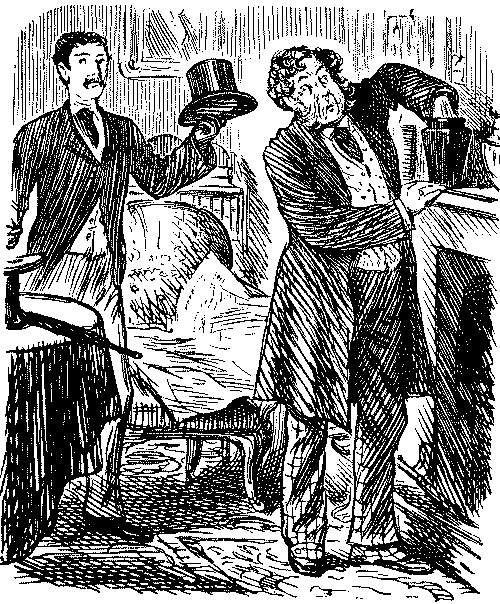
CREMATION
Nephew: "I hope you haven't been waiting long, Uncle?"
Uncle: "All right, my boy. Been reading the paper, and had a pinch—By the by, it's queer flavoured snuff in this jar of yours, Fred."
Nephew (aghast): "Snuff, Uncle!—Jar! Good gracious!—That's not snuff! Those are the ashes of my landlord's first wife!"
Punch, always a strong advocate of comprehension, saw in cremation a means of breaking down the barriers erected between conformists and nonconformists by exclusive graveyards.
Turning to other callings and the social problems which they presented, we may note that the difficulty experienced by retired officers in finding suitable and remunerative employment had begun to attract attention in 1885. The suggestions made by Lord Napier of Magdala in that year did not meet with a sympathetic response from Punch, who, in a somewhat infelicitous burlesque, foreshadowed the strange results on hotel management of the employment of officers in various menial capacities. The hardships of the underpaid clergy and "ragged curates" are seldom referred to in this period. In 1889 we are introduced to a new type in the moustachioed, eye-glassed, but energetic curate, who observes, "My vicar's away. I preach three times on Sunday, and boss the entire show." Indulgence in slang by bishops, however, did not come in till more than thirty years later.
Social inversions are a frequent theme of comment. The new commercial Crœsus expresses a contemptuous compassion for the "poor devils with fixed incomes." The Highlands are invaded by prosperous suburban tradesmen in kilts, and pen and pencil are enlisted to illustrate the embarrassments of the "New Poor," the altered balance between High and Low Life, and the comparative wealth of the working classes owing to their freedom from taxation and responsibilities. A notable sign of the times was the emergence of the American millionaire art collector. The first great ducal sale at Stowe dates back to 1848, but it was an isolated example and looked upon as almost a portent. In the 'eighties the depression of the landed interest led to further dispersion of treasures, beginning with the Duke of Hamilton's sale in 1882, and in 1889 the activity of American purchasers excited the laments of patriotic Frenchmen, echoed by Punch. There is, however, a good deal to be said on the other side when the American millionaire happens to be as enlightened and generous as the late Mr. Pierpont Morgan and his son. The influence of the "New Rich" in England on art only ministered to Punch's sense of ridicule, happily exercised at the expense of parvenus who bought books by the hundred yards or purchased faked "ancestral" portraits. These atrocities furnished congenial scope for the comments of Du Maurier's "Grigsby"—one of his most diverting creations—who plays the part of the facetious skeleton at the feasts of "Sir Pompey Bedell" and other self-satisfied plutocrats.
"Grigsby" on Family Portraits
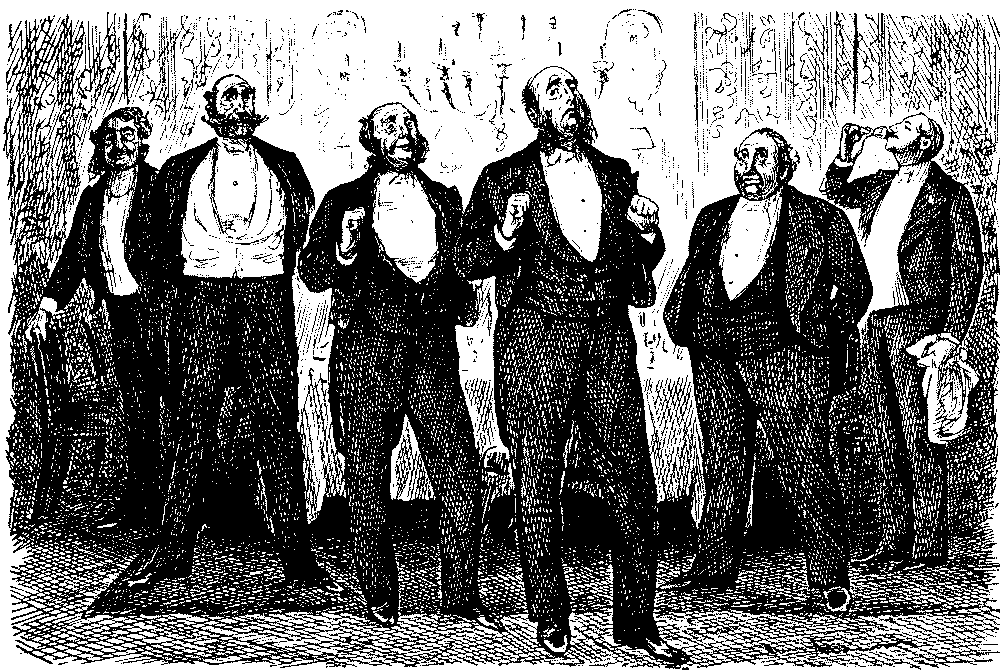
HISTORY OF A FAMILY PORTRAIT
Grigsby: "By the way, that's a new Picture, Sir Pompey—the Knight in Armour, I mean!"
Sir Pompey Bedell: "Er—yes. It came to me in rather a curious way—er—too long to relate at present. It's an Ancestor of mine—a Bedell of Richard the Third's period!"
Grigsby (who made an all but successful offer of three-seventeen-six for said Picture, last week, to old Moss Isaacs, in Wardour Street): "By Jove, he was precious near being an Ancestor of Mine, too!"
(Proceeds to explain, but is interrupted by Sir P.'s proposing to join the Ladies.)
Punch's attitude to the French, it may be noted, had grown much more genial and appreciative after the war of 1870. This mellower temper reflected a general feeling, but it was due in part at least to the influence of Du Maurier, who had French blood in his veins and had studied art in Paris. He did not refrain from chaffing the French "sportman," but his satire was delicate and tempered by candour. For example, one need only point to the picture of the Englishman in France expostulating with his French artist friend at the caricatures of Englishwomen in the Parisian Press, and suddenly silenced by the inopportune appearance of a party of Englishwomen exactly bearing out the caricature! Punch had no love of the English tourist on the Continent, and seldom failed to gibbet his inconsiderate angularity. He was no believer in globe-trotting as a means of promoting mutual understanding. But he was increasingly ready to admit that there were things which they managed better abroad, and to acknowledge that we might go very far astray if we formed our estimate of France on "Les Français peints par eux mêmes." Both nations have a way of putting their worst foot foremost, the one through shyness and reserve, the other through an excess of outspokenness, and Du Maurier's racial dualism made him an excellent interpreter of both failings.
Out of many miscellaneous features of this period we may single out the Japanese craze, a form of cheap æstheticism satirized by Punch in the early 'eighties; the popularity of the banjo, honoured by more than one reference in 1886 when it appears among the luggage to be taken to the seaside; the fashion in huge St. Bernard dogs, beloved of Du Maurier, who yet recognized the absurdity of breeding gigantic types in one of his nightmare pictures in 1879; and the plague of recitation, faithfully dealt with in Punch's admirable "Manual for Young Reciters." Christmas cards became fashionable in 1876; and Punch, as a sentimentalist, did not support the agitation against them as a "senseless extravagance" in 1878. The "Missing Word Competition" entered on its devastating career in 1892.
"Fin-de-Siècle"
As a symptom of the general speeding-up of life, and the resort to short cuts of all sorts in speech, as well as in action, one may note the appearance of a group of new words, of which "leaderette" and "sermonette" were the most notable until the arrival, many years later, of the "Suffragette." With the arrival of the 'nineties another formidable phrase, fin-de-siècle, sprang into prominence, and soon achieved a popularity that exasperated Punch beyond the bounds of endurance:—
WANTED, A WORD-SLAYER
Fin-de-siècle! Ah, that phrase, though taste spurn it, I Fear, threatens staying with us to eternity. Who will deliver Our nerves, all a-quiver, From that pest-term, and its fellow, "modernity"?
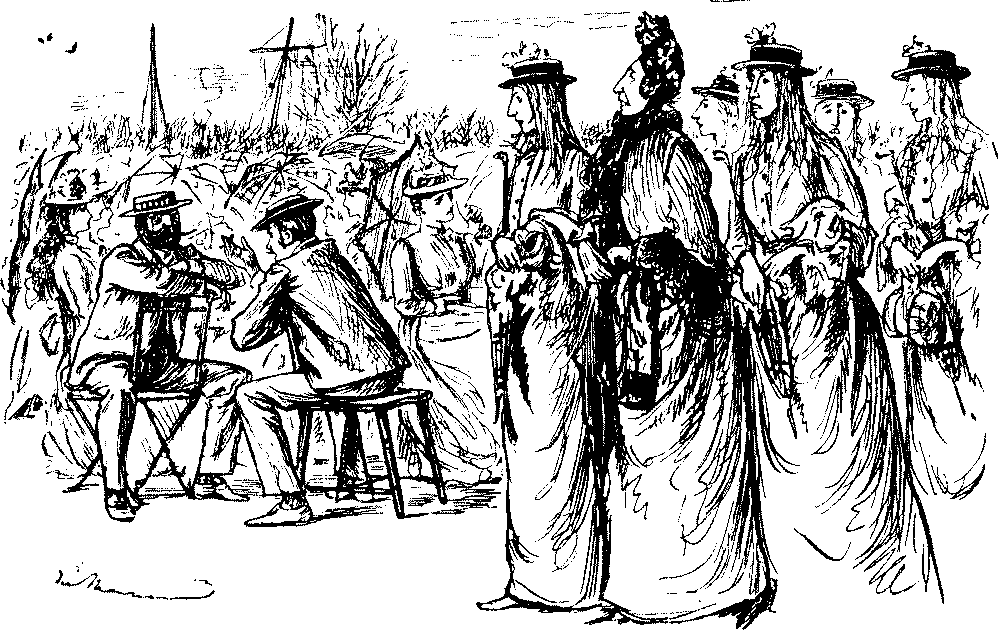
WHAT OUR ARTIST (THE INTENSELY PATRIOTIC ONE) HAS TO PUT UP WITH!
Just as he is pointing out to Monsieur Anatole Duclos, the Parisian journalist, how infinitely the English type of female beauty (especially amongst our Aristocracy) transcends that of France, or any other nation—who should come up from the beach but Lady Lucretia Longstaff and her five unmarried daughters!
—"And as for those idiotic old French caricatures of les Anglaises, with long gaunt faces and long protruding teeth and long flat feet—why, good heavens! my dear Duclos, the type doesn't even exist!"
Punch was much preoccupied with "modernity" and its numerous manifestations in these years, and his preoccupation took the form of a comprehensive series of "Modern Types," to which reference has already been made. Some of them will appear anything but modern to the Georgian reader, and, indeed, are not so much new as recurrent types—for example, the precocious undergraduate who gambles, drinks, fails in his schools, emigrates and dies miserably. The "Young Guardsman" is an eminently conventional portrait of a type which disappeared in the Great War, and is almost a libel on a Brigade whose social prestige is of infinitely less importance than its magnificent record of heroic achievement. The "Average Undergraduate" is in the main a handsome tribute to the public school system. He is not an Admirable Crichton, a Blue or a Scholar, but a decent fellow, truthful and ingenuous, who will always be a "useful member of the community." The tone of the whole series, however, is very far from ministering to national complacency. The bitterest of all these portraits is that of "The Adulated Clergyman," an effeminate, self-indulgent, insincere and unwholesome impostor, at all points a base variant of the type satirized in Thackeray's fashionable preacher, Charles Honeyman.
Punch's handling of social pests and evils throughout this period is decidedly pessimistic. The frank verses on divorce by consent—or rather collusion—in 1886 are a legitimate criticism enough. But at times he quite overshoots the mark, as, for example, in the acrimonious and grotesque tirade against the House of Lords, published in December, 1883, under the heading of "The Speaker: A Handbook to Ready-made Oratory." After giving a few notes on the personal appearance of some "titled types," the writer continues:—
There is a motto which every Peer is supposed to adopt as a rule of life—"noblesse oblige." It is presumed that every bearer of a hereditary title, carrying with it a right to receive numberless Blue Books published at the expense of the Public, is willing, in virtue of his position, to please everyone. Now it gratifies the community at large to hear a Peer talking in public, and, as some Peers cannot talk in public, it may be as well to give the specimen of the sort of speech which would cause unlimited satisfaction in all quarters but the highest. Of course, the imaginary speaker is a myth—a foolish but frank Lord, with the courage of his opinions. Should such a person, however, be found, there would be no doubt about his popularity—again, in certain circles. It must be remembered that, as the speaker would be a Peer addressing Commoners, all his Lordship's remarks would be received with the deepest approval.
"Noblesse Oblige!"
FLOWERS OF MODERN SPEECH AND SENTIMENT
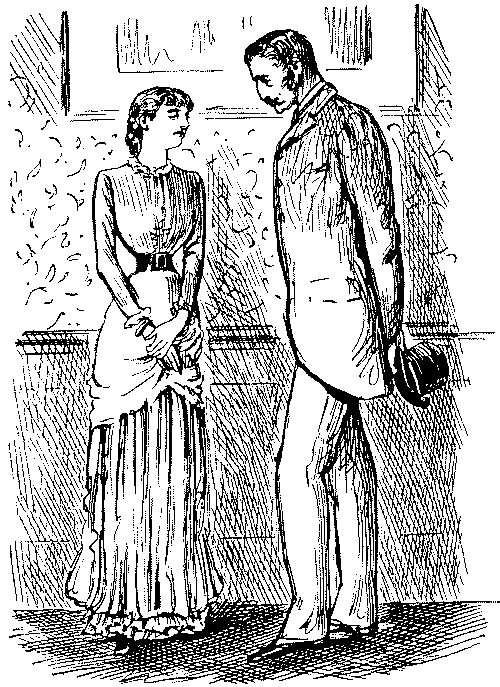
Our Gallant Colonel: "And where and how have you spent the Summer, Miss Golightly?"
Miss Golightly: "Oh, I sat in a punt with my favourite man—a quite too delicious man!"
Noble Orator (rising at the right of the Chairman). Gentlemen—(enthusiastic applause)—I am sure I must thank you for the honour you have conferred upon me. ("No, no!") Yes, it is an honour, because I believe I am verily the most uneducated dolt in all this brilliant assembly. (Cheers.) I am, indeed: and, although a great many of my peers—perhaps the majority—are highly respectable, still in my class you will discover many who resemble me in nearly every particular. (Applause.) As a lad I refused to learn anything, and could scarcely spell my name—certainly it was a long one—at fifteen. (Great cheering.) I was a dunce at school, and a cad at the University. (Frantic enthusiasm.) It is my great pride to remember that at this latter seat of learning I had the honour to burn half the College library, and to screw up the door to my tutor's apartments. (Roars of laughter.) But from this you must not imagine that I am fond of squandering. On the contrary, I audit my own butcher's book, and superintend the store-cupboard of my Lady's housekeeper. (Cheers.) I never go by a cab when I can take an omnibus, and if asked for a shilling by a genuinely starving beggar, would, after mature consideration, advance him a halfpenny on account, chargeable on approved security. (Cheers.) And yet I am very rich, enormously rich. (Renewed applause.) Many of the slums of the greatest city in the world belong to me. (Cheers.) And although slums are not pretty to look at or live in, they are good ones to pay. (Shouts of enthusiasm.) From this slight confession you may imagine that I am ignorant, vicious, mean, and grasping. (Prolonged cheering.) Well, I am all these, and more, for I am an ass into the bargain. (Thunders of applause.) Besides this, I have no birth to boast of. A hundred years ago or so, my great-grandfather swept a crossing, and his wife dealt in hare-and rabbit-skins. But what matter the past when we have the present before us! I am crassly ignorant and intolerably offensive, but I am a Lord. (Enormous enthusiasm.) And, as a Lord, I can give you what laws I please—("You can; you can!")—or never go near the House of Lords from one year's end to another. I generally adopt the latter course, except when the interest of my own class, or the gratification of a fad, cause me to perform my highly responsible duties. On these occasions, however, I take care that I represent none but myself. (A storm of applause.) Under these circumstances, as I am bored out of my life, and have just enough sense to see that I am a nuisance to everyone, inclusive of myself, I am sure you are glad that you are not me. "Noblesse oblige," I want to console you! (The noble speaker here resumed his seat amidst the wildest enthusiasm.)
Such a speech as the above would, no doubt, reconcile many listeners to cease to envy the Peerage, the more especially if they happened to be either Baronets of James the First's creation or members of the oldest (not the mushroom) county families.
Punch's Pessimism
The speaker was "imaginary," though the burning down half a College library was a true bill, and the ringleader in this exploit afterwards attained high rank as a politician. But these composite portraits are seldom satisfactory, and in this instance the resultant monstrosity ceases to be representative. The House of Lords was not exclusively composed of black sheep at any time, and on the whole more dangerous scoundrels have made their way into the elected House. But here, as so often happens, Punch provides the antidote to his own bane. In 1886, under the heading "A Radical Snob," he reprints what Thackeray wrote in his own pages just forty years earlier:—
"Perhaps, after all, there's no better friend to Conservatism than your outrageous Radical Snob. When a man preaches to you that all Noblemen are tyrants, that all Clergymen are hypocrites or liars, that all Capitalists are scoundrels, banded together in an infamous conspiracy to deprive the people of their rights, he creates a wholesome revulsion of feeling in favour of the abused parties, and a sense of fair play leads the generous heart to take a side with the object of unjust oppression.
"The frantic dwarf ... becomes a most wicked and dangerous Snob when he gets the ear of people more ignorant than himself, inflames them with lies, and misleads them into ruin."
Yet, when all allowance has been made for inconsistency and extravagance, we cannot deny that a strongly marked vein of discontent and dissatisfaction—often too well-grounded—with the "scheme of things in general" runs through the pages of Punch throughout these years, culminating in a dismal explosion of pessimism in March, 1884, over the decadence, the degeneracy and the vulgarity of the age:—
THE "ZEIT-GEIST"
Oh, for the Muse that laughed and stung On Gulliver's indignant tongue! Curt was his speech and fierce and strong, In lofty scorn of Cant and Wrong,— And small indeed the times that teach Weakness of grip for strength of speech, Craving once more that Muse to fire The chords of Satire's slackened lyre! Oh, little day of little men, What themes invite the mocker's pen! What rush for wealth at any cost, Honour and Health defied and lost; What blatant parodies of Fame (That hardly won and noble name), Dragged in the sickly spectral lee Of sallow Notoriety; Ambition's highest aim to quaff The rinsings of a paragraph, And Life's whole purpose sunk and spent To furnish an advertisement! Oh, for some Juvenalian verse Thy sound and fury to rehearse, While Indignation pours the strain Which Nature may desire in vain.[9] Where'er the stifled spirit fly, What sights and sounds obscure the sky! The Statesman's cut-and-dried abuse, And frothy violence turned to use, Dead Christian hatreds spurred to life, To serve the ends of party strife; The Lawyer's pæans in his fees; The Actor's noisy juggleries, As every little journal tells Where last he shook the cap and bells; The Critic in his newest dress, Sans scholarship or kindliness, With no credentials under Heaven For worthy work or asked or given, And nagging, after Insult's wont, At those who "do," for those who don't; Patriots by bravos hired and sung, For bright sword carrying fish-fag's tongue. The Poetaster's mixture, made Of pitch and darkness for a trade; The Man of Science, self-crowned King Of Learning and of everything, Serenely squatting on his throne, Fogged with conundrums of his own, And probing with his two-foot rod His muddy substitutes for God,— While tambourines and banjos raise The Hymn of Noise for that of Praise; Our very island's sea-girt rock Risked to be land-bound into "stock"; Ay, even Woman's tarnished crown Hawked through the windows of the town, And all our sires held first and best In pufferies of all sizes dressed, Till England watch, through England's Press, The fall of English manliness! Vexed soul, seek out some other shore; Houses are castles here no more; Vain in the penny-age to fly From all the penny-trumpetry: Or hide thee from the watchful zeal Of those who serve the weekly meal For jaded gluttons, keen to gloat On savoury sauce of Anecdote. Yet let nor cook nor eaters rue, The eaten seem to like it too, For in Society's new game Cooks, food, and eaters are the same, And Fashion, spider-like, supplies Her self-spun web to catch her flies! Thou boastful "Spirit of the Time," Wake prose itself to angry rhyme! Soon shall the dark forbid the light To any hand with power to write, And the new myriad scribbling-race, Like locusts shroud all Sense's face, Rushing (where angels are not seen) Into the Prigs' Own Magazine, While Upper-Tens profusely scrawl In grammar from the servants' hall, Till Ink itself shall blush to tint Nothing but amateurs in print, And the true child of letters learn He has no space to breathe or turn, And scorn accept the Century's plan, That all may write, save those who can. I turn me, wearied, at my desk, From the last "thinker's" last burlesque The last Agnostic's windy plea That none knows anything, but he, In English carefully destroyed To hide his meaning's outer void; And, bowing to the wisdoms old, Read simpler lessons writ in gold: And would but in a single word The "Spirit of the Age" be heard, Let him take up his glass and see His image this—Vulgarity. Marius.
The Spirit of the Time
What a list it is! The quest of notoriety, blatant advertisement, party rancour and sectarian strife, forensic greed, mummer-worship, incompetent and ungenerous criticism, fleshly poetry, the arrogance of science, "Corybantic Christianity," tarnished womanhood, the decay of manly fibre, prying journalism, amateurism in letters, windy Agnosticism, with vulgarity enthroned as high priestess of the age! Modern Juvenals, when they are Jeremiahs into the bargain, are not exhilarating companions. Here Punch saw life in England neither steadily nor whole, and made the mistake, not surprising in a Londoner, of confounding the extravagances, the eccentricities and the vices of London coteries and cliques, and, above all, of her idle rich, with the tone and temper of the nation at large. "Smart" London Society did not represent England or even London. But Punch spoke with many voices, and in the "Voces Populi," with which, towards the end of this period, Mr. Anstey had begun to refresh and rejoice the hearts of his readers, you will find an agreeable corrective of the unqualified pessimism of "Marius." The "people" whose "voices" are recorded were often ridiculous, vulgar and semi-educated, but they were not corrupt or degenerate. Twenty years later the extravagances castigated by "Marius" were even more pronounced, but were confined to the same limited though highly advertised circles. Yet many of those who seemed most wedded to self-indulgence were capable of a noble regeneration in the hour of their country's need. And outside these circles there was, in 1884, as at a later date, a great if unobtrusive throng of men and women who stood in the authentic line of the heroes and heroines of the past, only waiting for an opportunity to prove themselves the inheritors of their spirit.