MEN AND MASTERS: WORK AND WAGES
Reading edition
In the preceding volume I endeavoured to trace and account for the waning of Punch's reforming zeal and democratic ardour, and to illustrate his gradual movement from Left to Right Centre in the 'fifties, 'sixties, and early 'seventies. Many abuses had been remedied, the barriers of class privilege had been broken down, the cleavage between the "Two Nations" was less glaring, national prosperity had increased, the ladder of learning had been set up by Forster's Education Act. Free Trade and Gladstonian finance had eased the burden of the working man and the taxpayer. England was not a Utopia, but she had travelled far from the days of the Hungry 'Forties. In December, 1883, the late Sir Robert Giffen, one of the most trustworthy and deservedly respected of the much abused tribe of statisticians, published a comparative table of the consumption of the agricultural labourer in 1840 and 1881. Punch's comment takes the form of an imaginary letter from a farm hand under the heading of "Food and Figures":—
"Sir, Maister Punch,
"Look 'ee here, Sir. Squire Giffen, a-spoutin' tother night about I and we country folk, stuck to it that we wur better fed nowadays than we wur forty-one year ago; and them as 'eard 'im say that there, they up and swore as how we wur a grumblin', cantankerous, discontented, set o' chaps as didn't knaw naught of our own jolly good luck. Now look 'ee 'ere, Maister Punch; 'ere be Squire Giffen's figures. Says he that forty-one year ago, that be in 1840, I eat this 'ere in the first column, say in about a couple o' weeks, and that now I gets through this 'ere, wot he's set down in the second, in the same matter o' time."
Food and Figures
The table follows, and then Hodge continues:—
"Now addin' all that there up, that be for 1840, about 69 lbs. of food for I; while now he says, says he, 'Hodge, you old pig, you swallows 373 lbs.—that be six times as much—just as easy in the same time, and you grumbles at it too!' Now look 'ee 'ere, Maister Punch, if I does that there—and figures is figures—well ain't it plain that a feed up like that must give I such a fit o' blues from indigestion, as sets I hankerin' about franchise and land stealin', and such like things o' which I knows and cares just naught, and gets I called by a set o' chaps, as wants nothin' more than to make summat out o' me, yours all of a puzzle,
"Discontented Hodge."
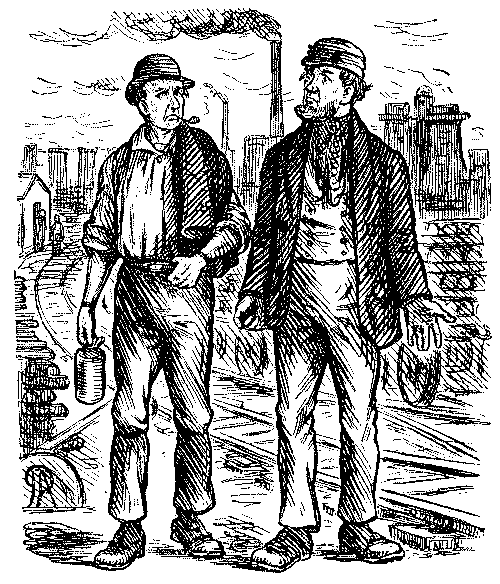
THE WAGES QUESTION (Overheard at Ironopolis)
Intelligent Working Man: "Arbitration! Ca' that arbitration! Why, they've given it against us!"
"Appetite comes with eating"; and here we have a concrete and "luciferous" example of the somewhat grudging approval which made Punch acknowledge improved conditions, while at the same time he expressed his misgivings at the leverage which the improvement furnished to agitation and unrest. In the 'forties Punch had recognized that the legitimate grievances of the underfed masses were a real danger. He now recognized, or at any rate implied, that when well-fed they might become equally dangerous under the guidance of extremists. He still believed that there was a great fund of inert anti-revolutionary sentiment amongst the rank and file of the people, but long before the days of "direct action," was alive to the possibilities inherent in the oligarchical rule of Trade Unionism. He saw that a well-organized minority in a key industry might dislocate the whole fabric of production, and when in 1877 the miners attempted to restrict output in order to keep up the price of coal and the rate of wages, addressed the following remonstrance to Mr. Macdonald, the mining M.P.:—
THE ARGUMENT A MINORI
So you suggest that they our coals who quarry Should shorten shifts to raise black diamonds' price? But, if so, why should other workers tarry, Each in his craft, to follow your advice? Till soon, hauled o'er the coals, like spark in stubble, Over-production's doctrine goes ahead, And all trades work half time, and come down double For beef and beer, for house, and clothes, and bread!
Towards the close of the 'seventies industrial distress was so general that in January, 1879, Punch abandoned his critical attitude and appealed for united effort and a cessation of party strife to drive the wolf from the door. The "New Charity" that he recommended was a voluntary curtailment of the luxuries of the rich—balls, entertainments, dinners, and theatre parties, the purchase of jewels, wines, etc.—in order to help in relieving distress. This involved a surrender of his old argument in favour of the production of luxuries on the ground that they provided lucrative employment. At the same time, the terrorism applied to non-Unionists by the "Rebecca" gangs in Durham moved him to vigorous protest, and in the verses on "blacklegs" in April he writes:—
Blackleg versus Blackguard be it! Let's see which shall have their way!
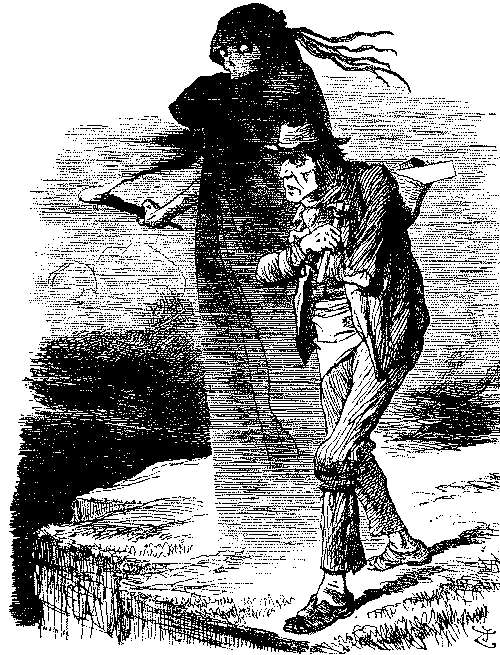
THE TEMPTER
Spirit of Anarchy: "What! No work! Come and enlist with me—I'll find work for you!!"
Henry George and Socialism
Henry George's Progress and Poverty, which attained a wide circulation in 1883, comes in for a good deal of hostile criticism. It was an epoch-making book; and though, as water to wine when compared to the strong drink of modern anti-capitalistic literature, it was thought worthy of serious attention by Punch. In his cartoon in January, 1884, Red Riding Hood is confronted by the Wolf of Socialism, with Henry George's book peeping out of his pocket. Punch, who reminds us that Mr. Labouchere called the author "George the Fifth," admits that gross inequalities existed, but saw no remedy in Henry George's policy, which he regarded as wholesale robbery, and in "St. George and the Dragon" ranked the American author along with Proudhon, the author of the saying "Property is Theft." Yet a few weeks later he rebukes the Duke of Albany, who, in a speech at Liverpool, had recommended that the poor should be taught cookery. Punch was a great believer in cookery, but held that your hare must be caught first:—
Prince, you spoke a word in season 'Gainst uncleanly plates and slops, But the workman cries with reason "Teach me first to catch my chops."
In 1886 the number of the unemployed rose to a formidable figure. There was rioting in Pall Mall and Piccadilly on February 8th after a meeting in Trafalgar Square, and Punch, under the heading, "Sneaking Sedition," indulged in a violent tirade against the "firebrand fanatics," Messrs. Hyndman, John Burns, and Champion. It is headed by a picture in which Punch is gleefully stringing up three puppets whose faces are portraits of the three "blatant trumpeters of sedition who prated a mixed mob to passion heat, and then discreetly withdrew whilst that passion found vent in wrecking and ruffianism." The writer denies with an exuberance of fiery rhetoric that they represented the unemployed, or anything but "fanatic hatred and shallow conceit—that is to say, themselves." They were "cowardly Catilines of the gutter," recruiting sergeants of the "Army of Anarchy," "Sedition-spouters," who egged on "the drunken, violent unworking-Man" to outrage. Punch appealed to all honest working men to repudiate these so-called but misrepresentative leaders, and "sweep these social democrats for ever from the land." It is a tremendous tirade, but disfigured by a great deal of sheer abuse, and the cause of law and order was not assisted thereby. Sedition cannot be quelled by strong language, and Punch admitted that honest wage-earners were exploited by Capitalists, Monopolists, and Middlemen; that all must compassionate the workless working man, and that all should help him by friendly aid at the moment and hereafter by well-considered reform. In the same number a strong appeal is made to the opulent to help the Mansion House Fund for Unemployed, and not to be scared by frothy street sedition. There had been wild talk at the Trafalgar Square meeting about gallows and lamp-posts for Ministers and Members of Parliament, and Punch, who on occasion was a true prophet, may be pardoned for his failure to foresee a time when John Burns would be denounced as a crusted bureaucrat and Mr. Hyndman publish an enthusiastic eulogy of the Clemenceau whose motto was "Je fais la guerre."
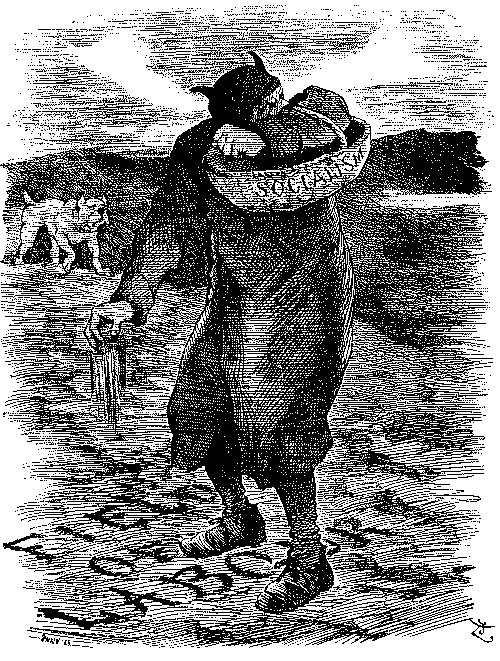
SOWING TARES (With a thousand apologies to Sir John E. Millais, Bart., R.A.)
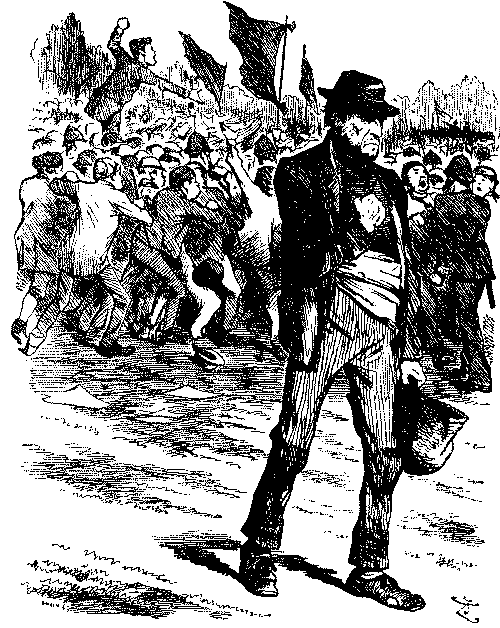
THE TWO VOICES
One of the Real "Unemployed": "How am I to make my voice heard in this blackguard row!"
Unemployed and Unemployables
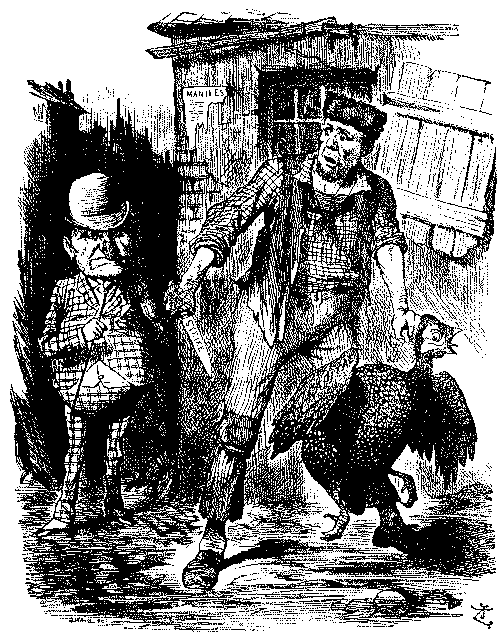
THE GUINEA-FOWL THAT LAYS THE GOLDEN EGGS (Æsop slightly altered)
Mr. P.: "Don't lose your head, my man! Who'd suffer most if you killed it?"
The contrast between the unemployed and the unemployables is repeatedly emphasized in these years. Works were closed down because the hands took themselves off to join a procession of unemployed. Wasters refused work, preferring hymn-singing in the streets and levying doles from credulous householders. A cartoon in 1887 shows one of the "real unemployed" exclaiming: "How am I to make my voice heard in this blackguard row?" Socialism is seen "Sowing Tares"—after Millais's picture. Anarchy as the tempter prompts unemployment to plunder, looting, and riot—the wrong way. But Punch was not content with chastising sedition-mongers, and in another cartoon rebuked callous complacency as a real danger in a time of serious distress. The contrasts of splendour and discontent were curiously illustrated in these years. In the spring of 1886 there was a "scene" at the Opera when the scene shifters struck work in the middle of the performance, and appeared on the stage begging for money. In 1887, the year of the Queen's Jubilee, special constables were sworn in, and Mr. Gladstone as the "Grand Old Janus" is shown with one face applauding a constable "downing" an English rough, while the other frowns on an R.I.C. man standing over a rebellious Irishman. It was in the same year that the growth and popularity of street processions moved Punch to protest against the invasion of the Parks by public meetings, which drove away quiet people who used them for recreation from fear of King Mob and the rabble rout. The procession habit has long since come to stay, though it is only of recent years that the presence of children has become a feature in these demonstrations. As for the Hyde Park stump orators, the types genially satirized in one of the Voces Populi series in 1889 include the Elderly Faddist, the Irish Patriot, the Reciter, and the Physical Force Socialist. The Reciter, who dates back to the time when the Latin satirist spoke of him as a nuisance in the dog-days, has disappeared from the Parks, though he flourishes in Georgian coteries. The other types remain with us, together with some new varieties. But there is little new under the sun. In 1887 the Annual Register mentions the exploit of a political agitator who chained himself to the railings in a conspicuous position in Central London, thus depriving the militant "suffragettes" of the credit of introducing this method of protest.
Praise for Cardinal Manning
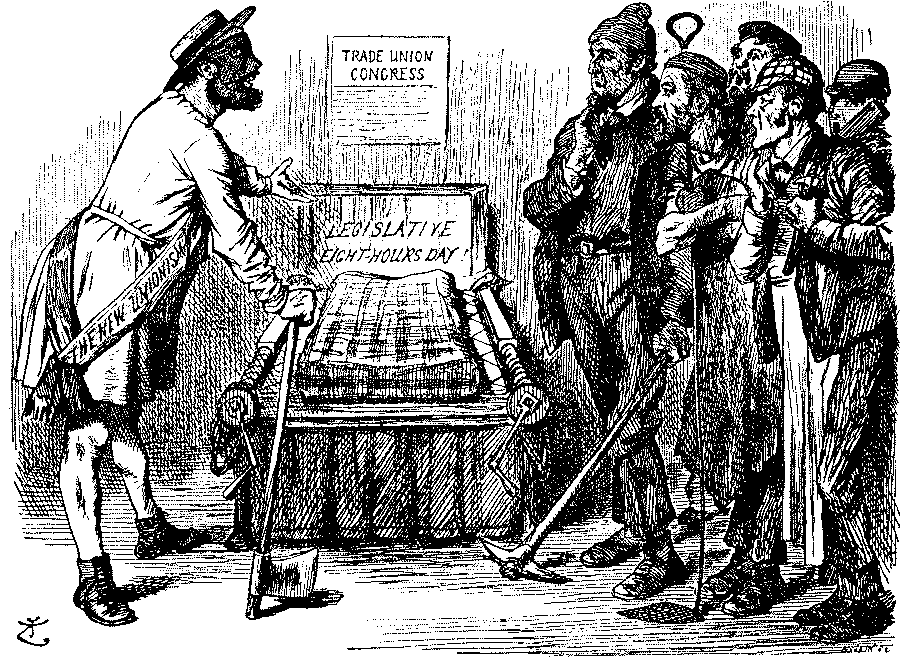
THE MODERN "BED OF PROCRUSTES"
Procrustes: "Now, then, you fellows; I mean to fit you all to my little Bed!"
Chorus: "Oh, Lor-r!"
["It is impossible to establish universal uniformity of hours without inflicting very serious injury to workers." (Motion at the recent Trades Congress.)
In the great dock strike of 1889 Punch, on the whole, showed a disposition to side with the men. In his first cartoon in September the working man appeals to the employer to think less of his luxuries, more of Labour's needs. A week later Punch appeals to the working man not to kill the guinea-fowl (Trade), that lays the golden eggs, by striking. In October, employer and employee are shown at the game of Beggar-my-Neighbour, the master playing Lock-out against Strike. Punch pleads for give-and-take. Both will lose by the game they are playing. The same argument is further developed a few months later in another cartoon in which the foreign competitor is the tertius gaudens. The foreign Fox goes off with Trade, while the two dogs, Capital and Labour, are asleep. To return to the dock strike, we may note that Cardinal Manning's intervention was warmly applauded. Punch thought the Cardinal ought to have been made a Privy Councillor and Lord Mayor Whitehead a baronet for their services as conciliators. Praise for a Cardinal and a Lord Mayor is indeed a wonderful change from the Punch of forty years earlier. The settlement of that "deed of darkness," the gas strike in 1889, prompted the cartoon showing the indignation of Bill Sikes and the Artful Dodger over the frustration of their plans. Industrial troubles were rife in 1890. The Labour May Day, already instituted, inspires a set of verses after Tennyson, in which an enthusiastic operative sings,
"Toil's to be Queen of the May, brother, Labour is Queen o' this May!"
The introduction of an eight hours' day, already vigorously agitated for, set Punch thinking on what would happen if the principle were logically applied all round—to the Courts, restaurants, theatres and the medical profession. He returned to the subject in the following year, and came to much the same conclusion—that it would turn out a new bed of Procrustes, on the ground that the universal uniformity of hours of work could not be established without inflicting serious injury on the workers. Socialism still continued to preoccupy Punch in 1890. This time it is depicted as a snake attacking an eagle in mid-air, rather a strange inversion of natural history. The eagle is Trade, the wings are Labour and Capital. The prosaic critic will ask how the snake got there except on the wings of a soaring imagination. John Burns is still a favourite bête noire, and is severely rebuked for his dictatorial and aggressive speeches at the Trade Union Congress and his action in connexion with industrial trouble on the Clyde, the ghost of Robert Burns being invoked to chastise his namesake in an adaptation of "The Dumfries Volunteer." At the Congress John Burns had said that he was "in the unfortunate position of having probably to go to Parliament at the next election, but he would rather go to prison half a dozen times than to Parliament once.... He must know on what terms he must do the dirty work of going to Parliament." This was not a happy utterance, though it hardly merited Punch's bludgeoning. Burns was "perhaps Boanerges spelt little": he "laid about him like mules who can kick hard"; "the mustard had gone to his nose," etc. But in view of the way in which Mr. Burns sank without a ripple from public notice in August, 1914, there is point in the caution:—
Be warned in good time—why there isn't a man, Sir, Or at most one or two, whom the universe misses; You strut for a moment, and then, like poor Anser, You vanish, uncared for, with splutter and hisses.
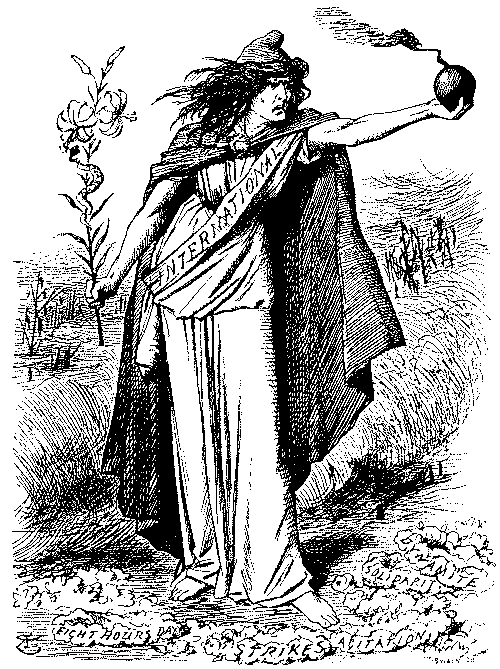
THE NEW "QUEEN OF THE MAY"
The Coal Strike of 1890
To modern readers, however, the most instructive passages dealing with industrial unrest in 1890 relate to the Coal Strike. In March of that year Punch published a prophetic journal of events, looming possibly somewhere ahead, of life in London after being without coal for sixteen weeks. It is interesting to compare this forecast with the realities of 1921. According to the prophet, people have burned their banisters and bed furniture; a syndicate of noblemen start boring for coal in Belgrave Square, but are stopped by the sanitary inspector. The wood pavement is pulled up and riots have broken out. The Archbishop of Canterbury preaches on the Plague of Darkness in the Abbey by the light of a farthing candle, which goes out; etc. Even if the recent stoppage had lasted sixteen instead of thirteen weeks, it is more than doubtful if Punch's prophecies would have been fulfilled. At best they are an exercise in burlesque, and lacking in circumstantial imagination. Punch might have foreseen the scenic possibilities of a long coal stoppage and its clarifying effect on the atmosphere. And with his belief in the solid sense of the people he ought to have refrained from the suggestion of riot. But he may be pardoned for failing to foresee how oil would come to our rescue. At the close of the same month Punch addresses a versified remonstrance to the miners. He admits that pay should be liberal for dangerous underground work, but deprecates the use of the strike weapon as ruinous to trade and other industries by the laying up of ships and the closing of factories and railways. So, just two years later, in a cartoon on "Going on Play," he condemns the miners' strike, which aimed openly at creating an artificial scarcity, and thereby kept up wages. A poor clerk is seen expostulating with a working man: "It's all very well, but what's play to you is death to us." In the omnibus strike of 1891 Punch was decidedly sympathetic towards the overworked drivers and conductors, just as he backed up the hairdressers in the same year when they agitated for an early closing day and better and healthier conditions. The verses on the Democratic Village of the Future, a paradise of sanitation in which there would be no more "bobbing to their betters," and the rule of Squire and parson would cease, are largely ironical, and the Socialist appropriation of May Day inspires a long warning to this "new May Day Medusa"—the International—in a "Hymn of Honest Labour" in May, 1892.
Bidding for the Labour Vote
Irony predominates, again, in the cynical verses of a year earlier satirizing the tendency of all parties to bid for the Labour vote:—
STRIKING TIMES New Version of an Old Street Ballad (By a Labouring Elector)
Cheer up, cheer up, you sons of toil, and listen to my song, The times should much amuse you; you are up, and going strong. The Working Men of England at length begin to see That their parsnips for to butter now the Parties all agree.
Chorus.
It's high time that the Working Men should have it their own way, And their prospect of obtaining it grows brighter every day!
It isn't "Agitators" now, but Parties and M.P.'s, Who swear we ought to have our way, and do as we darn please. Upon my word it's proper fun! A man should love his neighbour, Yet Whigs hate Tories, Tories Whigs; but oh! they all love Labour!
Chorus—It's high time, etc.
There's artful Joey Chamberlain, he looks as hard as nails, But when he wants to butter us, the Dorset never fails; He lays it on so soft and slab, not to say thick and messy, He couldn't flummerify us more were each of us a Jesse!
Chorus—It's high time, etc.
Then roystering Random takes his turn; his treacle's pretty thick; He gives the Tories the straight tip—and don't they take it—quick? And now, by Jove, it's comical!—where will the fashion end?— There's Parnell ups and poses as the genuine Labourer's Friend!
Chorus—It's high time, etc.
Comrades, it makes me chortle. The Election's drawing nigh, And Eight Hours' Bills, or anything, they'll promise for to try. They'll spout and start Commissions; but, O mighty Labouring Host, Mind your eye, and keep it on them, or they'll have you all on toast!
Chorus.
It's high time that the Working Men should have it their own way, They'll strain their throats—you mind your votes, and you may find it pay!
We have now seen Punch more as the critic than the friend of organized Labour, and it will be remembered that even in his most democratic days he evinced a deep-rooted distrust of delegates and Union officials. But there is another side to the picture, in which the old championship of the poor and oppressed is as vigorous and vocal as ever. If Punch was more mistrustful of Trade Unionism, he was at least as unsparing as in his early days in pillorying examples of the greed and tyranny of masters and employers who misused their opportunities of exploiting unorganized or partially organized labour. In the notes made for this section during this period the very first relates to the sinking of the La Plata and the burning of the Cospatrick, two emigrant ships, in 1875, and the indignation felt when it was found that the cargo of the latter vessel was highly inflammable and the boats inadequate in number. The scandal moved Punch to rewrite Dibdin, with compliments to Mr. Plimsoll for his campaign against coffin ships, which had not yet been carried to its successful legislative conclusion. He also published, in January, 1875, a mock inquiry—after the manner of Dickens's Bardell v. Pickwick trial—by shipowners into the loss of the emigrant ship Crossbones. The Court exculpates the offenders after finding that the cargo—containing all sorts of combustible and inflammable materials—was of the most harmless description, adding as a rider that the boats should in future be always launched keel upwards. The old abuse of the "climbing boys" still reared its unsightly head; Lord Shaftesbury, in the debate on his Chimney Sweepers' Bill, in May, 1875, quoted the remark of a master sweep: "In learning a child you can't be soft with him; you must use violence," and Punch enlarged on this text in his best manner. No appeal on behalf of children left him unmoved. When subscriptions were invited in 1878 to lay out a children's playground near St. Peter's, London Docks, he suggests that the fortunate children of the West End should help to give this playground to their less favoured brothers and sisters of the East. As a lover of children, Punch was quick to recognize those who had laboured on their behalf. In the Christmas number of 1879
George Smith of Coalville
he tells the life story of George Smith, of Coalville, who began life as a poor lad in the brickfields; worked his way up to the post of foreman and manager; and then devoted his life to calling attention to the cruel overwork and ill-treatment of the children whose labour he had once shared. In spite of neglect, opposition, and obloquy, he secured the passing of an Act which brought these hopeless little outcasts under the eye of Inspectors, limited their hours of labour, and secured them some measure of teaching. Though his action gave grievous offence and he lost his job, he set to work to render a similar service to the children of the bargees, and was the main agent in passing a law for the registration and inspection of canal boats. In these labours he sacrificed not only his time, but his means, and Punch appealed to his readers to contribute to the support of "this practical preacher of good will to man, this friend of the friendless, this helper of those who, till he came, had none to help them."
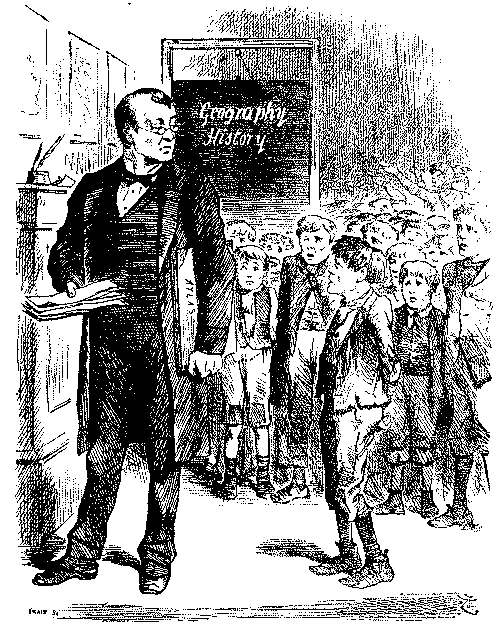
CRAMMING VERSUS "CLEMMING"!
Board-School Master: "Now then, boys, we must get to work again!"
Advanced Scholar: "Please, Sir—mayn't we have somethin' to relieve the craving of 'unger fust?"
In 1881 the hard time of boys in attendance on weighing machines, said to be on duty for thirteen or fourteen hours a day, aroused Punch's sympathy and ire. Invention, however, rather than philanthropy, furnished a remedy in the "automatics."
In the same year Punch's appeal for the fund to provide poor children with country holidays, embodied in "The Children's Cry," enabled him to forward £280 to the promoters. In 1885 the "almost formidable success" achieved by the experiment of Poor Children's Play-Rooms, in the parish of St. Martin's-in-the-Fields, delighted his heart. In 1888, Punch, in "Cramming versus 'Clemming'" emphasizes the need of providing free meals for poor children. At the very end of the period under review in this volume I have come across a notice of a book purporting to show up the cruelties practised on young people and animals in training them for acrobatic performances. The book was poor as literature, but if true called for searching inquiry. Children have, we may safely assume, been long safeguarded from the mishandling alleged to have been possible in 1892; but at the moment of writing these lines—August 11, 1921—an inquiry is being held into the treatment of animals by showmen and conjurers.
Nor was Punch less concerned with the conditions of women workers. In his "Dream of Fair Women " suggested by factory inspectors' reports in 1875, he points to lack of combination among women as the incentive to slave-driving on the part of "foggers." He prefaces a set of verses in October with a passage from a Report on the Black Country:—
The women are said to take the place of fathers as well as husbands, while the men are idle and drunken.... At Bromsgrove I heard also of the growing custom of idle, lazy young lads looking out for skilled industrious wives, in order to obtain an easy life.
Men, Women and Dogs
It was, as Punch puts it, an inversion of the old legend of Penthesilea and the Amazons. Women were unsexed by labour and serfdom. As for the men:—
You loaf, train your whippets, and guzzle and gorge, While they sweat at the anvil, and puddle and forge.
So at the time of distress in the mining districts in 1875 the miners are accused of using charitable relief for the welfare of their dogs rather than of their families. "How is it," asks a benevolent directress, "you've brought two cans to-day, Geordie?" And a miner on strike replies: "The yain's for my mither, marm, and t'uther for the greyhound."
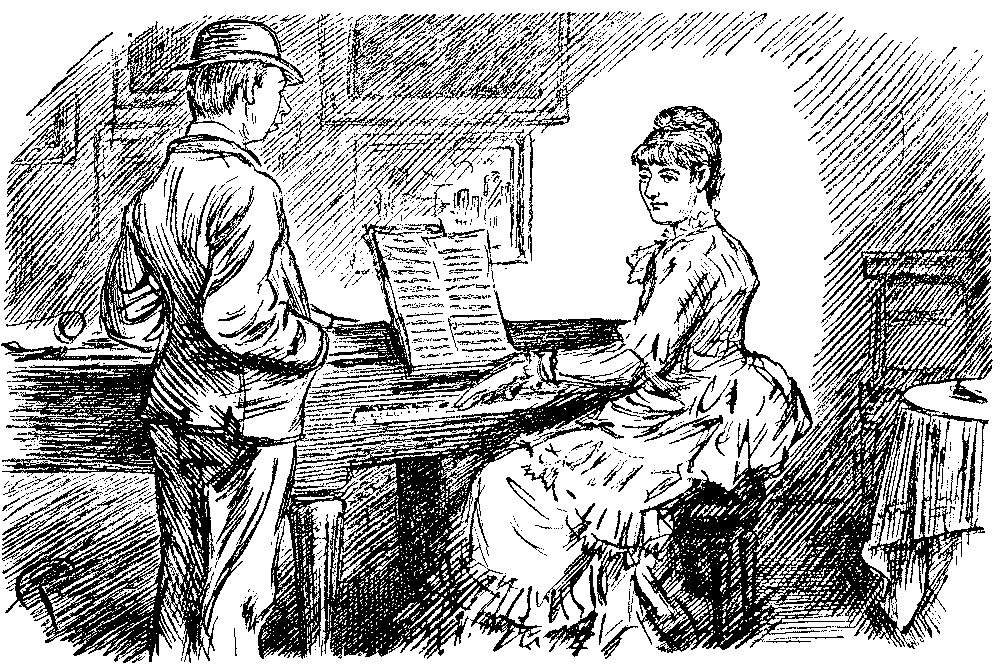
"TEMPORA MUTANTUR"
Farmer's Daughter: "I say, Jem, fancy! Mother said to me to-day I was to help in the Dairy, and might help in the Milking! Because she did when she was a Girl! I said I'd go for a Gov'ness first!"
There is little mention of the hardships of life on the land, though labourers' wages were still very low; but the rise of the farmer class to "gentility" is noted in 1885 in the picture of the farmer's daughter seated at the piano and declaring that she would rather go as a governess than help in the dairy. Punch's sympathies were more readily enlisted on behalf of shop and saloon girls. The movement began in Bristol in 1876, where a number of ladies issued a circular to employers asking that chairs should be provided for shop girls; the plan was adopted in Manchester, and, following the lead of Lancashire, Punch repeatedly urges the plea for more considerate treatment. The matter was "beyond a joke," and Punch recommended ladies to patronize shops where they were allowed, and boycott others. The subject was taken up by the Lancet, and the movement spread to Scotland, where a group of ladies made a personal tour of inspection in Edinburgh to see which shops provided seats. One of Punch's pictures in this year shows a considerate customer handing a chair over the counter to a tired shop-girl, and a set of verses describes a girl driven into sin by need of rest. As he put it in his plea for "More Seats and Shorter Hours," "A country where humanity interposes on behalf of an over-driven cab-horse will surely not go on suffering hard-working, weak and defenceless girls to be driven to death with impunity." There was only one other place in which seats are not allowed. "That is the House of Commons, but there the torture is only inflicted on one-half of the Members." We hear little nowadays of the hardships of shop-girls, but the seating accommodation of the House of Commons is even more inadequate than in 1880. Punch, however, discussed Sir John Lubbock's Shop Hours Bill in 1887 with an impartiality that borders on inconsistency, showing the other side of the question and the popular preference in poor districts for shopping in the evening, districts in which "St. Lubbock" was looked upon as a well-meaning but fussy philanthropist.
"The Cry of the Clerk"
As an individualist, a lover of independence, and an opponent of monopoly, Punch was in a difficult position. Some, at any rate, of the monster shops led the way in the humane and considerate treatment of their assistants. But the freezing out of the small shopkeeper struck him as an undoubted hardship, and in 1886 he published a prophetic article describing an interview in the "dim and distant future" between a Stranger and the last shopkeeper in London. It is an allegory of the tyranny of capitalism and monopoly, of the cult of bigness and universality, the triumph of ubiquitous caterers. That "dim and distant future" has not yet arrived, and after thirty-five years the small shopkeeper is still going almost as strong as in the days when Punch uttered his dismal prophecy. But his most impassioned plea in the 'eighties was not uttered on behalf of the working man or woman, or the small shopkeeper. It was reserved for the victims of State parsimony, underpaid clerks and Government officials. The campaign on behalf of these new protégés of his opened with "The Cry of the Clerk," a long wail, charged with sentiment, uttered by an overworked and underpaid drudge:—
I don't growl at the working man, be his virtue strict or morality lax; He'd strike if they gave him my weekly wage, and they never ask him for the Income-tax! They take his little ones out to tea in a curtained van when the fields are green, But never a flower, or field or fern in their leafy homes have my children seen. The case is different, so they say, for I'm respectable—save the mark! He works with the sweat of his manly brow, and I with my body and brain—poor Clerk!
Why did I marry? In mercy's name, in the form of my brother was I not born? Are wife and child to be given to him, and love to be taken from me with scorn? It is not for them that I plead, for theirs are the only voices that break my sorrow, That lighten my pathway, make me pause 'twixt the sad to-day and the grim to-morrow. The Sun and the Sea are not given to me, nor joys like yours as you flit together Away to the woods and the downs, and over the endless acres of purple heather. But I've love, thank Heaven! and mercy, too; 'tis for justice only I bid you hark To the tale of a penniless man like me—to the wounded cry of a London Clerk!
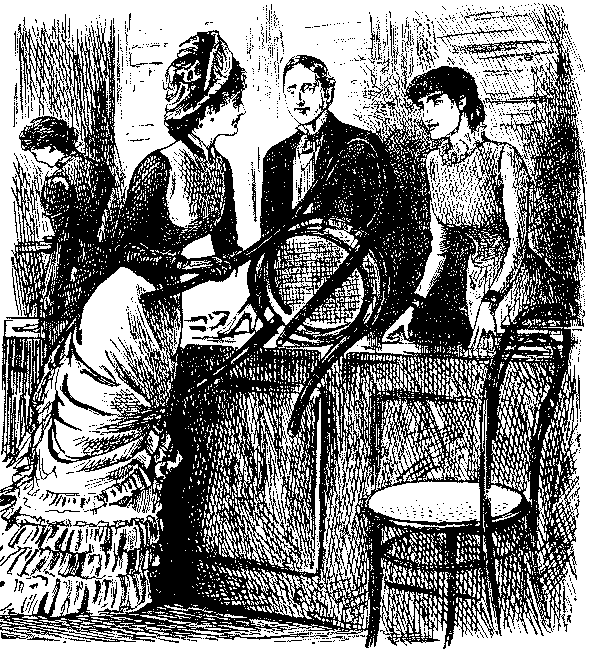
TAKING THE LAW IN ONE'S OWN HANDS
Fair but Considerate Customer: "Pray sit down. You look so tired. I've been riding all the afternoon in a carriage, and don't require a chair."
The verses lack the desperate poignancy of Hood's "Song of the Shirt," but they made their mark and were quoted in their entirety in The Times. Subsequent articles and verses especially single out the telegraph clerks as the victims of State slave-driving. Punch declares that there was no rest for the telegraph "operator," and describes a letter of appointment from the Government to one of this class as being really a death warrant, offering £65 a year with the prospect of rising to £160 after twenty years' service. Early in 1881 he writes under the heading, "Wiredrawn Salaries":—
The giggling girls, precocious boys, and half-starved clerks, who form the Telegraphic Staff of that money-grubbing department of Government—the Post Office—have petitioned for a slight increase of pay, and have been officially snubbed for their pains. They have petitioned for eight years, and for eight years they have received no answer. The Manchester clerks were too wise to petition. They struck, and their demands were at once attended to.
New Views of the Strike Weapon
This is not very polite to the ladies, but the comment is significant, since it shows that Punch was, on occasion, ready to abandon his old view of the inefficacy of the strike weapon. In June of the same year he announced that "The worms have turned":—
The chief art of Government is to do nothing with an air of doing much. The best administrators are those who have thoroughly mastered the axiom that zeal is a crime, and who are clever at sitting upon troublesome questions. Unfortunately there are questions that will not be sat upon, and the grievance of the Telegraph Clerks is one of them. The Government have "considered" this grievance so long and so dreamily, that at last the discontented Clerks have threatened to strike. They may not at present have the organization and the command of funds of the "working man," who is always on the verge of striking, but these will come in the fullness of time. The Government have roused a spirit of self-reliance in these overworked and underpaid servants of a money-grubbing department, which no tardy concessions can destroy. The patronizing, not to say fatherly articles in some of the newspapers will encourage this spirit, for under the tone of warning is an ill-concealed fear that skilful telegraphists are not to be obtained from the fields and gutters. How much better it would have been to have "considered" less and acted more, and have yielded gracefully.
The Government were not, however, the only offenders whose parsimony excited Punch's indignation. In 1878, when the wages of the railwaymen on the Midland were reduced, he prophesied increased inefficiency and more accidents. Railway servants were, in his opinion, overworked and underpaid. Twelve years later, in the autumn of 1890, Major Marindin, in his report on the collision at Eastleigh, found that an engine-driver and stoker had failed to keep a proper look-out, but noted that they had been on duty for sixteen and a half hours. Punch's comment took the form of the cartoon of "Death and his brother Sleep" on the engine. The overloaded country postman had excited Punch's compassion in 1885, and in the same year the outrageously long hours—sixteen a day and seven days a week—imposed on tram drivers and conductors had come in for severe censure in an article which also mentions the sweating of East End tailors' apprentices. It was this scandal, and the campaign which it provoked, that led to the appointment of a Royal Commission with Lord Dunraven as Chairman. Punch joined in the controversy with a whole series of articles, cartoons, and verses. His first contribution was headed with a picture of a fat fur-coated contractor raking sovereigns out of the "sweating furnace," and took for its text Lord Dunraven's statement that "as regards hours of labour, earnings, and sanitary surroundings, the condition of these workers is more deplorable than that of any body of working men in any portion of the civilized or uncivilized world." A set of ironical advertisements followed of clothes made by sweated labour, including "The Happy Duchess Jacket—straight from a fever-stricken home," and "The Churchyard Overcoat," the product of slave-labour in the East End. Then we have "The modern Venus attired by the Three Dis-Graces"—a stalwart fashionable lady waited on by three starveling sempstresses; a mock Ode on the Triumph of Capital, full of ironic eulogy of Mammon; and, most remarkable of all, a long sardonic poem, published in September, 1888, under the heading, "Israel and Egypt; or Turning the Tables," which is at once an indictment of, and an apology for, the Jew Sweaters.
Punch prefaces the poem with two extracts:—
"The Children of Israel multiplied so as to excite the jealous fears of the Egyptians.... They were therefore organized into gangs under taskmasters, as we see in the vivid pictures of the monuments, to work upon the public edifices. 'And the Egyptians made the Children of Israel to serve with rigour. And they made their lives bitter with hard bondage in mortar and in brick and in all manner of service in the field.'"—Smith's Ancient History.
"The Sweater is probably a Jew, and, if so, he has the gift of organization, and an extraordinary power of subordinating everything—humanity, it may be, included—to the great end of getting on.... The conditions of life in East London ruin the Christian labourer, and leave the Jewish labourer unharmed."—The Spectator on Sweaters and Jews.
Jews and Gentiles
The verses compare the treatment of the Israelites under Pharaoh with the modern sweating of the Gentile by the Jew middleman:—
Yes, the Gentile once "sweated" the Jew, But the Hebrew has now turned the tables; Dunraven will tell you that's true.
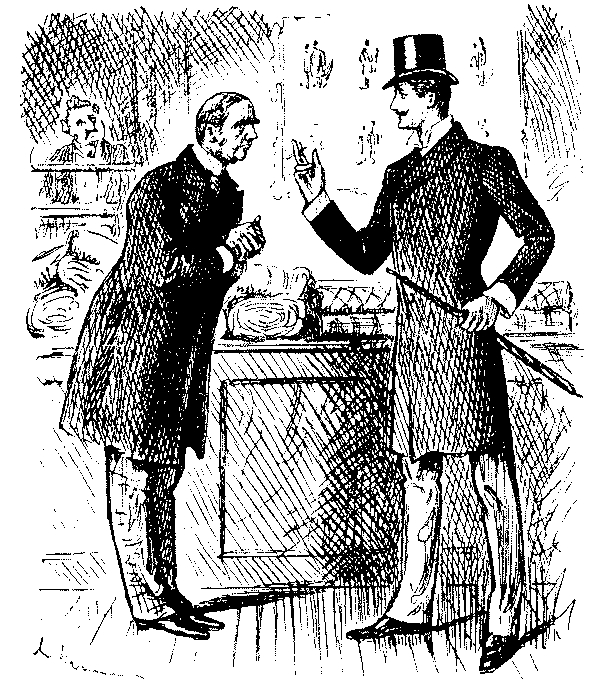
ONE EFFECT OF THE SWEATING COMMISSION
Swell (at West-End Tailor's, to the Foreman): "Ah—look here, Snipson, I've been reading all about this Sweating System, don'tcherno!—and as I find that the Things I pay you Eight Guineas for—ah—you get made by the Sweaters for about—ah—Two-and-Six—I've made up my mind—ah—to do the thing well, without screwing you down. So—ah—just take my order for a Seven-and-Sixpenny Dress Suit."
The moral is summed up in the last four lines:—
And, behold, though the Sun-God is silent, the Son of the Sun-God asleep, Still merciless Mammon is master, the slaves of the Gold-God still weep; Be his ministers Hebrew or Gentile, his worship is cruelty still; Still the worker must sweat 'neath the scourge that the stores of the tyrant may fill.
Lord Dunraven withdrew from the Commission, and Punch congratulated him on his retirement, though it "seemed caused by a fad," when the Report was published in 1890. The recommendations were inadequate, in Punch's view. He spoke contemptuously of applying the "rose-water cure" and whitewashing the sweater, whom he depicts as a monster vampire. Socialism, as we have seen, was a serpent of the boa constrictor type. The tendency to big combines was typified by an octopus, labelled Monopoly, controlling cotton, iron, coal, salt and copper, and threatening a distressful lady (Commerce) perilously navigating a frail canoe.
Bumbledom was not dead, but its activities were less blatant. Punch gibbets the stinginess of the Lambeth Workhouse when in 1875 the Guardians decided that Christmas pudding was too rich in good things and recommended a plainer variety. Fourteen years later, under the sarcastic heading, "Luxury for Paupers," we encounter the following elegant extract from the Standard of December 5, 1889:—
"At the Chester Board of Guardians yesterday, a discussion took place as to whether, in view of the Christmas dinner, it would be advisable to allow the inmates to have knives to cut their meat. It was explained that at present the paupers had to tear the meat to pieces with their fingers and teeth.... The Rev. O. Rawson proposed that they should buy knives and forks.... Mr. Charmley, farmer, opposed the proposal.... The motion to hire knives and forks on Christmas Day only was put, and carried by thirteen votes to ten."
Manchester under the Microscope
The negligence and delay in administering Parish relief moved Punch in 1876 to declare that sick paupers were worse treated than sick cows or horses. As an illustration of "The way we die now," there are further exposures of cruelty in lunatic asylums, and the hard-heartedness of Guardians in harrying "bundles of rags." But these revelations are fewer than in former years, and dwell more on mismanagement and extravagance than actual inhumanity. Thus the report of the committee of inquiry into the administration of the Metropolitan Asylums Board in 1885 revealed gross waste and extravagant consumption of wine and stimulants, not by the patients, but by the officials. Punch was "so long accustomed to hear of the wondrous doings of 'Manchester the Great' and the grand example she set to the rest of the Kingdom in all that constituted good and pure government and sound finance," that he could not repress a certain malicious satisfaction at the result of the audit of the accounts of her Corporation by the "Citizens' auditor," published in the autumn of 1884. The first instalment, reviewed in October, is an entertaining document winding up with an allusion to the pantomime of the Forty Thieves, fully justified by the further revelations summarized by Punch a month later:—
MANCHESTER'S PLUCKY AUDITOR
This bold Gentleman continues his amusing revelations to the apparent delight of the ratepayers, and the disgust of the bumptious Corporation. We can only make room for one or two extracts. This is the bill for a dinner, at the Queen's Hotel, for the Members of the Baths and Wash-houses Committee, at which it will be seen that they drank punch, sherry, hock, champagne, claret, port, gin, whiskey, brandy, liqueurs, and mild ale:—
"To Twenty-one dinners, caviare, turtle, etc., 15s. each, £15 15s. 0d.; sherry, 16s.; hock, 50s.; punch, 7s. 6d.; champagne, 138s. 6d.; claret, 50s.; port, 25s.; mild ale, 1s.; liqueur, 20s.; coffee, 10s. 6d.; cigars, 64s. 6d.; soda, 22s. 6d.; gin, 2s. 6d.; whiskey, 15s.; brandy, 27s. 6d.; service, 21s.
"In addition to the above, the Committee had sent up to the Baths the day before the opening, one dozen bottles of whiskey, 48s.; one dozen gin, 36s.; half-a-dozen brandy, 84s.; half-a-dozen port, 48s.; half-a-dozen sherry, 48s.; two dozen soda, 4s. 6d.; one dozen lemonade, 4s. 6d.; one dozen potass, 4s. 6d.; two boxes cigars, 22s. 6d. each; and half-a-dozen bottles of St. Julien, 36s.; making a total of £52 2s. paid to the proprietors of the Queen's Hotel."
He adds that strenuous efforts have been made to find out the Gentleman who called for Mild Ale, and, when got, consumed a shilling's-worth of it.
If there were many such auditors, audits would form a most amusing portion of our comic literature.
In these circumstances Punch expressed a natural joy that Municipal Reform was tackled at last in Sir William Harcourt's Bill, while in his "Bitter Cry of Alderman and Bumble" he showed these two worthies bursting into tears over the iniquities of "Werdant 'Arcourt."
The housing problem comes up early in 1877 à propos of the late Sir B. W. Richardson's hygienic theories. Punch admits that he was probably on the right track, but waxes sarcastic at the expense of crotchety alarmists, and his own suggestions are more whimsical than helpful. It was not until 1883 that he began to take the problem seriously. I deal in another section with the fashionable craze for "slumming," which Punch ridiculed as insincere and absurd. But there is genuine indignation in his verses on a judge's remarks at Manchester, and on the report of an inquest, at which it came out that a whole family occupied one bed on the floor; in the poem (after Hood) on the Real Haunted House, comparing slum dwellers with rural labourers; in the cartoon, "Mammon's Rents," on the text, "Dives, the owner of property condemned as unfit for habitation, is getting from 50 to 60 per cent. on his money"; and in "The Slum-dweller's Saturday Night" (after Burns), where Punch drives home his old point of the futility of foreign missions when we had all this unreclaimed slum savagery at home. The personal investigations of slum areas undertaken by Sir Charles Dilke, then President of the Local Government Board, traced the evil to the greed of grasping landlords.
To this year belong Punch's tirades against the iniquity of unjust rates. In December he has quite a long article based on the hardships of shopkeepers, small and large. He quotes two cases. The first is that of a small shopkeeper. The street in which he lived had been recently widened. Immediately his landlord raised his rent £30 a year, and his rates were at once raised from £16 to £30. Another victim carrying on business in a principal City thoroughfare paid a rental of £800 a year, his gross profits being £1,500. The street was improved; his rent was increased to £1,000; and £40 a year were added to his rates in consequence of an improvement which had already cost him £200 a year, which the landlord had received without the expenditure of a single shilling. One does not expect to find precise information on rating and rentals in a comic journal, but in the 'eighties at any rate Punch did not shirk such topics.
Housing and Health
In the issue of December 8, 1883, Punch ventured to remind his readers that on the 16th of that month, exactly forty years had elapsed since Hood's immortal "Song of the Shirt" appeared in his pages; but it was perhaps an overstatement to say that the "Bitter Cry" was as "loud and heart-rending" then as in the 'forties. The handling of the Housing Commission in 1884 is decidedly irreverent, and the account of its meetings and the speeches of Lord Salisbury, Mr. Lyulph Stanley (now Lord Sheffield), and Mr. Jesse Collings borders on the burlesque. Only towards Cardinal Manning does Punch extend a limited measure of sympathy. There was, however, no alloy in his praise of Sir Edward Guinness's gift in 1880 of £250,000 for the better housing of the poor. When Christ Church Cathedral was restored in Dublin by the liberality of a wealthy distiller, a poor Irishwoman, as she gazed on the building, remarked: "Glory be to God! To think that whisky could do all that!" Punch more discreetly commended "good Edward Guinness" as the "munificent host of 'The Tankard.'"
This was the year of the Health Exhibition, the second of that annual series which was a special feature of the 'eighties. On their recreative aspect I speak elsewhere. It may suffice here to say that Punch summed up the conflict of aims which they represented in the phrase "Commerce v. Cremorne." His anticipatory notice of the "Healtheries" abounds in burlesque suggestions for hygienic exhibits; in the account of the opening praise is largely tempered with irony; and his "insane-itary guide" shows how largely these Exhibitions depended on al fresco entertainments, illuminations, and bands.
The growth of the modern mania for amusement was still in its infancy, but Punch has some instructive remarks on the decline of the many institutions which had begun with the highest instructional aims and aspirations:—
The Crystal Palace at Sydenham ... commenced its career with the highest aspirations. The British Public were to be shown the architectural glories of the Alhambra and Pompeii, and soon found themselves watching the evolutions of Léotard and Blondin. In like manner the Westminster Aquarium was inaugurated by the Duke of Edinburgh, as a sort of supplement to "the mission of Albert the Good," but soon had to fall back on Zazel and a "Variety entertainment."
Punch accordingly prophecies a similar evolution in the character of the South Kensington Exhibition, and the sequel proved that here, at any rate, he was a true prophet.
Students of Criminology will find much to interest them in Punch's pages during this period. We have already seen that he had abandoned his objection to capital punishment in the 'sixties. Commenting on the debate in June, 1877, Punch defended the maintenance of the gallows as an ultima ratio legum—much on the lines of J. S. Mill, who had, more than anyone else, converted him from his old view. Later on, when the abolition was rejected by 263 votes to 64, he writes:—
We keep our gallows for the brute whom no rope weaker than the hempen halter will bind, and no terror less terrible than Tyburn Tree will hold in awe. There are such ruffians; and for them the gallows is, and will be, kept for the present standing.
In 1879 the trial of Peace, the murderer, gave Punch a good opening for condemning the undue prominence given in the Press to the personalities and tastes of criminals. He makes a good point against papers which speak with two voices: filling their news columns with personal details of murderers and denouncing the cult of the criminal in their leading articles. Such inconsistencies, however, still continue to grieve the judicious. In the early 'eighties the urbane inefficiency of the Police Force, and especially of the detective side, is a frequent theme of criticism, both burlesque and serious. The most amusing entry relates to a constable alleged to have reported: "At 1.45 this morning, found an earthquake opposite No. 207." Punch christened the C.I.D. the "Defective Police," but proved his impartiality by handsomely admitting the heavy odds against which constables had to contend—the truncheon was no match for the burglar's revolver.
Crime in Whitechapel
Frequent allusions to hooliganism and armed burglars occur in 1882. Punch speaks of a "Mohock Revival," and asks, "Is the Police Force no remedy, or must we all carry revolvers?" For a while complaints against the impotence of the police cease, or take a new form, as when Punch turns his attention to the disgraceful conditions prevailing at the Central Criminal Court, where respectable men and women subpœnaed as witnesses were exposed to hustling and insults from roughs—and constables. In 1887 he extended his censure to the shocking condition of the prisons in which unconvicted prisoners were lodged awaiting trial. For the conduct of the police during the Jubilee Celebrations he has nothing but praise, and waxed lyrical in "Punch to the Peelers" over their humanity and courtesy.
But a far more severe ordeal awaited the police in 1888, the year of the crime wave in Whitechapel. Sarcastic allusions to the inefficiency of the Force are renewed. One cartoon represents them blindfolded and stumbling about amongst jeering criminals. Punch was nearer the mark in the cartoon headed, "The Nemesis of Neglect"—based on a letter from "S. G. O." in The Times pointing out that East End slums invited crime—and in his admissions that the numbers of the police were inadequate and that their inefficiency was largely due to the publicity given to the movements of detectives, and the measures taken by the authorities, by sensational interviewers in the cheap press. The amateur "crime investigator" unfortunately continued to flourish in spite of Punch's censure. Hideous picture-posters, vividly representing sensational scenes of murder, exhibited as the "great attractions" of certain plays, are also condemned as a blot on civilization, a disgrace to the Drama, and a suggestion of crime. It should be added that Punch expressly exempted Sir Charles Warren from blame, and indignantly dissociated himself from the attacks of those who joined in making him a scapegoat:—
The Police Force requires strengthening, and Sir Charles is perfectly alive to the fact. What on earth can it matter if, in number, our Police compare favourably with the Police Force at Constantinople, or St. Petersburgh, or Vienna, or Jericho, if we have not sufficient Police to protect life and property in the Metropolis? Socialistic sensational Journalists and rowdy demagogues would like to see the Police Force reduced to one in every two thousand, until they fell to fighting among themselves, when they would be the first to yell out "Police!" and scream for the intervention of the enfeebled arm of the law.
In April, 1889, the proposed flogging of dangerous criminals excited a good deal of controversy. In Punch's cartoon in April Bill Sikes protests as an injured innocent against the cat on the ground that it will make a brute of him. Punch's attitude was strongly anti-sentimentalist, but he held that the lash should be used with discretion.
In the summer he renews his demand for increasing the police. The new Chief Commissioner, Monro, is shown telling John Bull that he can have any number of policemen if he likes to pay for them, while Policeman X, Junior, declares that the Force is overworked. It is curious to note that, in the list of police difficulties, besides Whitechapel murders, Punch includes the control of Salvation Army processions and obstructions. But in these days even so wise and good a man as Huxley did not hesitate to label—and libel—Salvationism as "Corybantic Christianity."
On the everlasting Drink Question Punch sided with the moderate reformers, disapproved of coercion or Prohibition, and found confirmation of his views in the testimony of the Howard Association in 1876 that moral persuasion and improvement in the conditions of living afforded the only real remedy. Recreation, as an alternative to and distraction from the public-house, he always advocated. When the Sunday opening of galleries and museums was again rejected in 1879, Punch's cartoon took his familiar line that Sabbatarianism drove men to drink. "Bung" congratulates Archbishop Tait on the support of the Episcopal bench in defeating the measure. But in the same month, in "Friend Bung's Remonstrance," Punch inserted a protest against the notion that all public-housekeepers would support Sabbatarian legislation. That he was sensitive to foreign criticism is shown by his skit on M. Millaud's articles in the Figaro in 1880 in which the drunkenness of London had been unfavourably commented upon.
Licensing Anomalies
The "marvellous magisterial licensing system" of the period, which was "vexatious, inconsistent, and meddlesome," is repeatedly criticized in the year. In an article on the degeneracy of the Aquarium, Punch gives a full account of its vulgar, inane, and sensational shows, and alludes to the nocturnal orgies enacted at that place of entertainment. Music and dancing licences, he declared, would be applied for by the ten thousand if there were freedom and wisdom, instead of the chaos and vested interest maintained by "Maw-worm" and "Meddlevex" (Middlesex) magistrates. The result was that London was "a city of unmitigated pot-houses." Yet drinking, judged by the test of state finance, was decreasing. The revenue from intoxicants in 1882 had fallen 2-1/2 millions in seven years, and Punch indulges in ironical comment. The picture in the spring of 1883 of the "Temperance Budget" shows the financial conditions of the country as only fairly satisfactory, and represents John Bull as saying: "I have been too sober—Nunc est bibendum." This was obviously ironical, but it was irony that might easily be misread. Punch would probably have endorsed Archbishop Magee's famous dictum: "Better England free than England sober." Teetotalism was to Punch inextricably associated with cranks, faddists, and fanatics. He was a robust humanitarian. Cock-fighting was a barbarous pastime, but he resented the unfair differentiation which punished working men who indulged in it with a heavy fine, while rich and aristocratic pigeon-shooters went scot-free. Dr. Carver's shooting performances at the Crystal Palace in 1879 are specially praised because he did not exhibit his skill by the slaughter of pigeons. So in 1876 Punch had supported Mr. Flower's agitation against the use of bearing-reins for horses. Cruelty to animals he detested; but, on the burning question of vivisection, firmly upheld the practice, in the interests of humanity, when guarded by stringent regulations, and sided with Lister and Paget against Lord Shaftesbury, whose opposition he deeply regretted.
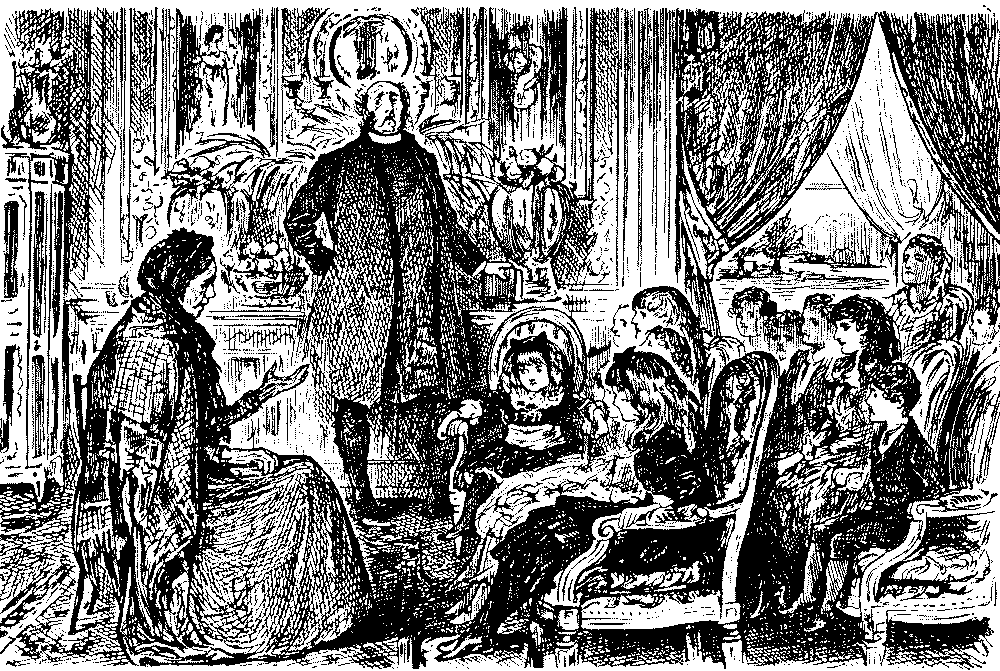
HAPPY THOUGHT—A "SUNDAY SCHOOL FOR THE UPPER CLASSES"
(Vide Bishop of Oxford's Speech at the Church Congress)
Elizabeth Waring (Laundress and Charwoman, and Sunday School Teacher to the U.C.): "And now, my dear little Ladies and Gentlemen, I trust you will not desecrate this beautiful Sunday Afternoon by going on the River! You can do that from Monday Morning till Saturday Night, you know! His Lordship here, who was at Eton and Oxford, will no doubt remember how the Oars he had plied so busily all the week, lay untouched on Sunday! And you too, my dears, will please to give up the River, on that one day—to those who have been toiling all the busy Week long in stifling Offices and grimy Workshops, and suchlike!"
Wages, as I have remarked above, were still remarkably low, judged by our post-war standards. In 1880 Punch quotes an advertisement from the Lincoln Gazette for an "active young town crier and bill-poster who can live on 1s. 3d. a week." But prices were low also, and by the mid 'seventies cheap railway fares and excursions had led to a great increase of travelling among the working classes. The "cheap tripper" figures largely in Punch throughout these years, and his (and her) manners and customs lent themselves more readily to satire than sympathy. Punch was still the friend as well as the critic of the masses, and when in 1883 the steam launch nuisance on the Thames was exciting a good deal of inflammatory comment, published his "Sunday School for the Upper Classes," in which a laundress and charwoman is seen giving a lesson to young gentlefolk, turning the tables on their Sabbatarian teaching, and asking them to give up the river on Sunday to those who worked all the week. But here, as so often, Punch showed his habitual impartiality by simultaneously admitting that the state of the river was a scandal, and welcoming an official inquiry by the Thames Conservancy Board. A year later he emphasized Sir Charles Dilke's statement that the river was "a sort of savage place," with no real police to enforce the law; Punch's picture of the Thames on Bank Holiday exhibits a carnival of rowdyism, collisions, and upsets. The steam launch was no favourite of Punch. He had already shown it as an intruder on the waterways of Venice, crowded with 'Arries and 'Arriets emitting characteristic comments on the Bridge of Sighs.
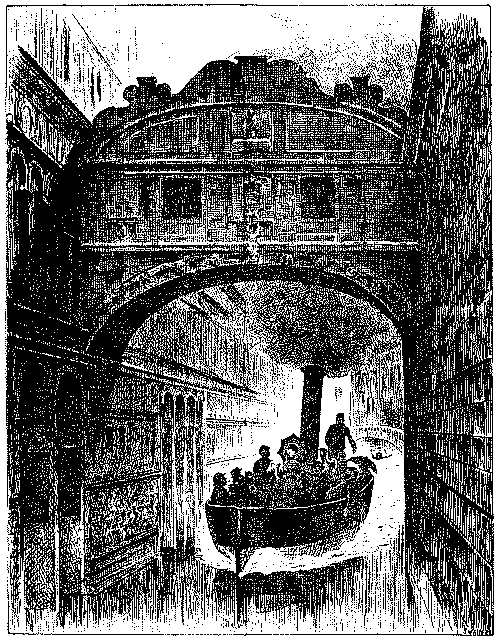
THE STEAM LAUNCH IN VENICE
("Sic Transit Gloria Mundi")
'Andsome 'Arriet: "Ow, my! If it 'yn't that bloomin' old Temple Bar, as they did aw'y with out o' Fleet Street!"
Mr. Belleville (referring to Guide-book): "Now it 'yn't! It's the famous Bridge o' Sighs, as Byron went and stood on; 'im as wrote Our Boys, yer know!"
'Andsome 'Arriet: "Well, I never! It 'yn't much of a size, any'ow!"
Mr. Belleville: "'Ear! 'Ear! Fustryte!"
Throughout the 'eighties all the unlovely and odious attributes of lower middle-class vulgarity were concentrated by Punch in a series of verses directed against 'Arry, who takes the place of the "snob" and the "gent" of the 'forties and 'fifties. One sometimes wonders whether the late Mr. Milliken, the creator of Punch's 'Arry, was not intoxicated by the exuberance of his own invention, by the deftness of his patter, and exaggerated the atrocities of the original. For there is no redeeming feature in 'Arry, or in 'Arriet, who is indeed the worse of the two. "... Modesty? Meekness? Thrift? Oh, Jiminy! Ladies of Fashion ain't caught now with no such moral niminy piminy." Their lingo is extensive, peculiar, and unpleasant, and much of it has mercifully passed into the limbo of lost words—"rorty," for example, and (let us hope) "lotion" for drink. 'Arry, as depicted in these monologues, is always the Cockney; the withers of the provincial are unwrung in contemplating his excesses. He is sometimes a clerk, though not of the class whose "Cry" had evoked Punch's sympathy, sometimes a counter-jumper, but always a cad. He and his partner are always drawn in such a way as to lend point to the cynical saying that "life would be endurable but for its amusements." His notion of pleasure is largely made up of din and destruction. If he takes a holiday in the country, he disturbs its sylvan seclusion by tearing up ferns and tearing down branches. But he is in his true element at the seaside—witness Punch's gruesome adaptation of Southey's lines on Lodore, under the heading "The Shore."
'Arry and 'Arriet
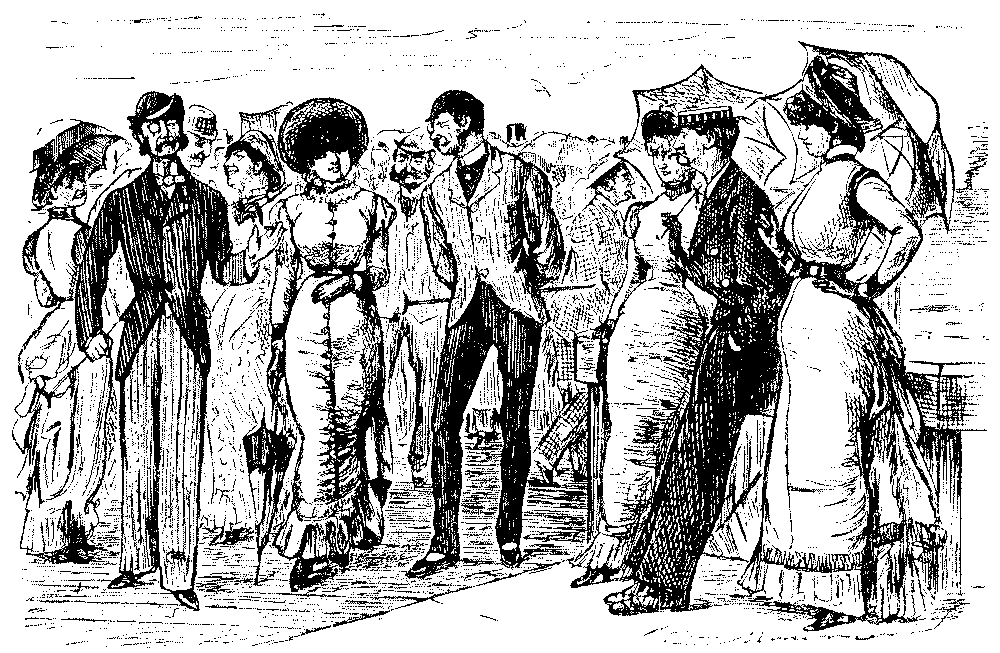
A GROUP OF 'ARRIES
In the centre of which may be seen the plain but captivating Mr. Belleville, who explains to the lovely Miss Eliza Larkins that it's of no consequence whether a man be handsome or not, "so long as he looks like a gentleman!"
'Arry figures in a less repulsive mood when visiting the Paris Exhibition of 1889—"'Arry in Parry." He is very far from belonging to the submerged classes, and has generally plenty of money to spend on his amusements and creature comforts. But he is not enamoured of hard work. The competition of the German clerk in 1886 fills him with fury. He is disgusted with the "Sossidges" for ousting Englishmen from their jobs, but is not prepared to emulate the industry of the foreigner:—
Young Yah-Yah 'as nobbled my crib, turns his pink shovel nose up, old man. He may live upon lager and langwidges, Charlie; sech isn't my plan.
Mr. Gladstone had appealed to the Englishman to prove himself the better man by competing with the German on the ground on which the latter excelled. The Cockney clerk retorts that it isn't good enough, and clamours for the expulsion of the industrious aliens who undercut him.
Mixed up with 'Arry's selfishness, greediness, and general lack of decency and good feeling there is a certain element of shrewdness, of practical common sense, but it is always exerted on behalf of Number One. Taken all round, he is easily the most disagreeable of all the types created by Punch in a period in which his former complacency had given place, at best, to a somewhat peevish optimism, sinking at times, as we note elsewhere, to dismal laments over our decadence. But, in justice to Punch, it is right to add that by far the most severe denunciations are reserved for the degenerates in high places. The 'Arry poems do not show Punch in the light of a Jeremiah or a Juvenal. Taken together, they form a sort of composite photograph of the mean Cockney who belongs neither to the classes nor the masses, who lacks the breeding and reticence of the one and the primitive virtues of the other. Moreover, the unabashed and undefeated complacency of these monologues, apart from their shrewdness, inspires a certain grudging admiration for this entirely impenitent "bounder."
Punch and the Army
But we part from him without regret, and with a feeling that he is almost too odious to be true to type. He bulks so largely in the pages of Punch as to obscure the evidences of abiding friendliness to the true democracy on which 'Arry was a mere excrescence. The manners of the cheap tripper might offend Punch, but he was genuinely delighted when bands were introduced in the Parks on Sundays to the discomfiture of Sabbatarians and Pharisees; and we find him contrasting the activity of the police in suppressing gambling in Bermondsey with the tolerance extended to certain West End clubs. There was nothing new in this attitude, but we may note a change in regard to his views on emigration, which in earlier days Punch had supported with enthusiasm. In 1877 a curious letter, guaranteed genuine, is published from a settler in Australia, describing the conditions there, and strongly deterring emigration to a country where there were no comforts, and nothing was cheaper than in England save meat.
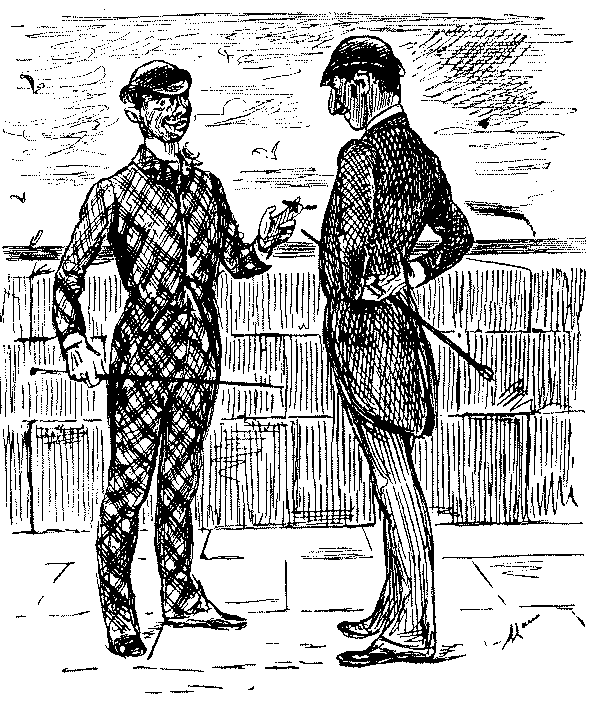
TECHNICAL
"'Ellow, 'Erry! Why, 'ow are yer?"
"Eighteen Car-rat, ole man! 'Ow's yerself?"
In the earlier volumes of this survey it has been shown how deep-seated was the prejudice against the Army amongst respectable middle-class and working people. In his earlier and anti-militarist days Punch had shared this feeling, and even denounced the recruiting-sergeant as an ogre or worse. From the Crimean War onward this hostility gave place to the wiser and saner view that the men who served their country bravely and faithfully should be decently treated, properly fed, and encouraged in self-respect by the community which they defended. How far public opinion fell short in this regard may be seen in the excellent appeal headed "Men Wanted" which Punch issued in January, 1875. The Army was greatly in need of recruits, and the evidence taken before the Recruiting Commission proved that "the want of respect shown by civilians to Her Majesty's uniform had a great deal to do with the Army's loss of popularity." Whereupon Punch proceeds to point out:—
1. That the intellectual training of Soldiers is now a matter of paramount importance, and that the Privates of many Regiments can compare favourably with civilians as regards education.
2. That through the exertions of H.R.H. the Duke of Cambridge, Recreation Rooms and Libraries have been established in all the Barracks, with the object (an object that has been attained) of fostering refinement in the ranks.
3. That, during the recent series of Autumn Manœuvres, the Armies in the Field have gained golden opinions from all with whom they have come in contact.
4. That most Soldiers, when they leave the Service, are found to be admirably adapted to fill the positions of clerks, railway-guards, policemen, and other posts of importance and responsibility.
5. That a Colour-Sergeant is a Non-Commissioned Officer in command of some sixty or a hundred men, who has been promoted after many years' service in the ranks, in recognition of zeal, cleverness, and good conduct.
Having made these observations, Field-Marshal Punch is forced to record his deep regret:—
1. That a Magistrate speaking from the Bench should have thought proper to inform a Recruit that to join the Army was to take a false step in life, which might possibly entail the breaking of his parents' hearts.
2. That a Non-Commissioned Officer should be refused admission to the best seats in a place of public entertainment because he (the Non-Commissioned Officer in question) happened at the time of purchasing his ticket to be wearing the should-be honoured uniform of Her Majesty the Queen.
Field-Marshal Punch consequently feels it to be his duty to issue the following orders:—
1. In future, City Aldermen, in their official capacities, will refrain from making remarks calculated to bring the Army into ridicule, hatred, or contempt.
2. If any regulation exists preventing soldiers in uniform from appearing in the better seats of places of entertainment, the rule in question must be immediately abolished.
In conclusion, Field-Marshal Punch is strongly of opinion that recruiting will continue to remain slack until the difference existing between the social conditions of the British Soldier in the present, and the Negro Slave in the past, is thoroughly understood and admitted by the public in general, and the people to whom this circular is addressed in particular. It must be remembered in future that the Livery of Her Majesty is worn by warriors, and not by flunkeys.
Mismanagement at Reviews
The remonstrance was well needed, though many years were to elapse before the second of these orders was acted on. Yet if Punch had little mercy on those who imagined that all soldiers were "brutal and licentious," he had no compassion on those who disgraced their uniform. In the controversy which arose in 1880 between Dr. W. H. Russell and Sir Garnet Wolseley over alleged breaches of discipline among our troops during the Zulu campaign, Punch held that the war correspondent's was a "true bill," and actually advocated the reintroduction of flogging in the Army for "exceptional cases of brutality which degrade the soldier to the level of the garrotter or the wife-beater."
The allusions to the Volunteer Review in the Great Park at Windsor in July, 1881, dwell chiefly on the habitual neglect and lack of consideration meted out to the Army on these occasions:—
HOW TO TREAT THE ARMY
Select the hottest day you can possibly find for a perfectly useless sham fight and send the men out with the heaviest, clumsiest, most antiquated, and unseasonable headgear. When a few of them perish, as a matter of course, of sunstroke, express the utmost astonishment that anybody can die from such a cause in such perfect uniform in a temperate climate.
HOW TO TREAT THE VOLUNTEERS
Encourage fifty thousand men to attend a Review, and then tell them coolly that your military organization is quite unequal to the task of giving them a day's food.... As they are nearly all respectable middle-class members of Society, give them a shilling apiece to take care of themselves, and trust to their decency not to abuse such extraordinary liberality.
Punch gave credit to the Duke of Cambridge for his efforts to improve the amenities of barrack life, but came down heavily on him for opposing the introduction, when the late Duke of Devonshire was at the War Office, of neutral-tinted uniforms on active service. The Duke of Cambridge thought it a good thing for a soldier that, when in action, he should be visible, and Punch dealt faithfully with this ducal ineptitude:—
"THE THIN RED LINE"
(Horse Guards Duo.)
Pro.
Who says a soldier's a thing ready made Of a suit of grey and a service-spade?— That there's pluck in picking a 'vantage ground, Then digging a hole and heaping a mound? The notion's preposterous, laughable, quizzible! By Jove, Sir, a soldier—he ought to be visible!
Con.
I grant you all that; but when Six-foot Guards Like ninepins go down at a thousand yards, 'Tis time to note that, if work's to be done, A field to be saved, a day to be won, It won't be by speeches as firework as fizzible, But by getting well home with movement invisible.
Pro.
Pooh! Stuff, Sir! What served us at Waterloo? Your neutral tint, or your washed-out blue? Digging and dodging?—I rather opine A rush with a cheer of a "thin red line," In the midst of a hailstorm of all things whizzible! Don't talk, Sir, to me of a coat that's not visible!
Con.
No use, my good friend; for though you may bless The days that departed with Old Brown Bess, If you make that "red line," that never will yield, A target for every shot in the field, Of your foemen you'll stir the faculties risible— For neither your troops nor your brains will be visible!
Heroes, Charlatans and Criminals
Nor did Punch in his zeal for the soldier on active service forget the claims to grateful recognition of the ex-service man. In 1890 we find an indignant appeal for the survivors of the Balaklava Charge, showing how they had been forgotten—except in music-hall recitations. To reinforce the appeal, Punch printed a picture contrasting a Balaklava survivor, dying in a garret, with the well-remunerated professional "fasting man," one of whom was much in the public eye just then. An even more lurid contrast in modern hero-worship is exhibited in the sardonic description of the fêting and glorifying of criminals. The verses "I'd be a criminal" show how fashion, pseudo-science, sensational journalism, and sentimental folly conspired to apotheosize the murderer.