RAILWAYS AND INVENTIONS: FORECASTS AND NOVELTIES
Reading edition
Railways continue to be a fertile seed plot of grievances. In 1876 Charles Keene devises a patent costume for collisions, closely resembling that of a diver. This was the year in which Captain Tyler's report on the Long Ashton accident to the "Flying Dutchman" on July 27 prompted Punch to a scathing set of verses on the G.W.R. directors, of which the motto was, "Westward Ho! with grim Death." The introduction of the Pullman dining-car in 1879 is welcomed in a lyrical effusion, to the air of "The Low-backed Car," in which Punch contrasts the discomforts of "Mugby Junction" days with the new amenities of travel:—
Five minutes, a frantic fixture, You strove with might and main To gulp some scalding mixture, While the bell rang—for the train! Your tea or soup you swallowed, As much as did not fly On your shirt-front or your waistcoat, From the dense crowd hustling by. While the minxes at Mugby Bar Smiled, serene, upon the war, For they'd learnt the art, And looked the part— Of "We are your betters far." But in Pullman's dining-car, Sir, Now run on the Northern Line, You've a soup, and a roast, and entrées, And your cheese and your pint of wine. At his table snug the passenger sits, Or to the smoke-room moves, While on either side the landscape flits, Like a world in well-greased grooves. Thanks to Pullman's dining-car, No more Mugby Junction Bar— No more tough ham and chicken, Nor passenger-pickin' For the minxes behind the Bar!
Punch is a Railway Critic
Punch's jubilation was short-lived; and in 1883 his discontent takes the form of a wholesale indictment of unnecessary noises, draughts, dismal chilly waiting-rooms, atrocious refreshment-rooms, undistinguishable station-names. The regulations and adjustments of Railwaydom, he sums up, "can only be praised in the same spirit as that in which Charles Kingsley lauded the British North-Easter." On the question of Railways in the Lake District, about which Ruskin had raised an exceeding bitter cry, Punch seems rather to favour the Philistine view:—
Let sentimental Ruskinites the thing disparage, Most scenery afoot you miss—it cannot be denied: The Nature-lover's point of view's a third-class smoking carriage, 'Twould be a blot if there were not a line to Ambleside.
"Justice at Fault," a cartoon in 1887, based on a recent inquiry, reiterates Punch's familiar complaint: overworked signalmen are punished, while the directors go scot free. No jarring note, however, is struck in the cartoon in the same year on the completion of the Canadian Pacific Railway—"the New North-West Passage," or in the verses in which Britannia and Canada exchange mutual compliments and indulge in hopeful auguries. The opening of the first electric underground railway in England by the Prince of Wales on November 4, 1890, passed unnoticed by Punch, but he rendered full justice in 1891 to the historic conclusion of the famous "Battle of the Gauges," when Stephenson's triumph over Brunel was finally crowned by the abandonment of the broad gauge on the Great Western. It had been an heroic contest, and Punch treated the defeated champion with dignity and respect, quoting the words, "Good-bye, poor old Broad Gauge, God bless you!" which were found written on the G.W. track.
The record of novelties, inventions and discoveries opens modestly in 1875 with the mention of hot-water bottles in bed as "a new idea." They have long since ousted the warming-pan, which until recently maintained a precarious existence in old-fashioned inns, and is now merely a picturesque antique. Lovers of The Rose and the Ring will remember its use as a weapon, and romantics will deplore its abandonment, for there is no romance in a hot-water bottle. I have dealt with the bicycle under the head of Pastime, but may supplement what I have said elsewhere with a few further observations on this momentous innovation. What I believe to be the first mention of the word occurs towards the end of 1878. Before that we only hear of velocipedes or "rantoones," and in the year 1879 an epigram refers to the "Bycicle." Punch's early references to the "steel horse" and the "public wheel" are decidedly friendly, and he contrasts the bicyclist favourably with the hangers-on of the noble animal:—
No slinking knaves environ him And dog his ins and outs; No jockeys, ostlers, stable-boys, No tipsters and no touts.
Another substitute for the horse, I may remark in parenthesis, comes in for notice at the time of our Egyptian campaigns.
The rules for the road in 1878 are farcical, their only interest being the reference to proprietors of 64-in. machines, for this was the day of the old "ordinary." The use of bells was first made obligatory in Liverpool in 1877. Twelve years later, when the "safety" bicycle was coming in, Punch addressed a warning to enthusiasts in the form of a skeleton cyclist stooping over the handles, in the approved attitude, with an alarming curvation of the spine. In the same year allusion is made to the thrill caused by the Bishop of Chester's taking to the bicycle; but the rumour was exaggerated, for Dr. Jayne only patronized the tricycle. A propos of skeletons, it may be noted that Mr. (afterwards Sir) Seymour Haden's advocacy of burial in wicker coffins and the exhibition held at Stafford House to popularize the scheme in 1875 merely served Punch as an occasion for punning on the projector's name, and suggesting that the funeral march of the future seemed likely to be Haydn's "With Verdure Clad," as the wicker baskets were to be filled with moss and ferns.
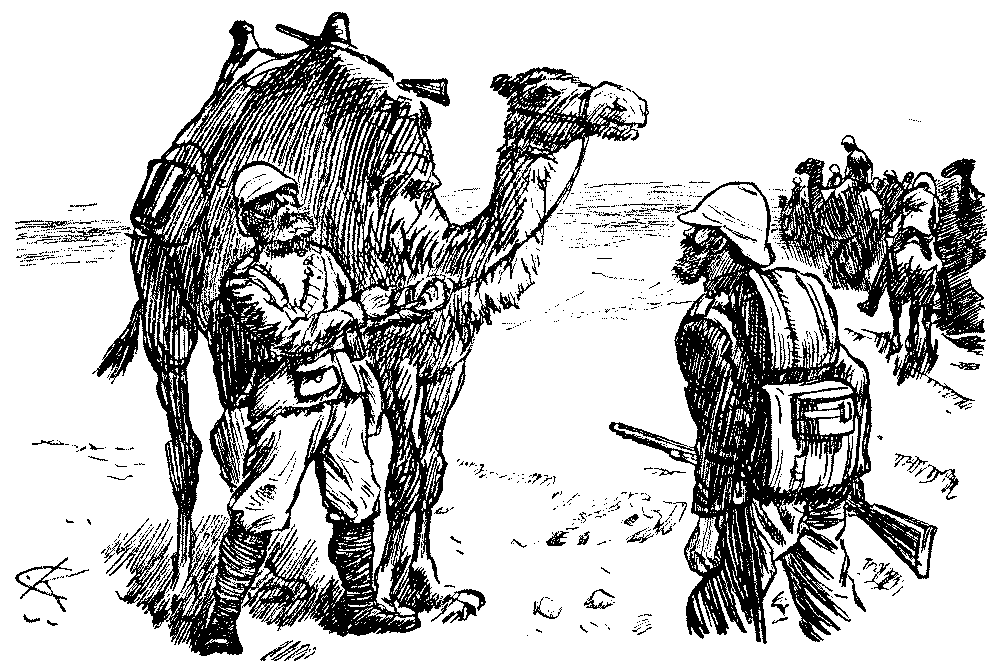
CAMEL-SHIP!
Tommy Atkins (to Mate, who had been told off to the same refractory Animal): "Oh, look here, Bill, here's this cussed Beast has been playing 'Cup and Ball' with me for the last Two Hours! Missed me ever so many times!"
(Vide Special Correspondence from the Soudan.)
Flying Machines
Of more topical interest to the readers of to-day is the account given by Punch in the autumn of 1876 of a flying machine invented by a Mr. Ralph Stott of Dover. Under the heading, "A Dædalus at Dover," Punch forecasts the use of the flying machine as an engine of war. Mr. Stott, who claimed that his machine was capable of speed up to one hundred miles an hour, and of hovering in mid-air, went to Berlin to see Bismarck, but backed out of the proposed trial ascent when the German Government declined to pay him £1,000 in advance. This recalled to Punch the old story of "Twopence more and up goes the donkey"; for the rest, while suspending judgment on the invention, he observes that its use in war will constitute a "fearfully costly addition to already bloated armaments: but the cheap defence of nations is now no longer possible, and Governments, in their martial preparations, are obliged to be regardless of expense."
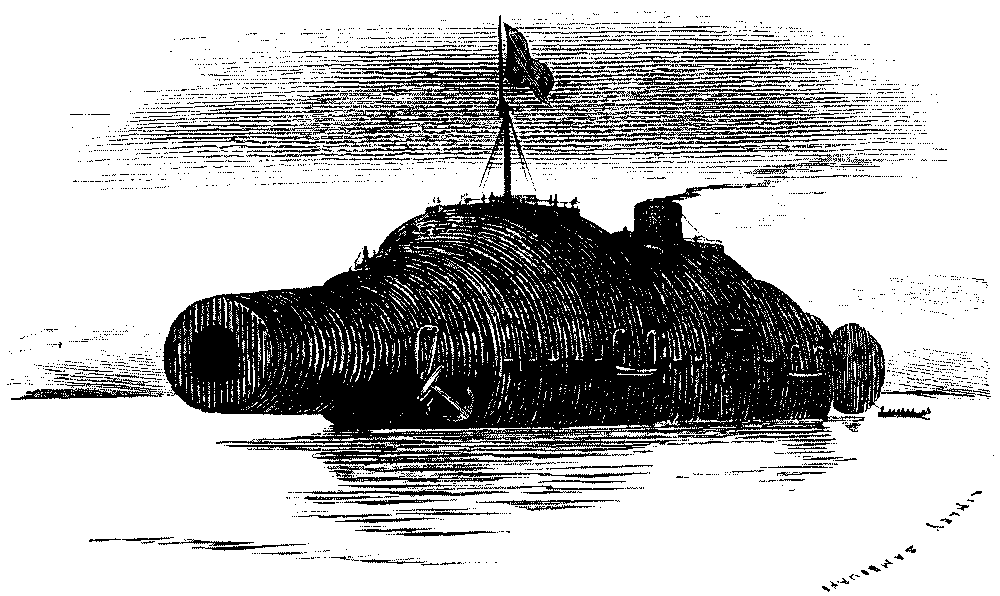
THE WAR-SHIP OF THE (REMOTE) FUTURE
Punch was not an inventor himself; he never even put a hat on the market; but almost every new invention or discovery prompted him to indulge in forecasts, often farcical or fantastical, but, when read in the light of subsequent views, sometimes proving that he prophesied better than he knew. This is specially true of the development of scientific warfare. The warship of the future, designed by Sambourne in 1875, is not nearly so wonderful as some of the "blisters" of the late war. In the following year the eighty-one-ton guns made at Woolwich prompt an account of an imaginary sea-fight in which battleships engage at fourteen miles distance. In 1879 Victor Hugo declared that the twentieth century would see war abolished, along with capital punishment, monarchy, dogmas and frontiers. Punch replied with a satirical forecast, in Hugo's manner, of a twentieth-century invasion of Paris based on the pacificist assumption that, given non-resistance, it would result in a "fraternal walk-over." The Channel Tunnel scheme, revived in the early 'eighties, was the subject of much discussion and debate, until in 1883 the Joint Select Committee of the Lords and Commons decided by a majority that it was inexpedient to give Parliamentary sanction to a submarine communication between England and France. In 1881 Punch notes the acute divergence of views between various experts, and the military opposition headed by the Duke of Cambridge and Lord Wolseley. He summed up the views of the majority in a picture of Britannia saying that she was glad to lunch with Sir Edward Watkin—the indefatigable champion of the scheme—any day, but drew the line at the tunnel. Early in 1883, under the heading, "After it is Open," Punch, in a vein of laboured and fantastic irony, records the evidence given before a "Channel Tunnel Closing Committee." Here by a complete change of front Lord Wolseley is represented as urging the maintenance of the tunnel, and John Bright as opposing it—both on account of the unforeseen consequences of its having been made. The alternative and subsequent scheme of a ferry or bridge is dealt with in 1890 by Du Maurier in a picture of a cross-Channel gigantic Pullman car labelled, "Electric Plate-glass Express." Du Maurier's fantasies were always fascinating, but the nightmare element robs them of any pretence to realism. This applies also to the "Tale for the Submarines in A.D. 2086" with Sambourne's illustration, published in February, 1886. The forecast of a naval battle given in 1891 under the title "Who'd be a Sailor? A Story of Blood and Battle," is a slightly more circumstantial attempt to realize the possibilities of marine warfare fifty years later. Punch's description of the devastating effect of high explosives is not too extravagant, though it is meant to be farcical. Points of more real interest in this fantasy are the idea of a Federation of Anglo-Saxon nations—England, the Dominions and the United States—and the well-merited recognition by name of the late Mr. Stead as an advocate of the maintenance of Great Britain's naval supremacy.
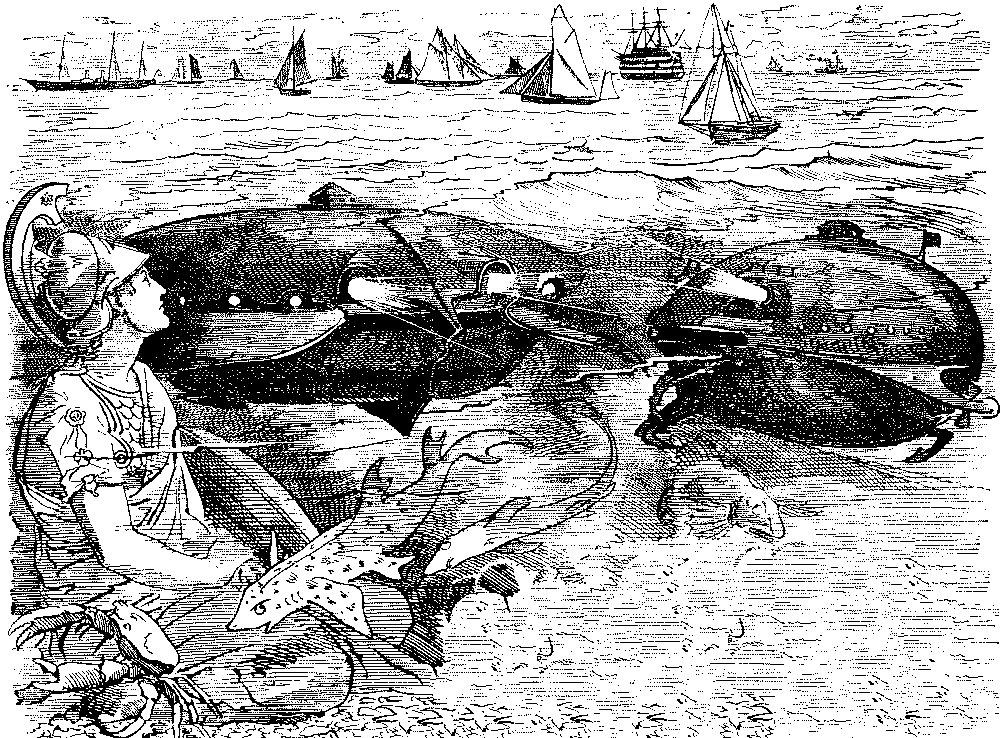
"UNDER THE SEA!"
(A Tale for the Submarines in A.D. 2086)
"Mr. Nordenfeldt, if he has not actually made a discovery that will revolutionize naval warfare, is on the track of one."—Daily Paper.
Gas v. Electricity
In 1881 Punch published a cartoon with the title "What will he grow to?" in which King Steam and King Coal are seen sulkily contemplating the new and portentous infant Electricity. The question has only been partially answered in the ensuing forty years, but Punch found ample material for comment and speculation in the achievements of the 'seventies and 'eighties. In his "Ode to the Coming Light" in 1878 delight is expressed at the possibility of a clean substitute for gas. Yet he showed a wise caution as well as true foresight in the verses accompanying the cartoon inspired by the slump in gas shares in the same year. The notion that gas is likely to go utterly to the wall is discouraged, and the panic-stricken share-holders typified by the silly birds clustering round the Electric Lighthouse are advised not to knock their brains out against the "Edison Light." Things would work themselves out right in the end, and they did. Night has not yet been turned into day, though a football match was played by electric light at Sheffield more than forty years ago, and fresh comfort for holders of gas shares was furnished in 1882 when the eminent Dr. Siemens recommended the use of gas stoves for cookery. The Electric Exhibition in 1881 is celebrated in an explosion of jocular optimism; and in a burlesque fantasia on electricity in the house in 1883, Punch anticipates the time when everything will be done by electricity—shaving, boot-cleaning, carpet-beating—down or up to an "Electric Family Prayer Reader," though not without frequent accidents, as when the last-named machine gives the same chapter of Genesis three mornings running. It was in the same year, by the way, that sixpenny telegrams were first introduced—one of the many vanished privileges which inspire envy in the harassed Georgian citizen.
References of the telephone abound through these years. The prevailing temper of Punch is shown in one of his earliest allusions to what he calls "The Coming Agony," in 1877. An experiment in long-distance telephoning is described in which a newspaper reporter is quoted as saying, "On putting the instrument to my ear, I felt somewhat as if a regiment of the line had fired a volley, at a hundred yards, into that member." The Almanack of 1878 has a page of telephone pictures, illustrating bottled composers and singers—Gounod, Patti, Nilsson, Santley, Henschel and De Soria—talks with the antipodes, etc. Mary starts a "tallyphone" in the kitchen to converse with her young man; and in another picture, suggested by the phonograph, Du Maurier foreshadows the coming of the gramophone. A more friendly note is struck in the article "Good-bye, Telephone," in 1881, lamenting that vested interests were, by legal decision, ousting the telephone in order to perpetuate the inefficiency of the telegraph:—
We may read about scientific progress, but we must go abroad to see it. The wire that misspells a message, and the street Arab who delivers it at his leisure, are all we shall get in this country till the day when we are conquered by the Irish.
On the whole I am inclined to think that this is the strangest of Punch's many strange prophecies.
In the illustration of the "Photophone," the long-promised and culminating development of the film, Du Maurier in 1881 depicts the romance of long-distance courtship between Boulogne and Folkestone. The "Telephone Trials" of 1885 are hardly distinguishable from those of to-day. Telephonic communication with Paris was first established in March, 1891, and Punch represents Lord Salisbury and President Carnot conversing over the wire about "outstanding questions." For the ordinary person it was an expensive luxury, even in those days of cheapness, and the lonely wife in Du Maurier's picture, on being reassured by her husband (just off to Paris) that she can talk to him over the telephone, but that it was rather costly, suggests he had better leave her some blank cheques. A cartoon in the following year, 1892, represents the telephone as the Cinderella of the Post Office; but Punch boldly predicts her final triumph over her "ugly sisters"—the Telegraph and the Letter Post. The imperfections of the telephone were simultaneously "guyed" in a delightful burlesque on "Telephonic Theatre-goers," suggested by performances of the "Theatrophone" at the Electrical Exhibition held in that year. The experiences of auditors of different types are ludicrously reproduced, notably those of the Irritable Person who is just beginning to hear the dialogue of an exciting melodrama:—
Ghostly Voices (in the Irritable Person's ear as before): "Your wife?" "Yes, my wife, and the only woman in the world I ever loved!"
The Irr. P. (pleased, to himself): "Come, now I'm getting accustomed to it, I can hear capitally."
The Voices: "Then why have you——?... I will tell you all. Twenty-five years ago, when a shinder foodle in the Borjeezlers I——"
A Still Small Voice (in everybody's ear): "Time, Please."
Unconscious Crime
In the realm of discovery the return of the Arctic Expedition of the Alert and the Discovery under Nares was an outstanding event of 1876 and was commemorated in two cartoons. As a mountain had been named after Punch he was naturally inclined to be proud of an expedition which had given him something to be proud of. In 1880 a plan for a new Arctic Expedition in which balloons should take part attracted a good deal of notice, but Punch was reluctantly sceptical of the feasibility of this "wild scheme," expounded before the Lord Mayor by a deputation mainly of sailors, but including Coxwell the famous aeronaut. In 1885 we catch the first murmurs of modern psychological jargon in a ballade on "The Unconscious Self":—
'Tis a famous idea of Myers, The Spectator attempts to explain, There's a hitch in the cerebral wires That the burden of thinking sustain; One "hemisphere" bustles amain, While the other is laid on the shelf, And what tenants these cells of the Brain? It is just the Unconscious Self! Now suppose that this essence inspires All acts that give Moralists pain, That ferocious passions it fires, Why the sinner may guiltless remain! He may forge, and may hurry to Spain With a parcel of alien pelf, But the culprit's that Side of his Brain, It is just the Unconscious Self! What a comfort to ladies and squires When their scutcheon is under a stain! They must answer whoever inquires, With apology none can disdain, "Automatic vagaries arraign, But acquit the poor innocent elf. Ananias is guiltless, and Cain, It is just the Unconscious Self!" Prince, surely the notion is plain To the critical mind of a Guelph, When we sin 'tis a kink in the brain. It is just the Unconscious Self!
Write "Subconscious" for "Unconscious," and Punch's lines remain an excellent exposition and criticism of the fashionable doctrine of Psycho-Analysis of to-day.
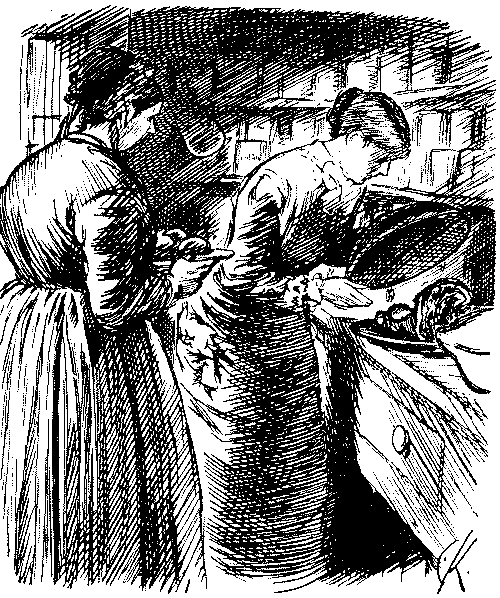
NO MISTAKE THIS TIME
Lodger: "Dear me, Mrs. Cribbles, your cat's been at this mutton again!"
Landlady: "Oh no, Mum, it can't be the cat. My 'usband says he b'lieves it's the Collerlarda Beetle."
The arrival of the Colorado Beetle, a "newcomer" the reverse of "blithe," is turned to humorous account by Keene in 1877. It was not Punch, however, who was responsible for the unfeeling suggestion that a young man, who had little to recommend him but the size of his feet, and was in need of employment, should emigrate to Colorado to crush the Beetle. Inoculation was already sufficiently advanced by 1881 for Punch to make it the subject of what no doubt seemed to him burlesque treatment. A lady, whose nephew is going out to Sierra Leone, comes to buy him some Yellow Fever from her chemist, who offers her the Traveller's half-guinea assortment of six of the Commonest Zymotics, to be supplemented with most of the Tropical diseases at 5s. each. In the light of the development of medical science the burlesque is not so fantastic after all. Of the alternative method of cure by suggestion or hypnotism Punch was sceptically critical, though he exhibits in 1889 an ironical preference for the hypnotic treatment of dipsomaniacs as compared with the repressive laws advocated by temperance extremists.
Drugs, Diet, and Speed
In 1890 influenza attained the proportions of an epidemic, and under the heading, "Refreshments in Vogue," a butler is shown saying to a lady, "Quinine or Antipyrin, my lady?" A propos of refreshments, it is to be noted that Punch, while no teetotaller, bestowed a somewhat lukewarm benediction on Vegetarianism in 1886, when a Vegetarian Restaurant was opened in the Strand opposite the Law Courts. The movement was supported by several eminent medical men, including Sir Henry Thompson and Sir James Crichton-Browne, on the ground that we ought to eat less meat. Of late years Sir James Crichton-Browne has shown more benevolence to carnivorous habits.
The general speeding-up of traffic on land and sea by improved methods of locomotion inspired Punch with mixed feelings. He was far-sighted enough to recognize the need of raising the status of the engineer in the Royal Navy long years before the introduction of the system of the "common entry," but when he read in 1883 that a ship was being built to cross the Atlantic in five days, he remarked that we were reducing our periods of astonishment: "It's only a five days' wonder now." Wonder gives place to protest, in 1889, against the racing of great Atlantic liners; and the following passage has a curiously prophetic ring when one thinks of the tragedy of the Titanic:—
RACING THE "RECORD"
(Suggestion for a brief Mid-Atlantic Cantata).
"Tearing ahead with the green sea sweeping the decks from end to end, never slacking speed in the face of the heaviest weather, regardless alike of the risk of crashing into some coming vessel and of the chance of splitting in half on some suddenly appearing iceberg, as of the dense fog which conceals both; with fires blazing and stokers fainting over the stress of work that is wrung out of them—the passage is made, from start to finish, at high-pressure pace. What is gained is a few hours' triumph in time over the performance of some rival Company, and the cost, if the practice be not speedily checked, will, sooner or later, most assuredly be the loss in Mid-Atlantic of a whole shipload of loudly protesting but as yet helpless and totally unheeded passengers."—Notes of some recent Atlantic Passages taken at random from the Daily Papers.
The speeding-up of agriculture by machinery found little favour in Punch's eyes. In the two pictures representing the "Delights of the Peaceful Country" in 1884, the point of view is that of the sportsman. Horses, maddened by the noise and smoke of steam ploughs and traction engines, are seen bolting in all directions. The leader of a tandem is shown standing on his hind-legs. Nowadays we expect to see sensitive motorcars behaving in a similar way in the presence of Highland cattle.
Punch did not retain a City editor on his staff, but the great increase of limited liability companies in the 'eighties did not escape his notice. The movement had gone so far that in 1886 a cartoon shows a "Baked Tater Merchant" about to convert his business into a limited liability company and retire into private life. The gold boom in Johannesburg in 1889 inspired him with no misgivings, and an optimistic article in the Daily News prompted him to picture the Transvaal, a Colonial Cinderella, transformed by Gold the fairy godmother. England was visited in the same year by a party of American engineers on their way to the Paris Exhibition, and their impressions are summarized in a set of verses entitled, "Yankee Notions," in which Punch undertakes to interpret their admiration and gratitude. They would be admirable if they had been written by an American, but acknowledgments of this sort lose nine-tenths of their virtue when the host usurps the privilege of the guest. Yet as a record of British achievement the lines are worth quoting:—
We have seen the Mersey Tunnel, 'tis a tidy little funnel; The Manchester Ship Canal, and Bridge of Forth, John Bull, And we find the land of Smeaton not so easily is beaten. We have travelled East and West, and South and North, John Bull. In your skill we've grown believers, and those Forth Bridge cantilevers Lick the topping towers of Washington and Eiffel, John Bull. And now we would say thankee on behalf of every Yankee Who has had your hospitality, no trifle, John Bull. At the Guildhall Banquet truly every toast was honoured duly, And the Yankee Engineers received a bumper, John Bull. The old "Star-spangled Banner," sung by Fryer in a manner All his own, made every Yankee heart a thumper, John Bull. It seemed to float right o'er us as we all joined in the chorus, And drank the loving cup in Civic style, John Bull. Well, and here's three hearty cheers for Old England's Engineers, Who make the best of your queer little isle, John Bull. 'Tisn't long, 'tis rayther narrow, but Laird, Bessemer, and Yarrow, With Armstrong, Whitworth, Maudslay, Ford, and Rennie,[7] John Bull. And others quite as clever use their very best endeavour To make their little land as good as any, John Bull. We must presently go back, and when on the homeward track The results of our excursion we shall tot, John Bull, And shall find ourselves agreeing we have seen some things worth seeing In the land of Telford, Stephenson, and Watt, John Bull.
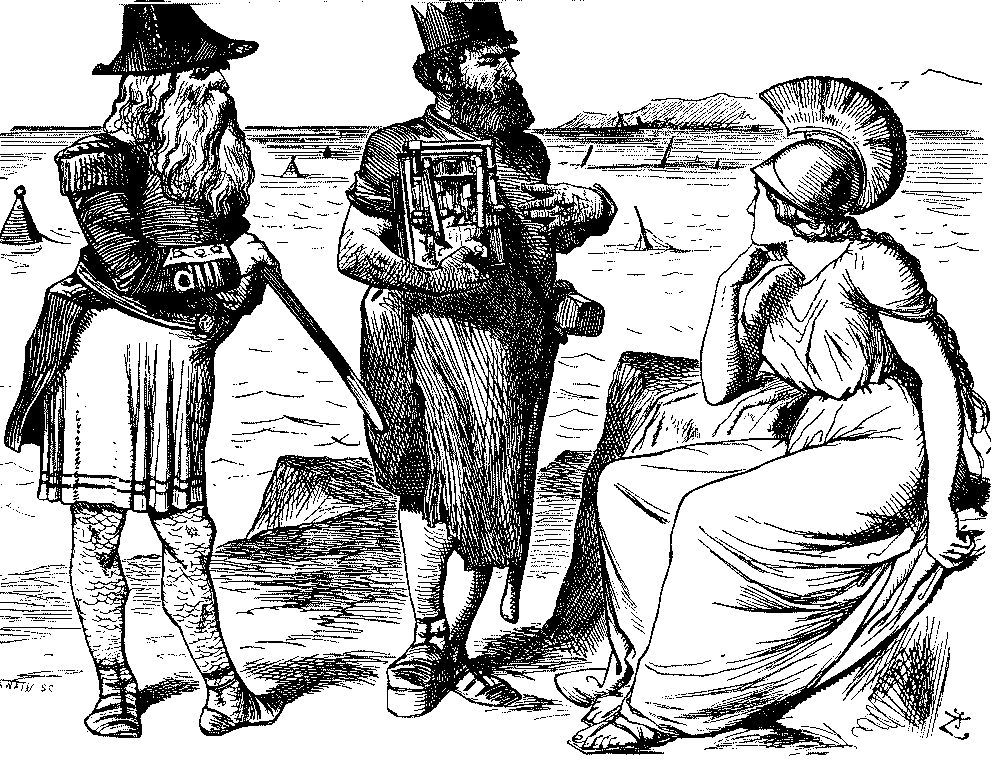
SALTS AND STOKERS
Vulcan (Chief Engineer): "Yes, Ma'am, things do look bad, and won't be better till you make a change in your officering! It's been Captain Nep's boys till now—it must be both our boys in future!!"
"Snapshot" photography is mentioned, but one cannot say honourably mentioned, in 1887, and in 1892 the "detective" camera is spoken of as a fashionable plaything. The introduction of the Parcel Post in 1883 inspires a burlesque correspondence on its abuse by the senders of unsuitable articles, such as red herrings. In 1890 the Jubilee of the Penny Post is celebrated in a ballad in praise of Rowland Hill, always one of Punch's heroes, who had carried his point though denounced as a lunatic.
PART II
THE SOCIAL FABRIC