LETTERS AND JOURNALISM: DRAMA AND MUSIC
Reading edition
As I ventured to remark in an earlier volume, a literary critic's acumen and flair are better shown in his estimates of writers whose fame is as yet unassured, or who are just emerging above the horizon, than of authors of established reputation. No special credit attaches to Punch for writing with reverence of Shakespeare, Milton, Wordsworth, Scott or Charles Lamb, whose centenary evoked a charming tribute in 1875, when the Headmaster of Christ's Hospital appealed in The Times for support in erecting a memorial to Elia in his old school. A better test is furnished in his references to Browning and Swinburne, Matthew Arnold, Charles Reade and Trollope, Jefferies and Stevenson and Thomas Hardy, George Eliot and Mrs. Humphry Ward, and, to come down to the end of this period, Kipling and Barrie. Yet all established reputations were not respected by Punch. When Rabelais was included in Professor Henry Morley's series of World's Classics in 1883 Punch uttered a vehement protest against the choice. He calls Rabelais a "dirty-minded, scurrilous, blasphemous, witty, broadly humorous and extravagantly grotesque clerical buffoon." The Saturday Review thought otherwise, but Punch declared that the defence was only put forward as "a stalking-horse for a malicious attack on ourselves."
The lines on George Eliot in 1881 are brief but laudatory. The phrase declining to rank her "among the tricksy mimes" is not happy; but she is spoken of as "this large-orbed glory of our times," and Punch prophesies for her "unfading bays," a prophecy to which the present generation would seem inclined to demur. Punch had little to add to his previous tributes to Carlyle when the Sage of Chelsea passed away in the same year, except to express the view that he was profoundly discontented with the England of to-day:—
He lived through England's triumph, but he heard With dying ears the shadow of decline.
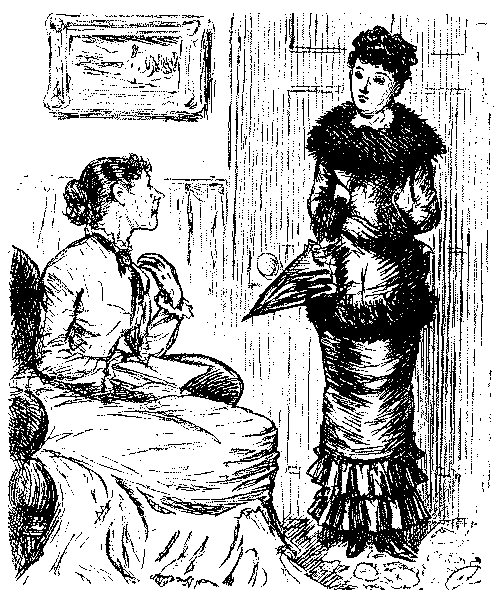
CULTURE—1881
Mistress: "As you've never been in Service, I'm afraid I can't engage you without a 'character.'"
Young Person: "I have three School Board certificates, Ma'am!"
Mistress: "Oh, well—I suppose for honesty, cleanliness——"
Young Person: "No, Ma'am—for 'Literatoor,' Joggr'phy and Free'and Drawin'!"
Relations with American Authors
The founding of the Browning Society in the same year met with no more encouragement from Punch than Miss Braddon's boiled-down versions of Scott's novels. Punch dimly recognized Browning's greatness while resenting his obscurities and eccentricities, and in a further skit on the Society carefully disclaims any disrespect for Browning himself. This mitigated appreciation is developed in the memorial verses in 1889 which hail him as a gallant and manly singer and apostle of healthy optimism, while denying his Muse the quality of elegance. Punch was nearer the mark in his laconic reference to Tupper, who died in the same year:—
"His name has passed into a Proverb."
Martin F. Tupper, famed for his Proverbial Philosophy, has joined the majority. He was thoroughly in earnest, and said many a true thing in what popularly passed for poetry. He will be remembered as "The Great Maxim Gun" of the nineteenth century.
The Annual Register reminds us that in twenty-five years over 100,000 copies of Proverbial Philosophy were sold in England and nearly half a million in America.
Punch was happier in dealing with Longfellow than with Emerson; the description of the latter as "the cheery oracle, alert and quick," is hardly adequate. Punch, however, protested against the proposed monument to Longfellow in the Abbey. He had learned to appreciate J. R. Lowell, who, on leaving England in 1885 after his four years' tenure of office as American Minister, said that "he had come among them as a far-away cousin, and they were sending him away as something very like a brother." Punch refused to say good-bye to this great and wise American, and his "au revoir" verses contain pleasant allusions to The Biglow Papers and Study Windows. Nor was his welcome of Oliver Wendell Holmes a whit less cordial, when the beloved "Autocrat" visited England to receive a D.C.L. degree in 1886. Bret Harte had been welcomed by Punch in 1879 as a master of wit and wisdom, humour and pathos. Though, as was said of a famous composer, he began as a genius and ended as a talent, the influence of The Luck of Roaring Camp[10] on the development of the short story was fruitful and abiding. To complete the record of Punch's relations with American authors it may be noted that in 1881 he greeted Joel Chandler Harris, the author of Uncle Remus, as a benefactor; that he resented Mr. W. D. Howells's critical depreciations of Dickens and Thackeray; and that, when Walt Whitman died in 1892, he indited what was virtually a palinode:—
Whilst hearts are generous and woods are green, He shall find hearers, who, in a slack time Of puny bards and pessimistic rhyme, Dared to bid men adventure and rejoice. His "yawp barbaric" was a human voice; The singer was a man.
To return to native writers, Punch happily linked a great Churchman and a great Victorian novelist in the stanza which appeared at the close of 1882:—
Two men whose loss all Englishmen must rue, True servants of the Studio and the State. No manlier Churchman Trollope ever drew Than History will portray in gentle Tait.
Punch had long acclaimed Tennyson as one of the major poets; but a slight element of reserve mingles in the congratulations on his peerage in 1883. Approval is tempered by chaff, and allusion is made to the Laureate's being prevented from taking his seat in the Lords by having lost his robes. There are no reserves in the tribute to the "beloved Cambridge rhymer" C. S. Calverley, when he passed away in early middle age in 1884. The memorial verses omit all mention of Calverley's genius for high parody, and incorrectly speak of the Ode to Beer as being written in Spenserian stanzas, but are otherwise affectionately appreciative:—
Well, well, omnivorous are the Shades; But seldom hath that Stygian sculler Oared o'er a gayer ghost than "Blayds,"[11] Whose transit leaves the dull world duller.
Literary Controversies
Charles Reade, who died in the same year, is not ineptly described as the "Rupert of Letters," and his indiscretions and exuberances are overlooked in virtue of his services both as a dramatist and novelist, and the "noble rage" with which he vindicated "the master-virtue, Justice."
Echoes of a controversy over the censorship exerted by the libraries, revived periodically in later years, come to us from the years 1884 and 1885, when the banning of Mr. George Moore's novels led to a correspondence in the Pall Mall Gazette. Here the late Mr. George Gissing, while professing little sympathy with Mr. Moore, had fallen foul of Thackeray for truckling to the demands of Mrs. Grundy and betraying his artistic conscience—à propos of the Preface to Pendennis. This was altogether too much for Punch, who belaboured Mr. Gissing to his heart's content in his most truculent vein, and did not abstain from his old and ugly habit of making offensive capital out of an antagonist's name: "humbly we own that we never heard of his name before, though it seems suggestive of a kind of guttural German embrace performed by the nationalizer of the Land [Henry George]."
Another famous literary quarrel broke out in 1886, the year of the trenchant attack, recalling the style and temper of Macaulay, on Mr. Gosse in the Quarterly Review for October. As Punch had already indulged in a good deal of acid pleasantry at the expense of the mutual admiration of "Poet Dobson" and "Poet Gosse," it was easy to guess on which side his sympathies would be enlisted. The sting of the Quarterly's indictment lay in the statement that "the men who write bad books are the men who criticize them," and Punch did not refrain from rubbing in the charge:—
Quarterly pay was dear to man Since or ever the world began, Chances vanish, and ventures cross, Even sometimes for bards like Gosse; Since or ever the world began. Quarterly pay was dear to man. But there's a something in quarterly pay Which doesn't please all men alway! Less than half-truth is a quarter-lie, Bound to be found out by-and-by; Since or ever the world began, Quarterly pay has been strict with man. Play straight and honest—for, if you don't, The public meed 'tis receive you won't; The mutual arts of puff and praise, Even in these degenerate days, Sink at last in the scorn they raise; Since or ever the world began, Quarterly pay has been straight with man.
Poet Dobson shall claim on high From Poet Gosse immortality! And Poet Dobson shall shed the same, No doubt, upon Poet Gosse's name— While a weak world wonders whence they came, And never a weakling dares deny (For there's no such thing as puffery) To each his immortality! Yet Quarterlies dare to say, for once, That dunce's works are reviewed by dunce. Shocking! Anonymous donkeys speak Donkey's dislike of a cultured clique— ("Fudge," by Goldsmith; but now called "cheek")— Yet since or ever the world began, Quarterly reckoning's good for man!
The Quarterly, not for the first time, overshot the mark by its "savage and tartarly" methods, and the incriminated critic survived an attack fortified by accurate learning but impaired by unrestrained animosity.
Punch Salutes Mr. Kipling
Punch resumed his genial strain in his tribute to Richard Jefferies, when that admirable prose poet of rural England and the pageantry of the seasons died prematurely in 1887. Matthew Arnold was not exactly one of Punch's literary heroes. His urbanity was admitted, but Punch slightly resented his intellectual superciliousness. Yet the verses on his death in 1888, cast in the "Thyrsis" stanza, acknowledge the value of his crusade against Philistinism, and the beauty of his elegiac poetry; he was "the great son of a good father." Towards Matthew Arnold's distinguished niece, Mrs. Humphry Ward, Punch was less benevolent on the occasion of the appearance of Robert Elsmere in the same year. The sorely tried hero is described as "wandering about, a married Hamlet in clerical attire, undecided as to his mission to set everything right and dying a victim to the Mephistophelean-Betsy-Prig spirit." Nor was Punch altogether appreciative of R. L. Stevenson, though he pays a reluctant homage to his genius in one of the "Mems for the New Year" for a literary man in January, 1889: "Resolutely to avoid making the most distant reference to 'Dr. Jekyll and Mr. Hyde.'" The standard of precision in the editing of Punch at this time was not above reproach. In the same year "Mr. J. L. Stevenson's Master of Ballantine" is reviewed though there was no such author and no such book. Punch made amends, however, in 1890 in his salutations of two notable newcomers. In February he was delighted by "the homely simplicity," the keen observation, shrewd wit and gentle pathos of Barrie in A Window in Thrums. Six weeks later he recognized in Rudyard Kipling's Plain Tales from the Hills a "new and piquant flavour," as of an Anglo-Indian Bret Harte. Punch found an "excessive abundance of phrases and local allusions which will be dark sayings to the uninitiated." But here adverse criticism ends. For the rest he acknowledges in the new writer a surprising knowledge of life, civil, military and native, and a happy command of pathos and humour. This tribute was followed up a few weeks later by a much more characteristic act of homage in doggerel verse:—
TO THE NEW SCRIBE AND POET
Air:—"O Ruddier than the Cherry."
O Rudyard, in this sherry, I drink your very, very Good health. I would That write I could Like Kipling, sad or merry.
(Signed) Invidius Naso.
The literary quality of Punch's literary criticism was not high in these days and his outlook was decidedly limited. It is therefore a welcome surprise to find him not only recognizing the beauty of Cory's Ionica in 1891, but specially singling out the famous version of the epitaph on Heraclitus. Punch could not dissect it as Walter Headlam did afterwards, but he noted one blemish—the confusion of "thou" and "you." Almost as unexpected, in view of his attitude towards much contemporary realism, is Punch's eulogy of Hardy's Tess in 1892. Barring the "absurdly melodramatic character of the villain" Punch has nothing but praise for its essential truth; acquits the author of "foolhardiness" in "boldly telling ugly truths about the Pagan Phyllises and Corydons of our dear old Christian England," and accepts his word for the faithfulness of the portraiture.
Punch had rejoiced over the dissolution of the Browning Society formed by Dr. Furnivall in 1891:—
Lovers of Browning may laugh and grow fat again, Rid of the jargon of Furnivallese.
He was not, however, any better disposed to Swinburne, Furnivall's antagonist and rival in the art of ferocious obloquy, of whom he wrote in the same year:—
There was a poor poet named Clough; Poet Swinburne declares he wrote stuff— Ah, well, he is dead! 'Tis the living are fed, By log-rollers on butter and puff!
Parodies and "Limericks"
Of Punch's relations with Ruskin we speak in another place. The most detailed notice of Meredith grew out of a real incident, the calling of the illustrious novelist as a witness in a libel action in the year 1891. Punch professes to give a full report of his evidence, in which Judge and Counsel are overwhelmed in a deluge of Meredithyrambics. It is a perfectly friendly and by no means inexpert parody of the contortions and obscurities which induced Tennyson to declare that reading Meredith was like wading through glue. Punch's friendly irreverence to his old friend of thirty years' standing prompts me to add that, throughout this period, parody was continually and increasingly employed, not like the bladder with which the Fool belabours bystanders, but as a weapon of genuine criticism. Here is a list, though not a complete list, of the authors who were subjected to this method in the period under review. Rhoda Broughton (for her emotional sentimentality) in Gone Wrong; Captain Hawley Smart, the sporting novelist; "Ouida"; Trollope; Disraeli, the florid magnificence and aristocratic atmosphere of whose Endymion is amusingly travestied in 1880; J. C. Harris, the author of Uncle Remus; Rider Haggard; Lord Lytton ("Owen Meredith") in "Fitzdotterel," a parody of Glenaveril; Stevenson; F. C. Philips, the author of As in a Looking Glass; Oscar Wilde; Barrie; Kipling; Hardy; Henley and Maeterlinck (in the style of Ollendorff).
Burnand was not a parodist of the class of Calverley or Sir Owen Seaman, Max Beerbohm or Mr. J. C. Squire; but what he lacked in literary felicity and scholarship and in that impersonation which assumes the habit of mind of the author travestied, he made up in his unfailing sense of the ludicrous, his high spirits and audacious burlesque. He confined himself mainly to prose. At the end of this period Mr. Anstey was a veritable tower of strength to the paper. His Voces Populi and his burlesques of recitations and music-hall songs are masterpieces of close observation and high-spirited fun. The extravagances of the æsthetic poets engaged other pens, but the best literary parodies belong to a rather later date. There is, however, a good specimen in the "domestic threnody" on Oleo-Margarine in the manner of Swinburne, which appears in 1881, and opens impressively:—
I am she whose nameless naked name to utter The strong are weak; The suet-sprung soft sweet sister of bad butter, Yet rid of reek. I, that, molten o'er the fires beneath me burning, From void of vat, Uprise supremer, in this my creamless churning, First-born of fat!
In this context I may note an original contribution to existing forms of verse in the ingenious doggerel French "Limericks" of Du Maurier, of which two specimens may suffice:—
Il était un homme de Madère Qui cassa le nez à son père. On demandait "Pourquoi?" Il répondit "Ma foi! Vous n'avez pas connu mon père!" Il existe une Espinstère à Tours, Un peu vite, et qui porte toujours Un ulsteur peau-de-phoque, Un chapeau bilicoque, Et des nîcrebocqueurs en velours.
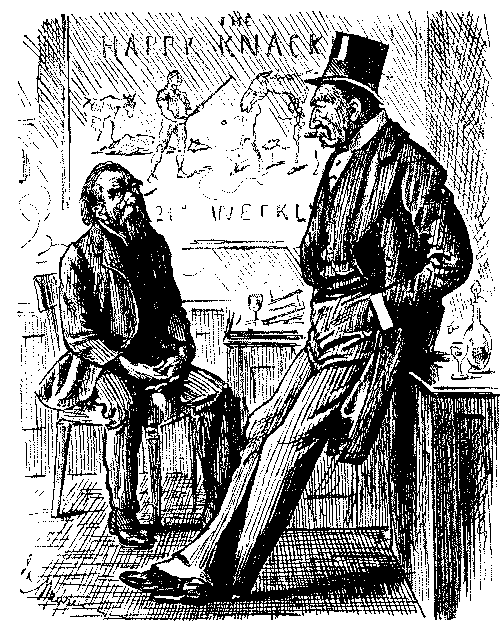
VICISSITUDES OF A RISING PERIODICAL
The Proprietor: "I'll tell you what it is, Shardson, I'm getting sick of the 'ole bloomin' Show! The Knacker ain't selling a Scrap—no notice took of us anywhere—not a bloomin' Advertisement! And yet there ain't 'ardly a livin' Englishman of mark, from Tennyson downwards, as we 'aven't shown up and pitched into, and dragged 'is Name in the Mud!"
The Editor: "Don't let's throw up the Sponge yet, Old Man! Let's give the dead 'uns a turn—let's have a shy at Thackeray, Browning, George Eliot, or, better still, let's bespatter General Gordon and Cardinal Newman a bit—that ought to fetch 'em a few, and bring us into Notice!"
Russel and Delane
Turning for the moment from gay to grave, we may note that Punch bestowed his benediction on the Dictionary of National Biography, when the first instalment of what was the greatest act of true sportsmanship in the publishing world of our times appeared in January, 1885. Per contra, the proposal for a British Academy in 1890 only met with irreverent suggestions from Punch for the constitution of the Elective Body.
Punch kept a watchful eye on the developments of journalism and periodical literature. He notes in 1876 the impending appearance of Truth, but his opinion of Society journals, discussed elsewhere, was not flattering. When Alexander Russel, the great editor of the Scotsman, died in July, 1876, Punch did not fail to recognize the conspicuous services of that fearless, honest and trenchant publicist and malleus stultorum:—
The shadows that make up our night, Were growing thin for him to fight, But still he fights, we think with pride, Our battle from the other side!
Long in our mêlée will be missed The mace of Russel's mighty fist, That struck and, wasting nought in sound, Buried its blow without rebound.
Bagehot, equally distinguished in letters and journalism, passed unnoticed in 1877, but Delane, the third and most widely renowned of the three great editors who died in the last half of this decade, was fitly eulogized in 1879 by one who was not the only writer who had served on the staff of both Punch and The Times:—
Rest in thy grave, that knew no resting here, Editor without equal, strenuous soul, Staunch friend, despising favour, scorning fear, Far-seeing, forward, cleaving to thy goal. He left a different scene from that he found, And had a large part in all change he saw, No slave, nor leader, of his time, but bound Abreast of it to keep its glass from flaw.
The centenary of The Times, which occurred in 1888, is duly noted, and by way of contrast to what was then a national institution there are allusions to short-lived but now forgotten papers and periodicals, more notorious than notable. Punch kept a vigilant eye on the provincial press, but he was, on the whole, more inclined to utilize it when it suited its purpose and to make humorous capital out of its shortcomings than to acknowledge its solid merits. Of Punch's own domestic history it may suffice to maintain that a mountain in the Arctic regions was named after him by the expedition under Captain Nares in 1876; and that he was once more banned in Paris on account of the cartoons on Marshal MacMahon in 1878. He paid affectionate homage to Tom Taylor on his death in 1880 as a cultivated man of letters, a considerate and judicious editor, above all, a warm-hearted, upright man and a staunch and loyal friend. Henry Mayhew, who died in 1887, "comrade of Punch and champion of the poor," was only associated with the paper in its earlier days and for a short period. By the death of the gentle Percival Leigh, of "Pips's Diary" fame, in 1889, the last link was snapped with the days of Mark Lemon, Douglas Jerrold, Leech and Doyle and Thackeray.
FINE ARTS
A survey of the Fine Arts from 1874 to 1892, based on a study of Punch, reveals changes and even reactions in his outlook. As we have seen in an earlier volume, he had been converted in great measure to Pre-Raphaelitism; he had welcomed Whistler as a master etcher; he had been a severe and at times even savage critic of the stereotyped conventions, the opportunism, the inanities of the Royal Academy.
Punch and Æstheticism
Something of this spirit remains in the period under review. The annual exhibitions at Burlington House are dealt with in no reverential mood. As far back as 1877 we note the first appearance of an article with illustrations very much on the lines of the modern "Academy Depressions." The pictures exhibited in the years of his declining powers by the late Mr. J. R. Herbert, R.A., are caricatured without mercy in 1885, and the New English Art Club is welcomed in 1889 for its revolt against "the dull dead level of sleek respectability, the commonplace churchwardenism of suburban gentility." The sequel invites quotation:—
A bold, original, impudent lot are these New Englanders, but they are notwithstanding wonderfully refreshing. Sometimes their spirits are too much for their strength, and they come tremendous "croppers." It has been well said that a strikingly original writer occasionally writes absolute nonsense, and by the same rule an artist, who turns aside from the well-swept, carefully watered, mathematically paved academic high road, must not infrequently paint absolute nonsense; but he thinks for himself, he does not view Nature through the spectacles of others, and in nine cases out of ten he is likely to produce works that will be successful in the long run. Though there are some pictures among the collection will make the casual visitor jump, there are not a few will make him think.
Some of the rebels of 1889 have developed into the academics of thirty years later, and Punch's list of the most notable contributors makes us jump as well as think: John S. Sargent, Solomon J. Solomon, Whistler, B. Sickert, Tuke, Edward Stott, A. Roche, N. Garstin, G. Roussell, Sidney Starr, F. Brown, A. Mann, H. Vos, W. J. Laidlaw and J. E. Christie.
Punch, then, cannot be written down as a Philistine, but there is no denying the fact that his artistic judgment was warped and impaired by his invincible hostility to the æsthetic movement; his inability to disentangle the good in it from the evil; his confusion of charlatanry and sincerity; and his failure to recognize the great services rendered by Morris in the domain of decorative design. Prejudice and ignorance mingle with good sense and good feeling in the manifesto which Punch put forth in 1882, and which may serve as a general exposition of his artistic and literary creed in the 'eighties:—
IN EARNEST
Let us be clearly understood. The word "Æstheticism" has been perverted from its original meaning; i.e. the perception of all that is good, pure and beautiful in Nature and in Art, and, as now vulgarly applied, it has come in a slang sort of way to stand for an effeminate, invertebrate, sensuous, sentimentally-Christian, but thoroughly Pagan taste in literature and art, which delights in the idea of the resuscitation of the Great God Pan, in Swinburnian songs at their highest fever-pitch, in the mystic ravings of a Blake, the affectation of a Rossetti, the Charmides and revoltingly pantheistic Rosa Mystica of Oscar Wilde, the Songs of Passion and Pain and other similar mock-hysterical imitations of the "Mighty Masters." Victor Hugo, Ouida, Swinburne, Burne-Jones, have much to answer for.
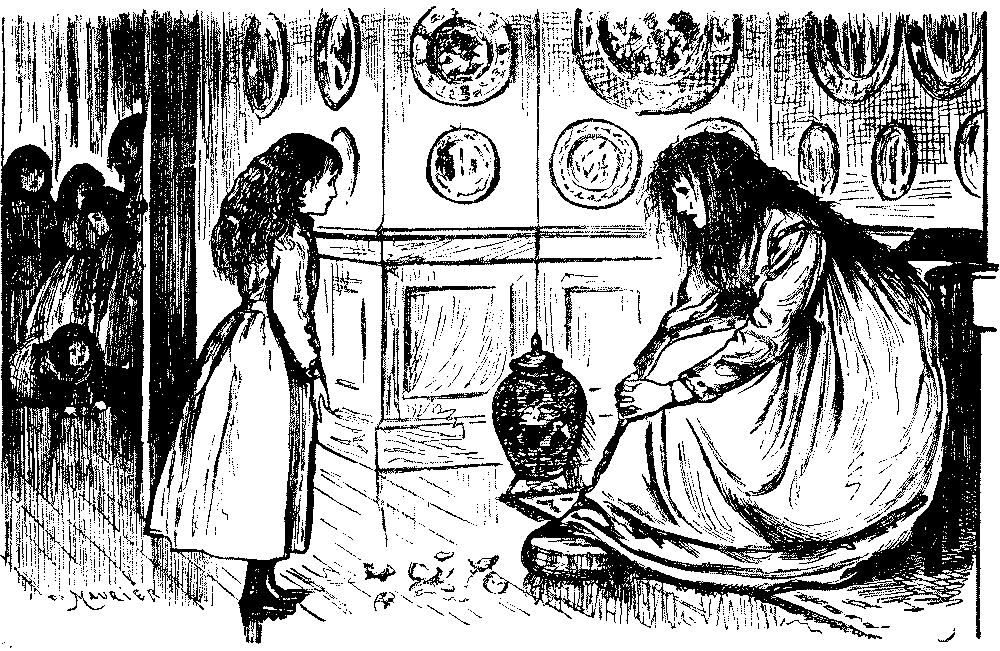
ACUTE CHINAMANIA
May: "Mamma! Mamma! Don't go on like this, pray!!"
Mamma (who has smashed a favourite pot): "What have I got left to live for?"
May: "Haven't you got me, Mamma?"
Mamma: "You, child! You're not unique!! There are six of you—a complete set!!"
This Æstheticism, as it has gradually come to be known, is the reaction from Kingsley's muscular Christianity. Exaggerated muscular Christianity, in its crusade against canting and whining religion, in its bold attempt to show that the practice of true religion was for men, as well as for women, trampled on the Christian Lily, emblem of perfect purity; and what Athleticism trod under foot, Æstheticism picked up, cherished, and then, taking the sign for the reality, paid to it the extravagant honours of a Pagan devotion; and the worship of the Lily was substituted for the veneration paid to the sacred character, in whose hand Christian Art had originally placed it. To this was added the worship of the Peacock's Feather. It is this false Æstheticism which we have persistently attacked, and will persistently attack to the bitter end, and henceforward those who misunderstand us do so wilfully, and it may be maliciously.
Whistler and Ruskin
Punch was justified in deploring the opportunism of Millais in painting "pot-boilers" and "pretty-pretty" pictures, such as "Bubbles." He had powerful and well-equipped allies in his view that Whistler in his later manner left off painting or etching where the difficulties began, a view expressed in the lines in 1883 on "Whistler in Venice":—
Whistler is "Niminy-Piminy," Funny, fantastic, and quaint. Yet he's so clever that Jimmy nigh Makes men believe he can paint. What of his works? Why, each etching is Only at present half done, And on the copper the sketching is Simply a wild piece of fun. Vainly the Critics will sit on him, Why such a butterfly slay? No one can e'er put the bit on him— Whistler's the wag of the day.
Yet Punch thought Ruskin had gone too far in the famous onslaught which led to the historic lawsuit and verdict in 1878:—
To John Ruskin
(On a recent Verdict)
If "Fors Clavigera," dear Slade Professor, Means "Force that bears a club," Be warned, since of a big stick you're possessor, And more discreetly drub. Strength unrestrained's not greater strength but lesser, And scorn provoketh snub.
The Grosvenor Gallery, opened in 1877, at once eclipsed Burlington House as the favourite target of Punch's ridicule and caricature, and as the home of all the tendencies which he repudiated in the manifesto quoted above. His general attitude is very much that of Gilbert in Patience; and Burne-Jones and Rossetti (whom he miscalls "D. S. Rosetti" as late as 1880) were indiscriminately confounded in dispraise along with the lesser fry. Tennyson's "Palace of Art" is perverted into a vehicle for assailing Pre-Raphaelitism. The "Dream of Queer Women" in 1878 gives prominence to the artistic type, and a visit to the Grosvenor Gallery in the early summer of the same year inspires "The Haunted Limbo; a May-night Vision" animated by the same hostility:—
Those women, ah, those women! They were white, Blue, green, and grey—all hues, save those of nature, Bony of frame, and dim, and dull of sight, And parlous tall of stature. Ars longa est—aye, very long indeed, And long as Art were all these High-Art ladies, And wan and weird; one might suppose the breed A cross 'twixt earth and Hades. If poor Persephone to the Dark King Had children borne, after that rape from Enna, Much so might they have looked, when suffering From too much salts and senna. Many their guises, but no various grace Or changeful charm relieved their sombre sameness Of form contorted, and cadaverous face, And limp lopsided lameness.
Homage to Cruikshank
Leighton's "Athlete and Python" in 1877 had been saluted as "a statue at last," and Punch welcomed his election as P.R.A. in the following year, with an excellent portrait by Sambourne of "the right man in the right place." It was in 1878 again that Punch turned aside from the flagellation of his pet aversions to pay homage to the genius of George Cruikshank, who died on February 1:—
England is the poorer by what she can ill spare—a man of genius. Good, kind, genial, honest and enthusiastic George Cruikshank, whose frame appeared to have lost so little of its wiry strength and activity, whose brain seemed as full of fire and vitality at fourscore as at forty, has passed away quietly and painlessly after a few days' struggle. He never worked for Punch, but he always worked with him, putting his unresting brain, his skill—in some forms of Art unrivalled—and his ever productive fancy, at the service of humanity and progress, good works, and good will to man. His object, like our own, was always to enforce truth and urge on improvement by the powerful forces of fun and humour, clothed in forms sometimes fanciful, sometimes grotesque, but never sullied by a foul thought, and ever dignified by a wholesome purpose.
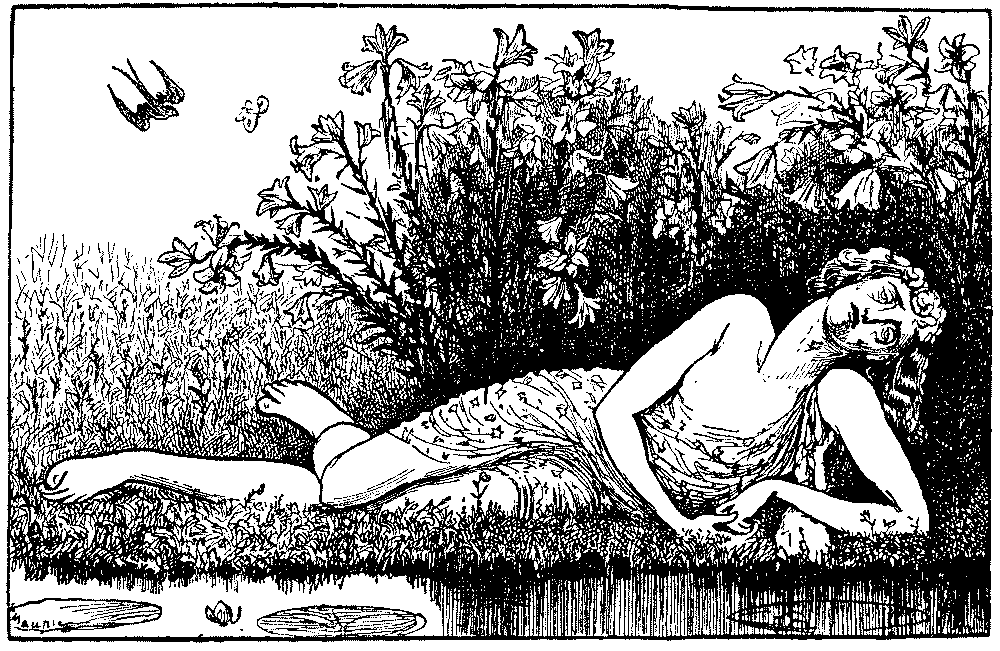
A LOVE-AGONY. Design by Maudle
(With verses by Jellaby Postlethwaite, who is also said to have sat for the Picture.)
His fourscore and six years of life have been years of unintermitting labour, that was yet, always, labour of love. There never was a purer, simpler, more straightforward, or altogether more blameless man. His nature had something childlike in its transparency. You saw through him completely. There was neither wish nor effort to disguise his self-complacency, his high appreciation of himself, his delight in the appreciation of others, any more than there was to make himself out better, or cleverer, or more unselfish than his neighbours.
In him England has lost one who was, in every sense, as true a man as he was a rare and original genius, and a pioneer in the arts of illustration.
Punch's estimate accords with that of the friend who knew Cruikshank well and described him as "in every word and deed a God-fearing, Queen-honouring, truth-loving, honest man," and it is all the more significant in view of Cruikshank's vehement and even fanatical espousal of the cause of temperance. Another great illustrator, though of a very different type, emerged in the following year in Randolph Caldecott. His genial and graceful commentaries on Nursery Rhymes were entirely after Punch's heart. He was speedily enlisted as an occasional contributor up to 1886, the year of his premature death, when Punch faithfully summed up the gifts of a true benefactor of all ages:—
We loved the limner whose gay fun Was ever loyal to the Graces; Who mixed the mirth of Gilpin's run With willowy forms and winsome faces; Who made old nursery lyrics live With frolic force rejuvenated, And yet the sweetest girls could give That ever pencil-point created. From Bracebridge Hall to Banbury Cross His fancy flew with fine facility. Orchards all apple-bloom and moss, Child sport, bucolical senility, The field full cry, snug fireside ease, Horse-fun, dog-joke his pencil covers, With Alderman and hawthorn trees, Parsons and Squires, and rustic lovers.
But in these years Punch had little time to spare for praise; he was so busy belabouring Burne-Jones and Rossetti, the Grosvenor Gallery, the Kyrle Society, or new fashions in house decorations and furniture, in which he saw nothing but gloom and discomfort. The protest in 1879 of the three Slade Professors—Sidney Colvin, W. B. Richmond and Legros—against the critics who denied Burne-Jones genius and greatness on the strength of defective anatomical details, left Punch impenitent. He mocked at their "triune testimonial" as an unconvincing attempt to convert the callous and captious critics who,
Persisted in belabouring B.-J. with tongue and pen Whilst Philistia looked on and laughed at those Three Mighty Men.
Prigs and Philistines
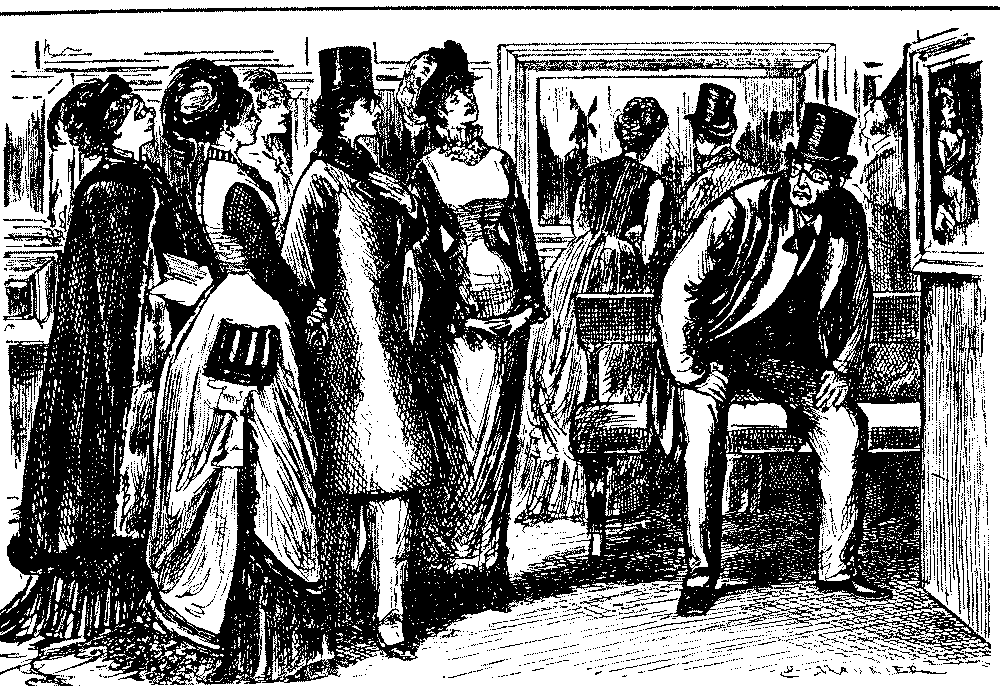
MODERN ÆSTHETICS
(Ineffable Youth goes into ecstasies over an extremely Old Master—say, Fra Porcinello Babaragianno, A.D. 1266-1281?)
Matter-of-fact Party: "But it's such a repulsive subject!"
Ineffable Youth: "'Subject' in art is of no moment! The Picktchah is beautiful!"
Matter-of-fact Party: "But you'll own the Drawing's vile, and the Colour's beastly!"
Ineffable Youth: "I'm Cullah-blind, and don't p'ofess to understand D'awing! The Picktchah is beautiful!"
Matter-of-fact Party (getting warm): "But it's all out of Perspective, hang it, and so abominably untrue to Nature!"
Ineffable Youth: "I don't care about Naytchah, and hate Perspective. The Picktchah is most beautiful!"
Matter-of-fact Party (losing all self-control): "But, dash it all, man, where the dickens is the beauty, then?"
Ineffable Youth (quietly): "In the Picktchah!"
Total defeat of Matter-of-fact Party.
It is true that Punch makes some reservations in his "Moral":—
Critics are full of "cussedness," omniscience sometimes slips, And even triune Oracles may chance to miss their tips.
But his sympathies undoubtedly remain with the critics, and he virtually identifies himself with Philistia in the plea of the Philistine in the following year:—
Take away all your adornments æsthetical, Plates of blue china and bits of sage green, Though you may call me a monster heretical, I can't consider them fit to be seen. Etchings and paintings I loathe and abominate, Grimly I smile at the name of Burne-Jones, Hating his pictures where big chins predominate— Over lean figures with angular bones. Buy me what grinning stage rustics call "farniture," Such as was used by our fathers of old; Take away all your nonsensical garniture, Tapestry curtains and borders of gold, Give me the ancient and solid mahogany, Mine be the board that will need no repairs, Don't let me see, as I sit at my grog, any Chippendale tables or spindle-legged chairs. Hang up a vivid vermilion wall-paper, Covered with roses of gorgeous hue, Matching a varnished and beautiful hall-paper, Looking like marble so polished and new. Carpets should all show a floral variety, Wreaths intermingling of yellow and red; So, when it enters my home, will Society Say, here's a house whence æsthetics have fled.
Belabouring Burne-Jones
The "Lay of the Private View" at the Grosvenor Gallery in May, 1881, forms a useful supplement to Gilbert and Sullivan's Patience, produced a fortnight before the verses appeared:—
The Grosvenor! the view that's called private, Yet all the world seems to be there; Each carriage that comes to arrive at The door, makes the populace stare. There's Gladstone, severe of demeanour, It's plain that the pictures don't please; And there, with an aspect serener, Her Highness the Princess Louise. The Haunt of the very æsthetic, Here come the supremely intense, The long-haired and hyper-poetic Whose sound is mistaken for sense. And many a maiden will mutter, When Oscar looms large on her sight, "He's quite too consummately utter, As well as too utterly quite."
Here's Whistler paints Miss Alexander, A portrait washed out as by rain; 'Twill raise Ruskin's critical dander, To find James is at it again. The flesh-tints of Watts are quite comic; There's Herkomer's chaos of stones; But where is the great anatomic Improver on Nature, Burne-Jones? A Grosvenor without him so strange is, We miss the long chins and knock-knees, The angel of bronze, who for change is Tied up to the stiffest of trees: Limp lads with their belli capelli, Mad maidens with love smitten sore, Oh, shade of defunct Botticelli, Burne-Jones comes to startle no more!
I deal in another section with the fashionable cult of æstheticism, which was now at its zenith. In estimating its artistic importance, Punch erred in his refusal to discriminate between eccentricity and independence. He continued to "belabour B.-J.," and brackets him with Whistler in the ribald suggestion that they were jointly responsible for the pictures exhibited by the "Screevers" or pavement artists. Millais is congratulated on breaking away from Pre-Raphaelitism, and invidious comparisons are drawn in 1886 between his pictures and those of Holman Hunt:—
There couldn't be a better foil to the manliness of the Millais Show at the Grosvenor than the pseudo-mediæval-O-quite-too-beautiful-namby-pamby-gilt-edged-and-gothic-clasped-Church-service style of the effeminate religious Art of Mr. Holman Hunt. Millais tried it, and, after a struggle, snapped the Pre-Raphaelite fetters, and escaped.
Yet in the next two years Millais is criticized for sacrificing character to "prettiness" and desecrating his talent by placing it at the disposal of the advertiser. Watts's enigmatic "Hope" was "guyed" in 1887 under the title "Cutting off her head with a saw." The multifarious activities of Herkomer—painter, etcher, director of a school of art at Bushey, designer of posters, operatic composer, etc.—did not escape Punch's amused notice. Punch himself, as might readily be expected, did not enjoy an immunity from art criticism. In 1883 he had congratulated Ruskin on his second election to the Slade Professorship at Oxford; at the end of the year Ruskin repaid the compliment, in his lectures on the Art of England, by a long detailed and in the main highly eulogistic survey of Punch's artistic work. But the panegyric was tempered by certain reserves:—
Says Mr. Ruskin, having before him in review one or two selected specimens of Mr. Punch's cartoons:—
"Look, too, at this characteristic type of British heroism—'John Bull guards his pudding.' Is this the final outcome of King Arthur and Saint George, of Britannia and the British Lion? And is it your pride or hope or pleasure that in this sacred island that has given her lion hearts to Eastern tombs and her Pilgrim Fathers to Western lands, that has wrapped the sea round her as a mantle, and breathed against her strong bosom the air of every wind, the children born to her in these latter days should have no loftier legend to write upon their shields than 'John Bull guards his Pudding'?"
And then Mr. Ruskin, as if conscious that the very onward sweep of his own free fancy has carried him beyond the limits of fair and reasonable estimate, as it were, harks somewhat back again, and offering Mr. Punch something in the nature of an apology, acquits him of all true responsibility for this same terrible and offending "pudding":—
"It is our fault" (proceeds Mr. Ruskin) "and not the Artist's; and I have often wondered what Mr. Tenniel might have done for us if London had been as Venice, or Florence, or Siena. In my first course of Lectures I called your attention to the Picture of the Doge Mocenigo kneeling in prayer; and it is our fault more than Mr. Tenniel's if he is forced to represent the heads of the Government dining at Greenwich rather than worshipping at St. Paul's."
Punch's Virtues as an Art Critic
Punch took the criticism in good part, while declaring that he had found this commonplace nineteenth century and its humdrum materials pretty well suited to his purpose; and after indulging in a whimsical dialogue between the editor, Giovanni Tennielo, and Ruskino in Venice, comes to the conclusion that after all the Queen of the Adriatic may have had even in her great days something less noble to lose than that condemned typical "pudding" which John Bull as yet has fortunately known how to guard. In this context I may add that in 1885 Punch reprinted an advertisement in which a young man, seeking for a place, stated amongst his credentials that he could "paint and talk Ruskinesque."
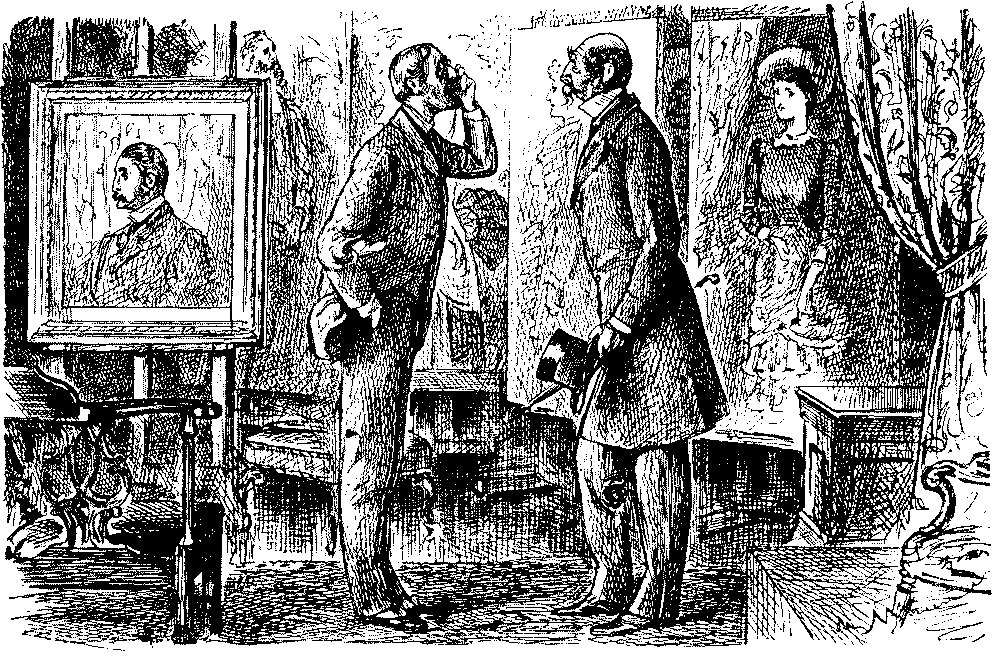
WHAT PORTRAIT-PAINTING IS COMING TO
The Duke of Dilwater: "I—a—have taken the liberty of calling to say that I shall esteem myself highly honoured if you will be so very kind as to accept from me a Commission to paint my Portrait, at any time most convenient to yourself!"
Fashionable Artist (after careful survey of His Grace's features): "You must excuse me, Duke, but I really can't. I—a—always choose my own Subjects now, you know, and I'm sorry to say that your Grace won't do!"
As I have not minimized Punch's limitations as an art critic, it is only fair to add that he was often sound and sometimes even acute. He said the right thing on the parvenu as art patron, and delicately hinted his approval of the independence of portrait painters. His appreciation of the strength of "Phiz" (Hablot K. Browne) as the illustrator of Dickens and Lever in helping us to visualize and fix certain types is excellently done, and generous admiration does not prevent him pointing out "Phiz's" weaknesses—his sketchiness, thin and skimpy style, and simpering mannerisms. This was said on the occasion of the show of "Phiz's" drawings in 1883 (the year after his death) which Punch recommended to "genial Middle-age with memories and unpriggish Youth without hyperæsthetic prejudices."
Nothing could be better in its way, again, than the castigation of the "slick" and deliberate eccentricities of Jan Van Beers in 1886. Punch admits the Dutch artist's talent, his capacity for higher work, proved in historical paintings, and then sets to work to wield the lash:—
Popinjay Art is plentiful enough. It is the trick whereby mediocrity antics itself into a sort of notoriety, and cynical cleverness indolently plays the fool with an easily humbugged public. It is probably calculated—perhaps with some reason—that these stagey tricks, and limelight effects, and dismal draperies, and bogey surprises, and peep-show horrors will perplex people into a foolish wonder, if not into an impossible enjoyment or an honest approval. Maybe that is all which is aimed at? But what an aim for anything calling itself Art!
Posturing Pierrots and smirking skeletons, goggling sphinxes and giggling cocottes, cadaverous surprises and ensanguined startlers, all the parade of nightmare and nastiness, pall upon the mind, as the phantasmagoric effects and sickly scents do upon the senses, of the visitors to the Salon Parisien. Whim and fantasy are all very delightful in their way. But this is not Wonderland, it is the world of drunken delirium and the Witches' Sabbath. A girl with emerald face, purple hair, and vivid vermilion lips, peeping between amber portières, is an inoffensive though purposeless, and not very interesting bizarrerie. But such gratuitous ghastlinesses as "Will o' the Wisp," "Felo de se," "Vive la Mort!" and particularly the offensively named "Ecce Homo," are simply revolting horrors. Somebody has hazarded the statement that they are Edgar-Poe-ish. Pooh! Poe was creepy sometimes, but he was an artist, an idealist, subordinating even occasional horror to the beautiful in his daring dreams.
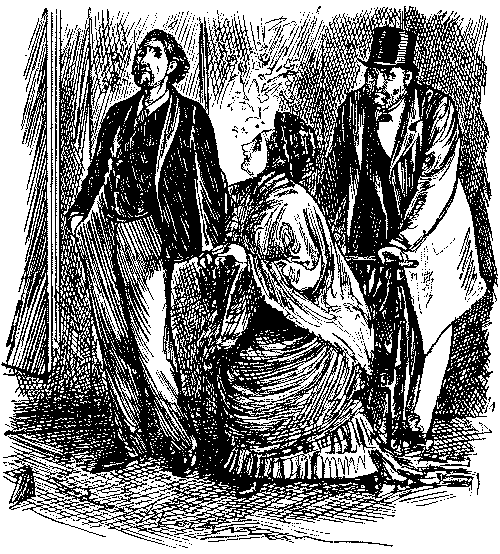
A FORTIORI
Philistine Father: "Why the dickens don't you paint something like Frith's 'Derby Day'—something everybody can understand, and somebody buy?"
Young Genius: "Everybody understand, indeed! Art is for the few, Father, and the higher the art, of course, the fewer the few. The highest art of all is for one. That art is mine. That one is—myself!"
Fond Mamma: "There speaks my own brave boy!"
Impartial Satire
As a rôle Punch was a strong partisan in art; yet on occasion he could hold the balance. I have illustrated the change in his view of Whistler, but it never degenerated into abuse. The dialogue, "Wrestling with Whistler," suggested by the exhibition at the Goupil Gallery in the spring of 1892, impartially satirizes Whistlerites, frank Philistines, and the literal and prosaic persons who were puzzled and bewildered by "arrangements," "harmonies," "symphonies" and "nocturnes." These simple souls, unable to recognize the objects depicted, were not helped by the faithful who retorted, "Ah, but it's the way he saw it!" To-day, as thirty years ago, their point of view is faithfully expressed in the unconscious irony of the serious elderly lady:
I've no patience with the man. Look at Gustave Doré now. I'm sure he was a beautiful artist if you like. Did he go and call his "Leaving the Prætorium" a "Symphony" or a "Harmony," or any nonsense of that kind? Of course not—and yet look at the difference!
It is true that the artist, like the prophet, is often "not without honour save in his own country and in his own house." The saying happily does not apply to Punch and his contributors. When Richard Doyle died in 1883, more than thirty years had elapsed since he severed his connexion with the paper, but Punch had never forgotten the old comrade who had designed his cover, and had been equally at home among the imps of Elfland and the swells and snobs of society:—
Turning o'er his own past pages, Punch, with tearful smile, can trace That fine talent's various stages, Caustic satire, gentle grace, Feats and freaks of Cockney funny— Brown, and Jones, and Robinson; And, huge hive of Humour's honey, Quaint quintessence of rich fun, Coming fresh as June-breeze briary With old memories of our youth— Thrice immortal Pips's Diary! Masterpiece of Mirth and Truth!
Personally I should invert the epithet "thrice immortal" and apply it to the "Continental Tour of Brown, Jones and Robinson"; otherwise the verses are a well merited tribute to the winged fancy and graceful humour of "Dicky Doyle." Charles Keene's death in January, 1891, removed another good comrade whose association with the paper was unbroken up to his last illness, and was one of the chief if not the greatest of its artistic glories:—
Frank, loyal, unobtrusive, simple-hearted, Loving his book, his pipe, his song, his friend, Peaceful he lived and peacefully departed, A gentle life-course, with a gracious end.
Ruskin on Leech
So much for the man; as for the artist, Punch was hardly overstating the case when he claimed that the exhibition of Keene's work in the following May stood for the supreme triumph of black and white in the achievements of its greatest master.
Ruskin, in the lecture noted above, had described Leech's work as containing "the finest definition and natural history of the classes of our society, the kindest and subtlest analysis of its foibles, the tenderest flattery of its pretty and well-bred ways, with which the modesty of subservient genius ever immortalized or amused careless masters." Small wonder was it, then, that Punch appealed for greater generosity to John Leech's three surviving sisters. Their combined pensions only amounted to £180—a "dole" which lent point to the dramatic dialogues in 1881 between a Minister and a Celebrity and (after the Celebrity's death) between the Minister and his Secretary, as a result of which the former decides to give the orphan daughter £50.
The cult of Japanese art in the late 'eighties furnished Punch's artists with new formulas and new methods of treating Parliamentary scenes. It also inspired the following ingenious adaptation of a famous phrase:—
Madame Roland Re-Edited (from a sham Japanese point of view): O Liberty! what strange (decorative) things are done in thy name!
Punch had reproached Millais for condescending to the "pretty-pretty" style, but in 1888 he was moved to caricature the modern fear of the same tendency—a fear destined to dominate so much of modern art in later years and to enthrone the Golliwog in the nursery.
DRAMA, OPERA AND MUSIC
Punch was mixed up with the drama from the very beginning. He drew his name and his initial inspiration from a puppet-show; all four editors who held the office between 1841 and 1892 were playwrights—three of them, Mark Lemon, Tom Taylor and Burnand prolific playwrights—and many of his leading contributors from Douglas Jerrold onwards owed a double allegiance to journalism and the drama. In these circumstances one can hardly expect to find in Punch's copious references to plays and players an entirely judicial or dispassionate critical attitude. Yet when all deductions have been made on the score of old loyalties, partisanship and even prejudice, his record, during the period which opened with the visits of Salvini and ended with Tree's Hamlet and the tyranny of "Ta-ra-ra-boom-de-ay," shows a creditable readiness to acclaim fresh talent and to applaud a good thing irrespective of its origin. We find a certain amount of resentment against the adulation of foreigners, but his patriotism in this respect is untainted by any Chauvinism—witness his "Salvo to Salvini" in 1875:—
Punch is rejoiced to see that a representative body of the London Actors lately made express application to the great Italian Player, now displaying his art for London's behoof, to give a morning performance of Othello, at which they could be present. Salvini answered the application with an Italian's courtesy, and an artist's feeling with his fellows. Remembering how, when Punch was young, an illiterate English mob once howled and hooted a French company from the stage of Drury Lane, and how, when the noblest Actor of his generation, William Macready, published a protest against the cowardly outrage, in which he associated his brother Actors with himself, a large body of those Actors disclaimed such association, and denied William Macready's right to speak for more than William Macready—Punch cannot but rejoice in the present indication of a larger and less "parochial" spirit of appreciation.
The actors who had the good fortune to see Salvini on Monday have seen a great artist, in the ideal sense of the word—one whose art "in the very storm and whirlwind of his passion, can beget a temperance that gives it smoothness"; whose voice keeps its music even in rage or agony, and whose action can be graceful, even in its moments of utmost vehemence; and this without forfeiture of force, or sacrifice of truth. It is of secondary importance whether or not those who hear Salvini understand Italian. They are sure to know the text of Othello; and Salvini's look, tone, and gesture speak the universal language.
Salvini, Ristori, Bernhardt
They must have marked the breadth and calmness of his style, the self-restraint that never betrays effort, and the grandeur resulting from this element of large effect. They will have seen how superior to points and petty tricks and clap-traps he is from first to last; how completely the Moor, steeped at first in the stately Oriental calm that almost looks like languor, till love lights in his eye and mantles in his face, or doubt begins to torture, and sense of wrong gathers and glows to fury, and a rage, far more terrible and unsparing than a wild beast's, works to madness in his brain.
The over-vehemence of Othello's final agony is deprecated, but Punch concludes by recommending all "who wish to know the highest expression of ideal tragic acting to see this famous Italian actor."
As he had welcomed another glory of Italian art in Ristori, so he yielded to the versatile enchantments of the "divine Sarah" in her frequent visits to our shores. The following tribute dates from 1879:—
TO SARAH!
(By an exuberant Enthusiast)
Mistress of Hearts and Arts, all met in you The Picturesque, informed by Soul of Passion! Say, dost thou feed on milk and honey-dew, Draining from goblets deep of classic fashion Champagne and nectar, shandy-gaff sublime, Dashed with a pungent smack of eau-de-Marah, Aspasia, Sappho, Circé of the time? Seductive Sarah! "Muse"? All Mnemosyne's bright brood in one! Compound of Psyché, Phryné, Britomarté, Ruler of storm and calm, Euroclydon And Zephyr! Slender Syrian Astarté! With voice the soul of music, like that harp Which whilom sounded in the Hall of Tara. How dare Philistines at thy whimsies carp, Soul-swaying Sarah!! "Poseuse"? Pooh! pooh! Yet who so well can pose As thou, sweet statuesque slim sinuosity? "Stagey"? Absurd! "The death's-head and the rose"? Delicious! Gives the touch of tenebrosity That lifts thee to the Lamia level. Oh! Shame on the dolts who hint of Dulcamara, A propos of levée and picture-show, Serpentine Sarah!!!
O idol of the hour and of my heart! Who calls thee crazy, half, and half-capricious? A compound of Lionne's[12] and Barnum's part, In outrecuidance rather injudicious? Ah! heed them not! Play, scribble, sculp, sing, paint, Pose as a Plastic-Proteus, mia cara; Sapphic, seraphic, quintessential, quaint, Sémillante Sarah!!!!
"Pierrot à Londres"
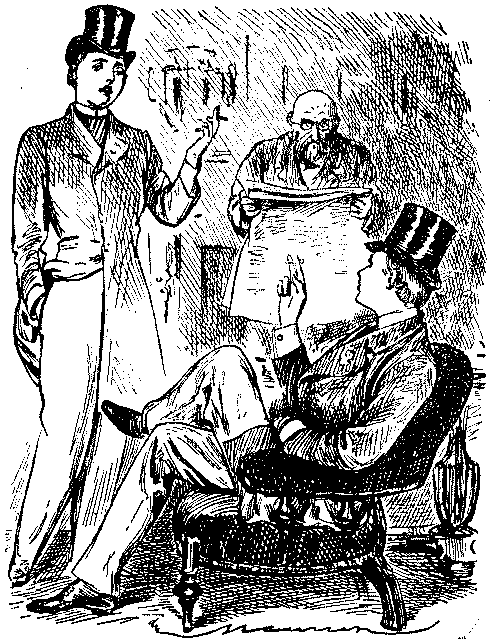
THE DIVINE SARAH
(For whose sake we've all gone wrong)
First Critic (ætat. 21): "Beats Rachel hollow in Ong-Dromack, hanged if she don't!"
Second Critic (ditto): "So I think, Old man! And in L'Etrong-jair she licks Mademoiselle Mars all to fits!"
This is enthusiasm at high-water mark, though the note of irony is not absent. Admiration, appreciation, or criticism never lacking in friendliness mark the notices of other visitors from the Old or the New World—the Dutch actors from Rotterdam in 1879 whose performance in Anne Mie impelled Punch to rewrite Canning's dispatch:—
In matters dramatic the charms of the Dutch Are perfect ensemble and sharpness of touch;
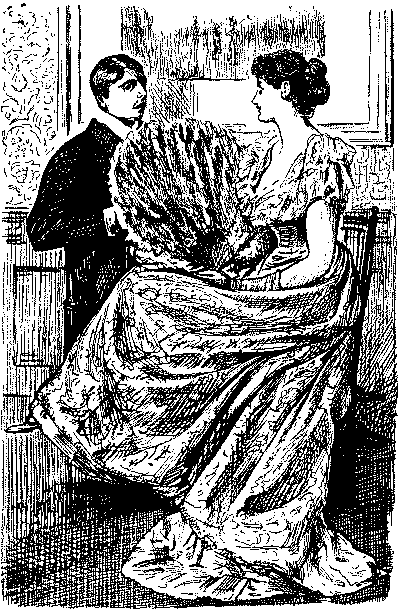
INANITIES OF THE DRAWING-ROOM
"Seen the Enfant Prodigue, Mr. Softy?"
"No; waiting till they do it in English!"
Modjeska, "a charming and consummate actress" in 1880; the German Shakespearean actors at Drury Lane in 1881; Mary Anderson in 1883; Coquelin in 1887; and Mlle. Jane May in L'Enfant Prodigue, that delightful pioneer dumb-show play which prompted Punch to exclaim in 1891, "Vive Pierrot à Londres!" with the Victorian caveat "but not a play for children." Punch's views on the transplantation of foreign products were never expressed more frankly or wisely than in his comments on the abortive attempt made by Mr. Wybrow Robertson to present selected tableaux from the Ober-Ammergau Passion Play at the Westminster Aquarium in 1879. The announcement of the withdrawal of the scheme was followed by a statement that no native of Ober-Ammergau had anything to do with it, which gave Punch his cue:—
It is a comfort that one set of people come well out of the mess—the worthy, simple and pious peasants of the Ober-Ammergau, for whom the performance of their Passion Play is a religious solemnity, in performance of a vow made in 1633, when their village was ravaged by a pestilence. When the performance of Passion Plays was interdicted in Bavaria in 1779, this one was specially excepted, as being under the superintendence of the monks of Ettal, hard by, and, besides, in fulfilment of a vow.
But if the institution of the play stayed the pestilence in 1633 (as these simple Ober-Ammergauers believe), its continuance may introduce a new pestilence in 1880, should it bring on Ober-Ammergau, as yet pure and simple, the plague of speculating Managers to tempt the village Actors, as well as of Cook's tourists and cosmopolitan audiences, to poison the village life with greed of gain, and take the sanctity of simple faith from this Passion Play, so turning it—as there is already fear it has begun to be turned—into a show which, in becoming popular, must become profane.
The long and consistently hostile campaign which Punch conducted against Ibsen and the Ibsen plays shows him in a much less favourable light and on precarious ground. It was open to him to pronounce Ibsen dreary, disagreeable and didactic; some of his plays were fair game for the parodist and the opportunity was turned to excellent account. But the long and acrimonious tirade against the Ibsenites and their "Arch or Archer-priest" in 1891 is seriously weakened by the writer's confession that his knowledge of the Ibsen plays was confined to perusal of "several of them"—that he had never seen one of them on the stage; and his challenge to the Ibsen-worshippers to test the merits of their idol by a single performance at a London theatre was rash, to say the least of it.
Actors and Society
Turning to native drama, one cannot avoid noticing that Punch, who had followed Irving's career with interest and sympathy from its modest beginnings in farce and comedy, became increasingly critical of his later ventures. He is pronounced physically unsuited to the part of Macbeth in 1875, and Punch did not fail to fasten on the vulnerable points in his Romeo in 1882. In the same year Irving is especially blamed for his resort to the "benefit" performance system, and his defence is pronounced unconvincing in an article ingeniously headed, "The Doubt of the Benefit," in which Irving is described as "an admirable Comedian, an occasionally impressive Tragedian, a nervously painstaking Actor, and, generally, an indifferent Elocutionist." But Punch had indulged in even more caustic criticism of the popular actor-manager in the previous year, à propos of an address delivered at Edinburgh:—
Again the sickening cry is raised about the "social status of the Actor," and this time à propos of a paper read by Mr. Henry Irving, at a Philosophical Institution known as The Music Hall in Edinburgh. The social status of the Actor is that of a well-fed, well-clothed, well-paid—perhaps over-paid—worker in a curious profession. If he be amusing and intelligent, and behaves like a gentleman, he is exceptionally favoured by what is called "Society"; as most people, except a few fanatics, are interested in the world behind the footlights. But every Actor is not necessarily amusing, intelligent, and gentlemanly, and these are the people, probably, who are a little uneasy about their status. If they are not content with their pudding, the world is all before them. On the other hand, the more favoured ones are a little apt to be spoiled by injudicious patronage. "Society" is a little too ready to treat them like pet poodles.
Why on earth does Mr. Irving yearn for the companionship of Bishops? Does he want to convert them all to Irvingism, and to come and listen to him discoursing Shakespearean Inspirations in Unknown Tongues? Does he require Church Patronage for the Stage, and his Theatre Stalls filled as those of a Cathedral are with Prebends, Minor Canons and Greater Guns of the Ecclesiastical Establishment? Is it the height of an Actor's ambition to swell the crowd of distinguished Nobodies at the Duchess of Mountrouge's reception, or to appear as a great attraction of Lady Doubtful's Assemblies, and to be able to exhibit cards of fashionable "At Homes" in the mirror which is held up to Nature over his mantelpiece?
Elevation of the Stage forsooth! We should have thought that the Stage had elevated Mr. Irving above all such twaddle as this.
"Act well your part, there all the honour lies."
Be satisfied with this: Live for your Art, not for that limited, narrow, uncharitable, scandalmongering section of the great public which calls itself "Society," and which loves to patronize Art in any form at the least possible cost to itself.
Even harsher is the rebuke administered three weeks later to Irving for his self-laudatory speeches, and the unnecessary autobiographical reminiscences in which he contrasted his present with his past earnings, thus creating a false impression of one who was in reality the most generous of men. The petting of actors by society appealed to Punch no more than the invasion of the stage by amateurs; he regarded such favouritism as ministering to their worst infirmity, vanity; and in 1884 he fell foul of Mrs. Kendal's speech at the Social Science Congress on the social position of actors, in which she reprobated self-advertisement (Satan rebuking Sin, according to her critic), but claimed a recognition which Punch denounced as mere snobbishness. Of Ellen Terry, who was associated with Irving at the Lyceum from 1878, Punch remained the affectionate and benevolent admirer, though he admitted that her conception of Lady Macbeth in 1889 raised a good deal of legitimate criticism. The lavish mounting of the Lyceum revivals, I may add, exercised Punch's frugal mind, and reached a climax in the production of Henry VIII in 1892.
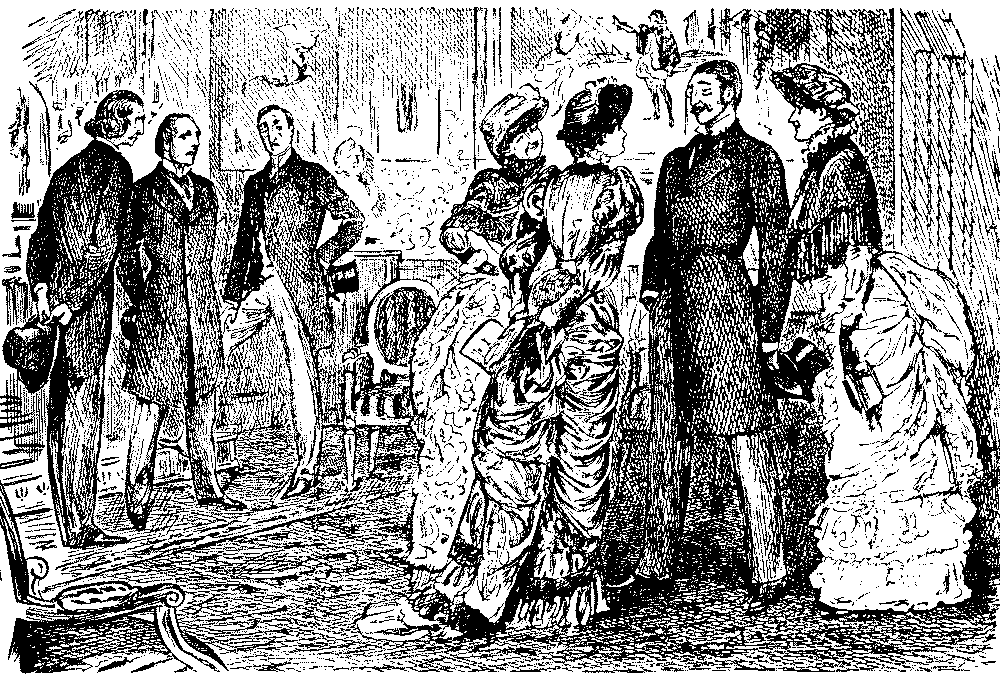
THE NEW CRAZE
Scene—The Green-Room of the Parthenon, before rehearsal.
Hard-working Baronet: "Here's the Duke, confound him! Only been six months on the stage, and getting twenty guineas a week!"
Conscientious Viscount: "Yes, and us only getting six after ten years of it. I hate these beastly Dukes coming and spoiling the profession!"
Ambitious Earl: "Ugh! I hate all amateurs, hang 'em, taking the bread out of one's mouth!"
Idols of the 'Eighties
Punch, as I have so often insisted, was a Londoner first and foremost, but he did not exclude the provinces from his survey. The opening of the Shakespeare Memorial Theatre at Stratford-on-Avon in 1879 was a landmark in the history of the legitimate drama, and Punch did not fail to acknowledge the strenuous local labour and large local liberality which had carried to completion a worthy scheme for commemorating the most memorable work ever wrought by mortal brain. It was in the same year, again, that Punch recorded with sympathy and admiration the memorial performances given at Manchester for the benefit of the widow and family of Charles Calvert, the actor-manager "who did more for the elevation and development of the higher drama, historical and imaginative, than any provincial manager on record, and than any metropolitan managers, except Macready, Charles Kean and Phelps." Phelps and Charles Mathews had both died in 1878, and Buckstone in 1879. Mrs. Langtry, who had taken to the stage, is advised to give up acting in 1882. In 1883 Mr. Anstey Guthrie's immortal Vice Versâ was dramatized and produced with Mr. Charles Hawtrey as Mr. Bultitude. The evergreen veterans of to-day were already advancing in fame and popularity. Sir Johnston Forbes Robertson had appeared as Romeo in 1881. In 1884 the late Mr. Wilson Barrett, encouraged by his successes in melodrama, essayed the rôle of Hamlet. Punch maliciously embodies his criticisms in a letter to Irving, then touring in America, but the general tenor of his remarks is decidedly reassuring to Irving. The long run of Our Boys in 1877 was equalled and eclipsed, after an initial failure, by the prodigious popularity of The Private Secretary, also in 1884. Lady Bancroft died only the other day; Sir Squire is still hale and hearty. Yet it is thirty-six years ago since they resolved, while still at the zenith of their popularity and in early middle age, to quit the scenes of their many triumphs, and Punch, in his notice of their farewell performance, says no more than the strict truth:—
The Bancrofts have done much for the Stage; in fact, the mise-en-scène at the houses where Comedy is played, owes its present completeness entirely to them. They, and Mr. Hare with them, introduced the natural style of acting, thereby supplanting the theatrical tone and gestures of the old school, which Burlesques had done good service in laughing off our Stage for ever.
The performance at Cambridge of the Eumenides by "Messrs. Æschylus and Verrall" in the same year is handled in a vein of friendly facetiousness. Punch found Sir Charles Stanford's music rather more than worthy of the occasion, but thinks Æschylus and his very clever collaborator might have shown more common sense and allowance for modern feeling.
Punch was less considerate in his treatment of the performance of Shelley's Cenci by the Shelley Society which had been founded by "a Dr. Furnivall," the scholar and redoubtable controversialist whom Punch had already attacked in connexion with the Browning Society. The performance was described by a member of the society as four hours of monotonous horror:—
"The actors and actresses in the labour of love did all that could be done; but the play is proved to be impossible, and so let us leave it in the hope (shared by many of my fellow-members) that before another 'sixty years' it will be possible to debate the matter calmly, but not to put 'The Cenci' on the Stage."
Punch was less hopeful. He regarded "the literary disease of which the Shelley Society may be regarded as an exemplar" as an ineradicable malady.
"L'Assommoir" in French and English
Sir Frank Benson's productions of A Midsummer Night's Dream and The Taming of the Shrew in 1890 come in for more commendation of the scenic effects than the acting, but a favourable exception is made in favour of the late Stephen Phillips, afterwards better known as poet and dramatist. Punch's notice of the late Sir Herbert Tree's Hamlet in the summer of 1892 is a good specimen of discreetly veiled disparagement. But it does not quite accord with Gilbert's famous description, "funny without being vulgar," as Punch considered some of the new readings and by-play to be tasteless and grotesque. It was this production that gave rise to that "desperate saying" that to solve the Bacon-Shakespeare controversy, all that was necessary was to let Tree play Hamlet and then open the two graves and see which of the mighty dead had turned.
It would be tedious to enumerate all the references to actors and plays, famous or forgotten, which crowd the pages of Punch in this period; to quote them in full would be impossible. Toole was one of his favourites. Boucicault was not, and excites satirical comment for having written a letter to Disraeli in 1876, puffing his own play The Shaughraun. A little earlier The Great Vance—immortalized in Stevenson's Wrong Box—the "lion comique" of the music-halls, is rapped over the knuckles for advertising his performances as "patronized by the Prince and Princess of Wales." Punch's notice of Zola's L'Assommoir when he saw it in Paris in May, 1879, reflects a divided mind. He found it fascinating and intolerable. Gil-Naza's acting as Coupeau was "wonderful, fearful, admirable, awful, infernal." Yet "the moral to most of those who assisted, the other evening, at L'Assommoir was, 'I say! Dash it! It's too horrible! Let's go and drink!' and the biggest drink I've had for a long time—much needed, I assure you—was after seeing L'Assommoir." Punch doubts whether the play could ever be done in English, but it was produced at the Princess's Theatre only a few weeks later in Charles Reade's version, with Charles Warner as Coupeau. The notice in Punch purports to be written by a working man, who signs himself "one as is a-thinking seriously of Taking the Pledge, but don't see his Way to it yet." He acknowledges the terrible realism of Warner's acting, but his testimonial is invalidated by the final sentences:—
Yes, Sir, Drink is a moral drama if ever there was one. It ought to do a deal of good. And as I think it over, I feel as I want a little something just to take the taste on it out o' my mouth.
Punch clearly did not believe in temperance propaganda on the stage. Nor did he support the restriction of child performers, maintaining in 1880 that the theatres at Christmas time were admirable infant schools; "even for teaching," he was "open to back the Theatre, while it lasts, against the Board School any day." There was much talk at this time about dramatic schools, but Punch refused to take the movement seriously, preferring to give a burlesque list of lectures by well-known actresses on aspects of acting entirely foreign to their own styles. He joined in the protest against the abolition of the pit at the Haymarket and the general raising of prices in the same year; and Captain Shaw's Treatise on Fires in Theatres found in him an energetic supporter of reform in respect of structural and other safeguards. Laments over the degeneracy of pantomime and the decline of the red-hot poker business still occur, but honourable exception is invariably made on behalf of the famous Vokes family. He had at an early date described the Drury Lane pantomime as "Vokes et præterea nihil." Bluebeard, at Christmas, 1879, is called "Vokes's Entire." "The family is a necessity at Drury Lane"; and then Punch goes on to embroider his text. Necessity has no Legs, but here the Vokes family have the pull over the Mother of Invention—alluding to the high-kicking exploits of Fred Vokes and other members of that engaging and high-spirited family. If pantomime showed signs of decay, the "sacred lamp of Burlesque" was burning brightly at the Gaiety with John Hollingshead as Lampadephoros and the famous quartet—Nellie Farren, Kate Vaughan, Edward Terry and Royce—as his chief hierophants. Miss Vaughan's secession in 1883, chronicled in a graceful tribute, rendered possible the historic question from the bench, "Who is Miss Connie Gilchrist?" but by 1892 she too had quitted the Gaiety to add histrionic lustre to the pages of Debrett. In 1883 Miss Vesta Tilley was playing in pantomime at Drury Lane; in 1884 Mrs. John Wood was singing "His Heart was true to Poll"; in 1886 the inauguration of the O.U.D.S. at Oxford introduced Mr. Bourchier as Feste in Twelfth Night; in 1887 Punch records the début of Miss Violet Vanbrugh.
More Gibes at Ibsen
Ibsen's Pillars of Society, produced at a matinée in July, 1888, is compared by Punch with a melodrama performed at the "Old Vic" before it became "a sort of frisky Coffee Palace," very much to the disadvantage of Ibsen. In the old play the dialogue was crisp and to the point, in the new it was "hopelessly dull." Punch adds that Mr. William Archer's translation seemed excellent, adding, "But what a pity he ever learned Norwegian!" Ada Rehan, the famous Irish-American actress, made her first appearance in London with Daly's company in the summer of 1890, but Punch, while delighted by her charming vivacity, thought she was already too old to play ingénue parts. Her successes in Shakespearean comedy were to come later.
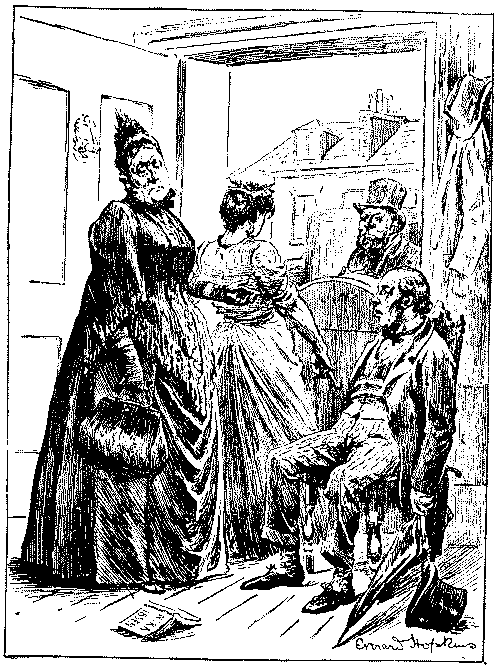
IBSEN IN BRIXTON
Mrs. Harris: "Yes, William, I've thought a deal about it, and I find I'm nothing but your Doll and Dicky Bird, and so I'm going!"
Three familiar names greet us in the notices of the Christmas pantomimes of 1891. Marie Lloyd, Dan Leno and Little Tich all appeared in Humpty Dumpty, but the last-named receives the Benjamin's portion of praise. "Why Marie?" asks Punch, who disliked these unnecessary variants, which have since taken a more eccentric form in "Maudi," "Mai," and so forth.
The Court Theatre was drawing the town with its Triple Bill in the spring of 1892, and Punch did not spare his praise of the "Pantomime Rehearsal" which, with Ellaline Terriss, Decima Moore, Weedon Grossmith and Brandon Thomas in the leading parts, is pronounced to be "about the very funniest thing to be seen in any London theatre." Gilbert's brilliant Hamlet burlesque, Rosencrantz and Guildenstern, was for a while included in the bill, and Punch describes it as "an excellent piece of genuine fun." It is all that and more. Gilbert never wrote anything wittier than the passage in which Ophelia discusses the various theories of the Prince's "mentality" and synthesizes them in the conclusion:—
Hamlet is idiotically sane, With lucid intervals of lunacy.
These were stirring years in the realm of music. To take only some of the outstanding events, there was the Wagner Festival at the Albert Hall in 1877, conducted by the composer, which led in due time to something like a revolution in the repertory of grand opera in London; there was the coming of Hans Richter, whose orchestral concerts lent a fresh impetus to the cult of symphonic music already fostered by Manns and Hallé; there were the visits of Rubinstein and Liszt in 1886; the superb performance of Verdi's Otello in 1887 by the Scala Company, with Tamagno and Maurel in the cast; the advent of the de Reszkes and Melba in 1889 and of Paderewski in 1890. Last and assuredly not least, when the test of pleasure and popularity is applied, there was the long and fruitful collaboration of Gilbert and Sullivan which began with Thespis, or the Gods grown Old, in 1871, and continued till nearly the close of the period under review.
Punch the Anti-Wagnerite
All these events and many others came under Punch's notice, but it must be confessed that his shortcomings as a critic are nowhere so conspicuous as in the domain of music. It is true that in 1875 he expressed a guarded admiration for Lohengrin: he found it good in parts, like the curate's egg. "Though not melodious, it is certainly most musically interesting and abundantly poetical." But the report of his Bayreuth correspondent in 1876 is admittedly a bogus document, compiled from German phrase-books in London, and tells us nothing about the music, for the writer never went to Bayreuth. The Albert Hall Festival is treated much in the same spirit of entirely irresponsible burlesque. Punch is determined at all costs to represent the Festival as a carnival of "Wagnerian waggeries." When it was over he admitted that many who went to scoff remained to praise. "The Rhinegold is a masterpiece," but he, is careful to add "this is not a discovery of mine," and goes on to express his deliberate opinion that the Tetralogy must inevitably be vulgarized by representation on the stage. "Such a mise-en-scène as the Ring demands is impossible," and he turns with obvious relief to discuss Patti in Dinorah and the performance of Orphée aux Enfers at the Alhambra.
In 1882 Punch attended the performances of the Ring, and after four nights "deliberately" said, "Never again with you, Wotan, Siegfried & Co." He found nothing new in the idea of leading motives: it was as old as the oldest pantomime. A few weeks later Punch heard Tristan done at Drury Lane and was bored to extinction:—
Had it been by a young English composer, or an elderly English composer of the Hanwellian School, it would not have been tolerated for half an hour after its commencement. For ourselves, if of two penances we had to choose one, either to sit out a long, dull sermon in a stuffy church on an August afternoon, or to hear one Act of Tristan and Isolda, we should unhesitatingly select the former, where, at all events, there would be the certainty of a tranquil repose, from which no cruel drum, bassoon, or violoncello, but only the snoring of our own nose, could rouse us. That there are occasional snatches of melody is undeniable, but a snatch here and there is not the grasp of a master hand to hold an audience. Judicious selections will always be welcome; but that, taken as a whole, it is the embodiment of stupendous boredom, might be the verdict of all English opera-goers who delight in the Operas of Rossini, Mozart, Meyerbeer, Gounod, Verdi, Balfe, Wallace, Bizet, and we are not afraid to add, even in these days of æsthetic mysticism, art-vagueness, and higher cultchaw—Bellini.
Punch then proceeds to "guy" the libretto and stage directions and continues:—
This sort of music can never, in our lifetime at least, thank goodness, become popular with the British public. It may, as Dr. Johnson said of the violoncello performance, be wonderful, but we only wish it were impossible. Wagner's lyrical-dramatic music requires no operatic vocalists at all. Let there be a first-rate orchestra, a book of the plot in hands of the audience, and tableaux vivants or dissolving views to illustrate it—as illustration is still necessary for the illiterate. To ourselves, speaking as mere laics in the matter, with a fondness for tune, harmony, and good dramatic situations, it seems that singing and acting are thrown away on such vocal music and such tedious and unsavoury libretti. Richard Wagner's Operas will be remembered when the Barbiere and a few more trifles are forgotten, but not till then.
And then Wagner inconsiderately went and died a few months later, and Punch, who was never given to indulging in war-dances over his dead enemies, printed not exactly a palinode, but a liberal acknowledgment that this "arch-revolutionist" of the brood of "Demiurgus militant" was a considerable figure. Given his temperament and aims, Punch asks:—
What wonder He brought the sword into mild Music's sphere, And in the clangour of the hurtling spear, The clashing mail, and the loud battle-thunder, Missed, sometime, of the finer harmony The still small voice, known of the subtler ear, Which outlives all War's clarions? Year on year May pass ere he is measured. Yet we see The work of a strong shaper, one whose part Was with new light to show a newer way. He stripped the gewgaw'd shams of Opera, Lord of two spheres, he wedded Art with Art, And Music, sunned in brighter, larger fame, May date its nobler dawn from Wagner's mighty name.
"The Beggar's Opera" in 1878
The splendid Indian summer of Verdi's genius which gave us Aïda, Otello and Falstaff is only partially recognized. When Aïda was produced in 1876 Punch was more interested in Patti and Nicolini, the magnificence of the mounting and the chatter of the boxes, than in the music. In the finale "the brass was everywhere, the voices nowhere." Punch was happier in dealing with Carmen, in which Nietzsche, after he had abandoned Wagnerism, found the exemplification of his dictum "il faut Méditerraniser la musique," and which has won the allegiance of all schools. And it is interesting in view of the wonderful success recently achieved by the revival of The Beggar's Opera to read Punch's eulogies of Sims Reeves, when the famous tenor appeared at Covent Garden as Captain Macheath in 1878. But here again he is more interested in Sims Reeves's singing and acting than in the play or the music:—
It was a treat. But what a stupid play! What a set of sordid, squalid, ruffianly characters, all, except Polly Peachum, prettily played by Madame Cave-Ashton, who obtained more than one encore. The chorus of "Let us take the Road" was very effectively given. I should like to see The Beggar's Opera with a well remodelled plot, an efficient cast, to include, of course, Mr. Sims Reeves (it would be nothing at all without his Captain Macheath) and Madame Cave-Ashton, and produced under such careful stage-management as was shown by Mr. Hare in bringing out Olivia at the Court Theatre. However, for the present, The Beggar's Opera, which, I believe, was the result of a considerable amount of "collaboration," is, as played the other night at Covent Garden, good enough, by way of a musical treat, for Your Representative.
What Punch wished to see forty years ago has been achieved under the inspiring direction of Mr. Nigel Playfair, though not exactly on the lines indicated.
Cherishing an old-fashioned weakness for a tune, Punch naturally deplored the passing of Offenbach, one of the greatest tune-coiners of the century. The memorial lines in October, 1880, are an admirable summary of the qualities which made Offenbach the musical incarnation of the unbridled gaiety of the Second Empire. But it is rather a surprise to find an allusion to "Golden Schneider" in view of Punch's earlier castigation of that ultra-vivacious lady. For the rest Punch was still true to the tradition expressed in the avowal of the Philistine who said he would rather hear Offenbach than Bach often. Regret of a very different temper inspires the tribute to Jenny Lind, Punch's favourite singer, on her death in 1887. Forty years earlier he had christened her "the Nightingale that sings in Winter," and recognized her unfailing response to all charitable appeals:—
"Dear Jenny Lind!" So then his song addressed her Who still is "Jenny Lind," and still is dear. Though Genius praised, and Fashion's crowd caressed her, She sank not, like some stars, below her sphere Into those darkening mists Whose taint the true and tender heart resists. Her nature fame was powerless to soil, Whom splendour hardened not, and puffery could not spoil. How the crowd rushed and crushed, and cheered and clamoured, Forty years syne, to hang upon her song! Of La Sonnambula's heroine enamoured, Thrilled by the flute-like trillings sweet as strong Of their dear Nightingale. Amina, Lucia, Alice, each they'd hail With fervent plaudits, in whose flush and stir Love of her silvery song was blent with love of her. And each well earned! The crowd would press and jostle To hear their favourite warbler, from whose throat, Clear as the lark, and mellow as the throstle, The limpid melody would soar and float. Now like a shattered lute, The Nightingale who sang in winter's mute; But long remembered that pure life shall be, To Music dedicate and vowed to Charity.
THE LATEST FASHION IN MUSIC AT HOME
"By Mendelssohn, is it not, Miss Prigsby?"
"We believe so."
"One of the 'Songs Without Words'?"
"Possibly. We nevah listen to Mendelssohn."
"Indeed! You don't admire his music?"
"We do not."
"May I ask why?"
"Because there are no wrong notes in it!"
(Our gallant colonel is "out of it" again.)
Jean and Edouard de Reszke
The idols of the operatic world in Punch's earlier days were mainly Italian or trained in Italy. In the period which we have now reached no single nation retained a monopoly of "stars." Madame Nordica, who appeared in 1890, was an American, Madame Melba was Australian-born of Scottish descent, and the two de Reszkes, Jean and Edouard, the chief glories of many recurrent seasons at Covent Garden, were Poles. A hundred years earlier Lord Mount-Edgcumbe, a famous amateur and critic, declared that the French opera singers were excruciating to listen to. In the late 'eighties and 'nineties the best singing was heard from those who had been trained in Paris. The de Reszkes in particular helped to achieve what Punch had declared to be impossible—they made Wagner popular among the fashionable opera-goers by singing his later works as they had never been sung before, turning to them at the zenith of their powers and reputation, a service to art which more self-protective singers have sedulously avoided. Jean de Reszke was great in Faust, Roméo et Juliette, Aïda, Le Prophète, but he was greater as Siegfried and Tristan. And so with his brother Edouard, when his Mephistopheles or his Friar Laurence are compared with his Wotan, his Hagen or his King Marke. I have spoken elsewhere of the disastrous National Opera House scheme of Mapleson and the fiasco of the Royal English Opera House in Shaftesbury Avenue. Ivanhoe, Sullivan's solitary excursion into the domain of grand opera, which was written for the opening of the last-named building, did not achieve more than a succès d'estime. Punch's notice is friendly but not enthusiastic. When it gave place to the Basoche, he summed up the situation facetiously but shrewdly enough under the heading, "English Opera as She isn't sung":—
It seems impossible to support a Royal English Opera House with its special commodity of English Opera, that is, Opera composed by an Englishman to an Englishman's libretto, and played by English operatic singers. Ivanhoe, a genuine English Opera, by a genuine English Composer (with an Irish name), produced with great éclat, has, after a fair run and lots of favour, been Doylécarté, in order to make room for the Basoche, an essentially French Opera, by a French Composer and Librettist, done, of course, into English, so as to be "understanded of the people." The Basoche has "caught on," and our friends in front, including Composer, Librettist, and Middleman—Druriolanus, who bought it, and Doyly Carty, who bought it of Sir Druri—are all equally pleased and satisfied. Considered as a matter of business, what signifies the nationality as long as the spec pays?—tout est là.
"Druriolanus" was Punch's ingenious agnomen for Augustus Harris, who, beginning as a melodramatic actor, had blossomed into a manager and operatic impresario and was knighted in 1891. It was at the close of the same year that Mascagni's Cavalleria Rusticana was first produced in England, scored a success which the composer has never succeeded in recapturing, and established the tyranny of the "Intermezzo," which is not even yet overpast. Verga's powerful story of love and revenge, on which the libretto is based, counted for much, but the crude emotional vigour of the score is not to be denied. Punch adored the "Intermezzo," speaks of the "charm" of the music, but says nothing of the plot. The Italian Company in 1891 were only moderately good; Madame Calvé's marvellously tragic impersonation of Santuzza, in the season of 1892, is inseparably associated in the minds of middle-aged opera-goers with Mascagni's solitary triumph.
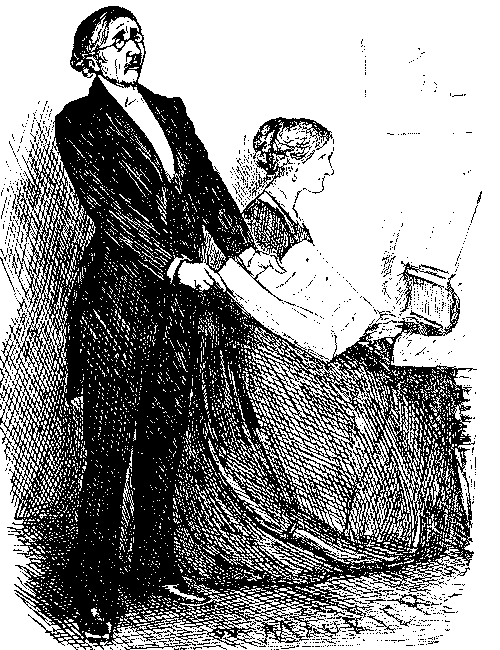
AN IRISH MELODY TRANSPLANTED
German Tenor warbles:—
"I'll not leaf zee, sow lone von, To bine on ze Schtem! Zins ze lôfly are Szchleebingk, Coh! szchleeeb sow fiz dem! Zos ghyntly I schgadder Zy leafs on the bet, Vair zy maids of ze karrten Lie schentless and tet!"
Gilbert and Sullivan
When we turn from grand to comic opera, the names of Gilbert and Sullivan confront us throughout the entire period under review in a light that sheds a still undiminished lustre on native art. Of each of the two partners in this long and fruitful collaboration it may be said, in the often quoted phrase, that if not absolutely great he was great in his genre. Between them they created an entirely new type of light opera. Moreover, it was an entirely English or British product in its spirit and structure, and relied entirely on British performers. Punch welcomed the venture from the outset, and in 1880, in some verses modelled on the Judge's song in Trial by Jury, and anticipating Sullivan's knighthood in 1883, he happily summarizes the career of the composer, with whom, by the way, Burnand had been associated in Cox and Box in 1866:—
As a boy I had such a musical bump, And its size so struck Mr. Helmore, That he said, "Though you sing those songs like a trump, You shall write some yourself that will sell more." So I packed off to Leipsic, without looking back,[13] And returned in such classical fury, That I sat down with Handel and Haydn and Bach— And turned out Trial by Jury. But W.S.G. he jumped for joy As he said, "Though the job dismay you, Send Exeter Hall to the deuce, my boy; It's the haul with me that'll pay you." And we hauled so well, mid jeers and taunts That we've settled, spite all temptations, To stick to our Sisters and our Cousins and our Aunts— And continue our pleasant relations.
In 1885, on the occasion of the production of the Mikado, which Punch bracketed with Pinafore as the best of all the series, there are some excellent observations on the dual autocracy exerted to admiration at the Savoy:—
Rarely, if ever, have Composer and Author produced piece after piece under conditions so favourable to success as have Messrs. Gilbert and Sullivan at the Savoy. They are their own Managers, the theatre is practically theirs, the Members of the Company, from the soprano and tenor down to the latest novice in the chorus, or among the "extras," depend mainly, if not entirely, upon the Composer and Author for their engagements. This Beaumont and Fletcher of Eccentric Opera can order rehearsals when they choose, can command the scene-painters and property-men, and, what is much more to the point, be obeyed. They have jointly and separately the authority of the Centurion: the Author is the autocrat of the acting and the Savoy stage generally; the Composer is the autocrat of the music, vocal and instrumental.
The Savoy Autocrats
At other theatres an Author may try to assume the autocrat, but, unless he can be absolutely independent, and able to take his piece out of the theatre without damaging his chance of earning a livelihood, the attempt is only a ridiculous and palpable failure. True that times have changed, considerably for the better, since Albert Smith said that "there was only one person in the theatre lower than the call-boy, and that was the Author," yet, in spite of much improvement, a young Dramatist will still sympathize with the spirit of Albert Smith's observation; and, ordinarily, the most experienced Playwright, if not, as I have said, absolutely independent, has, in almost every instance, to accommodate himself to the exigencies of the theatre, and to the tempers of the Actors. From the moment he has a piece in rehearsal, there is no peace for him on the Stage. He is promised what he will never obtain; he has to accept just what he can get; he has to humour the ideas of others and sacrifice his own; he has to make the best of unintentional mistakes and deliberately intentional alterations; he has to accede to the Manager's date for producing the piece, and its first night of public performance is, in the majority of cases, really and truly only a dressed rehearsal, and, in some cases, it is the first real rehearsal the piece has had.
Now nothing of this sort ought to take place at the Savoy. There Messrs. Gilbert and Sullivan have only themselves to please, only themselves and their piece to consider; they are monarchs of all they Savoy—I should say "survey"—they are masters of the situation, and if they allow any piece of theirs to be produced in a hurry, with incomplete appointments, with inappropriate scenery, faulty dresses, or after insufficient rehearsal, on their own heads be it and on no one else's. The Actor-singers are only intelligent puppets in their Showman's hands, and the more faithfully they carry out the instructions given them by their masters, the greater their individual and collective chance of success.
It delights me to see the precision of the action on the Stage of the Savoy, the result of a carefully-thought-out plan and well-regulated drill. The principals have been judiciously selected for the work, and they are suited by the two clever fellow-workers who, having taken their measure to a nicety, give them just what they can do, and no more; and who insist on their original conceptions being executed exactly according to their ideas. The result is that the ensemble is about the most effective thing in London—or in Paris for that matter—because the individuality of the Actor-singer is not destroyed, but is judiciously made use of, and worked up, as valuable material for the character he has to represent.
Patience in 1881 specially appealed to Punch because it was aimed against the æsthetes. His general appreciation of the Savoy Operas was, however, tempered by criticism. For example, he pronounces Iolanthe in 1882 to be "not within a mile of Pinafore and not a patch upon Patience." The Gondoliers in 1890 is placed third in order of excellence after the Mikado and Pinafore. The unfortunate temporary estrangement between the collaborators which led to the severance of their partnership in the same year, and which was alleged to have grown out of a dispute over a carpet, is treated in "A Chapter of Dickens up to Date," with Gilbert as Mrs. Gamp and Sullivan as Mrs. Prig. Punch's view of the merits of the dispute may be gathered from the fact that he gives the last word to Mrs. Prig, who, after alluding to a tempest in a teapot, observes: "Wich I don't believe there's either rhyme or reason in sech an absurd quarrel!" Yet when the Court Circular of March 9, 1891, recorded the performance at Windsor Castle of The Gondoliers, "a Comic Opera composed by Sir Arthur Sullivan," with full details of the programme, performers, etc., but no mention of Gilbert at all, Punch rubs in this conspicuous absence in his most sarcastic vein.
Mr. D'Oyly Carte, it seems, was presented to the Queen after the performance, and Punch goes on:—
Did R. D'Oyly think of mentioning that "the words" were by W.S.G.? And then it is told how D'Oyly refused to take any payment for the performance. Noble, generous-hearted, large-minded and liberal D'Oyly! Sir Arthur Courtly Sullivan's name was to the Bill, and so his consent to this extra act of generosity may be taken for granted. But what said Sir Brian de Bois Gilbert? By the merry-maskins, but an he be not pleased, dub me Knight Samingo! Will D'Oyly be dubbed Knight? And what sort of Knight? Well, remembering a certain amusing little episode in the more recent history of the Savoy Theatre, why not a "Carpet Knight"?
If Punch kept most of his friendships in good repair, it must be admitted that he also displayed on occasion a positive genius for impish malice.
Liszt, Rubinstein, Pachmann
Among the musical celebrities who visited us in these years Punch had a special word for Joachim, to whom England was almost a second home, and Madame Schumann, whose portrait with that of the great violinist appears in 1881. M. Pachmann's performance at a concert in 1883 is described with more fidelity than reverence:—
Then came a M. Vladimir de Pachmann, who, in consequence of his long hair, and a bulkiness about his waist and coat-tails suggestive of concealed fish-bowls, to be presently produced from under a handkerchief, I at first set down as a Conjurer. He wasn't, however, being a Pianist of considerable skill, with an overpowering propensity for getting the most out of every note, and listening in rapt admiration to its dying away in the distance, and then slowly raising his left hand as if pronouncing a blessing on the instrument as he went along.
Liszt and Rubinstein (who once said that compared with Liszt all other pianists, including himself, were mere wood-choppers) both visited England in 1886—Rubinstein still in the full possession of his powers, which he displayed in his remarkable cycle of seven historical recitals; Liszt, full of years and honours, but claiming attention as a composer, not as a performer, though he did play once or twice in private. The mention of the performance of his oratorio St. Elizabeth in St. James's Hall comes home to the present writer, who was a humble member of the chorus. Punch's notice is an adroit blending of facetiousness and respect. In his Postscript he observes, "How tired Liszt must be of hearing his own music! Fancy Pears being treated for a whole week to nothing but his own Soap!" I wonder whether Punch knew, what was the fact, that Liszt fell asleep in the performance of his own oratorio. Three months later he died at Bayreuth, having never recovered from the exhaustion caused by the lionizing hospitality of his English admirers. Rubinstein survived his visit for eight years. Punch was not far out in describing him in 1886 as the first player in the world. He was then fifty-seven, and his playing of Beethoven's Op. 57—the Appassionata Sonata—beggared description. Rubinstein used to say that in these recitals he played enough wrong notes to make a symphony; he was at times violent and extravagant and took strange liberties with the text. But here he was Titanic, and Punch's welcome was well deserved, though the critic erred in ranking Rubinstein the composer on the same plane with Rubinstein the performer. It is amusing to read, in the reference to the last recital, that the programme included works by
—such small contemporary deer as Liadoff, Balakireff, Rimsky-Korsakoff, and César Cui. My gracious! What names! Familiar, too, don't they seem? In the same category the patronymic of Tschaikowski rings refreshingly as that of an old friend.
The spelling of foreign musicians' names had always been a stumbling block to Punch, and I have revised his versions of two of the composers mentioned above, but by 1886 he had at least learned to spell Liszt correctly.
Hans Richter had shared the duties of conductor at the Wagner Festival of 1877 with the great composer himself. The concerts which made his name a household word in the musical world began in 1879. His leonine appearance and Olympian calm, his wonderful memory, which enabled him to conduct the great masterpieces, classical and modern, without a score; and the dignity and authority of his interpretations soon gained for him an admiration which survived his repudiation in 1914 of all the honours and distinctions conferred on him by the country in which for many years he had made his home. There are still a good many orchestral players amongst us who have a warm corner in their hearts for the "Doctor," and a profound respect for his mastery of the high art of conducting. His quaint sayings are legion, and ought to be collected. One of the best is his rebuke of his band at a rehearsal of the Venusberg music: "Gentlemen, you play it as if you were teetotallers, which you are not."
Punch acclaimed him as a master in 1886, and his tribute is all the more remarkable because it is coupled with an unexpected acknowledgment of the genius of Brahms, whose Fourth Symphony, a very tough nut to crack in those days, is contrasted with the "howling balderdash" of other moderns. Paderewski, who made his first appearance in the spring of 1890, is handsomely extolled. His first concert, which the present writer attended, only attracted a meagre audience, but the effect on his hearers was electrifying and the crescendo of popularity was immediate and abiding. Punch, of course, made puns on his name, but in these years he was so consistent an offender that he might very well have appropriated the old doggerel confession:—