DRAMA, OPERA, MUSIC AND THE FINE ARTS
Reading edition
Before the middle 'fifties critics of the Stage in England—apart from the extreme Puritans—had three main grounds for complaint: the monopoly of the patent theatres, the patronage of foreigners by the Court and fashionable Society, and the popularity of degrading sensational plays; and up to 1857 the pages of Punch were eloquent on all three counts. In the period covered by this volume not only was royal patronage more judiciously and impartially bestowed, but the abolition of the exclusive privileges of the patent theatres had cut at the root of the evil and rendered possible such enlightened ventures as those of Phelps and Mrs. Warner at Sadler's Wells. The immediate result of the Free Trade policy in plays was to stimulate the legitimate drama, and in particular the cult of Shakespeare. Phelps's work in this connexion comes in for repeated approval, especially for his good all-round casts. Shakespearean actors are prominent throughout. The announcement of the death of Scribe in 1861 inspires the comment that the Members of the Dramatic Authors' Association are as well as can be expected. Punch had no love for endless réchauffés of French plays, but he was no bigot where foreign actors of merit were concerned, and cordially welcomed Fechter as Hamlet in 1861, while deprecating the preliminary puffing of his manager. It was not needed, for while admitting that Fechter's accent was disconcerting, Punch had nothing but praise for his admirable play of feature, his graceful ease of attitude and gesture and his intelligent conception of the character. As for the interpretation as a whole, foreigners were entitled to read Shakespeare for themselves: Punch held no brief for the Protection of British Stage Traditions, but believed in free trade in intellect as well as in cotton.
Fechter and Ristori
At the foot of the notice there is a picture of a stout, shabby tragedian exclaiming "Fechter! Pah! Hamlet with light hair and no points. Pah! The drama's gone." This professional jealousy is again ridiculed in "The Groan of a True Briton" a month later. The "boom" in Shakespeare this winter was quite remarkable, with A Midsummer Night's Dream at Sadler's Wells, Booth in The Merchant of Venice and King Richard II, Brooke at Drury Lane, and Fechter at the Princess's. Othello's occupation (on the stage) was extremely popular. We read in the issue of November 9, under the heading "Great Fall of Blacks":—
Five Othellos are stabbing themselves regularly, just now, and there will soon be a sixth, Mr. Charles Kean having ordered the largest pot of blacking Messrs. Day and Martin supply, and having announced that he is cubbing dext.
The vendetta against Charles Kean, it will thus be seen, was so implacable that Punch could not resist the temptation of dragging him in without any provocation.
Another and a greater foreigner dominated the scene in 1863. Of Adelaide Ristori, "the greatest of living actresses" in his opinion, Punch confessed that her genius beggared description. When she appeared at Her Majesty's in the summer of 1863 he declared that "in no English or American dictionary could be found words of sufficient strength" to express his admiration of Adelaide Ristori, or "his compassion for the unhappy person who does not go and behold one or two of her performances. This is a debilitated under-statement of the case.... What a magnificent voice hers is, and how artistically managed. The vox humana is the first musical instrument in the world, but then so few can perform upon it. Our Adelaide is one of the few." Here, at least, Punch's estimate never varied, and was only heightened by further familiarity. When Ristori played Lady Macbeth in English ten years later, Punch owned to some misgivings as to her accent,[28] but on the second performance he only noticed it twice. Otherwise "there was not, from first to last, one single fault to be found with this remarkable performance."
The Drama in Russia
Foreign actors and actresses were in the main treated handsomely and on their merits by Punch. Bandmann, the German-American actor, was highly commended in 1868 and advised to act Shakespeare. The visit of the audacious Schneider belongs to another phase of the drama, but the condemnation of French acting as a mere "swindle" put into the mouth of "Opie Wing," a "British Veteran—legitimate lead and blank verse heavies," is purely ironical. The methods of the Comédie Française troupe visiting London in 1871 are attacked precisely for the qualities which were their greatest distinction—their refusal to force the note or play to the gallery, their delicacy and self-effacement in the interests of ensemble, as when Delaunay came on in livery just to give a message. Punch's readiness to admit that fruitful suggestions for the improvement of the British Stage might come from the most unexpected foreign quarters receives a curious and even prophetic illustration in his remarks on "The Theatre for the People":—
Russia may well be described as a benighted country! But of all the queer notions ever bred of barbarism, commend us to one in the Pall Mall's latest "Notes from Russia." Conceive a Commission appointed to examine the question of the establishment of a "Theatre for the People"! And more; imagine the Commission reporting strongly that such a theatre should be constructed! A theatre with a moral object! A theatre meant "to divert the people from foolish, vulgar and gross amusements, by providing them with healthy and elevating spectacular entertainments at a cheap rate"! A theatre to contain seats for 2,350 people—say something between Drury Lane and the Lyceum—with 1,300 of the seats at prices varying from 2d. to 4d., and the others from 4d. to 3s. 2d.! This infatuated Committee further report that such a theatre might be made to bring in a profit of £5,000 a year—or ten per cent, on the capital employed. They recommend that the management should be entrusted to a competent private person, of experience, taste and refinement, and have prepared a repertory of 140 pieces in the Russian language, original and translated, calculated, they think, to forward their object of entertaining and elevating.
They further recommend that lotteries, masked balls, and the sale of spirituous liquors be forbidden in the "Theatre of the People."
Hear that, ye stunning sons of the music-halls—hear that, frequenters of our splendid saloons and brilliant bars! Contrast this barbaric dream of a Russian Blue Book, with the civilized reality of London, where Free Trade in theatres does its work, and the demand is allowed to create the supply of theatrical pabulum for the people, from the Victoria[29] to the penny gaff! The idea of the people being condemned to "healthy and elevating" entertainment; when their betters can revel in the Schneider, the Menken, the Cancan and the Opera Bouffe, the indecent burlesque, the breakdown, and the sensational drama!
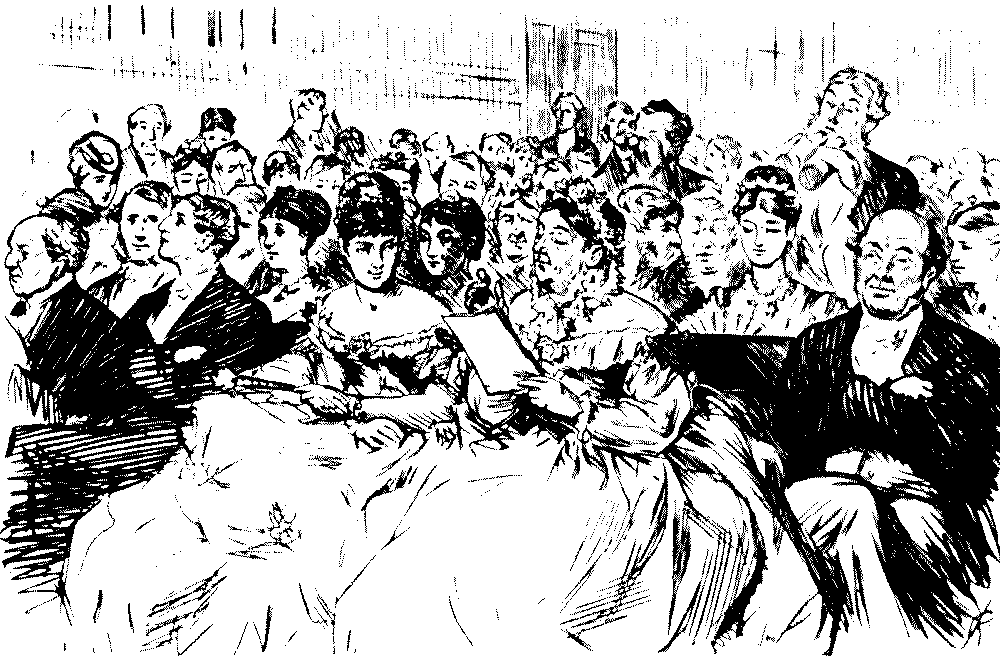
"FRENCH WITHOUT A MASTER"
Matron in Stalls (reads from programme): "'Overture to L'Onfong Prod-eeg.' What does that mean? The prodigious child, eh?"
Accomplished Daughter (shocked): "Mamma, dear! No—'L'Enfant Prodigue'—it means the Infant Prodigy!!"
The historic invasion of the Russians did not occur till about forty years later. Of the famous French players who delighted English audiences between 1857 and 1874 the last and not the least fascinating was Aimée Desclée, who, after an arduous apprenticeship to her art and ten years of weary waiting, had been discovered by Alexandre Dumas fils, and leapt into fame in La Femme de Claude, Diane de Lys, Princesse Georges, and, above all, as the original Frou-Frou in the play of that name. Of her it was well said by a French critic that "she had a strange, wandering, unbalanced look that revealed the troubled depths of her soul. Her voice had a most peculiar timbre, and her abrupt utterances, every word of which stung like the strokes of a whip, fell upon a spellbound audience that hung on every word." After fulfilling a brilliant engagement at the Princess's Theatre in 1873 she returned to Paris to die at the age of thirty-seven. The tragedy of her brief success and the exacting temper of the Parisian public are well summed up in Punch's memorial tribute:—
But too late came the harvest of her pains; The roots of Death had struck deep in her heart; And what cares Death for glory or for gains, Guerdon of that short life, so spent for Art? And she was dying, with the pitiless cry Of box and pit and gallery in her ear, "Give us thy life, but act, and, after, die; It is to live with thy life we are here."
While extending salutations to the foreigners Punch was not slow to acclaim native talent. In 1865 he recognized in Kate Terry "one of the most consummate actresses of her own range of parts we have ever seen on the English Stage." That was said of her appearance in Henry Dunbar in December, 1865, and in June, 1867, in Reade's Dora, "a real English Idyll, sweet, simple, natural and breathing of the country," he found her completely satisfying in a part unlike her usual stage self. Three months later Punch bade her farewell on her marriage and withdrawal from the stage, paying homage to her triple endowment of Genius, Goodness and Beauty, her "innocent sensitive face," and her gentle, gracious and womanly presence. Her "delicate influence" was a standing disproof of the arguments of those who despaired of true art and its reign on the stage, and she was retiring "from the top of the ladder reached fairly at last with her laurels still springing and none of them blighted."
The Coming of Irving
The rise of Irving from comedy and melodrama to Shakespearean drama is attentively and sympathetically followed. His performance in the "nightmare play" of The Bells is pronounced to be a triumph of merit; the sense of relief experienced on the fall of the curtain was in itself the highest praise. The programme at the Lyceum ended with Pickwick, with Irving as Jingle. Punch regarded it as an incongruity: he preferred to see Irving play The Bells without the Jingle. There was nothing wrong with Charles I but the play. "His make-up was admirable, his playing of the first and the last Act well-nigh faultless; but between these two Acts the actor was left to make the best bricks possible out of the scantiest wisps of straw.... I have no hesitation in saying that the last Act is as affecting a spectacle as anything I have ever seen on the stage." With Irving's Richelieu, in 1873, Punch was disappointed, though allowing him some pathetic moments. But Irving, it is suggested, may have been the victim of the bad traditions attaching to what was after all a pretentious and "wind-baggy" play. Irving's Hamlet was another matter altogether, and is treated very seriously and exhaustively by Punch. It was a "genuine and well-deserved success." No such strong and general sensation had been produced since Fechter, over whom Irving had the great advantage of speaking as a native the tongue in which Shakespeare wrote. No impersonation with which Punch was familiar, including that of Macready, displayed a more consistent conception, more sustained intention, more intelligent mastery of this many-sided character. This much granted, Punch severely criticized Irving's cavalier treatment of the text, his suppressions and omissions, his handling of all the scenes with the Ghost. The psychological interpretation of Hamlet's madness erred through over-emphasis on his pathetic and gentle side. The unsound strain was kept too much in the background, and consistency was attained at the expense of the text. Sundry scenic innovations are also condemned, and altogether high praise is tempered with a good deal of acute and legitimate criticism. On the vexed question of Hamlet's madness Punch writes intelligently, but without the wit which inspired the immortal couplet in Gilbert's Rosencrantz and Guildenstern:—
Hamlet is idiotically sane, With lucid intervals of lunacy.
There are some good lines, however, in the issue of December 12, 1874, on "Hamlet's Right Hair," whether flaxen or raven. After all, as Punch argues, it is not a question of the thatch of Hamlet's upper storey:
... It is a brain Fitting the part, that's asked to play the Dane.
Turning from serious drama to melodrama and comedy high and otherwise, we find a liberal acknowledgment of the excitement furnished by the Colleen Bawn, Boucicault's bedevilled version of Gerald Griffin's fine novel The Collegians, when it was produced towards the close of 1860. The plot is fully set forth, and "Jack Easel" confesses that he enjoyed the evening very much. "Whatever may be the opinion of the learned regarding Mr. Boucicault as a dramatist, there can be little doubt of his merits 'on the boards.' I can hardly imagine a better stage Irishman." But Punch, who had no mercy for Boucicault's resentment of criticism, in March, 1862, printed a mock notice signed "Dion Boucicault," threatening condign punishment on all who disparaged his genius or dared to leave the theatre before the curtain fell and D.B. appeared before the same. And a month later we read a mock trial of an unfortunate pittite who had ventured to make some unfavourable comments on the Cave scene. The production of the melodrama founded on Charles Reade's Never Too Late to Mend, in 1865, met with Punch's approval. Some of the audience hissed the prison scenes: yet Menken had been tolerated. This was the famous and notorious Adah Isaacs Menken, a native of
"The Menken"
Louisiana; dancer, actress, school teacher, journalist and poetess, married first of all to a Jew, whose faith she adopted, and then to the "Benicia Boy," Heenan, the prize-fighter. After a chequered career on and off the stage in America she appeared at Astley's in Mazeppa in 1864, when Punch made reference to her as "a bare-backed jade on bare-backed steed." It was certainly a succès de scandale, but "the Menken" made a stir in the literary world and found patrons and friends in Charles Reade, Charles Dickens (to whom her volume of poems, Infelicia, was dedicated), and Swinburne. In Paris, to which city she migrated, and where she died in 1869, she enjoyed the friendship of Dumas and Théophile Gautier. "The Menken" was not intended for a placid domestic life; she would not have been in her element at a Mothers' Meeting; but she was a highly educated woman, had studied Latin and Greek, had played Lady Macbeth, and, though not a Sappho, was a much better poetess than Ella Wheeler Wilcox.
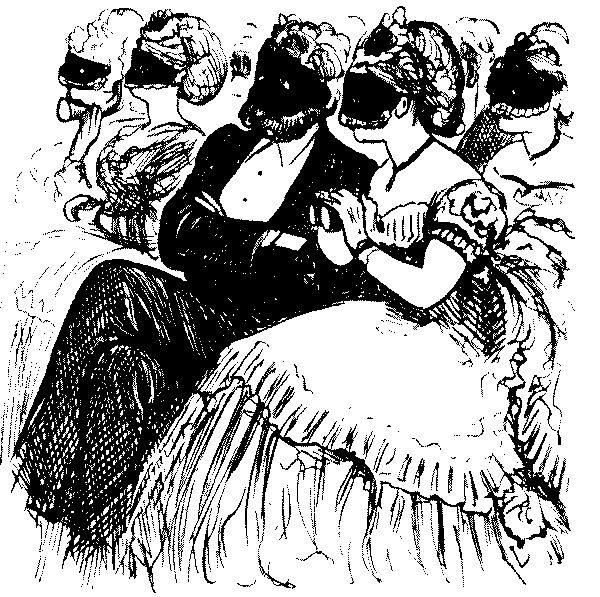
AT THE FRENCH PLAY
Happy thought: Incognito secured—blushes concealed—and self-respect preserved (at least outwardly).
Another actress of the "hectic" type, about whom Punch as an informal censor morum was much exercised, was the famous Mlle. Schneider, who incarnated the canaillerie of Offenbach, and was the idol of Paris in the years in which the Second Empire was dancing to its doom. She appeared in La Grande Duchesse and La Belle Hélène in London in the season of 1868, drew the town at the St. James's Theatre, but met with little encouragement from the Press. Punch declares that Schneider was far more vulgar in London than in Paris, though on her native heath her performance was witnessed chiefly by ladies of the faster set; and draws the moral that they manage these things better in France. He found her "perhaps scarcely so extravagant in her vulgarity" in La Belle Hélène, but "there is all that excessive grimacing, continual adoption of the 'cad'-tone (which her admirers think so charmingly clever), that pointless introduction of rough horse-play, hitting and kicking, without which Schneider would not be Schneider." So Punch notes, as a "natural consequence" of the indulgence allowed by the Lord Chamberlain to Schneider to "kick up behind and before," like "Ole Joe," on every occasion, the production of the notorious and (for the time) audacious play of Formosa a year later. Formosa was a play of fast life, with scenes at Cookham (hence the name); a strange amalgam of impropriety and sentimentality; and Punch dealt faithfully with the ridiculous situation in which the heroine, discovered by her parents in the most compromising company, "makes a sudden and miraculous leap from the lowest vice to the height of most sublime virtue."
Comedy and Satire
Schneider and Formosa were, however, excrescences on the history of the British stage. A really characteristic Victorian product was the series of "drawing-room comedies" by T. W. Robertson, associated with the Prince of Wales's Theatre in the Tottenham Court Road, and the management of the Bancrofts. Punch thought Play faulty in construction and tricky in its effects, but had nothing but praise for the acting of Marie Wilton, Lydia Foote, Montague, Bancroft and John Hare. With him the Play was not the thing, but the players; still Robertson's later comedies, for all their artificiality, gave an immense amount of harmless pleasure to Victorian audiences. Elderly playgoers will always retain the pleasantest memories of School and Caste; they were a most amusing "sentimentalization" of a phase of society which has passed away, and fitted the company to perfection. The little playhouse in the Tottenham Court Road did excellent work in other ways, as Punch acknowledged in his dream dialogue with Sheridan, when The School for Scandal was revived in 1874 with Bancroft as Joseph Surface, Coghlan as Charles, Hare "a perfect picture" as Sir Peter, and Mrs. Bancroft admirable in "the rural coquette who had adopted all the graces and manners of a woman of fashion." Another notable Sheridan revival was that of The Rivals at the Haymarket in November, 1870, though Punch notes the disconcerting effect of Buckstone's personality: people roared with laughter at him before he spoke, or if he merely winked.
The satiric drama was dormant until 1873, when The Happy Land was produced at the Court Theatre by Miss Marie Litton on March 17. It was founded on Gilbert's Wicked World, "a fairy comedy," written for Buckstone and the Kendals, and produced at the Haymarket with only moderate success on January 4. The Happy Land was designed by Gilbert himself, but the stage version was mainly worked out by Gilbert Arthur à Beckett. Gilbert's name did not appear on the bill, on which the piece was assigned to F. L. Tomline (i.e., Gilbert) and à Beckett. The Happy Land was a satire on the Gladstonian administration, and three of the principal actors were made up to caricature Gladstone, Lowe and Ayrton—so closely that after a few days the Lord Chamberlain intervened and the make-up was considerably modified. Punch saw the piece before the Lord Chamberlain's order had been issued, and "crabbed" it heavily. Unlike most of those who saw the play, he found little wit in it. There were three or four "palpable hits" in the opening scene, but ten minutes of it were enough: the satire was of the sledge-hammer order, and the slain were hewn over and over again to weariness. "For a short time the First Act was lively; the Second was a faint shadow of the First." Punch's disparagement is rather odd, in view of à Beckett's connexion with the paper: it is hard to avoid the suspicion that the estrangement from Gilbert, referred to elsewhere, may have coloured his judgment.
The year 1873 was marked by the passing of Macready, who died on April 27. His services to Art, his high aims and neglect of fashion are recognized in the memorial verses, from which we borrow the last stanza:—
Hail and Farewell—thou last of a great line, Who in ideal art moved as at home! Because you bowed at a now empty shrine Was your faith false? Lo, the believing come!
The sentiment is not easily to be reconciled with the generally hopeful view of the theatre expounded by Punch, or his comparison of Irving with Macready a few months later. In this personal context it is interesting to find that Punch's misgivings were at least partially removed by the emergence of a new star of the first magnitude. He had already welcomed Ellen Terry as Puck in the revival of A Midsummer Night's Dream at the Queen's Theatre; he now paid an unreserved tribute to her performance in The Wandering Heir at the same theatre in March, 1874:—
Considering the present position of our Theatre, such qualities as spontaneity, grace, the finest truth of accent and emphasis, tenderness in grave passages, mirthfulness in gay ones, and all these fused in an atmosphere of buoyancy and brightness which exhilarates like champagne, and irradiates like light, are something to be indeed thankful for, when found combined in one Actress on an English Stage. They are to be seen combined at this moment in Miss Ellen Terry's impersonation of Philippa, in Mr. Charles Reade's drama of The Wandering Heir, at the Queen's Theatre. Let those who may doubt if such praise nowadays can have a solid foundation, go and admire for themselves. A new power of graceful comedy and womanly sentiment comes to us with the return to the boards of this young and charming Actress, whose eclipse for the last few years has been hard indeed upon a Stage that had no light to spare.
Stage Realism
In the earlier years of this period Punch was much concerned with the craze for sensation, and the stage-realism which leaves nothing to the imagination, but exalts the practical carpenter at the expense of the dramatic genius. This stock complaint reaches a climax at the close of 1865 in connexion with the announcement in a fashionable paper that in a play to be shortly produced in Paris there would be "a grand park with a real waterfall" and "a real river flowing through the stage." Punch's comments, if not very subtle, are at least a sane contribution to the everlasting conflict over stage illusion waged between "enterprise" and idealism.
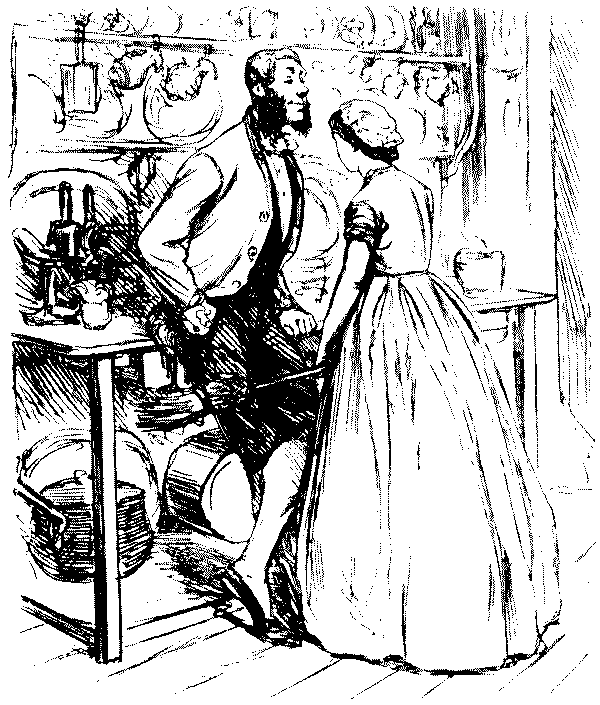
Well, Syusan, 'ow did yer like Aroorer Floyd last night?"
"Oh! so lovely, Jeames—I cried so! that wicked Conyers!... Oh, Jeames, you won't desert me for our young missus, will you, dear?"
Over-reliance on scenery and machinery was, however, a venial offence compared with the exploits of management recorded in the following year:—
With exquisite good taste a highly enterprising Manager engaged "a few of the survivors" who were rescued from the wreck of the London, and has been paying them to appear every evening at his theatre, as a prelude to the gambols of Pantaloon and Clown. With a similar high notion of the duties of men catering to entertain the public, another enterprising Manager has hired "kind old Daddy," late of Lambeth Workhouse, to exhibit himself nightly in a new sensation drama, called The Casual Ward. "Sweet are the uses of adversity," when it is utilized in this way for dramatic exhibition; and flourishing indeed is the condition of the drama, when such magnets are deemed requisite to make a play attractive, and to draw a decent house.
If the horrors of the casual ward be thought a fitting subject for dramatic exhibition, perhaps we soon may see a drama called The Union Infirmary, with a score of real paupers all lying really ill. Or a sensation scene of surgery perhaps might prove attractive, and a real leg or arm be amputated nightly, before a crowded house.... Playgoers will thus become familiarized with horrors, which they read of with dismay; and to some minds a calamity may fail to cause regret on the ground of its affording a good subject for the stage.
Music-Halls
These particular anticipations have, fortunately, not all been fulfilled, though persons who have been tried (and acquitted) on a murder charge have appeared on the boards of recent years, and the deliberate cult of horrors has become the avowed aim of the disciples of the Grand Guignol school at the Little Theatre. The imaginary forecast in 1858 of the possibilities of playbills as a means of advertisement has long been transcended in fact. More interesting than these speculations is the prophecy which grew out of the complaint against long runs in the middle 'sixties. Punch predicts in the summer of 1864 that if the repertory system is kept up in the provinces Londoners will go to Brighton every night for their play or their opera. The actual fact is that the revival of repertory theatres in the provinces has rendered country cousins less dependent on their periodical visits to London in order to keep abreast with the latest dramatic developments. The mention of Brighton recalls a curious episode illustrative of the social code of mid-Victorian times. In the autumn of 1858 Punch rebukes the headmaster of a Brighton school who sent away the son of a distinguished actor lest it should damage his connexion! Today such a pupil is probably an asset rather than a handicap. The attitude of the Church to the Stage was hardly benevolent in the 'sixties: this may account for the satisfaction displayed by Punch over the "exceptionally sensible" sermon preached in 1873 at St. James's, Piccadilly, by Lightfoot, then Canon of St. Paul's, and afterwards Bishop of Durham. Dr. Lightfoot maintained that the stage, well conducted, would be an auxiliary of the pulpit; that it was an enormous and powerful instrument in the hands of Society for good or evil; and, while holding that the present state of the drama was far from satisfactory, he paid all honour to those dramatists and managers who were attempting to raise it by not pandering to the vitiated tastes of some of the public. In all of which sentiments he was vigorously applauded by Punch, who could not, however, resist the temptation of making verbal capital out of the preacher's name.
The competition of music-halls with theatres had already begun, and Punch had little or no conception of the length to which it was ultimately destined to be carried. He had no love of the music-hall as then organized, and nothing but contempt for the style of song which flourished in the temples of variety. So when the Bill, promoted in 1865 by Mr. Locke, M.P. for Southwark, for legalizing theatrical performances in music-halls was supported by a "dramatic authors' petition," he fell foul of the petitioners especially in regard to their initial contention:—
"The Lower Middle Class and Working Class have, of late years, developed a large appetite for intellectual amusement, which the number of theatres, and the present construction of theatres (which give no comfortable or proper accommodation for these classes) have failed to satisfy."
Perhaps we may admit that the theatre, as generally conducted nowadays, is not exactly the place in which to satisfy an "intellectual appetite." With our "intellectual appetite," still suffering under the mockery of a Barmecide entertainment, in the shape of a recent course of burlesques, we feel that the intellectual playgoer, like the sheep in Milton's Sonnet, "looks up and is not fed" in our London theatres. But is there not something besides "numbers" and "construction " of theatre to blame here? May not the quality of the theatrical fare provided have a leetle to do with it? And who are the purveyors of that fare but many of the gentlemen who sign this petition.
If they fail so miserably in satisfying the "intellectual appetite" of even "the Lower Middle and Working-Class" in our theatres, how are they to satisfy it better in the music-halls which they wish to open for the unlimited consumption of their viands?
If they have anything better to offer, why not try it in the theatres, where they will, at least, find the cooks—such as they are—in the shape of actors, and the best procurable garnish of scenery, dresses, and decorations, without the distractions of chops and steaks, sherry cobblers, cold withouts, and sodas-and-brandies?
... But the less the demand for the opening of the music-halls to theatrical representations is based on the demands of the "intellectual appetite" of the Lower Middle and Working Classes, the better.
Three years later Punch was unable to notice any great improvement in the variety stage:—
The music-hall gentry had a great gathering the other day, for a purpose which we should approve, if we did not hold that the music-hall, as at present conducted, is so pestilent a nuisance that charity can have nothing to say to it. One of the performers had grace or shame enough to deliver some doggerel in which he deprecated the wrath of Punch on the ground that everybody must live. It is the plea usually heard in the dock, and the answer is: "Yes, but decently." But as it is of no use telling the music-hall folks what gentlemen think of them, perhaps they would like to know what the respectable artisan thinks of them, and of the spirit in which it is not impossible that he may deal with them. Here are the words of the organ of hundreds of thousands of the skilled artisans and the Trades Unions, in fact, and we recommend them to special attention:—
"To these glaring temples of dissipation our youth are nightly attracted; where they are being gradually trained to drinking habits; where their minds are debased by the low songs and vulgar exhibitions provided for them; and where their morals are undermined and corrupted by contact with loose associates, when their blood is fired and their brains bemuddled with drink.... The expenditure incurred in those places of amusement keeps young men poor; causes marriage to be greatly postponed—to the increase of vice; or, if entered into, without the necessary provision for making a comfortable home; while the habits they acquire by going there will too frequently cause them to neglect home and family for their nightly amusements."
So says the Beehive speaking the sentiments of the Working Man. We do not think that he will see much force in the mewing plea of "must live."
The music-halls of to-day do not call for such censure; they have even become fashionable; but one is tempted to wonder whether there is any modern counterpart in Labour journalism to the austerely Puritan Beehive.
Opera in 1858
In the world of opera the domination of the Italian School of composers and singers, though intermittently and not unsuccessfully assailed, remained practically unbroken throughout this period, 1857-1874. Still, the formation of the company for the performance of English operas by Louisa Pyne and William Harrison in 1856 is a landmark that must not be overlooked. The partnership was dissolved in 1862, but the performances given at the Lyceum, Drury Lane, and Covent Garden theatres in those years anticipated the good work done in later years by the Carl Rosa and other companies. The general musical situation in 1858 is not badly summarized in the lines published at the end of June under the heading "Musicians and Maniacs":—
Three Traviatas in diff'rent quarters, Three Rigoletti murd'ring their daughters!! Three Trovatori beheading their brothers, By the artful contrivance of three gipsy mothers!!! Verdi in the Haymarket, Verdi at the Lane, Green's in Covent Garden, and Verdi again! Was ever a being so music be-ridden, Barrel-organ-beground, German brass-band bestridden; What with all the Concerts at all the Halls, And the Oratorios—Samsons and Sauls— Mozart and Mendelssohn, Haydn and Handel— All lights of the Art in every part, From the blaze of the Sun to a farthing-candle! And the Classical Matinées, With Clauss's touch satiny, That to hear her your heart seems to go pit-a-pat in ye— And Hallé so dignified, pure and sonorous, And Henry Leslie's amateur chorus, And fair Arabella, so melting and mellow, That she charms the stern judgment of Autocrat Ella, And Rubinstein—rapid and rattling of fist, That one cries out with Hamlet's Papa, "Liszt, Oh Liszt."
Ella was the founder and director of the "Musical Union," which gave Chamber Music Concerts much on the lines of the famous "Pops"; Arabella was Arabella Goddard, the leading British pianist. Henry Leslie's choir for the performance of madrigal music carried off the prize against all comers at Paris in 1867. Wilhelmine Clauss was the Bohemian pianist, known in later years as Mme. Szarvady. To return to opera: it is amusing to find precisely the same charge hurled against Verdi as against Wagner twenty or thirty years later—that he cracked or wore out voices in their vain effort to contend against orchestral din. Grisi was still the chief diva, though a new star had arisen in Titiens, whose name spurred Punch to display his metrical prowess:—
We've got a great artist, a lady named Titiens, Whose praises we'd sing, but her name will not rhyme. Stuff! Horace reminds you, with "Tantalus sitiens," We've thirsted for music like hers a long time.
The Advent of Patti
The new Opera House had been opened at Covent Garden, and on the first night patrons complained of getting covered with white, as the paint was still fresh. The "Music of the Future" continues to excite Punch's derision, and at the close of 1858 he seizes the opportunity of running a tilt against Lohengrin:—
Meyerbeer's opera of the Africaine seems to be "The Opera of the Future," for there appears but little chance of its ever being played in our lifetime. How many years has it not been locked up in the great composer's portfolio, undergoing a species of African slavery, of which manager after manager has tried in vain to find the musical key. However, we are sorry to find Meyerbeer lending his great name to Messrs. Wagner, Liszt, and other crotchet-mongers of the Music of the Future, in support of their inharmonious fallacies, that have lately been aired in a grand pretentious production, called Lohengrin. A "grin" seems to be the end of all their Operas, though at best it is but a melancholy one, and anything but flattering to those who provoke it. The Viennese are all Lohengrinning like mad. We wish Meyerbeer would put this band of musical fanatics to shame by allowing his Africaine to become an "Opera of the Present," instead of "the Future," and so prove to these hare-brained gentlemen what good music really is. The best Music of the Future is that which has the elements of vitality in every note of it, so that there can be no doubt about its living several scores of years after its production. The specimen that we know of this class is Don Giovanni, and our would-be Mozarts cannot do better than take it as a model.
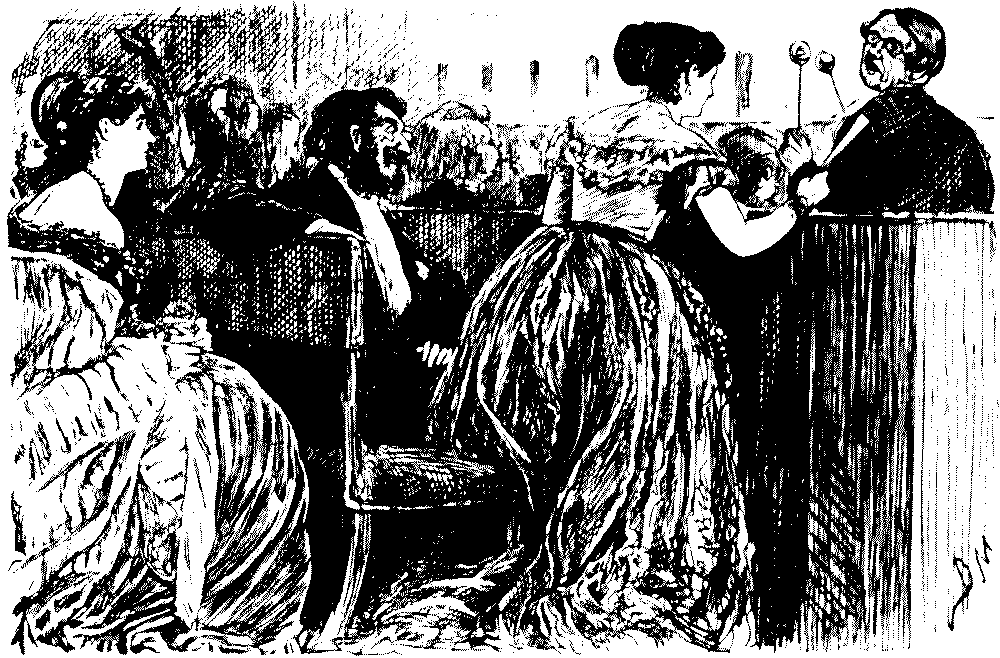
MODEST APPEAL
Lady (to big drum): "Pray, my good man, don't make that horrid noise. I can't hear myself speak!"
Punch's enthusiasm for Piccolomini had so far cooled that when a testimonial to her was suggested in 1860, he declined his support on the ground that she was "a pretty little personage, of good family, who, by force of bright eyes, intelligent acting, and a charming smile, pleased the public into a belief that she was a lyric artist." Moreover, if there was to be a testimonial, Grisi was the proper recipient. The following year was noteworthy for the advent of Patti, unheralded by any strident flourish of trumpets. Punch's first reference to her début in May was brief and ambiguous, and disfigured by a pun on her name. Six weeks later he remains still unshaken in his allegiance to his old heroines—Malibran, Jenny Lind, and Grisi—and suspends his judgment on the newcomer. Patti's arrival coincided with the "final farewell appearances" of Grisi, a mistress of the grand style as singer and actress, queen-like in her gestures and gait, unequalled even by Titiens (in Punch's opinion) in Norma and as Donna Anna; but Punch soon succumbed to the furore for Patti. As Zerlina she was "more charming than he expected," and a year later he celebrated his enslavement in jingling rhyme:—
O charming Adelina! How sweet is thy Amina How bewitching thy Zerlina! How seldom has there been a More tunable Norina! And have I ever seen a More enjoyable Rosina? But to tell the praise I mean a- -Las! there should have been a Score more rhymes to Adelina.
Punch said what he could in 1861 of two forgotten operas—Balfe's Puritan's Daughter, with Santley in the cast, and Benedict's Lily of Killarney, a tertiary deposit from The Collegians—but found more congenial occupation in the spring of 1862 in levelling the shafts of ineffectual, because uninstructed, ridicule against Wagner:—
LE VERITABLE "OPERA COMIQUE"
We read that Herr Wagner is about to compose a comic opera, music and words. We agree with our facetious contemporary, The Musical World,[30] that we never heard an opera of Wagner's yet that was not more, or less, comic.... As this gentleman's music is said to belong to "The Future"—and certainly as a Present it is not worth having—we suppose he generally gets it executed by the celebrated Band of "Hope."
A KING WITH A STRANGE TASTE FOR MUSIC
Wagner and Gounod
Herr Wagner, the great composer, "for the future" (a.d. 1962), has received sharp orders from the King of Saxony to return home instantly. Is the King jealous that other parts of the Continent should have so much of the services of his Kapellmeister, and he comparatively so little? He probably wishes to have Wagner all to himself. Far from quarrelling with the desired monopoly, in the cause of music we heartily rejoice at it. The royal edict will have the effect of narrowing the evil of contaminating compositions. It is tantamount to a musical quarantine. Travellers must not venture too near, or else they may be infected with one of his malignant airs, which are not so catching, perhaps, as they are lowering, leaving a fearful sense of depression behind them. Henceforth, the flights of The Flying Dutchman will be restricted to one kingdom instead of half a dozen. We hope Wagner will be confined to Dresden all his life. Our Philharmonic will gain from his imprisonment. It will run no further risk of being nearly knocked on the head from another blow of his erratic baton.
The chief operatic attractions of 1863 are set forth in an excellent mock-Virgilian Eclogue in which the two rival impresarios, Gye and Mapleson, figure as Damoetas and Menalcas and Punch as Palaemon. Patti's popularity is attested in the couplet:—
My little Patti all the world must own The nicest little party ever known.
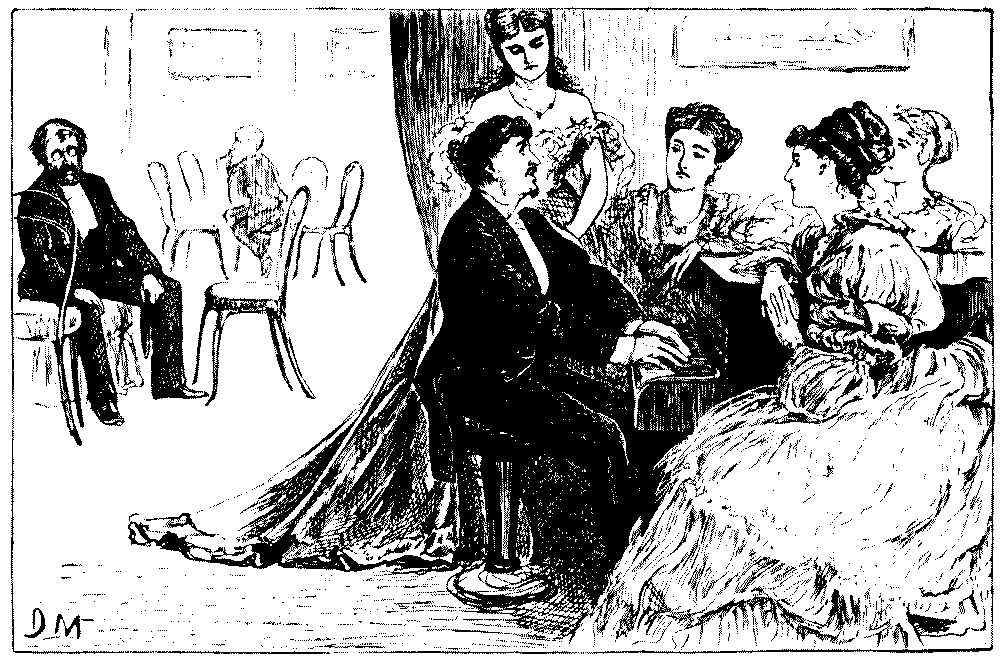
SIC VOS NON VOBIS
Literature, Science, and Music at an evening party. Total defeat of the two former.
The list of celebrities includes Titiens, Carvalho, Trebelli, Mario, Tamberlik (a heroic tenor, famous for his "ut de poitrine"), Giuglini, Faure, Formes, Santley—all of them long dead, except the last, who had, in 1862, just cast in his lot with Italian opera. He took part in the first performance of Faust in England as Valentine, and with such success that Gounod wrote for him the additional number "Dio possente." Faust is a landmark in the annals of opera in England; because it was the first work which shook the allegiance of the fashionable world to the Italian school, and for fifty years at least enjoyed a popularity equal to that of the early Verdi, of Donizetti, Bellini, and Rossini, and, judged by the test of performances, greater than that of Mozart or Meyerbeer. Faust was certainly founded on Italian rather than German traditions, but there was much in it that was essentially French, and one turns with curiosity to read how it struck so orthodox and, in some ways, so insular a critic as Punch. He treated the opening performance perfunctorily, briefly observing that the opera seemed to suit everyone's taste, but made his amende a month later:—
Thank you, M. Gounod; thank you, Mr. Gye; thank you, Mr. Mapleson.[31] As produced by your exertions Faust is certainly Faust-rate. Mr. Punch makes his apology for not saying so before, but he is not like some clairvoyants who can criticize by foresight. Moreover, such cascades of praise have spouted on all sides that he feared a while to add to the laudatory deluge. Now, having seen and heard and reflected at his leisure, Punch is ready to allow that the shower of superlatives has not fallen undeserved, and he will own that M. Gounod has produced the sweetest, prettiest and pleasantest new opera that, since the first night of Les Huguenots, the world has seen brought forth. The only drawback Mr. Punch felt when he witnessed the performance was that M. Gounod had not set the Brocken Scene. With that addition, Faust might have eclipsed Der Freischütz, and even without this it is not far inferior.
"Homeric Catalogue of Singers"
Many of the greatest singers of the time appeared in these performances. Miolan-Carvalho (the original Marguerite), Faure (the first Mephistopheles), Giuglini, the incomparable Trebelli, and Santley. Patti assumed the rôle of the heroine in the following year with great success; but Punch did not fail to welcome Titiens as Leonora in Fidelio, an achievement which he describes as "noble music nobly rendered." It was in 1864 again that the efforts of English opera to raise its diminished head called forth Punch's satire. Foreign opera still held the field, and the only English feature of the venture was the conductor Mellon.
The "Homeric Catalogue of Singers," published on April 1, 1865, shows how formidable was the competition of the foreign singers, headed by Patti, Lucca, and the honey-tongued Miolan-Carvalho, with other prima donnas from Munich, Berlin, Milan, Moscow, and Lisbon, and, amongst men, Mario, Wachtel ("the far-famed shouter of high notes"), Ronconi (a great actor and humorist) Tagliafico, and half a dozen others whose names have fallen into the limbo of forgotten singers.
Meyerbeer's long-promised and posthumous L'Africaine arrived at last in the summer season of 1865, but before its performance on July 22, with Pauline Lucca in the part of Selika, the libretto of this "grand new old opera" is irreverently burlesqued by Punch with delightful pictures by Du Maurier. We can only find room for an excellent travesty of the Song of Inez:—
I go to execution, 'Tis righteous retribution, And by this Constitution All foreigners must die—
and the excellent and well-merited criticism of the execrable singing of the opera chorus (old style).
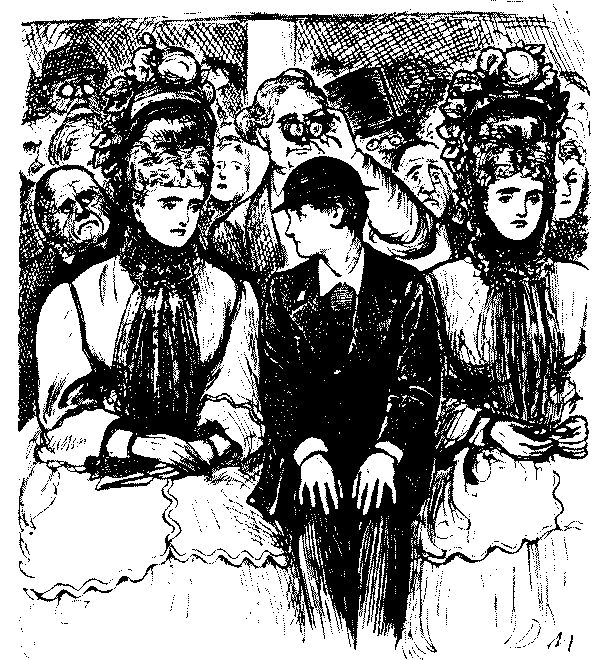
"JUST HINT A FAULT"
Little Tommy Bodkin takes his cousins to the gallery of the Opera.
Pretty Jemima: (who is always so considerate): "Tom, dear, don't you think you had better take off your hat, on account of the poor people behind?" you know?"
Nilsson and Grisi
Punch returns to L'Africaine a couple of months later, but in a vein of irresponsible ribaldry. Punch's notice, however, is valuable because it is a good (if partly unconscious) satire on the attitude of the frivolous opera-goer who goes (or shall we say went) to the opera to be amused and titillated, to see and be seen, to applaud the "stars" in their show songs, but for the rest deaf to the appeal of poetry and passion. Punch, at his worst, never sank to this level, witness his appreciation of Jenny Lind and Titiens and Ronconi; but the glamour of good looks and a fine voice seldom failed to touch his susceptible heart. His appreciation of Christine Nilsson on her appearance in 1867 is, with certain reserves, a good estimate of one who in her prime was an almost perfect Marguerite, or perhaps one should say Gretchen, and who might have stepped out of one of the canvases of Kaulbach:—
It is not usual, I know, to wear thick boots at the opera; but I regretted very much that, obeying my young wife, I had put on a thin pair, when I went the other night to hear the new young Swedish singer. I have seldom been more charmed than I was by her fresh voice, fair face, and her agreeable demeanour. She sings in a pure style, with intelligence and taste, and she can hold a long soft note with none of the affected trembling of the voice which of late has been so fashionable. Her tones are clear and full, high but never shrill; and she has no need of French polish to conceal those cracks and blemishes which Verdi makes in thin weak voices. She is very young at present, and must not be crudely criticized; but she seems by nature gifted for the operatic stage, and having ardour and ambition to shine lastingly upon it. Because she happens to be Swedish, people think of their old favourite, and make absurd comparisons between a finished artist in the climax of her fame and a clever débutante who is wishful to be famous. The parallel, though premature, may in one point be permitted, for these Swedes have both the gift of singing not to the ears only, but simply to the heart; and though Christine Nilsson may not be a second Jenny Lind, she is even now among the very first of prime donne.
In 1868 regret is expressed that Royalty bestowed more patronage on Offenbach than Handel—the Handel Festival coinciding with the production of La Grande Duchesse in 1868; on the other hand, Patti's marriage to the Marquis de Caux is thought worthy of a mention under the heading of "Essence of Parliament"! In 1869 Punch notes the knighthood conferred on Costa, whom he had once described as "the tamer of wild prima donnas," and pays homage to Grisi, who died at the close of the year:—
GIULIA GRISI
Nay, no elegies nor dirges! Let thy name recall the surges, Waves of song, whose magic play Swept our very souls away: And the memories of the days When to name thee was to praise; Visions of a queenly grace, Glowings of a radiant face, Art's High Priestess! at her shrine Ne'er was truer guard than thine. Were it Love, or were it Hate, It was thine, and it was great. Glorious Woman—like to thee We have seen not, nor shall see. Lost the Love, the Hate, the Mirth—
Light upon thee lie the earth!
Hervé's Chilpéric is hailed in 1870 as a welcome substitute for the tyranny of Schneider and Offenbach; as for Tannhäuser, Punch was apparently very much of the same way of thinking as the members of the Jockey Club in Paris, who received it with whistles and cat-calls in 1861:—
GEE WOE, WAGNER
A Solo by Mr. Crusty, after hearing a Selection from the Opera of Tannhäuser
"The music of the future," eh? Well, some may think it pleasant! But when such trash again they play, I'll for the future hope I may Not be among the present!
Mario's farewell benefit, on July 19, 1871, when he played Fernando in La Favorita for the last time in London, was a scene of "roaring and wreaths" described with mingled humour and emotion by Punch, who hailed the retiring idol as the Prince of Lyric Artists:—
Though lost to ear To memory dear I ne'er shall look upon his like again!
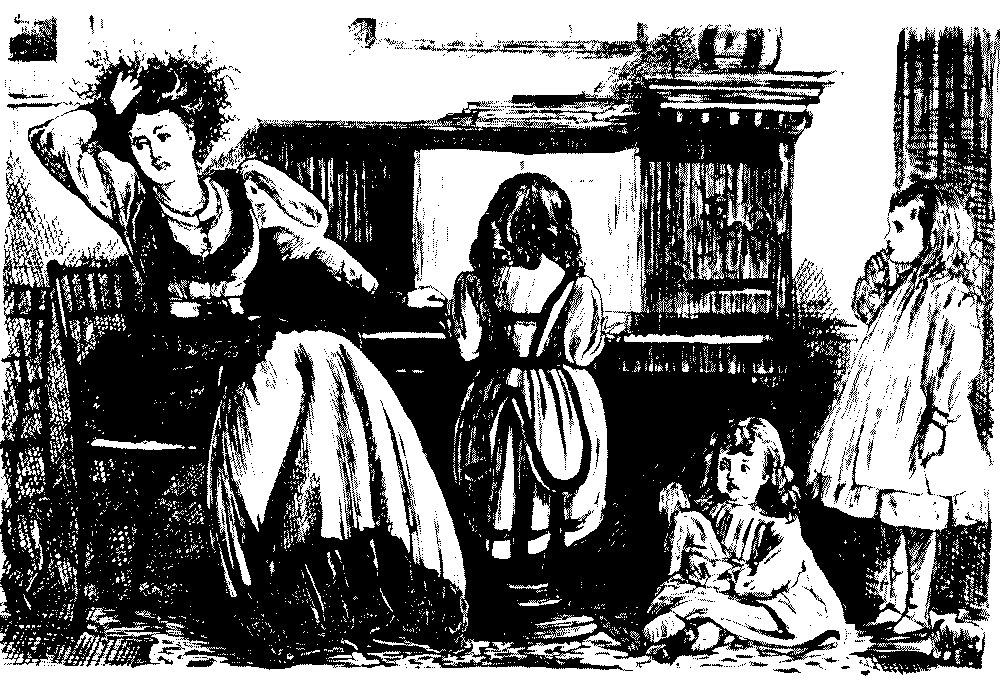
TO ARTISTS, COMEDIANS, AND OTHERS
Anyone who wishes to study the true dramatic expression of the Tragic Muse in the act of drinking the last bitter cup of despair to the very dregs, should watch a young mother teaching the elements of music to her first-born.
Popular Songs in 1858
Concert music between 1841 and 1857 began and ended, so far as Punch was concerned, with Jullien. To what we have written in the previous volume of Jullien's disasters and death, it may here be added that Punch bade him God-speed on the grand tour in 1858 which was to restore his fortunes, and when the end came was active in canvassing for funds to support his widow and family, who were left totally unprovided for. Also, that he repeated his tribute to Jullien's great services as an educator of the "shilling-paying public." The taste of the musical million was still a matter of concern to Punch. His detestation of street bands, Ethiopians, Germans, Tyrolese, and Italians—principally emissaries of Verdi, his pet aversion—amounted almost to an obsession. The names of the popular songs in 1858—"Jim Crow" and "Keemo Kimo" were certainly not romantic. At a concert held in St. James's Hall in June, 1858, a negro song was sung with the delectable refrain: "Flip up in de scidimadinc, jube up in de jubin jube." Punch found some solace, however, in the concerts at Sydenham, where morceaux of Mozart, Mendelssohn, and Handel, served up by Costa, took the sickly taste of Traviata out of his mouth. Punch's own education was advancing, but he had not yet learnt to spell Liszt's name properly. The extravagances of Liszt worship, which certainly reached a pitch never surpassed in the annals of musical idolatry, are burlesqued in a series of paragraphs aimed at Wagner as well as his son-in-law to be. Writing of Liszt's "fearful engagement" in Dresden, in 1859, he facetiously asserts that "Not less than two pianos were killed under him, and upwards of two dozen music-stools severely wounded." The "encore nuisance" had already found in Punch a strenuous critic; and a tumultuous scene at the Surrey Hall, when Sims Reeves had withstood the demands of a rowdy section of the audience for half an hour, provoked an indignant fulmination against the brutal exigencies of concert goers. Sydenham was in the main a centre of musical culture, but there was a slight lapse from grace at the end of this year when the "Calliope" or "Steam Orchestra" was imported from America. It was in reality only a big barrel organ, which gave out more steam than harmony. But the Crystal Palace redeemed itself in the following year by the performance of the Elijah, at a Mendelssohn commemoration, by 3,000 performers before an audience numbering 18,000. Sims Reeves, Miss Dolby, and Madame Parepa were the soloists; and Punch could think of no better praise of the last-named singer than to say that she reminded him of his Clara. For there was a Clara in those days, too: Clara Novello, the friend of Charles Lamb, all unmusical though he was, who had won the praise of Schumann at the outset of her distinguished career as a very great and noble oratorio singer. Punch went to hear her last farewell at the Crystal Palace in the autumn of 1860; "went, heard, and for the thousandth time was conquered."
The year 1860 was also noteworthy for the visit of the French Orphéonistes, a body of choral singers directed by M. Delaporte. The visit afforded Punch great sport because of the special "Vocabulaire et Guide des Orphéonistes Français à Londres" which was specially issued for their benefit, and contained, amongst other delights, a full transliteration of the National Anthem beginning:—
"God sève aoueur grésheuss Couinn."
The "Pops"
Blondin's performances at the Crystal Palace, which were a great feature of 1861, suggested to Punch that the concerts might be popularized if the performers appeared on the tight rope. But this was "wrote sarcastic"; the morbid taste of the public for witnessing dangerous performances is repeatedly rebuked, and as a matter of fact Blondin was forbidden to trundle his child in a wheelbarrow along the tight rope.
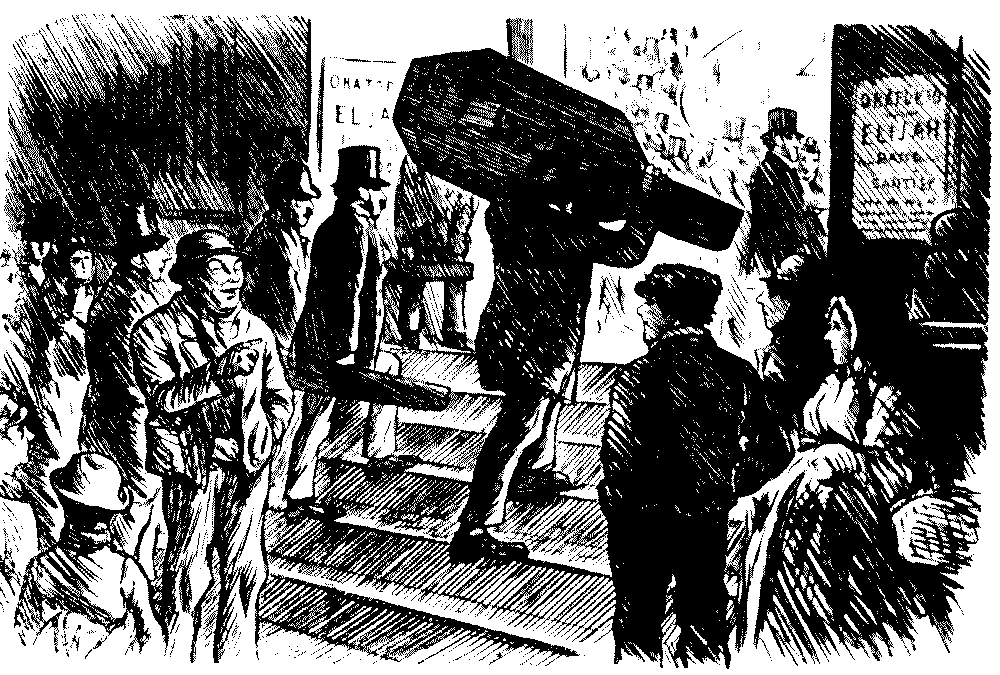
MUSIC IN THE MIDLANDS
Intelligent Youth of Country Town: "Ah say, Bill, 'ull that be Elijah goin' oop i' that big box?"
Orchestral music was still a luxury, but London was waking up. August Manns, who succeeded Jullien at Drury Lane in 1859, had provided the public with "more music and less row than in the Jullienic era"; but his great work was done at the Crystal Palace. The "Pops," which came in the 'fifties and were cordially supported by Punch, have gone, and with them St. James's Hall, where for so many years the votaries of chamber music listened to Joachim and Patti, Hallé and Lady Hallé, Madame Schumann, and other great artists: and Exeter Hall, where the Sacred Harmonic Concerts were held, has undergone a startling metamorphosis. Oratorio has lost something of its hold on the British public. But the work done by the "Pops" can never be forgotten; and the multiplication of first-rate string quartets can be traced in great measure to their inspiring influence in the days when they were attended by George Eliot and Herbert Spencer, Browning and Leighton.
Another pioneer whose talents Punch was quick to recognize was John Parry, the first, and as some old critics think, the best of the series of single-handed musical entertainers. Parry began as a serious musician, but soon found that his true bent lay in humorous sketches of the trials and tribulations and futilities of amateurs. After seeing Dundreary for the nineteenth time, Punch was persuaded by a friend to see John Parry in Mrs. Roseleaf's Party at the Gallery of Illustration. He was rewarded by a truly exhilarating impersonation of Mrs. Roseleaf, her little pet daughter, a tender tenor with a chronic cold in his head, a fascinating ringleted "Gusheress," and a matter-of-fact musician—all done by one gentlemanly actor without change of dress. Parry's gifts as a pianist extorted the admiration of eminent artists, and we may pardon Punch for saying that "none but himself can be his Parrylel."
Sims Reeves
Sims Reeves had been energetically supported by Punch in his refusal of encores. But when he was "conspicuous by his absence, as everybody might have known," on the occasion of a charitable performance in 1864, Punch made bold to observe that "considering how often Mr. Reeves is indisposed, it is high time that a deputy should be permanently hired for him." On this particular occasion "the usual medical certificate was produced and read amid the laughter of the audience, who had clearly come prepared to hear the usual apology which is expected now whenever Mr. Sims Reeves is announced." These are hard words, but the excuse was so frequently made that concert-givers in the provinces were in the habit of posting over their bills the reassuring announcement: "Sims Reeves has arrived." Even then he could not always be reckoned on. The famous tenor had undoubtedly a very delicate throat, and objected strongly to sing if he was not feeling perfectly fit. But his inordinate vanity was also a contributory cause. Sir Charles Hallé used to tell a story how, on one occasion, when Sims Reeves was engaged to sing at Manchester, he failed to appear at rehearsal. Hallé went off at once to his hotel—for he had "arrived"—and was told that Mr. Reeves was too ill to sing; but persisting in his intention, he was admitted to the sick chamber and found that the illness was due to the fact that Sims Reeves's name had been printed in the bills in the same type as the other performers. Sir Charles Hallé accordingly sent for copies, and by a process of accurate measurement succeeded in demonstrating that this awful act of lèse-majesté had not been committed and that "Sims Reeves" was printed in larger capitals than any other name. Whereupon the patient made a wonderful recovery and fulfilled his engagement.
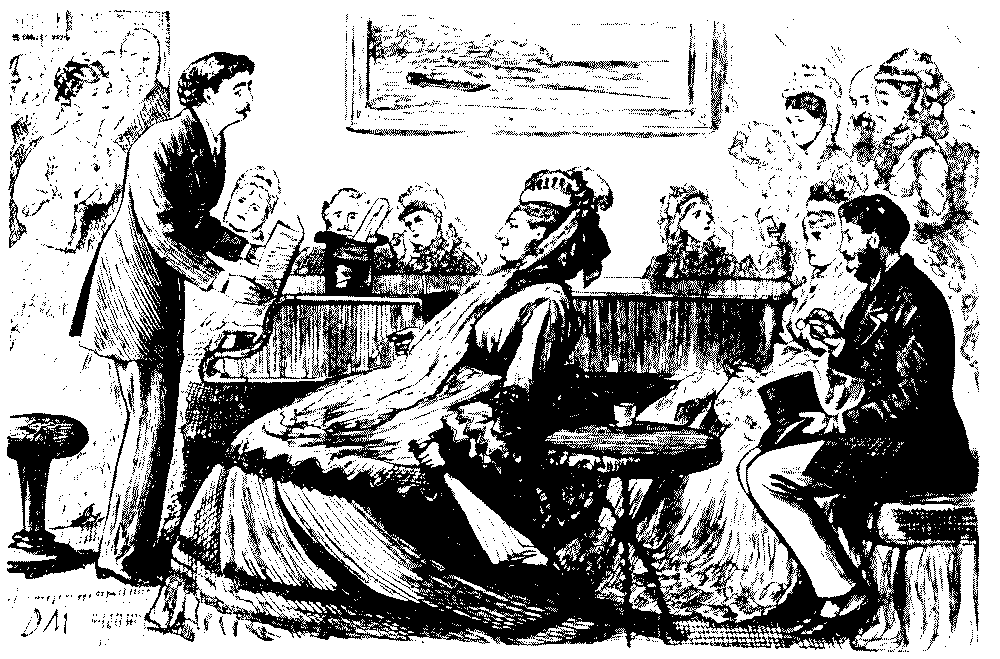
DRAWING-ROOM MINSTRELS (What they have to put up with sometimes.)
Affable Duchess (to Amateur Tenor, who has just been warbling M. Gounod's last): "Charming! Charming! You must really get somebody to introduce you to me."
As the "Pops" fulfilled Punch's ideal of a model chamber music concert, so the Saturday concerts at the Crystal Palace, conducted by Manns, with "G" (Sir George Grove[32]) as programme writer, best satisfied his requirements in the domain of the symphony and orchestral music generally. Charles Keene's picture in 1866 of the two enthusiasts, one political and one musical, is a pleasing comment on the growth of musical taste. They both agree that Monday had been a glorious night, but the one was thinking of Gladstone in the House, the other of Joachim in the Kreutzer Sonata.
Punch had already saluted John Parry; he extended a similar welcome in 1867 to the German Reed entertainment at St. George's Hall:—
It is really quite a novelty to hear some comic singing done by English singers, without feeling a strong wish that one had been born deaf. "Tol de rol," and "Rumti-iddity," and such old English comic choruses, have long since had their day. Go to the St. George's Opera if you would know what comic English choruses should be. In the interests of good music, we thank Mr. German Reed for giving men a chance of hearing something better, in the way of comic singing, than "Champagne Charley," or "Costermonger Joe." We hope his charming little opera-house will tempt people from going to the vulgar, stupid music-halls, when they want to hear some singing which may make them laugh.
This, be it remarked, was at the time when the favourite popular songs were "Champagne Charley," "Not for Joseph," and "Paddle Your Own Canoe," and when, in consequence, Punch's complaints of the idiocy of music-hall songs were both frequent and free.
THE FINE ARTS
Depreciation and Discovery
Punch's virtual conversion to the principles of Pre-Raphaelitism has already been noted, and the alliance was confirmed by the enterprise of his publishers in connexion with Once a Week, to which Millais, Sandys, and Rossetti were regular contributors. So we are not surprised to find his criticisms of the Royal Academy growing in frankness and even hostility during the early years of the period now under review. In June, 1858, he complains of the monotony of the subjects chosen for treatment at the annual show—endless portraits of a lady or gentleman; Tom Jones and Sophia; Sancho Panza and the Duchess; Moses and the Spectacles; Sir Roger de Coverley; Bruce and the Spider. To the same year belongs his protest against the patronage of foreign sculptors à propos of the Wellington Memorial Competition. But the point of his criticism is rather blunted by his failure to acknowledge the merits of native genius, as represented by Alfred Stevens, that "rare artist, too little recognized and revered," as a modern writer has truthfully described him. Punch refers to his design, but misspells his name "Stephens," and evidently saw nothing uncommon in his work. Against this lapse may be set the evidence of a true flair two years later. Amid a wilderness of mediocrities Punch finds an oasis or two at the Academy Exhibition of 1860. The names of most of the exhibitors are forgotten, but there is one notable exception:—
One would have expected Mr. Whistler's talents to have been developed on the flute rather than At the Piano (598). Nevertheless the painting of that title shows genius. The tone which he has produced from his piano is admirable, and he has struck on it a chord of colour which will, I hope, find an echo in his future works.
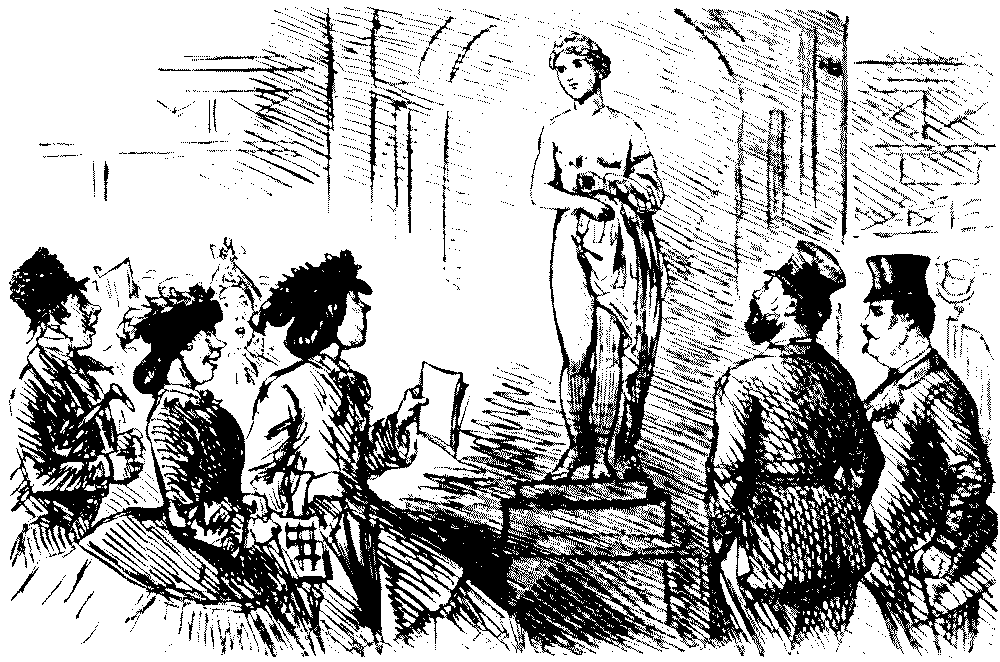
THE GREAT EXHIBITION
Sarah Jane: "Lawks! Why, it's hexact like our Hemmer!"
In 1861 the practice of holding "single picture" shows, charging for the privilege of beholding one canvas the price of a whole exhibition, comes in for semi-serious rebuke at the hands of an income-tax payer. But there was another evil against which Punch inveighed with positive ferocity in the tirade provoked by the Academy Banquet of 1862. The Royal Academy was not merely "mean in its local habitation" (the present exhibition rooms were not built till 1866), it was mean all through:—
Mean in its spirit, its schools, in the quality of the Art it has most fostered and engendered, mean in the self-seeking spirit of its rules of exhibition; mean in its treatment of the greatest men who have belonged to it, and still more, of the painters outside its pale; mean in the cliques which divide its own ranks, and the jealousies which distract its councils.
But it reaches the climax of its meanness once a year—at its Annual Dinner—and at this year's dinner it has capped the climax of meanness reached by all the dinners of all the years since first the Academy dined together.
This Academy Dinner is like the banquet which the poor lunatic, whose story is told by Sir Walter Scott, used to be set down to every day in his cell at the asylum. He fancied his table spread with a magnificent dinner of three courses, and ate of this imaginary feast with great gusto; but "somehow" he used to whisper to his visitors, "everything tastes of porridge." So at the Academy dinner everything tastes of toads.
The R.A. Banquet
The writer proceeds to drive home this indictment of Sir Charles Eastlake's[33] fulsome flattery of noble patrons and the niggardly encouragement of real talent by the familiar device of a dream. At the dinner of his vision great foreign painters are welcomed, and the solidarity of the Arts confirmed by the invitation of illustrious musicians and men of letters. Then comes the awakening:—
The newspaper reports of the Academy dinner lay before me, with its small list of distinguished statesmen, its long bead-roll of Titled Nobodies who never bought a picture or gave a commission to a painter; its absence of every one of the distinguished artists by rare chance assembled in London; its ignoring of foreign letters, and its scanty recognition of the respect due to native literature; its utter passing by of the claims of the Sister Arts—Music and the Drama; the fulsome fulness of its laudations of all who can influence its fortunes by favour; its sycophancy of rank and title and outward influence, and that in the face of a series of cool contemptuous disclaimers of all knowledge or interest in Art by the men before whom in succession the Academic speaker knocked his forehead on the ground; and lastly, as if to sum up in one unmeaning act the stupid snobbishness that marks the whole of this Academic entertainment, the toast of "Literature and its prospects and influences on Art" relegated to the very end of the feast, when every other institution which it can enter into the heart of a respectful and awe-stricken Academician to bow down to has been honoured, and when the lordly guests whom the bad dinner has disagreed with, or the President's eloquence has bored, have left the spaces at the tables, lately filled by their august heads, vacant.
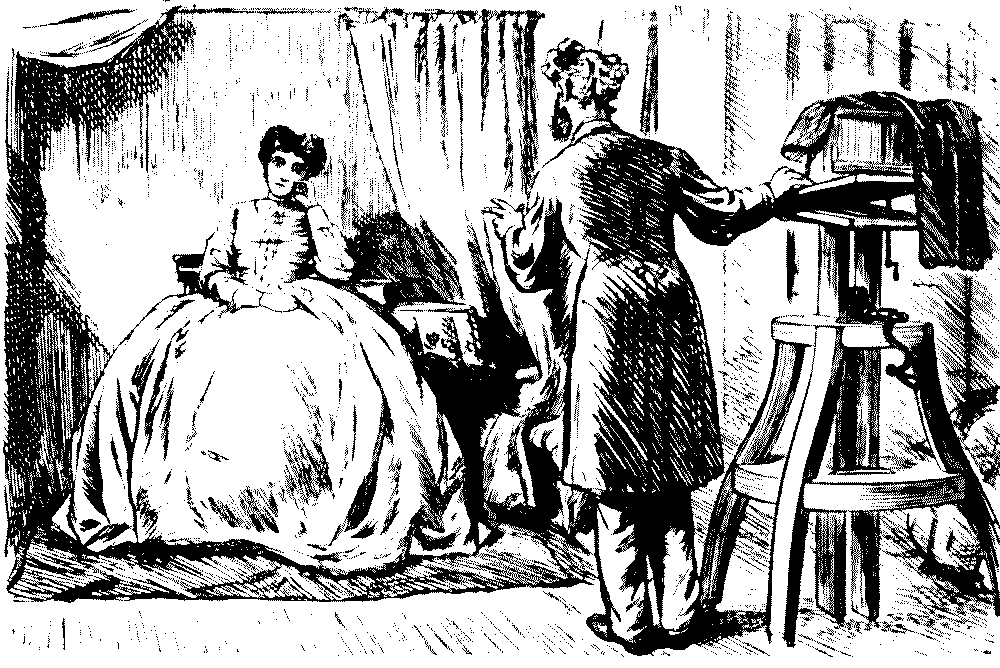
ART v. NATURE
Sitter: "Oh, I think this position will do; it's natural and easy."
Photographer: "Ah, that may do in ordinary life, ma'am; but in photography it's out of the question entirely!"
The Royal Academy has, in many respects, reformed itself out of all recognition as the institution which provoked and justified this explosion. It is only one of the many evidences which go to prove how much more than a merely comic journal Punch was that he should have contributed as damaging an attack as was ever penned against the principles and policy of the R.A. in the days when it laid itself most open to criticism.
There are not many events in the art world in the 'sixties dealt with in so serious a vein. When Frith's Railway Station was purchased in 1863 for £20,000 by a Mr. Flatou, Punch contented himself with calling the purchaser a "Flatou Magico." There are friendly and well-merited memorial notices of John Phillip, R.A., in 1867, and of Alexander Munro, the Scottish sculptor, in 1871, while in 1870 Punch supported the appeal for funds to put up a tombstone to George Cattermole, who died poor.
English etching was "up in the market" in 1871. Punch has high praise for Seymour Haden, higher still for Whistler, his "brother-in-law and etching master." The peculiar quality and historic interest of the etchings contained in the portfolio issued by Ellis, of King Street, Covent Garden, have seldom been better described than in this appreciation:—
Whistler has etched the tumble-down bank-side buildings of Thames, from Wapping and Limehouse and Rotherhithe to Lambeth and Chelsea, above-bridge—great gaunt warehouses, and rickety sheds, and balconies and gazebos hanging all askew, and rotting piles and green weeded quays and oozy steps and hards, where masts and yards score the sky over your head, and fleets of barges darken the mud and muddy water at your feet, and all is pitchy and tarry, and corny and coaly, and ancient and fishlike.
Such etchings of this queer long-shore reach and marine-store dealers, and ship-chandlers, bonded warehousemen, and boat-builders, ancient mariners, and corn-porters, wherry-men, and wharfingers, Thames-police, and mud-larks, are all the more precious because the beauties they perpetuate are dying out—what with embankments and improvements, increased value of river frontage, and natural decay of planking and piling. Whistler has immortalized Wapping, and given it the grace that is beyond the reach of anything but art. Let all lovers of good art and marvellous etching who want to know what Father Thames was like before he took to having his bed made, invest in Whistler's portfolio.
Academy Pictures in 1872
Punch was a great Londoner, and his enthusiasm for an artist who was able to perpetuate the romance and magic of the "ancient river" carries weight. He scores some palpable hits, again, in the "Academy Rhymes," published in 1872, which begin:—
Bad pictures hot! Bad pictures cold! Bad pictures such a lot! So well sold!
This shaft is especially aimed at Sir Francis Grant, P.R.A., and Mr. James Sant, R.A. Millais's famous Hearts are Trumps is neatly hit off in the quatrain:—
Liz, Di, and Mary, cool and airy, How does your garden grow? Azaleas in clumps, and hearts for trumps, And three pretty maids in a row.
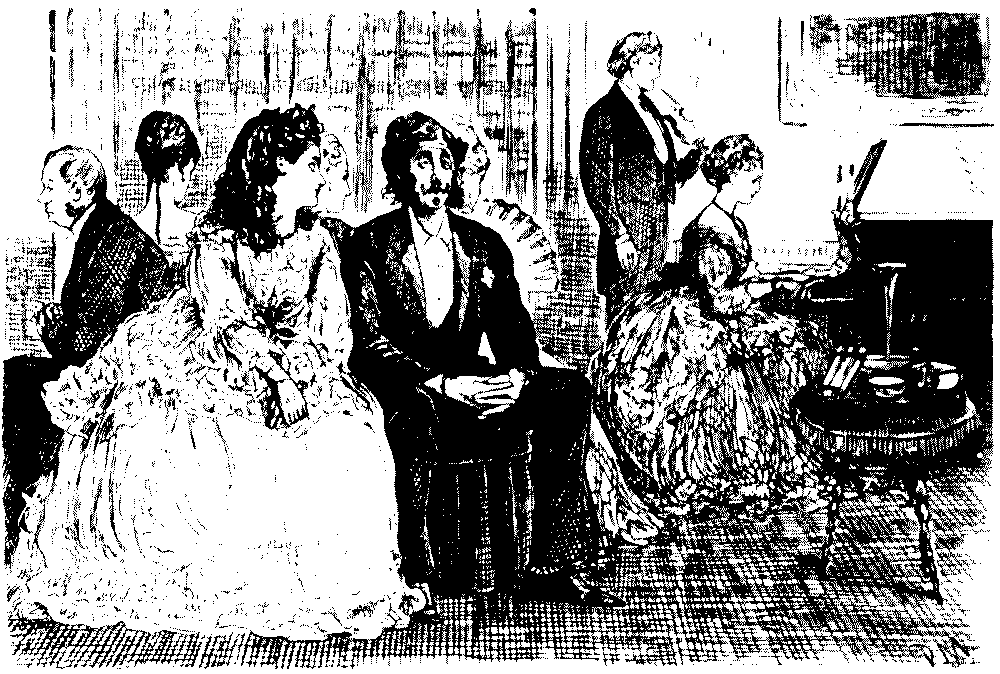
A POSER
Enthusiastic Young Lady: "Oh, Mr. Robinson, does not it ever strike you in listening to sweet music, that the rudiment of potential infinite pain is subtly woven into the tissue of our keenest joy?"
Punch was in no doubt as to the merits of one of the famous pictures of the year:—
About "Harbours of Refuge," no year But some M.P.'s a valuable talker; But my "Harbour of Refuge" is here And its C.E. is A.R.A. Walker!
But he was sadly to seek in his disparagement of Mason's beautiful Harvest Moon:—
Sweet, but scamped in every part, Such half-work most students guide ill: The free-masonry of Art Asks more labour, e'en in Idyll.
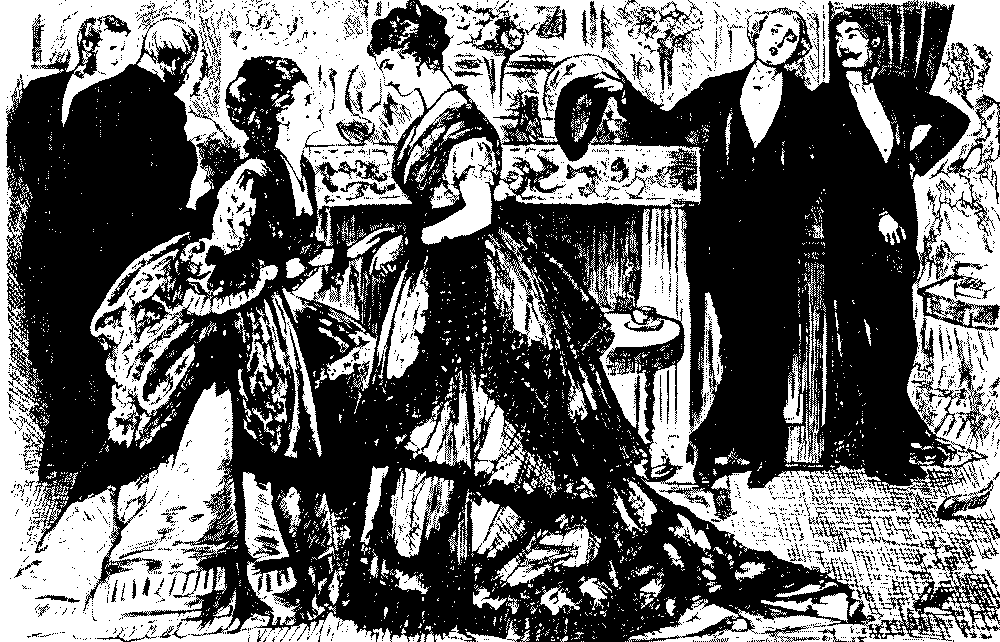
AESTHETIC WITH A VENGEANCE
Tom: "I say, old man, now you've got that stunning house of yours, you ought to be looking out for a wife!"
Rodolphus: "Quite so. I was thinking of one of those Miss Gibsons, don't you know."
Tom: "Ah! Let me recommend the tall one, old man. She'll make the best wife in the world!"
Rodolphus: "Quite so. But the short one seems to harmonize better with the kind of furniture I go in for—buhl and marqueterie, don't you know."
Sir Edwin Landseer
Landseer had often been severely handled by Punch for his accommodating courtiership, but when he died in the autumn of 1873, the long set of memorial verses which appeared on October 11 overlook this infirmity and concentrate on Landseer's services as a teacher of sympathy between man and brute. He was the first of painters who "give dumb things a soul"—in the faithful collie in the lone shieling with his head on his master's coffin; in his St. Bernards and antlered monarchs of the glen. It may be objected that the soul which Landseer gave his animals was a human soul and a sentimental one at that, and that Bewick had forestalled him with a more accurate diagnosis; but the insistence on Landseer's services as a promoter of the entente cordiale between man and beast is well justified. Landseer at the moment of his passing was probably, as Punch contends, "our best-known name in Art." The writer of the verses traces the official recognition of artists abroad:—
Till even upon this, our little isle That looms so large in light of various fames, The fair Queen deigned at last, though late, to smile And dubbed her Knights—a few but glorious names.
But surely this is to overlook the knighthoods of Van Dyck and Lely (both from the Netherlands), to say nothing of Sir Joshua.
The campaign directed against the extravagances of aestheticism by Du Maurier belongs in the main to a later decade, but even in the early 'seventies the vagaries of preciosity had already begun to furnish him with fruitful subjects for genial satire.