SPORT AND PASTIME
Reading edition
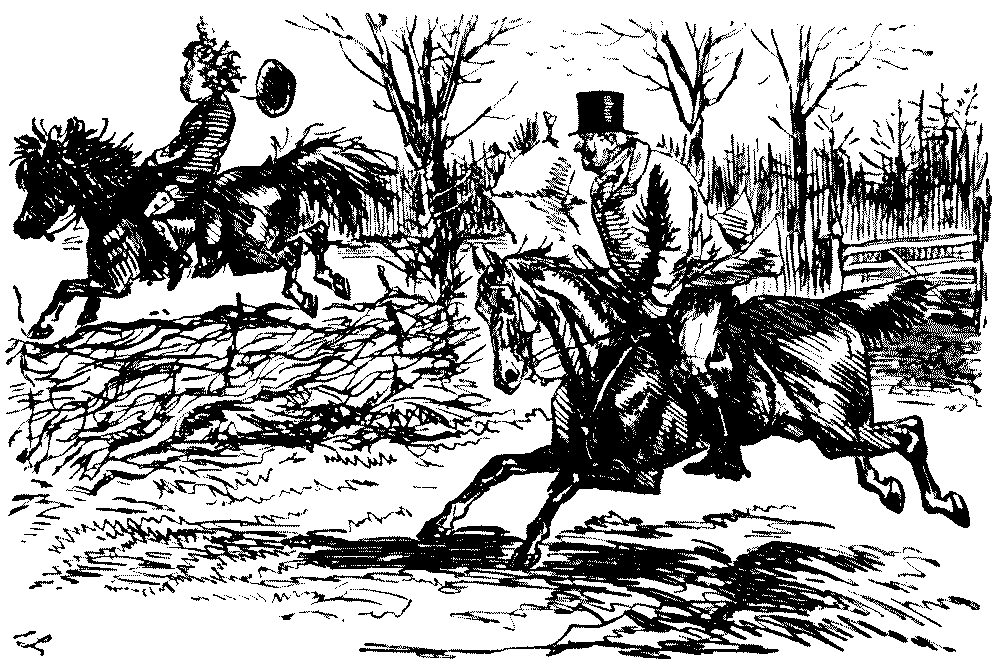
A CHIP OF THE OLD BLOCK
Grandpapa: "Bless his heart—just like me! Spare the Nimrod—spoil the child, I say."
In the region of sport fox-hunting continues to dominate the scene. Leech's pictures are largely devoted to satirizing cockney sportsmen, but they render full justice to the enterprise and intrepidity of the younger generation and of hard-riding young ladies. He is less happy or at any rate less genial in ridiculing the irregularities of the "Mossoo" in the hunting field. The exploits and adventures of the ubiquitous Mr. Briggs form an agreeable pendant and supplement to the novels of Surtees. Mr. Briggs was not an aristocrat, but he was more of a gentleman if less of a personality than Jorrocks. But Leech's premature death left a tremendous gap, for both in humour and draughtsmanship the artists who took his place as delineators of the chase were immeasurably his inferiors. In connexion with the "noble animal" we may note that the advent of Rarey, the famous horse-tamer, was warmly welcomed by Punch and Leech in 1858. The possibilities of the treatment are developed in a variety of ways, but there is more than mere burlesque in the suggestion that it could be profitably applied to stablemen and horsebreakers. And here we may note a crude foreshadowing of winter-sports in Leech's picture of the frozen-out foxhunter who builds a "treboggin" and, with his groom seated behind, careers down hill and across country in a machine about 12 feet long and not 2 feet wide with a splash-board in front.
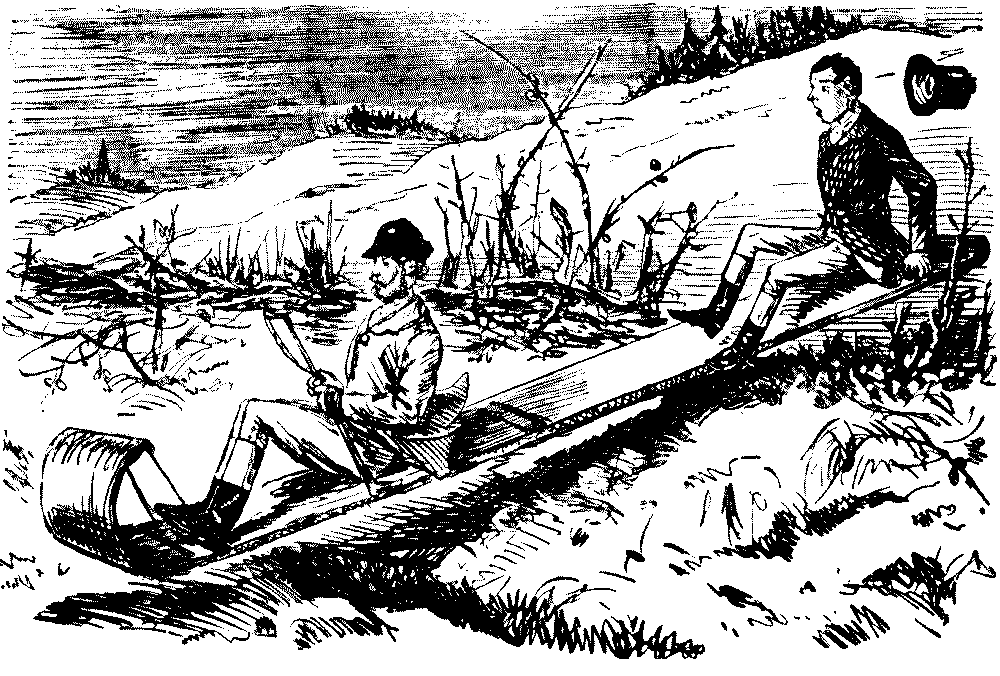
THE FROZEN-OUT FOX-HUNTER
Sporting Militaire recalls to mind his Canadian experiences (the ground being deep with snow), builds a treboggin, and for the moment ceases to swear at the frost, or to regret the six hunters he has eating their heads off in the stable.
In Praise of the Ring
Punch was in the main a supporter of "muscular Christianity" and had already noted, with more sympathy than hostility, the encouragement of boxing as an integral part of the education of the ingenuous youth. Disraeli's Parliamentary duel with Palmerston in 1858 is described in pugilistic terms, in which the victory is given to the former "on points." But, in view of his generally humane and humanitarian outlook, he had hardly prepared us for his remarkable eulogy of the Prize Ring in the year 1860. For it was in that year that the historic fight took place between the American Heenan (the "Benicia Boy") and Tom Sayers at Farnborough on April 17, and it was chronicled at full length in Punch. "The Fight of Sayerius and Heenanus: A Lay of Ancient London" in the style of Macaulay occupies a whole page. Its chief interest to modern readers resides in the fact that it is "supposed to be recounted to Great-grand-children, April 17, A.D. 1920, by an Ancient Gladiator." The narrative is put in the mouth of "Crawleius" well known "in the Domus Savilliana[36] among the sporting men," presumably a relative real or imaginary of Peter Crawley, a well-known prize fighter. But the speaker did a gross injustice to the next generation but one when he wrote:—
'Tis but some sixty years since The times whereof I speak, And yet the words I'm using Will sound to you like Greek. What know ye, race of milksops, Untaught of the P.R., What stopping, lunging, countering, Fibbing or rallying are? What boots to use the lingo When you have not the thing? How paint to you the glories Of Belcher, Cribb, or Spring, To you, whose sire turns up his eyes At mention of the Ring?
The train journey to Farnborough in the grey dawn, the company, and the fight itself are, however, described with spirit:—
Not only fighting covies, But sporting swells besides— Dukes, Lords, M.P.'s and Guardsmen, With county beaks besides; And tongues that sway our Senators And hands the pen that wield Were cheering on the Champions Upon that morning's field.
We pass over the details of the fight—how Sayers was floored nine times, and had his right arm crippled; how Heenan had both eyes put in mourning—to come to the last stage:—
Two hours and more the fight had sped, Near unto ten it drew, But still opposed—one-armed to blind— They stood, the dauntless two. Ah me! that I have lived to hear Such men as ruffians scorned, Such deeds of valour brutal called, Canted, preached down and mourned! Ah, that these old eyes ne'er again A gallant mill shall see! No more behold the ropes and stakes, With colours flying free! But I forget the combat— How shall I tell its close, That left the Champion's belt in doubt Between those well-matched foes? Fain would I shroud the tale in night,— The meddling Blues[37] that thrust in sight,— The ring-keepers o'erthrown;— The broken ring,—the cumbered fight,— Heenanus' sudden, blinded flight,— Sayerius pausing, as he might, Just when ten minutes used aright Had made the fight his own!
Bull Fight at Islington
This curious document, valuable as contemporary evidence, worthless as prophecy, serves to show how strangely Punch's humanitarianism was leavened and influenced by primitive instincts in the domain of sport.
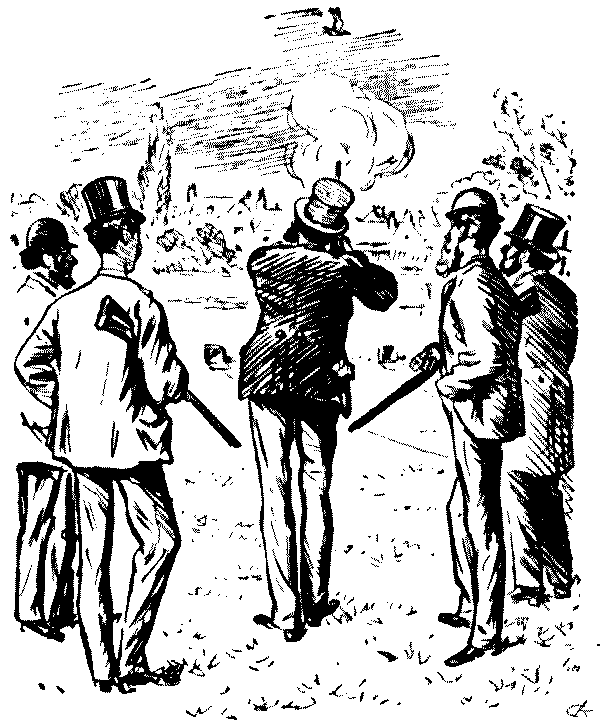
Upper Class: "Winged him, my lord!"
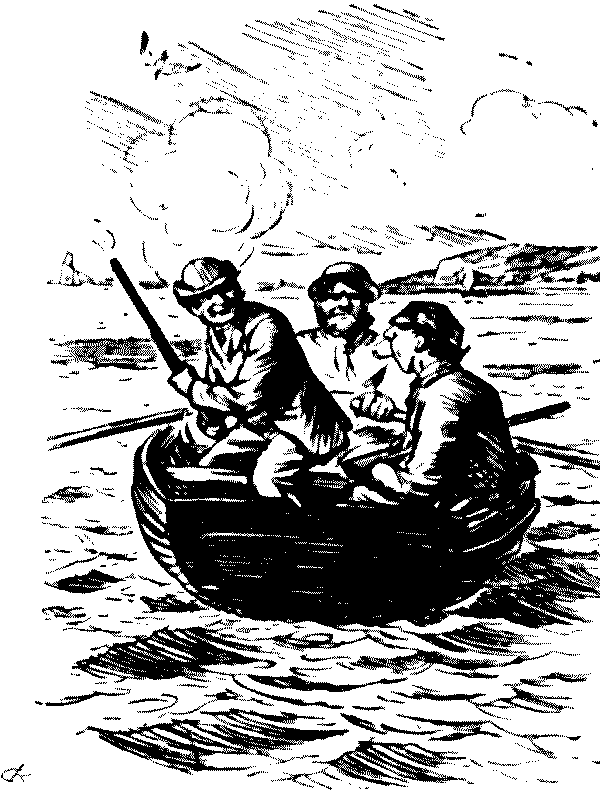
Lower Class: "There's another, 'Arry!"
Pigeon-shooting and bull-fighting were another matter altogether. In 1870 an abortive attempt was made to introduce the latter at the Agricultural Hall, Islington, and the Islington-Spanish bull-fight is treated with a happy mixture of ridicule and contempt in a contribution to Punch's "Evenings from Home." The proceedings appear to have been tame enough, and the bulls were probably "doped," yet enough of the real thing remained to warrant the hostile reception which the entertainment received. At its close the "Islington Spaniards" dispersed to the Islington public-houses. Punch returned to the subject a month later. The Society for the Prevention of Cruelty to Animals had interfered to good purpose. The Islington bull-fighters had been summoned before a magistrate and fined, and their "entertainment" had been stopped. Punch seized the occasion to add a comment which, on the very day on which, in 1921, I write these lines, is as timely as it was more than fifty years ago:—
From Islington to Wormwood Scrubbs is not far, and it is much to be feared by the tame-pigeon-shooting nobility and gentry that the officers of an impartial Association, vigilant to protect poor animals from cruelty, will as soon as possible be down upon the Gun Club.
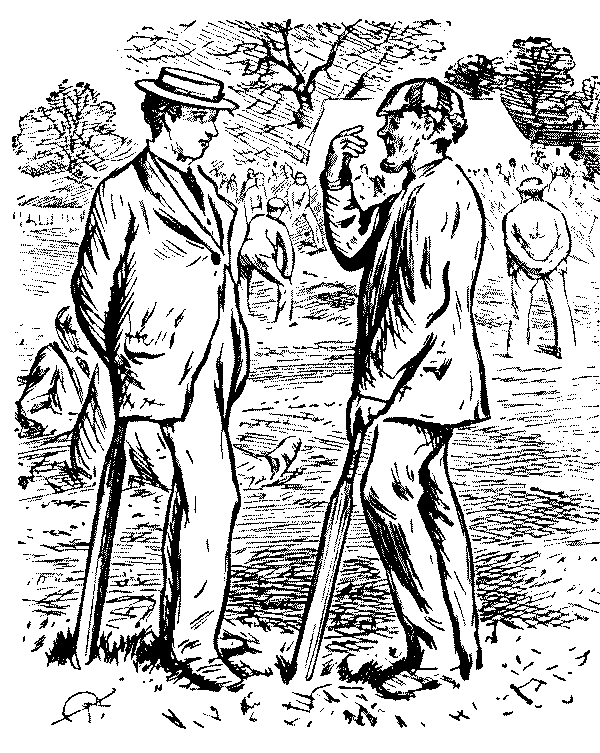
"TO MEMORY DEAR"
Enthusiastic Cricketer: "Ah, last season was a good one! I'd both eyes blacked in one match, and two fingers smashed in the return match the same week! But give me 1870 over again. I got the ball on my forehead at 'short leg,' and was senseless for three-quarters of an hour!"
Cricket and Football
Turning to cricket, we find that "over-hand bowling flung from the elbow" was mentioned by Punch as a novelty in the late 'fifties. Cricket was still played in tall hats at that time; but by the 'sixties caps had come in. The dangers of the game are a not infrequent subject of comment, and, before the days of billiard-table pitches, the ball was capable of a good deal of awkward bumping; but to judge from Punch's pictures the resultant contusions were regarded with equanimity by the players as part of the day's work or play. Cricket was extending its domain, and à propos of the establishment of clubs at Lisbon and Oporto Punch quotes an entertaining account of a game between these clubs by a Lisbon sporting journalist for the instruction of his countrymen. The incident is taken by Punch as an occasion for suggesting international games of cricket: Turks and Chinamen, Dutch and Japanese. The Dutch have long been votaries of cricket; and though it has not caught on with the Japanese and Chinese, both these races have of late years cultivated lawn tennis with considerable success. Here, then, as so often happens, a mock prophecy is fulfilled in a way in which the prophet never expected. A critical year in the annals of Lord's was reached in 1864 when there was a danger of the ground being sold for building purposes. A sum of £10,000 was needed to secure the interests of cricket, and Punch, in an imaginary dialogue between a countryman and a cockney, represents the former as ready to contribute 5s. to avoid a national disgrace and "zave Lard's cricket ground."
References to football are confined to comments, mostly humorous but occasionally serious, on the practice of shinning or hacking. The Rules of the "West Shynnington Football Club" are conveniently used as a vehicle for a number of bad puns, but the trials of the modern referee are foreshadowed in the suggestion that "a Police Magistrate should always be in attendance to dispose of all charges made by players." Punch in more serious mood discerns in the letter of "A Surgeon" to The Times the disastrous results of hacking as then permitted by the Rugby code. "Hacking," in Punch's view, was simply an unfair form of fighting and should be abolished.
The outstanding event in rowing circles during these years was the famous race between the Oxford and Harvard fours on August 27, 1869. Punch celebrated the victory of Oxford in a notice giving the names of those who took part in the contest, congratulating Oxford, and wishing health to both crews, the accompanying cartoon representing a gigantic brawny John Bull shaking hands with a muscular but comparatively slim Uncle Sam, both in rowing trim, with the legend "Well Rowed All!" Punch, as umpire, remarks: "Ha, dear boys, you've only to pull together to lick all the world!" The sentiment is better than the treatment. Unluckily the race led to some acrimonious comment in the New York papers on British sportsmanship, and Punch, in his rejoinder, was more vigorous than polite. River "aquatics" have not always been free from recrimination. The origin of the famous retort to bargees, "Who ate puppy pie under Marlow Bridge?" is obscure; but it is mentioned as far back as the Almanack for 1858.
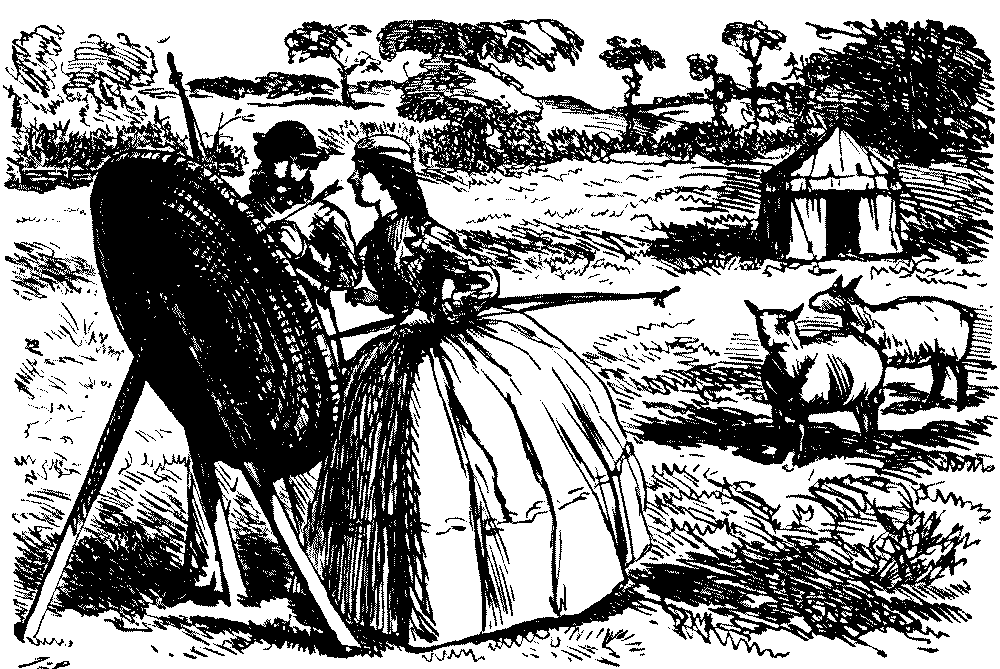
PRACTISING FOR A MATCH
Leonora: "Dear! Dear! How the arrow sticks!"
Captain Blank (with a sigh of the deepest): "It does, indeed!"
Croquet and Flirtation
"Golf Sticks" are alluded to in January, 1858, but during the rest of this period I find no further mention of golf. Of social pastimes archery is still in favour, but croquet is by far the most frequently referred to. To judge from the pictures, croquet, then in its unscientific infancy, was played on lawns innocent of mowing machines or scythes. It was mainly an excuse for flirtation between Charles and Clara; and the cheating earlier mentioned was regarded as quite fair game. Punch dealt with it in a serial poem of heroic proportions in the year 1863. This epic—for it was little less—ran to seven numbers, but it is not memorable apart from its length. When the Croquet Tournament was held at Wimbledon in 1870, Punch was ready to acknowledge the presence of Queens of Beauty, but could not accord the men players a higher title than that of Carpet Knights.
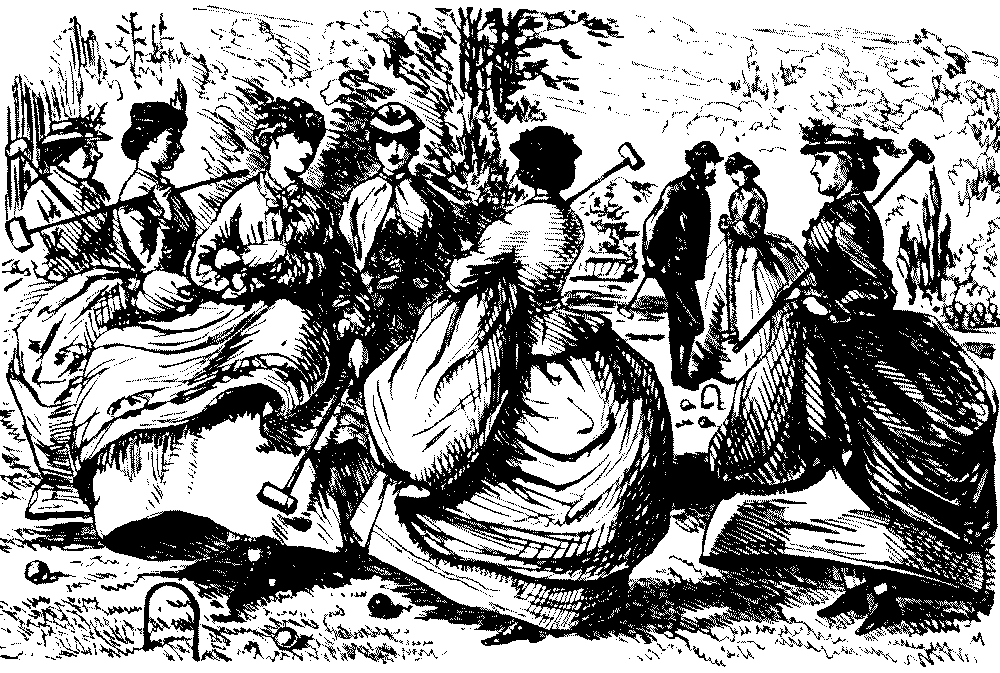
CROQUET
Chorus of Offended Maidens: "Well! If Clara and Captain de Holster are going on in that ridiculous manner—we may as well leave off playing."
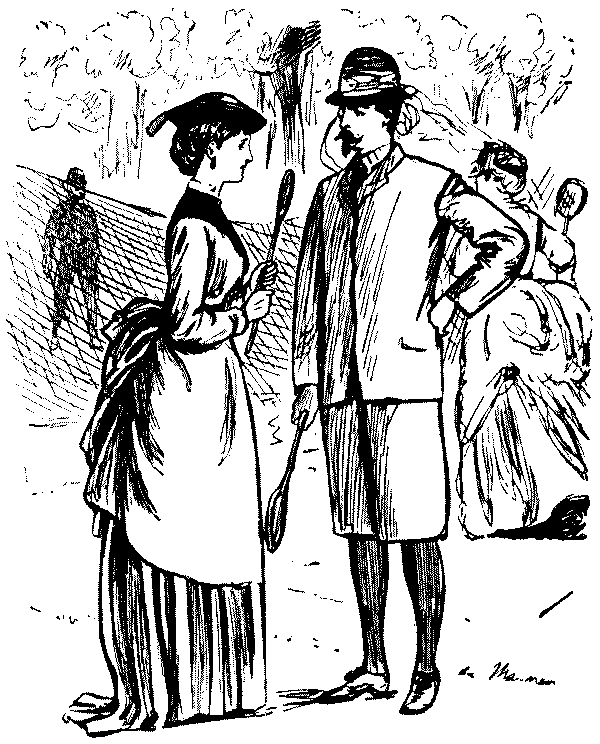
LAWN TENNIS
Miss Maud: "How do we stand?"
Captain Lovelace: "They are six to our love; and 'love' always means nothing, you know."
Miss Maud: "Always?"
Lawn Tennis
"Aunt Sally"—alleged to have been introduced by the Duke of Beaufort—is portrayed as a novel adjunct to the amenities of garden parties in 1860 by Leech. Roller-skating came in about 1873, and about the same time lawn tennis having survived its early name of "Sphairistikè," began to attract the attention of Punch's artists. The implements employed have a prehistoric appearance, but the pastime, thought still in its insular, garden-party and "pat-ball" stage, inspired some graceful lines in 1874:—
LAWN TENNIS
Now the long shadows of September come, And idle for a time the scribbler's pen is, He passes from the Town's discordant hum, From garrulous gossip of the kettle-drum,[38] From orators who should have been born dumb, To watch upon green lawns the girls play tennis. Robins are trilling in the faded trees, The flitting swallows of their voyage chatter, Testing their wings before they dare the seas, For Nile's dun marge or blue-girt Cyclades; The sportsman's shots come frequent on the breeze, The flying balls keep up a pleasant clatter. Croquet's a merry game for those who flirt (Who doesn't, pray—Punch, poet, peer, or parson?), But Tennis, when the ladies are alert, Follow the swift ball with a looped-up skirt, Strike it on high with graceful arm expert, Burns up the masculine heart with sudden arson. So, pour some icy fluid in a glass Tinged with deep mulberry stain, true work of Venice: And Mr. Punch will let the soft hours pass, Watching with tranquil eyes each lovely lass Flit like an Oread o'er the smooth green grass, And win his old heart as she wins at Tennis.
A complete Index will be found in the Fourth Volume.
Printed by Cassell & Company, Limited, La Belle Sauvage, London, E.C.4 F100.621