THE COURT
Reading edition
If the word "amazing" had not lost most of its significance through overwork since August, 1914, we should be inclined to apply it to the frankness with which Royalty and the Court were criticized and discussed by the Press in the 'forties and 'fifties. Punch, as we have seen, took a leading hand in the game, though he contrived to combine loyalty to the person of the Queen with the most outspoken attacks on the exercise of Court patronage and the extravagance of courtiers. But he did not stop here. The Prince Consort was mercilessly ridiculed for his Germanism, his notions of sport, his passion for tailoring, and, most serious offence of all, his alleged intervention in high politics. After ten years of anti-Albertianism, Punch dropped, to a considerable extent at any rate, the game of baiting the Prince, cordially admitted his services in connexion with the Exhibition of 1851, and for the rest of the period surveyed in our first volume granted him a comparative immunity from hostile criticism.
The change, or conversion, was not due to expediency or to a change of editorship or of the staff. It had already begun several years before the death, in 1857, of Punch's most democratic contributor, Douglas Jerrold. It was typical of a change in the enlightened middle-class opinion of which Punch was the mirror. The Monarchy had gained in popularity, and though there was no great revulsion of feeling about the Prince until after his death, he had earned respect by his active interest in education and philanthropy and the sagacity in counsel which was most freely acknowledged by those who came in closest contact with him. The charges of undue intervention and interference were effectually dealt with by Ministers at the time, though Punch failed to acknowledge his vindication, and the Life of Lord Beaconsfield shows that a much stronger case can be made out against the Queen on this count when she was no longer able to rely on the advice of the Prince.
The change in Punch's conception of his rôle as regards the Court did not come in the twinkling of an eye. But from 1858 onwards he is less of the licensed Court Jester, more of the unofficial Laureate. The old Punch, who had his eye on Tsars and Kaisers (like the Skibbereen Eagle) and autocrats is not dead yet. He has a tremendous fling in the "Essence of Parliament" in July, 1858, à propos of a contemplated revision of the Prayer-book:—
Lord Stanhope, a Peer exceedingly well entitled to be heard upon any such subject, then obtained an Address for cutting out of our Prayer Books the savage and abject forms of worship which our forefathers, at certain moments of excitement, thought it well to prescribe on certain anniversaries, as Guy Fawkes Day, the Martyrdom Day, and Oak Apple Day. When one reflects that the people who composed such things adulated the dirty old coward and fool, James the First; looked on while the body of the greatest of our English kings (except Alfred)—we mean, of course, King Oliver the First, and unfortunately the Only—was dragged from its grave to the gallows; and ecstatically murmured the Nunc dimittis when the friend of Nelly Gwynn, by no means his worst friend, returned to betray the public honour of England, and debauch that of her private life; one only wonders that such ecclesiastical profanities have been tolerated so long. The Archbishop of Canterbury and the Bishops of London, Oxford, and Cashel, expressed the sentiments that might be expected from enlightened gentlemen; but the offensive services found defenders in the poor old Bishop of Bangor, in the Bishop of St. Asaph, who has Mr. Punch's royal licence henceforth to sign himself A Sap, and in a brace of foolish Peers, called Marlborough and Duncannon: opposition which was the only thing wanting to show that every man of decent intellect feels alike on the subject.
Marriage of the Princess Royal
The disparaging allusion earlier in the same year to Prince Albert's Prize Pig and the attack on the bestowal of a K.C.B. on Colonel Charles Beaumont Phipps, the Prince Consort's Treasurer and Equerry to the Queen, are quite eclipsed by this explosion. But Punch was always ready to speak disrespectfully of a dictator. Constitutional monarchy he could respect and even admire, as Herbert Spencer said of the moderate proficiency of an amateur billiard-player. The new voice, the voice of the unofficial Laureate, had already been heard in his "Epithalamium" on the Princess Royal in 1858, over whose engagement, when it was first announced, he had been far from enthusiastic:—
Farewell, young Royal Lady, Ne'er may your life wax shady, Still may your path be shiny, All rosy—nothing spiny. Macbeth, when sitting stately, You were beholding lately, A point, which I may mention, Perhaps won your attention: The line of Kings, descending From Banquo, never ending; I hail you the Queen Mother, Young Bride, of such another. May the first line long sit in The royal seat of Britain, On Prussia's throne the second, From you to doomsday reckoned. United in alliance, May those two lines defiance Bid evermore to treason, By governing with reason.
The prophecy in the third and fourth stanzas gives one a shiver: but the word doomsday may pass in the sense of the day of doom. Simultaneously the critic appears in "A Few Queries touching a late wedding":—
Can't our penny-a-liners be loyal, Without writing themselves down flunkeys? Can't our crowd gape at ciphers royal, Without such percentage of "drunkies"? When we want a wedding cantata For our Princess Royal's espousal, Why for Tennyson Catnach barter, An owl for a singing ouzel? When English Fiddlers find fingers, And an English composer chords, Can't we find six English singers, Who at least could pronounce the words?
Must we still in ruts of old stick, All alike, both high and humble, Our nobs the slaves of Goldstick, Our snobs the slaves of Bumble?
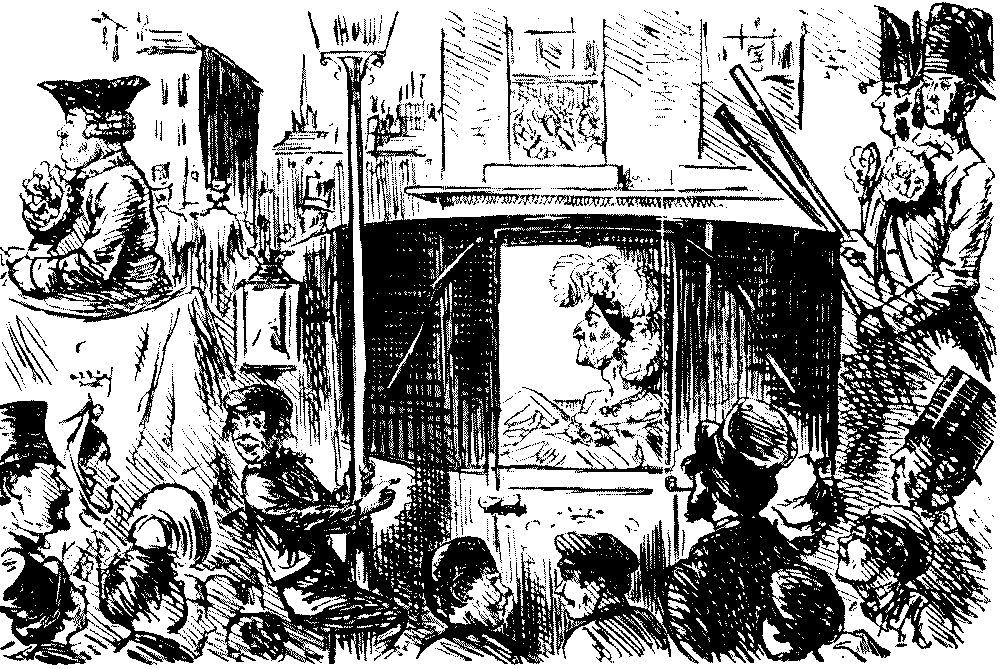
THE DRAWING ROOM
(A stoppage of a few minutes is supposed to take place.)
Dreadful Boy (on lamp post): "Oh! My eye, Bill! 'Ere's a rose bud."
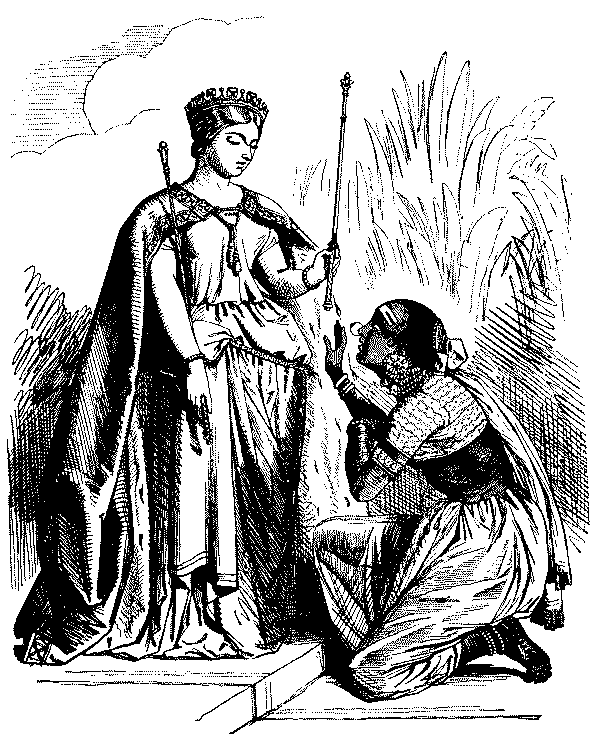
THE ACCESSION OF THE QUEEN OF INDIA
In the same vein is the protest in the spring of the same year, against the journalistic flunkeyism of the report of the opening concert in St. James's Hall (described as "vast in dimensions, elegant in proportion and splendid in decoration") which was "honoured by the presence of H.R.H. the Prince Consort, a large number of our aristocracy, and a very numerous company belonging for the most part to the better classes of society"—an English revival of the term optimates which Punch very properly disliked and deprecated.
The reorganization of the Government in India brought the Queen a new title, and in his congratulations we see Punch at his best:—
To thee is given another land, Another title of renown, Another sceptre in thy hand, And on thy head another crown. To India now at last appears Hope that before she ne'er had seen. She smiles upon thee through her tears, And looks for aid to England's Queen. To thee, her last of Monarchs, first She looks for justice, and the reign Of mercy, nor will she have nursed A fond belief, and hoped in vain. No more a victim and a prey, She trusts, with reason why she should, Like all that live beneath thy sway, She will be governed for her good.
This unofficial competition with the Laureate, however, did not prevent Punch from applauding Tennyson's additional stanzas to the National Anthem, which some critics had impugned for their metrical laxity. A little later on, à propos of the Queen's alleged refusal to wear a crinoline in 1859, Punch in a mood of mixed loyalty and levity contributed a new version of his own:—
Long live our gracious Queen, Who won't wear Crinoline, Long live the Queen! May her example spread, Broad skirts be narrowèd, Long trains be shortenèd, Long live the Queen! O storm of scorn arise, Scatter French fooleries, And make them pall. Confound those hoops and things, Frustrate those horrid springs, And indiarubber rings, Deuce take them all! May dresses flaunting wide, Fine figures cease to hide; Let feet be seen. Girls to good taste return, Paris flash modes unlearn, No more catch fire and burn, Thanks to the Queen!
The Empress Eugénie, it should be added by way of explanation, had already fallen under the lash of Punch's satire for supporting the crinoline, and starting absurd fashions, amongst which he specially notes the "occipital bonnet"—worn at the back of the head.
Punch and the Royal Princes
The Princess Royal was already off the Queen's and Mr. Punch's hands. The birth of her son in 1859—grande et conspicuum nostro quoque tempore monstrum—is duly celebrated in some lines "On an auspicious event" in which the Duchess of Kent is saluted as a great-grandmother. But in 1859 and 1860 Punch, who liked to take himself very seriously as an instructor of youth, is mainly concerned with the education of the Royal Princes. Prince Alfred (the Duke of Edinburgh) was already a middy, and his tour in Egypt and Palestine prompted severe comments on the obsequiousness with which he was fêted in the near East. As for the Prince of Wales, the dangers of sycophancy were (according to Punch) much less than those of over-pressure. In the cartoon entitled "The Royal Road to Learning," the Prince in cap and gown is shown surrounded by a group of stout, spectacled, bald and bottle-nosed professors and dons bowing and scraping before the Royal youth. Punch protests, too, in spirited doggerel against the process which threatened to make the Prince Jack-of-all-trades and lord of none. It is at any rate a consolation to think that the Prince of Wales evaded and survived the alleged attempt to convert him into a walking encyclopædia. The Prince's visit to Canada and the United States as "Baron Renfrew" in 1860 is followed with close interest and sympathy, and the frequent references in text and illustrations suggest many curious parallels with the experiences of his grandson in 1920. Punch welcomed the Prince's release from his arduous studies and was gratified with his reception; he did not acquit the American Press of sycophancy, but was obviously pleased when the New York Herald said that his "genial and unpretending" disposition had "gained him the affection of many true and worthy hearts." Perhaps the greatest compliment was paid him by an Irishman who accosted him in his railway car and said: "Come back four years from now and we'll run you for President."
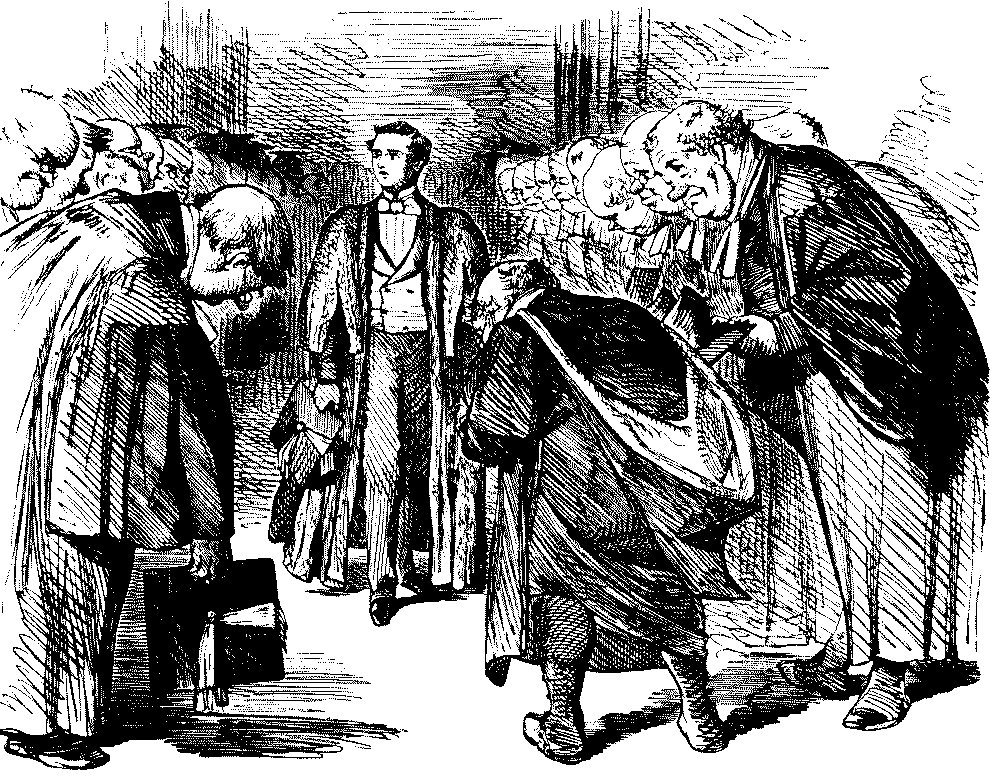
THE ROYAL ROAD TO LEARNING
But to us the most interesting comment on the visit is Punch's twice-repeated suggestion that the Prince might do a great deal worse than bring back an American bride. He made it on the Prince's departure in July in an Ode, with the apology, "If the Laureate won't do his work, Punch must," in which he says:
Transcendent charms drive even monarchs frantic, A German Princess must he marry? And who can say he may not carry One of Columbia's fascinating daughters O'er the Atlantic?
And he returns more seriously to the charge three months later:—
COUSINS FOR KINGS AND QUEENS
A Law which Nature contravenes, A rule of Rank and State, Forbids our Princes, Kings and Queens, With British spouse to mate. The safety of the Realm commands Them Protestants to wed; And therefore is their choice of hands Extremely limited. Their Cousins are our Royal race Confined, almost, to woo, Who, by the nature of the case Are German Cousins too. Now German Cousins far removed All very well may be, But Cousins German oft have proved Too near the parent tree. Near cousins o'er the German tide, What need remains to seek, Now steamers cross the Atlantic wide, Almost within a week? Of Yankee Land the Beauty pales All Continental Fair; Might not a bride be found for Wales, A distant Cousin, there?
Royal Speeches Criticized
From this onward for a great many years Punch was not content with supplementing the inactivities of the Laureate, but seldom allowed any event in the Royal annals—births, deaths, engagements or weddings—to pass unchronicled in serious rhyme. The art of eulogy is difficult, and the most that can be said of these efforts is that they were generally graceful and appropriate, and that their loyalty seldom degenerated into fulsomeness. On the subject of royal speeches Punch showed good sense as well as great frankness, in connexion with the public utterances of the Prince of Wales on the occasion of his visit to Ireland in 1861:—
WANTED, A COURT PENMAN
Royal personages, in answering loyal addresses, of course speak only that which is set down for them. If they made speeches of their own they would be continually committing themselves, unawares, to this statement and that, and unwittingly treading upon the corns of various people right and left. At least, to avoid making mistakes of this sort, they would have to take an amount of trouble in composing their replies so great that it would very much interfere with their ordinary business, and entirely spoil their pleasure. It is therefore necessary that Princes should be provided with attendants having the office to compose, and put into form, the platitudes in which they are called upon, from time to time, to acknowledge the compliments which are paid to them. But then the platitudes ought to be expressed in proper terms, such as it may become a Prince to utter; that is, in language which a decently educated person would naturally use. Now, is anybody who has been brought up in any school better than a Commercial Academy capable of delivering himself in such a style as that of the subjoined slip-slop which the Prince of Wales had to read in answer to an address presented to him by the Kingstown Commissioners?—
"Gentlemen,—I most heartily thank you for the gratifying terms in which, on your own behalf and that of the inhabitants of Kingstown, you greet me on my arrival at your port, after a voyage performed with such ease and expedition in the admirable vessel considerately placed at my disposal by its enterprising proprietors."
His Royal Highness is also actually made to say:—
"During former visits to Ireland, and particularly in the course of a tour made some years ago through the country, I had considerable opportunities of witnessing the beauty of her scenery."
Some clue to the authorship of the preceding instances of haberdashers' eloquence may perhaps be found in those characteristic forms of speech, "considerable" opportunities, and "witnessing" the beauty of her scenery. These are the notorious idioms of that sort of penny-a-lining which is the least worth a penny. The advisers of the Prince of Wales should cause their own private secretaries to write the speeches which they give the Prince to make, and not employ for that purpose the undermost reporter engaged on the Court Circular. At least let the Queen's son be allowed to speak his Mother's English.
As there is a Poet Laureate, so likewise ought there to be a Royal Professor of Prose, whose office, however, shall not be merely honorary, but shall consist in plainly wording the simple ideas which Royalty is occasionally called upon to express. Mr. Punch could mention some young men who, at a sufficiently high wage, would accept the work.
Whether the hint was taken or not, the fact remains that for a good many years Royal oratory has ceased to deserve such criticism. It may not be Ciceronian; it does not inflame or transport the hearer, but at least it is free from the cheap haberdashers' eloquence which aroused Punch's wrath sixty years ago.
The visit of the Queen and Prince Consort to Ireland in August, 1861, passed off without any untoward incident, but the comments in Punch were mainly ironical, as in the cartoon, "Doth not a meeting like this make amends," in which the Queen observes, "My dear Ireland, how much better you look since my last visit. I am so glad." For the rest there is much pungent criticism directed against the assiduity of the newspaper correspondents in chronicling small beer. The demonstrations were too carefully stage-managed in the operatic style: the odour of the footlights invaded Killarney; and Punch is quite furious with the snobbery of the unfortunate special correspondent who declared that "the Queen and Prince Albert repeatedly expressed their unqualified admiration of the scenery. His Royal Highness said many portions were sublime." It is by such practices, Punch truly remarks, that "the Press is lowered in repute and people think it is the work of a vulgarian to write for it."
In the year 1861 the Queen lost both her mother and her husband. The Prince Consort had outlived a great deal of his unpopularity—faithfully reflected in the pages of Punch. Yet even so late as 1858 he met with scant sympathy in the malicious imaginary conversation between the Emperor of the French, the Queen and himself at Cherbourg. The Emperor figures as the miles gloriosus, boastful of his strength; the Queen is ironically polite: Prince Albert angular and tactless. The mere suddenness and unexpectedness of his death brought a great reaction; those who had depreciated and disparaged him when living were especially vocal in their praises of the dead; but the full extent and significance of his loss to the Queen was not understood till long afterwards. Those terrible cartoons of Leech will keep coming before our eyes as we read the bland elegiac stanzas in which Punch made amends for ten years of scarifying ridicule:—
It was too soon to die. Yet, might we count his years by triumphs won, By wise, and bold, and Christian duties done, It were no brief eventless history. This was his princely thought: With all his varied wisdom to repay Our trust and love, which on that Bridal Day The Daughter of the Isles for dowry brought. For that he loved our Queen, And for her sake, the people of her love, Few and far distant names shall rank above His own, where England's cherished names are seen.
Punch and the Princess of Wales
The Queen never quite recovered from her bereavement. The next twenty years of her life were spent more or less in retirement; and Punch, in his pious and quite sincere request to be allowed to "share her grief," could not be expected to foresee that in less than two years the nation would have grown restive at the Queen's continued seclusion and that he himself would have become active in expressing its discontent. In 1862 the wedding of Princess Alice received the usual meed of ceremonial verse, Punch being happily spared a glimpse into the future in store for her and her daughters; and the refusal of the Greek Crown by Prince Alfred is recognized to be judicious. Punch bore the Prince of Wales no malice for not acting on his suggestion about an American bride; and greeted Princess Alexandra of Denmark as enthusiastically if not as poetically as the Laureate himself. When the wedding procession passed down Fleet Street (the offices of the paper were then at No. 85), the Princess was greeted with an effusion of loyal sentiment and champagne. But in her beauty, grace, and popularity Punch saw a means of rescuing women of fashion from their expensive servility to French milliners, and within a fortnight of his chronicling the marriage festivities he appeals to her to set the fashions for British ladies, hitherto copied from the French, and thus "turn the tide of absurdity in costume from the abyss into which, before her seasonable arrival, it was tending to plunge them." Long dresses, "sweeping and brushing the earth," heraldic gold-dust, powder and hair dyes are especially singled out for condemnation.
The birth of the Duke of Clarence is loyally chronicled in January, 1864, though in the following number Punch could not resist the temptation of printing some verses in parody of Tupper, then at the zenith of his popularity. The birth of the present King in the summer of the following year prompted some frank but friendly comments in Punch's "Essence of Parliament." Sir George Grey moved the address of congratulation to the Queen. Then follows this characteristic passage:—
Mr. Disraeli, who we are glad to perceive had so completely recovered from his gout as to be able to attend at the splendid marriage of Miss Evelina de Rothschild, and make the most tender and graceful of speeches in honour of the occasion, seconded the motion, which Mr. Punch, rousing himself for a moment into loyal enthusiasm, has the distinguished pleasure of thirding—and relapses.
The plain fact was that Punch was growing increasingly dissatisfied with the continued retirement of the "Royal Recluse." This dissatisfaction began with a "Loyal Whisper" at the time of the Prince's wedding:—
"Nay, let my people see me." Kind Was She whom then our cheers were greeting: Now, would that Lady bear in mind That words like those will bear repeating.
But it soon swelled to more vocal dimensions. It was one thing to check the extravagances of "indelicate and obtrusive loyalty"; it was another to maintain an almost Oriental aloofness. The subject is returned to again and again, in prose and verse, and in two cartoons by Tenniel: notably that of "Queen Hermione" in 1865. But the candour of Punch reaches its highest level in his comments on the announcement early in 1866 of the institution of a new decoration—the Albert Medal.
The "Effete Monarchy"
Mr. Punch's loyalty has been proved too often for question. Without the slightest apology, therefore, he proceeds to say what he would have preferred to leave unsaid, for it is not the part of a true friend to be silent when he should speak. Mr. Punch has cordially approved every reasonable effort to preserve the memory of the good Prince whose loss we all deplore. Statues, in far greater number than ever was accorded to an English Worthy, have been reared in honour of the lamented Consort. Though it is now just sixty years since Nelson was laid in St. Paul's, our great sea-captain's monument is unfinished—we hear nothing at all of the national monument to our great land-captain, though it is more than thirteen years since Wellington was laid by the side of Nelson—but the most splendid and costly of memorials is rapidly rising, in the Park, in testimony of our veneration for Prince Albert. When this shall have been completed, will it not be almost time to leave that good man's fame to take care of itself? Society is at least half inclined to believe that enough has been done in this way, and it will not be well that society should begin to smile at persistent efforts to add tribute to tribute. There is really no fitness in giving the Prince's name to the medal that is to reward the noblest of sea-service.
The Prince had no kind of connexion with or special regard for sea-achievements, though the irreverent may remark that his own courage was shown when he voyaged, inasmuch as he notoriously suffered on such occasions more than anyone else on board. Anything like ridicule should not be permitted to connect itself with an honoured memory.
The Albert Medal, as we know, was not restricted to those who exhibited conspicuous gallantry in the rescue of life from shipwreck, and the remarks we have quoted may very well have contributed to its being awarded in recognition of heroic deeds on land as well. A fortnight later a passage quoted from the New York Herald impelled Punch to reaffirm his loyalty to the Monarchy:—
England is completely prepared to become Republican, but the undoubted personal popularity of the Queen will probably sustain the effete monarchy until the time arrives for transmission of the Crown. But as for an Edward the Seventh, that is out of the question.
Whereon Punch observes "are there twenty republicans in England, deducting Bedlam?" On February 6 the Queen opened Parliament in person:—
The Queen has not performed this ceremony during the last five years, and the reason for the Sovereign's seclusion would render it unbecoming for Mr. Punch to say any word upon the subject of Her reappearance, except that it greatly rejoiced the nation and himself.
This emergence was welcome, but it was not followed up and did not satisfy public opinion, as we gather from an appeal made in the following year:—
The Pall Mall Gazette, inviting Her Majesty to resume her personal sway over society, says:—
"During the first twenty years of Queen Victoria's reign the salons of London did not reek with tobacco smoke, neither did the noble, the pure, and the young stagger under red wigs, glare with rouge and pearl-powder, or leer with painted eyes."
No. Neither do the noble and the pure stagger, glare or leer now. But if the ignoble, the impure, and some of the young do these things, and can be deterred from them by royal displeasure, manifested in the dignified way in which the First Lady would mark it, we should rejoice to know that the Queen intended to come forward and do an unwelcome duty. No worthier homage can be offered to the dead than a painful sacrifice for the sake of the living. The Crown has direct power over the court-class, and as for the idiots who parody their patrons, the parody, as we firmly believe, would be pursued even if great folks took to virtue and going to church. Which considerations, with the deepest respect, Mr. Punch submits to the notice of his Royal Mistress.
Many of us thought that the lavish use of paint and dye by the young was a portent of Georgian post-war days: it is something of a surprise, possibly a relief, to find it was prevalent more than fifty years ago.
From this point onwards one may notice a disposition to acquiesce in the self-imposed seclusion of the Queen, though any movement towards breaking it down is at once recognized and welcomed—even such a small thing as the publication of her Journal of our Life in the Highlands. Thus we read that its issue "on the advice of Mr. Arthur Helps is likely, if such a thing were possible, to endear her still more to the loving hearts of her people," and in a set of verses on "The Queen's Book" the Queen is applauded for her wise and womanly thought:—
What Queen like this was ever known To take her people to her heart? When was Queen's household-life so shown With modest truth and artless art? The Royal Widow has done well Thus on her people's love to call, Her simple wifely tale to tell And trust her joys and griefs to all.
The writer was evidently well aware that cynics and literary critics would make fun of the book, but the defence of sincerity comes with added weight from one who was always on the look out for ineptitudes in high places.
The announcement of the betrothal of the Princess Louise to the Marquis of Lorne gave Punch a fine opportunity in the autumn of 1870 of vindicating his prescience, and simultaneously revealing Thackeray in the light of a political prophet:—
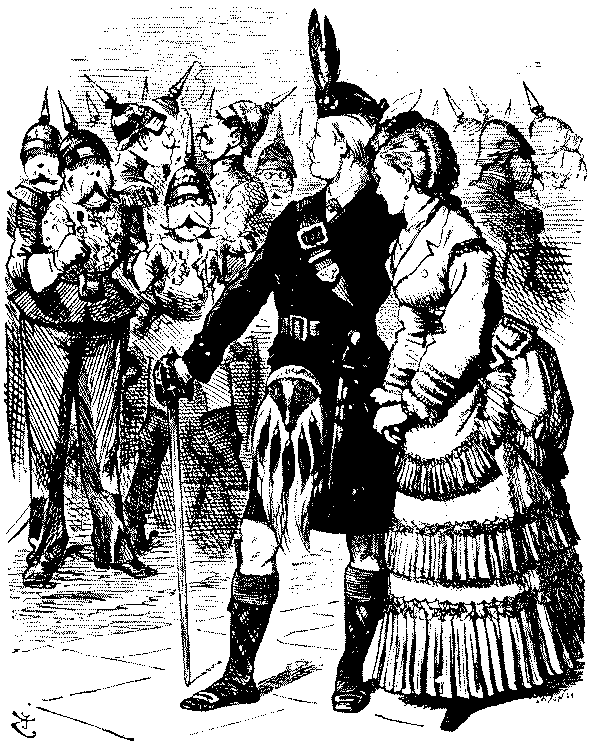
A (REAL) GERMAN DEFEAT
THE ROYAL MARRIAGE
Thackeray among the Prophets
Mr. Punch begs leave to make a distinguished bow to his excellent (if Conservative) contemporary, the Bath Chronicle. That admirable journal, the studies of whose Conductor are so evidently in a right direction that the success of the paper is a matter of course, has turned back to a somewhat remote Number of Punch, and has been amply rewarded by lighting upon an article, which has been transferred to the columns of the Bath Chronicle, with appropriate remarks, a portion of which Mr. Punch has the utmost pleasure in reproducing:—
"Twenty-one years ago, in the Number of Punch for February 3, 1849, the late Mr. Thackeray drew an imaginary picture of 'England in 1869,' in supposed extracts from the newspapers of the period. One of these, under the heading of 'Marriages of the Royal Family,' is so applicable to the circumstances of 'England in 1870' that it is worth reproducing. The humourist would have been amused himself had he lived to see how nearly he hit the mark. The following is the paragraph we refer to:—
"'Marriages of the Royal Family.—Why should our Princes and Princesses be compelled always to seek in Germany for matrimonial alliances? Are the youths and maidens of England less beautiful than those of Saxe and Prussia? Are the nobles of our own country, who have been free for hundreds of years, who have shown in every clime the genius, the honour, the splendour of Britain—are these, we ask, in any way inferior to a Prince (however venerable) of Sachs-Schlippenschloppen, or a Grand Duke of Pigwitz-Gruntenstein? We would breathe no syllable of disrespect against these potentates—we recognize in them as in ourselves the same Saxon blood—but why, we ask, shall not Anglo-Saxon Princes or Princesses wed with free Anglo-Saxon nobles, themselves the descendants, if not the inheritors of kings? We have heard in the very highest quarters rumours which under these impressions give us the very sincerest delight. We have heard it stated that the august mother and father of a numerous and illustrious race, whose increase is dear to the heart of every Briton, have determined no longer to seek for German alliances for their exalted children, but to look at home for establishments for those so dear to them. More would be at present premature. We are not at liberty to mention particulars, but it is whispered that Her Royal Highness The Princess Boadicea is about to confer her royal hand upon a young nobleman who is eldest son of a noble peer who is connected by marriage with our noble and venerable Premier, with the Foreign and Colonial Secretaries, and with H.G. the Archbishop of Canterbury. The same "little bird" also whispers that His Royal Highness, Prince Hengist, has cast an eye of princely approbation upon a lovely and accomplished young lady of the highest classes, whose distinguished parents are "frae the North," whose name is known and beloved throughout the wide dominions of Britain's sway—in India, at the Admiralty, at the Home and Colonial Offices and in both Houses of Parliament.'
"The first part of the prediction is being accomplished with a literalness that should drive Zadkiel to despair. The Princess Louise, then a baby not quite a year old, is betrothed to the eldest son of a nobleman actually in office, who comes 'frae the North,' and whose name is certainly known in India, seeing that he is and has for some time been the Secretary of State for India. Moreover he is connected by marriage with the Foreign Secretary, Earl Granville, for he married a Gower, the Earl's first cousin, while as the head of the Campbells he may claim cousinship with the Earl's second wife, Miss Campbell, of Islay, as well as with the Archbishop of Canterbury, whose mother was a Campbell."
Opposition to Royal Grants
When the question of the Princess's dowry and annuity came up in the House of Commons early in 1871, Parliamentary opposition to Royal grants reared its head, and Punch's summary of the debate is worth quoting:—
Mr. Gladstone, in a long speech, proposed, and Mr. Disraeli, with a gesture, seconded the proposal for granting £30,000 as dowry to Princess Louise, and £6,000 as H.R.H.'s annuity. There was loud acclamation from all parts of the House, and when Mr. Peter Taylor rose, hat in hand, to oppose the grant, the resolution had been carried. Here it may be convenient to add that, at a later stage, Mr. Taylor, rising amid groans from all sides, opposed the grant, and Sir Robert Peel expressed regret that a Princess had, by the advice of Ministers, been allowed to contract herself to the son of a Minister. Mr. Disraeli, as might be expected, treated the matter in a much more graceful way, paid a pleasant compliment to the Marquis of Lorne, and was glad that a Princess had accepted a Member of the House of Commons. Mr. Gladstone corrected Sir Robert, saying that deviation from the established rule of Royal marriage had been advised upon about eighteen months ago, and long before the engagement to the Marquis. The division was the most amusing which Mr. Punch has ever chronicled. There were, for the grant, 350; against it, 1. This unit was Mr. Fawcett, but there were really Three against the grant, namely, himself and two Tellers, Sir Charles Dilke and Mr. Peter Taylor. The Commons roared lustily, and the nation echoed the roar.
With a backing which though minute in numbers was strong in intellect, it was not to be expected that this opposition would disappear. It was again manifested over the grant to Prince Arthur in the same year, when Punch advised Sir Charles Dilke to renounce his title if he persisted in his opposition to royalties, and in 1872 Shirley Brooks gives a lively account of the debate on the proposed inquiry into the Civil List on the night of March 19, when Mr. Gladstone treated Sir Charles Dilke as Ulysses did Thersites:—
Having demolished his man, our Ulysses sat down amid astounding cheers from the Opposition as well as from his own party. Then another Aristocrat followed in the wake of the Baronet. The Honourable Auberon Herbert announced his preference for a Republic. The row then set in fiercely, and Mr. Punch inclines to draw a veil over proceedings that did not greatly redound to the credit of the House of Commons. It is true that they were an index of public opinion in the matter, but Parliament is expected to be decorous, and not to allow cock-crowing as an argument. Even the Gallic Cock could not have behaved worse. The Speaker said that the scene gave him great pain. Counts were attempted, and then strangers and reporters were excluded for an hour, and then there was a division on an attempt at adjournment—negatived by 261 to 23. Mr. Fawcett opposed the motion in a spirited and sensible speech, and denounced the mixing up the question of Republicanism with "huckstering and haggling over the cost of the Queen's household." Finally, there was division on the motion itself, and the voters for it, including Tellers, were three Aristocrats, namely, Baronets Dilke and Lawson, and Mr. Herbert, son of an Earl, and they had one friend, Mr. Anderson, of Glasgow. Against these Four were, without Tellers, Two Hundred and Seventy-Six. The House roared with laughter, and soon went away. The Republican attack on the Queen was about as contemptible as that by the lad who presented the flintless and empty pistol the other day; but in the latter case as in the former, the affair was one for the police, and Constable Gladstone A1, was quite equal to the occasion.
In the same number appears the cartoon, "Another Empty Weapon," in which "Little Charley Dilke," with a large horse-pistol labelled "Motion," is seized by the scruff of the neck by Constable Gladstone A1 as a Royal State coach is passing by.
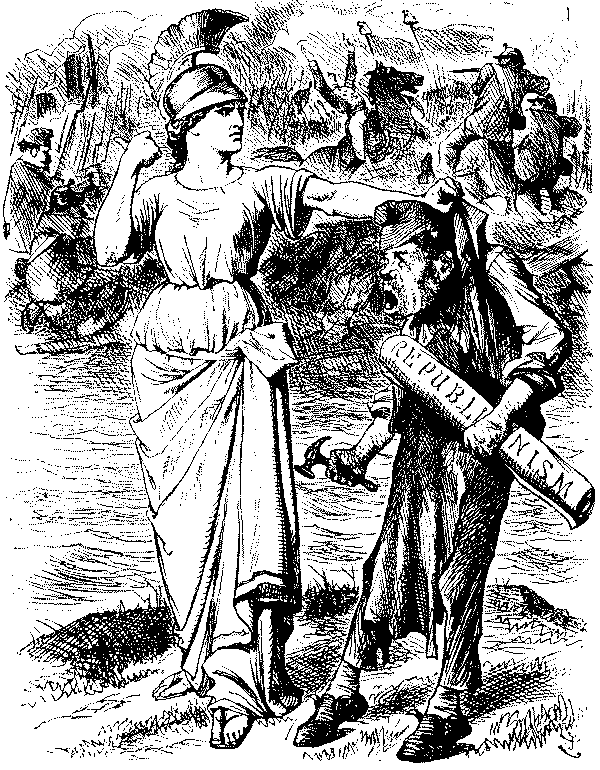
A FRENCH LESSON
Britannia: "Is that the sort of thing you want, you little idiot?"
Dilke returned to the charge again on the marriage of Prince Alfred (the Duke of Edinburgh) in 1874. How strongly Punch felt on this point may be gathered from the statement in the Life of Sir Charles Dilke that Shirley Brooks refused to meet him on account of his Republican speeches. The subject may be dismissed for the present with the excellent, if apocryphal, anecdote in rhyme which appeared in Punch under the heading, "A Problem Solved":—
About the Queen the Bart. C. Dilke Vents talk as acid as sour milk. Punch wants to know if this be true Which, told to him, he tells to you— How a great Lady deigned to wonder At Charley's anti-Windsor thunder "His father was so kind and mild— I knew this gentleman a child: I've stroked his hair. I sometimes say I must have stroked it the wrong way."
The Albert Hall was opened on March 28, 1871, and the occasion is seized to administer a comprehensive rebuke to those who found it easy to laugh at the Queen, the Prince Consort, King Cole (Sir Henry Cole) and the Kensington "Boilers." That there were grounds for discontent, and that it was unwise to overlook the existence of industrial unrest, militant Radicalism and Republicanism Punch freely admits in the vigorous doggerel entitled, "Looking Facts in the Face," in which he plays the part of candid friend to Queen, Lords and Commons alike. After examining the just causes for discontent at home, the activities of Bradlaugh and Odger, and the ominous warnings furnished by the Commune and the spread of the new doctrines of Karl Marx and the Internationalists, Punch continues:—
So we, who don't hold that the world To come right must be set topsy-turvy, Those now at the helm from it hurled, And their place taken crassâ Minervâ, Had better look squalls in the face, Make snug for a douche and a drenching, And—Queen, Lords, and Commons—embrace The supports that will stand the most wrenching. Were I Queen, I'd not so play my rôle, As if bent to prove those right who flout me, And show, while folks pay the Crown toll, How well things can go on without me. Were I Lord, Folly's gales I would thwart, Not by spreading my sails, but by furling 'em: Nor expose my prestige to be caught In the traps of the Gun Club and Hurlingham. Were I in the Commons, I'd strive More than one Bill a Session to carry; Nor abreast all my 'buses to drive, Till all in a block have to tarry. As Queen, Lords, or Commons, in fine, My course by the chart were I making, I should take just the opposite line To that Queen, Lords, and Commons are taking.
This was the first time that Karl Marx was mentioned in Punch. As for Odger, who is alluded to in the same verses, it may be recalled that at a meeting at Leicester held in this autumn he was credited with the statement that "me and my colleagues have resolved that the Prince of Wales shall never ascend the throne."
Anti-Monarchical Sentiment
There was undoubtedly a strong wave of anti-monarchical sentiment in England in 1871. It was not confined to agitators or extremists, but found utterance in organs which represented moderate opinion. Lord Morley in his Life of Gladstone quotes from the Pall Mall Gazette of September 29, 1871, to illustrate the depth and wide range of this discontent. He might very well have quoted Punch also as documentary evidence. The Political History of England sums up the grounds of this resentment among friendly critics not unfairly: "Ten years' seclusion from social activity and public duty seemed an excessive indulgence in the luxury of sorrow." The sympathy stirred by the Queen's illness in September, 1871, marked the beginning of a reaction; the acute anxiety "aroused by the dangerous illness of the Prince of Wales in the following December, and the subsequent rejoicings on his recovery, did much to improve the relations between Crown and people"; and Punch quotes the Queen's message of thanks to the nation as the most "acceptable Christmas gift which could have been bestowed on a loyal and affectionate people." In the verses on the Thanksgiving Service in St. Paul's on February 27 he is at pains to meet the sneers of those who only saw:—
A Queen, and Prince and Princess, and their Court, And coaches passing to St. Paul's to prayer; To settle scores with Heaven in stately sort:— A Show for once! and our shows are so rare.
But the defensive tone is soon dropped for one of congratulation:
Happy the Queen that can, love-guarded, go Still, through a prayerful capital, to pray Happy among these million hearts to know Not one but beats in tune with hers to-day.
It was reserved, however, for later historians to detect in the renewed political activity of the Queen evidence of her distrust in the foreign policy of Gladstone. Among the signs of the times which mark the close of this period and the great Conservative revival which followed, few are more curious than the cartoon headed, "A Brummagem Lion," inspired by the visit to Birmingham of the Prince and Princess of Wales and the courtesy displayed by Mr. Joseph Chamberlain as mayor, in spite of his Radical proclivities.
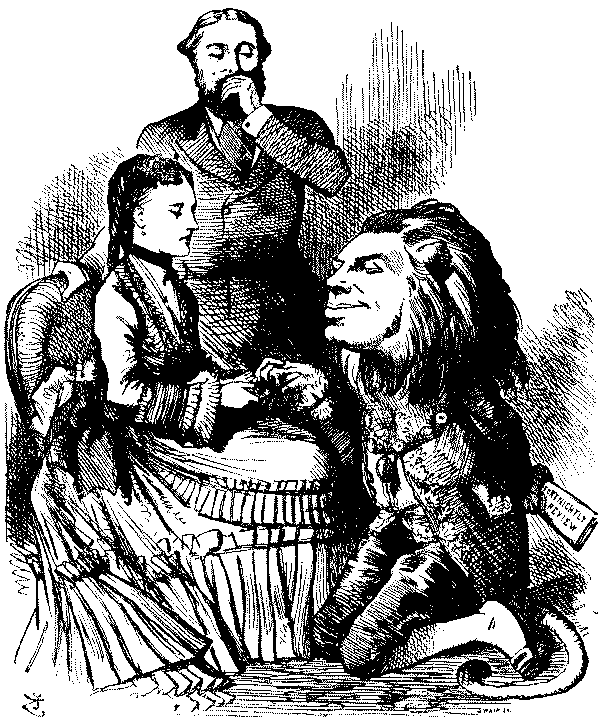
A BRUMMAGEM LION
The references to foreign potentates and their relations with the British Court show little abatement of Punch's old distrust and hostility. Of the French Emperor's flying visit to Osborne in 1857 we read that it was "strictly private—none but policemen were admitted." The most friendly allusion to the Empress Eugénie refers to her having ridden in an ordinary hansom cab during a visit to England incog. in 1860. For the rest she is repeatedly attacked for her extravagance in dress, for dabbling in spiritualism, and for her interference in politics and support of the Papal pretensions. "Everyone has his oracle," says Punch late in 1862.... "Didn't Numa Pompilius have his Egeria? Why, then, shouldn't Pius have his Eugenia?" In the same year she is abused for attending a bull-fight, and satirized in a cartoon representing the Emperor as Hercules and the Empress as Omphale. Punch waxes indignant at the patronage extended by the Emperor to the variety stage in 1866, and wonders whether the infection will reach our Court. But his imagination entirely failed to forecast the bestowal of decorations on the heroes of the music-hall. We have moved since then. A famous story is told of Queen Victoria in her later years sending an Equerry to inquire the name of a lively air which had been played by her Court band. The Equerry returned to say that it was a popular song of the day. The Queen was dissatisfied and instructed him to find out and let her know the words. The Equerry went back, returned and proceeded to recite the classic stanza:—
Come where the booze is cheaper; Come where the pots hold more; Come where the boss is a bit of a Joss, Come to the pub. next door.
There the story unfortunately ends, without the Queen's comment. But in the pages of Punch we read how in 1869, when the Constitutional régime had just been inaugurated in France under Emile Ollivier, the programme of one of the Queen's State concerts included "Heaven Preserve the Emperor, with variations," which prompts Punch to ask, "Would not this do for the French National Anthem?" In 1865 Punch devoted a cartoon to commemorate the completion of fifty years of peace between England and France, and in 1869 another on the centenary of the first Napoleon. With the catastrophe of 1870, Sedan and its sequel of exile and suffering, Punch's hostility changed to compassion, and his In memoriam verses on the Emperor, though too laboured and too frequently disfigured by inversions to attain to the dignity of poetry, form one of the best of contemporary summaries and estimates of the career and character of the dead ruler:—
Already scores of ready penmen draft Of his life's course to power their bird's-eye view, Through poverty and perjury and craft, And redder stains that the blurred track imbrue. Let whoso will count of his faults the cost, And point a moral in his saddened end; This is the thought in England uppermost— He who has died among us, lived our friend. If sinners may by suffering, too, be shriven, What penance those lost years had to sustain! The sting of fall and failure deeper driven By the dull stroke of slow and sleepless pain.
The time to weigh him fairly is not now; Nor are the true weights any France can bring: That sprang to fix the crown upon his brow, And her own neck beneath his feet to fling. Heavily both have answered for their sin: Nor did the Emperor heavier fall undo, Than France, that backed him still while he could win, Nor turned against him till the luck turned too.[13] But now 'tis England, and not France that stands Silent beside an Exile's dying bed, Mindful of kindness received by his hands, Sorrowing with those that sorrow for their dead.
Punch, as was made clear in the previous volume, was no lover of Prussian rule. On the eve of the war on Denmark he published a truly ferocious attack on King Wilhelm:—
THE SONG OF HOHENZOLLERN
Air—"The Standard Bearer."
French Emperor and Prussian King
I am a King; I reign by Right Divine, As did my sires some hundred years before me; Howe'er their crown was got, I came to mine, Obey me then, O people, and adore me. My seat I plant upon mine ancient Throne, And order back the waves of Revolution. My will the law, I sit supreme, alone, My footstool is the Prussian Constitution. Tsar Alexander's cause mine own I've made, Regardless of the blame of any journal. To crush the Poles I render him my aid; Help him enforce his discipline paternal. I lend a hand to catch the runaway, The fugitive hand over to the slaughter; And, on my mind, whatever you may say Makes no more mark than what blows leave in water. I'm called the Hangman's Cad, and I don't care For that dishonourable appellation. I carry Poland's garbage to the Bear, Serene amid the loudest execration. My mind is bent on arbitrary rule; In policy I copy my late Brother. If you presume to say he was a fool, You'll very likely dare call me another.
Hostility to Prussia did not abate in the succeeding years, and in 1866 indignation is expressed at a rumour that the Queen was about to visit Germany. A general friendliness towards King Victor Emmanuel did not prevent Punch from insinuating that he had sold his birthright to the French Emperor, and from expressing the fear that Sardinia as well as Savoy would be ceded to France. The most that can be said of his treatment of the Tsar Alexander II is that it was not quite so vehemently hostile as that meted out to his father. As early as January, 1862, we read that "the Russian Empire, with its body of brass and its feet of clay, will, if it does not take care, be requiring some support some day, to keep it up, on account of the extreme 'weakness of its legs.'"
The annals of Royalty, outside England, certainly afforded little scope for admiration. But the year 1865 was enlivened by a humorous instance of misplaced monarchical ambition. The King of Abyssinia, who had detained certain British subjects as prisoners, "was said to have favoured Queen Victoria with an offer of marriage, and to have imprisoned her lieges in revenge for her non-appreciation of his dusky love."