FASHION IN DRESS
Reading edition
In the period under review in this volume England was dominated by two monstrosities, the crinoline and the Claimant. Fortunately they were not concurrent or England might have succumbed beneath the double incubus. The former was pronounced "gone" in 1867, the same year in which the arrival and recognition of the so-called Sir Roger Tichborne as the rightful heir was announced in the columns of Punch. The historic trial soon loomed large on the horizon, though it did not open till 1871. Of this portent some notice will be found elsewhere. Of the crinoline it is no exaggeration to say that Punch waged war against it for ten solid years; his pages resolve themselves into a sort of Crinoliniad; and when the monster fell it was not by force of arms assisted by guile as in the parallel campaign against Troy, but by its own absurdity and through the weariness of its supporters. With Punch it was a positive obsession. The extravagances of the crinoline dominate his "social cuts" from 1857 onwards. In 1858 he tells us that "Fops' Alley" at the opera is to be rechristened "Petticoat Lane"; and that the Ladies' Gallery in the House of Commons is to be enlarged as a concession to the lateral expansion of women's skirts. The popular negro song "Hoop de Dooden Doo" is re-written to fit the prevailing fashion, and a classical lyric, "My Flora," is perverted to suit the same purpose. Even at this early stage, however, Punch seems to have recognized the futility of his crusade. As he puts it:
The more you scoff, the more you jeer, The more the women persevere In wearing this apparel queer.
Crinoline Absurdities
He applauds the railway companies for their alleged determination to charge for ladies' trunks by size, not weight, but adds: "It's no use trying to laugh or reason women out of it (crinoline). In all matters of dress and in that of crinoline especially, the mind female is impervious to ridicule and reason. The only argument to use with them is the argumentum ad pocketum."
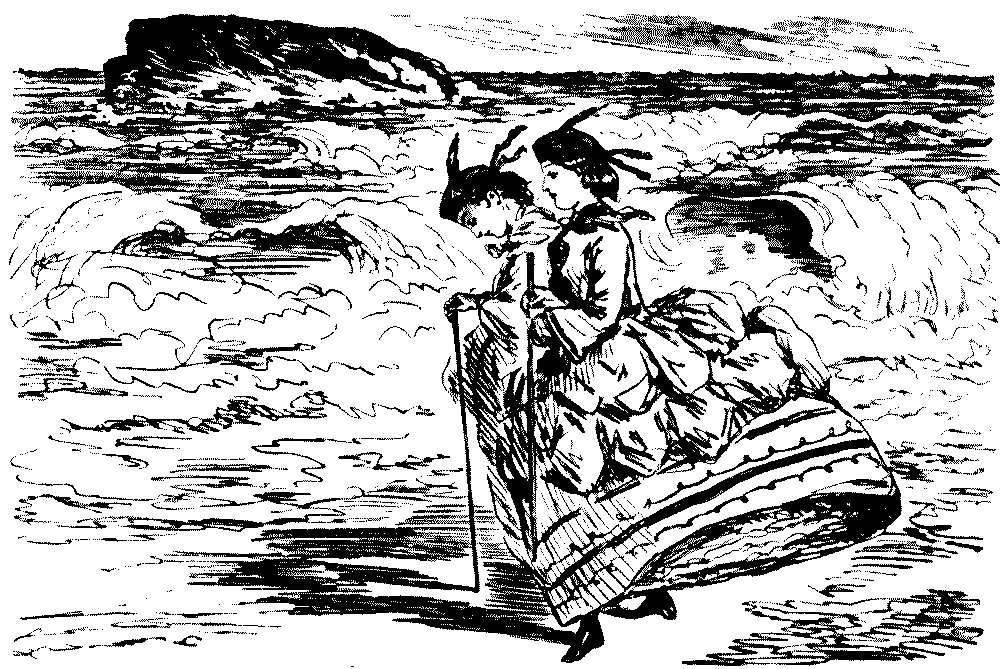
"IN THE BAY OF BISCAY, O!"
The last sweet things in hats and walking sticks at Biarritz.
Punch, though pessimistic, was persevering, if inconsistent, and continued to rely largely on the weapon of ridicule, and he had no lack of material. Thus we read in December, 1858:—
Visitors to the Cattle Show, at least those who go in Crinoline, would do well before they start to read the following short paragraph, which we extract for their perusal from a country print:-
"The Show was attended by several of the fair sex, for whose admission special means of entrance were provided. Through a pardonable neglect on the part of the Committee, this was neglected to be done at first, and a highly amusing incident occurred through the omission. Within a very few minutes of the Show being opened, a distinguished party of ladies and gentlemen arrived, and on coming to the turnstile (which was then the only entrance) it was discovered that the ladies, who we need not say were dressed in all the amplitude of fashion, could not possibly squeeze through so limited a space. In this dilemma, as the turnstile could not possibly be widened to the width that was required, the only course was, obviously, to throw open the great gates, through which the ladies, not without a titter, sailed majestically Show-wards in the wake of the prize beasts."
Ridicule, again, inspires the caricature of crinolines in the park chairs, or the account of children in crinolines. In 1861 Punch describes a child of four at an evening party who was fully six times and a half as broad as she was long, and reads a homily on the danger of implanting such follies in the mind of susceptible youth, since the child is the mother of the woman as well as the father of the man. There is, too, a burlesque picture of a modern governess giving a geography lesson on a globe formed by her own inflated skirts. But often he struck a serious note, and his suggestion of a crinoline hospital was not so absurd in view of frequent accidents, such as the following:—
CRINOLINE AND ITS VICTIMS
Notwithstanding all that Punch has said upon the subject, the accidents from Crinolines are, it would seem, upon the increase. Half a score at least have occurred through fire since Christmas, and several others we could cite have taken place from other causes. One of the last we saw reported was occasioned by a dress being caught up by a cab-wheel while the wearer was crossing a street at the West End. Here the victim was so fortunate as to escape with merely a bad fracture of her leg; but in most cases the sufferers have lost their life by their absurdity in wearing the wide dresses which are now accounted fashionable.
Length Succeeds Breadth
So the campaign went on for years and years, though Punch was magnanimous enough to record in 1864 that the much-abused monster had been the means of saving a girl's life by acting as a parachute and breaking her fall. In 1865 the fashion was already on the wane, but very long dresses were in vogue, to the great annoyance of Punch:—
LADIES AND THEIR LONG TAILS
Crinoline at length is going out, thank goodness! but long, trailing dresses are coming in, thank badness! In matters of costume lovely woman rarely ceases to make herself a nuisance; and the length of her skirt now is almost as annoying as, a while ago, its width was. Robes à queue they call these draggling dresses; but it is not at Kew merely that people are tormented by them. Everywhere you walk, your footsteps are impeded by the ladies, who, in Pope's phrase, "drag their slow length along" the pathway just in front of you. "Will anybody tread upon the tail of my petticoat?" This seems to be the general invitation they now give. Sad enemies to progress they are, in their long dresses; and a Reform Bill should be passed to make them hold their tails up.
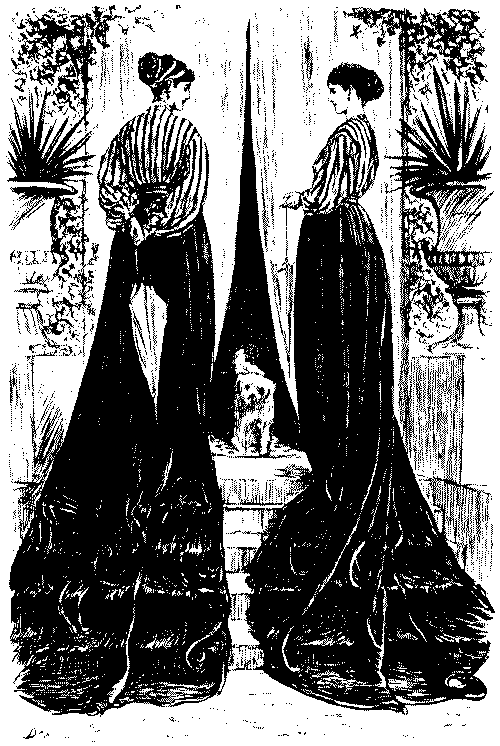
A REMARKABLE STUDY FROM NATURE
But the new nuisance was trifling compared with the old, and relief predominated in the "Rhymes to Decreasing Crinoline" published a few months earlier. It was not, however, until 1867 that crinolines practically disappeared in fashionable circles, and that long skirts were curtailed to reasonable dimensions.
Though chiefly preoccupied with skirts, Punch bestowed a good deal of attention on the vagaries of feminine headgear. In 1857 the huge round hats in vogue moved him to protest. They were discredited, in his view, when worn by elderly ladies, but he allowed them the negative merit of having displaced the "ugly." The "dear little Spanish hat, so charming and so much more sensible than a horrid bonnet" shown in the picture of a stout lady of uncertain age, justifies the reservation "on some people." But the hat was entering into a serious competition with the bonnet, and by 1860 the "pork-pie hat," so indelibly associated with Leech's portraits of mid-Victorian girls, was firmly established in favour and gradually ousting the spoon-shaped bonnet which disappeared in 1865. This growing popularity of the hat trimmed with feathers, as opposed to bonnets trimmed with ribbons, had the result of causing considerable distress in the ribbon trade in Coventry. Punch, though "no lover of extravagance," found himself accordingly driven to urge his lady readers to flock to their dressmakers and drapers and purchase as many hat-ribbons as possible. They could justify their action by singing in the slightly adapted words of the old song,
All round my hat I wear a new ribbon, All round my hat a new ribbon every day, And if anyone should ask of me the reason why I wear it, "'Tis to help the poor of Coventry who are wanting work," I'll say.
The appeal was followed up a week later by an ingenious and graceful picture of the new Lady Godiva riding through Coventry in a costume composed entirely of ribbons.
Bonnets held their own but in dwindling dimensions, their minuteness being specially noticed in 1867. This is attributed by Punch to the fashion of the chignon, on which he bestows ironic praise in 1869 as needing very small and therefore cheap bonnets. In 1871 "Dolly Varden" hats, flower-trimmed and with one side bent down, named after the character in Barnaby Rudge, engage Punch's pencil; a year later Mr. Austin Dobson wrote in St. Paul's Magazine: "Blue eyes look doubly blue beneath a Dolly Varden."
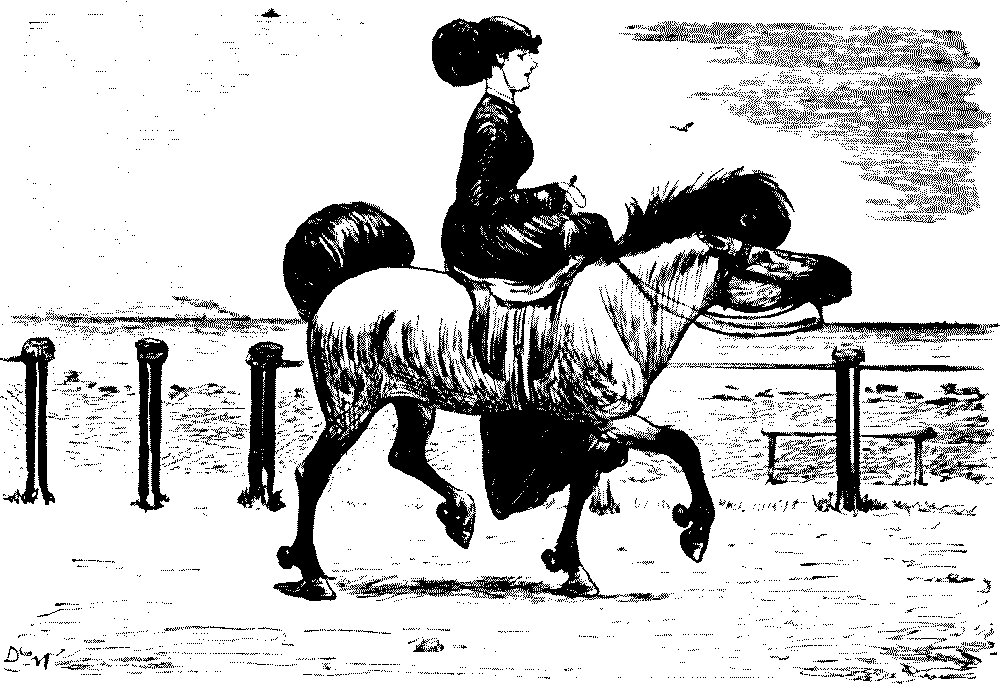
STUPENDOUS TRIUMPH OF THE HAIRDRESSER'S ART! The very last thing in chignons.
Chignons
Turning from headgear to hairdressing, we find Punch a vigilant critic of coiffure. In 1858 he attacks the vagaries of mode as shown in hairdressing à la Chinoise "pulled up by the roots," and the fashion of wearing coins. To judge from Leech's pictures he greatly preferred the simpler style of braids and hair nets. The great event of the mid-'sixties, however, was the advent of the chignon, which proved only second to the crinoline as an incentive to caricature and criticism. In the ironical verses addressed to a "Young Lady of Fashion," the chignon stands first in the list of the artificial enhancements of beauty resorted to half a century back:—
I love thee for thy chignon, for the boss of purchased hair, Which thou hast on thine occiput the charming taste to wear. Oh, what a grace that ornament unto thy poll doth lend, Wound on what seems a curtain-rod with knobs at either end! I love thee for the roses, purchased too, thy cheeks that deck, The lilies likewise that adorn thy pearly-powdered neck, And all that sweet "illusion" that, o'er thy features spread, Improves the poor reality of Nature's white and red. I love thee for the muslin and the gauze about thee bound, Like endive that in salad doth a lobster's tail surround. And oh! I love thee for the boots thine ankles that protect, So proper to the manly style young ladies now affect.
The chignon was no new invention, but a revival of a fashion mentioned by the Lady's Magazine for 1783, and described twenty-five years later by Maria Edgeworth as a combination of hair natural and false "plastered together to a preposterous bulk and turned up in a sort of great bag or club." But the fashion attained its apogee in the middle and late 'sixties, and afforded endless opportunities to the pencils of Du Maurier and Sambourne. One of the most ludicrous of the many caricatures to which the habit gave rise is that in which Du Maurier represented a lady riding on a pony with its mane and tail fluffed out to harmonize with her stupendous chignon. Later developments of the chignon are ridiculed by Sambourne in 1871.
Madame Rachel
The second stanza of the poem quoted above furnishes not an unfair summary of the arts of facial adornment of which that amazing adventuress Madame Rachel was the most notorious and expensive high priestess. Her beginnings were obscure and even ignominious. Her maiden name was Russell, but it is not certain whether she was born near Ballinasloe in Ireland or in London. Her first husband was a chemist's assistant in Manchester, from whom she had probably learned something of the compounding of cosmetics; her second and third husbands were both Jews—James Moses who was lost in the Royal Charter, October 26, 1859, and Philip Leverson. She kept a fried-fish shop in Vere Street, Clare Market, for a while, then started as a hair restorer in Conduit Street, and from 1861 to 1868 was in business in New Bond Street under the name of Madame Rachel (probably borrowed from that of the famous tragedian) as an enameller and vendor of cosmetics. She professed, in the phrase eternally associated with her name, to make women "beautiful for ever," but it was a costly process. Under the heading, "The Trials of Beauty," Punch, who had referred to her cosmetics as early as the winter of 1858, writes in 1862:—
The wife of a Captain has been called upon to pay near upon £1,000 for having been enamelled by Madame Rachel. Ladies take warning. Be natural rather than artificial. Never appear in society with a mask on, no matter how beautiful the mask may be. From the above you should learn in time how much it may cost you for being double-faced.
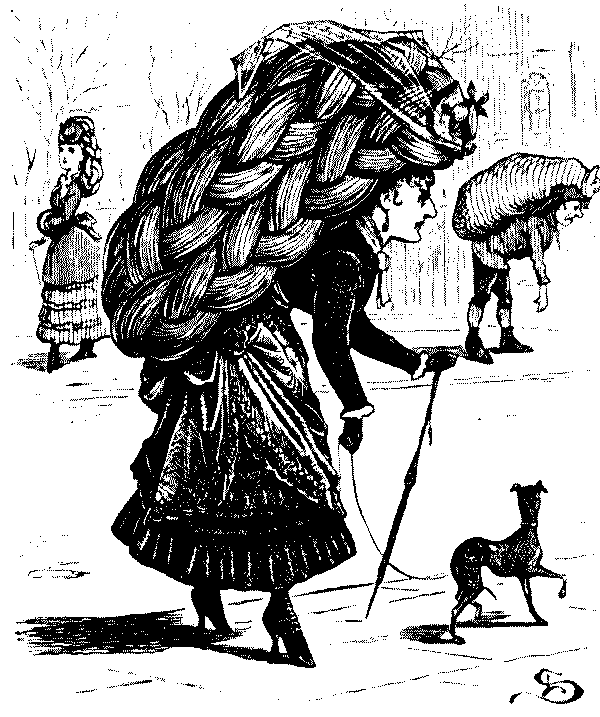
"THE BURDENS OF FASHION" What we must come to before long!
The warning, however, was unheeded, and Madame Rachel continued to flourish exceedingly for more than five years, living in an elegant house in Maddox Street and paying £400 in 1867 for a box at the opera. The first crash came in 1868, when she was tried for swindling Mrs. Borradaile, the widow of a colonel in the Madras Cavalry, out of £5,300 on the pretence of making her "beautiful for ever" and fitting her to be the wife of Viscount Ranelagh. In September of that year she was sentenced to five years' penal servitude, and she was burnt in effigy on Guy Fawkes' day. In the following March her house, furniture and effects came to the hammer, and Punch's description affords a good clue to the extent of her profits:—
The lady's business having been knocked down by the Judges, her effects are about to be knocked down by the auctioneer. The catalogue and sale bills are quite overpowering to the imagination. The drawing-rooms and principal apartments are said to "present splendour and magnificence difficult to describe." There are candelabra (brass and lacquer probably) formerly belonging to the Emperor Napoleon, and incense-burners once the property of the King of Delhi! "Dispersed through the house are numerous works of Art and articles of virtu, many of them presentations from Madame Rachel's distinguished patronesses."
Fashions in Coiffure
Punch headed his remarks "Madame Rachel's Last Appearance," but the heading was premature. Released on a ticket-of-leave in 1872 Madame Rachel boldly renewed her operations in Duke Street, Portland Place, in 1873, and continued them till 1878, when she was sentenced a second time to five years' penal servitude for swindling another client, and died in Woking Prison on October 12, 1880. The curious may turn for further details to the reminiscences of Serjeant Ballantine and Montagu Williams. Both Serjeant Ballantine and Montagu Williams appeared for the prosecution in the Borradaile case. There were two trials: in the first, held in August, the jury disagreed. It is perhaps not unfair to say that the heavy sentence passed by Mr. Commissioner Kerr was due more to Madame Rachel's demerits and her record than to the merits of the case. But she had not merely obtained money under false pretences: she was a forger and a blackmailer as well. Ballantine, who could not be accused of squeamishness, had known of her in earlier days and describes her as "one of the most filthy and dangerous moral pests that have existed in my time and within my observation."[34] Montagu Williams, who gives a full account of the trial, calls her a "wicked old woman," but contents himself with observing that the case "afforded a striking illustration of the vanity of some women, and of what tricks can be played upon them by the artful."[35] Madame Rachel does not appear in the D.N.B., though less remarkable impostors have found a niche in that comprehensive temple of native talent, and her fame was not confined to one hemisphere. One of the springs on the shores of Lake Rotorua in New Zealand was named "The Madame Rachel Bath" in virtue of its medicinal and rejuvenating qualities.
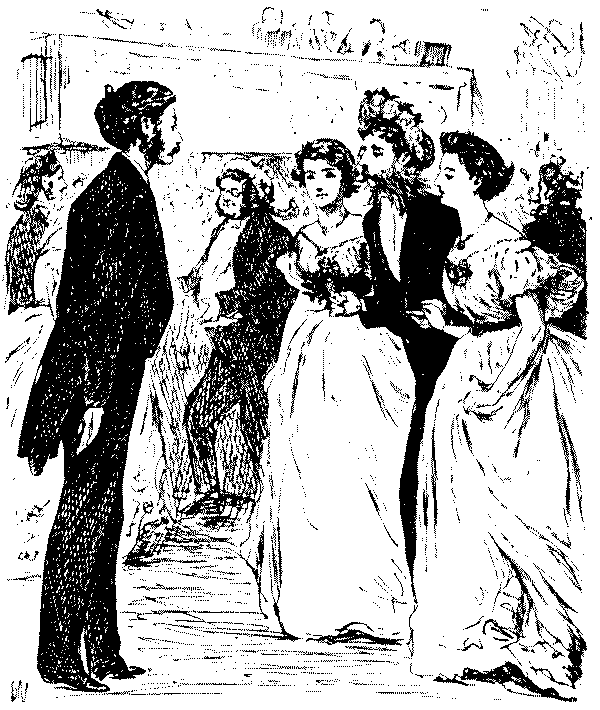
FASHIONS FOR THE COMING SEASON From the "Journal des Coiffeurs."
(The ladies have already begun.)
In 1866 the rage for dyeing the hair auburn seems to have been at its height. "Mr. Frizzle," a coiffeur de dames, is represented in one of Du Maurier's pictures as saying to a customer, "Black hair is never admitted into really good society." Enlarging on this theme in another place in the same volume, Punch observes that the maxim "Never say Dye" is completely abandoned, and suggests daily changes of complexion to suit the dresses worn. In 1864 we read of small dogs being dyed to match their mistresses' colouring! By 1867 the pendulum seems to have swung in the opposite direction and brunettes are again in vogue. The picture (also by Du Maurier) of fashionable ladies with short hair can hardly be taken seriously; it is probably not more than an unconscious prophecy of the "bobbing" habit of recent years. In 1869 Punch was much exercised by learning, on the authority of an American paper, that "nearly all the brilliant complexions seen among the fashionable women of New York are the result of eating arsenic. Since the introduction of the blonde fashion, arsenic-eating has become almost a mania." Tirades against tight-lacing date back to 1859, but they culminated in the ponderous irony of the "Wanton Warning to Vanity" published ten years later:—
Indeed the Morning Post ought to be ashamed of itself. That journal, which we used to call our fashionable contemporary, publishes a paragraph, headed "Tight-Lacing," which reports the particulars of an inquest held at the College Arms, Crowndale Road, Camden Town, on the body of a young woman, aged only nineteen, and whereby, if they see it, our dear girls who take in such instructive journals as the Englishwoman's Domestic Magazine will be terrified to no purpose by the information that—
"She was out three hours with a perambulator, in which was one child, and as she neared her destination she fell down insensible. She was taken to 10, Polygon, where upon examination by Dr. Smellie she was found quite dead. It was discovered that she was very tightly-laced, and Dr. Smellie stated that death was caused by effusion of blood on the brain, caused by fatty heart, accelerated by compression of the chest produced by tight-lacing. The jury returned a verdict in those terms."
This statement, so inconsistently published by our once, and, we hitherto supposed, our still fashionable contemporary, is calculated to have a most unfashionable effect, namely, that of deterring girls from following the revived fashion of lacing as tight as they can stand, and tighter than they are sometimes able to go. But a propensity, which seems a law of their nature, happily compels them, for the most part, to follow the fashion regardless of consequences. The typical and average woman can no more deviate from the dress of the day than an animal can choose to change its skin or its spots. There is no fear that any girls accustomed to tight-lacing will ever be induced to relinquish that practice which renders them such delightful objects to one another, if ridiculous and repulsive to stupid men, by any such nonsense as a report of the verdict of a coroner's jury ascribing death to the effect of tight-lacing in accelerating fatty degeneration of the heart.
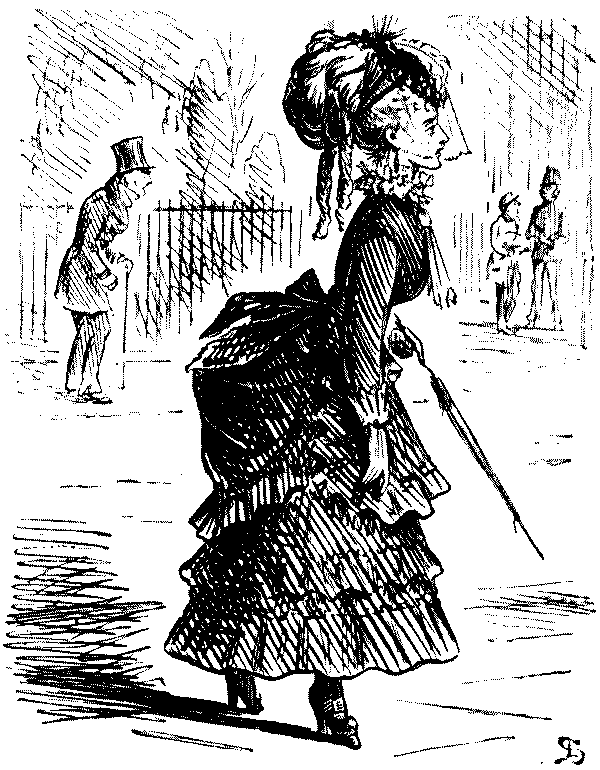
THE GRECIAN BEND
Does not tight-lacing and high heels give a charming grace and dignity to the female figure?
The Grecian Bend
High heels are not noticeable in Leech's pictures or before the middle 'sixties. The "manly style" of boots mentioned in the lines of the "Young Lady of Fashion" quoted above probably refer to the stout laced-up "Balmorals" which Frederick Locker refers to in his London Lyrics. The advent of tailor-made garments for women in the summer of 1864 is looked upon as a curiosity. Towards the end of the period under review a mode of carriage known as the "Grecian Bend," celebrated in a comic song of the time, is more than once noted and caricatured in Punch; faint echoes of the "Grecian Bend" still linger in the memories of the elderly; the "Roman Fall" is merely the shadow of a name. By the 'seventies the æsthetic movement had already begun to exert an influence on dress, but it was confined to a small coterie, to the précieux and précieuses who worshipped old china and wore waistless dresses of sage green. On the general question of "the Influence of costume and fashion on High Art," which was discussed in a manifesto issued by "The Artists of the Nineteenth Century," Punch wrote sensibly enough:—
The declaration is signed by a great number of eminent men at home and abroad, and its point is to insist that people of the present day dress so hideously that they will not make pictures. A transitional change is recommended, and the Declarers affectionately remind the public that so long as they make Guys of themselves at the instigation of tailors and milliners, portraits have no value except as family memorials, whereas, if we dressed properly, the artists would make us into tableaux which the whole world should admire. All this is perfectly true, but what is to be done? How are we to extricate ourselves from the tyranny of the tailor and the milliner? This the Declarers do not tell us, nor was it to be expected perhaps that they should advise us how to conduct a rebellion. But why do they not tell us how they would like us to dress? Men, for instance. Are they to come out with a choice array of colour, and with a picturesquely cut garb, and that general ampleness and nobleness in treatment of costume, which bespeaks the grand and heroic in the wearer?
The Briton Abroad
At this point Punch deviates into absurdity. But the main argument is sound. As a transition, however, to the subject of men's dress, another deliverance serves our purpose even better. Punch loved to criticize and even carp at his countrymen and countrywomen, but he did not easily suffer any infringement of his prerogative. And so, when a correspondent of The Times fell foul of the dowdiness of Englishmen and Englishwomen abroad, he was up in arms at once:—
The Times abuses John Bull, and Madame son Épouse, for going about on their travels got up as Guys—for shocking foreign prejudices, and showing their contempt for foreign opinion, by sporting eccentric shooting-coats, flaming flannel shirts, reckless wide-awakes—and worse still on the ladies' part, by the general shabbiness and ugliness of their travelling toilettes and headgear.
Now, making every allowance for the desperate necessities of newspaper writers in the dead season, and admitting that British travellers—male and female—include specimens both of the Guy and the Gorilla, Mr. Punch must put in his protest against any such wholesale indictment as this of his compatriots en voyage. On the contrary he is prepared to maintain, after surveying mankind from Calais to Calatafimi ... that, as a rule, the wearer of the best travelling suit (for stuff, cut, and condition together), the cleanest shirt, the least ragamuffin or ridiculous hat, the soundest and shapeliest foot-covering, is a Briton.
Englishmen turn neater and sweeter out of a railway carriage after a night's rattle, restlessness and frowst than any other people; they are more presentable, more like gentlemen, after an Alpine scramble among glacier and moraine, crevasse and couloir; they present better brushed hair, and cleaner hands and faces and whiter linen at the Table d'hôte under difficulties, and fall into less profound abysses of misery and degradation in sea-going steamers, than the natives of any other country.
I, Punch, am speaking now of the men. For the ladies—bless them!—I am compelled to admit they don't understand dress as an art so well as their French sisters. Millinery and dressmaking have their home and headquarters in France, just as cooking has; and for the same reason—because the inferiority of the raw material makes the elaborate and well-studied dressing of it a matter of sheer necessity.
But, apart from their national shortcoming in the art of dress, I maintain that Englishwomen, on their travels, deserve as much good said of them as Englishmen. Bless their fresh faces, and smooth hair, and clean cuffs and collars! In these particulars, what French or German woman can hold the candle to 'em?
I admit that the plain British female looks plain on her travels, and maybe dowdy ... But this I will maintain, that an attractive Englishwoman loses less of her attractiveness under the necessities and accidents of travel than any of her Continental rivals. She has a quality of purity and freshness about her which seems to repel all soil, whether material or moral, as the oil in the duck's tail-gland drives off the water-drops from his plumage; and, as a rule, her clothes, and her way of wearing them, have the same merits of freshness and purity in comparison with those of her rivals.
This, then, is the first proposition I am prepared to maintain against all comers: that English travellers, of both sexes, are, as a rule, the best-dressed travellers in the world.
My next proposition is like unto it, viz.: that the English abroad are the best-mannered travellers, and at home the best-mannered dealers with travellers, to be found in the circle of civilized nations.
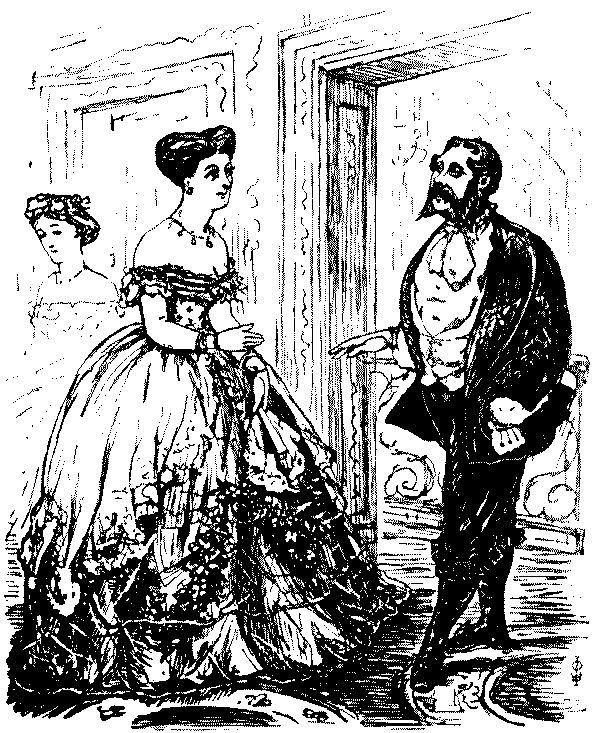
A HINT FOR TAILORS
This is John Jones, who has kindly selected Mrs. de Cotillon's Thé Dansant, to display his idea of what the alterations in evening dress (said to be meditated by a certain R-y-l P-rs-n-ge) ought to be.
Masculine Dress
Throughout the period dealt with in the previous volume man, in Punch, was the predominant partner in the domain of dress. From 1857 onwards the balance is handsomely redressed in favour of the women. And as Punch was staffed by men, we may fairly attribute this change to the standardizing of male attire which dates from the middle of the nineteenth century. The difference between the dress of men to-day and in 1860 is immensely less than that between the dress of women at the same two dates. Beaver hats were still worn in 1858; they are even now exhibited in the shop front of a well-known hatter's in St. James's Street; but the silk chimney pot had already come to stay. The evening dress suit was indistinguishable from that now worn. There was not much difference in the cut of morning coats. Only in the "nether integuments" is the flux of fashion really marked. "Peg-top" trousers were in vogue in 1858 and for a few years subsequently, and Punch attributes their shape to mimicry of the crinoline, though in one passage he professes to derive it from the contours of the Cochin China fowl. The "Peg-top," however, did not last. It was otherwise with the introduction of knickerbockers, so-called from the resemblance to the knee-breeches of the Dutchmen in Cruickshank's illustrations to Washington Irving's History of New York.
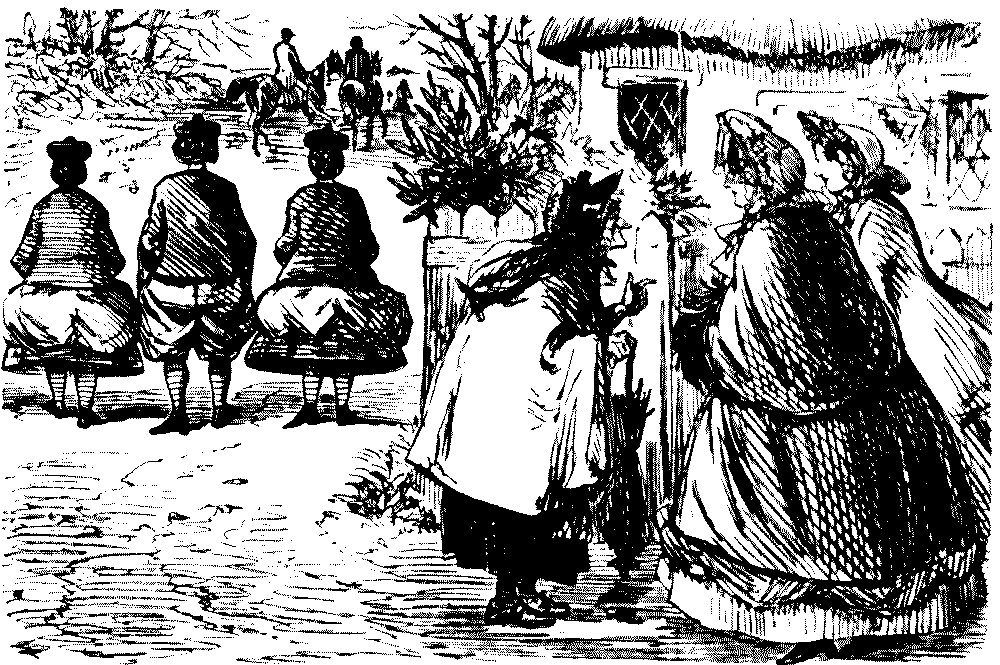
HARRY TAKES HIS COUSINS TO SEE THE HOUNDS MEET
Enter Mamma and Aunt Ellen.
Mamma (to old woman): "Pray, have you met two ladies and a gentleman?"
Old Woman: "Well, I met three people—but, la! there, I can't tell ladies from gentlemen nowadays—when I was a gal, etc., etc."
In a letter to The Times in May, 1859, Lord Elcho recommends "nickerbockers"—so he spells the word—as a substitute for trousers for volunteers. Charles Kingsley in the same year derived them from country-made—and badly made—puffed trunk-hose. But their utility and convenience for country wear and sport were soon established, though the dreadful abbreviation "Knickers" did not come into use for some twenty years. The shortening of ladies' dresses and the bagginess of men's knickerbockers afforded Punch some excuse for professing to be unable to distinguish the sexes at a distance, but the actual assumption of knickerbockers by women belonged to a later generation.
Lord Dundreary
It is rather in the fashion of wearing their hair than in their dress that the changes effected in the appearance of men in the last sixty years can be best studied. Beards came in after the Crimean War, but they were not universally popular. The Bishop of Rochester took up so strong a line on the subject in 1861 that Punch was moved to protest:—
Good Doctor Wigram (Rochestere), At Parsons' beards is raving: We sadly fear that we shall hear The Bishop's head needs shaving.
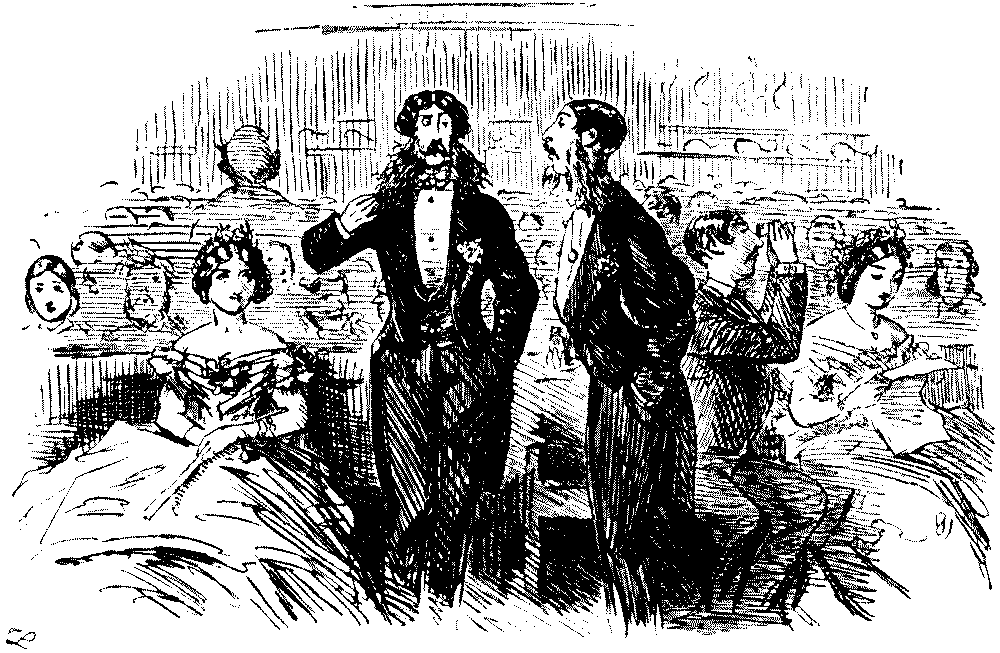
AFTER DUNDREARY
First Swell: "A-a-wah! Waw! Waw! How did you like him?"
Second Ditto: "Waw-waw-waw. No fellaw evaw saw such a fellaw. Gwoss cawicature-waw!"
But whiskers were the great feature of the 'sixties. They had been "ambrosial" before, but now the thing became a monstrosity in its profuse luxuriance. For this was the age of "Piccadilly Weepers," and of Lord Dundreary, the eccentric stage peer created by Sothern in Our American Cousin. Sothern, be it remembered, was a hunting-man and a persona grata in fashionable circles; and allowing for the element of caricature in his impersonation, it was at least based on firsthand knowledge of the type satirized. There is an interesting notice of the first production at the Haymarket of Our American Cousin in which Lord Dundreary is described as "a double eye-glassed dandy, with dyed whiskers which he paws and throws over his shoulder," but the critic admits that in spite of all Mr. Sothern's "funny and fantastic caricaturing, there is a something true to nature in his almost every touch." The hold that Sothern's impersonation took upon public fancy is shown by the fact that for several years Punch adopted "Dundreary" as a synonym for a vacuous, solemn, well-bred and prodigiously whiskered dandy, and in the Preface to Vol. xlii. Lord Dundreary is introduced as interlocutor in the usual dialogue.
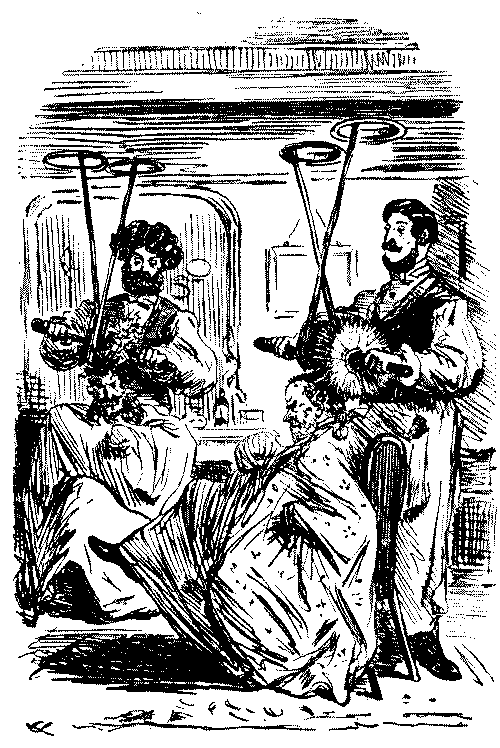
THE NEW AND DELIGHTFUL METHOD OF BRUSHING THE HAIR WITH MACHINERY
Tailors' pseudo-classical nomenclature was already a frequent theme with Punch. In the same year Punch quotes a tailor's advertisement of a "Negligé Milled Tweed suit, consisting of cape jacket, vest and trousers for £2 2s. 0d.," which arouses the envy of the post-war Englishman. Hair-brushing by machinery is noted as a novelty in the autumn of 1863; we trust that the customers contrived to keep their whiskers out of the way of the brush. For the rest, we may briefly note the advent of the "Ulster" in 1871, and the prevalence of the single eye-glass in 1873.