THE ROAD TO REFORM (continued 2)
Reading edition
In 1873 the wages in some collieries had gone up to 10s. or 15s. a day:—
Victims of the Income Tax
To be content with from 10s. to 15s. a day is to be satisfied with, say, some £234 a year. If that is to be earned by mining here, there can be no inducement for any skilled miner to betake himself to gold or diamond diggings. He can live in clover, on enough to satisfy all his wants, by raising black diamonds at home. For a miner, an income of the above amount is a salary much more adequate than £5,000 for a Law Officer of the Crown. The miner has no appearances to keep up in a mine. He need not incur any expenses but those which are necessary for his personal wants and pleasures, including champagne and dog-fighting; which, the former luxury as well as the latter amusement, he can manage to afford well enough by a judicious economy above-ground, of lodgings, furniture, and clothes.
Coals went up to 50s. a ton in London this year and the cry of the middle classes, of whom Punch was now the great champion, was echoed with great fervour in an article on a speech by Sir William, then Mr. Vernon Harcourt:—
Mr. Vernon Harcourt, in some of his late speeches, has placed himself in striking contrast with most of the other leading politicians, both Liberal and Conservative, by speaking the truth. For example, at the Druids' Dinner the other day, in discussing the impost by which the incomes of a part of the people are taxed to pay the expenses of the whole, instead of attempting to defend confiscation with sophistry, and to stifle complaint with sneers, he condemned the false and dishonest apology, alleged by financial swindlers' advocates on behalf of the Income-tax, that it weighs only on the rich who are well able to pay it, and he maintained that, on the contrary, it falls "with the greatest severity on the poorest of all the classes of the community—that which, upon limited means and small profits, has to keep up a state of respectability." The lie which Mr. Vernon Harcourt refuted is one of those lies which Statesmen are very apt to tell in talking to simpletons; lies coupled with truths, from which the generality of people at public meetings have not sense enough to disentangle them. It is quite true that the rich are well able to pay the Income-tax; but to say that the Income-tax weighs only on them is telling a falsehood which transcends common lying. The rich, as a rule, can afford to live up to their incomes, and it matters nothing to wealthy people whether their incomes are taxed, or duties are imposed upon the luxuries on which they expend them. The class rightly described by Mr. Harcourt as the poorest of the country consists of persons under the necessity of living as much within their incomes as possible. They need to make all the provision that ever they can against ruin constantly staring them in the face. The Income-tax, substituted for indirect taxation, wrings from them the savings they ought to put by, and, by way of compensation, offers them the advantage of buying cheapened superfluities, which, how cheap soever, are too dear for them at any price. Thus are their slender incomes in large measure confiscated by the Chancellor of the Exchequer, and amends are made them with facilities to squander the rest.
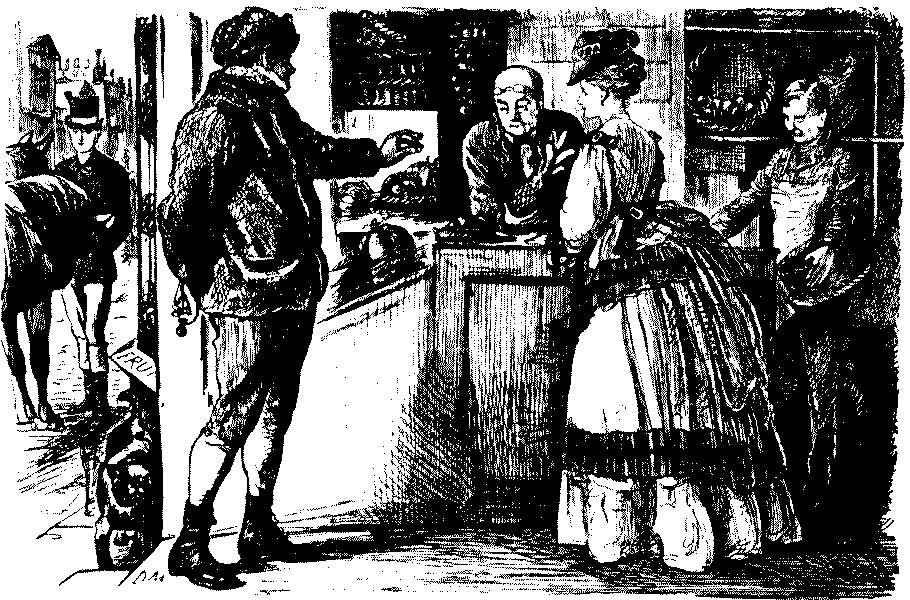
FROM THE COAL DISTRICTS
My Lady: "I'm afraid I must give up the pine-apple, Mr. Green! Eight shillings is really too much!"
Successful Collier: "Just put 'un up for me, then, Master. 'Ere's 'arf a sovereign; and look 'ere—yer may keep the change if yer'll only tell us 'ow to cook 'un!"
Colliers and Cormorants
References to the champagne-habit among the miners abound throughout this year. A picture shows a miner buying a pine-apple which a lady could not afford. Their practice of travelling first-class is also reprobated. But the bitterest explosion of Punch's wrath against the pampered aristocrats of industry was provoked by a speech in which John Bright complacently dwelt on "the growth of material prosperity and comfort in every class." To this Punch vehemently demurred:—
Clerks of all kinds, Civil servants, fund-holders and annuitants with fixed incomes, landowners, doctors, lawyers, and professional men in general, is that so? Do you find it so?
When Mr. Bright said "every class," did he not mean to say, or, at least, should he not have said "certain classes"? It is quite true that the shoddy class, and the class of great speculators, have prospered exceedingly, to as great an increase of their material comfort as increasing wealth could procure them. A proportionate growth of material comfort and prosperity has obviously been experienced by the operatives and mechanics, otherwise called the Working Classes—although there are classes who may be said to do some little work, other than manual labour, to be sure. Do not coal-miners for a fair day's work obtain at least a full two days' wages; do they not drink champagne; and have not they and the rest of our flesh-and-blood amongst them, drunk us out of the Alabama difficulty? They have grown in content too—the Striking Classes. They and the other classes that grasp with one hand and squander with the other, and go on grasping and squandering, and thereby raising prices higher and higher every day, they, all of them, indeed are without doubt increasingly prosperous and comfortable, but they are not everybody. There are a very great many other people besides, who constitute everybody else, and these, so far from being more prosperous and comfortable than they once were, can now no longer afford the luxuries, or even the necessaries, they then could, but have to go without.
The ugly phrase about the Alabama claims was not Punch's own coinage, but he was not in a mood to mince his words where the miners were concerned. The charges against overpaid workmen and profiteers have a strangely familiar ring. And so has the reference, though not under the now familiar name, to the practice of "Ca' Canny," which, however, had been in occasional use for many years before Punch suggested, in 1874, that it might be met by reprisals:—
COLLIERS AND CORMORANTS
The Sheffield Daily Telegraph informs consumers, already subjected by producers to excessive extortion, that at Motherwell:—
"At a mass meeting of Scotch miners on Thursday, 3,000 colliers resolved to work only four days per week, and only eight hours per day, in order to reduce the output, and to keep up prices."
But suppose the butchers and poulterers combined against them, as they combine against the public, what then? And could not the vintners agree to raise "these rapacious colliers' Champagne to some four or five pounds a bottle? Perhaps they will try.
Already Lord Shaftesbury had spoken plainly on the results of that "enormous increase of wages which had lately taken place in nearly every class of working men," even going to the length of endorsing the view that high wages, when unaccompanied by self-control, were the curse of the working classes:—
Of course, where economy and prudence were practised the condition of the Working Man should be improved by higher wages; but there was recklessness and improvidence. The sudden increase of money had been productive of the greatest possible mischief, and so long as these habits continued he could not but think that an increase of wages was a positive infliction to the Working Man, his wife, and his children.
This bold statement prompted Punch to reduce the argument to an absurdity, or something near it, by suggesting that the true way of planting the spirit of self-control in the minds of the people would be simply to lower their wages to the requisite standard. Simultaneously he vindicates the character of the working classes for thrift and sobriety in the following ironical eulogium:—
The Working Classes, it is surely not too much to say, spend every little increase of wages they obtain by their harmless strikes chiefly in the education of their children, and in the purchase of the appliances needful to make home happy. If they are at all extravagant is it not in books, and in the dress which some of them are a little too apt to lavish on their wives? For the vast improvement evident in their habits we have to thank not only the Licensing Act, but also the Trades' Unions Act; and moreover the Conservative Reform Bill, which has rendered them, as Mr. Lowe said, our masters—if not their own.
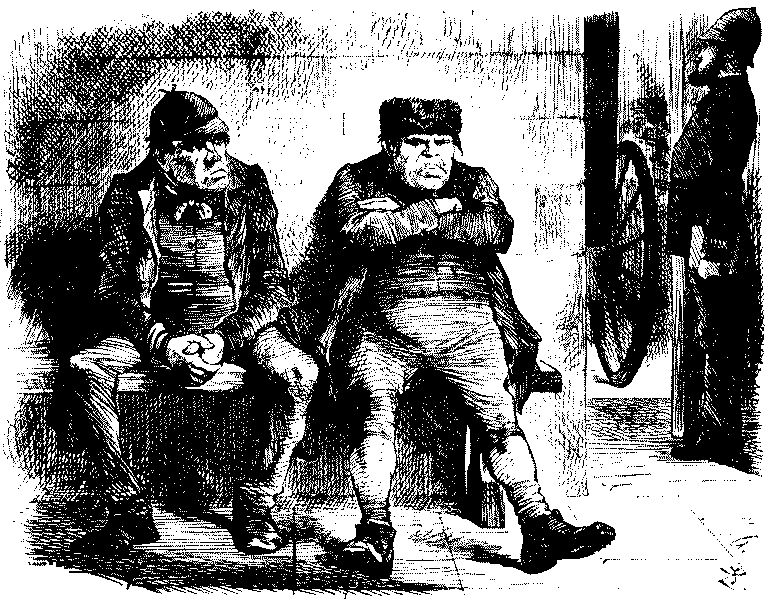
ONE-HANDED JUSTICE
First Ruffian: "Wot was I hup for, and wot 'ave I got? Well, I floor'd a woman and took 'er watch, and I've got two years and a floggin'."
Second Ruffian: "Ha! I flung a woman out o' the top floor winder; an' I've on'y got three months!"
First Ruffian: "Ah, but then she was yer wife!"
Punch and Capital Punishment
The reference to working men's wives is especially ironical, for Punch was at this time engaged in a vigorous campaign of protest against the very lenient sentences passed on men for brutal assaults on their wives. References to this subject abound in these years in prose and verse and cartoons, culminating in the year 1874. He strongly supported resort to flogging in such cases. We have already noticed the modification, indeed the practical abandonment, of his old hostility to capital punishment. The cause of this conversion is curious. It is hardly too much to say that it was largely the result of a remarkable speech made by John Stuart Mill—a true humanitarian if ever there was one—on the measure introduced in April, 1868, to make executions private. Punch, though he often differed from Mill, had the greatest respect for his fearless independence and integrity, and was evidently profoundly impressed by Mill's speech[5] in reply to Mr. Charles Gilpin (the Member for Northampton), who had argued in favour of the abolition of capital punishment, and we find the following admirable summary of it in his "Essence of Parliament":—
The speech of the night was that of Mr. Mill, who approved of many of the labours of the "philanthropists," but said that they ought to know when to stop. To deprive a criminal of the life of which he had proved himself unworthy—solemnly to blot him out from the fellowship of mankind, and from the catalogue of the living—was the most appropriate and the most impressive mode in which society could deal with so great a crime as murder. Imprisonment would be far more cruel, and less efficacious. None could say that this punishment had failed, for none could say who had been deterred, and how many would not have been murderers but for the awful idea of the gallows. Do not bring about an enervation, an effeminacy in the mind of the nation; for it is that to be more shocked by taking a man's life than by taking all that makes life valuable. Is death the greatest of all earthly ills? A manly education teaches us the contrary; if an evil at all, it is one not high in the list of evils. Respect the capacity of suffering, not of merely existing. It is not human life only, not human life as such, but human feelings, that should be held sacred. Moreover, taking life for murder no more implies want of respect for life than fining a criminal shows want of respect for property. In countries where execution is morbidly disliked there is no abhorrence of the assassin. Mr. Mill added that we had been in danger of reducing all our punishments to nothing; and, though that disposition had stopped, our penalties[6] for brutal crimes (for which he earnestly recommended the Scourge) were ridiculously light, and ought to be strengthened.
The Organ Grinder Nuisance.
It will be noted that Mill here met the argument which Punch had advanced in earlier years as to the relative severity of long imprisonment and capital punishment, and answered it on the humanitarian ground that the former was more cruel as well as less efficacious. Mill, as we notice elsewhere, had more than anyone else shaken Punch's hostility to woman suffrage, but the effect of his speech on capital punishment was even greater. It must not be forgotten, however, that Mill had been in the forefront of the movement for securing the prosecution of General Eyre for his drastic suppression of the riots in Jamaica. Punch supported General Eyre throughout, and it may well have been that on the question of capital punishment he was influenced by the principle fas est et ab hoste doceri, even though the opponent was undermining his own position. On more general grounds one can well understand that Punch, as an independent observer and thinker, would admire and be impressed by the candour and detachment from party ties which marked Mill's political career.
The change in Punch's views on the claims of Labour, especially organized labour, has already been sufficiently illustrated. But it did not prevent his espousing the cause of workers where the conditions were bad, the hours long and the pay inadequate. Punch's protracted campaign against the organ grinders was no doubt to a considerable extent due to Leech's sensitive nerves, and to sympathy with brain-workers such as Babbage, the mathematician, who declared that "one quarter of his entire working power had been destroyed by audible nuisances," but his support of Mr. Bass's Bill in 1864 was largely based on the fact that the business was conducted by undesirable aliens, and that the Italian padrone was an employer of sweated labour. In 1871 there is a cartoon satirizing the strong measures taken by the police against a demonstration of child match-makers at a time when adult agitators were allowed to preach Revolution and Communism in Hyde Park, and in the same year and month, when a post-mistress was convicted of theft and forgery, the evil is traced to the temptation to which underpaid officials were subjected. Punch had already predicted that in any national emergency the patriotism of the mercantile marine could be implicitly relied on, a prophecy splendidly realized in the Great War, and in 1873 he lent a vigorous helping hand to Samuel Plimsoll in his campaign against the "Coffin-Ships":—
Let horrified shipowners never so oft His charges, indignant, fling back, I call him the cherub who sits up aloft To keep watch for the life of Poor Jack!
Simultaneously Punch printed a cartoon assuming that "Jack" would never again be sent to sea in one of "Davy Jones's decoy ducks." This was rather premature, as Plimsoll's campaign to secure the compulsory load-line which began in 1870, and in which he showed more zeal than discretion, did not lead to legislation until 1876. But with all his faults Plimsoll earned his title of "The Sailor's Friend" and justified Punch's salutation.
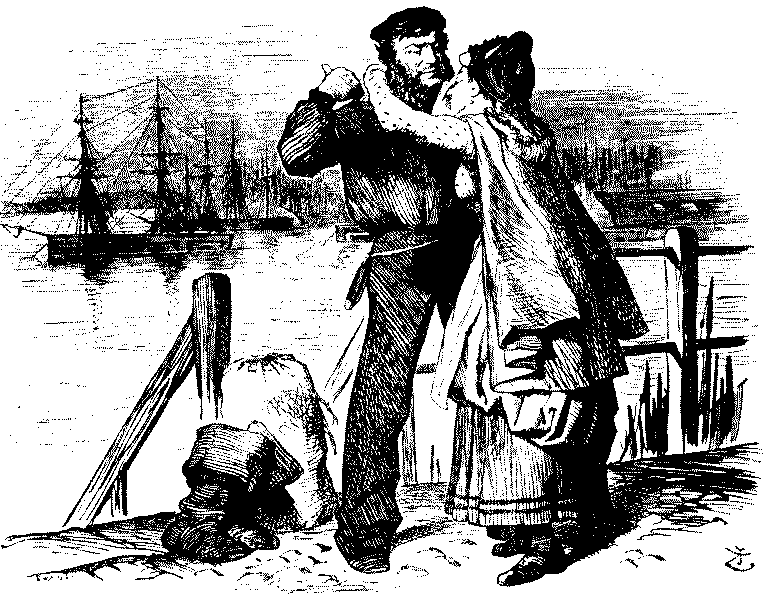
THE COFFIN-SHIPS
Polly: "Oh, dear Jack! I can't help crying, but I'm so happy to think you're not going in one of those dreadful ships!"
Jack: "What, Davy Jones's decoy ducks! No, no, lass—never more. Thanks to our friend Master Plimsoll, God bless him!"