WOMEN
Reading edition
"Feminism," in the modern sense, as was pointed out in the previous volume, is in English, at any rate, a twentieth century word. Yet the movement was there long before the name was coined or imported, and in the period on which we now enter a notable change reveals itself in the spirit of Punch's dream of womanhood. The change is all the more remarkable when we recall the fact that the paper was still written exclusively by men and appealed mainly to male readers. The first woman contributor with the pen—Miss Betham Edwards—did not appear until 1868. "Mrs. Punch's Letters to her Daughter," however, cannot be said to strike a new note, being for the most part a replica of Punch's own views, with a mild undercurrent of irony so carefully disguised as to be almost invisible. Mrs. Punch disavows all association with committees or causes. She was "not even a novelist"—apparently a hit at Rhoda Broughton, who had recently swum into the ken of the astonished Mrs. Grundy, and whose works are obliquely disparaged under the transparent aliases of "Unwisely but not too well," and "Cometh up as a Nettle." Mrs. Lynn Linton's tirades against the Girl of the Period had appeared in the Saturday Review earlier in the year, and Mrs. Punch follows mildly in the same path, rebuking the extravagances of fashion; monstrous chignons, false and dyed hair, the use of Madame Rachel's cosmetics, and a resort to audacious décolletage. In her advice on the choice and management of husbands Mrs. Punch is purely ironic. There is no serious effort to dislodge men from their entrenched positions as lords of creation. The furthest she goes is in a retort on the Young Man of the Period, whom she boldly pronounces an ass, whether he is of the tame cat order; or an "æsthetic" with a genius for disparaging everybody, especially his elders; or a mere conceited ass; or a clerical despot to whom woman is a ministering slave. Finally she deplores the precocity of the Young Children of the Period. Indeed, there weren't any young children at all, only richly-dressed supercilious little men and women; worldly-wise little satirists and snobs.
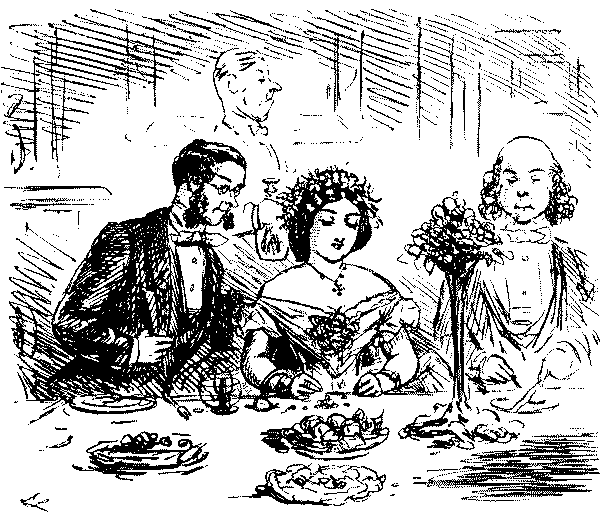
TOO BAD
Professor Pumper: "May I ask, Miss Blank, why you are making those little pellets?"
Miss B.: "Well, I don't know. It is a habit I have. I always make bread pills when I feel bored at dinner!"
A Change of Type
But from 1860 onwards one notes an increasing readiness to take women seriously. They are no longer merely regarded as "dear creatures," ornamental and domestic, as when the appearance of The Angel in the House inspired the comment that the title was one "which might be bestowed on a meritorious cook." Blue stockings are still the subject of much acidulated chaff, and "strong-minded" women are almost invariably represented as flat-chested, ill-dressed slatterns. But within certain limits women are allowed to cultivate intellect without loss of angelical charm. The type of feminine good looks portrayed by Leech remained unchanged to the end of his life. Yet in two directions we note a change. His charming buxom girls show a tendency to revolt against the tyranny of their pert schoolboy brothers;[22] they are beginning to cultivate the faculty of retort even at the expense of learned professors. And again, in the hunting-field, the superior boldness of the hard-riding young lady is frequently glorified at the expense of the more cautious male. In this context it is worthy of record that for many years after Leech's death the bulk of the hunting pictures were contributed by the first of Punch's lady artists—Miss G. Bowers.
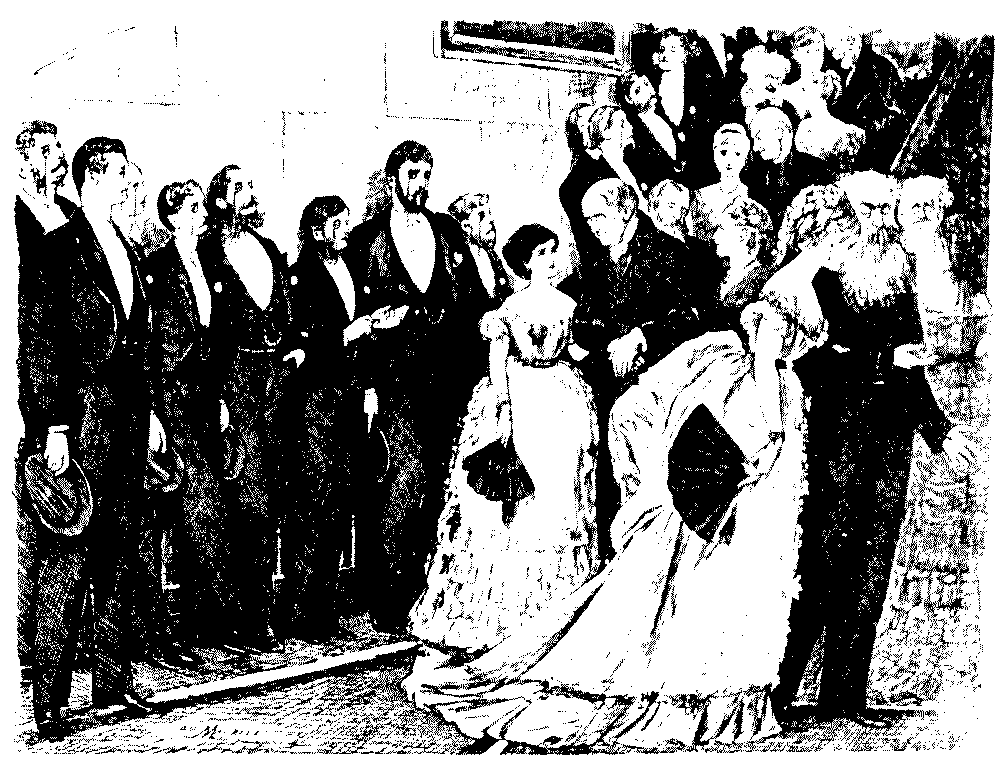
TERRIBLE RESULT OF THE HIGHER EDUCATION OF WOMEN!
Miss Hypatia Jones, Spinster of Arts (on her way to refreshment), informs Professor Parallax, F.R.S., that "young men do very well to look at, or to dance with, or even to marry, and all that kind of thing!" but that "as to enjoying any rational conversation with any man under fifty, that is completely out of the question!"
Du Maurier's Women
Fainting was still fashionable, but women were beginning to compete, mildly but increasingly, in the domain of sport and pastime. Hunting had long been their great stand-by; it afforded women the greatest opportunities for the display of nerve, skill and endurance, and they were as conspicuous by these qualities in the 'sixties as they are to-day. But the Amazon is a class apart. Archery—by reason of its opportunities for showing off a graceful figure as the arrow was "pulled on the tense string"—was still in its golden prime, and croquet so widely popular as to warrant the publication of a long poem in several instalments. Yet the code of mid-Victorian croquet, to judge by contemporary evidence, was not of a high standard. The ladies were charged with habitual cheating. It was a standing dish at garden parties, but, in a phrase of the time, seemed more closely connected with 'usbandry than 'orticulture. Lawn tennis did not arrive till later, and then only as a species of "pat-ball." But women were becoming more active and athletic. We do not speak merely of the professional gymnasts and performers on the tight-rope and the trapeze who emulated the feats of Blondin and Léotard, occasionally with tragical results; but rather of the change in physique and stature of English women. For one can hardly believe that the Junonian types which Du Maurier was so fond of drawing were purely imaginary, or that the gentle giantess, married to the diminutive husband who figures in the domestic record of Mr. Tom Tit, had no prototype in fact. Leech familiarized us with the Amazon of the hunting-field, but Du Maurier introduced us to the statuesque goddesses of the drawing-room, tall and divinely fair. But the debt of English womankind to his pencil went much further than his consistent homage to their beauty and gracious demeanour. He was more concerned to illustrate the taste of their dress than the absurdities of fashion. And above all he never failed to credit them with wit and subtlety in conversation. In sheer buxom comeliness Leech's women were never surpassed, but in elegance and distinction of feature and bearing the types, or perhaps we should say the type, favoured by Du Maurier raised the "social cuts" in Punch to a higher level. It was part of the general movement of the paper from its "Left Centre" position in the direction of the Right, from its aggressive championship of democratic principles towards a Liberalism tempered by an increasing disposition to criticize the working classes. Yet if Punch paid more attention to, and showed more consideration for Mayfair than in his earlier years, the follies and extravagance and arrogant exclusiveness of fashionable women seldom failed to excite his wrath. As he had regarded the decline and fall of Almack's as inevitable, he betrayed no enthusiasm over its revival in 1858.[23] The old oligarchical rule had its merits, in so far as it recognized that money alone was no passport to the revels of the aristocracy. But towards the end of the old régime the barriers had been partially broken down, as one may gather from the verses in which the re-opening of the Assembly Rooms was duly and unsympathetically recorded:—
Sing for joy, superior classes, But, of course, in tones subdued, Do not bellow like the masses, Bawl not as the multitude; But your joy should be outpoured, For behold Almack's restored! There shall Beauty, in exclusive Circles, waltz again with Wealth, Sharing exercise, conducive More to pleasure than to health, Whilst the sun ascends the skies, And the common people rise.
Oh! ye Flunkeys, holloa louder, Than the rest, for rampant mirth, In the pride of plush and powder, You'll attend on Rank and Birth. How transported you must wax, Thinking on revived Almack's!
Belgravian Manners and Maxims
The jaded belles who appeared in Hyde Park after dancing till 4 a.m. at Willis's rooms are treated with scant respect, and when Cremorne Gardens were reserved for the Aristocratic Fête organized by Lord Ingestre, a certain malicious satisfaction is expressed that the entertainment was spoilt by the rain. Punch admitted, in "The Cream at Cremorne," that some hundreds of pounds had been raised for charity, but he disapproved of the "exclusive" methods adopted.
The craze for toy-dogs was already rampant. Punch was always a lover of dogs and a good friend of animals, but he detested that form of feminine sentimentality which exalted caninity at the expense of humanity, and in 1858 turned one of Tennyson's lyrics to satiric use in the "Ballad of Poppetina":—
They came and told me where I lay, Poppetina, How that my pet had run away, Poppetina. With but a feather (as they say) You might have knocked me down that day, Poppetina; I almost fainted right away, Poppetina.
Amongst the "Belgravian maxims" published in the same year we note two which have not yet entirely lost their force: "We make our money in London, but we spend it in Paris. England gives us meat, and France sends us cooks." Nowadays we still call them "chefs" no matter what their nationality may be. As I write these lines the January sales are in full swing, and the shops of London "ring to the roar of an angel onset." It is interesting, by way of comparison, to give the results of a day's shopping by a middle-class young lady as catalogued in the winter of 1858:—
A TREMENDOUS BAG
Miss Lucy Smith went out shopping the other day, and brought home with her a most tremendous bag. It was so heavy that it was as much as the page could do to bring it into the parlour to be inspected by the ladies. Upon its contents being emptied on to the dining-room table, it was found to contain:—a bottle of Kiss-me-Quick, a pair of white satin shoes, a bulky packet of gloves (cleaned), a dozen rolls of cotton, a paper of pearl buttons (to mend Papa's shirts), a box of cough lozenges, a bundle of violet-powder, a kettle-holder, ten yards of blue ribbon, a pack of club cards, a pair of American overshoes, a pot of bear's grease, a pound of jujubes, a velvet necktie, three cambric pocket-handkerchiefs with "Lucy" embroidered in gay flowers in the corner, a pair of mittens, a small tin can supposed to contain acidulated drops, beads and long pins and gold daggers and imitation coins for the hair, fifteen yards of the best longcloth, a bundle of brushes and small jars of gum for potichomanie work, small curling-irons, several small pots containing perfumes and mysterious volatile essences for the toilette-table, numerous papers of different varieties of Berlin wool with coloured pattern of Brigand for the same, two ounces of shot to sew round the bottom of one's dress, seven yards of edging for night-caps, a set of doll's tea things, two packages of bird-seed for the canary, a bath bun, one Convent Call and Two Fond Hearts, with Ten Thousand a Year. Besides the above, there was concealed inside the longcloth a yellow book that looked suspiciously like a French novel; but as it was hastily snatched up by Miss Lucy, it is perfectly impossible to mention the name of it. Miss Smith was not a little pleased with the results of her day's sport, having brought down every one of the articles enumerated in the bag herself in the space of little more than four hours and a quarter.
Allowing for the exuberance of the satirist, one may still glean a good deal of information from this portentous list as to the tastes of the young person of the period. "Potichomanie" was the fashionable craze for pseudo-oriental decoration by covering the insides of glass vessels with designs on paper or sheet gelatine, so as to imitate Japanese porcelain. Ten Thousand a Year was Sam Warren's once popular novel, one of the first chronicles of the rise of the "bounder"; The Convent Call and Two Fond Hearts represent the appeal of propagandist Romanism and roseate sentimentality. The name of the French novel is withheld; it might perhaps have been one by Eugène Sue. Major Pendennis said that he had not read any other novelist for thirty years besides Paul de Kock, but we can hardly credit Miss Lucy Smith in 1858 with a choice which would be common form for her grand-daughters. Along with frequent references to the ignorance, and extravagance, the frivolity and futility of girls of the upper classes and to the mercenary marriages made in Society, we find an increasing readiness to recognize and welcome the competition of women in the sphere of art. The first Exhibition of Women Artists had been held in 1857; the name of Rosa Bonheur was already so familiar in England that in the summer of 1858 Punch expressed regret that there was "no picture in the Royal Academy of Prince Albert's prize pig by Sir Edwin or Rosa." The Female School of Art and Design at South Kensington is mentioned in 1860, and in 1861 Punch makes a friendly comment on the announcement that a female sculptor, Miss Susan Durant, had "received a commission to execute one of the poetical marbles for the Mansion House, being, so far as one can recollect, the first English lady who has ever obtained a compliment of this particular kind."
Women Artists
In music, women, as singers, had long established their claim to the allegiance of the opera-going world. Their recognition as instrumentalists came later. Punch had missed the first appearance of Mlle. Neruda in 1849, but waxes enthusiastic in 1858 over the performance of Mlle. Humler, a distinguished violinist, "a female Paganini, who pleases as well as astonishes," and in the same year extols native talent in the person of Arabella Goddard, the distinguished pianist who rendered admirable service by introducing the works of Beethoven to British amateurs:—
MR. PUNCH TO MISS GODDARD
A VALENTINE
My dear Miss Goddard; A creature foddered On Liszts and Thalbergs, extolled by Ella, Perceives creation Of new sensation When you strike ivory, Arabella. You've known, Miss Goddard, What 'tis to plod hard, The bee must toil ere he hives the mella. Now, music gushes, Or leaps, or rushes To your white fingers, Miss Arabella. The folks, Miss Goddard, Who yawn, or nod hard At tricksters, whack with the umbrella, When for grand Beethoven The way is cloven To English hearts, by my Arabella. My dear Miss Goddard, Punch "plies the rod hard On brass Impostors" (see Swift to Stella), And for that reason, Hath praise, in season, For golden Artists, like Arabella.
The Female Blondin
Such tributes, however, involved no breach with tradition or abandonment of prejudice. The position of women as public performers, whether on the lyric or dramatic stage, or in the circus, was assured and acquiesced in by the general public, always excepting what may be called the Exeter Hall Group, which included real benefactors and philanthropists as well as Chadbands and Jellybys. No objection, however, could be taken to those who sought to restrain the enterprise of managers who engaged women gymnasts to perform dangerous feats. The influence and intervention of the Queen did a great deal in educating public opinion, and the part played by Punch may be gathered from his comments on the tragedy which occurred at a fête of the Order of Foresters held at Aston Park, Birmingham, in July, 1863, at a time when Blondin was drawing large crowds to the Crystal Palace by his performances on the high rope:—
The Foresters of Birmingham, copying the example of the Aristocrats of Sydenham, assembled in a great crowd, on the previous Monday, to see a woman, named Powell, perform some dangerous feats akin to those performed by a man named Blondin. The scene was Aston Park, a place inaugurated by the Queen and Prince Albert, and devoted (as was supposed in this case and in that of the Crystal Palace) to rational recreation. M. Blondin has not yet been killed, but Mrs. Powell's rope broke and she died. She would have been a mother in three months. How the Aristocrats would act under similar circumstances remains to be seen. The Foresters continued their revels, danced, and finished with fireworks. The subject was brought before Parliament by Lord Malmesbury and Mr. Doulton, and the answer of Government is, that no doubt such things are very deplorable, but as the public likes such exhibitions "it is difficult" to interfere, but the Press (to which it is sometimes very convenient for great folks to appeal, and which at other times it is equally convenient to repudiate) is requested to express itself strongly on the matter. We conceive that we do so by simply stating the facts, and adding that the plea of the Government is a most unworthy one. If the very highest idea of a Government is, as Sydney Smith says, a Stout Constable, even that officer should prevent demoralizing exhibitions. Sir George Grey himself could interfere when M. Blondin proposed to carry a child—not unborn—along the Sydenham rope. Parliament would give him a prohibition Bill in three days, if he is afraid to act without one.
As Queen Victoria has been a good deal under the microscope of late, the letter which was written by her command to Mr. C. Sturge, the Mayor of Birmingham, deserves to be quoted:—
"Sir,—The Queen has commanded me to express to you the pain with which Her Majesty has read the account of a fatal accident which has occurred during a fête at Aston Park, Birmingham.
"Her Majesty cannot refrain from making known through you her personal feelings of horror that one of her subjects—a female—should have been sacrificed to the gratification of the demoralizing taste, unfortunately prevalent, for exhibitions attended with the greatest danger to the performers.
"Were any proof wanting that such exhibitions are demoralizing, I am commanded to remark that it would be at once found in the decision arrived at to continue the festivities, the hilarity, and the sports of the occasion after an event so melancholy.
"The Queen trusts that you, in common with the rest of the townspeople of Birmingham, will use your influence to prevent in future the degradation to such exhibitions of the Park which was gladly opened by Her Majesty and the beloved Prince Consort, in the hope that it would be made serviceable for the healthy exercise and rational recreation of the people."
More valuable evidence, however, of the education of the large and growing clientèle represented by Punch is to be found in the recognition of woman's invasion of spheres of activity hitherto restricted to men. In 1859 the telegraph offices are mentioned as opening a new field of employment for women, and in 1860 the subject is discussed, not very graciously, under the heading, "Work for Women":—
What are we to do with our young women? is a question which is now beginning to be seriously asked by the benevolent and by Paterfamilias. Thanks to the prevalent taste for a profusion of finery, combined with a rising Income Tax,[24] girls are getting too dear, that is to say too expensive, creatures, to find husbands. Under these circumstances there has been formed a Society for the Employment of Women. It met, the other evening, at 19, Langham Place, the Earl of Shaftesbury in the Chair. Among various recommendations and suggestions for the accomplishment of its gallant and generous object, Mr. Cookson urged law-engrossing as a suitable occupation for women, described the office established by the Society, which is at present supported by several solicitors, and gave an interesting account of the work done there. Mr. Hastings also spoke of printing as peculiarly well adapted for women, and read a paper contributed by Miss Emily Faithfull on the introduction of women into the printing trades.
Punch and the "Strong-minded Woman"
Miss Faithfull set up her printing establishment for women in the same year, and the excellence of the work of her "Victoria Press" secured her appointment as printer and publisher in ordinary to the Queen. Punch cordially supported the efforts of Miss Faithfull to extend the sphere of labour, still rigorously limited, for working-women, but showed a good deal of the old leaven of sex-prejudice in his comments on her plan to assist the emigration of educated women:—
For ourselves, we would sooner send away the uneducated women, and keep those who were educated in the country. We have not one too many. If, however, by the term "educated" is meant "Strong-minded," we will give our most cordial assent and hearty co-operation to a scheme at once so useful and beneficent, and one that cannot fail to be for the benefit of all parties, as well as a great relief to England. We would advise the Great Eastern being chartered immediately for this purpose, and we do not mind giving a large subscription in aid of it, providing the vessel sails at a very early period. However, we pity the poor colony that receives the intellectual cargo! The only chance of its escaping this blue-stocking visitation is, that the Strong-minded Women may quarrel amongst themselves on the voyage out, of which there is the most natural probability; so that when the heavily-freighted ship touches the shore, there may not be one of them alive, and nothing but their false back-hair, or magazine tales, left behind them. By all means let so interesting an experiment be carried out, and to the greatest possible number.
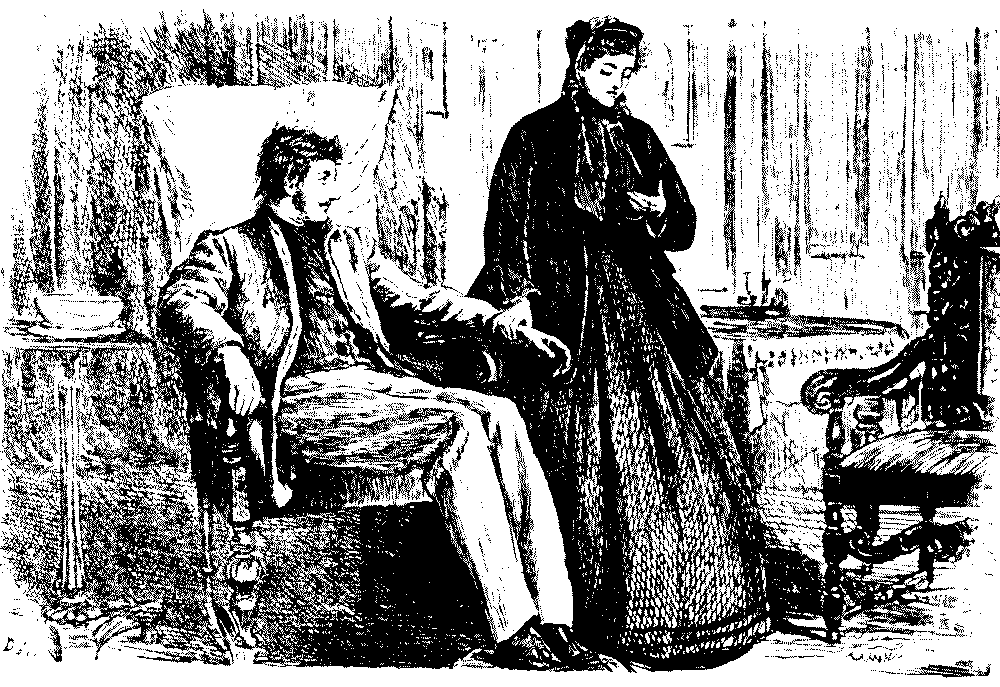
LADY PHYSICIANS
Who is this interesting invalid? It is young Reginald de Braces, who has succeeded in catching a bad cold, in order that he might send for that rising practitioner, Dr. Arabella Bolus!
Coming to the professions, we find a great advance on the somewhat hesitating attitude adopted by Punch in the 'fifties. In the early 'sixties he avowed himself as a convinced supporter of the admission of women to medical degrees. By 1870 he went so far as to advocate "opening the door of every secular profession to every woman qualified to enter it." He trusted their good sense not to attempt the impossible: "only fools rush in where angels fear to tread, and women, all but very rare mad women, fear to tread the rough ways they are unfitted for." Punch, along with Disraeli, ranges himself on the side of the angels. This marks the high-water level of his recognition of women's professional claims, but as early as 1862 he had registered his protest against the decision of the Edinburgh College of Physicians, when they refused to grant women the medical diploma, by a majority of 18 to 16 votes:—
We are glad the minority was so large, for we think it was in the right. There is no reason why a lady learned in medicine should be refused a doctor's degree. Nobody would be obliged to employ a medical woman in preference to a medical man. It is very true that it is necessary that a practitioner of medicine should be endowed with reflective faculties; but perhaps reason is not quite exclusively the prerogative of man. One or two women could be named whose works exhibit undeniable evidences of some logical faculty and judgment of causation. A female Harvey or Sydenham, or Hunter, or Abernethy would possibly turn up if the portals of medicine were not shut in her face.
The Medical Profession
The rejection of Miss Elizabeth Garrett and other women candidates by the Apothecaries and other medical corporations is unsparingly condemned in the issue of February 22, 1868; but the history of the campaign is written at length in the Life of Sophia Jex-Blake. It may suffice here to add the most notable, and, allowing for a little pardonable optimism, the sanest of Punch's contributions to the controversy in the period under review in this volume. It appeared in March, 1870, in the form of a letter, but here, as elsewhere, the views are clearly editorial:—
The necessity, Sir, of persevering study will, alone, we may be sure, suffice to keep all women out of the medical profession, but a very few. There is therefore no sort of occasion for the opposition to the movement on behalf of their eligibility to be members of that profession, offered, conceivably, by no men out of it but fools, and by none in it but trades unionists. Assuredly, Mr. Punch, rather should every encouragement be given to women desirous to enter the profession of medicine. Paterfamilias is a goose if he do not encourage any daughter of his, endowed with intellect, industry and resolution, who may evince a turn that way. No daughter can Paterfamilias get so thoroughly off his hands as a self-supporting one.
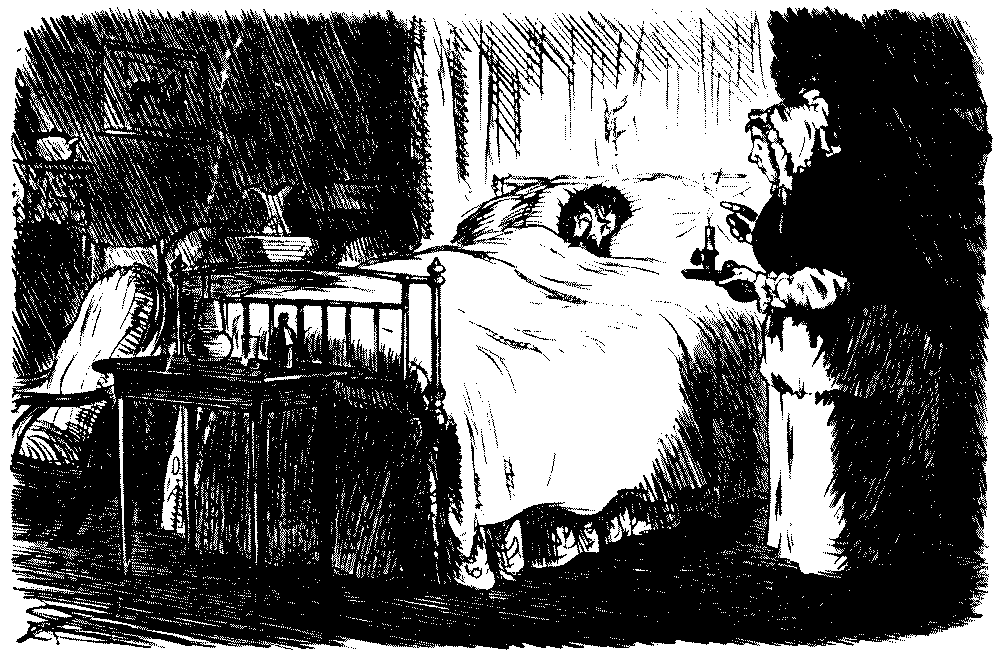
OUR NURSES
Experienced Night Nurse (sternly): "Come, come, sir! You must stop that horrid noise. If you keep wheezing and snoring like that all night, how am I to get to sleep?"
The medical science, Mr. Punch, acquired by a lady doctor here and there might prove a leaven which would leaven the whole lump so to speak, with apology for calling the fair sex a lump. And the lump sadly wants leavening. When it had got properly leavened there would soon be an end to advertisements of "corsets," cosmetics and ways of being made beautiful for ever; also an end of low dresses in high life and high latitudes. The death rate from bronchitis and consumption would largely decrease.
There would likewise be an end of Daffy and Dalby, and all manner of domestic quackery in those upper regions where future men and women make the noises which pious Æneas heard, the first thing, in the lower. Moreover, we should hear much less of those noises.
And mark. Whilst the medical profession would be a resource for a clever girl, who, having to live somehow, would like to live single, or at any rate, having a soul of her own as well as a body, would hate to sell herself in the marriage-market, it would by no means debar such an one, matrimonially disposed, from matrimony. For what young medical man wanting a partner could do better than choose a medical lady duly qualified (in every respect) for partnership? And every non-medical man thinking to take a wife would find his account in taking a doctress who would know better than, by continually breaking the natural laws, to let herself in for everlasting headaches, faintings, hysterics, and other ailments, rendering herself a perpetual plague to a husband, and running him up doctor's bills. Finally, the father of a family of children, whose mamma was a medical gentlewoman, would enjoy the advantage, instead of suffering the expense, of having a doctor always in the house.
That the Legislature will compel the Medical Council to grant a diploma to every lady who can satisfy their examiners is the hope of
Yours truly,
Celsus Excelsior.
The question of the admission of women to the Bar had already attracted serious discussion. In June, 1869, Punch, generalizing from a particular case, expressed mock horror at the prospect:—
THE BAR FEMININE (Respectfully but remonstratively recommended to the notice of John Stuart Mill)
Is this, we earnestly ask, in the name of cruelty to legal animals, what Court and Clients must be prepared for when ladies are admitted to practice at the Bar?
The Shedden legitimacy case was resumed this morning for the fifteenth time before the House of Lords. The Lord Chancellor commented upon the extreme prolixity of Miss Shedden's address, which has now occupied fourteen days, and exhorted her to confine her remarks to the evidence. Shortly after commencing to address their Lordships this morning Miss Shedden swooned, and was carried out. Dr. Bond being sent for, testified that the lady was suffering from hysteria, brought on by nervous exhaustion. Their Lordships postponed the case till to-morrow, when, if Miss Shedden should be unable to proceed, her father will be heard.
Talk of "the Subjection of Women," Mr. Mill! Here's the whole force of Law Lords in subjection to one woman ... who, after fifteen days, talks herself into hysteria, and their Lordships into—but what single word can be found comprehensive enough to describe their Lordship's state of body and mind, under the peine forte et dure of this distressingly fluent female. Fancy a Bar of Miss Sheddens! The masculine legal mind recoils in horror from the idea!
The Suffrage Question
According to the D.N.B. Miss Shedden conducted her case for thirty days. But a few months later Punch, discussing the "Professions of Petticoats," approved of the contemplated innovation, and in 1870 wrote: "Open the Bar, forensic as well as tabernary, only insist on the wig and gown—the regulation gown—let the law of judicial vision be the same for female counsel as for male."
The advance in Punch's education in regard to the most controversial of all woman's claims—that to the vote—is much smaller, but it is an advance. He began in ribaldry and ridicule; but the persistence, the ability, and the high character of the advocates of Woman Suffrage converted him (intermittently) to seriousness, and even respect. The successive stages of this change are interesting to trace. In 1857 a Feminist Meeting at Leicester is merely the subject for chaff. We have noted in the previous volume that Mayfair held severely aloof from the Women's Rights movement in its earlier days. But in the summer of 1858, at the same time when Almack's was revived, the Marchioness of Londonderry and Lady Dysart proclaimed their adherence to Woman Suffrage. Punch, still somewhat democratic, was not moved by this social portent, and when it was announced that the Ladies' Gallery in the House of Commons was to be enlarged, unfeelingly suggested that it must be a concession to crinoline: otherwise there could be no reason for favouring "a parcel of chattering and giggling women."
In 1859 we find a burlesque account of a woman's meeting, convened to discuss the Suffrage question. But a slightly altered tone is observable in the early 'sixties. Women's indirect electoral power is recognized in the hostile criticism of the Realm, a recently-founded Conservative organ, in the issue of April 23, 1864, and when the question of Woman Suffrage came up before the Social Science Congress in 1866, it is significant that Punch abandons ridicule for argument:—
THE WAY TO WOMANHOOD SUFFRAGE
The cause of Womanhood Suffrage was ably pleaded by Madame Barbara Bodichon at the Social Science Congress, and Madame Bodichon was gallantly followed on the same line by Dr. Mary Walker. It may safely be said that if every man is fit to vote, so is every woman; on conditions. These, of course, are, that if women are to exercise political functions, like men, they must accept all the obligations of the sterner sex. For instance, the right of voting would give women a voice in the organization of the army. This ought not to exist apart from liability to be drawn for the Militia, or to become subject to conscription, if that method of recruiting should come to be adopted in this country. The ladies who sigh for the suffrage should lose no time in enrolling themselves in regiments of Amazonian volunteers to signify that whilst they demand the rights, they are ready to accept the duties of citizenship.
Dr. Mary Walker was the American lady who wore a masculine or semi-masculine garb; Madame Bodichon was the benefactress who invented and endowed Girton.
J. S. Mill on the Suffrage
It was reserved, however, for John Stuart Mill, when, in the debate on the Reform Bill,[25] he moved that in Clause 4 the word "person" should be substituted for "man," to come nearest to breaking down Punch's opposition to Woman Suffrage. Mill's speech shook him very badly, as may be gathered from the full and eulogistic summary in the "Essence of Parliament":—
And now, Ladies, Mr. Punch does you the justice of believing that you would like to know what arguments your Friend advanced. You may be sure that all that could be said was said in the best manner by Mr. Mill, and that such of you as wish to fight the battle may have all the weapons, elegantly polished, at hand, Mr. Punch—your devoted slave—lays them before you in the most convenient form. Mr. Mill urged that at present:-
Neither birth, merit, exertion, intellect, fortune, nor even accident can enable any woman to have her voice counted in matters which concern her and hers as nearly as any person in the kingdom.
It is not just to make distinctions between the Queen's subjects, except for a positive reason.
Are women who manage property, or business, or teach more than most male electors know, unfit for the function of voting?
Would they be revolutionary?
Taxation and Representation should go together. Women pay taxes.
The real difficulty felt is not a practical one; it is only a feeling of Strangeness.
That is a thing which wears off. What are the objections?
1. Politics are not women's business.
2. You don't desire the suffrage.
3. You are sufficiently represented by your influence over male relatives.
4. You have power enough already.
The answers are:—
1. Nor are they man's, unless he is a professional politician. He has business of his own, which he does not neglect, for the sake of voting, more than a woman would.
2. But many do, and others would but for fear of being ill thought of. We are not to suppose that leading questions put to ladies elicit their real sentiments. None are so well schooled as women in making a virtue of necessity.
3. Does man apply this argument to rich men and others with influence?
4. You have great power, but it is under the worst conditions, for it is indirect, and therefore irresponsible. And he would have you work by a manly exchange of opinions, and not by cajolery.
There is a feeling which men have, but are ashamed to express—this:
A woman has no right to care about anything but how she may be the most useful and devoted servant of some man.
Mr. Mill professed such indignation at this idea that he would not argue about it.
In the old days woman and man lived apart—that is, the wife was a plaything or an upper servant. His friends were men. This is changed. The women of the family are the man's habitual society. The wife is his chief associate, most confidential friend, most trusted counsellor.
Then, should a man wish that such a companion should be studiously kept inferior to himself, and taught ignorance or indifference about the subjects among which his highest duties are cast?
The time has come when, if women are not raised to the level of men, men will be pulled down to theirs.
As to women being sufficiently protected, he would like a return of the number of women annually beaten or kicked, or trodden to death by their male protectors—of the cases when the dastardly criminal did not get off altogether—of the cases in which such brutes received lighter sentences than are awarded for trifling thefts.
Old educational endowments were for boys and girls alike. The girls have been shut out, as at Christ's Hospital, where there are 1,100 boys and 26 girls.
The Doctors shut out the ladies.
The painters do the same, excluding them from the associateship of the Academy, because they were distinguishing themselves too much.
A husband can tear away every shilling of his wife's and spend it in debauchery, and even then, if she struggles and saves, he can pounce on her earnings, unless she is judicially separated.
Your Champion, Ladies, wound up with an earnest assurance that when the time should come, as come it would, for acceding to his motion, we should never repent of the concession.
And Punch is sure that whether you want votes or not, you will say that the cheers Mr. Mill gained were well earned.
Mr. E. K. Karslake thought Mr. Mill confounded the distinction between man and woman.
Mr. Denman supported him, but thought the Bill already conferred the suffrage.
Mr. Fawcett (a newly married man too) earnestly supported the motion, and said that the time for chaff on the subject had gone by.
Mr. Laing talked nonsense about the ideal of woman, said that Juliet, Ophelia and Desdemona had nothing to do with votes—the poets understood woman better than Mr. Mill.
Sir George Bowyer, like a gallant knight, supported your cause.
Lord Galway said the motion placed admirers of the fair sex in an awkward position.
Mr. Onslow said that two young ladies had told him they would vote for the man who gave them the best pair of diamond ear-rings.
Mr. Mill was pleased, as well he might be, at the fearful debility of his opponents, and took the division, which was,
For the Ladies73
Against196
____
Majority123for keeping you out, dears.
This speech of Mr. Mill's was the event of the week.
At any rate it cannot be said that Punch failed to do justice to the debate on its merits. His account is both ampler and fairer than many reports of important discussions in Parliament which appear in the daily press of to-day. But this was the day of verbatim reports. Punch mentions one debate which occupied thirty-six columns of closely-printed small type in The Times.
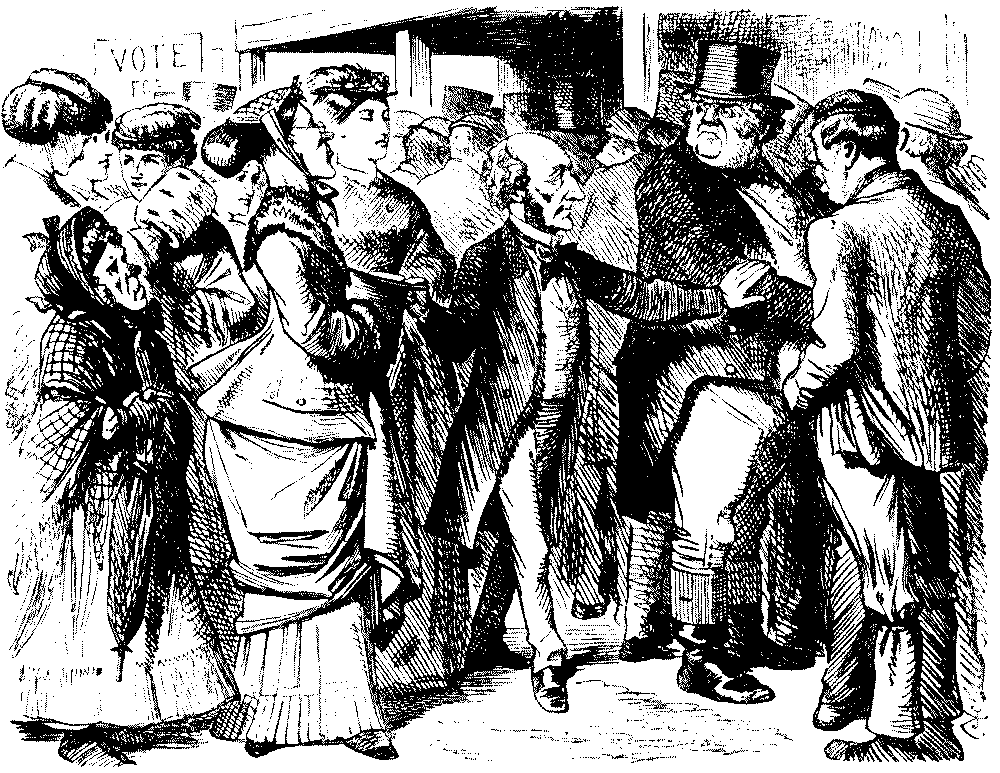
MILL'S LOGIC, OR FRANCHISE FOR FEMALES
"Pray clear the way, there, for these—ah—persons."
By way of an offset to the admissions made in his Parliamentary report, Punch published a long, open letter to Mr. Mill. The argument founded on the derogatory word "person" need not detain us. The letter is signed "Judy," but the voice is the voice of Punch, who would not give women the vote because he believed they could exercise their political rights of sovereignty more effectually by proxy. Why should they wish to exercise power through the franchise when they were already omnipotent over those who had the franchise? Men were not much the happier or the better or the wiser for their politics. Mill's proposal to exclude married women from the franchise is dexterously turned to account as an admission that female influence was paramount as it was; that it was unnecessary to give women what they already exercised through their husbands. In fine, till women were married, they were learning to rule their husbands. After they were married they had their husbands to rule. Politics were the natural occupation of the inferior or slavish sex. When would Mill's logic open his eyes to the fact that, like the Constitutional Sovereign, la femme règne et ne gouverne pas?
Such a letter brought but cold comfort to the Suffragists. It was like feeding them with the East Wind. But at its worst it was an immense improvement on the heavy facetiousness of Punch's earlier manner.
In May, 1868, Punch virtually sided with his "dear enemy":—
Mr. Mill presented to the Commons a petition signed by 21,757 women, who asked for the Franchise. The first signature was that of Mrs. Somerville, Mechanist of the Heavens; the second that of Miss Florence Nightingale, Healer on Earth. Right or wrong, the request ought to have been granted to such petitioners.
Open Letter to Mrs. Fawcett
So when at a meeting in Manchester in December, 1869, it was resolved to form a guarantee fund of £5,000, Punch declared that if the Suffrage was to be had for love or money, women would shortly have it, and went on with characteristic effrontery to claim the credit of being "the Liberator of the Ladies":—
When ladies, ere many months shall have passed over their heads, rush to the poll and tender their votes for the men of their choice, let them not forget to whom they are mainly indebted for ability to exercise the birthright of a Britoness. It has ever been the aim of Mr. Punch to elevate Woman as well as Man. To this end he has directed pen and pencil to the special exposure of the peculiarities which distinguish silly from sensible women to derision. The consequence has been a very general relinquishment of those ludicrous peculiarities, and an awakening the female mind to logical perception, and a sense of the absurd and the grotesque. Hence will sooner or later inevitably result Female Emancipation, for which Female Intellect will have to thank Mr. Punch.
These indiscretions, which were apparently only meant in a Pickwickian sense, obliged Punch to regularize his position in a letter to "Mrs. Professor Fawcett" in the following April. He congratulates the Suffragists on dropping the limitation with which they started and going in for repealing the electoral disabilities of all women—married as well as single. In revising their claim they were at once logical and wise in their generation. But on the broad question Punch comes down on the anti-Suffragist side of the fence:—
Has it never occurred to you that in parcelling out life into two great fields, the one inside, the other outside the house-doors, and in creating two beings so distinct in body, mind, and affections as men and women, the Framer of the Universe must have meant the two for different functions? Can you deny, or shut your eyes to the fact that a similar distinction runs through the whole animal kingdom? Surely, so long as the masculine creature keeps aloof from the domain of the feminine, and leaves to her the nursing and rearing and training of the family, and the ordering and gracing of the home, there lies a tremendously strong presumption against the wisdom of the feminine entry on the masculine domain of business and politics.
The conclusion he comes back to is his old argument: Why give women votes when they have them already?
In a word here is my dilemma, dear Mrs. Professor. Either women don't care for votes—in which case they will make a bad use of them; or they do care for them, in which case they have ours.
Look how you rule in that Parliament for the business of which you do care, and whose budget you control and appropriate. What man dares call his home his own? What man, that deserves to be called a man, with a good wife, wishes to be other than her humble servant, breadwinner, hewer of wood and drawer of water, within the walls of that sacred sphere, of which the household hearth is the central sun? Depend upon it, if Nature had meant you for the franchise, you would have had it long ago. But then, if you had been in our place, we should have been in yours. Do you think it would be a better world for the change?
The worldly wisdom and common sense shown in this letter is also to be found in Punch's review of the whole question of Women's disabilities in the same year. The facetious, patronizing tone is largely dropped, and though the cartoon on the "Ugly Rush," inspired by the rejection of Jacob Bright's Suffrage Bill, clearly approves of the result, it fully recognizes the seriousness of the onslaught on man's monopoly of the franchise. The time for chaff on the subject, as Fawcett said, had gone by.
Short of the vote, however, about which he remained recalcitrant, Punch supported the claims of women to official employment in connexion with the Poor Law, Education, Local Government generally. He bestows a tempered approval on the appointment of Women Parish Officers in Bucks in 1868, and when the first elections to the London School Board were held at the close of 1870, unofficially but strenuously championed the three women candidates—Miss Garrett, M.D., Mrs. Grey and Miss Davies:—
There are some very good men in the candidature, but they are well known, and can speak for themselves. Mr. Punch only wishes to point out that three ladies desire to do Woman's Work, and he hopes that they will be accredited to the Board. He seldom condescends to treat of mere political elections, but these Educational Elections are important, and wise men had better look to them.
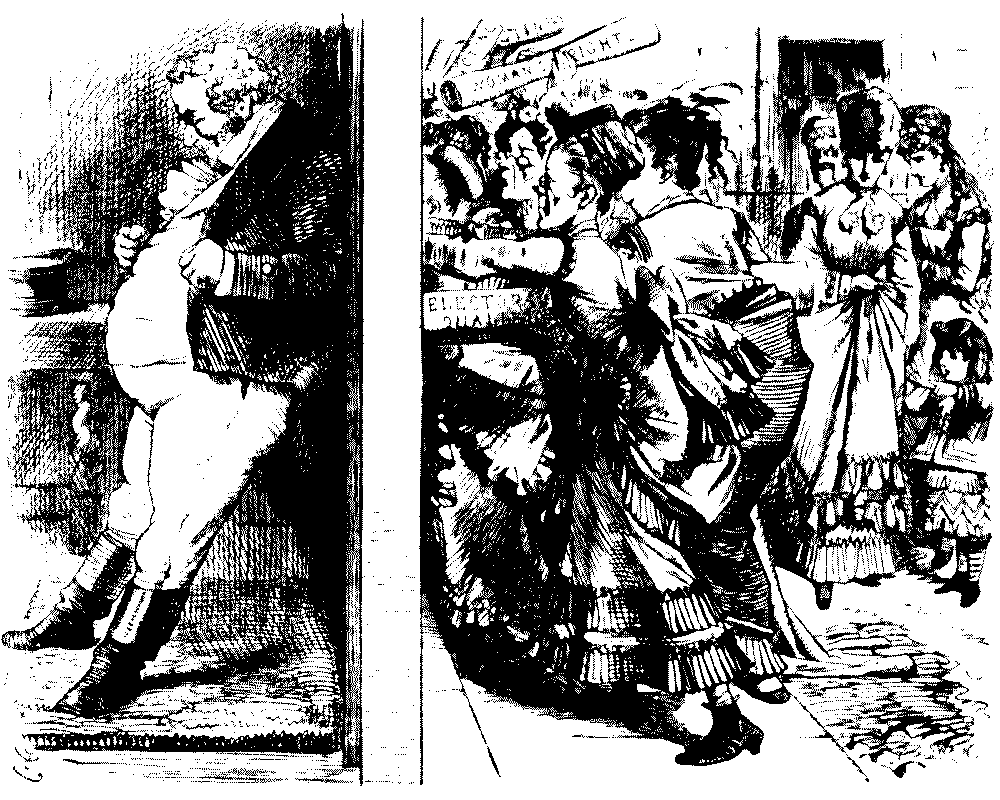
AN "UGLY RUSH"!
Mr. Bull: "Not if I know it!" (See Division on the Woman's Vote Bill.)
Mrs. Nassau Senior
The appointment of Mrs. Nassau Senior by the President of the Local Government Board to inspect and report on pauper schools, and her contribution to the Third Annual Report of that Department, meet with unqualified approval:—
In the midst of that vast blue-book of seven hundred pages there is a bit of motherly writing by Mrs. Nassau Senior, which is delightful to read, and cannot fail to be of immense use. Mrs. Senior has visited pauper schools, and has traced about seven hundred girls who had been educated at pauper schools; and her brief biographies of these poor little waifs are perfect in their simplicity. She believes that the Poor Law system will, in time, come to an end through improvement in education. Mr. Punch is not so sanguine. Mendicity is eternal. But the pauper may be gradually raised to a higher level; and such an inquiry as Mrs. Senior's is likely to do great good in this way.
Mr. Punch is delighted when a lady does in this direction what no man could possibly do. The terse memoirs of these poor little pauper maids are much more pathetic than anything in modern fiction. We trace the poor children from place to place—we see them stunted, sulky, squinting, suffering from ophthalmia, the very refuse of the world. Mrs. Senior, kind and keen in her investigations, tells the Guardians of the Poor (who too often deem themselves mere guardians of the ratepayers) how they may gradually diminish this evil. Mr. Stansfeld did a wise thing when he asked her to undertake the inquiry; if the lessons of it are rightly read, her second contribution to the blue-book will have a far rosier tinge.
The treatment of the Higher Education of Women follows much the same course—from ridicule to respect. When a Women's Library was founded in New York, it is seriously suggested in 1860 that a similar institution might with advantage be established in London, with Miss Bessie Parkes, who was an active promoter of the Social Science Association, as Librarian. But when in the summer of 1862 Mlle. Emma Chenu was admitted to the degree of Bachelor of Science at the Sorbonne, Punch contents himself with drawing up a burlesque list of Lady Professors for the University of Cambridge, most of them popular actresses of the time, including Marie Wilton, Patty Oliver, Lydia Thompson, etc. By way of contrast to this carnival of punning facetiousness we may note the rebuke administered in May, 1863, to the students of University College, who hissed the proposal to admit women to degrees.
Girton College
Great capital was made out of "Sweet Girl Graduates" by Du Maurier in many characteristic variations on the "Princess Ida" theme. But the movement was rapidly passing beyond the stage in which it could only be treated sentimentally or in a spirit of ridicule. Huxley was lecturing to women at South Kensington in 1870, and in 1871 the Ladies' College at Hitchin (founded in 1869), which owed its origin to the enterprise and liberality of Madame Bodichon—the friend of George Eliot and the zealous advocate of the improvement of women's position in the state—had so far justified itself as to earn Punch's commendation, under the typically frivolous heading of "The Chignon at Cambridge," a good example of inept alliteration's artless aid:—
At the examination lately held at Cambridge a number of students from the Ladies' College at Hitchin passed their "Little-go"; the first time that such undergraduates ever underwent that ordeal. It is gratifying to be enabled to add, that out of all those flowers of loveliness, not one was plucked. Bachelors of Art are likely to be made look to their laurels by these Spinsters, and Masters must work hard or they will be eclipsed by Mistresses, more completely than the Sun was the other day by the Moon. And we may expect that when such competitors of both sexes come to perform upon the classical and mathematical Tripos, a Pythoness will be first upon the former, and another young lady will dance off triumphantly Senior Wrangler.
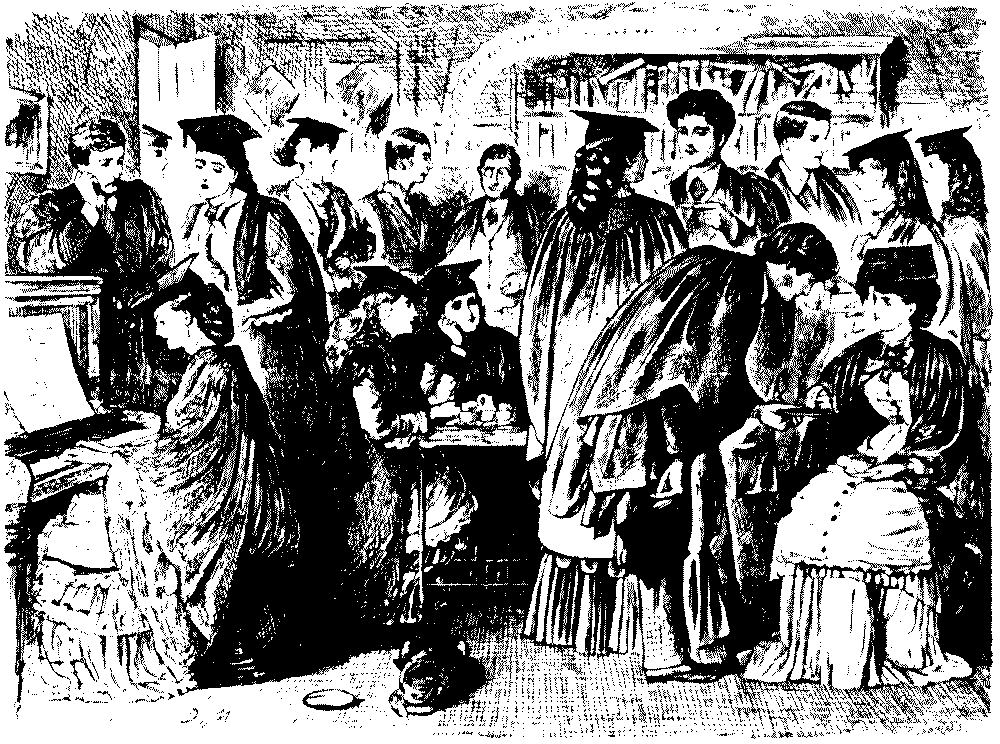
SWEET GIRL GRADUATES—AFTERNOON TEA VERSUS WINE
Punch's prophecy was fulfilled by the exploits of Miss Ramsay (afterwards Mrs. Montagu Butler) and Miss Philippa Fawcett, daughter of Henry and Millicent Garrett Fawcett. The College at Hitchin was moved to Cambridge in 1873, when it entered on a new and prosperous career under the title of Girton. But Punch, reverting to his facetious manner, availed himself of the opportunity to publish a set of burlesque regulations and syllabus of lectures for the new College. The same spirit is betrayed in the comments on the proposed Ladies' Club in 1869:—
A Ladies' Club is said to be in process of formation. How the male mind shudders at this most tremendous news! What a field for fearful questions the intelligence suggests! Will there be a Club Committee? and, if so, at its meetings how many ladies' tongues will be allowed to speak at once? Will there be a smoking-room? And, if so, will cigars be suffered to be lighted, or will the fear of being ill restrain the ladies from indulgence in anything except the very mildest cigarettes? Will conversation be restricted to the politics of the nursery and the latest news in bonnets; or what will be the limits sanctioned to recounters of a thrilling bit of scandal, or to narrators of a tale of love, or marriage, or divorce, which has just been set a-wagging in high life? Instead of billiards we presume the younger members will amuse themselves with tatting, while the elder are engaged in a fierce battle at Bézique....
The ladies will, of course, want a title for their Club. Perhaps "The Femineum" would be a fitting name for it; or would its members prefer to call themselves "The Chatterers" while the present fashion lasts? Should the Ladies' Club prove popular, there may doubtless be some little ducks desirous to belong to it. But we trust, however silly may be certain of its members, nobody will ever dream of calling it "The Goose Club."
The promoters might have retorted that such criticisms were worthy of the members of the "Asineum." But Punch was fairly entitled to make such capital as he could out of the advertisement quoted in 1874: "Philosopher wanted, as Secretary to a Ladies' Club."
The Economics of Marriage
As we have seen, Punch had frankly recognized that matrimony was not and could not be the be-all and end-all of all women—that there were some girls who, though they might marry if they chose, did not wish to; girls who preferred independence to matrimonial servitude; girls, again, who would make excellent wives, but were not chosen because men were stupid enough to be governed in their choice by looks and looks alone. The economics of marriage, again, were becoming an increasingly important consideration as a result of the raising of the standard of life and the cost of living. In the 'forties Punch printed a song of which the refrain was "If I had a thousand a year," which represented a sum almost beyond the dreams of middle-class avarice, to judge by all the things the dreamer would do and all the luxuries he would indulge in, if his income reached four figures. In 1858 The Times started a serious discussion of the problem "Marriage on £300 a year," which the same audience nowadays would regard not as practical politics but an act of insanity. Punch, however, satirized the discussion from the point of view of an agricultural labourer earning a wage of 10s. a week.
Though in the golden days of Gladstonian finance the income tax came down to 4d. and even 3d. in the pound, the standard of living rose, and £500 a year is mentioned in 1867 as a possible basis for matrimony. From whatever the cause—possibly the prevalence of large families had something to say to it—the rapidity with which married people of both sexes grew old, as compared with the juvenile grandparents of to-day, is strikingly illustrated in the pages of Punch. Take for example the two pictures "Twelve months after Marriage" and "Twenty years after Marriage" in 1862. When we take into account the earlier age at which people married sixty years ago, the couple in the picture on p. 265 need no be more than forty-five; yet they both look at least seventy. One is reminded of a passage in Sense and Sensibility (though, that, of course, was fifty years earlier), in which John Dashwood, speaking of his mother, who is "hardly forty," suggests that "she may live another fifteen years." The pictures given here represent a happy marriage. Punch had no panacea for unhappy marriages; but he remained of the same opinion, so often expressed in his earlier days, that a cheap Divorce Act was a better cure than the punishment of cruel wife-beaters. And throughout this period he remained constant in his support of the campaign for the amendment of the Women's Property Acts, on the lines of his summary of Lord Brougham's three resolutions moved in the House of Lords on February 13, 1857. They were "First, that their present rights were all wrongs. Second, that a woman was entitled to her own property; and third, that if our ridiculous theory of marriage prevented a woman from having this justice, at all events a profligate husband should be restrained from wasting her possessions." Lastly, he remained unshaken in his adhesion to the cause of marriage with a deceased wife's sister, or, as he termed it, "the Bill for Emancipation of Sisters-in-Law from the tyrannical disqualification which prevents their taking the matrimonial oath when elected by a Briton and a widower."
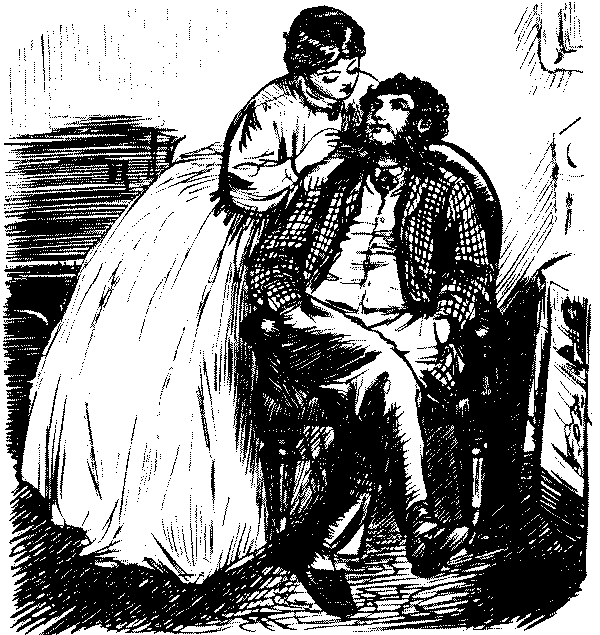
TWELVE MONTHS AFTER MARRIAGE
"Bobby ought to love his pet for taking such care of his beautiful whiskers."
The English Feminine Type
By way of conclusion we may add that if Punch reserved to himself the right of castigating the follies of his countrywomen, he was valorous in their defence when they were depreciated or caricatured by foreign critics or artists. In 1858 he falls foul of a German journalist, under the head of "British and German Beauty":—
The Berlin Charivari contains the following humorous remarks on English beauty:—
"Each Nation thinks itself the handsomest in the world. We paint the devil black; the blacks will have him white. Miss Pastrano delights in her beard, and every Englishman thinks his red-haired, crooked-nosed, rabbit-toothed, goggle-eyed, loose-legged, calfless Dulcinea the very perfection of human beauty."
Not quite that. Not so perfect as the raven-haired, Grecian-nosed, white-and-sound-toothed, sloe-eyed, neat-legged young Teutonic lady, with such pretty little feet and ankles at the end of her legs. Of course the Prussian Charivari's notion of an English girl is a bit of fun, complimentary irony; and we are sure our fair countrywomen will feel highly honoured by the mock-depreciation of our cousin German.
Much later on the French caricaturists, who habitually represented Englishwomen as lean, gaunt, ill-favoured and ill-dressed, and with long projecting teeth, roused him to protest with equal vigour against their gross and unseemly libels.
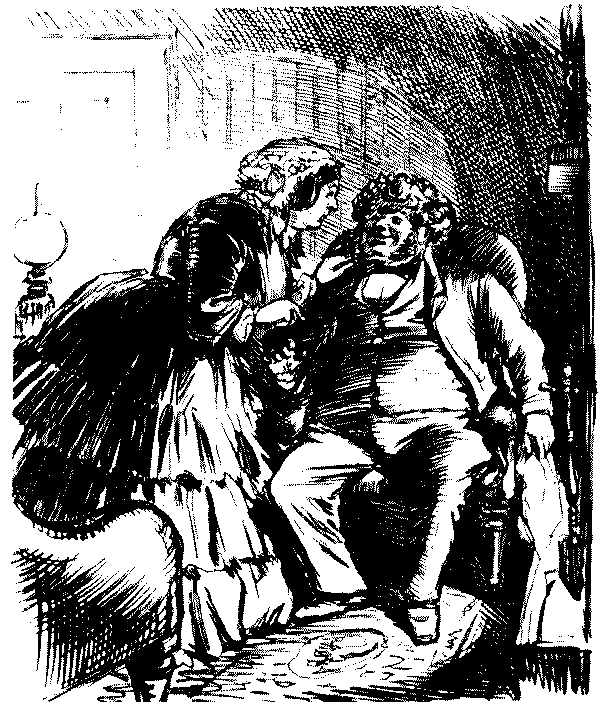
TWENTY YEARS AFTER MARRIAGE
"My dear Bobby, you must let me pull it off your nose; it looks so ugly."