GENERAL SOCIAL LIFE
Reading edition
From a variety of causes, most of which have been already discussed, reformers, humanitarians and critics of the established order generally display less resentment and acrimony throughout the mid-Victorian period. We have already hinted that the mellowing of Punch's temper may have been due in part to the death of Douglas Jerrold. But the fact remains that Punch had already begun to find less incentive to and less excuse for the saeva indignatio which animated his earlier tirades against the aristocracy, and the selfish detachment of the titled classes. The spectacle of the Cream of Society disporting themselves at Cremorne to the exclusion of the general public is satirized in 1858, but the satire is tempered by the admission that this aristocratic "jamboree" was organized for a charitable purpose and brought in substantial proceeds. An analysis of the special butts of Punch's satire reveals the interesting fact that, while not enjoying a complete immunity from criticism, the dukes are not only displaced from their unenviable pre-eminence, they almost disappear as targets for invective. We find attacks on the promotion of "well-connected politicians" à propos of Lord Clanricarde's appointment as Privy Seal in 1858; and verses in the same year on the worship of the peerage, with "John Bull loves a lord" as text, but the flunkeydom of the Press is already a far less frequent theme of scarifying comment. Punch's favourite occupation as the reviler of "Jenkins" was gone by the 'sixties, but snobbery in high places was not dead. Sir Benjamin Brodie, Sergeant-Surgeon to William IV and Queen Victoria, had been made a baronet in 1834; in 1858, when he was President of the Royal Society, there was some talk of his being made a peer, and Punch in December of that year bitterly attacked the influences and prejudices which he believed were effectual in preventing the bestowal of the honour.
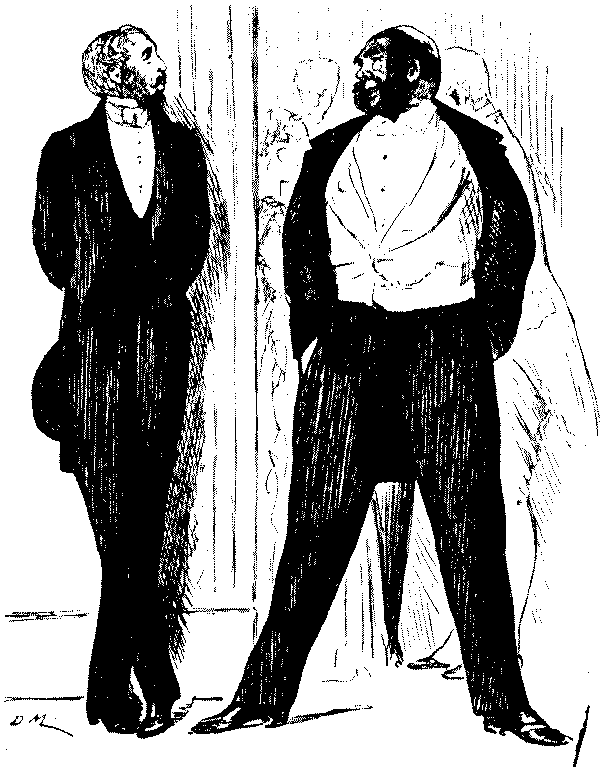
EXCLUSIVENESS
Host: "Nice party, ain't it, Major Le Spunger? 'Igh and low, rich and poor—most people are welcome to this 'ouse! This is 'Liberty 'All,' this is! No false pride or 'umbug about me! I'm a self-made man, I am!"
The Major: "Very nice party, indeed, Mr. Shoddy! How proud your father and mother must feel! Are they here?"
Host: "Well, no! 'Ang it all, you know, one must draw the line somewhere!"
Peers and Commerce
The reign of the old nobility, however, was not merely threatened by outspoken criticism. The situation crystallized in the title of the play, New Men and Old Acres, was already a real thing; prosperous cotton-spinners were beginning to buy estates; by 1865 Punch was contrasting the new representatives of the landed interest with their feudal predecessors—very much to the disadvantage of the former—and by the 'seventies the contrast was a favourite theme of Du Maurier. Simultaneously the converse tendency of the aristocracy to go into trade is noted, but with little sympathy. Thus we find in 1863 the prospectus of the Noble Hotel-keepers' Association (Limited) headed by a list of parasitic peers, including the Duke of Dangleton, the Duke of Dawdleton, the Duke of Diddleton, the Marquis of Hardupton, the Earl of Toadington, Viscount Ortolan, the Lord Verisopht, Sir Lionel Rattlecash, Bart., and so on; and a double-page cartoon shows the scene in the coffee-room of one of the Hotels in which "gents" of different types are being waited on by coronetted and bewhiskered peers. Greed rather than business capacity is indicated as the characteristic of the new recruits of commerce, and the annals of the last fifty years have furnished disastrous and even tragic examples of the results of this titled invasion of the City. Experience has shown that on the whole it is safer to gain a peerage by success in commerce than to exploit a peerage as a short cut to making money.
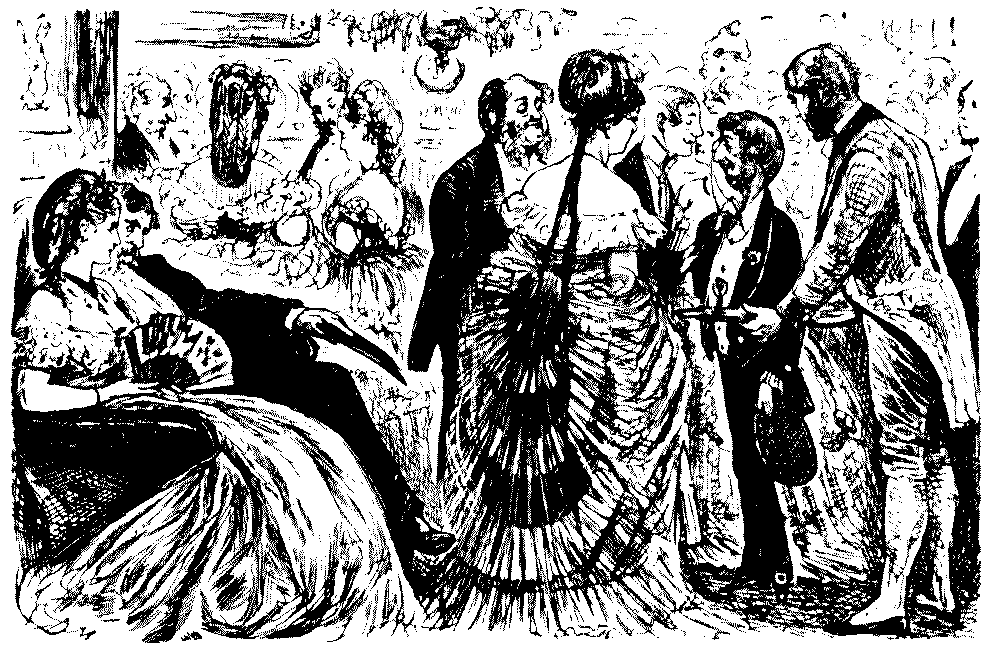
AN INVESTMENT
"Tell me, my dear, who's that little man they all seem so dotingly fond of?"
"That, Uncle? Oh, that's Lord Alberic Lackland!"
"Well, he's not much to look at!"
"No, poor fellow! But he's awfully hard up, and Mamma always likes to have a lord at her dances, so Papa gives him ten guineas to come—that is, lends it, you know—and a guinea extra for every time my brother Bob calls him Ricky!"
Commercialism in high places offended Punch's notion of noblesse oblige. Much the same sentiment inspired his vehement protest against our selling the house in which Napoleon died at St. Helena for 180,000 francs: "We have an especial dislike to this traffic in a great man's grave. It is turning the funeral urn into a money-box with a vengeance—the vengeance of a miserly shopkeeper." On the other hand, complaints of extravagance and waste, though not so strident as of late years, are freely uttered in connexion with official dinners or loyal demonstrations—for example, when the Prince and Princess of Wales visited Chester in 1869, the Mayor's subscription alone amounted to £500.
In the domain of Commerce and Economics no movement in the Victorian age was more fruitful of results than that of co-operation. But a history of the system which began with Owen, took concrete shape in the famous venture of the Rochdale Pioneers in 1844—twenty-eight working men with a capital of £38—and led to the multiplication of Workmen's Co-operative Societies all over the country, is outside the limits of this survey. The movement came from below; Punch was mainly if not entirely interested in its development as it affected the well-to-do classes by the establishment of "the Stores," and their competition with retail shops, and in the grievances of purchasers and their servants who had to carry their parcels home—grievances which reach their climax in the year 1868. In other words, he approaches the subject as an irresponsible social satirist, not as a student of economics. His pages only show the froth of the movement, not its deep underlying current. So, too, with the cult of Social Science. The periodic Congresses furnished him in the main with matter for chaff, though in 1858 he appeals to the moral engineers of the Social Science Association to devise some means of utilizing "social sewage"—swindlers, fraudulent bankers and trustees. The shortcomings of British cookery always found in Punch a candid critic, but he had no sympathy for those journalists who sought to remedy the deficiency by the publication of elaborate and expensive daily menus. Such instruction was a mockery to the poor who had not enough to eat, and did not know how to cook the little they had.
Banting and "Hydros"
An interesting treatise might be written on Victorian diseases and their remedies. The worship of pastime, exercise and athletics was still in its infancy; whatever its drawbacks, it has undoubtedly given a new lease of life to the middle-aged. Obesity, due in great measure to over-eating and lack of exercise, was the nightmare of the well-to-do, and, if proof be required of the statement, one need only refer to the success of the movement initiated by Banting. Inasmuch as he was a fashionable undertaker—he was responsible for the construction of the Duke of Wellington's funeral car—there was an element of disinterestedness in his efforts to promote longevity. He was also a living example of the virtue of his method, for he reduced himself many stones in weight by the use of non-fat-producing foods. "He had a whalebone frame made to fit his once large waistcoats and coats, and wore the whole over his reduced size—removing this armour to produce a full effect."[14] His famous letter to the Press "On Corpulence" rang through the land: his name was a household word in the 'sixties, and he enriched our vocabulary with a noun and verb which are enshrined in the classic pages of the New English Dictionary, though they are practically unknown to the Georgian generation. Hustle and exercise and nerves have removed the evil against which he warred, and in an age in which excessive bulk is a rarity, the name of Banting has passed into semi-oblivion. But Punch's Almanack for 1864 is full of it and him, and for a good many years Banting was as familiar in the mouths of men as Pussyfoot is to-day.
The campaign against over-indulgence was not confined to an attack on starch, fat and sugar. In the 'fifties hydropathy had come to stay, and in the 'sixties hydropathic establishments were to be found all over the British islands and in America, though the abbreviation of "hydro" was not introduced till later. Fortunes were made—and lost—in these institutions, and they still exist, though some of the most sumptuous "hydros" have undergone curious vicissitudes and conversions. One of the best known of all was used as a girls' school during the War. But the rigour of the water-cure treatment was only enforced in the early years of the movement; proprietors gradually realized that it did not pay to run their establishments as uncomfortable hospitals, and with a laxer administration the whole system fell somewhat into discredit. The convivial Punch never smiled on it, as may be gathered from the verses he printed in March, 1869, when hydropathy was still in its prime, on "Sound Port and Principles." They must not, however, be taken to represent Punch's own views, for he was no lover of guzzling. The poem is really a satire, but it is partly inspired by Punch's inveterate dislike of the teetotal fanatics.
Surgery was active, though the days of appendicitis and adenoids were still a long way off. Punch, however, was more interested in mental maladies and the pathology of the social system. The Victorian age had no monopoly of superstition and credulity, but prophets and spiritualists and diviners reaped a rich harvest in the 'fifties and 'sixties. The comet of 1857 caused a good deal of anxiety, so much so, that in December of that year an insolvent butcher gave as a reason for his failure "the loss he had sustained in June, when the comet was expected, by a large quantity of meat being spoilt." Dr. Cumming was assiduous in prophesying the end of the world, but unfortunately Punch ascertained that the doctor had renewed the lease of his house for fifty years, and the prophet's defence of his action did not mend matters:—
Mr. Punch finds in a Liverpool journal the following part of a lecture which Dr. Cumming has been delivering on Prophecy:—
"He had been, he said, taunted in the columns of Punch with having, notwithstanding his belief that the world was to come to an end in 1867, recently renewed the lease of his cottage for 50 years. The accusation, he said, although not literally, was generally true, but his answer to it was, that a belief in prophecy should not override commonsense. The doctor was frequently applauded throughout his eloquent lecture."
And by no person should he have been applauded more loudly than by Mr. Punch, if that gentleman had had the good fortune to be in the schoolroom at Claughton, where the lecture is reported to have been delivered. The last quoted sentence is so admirably frank that Mr. Punch cannot withhold his tribute of veneration. In other words, although it is all very well, in the way of business, to work the old Hebrew scrolls, which boil down into capital stock for the rather thin yet spicy soup vended by our Doctor, he has no notion of eating his own cookery. We wish we were as certain of our friend's orthography as we are of his commonsense, and would give a trifle (say the next three hundred Tupperian sonnets) to know whether, in his private ledger, he does not spell Prophets as worldly people spell the opposite of Losses.
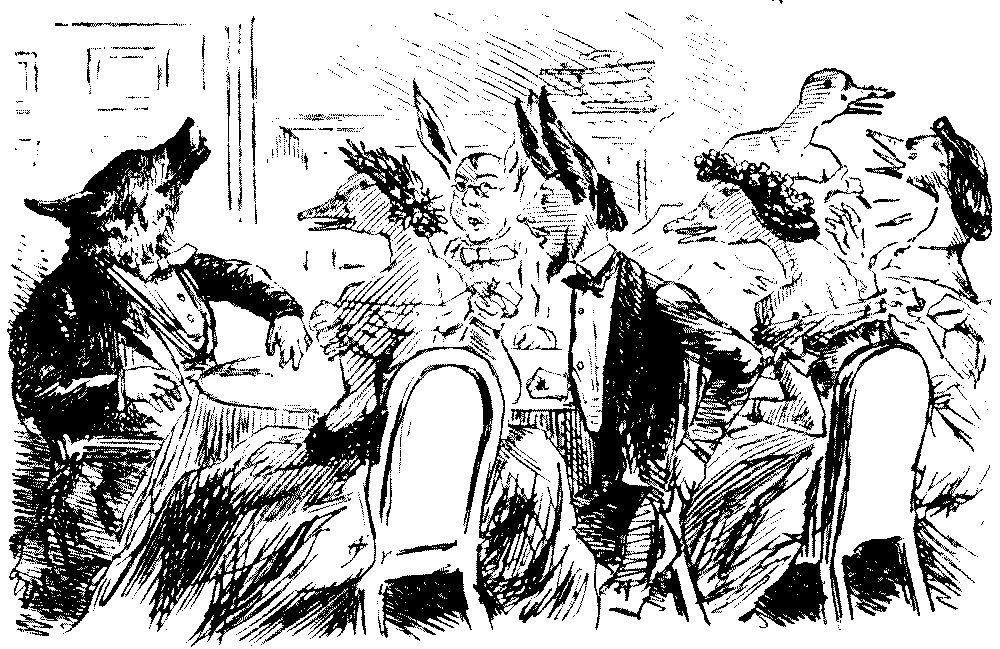
A SPIRIT RAPPING SEANCE!
Mr. Foxer (a medium): "Oh, dear! There's a spirit named Walker writing on my arm!"
"Diviners and Dupes"
The chief exploiters of credulity, however, were to be found in the ranks of spiritualists, mediums, clairvoyantes and professional somnambulists. Men of science still held aloof from this traffic with the unseen, and its terminology was crude, but the methods and results were strangely familiar. Spirit drawings, forerunners of spirit photographs, are mentioned as early as 1857. Under the heading of "Diviners and Dupes" Punch deals harshly with the advertisements of the clairvoyantes and diviners, and once more returns to his familiar complaint against the harrying of humble fortune-tellers while fashionable impostors escaped:—
The gipsies are hardly dealt with in being convicted as rogues and vagabonds for telling fortunes by the cards or the palm of the hand, whilst practitioners in Clairvoyance get their hands crossed with silver, or with postage-stamps, with perfect impunity. There is clearly one law for the Romany, and another for Somnambulists.
David Dunglas Home, born near Edinburgh, of Scottish parents, and descended on his mother's side from a family supposed to be gifted with second sight, returned in 1856 from America where he had spent his youth and early manhood, and in 1860, when he was at the zenith of his fame, elicited a scoffing tribute from Punch under the heading, "Home, Great Home." The first stanza of this poem, which is accompanied by a picture representing a spirit hand placing a wreath on the head of a lady with a goose's head, refers to Home's famous feats of "levitation" or rising in the air as if impelled by some unknown force. Punch was stubbornly sceptical of the whole business. But if any medium ever deserved the title of "great" it was Home. Did he not inspire Browning to write his famous "Sludge, the Medium"—though Mrs. Browning is said to have been a believer? Anyhow, the list of his converts is too remarkable to justify Punch's contemptuous disparagement. It included Dr. Robert Chambers, Dr. Lockhart Robertson, the editor of the Journal of Mental Science, John Elliotson, a distinguished physiologist, S. C. Hall, the Earl of Crawford and Balcarres, F.R.S., the Earl of Dunraven, and the late Sir William Crookes, F.R.S. Home was received into the Church of Rome and had an audience of the Pope in 1856, and eight years later was expelled from Rome as a sorcerer—a tremendous testimony to his powers. He married twice into the Russian noblesse, his first wife being a god-daughter of the Tsar Nicholas, and he gave repeated séances before his son Alexander II. The infatuation of the Russian Court for wonder-workers and miracle-mongers was hereditary, and of late years became tragically notorious, but Home was received with equal favour by the King of Prussia, the Emperor and Empress of the French, and the Queen of Holland. The "Spiritual Athenæum" (no connexion, need one say, with the august institution at the corner of Pall Mall) which he founded in 1866 had but a short life, and the gift of £60,000, which he received from a rich widow, was revoked as the result of a Chancery suit, the lady alleging he had obtained it by spiritual influence. But we have it on the authority of the D.N.B. that he "was not a professional medium, and scrupulously abstained from taking money for his séances," which answers Punch's sneer at his lucrative traffic with spirits. The writer of the notice concludes with the words, "his history presents a curious and unsolved problem." Taken all round, he was by far the most remarkable personality in spiritualistic circles in the nineteenth century, and "imagination's widest stretch" fails to shadow forth the influence he might have exerted had he flourished sixty years later. Let us be thankful that he lived when he did, and freely own that, if an impostor, he was an impostor of genius and emphatically not a Rasputin.
Mediums and Faith-healers
Alongside of Home's manifestations, the exploits of other Victorian mediums dwindle into insignificance. But they furnished Punch with food for ridicule, as when the Nottingham spiritualists in 1863 suggested the writing of a new Bible from their direct revelations; or when an American clairvoyante published, and distributed in Great Britain, her claims to having made "the greatest discovery ever made," viz., "Mediation Writing, direct to and from the spirit world, in One Minute, without any mechanism, except Pen, Ink and Paper." Her claim to have communicated with Shakespeare gave Punch a special opportunity, for it was the year of the Tercentenary, and the Bard of Avon must have had the whole history of the squabbles which beset that luckless undertaking inflicted upon him by the American lady. More interesting to us, however, is the reference to success achieved by legitimate conjurers in imitating the manifestations of spiritualists. For in 1860 the late Mr. Maskelyne had already exposed the Davenport Brothers, and greatly surpassed any feats they had accomplished in the way of levitation and the materializing of spirit forms. But populus vult decipi: decipiatur; and the game went on. Home was much in evidence in 1870 in the provinces and in Belgravian drawing-rooms, flying "by miracle up to the ceiling, And carrying hot coals on pate or palm, no inconvenience feeling." And in the same year there appeared Dr. Newton, an American faith-healer, or "healing medium," as he was called,
... Out-Homing Home, and curing folks' diseases, Giving blind and dumb, and deaf and halt, eyes, ears, tongues, legs as he pleases; By laying his hands upon them, and bidding their ailments begone, And doing it all for love, and not money—the downy one! And for all our march of intellect, and our monarchy of mind, There's never a Reynard the Fox, but he draws his tail of fools behind; And there's never a quack that quacks, but he finds green geese to echo his quacking, And never a swindler that lowers his trawl, and finds the flat fish lacking!
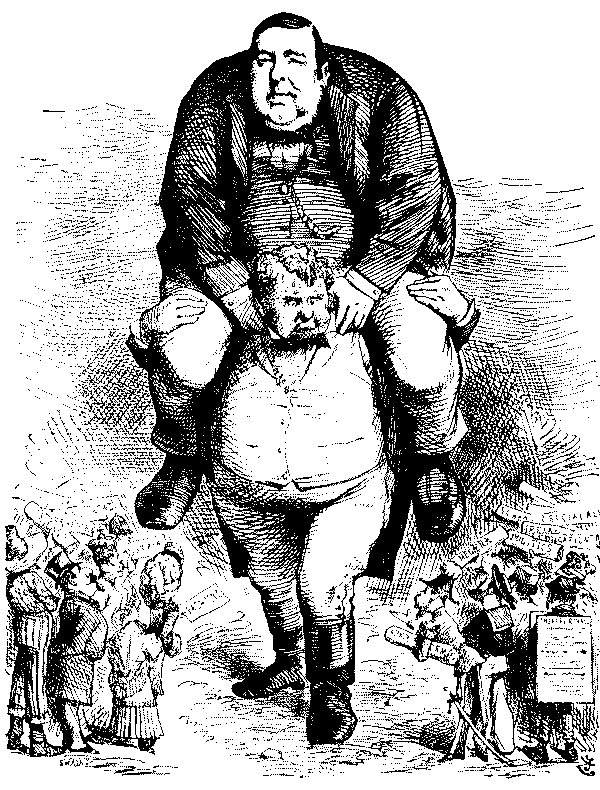
"THE OLD MAN OF THE SEA"
Sinbad (as representing the British Public): "I can't be expected to attend to any of you, with this 'Interesting Topic' on my shoulders!"
As Dr. Newton professed to cure diseases partly by mesmerism, partly by the aid of "disembodied assistants," the spiritualist newspapers waxed lyrical in his praise, while Punch contented himself with pointing out the entire absence of any expert verification of his alleged miracles.
If it almost amounted to a privilege to be imposed on by so splendid and well-connected an impostor as Home, the famous Tichborne case exhibited Victorian credulity in a less favourable light. Home's influence was confined to the well-to-do, even well-educated dupes. Though he toured the provinces, lectured and read poetry with considerable acceptance, he was most in his element among the "classes" and in Belgravia. The Claimant's appeal was far wider: he was the hero of the masses and of all the great army of the half-baked. Yet the element of romance was not wanting: there is always something "arresting," as the moderns say, in the emergence of a missing heir; everything connected with the business was on a huge scale—beginning with the physique of the Claimant himself, who weighed twenty-four stone—and at its worst it was far removed from the squalors of "Brides in Bath" and other modern trials. The unshaken belief of the Dowager Lady Tichborne was a great asset; the extraordinary astuteness of Orton in veiling his colossal ignorance and turning the hints of his cross-examiners to good account extorted reluctant admiration even from those most convinced of his guilt. There never was a greater example of the saying that "one lie is the father of many." The force of circumstances was too strong for him. It is generally believed that he would have abandoned his claim long before the first trial but for the pressure of his creditors. He was a seven-years incubus on England, but throughout the whole affair he showed a sort of perverted bulldog tenacity which accounted largely for his popularity.
The notices in Punch begin early in 1867 when, in an illustrated chronicle of the previous month, one of the entries reads, "Sir Roger Tichborne arrived from Australia, after many years absence, and was at once recognized as 'the rightful heir.'" The crescendo of excitement and interest went on for nearly four years before the case came into court. The first action opened on May 11, 1871, and two months later Punch bore witness to its devastating influence on social life:—
GROANS OF THE PERIOD
Vox Clamantis in Deserto: "Tichborne—Orton—quid refert, O!" Who, this side the Channel Ditch born, Can escape the talk of Tichborne? What would I not give in payment, To hear no more of "the Claimant"! Sure as Death to poor or rich born, Comes the inevitable Tichborne, Till with cursing, like a raiment, One is fain to clothe "the Claimant." To what realm, by wind or witch borne, Can I flee from talk of Tichborne? Was life to July from May meant, To be given up to "the Claimant"? Patient I've seen ache and stitch borne, But what's that to talk of Tichborne? O, ye Doctors, make essayment Of some cure for chatt'ring Claimant, Worse to kill than grass called twitch born, The still springing talk of Tichborne. All ask what his little game meant: All are pro or con "the Claimant."
Unto boredom's highest niche borne, There enshrine the name of Tichborne; Crest: two tongues, approuvant, blamant— Motto: "Rogerne an Arthur Claimant?"
"Poor, Persecuted Sir Roger"
When, after 102 days' hearing, the jury declined to hear any further evidence on March 5, 1872, Punch joyfully recorded "the collapse of an audacious attempt at robbery, supported by one of the most cruel and dastardly slanders ever devised by rogues in council," and rejoiced in the thought that the folks who lent money in aid of the scheme (by investing in Tichborne bonds) had lost it all. The same number contains a cartoon bearing the inscription, "The Monster Slain," showing Punch saluting Sir John Coleridge, who is standing, armed with the Sword of British Justice, on the prostrate form of the Claimant disguised as a dragon. To the dragon Punch gave the name of "The Waggawock"—a "portmanteau-word" compounded of Wagga-Wagga (where the claimant had lived in Australia) and Lewis Carroll's "Jabberwock," and proceeded to dress that prophetic and mystical poem in plain English.
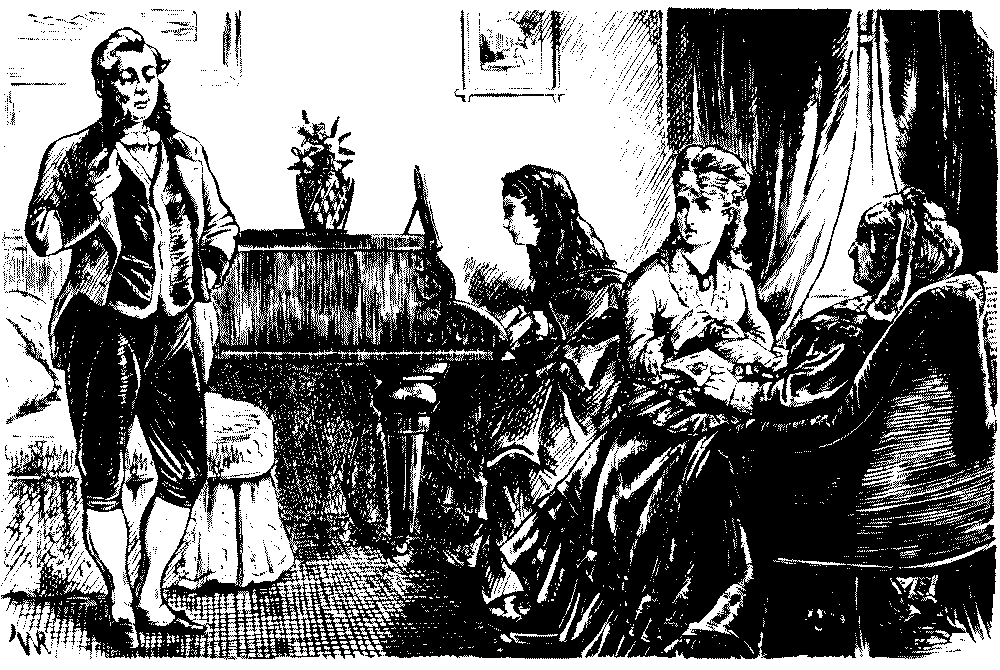
ONE OF THE "SYMPATHIZERS"
Jeames: "I'm afraid, me Lady, I'll require to leave you."
Lady: "Why?"
Jeames: "Well, me Lady, I can't agree with Master's suckasms against that poor, persecuted Sir Roger."
Punch's "chortling" was a trifle premature: two years had yet to elapse before England was finally rid of her "old man of the sea." In April, 1872, we find a picture representing a flunkey giving notice to his mistress, and when asked for his reason saying, "Well, me Lady, I can't agree with Master's suckasms against that poor, persecuted Sir Roger." The egregious Mr. Whalley, M.P. for Peterborough, at a meeting of 3,000 supporters of the claimant held at Southampton in June, spoke vehemently in his defence. There is a statue of Dr. Watts in Southampton Park, and Punch suggested that if these admirers decided to erect one to "Sir Roger" by its side, they should sing, at its unveiling, one of Watts' Divine and Moral Songs which begins:—
O 'tis a pleasant thing for youth To walk betimes in wisdom's way— To fear a lie, to speak the truth That we may trust to all they say.
The "Waggawock" was not really slain until February 28, 1874, when after a second gigantic trial lasting 188 days, the claimant was found guilty of perjury and sentenced to fourteen years' penal servitude. But his backers, mortified by the loss of the money they had invested in him, lent a ready ear to those, like Whalley, who ascribed the persecution to a Jesuit conspiracy. The agitation did not subside until Dr. Kenealy, who had led for the defence, who had been disbarred for breaches of professional etiquette, and was returned to Parliament to advocate the claimant's cause, was defeated by 433 votes to 1 on his motion to refer the conduct of the trial and the guilt or innocence of the prisoner to a Royal Commission. The Tichborne case remains for all time a rich treasure-house of materials for psychologists interested in the Esprit de la Foule; Punch in his punning days would have spelt the last word differently. It also furnishes a conspicuous and ignoble example of the insular detachment which prevailed in a period of "splendid isolation" and non-intervention. At the time when France, beaten to the dust, was agonizing in the throes of the Commune, England was preoccupied and obsessed by this gross and impudent pretender. He certainly made, and unmade, reputations at the Bar and left behind one immortal translation in the course of the cross-examination designed to test his knowledge of the classics—"The Laws of God for Ever" for Laus Deo Semper—but he was a national nuisance as well as a criminal, for he not only ruined himself but discredited thousands of his countrymen whose credulity had been reinforced by greed.
Sport and Pastime
The craze for sensational or dangerous exhibitions so frequently rebuked by Punch in connexion with the performances of Blondin and his imitators cannot be regarded as a specially Victorian weakness. Over pugilism and prize-fighting, as illustrated by the historic contest between Heenan and Sayers in 1860, he could wax enthusiastic. Sayers, by the way, was alleged to have earned £85,000 in one year, a sum which compares not unfavourably with the gains of modern champions. It was an age of non-intervention, but more robust in the expression of likes and dislikes, passions and prejudices, and in some respects less humane or refined in its pleasures. Sporting wagers which resulted in the riding of horses to death were growing rarer but had not altogether died out. The noble pastime of Alpine climbing was already established in 1858, but the combined attractions of healing waters and gambling tables were a more potent attraction to wearied legislators of the gilded breed. The manners of the British traveller were not always above reproach, and Punch in his Almanack for that year, employs his ironical method to explain our unpopularity:—
WHY ENGLISHMEN ARE BELOVED UPON THE CONTINENT
Because they are always so careful to abstain from either word or action, which, in any way, might hurt the feelings of a foreigner.
Because they never institute odious comparisons between things in general abroad and those they've left at home, unless indeed it is to the disparagement of the latter.
Because they never brag about the "freedom of a British subject," in countries which are under a despotic form of government.
Because they speak so fluently in any continental language, and always are so affable when publicly accosted by a stranger, and so ready at all times to enter into conversation with those they may be travelling with.
Because they don't bawl for beer at a first-class table d'hôte, nor make wry faces at the wine as though it disagreed with them.
Because they never in the least let trifles put them out, and however much they are annoyed they do their utmost to conceal it, instead of (as has been maliciously asserted) seizing with delight on every opportunity to give their temper vent, and express themselves dissatisfied with everything that's done for them.
Because whatever provocation they may think they have received, they are so careful not to let strong language pass their lips; and so far from making extracts from the Commination Service, are never heard to use an exclamation more forcible than "Dear me!" or "Now really, how provoking!"
A few years later Punch took up the cudgels on the other side, but the rebuke here administered was undoubtedly deserved. Foreign travel, however, was restricted by the passport trouble in 1858, and Punch saw in the restriction a chance for the native hotel-keeper, if he would only reduce his charges.
It was not exactly a temperate age. Heavy meals and copious potations play an important part in Dickens's novels; and a great many men ate and drank a great deal more than was good for them. Abernethy's method of dealing with the voracious Alderman might still have been profitably followed by Victorian practitioners. But we say "men" advisedly, for there is no evidence that women gorged and guzzled, certainly none to support the fantastic account of English dinner parties given by a French writer and reproduced in 1861 by Punch with characteristic comments:—
"At a dinner party the ladies retire into another room, after having partaken very moderately of wine; and while the gentlemen empty bottles of Port, Madeira, Claret and Champagne, it is a constant habit among the ladies to empty bottles of brandy."
The National Type
The extract is taken from a book on Les Anglais, Londres et L'Angleterre, with an introduction by no less eminent an authority than M. Emile de Girardin, who vouched for its accuracy. According to the writer the English cared for nothing but roast beef, porter, and spirits. They were "averse to contemplation," had not the remotest conception of grace or feeling, their "climate, coarse food, and black drink being utterly opposed to any mental refinement. To possess taste it is necessary to possess soul, and a large soul; and the English possess nothing but appetite." It was a gross libel, but the misconception was mutual, and Punch had done a great deal to foster it by his persistent representation of the "Mossoo" as a mere figure of fun. And let it never be forgotten that the notion of the English as a gross and crapulous race was in great measure due to our caricaturists, Gillray and Rowlandson, and even Hogarth. We chose the beefy, burly, sixteen-stone top-booted farmer as the national type, and we have retained it long after "John Bull" ceased to be typical of the breed physically. It became a caricature, but we have only ourselves to blame if foreign artists caricatured our own caricature. The process of the mutual discovery of France and England has moved far since the 'sixties, and has reached its climax (on the French side) in Les Silences du Colonel Bramble, by our good friend M. André Maurois—a work recently described by Mr. H. A. L. Fisher as "the best psychological study of the English character ever written by a foreigner."
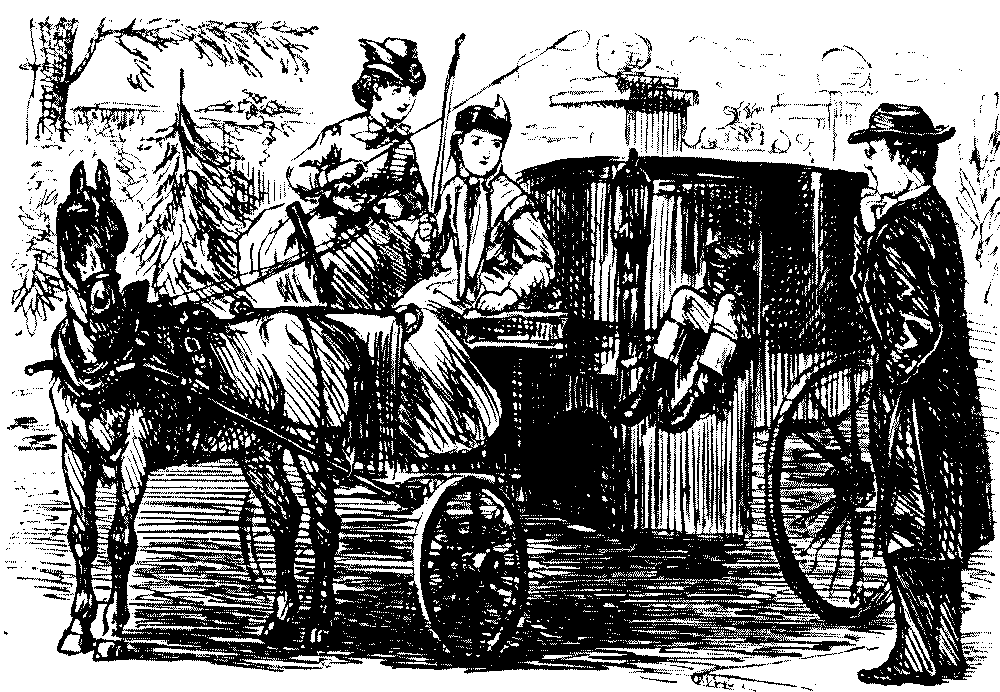
Brougham Drives Up—Two Ladies in Toxophilite Costume on the Box, One Driving—Pair of Top-booted Legs Sticking Out of Window.
Driving Lady (loq.): "Oh, Frank, dear, only fancy, George has got so tipsy at the Archery Meeting, that we've been obliged to put him inside, and drive home ourselves—and poor Clara has pinched her fingers dreadfully putting on the drag, coming down Blunsden Hill!"
The social history of any period may be studied in its lions, and, if the truth be told, in 1861 Du Chaillu and the Gorilla loom larger than Darwin in the pages of Punch, though the Origin of Species is described as "a book of much worth." Punch was not much interested in the theological controversy involved, though he naturally made play later on with Disraeli's famous "Apes and Angels" speech at Oxford. Disraeli was dubbed the new "Angelical Doctor," and in a famous cartoon is exhibited as dressing for an Oxford bal masqué, with a contemptuous set of verses on his bewildering versatility, his impartial hostility to Tractarians and Broad Churchmen, winding up with the warning:—
Yet scarce the best mimes can from Nature escape, And what's simious to saintly brooks change ill; Have a care lest thou then should be most of the ape, When most bent on enacting the Angel.
Another and earlier poem is mainly concerned with the lively disputes that broke out between Huxley and Owen and between rival geologists. Du Chaillu's claims were hotly contested; his book was treated by some critics as a collection of traveller's tales, and his meridional exuberance of manner and diction inspired scepticism among some cautious scientists. But Punch espoused his cause—attracted, no doubt, by his championship of Livingstone—promoted the gorilla to the rank of the "Lion of the Season" in May, 1861, and in due course of time Du Chaillu's veracity was substantially confirmed by later explorers.
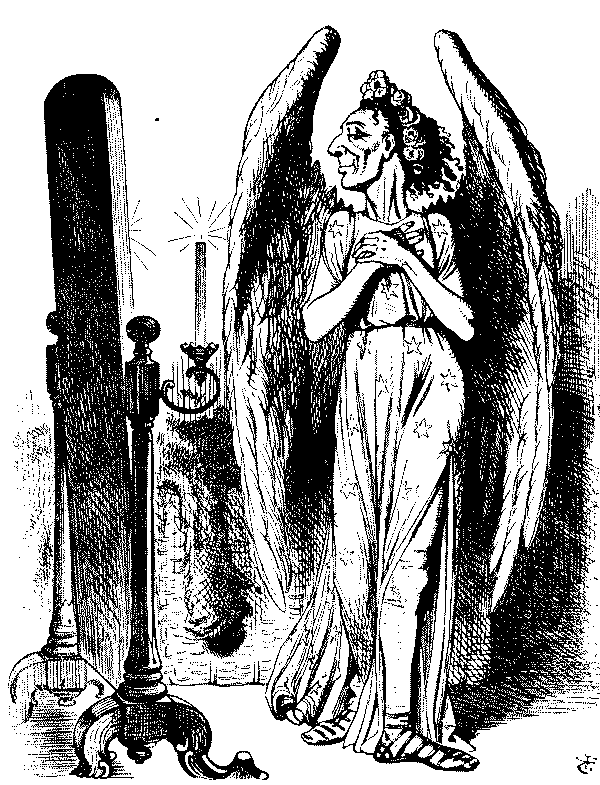
DRESSING FOR AN OXFORD BAL MASQUÉ
"The question is, Is man an ape or an angel? (A laugh.) Now, I am on the side of the angels." (Cheers.)—
Mr. Disraeli's Oxford Speech, Nov. 25, 1864.
There were lionesses as well as lions in the 'sixties, and the year 1864 was marked by a new and momentous apparition—that of the American woman of fashion. Hitherto America had sent us only social and dress reformers, but the arrival of the "elegant and fascinating American young lady" was an event which did not escape the vigilance of Punch. The War was still raging, and, as we know, he regarded the antagonists with almost equal disfavour; but towards these fair New Yorkers he bore no hostility, and no fewer than three pictures, all by Leech, do justice to their charm while the legends emphasize the "pretty little Americanisms" of their speech. It is a welcome change from the consistent disparagement of their brothers and fathers from Lincoln downwards. But the great lion of 1864 was Garibaldi, who was given the freedom of the City of London and greeted everywhere with the enthusiasm which he deserved. It was this visit that gave rise to one of Palmerston's characteristic sayings. Someone suggested that they ought to find Garibaldi an English wife, and someone else observed that he had already got an Italian one, whereupon Pam cheerfully remarked, "O that doesn't matter. We'll get Gladstone to explain her away."
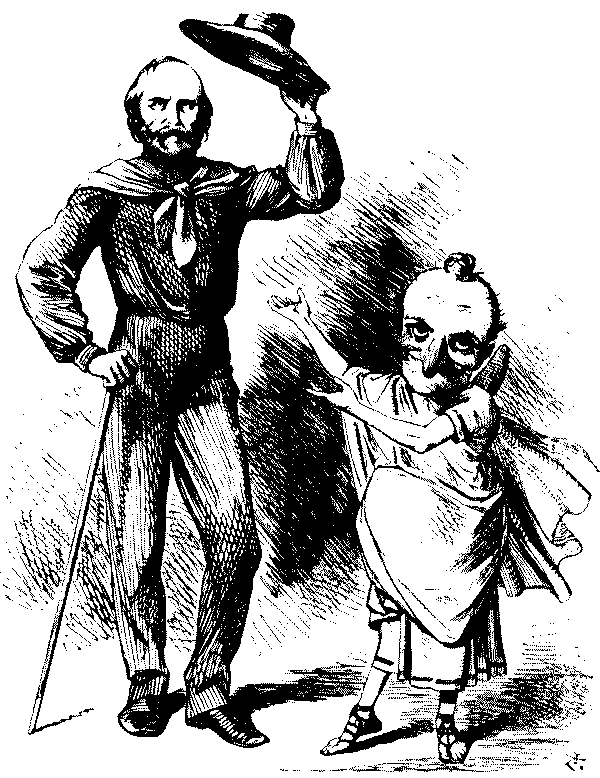
"THIS IS THE NOBLEST ROMAN OF THEM ALL!"
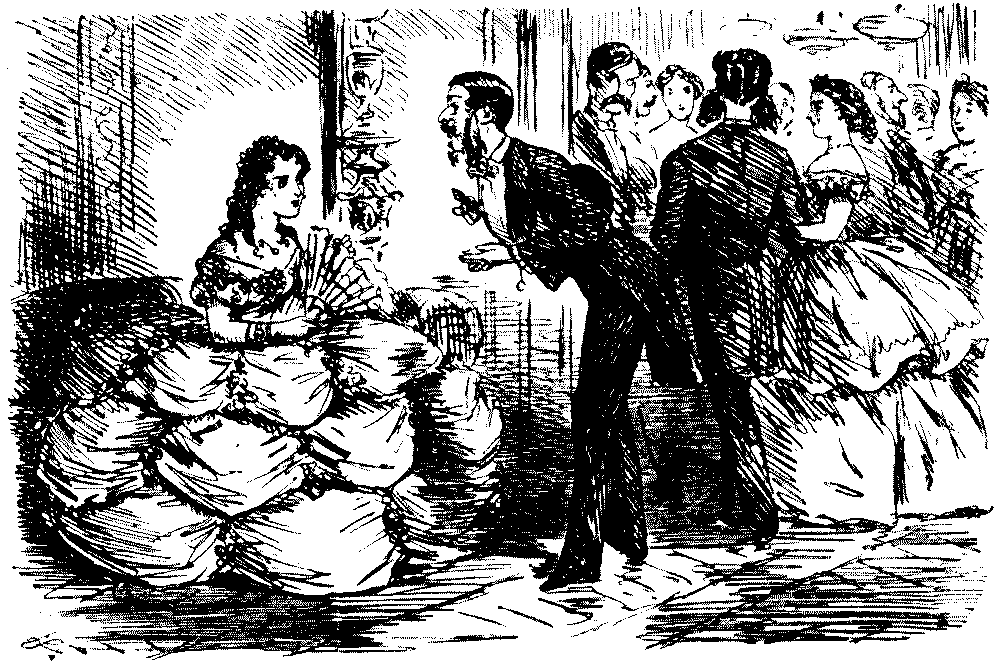
ANOTHER PRETTY LITTLE AMERICANISM
Englishman (to fair New Yorker): "May I have the pleasure of dancing with you?"
Darling: "I guess you may—for I calc'late that if I sit much longer here, I shall be taking root!"
Baker and Stanley
Sir Samuel Baker, who returned from his adventurous and fruitful explorations in Central Africa in October, 1865, with his heroic wife and companion of his travels, was the hero of that year, and the lion of the winter of 1873, after his successful but arduous campaign against the slave-traders of the Equatorial Nile basin. In 1866, after Baker was knighted, Punch printed a poem of congratulation to the heroic pair, winding up with the lines:—
Three cheers for the Knight and the Lady so brave, If Echo's asleep let us lustily wake her; For none are more worthy of shout and of stave, Than the Two who ennoble the old name of Baker.
Stanley, whose historic "Dr. Livingstone, I presume?" when he found the great missionary-explorer at Ujiji, had been duly chronicled by Punch in July, 1872, found himself famous on his arrival in London later in the year. He was, however, a somewhat intractable lion, and the criticisms of the geographical pundits caused him to roar in a rather formidable fashion. Still he received many gratifying proofs of recognition for his great services. He was entertained at Dunrobin Castle by the Duke of Sutherland; his book and lectures brought him in a handsome sum; and the Queen sent him a gold snuffbox set with brilliants.
The Shah-in-Shah
The last of the lions of this period was the Shah. The lion-hunting of Royalties was always offensive to Punch; it is frequently castigated throughout this period, and here it reached a pitch which moved "the Democritus of Fleet Street" to explosions of sardonic and mirthless laughter. There is true satire in the bitter lines headed, "The Shah's Impressions," in the issue of July 12, 1873:—
Yes! Shah-in-Shah in truth I must be Or why this fuss of the Feringhee?[15] Why all these hosts my steps that crowd, With bows so low and cheers so loud? If the Inglees Queen, so great among princes All this respect for me evinces; If the Tsarevitch, when I appear Falls flat as the flattest of bitter beer; If all these Wuzeers[16] and Aghas, and Khans, For me spend their time and their tomauns[17]; Their parks and their palaces lay at my feet, Muster for me their army and fleet And their miles upon miles of merchant ships; If without their ferashes[18] and their whips, Manchester gathers and Liverpool runs, With voices of men and thunder of guns, To the light of the face of the Shah-in-Shah, As unto the amber is drawn the straw; All this is proof in more than words, I am King of Kings and Lord of Lords! They told me in leaving Teheran, Danger of eating dirt I ran,— That out of the realms of the Shah-in-Shah I should find rulers called Light and Law. May the graves of their mothers be defiled That fain with such bosh had their Shah beguiled! For the more of these Feringhee Kaffirs[19] I've known, The whiter to me my face has grown. I've seen the land calls the Russki lord, And there the rulers are Stick and Sword; To the land of the Prusski when I came, The tongue was changed, but the rule the same: The stars on the coats may be sown more thick, But the Prusski's Shah-in-Shah is Stick! And here in the land of the Inglees They live and move but the Shah to please. If my diamonds are as the sun in the skies, What is the brightness of my eyes? As in this land there is no sun, They make a daylight instead of one. The Queen from her palace for me retires To Teheran binding it with wires. Here's Sutherland Beg[20] makes his palace mine, And all but bids skies for me to shine. At the Crystal Palace, Effendi Grove With the rain itself for my pleasure strove, And out of the water brought the fire To compass the Shah-in-Shah's desire. In a wonderful land of wax I've been, And houris fairer than Heaven I've seen; To the Inglees Bank a visit I've paid Where Reuter's gold for me is laid; And all that have seen me, and all I have seen, As dust in the path of the Shah hath been, And instead of eating dirt, I see But Kaffirs eating dirt to me.
We need not be surprised, after reading this scathing poem, to find that, when the Shah left our shores, Punch had no difficulty in enduring his bereavement with fortitude. The net result, so far as the million were concerned, was the addition of "Have you seen the Shah?" to the catchwords of the hour.
In the eternal competition between London and the provinces, centralization and local autonomy, it was hardly to be expected that Punch, in his jealousy for London, should adopt a judicial or impartial attitude. In earlier years he had protested vigorously against Celtic egotism, when developed at the expense of English sobriety, and the growth of the movement in favour of the vernacular in Wales and the spread of Eisteddfods provoked him to contemptuous antagonism. In the "Essence of Parliament" for May 5, 1862, this hostility is sufficiently outspoken:—
In the course of the debate on Education, the Honourable Douglas Pennant, a Conservative, and member for Carnarvonshire, had the courage to say, that he believed the Welsh language to be the curse of Wales, being the great obstacle to improvement. Of course it is, but while a pack of sentimentalists keep up a twitter about it, and offer prizes for Welsh Odes and such-like Gorilla utterances, how is the fatal jargon to be exterminated? Here's a health to Edward the First, though we are sorry to say that historians now disbelieve that he did spiflicate highborn Hoel, soft Llewellyn, Modred, who made Plinlimmon shudder with his dissonant ballads, and the rest of the Welsh Bards—whose only merit was their having afforded T.G. [Thomas Gray] the subject for an ode that will outlast Snowdon.
The report of the Eisteddfod, held at Bala in the autumn, given in the Oswestry Observer, serves as the occasion for a truly ferocious attack on the disloyal "caterwauling" of the Chapel Bards. In particular Punch is exasperated by the fulminations of the Bard Castell, his appeal to his countrymen to "conquer or die," and his final challenge to the English tyrant:—
We scorn your ways, we can despise your terrors, Then take your chains, pray keep them for your errors.
Punch's Pet Aversions
For a whole column Punch pours the vials of his abuse on the "humbug" and "bosh" of "Bardery." Some critics declare that Punch killed the crinoline, though he himself acknowledged his failure; he was certainly powerless to check the spread of Eisteddfodau and Pan-Celtitis, and he undoubtedly overshot the mark by the violence of his diatribes.
Pseudo-intellectualism and preciosity were a safer target, and towards the end of this period aestheticism in its earlier stages comes in for a certain amount of satirical notice.
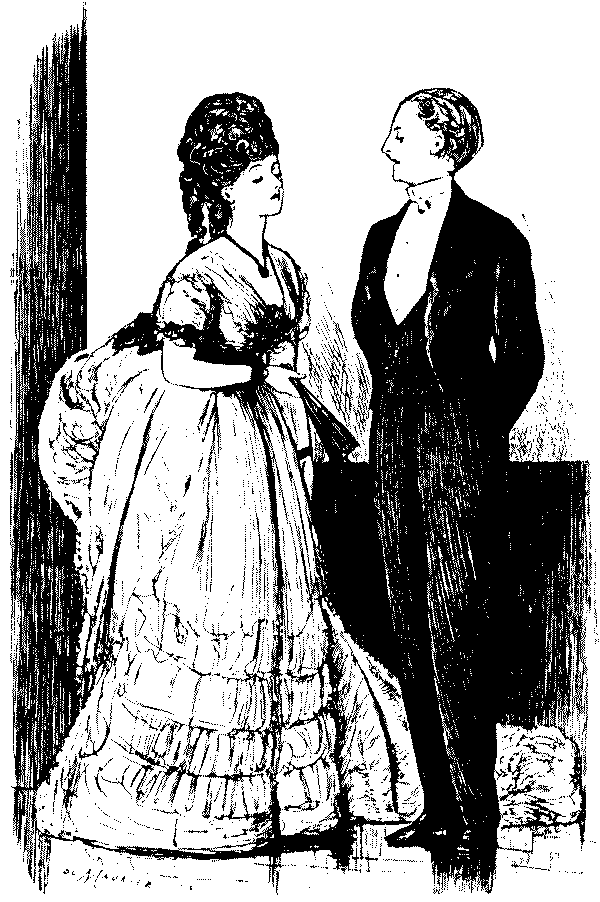
REFINEMENTS OF MODERN SPEECH
Female Exquisite: "Quite a nice ball at Mrs. Millefleurs', wasn't it?"
Male Ditto: "Very quite. Indeed, really most quite!"
Punch's reference to abusive personalities in the Press were no doubt justified, though (as we have seen in his comments on the Welsh Bards) they laid him open to the retort, "physician, heal thyself"; but his withers were unwrung when he assailed the Saturday Review in 1858 for its frigid pedantry; or protested against the maudlin, devotional tone and mock impressiveness of fashionable clergymen; or the vulgar curiosity of snobs at bathing places. The futilities of garrison town life and the dangers which young ladies ran of being entrapped by seedy captains are exposed in the same year, to which also belongs a properly indignant remonstrance with the Lord Mayor of London for advising a thief to enlist in the army, a thoroughly characteristic example of the old middle-class prejudice against soldiers. The humours and trials of studio life play an increasing part in the pictorial side of Punch; they were derived largely, no doubt, from the experiences of his own artists, but the multiplication of these references serves to show the growing social importance of the artist; and the same remark, mutatis mutandis, applies to amateur theatricals. The allusions to club life are fewer than in earlier years, and are mainly concerned with the Athenæum. It is amusing to find the ancient legend of the alleged unsociability of the Athenæum referred to as far back as 1858. The Almanack for that year contains the following: "Imaginary Conversation—Anybody speaking to anybody at the Athenæum." As for Victorian society generally, it would be hard to find a more instructive sidelight on its usages than that furnished by Punch's protest against "the Morning Call Nuisance":—
"Sir," said Dr. Johnson (or might have done so if he didn't), "the man who makes a morning call pays homage to a custom which the imbecile may bow to, but the sensible contemn." In the presence of his lady readers Mr. Punch has not the courage to confess that he applauds the dictum of the doctor. If it were not for the practice of making morning calls, ladies often would be puzzled to know what on earth to do; and Mr. Punch would not debar them from what is, after all, a harmless act of time-slaughter. But he protests with all his might against the notion which some ladies appear to entertain, that their husbands should attend them when they pay these morning visits. It is bad enough for husbands to be dragged to evening parties, but worse still is their suffering when they are cruelly compelled to make some morning call.
"What is always Going On"
Social abuses and grievances and disparities were not so flagrant as they had been twenty years before; still Punch, though no iconoclast, found plenty of scope for his reforming zeal. Cremation was not pronounced a legal procedure until 1884, but Shirley Brooks was one of the original members of the English Cremation Society formed in January, 1874, as a result of Sir Henry Thompson's advocacy of a method which had been neglected in England since Sir Thomas Browne published his Hydriotaphia, or Urn Burial in 1658.
In the summer of 1872 Punch printed a list headed, "What is always going on." It is a reassuring proof of the stability of England that of the twenty-six entries exactly half, quoted beneath, are as topical to-day as they were fifty years ago:—
The weather. The Publicans. Strikes. Jobs. Ireland. An International Something or Other. A Big Subscription. An Inauguration. A Millenary, Centenary, Anniversary or Jubilee. A New Daily Paper. Another English Opera Company. The High Price of Provisions. The Albert Memorial.