Volume 22 — TRAVELS IN THE INTERIOR OF NORTH AMERICA, IN THE YEARS 1832, 1833, AND 1834 (continued 4)
Hannibal Evans Lloyd translation
Early in the morning of the 20th of March we approached the mouth of the Ohio, where it falls into the Mississippi, 959 miles from Pittsburg, and 129¾ miles from St. Louis. The tongue of land on the right, which separates the two rivers, was, like the whole of the country, covered with rich woods, which were partly cleared, and a few houses erected, with an inn and store, and the dwelling of a planter, where we took in wood. In this store we saw, among heaps of skins, that of a black bear, lately killed, of which one of the three cubs, a very comical little beast, had been kept alive. This young bear had on his breast a semicircle of white hair. The settlement, at which we now were, has no other name than Mouth of the Ohio.[113] We now entered the Mississippi, and ascended it, keeping to the left or eastern bank. This river is not broader here than the Ohio, and the water of both was of the same colour; the bank was steep, covered with broken stems of trees, and crowned on the summit with high slender poplars. The lower banks were clothed with lofty trees, and at their feet strips of poplar and willows bending over the water. On the right hand, in particular, were romantic forest scenes; a wilderness of fallen trees, which the floods and storms had thrown and piled upon each other, like an abatis. Parasite plants wound round the trees, and matted them together; while, further on, rose the picturesque terraces of the wood-covered bank. There being many snags (trunks lying in the water) in the river, we could only proceed by daylight. The islands, covered with high poplars, were generally bordered with thickets of willow, which had now no appearance whatever of green, but looked of a bright yellowish red, from the colour of their branches. Gleams of sunshine 97 sometimes cast over these willow thickets a fine red glow, and gave them a very original appearance. Large quantities of drifted wood were frequently seen on the points of the islands towards the current. The water being very low, we were obliged to take soundings, and yet our vessel proceeded five or eight hours against the stream. The O'Connell steam-boat had run aground in this place, and its people were employed in landing the cargo, consisting chiefly of lead.[114] In many places on the bank, slender poplars form thick groves, whose tall stems spread into branches at the summit. They are all of an equal height, and are one of the characteristic features in the landscape scenery of the Mississippi and Missouri. At twelve at noon, Reaumur's thermometer was at +14½°, with a high wind, which blew the sand of the sand banks into the air. We lay to, to take in fuel, which cost three dollars for two cords. Here was a high, steep, sandy bank, and a small, very wretched planter's log-house, exposed on all parts to the wind, the sides of which consisted only of boards set upright. A couple of bad beds took up almost the whole of the interior. The woman, with her pipe in her mouth, was occupied at the miserable fire-place; the man was just returned, with a boy, from the forest; the two other children looked unhealthy, weak and pale; one of these girls was employed in planting onions in a small patch of newly-prepared ground. A couple of oxen, five or six young hogs, and some Muscovy ducks, were feeding about the cottage. Immediately behind, and close to it, commenced the magnificent, dense, and lofty forest, which we resolved at once to explore, and there very sensibly felt the heat of the spring, because the wind could not penetrate. The underwood of the forest consisted of the spicewood (Laurus benzoin), which grows to the height of ten and fifteen feet; its bark is highly aromatic, and it was covered with small yellow blossoms, which appear before the leaves, and resemble those of our cornelian cherry. The abundance of these flowers gives to the underwood a lively tint, which strikes the eye at a distance. Large, lofty trees, overgrown with climbing plants, formed the forest on the Mississippi, and the ground was covered with a delicate yellow flowering plant (Corydalis flava, N.) In the front of the cottage, which was close to the bank, stood a tree, about which a beautiful Bignonia radicans entwined; and the turkey buzzards hovered high in the air above the forest.
As we proceeded on our voyage, the wind was so high, and it raised the waves and the sand so excessively, that we sought the protection of the opposite bank. We passed many islands, several of which give a great insight into the formation of the banks of the Mississippi. One of them, especially, showed, at a certain place, a bank which had sunk down, where we perceived layers of large trunks of trees, heaped one upon another, the tops of which were visible. On such foundations the river throws its sand, willows and poplars grow up, by the leaves of which good earth is formed, and, in the end, lofty forests of hard wood arise. Though the Paragon drew only five feet of water, we were often aground; the wind laid the vessel a little on the side, the crew shoved with poles, sounded, stopped the engine, then made the vessel go backwards 98 and then sidewards, and so got afloat again. Little villages were seldom seen on this part of the banks of the Mississippi; however, we came to the village of Commerce,[115] on a rocky hill, and it is here that rows of hills of a very interesting appearance commence on the left or Missouri bank. Fragments of rock lie about, and the cedar (Juniperus Virginiana) immediately appears again. The forest seems to decrease in height in these calcareous rocks, especially the planes, which are more colossal in Indiana; and on the eminences in the forests, isolated groups of rocks are often seen, frequently of singular forms, like pulpits. Night setting in, we retired to our cabin to avoid the cold evening air, and lay to under cover of the bank. At this spot there was a single planter's dwelling upon the steep bank, which was fifty or sixty feet high. A large fire was kindled at the top, which brilliantly illuminated the high trunks of the forest, and warmed our crew by its intense heat. In the cleanly cottage of the peasant, which was well closed on all sides, we conversed with his wife, who told us that their house had been burnt down a short time before, and rebuilt; she said also that wild animals abound in this part of the country; stags especially are numerous, but bears are rarely met with.
On the 21st of March we reached Cape Girardeau, an ancient French settlement, now a large scattered village, which, as we were told, had of late much improved. Beds of limestone appeared on the bank, and heaps of it were piled up; it contains many shells. After passing Devil's Island, we found in the river a sunk steam-boat, which was now quite broken up; many of these vessels passed us. The spicewood was everywhere in flower in the forests on the bank, and it is said that its appearance indicates a fine soil. The pretty narrow-leaved willow, on the contrary, was still covered with its last year's dry leaves. We passed by the villages of Bainbridge and Harrisburg, and then came to that part of the river which is called Hanging-Dog-Bend, where the Mississippi is wide and beautiful. Various strata and ravines are observed in the wooded calcareous mountains; such a stratified rock, cleft perpendicularly, has the name of Devil's Tea-table; other rocks resembled round towers standing close to each other, all crowned with wood, where the turkey buzzard resorted.[116] The opposite or Illinois bank has very seldom any such rocks, and it is more cultivated close to the river. Flocks of ducks, probably Anas rufitorques, were swimming on the water. The calcareous rocks, grey, bright yellow, bright blue, or yellowish red, were frequently very singularly formed, especially a little further up, the interesting Grand Tower, an isolated, cylindrical rock, from sixty to eighty feet in height, which we reached when it was splendidly illumined by the setting sun.[117] To the right, on the Illinois bank, opposite the Tower Rock, at the point or corner of the mountain projecting towards the Mississippi, three or four very strangely formed rocks are standing, full of clefts and ravines, the foremost of which is called the Devil's Bake-oven, and is covered at the summit with pines. The Grand Tower[118] stands 99 quite isolated on the left bank; and its summit is crowned with red cedars. Behind it there is another large rock, split into several perpendicular divisions, like towers, and the whole group forms, as it were, a most original portico. Some habitations were picturesquely situated against these rocks. A little above that narrow rocky portico of the river, the Obrazo Creek, in the State of Missouri, appears, where we took in fuel. The ravine of the stream was covered with fine tall timber, to which the kingfisher resorted. A couple of cottages were inhabited by negroes, and in front of them lay a piece of fertile land, where rows of cotton trees were planted. The high old elms were now in flower by the side of the stream, and the large red cedars, around the dwellings, were still partly laden with their black berries. The Mnium ciliare (Grev.; Bryum) was abundant in this neighbourhood. Above Hat Island, we lay to for the night on the Missouri bank.
The morning of the 22nd of March was serene; the sight of the rising sun from the poop of the vessel was truly magnificent; as the flaming disk of the king of day rose above the woody banks of the Mississippi, the waves formed by the rapid course of the vessel glowed with the most resplendent colours; the wild geese and ducks, frightened by our Paragon, hastened away with rustling wings; the kingfisher was frequent on the shrubs. Near St. Mary River we ran aground, but were not long delayed by this accident. The cords of wood for the steam-boat were lying ready piled up on the bank, stating the price and the quantity. The village of Chester, in Illinois, where we took in wood, was quite a new settlement, consisting at present of but a few houses. Among the limestone and wood on the bank, we shot a beautiful lizard (Agama undulata, Daud.), which is said to attain a considerable size, especially on the river St. Peter. The buds of the red oak were very forward. At noon the weather was excessively warm, and on the river the thermometer was +11½° Reaumur. We saw the mouth of the Kaskaskia River, on the Illinois bank, six miles up which Kaskaskia is situated, one of the oldest French settlements on the Mississippi.[119] The tribe of Kaskaskian Indians dwelt in these parts, and some remains of them still live near the settlement. We were told that there was at present only one man among them of the pure race. A wooded chain of hills runs along the Kaskaskia, in which large columns of smoke were rising, doubtless occasioned by the woods being on fire. Numbers of tortoises were basking at noon on the trunks of trees and stones in the river. They have hard shells, and most of them are not large; though we often shot at them, we did not succeed in getting a single one. Wild geese were walking upon the sand-banks; we fired at them; the first shot did not in the smallest degree discompose them; at the second, when the ball whizzed close by them, they flew away, but only to a short distance. At St. Geneviève Island, the river divides, and we steered to the west of the island. It is covered with lofty trees; the banks are abruptly broken; large trunks 100 of trees were lying in the water. Before us we saw St. Geneviève,[120] where columns of smoke ascended in the distance; on the island was a small settlement, with a hut, worse than that of an Indian, and near, the canoe, turned bottom upwards. The inhabitants were sunburnt, badly clothed, of a savage aspect, like the Indians. A tall forest surrounded this characteristic scene. The Mississippi is here very broad, and is certainly a very noble stream. The prospect up the river is highly picturesque. Gentle eminences bound the horizon, and on account of a bend which the river makes to the right, it appears to come through a narrow opening. St. Geneviève, an old French settlement, now a large village, with 600 or 800 inhabitants, is about twenty minutes' walk from the landing-place, and appears to be in a state of decline; it was founded at the same time as Kaskaskia. The streets are at right angles, unpaved, and bordered with hedges. The houses, which are of one story, are separate from each other, and have, in general, a verandah in front. The church is built of red brick. French and English are spoken, and there are several German inhabitants. Caravans go every spring from hence to the interior of the western prairies, to Sante Fé and the Rocky Mountains; they consist of many armed men, with their horses and wagons. The well-known lead mines are further up the country.[121] Limestone everywhere stands out: the water is very bad, and not fit for drinking.
On the morning of the 23rd of March, the sun shining very brightly, strange forms of rock, alternating with high forests, appeared on the banks of the river; on the left, or western bank especially, the walls of rock were cleft by rude valleys, from which a small stream generally issued. Single pines are scattered in the woods; on the right bank, on the skirts of the forest, is a row of poplars, of perfectly equal height, but the planes are not so high as those we have before seen. We passed the place where Fort Chârtres formerly stood.[122] The limestone rocks in these parts assume the most highly original shapes and formations, about which much might be said if our limits would permit. They have often natural caverns and excavations, like the niches cut for the images of saints, which we see in Europe.[123] Others have regular 101 projecting ledges and lofty cones; sometimes they are so rounded as to represent a row of perpendicular towers, &c. On many of the rocks shot towers have been erected, the whole country, as is well known, abounding in lead.
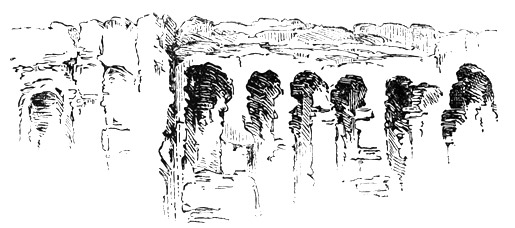
Formations of limestone rocks
We passed by the settlement of Selma, and the village of Herculaneum;[124] the latter consisting of about thirty houses, the immediate vicinity of which is remarkable for a perforated limestone rock. The distance from hence to Geneviève is twenty-one miles, and to St. Louis, thirty. After passing round the point of Little Rock, which is about forty feet high—beyond which the small Platteen Creek falls into the river—we soon reached the mouth of the Merrimack River, where we saw large flocks of ducks and sea-gulls.[125] About Robert's Island the country becomes flat and uninteresting. Towards evening we reached Jefferson barracks, on the left bank, where the 6th regiment of regular infantry was in garrison, and the flag of the United States was hoisted. These barracks were interesting at this time, because the celebrated Indian chief, Black Hawk, was imprisoned in them. Before night, we passed the French settlement of Vide-Poche, or Carondelet, founded about 100 years ago, a large scattered village, the inhabitants of which are reported to be not very industrious. The neighbouring hills are covered with low oak bushes. We passed the night nearly opposite Kahokia, and on the morning of the 24th of March, to our great joy, beheld the town of St. Louis.[126] Its first appearance is not prepossessing, as it has no high steeples. The mass of houses, however, unfolds itself as you approach; the environs are low and monotonous. We landed about nine o'clock in the morning, in a cold high wind. The people whom we first saw were mostly negroes, or labourers.
St. Louis is a rapidly increasing town, with 6,000 or 8,000 inhabitants, on the western bank of the Mississippi, about 1,200 miles from New Orleans, and 1,134 miles from Pittsburg. It is built on a rather bare, gently rising, and not very elevated part of the banks; forms two streets parallel to the river, besides many houses lying on the summit in the prairie, where building seemed to be proceeding rapidly. On this upper part there are churches and other considerable buildings, of which the town has many of different kinds; and the highly favourable situation, in the centre of the trade of the Mississippi, Ohio, and Missouri, will soon make it one of the most important places in the west. St. Louis was originally founded by the French; at first there was only a fort, and it was not till 1764 that the building of the town commenced, which in 1816 contained about 2,000 inhabitants. Persons were still living—for instance, M. Chouteau—who had the wood felled on the spot where the buildings of the town now stand.[127] The principal streets are full of handsome shops; numerous steam-boats come and go, daily, to and from New Orleans, Pittsburg, Cincinnati, Louisville, Prairie du Chien, &c.; and a very brisk trade employs the motley population of many nations. Most of the merchants have their warehouses, which are mostly built of solid stone, on the bank of the Mississippi. The greater part of the workmen in the port, and all the servants in St. Louis, are negroes, and their descendants, who, as in the State 102 of Missouri, are all slaves. They are very numerous here; and though modern travellers represent in very favourable colours the situation of this oppressed race, the negro slaves are no better off here than in other countries. Everywhere they are a demoralized race, little to be depended upon; and the manner in which they are treated is generally not so good as has been represented. We were witnesses of deplorable punishments of these people. One of our neighbours at St. Louis, for instance, flogged one of his slaves in the public streets, with untiring arm. Sometimes he stopped a moment to rest, and then began anew.
St. Louis was the more interesting to us, at this moment, because we had, here, the first opportunity of becoming acquainted with the North American Indians in all their originality; for the office for all the Indian affairs of the west is at St. Louis, under the direction of General Clarke, celebrated for his journey with Captain Lewis to the Rocky Mountains and Columbia River, who has the title of superintendent of Indian affairs.[128] He manages all these matters; and all strangers who wish to visit the interior of the western territory are obliged to have a passport from him, and all Indian agents and sub-agents are under him. It happened that, during our stay at St. Louis, a deputation came down the Mississippi from two Indian tribes, the Saukies (Sacs) and the Foxes or Outagamis, to intercede for the Black Hawk, who was a prisoner in Jefferson barracks.[129] A Saukie chief, named Kiokuck, was at the head of this numerous deputation, and he was the very same person who had delivered the unfortunate Black Hawk into the hands of the Americans.[130] General Clarke, to whom I was introduced by the kindness of Duke Bernhard of Saxe Weimar, had very obligingly informed me of the meetings or councils which he held with the Indians, and we had the pleasure of being able thoroughly to observe and study these remarkable people. Quarters were assigned them in a large magazine near the harbour, to which we immediately repaired. We saw already on the beach a collection of the populace, and amidst the crowd of curious spectators, distinguished the strange dark brown figures, enveloped in red, white, or green blankets. We did not come up to them till they were in the house, and the first sight of them, which did not a little surprise me, convinced me at once of their great affinity to the Brazilians, so that I cannot hesitate to consider them as belonging to the same race.[131] They are stout, well formed men, many of them above the middle size, broad shouldered, muscular and brawny. The features of the men are expressive, and strongly marked; the cheek bones prominent, the lower jaw broad and angular; the dark brown eyes animated and fiery, and especially in youth, the inner corner rather drawn down, but not so much so as in the Brazilians. The outer corner of the eye is not elevated either in the North or South Americans, at least I have seen it 103 in very few instances. The forehead appears to me not to recede so much in the North Americans as has been generally assumed, which is also the case with the Brazilians. Meyen[132] confirms this with respect to the people west of the Cordilleras. The teeth are strong, firm, and white, and generally perfectly sound, even at an advanced age. The nose is large and prominent, often much arched, but not always, a trait which occurs much more rarely among the Brazilians.[133] The lips are usually rather thick; the hair straight, smooth, and black, as in all the Americans. The colour of the skin a darker or lighter brown, often deeper than in the Brazilians, but, on the whole, perfectly the same. Some of these Indians resemble the Chinese, which Bossu, too, affirms of the now extirpated race of the Natchez. The features of others strongly reminded me of the Botocudos.[134]
It may be observed here, with Von Humboldt and Meyen,[135] that, notwithstanding a certain general affinity and resemblance of the race, there are, however, very great diversities among the people of American descent. Thus, for instance, the large aquiline nose of several northern nations may be mentioned, which must have been very remarkable among the ancient tribes of Mexico, as is proved by the old monuments of that, historically, most interesting country. Though this similarity appears to indicate an affinity of the Mexicans with more northern nations, a similar conformation was found here and there in South America also; as Duperrey[136] represents the Peruvians, and as Dr. Meyen also states. I am, however, of opinion that the notion of the last-named learned travellers is untenable, viz., that on account of the different[137] form of their skulls, the Puris and the Botocudos, who live so near to each other, are distinct races. I have compared numbers of Mandan skulls with each other, which were all genuine, and found great diversity in them, especially with respect to the receding of the forehead and the flattening of the head. In the same manner the brown colour of the American is of different shades. Mr. Von Humboldt found the Mexicans darker than many South Americans;[138] and many of the North American nations which I have seen, were likewise of a darker complexion than many Brazilians. My observations with respect to this point coincide so perfectly with the views of that distinguished traveller, that I might copy the passages in his works which treat of the Americans, and confirm them by many additional proofs. Among the Botocudos I met with individuals who were nearly white; Volney was certainly deceived by Michichinakua (the little tortoise), who wanted to raise himself to the dignity of a white man, for the North Americans are not of a lighter colour on 104 those parts of their bodies which are clothed, than on those which are exposed to the air and sun. Pike, and some other travellers, pretend to have found the Mongol physiognomy among the North American Indians, especially the Pawnees and the Sioux;[139] but I can affirm that I met with no such physiognomy, though I saw a few instances of it in Brazil. Mr. Von Humboldt very justly observes, on this head, that not merely the bodily conformation, but likewise the mode of living, of the two races, are entirely different. The great contrast between the American and Mongol races is immediately apparent, when we consider that the former have no breed of cattle, and do not subsist on milk, without which the latter cannot live.[140] The Tartar features, which are very handsome, did not occur to me in North America. Warden, in his work on American antiquities,[141] gives a drawing of a vessel found near the river Cany, which is adorned with three human heads. These heads have not the Tartar physiognomy, as the author believes, but precisely that of the North American Indians.
From this digression on the general conformation of the North Americans, we return to our narrative.
The Saukies and Foxes had shaved their hair off the whole head except a small tuft behind, the greater part of which was cut short, like a brush, and which terminated in a thin braid, to which was fastened the chief ornament of the head, the deer's tail, which is a tuft of hair from the tail of the Virginian stag, white, with some black hair, the white part being dyed red with vermilion.[142] It is fastened in an ingenious manner, with some strings and pegs of wood, to the tuft of hair at the back of the head; and in the middle of it, concealed between the hair, is a small piece of carved wood, to which a small bone box is affixed, into which a large eagle's feather is fastened, projecting horizontally behind; this feather is often dyed with vermilion, and is the characteristic distinction of a brave warrior. He who has become renowned for horse-stealing, which, according to their notions, is a heroic exploit, fastens to the tip of this feather the rattle of a rattlesnake. The whole deer's tail, when it is not worn, is rolled up in the form of a thick ball, fastened with leather straps, and kept in this manner, that the hair may remain smooth, and in the proper position. Mr. Bodmer took an admirable likeness of Watapinat (eagle's nest), a handsome Fox Indian, wearing this head-dress.[143] The North Americans pluck out their eyebrows, beard, &c., like the Brazilians, and, at present, employ in this operation a spiral wire, between the windings of which they take hold of the hair. These nations adorn their ears in a very original manner; three large holes, one above the other, are made at the outer rim, in which short strings of blue and white wampum shells[144] are hung, like tassels. Some of the men had even cut through 105 the whole outer rim, which remained attached only above and below, and was adorned with strings of wampum and metal rings; similar strings, and pieces of blue and white shells, are worn in many rows around the neck.
The women are small and thickset; most of them have large round heads, and broad, flat, round faces. They let their hair grow naturally, part it on the forehead, and tie it together, at the back of the head, in a short, thick bunch, which is bound round with red and green ribbon. A few old men had not shaved their heads; but in winter it is said that these Indians let their hair grow, to protect them against the cold. Both sexes had their faces more or less painted red: the Saukies mostly red, in different designs; the Foxes, red and yellow, or red, white, and black. The manner of painting depends on the taste of the individual; nearly all of them had red circles round the eyes and ears, and red stripes down the cheeks, the rest of the face being left of the natural colour. They use, for this purpose, vermilion, which they obtain from the merchants. The Fox Indians had often the whole head painted red; a yellow or white stripe on the forehead, and the mouth and chin with the figure of a yellow hand, or else quite black. A tall, handsome Saukie Indian, called Massica (the tortoise), had a bold, fierce countenance, and an aquiline nose; his cordiality was very striking; his brown eyes sparkled, and his white teeth looked quite dazzling, contrasted with the dark brown face, which had a good deal of red paint on it. On his forehead he wore a band of otter skin, which was fastened behind the head, and then fell down in two long stripes to the ground. He had attached a black and white eagle's feather to his deer's tail, and was covered with a large red blanket. Mr. Bodmer has given a very good likeness of this handsome man in Plate 36, but without his head-dress, in order to show the manner in which the tuft of hair was cut. Many of these people wore coloured calico shirts, and all used the Indian leather leggins, which come down to the shoes, and are ornamented at the ankles with leather fringes. They are fastened, with leather straps, above the girdle. They also wear a piece of woollen cloth, generally striped blue and white, round the waist, which is fastened under the girdle. The girdle and knee bands were often very elegantly adorned with glass beads, and in the former is a sheath, similarly ornamented, for a large, broad, and very sharp knife, which they obtain, by barter, from the merchants, and employ for various purposes, especially for cutting up game, and scalping their enemies. The shoes, generally called mocassins, are made of soft, tanned buckskin, and the upper edge turned down below the ankle. These people wear them very plain, without any ornament. Many of them had fastened swan skins, with the down, or that of polecats, much marked with white, below their knees, the long hairy tail of which hung down to the ground, or to the ankle. Most of them had no other covering, on the upper part of the body, under their blankets; and 106 many wore brass necklaces and bracelets. The men, who were between thirty and forty in number, never appeared without their arms; they carried tomahawks,[145] or else the common Indian club,[146] which has, at the upper end, a steel plate, sharp on both edges, and pointed.[147] We did not see any bows and arrows among these Indians, because they had not come out on a warlike expedition, but on a festal visit; many of them had a kind of lance, made of a long sword blade, fastened to a pole, which was covered with red cloth, and ornamented with many black raven's or eagle's feathers, hanging down either in a long row, or in long bunches.[148] These weapons they had always in their hand, and never laid them aside. The women, like those of Brazil, carried their bundles on their backs, with a leather strap passing over the forehead; they had their children with them, some of whom were in very convenient cradles. They all had very neat bast mats, ornamented with black figures, on which they slept, and some had, likewise, bear skins. Their travelling sacks, or bags, in which they had all their effects, were of the same material.
The chief or leader of the Indians assembled here, was the Saukie chief, Kiokuck, a slender man, of the middle size, with agreeable features, not very different from those of an European, though of a darker colour. He wore a coloured calico shirt, and, on his breast, a large medal, which he had received from the President of the United States; and likewise wore a figured handkerchief round his head, and was wrapped in a green blanket. He carried in his hand a calumet, ornamented with feathers. His face was not painted, his ears not disfigured, and it was affirmed that he was not of pure Indian origin. He wore brass rings round his neck and wrists.
The dwelling-place of these Indians is on the western banks of the Mississippi, about Rock River and Rock Island, where the agent appointed for them by the government resides. In 1805 they sold, to the United States, their territory on the east of the Mississippi; still claiming a large tract of land, which extends from the upper Jowa River, along the west bank of the Mississippi, down to the river Des Moines, and further back to the Missouri.[149] The Fox Indians call themselves Musquacki, or Mus-quack-ki-uck. They live sociably in villages, in permanent arched huts, and it is said that they can muster 1,600 warriors (according to Dr. Morse, however, only 800),[150] and that they number about 5,000 souls. They plant maize, beans, gourds, &c. The men hunt, and work in their lead mines, which are very productive, so that, it is said, they have yielded 500,000 lbs. in one season.[151] Their language has not a barbarous sound; it has some nasals and gutturals; the words are very frequently pronounced indistinctly, so that 107 it is often difficult to write them down; though, on the whole, less so than is the case with many other nations.
The French and English find much more difficulty than the Germans, in pronouncing all the Indian languages of North America, with which I have become acquainted. It was highly interesting to us, to observe so many of these Indians together. They were by no means grave and still; on the contrary, they were very cheerful, and often laughed heartily. If one went up to them familiarly, and spoke to them, many of them had a very agreeable, friendly expression; others were cold, and appeared, to us, hostile. Several repeated, with pleasure, the words of their language, and were very willing to have their portraits drawn, for which they always required a present. At last they were so annoyed by the importunity of the motley crowd, that we could have no more intercourse with them. They sold many of their effects, for which they received money, which they soon disposed of, but always examined whether it was genuine or false. There were some grave, dignified men among them, who carefully observed what was passing around them. Of these, I especially noticed Watapinat and Massica.
General Clarke invited us to a small assembly, which he was to hold in his house with the Indians. We accordingly repaired thither. This meeting took place in the apartments, which are ornamented with a highly interesting collection of arms and utensils, which the General had procured on his extensive travels with Captain Lewis.[152] The rooms contain, likewise, portraits of the most distinguished Indian chiefs of different nations. General Clarke, with his secretary, was seated opposite to the Indians, who sat in rows along the walls of the apartment. We strangers sat at the General's side, and near him stood the interpreter, a French Canadian. The Indians, about thirty in number, had done their best to ornament and paint themselves; they all looked very serious and solemn, and their chief sat at their right hand. The general first told them, through the interpreter, for what reason he had assembled them here, on which Kiokuck rose, with the calumet in his left hand, gesticulating with his right hand, in harmony with his thoughts; he spoke very loud, in broken sentences, interrupted by short pauses. His speech was immediately translated and written down. This conference lasted above half an hour. General Clarke had introduced us to the Indians, telling them that we had come far over the ocean to see them; they all testified their satisfaction in a rather drawling "Hah!" or "Ahah." Before and after the sitting all the Indians passed us in a line, each giving us his right hand, and looking steadfastly in our faces. They then withdrew, headed by their chiefs. The General had told them that they should persevere in their amicable sentiments as hitherto; and they had expressed the wish that their brethren might soon be set at liberty, because their wives and children at home were suffering hunger and distress. Upon this the General advised them, when Black Hawk and his associates should be set at liberty, to keep a watchful eye over them. On this condition he would intercede for the prisoners. We were invited by the General to accompany him, on the 108 following day, on board the Warrior[153] steam-boat, when he intended to convey the Indians to the barracks, to grant them an interview with Black Hawk.
On the 26th of March we found the Indians already on board the Warrior, which was hired for this excursion; others of these original figures, wrapped in their red blankets, were walking on the beach. We had provided cigars and other trifles, by which we soon gained their confidence. Massica, the tall young Saukie Indian, was the most interesting among them. As soon as General Clarke came, the anchor was weighed, and the Warrior proceeded down the Mississippi. The Indians assembled on the fore part of the ship, to sing: the bleak wind was much felt by many of them, as they wore no covering under their blankets, yet they always remained on deck. Below, in the after hold of the vessel, they had a fire, at which they boiled and roasted the provisions that were given them. They examined, with much attention, the steam-engine, the hissing and roaring of which interested them extremely. They formed groups of different kinds; many were busy in improving the painting of their faces, at their small looking-glasses; others were smoking their pipes in philosophical ease; and others lay asleep on the floor, wrapped in their blankets. They very readily acquiesced, whenever we asked them to sing; their chorus-singing was remarkable; it rises and falls, now loud now low, often quavering, yet, on the whole, not inharmonious; and though it has some resemblance with that of the Botocudos, in Brazil, it was by no means so rude and savage. Sometimes they shouted aloud, and generally ended their song with their war-whoop—a shrill cry, in which they cause the voice to quaver, by holding the hand before the mouth.
About ten o'clock the Warrior approached Jefferson barracks, where the inhabitants had assembled on the shore to see the Indian deputation land. The Indians sung a wild chorus, rattling their weapons, and, as soon as they had landed, marched in procession, led by their chiefs, to the heights, where the barracks formed a quadrangle, open to the river, enclosing a large space. General Clarke introduced us to General Atkinson, the commandant of the place;[154] and, after resting a short time in his house, we proceeded to a spacious empty hall in one of the adjoining buildings, where the Indians were already seated in rows. The Generals sat opposite to them, surrounded by the spectators, among whom were several ladies. When all were assembled, Kiokuck, with the aid of the interpreter, delivered an address to General Atkinson, who replied, on which the prisoners were introduced. First of all, Black Hawk appeared, a little old man, perhaps seventy years of age, with grey hair, and a light yellow complexion; a slightly curved nose, and Chinese features, to which the shaven head, with the usual tuft behind, not a little contributed.[155] None of the prisoners were painted. These poor men entered with downcast looks; and though no Indian betrayed any lively demonstrations of emotion, such feelings were very manifest in many of them. The prisoners gave their hands to their countrymen all round, and then sat down with them. Two of the Indians, known as particularly 109 dangerous men, one of them the celebrated Winnebago prophet, who has a repulsive countenance, had chains with large iron balls at their feet.[156] The other prisoners were not chained, and we were told that they were taken out every day to walk, by the guard. The speeches now recommenced: Kiokuck spoke often, and interceded for the prisoners; and General Atkinson repeated to them pretty nearly what General Clarke had already said, on which the Indians again uttered their "Hah," or "Ahah." When the speeches were ended, the company withdrew, and left the prisoners alone with their countrymen, to give free vent to their feelings. The sight of old Black Hawk, and the whole scene of the prisoners and their friends, was affecting, and many of the spectators appeared to participate in their feelings.
We then examined the barracks, in which four companies of the 6th regiment were quartered. The hospital is a detached building; the surrounding country is open prairie; in the vicinity of the buildings, however, it is covered with a wood of slender oaks, without underwood, and from the eminence is a very agreeable prospect over the river. General Atkinson invited us to dinner, and introduced us to his family. At three o'clock we again embarked on the Warrior with all the Indians, and reached St. Louis late in the evening.
As it was my intention to travel through the interior of the western part of North America, and, if possible, the Rocky Mountains, St. Louis was unquestionably the most proper basis for such an enterprise. The question was, whether it was more advisable to go by the caravans by land to Santa Fé, or to proceed by water up the Missouri? Captain Stewart (of Grand Tully), an English traveller, with whom I had become acquainted at St. Louis, was on the point of setting out by land by the caravan, and it would have been agreeable to me to travel in his company;[157] but after I had consulted many persons well acquainted with the country, the plan of following the course of the Missouri seemed to be the most suitable for my purposes; for, first, I should not be able to observe any Indians on the land journey; for if you happen to meet with them, you must fight them, and, therefore, cannot become well acquainted with them; and, secondly, it is extremely difficult, nay impossible, to make considerable collections of natural history on such a journey. These reasons were decisive: I hoped, therefore, to obtain from the gentlemen of the American Fur Company, a passage up the Missouri in their steam-boat, the Yellow Stone, which was daily expected to return from New Orleans; and as soon as it had taken in a cargo, was to set out on its voyage up the Missouri.[158] It is necessary to prefix a few words respecting this American Fur Company. The first regular company of this kind in the United States was the Michilimakinack Fur Company, established in 1790. Its capital belonged chiefly to some persons in Canada; but as foreigners were not allowed to trade with the Indians in the United States, some citizens of the latter gave it the sanction of their names.[159] The last war with England dissolved the company, and during that time no trade was carried on with the Indians. About 1816, Mr. Astor, of New York, a countryman of ours, formed a fur company, under the name of 110 the American Fur Company.[160] His plan was well conceived, very extensive, and designed to carry on trade with all the Indian tribes. Mr. Astor's enterprises towards the Columbia River did not succeed, but in all other parts the fur trade prospered, and is carried on, up to the present time, with great success.[161] About the same time two other companies were formed at St. Louis—the Missouri Fur Company, and the French Company, which proposed to carry on the trade on that river. The first continued its operations for about five or six years, when it terminated, having met with many difficulties.[162] In 1822 the Columbia Fur Company was established, and violent opposition and rivalry arose between the three companies, which continued till 1826.[163] During this time the fur trade had afforded but little profit to any of the persons engaged in it. In the spring of that year, a person of the name of Crooks was sent from New York by the American Fur Company to buy up the two other companies, in which he succeeded.[164] Some of the members of these companies were received into the American Company, and thus the whole of the very extensive fur trade was concentrated in the hands of that company, and remains so up to this moment. Some individuals and small associations have since made frequent attempts to carry on the trade in the Indian territory and the Rocky Mountains,[165] but have always been obliged to give way to the powerful and wealthy company, which has now spread its commercial stations over a great part of the interior of North America, and continues to extend them more and more.[166]
In British North America, two great fur companies were founded at an earlier period—the North-west, and the Hudson's Bay Company, which for a long time were at open war with each other, but afterwards joined, and still exist under the name of the Hudson's Bay Company.[167] To the north of the Missouri on the borders of British North America, they are rivals of the American Company, and both parties endeavour to draw over the Indians to their side. But as no white settlers have yet penetrated to those remote and desolate regions, the American Company rules there alone, by its commercial stations and its numerous servants, the goods with which they carry on the trade having become necessary even to the most dangerous Indian tribes; for this reason foreign travellers cannot expect to succeed in their enterprises without the consent and assistance of this company.[168]
At St. Louis I had become acquainted with several very interesting persons; Major Ofallon, having been formerly agent of the Indian nations on the Missouri, was well acquainted with the country, and assisted me with his advice, as well as Major Dougherty,[169] now agent for the nations of the Pawnees, Otos, and the Joways: they both advised me, as the only practicable means of visiting those countries with safety, to join the American Fur Company, and to obtain from the 111 directors a passage on board their steam-boat. Fully appreciating the value of this counsel, I endeavoured to become acquainted with Mr. Pierre Chouteau, who directed the affairs of the company at St. Louis, and with Mr. Mc Kenzie, who usually lived on the Upper Missouri, and was now on the point of proceeding on board the steamer to Fort Union, at the mouth of the Yellow Stone River. Both gentlemen received me with great politeness, and readily acceded to my request.[170]
Our necessaries for this journey,[171] and many small articles for bartering with the Indians, were procured and placed on board the Yellow Stone steamer. General Clarke favoured me with his advice, as well as several other gentlemen, particularly Major Pilcher,[172] who had penetrated far into the Indian territory to the Rocky Mountains, while he was a member of the Missouri Fur Company; likewise Messrs. Sanford and Bean, the former of whom was agent for the Crows, Mandans, Assiniboines, Manitaries and Blackfeet, and the latter for the Puncas and Sioux.[173] All these persons, who were well acquainted with the Indian territory, were to accompany us up the Missouri to their several stations. Major Ofallon, whom we visited at his pleasant country seat, near St. Louis, had the kindness to furnish me with the map of the course of the Missouri, by Lewis and Clarke, on a large scale.[174] We found at his house an interesting collection of Indian articles, and a great number of Indian scenes by Catlin, a painter from New York, who had travelled in 1831 to Fort Union.
Before we left St. Louis, another deputation of Saukie Indians arrived from the Lower Missouri, who held councils with General Clarke. They came down the Missouri in long double canoes. Among them were several very strong, robust men, who, when they were in liquor, were dreadfully savage and wild. One of their most distinguished warriors, who was remarkable for a curved nose, exactly such as we see in the Mexican sculptures, suffered severely from consumption; his family seemed much concerned about him; the women sat around him and lamented. The time passed rapidly in observing these interesting people, till the 10th of April, which was the day fixed for our departure.
CHAPTER X
JOURNEY FROM ST. LOUIS TO THE CANTONMENT OF LEAVENWORTH, OR TO THE BORDERS OF THE SETTLEMENT, FROM THE 10TH TO THE 22ND OF APRIL
Departure from St. Louis—The Engagés, or Voyageurs—St. Charles—Gasconade River—Osage River—Jefferson City—Boonville and Franklin—Arrow Rock—Chariton—Grand River—Battle of the Missouri Indians—Fire Prairie—Dangerous place and situation of the vessel—Fort Osage—The Osages—Liberty—Quicksands—Konzas River—Boundary of the United States—The Konzas Indians—Pilcher's Expeditions—Little Platte River—Dwelling of the Joways—Diamond Island—Cantonment of Leavenworth.
On the 10th of April, at eleven o'clock, all our company having collected, the Yellow Stone left St. Louis; Mr. Pierre Chouteau, and several ladies of his family, accompanied us to St. Charles.[175] Some guns were fired, as a signal, on our departure, on which numbers of the inhabitants assembled on the shore, among them the Saukies and some half-civilized Kikapoo Indians. Mr. Bodmer made some interesting sketches of the former, of which the plate gives a specimen.[176] There were about 100 persons on board the Yellow Stone, most of whom were those called engagés, or voyageurs, who are the lowest class of servants of the Fur Company. Most of them are French Canadians, or descendants of the French settlers on the Mississippi and Missouri.
The appearance of the river above St. Louis did not differ from that already described. The red-bud (Cercis Canadensis) appeared as underwood in the forests, covered with dark red blossoms before the appearance of the leaves, which form red stripes along the shore, and make a pleasing contrast with the young, bright green leaves of the willows. At noon, Reaumur's thermometer on board was at +17½°. We had soon passed the 16½ miles to the mouth of the Missouri,[177] but before we entered it, we lay to, on the Illinois side, to take in wood. The Yellow Stone entered 113 the Missouri, which, at its mouth, is about the same breadth as the Mississippi at this place. In the afternoon we reached, on the S. W. side, Belle Fontaine, a rather decayed building belonging to the military station established, in 1803, against the Indians, but which was subsequently abandoned. The current of the river runs here at the rate of five miles an hour; on the left bank there is a chain of calcareous hills with the same singular forms of towers, &c. as on the Mississippi. The bushes of wild plums were covered with snow-white blossoms, and those of the Cercis Canadensis, with their red flowers; and I could not help remarking that, in this country, most of the trees and bushes have their flowers before their leaves. On the beach the inhabitants had fixed fishing rods, which they examined, from time to time, and we saw them take up a large cat-fish. Towards evening the lofty plane trees, with their white branches, were beautifully tinged with the setting sun. We passed several islands, which showed us the usual formation of these accumulations of sand, which arise rapidly, and are often as rapidly destroyed. Against the stream they generally have a naked, sandy point, with layers of thick, heavy timber; young willows grow first, then poplars, and, lastly, hard timber. In many places in the forests, and between the willows, we observed the high rushes (Equisetum hyemale) which are said to be injurious to the horses, unless salt is given them with it.
Next morning we reached St. Charles, on the N. E. shore, one of the oldest French settlements on the Missouri, consisting of about 300 houses, where the massive church, with its low tower, has a very good appearance. The environs of this scattered village are rather bare, but there were many European fruit trees in blossom. Most of the houses are built of wood, but a modern part of the place is of brick. On an eminence rising behind it, stands an old stone tower, which formerly served as a defence against the Indians. We lay to, opposite St. Charles, where Messrs. Mc Kenzie and Dougherty joined us, and M. Chouteau and his family took leave, and returned to St. Louis. After stopping a few hours, we continued our voyage till a storm of wind filled the air with sand, from the sand banks, and compelled us to stop after twelve o'clock, above the whirlpool, called Remoux á Baguette;[178] towards dark, however, we reached Isle au Bon Homme, in the vicinity of which we passed the night. On the 12th of April, the original forms of the calcareous rocks again appeared, with the red cedar, as usual, growing upon them. The hills were covered with forests, where many trees were putting forth leaves, especially the very delicate green foliage of the sugar maple. A cavern at this place is called the Tavern Rock (Taverne de Montardis), and on both sides of the river were numerous snags, which often prove dangerous to vessels. Near some habitations the European peach trees were in blossom; among the strange forms of the rocks, I saw one flattened at the top like a table, on a thin stem, and quite isolated. The country is here pretty well peopled, and game is rather rare in the forests, at least we were told that stags, bears, and wild turkeys were not often found there. The people settle on the eminences, rather than below on the bank of the river, where the air is 114 said to be less salubrious. The inundations of the river form marshes on the low grounds, which, being protected from the sun by the surrounding trees, produce fevers. Flint, in his History and Geography of the Mississippi Valley,[179] gives a very good account of the climate and diseases of this country. We passed Isle and Rivière au Bœuf, as well as the village of Pinkney;[180] observed very picturesque rocky scenes, climbing plants, which twined round overthrown broken trunks of trees, and gloomy ravines, which were now full of the bright green young leaves that were everywhere sprouting forth. The Yellow Stone had several times struck against submerged trunks of trees, but it was purposely built very strong, for such dangerous voyages. This was its third voyage up the Missouri. The Fur Company possess another steamer called the Assiniboin which had left St. Louis to go up the Missouri before us.[181] At night-fall we lay to on the right bank, where a cheerful fire of large logs was soon made, round which our engagés assembled and chatted incessantly in French. We spent part of the night with Messrs. Mc Kenzie, Dougherty, and Sanford, under the canopy of the starry heavens, while a couple of clarionets, on board the vessel, played Scotch airs and the famous "Yankee-doodle."
On the morning of the 13th of April, the weather was serene and cool, the thermometer, at eight in the morning, +5° Reaum., and at noon, +9°. We had lain to, for the night, near Otter Island,[182] and soon saw before us the country about Gasconade River. There were extensive sand banks on the left hand, picturesque hills, many pleasing gradations of tint in the forests; an island, on the surface of which we distinctly saw the layer of black mould, six feet thick, with sand beneath it; further from the left bank a chain of hills, valleys, and eminences, covered with high trees, which were just beginning to put forth leaves, all illumined by the beams of the brightest morning sun. Near the Gasconade, where we took in wood, many interesting plants were in blossom. The Gasconade, which is an inconsiderable river, and rises not far from the source of the Merrimack, in the State of Missouri, expands behind a high, bold eminence, the summit of which is covered with rocks and red cedars. The hills near it are frequently covered with the white and the yellow pine, which supply St. Louis with boards and timber for building. Its mouth, which is reckoned to be 100 miles from that of the Missouri, is picturesquely situated in a lofty forest. Near it, our hunters fired unsuccessfully at a flock of wild turkeys. We soon passed the village of Portland; then the mouth of Little-Au-Vase Creek, where we observed, in the woods, the young leaves of the buck-eye trees (Pavia) which grew in great abundance.[183] A little further on, the Osage River appears between wooded banks: it is a small stream, in which, according to Warden, many soft-shelled tortoises are found: we came then to Côte-Sans-Dessein, an old French settlement of six or eight houses, celebrated for the brave defence made by a few men against a numerous body of Indians. It must have been formerly much more considerable, since Brackenridge calls it a beautiful place.[184] The river has destroyed it, and it is now quite insignificant. Opposite to it, on the left bank, further up the country, there 115 are many originally French families, and half-breeds, descendants of the Osage Indians, who formerly dwelt in these parts. While Mr. Bennett, the master of our vessel, landed to visit his family, who lived here, we botanized on the opposite bank, where oaks of many kinds were in blossom, and where the Monocotyledonous plant is found, which is called here Adam and Eve. Its roots consist of two bulbs joined together, of which it is said that, when thrown into the water, one swims and the other sinks. It is held to be a good cure for wounds. The flower was just beginning to appear.
From Côte-Sans-Dessein, you soon come to Jefferson City, on the south bank of the Missouri, the capital, as it is called of the State of Missouri, where the governor resides.[185] It is at present only a village, with a couple of short streets, and some detached buildings on the bank of the river. The governor's house is in front, on the top of the bank, and is a plain brick building of moderate size. The gentle eminences, on which the place was built about ten years ago, are now traversed by fences, and the stumps of the felled trees are everywhere seen.
The morning of the 14th of April was clear but cool; at 8 o'clock +8°, a thick mist rising from the river. On a wooded eminence, on the left hand, at some distance from the bank, is a high, isolated rock, which stands like a tower in the forest. Major Dougherty, once passing this place with some Joway Indians, was told by them, that there was a tradition among their ancestors, that this rock was formed of the dung of a race of bisons, which lived in heaven, but they themselves no longer believed this fable. The Manito rocks, two isolated blocks, about fifty feet high, which have been mentioned by many travellers, appear below, on the bank of the river. They are mentioned in the account of Major Long's Expedition, which contains much information respecting the Missouri, as far as Council Bluff, to which I refer. We learn from that work, that almost all these calcareous rocks of the Missouri contain organic remains, encrinites, &c. On the rocks, which are divided by ravines into broad rounded shapes, like towers, the Virginia red cedar grows, and falcons build their nests. We see here on the rocky walls red spots, strokes and figures, remaining from the times when the Indians dwelt here: two towering overhanging rocks, in which there are several caves, put me in mind of the ruins of the castle of Heidelburg. Just before dinner we reached Rockport, a village founded two years ago, on the Manito River, six miles up which river Columbia is situated.[186] Near this place there are again many red figures on the rocky walls, among others that of a man with uplifted arms; not thirty years have elapsed since this whole country was in the possession of the Indians. After passing Manito and Bonne Femme Creek, we stopped at the village of Boonville on the left bank, opposite which is Old Franklin.[187] As this place was threatened by the river, and is besides in an unhealthy situation, the people founded New Franklin, rather further inland, now a thriving village, near which salt springs have been discovered. We afterwards passed the mouth of La Mine River, which is about equal to the Lahn, and lay to for the night at Arrow Rock (Pierre à flêche), a chain in which 116 flint is found, of which the Indians formerly made the heads of their arrows. In a ravine, before Arrow Rock Hill, there is a new village, which was called New Philadelphia, though the inhabitants did not approve of this name.[188]
On the following morning (April 15th), proceeding on our voyage, we passed little Arrow Rock, and found a very fertile and rather populous country. Near the mouth of Chariton River, there are several islands, covered with willows, poplar, and hard timber. The river here makes a considerable bend; the numerous sand banks did not permit us to proceed in a direct line, but compelled us to take the narrow channel, at the outer edge of the bend, and to take soundings continually, being in great danger of striking against the snags. Some parts of the banks were rent in a remarkable manner by the rapid stream, when the water was high. In many places, large masses, fifteen or eighteen feet in height, had sunk down, with poplars thirty or forty feet high, as well as entire fields of maize, and piles of timber, which form together a wild scene of devastation, to which the broken poplars not a little contributed.
The drift wood on the sand bank, consisting of the trunks of large timber trees, forms a scene characteristic of the North American rivers; at least I saw nothing like it in Brazil, where most of the rivers rise in the primeval mountains, or flow through more solid ground. On the banks which we now passed, the drifted trunks of trees were in many places already covered with sand; a border of willows and poplars was before the forest, and it is among these willow bushes that the Indians usually lie in ambush, when they intend to attack those who tow their vessels up the river by long ropes. At five o'clock in the afternoon we reached the mouth of Grand River, which was then very shallow, almost as broad as the Wabash. The Yellow Stone nearly run aground at the mouth of this river, and stirred up the sand so as to discolour the water. The Joway Indians dwelt on the Grand River till 1827, when they removed to Little Platte River.[189] They continue, however, like the Saukies and Foxes, to hunt in the prairies at its source, where buffaloes, elks, and stags, are said to be still pretty numerous. The first of these Indians called the Grand River, Nischna-Honja; and the Missouri, Nischna-Dja:—Ni, in their language, means water, and Nischna, the river.[190]
We lay to, for the night, beyond Waconda Creek.[191] Our hunters dispersed into the neighbouring woods and plantations, but they only shot some parrots. On the 16th, in the morning, we had, on the left bank, undulating hills, thinly covered with trees, and on the bank were strata of limestone. Here is the mouth of the stream, the Bonnet de Bœuf, which, doubtless, has its name from the caps, with ox horns, which the Indians, who formerly dwelt here, wore in their dances. Some highly dangerous submerged snags left only a very narrow channel open for our vessel. At ten 117 o'clock we came to some excessively dangerous parts, where our vessel frequently struck, and we were obliged to stop the engine, and to push by poles. The vessel stuck fast in the sand, and it was necessary to fasten it to the trees on the bank till it could be got afloat again. At this point the great forests begin to be interrupted by open places, or prairies, and we were at the part called Fox Prairie, where the Saukie and Fox Indians, and, perhaps, some other nations,[192] formerly attacked, and nearly extirpated the tribe of the Missouris. The remainder of the people saved themselves among the Otos, on the southwest banks, where their descendants still live, mingled with the natives. The Missouris came down the river in many canoes, and their enemies had concealed themselves in the willow thickets. After the Missouris, who suspected no evil, had been killed or wounded with arrows, the victors leaped into the water, and finished their bloody work with clubs and knives: very few of the Missouris escaped.[193]
To-day we saw, for the first time, from the deck of our vessel, the prairies of the Lower Missouri covered with luxuriant young grass, but the air was misty, and bounded our prospect. In the afternoon we took in fuel at Webb's warehouse; the river was here again covered with wood, which so greatly impeded our progress, that we were obliged to lay to for the night, seven miles above Webb's warehouse. In the morning of the 17th we saw only an uninterrupted forest; in the course of the day we again encountered much danger from the quantity of snags, which, in some places, scarcely left a channel of ten feet in breadth; but our pilot steered, with great dexterity, between all these dangers, where many a smaller vessel had been wrecked. During this hazardous navigation, we were all on deck, anxiously expecting the result, but everything went off well. We afterwards sounded, sought another channel, but proceeded very slowly, so that we only passed Fire Prairie,[194] and lay to for the night, five miles below Fort Osage.
Our engine was broken, so that we could not proceed till the next morning (18th April). On that morning I had the misfortune to break my last Reaumur's thermometer, so that, henceforth, all the observations of the temperature are according to Fahrenheit's scale. Some of my people, attracted by the cries of the wild turkeys, were tempted to land, but returned without having met with any success. I happened to have taken no piece with me, which I much regretted, for a wild turkey-cock came out of a bush about ten paces from me, and stood still, looking at me, while his splendid feathers shone in the sun. Vegetation was rather backward. A large flock of sandhill cranes, taking their course to the north-east, filled the air with their cries; their note is very similar to that of the European crane. After the people had returned on board, at the repeated summons of the bell, we proceeded on our voyage, but were soon obliged to take soundings, and to saw off some dangerous snags; we then landed twenty men on a sand bank, to tow the 118 steamer, but their efforts broke the rope, and they all tumbled one upon another, to the great amusement of those on board. By way of precaution, our vessel was fastened to a large tree, which proved our safety, for the rudder was soon afterwards deranged, and rendered unserviceable. It was repaired about two o'clock, but we soon run aground on a sand bank, where we were obliged to remain all night, in a rather unsafe situation, for the current, on the bank, was very strong, and we could not fasten the vessel to anything, so that we might easily have been carried down the stream; the river, however, continued to subside. On the morning of the 19th a flat boat was procured, to lighten our vessel, by landing a part of the cargo, which was piled up in the wood, on the bank, and covered with cloths. Mr. Bodmer made a faithful sketch of this scene.[195]
At four o'clock in the afternoon, the crew had got the steamer off the sand bank into deeper water, on the right, a little below the mouth of Fishing Creek.[196] Here our anchors, boats, &c., were taken on board, and three men left to take care of the landed goods, which consisted of the presents for the Indians in Major Dougherty's agency. The flat boat was sent back to its owner, on Fishing Creek, under the care of thirty men, who had to wade in the water to keep it afloat. After taking in fuel, for which the wood of the red mulberry and the ash is preferred, we proceeded slowly, and reached, at dusk, the hill, on the right bank, where Fort Osage, built, in 1808, by Governor Lewis, formerly stood. The ridge on which it was situated is free from wood, and cultivated, and the last posts and beams were taken away by the people in the neighbourhood. This part of the country was the chief abode of the Osages. Only ten years ago they were still at Côte-Sans-Dessein. They are peaceably disposed towards the Americans; and the Fur Company have trading posts in their territory. The whole tract, from the Osage River, through which we have passed, was formerly theirs, but they sold a part of it to the United States, and they are now entirely forced back into the prairies, on the river Arkansas.[197]
We lay to, for the night, a short distance below Fort Osage. On the 20th, in the morning, Blue Water River was hid from us, by a long island, on the steep banks of which large snags, covered with sand and earth, projecting very far, formed a threatening point.[198] We had scarcely passed it, when we run aground on a sand bank. The engine was immediately backed; but the current carried the vessel so close to the above point, that it tore away our side gallery with a great crash. The carpenter soon repaired it, and our progress was now more favourable. At noon we had 68½° Fahrenheit. At this time a thunder-storm arose, accompanied with hail and rain. The rain continued to fall in torrents till we reached the landing-place of the village of Liberty, which is at some distance from the river.[199] Some buildings and detached houses were situated on the bank, in front of the wooded mountains, where the vigorous vegetation, refreshed by the rain, was very brilliant. The tall, slender, forest trees, grow among picturesque rocks; the beautiful flowers of the red bud tree, bright green moss, and a thick carpet of verdure, chiefly consisting 119 of the leaves of the May-apple (Podophyllum), everywhere covered the mountains. The papaw trees were just opening their buds. This is about the northern limit for the growth of this tree. Some keel-boats were lying here, belonging to the Fur Company of Messrs. Ashley and Soublette, which was just established as a rival to the American Fur Company.[200] In the pay of these gentlemen, there were, in the boats, about ten Germans, who had engaged in this service, for which they were not well qualified, and were, besides, wholly inexperienced in the mode of trading with the Indians. We next reached the mouth of the Blue Water River, the clear blue waters of which formed a great contrast to those of the Missouri.[201] We were here joined by a couple of canoes, with some Canadian engagés from the Upper Missouri, who brought to Mr. Mc Kenzie news from Fort Union, at the mouth of the Yellow Stone River. Their half Indian costume, which is usually worn, was new to us. One of them, named Defond, a tall, slender, brown man, was a half-breed Indian, and one of the best and most experienced pilots of the Missouri. Mr. Mc Kenzie had sent for him to steer our vessel up the river, and he fully justified his reputation. He was likewise a sportsman, and brought us several turkeys which had been lately shot. Before evening we became acquainted with the quicksands of the Missouri. These are sand banks which are so soft that one immediately sinks in them. We saw an ox, which went deeper at every motion, while nobody could afford it any assistance.
On the next morning (21st April), we reached the mouth of the river Konza, or Konzas, called by the French, Rivière des Cans, which is not quite so broad as the Wabash, and was now very shallow. Its clear green water was distinguished by a well-defined, undulating line, from the muddy stream of the Missouri. The steam-boat has navigated the Konzas about seven miles upward, to a trading-post of the American Fur Company, which is now under the direction of a brother of Mr. P. Chouteau.[202] It is said that this country formerly abounded in beavers, but their numbers are much diminished. At the point of land between the Konzas and the Missouri, is the boundary which separates the United States from the territory of the free Indians. It runs directly from south to north, comes from the territory of the Osages, passes the Osage River, and goes northward from the Missouri, parallel to the Little Platte River, to Weeping Water River, which falls into the Missouri, whence it runs eastward to the Des-Moines and the Mississippi. About 500 or 600 paces from the mouth of the Konzas, the banks of the river consist of high yellow clay walls, in the forest; and near it live the remnants of several Indian tribes, which were driven or dislodged from the States to the east of the Mississippi, to whom land was assigned in these parts. Among them were the Delawares, Shawnees, Miamis, &c., &c.
Proceeding 90 or 100 miles up the river, you come to the villages of the Konzas (Cans, of the French), the best accounts of whom are given by Mr. Say in the narrative of Mr. Long's travels.[203] These people formerly lived nearer to the Missouri, but have gradually retired from it. Their language is entirely the same as that of the Osages, and the language of these two people 120 is only a dialect, originally not different from that of the Omahas and Puncas, being distinguished only by the pronunciation, and not by its roots. At present the Konzas inhabit the tract on both sides of the river of the same name, and its tributaries, and they make excursions into the prairies of the Arkansas.
We were now in the free Indian territory, and felt much more interested in looking at the forests, because we might expect to meet with some of their savage inhabitants. We examined the country with a telescope, and had the satisfaction of seeing the first Indian, on a sand bank, wrapped in his blanket; but our attention was soon called to the obstacles on the river: we avoided one dangerous place, where the Missouri was so full of trunks of trees that we were forced to put back; but at noon, when the thermometer was at 75°, we got among drift wood, which broke some of the paddles of our wheels, so that it was necessary to stop the engine. Forty-two of our men, most of whom had been out with their fowling-pieces, came on board. Among them was Dr. Fellowes, a young physician, going to the cantonment at Leavenworth.
The underwood of the forest consisted chiefly of Laurus benzoin and Cercis Canadensis; the ground was covered with Equisetum hyemale, from one and a half to two feet high. Limestone everywhere stood out; large blocks of it were on the bank. The Little Platte River here falls into the Missouri. On the northern bank, seven miles up that river, are the villages of the Joway Indians, who speak the same language as the Ottowas.[204] They inhabit and hunt the country about the Little Platte, Nadaway, Nishnebottoneh Rivers, together with a band of the Saukies, who have settled in this neighbourhood. A couple of Shawnee Indians stood on the high bank, and made us friendly signs. We halted, for the night, near Diamond Island; our people cut down some trees, and kindled a large fire, which illumined the tall forests.
The next morning, 22nd of April, was warm and cheerful, the thermometer being at 64½° Fahrenheit, at half-past seven o'clock. About six, we passed several islands, separated by narrow channels, where our pilot steered so close to the left bank that the hens which we had on board flew to the land.[205] We soon came to a place where most of the trees were cut down, and we were not a little surprised at the sight of a sentinel. It was the landing-place of the cantonment Leavenworth, a military post, where four companies of the sixth regiment of infantry of the line, about 120 men, under Major Ryley, were stationed to protect the Indian boundary.[206] There were also 100 rangers, who are mounted and armed militia, who are well acquainted with Indian warfare.
We were stopped at this place, and our vessel searched for brandy, the importation of which, into the Indian territory, is prohibited;[207] they would scarcely permit us to take a small portion to preserve our specimens of natural history. Major Dougherty rejoined us here, and brought with him several Kickapoo Indians who had come from St. Louis to receive land in these parts.[208] The 121 Kikapoos, and Delawares, and some other Indians, are settled at no great distance from this place; the officers of the garrison were on board the whole day, and our hunters rambled about the surrounding country. We saw, in the neighbourhood, the beautiful yellow-headed Icterus xanthocephalus. The black oak and other trees were in blossom, and many interesting plants. Near the bank, where the vessel lay, the beds of limestone were full of shells, of which we kept some specimens. Between these limestone strata there were, alternately, thin layers of dark bluish clay slate, which was not yet very hard.
CHAPTER XI
JOURNEY FROM THE CANTONMENT OF LEAVENWORTH TO THE PUNCA INDIANS, FROM APRIL 22ND TO MAY 12TH
Dangerous place, Wassoba-Wakandaga—Independence River—Blacksnake Hills, with Roubedoux Trading House—The Joways and Saukies—Nadaway River—Wolf River—Grand Nemahaw River—Country of the Half-breeds—Nishnebottoneh River—Little Nemahaw River—Violent Storm—Weeping-water Creek—La Platte River—Belle Vue, Dougherty's Agency—The Omaha Indians—Their Dance—Council Bluffs—Boyer's Creek—Little Sioux River—Blackbird Hills—Floyd's Grave—Big Sioux River—Joway River—Vermilion Creek—Jacques River—The Punca Indians—Meeting with the Assiniboin Steamer.
The Yellow Stone left the cantonment at five in the afternoon of the 22nd of April, and we soon reached the narrow part of the river called, by the Osages and Konzas, Wassoba-Wakandaga (Bear-Medicine).[209] There were so many trunks of trees in the river that it seemed very problematical whether we should be able to pass between them. Our people cut off some of the most dangerous branches below water, and got our vessel gradually through; soon after which we lay to for the night.
The next morning, 23rd of April brought us a storm, with thunder, but without lightning. Early in the morning a large branch of a tree, lying in the water, forced its way into the cabin, carried away part of the door case, and then broke off, and was left on the floor. After this accident, when one might have been crushed in bed, we came to Cow Island, where, in 1818, some troops, on their way to Council Bluff, were overtaken by the frost, and obliged to pass the winter.[210] At half-past seven o'clock, the temperature was 67°. The heat of the preceding day had greatly advanced vegetation; the forests were beautifully verdant, and there were many flowers. The Indians now make sugar from the maple. The Kikapoo Indians, whom we had seen at St. Louis, were to have lands assigned them in these parts, and their territory is said to extend to Independence River. There were no fixed Indian villages at that time, but the 123 Joways, Saukies, and Foxes hunt in these parts. We proceeded past Cow Island, which is six miles in length, and covered with poplars, and shave grass. The sand was marked by the footsteps of the stags which come here to drink, by which they tread down deep paths to the water's edge, and lick holes in the saline clay of the bank. Here began green hills without wood, which are the transition to the entirely naked prairie, as they at first alternate with woods, which grow in the ravines, and on the banks of the river. At twelve o'clock the thermometer was at 77°. Our navigation was attended with many difficulties to Independence River, the mouth of which is on the right bank; here we reached, on the same side of the river, naked grassy eminences, where a village of the Konzas formerly stood, and which is still usually marked in the maps. The Spaniards had a post of a few soldiers here.[211] The soil is said to be very fertile and favourable to settlers. The forests were now in their greatest beauty, and began to afford some shade.
On the 24th we saw the chain of the Blacksnake Hills, but we met with so many obstacles in the river that we did not reach them till towards the evening. They are moderate eminences, with many singular forms, with an alternation of wooded and open green spots. Near to the steep bank a trading house has been built, which was occupied by a man named Roubedoux, an agent of the Fur Company.[212] This white house, surrounded by the bright green prairies, had a very neat appearance, and Mr. Bodmer sketched this pretty landscape, which had a beautiful effect of light and shade. It is only this part of the chain that is called Blacksnake Hills, for the chain itself is no other than that which we had long observed on the banks, of which there are two, one on each side, running parallel to each other, and forming the valley of the Missouri, more or less approaching to or receding from it. The river flows through the alluvial soil which it has thrown up, and which is changed, every year, crossing from one chain to the other, and, where it reaches the chain, produces high banks by the shock.
When the steam-boat lay to, between 500 or 600 paces from the trading house, some of the engagés of the company came on board, and reported that the Joway Indians, whose village was about five or six miles distant, had made an incursion into the neighbouring territory of the Omahas, and killed six of these Indians, and brought in a woman and child as prisoners, whom they offered for sale. Major Dougherty, to whose agency the Joways belong, immediately landed to rescue the prisoners, accompanied by Major Bean and Mr. Bodmer, but they returned, at eleven o'clock at night, without having accomplished their object, because the Joways, fearing his reproaches, had completely intoxicated both themselves and their prisoners.[213] Mr. Bodmer brought some beautiful plants from the prairie, among which were 124 the fine orange-coloured flowers of the Batschia canescens, which we here saw for the first time.
On the forenoon of the following day, the 25th, we passed the mouth of the Nadaway River,[214] and met with many difficulties, so that we were even obliged to back for some distance, and landed our wood-cutters in Nadaway Island. A Captain Martin wintered on this island for two seasons, 1818 and 1819, with three companies of riflemen.[215] At that time there was so much game that they entirely subsisted on it. We were told that in one year they killed 1,600, in the other 1,800 head of game (Cervus Virginianus), besides elks and bears; and wounded, perhaps, as many more of those animals, which they were unable to take. The woods were very picturesque. The numerous horse-chestnuts were in full leaf; the white ash was in flower, as well as many species of pear and plum, which looked as if covered with snow, and formed a beautiful contrast with the red masses of the flower of the Cercis. The canal between Nadaway Island and the cantonment is called Nadaway Slew, at the end of which we saw the remains of some Indian huts. In a dark glen in the forest, we observed a long Indian hut, which occupied almost its whole breadth, and must have served for a great number of persons. The bald eagle had built its nest on many of the high trees on the bank. In some places we saw smoke rising in the forest; in others, the trees and the ground were burnt quite black. Such fires are sometimes caused by the Indians, in order to escape the pursuit of their enemies, and sometimes, also, by the agents of the fur traders. We were told that the forest was green, this year, a fortnight earlier than usual. We saw everywhere pairs of the beautiful Anas sponsa, which came out of the holes in the bank, where they doubtless had their nests. Before dusk we reached the mouth of Wolf River, where an eagle had built her nest. The Oto Indians, mixed with some Missouris, live in these parts, on the west bank of the Missouri.[216] They are allies of the Joways, and hunt as far as the river La Platte.
On the following morning, April 26th, we saw great numbers of water fowl, and many wild geese with their woolly young; the parents never abandoned them, even when our people shot at them. The care and anxiety which these birds shewed for their young interested us much. We came to the mouth of the Grand Nemahaw river in a beautiful romantic country, from which, to the Little Nemahaw, the territory of the people called Half-breeds extends. Among the Omaha, Oto, Joway, and Yankton (Sioux) Indians, there lived from 150 to 200 of their descendants by white men, to whom they assigned this tract of land as their property. They had taken this resolution two years before, but had not yet carried it into execution. The land was given by the Otos to whom it belonged, and the other tribes bore part of the expenses. Towards noon, when the thermometer was at 27°, we again, several times touched the bottom, near Tarkio 125 River, but without receiving any injury. Picturesque forests alternate with the verdant alluvial banks of the river, and Indian hunting huts were everywhere seen, but no inhabitants. One may travel thousands of miles along this river without seeing a human being. From the mouth of the Nishnebottoneh to Council Bluffs, there is a narrow green prairie before the chain of hills; the mouth itself is between lofty trees on the east bank. In the wood below, Major Dougherty once killed twenty elks, all belonging to one troop. They had divided, and part broke into the ice in the river, where they fell a prey to the Otos who pursued them. Beavers formerly abounded in this river, but they are now extirpated. When the evening sun, gradually sinking behind the tall forest, illumined the whole country, we had a lovely view of the chain of hills, variously tinged with brilliant hues of violet, pink, and purple, while the broad mirror of the river and adjacent forest shone as if on fire. Silence reigned in these solitudes, the wind was hushed, and only the dashing and foaming of our steamboat interrupted the awful repose. We were disagreeably roused from our reverie by our vessel striking against the snags in the river. We passed the night near Morgan's Island, not far from which there was formerly a trading house for the Oto Indians, but it no longer existed.[217] The note of the whip-poor-will, which we had not before met with, was heard in all the adjacent forests.
The next morning, proceeding on our voyage, we plainly observed in the steep banks of the river, the alternate strata of clay and sand, with a thick layer of fertile black mould at the top, and, about eight feet below the surface, a black stratum of bituminous coal, or coal slate, which we were, however, unable to examine closely. On the bank we saw what are called pumice stones, which are pieces of the rock of the Upper Missouri, changed by fire, and brought down by the river; the Indians use this pumice stone to smooth their tanned and hardened skins. At the mouth of the Little Nemahaw River, the Missouri was very shallow. Our vessel having received several violent shocks by striking, and a storm, accompanied by heavy rain, arising, we ran aground, about noon, on a sand bank, and were obliged to put out a boat to take soundings, but the wind, which blew with increasing violence from the open prairie on the south-west, drove us further into the sand bank. Every moment it became more furious; our vessel lay almost on her side, which the people endeavoured to counteract by fastening her with strong cables to the trees lying in the water. After dinner several of our hunters went on shore, but the boat had scarcely returned, when the storm suddenly increased to such a degree that the vessel appeared to be in imminent peril. One of our chimneys was thrown down, and the foredeck was considered in danger; the large coops, which contained a number of fowls, were blown overboard, and nearly all of them drowned. As they got upon the sand banks they were afterwards taken up, with other things which we had been obliged to throw overboard; our cables had, happily, held fast, and, as the wind abated a little, Captain Bennett hoped to lay the vessel close to the bank, which was twenty feet high, where it would be safe 126 but the storm again arose, and we got deeper and deeper into the sands. Some of our hunters and Mr. Bodmer appeared on the bank, and wanted to be taken on board, but the boat could not be sent, and they were obliged to seek shelter from the storm in the neighbouring forests. Mr. Mc Kenzie, and other persons acquainted with the Missouri, assured us they had never encountered so violent a storm in these parts. After four o'clock, however, the wind abated, and the boat was dispatched to pick up the articles we had lost.
On the following day we were obliged to lighten the ship before we could proceed, by landing the wood which we had taken in the previous day, and many other articles. Our vessel, however, soon ran aground again, and as we could not proceed, we made the vessel go backwards to the right bank, where we passed the night. In the preceding year the Yellow Stone had been detained five days at this place. Towards evening a flock of above 100 pelicans, flying northwards, passed over us. Their flight was in the form of a wedge, and sometimes of a semicircle. On the 29th, we found sufficient water, and proceeded; a still larger flock of pelicans induced our engagés to make use of their rifles, and they winged one of the birds, which strutted about on the shore, but we could not venture to take it. At half-past seven, a.m., we were at a place called the Narrows of Nishnebottoneh; here, about thirty miles from its mouth, this river comes so near to the Missouri, that between both there is an interval of only 200 paces. The appearance of the chain of hills beyond the Nishnebottoneh is very remarkable.[218] The calcareous rock is in very strange forms, sometimes like entrenchments and bastions, partly clothed with verdure, partly with dry yellow grass, and spotted with yellowish red clay. The soil is extremely fertile, and well adapted for agriculture; formerly there were hundreds of elks and stags in these parts, but they are now rarely met with. By a general agreement the Otos, Joway, Fox, and Saukie Indians hunt this country in common. Having been on shore for some time, I was returning to the vessel when the pilot called out that there was a rattlesnake very near me, the rattle of which he heard; I looked, and immediately found the animal, and having stunned it with some slight blows, I put it into a vessel in which there were already a live heterodon and a black snake, where it soon recovered. The three agreed very well together, but were afterwards put into a cask of brandy to go to Europe. This rattlesnake was of the species Crotalus tergeminus, first described by Say, which is very common on the Missouri. The water being too shallow, it was necessary partly to unload the vessel on a sand bank, and to stop for the night. On the morning of the 30th, many attempts were made to move from this spot; we sounded, put out thirty men, but were at last obliged to return to the place where we had passed the night. Messengers were then sent up the river to endeavour to procure a keelboat; meanwhile all our hunters went ashore. I found in the vicinity traces of the Indians, and large traces of wolves in the sand. A storm drove us back to the vessel, and soon drenched us with a torrent of rain. Our hunters killed a wild goose, a wood duck, and an owl, and brought a 127 black snake with them; one of them had broken off a piece of poison vine, by which his hands and face were much swollen; but the people here do not much mind such accidents, though the swelling frequently lasts many days.
The 1st of May set in with rain and a clouded sky; the forests were dripping wet; during the night we had observed some fireflies. Numerous flocks of two kinds of swallows passed us, flying to the north. About noon a white cat-fish was caught by one of the lines which we had thrown out; a second broke the strong line as we were drawing it up. The first we had caught weighed sixty pounds, and we soon took another weighing sixty-five pounds, and a third weighing 100 lbs, in the jaws of which was the hook of the line that had been broken. In the stomach of this and the other cat-fish were found large pieces of pork, the bones of fowls, &c., feet of geese, all refuse from the vessels; and likewise the entire gills of another large fish. A great number of leeches were attached to the gills of these fish. It is only on the Upper Missouri that this fish attains so large a size.
On the following morning the Missouri had risen a little. In the neighbouring thickets some birds were singing, or rather twittering, and there was nothing like the loud concert which, at this season of the year, animates the European forests. The Yellow Stone did not set out till near eleven o'clock. In the afternoon we came to some almost perpendicular hills on the bank, the base of which consisted of violet, the middle of bluish grey, the upper part of yellow red clay. In some places a whole colony of swallows had built against them. About the place where Weeping-water Creek opens, among beautiful thickets, before the green hills of the prairies, we met with great obstructions, and were several times obliged to put the vessel back. We reached Five Barrel Islands, in a broad part of the river, just when the evening sun gave a peculiar charm to the verdant landscape.[219] The forest was picturesque but not very lofty; the bird cherry was in flower, but the blossoms of the red bud had lost their bright colour. Vines twined round the trunks of the trees, and the numerous blossoms of the phlox formed blue spots amongst the rocks. Towards night we met a canoe, with two persons on board, one of whom was M. Fontenelle, clerk to the Fur Company, who resided near at hand at Belle Vue. He was a man who had much experience in the trade with the Indians, and had often visited the Rocky Mountains. As he was shortly to undertake an expedition to the mountains, with a body of armed men, he turned back with us.[220]