Volume 22 — TRAVELS IN THE INTERIOR OF NORTH AMERICA, IN THE YEARS 1832, 1833, AND 1834 (continued 5)
Hannibal Evans Lloyd translation
Early on the morning of the 3rd of May, we came to the hill called by the Otos and Omahas—Ischta Maso, or Ischta Manso (the iron eye). It is rather higher than the neighbouring hills, and a small stream of the same name runs from its side into the Missouri.[221] We were now near the month of La Platte River. Four or five miles before you come to the conflux, you distinguish the water of the two rivers by their colour, that of the La Platte being clear and green, and keeping unmixed on the western bank. A mile further up, the water was covered with foam, in 128 consequence of the heavy rains. In half an hour we came to the first mouth of the river, which is divided from the second by a low island, with gently rounded verdant hills in the back ground. The second mouth is the largest. There were large piles of drift wood on the sand bank, next the island. The river, which was much swollen, brought down wood and foam, and its waters, though, at present, not quite clear, yet still of a bluish tint, were plainly distinguished as they ran in a semicircular bend, from the yellowish, dirty water of the Missouri. After passing the sand bank at its mouth, we reached, in twenty minutes, Papilion Creek, and saw before us the green-wooded chain of hills with the buildings of Belle Vue, the agency of Major Dougherty. There were many sand banks in the river, on which there were numbers of wild geese, and some quite white birds, with black quill feathers—perhaps cranes or pelicans. At two in the afternoon we reached M. Fontenelle's dwelling, consisting of some buildings, with fine plantations of maize, and verdant wooded hills behind it. A part of the plantations belongs to the government. The prairie extends beyond the hills. The land is extremely fertile; even when negligently cultivated, it yields 100 bushels of maize per acre, but is said to produce much more when proper care is bestowed on it. The cattle thrive very well, and the cows give much milk, but some salt must now and then be given them. M. Fontenelle expected to possess, in a few years, 5,000 swine, if the Indians did not steal too many of them. The government of the United States bought of the Indians a great tract of land to the east of the Missouri, extending to Big Sioux River, but have hitherto left them in possession of this land.[222]
Belle Vue, Mr. Dougherty's post, is agreeably situated. The direction of the river is north-west. Below, on the bank, there are some huts, and on the top the buildings of the agents, where a sub-agent, Major Beauchamp, a blacksmith, and some servants of the company, all lived with their families, who attend to the plantations and affairs of the company. These men were mostly married to women of the tribes of the Otos and Omahas; all, on our landing, immediately came on board. Their dress was of red or blue cloth, with a white border, and cut in the Indian fashion. Their faces were broad and coarse, their heads large and round, their breasts pendent, their teeth beautiful and white, their hands and feet small and delicate. Their children had dark brown hair, and agreeable features. Belle Vue was formerly a trading post of the Missouri Fur Company, on the dissolution of which it was bought by M. Fontenelle, who parted with it to the government, and was appointed to the agency of the Otos, Omahas, Pawnees, and Joways.[223] M. Fontenelle settled, as I have said, 600 or 800 paces further down the river. Here the Yellow Stone lay to, and we inspected the buildings of the agency, from which there is a very fine view of the river, especially from the summit of the hill, where the cemetery is situated. The rock here is limestone, with a great number of shells, of which, however, I could see only bivalves; but our time was too short to decide on this point.
129 It was near this place that a marauding party of twelve Joways lately crossed the river, and pursued a defenceless company of Omahas, who had just left Belle Vue; and, having overtaken them three miles off, killed and plundered all of them, except some who were desperately wounded, and whom they believed to be dead. The victors returned by another way. A woman and a child recovered. Major Dougherty took leave of us at Belle Vue, intending to go to the Omahas, and appease the vengeance of that tribe. About five in the afternoon we also left, and were proceeding along the west bank, when we met two Mackinaw[224] boats, which had been obtained for our vessel by a boat which we had sent before. On the same bank we suddenly saw three Omaha Indians, who crept slowly along. They were clothed in buffalo robes, and had bows, with quivers made of skin, on their backs. About the nose and eyes they were painted white.[225]
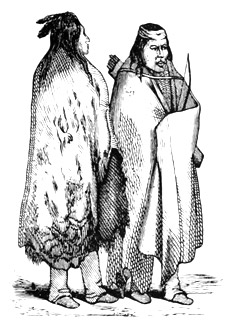
Omaha Indians
Among these Indians there was a woman who had been severely wounded; namely, the well-known Mitain, who is spoken of in Major Long's "Travels to the Rocky Mountains," as an interesting instance of maternal affection, but without mentioning her name. She and her child had received many severe wounds, but were so fortunate as not to be scalped.[226] The nearest village of the Omahas is twenty-five miles from Belle Vue.[227] This country is the proper territory of this tribe, which lives on both sides of the Missouri, from Boyer River to Big Sioux River, and hunts further up to Jacques River, as well as between Running Water River (l'eau qui court) and the La Platte.
On the morning of the 4th of May, at half-past seven o'clock, the thermometer was at 69¾°. We had all round us beautiful low prairie hills, before which was alluvial land, thrown up by the 130 river, covered with fine grass. The river had risen an inch during the night. The noise and smoke of our steamer frightened all living creatures; geese and ducks flew off in all directions. There was formerly a village of the Joway Indians at this place, the inhabitants of which, on the death of their chief, returned to their countrymen further down. On the left bank there were whole tracts covered with dead poplars, which had been killed by the fires caused by the Indians in the forest and prairie. We soon saw the white buildings of Mr. Cabanné's trading post, which we saluted with some guns, and then landed.
We were very glad to see, at the landing-place, a number of Omaha and Oto Indians, and some few Joways, who, in different groups, looked at us with much curiosity; all these people were wrapped in buffalo skins, with the hairy side outwards; some of them wore blankets, which they sometimes paint with coloured stripes. In their features they did not materially differ from those Indians we had already seen, but they were not so well formed as the Saukies. Many of them were much marked with the small pox. Several had only one eye; their faces were marked with red stripes: some had painted their foreheads and chins red; others, only stripes down the cheeks. Few only had aquiline noses, and their eyes were seldom drawn down at the corners; generally speaking, their eyes are small, though there are exceptions. They wore their hair loosely hanging down their backs; none had shaved their heads; and, on the whole, they looked very dirty and miserable. The countenances of the women were ugly, but not quite so broad and flat as those of the Foxes and Saukies; their noses, in general, rather longer. Their dress did not differ much from that of those Indians, and they wore the same strings of wampum in their ears. The men carried in their hands their tobacco pipes, made of red or black stone (a hardened clay), adorned with rings of lead or tin, which they generally obtain from the Sioux, at a high price.
This trading post consists of a row of buildings of various sizes, stores, and the houses of the engagés, married to Indian women, among which was that of Mr. Cabanné, which is two stories high. He is a proprietor of the American Fur Company, and director of this station.[228] He received us very kindly, and conducted us over his premises. From the balcony of his house was a fine view over the river, but the prospect is still more interesting from the hills which rise at the back of the settlement. Between the buildings runs a small stream, with high banks, which rises from a pleasant valley, in which there are plantations of maize for the support of the inhabitants. Mr. Cabanné had planted fifteen acres of land with this invaluable grain, which yield, annually, 2,000 bushels of that corn, the land here being extremely fertile. The banks of the stream are covered with fine high trees, and many of the plants were in flower, especially the beautiful blue lychnis, the white oak, &c. A high wind prevailed throughout the day, but, within doors, the weather was warm, 78° at four o'clock. Our vessel remained here the whole day, and we were besieged all the time by Indians, who caused a very disagreeable heat in our cabins. Among 131 them was a Joway, called Nih-Yu-Máh-Ni (la pluie qui marche), who sold us several articles of his dress. Mr. Bodmer made a sketch of the boy of an Omaha, whom the father first daubed with red paint. He took vermilion in the palm of the hand, spat upon it, and then rubbed it in the boy's face. The head of this boy was shaved quite smooth, excepting a tuft of hair in front, and another at the back.[229] A number of men and women stood round, looking on with eager curiosity. I showed the Indians a rattlesnake in brandy, and they gave me to understand that a child had lately been bitten by one of these animals, and died in consequence. The little child, lately wounded by the Joways, was brought to us; the wounds, though they had not been dressed and covered, were almost healed.
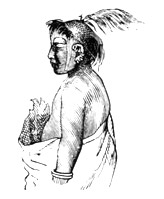
An Omaha boy
We spent a very pleasant evening with Mr. Cabanné; sitting in the balcony of his house, we enjoyed the delightful temperature and the fine scene around us. The splendid sky was illumined by the full moon; silence reigned around, interrupted only by the noise of the frogs, and the incessant cry of the whip-poor-will, in the neighbouring woods, till the Indians assembled round the house, and, at the request of Mr. Cabanné, performed a dance. About twenty Omahas joined in it; the principal dancer, a tall man, wore on his head an immense feather cap, like those of the Camacans in Brazil, but larger and of less elaborate workmanship, composed of long tail and wing feathers of owls and birds of prey;[230] in his hand he held his bow and arrows. The upper part of his body was covered only with a whitish skin, which fell over the right shoulder and breast, and was adorned with bunches of feathers; his arms, face, and the uncovered parts of his body, were painted with white stripes and spots. His trousers were marked with dark cross stripes, and trimmed at the ankles with a great quantity of fringe. He also wore an apron. He had a savage and martial appearance, to which his athletic figure greatly contributed. Another man, 132 who was younger, of a very muscular frame—the upper part of whose body was naked, but painted white—had in his hand a war club, striped with white, ornamented at the handle with the skin of a polecat.[231] He wore on his head a feather cap, like that already described. These two men, and several youths and boys, formed a line, opposite to which other Indians sat down in a row; in the middle of which row the drum was beat in quick time. Several men beat time with war clubs hung with bells; and the whole company (most of whom were painted white) sung, "Hi! hi! hi!" or "Hey! hey! hey!" &c., sometimes shouting aloud. The manner of the dance was thus: bending their bodies forward, they leaped up with both feet at once, not rising high from the ground, and stamped loudly, while the drum beat in quick time, and their arms were rattled and occasionally lifted up into the air. Thus they leaped opposite to each other, with great exertion, for about an hour; they perspired violently, till the usual presents, a quantity of tobacco stalks, were thrown on the ground before them. This dance was very interesting to me, especially in connection with the beautiful evening scene on the Missouri. The bright light of the moon illumined the extensive and silent wilderness; before us, the grotesque band of Indians, uttering their wild cry, together with the loud call of the night raven, vividly recalled to my mind scenes which I had witnessed in Brazil. We did not return to our vessel till late at night, after taking leave of our kind host, and of Major Pilcher; the former was on the point of returning to St. Louis, leaving the superintendence of the trading post to Major Pilcher.
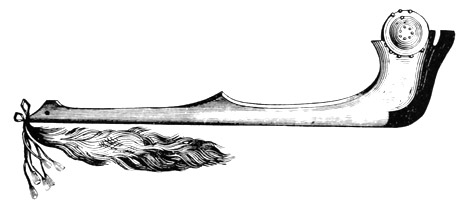
Omaha war club
The Omahas, or, as some erroneously call them, Mahas, were formerly a numerous tribe, but have been much reduced by frequent wars with their neighbours; the smallpox, too, has committed dreadful ravages, and there are now but few vigorous young men among them. Their language differs from that of the Otos, Missouris, and Joways; there is, however, an affinity between them. The best and most complete accounts of the Omahas are given by Mr. Say in his Narrative of Major Long's "Expedition to the Rocky Mountains," to which I would refer my readers.[232]
On the 5th of May, the Yellow Stone left Cabanné's trading house; the weather was warm 133 and serene; we passed the mouth of Boyer's Creek on the east bank, where the Missouri makes a bend, and saw the ruins of the former cantonment, or fort, at Council Bluffs.[233] This military post was established, in the year 1819, for 1,000 men, but, in fact, there were now only 500 men of the regiment in garrison at Jefferson barracks. In the year 1827, these troops were withdrawn and stationed at Leavenworth; the fort, or, rather, the barracks, formed a quadrangle, with a bastion or blockhouse, in two of the angles. At present there were only the stone chimneys, and, in the centre, a brick storehouse under roof. Everything of value had been carried away by the Indians. We were told that numerous rattlesnakes are found among the ruins. The situation of Council Bluffs is said to have been much more favourable for observing the Indians than that at Leavenworth; and it was even conjectured that this post will be again occupied. The military station was at first placed a little further inland, but the scurvy carried off 300 of the garrison in one winter. Mr. Sandford, who had rejoined us, once found here the large grinders of a mastodon, which are now in the possession of General Clarke, at St. Louis.
At twelve at noon, we ran aground, but happily sustained no damage, at a dangerous place, where the left bank was blocked up with many snags, and which is called the Devil's Race-ground. The country was low and uniform till we again reached the hills, which were rather bare of wood, but of grotesque form, and covered with a fine verdant carpet. Near the mouth of the Soldier River, an engagé met us, who brought letters from the Assiniboin steamer. We went on pretty well till the evening, when we got upon a sand bank, and then made the vessel fast for the night; after which our people exerted themselves to get off the bank, in the midst of a storm of thunder and lightning.
The steamer was got afloat by daybreak on the 6th. On both sides there was alluvial soil, thickly covered with willows and poplars, mixed, in some places, with other trees. Here we saw, on a sand bank, two large wolves, which seemed to look at us with surprise. The Omaha Indians hunt on both banks of this part of the river; they are said to be the most indolent, dull, unintellectual, and cowardly of the Missouri Indians. At two in the afternoon we landed on the prairie, which was covered with tall trees, and forty or fifty of our men immediately began to hew down wood for fuel; there was abundance of grass, but not a single flower, which was caused by the prairie having been set on fire; black burnt wood was scattered about, and the ground itself was discoloured in places by the effects of the fire.
From this place the country becomes more and more level, and bare of wood, and the eye roves over the boundless prairie. Behind a willow-tree I saw some remains of Indian huts, in front of one of which a pole was set up, with a piece of red cloth attached to the top. The forest, which had been inundated, was likewise destitute of flowers; numerous traces of stags were everywhere seen. During the night a man deserted, whom Mr. Mc Kenzie had some time before put under arrest for having uttered vehement threats. The 7th day of May, the anniversary of our 134 departure from Germany, was very fine. We soon reached the chain of hills on the left bank, at a place where the yellow limestone rock was nearly perpendicular, and in which innumerable swallows had built their nests; these are called Wood's Hills, and do not extend very far. On one of them we saw a small, conical mound, which is the grave of the celebrated Omaha chief, Washinga-Sahba (the blackbird). In James's Narrative of Major Long's Expedition, is a circumstantial account of this remarkable and powerful chief, who was a friend to the white man: he contrived, by means of arsenic, to make himself feared and dreaded, and passed for a magician, because he put his enemies and rivals out of the way when it suited him. An epidemical smallpox carried him off, with a great part of his nation, in the year 1800, and he was buried, sitting upright upon a live mule, at the top of a green hill on Wakonda Creek. When dying, he gave orders that they should bury him on that hill, with his face turned to the country of the white men.[234] The Omahas have been since so reduced by their enemies, the Sioux, Saukies, and Foxes, that they are now quite powerless and insignificant, not being able to muster above 300 or 400 warriors. Washinga-Sahba was so feared by his own people, that nobody ventured to wake him when he slept: it is said that they used then to tickle his nose with a blade of grass. The present chief of the Omahas is Ongpa-Tanga (the great elk), of whom Godman, in his Natural History, has given a good portrait. He lives on the Horn River, which falls into the La Platte, about twenty miles above its mouth.[235]
On the following day (the 8th of May) we came to Floyd's Grave, where the sergeant of that name was buried by Lewis and Clarke. The bank on either side is low. The left is covered with poplars; on the right, behind the wood, rises a hill like the roof of a building, at the top of which Floyd is buried. A short stick marks the place where he is laid, and has often been renewed by travellers when the fires in the prairie have destroyed it. A little further up is Floyd's River, and on Floyd's Hills there were a few fir trees, over which the kite hovered in the air.[236] About half a league beyond Floyd's River is the mouth of the Big Sioux River, interesting from the circumstance of its being the boundary of the territory of the Dacota, or Sioux nation. Its breadth, at the mouth, is about sixty paces, and it is said to be navigable by Mackinaw boats for 100 miles. About 120 miles up this river, a tribe of the Sioux reside, which is known by the name of Wahch-Pekuté; this, and another tribe of this people on the Mississippi, and near Lake Pepin, are the only ones of their nation who plant maize; all the other hordes of the Sioux are hunters. The territory of these people formerly extended further to the south, till the before-mentioned treaty for the purchase of land was concluded with the Indians.[237]
At noon, with a temperature of 75°, there was such a violent wind, that the fine sand from the banks penetrated into the innermost parts of our vessel; the broad river was so agitated by the wind, that the pilot could not distinguish the sand banks, and we were obliged to lie to. In a small meadow in the woods we saw the giant footsteps of the elks, and likewise of the common 135 stag, which we would willingly have followed had not a rising tempest compelled us to return on board. Vivid lightning flashed in the horizon, the rain soon poured down in torrents, and at night a storm arose which, at midnight, raged with such fury, that we might have felt some alarm, had not our vessel been so well protected by the bank. The storm frequently forced open the doors of the upper cabin, and the rain beat into the room. Towards daybreak the tempest returned with increased violence; the flashes of lightning and the claps of thunder were incessant during the twilight, and everybody thought that the vessel must be struck.
The 9th of May set in with rain, a cloudy sky, and high wind; the thermometer, before so high, fell, at half-past seven o'clock, to 56°. When the storm had passed over, our vessel quitted the place where it had taken shelter. We passed along wild, desolate banks, then a green prairie, by a chain of steep hills, partly bare, partly covered with forests, or with isolated fir trees and picturesque ravines, with dark shadows, into which the close thicket scarcely allowed the eye to penetrate. We here saw, for the first time, a plant which now became more and more common; namely, the buffalo-berry-bush (Sheperdia argentea, Nutt.), with pale, bluish-green, narrow leaves. At the mouth of the Joway River, which runs into the Missouri, on the south bank, at a very acute angle, clay-slate appeared to stand out on the bluffs, divided into narrow, horizontal strata, the lower of which were blackish-blue, and those above of yellowish-red colour.[238] Our hunters and wood-cutters landed, on which occasion we lost a hound, which had strayed too far into the forest. Five or six hundred paces further up, we saw, among the thickets of willow and poplar, an old Indian wigwam,[239] near which the red willow, mixed with the common willow, was in blossom. The thermometer, which had been at 56° in the morning, rose at ten o'clock, when the sun broke through the clouds. We frequently observed the wild geese, which endeavoured to take their young, of which they never had more than four or six, to some place on shore, where they would be safe from us. When we came very near, the mother fluttered anxiously to a little distance, and called them to her.
We continued our voyage, but soon lay to at the prairie, on the right bank, because Mr. Mc Kenzie wished to form a plantation at this place. The whole plain was covered with high, dry grass. On the bank of the river there was a fine border of tall timber trees, in which the turtle-dove cooed, and flocks of blackbirds were flying about. The hills of the prairie were covered with the finest verdure, and the singular forms of the hills afforded us an interesting subject of observation on the otherwise uniform appearance of the country. We halted for the night near the high trees that bordered the prairie, where there were numbers of ducks and plovers. As soon as it was dark, the young men set fire to the dry grass of the prairie, to give us the pleasure of seeing how the fire spread, but the attempt did not fully succeed, because there was 136 no wind. Mr. Mc Kenzie left some men here, with agricultural implements, to make a plantation; among them was one François Roi, of Rheims, whose name gave occasion to many innocent jokes, and we deliberated what name should be given to the kingdom he was going to found.
On the following day, the 10th, we had been exactly four weeks since we left St. Louis. At the spot where we now were, it is said that large herds of buffaloes are seen in the winter, but we had not yet met with one of these animals. The character of the country was much changed; it is, for the most part, naked, and without woods. The trees which are found here are no longer lofty and vigorous, as on the Lower Missouri; yet the wild vines are still seen climbing on the bushes, though this, too, entirely ceases further up the river. Near the mouth of Vermilion Creek, the green hills of the prairie approach very near the water; and here we saw, on the back of one of the hills, a grave surrounded with poles, which was that of some Sioux Indians, who had been killed by lightning in a violent thunder-storm. At the mouth of the stream we saw wild ducks and geese, of which a pair of the latter, with six young ones, anxiously endeavoured to escape us. The female remained faithfully with her young ones, while the male flew away.
The morning of the following day (the 11th of May) brought us to the mouth of Jacques River, which was concealed from our view by a sand bank. The steep banks, which in Lewis and Clarke's map are called Calumet Bluffs, have deep ravines, and are of an ash-grey colour at the base, and yellow above. We reached the island called by those travellers Sego Island, where we found very little water, and then came to Lewis and Clarke's White Bear Bluffs, of which Mr. Bodmer made a drawing.[240] At noon the thermometer was at 63°. After dinner we saw, at a distance, the Assiniboin steamer, with which we came up in half an hour. It had not been able to proceed any further for want of a sufficient depth of water. After we had saluted the master of the vessel, Mr. Pratte, son of the General of that name at St. Louis, and a member of the American Fur Company, we went on board his vessel.[241] In this steamer there were two cabins, much lighter and more pleasant than those in the Yellow Stone; the stern cabin had ten berths, and the fore cabin twenty-four, and between decks was the large apartment distinct for the engagés. The crew had lately killed a she-bear—the young ones were alive on board. While we were visiting the Assiniboin, we suddenly perceived, on the left or southern bank, a number of Indians, between fifteen and twenty of whom rolled down the hills. As our people did not seem very desirous of having anything to do with them, and contented themselves with looking at them through a telescope, we took advantage of the fine weather to make an excursion into the prairie.
The chain of hills, bounding the valley of the Missouri on the north, crossed the verdant prairie, in a straight line, at a distance of about 1,000 paces from the river. The appearance of this chain was singular, with perpendicular, yellow, calcareous walls, which indicated that the 137 river must, formerly, have flowed in that direction; and the cylindrical hollow marked the ancient bed of the river. In the prairie itself there were many pools of water, and we found several interesting plants, among which were some with long roots like carrots, especially the yellow flowering Batschia longiflora (Pursh.), and the Oxitropis Lamberti B. The great yellow-breasted lark (Sturnella, Vieill.), was everywhere seen in pairs, and its short, coy call, and its pleasing, whistling note, were heard from every side. Besides these, we saw the prairie hen, and the great long-billed curlews (Numenius longirostris), of which we shall speak hereafter. Skeletons of buffaloes were scattered in the plain, especially many skulls, but very few of which were entire.
When I returned to the vessel, I found there three Punca Indians, the chief of the tribe Shudegacheh,[242] his brother Passitopa,[243] and Ha-cha-ga. They were all robust, good-looking men, tall, and well-proportioned, with strongly-marked features, high cheek-bones, aquiline noses, and animated dark hazel eyes. Their hair hung down as far as the shoulders, and part of it lower; that of the chief was shorter, and fastened together in a plait. The upper part of the body of these Indians was naked, only they wore round the neck an ornamented band, and had a large slit in their ears: from those of the chief an ornament of shell work was suspended. His beard below the chin consisted of scanty hairs, which had been suffered to grow very long.[244] They wore a narrow bracelet of white metal round the wrist, very plain, leather pantaloons, and large buffalo robes; the chief, however, was wrapped in a white blanket.
The Puncas, as they are now universally called, or as some travellers formerly called them, Poncaras, or Poncars, the Pons of the French, were originally a branch of the Omahas, and speak nearly the same language. They have, however, been long separated from them, and dwell on both sides of Running-water River, and on Punca Creek, which Lewis and Clarke call Poncara. They formerly lived, like the Omahas, in clay huts, at the mouth of the river, but their powerful enemies, the Sioux and the Pawnees, destroyed their villages, and they have since adopted the mode of life of the former, living more generally in tents made of skins, and changing their place from time to time. Their external appearance and dress do not much differ from those of the Omahas. They are said to have been brave warriors, but have been greatly reduced by war and the smallpox. According to Dr. Morse's report, they numbered, in 1822, 1,750 in all; at present the total amount of their warriors is estimated at about 300.[245] The band of them, which 138 we met with here, has set up eight or nine leather tents, at the mouth of Basil Creek,[246] on a fine forest.[247] They plant maize, which they sell to the Sioux, but they had neglected to cultivate this grain for about three years, and obtained it from the Omahas; they, however, intended to grow it again themselves.
As Major Bean was agent of the Puncas, they came to speak to him. The chief had formerly received, through the agent, a large silver medal of President Madison, which he wore suspended round his neck. On the face of all these medals, which are given as a distinction to the Indian chiefs, there is the bust of the President, and, on the reverse, two clasped hands, with a suitable inscription.[248] Shudegacheh had a remarkably intelligent countenance, and fine manly deportment. He sat down by us, and smoked, with his comrades, the only pipe that they had with them; but, according to Indian custom, several pipes soon circulated in the company. The evening was very cool, and, as some of the Indians had no leggins, we took them into our cabin, where their portraits were drawn, after they had been regaled with pork, bread, and tea, which Mr. Mc Kenzie gave them. One of the Indians made me a present of his wooden war-club, which was painted reddish-brown;[249] another, with a pair of shoes, made of elk leather, which were dyed black with the juice of white walnut. These people were not armed, as they had come merely on a visit, and had left their best effects behind. Among them was a French Canadian, named Primeau, who has long lived among them. He acted as interpreter, and communicated to me some words of the Punca language.[250]

Punca war club
The morning of the 12th of May was cold, there having been a hoar frost during the night. The Indians sat upon the bank, wrapped in their buffalo skins, as represented in the subjoined woodcut.[251]
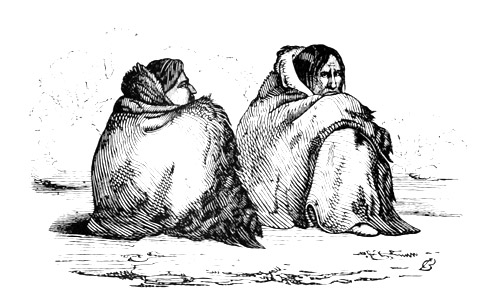
Punca Indians in buffalo robes
139 While the Yellow Stone remained stationary, the Assiniboin attempted to pass the shallow place on the river, during which time the hunters went into the prairie. The Indians had a conference with their agent, in which the chief expressed a wish that their great father (the President) would send them several articles, particularly agricultural implements. The attitude and gestures of the speaker were graceful; his right arm and shoulder were bare, while he gesticulated with his hand; and his fine, manly countenance was very expressive. As he had not put on his leggins, we observed, on his muscular calves, two tattooed stripes crossing each other, X; otherwise, he was neither tattooed nor painted. Some of these Indians had been inoculated with the smallpox by a surgeon, whom Major Bean had taken to them the year before, and who had inoculated 2,600 Indians of different tribes. Many of them had manifested distrust on this occasion; and, when he offered to perform the operation, said, "Now we are well; if we should become sick it will be time enough to submit to the operation." Shudegacheh had on the upper part of his arm a large, round scar, which he is said to have burnt into his flesh with his tobacco-pipe, on the death of a relation. Major Bean presented to the Indians, in the name of the Government, tobacco, powder, and ball, and the chief received a fine blanket. Mr. Mc Kenzie observed to him, that "the Puncas furnished too few skins, and did not plant maize enough; it was not possible to purchase anything of them;" to which he replied, that "there was no unity among his people; that they lived too scattered, and, therefore, he could not superintend them, and keep them to work." At noon, the thermometer being at 67°, our hunters returned, without having seen anything of consequence, except a couple of large curlews. The boats, which had been sent out to take soundings, likewise came back, and great exertions were made to lighten the steamer, by transferring part of the cargo to the Maria keel-boat. At length, at two o'clock, we were able to weigh anchor, and run awhile down the river, which was done with such rapidity that the Indians became giddy, and sat down on the floor. In this manner we turned round a sand bank, and proceeded upwards, along the south coast of the river, and in twenty minutes were opposite the huts of the Punca Indians. They lay in the shade of a forest, like white cones, and, in front of them, a sand bank extended into the river, which was separated from the land by a narrow channel. The whole troop was assembled on the edge of the bank, and it was amusing to see how the motley group crowded together, wrapped in brown buffalo skins, white and red blankets—some naked, of a deep brown colour. The little children, with their protuberant bellies,[252] and their legs, of a dark brown colour, carrying bows and arrows in their hands, were running along the beach, or cowering like little monkeys, while the men walked about, very gravely, with their weapons in their hands. We landed our Indian visitors on the sand bank; the boat brought back some skins, and we afterwards saw Primeau, with the Indians, wade through 140 the channel. A little further up we witnessed a great prairie fire, on the left bank. The flames rose from the forest to the height of 100 feet—fiery smoke filled the air: it was a splendid sight! A whirlwind had formed a remarkable towering column of smoke, which rose, in a most singular manner, in graceful undulations, to the zenith. Afterwards we came to steep hills, behind which is Manoel's Creek, so called from Manoel Lisa, a Spaniard, who formerly carried on the fur trade in these parts.[253] Towards evening we were near the Assiniboin steamer, which lay before us, and halted in the vicinity of Basil Creek, where the Puncas formerly dwelt, numbers of whose graves are seen upon the hills. The trunks of trees in the river had much injured our paddles.
CHAPTER XII
VOYAGE FROM L'EAU QUI COURT TO FORT PIERRE, ON THE TETON RIVER (THE LITTLE MISSOURI), AND STAY THERE, FROM MAY 13TH TO JUNE 4TH
Running-water River (l'eau qui court)—Punca Creek—Remarkable Mountains—Cedar Island—Delay caused by the insufficient Depth of the Water—First Sight of Buffaloes and Antelopes—Burning Mountain—Black Strata of bituminous Coal—Bijoux Hills—Prairie Dogs—Shannon, or Dry River—White River—Ruins of Cedar Fort—Fort Look-out (Sioux Agency)—Visit to it—The Dacotas of the Branch of the Yanktons—Wahktageli—Big Bend, or Grand Détour—Medicine Hills—Teton River—Fort Pierre—Stay there—The Tetons, a branch of the Dacotas or Sioux.
On the morning of the 13th of May, the Yellow Stone passed the mouth of the Running-water River (l'eau qui court),[254] when the thermometer was at 55°. The Assiniboin was before us. We reached the mouth of Punca Creek, which runs along the chain of hills obliquely to the Missouri. At the time when the Puncas separated from the Omahas, they built a kind of fort of earth, some miles up this river, which, however, they no longer occupy. There are said to be hot springs in the neighbourhood, such as are known to exist in several places on the banks of the Missouri.[255] Springs of any kind are, however, very rare in these dry prairies. In this neighbourhood are many villages of the prairie dogs (Arctomys ludoviciana, Ord.), in the abandoned burrows of which, rattlesnakes abound. It has been affirmed that these two species of animals live peaceably together in these burrows; but observers of nature have proved that the snakes take possession of abandoned burrows only, which is in the usual course of things. Deep 142 gullies traverse the summits of the banks, above which the turkey buzzards were hovering. On a sudden, three Punca Indians appeared and hailed us; they were wrapped in their buffalo skins, and carried their bows and arrows on their shoulders. One of them had a very singular appearance, having bound up the hair of his head, so that it stood quite upright. Though they made signs to us to take them on board, we did not stop, but renounced the pleasure of more closely observing these interesting people. The trees on the edge of the prairie, by which we passed, were old, thick, and low, with their summits depressed and cramped. They were the resort of the Carolina pigeon, which is found all along the banks of the river. The red cedars, in particular, were stunted and crippled, often thicker than a man's body in the trunk, and very frequently wholly withered. The swallows' nests—numbers of which were built against the steep banks—were not yet inhabited. We were unable, on account of the shallowness, to reach a fine grove of poplars on the right bank, and proceeded along the hills of the left bank, which were seventy or eighty feet in height, where the red cedar abounded, and we stopped to fell a number of these trees. A wild lateral ravine here opened to the Missouri, up the steep sides of which our wood-cutters climbed, and cut down the cedars, which were loaded with their black berries. The wood of this tree emits a very aromatic scent, and it is much used by the steam-boats for fuel, because it supplies a great deal of steam, and the berries, as we were told, are eaten by the Indians for certain medicinal purposes. At the bottom of the narrow ravine, there was a thicket of elm, cedar, bird-cherry, clematis, celtis, celastrus, vine, and other shrubs; and the neighbouring lofty verdant hills of the prairie produced many beautiful plants, among which was Stanleya pinnatifida, with its splendid long bunches of yellow flowers. Returning to our vessel, when the bell gave the signal for departure, we found one of the three Punca Indians whom we had seen in the morning. He had taken advantage of our slow progress to overtake us. His hair hung down to his shoulders, and was tied together in a queue. His countenance was good-natured and friendly; he wore a buffalo robe, had a bow and arrows on his back, and, in his hand, a large hussar sabre, which he had received as a present. Major Bean gave him some tobacco, powder, lead, and ball; and after he had satisfied his craving appetite he returned, well satisfied, to his comrades. In the afternoon the country was by no means attractive, rather flat, and not so verdant; our vessel sustained many violent shocks. The chain of hills, in the distance, appeared in more and more singular forms, partly resembling ramparts and batteries, and then again perfectly flat, like table-land. An isolated, round, conical eminence, which is called the Tower, stands on them.[256] On the bank were, again, singularly stunted woods and thickets, probably kept down by the cold winds of the prairie. The soil and the whole character of the country was changed; on the Lower Missouri it was a black mould, and very fertile. Cedars flourished here, growing to the height of forty or fifty feet, yet they were often withered, or, at least, many had dry branches on their summits.
143 On the following morning, the 14th, we had a very difficult navigation, and were even obliged to put back, so that the Assiniboin overtook and passed us, and we followed it up the river on the north bank, and afterwards landed forty men to lighten the vessel; ran happily over a sand bank, and again passed the Assiniboin. In the preceding year, the whole prairie was seen from the steamer to be covered with herds of buffaloes, but now there were no living creatures, except a few wild geese and ducks, which had likewise become scarce, since the termination of the great forest below the La Platte River. The monotony of this rude landscape was, however, soon interrupted by the appearance of a canoe, in which were four white men rowing down the river. A boat was speedily manned, into which Mr. Mc Kenzie and Mr. Sandford went, well armed, in order to speak to them, because they were supposed to be engagés of the Company who were deserting. We were informed by them, that the Arikkaras, a dangerous Indian tribe, had lately murdered three beaver hunters, one of whom was a man named Glass, well known in the country, of whom I shall have occasion to speak in the sequel.[257]
Upon an island, to which we came, was a real wilderness; the beavers had formed a kind of abattis, by felling poplars; another island was remarkable because there is a hot spring opposite to it, on the main land, the water of which has no mineral taste. On the left bank, about five or six miles below Cedar Island, we observed the remains of Indian huts. Mr. Mc Kenzie had met here, in the preceding year, a camp of the Punca Indians. On the steep banks were coloured stripes, or regular strata; some black, doubtless bituminous coal, others reddish brown, and, in several places, burnt black. Some parts had burnt very lately, and, in many places, had fallen in. Unhappily we were not able more closely to examine these remarkable strata. We fastened the vessel for the night to the western coast; and the lightning was very brilliant.
On the following day, the 15th of May, we saw in the thickets, behind which the prairie extended, many traces of an Indian camp; heads of elks, stags, and other animals, were scattered about; the marks of horses' feet were everywhere visible; and a practicable trodden path led through the thickets. At noon, when the thermometer was at 77°, the Assiniboin again passed us, and, with the keel-boat Maria, vanished from our sight. At four in the afternoon, we reached the place where we had stopped the preceding night, with the help of the keel-boat, which had returned, and at length succeeded in getting forward; but again had a storm of thunder and lightning. The whole country, beyond the banks, consisted of hills, rising one above the other; some covered with verdure, some of a yellowish colour, mostly without life and variety. While the lightning flashed from the dense black clouds, we again overtook the Assiniboin, which had landed its wood-cutters to fell some cedars on the steep mountain. We, too, landed 300 paces further up, to cut down cedars for fuel. At this place there was the narrow deep ravine of a small stream, now dry, in which we caught a pale yellow bat, and saw some snakes, and the scattered bones of buffaloes. We climbed from the bottom of the ravine up the singular 144 eminences of the prairie, and collected some interesting plants, particularly the wild turnip. Two species of cactus were not yet in blossom; they are, probably, not sufficiently known to botanists. One of them has been taken for the Cactus opuntia; and Captain Back,[258] too, says, that it is found on an island in the Lake of the Woods; but this is certainly not the above-named plant. On the highest elevation above the river, we enjoyed a remarkably fine prospect, while the sky was darkened by black thunder clouds. Around us was the amphitheatre of singularly-formed mountain-tops; at our feet lay the fine broad river, intersected by innumerable sand banks, which plainly showed us the difficulties of our navigation. On the banks, at so great a distance from the dwellings of civilized men, were two large vessels emitting volumes of steam. We were lost in the contemplation of this vast wilderness, when the bell summoned us on board. Our people had found a channel with five feet water, but it was so dark and foggy, that we were obliged to lie to early.
On the following morning, the 16th of May, having passed a village of the prairie dogs, we reached, at nine o'clock, the Cedar Island, which is said to be 1,075 miles from the mouth of the Missouri.[259] On the steep banks of this long narrow island, which lies near the south-west bank, there were thickets of poplars, willows, and buffalo berry; the rest of the island is covered with a dark forest of red cedars, of which we immediately felled a good number. Their beautiful violet-coloured wood is traversed towards the edge by white veins, and is found very fit for ship-building. We crossed, with great pleasure, this wilderness of lofty cedars, the rough bark of which peels off of itself, and hangs down in long slips; many of them were withered, others broken and thrown down, or lying on the ground, covered with moss and lichens. The notes of numerous birds were heard in the gloom of this cedar forest, into which no ray of the sun could penetrate. Here, too, we found everywhere traces of the elks and stags, and saw where they had rubbed off the bark with their antlers. This may be considered as the limit to which the wild turkey extends on the Missouri. It is true that this bird is, now and then, found higher up, even on the Yellow Stone River; but these are exceptions, for beyond this place the woods are too open and exposed. The Indians, on the Upper Missouri, very readily barter for the tails of these fine birds, to use them as fans and ornaments, and Mr. Mc Kenzie, accordingly, took a good supply with him.
On account of the high wind we were obliged to stop longer than we intended at Cedar Island, and took advantage of the delay to send out our hunters with their fowling-pieces. They brought back some birds, and a quadruped which was new to me. The wood-cutters had found, in a hollow tree, a nest of the large wood-rat, with four young ones. This fine animal has a tuft of hair at the end of its tail, and sometimes the whole tail is covered with hair. In colour and shape it resembles our Norway rat, and has not yet been mentioned as found on the Missouri, unless a couple of passages in Lewis and Clarke's Travels, which say, "very large rats were found here," refer to it.
145 On the morning of the 17th we saw the first antelopes, or cabris, half a dozen of which fled over the hills, but at so great a distance that we could not well distinguish them; we, however, subsequently had the pleasure of seeing one of these animals stop so long on the summit of the bank that we could very plainly observe it nearer at hand. It gazed for a long time at the steamer, appeared to be alarmed, trotted away, then stopped again, and disappeared behind the hills. The antelope becomes more and more common in this part of the country, and we saw several to-day, but the wishes of our hunters were disappointed. The Indians use the skin of these animals for clothing, but they are not very eager in the chase of the antelope, except where the buffalo is scarce. As, on sounding the channel, only four feet of water were found, the steamer was moored to the bank, and we took our fowling-pieces. With difficulty we penetrated through the thickets of poplar and willow on the bank, where the large tracks of the elks and of the Virginian deer were everywhere deeply imprinted in the soft soil. We then reached the prairie, which is perfectly level, and extends for 300 or 400 paces to the hills. It was covered with high grass, and clusters of many different plants. Our people traversed the prairies in all directions, looking for the pomme blanche, which was very common. Near the thickets we saw the pretty Carolina pigeon, seeking its food on the ground, but, when we approached, all the birds immediately flew out of the prairie, and sought refuge in the recesses of the thickets. We had a fine, starlight, cool evening.
On the 18th we saw the first buffaloes that we had met with on this voyage. Several of our hunters were immediately landed to pursue them. They ascended into a ravine, and disappeared behind the hills. We also landed, at noon, when the thermometer was at 68°. Beyond the thickets on the bank, there were some old isolated trees in the prairie, in which, as well as in the tall plants, bushes, and grass, there were numerous birds. During the day, the mosquitoes (Tipula) were so troublesome in the wood, that we could scarcely load our pieces; it is said that, in the height of summer, this nuisance is still more intolerable. The buffalo hunters returned to the vessel at the same time with us; they had, indeed, missed their object, but had killed a large buck antelope, as well as a great many prairie dogs, the heads of which were all mutilated by the rifle balls. As these little animals retreat to their burrows, on the approach of any strange object, and only put out their heads, the Americans, with their long rifles, generally hit them in this part: they are a favourite food among them. Our men brought back the skin and the head, as well as the flesh of the antelope which they had killed: they likewise brought me a fine grey eagle and a serpent (Col. eximus). The river being so shallow, we were not able to proceed on the following day, and continued our excursions on shore. I often passed my time in the lofty and shady forest which extended beyond the willow thickets on the banks, at the border of the open prairie. Sitting on an old trunk, in the cool shade, I could observe at leisure the surrounding scene. I saw the turkey buzzards, that hovered above the hills, contending against the high wind, while a couple of falcons frequently made a stoop at them, doubtless to defend 146 their nest. A couple of ravens likewise flew about them. The red-eyed finch, the beautiful Sylvia æstiva, the Sylvia striata, and the wren, flew around me, the latter singing very prettily. If I passed beyond the prairie hills, I found the ground, on the long-extended ridge, covered with the blue flowers of the Oxitropis Lamberti (Pursh.), which grew in tufts about a foot high. There, too, I saw dens of the foxes and wolves. I saw a fine bird which we had not before met with, namely, the prairie hen (Tetrao phasianellus), a pair of which rose before me, and of which I first shot the cock. These birds are found in considerable numbers from this place up to the Rocky Mountains. In the daytime we suffered great heat in these excursions, while there was also a high wind, and the ground was hard and dry; the soles of our shoes became so polished on this ground and the hard dry grass, that it was difficult and fatiguing to walk on the slopes. We were forced to remain here many days, because the water was very shallow, and, during this time, we had several violent thunder-storms. It is a peculiarity of this part of the country that, in spring, rain, storms, and tempests prevail, while the summer and autumn are, in general, very dry. All the small streams in the extensive prairies then dry up, and there is a general want of water, except in the vicinity of the large rivers.
On the 21st of May it was so cool that we were obliged to have fires in the cabins; the river had risen a little, and we endeavoured to proceed. Captain Pratte, of the Assiniboin, came on board with a man named May, a beaver hunter, who had left Fort Union, on the Yellow Stone, in March. He confirmed the account of the murder of the three men by the Arikkaras, and added the still more alarming intelligence, that thirteen of the Company's engagés had been killed by the Blackfoot Indians. He said that the herds of buffaloes had left the Missouri, and had been followed by the Sioux Indians, so that we must expect to see only a few of them on the river. The keel-boat of the Assiniboin had taken part of our cargo on board on the 22nd, and, as there was rather more depth of water, the Yellow Stone had been got afloat, after a delay of five days in this shallow place. We happened to be on the hills when the bell summoned us on board, and hastened as quickly as possible to the bank, but came too late, and were compelled to follow the vessel for a couple of hours, clambering over fragments of stone, pieces of rock, to creep through thickets full of thorns and burrs, or to wade through morasses; and not till eleven o'clock did we get on board. The hills on both sides of the river were of singular forms; some of them were crowned with rocks resembling ancient towers and ruins. The eminences had some dark spots, caused by black shining strata of coal. Many of these strata had been on fire, and one of them was extinguished only last year, after having burnt more than three years. Such a thick stratum of bituminous coal ran in a well-defined stripe on both sides of the river, at an equal elevation, along all the hills, as far as the eye could reach; and it is not difficult to follow this stratum for many hundred miles; it is only interrupted, at intervals, by ravines. Some lofty hills, hereabouts, are called Bijoux Hills, after a person of that name, who resided here many years.[260] 147 The next morning we found the Assiniboin at the foot of these hills. Our steamer could not be moved till noon, and then did not proceed far, but lay to near a sand bank. On the morning of the 24th, Major Bean left us, accompanied by Mr. Bodmer, to go by land to Sioux Agency, or Fort Lookout, where he intended to wait for us. He had procured saddle-horses from that place. As we expected the keel-boat, to lighten the ship, we had time to go ashore and make an excursion inland. At eleven o'clock the bell summoned us to return. The vessel was made to drop about 2,000 paces down the river, and then, with much exertion, to proceed along the north-east bank, where we found the Maria keel-boat, which had likewise run aground, but had been got afloat by its crew, who laboured up to their waists in water, while the people were lightening our steamer. Mr. Mc Kenzie and myself went on shore to explore the neighbouring eminences, where we found many rare plants. The geology and mineralogy of these hills are likewise interesting. The surface consists of clay of various colours, partly resembling lithomarge; plates and fragments of foliated gypsum were scattered around, and seemed to stand out in the clay. When we reached the bare sterile heights which belong to the black burnt stratifications, I found the soil quite different from what it had appeared to me when I looked at it from below. The whole consists of a clay, which has undergone the effects of fire, and is partly burnt black on the surface. We saw no living creatures on these bare heights, except the finch (Fringilla grammaca), first described by Say. Several caves or dens of wolves, foxes, and marmots, were observed in the declivities of the hills. Between four and five o'clock, the keel-boat having been sent on before, the Yellow Stone proceeded along the northeast bank. Near the Shannon, or Dry River, the sun sank behind the poplar wood on the bank, and we lay to for the night. From the Shannon, the mouth of which is on the west side, the territory of the Sioux nations is reckoned to extend up the Missouri. On the east bank, as I have observed, it begins much sooner.
At five o'clock, on the following morning, the 25th of May, we had already reached the White River,[261] and at noon came to a place where the Cedar Fort, a trading post of the Missouri Fur Company, had formerly stood. When the Company was dissolved, this and other settlements were abandoned, and demolished by the Indians.[262] Directly opposite, on the east bank, a stratum of earth burnt till 1823, in consequence of which a large portion of a hill fell, and now stands isolated before the bank; it is seventy or eighty feet high, and 150 feet long. In the course of the day we came to a place where an Arikkara village had formerly stood, on the ridge of the hills, which was destroyed by the Sioux, and the inhabitants expelled. Opposite to this was Fort Lookout, where the French Fur Trading Company had a post. A little further up the river we saw, on the hills, some burying-places of the Sioux Indians; most of them were formed of a high platform, on four stakes, on which the corpse, sewn up in skins, lies at full length; others consisted of stakes and brushwood, like a kind of hedge, in the middle of which the deceased is buried in the ground. We were told that the son of a chief was buried in one of the latter, in a 148 standing posture. On a point of land, at the left hand, round which the Missouri turns to the west, we saw the buildings of Sioux Agency; the Yellow Stone saluted the post with several guns, and was welcomed to the fort by the hoisting of a flag, while the whole population, about fifty in number, chiefly consisting of Sioux Indians, were assembled on the beach. We greeted our friends Major Bean and Mr. Bodmer, and proceeded a mile further, to an extensive forest, where we took in wood, and stopped for the night. In order to get acquainted with the Sioux, in whom I took so much interest, I returned, in a heavy rain, through the bushes and high grass, to the agency, where Major Bean received me very kindly, though his dwelling, according to the fashion of the place, was rudely constructed, and he was incommoded by too many visitors.
Sioux Agency, or, as it is now usually called, Fort Lookout, is a square, of about sixty paces, surrounded by pickets, twenty or thirty feet high, made of squared trunks of trees, placed close to each other, within which the dwellings are built close to the palisades. These dwellings consisted of only three block-houses, with several apartments. Close to the fort, in a northern direction, the Fur Company of Mr. Soublette had a dwelling-house, with a store; and, in the opposite direction, was a similar post of the American Fur Company.[263] The fort is agreeably situated on a green spot, near the river, partly covered with bushes, and partly open, bounded by hills, beyond which the prairie extends, first, with a few old trees, and some wooded spots, but soon assuming its peculiar bare character. About ten leather tents or huts of the Sioux, of the branch of the Yanktons or Yanktoans, were set up near the fort.[264]
The Dacotas, as they call themselves, or the Sioux of the French, called by the Ojibuas or Chippeways, Nandoesi (which has been corrupted into Nadowassis), are still one of the most numerous Indian tribes in North America. Pike stated their number at 21,575 souls, and they are still reckoned at 20,000; nay, some even affirm, that they are still able to furnish 15,000 warriors, which seems rather too high an estimate. Major Long, who gives much information respecting this people, calculates their number at 28,100, of which 7,055 are warriors, the nation possessing 2,330 tents, which agrees pretty nearly with the statements we received on the Missouri. If we add the Assiniboins, who are of the same origin, and who are estimated at 28,000, we shall have for all the Dacotas, 56,100 souls, of whom 14,055 are warriors, and the number of their tents 5,330. Major Long is of opinion that they cannot be calculated at less than 25,000 souls, and 6,000 warriors; 20,000 is, therefore, not too high an estimate.
The territory which they inhabit extends from Big Sioux River, between the Missouri and the Mississippi, down the latter to Rock River, and northwards to Elk River; then westwards, in a line which includes the sources of St. Peter's River, and reaches the Missouri below the Mandan villages, stretches down it, crosses it near Heart River, and includes the whole country on the western bank, to the Black Hills about Teton River, as far as Shannon River. The Sioux are divided into several branches, which all speak the same language, with some deviations. 149 Three principal branches live on the Missouri, viz., the Yanktons, or Yanktoans, the Tetons, or Titoans, and the Yanktonans, or Yanktoanons. The Mende-Wakan-Toann, or the people of the Spirit Lake, and some others, live on the Mississippi. All these branches together are, as Major Long says, divided by the traders into two great classes—the Gens du Lac and the Gens du Large; i.e., those who live near the Spirit Lake, and are now chiefly found on the banks of the Mississippi, and those who roam about in the prairies. The Yanktoanons are said to constitute one-fifth of all the Dacotas, and the Tetons the half of the whole nation.[265]
The Dacotas roam as far as the territory of the Puncas, over the Black Hills, to the Arkansa, and westwards to the Rocky Mountains, into the territory of the Crows, on the Yellow Stone River, &c. Pike makes them, as well as the Pawnees, descend from the Tartars; but many objections may be made to this notion, as the affinity of the North Americans and the people of Asia is not proved, and the resemblance between them appears to be very limited. In general, these Indians have more strongly-marked countenances and higher cheek-bones than many other tribes on the Missouri, nor are their features so regular or pleasing, yet there is no considerable difference in their physiognomy. Bradbury says they are much inferior in stature to the Osages, Mandans, and Puncas, and by no means so robust; but this assertion must be very much restricted, because there are many tall men among the Dacotas. The Yanktons live in Sioux Agency, or the furthest down the Missouri, among which tribe we now were. All these Dacotas of the Missouri, as well as most of those of the Mississippi, are only hunters, and, in their excursions, always live in portable leather tents. Only two branches of them are exceptions to this rule, especially the Wahch-Pe-Kutch, on the Mississippi, who cultivate maize and other plants, and therefore live in fixed villages. All these Indians have great numbers of horses and dogs, the latter of which often serve them as food. The Dacotas, on the Missouri, were formerly dangerous enemies to the Whites. Bradbury calls them blood-thirsty savages; whereas now, with the exception of the Yanktonans, they bear a very good character, and constantly keep peace with the Whites. Pike seems to have too high an idea of their valour; at least, this is the opinion now entertained on the Missouri. Such of these Indians as reside near the Whites, are frequently connected with them by marriages, and depend on them for support. They then become negligent hunters, indolent, and, consequently, poor. This was partly the case at Sioux Agency, where they rarely possessed more than two horses. One of the most considerable men among them, wholly devoted to the Whites, was Wahktageli, called the Big Soldier, a tall, good-looking man, about sixty years of age, with a high aquiline nose, and large animated eyes. Besides him, there were several elderly, and some slender young men of this nation, here. They had, in general, a rather narrow, oval countenance, narrow, long eyes, and aquiline, or straight, well-formed noses; their colour was a dark brown. They wore their hair hanging down long over the shoulders, and often plaited en queue; the older men, however, let it hang loosely, cut off a little below the 150 neck, and turned back from the forehead. Younger people generally wore it parted, a large lock hanging down on the nose; young men had the upper part of the body only wrapped in their large white or painted buffalo hides. They had long strings of blue and white wampum shells in their ears; some of them wore one, two, or three feathers, which were partly stripped till towards the point.[266]
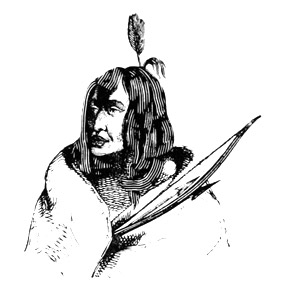
Method of wearing hair
Mr. Bodmer having expressed a wish, immediately on the arrival of the Big Soldier, to paint his portrait at full length, he appeared in his complete state dress. His face was painted red with vermilion, and with short, black, parallel, transverse stripes on the cheeks. On his head he wore long feathers of birds of prey, which were tokens of his warlike exploits, particularly of the enemies he had slain. They were fastened in a horizontal position with strips of red cloth. In his ears he wore long strings of blue glass beads, and, on his breast, suspended from his neck, the great silver medal of the United States. His leather leggins, painted with dark crosses and stripes, were very neatly ornamented with a broad embroidered stripe of yellow, red, and sky-blue figures, consisting of dyed porcupine quills, and his shoes were adorned in the same manner. His buffalo robe was tanned white, and he had his tomahawk or battle-axe in his hand.[267] He appeared to stand very willingly as a 151 model for Mr. Bodmer, and remained the whole day in the position required, which, in general, the Indians find it difficult to do. The remainder of these people were now entirely without ornaments, naked, and the upper parts of their bodies not at all painted, but only wrapped in their buffalo robes. On their backs they carried their quivers, which were made of leather, in which their arrows are kept; they carry their bows in their hands.[268]
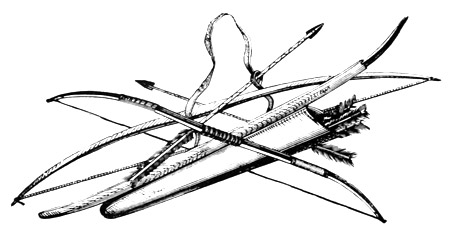
Bows, arrows, and quiver
The features of the women resembled, on the whole, those we have already described, yet their faces, for the most part, were not so broad and flat as those of the Saukies, or Musquake women, and some were even pretty. The tents of the Sioux are high pointed cones, made of strong poles, covered with buffalo skins, closely sewed together. These skins are scraped on both sides, so that they become as transparent as parchment, and give free admission to the light. At the top, where the poles meet, or cross each other, there is an opening, to let out the smoke, which they endeavour to close by a piece of the skin covering of the tent, fixed to a separate pole standing upright, and fastened to the upper part of the covering on the side from which the wind blows. The door is a slit, in the front of the tent, which is generally closed by another piece of buffalo hide, stretched upon a frame.[269] A small fire is kept up in the centre of the tent. Poles are stuck in the ground, near the tent, and utensils of various kinds are suspended from them. There are, likewise, stages, on which to hang the newly-tanned hides; others, with gaily-painted parchment pouches and bags,[270] on some of which they hang their bows, arrows, quivers, leather shields, spears, and war clubs.
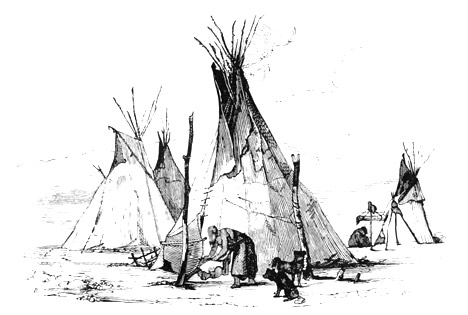
Tents of the Sioux
We paid a visit to Wahktageli in his tent, and had some difficulty in creeping into the narrow, low entrance, after pulling aside the skin that covered it. The inside of this tent was 152 light, and it was about ten paces in diameter. Buffalo skins were spread on the ground, upon which we sat down. Between us and the side of the tent were a variety of articles, such as pouches, boxes, saddles, arms, &c. A relation of the chief was employed in making arrows, which were finished very neatly, and with great care. Wahktageli immediately, with much gravity, handed the tobacco-pipe round, and seemed to inhale the precious smoke with great delight. His wife was present; their children were married. The conversation was carried on by Cephier, the interpreter kept by the Agency, who accompanied us on this visit. It is the custom with all the North American Indians, on paying a visit, to enter in perfect silence, to shake hands with the host, and unceremoniously sit down beside him. Refreshments are then presented, which the Big Soldier could not do, as he himself stood in need of food. After this the pipe circulates. The owner of a neighbouring tent had killed a large elk, the skin of which the women were then busily employed in dressing. They had stretched it out, by means of leather straps, on the ground near the tent, and the women were scraping off the particles of flesh and fat with a very well-contrived instrument. It is made of bone, sharpened at one end, and furnished with little teeth like a saw, and, at the other end, a strap, which is fastened round the wrist. The skin is scraped with the sharp side of this instrument till it is perfectly clean.[271] Several Indians have iron teeth fixed to this bone. Besides this operation, we took particular notice of the harness of the dogs and horses, hanging up near the tent, both these animals being indispensable to the Indians to transport their baggage on their journeys. Even the great tent, with many long, heavy poles, is carried by horses, as well as the semi-globular, transparent wicker panniers, under which the little children are protected against sun and rain, by spreading blankets and skins over them. Smaller articles are conveyed by the dogs, as we shall relate in the sequel. Many of the Sioux are rich, and have twenty or more horses, which they obtained originally from the Spaniards on the Mississippi, and the frontier of New Mexico on the Oregon, but which are now found in great numbers among the several Indian nations. One of their most important employments is to steal horses, and the theft of one of these animals, from another nation, is considered as an exploit, and as much, nay more honoured than the killing of an enemy. The dogs, whose flesh is eaten by the Sioux, are equally valuable to the Indians. In shape they differ very little from the wolf, and are equally large and strong. Some are of the real wolf colour; others black, white, or spotted with black and white, and differing only by the tail being rather more turned up. Their voice is not a proper barking, but a howl, like that of the wolf, and they partly descend from wolves, which approach the Indian huts, even in the daytime, and mix with the dogs.
Among the peculiar customs of the Sioux is their treatment of the dead. Those who die 153 at home are sewed up, as I have before stated, in blankets and skins, in their complete dress, painted, and laid with their arms and other effects on a high stage, supported by four poles, till they are decomposed, when they are sometimes buried. Those who have been killed in battle are immediately interred on the spot. Sometimes, too, in times of peace, they bury their dead in the ground, and protect them against the wolves by a fence of wood and thorns. There were many such graves in the vicinity of the Sioux Agency, among which was that of the celebrated chief, Tschpunka, who was buried with his full dress and arms, and his face painted red. Very often, however, they lay their dead in trees; and we saw, in the neighbourhood of this place, an oak, in which there were three bodies wrapped in skins. At the foot of the tree there was a small arbour, or shed, made of branches of poplar, which the relations had built for the purpose of coming to lament and weep over the dead, which they frequently do for several days successively. As a sign of mourning, they cut off their hair with the first knife that comes to hand, daub themselves with white clay, and give away all their best clothes and valuable effects, as well as those of the deceased, to the persons who happen to be present. The corpse of a young woman had been enveloped in skins about a week before, and placed between the branches of the oak, with six pieces of wood under it; and a little higher in the tree there was a child. Guided by the obliging interpreter, we viewed everything remarkable in the Sioux agency, which, indeed, is confined to the Indians and their mode of life. Major Bean had the kindness to accommodate us for the night.
We passed the 26th of May here, when Mr. Bodmer finished his very capital likeness of Wahktageli. The elk, killed by the Indians, furnished us with fresh meat, and we considered ourselves very well off. In the afternoon, Messrs. Mc Kenzie and Sandford came from the Yellow Stone to visit us, and we returned on board in the evening.
The following morning (27th) was cool, windy, and cloudy, and, at half-past seven, the thermometer at only 54°. It was so cold that we had fires in our cabins the whole day. Major Bean had the courtesy to present me with the complete dress of the Big Soldier, an interesting souvenir of the friendly reception we had met with in his house. The Assiniboin passed us rapidly in the afternoon, and we followed. A well-known Sioux chief, called Tukan Haton, and, by the Americans, the Little Soldier, was on board with his family, intending to accompany us to Fort Pièrre, on the Teton River. These Indians were in mourning for some of their relations lately deceased; their dress was, therefore, as bad as possible, and their faces daubed with white clay. The Big Soldier also paid us a visit previous to our departure. He had no feathers on his head, but only a piece of red cloth. After receiving some food he took leave, and we saw the grotesque, tall figure stand for a long time motionless on the beach. As the vessel proceeded very quickly, our Indians laid down their heads as a sign that they were giddy, but they were soon relieved, as the water became shallow. We lay to not far above the stream which 154 Lewis and Clarke call the Three Rivers.[272] Here we again had leisure to make an excursion in the wood, where the ground was covered with pea vine (Apios tuberosa),[273] and a plant resembling convallaria. The Carolina pigeon was frequent here, and was sought after by our people for their dinner, to which the river contributed some cat-fish, of the usual olive-brown kind. Our Indians kindled their fire in the neighbouring wood, and lay around it, but soon returned to the vessel.
Early on the 28th, part of the goods had been put into the keel-boat, to lighten the steamer, which was accomplished by eight o'clock. From this place to the Big Bend of the Missouri is fifteen miles, before reaching which we came to an island, which has been formed since Lewis and Clarke were there. The same stratum of coal, which I have before mentioned, ran along the hills, and was visible at a great distance. We soon overtook the Assiniboin, and reached the Big Bend which the Missouri takes round a flat point of land; following the course of the river, it is twenty-five miles round, while the isthmus is only one mile and a half across.[274] The large peninsula, round which the Missouri turns, is flat, and bordered with poplars and willows; the opposite bank is higher, steep, and bare. A couple of antelopes were, in this place, frightened by the noise of our steamer; these animals are said to be very numerous here in the winter time. The Little Soldier sat by the fireside, smoking his pipe, in doing which, like all the Indians, he inhaled the smoke, a custom which is, doubtless, the cause of many pectoral diseases. The tobacco, which the Indians of this part of the country smoke, is called kini-kenick, and consists of the inner green bark of the red willow, dried, and powdered, and mixed with the tobacco of the American traders. According to Say, they also smoke the leaves of the arrow-wood (Viburnum), when they have none of the bark.
On the 29th, we were nearly at the end of the Big Bend, and stopped, at seven o'clock in the morning, to cut down cedars. Here we ascended the lofty, steep hills, which were partly bare, and burnt black, and from which we had a view of the whole bend of the river. To the south, we saw the tops of the Medicine Hills, which are about eight miles from the Medicine Creek, on the west bank.[275] Towards noon there appeared, on the western bank, steep, rocky walls, and, behind them, singularly-formed hills, some resembling pyramids, others, round towers, &c. At this place we suddenly espied a canoe, with four men in it, which touched at a sand bank; a boat was put out, and brought back two of the strangers, who proved to be Mr. Lamont, a member of the Fur Company, and Major Mitchell, one of their officers, and Director of Fort Mc Kenzie, which is situated near the falls of the Missouri.[276] They came last from Fort Pièrre, and were on their way to St. Louis, but we persuaded them to return with us. Having taken in 155 wood on the morning of the 30th, we came to a leather tent on the bank, in which three of the Company's engagés and some Indians lived, to take care of 100 horses, belonging to Fort Pièrre. They had lately killed three antelopes, and gave us some of the fresh meat. At seven o'clock we had, on the right hand, Simoneau's Island, which, in Lewis and Clarke's map, is called Elk Island; it was covered with lofty, green poplars.[277] Soon after twelve o'clock we came to a plantation, made by the inhabitants of Fort Pièrre, where we found about ten men, who had got ready a great quantity of fine stack wood for our vessel. At this place, which is only three miles from the fort, we observed hills, of a singular form, often cleft perpendicularly, and, in the river, several islands, all of which have now different names from those given to them by Lewis and Clarke. Before six, in the evening, we reached the mouth of the Teton River, or the Little Missouri, which the Sioux call the Bad River. It rises in the Black Hills, and has a long course, with many windings; but is said, however, to be straight for 150 miles from the mouth. In this part of the Missouri are vast sand banks, on which we saw a numerous flock of pelicans. These birds, however, only stop here on their passage, and do not build their nests. The river is very wide at the mouth of the Teton, and has extensive low prairies, with a border of poplars and willows. The French Fur Company had formerly a fort just above the mouth of the Teton, which was abandoned when the Companies joined, and another built further up, which was called Fort Teton; this, too, was abandoned;[278] and Fort Pièrre (so called after Mr. Pièrre Chouteau) was erected higher up, on the west bank, opposite an island.[279]
The steamer had proceeded a little further, when we came in sight of the Fort, to the great joy of all on board: the colours were hoisted, both on the steamer and on the fort, which produced a very good effect between the trees on the bank; a small village, consisting of thirteen Sioux tents, lay on the left hand. Our steamer first began to salute with its cannon, which was returned from the shore by a running fire of musketry, and this was answered from our deck by a similar very brisk fire. Before we reached the landing-place, we perceived an isolated, decayed old house, the only remains of Fort Tecumseh,[280] and, ten minutes afterwards, landed at Fort Pièrre, on the fifty-first day of our voyage from St. Louis. A great crowd came to welcome us; we were received by the whole population, consisting of some hundred persons, with the white inhabitants at their head, the chief of whom was Mr. Laidlow, a proprietor of the Fur Company, who has the management at this place.[281] There were many Indians among them, who had done their part to welcome us by firing their muskets, which they carried in their hands. There seemed to be no end of shaking hands; a thousand questions were asked, and the latest news, on both sides, was eagerly sought for. Mr. Fontenelle, who was to undertake a journey to the Rocky Mountains, was already here, having performed the journey, on horseback, in eleven days. As soon as we set foot on land, we proceeded, accompanied by numbers of persons, to the Fort, to which there is a straight road of about a quarter of a mile. We put up at Mr. Laidlow's house, where we rested beside a good fire.
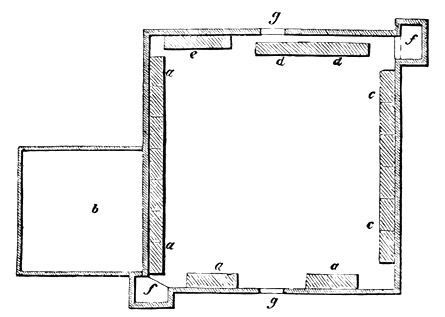
Plan of Fort Pierre
156 Fort Pièrre is one of the most considerable settlements of the Fur Company on the Missouri, and forms a large quadrangle, surrounded by high pickets,[282] round which the buildings stand in the manner already described. At the north-east and south-west corners there are block-houses, with embrasures, f, f, the fire of which commands the curtain; the upper story is adapted for small arms, and the lower for some cannon; each side of the quadrangle is 108 paces in length; the front and back, g, g, each 114 paces; the inner space eighty-seven paces in diameter. From the roof of the block-houses, which is surrounded with a gallery, there is a fine prospect over the prairie; and there is a flag-staff on the roof, on which the colours are hoisted. The timber for this fort was felled from forty to sixty miles up the river, and floated down, because none fit for the purpose was to be had in the neighbourhood. Mr. Laidlow's dwelling-house, d, d, consisted of one story only, but was very conveniently arranged, with large rooms, fire-places, and glass windows. Next this house was a smaller building, e, for the office and the residence of a clerk. The other clerks, the interpreters for the different Indian nations, the engagés and their families, altogether above 100 persons, lived in the other buildings, a, a, a, a. Opposite, in c, c, were the stores, at that time of the value of 80,000 dollars; and in other rooms, the furs obtained from the Indians by barter. The fort has two large doors, g, g, opposite each other, which are shut in the evening; in b there was an enclosed piece of garden ground. The situation of the settlement is agreeable; the verdant prairie is very extensive, animated by herds of cattle and horses; of the latter, Fort Pièrre possessed 150, and of the former, thirty-six, which afforded a sufficient supply of milk and fresh butter. Indians, on foot and on horseback, were scattered all over the plain, and their singular stages for the dead were in great numbers near the Fort; immediately behind which, the leather tents of the Sioux Indians, of the branches of the Tetons and the Yanktons, stood, like a little village; among them the most distinguished was the tent of the old interpreter, Dorion, a half Sioux, who is mentioned by many travellers, and resides here with his Indian family.[283] This tent was large, and painted red; at the top of the poles composing 157 it some scalps fluttered in the wind. A great number of Indian dogs surrounded this village, which did not differ from those we have already described. Many of them were perfectly similar to the wolf in form, size, and colour; they did not bark, but showed their teeth when any one approached them.
Near the fort we roused, in the thickets, a Virginian deer, and saw wolves, in the middle of the day, prowling about in the prairies; but we could not get near them, and fired at them in vain with our rifles. Round an isolated tree in the prairie I observed a circle of holes in the ground, in which thick poles had stood. A number of buffalo skulls were piled up there; and we were told that this was a medicine, or charm, contrived by the Indians in order to entice the herds of buffaloes. Everywhere in the plain we saw circles of clods of earth, with a small circular ditch, where the tents of many Indians had stood. This time we visited the Indian tents uninvited; in that which we first entered there were several tall, good-looking men assembled; the owner of the tent was a man of middle-size; his complexion very light, and his features agreeable. His wives were dressed very neatly, and were remarkably clean, especially the one who appeared to be the principal; she wore a very elegant leather dress, with stripes and borders of azure and white beads, and polished metal buttons, and trimmed as usual at the bottom with fringes, round the ends of which lead is twisted, so that they tinkle at every motion. Her summer robe, which was dressed smooth on both sides, was painted red and black, on a yellowish white ground.[284] She estimated all these articles of dress very highly. Among the effects piled up inside the tent, there were several interesting things, such as cradles for the infants, viz., ornamented boards, to which they are fastened with broad leathern straps, one passing over the head, and the other over the middle of the body. The workmanship of these leathern straps was remarkably neat and curious; for instance, they were entirely covered with a ground of milk-white porcupine quills, on which figures of men, of a vermilion colour, and black figures of dogs, and other similar patterns, were most tastefully embroidered, and all of the most lively and well-chosen colours. After we had conversed with the men, the pipe circulated. The pipes of 158 the Dacotas are very beautiful,[285] in truth the most beautiful of all the North American Indians, which they make, in various forms, of the red indurated clay, or stone.[286]
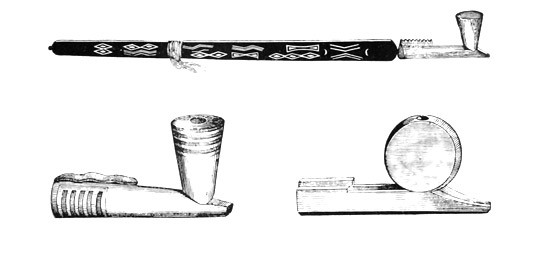
Dakota pipes
The pipe has a long, flat, broad wooden tube, which is ornamented with tufts of horse-hair, dyed red, yellow, or green, and wound round with strings of porcupine quills of divers colours. We looked at the women as they were at work. For the shoes which they made they had softened the leather in a tub of water, and stretched it in the breadth and length with their teeth. In the middle of the hut was a fire, over which the kettle was suspended by a wooden hook; they now all use iron kettles, which they obtain from the traders. Before most of the tents poles were placed, leaning against each other, to which gaily-painted parchment pouches were hung, and likewise the medicine-bags, as they are called, in which the medicine, or charms, are preserved, and which they open and consult only on solemn or important occasions, such as campaigns and the like. Here, too, were suspended the bow and quiver of arrows, spears, and a round shield of thick leather, with a thin cover, also of the same material. In another tent the women were dressing the skins, either with a pumice-stone, or with the before-described toothed instrument, which was here entirely of iron. They then pulled the skin over a line, in all directions, backwards and forwards, to make it pliable.
The Sioux at Fort Pièrre were in general slender, sometimes muscular-men, of middling stature, though some of them were tall. They had oval faces, with prominent cheek-bones, slightly-curved and well-formed noses; the inner angle of the eye often drawn down. Their faces were painted red, some with white rings round the eyes, and others with a black point on the forehead, or a white circle with a black point on each cheek. Some had strings of wampum in their ears, but the greater part of them strings of white or blue glass beads, and round their necks an elegant, and frequently broad necklace, embroidered with white beads. The neck and breast of several were marked with dark blue tattooed stripes, or only with some small figures. These Indians let their hair grow as long as possible, and plait it behind in a long tail, which is ornamented with round pieces of brass, and often hangs down to a great length, as among the Chinese. Many of the Dacotas have three such tails, one behind, and one at each side, for the Indians on the Upper Missouri take much pride in long hair, whereas those in the country lower 159 down the river, cut it short. Some wore feathers in their hair, which are tokens of their exploits, and are determined with great precision, according to the merit of the wearer. The annexed figure of a Dacota shows the manner in which the hair is divided into plaits.[287]
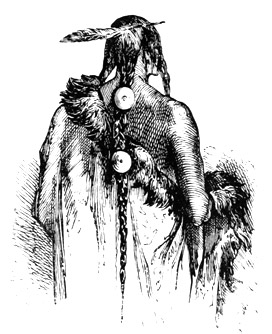
A Dakota, with plaited hair
The women wore their hair hanging down, naturally parted on the middle of the head, and the parting painted red. Their robes were coloured red and black. Their shoes are neatly ornamented with various figures made of dyed porcupine quills. I purchased several Dacota shoes; and, among them, a pair, on the upper part of which the figure of a bear's footstep was very neatly embroidered in bright colours.[288] The old women are generally very ugly and dirty, as they are obliged to do very hard work.
The Sioux, who live on Teton River, near Fort Pièrre, are mostly of the branch of the Tetons; though there are some Yanktons here. The former are divided into five branches, and the latter into three.[289] Like all the North American Indians, they highly prize personal bravery, and, therefore, constantly wear the marks of distinction which they have received for their exploits; among these are, especially, tufts of human hair attached to their arms and legs, and feathers on their heads. He who, in the sight of the adversaries, touches a slain or a living enemy, places a feather horizontally in his hair for this exploit. They look upon this as a very distinguished act, for many are often killed in the attempt, before the object is attained. He who kills an enemy by a blow with his fist, sticks a feather upright in his hair. If the enemy is killed with a musket, a small piece of wood is put in the hair, which is intended to represent a ramrod. If a warrior is distinguished by many deeds, he has a right to wear the great feather-cap, with ox-horns, 160 which will be described in the sequel. This cap, composed of eagle's feathers, which are fastened to a long strip of red cloth, hanging down the back, is highly valued by all the tribes on the Missouri, and they never part with it except for a good horse. In a battle with the Pawnees, a Sioux chief was killed, who wore such a cap; the conqueror wore it as a trophy, and the Sioux recognized him by it in the next battle; they made great efforts to kill him, and succeeded in wounding him; but his horse was too fleet for them, and he always escaped. Whoever first discovers the enemy, and gives notice to his comrades of their approach, is allowed to wear a small feather, which is stripped, except towards the top.[290] The scalps taken in battle are drawn over small hoops, and hung on the top of the tent-poles. He who takes a prisoner wears a particular bracelet. These Indians frequently possess from thirty to forty horses, and are then reckoned to be rich. The tents are generally composed of fourteen skins, each worth two dollars. We were told, that wealthy people sometimes have eight or nine wives, because they are able to support them. The Sioux do not understand the treatment of diseases, but generally cure wounds very well. Before their death, they usually determine whether they will be buried, or be placed on a stage, or in a tree.
There was, among the Dacotas at this place, a young Punca Indian, whose name was Ho-Ta-Ma, a handsome, friendly man, who often amused himself with different games; frequently he was seen with his comrades playing at what was called the hoop game, at which sticks, covered with leather, are thrown through a hoop in motion. In the daytime the Indians were often seen galloping their horses, mostly riding on their bare backs: sometimes they ran races, as Mr. Bodmer has represented.[291] In the evening they drive their horses into the fort, as they are more safe from a hostile attack, and horse-stealing is universally practised by the Indians. The Indian families residing here are mostly related to the white inhabitants of the fort, and, therefore, constantly abide near them. The men lead a very indolent life; for, besides the chase and war, their only occupations are eating, smoking, sleeping, and making their weapons.