Volume 22 — TRAVELS IN THE INTERIOR OF NORTH AMERICA, IN THE YEARS 1832, 1833, AND 1834 (continued 6)
Hannibal Evans Lloyd translation
During our stay here, on board the vessel, we were continually besieged by Indians, who did not move from the spot. Our time was, therefore, divided between these visitors and our excursions into the prairie. On the 2nd of June, 7,000 buffalo skins and other furs were put on board the Yellow Stone, with which it was to return to St. Louis. We took this opportunity of sending letters to Europe: the Assiniboin was assigned us for the continuation of the voyage. The weather, at this time, was very unfavourable; it rained at a temperature of 57°, and we were obliged to have a fire in our cabin throughout the day. The Assiniboin had already taken our baggage on board, but still lay on the east bank, for an attempt to bring it over to our side had failed, because the water was too low. In the afternoon, when we visited Mr. Laidlow in the fort, six Sioux, from the prairie, arrived on horseback, whose horde, of 200 tents, was at the distance of a 161 day's journey. They brought word that, two days' march from the fort, there were numerous herds of buffaloes. Among these new comers there were some elderly men; the plaits of their hair were wound about with strips of skin, and their faces were painted red; their bodies were fleshy, which was a proof that they had suffered less from hunger than those in the fort. They paid a visit first to the Assiniboin, and then to Mr. Laidlow, who gave them food and tobacco. Mr. Lamont, who had taken leave of us to-day, to go by the steam-boat to St. Louis, embarked with some of the Company's clerks: he was saluted with several cannon shot, and before evening the Yellow Stone rapidly descended the river. While Messrs. Mc Kenzie, Sandford, and Mitchell took up their abode in the fort, we went on board the Assiniboin, from which I made, on the 4th of June, an interesting excursion into the prairie, in order to make myself acquainted with the eastern bank.
I left the vessel at half-past seven o'clock, the thermometer being at 59°, and immediately ascended the steep eminences, of which the lower were covered partly with bright green, partly with dry, yellow grass, and the higher ones bare, with the surface frequently blackened by fire. A path, trodden by the elks to the river, led me to the highest summit, from which I had a pleasing prospect of the opposite bank and the fort. It lay, clearly delineated, in the extensive verdant plain, bounded by a singular chain of hills; and I again distinguished, half way up the mountains, the black stripe of the extensive stratum of coal. At noon it was warm and I returned much heated, the thermometer being at 72°. We received a visit from six or seven newly arrived Tetons, whom the interpreter, Dorion, introduced to us. They were particularly interested by the steam-boat, and, after they had very minutely examined it, they were served with dinner and pipes. The dinner chiefly consisted of bacon, which the Indians do not like; 162 they, however, swallowed it, in order that they might not appear uncourteous. Among them was a Teton, named Wah-Menitu (the spirit, or god, in the water), and who had such a voracious appetite, that he devoured everything which the others had left; his face was painted red; he had a remarkably projecting upper lip, and an aquiline nose much bent. In his hair, which hung in disorder about his head, with a plait coming over one of his eyes or nose, the feather of a bird of prey was placed horizontally; but observe that he had a right to wear three. Mr. Bodmer, who desired to draw this man's portrait, gave him some vermilion, on which he spat, and rubbed his face with it, drawing parallel lines, in the red colour, with a wooden stick.[292] Wah-Menitu stayed on board for the night; sung, talked, laughed, and joked without ceasing; and seemed quite to enjoy himself.
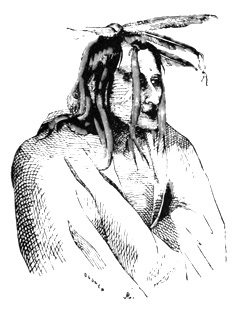
A Teton
CHAPTER XIII
VOYAGE FROM FORT PIERRE, ON THE TETON RIVER, TO FORT CLARKE, NEAR THE VILLAGES OF THE MANDANS, FROM JUNE 5TH TO JUNE 19TH
Singular conformation of the Country—Traces of Fire—Chayenne Island and River—Former abode of the Arikkaras—The Woodcutters alarmed by the Indians—Cabris or Antelopes—Wolves and other Animals—Little Chayenne River—Abundance of Game—Traces of the Beaver, and of the breaking-up of the Ice—Moreau's River—Grand or Wetarko River—Rampart River—The two abandoned Villages of the Arikkaris—La Butte au Grès—La Butte de Chayenne—Murder of Whites by the Arikkaras—Cannon-ball River, with its Sand-stone Balls—Heart River—La Butte Carrée—Interview with the Yanktonans—Fort Clarke, near the Mandan Villages—The Mandans—The Crows.
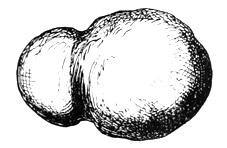
Our departure was delayed till ten o'clock on the 5th of June, when three guns were fired, and we left the fort. The Assiniboin was perfectly equipped for the voyage up the river, and had sixty men on board. Mr. Mc Kenzie had remained behind in the fort, but overtook us at noon with Mr. Laidlow, who was desirous to accompany us a little way. We had stopped at an island called, by the Canadians, Isle au Village de Terre, because, on the other side of the channel which divides it from the continent, there was formerly a village of the Sioux. This island was covered with an almost impenetrable thicket of narrow-leaved willows, which was so dense and entangled, that one of our large dogs caught an elk calf alive; we heard its moaning, but were not able to find it. The next morning the thermometer was at 66½°. We were obliged to unload some goods, and to lighten our vessel, and our hunters brought us many interesting objects, particularly several birds, among which was the grey butcher-bird (Lanius excubitoroides), of which Richardson gives a representation, and which we had not met with before. Though antelopes and a white wolf had approached very closely to them, our hunters had not been able to kill any large animals. The addition to our Flora was very considerable. The hills all consisted of clammy, greasy, sterile clay, which was burnt on the surface, and covered with pieces of stone; and in many places we observed on them round masses, which looked as if they had been 164 melted and formed by fire. We stayed here till noon on the 7th of June, when we again proceeded with an agreeable temperature of 77½°. We ran aground several times, and at last took in our goods, which we had deposited on the left bank. This delay gave us time to make an excursion. In company with Mr. Bodmer, I ascended the slippery, very steep eminences along the river, the singular shapes of which often appeared to form perfect craters. The earth and stones everywhere indicated that they had undergone change by fire. The earth was hard, friable, with many crevices—the stones brown, blackish, and often looking like scoriæ. This clay, when wet, is exceedingly clammy and tough. The conical summits, most of which were perfectly round and pyramidal, were most singularly formed. At the top there were always very regular, parallel, horizontal rings; the lower parts of the pyramid had perpendicular furrows, or clefts, as the annexed woodcut shows.[293] These conical hills have been evidently elevated by fire, so that many crater-like hollows are seen between and near them. In the furrows and clefts of these singular hills, many low plants grow, and form regular net-like green stripes on the bare black clay. These lines, intersecting each other, divide the surface into regular beds. The lower part of these eminences is generally covered with plants, particularly grasses, while the upper is bare, or merely crossed with the transverse stripes of verdure, and often they are entirely bare. The climbing up these high, slippery ascents in the heat of the day was rather fatiguing. When we came into the clefts between the pyramids, we found the ground, in general, slimy, and so adhesive that we were almost compelled to leave our shoes behind. In such places, some old red cedars, groups of the bird cherry, ashes, roses, &c., were nourished by the moisture. Near the hills, and in the plain, a cactus, with roundish, flat joints, grew in abundance. It was not yet in blossom, and I cannot say whether it is the plant taken, by Nuttall, for Cactus opuntia; probably it is Cactus ferox. We found many traces of antelopes and of herds of buffaloes. The latter had everywhere trodden broad paths on their way to the river to drink. No beast of the chase presented itself as an object for our rifles, and, as the sun was going down, we set out on our return. On the way we 165 found the horns of an elk, with twelve antlers, and it was late before we reached the Assiniboin. On the 8th of June, in the morning, we received a farewell visit from Mr. Laidlow, and then saw Mr. Fontenelle's party, consisting of sixty men and 185 horses, pass along over the hills. They rode in our sight through the stream called, by the Anglo-Americans, Breechcloth Creek, and, by the Sioux, Tscheh-ke-na-ka-oah-ta-pah.[294] This stream, as well as most of the small rivers of the prairie, not excepting even the Little Sioux River, have, in general, a brackish taste when the water is low. Frequently taking soundings, we proceeded but slowly in the shallow Missouri, and, early in the afternoon, reached the place where the timber for building Fort Pièrre had been felled. From this place it is fifteen miles to the mouth of the Chayenne River. Finding some cords of wood ready piled up, we took them on board. At sunset, a high wind arose, so that we could not reach the mouth of the Chayenne till about seven o'clock on the following morning, after passing Chayenne Island. The country about the mouth of this river is open, the chain of hills low, and the banks covered with forests. At its mouth, and for some way up on both sides of the Missouri, the Arikkaras formerly dwelt, till they were driven further up by the Sioux, and, at length, wholly retired from the banks of the Missouri.[295] If we follow the course of the Chayenne for a couple of hundred miles up to the Black Hills, we come to the dwellings of the Chayenne Indians, who are hostile to most of the tribes of the Missouri. They are said to be tall, slender men, with long, narrow faces, and differing in their language from all the other tribes in the country. They formerly lived at the mouth of Chayenne River. They affirm that they came to the Missouri from the north-east.[296] Dr. Morse states their number at 3,250 souls.
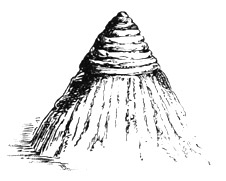
Hill of baked clay
We made but slow progress to-day; and at two o'clock, after our boats had taken soundings in all directions, we remained fast aground, and had burnt all our fuel, so that we had to send wood-cutters into the forests on the left bank. In about half an hour the boats suddenly returned, bringing word that hostile Indians had been seen in the forest, and the wood-cutters had, therefore, refused to begin their work. To give them courage, and to protect them during their work, all hands on board, that could be spared, armed themselves with rifles and muskets, and, to the number of twenty-six persons, immediately went on shore. They formed a line of outposts behind the trees, under whose protection the wood-cutters pursued their work. But they were not disturbed, for the Indians had retired, or it had been a false alarm. We lay to for the night on the west bank; a strong wind had risen, with a pretty high temperature, which continued till the following morning, the 10th of June. Early on that day we reached an island, which appears to be that called, by Lewis and Clarke, Caution Island, where a couple of white wolves gazed at us without appearing to be at all afraid. In the afternoon, we came to the mouth of Little Chayenne River, on the east bank.[297] Elks are very numerous in these parts; on the following morning we saw a herd of, at least, thirty of these large animals, as well as a great many wolves, often three or four together, most of them white. The wood, on the high bank, bore marks of 166 the breaking up of the ice, the bark of the trees being peeled off eight or ten feet above ground. At noon, Mr. Bodmer had shot a very large male antelope, which we despatched some of the people to bring on board; other hunters, who had gone out early to the east bank, made signs that they had killed some game; and the boat which we sent to them returned in the evening with four large elks. In the thick forest, on the left bank, were many traces of beavers, which are more numerous hereabouts than in most of the other parts on the Missouri, because the trappers (beaver catchers) did not venture to place their traps in the territory of the hostile Arikkara Indians.
Opposite to the mouth of Otter Creek,[298] in the woods and thickets of the west bank, behind which rose the green hills of the prairie, there were many elks, which were frightened by the noise of the steamer. In this forest we found an uninhabited loghouse, 180 steps from which runs a pretty river, called Moreau's River, from a man of that name who passed the night here with a Chayenne Indian woman, who had been taken by the Arikkaras and escaped.[299] She stabbed him while he slept, and fled on his horse to her own nation. This river is called the southern boundary of the territory of the Arikkaras, though they often make excursions far beyond it. We stopped at the above-mentioned loghouse to cut wood, but it was found more convenient to pull down part of the old building and take it away. On the morning of the 12th, our cannon, muskets and rifles were loaded with ball, because we were approaching the villages of the hostile Arikkaras. We came to Grand River, called in Lewis and Clarke's map Wetarko River. As we here touched the bottom, we crossed to the east bank, and in half an hour reached Rampart River,[300] which issues from a narrow chain of hills, called Les Ramparts; and soon afterwards an island covered with willows, which, on the large special map of Lewis and Clarke, has an Arikkara village, of which there are now no traces.[301] From the hills we had a fine prospect over the bend of the river, on which the villages of the Arikkaras are situated, and which we reached after a short run of only two miles.
The two villages of this tribe are on the west bank, very near each other, but separated by a small stream. They consist of a great number of clay huts, round at the top, with a square entrance in front, and the whole surrounded with a fence of stakes, which were much decayed, and in many places thrown down. It is not quite a year since these villages had been wholly abandoned, because their inhabitants, who were extremely hostile to the Whites, killed so many Americans, that they themselves foresaw that they would be severely chastised by the United States, and therefore preferred to emigrate. To this cause was added, a dry, unproductive season, when the crops entirely failed; as well as the absence of the herds of buffaloes, which hastened their removal. It is said that these Indians now roam about on the road from St. Louis to Santa Fé, and the late attacks on the caravans are ascribed to them.[302] Mr. Bodmer made an accurate drawing of these deserted villages. The principal chief of the Arikkaras, when they retired from 167 the Missouri, was called Starapat[303] (the little hawk, with bloody claws), and generally La Main pleine de Sang, who will be mentioned in the sequel.
The Arikkaras, or, as they are called by the Mandans, Rikkaras or Rees, Les Ris of the Canadians, are a branch of the Pawnees, from whom they long since separated. Their language, which is very easy for a German to pronounce, is said to be a proof of this affinity. Their number is supposed to be still 4000 souls, among whom 500 or 600 are able to bear arms. The wife of La Chapelle, the interpreter for that nation, was an Arikkara; she had a round full countenance, and rather delicate small features, with a very light yellowish complexion. It is affirmed that the women of this nation are the handsomest on the Missouri. Manoel Lisa, a well-known fur trader, had formerly built a trading house in this country, of which nothing now remains; though the place is still called Manoel Lisa's Fort.[304] The prairie was to-day more verdant and pleasant than yesterday. A mountain, with some remarkable summits, called La Butte au Grès, gave it some diversity. Here we suddenly saw, on the bank, a man, who fired his musket three times, and at first took him for an Indian; but another soon appeared, in a small leathern boat, and we learnt that both were engagés or travellers of the Company, who were dispatched from the Upper Missouri, with letters for Mr. Mc Kenzie. We took them in, and the little leathern boat was left lying on the beach. In the distance, on the left, there was a chain of mountains, with numerous summits, near which Cannon-ball River flows; and, nearer to the Missouri, a chain of flat hills, level at the top, with many clefts, called La Butte de Chayenne.[305] In this neighbourhood we saw a high tree in a poplar wood, entirely covered with turkey buzzards, as in Brazil; towards evening we passed Beaver Creek (Rivière au Castor), the Warananno[306] of Lewis and Clarke.[307]
On the 14th, in the morning, the sky was clouded, and the wind very bleak. On the west bank of the river a ravine was shown us, where, seven or eight years before, the Arikkaras had shot seven white men, who were towing a loaded Mackinaw boat up the river.
After we had passed an island, which is not marked in Lewis and Clarke's map, we observed two isolated table mountains in the prairie, on the west bank, which are not far from Cannon-ball River; and we then came to an aperture in the chain of hills, from which this river, which was very high, issues.[308] On the north side of the mouth, there was a steep, yellow clay wall; and on the southern, a flat, covered with poplars and willows. This river has its name from the singular regular sand-stone balls which are found in its banks, and in those of the Missouri in its vicinity. They are of various sizes, from that of a musket ball to that of a large bomb, and lie irregularly on the bank, or in the strata, from which they often project to half their thickness 168 when the river has washed away the earth; they then fall down, and are found in great numbers on the bank. Such sand-stone balls are met with in many places on the Upper Missouri; and former travellers have spoken of them. Many of them are rather elliptical, others are more flattened, and others flat on one side, and rather convex on the other. Of the perfectly spherical balls, I observed some two feet in diameter. On the steep bank of the Missouri we saw many such balls projecting from the narrow strata of the yellow sand-stone. A mile above the mouth of the Cannon-ball River, I saw no more of them. The Missouri had risen considerably; and, during the night, our people were obliged to keep off, with long poles, the trunks of trees that came floating down the river, without being able to prevent our receiving shocks which made the whole vessel tremble.
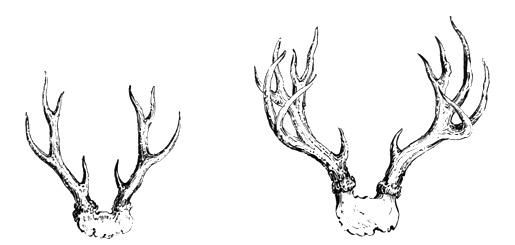
Antlers of deer
On the 15th, the river had risen nine inches, and brought down much wood and foam, which was expected, for it is reckoned that, in the month of June, the Missouri is twice much swollen from the melting of the snow in the Rocky Mountains. The weather was serene and warm. As early as half-past five o'clock we saw, on the eastern bank, a chain of table hills, quite flat at the top, which extends to a pretty considerable distance. The river turns, to the westward, towards this interesting chain, which is called the Mountains of the Old Mandan Village, because, at the place where it is traversed by the river, such a village is said to have formerly stood. At nine o'clock we stopped on the western bank to repair the damage the vessel had sustained, which gave our hunters time to make an excursion a few miles into the prairie. Towards eleven o'clock the bell gave the signal for departure. The current of the river was now very strong, so that we could proceed but slowly. We came to the site of the old Mandan village, which was situated, at the foot of the hills, in a fine meadow near the river; some poles, that were still standing, were the only remains of it; there was no village here at the time of Lewis and Clarke's journey. Dry, yellow grass now covered the place which had once been the scene of busy Indian life: only a colony of swallows, that had built their nests in the neighbouring hills, gave some animation to the scene. We were now in the territory of the Indian tribe of the Mandans.[309] A little further up, we saw four of our hunters sitting on the level ground, which was covered with poplars; one of them, Ortubize, the Sioux interpreter, had killed a Virginian deer, and wounded a large elk, which had escaped; soon after, Messrs. Bodmer and Harvey[310] arrived quite fatigued and heated; they had gone a great way, and very nearly missed the steamer. Mr. Harvey had killed a black-tailed or mule deer.[311] They had met with four of these animals, and brought the 169 head and skin, with some of the flesh of the one killed. At the next place, where we reached the hills, an isolated summit rose above the rest, which is called Bald Eagle Head; these hills were beautifully illumined with the setting sun; we saw the white wolves trotting about on them, and some swans were swimming in the river. On the eastern bank we saw the ruins of an old trading house, and many traces of beavers. Near the mouth of Apple Creek we took in wood, and saw, on the left hand, the continuation of a chain of hills, of very singular forms.[312] The night swallows flew over the river at an early hour, and a large beaver appeared among the willows, which we shot at without success. The 16th of June set in with a high northeast wind, accompanied with rain. We soon reached the mouth of Heart River,[313] but the wind drove our vessel towards the bank, and we were obliged to lay to at six o'clock; and it was not till the evening that the wind so far abated as to allow us to continue our voyage. The next morning, early, we came in sight of the Butte Carrée.[314] In the willow thickets, on the bank, a very fine buffalo bull stood within half musket-shot; our people fired, but to no purpose. Soon after, we saw, in the prairie, two more very large animals of this species; and, in the course of the day, perceived a great number of them. The river brought down several dead buffalo cows. A little before the mouth of Lewis and Clarke's Hunting Creek,[315] the Missouri is half a mile broad, but soon becomes narrower. At eight o'clock we reached the place where a Mandan village had formerly stood.[316] The Sioux, from St. Peter's River, surprised it about forty years ago, killed most of the inhabitants, and destroyed the huts. The prairie hills formed, in this part, long, flat, naked ridges, perfectly resembling the walls of a fortress. The oaks and ashes, at the edge of the thickets, were but just 170 beginning to unfold their buds. It is probable, however, that they had suffered by a fire in the prairie. After we had passed, alternately, prairies, with their hills, steep clay banks, and stripes of forest, we prosecuted our voyage till dusk, and lay to near a large willow thicket, on the eastern bank, when some musket shots were suddenly heard, the flashes of which were evidently seen. Mr. Mc Kenzie immediately supposed that it was an Indian war party, which people, in general, avoid, as they do not much trust them. We consulted what was to be done. Many shots followed, which made a very loud report, it being the custom of the Indians to use a great deal of powder; and we soon perceived, among the dark thickets, the figures of the Indians in their white buffalo robes. As nobody knew the intentions of these people, we looked forward to the meeting with some anxiety. The Indians broke silence first, calling out that they were come with peaceable intentions, and wished to be taken on board. Ortubize, the interpreter, telling us that they were Sioux, of the branch of the Yanktonans, we conferred some time with them, while a kind of bridge of planks was thrown across to the shore. Twenty-three, for the most part tall men, came on board, and were made to sit down, in a row, on one side of the large cabin. They came from a camp of the Yanktonans, consisting of 300 tents, which was in the neighbourhood; they generally lived on the banks of the Chayenne, which falls into the Red River, near the Devil's Lake, and the sources of St. Peter's River.[317] They had been hunting in the neighbourhood, and shot some buffaloes. The Yanktonans are represented as the most perfidious and dangerous of all the Sioux, and are stated frequently to have killed white men, especially Englishmen, in these parts. They generally come to the Missouri in the winter, but at this season it was a mere chance that we met with them. They were mostly robust, slender, well-shaped men, with long dishevelled hair, in which some wore feathers as indications of their exploits. The upper parts of their bodies were generally naked, merely covered with the buffalo's skin, or blanket; but their whole dress was plain and indifferent, as they only came out for a hunting excursion. The chief of these people was Tatanka-Kta (the dead buffalo), a man of middling stature, with a very dark brown, expressive countenance, and his hair bound together over the forehead in a thick knot; he was dressed in a uniform of red cloth, with blue facings and collar, and ornamented with silver trimmings, such as the traders are used to give, or to sell to such chiefs as they desire to distinguish. In his hand he had the wing of an eagle for a fan.
After we had smoked with these Yanktonans all round, the chief opened, before Mr. Mc Kenzie, a bag, with old pemmican (dry meat powdered), by way of present, and then rose to make a speech. After shaking hands, successively, with all persons present, he said, with much gesticulation, and in short sentences, between which he appeared to be reflecting, "that the whole body of the 300 huts was under the principal chief, Jawitschahka; that his people had been formerly on good terms with the Mandans, but had been at variance with them for about a year, on account of the murder of a Sioux, and now wished to make peace again; that with this view 171 they had sent three of their people to the Mandan villages, but did not know the result; and, therefore, were very desirous of the mediation of Mr. Mc Kenzie; that they happened to be near the river, when they perceived their father's ship, and were come to visit him; that to be able to supply the Fur Company with more beaver skins, they wished to have liberty to hunt on the Missouri, and on that account peace with the Mandans was of importance to them. They hoped, therefore, that Mr. Mc Kenzie would intercede for them, and allow them to accompany him." The answer was—"That if, like the other tribes of their nation, who lived constantly on the Missouri, they would, in future, conduct themselves properly, and never kill white men, he would attempt all that lay in his power; but he bade them consider what would be the best for them, whether to come on board with him, or to go alone by land to the Mandan villages, as he did not know how they might be received by the young men of the Mandan tribe." These Indians showed us a beautiful skin of a young, white, female buffalo, which they intended as a present for the Mandans, by whom such skins are highly valued. They had already sent them a white buffalo calf. Our visitors were afterwards taken into another apartment, where refreshments were set before them, and they were lodged for the night. The next morning, however, they went ashore, and proceeded to Fort Clarke on foot. During the night there was a violent tempest, and the next morning, the 18th June, was gloomy, damp, and windy. We left at an early hour the place of the meeting, from which it was twelve miles to Fort Clarke. The Yanktonans, keeping in sight of us, walked through the prairie, where they frightened a herd of ten or twelve wolves, which had long amused us by their gambols. At half-past seven we passed a roundish island covered with willows, and reached then the wood on the western bank, in which the winter dwellings of part of the Mandan Indians are situated; and saw, at a distance, the largest village of this tribe, Mih-Tutta-Hang-Kush, in the vicinity of which the whole prairie was covered with riders and pedestrians.[318] As we drew nearer the huts of that village, Fort Clarke, lying before it, relieved by the back-ground of the blue prairie hills, came in sight, with the gay American banner waving from the flagstaff.[319] On a tongue of land on the left bank were four white men on horseback; Indians, in their buffalo robes, sat in groups upon the bank, and the discharge of cannon and musketry commenced to welcome us. The Assiniboin soon lay to before the fort, against the gently sloping shore, where above 600 Indians were waiting for us. Close to the beach, the chiefs and most distinguished warriors of the Mandan nation stood in front of the assembly of red men, among whom the most eminent were Charata-Numakschi (the wolf chief), Mato-Topé (the four bears),[320] Dipauch (the broken arm), Berock-Itainu (the ox neck), Pehriska-Ruhpa (the two ravens), and some others. They were all dressed in their finest clothes, to do us honour. As soon as the vessel was moored, they came on board, and, after having given us their hands, sat down in the stern cabin. The pipe went round, and the conversation began with the Mandans, by the assistance of Mr. Kipp, clerk to the American Fur Company, and director of 172 the trading post at Fort Clarke;[321] and with the Manitaries, by the help of the old interpreter, Charbonneau, who had lived thirty-seven years in the villages of the latter people, near this place.[322] Mr. Mc Kenzie caused the proposal of the Yanktonans to be submitted to these Indians, but the latter, after long deliberation, replied that they could not possibly accept these proposals of peace, because the Yanktonans were much too treacherous; that, however, no harm should now be done to them, and that they might depart unmolested.
Most of the Indians in our cabin were stout, tall men, except Mato-Topé, who was of middle stature, and rather slim. I shall have occasion to say more, in the sequel, of this brave and distinguished chief. They had their weapons, such as muskets, bows, war clubs, and battle axes, in their hands, and also fans of eagles' wings, and wore buffalo robes, which, on the inner side, are painted reddish-brown, or white, and adorned with coloured figures. They let their hair hang down at length, considering it as an ornament. Sometimes it is divided into plaits, and daubed with a reddish clay. However, I refrain, at present, from describing these Indians, of whom I shall have occasion to speak more at length. The Mandans, Manitaries, and Crows, of which tribe there were now seventy tents about the fort, differ very little from each other in their appearance and dress; they are, however, taller than the Indians on the Missouri whom we had before seen, and their features more regular than those of the Sioux.
We soon went on shore, and examined the numerous assemblage of brown Indian figures, of whom the women and children, in numerous groups, were sitting on the ground; the men, some on horseback, some on foot, were collected around, and making their observations on the white strangers. Here we saw remarkably tall and handsome men, and fine dresses, for they had all done their utmost to adorn themselves. The haughty Crows[323] rode on beautiful panther skins, with red cloth under them, and, as they never wear spurs, had a whip of elk's horn in their hand. These mounted warriors, with their diversely painted faces, feathers in their long hair, bow and arrows slung across their backs, and with a musket or spear in their hands, the latter of which is merely for show, were a novel and highly interesting scene. This remarkable assembly gazed at the strangers with curiosity, and we conversed with them by signs, but soon proceeded to the fort, which is built on a smaller scale, on a plan similar to that of all the other trading posts or forts of the Company. It is about the size of the Sioux Agency, but more rudely constructed. Immediately behind the fort there were, in the prairies, seventy leather tents of the Crows, which we immediately visited.[324]
The tents of the Crows are exactly like those of the Sioux, and are set up without any regular order. On the poles, instead of scalps, there were small pieces of coloured cloth, chiefly red, floating like streamers in the wind. We were struck with the number of wolf-like dogs of all colours, of which there were certainly from 500 to 600 running about. They all fell upon the strangers, and it was not without difficulty that we kept them off by throwing stones, in which 173 some old Indian women assisted us. We then proceeded about 300 paces in a north-west direction from the fort, up the Missouri, to the principal village of the Mandans, Mih-Tutta-Hang-Kush.[325] This village consisted of about sixty large hemispherical clay huts, and was surrounded with a fence of stakes, at the four corners of which conical mounds were thrown up, covered with a facing of wicker-work, and embrasures, which serve for defence, and command the river and the plain. We were told that these cones or block-houses were not erected by the Indians themselves, but by the Whites. Three miles further up the river, and on the same bank, is the second village of the Mandans, called Ruhptare, consisting of about thirty-eight clay huts, which we could not then visit for want of time. In the immediate vicinity of the principal village, the stages, on which these Indians, like the Sioux, place their dead, lay scattered.[326]
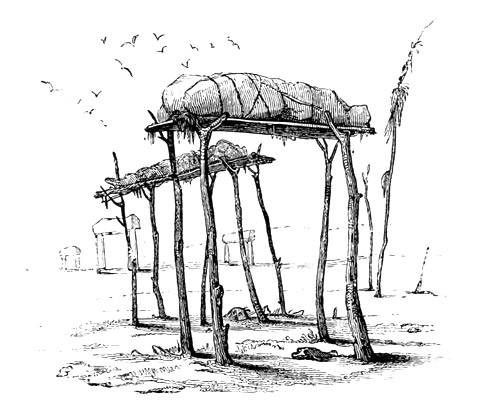
Sioux burial stages
Around them were several high poles, with skins and other things hanging on them, as offerings to the lord of life, Omahank-Numakshi, or to the first man, Numank-Machana.[327] The three villages of the Manitaries (gros ventre) nation, whose language is totally different from that of the Mandans, are situated about fifteen miles higher up on the same side of the river, and most of their inhabitants had come on this day to the Mandan villages.[328]
The view of the prairie around Fort Clarke was at this time highly interesting. A great number of horses were grazing all round; Indians of both sexes and all ages were in motion; we were, every moment, stopped by them, obliged to shake hands, and let them examine us on all sides. This was sometimes very troublesome. Thus, for example, a young warrior took hold of my pocket compass which I wore suspended by a ribbon, and attempted to take it by force, to hang as an ornament round his neck. I refused his request, but the more I insisted in my refusal, the more importunate he became. He offered me a handsome horse for my compass, 174 and then all his handsome clothes, and arms into the bargain, and as I still refused, he became angry, and it was only by the assistance of old Charbonneau, that I escaped a disagreeable and, perhaps, violent scene. On returning to the steamer we there found a numerous company of Indians, some smoking, others wrapped in their blankets, and asleep on the floor.
Mr. Sandford, the sub-agent of the Mandans, Manitaries, and Crows, had a conference with Eripuass (the rotten belly), the distinguished chief of the latter. We accompanied Mr. Sandford to this meeting. Eripuass, a fine tall man, with a pleasing countenance, had much influence over his people; being in mourning he came to the fort in his worst dress, his hair cut close, and daubed with clay. Charbonneau acted as interpreter in the Manitari language. Mr. Sandford recommended to the chief continued good treatment of the white people who should come to his territory, hung a medal round his neck, and, in the name of the government, made him a considerable present of cloth, powder, ball, tobacco, &c., which this haughty man received without any sign of gratitude; on the contrary, these people consider such presents as a tribute due to them, and a proof of weakness. The Crows, in particular, as the proudest of the Indians, are said to despise the Whites. They do not, however, kill them, but often plunder them. At nightfall we visited Eripuass in his tent. The whole camp of the Crows was now filled with horses, some with their foals, all which had been driven in, to prevent their being stolen. This nation, consisting of 400 tents, is said to possess between 9,000 and 10,000 horses, some of which are very fine. The dogs were partly taken into the tents, and we were less exposed to their attacks than in the day time, yet still we had to fight our way through them. The interior of the tent itself had a striking effect. A small fire in the centre gave sufficient light; the chief sat opposite the entrance, and round him many fine tall men, placed according to their rank, all with no other covering than a breech-cloth. Places were assigned to us on buffalo hides near the chief, who then lighted his Sioux pipe, which had a long flat tube, ornamented with bright yellow nails, made each of us take a few puffs, holding the pipe in his hand, and then passed it round to the left hand. After Charbonneau had continued the conversation for some time in the Manitari language, we suddenly rose and retired, according to the Indian customs.
The Crows are called by the Mandans, Hahderuka, by the Manitaries, Haideroka; they themselves call their own tribe Apsaruka. The territory in which they move about is bounded, to the north or north-west, by the Yellow Stone River, and extends round Bighorn River, towards the sources of Chayenne River and the Rocky Mountains. These Indians are a wandering tribe of hunters, who neither dwell in fixed villages, like the Mandans, Manitaries, and Arikkaras, nor make any plantations except of tobacco, which, however, are very small. About six years ago, the Crows are said to have had only 1,000 warriors, at present they are reckoned at 1,200. They roam about with their leather tents, hunt the buffalo, and other wild animals, and have many horses and dogs, which, however, they never use for food. They are said to possess more 175 horses than any other tribe of the Missouri, and to send them in the winter to Wind River, to feed on a certain shrub, which soon fattens them. The Crow women are very skilful in various kinds of work, and their shirts and dresses of bighorn leather, embroidered and ornamented with dyed porcupine quills, are particularly handsome, as well as their buffalo robes, which are painted and embroidered in the same manner. I shall speak, in the sequel, of their large caps of eagles' feathers, and of their shields, which are ornamented with feathers and paintings,[329] and other articles. The men make their weapons very well, and with much taste, especially their large bows, covered with the horn of the elk or bighorn, and often with the skin of the rattle-snake. I have represented a beautiful quiver of this nation, adorned with rosettes of porcupine quills.[330] In stature and dress these Indians correspond, on the whole, with the Manitaries, both having been originally one and the same people, as the affinity of their languages proves. Long hair is considered as a great beauty, and they take great pains with it. The hair of one of their chiefs, called Long Hair, was ten feet long, some feet of which trailed on the ground when he stood upright.[331] The enemies of the Crows are the Chayennes, the Blackfeet, and the Sioux; their allies are the Mandans and Manitaries. With the latter they bartered their good horses for European goods, but the American Fur Company has now established a separate trading post for them on the Yellow Stone River, which is called Fort Cass.[332]
Though the Crows look down with contempt upon the Whites, they treat them very hospitably in their tents, yet their pride is singularly contrasted with a great propensity to stealing and begging, which makes them very troublesome. They are said to have many more superstitious notions than the Mandans, Manitaries, and Arikkaras; for instance, they never smoke a pipe when a pair of shoes is hung up in their tent; when the pipe circulates none ever takes more than three puffs, and then passes it in a certain manner to his left-hand neighbour. They are skilful horsemen, and, in their attacks on horseback, are said to throw themselves off on one side, as is done by many Asiatic tribes. They have many bardaches,[333] or hermaphrodites, among them, and exceed all the other tribes in unnatural practices.
As among all the Missouri Indians, the Crows are divided into different bands or unions. A certain price is paid for admission into these unions and their dances, of which each has one peculiar to itself, like the other Missouri tribes; on which occasion the women are given up to the will of the seller in the same manner, as will be more particularly mentioned when speaking of the other tribes. Of the female sex, it is said of the Crows, that they, with the women of the Arikkaras, are the most dissolute of all the tribes of the Missouri.
This people have a superstitious fear of a white buffalo cow; when a Crow meets one he addresses the sun in the following words: "I will give her (i.e. the cow) to you." He then 176 endeavours to kill the animal, but leaves it untouched, and then says to the sun, "Take her; she is yours." They never use the skin of these white buffalo cows, as the Mandans do, of which I shall, by-and-by, speak at length. The most sacred objects in the eyes of this people are the sun, the moon, and tobacco, that is, the leaves of the genuine tobacco (Nicotiana); and, therefore, all their children wear a small portion of this herb, well wrapped up, round their necks, by way of amulet.
They do not bury their dead in the ground, but, like the Mandans, Manitaries, Sioux, and Assiniboins, lay them on stages in the prairie.[334] A Crow woman, who was on the point of death, was very apprehensive and uneasy in her mind lest she should be interred in the ground, according to the custom of the Whites. This was her sole concern, though she did not otherwise express any fear of death; as soon as she was made easy on this point, she died perfectly satisfied.
CHAPTER XIV
VOYAGE FROM FORT CLARKE TO FORT UNION, NEAR THE MOUTH OF THE YELLOW STONE RIVER, FROM THE 19TH TO THE 24TH JUNE
Ruhptare, the second Village of the Mandans—The Villages of the Manitaries on the Knife River—Interview with the Manitaries—Winter Villages of that Nation—Remarkable Hills—Mountain L'Ours qui Danse—Little Missouri River—Territory of the Assiniboins—Kiasax and Matsokui, two Blackfeet Indians—The Grizzly Bear—Interview with the Assiniboins—The Bighorn—Muddy River, Lewis and Clarke's White Earth River—Yellow Stone River—Fort Union.
On the 19th June, the Assiniboin left Fort Clarke, with a high, cold wind, and clouded sky; the thermometer, at nine in the morning, being at 60½°. The chiefs, and other Indians, had come on board, and also Kiasax, a Blackfoot Indian, who wished to return to his own people. The country, on the south bank, appeared to us to have some resemblance with many parts on the banks of the Rhine; but, on the right bank, there soon appeared those singular hills, resembling fortifications. At ten o'clock, we came to Ruhptare, the second Mandan village, on the south bank, which is situated in a plain a little higher than the river. All the inhabitants, in their buffalo dresses, were collected on the bank, and some had taken their station on the tops of their huts to have a better view: the whole prairie was covered with people, Indians on horseback, and horses grazing. In the low willow thickets on the bank, the brown, naked children were running about; all the men had fans of eagles' feathers in their hands. The village was surrounded with a fence of palisades; and, with its spherical clay huts, looked like a New Zealand Hippah. Here, too, there were high poles near the village, on which skins and other things were hung, as offerings to the lord of life, or the sun, and numerous stages for the dead were scattered about the prairie. As we proceeded, the whole population accompanied us along the steep bank on foot and on horseback, followed by many of their large wolf dogs. The 178 country was pretty open and flat. We saw before us the fine broad mirror of the river, and, at a distance on the southern bank, the red mass of the clay huts of the lower village of the Manitaries, which we reached in half an hour. The Missouri is joined by the Knife River, on which the three villages of the Manitaries are built. The largest, which is the furthest from the Missouri, is called Eláh-Sá (the village of the great willows); the middle one, Awatichay (the little village), where Charbonneau, the interpreter, lives; and the third, Awacháwi (le village des souliers), which is the smallest, consisting of only eighteen huts, situated at the mouth of Knife River.[335] While we were examining this interesting country, and receiving from Charbonneau many particulars respecting these villages, in which he had lived for more than thirty years, our Indian companions were sitting or lying about the fire, smoking their pipes. Among them was Dipauch (the broken arm), a tall, stout man, with whom I frequently came in contact in the following winter. His long, thick hair was bound together in a large queue, and on his breast he wore a silver gorget, which he had received as a present from the Whites. The expression of his countenance was agreeable, whereas that of Berock Itainú (bull's neck), a similar colossus, the inseparable companion of the former, was gloomy and less pleasing. Both were six feet high, and Berock Itainú wore his hair tied together in a knot upon his head. Mato-Topé (the four bears), the eminent Mandan chief, whom I have before mentioned, and Cháratá-Numákshi (the chief of the wolves), were also present; and I purchased from the former his painted buffalo dress, which had hitherto been his medicine (i.e. charm), which he highly valued as a souvenir of his brother, who had been shot by the enemy. Our cookery pleased them much; they were fond of coffee, and sugar was a great delicacy; but they cannot make maple sugar like the Indians in the woody country, because the trees are neither numerous nor strong enough to produce this article.
When we turned our eyes from the dark brown inhabitants to the surrounding scenery, we saw, on the banks, grey hills, with level prairies and willow thickets next the river, and the country, in general, was rather flat than mountainous. The hills were partly depressed at the top—a feature which is almost peculiar to these hills. At noon the sun burst forth, and the thermometer was at 76°, with a high wind. The south bank of the river was now animated by a crowd of Indians, both on foot and on horseback; they were the Manitaries, who had flocked from their three villages to see the steamer and to welcome us. The appearance of this vessel of the Company, which comes up, once in two years, to the Yellow Stone River, is an event of the greatest importance to the Indians; they then come from considerable distances to see this hissing machine, which they look upon as one of the most wonderful medicines (charms) of the white men. The sight of the red-brown crowd collected on the river side, for even their buffalo skins were mostly of this colour, was, in the highest degree, striking. We already saw above a hundred of them, with many dogs, some of which drew sledges, and others, wooden boards 179 fastened to their backs, and the ends trailing on the ground, to which the baggage was attached with leather straps. The Indians hastened through the willow thicket, and, altogether, stood opposite to us on the steep, low, sandy bank, where they were so crowded that we, every moment, expected to see the sand give way.
The most attractive sight which we had yet met with upon this voyage, now presented itself to our view. The steamboat lay to close to the willow thicket, and we saw, immediately before us, the numerous, motley, gaily painted, and variously ornamented crowd of the most elegant Indians on the whole course of the Missouri. The handsomest and most robust persons, of both sexes and all ages, in highly original, graceful, and characteristic costumes, appeared, thronged together, to our astonished eye; and there was, all at once, so much to see and to observe, that we anxiously profited by every moment to catch only the main features of this unique picture. The Manitaries are, in fact, the tallest and best formed Indians on the Missouri, and, in this respect, as well as in the elegance of their costume, the Crows alone approach them, whom they, perhaps, even surpass in the latter particular. Their faces were, in general, painted red, in which the North Americans agree with the Brazilians, and many other South Americans; their long hair hung in broad flat braids down their backs; on the side of each eye, they had hanging, from the forehead, a string of white and blue beads, alternating with tooth shells, and their heads were adorned with feathers, stuck in the hair.
The expression of their remarkable countenances, as they gazed at us, was very various; in some, it was cold and disdainful; in others, intense curiosity; in others, again, good-nature and simplicity. The upper parts of their bodies were, in general, naked, and the fine brown skin of their arms adorned with broad, bright bracelets of a white metal. In their hands they carried their musket, bow and battle-axe; their quivers, of otter skin, elegantly decorated, were slung over their backs; their leggins were trimmed with tufts of the hair of the enemies whom they had killed, with dyed horse-hair of different colours, and with a profusion of leather fringe, and beautifully embroidered with stripes of dyed porcupine quills, or glass beads, of the most brilliant colours. These handsome, robust men, showing their remarkably fine white teeth as they smiled, gave free expression to their feelings; and the unnatural and ugly fashions, as well as the different costumes of the white people, probably afforded ample matter for satirical observations, for which these children of nature have a peculiar turn. All these Indians were dressed in their very finest clothes, and they completely attained their object; for they made, at least upon us strangers, a very lively impression. Many of them were distinguished by wearing leather shirts, of exquisite workmanship, which they obtain by barter from the Crows. Several tall, athletic men were on horseback, and managed their horses, which were frightened by the noise of the steam-boats, with an ease which afforded us pleasure. Urging them with their short whips in the manner of the Cossacks, with the bridle fastened to the lower jaw, they, at length, pushed the 180 light, spirited animals through the willow thicket, till they reached the river, where these fine bold horsemen, resembling the Circassians, with their red-painted countenances, were regarded with great admiration. Many of them wore the large valuable necklace, made of long bears' claws, and their handsomely-painted buffalo robe was fastened round the waist by a girdle. In general they had no stirrups, but sat very firmly on the naked backs of the horses, and several rode on a saddle resembling the Hungarian saddle. Among the young women we observed some who were very pretty, the white of whose sparkling hazel eyes formed a striking contrast with the vermilion faces. I regret that it is impossible, by any description, to give the reader a distinct idea of such a scene, and there was not sufficient time for Mr. Bodmer to make a drawing of it. The following winter, however, afforded us an opportunity, in some measure, to supply this deficiency.

A Blackfoot musical instrument
The chiefs of the Manitaries came on board for a short time; among them were old Addi-Hiddisch (the road maker), Péhriska-Rúhpa (the two ravens), Lachpizí-Sihrish (the yellow bear), and several others, and with them the Blackfoot Kiasax, in his best dress, who was to make the voyage along with us. He was accompanied by his Manitari wife, who carried a little child, wrapped in a piece of leather, fastened with straps. She wept much at parting from her husband, and the farewell scene was very interesting. While this was going on, an Indian, on the shore, was employed in keeping off the crowd with a long willow rod, which he laid about the women and children with a right hearty good will, when, by their curiosity, they hindered our engagés and crew in loosening the vessel from the shore. The vessel, however, was ready to start; Mr. Kipp, Charbonneau, the interpreter, and the Manitari chiefs, took leave, and hastened to land, on which the Assiniboin proceeded rapidly up the Missouri. The Indians followed us, for a time, along the bank; about thirty of them formed an interesting group on horseback, two sometimes sitting on the same beast. As the willow thickets on the banks ceased, we had a good view of the prairie, where many Indian horsemen were galloping about; herds of horses fled from the noise of the vessel. The friends and relations of Kiasax and Matsokui—for we had taken another Blackfoot on board—followed the vessel longer than any of the others; they frequently called to them, and nodded farewell, to which Kiasax answered with a long wooden pipe, upon which he played a wretched piece of music.[336] This Mandan pipe, which the Indians, on the Upper Missouri, frequently use, is from two and a half to three feet long, rather wider at the lower end, and has a hole on the upper side, which is alternately opened and shut with the finger. By way of ornament, an eagle's feather is fastened 181 to the end of the instrument with a string, which is generally a medicine or talisman of the owner. Kiasax set a high value on his pipe, which he held constantly in his hand, and would not sell on any terms. A violent storm, accompanied by heavy rain, compelled us to lay to, for ten minutes, on the left bank, where the river is bounded by steep high hills. At this spot Major Pilcher had formerly established a trading post for the Crows and Assiniboins.[337] There were, at that time, no such posts further up the Missouri, but it has since been abandoned, and no trace of it is now to be seen. Before us was a fine extensive view of romantic gradations of the tongues of land, singular mountain tops and cones; and, on the grey chain of hills, we again saw the black horizontal parallel strata of the bituminous coal, which accompany, without interruption, the course of the Missouri. This black fossil has often been examined, with the hope that it might be employed as fuel, but it is unserviceable, has a very bad smell, and is of no use even for blacksmiths' work.[338] These black strata have evidently undergone, in former times, the action of fire; and we everywhere observed, on the ridges of the hills, clay or clay-slate formations, either in the shape of cones, or angular, like fortifications. Many of these pyramids are perfectly regular, and stand on a broad basis, furrowed by the water; some are square, and others regularly flattened. The strata of bituminous coal extend along the base of most of them; all these singularly-formed rocks have, doubtless, been elevated by the action of subterraneous fire. The evening sun illumined the grotesque pyramidal hills, and their shadows gave us a clear idea of their forms. The northern declivity of the mountains was partly covered with bushes; the southern, almost always naked and bare. Towards nightfall we passed the winter village of the Manitaries,[339] situated in a forest, which, at this time, was without inhabitants, and then came to a tongue of land on the right hand, with a high, steep, rocky bank, on which Mr. Sandford once found, in the month of April, great numbers of serpents, which he estimated at several thousands. They appear to have consisted of two species only, which, by their description, were, doubtless, the Col. sirtalis and flaviventris of Say. All the holes and pits in the sides of the rock, and between the blocks of stone on the bank, are said to have been full of them. In one small ravine they lay coiled up in balls; several hundreds of them were killed, the Americans, in general, having an antipathy to these animals. Bradbury, too, mentions large heaps of serpents, under stones, along the Missouri, but at another season of the year. That serpents must abound in these parts, seems to be proved by the name of a small stream, which is called Snake Creek. Half a mile from this place, the Miry Creek flows, from a flat meadow;[340] on the hills beyond we saw some antelopes.
On the following morning, the 20th of June, we perceived, in a forest on the bank, fifteen Indians, and soon afterwards four large elks, which would have been a welcome prey to the hunters, had they been aware of their being so near. One of the strata of black coal on the generally flat hills of this part of the country had lately been on fire; we did not, however, perceive any smoke.
182 After ten o'clock, having taken in fuel, we came to singular hills, flattened at the top, which are called L'Ours qui Danse, because it is said the Indians here celebrate the bear dance, a medicine feast, in order to obtain success in the chase.[341] At noon there was a high cold wind while the thermometer was at 70°. The country was rather flat, and the river was bordered by green forests; on the right bank, in particular, the wood was beautiful, lofty, and dark. Here we observed many traces of beavers, such as gnawed trees and paths leading to the water's edge. Our hunters gradually returned to the bank; they had shot two Virginian deer, an antelope, and a prairie hen. Mr. Bodmer, who returned to the vessel much fatigued and heated, brought with him a stone[342] of the shape of a battle-axe, which had been found in the prairie.[343]
Stone battle-axe
Continuing our voyage, we saw the buffaloes hasten away, and moored our vessel at twilight to some trees on the north bank. All over the plain there were deeply trodden paths of the buffaloes. On the morning following, the 21st, the river had risen considerably, and brought down trunks of trees, branches, &c., which covered the surface, and gave our vessel some violent shocks: strips of wood, and desolate hills, without any vegetation, appeared. On the southern bank we came to a green spot at the mouth of the Little Missouri,[344] which is reckoned to be 1670 miles from the mouth of the Great Missouri. The chain of blue hills, with the same singular forms as we had seen before, appeared on the other side of this river. In the forests roses in full blossom formed a thick underwood, which was traversed by the path of the buffaloes. Before noon we reached the territory of the Assiniboins, and were, at this time, at Wild Onion Creek.[345] Kiasax (l'ours gauche—left-handed or awkward bear) had permitted Mr. Bodmer to take his portrait, without making any objection, whereas Matsokui (beautiful hair) was not to be persuaded to do so, affirming that he must then infallibly die. It turned out in the sequel that he was to die, and Kiasax to return, unhurt by the enemy. The latter had adopted the costume of the Manitaries, but at the same time wrapped himself in a Spanish blanket, striped blue, white and black, which, as well as a metal cross, which he wore suspended round his neck, was a proof of the intercourse between the Blackfoot Indians and the Spaniards near the Rocky Mountains. These two Indians appeared to be very quiet, obliging men. Thus, for instance, they never 183 returned from an excursion on shore, without bringing me some handfulls of plants, often, it is true, only common grass, because they had observed that we always brought plants home with us.
We lay to about three miles below Goose Egg Lake. A white wolf accompanied the steam-boat as it proceeded. We came to the canal which joins Goose Egg Lake to the Missouri, which I was unable to examine, as the steamer did not stop. Here the river makes a great bend, which, as well as that near Fort Lookout, is called by some Canadians Le Grand Détour.[346] Early on the following morning, the 22nd, we saw wild animals of various kinds, such as buffaloes, elks, and Virginian deer. The wild geese with their young suffered us to approach pretty closely, because, at this season, they moult their long wing feathers. About ten o'clock we had an alarm of fire on board: the upper deck had been set on fire by the iron pipe of the chimney of the great cabin. We immediately lay to, and, by breaking up the deck, the danger was soon over, which, however, was not inconsiderable, as we had many barrels of powder on board. We had scarcely got over this trouble, when another arose; the current of the swollen river was so strong, that we long contended against it to no purpose, in order to turn a certain point of land, while, at the same time, the high west wind was against us, and both together threw the vessel back three times on the south coast. The first shock was so violent, that the lower deck gallery was broken to pieces. Our second attempt succeeded no better; part of the paddle-box was broken, and carried away by the current. We were now obliged to land forty men to tow the vessel, for which purpose all on board voluntarily offered their services, even the two Blackfeet overcame their natural laziness. Beyond this dangerous place, we took on board the hunters whom we had sent out. They were covered from head to foot with blood, and hung about with game, having killed two elks. The effect of the current and the wind upon our vessel continued for a long time. It was often thrown against the alluvial bank, so that the deck was covered with earth, and the track of our vessel clearly marked along the clayey sand bank. After four o'clock we stopped at a narrow verdant prairie in front of the hills, to fell wood: several pretty plants, among which was a juniper with the berries still green, were found here. The cat bird, the wren and blackbird animated the thickets, and we observed also the great curlew (Numenius longirostris). A very large elk horn of twelve antlers had been found; a number of them lie about in all the forests and prairies, of which no use is made. In the afternoon we saw in the prairie of the north bank a large grizzly bear, and immediately sent Ortubize and another hunter in pursuit of him, but to no purpose. Soon after we saw two other bears, one of a whitish, the other of a dark colour, and our hunters, when they returned, affirmed that they had wounded the largest. Harvey had shot an elk, and brought the best part of it from a great distance, and with considerable exertion, to the river. From this place upwards, the grey bear became more and more common; further down the river it is still rare. Brackenridge says, it is not found below the 184 Mandan villages, but this is not quite correct. Near the prairie where we saw the bears, is the mouth of White Earth River, called by Lewis and Clarke, Goat-pen River.[347] Here we crossed the Missouri, and lay to for the night on the south coast, where some of our people landed to set traps for the beavers. Harvey had the good fortune to catch, during the night, a young beaver, which he brought on board alive, on the following morning, the 23rd. The iron trap had broken one of the legs of the little beaver, and with all our care we could not keep it alive. The surrounding country on the banks of the Missouri, which is here very broad, again showed the singularly formed angular hills flattened at the top like tables: several pretty prairies, in which the white artemisia and other beautiful plants grew, extended at the foot of the eminences, on the declivity of which the buffalo berry and the creeping juniper were common; henceforward the clay cones were partly burnt as red as bricks, which was a clear proof of their origin. Many of them had parallel horizontal stripes, projecting a little, of harder sandstone strata, which had resisted the influence of the elements more than the intermediate strata of clay and sand.
The vessel laying to, about eleven o'clock, near a wood on the south bank, we suddenly perceived on the north bank some Indians, who immediately called to us. They were the first Assiniboins that we had met with; they sat upon the bank waiting for the boat which Mr. Mc Kenzie sent to them. After a short pause they came on board the steamer, and proved to be Stassága (le brecheux), who was well known to Mr. Mc Kenzie, with seven of his people of the branch called by the French, Gens des Filles.[348] The chief, a robust, thick-set man, rather above the middle size, wore his hair tied behind in a thick queue, and cut short in front; he had bound across the crown a slip of whitish skin; in his ears he had strings of blue and white glass beads; round his neck a collar of bears' claws; the upper part of his body was wrapped in a red woollen shirt; his legs were quite bare, but he had a pair of handsomely embroidered leggins which he put on when his people left the vessel. He was wrapped in a buffalo robe, and had in his hand a musket, and an eagle's wing for a fan. Another robust man had smeared his face, about the eyes, with white clay. The rest of these Indians were neither well formed nor well dressed, but dirty and slovenly. Their hair hung in disorder about their heads; some of them had made it up into three plaits; their legs were mostly bare; only a couple of them had leggins. One of them, with a Jewish physiognomy, wore a white wolf skin cap. Some of them were marked with two parallel tattooed black stripes from the neck down the breast; the upper parts of their bodies were naked, but they were wrapped in buffalo robes. Most of them had guns, and all, without distinction, bows and arrows, the latter in a quiver or bag made of skin, to which also the case for the bow is attached, as shown in the woodcut.[349]
As the Assiniboins are a branch of the Sioux, Ortubize was able to act as interpreter. They were made to sit down round the great cabin, and the pipe circulated; they likewise 185 received abundance of food, which seemed to please them much. They said that since they came to these parts in the spring, they had suffered much from want of food, buffaloes being scarce. They intended shortly to leave this part of the country, but the chief wished to go with us to Fort Union, which we allowed him to do. After they had been shown about the vessel, the steam-engine of which greatly excited their attention, though they suppressed any mark of surprise, they were landed in a lofty poplar grove on the north bank.
After dinner, we proceeded along the side of a prairie, where we heard the note of the great curlew. The valley of the river was bounded on both sides by very remarkable whitish-grey, obliquely stratified ridges, with singular spots of red clay, and bushes in the ravines; at their feet was the prairie, covered with pale green artemisia; and on the tongues of land, at the windings of the Missouri, there were fine poplar groves, with an undergrowth of roses in full bloom, buffalo-berry bushes, and many species of plants. On the mountains we again saw naked rounded cones of earth, as if they had been thrown up by moles, and, on the tops of some of them, a little turret, or cone, while their sides were rounded by the rain water, or marked with parallel perpendicular furrows.
On our further progress up the river, we saw, for the first time, the animal known by the name of the bighorn, or the Rocky Mountain sheep, the Ovis montana of the zoologists. A ram and two sheep of this species stood on the summit of the highest hill, and, after looking at our steamer, slowly retired. These animals are not frequent hereabouts, but we afterwards met with them in great numbers. We here took on board some cord wood, which the different trading posts had employed their engagés to get ready for the steamboat.
On the 24th, in the morning, we found the banks wooded, and beyond the thickets were the chain of hills, in the middle of which were strata of the colour of red bricks. Cones of that colour, and sometimes detached grey figures, with a red base, crowned the heights. Many varied colours showed that these eminences must have undergone the action of fire. About eight o'clock we came to the mouth of Muddy River (the White Earth River of Lewis and Clarke), which issues from a thicket on the north bank.[350] In this part we saw smoke on the bank, and, soon afterwards, some Assiniboins, one of whom fired three shots to attract our attention: others soon came up, and we took them on board. They were robust men, with high cheek-bones, well dressed, all in leather shirts, their legs mostly bare, and their hair hanging smooth about their heads; one of them took off the leather case of his bow, and wrapped it round his head like a turban, so that a little tuft of feathers, at one end of it, stood upright. Following the numerous windings of the Missouri, from one chain of hills to another, we reached, at seven o'clock in the evening, the mouth of the Yellow Stone, a fine river, hardly inferior in breadth to the Missouri at this part. It issues below the high grey chain of hills, and its mouth is bordered with a fine wood of tall poplars, with willow thickets. The two rivers unite in an obtuse angle; and there 186 is a sudden turn of the Missouri to the north-west; it is not wooded at the junction, but flows between prairies thirty or more miles in extent. Herds of buffaloes are often seen here; at this time they had left these parts: we saw, however, many antelopes. At the next turn of the river, towards the right hand, we had a fine prospect. Gentle eminences, with various rounded or flat tops, covered with bright verdure, formed the back-ground; before them, tall poplar groves, and willow thickets on the bank of the river, whose dark blue waters, splendidly illumined by the setting sun, flowed, with many windings, through the prairie. A little further on lay Fort Union, on a verdant plain, with the handsome American flag, gilded by the last rays of evening, floating in the azure sky, while a herd of horses grazing animated the peaceful scene.[351]
As the steamer approached, the cannon of Fort Union fired a salute, with a running fire of musketry, to bid us welcome, which was answered in a similar manner by our vessel. When we reached the fort, we were received by Mr. Hamilton, an Englishman, who, during the absence of Mr. Mc Kenzie, had performed the functions of director,[352] as well as by several clerks of the Company, and a number of their servants (engagés or voyageurs), of many different nations, Americans, Englishmen, Germans, Frenchmen, Russians, Spaniards, and Italians, about 100 in number, with many Indians, and half-breed women and children. It was the seventy-fifth day since our departure from St. Louis, when the Assiniboin cast anchor at Fort Union.
The Yellow Stone, being one of the principal affluents of the Missouri, receives several considerable streams, of which the following are the chief:—
1. The Bighorn River (La Grosse Corne). 2. The Little Bighorn River (La Petite Grosse Corne). 3. The Tongue River (La Rivière à la Langue). 4. The Powder River (La Rivière à la Poudre).
The Yellow Stone is called, by the Canadians, La Roche Jaune. Warden calls it Keheetsa, but I do not know where he got this name. Lewis and Clarke say it has no name. The names given it by most of the Indian nations signify Elk River.[353]
CHAPTER XV
DESCRIPTION OF FORT UNION AND ITS NEIGHBOURHOOD
Description of the Fort and its Vicinity—Its Inhabitants, and the Fur Trade on the Upper Missouri—The Indian Branch of the Assiniboins, the original Possessors of this Spot.
The erection of Fort Union was commenced in the autumn of 1829, by Mr. Mc Kenzie, and is now completed, except that some of the edifices which were erected in haste are under repair. The fort is situated on an alluvial eminence, on the northern bank of the Missouri, in a prairie, which extends about 1,500 paces to a chain of hills, on whose summit there are other wide-spreading plains. The river runs at a distance of scarcely fifty or sixty feet from the fort, in the direction from west to east; it is here rather broad, and the opposite bank is wooded. The fort itself forms a quadrangle, the sides of which measure about eighty paces in length, on the exterior. The ramparts consist of strong pickets, sixteen or seventeen feet high, squared, and placed close to each other, and surmounted by a chevaux-de-frise. On the south-west and north-east ends, there are block-houses, with pointed roofs, two stories high, with embrasures and some cannon, which, though small, are fit for service. In the front of the enclosure, and towards the river, is the well-defended principal entrance, with a large folding gate. Opposite the entrance, on the other side of the quadrangle, is the house of the commandant; it is one story high, and has four handsome glass windows on each side of the door. The roof is spacious, and contains a large, light loft. This house is very commodious, and, like all the buildings of the inner quadrangle, constructed of poplar wood, the staple wood for building in this neighbourhood. In the inner quadrangle are the residences of the clerks, the interpreters, and the engagés, the powder magazine, the stores, or supplies of goods and bartered skins, various workshops for the handicraftsmen, smiths, carpenters, &c., stables for the horses and cattle, rooms for receiving and entertaining the Indians; and in the centre is the flag-staff, around which several half-breed Indian hunters had erected their leathern tents. A cannon was also placed here, with its mouth towards the principal 188 entrance.[354] The fort contains about fifty or sixty horses, some mules, and an inconsiderable number of cattle, swine, goats, fowls, and domestic animals. The cattle are very fine, and the cows yield abundance of milk. The horses are driven, in the day-time, into the prairie, guarded and exercised by armed men, and, in the evening, brought back into the quadrangle of the fort, where the greater part of them pass the night in the open air. Mr. Mc Kenzie has, however, lately had a separate place, or park, provided for them.
Fort Union is one of the principal posts of the Fur Company, because it is the central point of the two other trading stations, still higher up, towards the Rocky Mountains, and having the superintendence of the whole of the trade in the interior, and in the vicinity of the mountains. One of these two trading stations, called Fort Cass, is 200 miles up the Yellow Stone River, and is confined to the trade with the Crow tribe; the other, Fort Piekann, or, as it is now called, Fort Mc Kenzie, is 850[355] miles up the Missouri, or about a day's journey from the falls of this river, and carries on the fur trade with the three tribes of the Blackfoot Indians. The latter station has been established about two years, and, as the steamers cannot often go up to Fort Union, they despatch keel-boats, to supply the various trading posts with goods for barter with the Indians. They then pass the winter at these stations, and in the spring carry the furs to Fort Union, whence they are transported, in the course of the summer, to St. Louis, by the steamers.
The Company maintains a number of agents at these different stations; during their stay they marry Indian women, but leave them, without scruple, when they are removed to another station, or are recalled to the United States. The lower class of these agents, who are called engagés, or voyageurs, have to act as steersmen, rowers, hunters, traders, &c., according to their several capabilities. They are often sent great distances, employed in perilous undertakings among the Indians, and are obliged to fight against the enemy, and many of them are killed every year by the arms with which the Whites themselves have furnished the Indians. Some of the agents of the Fur Company winter every year in the Rocky Mountains.[356]
The proprietors of the American Fur Company were Messrs. Astor, at New York, General Pratte, Chouteau, Cabanné, Mc Kenzie, Laidlow, and Lamont; the three latter had a share 189 in the fur trade on the Upper Missouri only. Wild beasts and other animals, whose skins are valuable in the fur trade, have already diminished greatly in number along this river, and it is said that, in another ten years, the fur trade will be very inconsiderable. As the supplies along the banks of the Missouri decreased, the Company gradually extended the circle of their trading posts, as well as enterprises, and thus increased their income. Above 500 of their agents are in the forts of the Upper Missouri, and at their various trading posts; and, besides these individuals, who receive considerable salaries (for it is said that the Company yearly expend 150,000 dollars in salaries), there are in these prairies, and the forests of the Rocky Mountains, beaver and fur trappers, who live at their own cost; but whose present wants, such as horses, guns, powder, ball, woollen cloths, articles of clothing, tobacco, &c. &c., are supplied by the Company, and the scores settled, after the hunting season is over, by the furs which they deliver at the different trading posts. Many of these, when not employed in hunting, live at the Company's forts. They are, for the most part, enterprising, robust men, capital riflemen, and, from their rude course of life, are able to endure the greatest hardships.
During the summer, the Company send out, under the direction of an experienced clerk, a number of strong, well-armed, mounted men, who convey the necessary goods and supplies, on pack-horses, to the trading stations, at a distance from the river; they always observe and enforce the required conditions of the Indians, and not unfrequently come to blows with them. These expeditions have to support themselves by the chase, consequently the men must be good hunters, as they subsist almost exclusively on what they procure by their guns. Besides the forts which I have so often named, the Company has also small winter posts, called log-houses, or block-houses, among the Indians, quickly erected, and as quickly abandoned: to these the Indians bring their furs, which are purchased, and sent, in the spring, to the trading posts. The American Fur Company has, at present, about twenty-three, large and small, trading posts. In the autumn and winter the Indian tribes generally approach nearer to these posts, to barter their skins; while in the spring and summer they devote themselves especially to catching beavers, for which they receive every encouragement from the merchants, who lend or advance them iron traps for the purpose.
The animals, whose skins are objects of this trade, and the annual average of the income derived from skins, may be pretty well ascertained from the following statement:
1. Beavers: about 25,000 skins. They are sold in packs of 100 lbs. weight each, put up separately, and tied together. There are, generally, about sixty large skins in a pack; if they are smaller, of course there are more skins. A large beaver skin weighs about two pounds—sometimes more. The usual price is four dollars a pound.[357]
190 2. Otters: 200 to 300 skins.
3. Buffalo cow skins: 40,000 to 50,000. Ten buffalo hides go to the pack.
4. Canadian weasel (Musetela Canadensis): 500 to 600.
5. Martin (pine or beech martin): about the same quantity.
6. Lynx; the northern lynx (Felis Canadensis): 1,000 to 2,000.
7. Lynx; the southern or wild cat (Felis rufa): ditto.
8. Red foxes (Canis fulvus): 2,000.
9. Cross foxes: 200 to 300.
10. Silver foxes: twenty to thirty. Sixty dollars are often paid for a single skin.
11. Minks (Mustela vison): 2,000.
12. Musk-rats (Ondathra): from 1,000 to 100,000.[358] According to Captain Back, half a million of these skins are annually imported into London, as this animal is found in equal abundance as far as the coasts of the Frozen Ocean.
13. Deer (Cervus Virginianus and macrotis): from 20,000 to 30,000.
Beyond Council Bluffs, scarcely any articles are bartered by the Indians—especially the Joways, Konzas, and the Osages—except the skins of the Cervus Virginianus, which is found in great abundance, but is said to have fallen off there likewise very considerably.
The elk (Cervus Canadensis, or major), is not properly comprehended in the trade, as its skin is too thick and heavy, and is, therefore, used for home consumption. The buffalo skin is taken, as before observed, from the cows only, as the leather of the bulls is too heavy. The wolf skins are not at all sought by the company, that is to say, they do not send out any hunters to procure them; but, if the Indians bring any, they are bought not to create any dissatisfaction, and then they are sold at about a dollar a-piece. The Indians, however, have frequently nothing to offer for barter but their dresses, and painted buffalo robes.
The support of so large an establishment as that at Fort Union requires frequent hunting excursions into the prairie; and Mr. Mc Kenzie, therefore, maintained here several experienced hunters of a mixed race, who made weekly excursions to the distance of twenty or more miles into the prairie, sought the buffalo herds, and, after they had killed a sufficient number, returned home with their mules well laden. The flesh of the cows is very good, especially the tongues, which are smoked in great numbers, and then sent down to St. Louis. The colossal marrow-bones are considered quite a delicacy by the hunters and by the Indians. The consumption of 191 this animal is immense in North America, and is as indispensable to the Indians as the reindeer is to the Laplanders, and the seal to the Esquimaux. It is difficult to obtain an exact estimate of the consumption of this animal, which is yearly decreasing and driven further inland. In a recent year, the Fur Company sent 42,000 of these hides down the river, which were sold, in the United States, at four dollars a-piece. Fort Union alone consumes about 600 to 800 buffaloes annually, and the other forts in proportion. The numerous Indian tribes subsist almost entirely on these animals, sell their skins after retaining a sufficient supply for their clothing, tents, &c., and the agents of the Company recklessly shoot down these noble animals for their own pleasure, often not making the least use of them, except taking out the tongue. Whole herds of them are often drowned in the Missouri; nay, I have been assured that, in some rivers, 1,800 and more of their dead bodies were found in one place. Complete dams are formed of the bodies of these animals in some of the morasses of the rivers; from this we may form some idea of the decrease of the buffaloes, which are now found on the other side of the Rocky Mountains, where they were not originally met with, but whither they have been driven.
Besides the buffalo, the hunters also shoot the elk, the deer, and, occasionally, the bighorn. The former especially are very numerous on the Yellow Stone River. All other provisions, such as pork, hams, flour, sugar, coffee, wine, and other articles of luxury for the tables of the chief officers and the clerks, are sent from St. Louis by the steamer. The maize is procured from the neighbouring Indian nations. Vegetables do not thrive at Fort Union, which Mr. Mc Kenzie ascribes to the long-continued drought and high winds.
The neighbourhood around Fort Union is, as I have observed, a wide, extended prairie, intersected, in a northerly direction, by a chain of rather high, round, clay-slate, and sand-stone hills, from the summits of which we had a wide-spreading view over the country on the other side of the Missouri, and of its junction with the Yellow Stone, of which Mr. Bodmer made a very faithful drawing.[359] We observed on the highest points, and at certain intervals of this mountain chain, singular stone signals, set up by the Assiniboins, of blocks of granite, or other large stones, on the top of which is placed a buffalo skull,[360] which we were told the Indians place there to attract the herds of buffaloes, and thereby to ensure a successful hunt. The strata of sand-stone occurring in the above-mentioned hills are filled, at least in part, with impressions of the leaves of phanerogamic plants, resembling the species still growing in the country.[361] A whitish-grey and reddish-yellow sand-stone are found here. In all these prairies of North America, as well as in the plains of northern Europe, those remarkable blocks or fragments of red granite, are everywhere scattered, which have afforded the geologist subject for many hypotheses. Major Long's Expedition to St. Peter's River[362] mentions blocks of granite in the prairies of Illinois; they are found in abundance in the north, about St. Peter's 192 River, in the State of Ohio, &c. Other boulders, however, of quartz, flint, slate, &c., evidently formed by water, are found everywhere in the prairies. The hills were partly bare, and very few flowers were in blossom; the whole country was covered with short, dry grass, among which there were numerous round spots with tufts of Cactus ferox, which was only partly in flower. Another cactus, resembling mammillaris, with dark red flowers, yellow on the inner side, was likewise abundant. Of the first kind it seems that two exactly similar varieties, probably species, are found everywhere here; both have fine, large, bright yellow flowers, sometimes a greenish-yellow, and, on their first expanding, are often whitish, and the outer side of the petals, with a reddish tinge; but in one species, the staminæ are bright yellow, like the flower itself, and, in the other, of a brownish blood red, with yellow anthers. The true flowering time of these plants begins at the end of June.
The scene of destruction, which has often been mentioned, namely, the whitening bones of buffaloes and stags, recurs everywhere in the prairie, and the great dogs of the fort frequently seek for such animal remains. Between the hills, there are, sometimes, in the ravines, little thickets of oak, ash, negundo maple, elm, bird-cherry, and some others, in which many kinds of birds, particularly the starling, blackbird, &c., build their nests. The king-bird and the red thrush are likewise found. Of mammalia, besides those in the river, namely, the beaver, the otter, and the muskrat, there are, about Fort Union, in the prairie, great numbers of the pretty little squirrel, the skin of which is marked with long stripes, and regular spots between them (Spermophilus Hoodii, Sab.), which have been represented by Richardson and Cuvier. The Anglo-Americans of these parts call it the ground squirrel; and the Canadians, l'écureuil Suisse. From its figure and agility, it is a genuine squirrel, and, therefore, rather different from the true marmot arctomys. The burrows, in which these animals live, are often carried to a great extent underground. The entrance is not much larger than a mouse hole, and has no mound of earth thrown up, like those of the prairie dogs. Besides these, there are several kinds of mice, particularly Mus leucopus. The flat hills of the goffer are likewise seen; this is a kind of large sand rat, living underground, of which I did not obtain a specimen.
Not far above and below the fort there were woods on the banks of the Missouri, consisting of poplars, willows, ash, elm, negundo maple, &c., with a thick underwood of hazel, roses, which were now in flower, and dog-berry, rendered almost impassable by blackberry bushes and the burdock (Xanthium strumarium), the thorny fruit of which stuck to the clothes. In these thickets, where we collected many plants, the mosquitos were extremely troublesome. In such places we frequently heard the deep base note of the frogs; and in those places which were not damp, there were patches of two kinds of solidago; likewise Gaura coccinea (Pursh.), and Cristaria coccinea, two extremely beautiful plants; and, on the banks of the river, the white-flowering Bartonia ornata (Pursh.), and the Helianthus petiolaris (Nutt.), which were everywhere in flower, &c. &c.
193 In the forest, a pretty small mouse was frequent, as well as the large wood rat, already mentioned. Of birds, there are some species of woodpeckers, the Carolina pigeon, numerous blackbirds (Quiscalus ferrugineus), thrushes, several smaller birds, the beautiful bluefinch, first described by Say, the American fly-catcher, and several others. The whip-poor-will is not found so high up the Missouri. The river does not abound in fish; it produces, however, two species of cat-fish, and soft shell turtles, but which are not often caught.
The climate about Fort Union is very changeable. We had often 76° Fahrenheit, and storms of thunder and lightning alternating with heavy rains. Other days in the month of June were cold, the thermometer falling to 56°. Winds prevail here the greater part of the year, and therefore the temperature is usually dry. The weather, while we were there, was uncommonly rainy. Spring is generally the wettest season; the summer is dry; autumn the finest time of the year; the winter is severe, and often of long continuance. The snow is often three, four, or six feet deep in many places, and then dog sledges are used, and the Indians wear snow shoes. The winter of 1831-1832 had been remarkably mild in these parts. The Missouri had scarcely been frozen for three days together; but the spring, however, set in very late. On the 30th of May, 1832, the forests were still without verdure; and there was, in that month, such dreadful weather, that an Indian was frozen to death in the prairie: a snow storm overtook him and a girl, who escaped with one of her feet frozen. In general, however, the climate is said to be very healthy. There are no endemic disorders, and the fine water of the Missouri, which, notwithstanding the sand mixed with it, is light and cold, does not a little contribute to make the inhabitants attain an advanced age. There are no physicians here, and the people affirm they have no need of them. Persons, whom we questioned on the subject, said, "We don't want doctors; we have no diseases." In the preceding spring, however, there had been more sickness than usual on the Missouri, and at the time of our visit, the approach of the cholera was feared. Colds are, probably, the most frequent complaints, the changes in the temperature being sudden, the dwellings slight and ill built, and the people exposing themselves without any precaution.
Fort Union is built in the territory of the Assiniboins, of whom a certain number generally live there. At this time they had left, because the herds of buffaloes were gone to a distant part of the country. The Assiniboins are real Dacotas, or Sioux, and form a branch which separated from the rest a considerable time ago, in consequence of a quarrel among them. They still call themselves by that name, though they seem generally to pronounce it Nacota. They parted from the rest of the tribe, after a battle which they had with each other on Devil's Lake, and removed further to the north. The tribe is said to consist of 28,000 souls, of whom 7,000 are warriors. They live in 3,000 tents; the territory which they claim as theirs, is between the Missouri and the Saskatschawan, bounded by lake Winipick on the north, extending, on the east, to Assiniboin River, and, on the west, to Milk River. The English and Americans sometimes 194 call them Stone Indians, which, however, properly speaking, is the name of only one branch.