Volume 22 — TRAVELS IN THE INTERIOR OF NORTH AMERICA, IN THE YEARS 1832, 1833, AND 1834 (continued 2)
Hannibal Evans Lloyd translation
This first chain is said to be only 2,000 feet above the level of the sea; but it extends here further than the eye can reach, and is uniformly covered with verdant, primeval forests. It runs in the direction from north to south, and has no characteristically shaped peaks, or remarkable forms, so that there is nothing picturesque in the total effect. With the exception of some parts, especially the beautiful Catskill mountains, most of the landscapes of North America are characterized by this want of striking outlines, and this constitutes the great difference between them and 33 the views in Brazil, where the mountains and the outlines of the horizon are almost always marked by the most striking forms, as is usual in primitive mountains.
In the chain before us, we remarked an opening in a northerly direction, where the Delaware breaks through; this is called the Delaware Water Gap, or the Delaware Gap. It is twenty-three miles from Bethlehem, and was the place of our destination to-day. We were now two miles from it. After passing the little town of Williamsburg, we saw before us, almost in all directions, luxuriant verdant woods, and eminences rising behind each other. As our horses hastened to the valley, the height of the mountains seemed to increase. At length the bright Delaware appeared before us, and we soon reached its banks. The river here forms the boundary of Warren County in New Jersey. On the opposite side we perceived a large glasshouse, managed by Germans, called Columbia Glasshouse, where many who have possessed it have already become bankrupts.
As we approached this defile, we observed a water-snake swimming in the river, which suffered itself to be carried down with the stream, but disappeared as soon as we approached. We procured one on the following day, as they are not uncommon here.
We had now reached the mountain chain, which rose bold and steep on both sides, and at every step became more and more contracted. Just before the defile, or gap, is an inn, behind which, at the distance of hardly a couple of hundred paces, runs the steep rocky wall of grauwacke and clay slate, here the predominant kind of rock. This high wall is crowned on the summit with pines, and covered at the base with various other trees, while the middle part is naked and rugged. At the foot of the mountains are luxuriant fields and meadows, in which the fine cattle were grazing. From this spot the rocky wall approaches nearer and nearer to the river, the banks of which, rude and desolate, are covered with many broken trunks of trees confusedly thrown together, many of which were still lying in the water. This is the effect of the rising of the river, and the breaking-up of the ice in spring, which had caused more extensive damages in the spring of 1832 than on any former occasion within the memory of man. Where the banks of the river are flat and sandy, thickets of young planes often supply the place of the willows on the banks of our European rivers. The plane—called by the German inhabitants water maple, or water beech; by the Anglo-Americans, buttonwood, or sycamore—flourishes particularly near the water, or in low, moist situations, where it attains its colossal growth in perfection. These young planes, on the bank, were almost entirely stripped of their bark by the action of the water.
The inn, Delaware Gap, is supposed to be 600 feet higher than Philadelphia, and the steep wall of rock behind it is elevated 600 or 700 feet above it. We might have stopped here for the night, but, as it was early, we preferred passing the Gap. The road now led immediately along the bank of the river, and then obliquely upwards on the steep wooded western rocky wall. The savage grandeur of the scenery is very striking. The forest has underwood of 34 various kinds, where numbers of interesting plants attracted our attention. Picturesque rocks, over which water trickles, covered with various coloured mosses, lichens, and beautiful ferns, stand between the trunks of the trees, and form shady nooks, caverns, seats; while all the forest trees of this country, mixed with pines, particularly the hemlock spruce fir, and the Weymouth pine, make a dark wilderness that inspires a feeling of awe.
The valley of the Gap leaves the river just room enough to force its way between the steep walls of rock; and, if you turn and look back in this interesting ravine, you see against a steep-wooded height what is called the Indian ladder. There are several islands in this part of the river, which are partially stripped of their wood by the action of the current, but some of them have pretty lofty trees on them. At the distance of about a mile from the narrowest part of the Gap, we reached a lonely house, where a man, six feet high, and very corpulent, came to meet us; he was of German descent, and his name was Dietrich. He would willingly have received us for the night in his small public-house, but there was no accommodation for our horses, and we therefore proceeded on our journey. In a short time we reached an eminence, at the turn of the rocky wall, where the solitary dwelling of a Frenchman, named Dutot, is built on a steep rock, high above the river. From this place the valley becomes more open, and the mountains less steep as you recede from the Delaware. A bad road leads over some eminences to a large open place in the woods, forming a hollow, where the poor little village, Dutotsburg, consisting of twelve or thirteen scattered dwellings, is situated. Here we took up our night's lodging in a tolerable public-house, which is also the post-office for the stages, and is kept by a farmer named Broadhead.
We had scarcely taken a little rest, when a poor old man entered, who was the first person that had settled in this part of the country; his name was Dutot, and the village was called after him. He was formerly a wealthy planter in St. Domingo, and possessed 150 slaves; but, being obliged to fly during the revolution, had purchased a considerable piece of land here on the Delaware, and commenced building Dutotsburg. He had previously lost part of his property by the capture of ships, and his speculations here too seem to have failed. The property melted away, and the last remnant of his possessions was sold. He had built houses and sold them, so that he might be called the founder of the whole of Dutotsburg; yet, after all this, he is reduced to a state of great poverty, and his situation excites the compassion of travellers who pass that way.
As the country about Delaware Gap was highly interesting to me, we remained here on the following day, the 24th of August. We were early in motion, when the rising sun beautifully illumined the mountains. Our guide, Wöhler, had accompanied young Broadhead on a shooting excursion in the woods; the rest of us went different ways, each with his gun, till breakfast time. Near the village, a small stream, the Cherry Creek, meandered through the thickets and meadows, where numbers of birds came to drink, while the report of the fowling-pieces of our sportsmen 35 echoed from the neighbouring wood. After our return, I accompanied old Dutot to see his house and his family. He himself had nearly forgotten his native language, and his family knew nothing of it. We found in this house a delightful view into the ravine of the Delaware below, and afterwards took the way to the romantic wild tract which we passed through on the preceding evening. Several plants were here pointed out to me, to the roots of which the inhabitants of the country ascribe great medicinal virtues; for instance, the snake root, perhaps Aristolochia serpentaria, which is said immediately to stanch the most violent bleeding of any wound; and, above all, the lion's heart (Prenanthes rubicunda), which is commended as a sovereign remedy against the bite of serpents. Old Dutot related a number of successful cures which he had performed with this root. This plant has a tall flower stem with many flowers, and large arrow-shaped leaves; its root is partly tuberous, partly long, pretty large, and branching, of a reddish yellow colour, and contains a milky juice. It is boiled with milk, and two table-spoonfuls are taken as a dose. The swelling, caused by the bite of the reptile, is said speedily to disappear, after chewing the root. The Delaware Indians,[39] who formerly inhabited all Pennsylvania, made this remedy known to an old man, from whom it was inherited by the family of Dutot. The latter had himself been among the Indians, and gave me some information respecting them. They, as well as the river, were called after an English nobleman, but they named themselves Leni Lenape, that is, the aboriginal, or chief race of mankind, and they called the river Lenapewi-hittuck (river of the Lenape). They are the Loups, or Abenaquis of the French, inhabited Pennsylvania, New Jersey, &c., and were formerly a powerful tribe. A great part of them dwelt, subsequently, on the White River, in Indiana, after they had been much reduced by the whites; but, in 1818, they were compelled to sell the whole of this tract of country also, to the Government of the United States, and lands have been allotted to them beyond the Mississippi, where some half-degenerate remnants of them still live. They are said to have previously dwelt between fifty and sixty years in the territory of the present state of Ohio. They buried their dead in the islands of the Delaware, which are now partly in possession of old Dutot, but wholly uncultivated, and of little importance. It is said that human bones are still constantly met with on turning up the ground, and that, formerly, Indian corpses were found buried in an upright position, which, however, seems to be uncertain, and with them a quantity of arrow-heads and axes of flint; but all these things were disregarded and thrown away, nor had Dutot anything remaining but a thin, smoothly polished stone cylinder, with which those Indians used to pound their maize. I was filled with melancholy by the reflection that, in the whole of the extensive state of Pennsylvania, there is not a trace remaining of the aboriginal population. O! land of liberty!
Our excursion was extended to the public-house situated on the other side of the Delaware Gap, where we found a live specimen of the red fox of this country (Canis fulvus, Desm.), which we had not before met with. Loaded with plants, and other interesting objects, we returned to 36 Broadhead's house, where all the persons of our party successively arrived, each with something interesting. Some boys brought me the beautiful water-snake which we had seen on the preceding day. Mr. Bodmer had taken a faithful view of the Gap, near Dietrich's public-house.
We left Broadhead's on the 25th of August, early in the morning. The place which we wished to reach on this day is called the Pokono, and is the most elevated point of the first chain of the Alleghanys or Blue Mountains. Our road led in a south-westerly direction, along Cherry Creek, through a pleasant valley diversified with meadows, thickets, and woods, and gradually ascending.
As we rose higher and higher over gentle hills, we met a disagreeable, raw, cold wind, and reached, on the elevated plain, an isolated church, with a few habitations round it. On our asking the name of the place, a person, pretty well dressed, said, "he did not himself know the name of the place; the clergyman, a German, came, about once in a month, from Mount Bethel, to preach here."
On reaching the top, we saw before us the highest ridge of the Blue Mountains, the summit of which, as I have said, is called Pokono, where an unbroken tract of dark forests covers the whole wilderness. We gradually advanced towards a more bleak and elevated region, where pines and firs more and more predominated. On an elevated plain we were surrounded, as far as the eye could reach, with woods or thickets of low oaks, from which numbers of slender, half-dried, short-branched pines (Pinus rigida) shot up. These pines originally formed the forest—the oaks, only the underwood; but the former have, for the most part, perished in the fires, with which the settlers have, in the most unwarrantable manner, without any necessity whatever, destroyed these primeval forests. On a part of the highland, cleared of wood, through which the road passes, we saw a row of new wooden houses, and at once perceived that timber is the source of the subsistence of the inhabitants. Boards, planks, shingles, everywhere lay about, and large quantities are exported. Shops, where most of the common necessaries of life were sold, had already been established in this new settlement.
From this place, called Chestnut Hill, from the abundance of chestnut trees in the forests, the road declines a little, and you see, on all sides, numerous saw mills, which prepare for use the chief product of the country. The outside cuts of the pine and firs were piled up in large stacks; scarcely any use is made of them, and they may be bought for a trifle. We had to pass five or six times the windings of Pokonbochko Creek, the banks of which are agreeably bordered with thickets of alder, birch, willow-leaved spiræa, and the Lobelia cardinalis. A great number of skins of different animals were hung up at the house of a tanner, such as grey and red foxes, racoons, lynxes, &c., which led us to ask what beasts of the chase were to be met with, and we learned that deer and other large animals are still numerous. Rattlesnakes abound in these parts; they showed us many of their skins stuffed, and one very large one was hung up on the 37 gable end of a house. Some persons eat these dangerous serpents from a notion that, when dressed in a certain manner, they are an effectual remedy against many diseases.
We had here a foretaste of the wild scenery of North America, which we might expect to find in perfection, in uninterrupted primeval forests on the Pokono; we, therefore, did not stop here, but hastened to the less inhabited, more elevated, and wilder region, where the mixture of firs in the forest already began to preponderate. We halted, and took our dinner at an isolated public-house, kept by a man of German origin, whose name is Meerwein. Forests surrounded the verdant meadows about the house, in which woodcocks were numerous. In a little excursion in the forest I saw splendid bushes of Rhododendron maximum, kalmia, Andromeda, Rhodora canadensis, Ceanothus vaccinum; and in the shade of the first, Orchis ciliata, with its beautiful orange-coloured flowers, which is found also nearer to Bethlehem.
The entertainment in this solitary house was pretty good and reasonable; all the inmates, except one man, were Germans. If we had stopped for the night, they would have gone out for us with their guns, as deer and pheasants abound in the forests. Having taken the opportunity of forwarding our collections to Bethlehem by the stage which passed the house, we proceeded on our journey. From this place the road continues to ascend, traversing a fine thick wood, frequently crossing the stream. An undergrowth of scrub oak and chestnut is spread uniformly, and without interruption, over the whole country, the pines, as already mentioned, rising above it, most of which have suffered by fire; for in the dry season these woods have often been destroyed by extensive conflagrations, which have generally been caused by the negligence of the wood-cutters and hunters. Even now, clouds of smoke rose at a distance, and announced a fire in this great lonely wilderness. The high road is here carried directly through the forest; it is, for the most part, laid with wood, covered with earth, which requires carriages with good springs.
When you have nearly reached the most elevated part of this wilderness, and look back, you have a grand prospect. Lofty ridges rise one above another in a narrow valley, all covered with dark forests, and, on the right and left, high walls of rock close the valley. We soon reached the highest summit of the Pokono, or second chain of the Blue Mountains, which, as I have said, forms the most easterly of the Alleghanys.
Mr. Moser, a young botanist, had accompanied us from Bethlehem, and I undertook with him an excursion to a neighbouring lake on the top of the Pokono, while Dr. Saynisch prepared the birds that had been killed, and our other hunters went out to look for stags and woodhens.
We proceeded about half an hour along the high road, when we perceived the summit of the Pokono, and then turned to the right towards an old decayed cottage, where oxen were grazing among the thick bushes, and followed a scarcely perceptible path through the wilderness. We crossed a valley, with thickets and scorched pines rising above them, where the ground was covered with various kinds of plants. An old path led us half a league over an eminence; after which we 38 found a valley, where the lake, called Long Pond, is situated, surrounded by low reeds and rushes, among pine woods and various interesting shrubs. On the narrow lake we found a small boat, in which Mr. Moser pushed about to botanize. He procured in this manner the pretty blue flowering Pontederia lanceolata, a red flowering utricularia, nymphæa, &c. Though this wilderness was perfectly lonely, we did not see any water-fowl, and, in fact, very little animal life, so that the botanist finds much more employment than the zoologist. The lake is about a mile long, has but little open or clear water, and receives its supply from the Tonkhanna Brook. When Mr. Moser reached the bank again, he called to me that he was very near a rattlesnake, the rattle of which he had distinctly heard; but, though we looked diligently, we could not find the animal which we had long wished to possess, because the ground was so thickly overgrown with plants. One of the sons of Mr. Sachs, our landlord, had been lately bitten by a rattlesnake while fishing, and they affirmed that he was soon cured by tea made of the bark of the white ash, which is said to be an infallible antidote to the bite of serpents.
At noon, while we were all taking some repose, we were suddenly alarmed. A mink, or minx (Mustela vison), a small beast of prey, resembling the European lesser otter, had had the boldness to attack, in broad daylight, the poultry that were about the house, and was shot. Our hunters had had no success, a single pheasant being all they had procured.
In the afternoon Mr. Bodmer joined us, having been driven hither by Broadhead. We immediately went out to look in the neighbourhood of the Sand springs[40] for a bear-trap, with an iron plate fastened to a chain, which was carefully covered up and concealed. Mr. Moser, who thought he could find the place, led us astray, but we amused ourselves with the interesting vegetation.
We made but little addition to our ornithological collections, scarcely anything having been killed but the whip-poor-will (Caprimulgus Virginianus), which is very numerous in all these forests. Day had scarcely dawned on the 17th of August, when our whole company was in motion to go seven miles to the house of another Sachs (a near relation of our host), whose widow lived there. For about a mile the wood retains the same character, the firs then attain a greater height, and are closer together. The wood had been cleared around some houses, and Phytolacea, Verbascum, and Rhus typhinum, which occupy all the uncultivated spots in Pennsylvania, immediately sprang up. The small habitations were built entirely of wood, and generally painted a reddish brown. In some places we observed traces of fire: the low scrub oaks were scorched and black, and were putting forth shoots from the stumps and roots. At times we had an extensive view of the mountains, uniformly clothed with dark pine forests, everywhere high tops and ridges, and all around black woods. The Canadian and the Virginian pine were high and close together, especially in the valleys. The soil in this part is not very fertile, and requires to be well manured. All is forest and wilderness, and bears, deer, and other wild animals abound. 39 The Tonkhanna meanders picturesquely between thickets, and the Lobelia cardinalis was in blossom on its banks. Bull-frogs appeared here, as on the banks of the Lehigh at Bethlehem, and the same species of butterflies as are found there. Not far from this place we came to a second very romantic brook, the Tobihanna, over which a short, covered bridge is thrown, and about 300 paces further, reached the lonely habitation of the Widow Sachs, in a desert spot without wood, where we were to pass the night.
Mrs. Sachs gave us tolerable quarters, and I immediately sent for the most expert hunters of the neighbourhood, in order, if possible, to procure a bear or a stag. Three or four men came who were ready to go for a remuneration. One of them had but a few days before, met with two bears and their young, among the bilberry bushes, and shot two of them. I obtained from him a fine large skin of one of them, and several interesting stags' horns.
The part of the country in which we now were was so lonely, wild, and grand, that we immediately took our fowling-pieces to ramble about. The Tobihanna,[41] over which is the above-mentioned bridge, thirty or forty paces in length,[42] is a pretty considerable stream, and the surrounding scenery is extremely picturesque. It is enclosed in rather high banks, overhung with fine, dark, primeval forests of Canadian pine trees, here called spruce fir, mixed with isolated trees of various kinds, and with a very close underwood of colossal Rhododendron maximum, thicker than a man's arm,[43] whose dense masses of foliage, with their dark green, laurel-like leaves hang down over the water, and are often mixed with the beautiful Kalmia latifolia. Even now, the appearance of this dark thicket on the bank was magnificent; how much more beautiful must it be when in blossom! The black forest of gigantic firs, crowded together, rises in awful gloom, here and there relieved by the light green foliage of other trees. These majestic pine forests have hitherto been visited by only a few settlers, and have escaped the great conflagrations which have deprived the skirts of these wooded mountains of part of their lofty stems. We were charmed with this North American wilderness, where Nature is, indeed, less vigorous, and poorer than in the hot climates, but still has a striking, though very different character of solemn and sublime grandeur. Mr. Bodmer immediately chose a place to sketch the above-mentioned beautiful brook, while the rest of our party strolled through the forest. Old decayed trees, often singularly hollowed, and roots of firs covered with moss, spreading over the surface in all directions, hindered us from penetrating far into this wilderness. A dark, damp shade received us here in the heat of the day, and the three-striped viper, of which there are 40 numbers under the old, decayed trunks, frequently fled as we advanced. Rattlesnakes are said to be less common than in the parts which we had before visited. Birds were not numerous in the deep recesses of these forests; only the hammering of the woodpeckers resounded in the awful wilderness. In places where there was much underwood, very thick stems of rhododendron, often from ten to twenty feet high, formed an intricate, impenetrable thicket. It was now perfectly dark, and we found the most beautiful natural arbours. The Kalmia latifolia, too, grew to the height of eight or ten feet. This country was so wild and attractive that I resolved to stop another day. To the north-east of the solitary dwelling of the Widow Sachs, was a fine beech forest, among the underwood of which pheasants were pretty numerous. We procured some of them, but I could not yet succeed in obtaining a stag or a bear.
On the 28th of August we undertook an excursion to see the bear-trap, in which one of those animals had been caught two or three days before. The man who owned this trap lived on the road between Tonkhanna and the Tobihanna, both of which flow into the Lehigh. He had appointed his house for our rendezvous, where we saw the skin of the bear, lately taken, nailed up against the gable end to dry. The saw-mill of our bear-catcher lay in a rude valley, to the south-west of the road. We came to this saw-mill, in a solitary valley, on the Tonkhanna, which rushes, roaring and foaming over rocks covered with black moss, between old broken pines, in a true primeval wilderness. In this retreat for bears, prickly smilax, brambles, and other thorny plants, tear the strongest hunting dress, and leather alone resists these enemies. At every step we had to clamber over fallen trunks of trees, to the injury of our shins, which were almost always bleeding. We found our guide, who, though it poured of rain, took his rifle, and went before, to lead us to the bear-trap.
The trap was in a place rather bare of thick stems, between young pines, and made of large logs, in such a manner that a young bear might be taken alive in it. It consisted of two round stems lying flat on the ground, between which two others, which are supported by a prop, are made to fit, and fall down when the prop is touched.[44] a is the base on which the two logs, b, rest; c, the two suspended logs, which fall as soon as the bear touches the bait, fixed in e, at the lower end of the rack f. The pole A, A, which is set in the rack f, rests in front on the prop g, and supports in h, by means of a withe, the logs c, c, c, c. When the bear touches the bait, the rack f moves, the pole A, A, becomes free, and lets the logs c, c, c, c, fall, which catch or kill the animal. The whole is covered with green fir boughs when the trap is set, and all the parts must have their bark on. The bear caught here, some days before, was about a year old, so that there was room for him between the logs; and as he was not large, and had entered the trap in front and not from the side, his life was prolonged a little. He was shot in the trap, and his head used as a bait; we took the head away with us, and the owner of the trap substituted a piece of the animal's lungs in its stead.
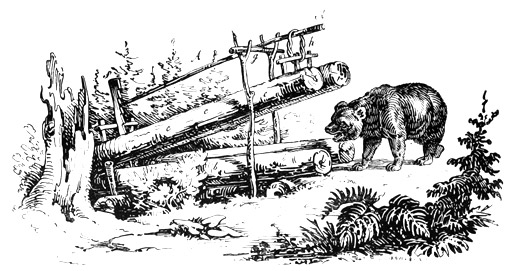
Bear-trap
View larger image
After a hasty sketch had been made of the bear-trap, we set out on our return; I very much regretted leaving the magnificent wilderness. On the way we found a fine viburnum, with large reddish leaves, and the Oxalis acetosella, which grew in abundance among the moss and decaying trunks of trees. The loud hammering of the woodpeckers resounded in this forest, and we shot the great spotted woodpecker of this country, which very much resembles our Picus major; for dinner we had bear's flesh, which we thought resembled mutton.
When I returned to the house of Sachs, I found the hunters, whom I had hired, in no little confusion. One of them, in particular, after receiving his wages for the first day, had remained in the public-house the whole night and the following morning. Stretched at length on a table, he had slept off the effects of his drunken fit, talked big, and found here a willing audience, a number of drinkers of whisky being collected in this place. Brandy drinking is far more common among the lower classes in America than with us; and here, on the Pokono, this bad habit was peculiarly prevalent among the country people. Not far from Tobihanna Creek there was a small wooden house, ten or twelve feet square, with a little iron stove (see the view of the Tobihanna Bridge), in which a school was kept. The stalls for cattle, swine, and sheep, are, for the most part, cages, the bars of which being pretty wide apart, the cold winter wind blows freely through them; nay, many of them had half fallen to pieces. The swine, which ran about in great numbers, had a triangular yoke round their necks to hinder them from getting through the fences. In all this part of the country, garden vegetables are raised in beds, or rather boxes, filled with mould, elevated on four posts. The seeds are sown in these boxes, and the young plants not transplanted till they have acquired a certain growth, otherwise they would be destroyed by the insects. Maple sugar is not made here, because the tree does not grow in sufficient abundance. The 42 chief occupation of the settlers, in this part, is the making of shingles, which are manufactured from the Weymouth pine. We were assured, that these peasants steal the greater part of the wood for their shingles, in the forests belonging to greater landowners, who live at a distance, and have no keepers to protect their property. One workman can make in a day 300 or 400 shingles, which are sold on the spot for half-a-dollar per 100. They are sent to all the neighbouring country, in large wagons drawn by four horses. At Bethlehem, forty-two miles from Pokono, the best shingles were sold, at that time, for eleven dollars per 1,000. These shingles are of two kinds; the German, made by Germans, who first manufactured them in this way, which are considered to be the best, and the English; the former are equally thick at both edges, the latter thicker at one side than the other. Many persons, whose horses are not otherwise employed, come here and fetch shingles.
On the 29th of August we continued our journey through forests that extended, without interruption, on all sides. After crossing a bridge over the little brook called Two-miles-run, we came to an open spot in the forest, where the great village of Stoddartsville is built on the Lehigh, which at this place is still an inconsiderable stream. The environs of the place are still wild. Stumps of trees, cut or sawed off two or three feet from the ground, were everywhere seen, and this newly-cleared spot was still covered with wild plants. As you come down the hill, you look directly into the street of the place, to which some neat and pretty houses give a very striking effect in this wilderness. We continued our journey over wooded eminences, where bears and stags are said to be still numerous. Having passed Bear Creek and Ten-miles-run Creek, we soon reached the Pokono, or highest summit of the Blue Mountains, and began gradually to descend. In the forests through which we now passed, the firs began to give way to other timber trees, and the woods are again more burnt and ruined, frequently consisting only of shoots from the stumps of oaks, chestnuts, maples, and sassafras trees, with single pines everywhere rising above them, as the palms in Brazil do, above the lower Dicotyledones.
On one of the next eminences, we came to another lofty point, whence we had the most extensive view, backwards and forwards, that we had yet enjoyed in these mountains. Towards the north-west lies the beautiful valley of Wyoming, through which the Susquehannah flows; and backwards, in the opposite direction, a rude prospect of wood and mountain, where peak rises above peak, and the eye ranges over an uninterrupted extent of immense forests. It is said to have been ascertained, by actual measurement, that this spot is 1,050 feet above the level of the Atlantic. Unfortunately, our time would not allow us to take a drawing of this grand prospect. From this place we began to descend into the valley of the Susquehannah, where the woods assume a more cheerful character, the firs being soon entirely succeeded by the oak, chestnut, and other timber trees. The road resembles an avenue, overshadowed by lofty oaks, tulip, chestnut, walnut, beech, hornbeam, birch, maple, elm, nyssa, and other trees, growing very close 43 together. Here we already see the formation of the conglomerate—the precursor of the coal district, which we now enter. When we had descended rather more than half way down the declivity of the mountain, we were taken about 200 paces to the right of the road, to be surprised by the beautiful prospect of the valley of Wyoming, or the Susquehannah. A group of rocks of conglomerate rises, isolated in the forest, and, on ascending it, you have a magnificent view. The broad and extensive valley, covered with towns and detached houses, alternates agreeably with forests and fields; the river flows through its whole length, and at our feet lay the pretty town of Wilkesbarre, the streets of which we could overlook. It is manifest, at a glance, that the whole of the valley was formerly covered with a thick primeval forest, for strips of wood everywhere traverse the fields.
Proceeding on our journey we came to a solitary public-house, where we met with a rattlesnake. I bought it, and it was put into brandy, as a live creature of this kind is not the most agreeable travelling companion. This snake had been kept three weeks in a box, and had not taken any nourishment whatever, so that it moved its rattle but faintly when it was irritated. As it was a very large and handsome specimen, I paid two dollars and a half for it. The landlady, a very corpulent personage, was in a very light morning dress when she concluded the bargain with me, and not being able to give me change, she immediately threw on her Sunday clothes, to follow our carriage on foot, and settle the account at Wilkesbarre. Her head was adorned with a large fashionable straw hat; she had a silk gown, and a silk parasol, which she might very well have spared, protected her tanned face from the sun. It was remarkable that, heavy as she was, she reached the town as soon as we did, though we had half a league to go. Wilkesbarre, in Lucerne county, is a place with about 1,200 inhabitants, with three churches, a court-house, a bank, &c.[45] The streets are pretty regular, and the buildings separated by gardens and intermediate spaces. The place has its singular name from the first settlers, who were called Wilkes and Barre. The population consists of handicraftsmen, field labourers, storekeepers, and merchants; and several of the inhabitants are interested in the important coal mines, situated to the west of the road which we had taken. This bed of coals is said to extend fourteen miles along the slope of the valley of the Susquehannah, and then to continue over other eminences, of which there will be occasion to speak in the sequel. For the purpose of conveying the coals by water, a canal has been dug, which was not quite completed, and which is to form a communication between the coal mines and the Susquehannah. On the other side of the river the great Pennsylvania canal is already finished, which connects Pennsylvania with Maryland by means of the Susquehannah.[46] This last canal, which is divided into several parts, will be continued to Baltimore, the chief seaport, but it is not yet quite completed. Pennsylvania is already intersected by numerous canals, which connect the rivers, and are of the highest importance by the facilities they afford to inland trade.
44 The inn at which we put up at Wilkesbarre was kept by a German, named Christ, who recommended to our notice some interesting points in the environs; and we, therefore, did not take the usual road at the bottom of the valley, but soon turned aside from the Susquehannah, into a wild, lateral valley, in which there are fine waterfalls. At less than a league from Wilkesbarre, we reached, at the foot of the mountain, a wild, thickly-wooded ravine, where we soon heard the roaring of Solomon Creek. Near a mill, the owner of which is General Ross,[47] this stream forms some highly picturesque cascades over smooth, perpendicular black rocks, covered with moss, forming a basin below, in a thick forest of pine and other timber. There are two cascades, one above the other, of which the second is the largest; then comes the last and highest, where the water, conducted from the mill directly across the ravine, falls perpendicularly, about the height of a house, over a steep rock. It was, unfortunately, too late, when we arrived, to make a drawing of this interesting scene. We asked for accommodation for the night in the mill, which is a roomy house; but our countryman (this man's mother was born in Germany) could not, or would not, receive us. They gave us some of the water of the stream to drink, which had a strong taste of iron and sulphur. As it was not possible to find a lodging in the neighbourhood, we were advised to proceed three miles to the top of the mountain, which we, indeed, accomplished, but had nearly had reason to repent of our resolution.
The road ascends on the left rocky bank of Solomon Creek, in a thick forest, over rough ground, so that we constantly had the steep precipice on the right hand. There was no room for two carriages to pass; luckily, carriages are rare in this remote wilderness. As we had been told that there was abundance of wild animals, we loaded our fowling-pieces with ball. We now turned to ascend in a wooded defile, where a couple of solitary miserable dwellings, built of trunks of trees, scarcely left room for a small field or a little garden overgrown with weeds. While the road became more and more rude, and obstructed by the vegetation, twilight set in, and it was only with the greatest efforts that our horses could draw the carriages among rocks and fallen trunks of trees, and nothing but the greatest care prevented them from being overturned. We met several peasants, with their axes and guns, returning from their work in the woods: they were robust, savage-looking, powerful men, whose sudden appearance in such a lonely spot might elsewhere have excited suspicion. There are no robbers in these parts; at least, I never heard of any, but it must be owned that the place is extremely well suited to them. The beautiful cardinal flower (Lobelia cardinalis) grew in such abundance in the swampy parts of the wood, as to form a fine red carpet. The Chelone obliqua, with its white flowers, was likewise very common.
At length the moon rose bright and clear to relieve us from our unpleasant situation, and cheered by her friendly beams the gloomy path of the wanderer. When we reached the summit the road divided into two branches, of which we were so lucky as to choose the right one. At 45 length, about nine in the evening, we had the pleasure of seeing a light; and a lonely house, in an open spot, lay before us. On our knocking, the door was slowly opened. We entered a poor hut, where two women—one an elderly person, the other younger—were sitting by the fireside. The master of the house, whose name was Wright, was not at home. The two women were very tall, and were smoking, quite at their ease, small clay pipes. They were not a little surprised at so late a visit, but soon stirred up the fire, and set on water. Our frugal supper, consisting of coffee and potatoes, was soon finished, and we lay down in our clothes on tolerable beds, placed in a large unfurnished room, which in this country are almost always made for two persons. This house belongs to Hanover township; the settlement itself had not yet any name. Only English was spoken here. Not far from the house the Wapalpi Creek ran through the thickets towards the ravine.
The night was soon passed, and at six in the morning we proceeded on our journey. In order to take a view of the Falls of Solomon Creek, Mr. Bodmer left us, and returned to the mill, with the intention of joining us again at Bethlehem, by taking another road. John Wright, brother to our host, lived three miles off, in a little rude valley, where we intended to breakfast. Some men, who were going to hay-making, with their guns and dogs, met us. The inhabitants of these woods generally take their guns when they go to their work, as they frequently have opportunities of killing some large game. They have powerful dogs, resembling our German bloodhounds, brown or black, with red marks; or striped like the wolf, and sometimes, but seldom, their ears are cropped. These dogs are used in chasing the bear or the stag.
In a romantic wooded valley we reached the solitary dwelling of John Wright, where we halted. The mistress of the house, who, with a little boy, was alone at home, gave us a very friendly reception, and prepared us a breakfast with coffee; all very clean and good for this retired spot. In the course of conversation we learned that she was of German descent, and born at Tomaqua.[48] She lived here in a pretty roomy log-house, with a chimney and iron stove; yet she said that in winter it was often very cold in the room, the walls of which were, indeed, not quite air-tight. In many rooms in these mountains we found two iron stoves. Leaving these scattered dwellings of Hanover township, we reached, in five hours, the Nescopeck Valley, eleven miles from our last night's quarters, the road to which is bad, little frequented, and in part stony, gently ascending and descending, and passing through ruined forests, such as have already been described. In some places the wood is thicker, in others the sides of the mountains had been quite cleared, and were covered with young shoots and some higher trees; small streams, here called runs, flow in the defiles and valleys; the bridges of beams over which were, for the most part, so rotten, 46 and in such bad condition, that horses and carriages could not pass without danger. We saw no human beings or dwellings on this road, nor any animals except some small birds and frogs. After this rather monotonous journey, we were glad to descend into the Nescopeck Valley, and reached it, at the mill of one Bug, of German descent, where we refreshed ourselves with milk and brandy. The Nescopeck Creek, a pretty considerable stream, which turns several mills, flows through this beautiful wooded valley. This district belongs to Sugarloaf township, in Lucerne county.
After we had watered our horses, and the miller had questioned us about his native Germany, we crossed the bridge over the stream, ascended the mountain on the other side, and reached an inn on the summit, from which it is eighteen miles to Wilkesbarre. Proceeding from this place, we crossed the valley of the little Nescopeck Creek, which is covered with lofty trees, then passed the little Black Creek, and afterwards came to a high mountain wall, with a beautiful wood of various forest trees, which the inhabitants, who are mostly of German origin, call the Bocksberg. German is everywhere spoken here.
From the mill, the way leads through a thick underwood of shrub-like oaks, with a few higher trees, and we soon reached the high road from Berwick, in the Susquehannah Valley, along which we proceeded to Mauch Chunk, where two stage-coaches pass daily.
We took this road, and soon came to an inn, kept by a German named Anders, who likewise had a saw-mill. The host had, a short time before, caught an old she-bear in a trap, and in the three following days her three cubs, which he sold to travellers passing that way. The point where we now were is called the Hasel Swamp; and, proceeding onwards, we passed Pismire Hill, where rattlesnakes are said to abound. We observed, too late, a very large animal of this kind dead in the road, one of the wheels of our carriage having crushed the head of the snake, which was otherwise in a good state of preservation. My driver laid it in a natural position by the road-side, and I have no doubt that it was again knocked on the head by some other traveller. The marshy tract through which the Beaver Creek flows, is called Beaver Meadow, and is covered with willow bushes. It is probable that beavers may have formerly been numerous here, at least the place is quite suited to them; but those harmless animals have been long since extirpated. We came next to a considerable eminence, called Spring Mountain, which we ascended, and then rapidly descended, always through a thick forest, where we observed, on both sides of the way, the Grauwacke formation. On reaching the bottom of Spring Mountain we entered a wide valley, both the steep sides and bottom of which are covered with thick woods, only thinned a little round the habitations. In the middle of the valley, directly before us, six or seven buildings, in a broad street, formed the village of Lausanne, five or six hundred paces below which the Quackack Brook flows through the valley. A Jew keeps here a public-house and shop, where we met likewise with newspapers.
47 Beyond Lausanne is a high mountain, called Broad Mountain, up which the road is carried in an oblique direction. Trees and shrubs form everywhere a very thick but ruined forest, in which there is scarcely any serviceable timber. The view back over the extensive and wild valley of Lausanne was extremely interesting. One can hardly fancy this sublime and rude country without its aboriginal red inhabitants. The wide and hollow valley is everywhere covered with dense forests; and the little village of Lausanne is scarcely to be seen amidst the dark green foliage. On the Broad Mountain we find again the same formation of conglomerate, which I have before mentioned; the beds of coal are at a small distance. On the side which we descended the wood is more beautiful, the trees taller than on the edge of the mountain; oaks, chestnuts, and other trees, were very vigorous and luxuriant. Several planters have formed detached settlements here, among whom an Irishman was pointed out to us, who had lately been arrested on an accusation of murder, but had been since set at liberty.
The Neskihone or Neskihoning Valley, into which we now descended, is wide, and enclosed by very high, far-extending walls of rock, everywhere covered with thick woods, in which some small cultivated patches are here and there seen. Along the right, or southern wall, an iron railroad has been laid down, which forms a communication between one of the coal mines of the Mauch Chunk Company, on the Rumrun Creek, and Mauch Chunk. It runs down into the valley of the Lehigh, which it follows to the last-named place. The appearance of the valley is very wild and picturesque; the Neskihone, which you pass at a saw-mill, flows at the bottom of it, and then turns to the left into the beautiful valley of the Lehigh, into which the Neskihone empties itself. The Lehigh comes on the left hand, out of a deep, extremely wild mountain valley, or dark glen, the entrance to which is entirely concealed by lofty, steep wooded mountains. Its glassy surface shines, half hid by tall shady oaks, beeches, and chestnuts; and the whole is one of the most interesting scenes that I met with in Pennsylvania. The road from this place to the Lehigh Valley is agreeably shaded by high trees, and on the banks of the river there are several dwelling-houses and inns. In a quarter of an hour we reached Mauch Chunk, now celebrated as the central point of the Lehigh coal district.
CHAPTER V
DESCRIPTION OF MAUCH CHUNK AND ITS COAL MINES—JOURNEY THROUGH THE LEHIGH VALLEY TO BETHLEHEM, AND LAST RESIDENCE IN THAT TOWN, FROM AUGUST 31ST TO SEPTEMBER 16TH
Mauch Chunk—The Coal Mines—Lehighton—Mahoning Creek and Valley—Gnadenhütten, a destroyed Colony of the Moravian Brethren—Weissport—Lehigh Gap—The Devil's Pulpit—Berlin—Crytersville—Howard Town—Schoner's Town—Last Residence in Bethlehem.
Mauch Chunk is a village of about 200 houses, in the deep and narrow Lehigh Valley. The houses form almost one row only, and a small street in the lateral valley of the Mauch Chunk stream. This place has sprung up since the discovery of the very rich coal mines in the vicinity. The Lehigh Company employs from 800 to 1000 workmen, and supplies the whole surrounding country with the very fine coals obtained here. Several iron railroads, leading to the works, have already been made, canals dug to export the coals in numerous barges, great works erected, a large and capital inn established in the valley of the Lehigh, and mills of various kinds built; and travellers ought by no means to neglect this highly interesting spot. This deep and wild valley, which is enclosed on every side by wooded mountains from 800 to 1000 feet high, has become, within a few years, a scene of action and profitable industry, which will soon render this spot one of the most remarkable in Pennsylvania. The principal work, to which an iron railroad has been made, lies on a considerable eminence, nine miles from Mauch Chunk. On the 31st of August, we visited this interesting spot.
As the railroad runs up along the declivity, it has been necessary to cut it obliquely; it is, therefore, narrow, with only one line; and places, at certain intervals, to allow two carriages to pass. For the convenience of travellers who wish to see the works, a stage-coach has been established, which is drawn up by two horses. Our company assembled at the inn, and ascended, by a steep path, from the town, to the iron railroad, which runs a little above the village. The 49 railroad stages are light carriages, with four low wheels, and seats for eight persons; they are covered at top, and open at the sides. The wheels are of iron, and have a groove, which fits into the rail, and runs upon it. The driver sits in front, and has a long tin horn, which he blows, to announce his approach to such as may be coming in the opposite direction; in the other hand he holds, in the descent, the machine with which the carriage is stopped when necessary. This contrivance consists of a pole, at the lower end of which there is a stuffed leather cushion, which, by moving the pole, is brought close to the wheels, and by its friction checks the rapidity of the motion. As a train of coal-wagons was expected, we slackened our pace. The two stages were fastened together, and though both were quite full of passengers, a couple of horses drew them up with great ease. We had not proceeded far, when we heard the rolling of a train of coal-wagons. It was interesting to see the black train advance, and dart by us with the rapidity of an arrow. These are built of strong beams and planks; each contains two tons of coals, and forty-five wagons go at the same time, which carry 90 tons; they run five times a day, thus 450 tons, or 25,200 bushels, are brought down to Mauch Chunk daily. Every fifteen wagons are fastened together by strong iron bands, and in the middle of this train is a man who holds a chain in his hand, by means of which he can check the rapidity of the motion, or even stop it entirely. Four or five hundred paces behind the first column comes the second, and then, at an equal distance, the third, and after these, seven wagons, in each of which there are four mules, with provender, and a bridge for them to get in and out. Their heads are turned to the front, and they eat quietly, as they descend. These mules are to draw up the empty coal wagons.
It was interesting to see the thundering column approach us, and then hasten by. As soon as it had passed, our horses trotted up the mountain, which could not be attempted, except on an iron railroad. The road runs along the rocky wall, always through a forest, where single settlers have here and there built their little wooden dwellings. Cattle were feeding in the neighbourhood, whose bells we heard in the woods. The valley at our left hand was very wild and romantic. Both the high mountain and the valley below, in which the Mauch Chunk flows, are clothed with a forest of fir and other timber, and wild vines twine about the bushes by the road-side. The number of miles is marked on white boards nailed to the trees. When we reached the top we came to an inn, which had a small park with Virginian deer. The fawns of these deer were still spotted a little at the end of August.
As soon as our company had rested a little, and taken some refreshment, as it was very hot, we got again into our carriage, and proceeded, this time without horses, to the coal mines, about ten minutes from our inn, to which the railroad declines a little. You reach these interesting works by a deep section of the upper stratum of sandstone, and then enter the pits, which may be 300 paces long, 150 wide, and 30 feet deep; quite open at top, having been gradually sunk to that depth. 112 men were at work in and about these mines, and 130 mules were employed 50 in conveying the coals, which stand out, shining, and with a beautiful play of colours; in some places they are of better quality than in others. They are detached partly with iron crows, partly by gunpowder, broken into pieces with pickaxes, and loaded in the wagons. From one part of the mine to another there are little railroads, on which boxes with four wheels run like what is called the dog (hund), in our German mines, in which refuse and rubbish are removed. In this manner high heaps of rubbish have arisen about the pits, which extend further and further into the valley. In some parts of the works there are impressions of antediluvian plants, of which we found some interesting specimens. The labour of seeking, in a stooping attitude, was particularly disagreeable on this day, which was hotter than any that preceded it. When we returned from the works to our inn, the thermometer, at twelve o'clock, and in the house, was at 96°; to which we must add that the mine is 1,460 feet above the level of the sea. There was not a breath of air stirring, and everybody found the heat extremely oppressive.
To return to Mauch Chunk we again got into our carriage, but had now no need of horses; the driver shoved the carriage a few steps, leaped into his seat, and we immediately proceeded faster than a horse could gallop. We had travelled the greater part of the way in seventeen minutes, when we were obliged to halt, in order to let a train of wagons, returning, pass us, which detained us about twenty minutes; we then proceeded with the rapidity of an arrow, and travelled the whole distance of eight miles in thirty-two minutes. When we had reached the bottom we hastened to see the place where the wagons are unloaded.
At the end of the iron railroad is a building on the eminence, in which there is a large windlass, with an endless rope, which with one part lowers a loaded coal wagon, on an obliquely inclined iron railroad, down the mountain, while the other part draws up an empty wagon from below. The distance from the windlass to the place on the iron railway, where the wagons deposit the coals in a large shed, is above 700 feet.[49] The mechanism of all these works is well worth seeing, and the whole establishment extremely interesting. Mr. White, one of the principal members of the Lehigh Company, is a man of much and varied knowledge, and particularly well acquainted with machinery.[50] He has erected a saw-mill on the Lehigh, the construction of which is very ingenious. A single workman is able to saw 4,000 square feet of deal in twelve hours. The Company requires six such saw-mills in the Mauch Chunk, to saw the wood that it wants, because the coal barges are sent down the canal and the Delaware, and sold at Philadelphia as planks.
The road from Mauch Chunk through the Lehigh Valley, which we took, on the 31st of August, in the evening, is agreeable and diversified. A violent thunder-storm had passed over the valley, and had poured down torrents of rain, the traces of which were everywhere visible. We proceeded along the right bank of the river, in a rather sandy road, shaded by old trees. On 51 our right hand we had at first the steep wooded mountain, where Rubus odoratus and other beautiful plants grew amongst rude rocks. The mountains then recede, and fields, meadows, and detached dwellings, succeed.
We came to Lehighton, where the sign of the inn was conspicuous afar off.[51] Lehighton is situated at no great distance from the opening of the Mahoning Valley, from which the Mahoning stream flows. This valley is wooded, has many settlements, and is well known from the destruction of Gnadenhütten, a small establishment, founded there by the Moravian Brethren. Some Delaware Indians, instigated, it is said, by neighbouring colonists, who were hostile to the Brethren, attacked the settlement, which they burnt, and killed eleven persons. Only four of the fifteen who composed the little colony escaped.[52] Mr. Bodmer, who followed us from Wilkesbarre, visited the spot. He found among the bushes the tomb-stone which covers the remains of the victims, and made a drawing of it. The following is the inscription:—
TO THE MEMORY OF GOTTLIEB AND CHRISTINA ANDERS, WITH THEIR CHILD JOHANNA; MARTIN AND SUSANNAH NITSCHMANN; ANN CATHARINE SENSEMANN; LEONHARD GATTERMEYER; CHRISTIAN FABRICIUS, CLERK; GEORGE SCHWEIGERT; JOHN FREDERIC LESLY; AND MARTIN PRESSER; WHO LIVED HERE AT GNADENHÜTTEN, UNTO THE LORD, AND LOST THEIR LIVES IN A SURPRISE FROM INDIAN WARRIORS, NOVEMBER 24TH, 1755. "Precious in the sight of the Lord is the death of his Saints." PSALM CXVI. 15. 1788, AND. W. BOVER, PHILADELPHIA.
On the lands at Gnadenhütten, which still belong to the Brethren, several farmers reside, among whom there is a singular female of no ordinary education, and, as it is said, of high rank, 52 whose real name is not known. She is said to have come from Germany, it is supposed from the principality of Lippe. Her sole employment is agriculture; she performs all manual labour herself, milks her cows, to which she has given names, and which she has tamed. She has rented a piece of land from the Brethren, which Mr. Von Schweinitz, as director of the council, let to her.
Near the issue of the Mahoning, or Mahony Valley, a wooden bridge has been built, in a picturesque situation, over the Lehigh. It is surrounded on all sides by fine lofty trees, and on the right hand the wooded eminences of the Mahony Valley overlook it. From this place we came to a level, open part of the valley, where a few scattered dwellings bear the name of Weissport.[53] A man named Weiss proposed to build a town here, and had collected the names of many subscribers, but the town consists, at present, of only four detached houses.
Night set in, and the moon showed us, in the Blue Mountains before us, a deep cleft, called the Lehigh, or Lecha Gap, where that river passes through the mountain chain. At the Gap we halted at an isolated, but very good inn, kept by a man named Craig, son of the General of that name. He spoke both English and German, and we were very well accommodated in his house.
On the 1st of September we visited the Lehigh Gap, the mountains on the north side of which are low, rocky, and wooded. A projecting portion is called the Devil's Rock. Near the buildings there are great heaps of limestone thrown up, which is obtained from a mountain in the Mahony Valley. The lime is of bad quality, but serves very well for mortar. It contains a number of small bivalve shells. About eight o'clock we left the Lehigh Gap, and took the road to Bethlehem, where we arrived at noon, having passed through Berlin, Cryterville, Howard Town, and Schoner's Town.
Our baggage, which we had so long expected from Boston, arrived at length on the 4th of September, and as Mr. Bodmer rejoined us on the 10th, I should have thought of proceeding on our journey, did not the traveller often depend on accidents, which render it impossible to fix anything for certain. Mr. Bodmer, desiring to finish a drawing that he had begun, undertook a second visit to the Delaware Gap, and on this occasion was severely wounded by the bursting of his fowling-piece, which compelled us again to defer our departure. On our hunting excursions, we now saw the country in its autumnal dress. Night frosts had already set in, and the mornings were foggy, till the sun had risen pretty high, when a hot day followed. Most of the birds of passage were gone; no swallows were to be seen, and the wild pigeons passed by in large flocks. On a walk to Allentown,[54] the capital of Lehigh County, which has 1,700 inhabitants, three churches, and a court-house, six miles from Bethlehem, we found, in the Lehigh Valley, several flocks of birds ready to depart. The blue birds (Sylvia sialis) were assembled, twenty together. The yellow woodpecker and the nuthatch were hovering about the gardens and fields, where 53 numbers were collected together. The plants that were in blossom in the fields and hedges were chiefly of the class Syngenesia.
The accounts of the progress of the cholera, which we daily received, were not favourable. In New York and Philadelphia, and more especially at Baltimore, the disorder was extremely dangerous; it had also spread in the country about the great lakes, and on Hudson's River, and had extended from Detroit to the Mississippi and Ohio. It seemed impossible to avoid it; I therefore chose the route down the Ohio, intending to make the Mississippi, in the following spring, the basis of our excursions into the Western wilds or the Indian country. We took leave of our friends at Bethlehem, and set out in the first instance for Pittsburg.
CHAPTER VI
JOURNEY FROM BETHLEHEM TO PITTSBURG, OVER THE ALLEGHANYS, FROM SEPTEMBER 17TH TO OCTOBER 7TH
Allentown—Reading—Lebanon—Harrisburg—Mexico—Mifflin Town—Valley of the Juniata—Huntington—Alexandria—Yellow Springs—The Summit—Ebensburg—Hunting parties—Wild Scenery of the Alleghanys—Laurel Hills—Conomaugh Valley—Blairsville—New Alexandria on the Loyalhanna—Pittsburg—Situation of the Town—Economy, Mr. Rapp's Settlement on the Ohio—Remarkable natural productions of that river.
Violent thunder-storms, accompanied with heavy rains, had taken place during the night before I left Bethlehem, early in the morning of the 17th, with the stage from Easton to Reading. Mr. Bodmer remained behind for some days, on account of the injury done to his hand. At day-break we reached Allentown, where we changed both carriage and horses, and passed the Cedar Creek, which was much swollen. The thunder-storm had not changed the temperature of the air. All this country was covered with plantations of maize, clover, and buckwheat, and detached farm-houses were numerous. The clover was often sown, as among us, with the corn. The ears of the maize were partly cut off, and the stalks tied up in bundles. The maize becomes ripe here in October. We halted very often at the post-houses, where the horses are always watered. As soon as the stage arrives, the large leather bag containing the letters is thrown down, and the correspondence for places further on the road is put in. We were here on a calcareous soil, and many limekilns were burning in the neighbourhood. Flocks of birds, of many kinds, appeared ready to depart; Papilio plexippus flew about the hedges. The Datura, with purple blossoms, and the Phytolacea, with ripe black berries, dark red stems and branches, grow on the road-side, and about the houses.[55] The leaves of the sumach, and of some kinds of oak and maple, had already 55 changed to a beautiful red colour. The fallow fields were entirely covered with the yellow blossoms of the golden rod, or St. John's wort, and beautiful asters, mostly with small white or purple flowers. The farm-houses in this part of the country are remarkably handsome. The barns are built of stone, very large, and have, in the lower part, the stables, with eight or twelve doors and windows, and over this is the barn, properly so called. At the end of the building there is a passage where the wagons stand under cover; the windows, doors and roof are frequently painted of a reddish brown colour: cattle of all kinds surround these farms. The swine are very fat, have broad hanging ears, and are generally marked with small round black spots, and sometimes, but more rarely, they are reddish brown. We saw some fine forests of oak and walnut trees, among which is much hickory (Juglans alba), which, next to the white oak, and the black walnut tree, furnishes the best timber. In general this country resembles Germany: it is diversified and pleasant; wooded eminences on the sides, and bright green meadows, often kept in very good order, occur as in our country; but large, new habitations, built in rather a different style, the zigzag fences, and the more lofty and luxuriant growth of the trees, give, on the whole, another character to the scenery.
In Maxatawny township we addressed the inhabitants in the German language, who answered us at once in the same, and we heard German names all the way to Pittsburg. After passing Sackoma Creek, we arrived at ten o'clock at Kutztown, eighteen miles from Bethlehem, where we breakfasted. The heat being very great, the dust was extremely annoying, for the thunder-storm, which had passed over Bethlehem, had not extended to this part of the country. The cattle sought protection against the sun, in the shade of single trees, or in the orchards. Large stacks of corn, six, eight, or ten together, stood in rows by the fences. On the right hand ran the Oli Mountains, beautiful verdant wooded eminences, which are connected with the Lehigh Mountains. About noon we had travelled the thirty-six miles to Reading, where we were obliged to stop one day, because the stage had already left.
Reading is a very pretty town on the Schuylkill, with 6,000 or 7,000 inhabitants; it has seven churches, and a new one was just then building. There are about 400 negroes and people of colour. Some of the streets were not paved in the middle, but have on the sides a pavement of bricks for the foot passengers, planted with acacias, planes, poplars, and other trees. All these towns are rapidly increasing. The cholera had already carried off many persons here, but the inhabitants would not confess this. We saw a funeral procession returning home, in which there were several women on horseback; the veils on their large fashionable hats fluttered in the wind, and gave this caravan of Amazons a singular appearance. Much fruit is grown in the neighbourhood, and the apples are good, but not the plums. Peaches thrive very well; we saw whole wagon-loads of them brought into Reading, around which the people crowded to buy, while the children stole them.
56 On the 18th of September it was with very great difficulty that we got places in the stage, the travellers being very numerous. After we had passed Kakusa Creek, we came to Womelsdorf, founded by Germans, fourteen miles from Reading, where we stopped to dine, and then proceeded over Dolpahaga Creek, to Lebanon County, which is in a tract diversified with eminences and wooded mountains. On this road we several times passed the Union Canal, which goes from Baltimore to Pittsburg, is very nearly completed, and is said to have cost 18,000,000 of dollars. After we had passed the River Swatara, which runs into the Susquehannah, we continued our journey in a dark but fine evening; the crickets and grasshoppers chirped all around; but their note is by no means so loud as that of those in the Brazils. At length we perceived a number of lights before us, and came to Harrisburg, the capital of Pennsylvania, the end of our journey to-day.
Harrisburg is a small town, with only 5,000 inhabitants, situated between the Susquehannah and the Union Canal. It has broad streets crossing each other at right angles; but many of the buildings are of wood, for which they are now, however, gradually substituting better ones of brick. Rows of trees are planted in front of the houses. The inn at which we put up was in a square, which they were just covering with broken stones. Here, too, is the market-hall, a long roofed building supported by pillars, in which the productions of the country are exposed for sale, as in most of the towns in the United States. Harrisburg, being the capital of the state, is the residence of the Governor. The state-house is built on a gentle eminence on the canal, near the town, and with its two wings is a very considerable building, with a colonnade and a cupola supported by pillars. Another interesting point of the town is the view of the Susquehannah, which is very broad here, and forms an island. A long bridge, covered at top, and enclosed at the sides, is built over each arm of the river. One of these bridges is about 600 paces in length. In the first there are twenty-three glass windows, and it has two pillars on shore, and five in the river. There are colossal bridges of this kind in the United States; and there is one further down the Susquehannah, which is one and a quarter mile and four rods in length, and has fifty-two pillars. The view from this bridge up the river is peculiarly beautiful. Verdant wooded islands adorn its surface, which is broad, but it was at this time very shallow. There are 500 negroes and people of colour. Germans are met with everywhere, and we were told that an able German physician lived here.
The defective arrangements of the post-houses obliged us to stop here three days, and it was not till the 21st of September, in the evening, that we could leave the town to continue our journey during the night. We passed the Susquehannah, and the Juniata, which comes from the Alleghany Mountains, and flows into it. On the 22nd, at day-break, we were at the little village of Mexico.
Mexico is in Mifflin County, forty miles from Harrisburg. Three miles further is the village of Mifflin Town, the capital of the county, where they were just building a new town-hall. The Union Canal, which connects Philadelphia and Baltimore with Pittsburg, in general follows the 57 same direction as the river Juniata, near which it often runs at a greater elevation, and sometimes is even carried over it. The river is here about as broad as the Lehigh, but was at this time very shallow. Beyond Mifflin Town it receives the Los Creek. From this place we observed in the valley many robinias, which grow very high and vigorous, as well on the mountain, which is rather dry, as by the water-side; vines as thick as a man's arm twine round the trunks, and frequently rise to the very summit. The nettle tree (Celtis) grew in great abundance, and the maples were just assuming their red tinge. The picturesque forest is intermingled with Canadian pines, many of which are quite blighted and withered. The valley now became wilder and more romantic; on the right hand rose a high precipice, covered with bolders, fragments of rock, mouldering trunks, and the finest trees of the country, forming a real wilderness. A very narrow part of the valley, where we watered our horses at an insulated house, bears the name of the Long Narrows; and the steep wooded mountain, on the south bank of the river, is called Blacklog Mountain; it is said to be the haunt of bears and stags. The cattle belonging to the log-houses were grazing among the rocks. After some time the valley grew more open, and at a wider spot, near the road, which descended towards the defile of James Creek, was a group of lofty and slender robinias, on which a flock of tame turkeys were sitting. These birds resemble in colour the wild ones which are common in this country; they often go into the forests, where they breed, and come home again with their young ones. After passing Kishikokinas Creek, we reached, at a broad part of the valley, the village of Louis Town, in which there are some considerable houses. The country people were ploughing and harrowing their fields; and I may here observe, that, in all Pennsylvania, they never employ oxen in these operations, but horses only, of which they have great numbers. The plough is rather different from that of Germany.
Beyond Louis Town we saw a number of horsemen, assembled for the fox-chase. The fox was caught in a trap, then let loose at a certain spot, and hunted with many dogs, as in England. In a district diversified with forests and cultivated fields, we came to Waynesburg, a small town agreeably situated in a valley. The forests began to assume their autumnal tints; the maples, the dogwood (Cornus Florida), and the sumach, were partly red; the walnut trees, and the hickory, yellow, which gave great variety to the landscape. Near some habitations we observed weeping willows of extraordinary size. The surrounding mountains were covered with forests, into which we penetrated to ascend the first ridge of the Western Alleghanys. The road, which is, for the most part, in bad condition, rose obliquely on the side of a rude picturesque precipice. Except a pheasant, which flew past us, we saw but few living objects. Advancing into the valley we again came to the Juniata, over which the canal is here carried by an aqueduct, supported by four pillars. In this part of the river there are several dams, such as we had seen in the Lehigh, near Bethlehem, with this difference that here they are triple. For this purpose, rows 58 of stones, piled one upon another, are laid across the river, forming, in the direction of the stream, acute angles, where a basket is placed, in which the fish are collected.
At a place where three valleys meet stands the village of Huntingdon,[56] ninety miles from Harrisburg, where we found a tolerably good inn, on an eminence above the banks of the Juniata. From this inn we proceeded, during the night, through high rude tracts and forests, past Alexandria, and at midnight reached Yellow Springs, and then the highest points of this ridge, called the summit, between 2,400 and 3,000 feet above the level of the sea, in the vicinity of Blair's Gap. This wild mountain region bears hemlock spruce firs of colossal magnitude, mixed with other timber. The night was clear and cool; towards morning fogs arose from the deep valleys, which at daybreak covered the pine forest through which we descended. We passed the Conomaugh Creek, and then arrived at the little town of Ebensburg, on an open spot in the forest. We stopped here at a small inn to wait for our travelling companions.
Ebensburg, the capital of Cambria County, is an inconsiderable place, consisting of wooden buildings, forming not much more than one broad, unpaved street, but has a town-house and a pretty large church. The inhabitants, about 300 or 400 in number, are of English, Irish, and some of German extraction. The surrounding country is very mountainous and woody, and is said to abound in all sorts of game, as indeed the many skins of lynxes, racoons, martens, and minks, fastened against the houses, prove; bears, stags, and wolves, are said not to be uncommon, as lofty and dark forests surround the town within a couple of hundred paces. Ebensburg derives some profit from the numerous wagons, drawn by two, four, or six strong horses, that pass through it on the high road to Pittsburg.
Our hunting excursions in this rude country were very interesting. We proceeded first in a northern direction into the forest, which we found to be quite a primeval wilderness. The mountains rise peak above peak, with deep ravines, where pines, beeches, chestnuts, birches, maples, and walnut trees of various kinds, form a gloomy forest, and fallen and decayed trunks check your advance at every step; cool, sylvan brooks rushed foaming through all the defiles, and we had continually to cross them on natural bridges, formed by the fallen trunks of trees. Such old trunks are covered with a whole world of mosses, lichens, fungiwood, sorrel, ferns, &c.; nay, even young shoots of maple, beeches, and tulip trees, had taken root on them. We clambered over the trunks, went round the fallen giants of the forest, and found everywhere, on the ground, traces of the numerous squirrels (Sciurus cinereus), in the remains of fruit and shells, especially, of the chestnut.
But there was also an interesting wilderness in the opposite direction. Here a very extensive fall of timber had been commenced—a gigantic labour, as in Brazil, where the wood is burnt afterwards, as soon as it is sufficiently dry. The sturdy woodcutters were of German extraction, and spoke German. From this place a dark narrow path led through an old pine forest, where 59 the little creeping Michella repens, here called ground berry, with its beautiful red berries, grew among the moss, and often covered the ground. Several small runs and muddy ditches crossed the forest, over which I walked or rode on trunks of trees that served as bridges; in doing which my clothes suffered not a little. Woodpeckers abounded here, especially the great black woodpecker (P. pileatus), which we had not seen before. It is nearly as large as a crow, and its splendid bright red tuft is conspicuous at a great distance. They were very shy; knocked and hammered on the dead pine trees, which stood like the ruins of a colonnade, and were pierced and bored by their strong bills. This fine large bird is called here, and in general, woodcock. A young man who lived in the forest, some miles off, told me that bears, stags, and other wild animals, were very numerous, particularly the pheasant, or cock of the wood (Tetrao umbellus), one of which we shot. There is a saw-mill here, among the lofty pines, on an arm of Conomaugh Creek, in a wild, lonely spot. The owner was not a little astonished at my double-barrelled percussion gun. After we had spent two days here in exploring the woods, our travelling companions, Dr. Saynisch and Mr. Bodmer, at length joined us, on the 26th, but as the latter still had need of rest, on account of his wound, we took their places, and set out immediately for Pittsburg.
Seven miles from Ebensburg is the place which is looked upon as the boundary of the Alleghanys, properly so called; here begins the ridge called the Laurel Hills, for these mountains consist of several parallel chains, many of which have distinct names. The forest now assumes a different character. Oaks of various species succeed the pines and beeches; the forest is not so high, rude, and thick, and from an elevated spot on the road there is a fine view as you look back on the long wooded chain of the Alleghanys.
The traveller soon sees before him a deep and wide valley in which the Conomaugh River flows, and beyond it a long ridge, covered with verdant woods, called the Chestnut Ridge, in which there is a gap, through which both the river and the canal pass. The eminences are uniformly wooded, and the chestnut and chestnut oak appear to predominate. We changed horses at Further Laurel Hill, and at Amagh, and then passed the gap. In the meadows and fields, the stumps of the trees that had been cut down were still standing, for the whole country was formerly one unbroken forest. The habitations were few in number, and, at the same time, small and wretched. We were told that this part of the country is chiefly inhabited by Irish, who are bad managers, and addicted to drinking. A better character is given to the settlers of German origin, and they are said frequently to possess well cultivated farms.
In the woods of this district, we everywhere remarked that the tops of the branches, for about a foot or a foot and a half, were hanging down and withered, which is caused by a kind of cricket (locust, Cicada septem decem, Linn.). This insect, which, as is well known, appears only once in seventeen years, but then, like the cockchafer with us, in prodigious numbers, had abounded 60 in Pennsylvania in 1832, and in many places was a real scourge; it does not, however, appear everywhere at the same time. But a few weeks before, they were so numerous in these forests, that the noise they made almost overpowered the human voice. On examining the withered twigs, we found the bark, as it were, ripped open in many places, the wood quite dry, and in the sap, a whitish substance, which consists of the eggs of the insect.
As we drove rapidly down the hills, we saw before us the extensive valley of the Conomaugh, for the most part covered with woods, and gently rising on all sides, in which, a little higher up, the small town of Indiana is situated. We stopped at a lonely inn by the road-side, watered our horses, and hastened forwards. On every side we saw extensive forests, and from the next eminence looked down into another valley, in which the Conomaugh runs by the town of Blairsville, a pretty little place, with many respectable houses, and a very good inn, in a broad main street, which runs directly across the valley. The country is hilly, or mountainous, well cultivated, and with neat farm-houses scattered around. From this place, it is ten miles to New Alexandria, a village with tolerably good wooden houses, many of which are painted. Beyond it runs the Loyalhanna, a small stream, which was at this time very shallow, with a covered bridge over it. At nightfall we reached New Salem, then Millersburg, and about midnight, Pittsburgh.[57]
Pittsburg is an old, large, but by no means handsome town, celebrated for its manufactories and brisk trade, and has been described by many travellers. The town itself has 12,000 inhabitants; but with the suburbs, its population is estimated at 24,000 souls, including many Germans, some of whom are respectable merchants. Coal mines in the immediate neighbourhood (a part of which is now on fire), afford an ample supply of fuel for the numerous steam-engines, stoves, &c. The style of building in the town is everything but uniform, neat brick houses being mixed with small wooden ones. The streets are ill-paved, dirty, and badly lighted; some of them, however, are modern and regular; and the new edifices are handsome and elegant. There are many iron works, nail manufactories, glasshouses, cotton manufactories, &c., in many of which, steam-engines are employed, of which, as we were told, there are above 100 at work, which are likewise made here.
This town lies on the tongue of land between the rivers Monongahela and Alleghany, which, by their union, form the Ohio; this river is not very considerable here; yet, at certain seasons, when the water is high, it is navigable by steam-boats, of which I counted sixteen on the banks of the Monongahela. Over the Alleghany there is a covered bridge, 500 paces in length, which has, on each side, an additional covered footpath; and a covered aqueduct, of the same length, is likewise carried across the river. A similar long and colossal bridge is built over the Monongahela.
The situation of Pittsburg itself is not very pleasing, but there are interesting points in the environs. As I was furnished with very good letters of recommendation, several of the inhabitants of Pittsburg endeavoured to make my stay there agreeable. Messrs. Volz and Von Bonnhorst 61 (the latter of whom had been an officer in the Prussian army) were extremely kind to me. Mr. Lambdin, possessor of a museum which was yet in its infancy, likewise gave useful recommendations and instructions.[58] Mr. Volz had the goodness to accompany me to Economy, the remarkable and interesting colony of Mr. Rapp. For this purpose we left Pittsburg on the 29th, passed the great Alleghany bridge, and the suburb, and drove by the large new House of Correction, towards the Ohio.[59] On the eminence to the right of the town is the convent of Flanders nuns, who have established a school, in which they receive children of all religious denominations. We proceeded on the right bank of the Ohio, eighteen miles, to Economy.
Economy has been described, in its leading features, by Duke Bernard of Saxe Weimar;[60] but it has become much more flourishing since that time. It is well known that old Mr. Rapp, with a company of between 600 and 700 Swabian emigrants, came to America, and had, at that time, but very limited resources. He founded, with his people, successively three settlements; first, Old Harmony, near the Ohio; then, New Harmony, on the Wabash, in the State of Indiana; and then, Economy, near Pittsburg. This last settlement has now about 150 houses, which at first were slightly built of wood, but are now succeeded by better ones of brick; they are two stories high, and neatly painted. The church is spacious and plain, built of brick, with a pretty steeple, and a good bell.
The rapidity with which these settlements sprung up, amidst thick forests, proves the judgment and prudence of their founder. The order introduced at Economy is admirable; nobody is seen in the streets during the day; all the inhabitants are usefully employed; young men and women, and also the children, are distributed among the several manufactories, where they work and receive no wages, but all their wants are amply provided for, free of cost. They are cleanly and neatly dressed in their Swabian costume, and nothing but German is spoken amongst them. The possessions and the revenues of the whole establishment are the joint property of the community, every inhabitant having placed his property in the common fund. Mr. Rapp and his adopted son are the directors, and the only complaint is, that no account is given of the management, and that the government of the institution is rather too dictatorial. Be this as it may, it cannot be denied that the arrangement and direction of this artificial society are admirable, and do honour to the founder. Mr. Rapp has established several important manufactories with steam-engines; even silks are manufactured from silk produced on the spot. The mulberry plantations and the management of the silk-worms are under the especial care of Mr. Rapp's grand-daughter. The manufactories alone are said now to yield an annual profit of 20,000 dollars. Several large buildings have been erected for a cotton and a woollen cloth manufactory, a mill, an inn, where the accommodations are very good and reasonable, &c. Everything they want is raised or made by themselves. They have extensive corn fields and vineyards, and breed great numbers of 62 cattle. Mr. Rapp has erected a large building, with a great saloon in the upper story, where the inhabitants meet on festive occasions, and where they have musical entertainments. In the lower story of this building, a cabinet of natural history has been commenced, in three rooms, which already contains some very interesting specimens.
After we had viewed all these objects, and had been led by Mr. Rapp, jun., through the manufactories, we went to the dwelling-house of the director of the establishment, and met with a very friendly reception from his family, who were dressed entirely in the manner of the country people of Würtemberg. They told us they would never deviate from their old national manners, and would always remain Germans, which we were very glad to hear. Soon afterwards, the founder of the establishment, Mr. Rapp, came in. He was a vigorous old man, of venerable appearance, with white hair and a long beard. We supped with him, drank very good wine produced here, and, in conclusion, were entertained by six or seven girls and a young man, who is the schoolmaster, and is said to be well informed, with singing and playing on the piano. We here became acquainted with Mr. Ehrmann of Mannheim, an agreeable, well-educated man, whose wife is likewise a very interesting person, and who was engaged in establishing a manufactory near Economy.
On the following day we viewed the park, in which there were seventeen Virginian deer. Most of them had already got their winter coat; some were still a little red: they cast their horns in March. As it was Sunday, the people assembled, at nine in the morning, in the church, which has neither pulpit nor organ. The men sat on the right hand of the preacher, the women on the left; the older persons in front, the young people a little way back. Mr. Rapp's family had the first place. When the congregation were assembled, old Mr. Rapp entered with a firm step, seated himself at a table which was on a raised platform, and gave out a hymn, which was sung in rather quick time. After a prayer delivered standing, he preached on a text from the bible, in a bold, figurative style, well suited to country people, and with very animated gesticulation. After the sermon some verses were sung, and Mr. Rapp delivered a prayer, which the congregation repeated after him, sitting. The word Amen was always repeated by the whole congregation. In the afternoon we took a very cordial farewell of the worthy family of Mr. Rapp, and set out on our return.
The country about Pittsburg has some zoological rarities, specimens of which my travelling companions had collected during my absence. Among them are, in particular, many interesting fresh water shells of the Ohio. Several American naturalists have written on these Bivalve testacea; and there is, probably, no other country so rich in beautiful and manifold productions of this kind. On their excursions in the neighbouring islands in the Ohio, they met with trees of colossal size, and especially a maple, that measured twenty French feet in circumference at the height of twelve feet from the ground, where it divided into four thick parallel stems, from which 63 the branches issued. Among the remarkable and interesting natural productions of these rivers, we must mention the soft shell turtles of the Americans (Trionyx, Aspidonectes, Wagl.), of which there are two or three species. They grow to a great size, and are often seen in the markets. Another very remarkable animal, which is very numerous here, is the great Alleghany salamander (Menopoma, Harlan), which is here called alligator, and of which I obtained many specimens alive, so that Mr. Bodmer was able to make an accurate drawing from the life. Then there is the Triton lateralis, Say., or Menobranchus lateralis, Harlan, which differs from the preceding by the tufts at the gills, which remain even in old age. America is well known to abound in these singular enigmatical animal forms, which are nearly akin to the European Proteus, or Hypochthon.
CHAPTER VII
JOURNEY FROM PITTSBURG TO NEW HARMONY, ON THE WABASH, FROM 8TH TO 19TH OCTOBER, 1832
Cannonsburg—Wheeling—Embarkation in the Nile Steam-boat—Marietta, on the Muskingum River—Indian Antiquities—Flat-boats—Gallipolis—Portsmouth, at the mouth of the Scioto River—Cincinnati—Big Miami River, which forms the boundary between Ohio and Indiana—Louisville, on the Falls of the Ohio—Horse-races—Embarkation in the Waterwitch Steam-boat—The Cholera on Board—Mount Vernon—Landing—Journey by Land to New Harmony.
The Ohio, called by the French La Belle Rivière, was at this time too shallow at Pittsburg to be navigated by steamboats, and we were therefore obliged to go by land to Wheeling,[61] a distance of fifty-seven miles; by the river, it is ninety-five miles. After taking leave of Dr. Saynisch, who returned to Bethlehem, we crossed the Ohio, near the town, in a well contrived ferry, the wheels of which were moved by four horses. Our stage was drawn rapidly, by four good horses, along the path of the mountains, where the road passed through lofty forests, great part of which was, however, ruined and cleared. The foliage was adorned with the most beautiful varied tints of autumn, a circumstance which distinguishes North America, at this season, from all other countries. In the Brazils, it is the spring, or the transition from the rainy to the dry season, that adorns the forest with the most beautiful diversity of tints, which, however, are chiefly produced by the flowers, which frequently appear before the leaves. North America, on the other hand, has but few such flowering trees; most of them have catkins (amenta), and it is the foliage, which assumes in the autumn so great a variety of colours.
On the next eminence, the road leaves the river, and turns to the south-west. Strata of coal appear in some places, and workmen were busy in removing the earth above them. We frequently met with European emigrants, most of them in their peasant's dress, with faces burnt by the sun, and carrying their children. The country consists of high hills and forests, and we frequently saw the robinia, pseud-acacia, which is partly planted for the sake of its timber, potatoes, 65 clover, and corn, which was now in the ear. A great deal of fruit is cultivated here, and the farmers were just reaping the maize. The farm-houses are all slightly built of wood, with the chimney on the outside, to avoid the danger of fire. As the sun shone with intense heat, the birds were all life, twittering on the high trees, where the loquacious blackbirds flew about in companies. The woods, presenting a beautiful mixture of yellow, vermilion, purple and green, gave us much pleasure, and we reached Chattier or Shirtee Creek, which, after numerous windings, falls into the Ohio, near Wheeling. We proceeded along its valley, where colossal planes and elms, as well as robinia and willows, afforded a welcome shade. We had passed several covered bridges before we reached Cannonsburg, eighteen miles from Pittsburg, where we changed horses, and, as usual in all such places in the United States, were gazed at by the curious and the idle. There is a college here for young divinity students. We now traversed the valley of the Chattier Creek, where the plane trees were very lofty and spreading. They were covered with their round fruit, from which the Americans have given the tree the name of button-wood.