Volume 22 — TRAVELS IN THE INTERIOR OF NORTH AMERICA, IN THE YEARS 1832, 1833, AND 1834 (continued 7)
Hannibal Evans Lloyd translation
The Assiniboins are divided into the following branches or bands:
1. Itscheabiné (les gens des filles).
2. Jatonabinè (les gens des roches). The Stone Indians of the English. Captain Franklin, in his first journey to the Frozen Ocean, speaks of these Indians, and observes that they are little to be depended upon.[363] He says that they call themselves Eascab, a name with which, however, I have not met.
3. Otopachgnato (les gens du large).
4. Otaopabinè (les gens des canots).
5. Tschantoga (les gens des bois). They live near the Fort des Prairies, not far from Saskatschawan River.[364]
6. Watópachnato (les gens de l'age).
7. Tanintauei (les gens des osayes).[365]
8. Chábin (les gens des montagnes).[366]
In their personal appearance the Assiniboins differ little from the true Sioux; those whom we saw were, perhaps, on the whole, not so tall and slender as the Sioux. Their faces are broad, with high cheeks, and broad maxillary bones. They frequently do not wear their hair so long as the Sioux; many of them have it scarcely hanging down to the shoulders; some, however, let it grow to a great length, and braid it in two or three tails; nay, some let it hang like a lion's mane over their faces and about their heads. Several wore round white leather caps, others feathers in their hair, or a narrow strip of skin fastened over the crown. A remarkable head-dress is that with two horns, of which I shall have to speak in the sequel. They paint their faces red, or reddish-brown, and, when they have killed an enemy, quite black: the hair in front is often daubed with clay; the upper part of the body is seldom naked in winter time, when they wear leather shirts, with a large round rosette on the breast, which is embroidered with dyed porcupine quills, of the most vivid colours; and they have often another exactly similar ornament on their back. The sleeves of these leather shirts are adorned with tufts of their enemies' hair. The outer seam of the leggins, as among all the other tribes, has an embroidered stripe of coloured porcupine quills, and trimmed in the same manner with human or dyed horsehair. In the summer time the upper part of the body is often naked, and the feet bare, but they are never without the large buffalo robe, which is often curiously painted. Their necklaces and other ornaments are similar to those of the other nations which have already been described. They, however, very frequently wear the collar of the bears' claws, but not the long strings of beads 195 and dentalium shells, which are used by the Manitaries. Most of the Assiniboins have guns,[367] the stocks of which they ornament with bright yellow nails, and with small pieces of red cloth on the ferrels for the ramrod. Like all the Indians, they carry, besides, a separate ramrod in their hand, a large powder-horn, which they obtain from the Fur Company, and a leather pouch for the balls, which is made by themselves, and often neatly ornamented, or hung with rattling pieces of lead, and trimmed with coloured cloth. All have bows and arrows; many have these only, and no gun. The case for the bow and the quiver are of the skin of some animal, often of the otter, fastened to each other; and to the latter the tail of the animal, at full length, is appended. The bow is partly covered with elk horn, has a very strong string of twisted sinews of animals, and is wound round in different places with the same, to strengthen it. The bow is often adorned with coloured cloth, porcupine quills, and white strips of ermine, but, on the whole, this weapon does not differ from that of the Sioux. Most of them carry clubs in their hands, of various shapes, and the fan of eagles' or swans' wings is indispensable to an elegant dandy.
The Assiniboins being hunters, live in movable leather tents, with which they roam about, and never cultivate the ground. Their chief subsistence they derive from the herds of buffaloes, which they follow in the summer, generally from the rivers, to a distance in the prairie; in the winter, to the woods on the banks of the rivers, because these herds, at that time, seek for shelter and food among the thickets. They are particularly dexterous in making what are called buffalo parks, when a tract is surrounded with scarecrows, made of stones, branches of trees, &c., and the terrified animals are driven into a narrow gorge, in which the hunters lie concealed, as represented and described by Franklin, in his first journey to the Frozen Ocean.[368] There was such a park ten miles from Fort Union, where I was told there were great numbers of the bones of those animals. On such occasions the Indians sometimes kill 700 or 800 buffaloes. Of the dried and powdered flesh, mixed with tallow, the women prepare the well-known pemmican, which is an important article of food for these people in their wanderings. These Indians frequently suffer hunger, when the chase or other circumstances are unfavourable; this is particularly the case of the northern nations, the Crees, the Assiniboins, the Chippeways, and others, as may be seen in Tanner,[369] Captain Franklin, and other writers, when they consider dead dogs as a delicacy. In the north, entire families perish from hunger. They eat every kind of animals, except serpents; horses and dogs are very frequently killed for food, which is the reason why they keep so many, particularly of the latter.
In comparison with the other nations, the Assiniboins have not many horses; their bridles and saddles are like those of the Manitaries. The rope of buffalo hair, which is fastened to the 196 lower jaw as a bridle, is always very long, and trails on the grass when the animal is not tied up. Many have large parchment stirrups in the shape of shoes, and all carry a short whip in their hand, generally made of the end of an elk's horn, and gaily ornamented. Their dogs are of great help to the women in their heavy work; and they are loaded with the baggage in the same manner as among the Manitaries.
In general, the Assiniboins have the customs as well as the superstitious notions of the Sioux; for an account of which, Major Long's "Expedition to St. Peter's River," may be consulted. They keep on good terms with the Fur Company, for their own interest; they are, however, horse-stealers, and not to be trusted; and when one meets them alone in the prairie, there is great danger of being robbed. Smoking is a favourite enjoyment with them, but, as they live at a distance from the red pipe clay, the bowls of their pipes are generally made of a blackish stone, or black clay, and are different in shape from those of the Dacotas.[370] The pipe tube is ornamented like those of the other tribes.[371] They generally smoke the herb kinikenick, which we have before mentioned, or the leaves of the bear-berry (Arbutus uva ursi), mixed with genuine tobacco. To clean their pipes they make use of a painted stick, bound round with quills, dyed of various colours, and with a neat tassel at the end of it,[372] which is generally stuck in their hair.
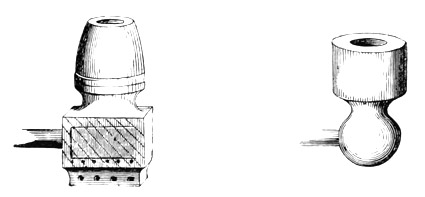
Assiniboin pipes

Pipe for warlike expeditions
Many games are in use among these Indians; one of these is a round game, in which one holds in his hand some small stones, of which the others must guess the number, or pay a forfeit. This game is known also to the Blackfeet. Another is that in which they play with four small bones and four yellow nails, to which one of each sort is added; they are laid upon a flat 197 wooden plate, which is struck, so that they fly up and fall back into the plate, and you gain, or lose, according as they lie together on one side, and the stake is often very high.
Among the amusements and festivities are their eating feasts, when the guests must eat everything set before them, if they will not give offence. If one of the guests is not able to eat any more, he gives his neighbour a small wooden stick, and the plate with food, the meaning of which is that he will make him a present of a horse, on the next day, if he will undertake to empty the plate; and the young men do this in order to gain reputation. The Assiniboins are brave in battle, and often very daring. They frequently steal into the villages of the Mandans and Manitaries, shoot the inhabitants in or near their huts, or steal their horses.
They believe in a creator, or lord of life (Unkan-Tange), and also in an evil spirit (Unkan-Schidja), who torments people with various disorders, against which their sorcerers or physicians (medicine men) use the drum and the rattle to expel the evil spirit. Like the Crees and several other tribes, they believe that thunder is produced by an enormous bird, which some of them pretend to have seen. Some ascribe lightning to the Great Spirit, and believe that he is angry when the storm is violent. They believe that the dead go to a country in the south, where the good and brave find women and buffaloes, while the wicked or cowardly are confined to an island, where they are destitute of all the pleasures of life. Those who, during their lives, have conducted themselves bravely, are not to be deposited in trees when they die, but their corpses are to be laid on the ground, it being taken for granted that, in case of need, they will help themselves. Of course they are generally devoured by the wolves, to secure them from which, however, they are covered with wood and stones. Other corpses are usually placed on trees, as among the Sioux, and sometimes on scaffolds. They are tied up in buffalo hides, and three or four are sometimes laid in one tree.
The language of the Assiniboins is, on the whole, the same as that of the Sioux, altered by their long separation, and the influence of time and circumstances. Like them, they have many gutturals and nasal tones; in general, however, it is an harmonious language, which a German pronounces without difficulty.
Important Historical Publications OF The Arthur H. Clark Company
Full descriptive circulars will be mailed on application
AUDUBON'S WESTERN JOURNAL: 1849-1850
Being the MS. record of a trip from New York to Texas, and an overland journey through Mexico and Arizona to the gold-fields of California
By JOHN W. AUDUBON
With biographical memoir by his daughter MARIA R. AUDUBON
Edited by FRANK HEYWOOD HODDER Professor of American History, University of Kansas
With folded map, portrait, and original drawings

OHN W. AUDUBON, son of the famous ornithologist, was a member of Colonel Webb's California Expedition which started from New York City for the gold-fields in February, 1849. The Journal consists of careful notes which Audubon made en route. It was written with a view to publication, accompanied by a series of sketches made at intervals during the journey; but owing to Audubon's pre-occupation with other affairs, the plan of publication was never realized.
The Journal is, therefore, here published for the first time, and is illustrated by the author's original sketches, carefully reproduced. It gives a vivid first-hand picture of the difficulties of an overland journey to California, and of the excitements, dangers, and privations of life in the gold-fields. An additional interest attaches to this account from the fact that Colonel Webb deserted his party, which consisted of nearly a hundred men, when the expedition reached Roma, and the command then by unanimous choice of the party devolved upon Audubon. This situation, as modestly related by the author, displays his sympathetic nature, as well as his keenness and ability as a leader.
Besides being a fascinating story of adventure, the Journal throws much light on the interesting years immediately following the discovery of gold in California. John W. Audubon was (with his brother Victor G. Audubon) the assistant of his father, and executed much of the artistic work on the famous "Quadrupeds of North America." His pictures of the spreading of the gold craze in the East, the journey through Mexico, and the social conditions after reaching California, show him to be a keen and faithful observer.
The Editor, Professor F. H. Hodder, of the University of Kansas, has supplied complete annotation explaining matters of topography, natural science, and historical and personal allusions. Professor Hodder in his editorial work has drawn liberally upon his special knowledge of the history and geography of the West and Southwest. A biographical memoir has been written by Miss Maria R. Audubon. Being the daughter of the author, she has availed herself of a large amount of auxiliary material not accessible to any other biographer.
Printed direct from type on Dickinson's deckle-edged paper, and illustrated with folded map, portrait, and plates, in one volume, 8vo, about 225 pages, cloth, uncut.
Price $3.00 net.
The Arthur H. Clark Company PUBLISHERS CLEVELAND, OHIO
PERSONAL NARRATIVE OF
Travels in Virginia, Maryland, Pennsylvania, Ohio, Indiana, Kentucky; and of a Residence in the Illinois Territory: 1817-1818
BY
ELIAS PYM FORDHAM
With facsimiles of the author's sketches and plans
Edited with Notes, Introduction, Index, etc., by FREDERIC AUSTIN OGG, A.M. Author of "The Opening of the Mississippi"
AN UNPUBLISHED MS.
This hitherto unpublished MS., which is a real literary and historical find, was written in 1817-18 by a young Englishman of excellent education who assisted Morris Birkbeck in establishing his Illinois settlement. The author writes anonymously, but by a careful study of various allusions in the Narrative and from information furnished by the family in possession of the MS., has been identified as Elias Pym Fordham. Landing at Baltimore, he reached the West by way of Philadelphia, Pittsburg, and the Ohio River to Cincinnati, describing the people and the country as he went along.
THE MIDDLE WEST IN 1817
Fordham was an especially well-qualified observer of the Middle West because of the numerous journeys he undertook, on land-hunting trips for new emigrants, in the service of Mr. Birkbeck. These journeys led him into Indiana, Ohio, and Kentucky; and he never omits the opportunity to make frank and pointed comment on society, manners, and morals, as well as careful observations of the face of the country and of industrial conditions. The style is quite unaffected and has much natural charm and sprightliness; and the fact that he wrote anonymously made him much more free in his comments on contemporary society than would otherwise have been possible.
LOCAL AND PIONEER HISTORY
These journeys also gave him unexampled opportunities for contact with the pioneers of Middle West, and his journal is consequently rich in personalia of early settlers, remarks on contemporary history and politics, state of trade, agriculture, prices, and information on local history not obtainable elsewhere. He also visited the larger cities and gives very interesting accounts of Pittsburg and Cincinnati, accompanied by original sketches and plans. In Kentucky he had the opportunity to study slavery; and although at first prejudiced against this institution he finally reached the conclusion that the slave states offered better chances of successful settlement than the free states.
VALUE FOR READERS AND STUDENTS
The publication of Fordham's Narrative with introduction, extensive annotations, and index by professor Frederic A. Ogg, one of the best authorities on the history of the Mississippi Valley, will make accessible to historical students much new and important material, besides giving the general reader a book of vital and absorbing interest.
Printed direct from type on Dickinson's deckle-edged paper, and illustrated with original sketches and plans, in one volume, 8vo, about 180 pages, cloth, uncut.
Price $3.00 net.
The Arthur H. Clark Company PUBLISHERS CLEVELAND, OHIO
"AN AUTHORITY OF THE HIGHEST IMPORTANCE"—Winsor
THE PRESENT STATE OF THE EUROPEAN SETTLEMENTS ON THE MISSISIPPI; WITH A Geographical Description of that River. ILLUSTRATED BY PLANS and DRAUGHTS.
By Captain PHILIP PITTMAN.
LONDON. Printed for J. Nourse, Bookseller to His MAJESTY. MDCCLXX
Edited with Introduction, Notes, and Index, by FRANK HEYWOOD HODDER Professor of American History, University of Kansas
This exceedingly rare work was issued in London, in 1770, and has been so much in demand by historical students and collectors of Americana that even imperfect copies of the original are now almost impossible to obtain at any price. Our text is from a perfect copy of the original with all the folding maps and plans carefully reproduced.
*Only two copies have been offered for sale during the past five years; one copy sold at $95.00, and the other is now offered by a reliable firm of booksellers at $105.00.
A valuable source work
Pittman's Mississippi Settlements contains much valuable original material for the study of the French and Spanish Settlements of old Louisiana, West Florida, and the Illinois country. The author, Captain Philip Pittman, was a British military engineer, and gives an accurate general view of the Mississippi Settlements just after the English came into possession of the eastern half of the valley by the Peace of 1763. His account, written from personal observation, is rich in allusions to the political, social, and military readjustments resulting from this change of possession. "A comprehensive account of the Illinois country and its inhabitants, with sketches in detail of the several French posts and villages situated therein, as personally viewed by him in 1766-67.... It contains, in a compact form, much useful and reliable information (nowhere else to be found) concerning the Mississippi Valley and its people at that transition period."—Wallace: Illinois and Louisiana under French Rule.
The earliest English account
Dr. William F. Poole in Winsor's Narrative and Critical History of America says: "It is the earliest English account of those settlements, and, as an authority in early western history, is of the highest importance. He [Pittman] was a military engineer, and for five years was employed in surveying the Mississippi River and exploring the western country. The excellent plans which accompany the work, artistically engraved on copper, add greatly to its value."
Annotation by Professor Hodder
An introduction, notes, and index have been supplied by Professor Frank Heywood Hodder, who has made a special study of American historical geography. The value of the reprint is thus enhanced by annotation embodying the results of the latest researches in this field of American history.
The edition is limited to 500 copies, each numbered. It is handsomely printed in large Caslon type on Dickinson's deckle-edged paper. With folding maps and plans. Large 8vo, cloth, uncut, gilt top.
Price $3.00 net.
The Arthur H. Clark Company PUBLISHERS CLEVELAND, OHIO
"We cannot thoroughly understand our own history, local or National, without some knowledge of these routes of trade and war."—The Outlook.
The Historic Highways of America by Archer Butler Hulbert
A series of monographs on the History of America as portrayed in the evolution of its highways of War, Commerce, and Social Expansion.
Comprising the following volumes:
I—Paths of the Mound-Building Indians and Great Game Animals.
II—Indian Thoroughfares.
III—Washington's Road: The First Chapter of the Old French War.
IV—Braddock's Road.
V—The Old Glade (Forbes's) Road.
VI—Boone's Wilderness Road.
VII—Portage Paths: The Keys of the Continent.
VIII—Military Roads of the Mississippi Basin.
IX—Waterways of Westward Expansion.
X—The Cumberland Road.
XI, XII—Pioneer Roads of America, two volumes.
XIII, XIV—The Great American Canals, two volumes.
XV—The Future of Road-Making in America.
XVI—Index.
Sixteen volumes, crown 8vo, cloth, uncut, gilt tops. A LIMITED EDITION only printed direct from type, and the type distributed. Each volume handsomely printed in large type on Dickinson's hand-made paper, and illustrated with maps, plates, and facsimiles.
Published a volume each two months, beginning September, 1902.
Price, volumes 1 and 2, $2.00 net each; volumes 3 to 16, $2.50 net each.
Fifty sets printed on large paper, each numbered and signed by the author. Bound in cloth, with paper label, uncut, gilt tops. Price, $5.00 net per volume.
"The fruit not only of the study of original historical sources in documents found here and in England, but of patient and enthusiastic topographical studies, in the course of which every foot of these old historic highways has been traced and traversed."—The Living Age.
"The volumes already issued show Mr. Hulbert to be an earnest and enthusiastic student, and a reliable guide."—Out West.
"A look through these volumes shows most conclusively that a new source of history is being developed—a source which deals with the operation of the most effective causes influencing human affairs."—Iowa Journal of History and Politics.
"The successive volumes in the series may certainly be awaited with great interest, for they promise to deal with the most romantic phases of the awakening of America at the dawn of occidental civilization."—Boston Transcript.
"The publishers have done their part toward putting forth with proper dignity this important work. It is issued on handsome paper and is illustrated with many maps, diagrams, and old prints."—Chicago Evening Post.
FOOTNOTES