← Table of contents
Master Wace, His Chronicle of the Norman Conquest From the Roman De Rou

Chapter XXIII

Edgar Taylor translation

THE ROLL OF THE NORMAN LORDS CONTINUED.

Next the company of Neel[1] rode Raol de Gael; he was himself a Breton, and led Bretons; he served for the land which he had, but he held it short time enough; for he forfeited it, as they say[2].

Avenals des Biarz[3] was there, and Paienals des Mostiers-Hubert[4]; and Robert Bertram, who was Tort (crooked)[5], but was very strong when on horseback, had with him a great force, and many men fell before him. The archers of Val de Roil[6], and those of Bretoil[7], put out the eyes of many an Englishman with their arrows. The men of Sole[8] and Oireval[9], and of St. Johan and Brehal[10], of Brius[11] and of Homez[12], were to be seen on that day, striking at close quarters, and holding their shields over their heads, so as to receive the blows of the hatchets. All would rather have died than have failed their lawful lord.

And there were also present the lords of Saint-Sever[13] and Caillie[14], and the sire de Semillie[15], and Martels de Basquevile[16]; and near him the lords of Praels[17], of Goviz[18] and Sainteals[19], of Viez Molei[20], and Monceals[21]; and he who was sire de Pacie[22], and the seneschal de Corcie[23], and a chevalier de Lacie[24], with the lords de Gascie[25], d'Oillie[26], and de Sacie[27], and the sires de Vaacie[28], del Torneor[29] and de Praeres[30], and Willame de Columbieres, and old Gilbert d'Asnieres[3l], de Chaignes, and de Tornieres[32], and old Hue de Bolebec[33], and Dam Richart, who held Orbec[34], and the sire de Bonnesboz[35], and the sires de Sap, and de Gloz[36] and he who then held Tregoz[37]; he killed two Englishmen; smiting the one through with his lance, and braining the other with his sword; and then galloped his horse back, so that no Englishman touched him.

And the sire de Monfichet[38] was there, leading a gallant party; and the ancestor of Hue li Bigot[39], who had lands at Maletot, and at Loges and Chanon, and served the duke in his house as one of his seneschals, which office he held in fee. He had with him a large troop, and was a noble vassal. He was small of body, but very brave and bold, and assaulted the English with his men gallantly.

And now might be heard the loud clang and cry of battle, and the clashing of lances. The English stood firm in their barricades, and shivered the lances, beating them into pieces with their bills and maces. The Normans drew their swords and hewed down the barricades, and the English in great trouble fell back upon their standard, where were collected the maimed and wounded.

Then the sire de la Haie[40] charged on, and neither spared nor pitied any; striking none whom he did not kill, and inflicting wounds such as none could cure.

The lords de Vitrie[41] and Urinie[42], de Moubrai[43] and Saie[44], and the sire de la Ferté[45], smote down many of the English, most of whom suffered grievously, and many of them were killed. Botevilain[46] and Trossebot[47] feared neither blow nor thrust, but heartily gave and took many on that day.

William Patric de la Lande[48] called aloud for king Harold, saying that if he could see him, he would appeal him of perjury. He had seen him at la Lande, and Harold had rested there on his way through, when he was taken to the duke, then at Avranches, on his road to Brittany. The duke made him a knight there, and gave him and his companions arms and garments, and sent him against the Bretons. Patric stood armed by the duke's side, and was much esteemed by him.

There were many knights of Chauz[49], who jousted and made attacks. The English knew not how to joust, nor bear arms on horseback, but fought with hatchets and bills. A man when he wanted to strike with one of their hatchets, was obliged to hold it with both his hands, and could not at the same time, as it seems to me, both cover himself and strike with any freedom[50].

The English fell back upon a rising ground, and the Normans followed them across the valley, attacking them on foot and horseback. Then Hue de Mortemer[51], with the sires d'Auviler[52], d'Onebac[53], and Saint-Cler[54], rode up and charged, overthrowing many.

Robert Fitz Erneis[55] fixed his lance, took his shield, and galloping towards the standard with his keen-edged sword, struck an Englishman who was in front, killed him, and then drawing back his sword, attacked many others, and pushed straight for the standard, trying to beat it down; but the English surrounded it, and killed him with their bills. He was found on the spot, when they afterwards sought for him, dead, and lying at the standard's foot.

Robert count of Moretoing[56] never went far from the duke. He was his brother on the mother's side, and brought him great aid. The sire de Herecort[57] was also there, riding a very swift horse, and gave all the help he could. The sires de Crievecoer[58], Driencort[59], and Briencort[60], also followed the duke wherever he moved. The sires de Combrai[61], and Alnei[62]; de Fontenei[63], Rebercil[64], and Molei[65] challenged Harold the king to come forth, and said to the English, "Stay! stay! where is your king? he that perjured himself to William? He is a dead man, if we find him."

Many other barons there were, whom I have not even named; for I cannot give an account of them all, nor can I tell of all the feats they did, for I would not be tedious. Neither can I give the names of all the barons, nor the surnames[66] of all whom the duke brought from Normandy and Brittany in his company. He had also many from Mans and Thouars; and Angevins and Poitevins; and men of Ponthieu and Bologne. He had also soldiers[67] from many lands, who came some for land and some for money. Great was the host, and great the enterprize.

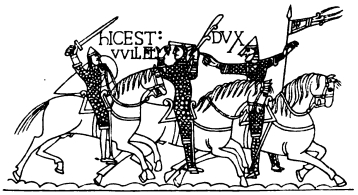
Duke William fought gallantly, throwing himself wherever the greatest press was, beating down many who found no rescue; so that it might easily be seen that the business in hand was his own. He who bore his gonfanon that day—Tostein[68], Fitz-Rou le blanc by name, born at Bec near Fescamp—was a brave and renowned knight. He bore the gonfanon boldly, high aloft in the breeze, and rode by the duke, going wherever he went. Wherever the duke turned, he turned also, and wheresoever he stayed his course, there he rested also. And the duke fought where the greatest throng was, where he saw the most English, and wherever the Normans were attacking and slaughtering them. He also had around him a great company, vavassors of Normandy, who to save their lord would have put their own bodies between him and the enemies' blows.

Alain Fergant[69], count of Brittany, lead a great company of Bretons, a bold and fierce people, who willingly go wherever booty is to be won. They wounded and killed many; and few that they struck stood their ground. Alain Fergant himself fought like a noble and valiant knight, and led his Bretons on, doing great damage to the English.

The sire de St. Galeri[70], and the count d'Ou[71], and Roger de Montgomeri and dam Ameri de Toarz also demeaned themselves like brave men, and those whom their blows reached were ill handled.

Signet ring
Signet ring
Illustration from Master Wace, His Chronicle of the Norman Conquest From the Roman De Rou

Notes in this chapter

Note 2 · [39] BIGOT. This illustrious family is traced no higher than Robert le Bigot, who was a relation of Richard d'Avranches, and quitted the serNote 1 · NEEL; see former note on Neel de Saint Sauveur, whose 'company,' as viscount of the Cotentin, seems to be here referred to.Note 2 · RAOL DE GAEL, lord of Gael or Guader, and Montfort in Brittany, 'Ranols de Gader, le proz,' in Benoit. It does not appear that Raol commandeNote 3 · BIARZ, see last chapter, note 40. William Avenel, lord of Biarz, seems meant in both cases. The Avenels were seneschals to the counts of MorNote 4 · This may be read either HUBERT PAISNEL, lord of MOSTIERS—or PAISNEL, lord of MOSTIERS-HUBERT; but the latter is more likely, [no Hubert PaisNote 5 · ROBERT BERTRAM the tort or crooked, lord of Briquebec near Valognes;—as to the picturesque remains of whose castle see Mr. Cotman's and Mr. Note 6 · LE VAUDREUIL, arrondissement of Louviers.Note 7 · BRETEUIL, arrondissement of Evreux.Note 8 · SOULES, arrondissement of St. Lo. See M. de Gerville, Mém. Ant. Norm. v. 260. In the Red book, 'Willus de Sola 1 mil. ad servitium suum 2 miNote 9 · ORVAL, near Coutances. In the Red book, 'Willmus de Aureavalle 2 mil. et dim. et ad servitium suum 6 mil. in Constantin.' See, as to this faNote 10 · SAINT JEAN, near Avranches, from which came the St. Jean who married the daughter of Robert de Haiâ. See note 40 below, and the Recherches oNote 11 · The British Museum MS. changes the number of the pronoun, and reads cil de BRIUS; not cels, as in the case of the three preceding names. M. Note 12 · HOMMET, arrondissement of St. Lo; see M. de Gerville's Recherches, No. 10 and elsewhere, as to this powerful family, and as to the castle, NNote 13 · SAINT SEVER, (in the arrondissement of Vire), may be here used to represent Hugh Lupus, as AVRANCHES has perhaps been for Richard his fatherNote 14 · CAILLY, arrondissement of Rouen; referring either to Osbern de Cailly; or to his son Roger, who in 1080 made a donation to St. Ouen. WilliamNote 15 · SEMILLY, near St. Lo. William de Semilly appears in two charters about 1082. The family becoming extinct in the twelfth century, Semilly pasNote 16 · BACQUEVILLE, arrondissement of Dieppe. The head of this family, in the maternal line, was Nicholas de Bacqueville, one of the six sons of BaNote 17 · PREAUX. There are several communes of the name in Normandy, and it might be safest to refer this to one in Wace's neighbourhood. There are aNote 18 · Gouvix, arrondissement of Falaise. The early history of the lords of Gouvix is not known; but Ralf de Goviz appears, in 1181, in the charterNote 19 · CINTHEAUX, arrondissement of Falaise. The early lords of Cintheaux also are unknown. In 1181 the church is mentioned as given to Barbery. A.Note 20 · See note below, on MOLEI.Note 21 · There are many communes called MONCEAUX. The one meant is probably that near Bayeux.Note 22 · PACY SUR L'EURE, arrondissement of Evreux. Pacy seems at the conquest to have belonged to William Fitz-Osbern. But there certainly was a WilNote 23 · COURCY has occurred before. The lords of Courcy known to have held the office of seneschal were Robert, under the empress Matilda, and WilliNote 24 · LACIE also has occurred before. Here the expression is peculiar, 'un chevalier de Lacie,'—which was intended perhaps to distinguish him fromNote 25 · GACÉ, arrondissement of Argentan. Robert de Gacé, grandson of archbishop Robert, and son of Ralf 'caput Asini,'—who was concerned in the murNote 26 · The cradle of the noble family of D'OILEY is, on the authority of M. Le Prevost and M. Galeron, to be sought at Ouilly-le-Basset, arrondisseNote 27 · SASSY, arrondissement of Avranches, near Pontorson. Jourdain de Sacey appears in a charter of Richard de Subligny, bishop of Avranches, abouNote 28 · VASSY, arrondissement of Vire. Robert and Ivo de Vassy—Vesci in English orthography—were in William's expedition, and settled in England. A.Note 29 · LE TOURNEUR, near Vire. A.L.P.Note 30 · PRESLES, arrondissement of Vire. In the Red book, 'In ballia de castro de Virâ,' are 'Joannes de Praeriis dim. mil.' and 'Mattheus de PraeriNote 31 · [31] COLUMBIERES and ASNIERES are in the arrondissement of Bayeux. The lords of both are found in a charter of 1082, in favour of the AbbayeNote 32 · CAHAGNES, arrondissement of Vire. The lords of Cahagnes are among the benefactors of Grestein and Lewes. William de Cahagnes appears to haveNote 33 · BOLBEC, arrondissement of Havre. The printed text is 'Luce.' The MS. of Duchesne reads 'le filz Hue de Bolbec;' but the British Mus. MS. reaNote 34 · RICHARD DE BIENFAITE, arrondissement of Lisieux. He was Fitz-Gilbert, as son of Gilbert earl of Brionne, elder brother of Baldwin de Meules Note 35 · BONNEBOSQ, arrondissement of Pont-l'Evesque. Ralf de Bonnebosq appears among the benefactors of St. Stephen at Caen. Under Hen. I. Gilbert dNote 36 · SAP and GLOZ, arrondissement of Argentan. Sap was before the conquest given, with Meules, to Baldwin; of whom it was therefore held by whoevNote 37 · TREGOZ, or Trois-Gots, arrondissement of St. Lo. The ruins of the castle are visible at the confluence of the Vire and the brook Marquelan. Note 38 · MONTFIQUET, arrondissement of Bayeux, where the ruins of the old castle are visible. William de Montfichet was benefactor of Cerisy during tNote 39 · HAIE-DU-PUITS, arrondissement of Coutances; near the abbey of Lessay, which was founded by Richard, commonly called Turstain Haldup, Halduc,Note 40 · See the last chapter, note 43.Note 41 · ORIGNY. There are two of the name, one near Bellesme, the other near Mamers.Note 42 · ROGER DE MOUBRAY, see note 2, page 157.Note 43 · SAY, arrondissement of Argentan. The lords of Say took the name or surname of PICOT, by which, as in Domesday, they are often called withoutNote 44 · FERTÉ MACÉ—(Feritas Matthæi)—arrondissement of Dunfront. A sister of Odo bishop of Bayeux, and of Muriel, the wife of Eudo cum Capello mentiNote 45 · The lord of BOUTTEVILLE, arrondissement of Valognes, was at the conquest; see M. de Gerville, Recherches, No. 24. Whether Boutevile in the BNote 46 · The name of Trossebot—afterwards TRUSSBUT in England—occurs both in the Battle Abbey roll, and in Brampton. From Ordericus Vitalis it appearNote 47 · WILLIAM PATRY, lord of LA LANDE-PATRY, arrondissement of Domfront. See La Roque, Histoire de la maison d'Harcourt, and La Chesnaye des Bois.Note 48 · The pays de Caux.Note 49 · See note to next chapter, as to the use of the shield, and the enarmes,and guige.Note 50 · RALF DE MORTEMER, not Hugh his son, appears to have been with the expedition. An instance of Wace's imperfect knowledge of this family has bNote 51 · Most probably AUVILLARS, arrondissement of Pont-l'Evesque. In the Red book, (de Baiocasino) 'Robertus de Alviler 1 mil. de 2 mil. et 4 part.Note 52 · ASNEBEC, near Vire. The estate appears to have belonged to the lords of Beaumont-le-Roger at the period of the conquest. A.L.P. According toNote 53 · SAINT-CLAIR, arrondissement of St. Lo. See M. de Gerville's Recherches. The scite of the castle is still observable. William de Saint-Clair Note 54 · ROBERT FITZ-ERNEIS, nephew of Raoul Tesson I. mentioned before, at the battle of Val-des-Dunes, as Raol Tesson de Cingueleiz, and cousin of Note 55 · ROBERT COMTE DE MORTAIN—comes Moritolii—whom William of Malmsbury describes as 'crassi et hebetis ingenii hominem,'—uterine brother of WilliNote 56 · ERRAND DE HARCOURT, according to the historian of the house, a person little known, and of doubtful authenticity. A branch of this illustrioNote 57 · CREVECŒUR, arrondissement of Lisieux. The Crevecœurs—de Crepito-corde—settled in England, and were divided into two branches, those of RedbuNote 58 · DRIENCOURT changed its name to Neufchâtel, after Hen. I. built a castle there. Nothing seems known of the lords of Driencourt in England; unNote 59 · No place of this name is known in Normandy. It may refer to BRUCOURT, arrondissement of Pont-l'Evesque; and the correct reading of the MS. wNote 60 · COMBRAY, arrondissement of Falaise. At a later period lords of this name are among the benefactors of St Barbe-en-Auge and Fontenay.Note 61 · AULNAY. See note 22 last chapter. There are four communes of this name. Aulnay l'Abbaye, arrondissement of Vire, belonged in the twelfth cenNote 62 · There are nine FONTENAYS in Normandy. If we are to presume that the one here alluded to is Fontenay-le-Marmion, near Caen, the lord of MarmiNote 63 · RUBERCY, arrondissement of Bayeux. It appears that when the abbey of Longues was founded in 1168 by Hugh Wac, he was lord of Rebercil, and gNote 64 · See VIEUX-MOLAY before; this being perhaps a repetition of the same person, lord of MOLLEI-BACON, arrondissement of Bayeux. William Bacon, wNote 65 · Brampton takes the safe side in protesting against being accountable for the baptismal names of the early Norman barons; in specifying whichNote 66 · Hired men.Note 67 · See previous note on TURSTIN FITZ-ROU, the standard bearer.Note 68 · ALAN LE ROUX, the red—of Britanny—received the earldom of Richmond and splendid grants for his services. See Introd. Domesday, i. 366; and, Note 69 · BERNARD DE ST. VALERY, on the Somme, who was grandson of duke Richard II. by a daughter, and was therefore cousin to the conqueror. A branchNote 70 · ROBERT COMTE D'EU. We have seen him before at the battle of Mortemer. He received the custody of the castle of Hastings, and considerable la
Explore with AITake your curiosity a little further.

Reading settings