Chapter XVI
Edgar Taylor translation
HOW BOTH HOSTS PASSED THE NIGHT AND MADE READY FOR BATTLE; AND HOW THE DUKE EXHORTED HIS MEN.
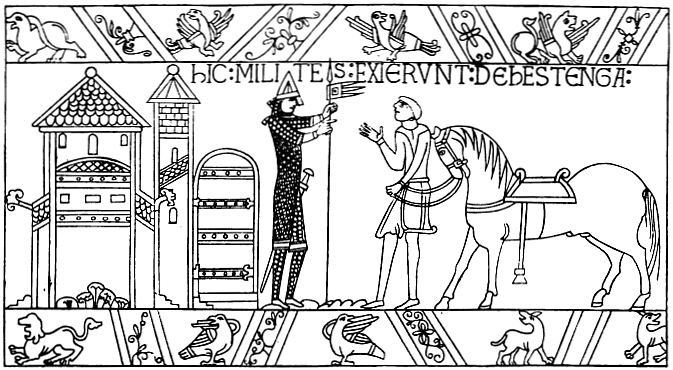
The duke and his men tried no further negotiation, but returned to their tents, sure of fighting on the morrow. Then men were to be seen on every side straightening lances, fitting hauberks and helmets; making ready the saddles and stirrups; filling the quivers, stringing the bows, and making all ready for the battle.
I have heard tell that the night before the day of battle, the English were very merry, laughing much and enjoying themselves. All night they ate and drank, and never lay down on their beds. They might be seen carousing, gambolling and dancing, and singing; BUBLIE they cried, and WEISSEL, and LATICOME and DRINCHEHEIL, DRINC-HINDREWART and DRINTOME, DRINC-HELF, and DRINC-TOME[1]. Thus they bemeaned themselves; but the Normans and French betook themselves all night to their orisons, and were in very serious mood. They made confession of their sins, and accused themselves to the priests; and whoso had no priest near him, confessed himself to his neighbour.
The day on which the battle was to take place being Saturday, the Normans, by the advice of the priests, vowed that they would nevermore while they lived eat flesh on that day. Giffrei[2], bishop of Coutanes, received confessions, and gave benedictions, and imposed penances on many; and so did the bishop of Bayeux, who carried himself very nobly. He was bishop of the Bessin, Odes by name, the son of Herluin[3], and brother of the duke on the mother's side. He brought to his brother a great body of knights and other men, being very rich in gold and silver.
On the fourteenth day of October was fought the battle whereof I am about to tell you.
The priests had watched all night, and besought and called on God, and prayed to him in their chapels which were fitted up throughout the host. They offered and vowed fasts, penances, and orisons; they said psalms and misereres, litanies and kyriels; they cried on God, and for his mercy, and said paternosters and masses; some the SPIRITUS DOMINI, others SALUS POPULI, and many SALVE SANCTE PARENS, being suited to the season, as belonging to that day, which was Saturday. And when the masses were sung, which were finished betimes in the morning, all the barons assembled and came to the duke, and it was arranged they should form three divisions, so as to make the attack in three places.
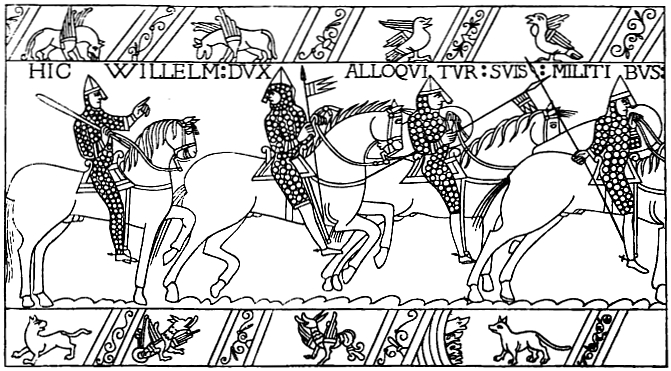
The duke stood on a hill, where he could best see his men; the barons surrounded him, and he spoke to them proudly:
"Much ought I," said he, "to love you all, and much should I confide in you; much ought and will I thank you who have crossed the sea for me, and have come with me into this land. It grieves me that I cannot now render such thanks as are due to you, but when I can I will, and what I have shall be yours. If I conquer, you will conquer. If I win lands, you shall have lands; for I say most truly that I am not come merely to take for myself what I claim, but to punish the felonies, treasons, and falsehoods which the men of this country have always done and said to our people. They have done much ill to our kindred, as well as to other people, for they do all the treason and mischief they can. On the night of the feast of St Briçun, they committed horrible treachery; they slew all the Danes in one day; they had eaten with them, and then slew them in their sleep; no fouler crime was ever heard of than in this manner to kill the people who trusted in them.
"You have all heard of Alwered[4], and how Godwin betrayed him; he saluted and kissed him, ate and drank with him; then betrayed, seized and bound him, and delivered him to the felon king, who confined him in the Isle of Eli, tore out his eyes, and afterwards killed him. He had the men of Normandy also brought to Gedefort[5], and decimated them; and when the tenth was set apart, hear what felony they committed! they decimated that tenth once more, because it appeared too many to save. These felonies, and many other which they have done to our ancestors, and to our friends who demeaned themselves honourably, we will revenge on them, if God so please. When we have conquered them, we will take their gold and silver, and the wealth of which they have plenty, and their manors, which are rich. We shall certainly easily conquer them, for in all the world there is not so brave an army, neither such proved men and vassals, as are here assembled[6]."
Then they began to cry out, "You will not see one coward; none here will fear to die for love of you, if need be."
And he answered them, "I thank you well. For God's sake spare not; strike hard at the beginning; stay not to take spoil; all the booty shall be in common, and there will be plenty for every one. There will be no safety in peace or flight; the English will never love or spare Normans. Felons they were and are; false they were and false they will be. Shew no weakness towards them, for they will have no pity on you; neither the coward for his flight, nor the bold man for his strokes, will be the better liked by the English, nor will any be the more spared on that account. You may fly to the sea, but you can fly no further; you will find neither ship nor bridge there; there will be no sailors to receive you; and the English will overtake you and kill you in your shame. More of you will die in flight than in battle; flight, therefore, will not secure you; but fight, and you will conquer. I have no doubt of the victory; we are come for glory, the victory is in our hands, and we may make sure of obtaining it if we so please."
As the duke said this, and would have said yet more, William Fitz Osber rode up, his horse being all coated with iron[7]; "Sire," said he to his lord, "we tarry here too long, let us all arm ourselves. Allons! allons!"
Then all went to their tents and armed themselves as they best might; and the duke was very busy, giving every one his orders; and he was courteous to all the vassals, giving away many arms and horses to them.
When he prepared to arm himself, he called first for his good hauberk, and a man brought it on his arm, and placed before him; but in putting his head in, to get it on, he inadvertently turned it the wrong way, with the back part in front. He quickly changed it, but, when he saw that those who stood by were sorely alarmed, he said, "I have seen many a man who, if such a thing had happened to him, would not have borne arms, or entered the field the same day; but I never believed in omens, and I never will. I trust in God; for he does in all things his pleasure, and ordains what is to come to pass, according to his will. I have never liked fortune-tellers, nor believed in diviners; but I commend myself to our Lady. Let not this mischance give you trouble. The hauberk which was turned wrong, and then set right by me, signifies that a change will arise out of the matter we are now moving. You shall see the name of duke changed into king. Yea, a king shall I be, who hitherto have been but duke[8]."
Then he crossed himself, and straightway took his hauberk, stooped his head, and put it on aright; and laced his helmet and girt his sword, which a varlet brought him.