← Table of contents
Master Wace, His Chronicle of the Norman Conquest From the Roman De Rou

Chapter XXII

Edgar Taylor translation

THE ROLL OF THE NORMAN CHIEFS; AND THEIR DEEDS.

LES NONS DE GRAUNTZ DELA LA MER QUE VINDRENT OD LE CONQUEROUR WILLIAM BASTARD DE GRAUNT VIGOURE[1].

Old Rogier de Belmont[2] attacked the English in the front rank; and was of high service, as is plain by the wealth his heirs enjoy: any one may know that they had good ancestors, standing well with their lords who gave them such honors. From this Rogier descended the lineage of Mellant. Guillame, whom they call Mallet[3], also threw himself boldly into the fray, and with his glittering sword created great alarm among the English. But they pierced his shield and killed his horse under him, and he would have been slain himself, had not the Sire de Montfort[4], and Dam Williame de Vez-pont[5], come up with their strong force and bravely rescued him, though with the loss of many of their people, and mounted him on a fresh horse.

The men of the Beessin[6] also fought well, and the barons of the Costentin; and Neel de St. Salveor[7] exerted himself much to earn the love and good will of his lord, and assaulted the English with great vigour. He overthrew many that day with the poitrail of his horse, and came with his sword to the rescue of many a baron. The lord of Felgieres[8] also won great renown, with many very brave men that he brought with him from Brittany.

Henri the Sire de Ferrieres[9], and he who then held Tillieres[10], both these barons brought large companies, and charged the English together. Dead or captive were all who did not flee before them, and the field quaked and trembled.

On the other side was an Englishman who much annoyed the French, continually assaulting them with a keen edged hatchet. He had a helmet made of wood, which he had fastened down to his coat, and laced round his neck, so that no blows could reach his head[11]. The ravage he was making was seen by a gallant Norman knight, who rode a horse that neither fire nor water could stop in its career, when its lord urged it on. The knight spurred, and his horse carried him on well till he charged the Englishman, striking him over the helmet, so that it fell down over his eyes; and as he stretched out his hand to raise it and uncover his face, the Norman cut off his right hand, so that his hatchet fell to the ground. Another Norman sprung forward and eagerly seized the prize with both his hands, but he kept it little space, and paid dearly for it; for as he stooped to pick up the hatchet, an Englishman with his long handled axe[12] struck him over the back, breaking all his bones, so that his entrails and lungs gushed forth. The knight of the good horse meantime returned without injury; but on his way he met another Englishman, and bore him down under his horse, wounding him grievously, and trampling him altogether underfoot.

The good citizens of Rouen, and the young men of Caen, Faleise and Argentoen, of Anisie and Matoen[13], and he who was then sire d'Aubemare[14], and dam Willame de Romare[15], and the sires de Litehare[16], Touke[17], and La Mare[18], and the sire de Neauhou[19], and a knight of Pirou[20], Robert the sire de Belfou[21], and he who was then sire de Alnou[22], the chamberlain of Tancharvile[23] and the sire d'Estotevile[24], and Wiestace d'Abevile[25], and the sire de Magnevile[26], William whom they call Crespin[27], and the sire de St. Martin[28], and dam William des Molins[29] and he who was sire des Pins[30]; all these were in the battle, and there was not one of them that did not render great aid.

A vassal from Grente-mesnil[31] was that day in great peril; his horse ran away with him, so that he was near falling, for in leaping over a bush the bridle rein broke, and the horse plunged forward. The English seeing him ran to meet him with their hatchets raised, but the horse took fright, and turning quickly round brought him safe back again.

Old Gifrei de Meaine[32], and old Onfrei de Bohun[33], Onfrei de Cartrai[34], and Maugier a newly made knight, were there also. William de Garenes[35] came too, his helmet setting gracefully on his head; and old Hue de Gornai[36] and together with him his men of Brai. With the numerous forces they brought, they killed great numbers.

And Engerran de l'Aigle[37] came also, with shield slung at his neck; and gallantly handling his spear, struck down many English. He strove hard to serve the duke well, for the sake of the lands he had promised him. And the viscount of Toarz[38] was no coward that day. And Richard d'Avrencin[39] was there, and with him were the sire de Biarz[40], and the sire de Solignie[41], and the butler d'Aubignie[42], and the lords de Vitrie[43], de Lacie[44], de Val de Saire[45], and de Tracie[46]; and these forming one troop, fell on the English off hand, fearing neither fence nor fosse; many a man did they overthrow that day; many did they maim, and many a good horse did they kill.

Hugh the sire de Montfort[47], and those of Espine[48], Port[49], Courcie[50], and Jort also, that day slew many English. He who was then sire de Reviers[51], brought with him many knights who were foremost in the assault, bearing the enemy down with their warhorses. Old Willame de Moion[52] had with him many companions; and Raol Teisson de Cingueleiz[53], and old Rogier Marmion[54], carried themselves as barons ought, and afterwards received a rich guerdon for their service.
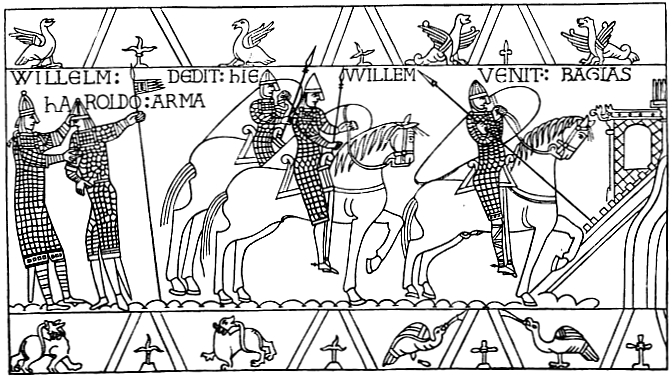
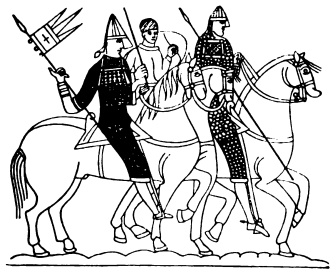
Illustration from Master Wace, His Chronicle of the Norman Conquest From the Roman De Rou

Notes in this chapter

Note 1 · From Brompton. A few names have already occurred, such as FITZ OSBERN, RALF DE CONCHES, WALTER GIFFART, ROGER DE MONGOMERI, the counts d'OU Note 2 · ROGER DE BEAUMONT; see as to him the former note, p. 102. William of Poitiers states that he did not join the expedition, but remained in NoNote 3 · WILLIAM MALET died before Domesday, which says, 'W. Malet fecit suum castellum ad Eiam,' in Suffolk. His son Robert then held the honor of ENote 4 · MONTFORT SUR RILLE, arrondissement of Pont-Audemer. Four lords of this place successively bore the name of Hugh. It is presumed the conqueroNote 5 · Dam, or Dan—Dominus—is often used by Wace. ROBERT, not William, lord of VIEUX-PONT, appears to have been at Hastings. In 1073 he was sent toNote 6 · The Brit. Mus. MS. reads 'cil de Beessin,' not cels. If this be correct, Wace may here mean the viscount of the Bessin, RANOULF DE BRICASARTNote 7 · Wace's annotator, M. Le Prevost, is incredulous as to the fact of NEEL de Saint Sauveur-le-vicomte (near Valognes) having been at the conqueNote 8 · RAOUL, son of Main, second of the name, lord of FOUGERES in Brittany. He, or a second Raoul, founded Savigny in 1112. A Ralf held large possNote 9 · HENRY, lord of St. Hilaire de FERRIERES, arrondissement of Bernay, son of Walkelin de Ferrieres, ante page 8. The scite of the castle is stiNote 10 · GILBERT CRESPIN was then lord of TILLIERES, arrondissement of Evreux. The building of the castle is described by Wace, i. 335. He is consideNote 11 · See note, page 177, as to the English helmets.Note 12 · 'Coignie.'Note 13 · ANISY and MATHIEU, two leagues from Caen.Note 14 · AUMALE or ALBAMALE. See, in the Archæologia vol. 26, the materials furnished by Mr. Stapleton for the pedigree of the family holding Aumale Note 15 · ROUMARE—Rollonis Mara—arrondissement of Rouen. There were three Williams de Romare:—the first was earl of Lincoln; the second was probably tNote 16 · LITHAIRE, commune of Haie-du-Puits, in the Cotentin, on the coast opposite Jersey; probably a Roman castellum exploratorium, according to M.Note 17 · TOUQUES, arrondissement of Pont l'Evesque, at the mouth of the river so called. In the Monasticon are found the names of Jourdain, Roger, RoNote 18 · Probably HUGH DE LA MARE. The family remained both in Normandy and England; and is supposed to have sprung from the fief of la Mare, in the Note 19 · NEHOU, in the arrondissement of Valognes—Neel's hou or holm, (place surrounded by water, or liable to be so, as in this case)—'Nigelli humusNote 20 · PIROU, near Lessay, in the Cotentin; see M. de Gerville's Recherches No. 48. William de Pirou signs as 'dapifer' in a charter of Hen. I. A cNote 21 · BEAUFOY, Beaufou, or Belfai—Bellus fagus. The scite of the caput of this barony is in the environs of Pont l'Evesque. The lords of Beaufou dNote 22 · FULK D'AUNOU, one of the numerous family of Baudry-le-Teuton, by a daughter of Richard de Bienfaite, mentioned below. The place in question Note 23 · The lord of TANCARVILLE, in the arrondissement of Havre, hereditary chamberlain of Normandy. His presence is vouched by no other authority. Note 24 · There are two ETOUTEVILLES; the one meant appears to be near Ivetot, not that near Cailli. The received opinion is that it was Robert, the fNote 25 · EUSTACE OF ABBEVILLE. There is a commune so named in the arrondissement of Lisieux, but M. Le Prevost thinks it more probable that AbbevilleNote 26 · JEFFERT DE MAGNEVILLE, in the arrondissement of Valognes, —whose name became in England Mandeville,—was constable of the tower of London, anNote 27 · WILLIAM CRESPIN I. lord of Bec Crespin, in the pays de Caux. See our former note, and the pedigree; which is at variance with the assumptionNote 28 · This may be WALTER DE SAINT MARTIN, brother of William Martel. Many communes bear this name; the one in question may be that in the pays de Note 29 · WILLIAM, lord of MOULINS-LA-MARCHE,—Molendina,—in the arrondissement of Mortagne, was son of Walter de Falaise. The duke, in reward of his sNote 30 · FULK DU PIN is, in a charter to St. Pierre-sur-Dive, quoted as contemporary with the conqueror. Ordericus Vitalis mentions a Morin du Pin asNote 31 · HUGH DE GRENTE-MESNIL, now Grandmesnil, arrondissement of Lisieux, had been banished in 1063. He became sheriff of Leicestershire, and had oNote 32 · JEFFRY DE MAINE. Although there were Mançeaux in the army, it is hardly to be supposed that 'Giffrei li sire de Meaine,' (Wace, vol. ii. 85)Note 33 · BOHUN, arrondissement of St. Lo, in the Cotentin; where are still St. André and St. Georges de Bohon. The mound of the old castle remains viNote 34 · CARTERET, arrondissement of Valognes. The family has remained in Jersey and England; Recherches, No. 14. In the Red book, 'in ballivâ OsbertNote 35 · WILLIAM WARREN, named from the fief of Varenne, in St. Aubin-le-Cauf, arrondissement of Dieppe. His English history as earl of Surrey is welNote 36 · HUGH, lord of GOURNAY, who occupied the frontier district of Brai; an important post for the defence of Normandy. See before, p. 49. We findNote 37 · ENGERAND DE L'AIGLE, appears to have been the son of Fulbert, the founder of the castle de l'Aigle, on the Rille, arrondissement of MortagneNote 38 · AIMERI viscount of THOUARS has appeared before.Note 39 · It is generally understood that not RICHARD D'AVRANCHES, in the Cotentin, (though living at the time), but his son HUGH LUPUS accompanied thNote 40 · LES BIARDS, canton d'Isigny, arrondissement of Mortain. William Avenel is probably meant, who in 1082 was a benefactor to the abbey of St. PNote 41 · SUBLIGNY, near Avranches. There was a bishop of Avranches of this house in the twelfth century. Sublignys appear in Cornwall, Devon, and SomNote 42 · D'AUBIGNY, near Periers, in the Cotentin; where there are now two parishes, St. Martin and Christopher d'Aubigny. As to the chateau, and thaNote 43 · ROBERT, lord of VITRE or Vitry, in Brittany, was, according to the Breton historians, in William's expedition, and is probably here meant. TNote 44 · LASSY, arrondissement of Vire. Walter de Lacy was the conqueror's attendant, and Ilbert de Lacy is also said to have been present. Roger, soNote 45 · VAL DE SAIRE is the name of a district in the Cotentin, arrondissement of Valognes; 'là tut dreit u Sarre en mer chiet;' Wace, i. 318.Note 46 · TRACY, in the arrondissement of Caen, where are still remains of the castle. It was probably Turgis de Tracy who was at the battle. Orderic.Note 47 · HUGH DE MONTFORT, noticed above.Note 48 · EPINAY is a common name in Normandy. M. Le Prevost thinks that Epinay-sur-Duclair, arrondissement of Rouen, was meant here. Its lords appearNote 49 · PORT, near Bayeux. Hugh and Robert de Port seem to have been at the conquest. Gilbert de Port is found in documents soon after. Hugh had theNote 50 · COURCY and JORT are in the arrondissement of Falaise. Robert de Courcy father of Richard who was at the conquest, was one of the sons of BauNote 51 · REVIERES, arrondissement of Caen. M. Le Prevost, in his notes, states this to be BALDWIN DE MEULES—near Orbec, arrondissement of Lisieux—othNote 52 · WILLIAM, lord of MOYEN, arrondissement of St. Lo, where the scite of his castle is still visible. He and his descendants the Mohuns are knowNote 53 · Three generations bearing the name of RAOUL TESSON rapidly succeeded during the conqueror's reign. Raoul I. we have seen at Valesdunes; RaouNote 54 · See note on Fontenay in the next chapter.
Explore with AITake your curiosity a little further.

Reading settings