Chapter XXIV
Edgar Taylor translation
WHAT DEEDS OF ARMS DUKE WILLIAM DID; AND HOW HAROLD WAS SLAIN AND THE ENGLISH FLED.
Duke William pressed close upon the English with his lance; striving hard to reach the standard with the great troop he led; and seeking earnestly for Harold, on whose acconnt the whole war was. The Normans follow their lord, and press around him; they ply their blows upon the English; and these defend themselves stoutly, striving hard with their enemies, returning blow for blow.
One of them was a man of great strength, a wrestler, who did great mischief to the Normans with his hatchet; all feared him, for he struck down a great many Normans. The duke spurred on his horse, and aimed a blow at him, but he stooped, and so escaped the stroke; then jumping on one side, he lifted his hatchet aloft, and as the duke bent to avoid the blow, the Englishman boldly struck him on the head, and beat in his helmet, though without doing much injury. He was very near falling however, but bearing on his stirrups he recovered himself immediately; and when he thought to have revenged himself on the vagabond by killing him, the rogue had escaped, dreading the duke's blow. He ran back in among the English, but he was not safe even there, for the Normans seeing him, pursued and caught him; and having pierced him through and through with their lances, left him dead on the ground.
Where the throng of the battle was greatest, the men of Kent and of Essex fought wondrously well, and made the Normans again retreat, but without doing them much injury. And when the duke saw his men fall back, and the English triumphing over them, his spirit rose high, and he seized his shield by the 'enarmes'[1], and his lance, which a vassal handed to him, and took his post by his gonfanon.
Then those who kept close guard by him, and rode where he rode, being about a thousand armed men, came and rushed with closed ranks upon the English; and with the weight of their good horses, and the blows the knights gave, broke the press of the enemy, and scattered the crowd before them, the good duke leading them on in front[2]. Many pursued and many fled; many were the Englishmen who fell around, and were trampled under the horses, crawling upon the earth, and not able to rise. Many of the richest and noblest men fell in that rout, but still the English rallied in places; smote down those whom they reached, and maintained the combat the best they could; beating down the men and killing the horses. One Englishman watched the duke, and plotted to kill him; he would have struck him with his lance, but he could not, for the duke struck him first, and felled him to the earth.
Loud was now the clamour, and great the slaughter; many a soul then quitted the body it inhabited. The living marched over the heaps of dead, and each side was weary of striking. He charged on who could, and he who could no longer strike still pushed forward. The strong struggled with the strong; some failed, others triumphed; the cowards fell back, the brave pressed on; and sad was his fate who fell in the midst, for he had little chance of rising again; and many in truth fell who never rose at all, being crushed under the throng.
And now the Normans had pressed on so far, that at last they reached the standard[3]. There Harold had remained, defending himself to the utmost; but he was sorely wounded in his eye by the arrow, and suffered grievous pain from the blow. An armed man came in the throng of the battle, and struck him on the ventaille of his helmet, and beat him to the ground; and as he sought to recover himself, a knight beat him down again, striking him on the thick of his thigh, down to the bone.
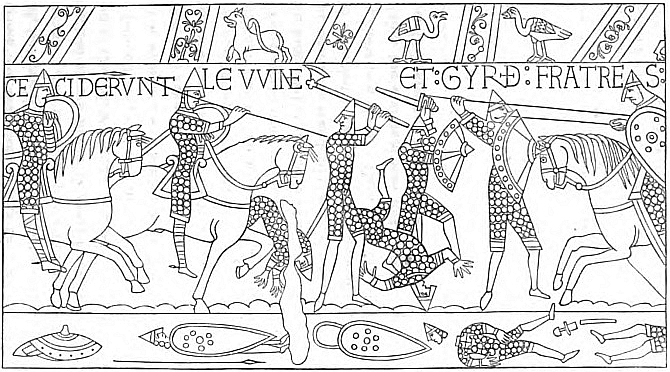
Gurth saw the English falling around, and that there was no remedy. He saw his race hastening to ruin, and despaired of any aid; he would have fled, but could not, for the throng continually increased. And the duke pushed on till he reached him, and struck him with great force. Whether he died of that blow I know not, but it was said that he fell under it, and rose no more.
The standard was beaten down, the golden gonfanon was taken, and Harold and the best of his friends were slain; but there was so much eagerness, and throng of so many around, seeking to kill him, that I know not who it was that slew him.
The English were in great trouble at having lost their king, and at the duke's having conquered and beat down the standard; but they still fought on, and defended themselves long, and in fact till the day drew to a close. Then it clearly appeared to all that the standard was lost, and the news had spread throughout the army that Harold, for certain, was dead; and all saw that there was no longer any hope, so they left the field, and those fled who could[4].
I do not tell, and I do not indeed know, for I was not there to see, and have not heard say, who it was that smote down king Harold, nor by what weapon he was wounded; but this I know, that he was found among the dead. His great force availed him nothing; amidst the slain he was found slain also[4].
The English who escaped from the field did not stop till they reached London, for they were in great fear, and cried out that the Normans followed close after them[5]. The press was great to cross the bridge, and the river beneath it was deep; so that the bridge[6] broke under the throng, and many fell into the water.
William fought well; many an assault did he lead, many a blow did he give, and many receive, and many fell dead under his hand. Two[7] horses were killed under him, and he took a third when necessary, so that he fell not to the ground, and lost not a drop of blood. But whatever any one did, and whoever lived or died, this is certain, that William conquered, and that many of the English fled from the field, and many died on the spot. Then he returned thanks to God, and in his pride ordered his gonfanon to be brought and set up on high, where the English standard had stood; and that was the signal of his having conquered, and beaten down the standard. And he ordered his tent to be raised on the spot among the dead, and had his meat brought thither, and his supper prepared there.
But behold, up galloped Galtier Giffart; "Sire," said he, "what are you about? you are surely not fitly placed here among the dead. Many an Englishman lies bloody and mingled with the dead, but yet sound, or only wounded and besmeared with gore; tarrying of his own accord, and meaning to rise at night, and escape in the darkness[8]. They would delight to take their revenge, and would sell their lives dearly; no one of them caring who killed him afterwards, if he but slew a Norman first; for they say we have done them much wrong. You should lodge elsewhere, and let yourself be guarded by one or two thousand armed men, whom you can best trust. Let a careful watch be set this night, for we know not what snares may be laid for us. You have made a noble day of it, but I like to see the end of the work." "Giffart," said the duke, "I thank God, we have done well hitherto; and, if such be God's will, we will go on, and do well henceforward. Let us trust God for all!"
Then he turned from Giffart, and took off his armour; and the barons and knights, pages and squires came, when he had unstrung his shield; and they took the helmet from his head, and the hauberk from his back, and saw the heavy blows upon his shield, and how his helmet was dinted in. And all greatly wondered, and said, "Such a baron (ber) never bestrode warhorse, nor dealt such blows, nor did such feats of arms; neither has there been on earth such a knight since Rollant and Oliver."
Thus they lauded and extolled him greatly, and rejoiced in what they saw; but grieving also for their friends who were slain in the battle. And the duke stood meanwhile among them, of noble stature and mien; and rendered thanks to the king of glory, through whom he had the victory; and thanked the knights around him, mourning also frequently for the dead. And he ate and drank among the dead, and made his bed that night upon the field.
The morrow was Sunday; and those who had slept upon the field of battle, keeping watch around, and suffering great fatigue, bestirred themselves at break of day, and sought out and buried such of the bodies of their dead friends as they might find. The noble ladies of the land also came, some to seek their husbands, and others their fathers, sons, or brothers[9]. They bore the bodies to their villages, and interred them at the churches; and the clerks and priests of the country were ready, and, at the request of their friends, took the bodies that were found, and prepared graves and lay them therein.
King Harold was carried and buried at Varham[10]; but I know not who it was that bore him thither, neither do I know who buried him. Many remained on the field, and many had fled in the night.