PART IV LITERATURE AND LIFE IN THE HOMELAND
Reading edition
“One flag, one land, one heart, one hand, One Nation evermore!” —Oliver Wendell Holmes.
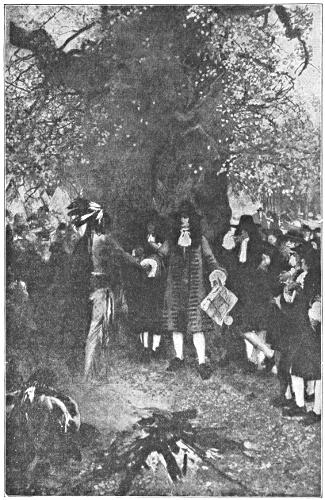
Copyright by M. G. Abbey (from a Copley Print, copyright by Curtis & Cameron, Boston)
PENN’S TREATY WITH THE INDIANS
LITERATURE AND LIFE IN THE HOMELAND INTRODUCTION
It is a hard thing to picture to ourselves our Homeland. Is America just a lot of cities and towns and farms, or a collection of so many thousands of square miles of prairies and mountains, the sort of thing one would see from an airplane if one could get up high enough and had good enough eyes? Or is it a collection of states with queer boundary lines that look plainer on a map than they do when we cross them in the train? There are people who try to find America in some motto or symbol. One of our great cities has for its motto the words “I will,” and the people who live in that city like to think that the enterprise by which they build great industries and give work to great numbers of people is the expression of their Americanism. And some people see in the Statue of Liberty in the New York harbor, a statue holding aloft a blazing torch to give light to all people, the symbol that best expresses the spirit of America.
Both the motto and the statue help us to see our country as something more than a part of a book called “Geography” or “History.” Both of them express what America had always been to its citizens and what it became to the world in 1917. We did not desire to enter the war, but when it became necessary to do so no true American hesitated. There were great difficulties: an army to raise and equip and train so that it could meet an army that had been preparing for forty years to fight the world; an army to be transported over three thousand miles of water, a terrific task even in normal times, but made a hundred-fold harder because of the monsters that lurked under the sea waiting a chance to send a transport to the bottom. And once across, there were docks and railroads to be built and a great industrial organization to be set going. But the will of America was triumphant and the job was done. And the statue, like the “I will,” is a symbol of the spirit in America that has helped the spirit of liberty throughout the world, so that we now know the day is coming when all peoples, everywhere, shall be free. We can make a beginning, therefore, in our effort to form a picture of what America means, by thinking of this Statue of Liberty and of these words of high purpose, “I will.”
But we must fill in the picture. No statue will do, for it, after all, is lifeless. No motto will do, for it is only a phrase, an inscription. A photograph on which you have written a date or the record of a happy meeting with your friend, is very interesting indeed, and helps you to call to mind your friend. But in reality the photograph merely suggests to you your friend and your happy times together. Your friend has many moods, now sad, now gay. Your friend looks different at different times. The history of your friendship has many events in it, and all these go together, a thousand details, to make up your own idea “this is my friend.” So it is with America. History and legend, the knowledge of past events, must acquaint us with our country as with our friend. Infinite variety of mood she has, now stern and grave like her mountains, now placid like her vast expanse of prairie or her waving fields of grain; now laughing like the waters in the sunlight, or beautiful in anger as mighty storms sweep hill and plain. And infinite, again, are her activities—great factories and mills, lofty office buildings filled with workers, trains speeding like mighty shuttles through vast distances, farms filled with growing food for a world. All these you must bring into your picture, and more, for infinite, also, are the ideals and hopes that go to make up this many-sided personality that we name Our Country.
The selections that follow will help you to make this picture that is to be more to us than a statue or a photograph. Some of them are little views, snapshots of our nation’s childhood. Others are pictures of various moods or appearances of the later America. Some show the spirit of laughter in America; others give some of the songs of America; and at the end are a few pictures of America at work. All will help, but they are only an imperfect and brief introduction to a subject that is going to interest you all through your life: What is America to me, and what can I do to make her happy?
EARLY AMERICA
THE CHARACTER OF COLUMBUS
ARCHBISHOP CORRIGAN
To us it is given to behold in its full splendor what Columbus, like another Moses on the borders of the Land of Promise, could only discern in dim and distant outlines. And, therefore, with Italy, the land of his birth; with Spain, the land of his adoption; with the other nations of the globe who are debtors to his daring, we gladly swell the universal chorus in his honor of praise and of thanksgiving.
In 1792 the ocean separated us by a journey of seventy days from Europe; our self-government was looked upon as a problem still to be solved; at home, facilities of travel and of intercommunication were yet to be provided. More than this, the unworthy innuendoes, the base as well as baseless charges that sought to tarnish the fair fame of Columbus, had not been removed by patient historical research and critical acumen. Fortunately, these clouds that gathered around the exploits of the great discoverer have been almost entirely dispelled, thanks especially to the initiative of a son of our Empire State, the immortal Washington Irving.
I beg to present Columbus as a man of science and a man of faith. As a scientist, considering the time in which he lived, he eminently deserves our respect. Both in theory and in practice he was one of the best geographers and cosmographers of the age. According to reliable historians, before he set out to discover new seas, he had navigated the whole extent of those already known. Moreover, he had studied so many authors and to such advantage that Alexander von Humboldt affirmed: “When we consider his life we must feel astonishment at the extent of his literary acquaintance.”
Columbus took nothing for granted. While he bowed reverently to the teachings of his faith, he brushed away as cobwebs certain interpretations of Scripture more fanciful than real, and calmly maintained that the Word of God cannot be in conflict with scientific truth. The project of bearing Christ over the waters sank deeply into his heart. Time and again he alludes to it as the main object of his researches and the aim of his labors. Other motives of action undoubtedly he had, but they were a means to an end.
Moreover, may we not reasonably assume that the great navigator, after all, was a willing instrument in the hands of God? The old order was changing. Three great inventions, already beginning to exert a most potent influence, were destined to revolutionize the world—the printing-press, which led to the revival of learning; the use of gun-powder, which changed the methods of warfare; the mariner’s compass, which permitted the sailor to tempt boldly even unknown seas.
These three great factors of civilization, each in its own way, so stimulated human thought that the discovery of America was plainly in the designs of that Providence which “reacheth from end to end mightily and ordereth all things sweetly.”
NOTES AND QUESTIONS
Biography. Michael Augustine Corrigan (1839-1902) was born in Newark, New Jersey. He became Archbishop of New York and was a distinguished Prelate. This selection is taken from a Columbus Day address he gave in Chicago in 1892.
Discussion. 1. Explain the comparison found in the second line. 2. What claims does the author make for Columbus as a scientific man? 3. What great inventions occurred previous to Columbus’s voyage that affected his discovery of America? 4. Do you think the spirit of adventure had something to do with Columbus’s discovery? Pronounce the following: government; acumen; exploits; geographers; alludes.
Phrases
unworthy innuendoes, 405, 11
critical acumen, 405, 14
potent influence, 406, 22
factors of civilization, 406, 27
THE LANDING OF THE PILGRIM FATHERS
FELICIA HEMANS
The breaking waves dashed high On a stern and rock-bound coast, And the woods against a stormy sky Their giant branches tossed; And the heavy night hung dark The hills and waters o’er, When a band of exiles moored their bark On the wild New England shore. Not as the conqueror comes, They, the true-hearted, came; Not with the roll of the stirring drums, And the trumpet that sings of fame; Not as the flying come, In silence and in fear; They shook the depths of the desert gloom With their hymns of lofty cheer. Amidst the storm they sang, And the stars heard and the sea; And the sounding aisles of the dim woods rang To the anthem of the free! The ocean eagle soared From his nest by the white wave’s foam; And the rocking pines of the forest roared— This was their welcome home! There were men with hoary hair Amidst that pilgrim band; Why had they come to wither there, Away from their childhood’s land? There was woman’s fearless eye, Lit by her deep love’s truth; There was manhood’s brow serenely high, And the fiery heart of youth. What sought they thus afar? Bright jewels of the mine? The wealth of seas, the spoils of war? They sought a faith’s pure shrine! Ay, call it holy ground, The soil where first they trod. They have left unstained what there they found— Freedom to worship God.
NOTES AND QUESTIONS
Biography. Felicia Hemans (1793-1835), an English poet, was born in Liverpool. She began to write poetry when young, and in 1819 won a prize of £50 offered for the best poem on “The Meeting of Wallace and Bruce on the Banks of the Carron.” She is best known by her short poems, some of which have become standard English lyrics, such as “The Landing of the Pilgrim Fathers,” “Treasures of the Deep,” and “Casabianca.”
Discussion. 1. What picture do the first two stanzas give you? 2. Compare the coming of a conqueror with the coming of these early settlers. 3. What different kinds of persons composed the “pilgrim band”? 4. Why did they come to this new country? 5. Why does the poet say “holy ground”? 6. What legacy have the Pilgrims left us?
Phrases
hung dark, 407, 5
stirring drums, 407, 11
hoary hair, 408, 1
pilgrim band, 408, 2
spoils of war, 408, 11
faith’s pure shrine, 408, 12
PHILIP OF POKANOKET AN INDIAN MEMOIR
WASHINGTON IRVING
As monumental bronze unchanged his look; A soul that pity touch’d but never shook; Train’d from his tree-rock’d cradle to his bier, The fierce extremes of good and ill to brook Impassive—fearing but the shame of fear— A stoic of the woods—a man without a tear. Campbell.
It is to be regretted that those early writers, who treated of the discovery and settlement of America, have not given us more particular and candid accounts of the remarkable characters that flourished in savage life. The scanty anecdotes which have reached us are full of peculiarity and interest; they furnish us with nearer glimpses of human nature, and show what man is in a comparatively primitive state, and what he owes to civilization. There is something of the charm of discovery in lighting upon these wild and unexplored tracts of human nature; in witnessing, as it were, the native growth of moral sentiment, and perceiving those generous and romantic qualities which have been artificially cultivated by society, vegetating in spontaneous hardihood and rude magnificence.
In civilized life, where the happiness, and indeed almost the existence, of man depends so much upon the opinion of his fellow-men, he is constantly acting a studied part. The bold and peculiar traits of native character are refined away, or softened down by the leveling influence of what is termed good-breeding; and he practices so many petty deceptions, and affects so many generous sentiments, for the purposes of popularity, that it is difficult to distinguish his real from his artificial character. The Indian, on the contrary, free from the restraints and refinements of polished life, and, in a great degree, a solitary and independent being, obeys the impulses of his inclination or the dictates of his judgment; and thus the attributes of his nature, being freely indulged, grow singly great and striking. Society is like a lawn, where every roughness is smoothed, every bramble eradicated, and where the eye is delighted by the smiling verdure of a velvet surface; he, however, who would study nature in its wildness and variety, must plunge into the forest, must explore the glen, must stem the torrent, and dare the precipice.
These reflections arose on casually looking through a volume of early colonial history, wherein are recorded, with great bitterness, the outrages of the Indians, and their wars with the settlers of New England. It is painful to perceive even from these partial narratives, how the footsteps of civilization may be traced in the blood of the aborigines; how easily the colonists were moved to hostility by the lust of conquest; how merciless and exterminating was their warfare. The imagination shrinks at the idea, how many intellectual beings were hunted from the earth, how many brave and noble hearts, of nature’s sterling coinage, were broken down and trampled in the dust!
Such was the fate of Philip of Pokanoket, an Indian warrior, whose name was once a terror throughout Massachusetts and Connecticut. He was the most distinguished of a number of contemporary Sachems who reigned over the Pequods, the Narragansets, the Wampanoags, and the other eastern tribes, at the time of the first settlement of New England; a band of native untaught heroes, who made the most generous struggle of which human nature is capable; fighting to the last gasp in the cause of their country, without a hope of victory or a thought of renown. Worthy of an age of poetry, and fit subjects for local story and romantic fiction, they have left scarcely any authentic traces on the page of history, but stalk, like gigantic shadows, in the dim twilight of tradition.
When the pilgrims, as the Plymouth settlers are called by their descendants, first took refuge on the shores of the New World, from the religious persecutions of the Old, their situation was to the last degree gloomy and disheartening. Few in number, and that number rapidly perishing away through sickness and hardships; surrounded by a howling wilderness and savage tribes; exposed to the rigors of an almost arctic winter, and the vicissitudes of an ever-shifting climate; their minds were filled with doleful forebodings, and nothing preserved them from sinking into despondency but the strong excitement of religious enthusiasm. In this forlorn situation they were visited by Massasoit, chief Sagamore of the Wampanoags, a powerful chief, who reigned over a great extent of country. Instead of taking advantage of the scanty number of the strangers, and expelling them from his territories, into which they had intruded, he seemed at once to conceive for them a generous friendship, and extended toward them the rites of primitive hospitality. He came early in the spring to their settlement of New Plymouth, attended by a mere handful of followers, entered into a solemn league of peace and amity; sold them a portion of the soil, and promised to secure for them the good-will of his savage allies. Whatever may be said of Indian perfidy, it is certain that the integrity and good faith of Massasoit have never been impeached. He continued a firm and magnanimous friend of the white men; suffering them to extend their possessions, and to strengthen themselves in the land; and betraying no jealousy of their increasing power and prosperity. Shortly before his death he came once more to New Plymouth, with his son Alexander, for the purpose of renewing the covenant of peace, and of securing it to his posterity.
At this conference he endeavored to protect the religion of his forefathers from the encroaching zeal of the missionaries; and stipulated that no further attempt should be made to draw off his people from their ancient faith; but, finding the English obstinately opposed to any such condition, he mildly relinquished the demand. Almost the last act of his life was to bring his two sons, Alexander and Philip (as they had been named by the English), to the residence of a principal settler, recommending mutual kindness and confidence; and entreating that the same love and amity which had existed between the white men and himself might be continued afterwards with his children. The good old Sachem died in peace, and was happily gathered to his fathers before sorrow came upon his tribe; his children remained behind to experience the ingratitude of white men.
His eldest son, Alexander, succeeded him. He was of a quick and impetuous temper, and proudly tenacious of his hereditary rights and dignity. The intrusive policy and dictatorial conduct of the strangers excited his indignation; and he beheld with uneasiness their exterminating wars with the neighboring tribes. He was doomed soon to incur their hostility, being accused of plotting with the Narragansets to rise against the English and drive them from the land. It is impossible to say whether this accusation was warranted by facts or was grounded on mere suspicion. It is evident, however, by the violent and overbearing measures of the settlers, that they had by this time begun to feel conscious of the rapid increase of their power, and to grow harsh and inconsiderate in their treatment of the natives. They despatched an armed force to seize upon Alexander, and to bring him before their courts. He was traced to his woodland haunts, and surprised at a hunting house, where he was reposing with a band of his followers, unarmed, after the toils of the chase. The suddenness of his arrest, and the outrage offered to his sovereign dignity, so preyed upon the irascible feelings of this proud savage, as to throw him into a raging fever. He was permitted to return home, on condition of sending his son as a pledge for his reappearance; but the blow he had received was fatal, and before he had reached his home he fell a victim to the agonies of a wounded spirit.
The successor of Alexander was Metacomet, or King Philip, as he was called by the settlers, on account of his lofty spirit and ambitious temper. These, together with his well-known energy and enterprise, had rendered him an object of great jealousy and apprehension, and he was accused of having always cherished a secret and implacable hostility toward the whites. Such may very probably, and very naturally, have been the case. He considered them as originally but mere intruders into the country, who had presumed upon indulgence, and were extending an influence baneful to savage life. He saw the whole race of his countrymen melting before them from the face of the earth; their territories slipping from their hands, and their tribes becoming feeble, scattered, and dependent. It may be said that the soil was originally purchased by the settlers; but who does not know the nature of Indian purchases, in the early periods of colonization? The Europeans always made thrifty bargains through their superior adroitness in traffic; and they gained vast accessions of territory by easily provoked hostilities. An uncultivated savage is never a nice inquirer into the refinements of law, by which an injury may be gradually and legally inflicted. Leading facts are all by which he judges; and it was enough for Philip to know that before the intrusion of the Europeans his countrymen were lords of the soil, and that now they were becoming vagabonds in the land of their fathers.
But whatever may have been his feelings of general hostility, and his particular indignation at the treatment of his brother, he suppressed them for the present, renewed the contract with the settlers, and resided peaceably for many years at Pokanoket, or, as it was called by the English, Mount Hope, the ancient seat of dominion of his tribe. Suspicions, however, which were at first but vague and indefinite, began to acquire form and substance; and he was at length charged with attempting to instigate the various Eastern tribes to rise at once, and, by a simultaneous effort, to throw off the yoke of their oppressors. It is difficult at this distant period to assign the proper credit due to these early accusations against the Indians. There was a proneness to suspicion, and an aptness to acts of violence, on the part of the whites, that gave weight and importance to every idle tale. Informers abounded where talebearing met with countenance and reward; and the sword was readily unsheathed when its success was certain, and it carved out empire.
The only positive evidence on record against Philip is the accusation of one Sausaman, a renegado Indian, whose natural cunning had been quickened by a partial education which he had received among the settlers. He changed his faith and his allegiance two or three times, with a facility that evinced the looseness of his principles. He had acted for some time as Philip’s confidential secretary and counselor and had enjoyed his bounty and protection. Finding, however, that the clouds of adversity were gathering round his patron, he abandoned his service and went over to the whites; and, in order to gain their favor, charged his former benefactor with plotting against their safety. A rigorous investigation took place. Philip and several of his subjects submitted to be examined, but nothing was proved against them. The settlers, however, had now gone too far to retract; they had previously determined that Philip was a dangerous neighbor; they had publicly evinced their distrust; and had done enough to insure his hostility; according, therefore, to the usual mode of reasoning in these cases, his destruction had become necessary to their security. Sausaman, the treacherous informer, was shortly afterwards found dead in a pond, having fallen a victim to the vengeance of his tribe. Three Indians, one of whom was a friend and counselor of Philip, were apprehended and tried, and, on the testimony of one very questionable witness, were condemned and executed as murderers.
This treatment of his subjects, and ignominious punishment of his friend, outraged the pride and exasperated the passions of Philip. The bolt which had fallen thus at his very feet awakened him to the gathering storm, and he determined to trust himself no longer in the power of the white men. The fate of his insulted and broken-hearted brother still rankled in his mind and he had a further warning in the tragical story of Miantonimo, a great Sachem of the Narragansets, who, after manfully facing his accusers before a tribunal of the colonists, exculpating himself from a charge of conspiracy, and receiving assurances of amity, had been perfidiously despatched at their instigation. Philip, therefore, gathered his fighting men about him; persuaded all strangers that he could, to join his cause; sent the women and children to the Narragansets for safety; and, wherever he appeared, was continually surrounded by armed warriors.
When the two parties were thus in a state of distrust and irritation, the least spark was sufficient to set them in a flame. The Indians, having weapons in their hands, grew mischievous, and committed various petty depredations. In one of their maraudings a warrior was fired on and killed by a settler. This was the signal for open hostilities; the Indians pressed to revenge the death of their comrade, and the alarm of war resounded through the Plymouth colony.
In the early chronicles of these dark and melancholy times we meet with many indications of the diseased state of the public mind. The gloom of religious abstraction, and the wildness of their situation, among trackless forests and savage tribes, had disposed the colonists to superstitious fancies, and had filled their imaginations with the frightful chimeras of witchcraft and spectrology. They were much given also to a belief in omens. The troubles with Philip and his Indians were preceded, we are told, by a variety of those awful warnings which forerun great and public calamities. The perfect form of an Indian bow appeared in the air at New Plymouth, which was looked upon by the inhabitants as a “prodigious apparition,” At Hadley, Northampton, and other towns in their neighborhood, “was heard the report of a great piece of ordnance, with a shaking of the earth and a considerable echo.” Others were alarmed on a still, sunshiny morning, by the discharge of guns and muskets; bullets seemed to whistle past them, and the noise of drums resounded in the air, seeming to pass away to the westward; others fancied that they heard the galloping of horses over their heads; and certain monstrous births, which took place about the time, filled the superstitious in some towns with doleful forebodings. Many of these portentous sights and sounds may be ascribed to natural phenomena: to the northern lights which occur vividly in those latitudes; the meteors which explode in the air; the casual rushing of a blast through the top branches of the forest; the crash of fallen trees or disrupted rocks; and to those other uncouth sounds and echoes which will sometimes strike the ear so strangely amidst the profound stillness of woodland solitudes. These may have startled some melancholy imaginations, may have been exaggerated by the love of the marvelous, and listened to with that avidity with which we devour whatever is fearful and mysterious. The universal currency of these superstitious fancies, and the grave record made of them by one of the learned men of the day, are strongly characteristic of the times.
The nature of the contest that ensued was such as too often distinguishes the warfare between civilized men and savages. On the part of the whites it was conducted with superior skill and success; but with a wastefulness of the blood, and a disregard of the natural rights of their antagonists; on the part of the Indians it was waged with the desperation of men fearless of death, and who had nothing to expect from peace, but humiliation, dependence, and decay.
The events of the war are transmitted to us by a worthy clergyman of the time, who dwells with horror and indignation on every hostile act of the Indians, however justifiable, whilst he mentions with applause the most sanguinary atrocities of the whites. Philip is reviled as a murderer and a traitor, without considering that he was a true born prince, gallantly fighting at the head of his subjects to avenge the wrongs of his family, to retrieve the tottering power of his line, and to deliver his native land from the oppression of usurping strangers.
The project of a wide and simultaneous revolt, if such had really been formed, was worthy of a capacious mind, and, had it not been prematurely discovered, might have been overwhelming in its consequences. The war that actually broke out was but a war of detail, a mere succession of casual exploits and unconnected enterprises. Still it sets forth the military genius and daring prowess of Philip; and wherever, in the prejudiced and passionate narrations that have been given of it, we can arrive at simple facts, we find him displaying a vigorous mind, a fertility of expedients, a contempt of suffering and hardship, and an unconquerable resolution, that command our sympathy and applause.
Driven from his paternal domains at Mount Hope, he threw himself into the depths of those vast and trackless forests that skirted the settlements, and were almost impervious to anything but a wild beast or an Indian. Here he gathered together his forces, like the storm accumulating its stores of mischief in the bosom of the thunder cloud, and would suddenly emerge at a time and place least expected, carrying havoc and dismay into the villages. There were now and then indications of these impending ravages, that filled the minds of the colonists with awe and apprehension. The report of a distant gun would perhaps be heard from the solitary woodlands, where there was known to be no white man; the cattle which had been wandering in the woods would sometimes return home wounded; or an Indian or two would be seen lurking about the skirts of the forests, and suddenly disappearing; as the lightning will sometimes be seen playing silently about the edge of the cloud that is brewing up the tempest.
Though sometimes pursued and even surrounded by the settlers, yet Philip as often escaped almost miraculously from their toils, and, plunging into the wilderness, would be lost to all search or inquiry, until he again emerged at some far distant quarter, laying the country desolate. Among his strongholds were the great swamps or morasses, which extend in some parts of New England; composed of loose bogs of deep black mud; perplexed with thickets, brambles, rank weeds, the shattered and moldering trunks of fallen trees, overshadowed by lugubrious hemlocks. The uncertain footing and the tangled mazes of these shaggy wilds rendered them almost impracticable to the white man, though the Indian could thread their labyrinths with the agility of a deer. Into one of these, the great swamp of Pocasset Neck, was Philip once driven with a band of his followers. The English did not dare to pursue him, fearing to venture into these dark and frightful recesses, where they might perish in fens and miry pits, or be shot down by lurking foes. They therefore invested the entrance to the Neck, and began to build a fort, with the thought of starving out the foe; but Philip and his warriors wafted themselves on a raft over an arm of the sea, in the dead of the night, leaving the women and children behind; and escaped away to the westward, kindling the flames of war among the tribes of Massachusetts and the Nipmuck country, and threatening the colony of Connecticut.
In this way Philip became a theme of universal apprehension. The mystery in which he was enveloped exaggerated his real terrors. He was an evil that walked in darkness; whose coming none could foresee, and against which none knew when to be on the alert. The whole country abounded with rumors and alarms. Philip seemed almost possessed of ubiquity; for, in whatever part of the widely-extended frontier an irruption from the forest took place, Philip was said to be its leader. Many superstitious notions also were circulated concerning him. He was said to deal in necromancy, and to be attended by an old Indian witch or prophetess, whom he consulted, and who assisted him by her charms and incantations. This indeed was frequently the case with Indian chiefs; either through their own credulity, or to act upon that of their followers; and the influence of the prophet and the dreamer over Indian superstition has been fully evidenced in recent instances of savage warfare.
At the time that Philip effected his escape from Pocasset, his fortunes were in a desperate condition. His forces had been thinned by repeated fights, and he had lost almost the whole of his resources. In this time of adversity he found a faithful friend in Canonchet, chief Sachem of all the Narragansets. He was the son and heir of Miantonimo, the great Sachem, who, as already mentioned, after an honorable acquittal of the charge of conspiracy, had been privately put to death at the perfidious instigations of the settlers. “He was the heir,” says the old chronicler, “of all his father’s pride and insolence, as well as of his malice toward the English”;—he certainly was the heir of his insults and injuries, and the legitimate avenger of his murder. Though he had forborne to take an active part in this hopeless war, yet he received Philip and his broken forces with open arms; and gave them the most generous countenance and support. This at once drew upon him the hostility of the English; and it was determined to strike a signal blow that should involve both the Sachems in one common ruin. A great force was, therefore, gathered together from Massachusetts, Plymouth, and Connecticut, and was sent into the Narraganset country in the depth of winter, when the swamps, being frozen and leafless, could be traversed with comparative facility, and would no longer afford dark and impenetrable fastnesses to the Indians.
Apprehensive of attack, Canonchet had conveyed the greater part of his stores, together with the old, the infirm, the women and children of his tribe, to a strong fortress; where he and Philip had likewise drawn up the flower of their forces. This fortress, deemed by the Indians impregnable, was situated upon a rising mound or kind of island, of five or six acres, in the midst of a swamp; it was constructed with a degree of judgment and skill vastly superior to what is usually displayed in Indian fortification, and indicative of the martial genius of these two chieftains.
Guided by a renegado Indian, the English penetrated, through December snows, to this stronghold, and came upon the garrison by surprise. The fight was fierce and tumultuous. The assailants were repulsed in their first attack, and several of their bravest officers were shot down in the act of storming the fortress sword in hand. The assault was renewed with greater success. A lodgment was effected. The Indians were driven from one post to another. They disputed their ground inch by inch, fighting with the fury of despair. Most of their veterans were cut to pieces; and after a long and bloody battle, Philip and Canonchet, with a handful of surviving warriors, retreated from the fort, and took refuge in the thickets of the surrounding forest.
The victors set fire to the wigwams and the fort; the whole was soon in a blaze; many of the old men, the women, and the children perished in the flames. This last outrage overcame even the stoicism of the savage. The neighboring woods resounded with the yells of rage and despair, uttered by the fugitive warriors, as they beheld the destruction of their dwellings, and heard the agonizing cries of their wives and offspring. “The burning of the wigwams,” says a contemporary writer, “the shrieks and cries of the women and children, and the yelling of the warriors, exhibited a most horrible and affecting scene, so that it greatly moved some of the soldiers.” The same writer cautiously adds, “They were in much doubt then, and afterwards seriously inquired, whether burning their enemies alive could be consistent with humanity, and the benevolent principles of the Gospel.”
The fate of the brave and generous Canonchet is worthy of particular mention: the last scene of his life is one of the noblest instances on record of Indian magnanimity.
Broken down in his power and resources by this signal defeat, yet faithful to his ally, and to the hapless cause which he had espoused, he rejected all overtures of peace, offered on condition of betraying Philip and his followers, and declared that “he would fight it out to the last man, rather than become a servant to the English.” His home being destroyed, his country harassed and laid waste by the incursions of the conquerors, he was obliged to wander away to the banks of the Connecticut; where he formed a rallying point to the whole body of western Indians, and laid waste several of the English settlements.
Early in the spring he departed on a hazardous expedition, with only thirty chosen men, to penetrate to Seaconck, in the vicinity of Mount Hope, and to procure seed corn to plant for the sustenance of his troops. This little band of adventurers had passed safely through the Pequod country, and were in the center of the Narraganset, resting at some wigwams near Pawtucket River, when an alarm was given of an approaching enemy. Having but seven men by him at the time, Canonchet dispatched two of them to the top of a neighboring hill, to bring intelligence of the foe.
Panic-struck by the appearance of a troop of English and Indians rapidly advancing, they fled in breathless terror past their chieftain, without stopping to inform him of the danger. Canonchet sent another scout, who did the same. He then sent two more, one of whom, hurrying back in confusion and affright, told him that the whole British army was at hand. Canonchet saw there was no choice but immediate flight. He attempted to escape round the hill, but was perceived and hotly pursued by the hostile Indians and a few of the fleetest of the English. Finding the swiftest pursuer close upon his heels, he threw off, first his blanket, then his silver-laced coat and belt of peag, by which his enemies knew him to be Canonchet, and redoubled the eagerness of pursuit.
At length, in dashing through the river, his foot slipped upon a stone, and he fell so deep as to wet his gun. This accident so struck him with despair, that, as he afterwards confessed, “his heart and his bowels turned within him, and he became like a rotten stick, void of strength.”
To such a degree was he unnerved that, being seized by a Pequod Indian within a short distance of the river, he made no resistance, though a man of great vigor of body and boldness of heart. But on being made prisoner the whole pride of his spirit arose within him; and from that moment we find, in the anecdotes given by his enemies, nothing but repeated flashes of elevated and prince-like heroism. Being questioned by one of the English who first came up with him, and who had not attained his twenty-second year, the proud-hearted warrior, looking with lofty contempt upon his youthful countenance, replied, “You are a child—you cannot understand matters of war—let your brother or your chief come—him will I answer.”
Though repeated offers were made to him of his life, on condition of submitting with his nation to the English, yet he rejected them with disdain, and refused to send any proposals of the kind to the great body of his subjects; saying that he knew none of them would comply. Being reproached with his breach of faith toward the whites, his boast that he would not deliver up a Wampanoag nor the paring of a Wampanoag’s nail, and his threat that he would burn the English alive in their houses, he disdained to justify himself, haughtily answering that others were as forward for the war as himself, and he desired to hear no more thereof.
So noble and unshaken a spirit, so true a fidelity to his cause and his friend, might have touched the feelings of the generous and the brave; but Canonchet was an Indian, a being toward whom war had no courtesy, humanity no law, religion no compassion—he was condemned to die. The last words of him that are recorded are worthy the greatness of his soul. When sentence of death was passed upon him, he observed that he liked it well, for he should die before his heart was soft, or he had spoken any thing unworthy of himself. His enemies gave him the death of a soldier, for he was shot at Stoningham, by three young Sachems of his own rank.
The defeat at the Narraganset fortress, and the death of Canonchet, were fatal blows to the fortunes of King Philip. He made an ineffectual attempt to raise a head of war, by stirring up the Mohawks to take arms; but though possessed of the native talents of a statesman, his arts were counteracted by the superior arts of his enlightened enemies, and the terror of their warlike skill began to subdue the resolution of the neighboring tribes. The unfortunate chieftain saw himself daily stripped of power, and his ranks rapidly thinning around him. Some were suborned by the whites; others fell victims to hunger and fatigue, and to the frequent attacks by which they were harassed. His stores were all captured; his chosen friends were swept away from before his eyes; his uncle was shot down by his side; his sister was carried into captivity; and in one of his narrow escapes he was compelled to leave his beloved wife and only son to the mercy of the enemy. “His ruin,” says the historian, “being thus gradually carried on, his misery was not prevented, but augmented thereby; being himself made acquainted with the sense and experimental feeling of the captivity of his children, loss of friends, slaughter of his subjects, bereavement of all family relations, and being stripped of all outward comforts, before his own life should be taken away.”
To fill up the measure of his misfortunes, his own followers began to plot against his life, that by sacrificing him they might purchase dishonorable safety. Through treachery a number of his faithful adherents, the subjects of Wetamoe, an Indian princess of Pocasset, a near kinswoman and confederate of Philip, were betrayed into the hands of the enemy. Wetamoe was among them at the time, and attempted to make her escape by crossing a neighboring river; either exhausted by swimming, or starved by cold and hunger, she was found dead and naked near the water side.
However Philip had borne up against the complicated miseries and misfortunes that surrounded him, the treachery of his followers seemed to wring his heart and reduce him to despondency. It is said that “he never rejoiced afterwards, nor had success in any of his designs.” The spring of hope was broken—the ardor of enterprise was extinguished—he looked around, and all was danger and darkness; there was no eye to pity, nor any arm that could bring deliverance. With a scanty band of followers, who still remained true to his desperate fortunes, the unhappy Philip wandered back to the vicinity of Mount Hope, the ancient dwelling of his fathers. Here he lurked about, like a specter, among the scenes of former power and prosperity, now bereft of home, of family, and friend. There needs no better picture of his destitute and piteous situation than that furnished by the homely pen of the chronicler, who is unwarily enlisting the feelings of the reader in favor of the hapless warrior whom he reviles. “Philip,” he says, “like a savage wild beast, having been hunted by the English forces through the woods, above a hundred miles backward and forward, at last was driven to his own den upon Mount Hope, where he retired, with a few of his best friends, into a swamp, which proved but a prison to keep him fast till the messengers of death came by divine permission to execute vengeance upon him.”
Even in this last refuge of desperation and despair, a sullen grandeur gathers round his memory. We picture him to ourselves seated among his careworn followers, brooding in silence over his blasted fortunes, and acquiring a savage sublimity from the wildness and dreariness of his lurking-place. Defeated, but not dismayed—crushed to the earth, but not humiliated—he seemed to grow more haughty beneath disaster, and to experience a fierce satisfaction in draining the last dregs of bitterness. Little minds are tamed and subdued by misfortune; but great minds rise above it. The very idea of submission awakened the fury of Philip, and he smote to death one of his followers, who proposed an expedient of peace. The brother of the victim made his escape, and in revenge betrayed the retreat of his chieftain. A body of white men and Indians were immediately dispatched to the swamp where Philip lay crouched, glaring with fury and despair. Before he was aware of their approach, they had begun to surround him. In a little while he saw five of his trustiest followers laid dead at his feet; all resistance was vain; he rushed forth from his covert, and made a headlong attempt to escape, but was shot through the heart by a renegado Indian of his own nation.
Such is the scanty story of the brave but unfortunate King Philip; persecuted while living, slandered and dishonored when dead. If, however, we consider even the prejudiced anecdotes furnished us by his enemies, we may perceive in them traces of amiable and lofty character sufficient to awaken sympathy for his fate and respect for his memory. We find that, amidst all the harassing cares and ferocious passions of constant warfare, he was alive to the softer feelings of connubial love and paternal tenderness, and to the generous sentiment of friendship. The captivity of his “beloved wife and only son” are mentioned with exultation as causing him poignant misery; the death of any near friend is triumphantly recorded as a new blow on his sensibilities; but the treachery and desertion of many of his followers, in whose affections he had confided, is said to have desolated his heart, and to have bereaved him of all further comfort. He was a patriot attached to his native soil—a prince true to his subjects, and indignant of their wrongs—a soldier, daring in battle, firm in adversity, patient of fatigue, of hunger, of every variety of bodily suffering, and ready to perish in the cause he had espoused. Proud of heart, and with an untamable love of natural liberty, he preferred to enjoy it among the beasts of the forests or in the dismal and famished recesses of swamps and morasses, rather than bow his haughty spirit to submission, and live dependent and despised in the ease and luxury of the settlements. With heroic qualities and bold achievements that would have graced a civilized warrior and have rendered him the theme of the poet and the historian, he lived a wanderer and a fugitive in his native land, and went down, like a lonely bark foundering amid darkness and tempest—without a pitying eye to weep his fall or a friendly hand to record his struggle.
NOTES AND QUESTIONS
Biography. Washington Irving (1783-1859) was born in New York City in the very year in which the Treaty of Peace that ended the Revolutionary War was signed. He was destined to do for American literature what the War had already done for the American government and people—make it respected among all nations. Irving’s mother said, “Washington’s great work is done; let us name our boy Washington,” little dreaming when thus naming him after the Father of his Country that he should one day come to be called the “Father of American Letters.”
On April 30, 1789, when this little boy was six years old, his father took him to Federal Hall in Wall Street, to witness Washington’s inauguration as the first president of the United States. It is told that President Washington laid his hand kindly on the head of his little namesake and gave him his blessing.
Young Washington Irving led a happy life, rambling in his boyhood about every nook and corner of the city and the adjacent woods, which at that time were not very far to seek, idling about the busy wharves, making occasional trips up the lordly Hudson, roaming, gun in hand, along its banks and over the neighboring Kaatskills, listening to the tales of old Dutch landlords and gossipy old Dutch housewives. When he became a young man he wove these old tales, scenes, experiences, and much more that his imagination and his merry humor added, into some of the most rollicking, mirthful stories that had been read in many a day. The first of these was a burlesque History of New York, purporting to have been found among the papers of a certain old Dutch burgher by the name of Diedrich Knickerbocker (1809). This may be said to have been his first important work. It made him instantly famous. But better than that, it silenced the sneers of the English critics who, up to that time, had been asking contemptuously, “Who reads an American book?” and set them all to reading and laughing over it with the rest of the world. It also showed to Americans as well as to foreigners what wealth of literary material this new country already possessed in its local legends and history.
Ten years later, during his residence in England (1819-20), Irving published The Sketch Book, containing the inimitable “Rip van Winkle” and the delightful “Legend of Sleepy Hollow.” This may be said to mark the real beginning of American literature.
A visit to Spain resulted in The Alhambra and The Life of Columbus, descriptive and historical works in which Irving won as great success as he had attained with his humorous tales. Then followed some years of quiet life at his beautiful home, Sunnyside, near Tarrytown on the Hudson, in the midst of the favorite haunts of his boyhood days and the scenes which his pen had immortalized. He was not idle, however, for a half-dozen works appeared during these stay-at-home years, some of them growing out of his travels through our then rapidly expanding West. Only once more did he leave his native shores, when he served as Minister to Spain (1842-46). But through all his life he seems to have cherished a patriotic reverence for the great American whose name he bore, and now, as the crowning work of his ripe old age, he devoted his last years to completing his Life of Washington, the fifth and final volume of which appeared but a few months before his death on November 28, 1859. His genial, cheerful nature shines through all his works and makes him still, as his friend Thackeray said of him in his lifetime, “beloved of all the world.”
Discussion. 1. What effect does Irving say civilized life has upon traits of native character? 2. Explain the comparison, “Society is like a lawn.” 3. Who was Philip of Pokanoket? 4. What “league of peace” did Massasoit make with the Plymouth settlers? 5. Give an account of Alexander’s career as Sachem. 6. What was the attitude of the white settlers toward Philip? 7. What evidence of friendliness toward the settlers did he give? 8. What omens disturbed the Indians? 9. What natural explanation can you give for these “awful warnings”? 10. Give a brief account of the Indian war that followed. 11. Describe the death of King Philip. 12. Point out evidences of military ability on the part of King Philip. 13. What traces of lofty character does Philip show in the face of persecution? 14. Read passages that show his courage. 15. Does Irving give you the impression that the white settlers may have been partly responsible for the conflict with King Philip and his followers? 16. Other interesting books dealing with Indian life are Cooper’s Leather Stocking Tales and his The Last of the Mohicans; have you read these? 17. Pronounce the following: attributes; aborigines; Sachem; amity; tenacious; haunts; implacable; simultaneous; patron; mischievous; revolt; indicative; harassed.
Phrases
artificially cultivated, 409, 11
vegetating in spontaneous hardihood, 409, 12
petty deceptions, 409, 19
affects so many generous sentiments, 409, 19
impulses of his inclination, 410, 2
dictates of his judgment, 410, 2
smiling verdure, 410, 6
footsteps of civilization, 410, 14
sterling coinage, 410, 19
any authentic traces, 410, 31
dim twilight of tradition, 410, 32
doleful forebodings, 411, 5
rites of primitive hospitality, 411, 13
encroaching zeal, 411, 27
proudly tenacious, 412, 4
hereditary rights and dignity, 412, 4
intrusive policy, 412, 5
after the toils of the chase, 412, 19
sovereign dignity, 412, 20
implacable hostility, 412, 32
superior adroitness, 413, 5
easily provoked hostilities, 413, 7
proneness to suspicion, 413, 25
ignominious punishment, 414, 18
exasperated the passions, 414, 19
perfidiously despatched, 414, 28
religious abstraction, 415, 6
superstitious fancies, 415, 8
frightful chimeras of witchcraft, 415, 9
portentous sights and sounds, 415, 25
capacious mind, 416, 19
casual exploits, 416, 22
fertility of expedients, 416, 26
impending ravages, 416, 37
lugubrious hemlocks, 417, 18
possessed of ubiquity, 418, 2
perfidious instigations, 418, 20
legitimate avenger, 418, 24
comparative facility, 418, 34
incursions of the conquerors, 420, 6
subdue the resolution, 422, 3
suborned by the whites, 422, 5
sullen grandeur, 423, 15
savage sublimity, 423, 18
graced a civilized warrior, 424, 22
THE COURTSHIP OF MILES STANDISH
HENRY WADSWORTH LONGFELLOW
MILES STANDISH
In the Old Colony days, in Plymouth the land of the Pilgrims, To and fro in a room of his simple and primitive dwelling, Clad in doublet and hose, and boots of Cordovan leather, Strode, with a martial air, Miles Standish the Puritan Captain. Buried in thought he seemed, with his hands behind him, and pausing Ever and anon to behold his glittering weapons of warfare, Hanging in shining array along the walls of the chamber— Cutlass and corselet of steel, and his trusty sword of Damascus, Curved at the point and inscribed with its mystical Arabic sentence, While underneath, in a corner, were fowling-piece, musket, and matchlock. Short of stature he was, but strongly built and athletic, Broad in the shoulders, deep-chested, with muscles and sinews of iron; Brown as a nut was his face, but his russet beard was already Flaked with patches of snow, as hedges sometimes in November. Near him was seated John Alden, his friend, and household companion, Writing with diligent speed at a table of pine by the window; Fair-haired, azure-eyed, with delicate Saxon complexion, Having the dew of his youth, and the beauty thereof, as the captives Whom Saint Gregory saw, and exclaimed, “Not Angles but Angels.” Youngest of all was he of the men who came in the May Flower. Suddenly breaking the silence, the diligent scribe interrupting, Spake, in the pride of his heart, Miles Standish the Captain of Plymouth. “Look at these arms,” he said, “the warlike weapons that hang here, Burnished and bright and clean, as if for parade or inspection! This is the sword of Damascus I fought with in Flanders; this breast-plate, Well I remember the day! once saved my life in a skirmish; Here in front you can see the very dint of the bullet Fired point-blank at my heart by a Spanish arcabucero. Had it not been of sheer steel, the forgotten bones of Miles Standish Would at this moment be mold, in their grave in the Flemish morasses.” Thereupon answered John Alden, but looked not up from his writing: “Truly the breath of the Lord hath slackened the speed of the bullet; He in his mercy preserved you, to be our shield and our weapon!” Still the Captain continued, unheeding the words of the stripling: “See, how bright they are burnished, as if in an arsenal hanging; That is because I have done it myself, and not left it to others. Serve yourself, would you be well served, is an excellent adage; So I take care of my arms, as you of your pens and your ink-horn. Then, too, there are my soldiers, my great, invincible army, Twelve men, all equipped, having each his rest and his matchlock, Eighteen shillings a month, together with diet and pillage, And, like Cæsar, I know the name of each of my soldiers!” This he said with a smile, that danced in his eyes, as the sunbeams Dance on the waves of the sea, and vanish again in a moment. Alden laughed as he wrote, and still the Captain continued: “Look! you can see from this window my brazen howitzer planted High on the roof of the church, a preacher who speaks to the purpose, Steady, straightforward, and strong, with irresistible logic, Orthodox, flashing conviction right into the hearts of the heathen. Now we are ready, I think, for any assault of the Indians; Let them come, if they like, and the sooner they try it the better— Let them come if they like, be it sagamore, sachem, or pow-wow, Aspinet, Samoset, Corbitant, Squanto, or Tokamahamon!” Long at the window he stood, and wistfully gazed on the landscape, Washed with a cold gray mist, the vapory breath of the east wind, Forest and meadow and hill, and the steel-blue rim of the ocean, Lying silent and sad, in the afternoon shadows and sunshine. Over his countenance flitted a shadow like those on the landscape, Gloom intermingled with light; and his voice was subdued with emotion, Tenderness, pity, regret, as after a pause he proceeded: “Yonder there, on the hill by the sea, lies buried Rose Standish; Beautiful rose of love, that bloomed for me by the wayside! She was the first to die of all who came in the May Flower! Green above her is growing the field of wheat we have sown there, Better to hide from the Indian scouts the graves of our people, Lest they should count them and see how many already have perished!” Sadly his face he averted, and strode up and down, and was thoughtful. Fixed to the opposite wall was a shelf of books, and among them Prominent three, distinguished alike for bulk and for binding: Bariffe’s Artillery Guide, and the Commentaries of Cæsar, Out of the Latin translated by Arthur Goldinge of London, And, as if guarded by these, between them was standing the Bible. Musing a moment before them, Miles Standish paused, as if doubtful Which of the three he should choose for his consolation and comfort, Whether the wars of the Hebrews, the famous campaigns of the Romans, Or the Artillery practice, designed for belligerent Christians. Finally down from its shelf he dragged the ponderous Roman, Seated himself at the window, and opened the book, and in silence Turned o’er the well-worn leaves, where thumb-marks thick on the margin, Like the trample of feet, proclaimed the battle was hottest. Nothing was heard in the room but the hurrying pen of the stripling, Busily writing epistles important, to go by the May Flower, Ready to sail on the morrow, or next day at latest, God willing! Homeward bound with the tidings of all that terrible winter, Letters written by Alden, and full of the name of Priscilla, Full of the name and the fame of the Puritan maiden Priscilla!
LOVE AND FRIENDSHIP
Nothing was heard in the room but the hurrying pen of the stripling, Or an occasional sigh from the laboring heart of the Captain, Reading the marvelous words and achievements of Julius Cæsar. After a while he exclaimed, as he smote with his hands, palm downwards, Heavily on the page: “A wonderful man was this Cæsar! You are a writer, and I am a fighter, but here is a fellow Who could both write and fight, and in both was equally skillful!” Straightway answered and spake John Alden, the comely, the youthful: “Yes, he was equally skilled, as you say, with his pen and his weapons. Somewhere have I read, but where I forget, he could dictate Seven letters at once, at the same time writing his memoirs.” “Truly,” continued the Captain, not heeding or hearing the other, “Truly a wonderful man was Caius Julius Cæsar! Better be first, he said, in a little Iberian village, Than be second in Rome, and I think he was right when he said it. Twice was he married before he was twenty, and many times after; Battles five hundred he fought, and a thousand cities he conquered; He, too, fought in Flanders, as he himself has recorded; Finally he was stabbed by his friend, the orator Brutus! Now, do you know what he did on a certain occasion in Flanders, When the rear-guard of his army retreated, the front giving way too, And the immortal Twelfth Legion was crowded so closely together There was no room for their swords? Why, he seized a shield from a soldier, Putting himself straight at the head of his troops, and commanded the captains, Calling on each by his name, to order forward the ensigns; Then to widen the ranks, and give more room for their weapons; So he won the day, the battle of something-or-other. That’s what I always say: if you wish a thing to be well done, You must do it yourself, you must not leave it to others!” All was silent again; the Captain continued his reading. Nothing was heard in the room but the hurrying pen of the stripling Writing epistles important to go next day by the May Flower, Filled with the name and the fame of the Puritan maiden Priscilla; Every sentence began or closed with the name of Priscilla, Till the treacherous pen, to which he confided the secret, Strove to betray it by singing and shouting the name of Priscilla! Finally closing his book, with a bang of the ponderous cover, Sudden and loud as the sound of a soldier grounding his musket, Thus to the young man spake Miles Standish the Captain of Plymouth: “When you have finished your work, I have something important to tell you. Be not however in haste; I can wait; I shall not be impatient!” Straightway Alden replied, as he folded the last of his letters, Pushing his papers aside, and giving respectful attention: “Speak; for whenever you speak, I am always ready to listen, Always ready to hear whatever pertains to Miles Standish.” Thereupon answered the Captain, embarrassed, and culling his phrases: “’Tis not good for a man to be alone, say the Scriptures. This I have said before, and again and again I repeat it; Every hour in the day, I think it, and feel it, and say it. Since Rose Standish died, my life has been weary and dreary; Sick at heart have I been, beyond the healing of friendship. Oft in my lonely hours have I thought of the maiden Priscilla. She is alone in the world; her father and mother and brother Died in the winter together; I saw her going and coming, Now to the grave of the dead, and now to the bed of the dying, Patient, courageous, and strong, and said to myself, that if ever There were angels on earth, as there are angels in heaven, Two have I seen and known; and the angel whose name is Priscilla Holds in my desolate life the place which the other abandoned. Long have I cherished the thought, but never have dared to reveal it, Being a coward in this, though valiant enough for the most part. Go to the damsel Priscilla, the loveliest maiden of Plymouth, Say that a blunt old Captain, a man not of words but of actions, Offers his hand and his heart, the hand and heart of a soldier. Not in these words, you know, but this in short is my meaning; I am a maker of war, and not a maker of phrases. You, who are bred as a scholar, can say it in elegant language, Such as you read in your books of the pleadings and wooings of lovers, Such as you think best adapted to win the heart of a maiden.” When he had spoken, John Alden, the fair-haired, taciturn stripling, All aghast at his words, surprised, embarrassed, bewildered, Trying to mask his dismay by treating the subject with lightness, Trying to smile, and yet feeling his heart stand still in his bosom, Just as a timepiece stops in a house that is stricken by lightning, Thus made answer and spake, or rather stammered than answered: “Such a message as that I am sure I should mangle and mar it; If you would have it well done—I am only repeating your maxim— You must do it yourself, you must not leave it to others!” But with the air of a man whom nothing can turn from his purpose, Gravely shaking his head, made answer the Captain of Plymouth: “Truly the maxim is good, and I do not mean to gainsay it; But we must use it discreetly, and not waste powder for nothing. Now, as I said before, I was never a maker of phrases. I can march up to a fortress and summon the place to surrender, But march up to a woman with such a proposal, I dare not. I’m not afraid of bullets, nor shot from the mouth of a cannon, But of a thundering ‘No!’ point-blank from the mouth of a woman, That I confess I’m afraid of, nor am I ashamed to confess it! So you must grant my request, for you are an elegant scholar, Having the graces of speech, and skill in the turning of phrases.” Taking the hand of his friend, who still was reluctant and doubtful, Holding it long in his own, and pressing it kindly, he added: “Though I have spoken thus lightly, yet deep is the feeling that prompts me; Surely you cannot refuse what I ask in the name of our friendship!” Then made answer John Alden: “The name of friendship is sacred; What you demand in that name, I have not the power to deny you!” So the strong will prevailed, subduing and molding the gentler, Friendship prevailed over love, and Alden went on his errand.
THE LOVER’S ERRAND
So the strong will prevailed, and Alden went on his errand, Out of the street of the village, and into the paths of the forest, Into the tranquil woods, where bluebirds and robins were building Towns in the populous trees, with hanging gardens of verdure, Peaceful, aerial cities of joy and affection and freedom. All around him was calm, but within him commotion and conflict, Love contending with friendship, and self with each generous impulse. To and fro in his breast his thoughts were heaving and dashing, As in a foundering ship, with every roll of the vessel, Washes the bitter sea, the merciless surge of the ocean! “Must I relinquish it all,” he cried with a wild lamentation, “Must I relinquish it all, the joy, the hope, the illusion? Was it for this I have loved, and waited, and worshiped in silence? Was it for this I have followed the flying fleet and the shadow Over the wintry sea, to the desolate shores of New England? Truly the heart is deceitful, and out of its depths of corruption Rise, like an exhalation, the misty phantoms of passion; Angels of light they seem, but are only delusions of Satan. All is clear to me now; I feel it, I see it distinctly! This is the hand of the Lord; it is laid upon me in anger, For I have followed too much the heart’s desires and devices, Worshiping Astaroth blindly, and impious idols of Baal. This is the cross I must bear; the sin and the swift retribution.” So through the Plymouth woods John Alden went on his errand; Crossing the brook at the ford, where it brawled over pebble and shallow, Gathering still, as he went, the May-flowers blooming around him, Fragrant, filling the air with a strange and wonderful sweetness, Children lost in the woods, and covered with leaves in their slumber. “Puritan flowers,” he said, “and the type of Puritan maidens, Modest and simple and sweet, the very type of Priscilla! So I will take them to her; to Priscilla the May-flower of Plymouth, Modest and simple and sweet, as a parting gift will I take them; Breathing their silent farewells, as they fade and wither and perish, Soon to be thrown away as is the heart of the giver.” So through the Plymouth woods John Alden went on his errand; Came to an open space, and saw the disk of the ocean, Sailless, somber, and cold with the comfortless breath of the east-wind; Saw the new-built house, and people at work in a meadow; Heard, as he drew near the door, the musical voice of Priscilla Singing the hundredth Psalm, the grand old Puritan anthem, Music that Luther sang to the sacred words of the Psalmist, Full of the breath of the Lord, consoling and comforting many. Then, as he opened the door, he beheld the form of the maiden Seated beside her wheel, and the carded wool like a snow-drift Piled at her knee, her white hands feeding the ravenous spindle, While with her foot on the treadle she guided the wheel in its motion. Open wide on her lap lay the well-worn psalm-book of Ainsworth, Printed in Amsterdam, the words and the music together, Rough-hewn, angular notes, like stones in the wall of a churchyard, Darkened and overhung by the running vine of the verses. Such was the book from whose pages she sang the old Puritan anthem, She, the Puritan girl, in the solitude of the forest, Making the humble house and the modest apparel of home-spun Beautiful with her beauty, and rich with the wealth of her being! Over him rushed, like a wind that is keen and cold and relentless, Thoughts of what might have been, and the weight and woe of his errand; All the dreams that had faded, and all the hopes that had vanished, All his life henceforth a dreary and tenantless mansion, Haunted by vain regrets, and pallid, sorrowful faces. Still he said to himself, and almost fiercely he said it, “Let not him that putteth his hand to the plow look backwards; Though the plowshare cut through the flowers of life to its fountains, Though it pass o’er the graves of the dead and the hearts of the living, It is the will of the Lord; and his mercy endureth forever!” So he entered the house; and the hum of the wheel and the singing Suddenly ceased; for Priscilla, aroused by his step on the threshold, Rose as he entered, and gave him her hand, in signal of welcome, Saying, “I knew it was you, when I heard your step in the passage; For I was thinking of you, as I sat there singing and spinning.” Awkward and dumb with delight, that a thought of him had been mingled Thus in the sacred psalm, that came from the heart of the maiden, Silent before her he stood, and gave her the flowers for an answer, Finding no words for his thought. He remembered that day in the winter, After the first great snow, when he broke a path from the village, Reeling and plunging along through the drifts that encumbered the doorway, Stamping the snow from his feet as he entered the house, and Priscilla Laughed at his snowy locks, and gave him a seat by the fireside, Grateful and pleased to know he had thought of her in the snowstorm. Had he but spoken then! perhaps not in vain had he spoken; Now it was all too late; the golden moment had vanished! So he stood there abashed, and gave her the flowers for an answer. Then they sat down and talked of the birds and the beautiful Springtime, Talked of their friends at home, and the May Flower that sailed on the morrow. “I have been thinking all day,” said gently the Puritan maiden, “Dreaming all night, and thinking all day, of the hedge-rows of England— They are in blossom now, and the country is all like a garden; Thinking of lanes and fields, and the song of the lark and the linnet, Seeing the village street, and familiar faces of neighbors Going about as of old, and stopping to gossip together, And, at the end of the street, the village church, with the ivy Climbing the old gray tower, and the quiet graves in the churchyard. Kind are the people I live with, and dear to me my religion; Still my heart is so sad, that I wish myself back in Old England. You will say it is wrong, but I cannot help it; I almost Wish myself back in Old England, I feel so lonely and wretched.” Thereupon answered the youth:—“Indeed I do not condemn you; Stouter hearts than a woman’s have quailed in this terrible winter. Yours is tender and trusting, and needs a stronger to lean on; So I have come to you now, with an offer and proffer of marriage Made by a good man and true, Miles Standish the Captain of Plymouth!” Thus he delivered his message, the dexterous writer of letters— Did not embellish the theme, nor array it in beautiful phrases, But came straight to the point, and blurted it out like a schoolboy; Even the Captain himself could hardly have said it more bluntly. Mute with amazement and sorrow, Priscilla the Puritan maiden Looked into Alden’s face, her eyes dilated with wonder, Feeling his words like a blow, that stunned her and rendered her speechless; Till at length she exclaimed, interrupting the ominous silence: “If the great Captain of Plymouth is so very eager to wed me, Why does he not come himself, and take the trouble to woo me? If I am not worth the wooing, I surely am not worth the winning!” Then John Alden began explaining and smoothing the matter, Making it worse as he went, by saying the Captain was busy Had no time for such things;—such things! the words grating harshly Fell on the ear of Priscilla; and swift as a flash she made answer: “Has he no time for such things, as you call it, before he is married, Would he be likely to find it, or make it, after the wedding? That is the way with you men; you don’t understand us, you cannot. When you have made up your minds, after thinking of this one and that one, Choosing, selecting, rejecting, comparing one with another, Then you make known your desire, with abrupt and sudden avowal, And are offended and hurt, and indignant perhaps, that a woman Does not respond at once to a love that she never suspected, Does not attain at a bound the height to which you have been climbing. This is not right nor just; for surely a woman’s affection Is not a thing to be asked for, and had for only the asking. When one is truly in love, one not only says it, but shows it. Had he but waited awhile, had he only showed that he loved me, Even this Captain of yours—who knows?—at last might have won me, Old and rough as he is; but now it never can happen.” Still John Alden went on, unheeding the words of Priscilla, Urging the suit of his friend, explaining, persuading, expanding; Spoke of his courage and skill, and of all his battles in Flanders, How with the people of God he had chosen to suffer affliction, How, in return for his zeal, they had made him Captain of Plymouth; He was a gentleman born, could trace his pedigree plainly Back to Hugh Standish of Duxbury Hall, in Lancashire, England, Who was the son of Ralph, and the grandson of Thurston de Standish; Heir unto vast estates, of which he was basely defrauded, Still bore the family arms, and had for his crest a cock argent Combed and wattled gules, and all the rest of the blazon. He was a man of honor, of noble and generous nature; Though he was rough, he was kindly; she knew how during the winter He had attended the sick, with a hand as gentle as woman’s; Somewhat hasty and hot, he could not deny it, and headstrong, Stern as a soldier might be, but hearty, and placable always, Not to be laughed at and scorned, because he was little of stature; For he was great of heart, magnanimous, courtly, courageous; Any woman in Plymouth, nay any woman in England, Might be happy and proud to be called the wife of Miles Standish! But as he warmed and glowed, in his simple and eloquent language, Quite forgetful of self, and full of the praise of his rival, Archly the maiden smiled, and, with eyes overrunning with laughter, Said, in a tremulous voice, “Why don’t you speak for yourself, John?”
JOHN ALDEN
Into the open air John Alden, perplexed and bewildered, Rushed like a man insane, and wandered alone by the seaside; Paced up and down the sands, and bared his head to the east wind, Cooling his heated brow, and the fire and fever within him. Slowly as out of the heavens, with apocalyptical splendors, Sank the City of God, in the vision of John the Apostle, So, with its cloudy walls of chrysolite, jasper, and sapphire, Sank the broad red sun, and over its turrets uplifted Glimmered the golden reed of the angel who measured the city. “Welcome, O wind of the East!” he exclaimed in his wild exultation, “Welcome, O wind of the East, from the caves of the misty Atlantic! Blowing o’er fields of dulse, and measureless meadows of sea-grass, Blowing o’er rocky wastes, and the grottoes and gardens of ocean! Lay thy cold, moist hand on my burning forehead, and wrap me Close in thy garments of mist, to allay the fever within me!” Like an awakened conscience, the sea was moaning and tossing, Beating remorseful and loud the mutable sands of the seashore. Fierce in his soul was the struggle and tumult of passions contending; Love triumphant and crowned, and friendship wounded and bleeding, Passionate cries of desire, and importunate pleadings of duty! “Is it my fault,” he said, “that the maiden has chosen between us? Is it my fault that he failed—my fault that I am the victor?” Then within him there thundered a voice, like the voice of the Prophet: “It hath displeased the Lord!”—and he thought of David’s transgression, Bathsheba’s beautiful face, and his friend in the front of the battle! Shame and confusion of guilt, and abasement and self-condemnation, Overwhelmed him at once; and he cried in the deepest contrition: “It hath displeased the Lord! It is the temptation of Satan!” Then, uplifting his head, he looked at the sea, and beheld there Dimly the shadowy form of the May Flower riding at anchor, Rocked on the rising tide, and ready to sail on the morrow; Heard the voices of men through the mist, the rattle of cordage Thrown on the deck, the shouts of the mate, and the sailors’ “Ay, ay, sir!” Clear and distinct, but not loud, in the dripping air of the twilight. Still for a moment he stood, and listened, and stared at the vessel, Then went hurriedly on, as one who, seeing a phantom, Stops, then quickens his pace, and follows the beckoning shadow. “Yes, it is plain to me now,” he murmured; “the hand of the Lord is Leading me out of the land of darkness, the bondage of error, Through the sea, that shall lift the walls of its waters around me, Hiding me, cutting me off, from the cruel thoughts that pursue me. Back will I go o’er the ocean, this dreary land will abandon, Her whom I may not love, and him whom my heart has offended. Better to be in my grave in the green old churchyard in England, Close by my mother’s side, and among the dust of my kindred; Better be dead and forgotten, than living in shame and dishonor! Sacred and safe and unseen, in the dark of the narrow chamber With me my secret shall lie, like a buried jewel that glimmers Bright on the hand that is dust, in the chambers of silence and darkness— Yes, as the marriage ring of the great espousal hereafter!” Thus as he spake, he turned, in the strength of his strong resolution, Leaving behind him the shore, and hurried along in the twilight, Through the congenial gloom of the forest silent and somber, Till he beheld the lights in the seven houses of Plymouth, Shining like seven stars in the dusk and mist of the evening. Soon he entered his door, and found the redoubtable Captain Sitting alone, and absorbed in the martial pages of Cæsar, Fighting some great campaign in Hainault or Brabant or Flanders. “Long have you been on your errand,” he said with a cheery demeanor, Even as one who is waiting an answer, and fears not the issue. “Not far off is the house, although the woods are between us; But you have lingered so long, that while you were going and coming I have fought ten battles and sacked and demolished a city. Come, sit down, and in order relate to me all that has happened.” Then John Alden spake, and related the wondrous adventure, From beginning to end, minutely, just as it happened; How he had seen Priscilla, and how he had sped in his courtship, Only smoothing a little, and softening down her refusal. But when he came at length to the words Priscilla had spoken, Words so tender and cruel: “Why don’t you speak for yourself, John?” Up leaped the Captain of Plymouth, and stamped on the floor, till his armor Clanged on the wall, where it hung, with a sound of sinister omen. All his pent-up wrath burst forth in a sudden explosion, Even as a hand-grenade, that scatters destruction around it. Wildly he shouted, and loud: “John Alden! you have betrayed me! Me, Miles Standish, your friend! have supplanted, defrauded, betrayed me! One of my ancestors ran his sword through the heart of Wat Tyler; Who shall prevent me from running my own through the heart of a traitor? Yours is the greater treason, for yours is a treason to friendship! You, who lived under my roof, whom I cherished and loved as a brother; You, who have fed at my board, and drunk at my cup, to whose keeping I have intrusted my honor, my thoughts the most sacred and secret— You too, Brutus! ah woe to the name of friendship hereafter! Brutus was Cæsar’s friend, and you were mine, but henceforward Let there be nothing between us save war, and implacable hatred!” So spake the Captain of Plymouth, and strode about in the chamber, Chafing and choking with rage; like cords were the veins on his temples. But in the midst of his anger a man appeared at the doorway, Bringing in uttermost haste a message of urgent importance, Rumors of danger and war and hostile incursions of Indians! Straightway the Captain paused, and, without further question or parley, Took from the nail on the wall his sword with its scabbard of iron, Buckled the belt round his waist, and, frowning fiercely, departed. Alden was left alone. He heard the clank of the scabbard Growing fainter and fainter, and dying away in the distance. Then he arose from his seat, and looked forth into the darkness, Felt the cool air blow on his cheek, that was hot with the insult, Lifted his eyes to the heavens, and, folding his hands as in childhood, Prayed in the silence of night to the Father who seeth in secret. Meanwhile the choleric Captain strode wrathful away to the council, Found it already assembled, impatiently waiting his coming; Men in the middle of life, austere and grave in deportment, Only one of them old, the hill that was nearest to heaven, Covered with snow, but erect, the excellent Elder of Plymouth. God had sifted three kingdoms to find the wheat for this planting, Then had sifted the wheat, as the living seed of a nation; So say the chronicles old, and such is the faith of the people! Near them was standing an Indian, in attitude stern and defiant, Naked down to the waist, and grim and ferocious in aspect; While on the table before them was lying unopened a Bible, Ponderous, bound in leather, brass-studded, printed in Holland, And beside it outstretched the skin of a rattlesnake glittered, Filled, like a quiver, with arrows; a signal and challenge of warfare, Brought by the Indian, and speaking with arrowy tongues of defiance. This Miles Standish beheld, as he entered, and heard them debating What were an answer befitting the hostile message and menace, Talking of this and that, contriving, suggesting, objecting; One voice only for peace, and that the voice of the Elder, Judging it wise and well that some at least were converted, Rather than any were slain, for this was but Christian behavior! Then outspoke Miles Standish, the stalwart Captain of Plymouth, Muttering deep in his throat, for his voice was husky with anger: “What! do you mean to make war with milk and the water of roses? Is it to shoot red squirrels you have your howitzer planted There on the roof of the church, or is it to shoot red devils? Truly the only tongue that is understood by a savage Must be the tongue of fire that speaks from the mouth of the cannon!” Thereupon answered and said the excellent Elder of Plymouth, Somewhat amazed and alarmed at this irreverent language: “Not so thought St. Paul, nor yet the other Apostles; Not from the cannon’s mouth were the tongues of fire they spake with!” But unheeded fell this mild rebuke on the Captain, Who had advanced to the table, and thus continued discoursing: “Leave this matter to me, for to me by right it pertaineth. War is a terrible trade; but in the cause that is righteous, Sweet is the smell of powder; and thus I answer the challenge!” Then from the rattlesnake’s skin, with a sudden, contemptuous gesture, Jerking the Indian arrows, he filled it with powder and bullets Full to the very jaws, and handed it back to the savage, Saying, in thundering tones: “Here, take it! this is your answer!” Silently out of the room then glided the glistening savage, Bearing the serpent’s skin, and seeming himself like a serpent, Winding his sinuous way in the dark to the depths of the forest.
THE SAILING OF THE MAY FLOWER
Just in the gray of the dawn, as the mists uprose from the meadows, There was a stir and a sound in the slumbering village of Plymouth; Clanging and clicking of arms, and the order imperative, “Forward!” Given in tone suppressed, a tramp of feet, and then silence. Figures ten, in the mist, marched slowly out of the village. Standish the stalwart it was, with eight of his valorous army, Led by their Indian guide, by Hobomok, friend of the white men, Northward marching to quell the sudden revolt of the savage. Giants they seemed in the mist, or the mighty men of King David; Giants in heart they were, who believed in God and the Bible— Ay, who believed in the smiting of Midianites and Philistines. Over them gleamed far off the crimson banners of morning; Under them loud on the sands, the serried billows, advancing, Fired along the line, and in regular order retreated. Many a mile had they marched, when at length the village of Plymouth Woke from its sleep, and arose, intent on its manifold labors. Sweet was the air and soft, and slowly the smoke from the chimneys Rose over roofs of thatch, and pointed steadily eastward; Men came forth from the doors, and paused and talked of the weather, Said that the wind had changed, and was blowing fair for the May Flower; Talked of their Captain’s departure, and all the dangers that menaced, He being gone, the town, and what should be done in his absence. Merrily sang the birds, and the tender voices of women Consecrated with hymns the common cares of the household. Out of the sea rose the sun, and the billows rejoiced at his coming; Beautiful were his feet on the purple tops of the mountains; Beautiful on the sails of the May Flower riding at anchor, Battered and blackened and worn by all the storms of the winter. Loosely against her masts was hanging and flapping her canvas, Rent by so many gales, and patched by the hands of the sailors. Suddenly from her side, as the sun rose over the ocean, Darted a puff of smoke, and floated seaward; anon rang Loud over field and forest the cannon’s roar, and the echoes Heard and repeated the sound, the signal-gun of departure! Ah! but with louder echoes replied the hearts of the people! Meekly, in voices subdued, the chapter was read from the Bible, Meekly the prayer was begun, but ended in fervent entreaty! Then from their houses in haste came forth the Pilgrims of Plymouth, Men and women and children, all hurrying down to the seashore, Eager, with tearful eyes, to say farewell to the May Flower, Homeward bound o’er the sea, and leaving them here in the desert. Foremost among them was Alden. All night he had lain without slumber, Turning and tossing about in the heat and unrest of his fever. He had beheld Miles Standish, who came back late from the council, Stalking into the room, and heard him mutter and murmur; Sometimes it seemed a prayer, and sometimes it sounded like swearing. Once he had come to the bed, and stood there a moment in silence; Then he had turned away, and said: “I will not awake him; Let him sleep on, it is best; for what is the use of more talking!” Then he extinguished the light, and threw himself down on his pallet. Dressed as he was, and ready to start at the break of the morning— Covered himself with the cloak he had worn in his campaigns in Flanders— Slept as a soldier sleeps in his bivouac, ready for action. But with the dawn he arose; in the twilight Alden beheld him Put on his corselet of steel, and all the rest of his armor, Buckle about his waist his trusty blade of Damascus, Take from the corner his musket, and so stride out of the chamber. Often the heart of the youth had burned and yearned to embrace him, Often his lips had essayed to speak, imploring for pardon, All the old friendship came back, with its tender and grateful emotions. But his pride overmastered the noble nature within him— Pride, and the sense of his wrong, and the burning fire of the insult. So he beheld his friend departing in anger, but spake not, Saw him go forth to danger, perhaps to death, and he spake not! Then he arose from his bed, and heard what the people were saying, Joined in the talk at the door, with Stephen and Richard and Gilbert, Joined in the morning prayer, and in the reading of Scripture, And, with the others, in haste went hurrying down to the seashore, Down to the Plymouth Rock, that had been to their feet as a doorstep Into a world unknown—the corner-stone of a nation! There with his boat was the Master, already a little impatient Lest he should lose the tide, or the wind might shift to the eastward, Square-built, hearty, and strong, with an odor of ocean about him, Speaking with this one and that, and cramming letters and parcels Into his pockets capacious, and messages mingled together Into his narrow brain, till at last he was wholly bewildered. Nearer the boat stood Alden, with one foot placed on the gunwale, One still firm on the rock, and talking at times with the sailors, Seated erect on the thwarts, all ready and eager for starting. He too was eager to go, and thus put an end to his anguish, Thinking to fly from despair, that swifter than keel is or canvas, Thinking to drown in the sea the ghost that would rise and pursue him. But as he gazed on the crowd, he beheld the form of Priscilla Standing dejected among them, unconscious of all that was passing. Fixed were her eyes upon his, as if she divined his intention, Fixed with a look so sad, so reproachful, imploring, and patient, That with a sudden revulsion his heart recoiled from its purpose, As from the verge of a crag, where one step more is destruction. Strange is the heart of man, with its quick, mysterious instincts! Strange is the life of man, and fatal or fated are moments, Whereupon turn, as on hinges, the gates of the wall adamantine! “Here I remain!” he exclaimed, as he looked at the heavens above him, Thanking the Lord whose breath had scattered the mist and the madness, Wherein, blind and lost, to death he was staggering headlong. “Yonder snow-white cloud, that floats in the ether above me, Seems like a hand that is pointing and beckoning over the ocean. There is another hand, that is not so spectral and ghost-like, Holding me, drawing me back, and clasping mine for protection. Float, O hand of cloud, and vanish away in the ether! Roll thyself up like a fist, to threaten and daunt me; I heed not Either your warning or menace, or any omen of evil! There is no land so sacred, nor air so pure and so wholesome, As is the air she breathes, and the soil that is pressed by her footsteps. Here for her sake will I stay, and like an invisible presence Hover around her forever, protecting, supporting her weakness; Yes! as my foot was the first that stepped on this rock at the landing, So, with the blessing of God, shall it be the last at the leaving!” Meanwhile the Master alert, but with dignified air and important, Scanning with watchful eye the tide and the wind and the weather, Walked about on the sands; and the people crowded around him Saying a few last words, and enforcing his careful remembrance. Then, taking each by the hand, as if he were grasping a tiller, Into the boat he sprang, and in haste shoved off to his vessel, Glad in his heart to get rid of all this worry and flurry, Glad to be gone from a land of sand and sickness and sorrow, Short allowance of victual, and plenty of nothing but Gospel! Lost in the sound of the oars was the last farewell of the Pilgrims. O strong hearts and true! not one went back in the May Flower! No, not one looked back, who had set his hand to this plowing! Soon were heard on board the shouts and songs of the sailors Heaving the windlass round, and hoisting the ponderous anchor. Then the yards were braced, and all sails set to the west-wind, Blowing steady and strong; and the May Flower sailed from the harbor, Rounded the point of the Gurnet, and leaving far to the southward Island and cape of sand, and the Field of the First Encounter, Took the wind on her quarter, and stood for the open Atlantic, Borne on the send of the sea, and the swelling hearts of the Pilgrims. Long in silence they watched the receding sail of the vessel, Much endeared to them all, as something living and human; Then, as if filled with the spirit, and wrapt in a vision prophetic, Baring his hoary head, the excellent Elder of Plymouth Said, “Let us pray!” and they prayed and thanked the Lord and took courage. Mournfully sobbed the waves at the base of the rock, and above them Bowed and whispered the wheat on the hill of death, and their kindred Seemed to awake in their graves, and to join in the prayer that they uttered. Sun-illumined and white, on the eastern verge of the ocean Gleamed the departing sail, like a marble slab in a graveyard; Buried beneath it lay forever all hope of escaping. Lo! as they turned to depart, they saw the form of an Indian, Watching them from the hill; but while they spake with each other, Pointing with outstretched hands, and saying, “Look!” he had vanished. So they returned to their homes; but Alden lingered a little, Musing alone on the shore, and watching the wash of the billows Round the base of the rock, and the sparkle and flash of the sunshine, Like the spirit of God, moving visibly over the waters.