PART II ADVENTURES OLD AND NEW (continued 3)
Reading edition
Phrases
rude armor, 171, 3
fleshless palms, 171, 6
cavernous eyes, 171, 9
pale flashes, 171, 10
heart’s chamber, 171, 16
poor whimpering hound, 172, 3
frozen lair, 172, 5
souls that sped, 172, 18
measured in cups of ale, 172, 26
soft splendor, 173, 4
vows were plighted, 173, 8
lips unshorn, 173, 26
death without quarter, 174, 24
wings aslant, 174, 29
open main, 175, 1
stretching to leeward, 175, 8
time dried the maiden’s tears, 175, 14
stagnant fen, 175, 22
warlike gear, 175, 26
flowing bowl, 176, 1
THE THREE FISHERS
CHARLES KINGSLEY
Three fishers went sailing away to the West, Away to the West as the sun went down; Each thought on the woman who loved him the best, And the children stood watching them out of the town; For men must work and women must weep, And there’s little to earn and many to keep, Though the harbor bar be moaning. Three wives sat up in the lighthouse tower, And they trimmed the lamps as the sun went down; They looked at the squall and they looked at the shower, And the nightrack came rolling up ragged and brown; But men must work and women must weep, Though storms be sudden and waters deep, And the harbor bar be moaning. Three corpses lay out on the shining sands, In the morning gleam as the tide went down, And the women are weeping and wringing their hands For those who will never come home to the town; For men must work and women must weep, And the sooner it’s over the sooner to sleep, And good-bye to the bar and its moaning.
NOTES AND QUESTIONS
Biography. Charles Kingsley (1819-1875), clergyman, lecturer, poet, and novelist, was born in Dartmoor, England. During his earlier years he lived in the beautiful Fen Country, the scenery of which made a deep impression on him. He was a friend of Tennyson and a poet of real excellence. His ballads, “The Three Fishers” and “The Sands of Dee,” are widely read and admired, and his novel Westward Ho! is a brilliant narrative of adventure. In “The Three Fishers” he shows that he has studied the fisher folk of his native country and sees with genuine sympathy their hard life and the courage that enables them to brave the perils of the sea.
Discussion. 1. What does the poem tell you about the three fishers? 2. What does it suggest? 3. Where could a stanza be inserted to tell a part of the story that is only suggested? 4. Do you think this would improve the poem? 5. What signs were there of an approaching storm? 6. Why does the occupation of deep-sea fishers train them to understand signs indicating changes in the weather? 7. Why did these fishers go out to sea notwithstanding signs of a storm? 8. What other thought do you think was in their minds as “Each thought on the woman who loved him best”? 9. What idea of the deep-sea fishers does this poem give you? 10. What idea of the sea? 11. What other poems do you know that tell of life on the sea? 12. What idea of the sea does each give?
Phrases
harbor bar be moaning, 177, 7
nightrack came rolling, 177, 11
morning gleam, 177, 16
the sooner to sleep, 177, 20
LORD ULLIN’S DAUGHTER
THOMAS CAMPBELL
A chieftain to the Highlands bound Cries “Boatman, do not tarry! And I’ll give thee a silver pound To row us o’er the ferry!” “Now who be ye, would cross Lochgyle, This dark and stormy water?” “O I’m the chief of Ulva’s isle, And this, Lord Ullin’s daughter. “And fast before her father’s men Three days we’ve fled together, For should he find us in the glen, My blood would stain the heather. “His horsemen hard behind us ride— Should they our steps discover, Then who will cheer my bonny bride, When they have slain her lover?” Out spoke the hardy Highland wight, “I’ll go, my chief, I’m ready; It is not for your silver bright, But for your winsome lady. “And by my word! the bonny bird In danger shall not tarry; So though the waves are raging white I’ll row you o’er the ferry.” By this the storm grew loud apace, The water-wraith was shrieking; And in the scowl of Heaven each face Grew dark as they were speaking. But still as wilder blew the wind, And as the night grew drearer, Adown the glen rode arméd men, Their trampling sounded nearer. “O haste thee, haste!” the lady cries, “Though tempests round us gather; I’ll meet the raging of the skies, But not an angry father.” The boat has left a stormy land, A stormy sea before her— When, oh! too strong for human hand The tempest gather’d o’er her. And still they row’d amidst the roar Of waters fast prevailing; Lord Ullin reach’d that fatal shore— His wrath was changed to wailing. For, sore dismay’d, through storm and shade His child he did discover; One lovely hand she stretch’d for aid, And one was round her lover. “Come back! come back!” he cried in grief, “Across this stormy water; And I’ll forgive your Highland chief, My daughter!—Oh, my daughter!” ’Twas vain: the loud waves lash’d the shore, Return or aid preventing; The waters wild went o’er his child, And he was left lamenting.
NOTES AND QUESTIONS
Biography. Thomas Campbell (1777-1844) was a popular Scottish poet. He was born in Glasgow, his father being a prominent merchant of that city. At an early age Campbell began to write poetry, and at twenty-one had published “The Pleasures of Hope,” a poem that was received with much favor. He excelled in war poetry, his “Hohenlinden”, “The Battle of the Baltic”, and “Ye Mariners of England” being the most widely read. His ballads “Lochiel” and “Lord Ullin’s Daughter” are the best known. Campbell is remembered not alone for these stirring narrative poems, but also for the excellence of favorite lines that he wrote, such as “To live in the hearts we leave behind is not to die,” and “’Tis distance lends enchantment to the view.”
Discussion. 1. Tell briefly the story of the poem. 2. What picture do the first two stanzas give you? 3. What reason did the boatman give for saying he would row them over the ferry? 4. What change of time do you notice in the tenth stanza? 5. What does the eleventh stanza tell you? 6. Which stanza tells you of the tragedy? 7. What other poems of the sea have you read in this book? 8. What characteristics of the ballad has this poem?
Phrases
to the Highlands bound, 178, 1
stain the heather, 178, 12
hardy Highland wight, 179, 1
raging white, 179, 7
grew loud apace, 179, 9
in the scowl of Heaven, 179, 11
waters fast prevailing, 179, 26
fatal shore, 179, 27
THE PIPES AT LUCKNOW
JOHN G. WHITTIER
Pipes of the misty moorlands, Voice of the glens and hills, The droning of the torrents, The treble of the rills! Not the braes of broom and heather, Nor the mountains dark with rain, Nor maiden bower, nor border tower, Have heard your sweetest strain! Dear to the Lowland reaper, And plaided mountaineer, To the cottage and the castle The Scottish pipes are dear; Sweet sounds the ancient pibroch O’er mountain, loch, and glade; But the sweetest of all music The Pipes at Lucknow played. Day by day the Indian tiger Louder yelled, and nearer crept; Round and round the jungle-serpent Near and nearer circles swept. “Pray for rescue, wives and mothers— Pray today!” the soldier said; “Tomorrow, death’s between us And the wrong and shame we dread.” O they listened, looked, and waited, Till their hope became despair; And the sobs of low bewailing Filled the pauses of their prayer. Then up spake a Scottish maiden, With her ear unto the ground: “Dinna ye hear it?—dinna ye hear it? The pipes o’ Havelock sound!” Hushed the wounded man his groaning; Hushed the wife her little ones; Alone they heard the drum-roll And the roar of Sepoy guns. But to sounds of home and childhood The Highland ear was true; As her mother’s cradle-crooning The mountain pipes she knew. Like the march of soundless music Through the vision of the seer, More of feeling than of hearing, Of the heart than of the ear, She knew the droning pibroch, She knew the Campbell’s call; “Hark! hear ye no’ MacGregor’s, The grandest o’ them all!” O they listened, dumb and breathless, And they caught the sound at last; Faint and far beyond the Goomtee Rose and fell the piper’s blast! Then a burst of wild thanksgiving Mingled woman’s voice and man’s; “God be praised!—the March of Havelock! The piping of the clans!” Louder, nearer, fierce as vengeance, Sharp and shrill as swords at strife, Came the wild MacGregor’s clan-call, Stinging all the air to life. But when the far-off dust-cloud To plaided legions grew, Full tenderly and blithesomely The pipes of rescue blew! Round the silver domes of Lucknow, Moslem mosque and pagan shrine, Breathed the air to Britons dearest, The air of Auld Lang Syne. O’er the cruel roll of war-drums Rose that sweet and homelike strain; And the tartan clove the turban, As the Goomtee cleaves the plain. Dear to the corn-land reaper And plaided mountaineer, To the cottage and the castle The piper’s song is dear. Sweet sounds the Gaelic pibroch O’er mountain, glen, and glade; But the sweetest of all music The Pipes at Lucknow played!
NOTES AND QUESTIONS
For Biography, see page 60.
Historical Note. The Indian Mutiny was the great revolt of the Bengal native army (the Sepoys) against the British rule in 1857. At Lucknow, in northern India, the English were almost overcome. The town, defended by a garrison of only 1720 men, who were protecting many women and children, was besieged by a greatly superior number. The defense, nevertheless, was maintained from the 30th of June to the 26th of September, when the relief column under the Scottish general, Sir Henry Havelock, preceded by the music of the bagpipes, reached the city.
Discussion. 1. What stanzas picture Scotland and the feeling her people have for the music of the bagpipe? 2. What contrasts show how universal this feeling is? 3. In the first stanza, what is this music said to be like? 4. What do you know about the bagpipe that makes this comparison especially apt? 5. The poem tells a story; with what stanzas does the story begin and end? 6. What relation to this story have the first two stanzas? 7. What do you know of the Indian Mutiny that helps you to understand this story? 8. Who first heard the sound of the pipes? 9. How is this accounted for? 10. What did this sound mean to her? 11. Read the stirring lines that give the spirit of the martial music of the pipes. 12. Why did the piper change to the air “Auld Lang Syne”? What stanzas picture the feeling of those who heard this music? 13. What people wear the “tartan”? The “turban”? 14. What is the most interesting point in the story? 15. Does the story make clear the poet’s reason for saying that the “sweetest strain” the pipes ever played was at Lucknow?
Phrases
droning of the torrents, 181, 3
treble of the rills, 181, 4
braes of broom, 181, 5
plaided mountaineer, 181, 10
ancient pibroch, 181, 13
the Indian tiger, 181, 17
jungle-serpent, 181, 19
low bewailing, 181, 27
cradle-crooning, 182, 11
vision of the seer, 182, 14
fierce as vengeance, 182, 29
Moslem mosque, 183, 6
pagan shrine, 183, 6
Goomtee cleaves the plain, 183, 12
SPANISH WATERS
JOHN MASEFIELD
Spanish waters, Spanish waters, you are ringing in my ears, Like a slow sweet piece of music from the gray forgotten years; Telling tales, and beating tunes, and bringing weary thought to me Of the sandy beach at Muertos, where I would that I could be. There’s a surf breaks on Los Muertos, and it never stops to roar, And it’s there we came to anchor, and it’s there we went ashore, Where the blue lagoon is silent amid snags of rotting trees, Dropping like the clothes of corpses cast up by the seas. We anchored at Los Muertos when the dipping sun was red, We left her half-a-mile to sea, to west of Nigger Head; And before the mist was on the Cay, before the day was done, We were all ashore on Muertos with the gold that we had won. We bore it through the marshes in a half-score battered chests, Sinking, in the sucking quagmires, to the sunburn on our breasts, Heaving over tree-trunks, gasping, damning at the flies and heat, Longing for a long drink, out of silver, in the ship’s cool lazareet. The moon came white and ghostly as we laid the treasure down, There was gear there’d make a beggarman as rich as Lima Town, Copper charms and silver trinkets from the chests of Spanish crews, Gold doubloons and double moydores, louis d’ors and ortagues. Clumsy yellow-metal earrings from the Indians of Brazil, Uncut emeralds out of Rio, bezoar stone from Guayaquil, Silver, in the crude and fashioned, pots of old Arica bronze, Jewels from the bones of Incas desecrated by the Dons. We smoothed the place with mattocks, and we took and blazed the tree, Which marks yon where the gear is hid that none will ever see, And we laid aboard the ship again, and south away we steers, Through the loud surf of Los Muertos which is beating in my ears. I’m the last alive that knows it. All the rest have gone their ways, Killed, or died, or come to anchor in the old Mulatas Cays, And I go singing, fiddling, old and starved and in despair, And I know where all that gold is hid, if I were only there. It’s not the way to end it all. I’m old and nearly blind, And an old man’s past’s a strange thing, for it never leaves his mind. And I see in dreams, awhiles, the beach, the sun’s disc dipping red, And the tall ship, under topsails, swaying in past Nigger Head. I’d be glad to step ashore there. Glad to take a pick and go To the lone blazed coco-palm tree in the place no others know, And lift the gold and silver that has moldered there for years By the loud surf of Los Muertos which is beating in my ears.
NOTES AND QUESTIONS
Biography. John Masefield (1875-⸺) is an English poet and playwright. When a small boy he had a mania for running away from home; to satisfy this longing his father sent him to sea when he was fourteen years old, in charge of the captain of a sailing vessel. During his travels he collected much material which he afterward used in his poems. On one of his trips he landed in New York City, where he acquired considerable knowledge of American customs. Next to Kipling he is England’s greatest singer of her “Seven Seas and Five Oceans.”
Early in 1916 Masefield came to the United States on a lecture tour which aroused much interest in him and his writings. During the recent World War he served in France in connection with the Red Cross. He also served in the campaign on the Gallipoli Peninsula and wrote a splendid account of that unfortunate undertaking.
Discussion. 1. Who is addressed in the first stanza? 2. What comparison do you find in this stanza? 3. Tell the story in your own words. 4. Where was the treasure secured? 5. What marks of the ballad do you find in this poem? 6. What do you particularly like in this poem? 7. Pronounce the following: quagmires; palm.
Phrases
gray forgotten years, 184, 2
bringing weary thought, 184, 3
sunburn on our breasts, 185, 2
rich as Lima Town, 185, 6
in the crude and fashioned, 185, 11
laid aboard the ship, 185, 15
KILMENY (A Song of the Trawlers)
ALFRED NOYES
Dark, dark lay the drifters, against the red west, As they shot their long meshes of steel overside; And the oily green waters were rocking to rest When Kilmeny went out, at the turn of the tide. And nobody knew where that lassie would roam, For the magic that called her was tapping unseen. It was well nigh a week ere Kilmeny came home, And nobody knew where Kilmeny had been. She’d a gun at her bow that was Newcastle’s best, And a gun at her stern that was fresh from the Clyde, And a secret her skipper had never confessed, Not even at dawn, to his newly wed bride; And a wireless that whispered above like a gnome, The laughter of London, the boasts of Berlin. O it may have been mermaids that lured her from home, But nobody knew where Kilmeny had been. It was dark when Kilmeny came home from her quest, With her bridge dabbled red where her skipper had died; But she moved like a bride with a rose at her breast; And “Well done, Kilmeny!” the admiral cried. Now at sixty-four fathom a conger may come, And nose at the bones of a drowned submarine; But late in the evening Kilmeny came home, And nobody knew where Kilmeny had been. There’s a wandering shadow that stares at the foam, Though they sing all the night to old England, their queen, Late, late in the evening Kilmeny came home, And nobody knew where Kilmeny had been.
NOTES AND QUESTIONS
Biography. Alfred Noyes (1880-⸺), an English poet, lives in London. He was educated at Oxford, where for three years he rowed on the college crew. As soon as his college days were over he devoted himself to literature, contributing to many English magazines. During the World War he wrote many stirring poems, of which “Kilmeny” is among the best. In 1918-1919 Mr. Noyes was professor of literature in Princeton University.
Discussion. 1. What picture does the first stanza give you? 2. What suggests to you the work in which the trawler was engaged? 3. Which stanza suggests the result of Kilmeny’s trip? 4. What was the magic that called Kilmeny to the quest? 5. What other poems of the sea have you read in this book? 6. Tell what you know about the author.
Phrases
against the red west, 186, 1
long meshes of steel, 186, 2
turn of the tide, 186, 4
Newcastle’s best, 187, 1
like a gnome, 187, 5
wandering shadow, 187, 17
THE GUARDS CAME THROUGH
SIR ARTHUR CONAN DOYLE
Men of the Twenty-first Up by the Chalk Pit Wood, Weak with our wounds and our thirst, Wanting our sleep and our food, After a day and a night— God, shall we ever forget! Beaten and broke in the fight, But sticking it—sticking it yet. Trying to hold the line, Fainting and spent and done, Always the thud and the whine, Always the yell of the Hun! Northumberland, Lancaster, York, Durham, and Somerset, Fighting alone, worn to the bone, But sticking it—sticking it yet. Never a message of hope! Never a word of cheer! Fronting Hill 70’s shell-swept slope, With the dull dead plain in our rear. Always the whine of the shell, Always the roar of its burst, Always the tortures of hell, As waiting and wincing we cursed Our luck and the guns and the Boche, When our Corporal shouted, “Stand to!” And I heard someone cry, “Clear the front for the Guards!” And the Guards came through. Our throats they were parched and hot, But Lord, if you’d heard the cheers! Irish and Welsh and Scot, Coldstream and Grenadiers. Two brigades, if you please, Dressing as straight as a hem, We—we were down on our knees, Praying for us and for them! Lord, I could speak for a week, But how could you understand! How should your cheeks be wet, Such feelin’s don’t come to you. But when can we or my mates forget, When the Guards came through? “Five yards left extend!” It passed from rank to rank. Line after line with never a bend, And a touch of the London swank. A trifle of swank and dash, Cool as a home parade, Twinkle and glitter and flash, Flinching never a shade, With the shrapnel right in their face Doing their Hyde Park stunt, Keeping their swing at an easy pace, Arms at the trail, eyes front! Man, it was great to see! Man, it was fine to do! It’s a cot and a hospital ward for me, But I’ll tell ’em in Blighty, wherever I be, How the Guards came through.
NOTES AND QUESTIONS
Biography. Sir Arthur Conan Doyle (1859-⸺) is an English author. He was educated in Stonyhurst College and at the University of Edinburgh. In 1885 he was graduated as a doctor of medicine and soon afterwards began practice. It was about this time that his first book, A Study in Scarlet, was published. His greatest success came with the publication of The Adventures of Sherlock Holmes, a collection of detective stories that introduced a character who has become as famous as if he had actually lived. Other books that have added to his fame are The Lost World, The New Revelation, and The Memoirs of Sherlock Holmes. He has written many interesting articles on the World War, particularly descriptions of the western campaigns. In 1902 he was knighted.
Discussion. 1. Who is supposed to be telling the story? 2. Why were the soldiers of the Twenty-first so disheartened? 3. What effect upon them had the arrival of the Guards? 4. Do you think that you would have felt like cheering if you had been a soldier of the Twenty-first? 5. What effect upon you has the line “Dressing as straight as a hem”? 6. What picture does the last stanza give you? 7. Does the poet make you see the Guards as they came through? 8. What do the last three lines suggest? 9. What does “Blighty” mean to you? 10. Why does the one who is telling the story say that we could not understand?
Phrases
shell-swept slope, 188, 19
waiting and wincing, 188, 24
swank and dash, 189, 19
arms at the trail, 189, 26
STORIES OF THE SEA
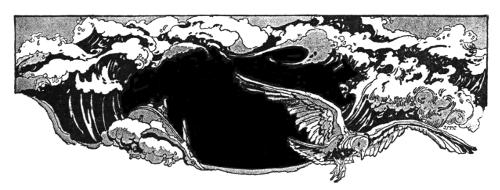
A DESCENT INTO THE MAELSTROM
EDGAR ALLAN POE
MY FIRST VIEW OF THE MAELSTROM
We had now reached the summit of the loftiest crag. For some minutes the old man seemed too much exhausted to speak.
“Not long ago,” said he at length, “and I could have guided you on this route as well as the youngest of my sons; but, about three years past, there happened to me an event such as never happened before to mortal man—or at least such as no man ever survived to tell of—and the six hours of deadly terror which I then endured have broken me up, body and soul. You suppose me a very old man—but I am not. It took less than a single day to change these hairs from a jetty black to white, to weaken my limbs, and to unstring my nerves, so that I tremble at the least exertion, and am frightened at a shadow. Do you know I can scarcely look over this little cliff without getting giddy?”
The “little cliff,” upon whose edge he had so carelessly thrown himself down to rest that the weightier portion of his body hung over it, while he was only kept from falling by the tenure of his elbow on its extreme and slippery edge—this “little cliff” arose, a sheer unobstructed precipice of black shining rock, some fifteen or sixteen hundred feet from the world of crags beneath us. Nothing would have tempted me to within half a dozen yards of its brink. In truth, so deeply was I excited by the perilous position of my companion, that I fell at full length upon the ground, clung to the shrubs around me, and dared not even glance upward at the sky—while I struggled in vain to divest myself of the idea that the very foundations of the mountain were in danger from the fury of the winds. It was long before I could reason myself into sufficient courage to sit up and look out into the distance.
“You must get over these fancies,” said the guide, “for I have brought you here that you might have the best possible view of the scene of that event I mentioned—and to tell you the whole story with the spot just under your eye.
“We are now,” he continued, in that particularizing manner which distinguished him—“we are now close upon the Norwegian coast—in the sixty-eighth degree of latitude—in the great province of Nordland—and in the dreary district of Lofoden. The mountain upon whose top we sit is Helseggen, the Cloudy. Now raise yourself up a little higher—hold on to the grass if you feel giddy—so—and look out, beyond the belt of vapor beneath us, into the sea.”
I looked dizzily, and beheld a wide expanse of ocean, whose waters wore so inky a hue as to bring at once to my mind the Nubian geographer’s account of the Mare Tenebrarum. A panorama more deplorably desolate no human imagination can conceive. To the right and left, as far as the eye could reach, there lay outstretched, like ramparts of the world, lines of horridly black and beetling cliff, whose character of gloom was but the more forcibly illustrated by the surf which reared high up against it, its white and ghastly crest, howling and shrieking forever. Just opposite the promontory upon whose apex we were placed, and at a distance of some five or six miles out at sea, there was visible a small, bleak-looking island; or, more properly, its position was discernible through the wilderness of surge in which it was enveloped. About two miles nearer the land arose another of smaller size, hideously craggy and barren, and encompassed at various intervals by a cluster of dark rocks.
The appearance of the ocean, in the space between the more distant island and the shore, had something very unusual about it. Although, at the time, so strong a gale was blowing landward that a brig in the remote offing lay to under a double-reefed try-sail, and constantly plunged her whole hull out of sight, still there was here nothing like a regular swell, but only a short, quick, angry cross-dashing of water in every direction—as well in the teeth of the wind as otherwise. Of foam there was little except in the immediate vicinity of the rocks.
“The island in the distance,” resumed the old man, “is called by the Norwegians Vurrgh. The one midway is Moskoe. That a mile to the northward is Ambaaren. Yonder are Iflesen, Hoeyholm, Kieldholm, Suarven, and Buckholm. Farther off—between Moskoe and Vurrgh—are Otterholm, Flimen, Sandflesen, and Skarholm. These are the true names of the places—but why it had been thought necessary to name them at all is more than either you or I can understand. Do you hear anything? Do you see any change in the water?”
We had now been about ten minutes upon the top of Helseggen, to which we had ascended from the interior of Lofoden, so that we had caught no glimpse of the sea until it had burst upon us from the summit. As the old man spoke, I became aware of a loud and gradually increasing sound, like the moaning of a vast herd of buffaloes upon an American prairie; and at the same moment I perceived that what seamen term the chopping character of the ocean beneath us, was rapidly changing into a current which set to the eastward. Even while I gazed, this current acquired a monstrous velocity. Each moment added to its speed—to its headlong impetuosity. In five minutes the whole sea, as far as Vurrgh, was lashed into ungovernable fury; but it was between Moskoe and the coast that the main uproar held its sway. Here the vast bed of the waters, seamed and scarred into a thousand conflicting channels, burst suddenly into frenzied convulsion—heaving, boiling, hissing—gyrating in gigantic and innumerable vortices, and all whirling and plunging on to the eastward with a rapidity which water never elsewhere assumes, except in precipitous descents.
In a few minutes more, there came over the scene another radical alteration. The general surface grew somewhat more smooth, and the whirlpools, one by one, disappeared, while prodigious streaks of foam became apparent where none had been seen before. These streaks, at length, spreading out to a great distance, and entering into combination, took unto themselves the gyratory motion of the subsided vortices, and seemed to form the germ of another more vast. Suddenly—very suddenly—this assumed a distinct and definite existence, in a circle of more than a mile in diameter. The edge of the whirl was represented by a broad belt of gleaming spray; but no particle of this slipped into the mouth of the terrific funnel, whose interior, as far as the eye could fathom it, was a smooth, shining, and jet-black wall of water, inclined to the horizon at an angle of some forty-five degrees, speeding dizzily round and round with a swaying and sweltering motion, and sending forth to the winds an appalling voice, half shriek, half roar, such as not even the mighty cataract of Niagara ever lifts up in its agony to Heaven.
The mountain trembled to its very base, and the rock rocked. I threw myself upon my face, and clung to the scant herbage in an excess of nervous agitation.
“This,” said I at length, to the old man—“this can be nothing else than the great whirlpool of the Maelstrom.”
“So it is sometimes termed,” said he. “We Norwegians call it the Moskoe-strom, from the island of Moskoe in the midway.”
The ordinary accounts of this vortex had by no means prepared me for what I saw. That of Jonas Ramus, which is perhaps the most circumstantial of any, cannot impart the faintest conception either of the magnificence or of the horror of the scene—or of the wild bewildering sense of the novel which confounds the beholder. I am not sure from what point of view the writer in question surveyed it, nor at what time; but it could neither have been from the summit of Helseggen, nor during a storm. There are some passages of his description, nevertheless, which may be quoted for their details, although their effect is exceedingly feeble in conveying an impression of the spectacle.
“Between Lofoden and Moskoe,” he says, “the depth of the water is between thirty-six and forty fathoms; but on the other side, toward Ver (Vurrgh), this depth decreases so as not to afford a convenient passage for a vessel, without the risk of splitting on the rocks, which happens even in the calmest weather. When it is flood, the stream runs up the country between Lofoden and Moskoe with a boisterous rapidity; but the roar of its impetuous ebb to the sea is scarce equaled by the loudest and most dreadful cataracts, the noise being heard several leagues off; and the vortices or pits are of such an extent and depth, that if a ship comes within its attraction, it is inevitably absorbed and carried down to the bottom, and there beat to pieces against the rocks; and when the water relaxes, the fragments thereof are thrown up again. But these intervals of tranquillity are only at the turn of the ebb and flood, and in calm weather, and last but a quarter of an hour, its violence gradually returning. When the stream is most boisterous, and its fury heightened by a storm, it is dangerous to come within a Norwegian mile of it. Boats, yachts, and ships have been carried away by not guarding against it before they were within its reach. It likewise happens frequently that whales come too near the stream, and are overpowered by its violence; and then it is impossible to describe their howlings and bellowings in their fruitless struggles to disengage themselves. A bear once, attempting to swim from Lofoden to Moskoe, was caught by the stream and borne down, while he roared terribly, so as to be heard on shore. Large stocks of firs and pine trees, after being absorbed by the current, rise again broken and torn to such a degree as if bristles grew upon them. This plainly shows the bottom to consist of craggy rocks, among which they are whirled to and fro. This stream is regulated by the flux and reflux of the sea—it being constantly high and low water every six hours. In the year 1645, early in the morning of Sexagesima Sunday, it raged with such noise and impetuosity that the very stones of the houses on the coast fell to the ground.”
In regard to the depth of the water, I could not see how this could have been ascertained at all in the immediate vicinity of the vortex. The “forty fathoms” must have reference only to portions of the channel close upon the shore either of Moskoe or Lofoden. The depth in the center of the Moskoe-strom must be immeasurably greater; and no better proof of this fact is necessary than can be obtained from even the sidelong glance into the abyss of the whirl which may be had from the highest crag of Helseggen. Looking down from this pinnacle upon the howling Phlegethon below, I could not help smiling at the simplicity with which the honest Jonas Ramus records, as a matter difficult of belief, the anecdotes of the whales and the bears; for it appeared to me, in fact, a self-evident thing that the largest ships of the line in existence, coming within the influence of that deadly attraction, could resist it as little as a feather the hurricane, and must disappear bodily and at once.
The attempts to account for the phenomenon—some of which, I remember, seemed to me sufficiently plausible in perusal—now wore a very different and unsatisfactory aspect. The idea generally received is that this, as well as three smaller vortices among the Faroe Islands, “have no other cause than the collision of waves rising and falling, at flux and reflux, against a ridge of rocks and shelves, which confines the water so that it precipitates itself like a cataract; and thus the higher the flood rises, the deeper must the fall be, and the natural result of all is a whirlpool or vortex, the prodigious suction of which is sufficiently known by lesser experiments.”—These are the words of the Encyclopedia Britannica. Kircher and others imagine that in the center of the channel of the Maelstrom is an abyss penetrating the globe, and issuing in some very remote part—the Gulf of Bothnia being somewhat decidedly named in one instance. This opinion, idle in itself, was the one to which, as I gazed, my imagination most readily assented; and, mentioning it to the guide, I was rather surprised to hear him say that, although it was the view almost universally entertained of the subject by the Norwegians, it nevertheless was not his own. As to the former notion he confessed his inability to comprehend it; and here I agreed with him—for, however conclusive on paper, it becomes altogether unintelligible, and even absurd, amid the thunder of the abyss.
THE GUIDE’S MARVELOUS TALE
“You have had a good look at the whirl now,” said the old man, “and if you will creep round this crag, so as to get in its lee, and deaden the roar of the water, I will tell you a story that will convince you I ought to know something of the Moskoe-strom.”
I placed myself as desired, and he proceeded.
“Myself and my two brothers once owned a schooner-rigged smack of about seventy tons burden, with which we were in the habit of fishing among the islands beyond Moskoe, nearly to Vurrgh. In all violent eddies at sea there is good fishing, at proper opportunities, if one has only the courage to attempt it; but among the whole of the Lofoden coastmen we three were the only ones who made a regular business of going out to the islands, as I tell you. The usual grounds are a great way lower down to the southward. There fish can be got at all hours, without much risk, and therefore these places are preferred. The choice spots over here among the rocks, however, not only yield the finest variety, but in far greater abundance; so that we often got in a single day what the more timid of the craft could not scrape together in a week. In fact, we made it a matter of desperate speculation—the risk of life standing instead of labor, and courage answering for capital.
“We kept the smack in a cove about five miles higher up the coast than this; and it was our practice, in fine weather, to take advantage of the fifteen minutes’ slack to push across the main channel of the Moskoe-strom, far above the pool, and then drop down upon anchorage somewhere near Otterholm, or Sandflesen, where the eddies are not so violent as elsewhere. Here we used to remain until nearly time for slack water again, when we weighed and made for home. We never set out upon this expedition without a steady side wind for going and coming—one that we felt sure would not fail us before our return—and we seldom made a miscalculation upon this point. Twice, during six years, we were forced to stay all night at anchor on account of a dead calm, which is a rare thing indeed just about here; and once we had to remain on the ground nearly a week, starving to death, owing to a gale which blew up shortly after our arrival, and made the channel too boisterous to be thought of. Upon this occasion we should have been driven out to sea in spite of everything (for the whirlpools threw us round and round so violently that, at length, we fouled our anchor and dragged it) if it had not been that we drifted into one of the innumerable cross currents—here today and gone tomorrow—which drove us under the lee of Flimen, where, by good luck, we brought up.
“I could not tell you the twentieth part of the difficulties we encountered ‘on the ground’—it is a bad spot to be in, even in good weather—but we made shift always to run the gauntlet of the Moskoe-strom itself without accident; although at times my heart has been in my mouth when we happened to be a minute or so behind or before the slack. The wind sometimes was not as strong as we thought it at starting, and then we made rather less way than we could wish, while the current rendered the smack unmanageable. My eldest brother had a son eighteen years old, and I had two stout boys of my own. These would have been of great assistance at such times, in using the sweeps, as well as afterward in fishing—but, somehow, although we ran the risk ourselves, we had not the heart to let the young ones get into the danger—for, after all said and done, it was a horrible danger, and that is the truth.
“It is now within a few days of three years since what I am going to tell you occurred. It was on the tenth of July, 18—, a day which the people of this part of the world will never forget—for it was one in which blew the most terrible hurricane that ever came out of the heavens. And yet all the morning, and indeed until late in the afternoon, there was a gentle and steady breeze from the southwest, while the sun shone brightly, so that the oldest seaman among us could not have foreseen what was to follow.
“The three of us—my two brothers and myself—had crossed over to the islands about two o’clock P.M., and soon nearly loaded the smack with fine fish, which, we all remarked, were more plenty that day than we had ever known them. It was just seven, by my watch, when we weighed and started for home, so as to make the worst of the Strom at slack water, which we knew would be at eight.
“We set out with a fresh wind on our starboard quarter, and for some time spanked along at a great rate, never dreaming of danger, for indeed we saw not the slightest reason to apprehend it. All at once we were taken aback by a breeze from over Helseggen. This was most unusual—something that had never happened to us before—and I began to feel a little uneasy, without exactly knowing why: We put the boat on the wind, but could make no headway at all for the eddies, and I was upon the point of proposing to return to the anchorage, when, looking astern, we saw the whole horizon covered with a singular copper-covered cloud that rose with the most amazing velocity.
“In the meantime the breeze that had headed us off fell away, and we were dead becalmed, drifting about in every direction. This state of things, however, did not last long enough to give us time to think about it. In less than a minute the storm was upon us—in less than two the sky was entirely overcast—and what with this and the driving spray, it became suddenly so dark that we could not see each other in the smack.
“Such a hurricane as then blew it is folly to attempt describing. The oldest seaman in Norway never experienced anything like it. We had let our sails go by the run before it cleverly took us; but, at the first puff, both our masts went by the board as if they had been sawed off—the mainmast taking with it my youngest brother, who had lashed himself to it for safety.
“Our boat was the lightest feather of a thing that ever sat so upon water. It had a complete flush deck, with only a small hatch near the bow, and this hatch it had always been our custom to batten down when about to cross the Strom, by way of precaution against the chopping seas. But for this circumstance we should have foundered at once—for we lay entirely buried for some moments. How my elder brother escaped destruction I cannot say, for I never had an opportunity of ascertaining. For my part, as soon as I had let the foresail run, I threw myself flat on deck, with my feet against the narrow gunwale of the bow, and with my hands grasping a ringbolt near the foot of the foremast. It was mere instinct that prompted me to do this—which was undoubtedly the very best thing I could have done—for I was too much flurried to think.
SWEPT INTO THE MAELSTROM
“For some moments we were completely deluged, as I say, and all this time I held my breath, and clung to the bolt. When I could stand it no longer I raised myself upon my knees, still keeping hold with my hands, and thus got my head clear. Presently our little boat gave herself a shake, just as a dog does in coming out of the water, and thus rid herself, in some measure, of the seas. I was now trying to get the better of the stupor that had come over me, and to collect my senses so as to see what was to be done, when I felt somebody grasp my arm. It was my elder brother, and my heart leaped for joy, for I had made sure that he was overboard—but the next moment all this joy was turned into horror—for he put his mouth close to my ear, and screamed out the word ‘Moskoe-strom!’
“No one will ever know what my feelings were at that moment. I shook from head to foot as if I had had the most violent fit of the ague. I knew what he meant by that one word well enough—I knew what he wished to make me understand. With the wind that now drove us on, we were bound for the whirl of the Strom, and nothing could save us!
“You perceive that in crossing the Strom channel, we always went a long way up above the whirl, even in the calmest weather, and then had to wait and watch carefully for the slack—but now we were driving right upon the pool itself, and in such a hurricane as this! ‘To be sure,’ I thought, ‘we shall get there just about the slack—there is some little hope in that’—but in the next moment I cursed myself for being so great a fool as to dream of hope at all. I knew very well that we were doomed, had we been ten times a ninety-gun ship.
“By this time the first fury of the tempest had spent itself, or perhaps we did not feel it so much as we scudded before it; but at all events the seas, which at first had been kept down by the wind, and lay flat and frothing, now got up into absolute mountains. A singular change, too, had come over the heavens. Around in every direction it was still black as pitch, but nearly overhead there burst out, all at once, a circular rift of clear sky—as clear as I ever saw—and of a deep bright blue—and through it there blazed forth the full moon with a luster that I never before knew her to wear. She lit up everything about us with the greatest distinctness—but, oh, God, what a scene it was to light up!
“I now made one or two attempts to speak to my brother—but, in some manner which I could not understand, the din had so increased that I could not make him hear a single word, although I screamed at the top of my voice in his ear. Presently he shook his head, looking as pale as death, and held up one of his fingers, as if to say listen!
“At first I could not make out what he meant—but soon a hideous thought flashed upon me. I dragged my watch from its fob. It was not going. I glanced at its face by the moonlight, and then burst into tears as I flung it far away into the ocean. It had run down at seven o’clock! We were behind the time of the slack, and the whirl of the Strom was in full fury!
“When a boat is well built, properly trimmed, and not deep laden, the waves in a strong gale, when she is going large, seem always to slip from beneath her—which appears very strange to a landsman—and this is what is called riding, in sea phrase.
“Well, so far we had ridden the swells very cleverly; but presently a gigantic sea happened to take us right under the counter, and bore us with it as it rose—up—up—as if into the sky. I would not have believed that any wave could rise so high. And then down we came with a sweep, a slide, and a plunge, that made me feel sick and dizzy, as if I was falling from some lofty mountain-top in a dream. But while we were up I had thrown a quick glance around—and that one glance was all-sufficient. I saw our exact position in an instant. The Moskoe-strom whirlpool was about a quarter of a mile dead ahead—but no more like the everyday Moskoe-strom than the whirl as you now see it is like a mill-race. If I had not known where we were, and what we had to expect, I should not have recognized the place at all. As it was, I involuntarily closed my eyes in horror. The lids clenched themselves together as if in a spasm.
“It could not have been more than two minutes afterwards until we suddenly felt the waves subside, and were enveloped in foam. The boat made a sharp half turn to larboard, and then shot off in its new direction like a thunderbolt. At the same moment the roaring noise of the water was completely drowned in a kind of shrill shriek—such a sound as you might imagine given out by the water-pipes of many thousand steam vessels, letting off their steam all together. We were now in the belt of surf that always surrounds the whirl; and I thought, of course, that another moment would plunge us into the abyss—down which we could only see indistinctly on account of the amazing velocity with which we were borne along. The boat did not seem to sink into the water at all, but to skim like an air-bubble upon the surface of the surge. Her starboard side was next the whirl, and on the larboard arose the world of ocean we had left. It stood like a huge, writhing wall between us and the horizon.
“It may appear strange, but now, when we were in the very jaws of the gulf, I felt more composed than when we were only approaching it. Having made up my mind to hope no more, I got rid of a great deal of that terror which unmanned me at first. I suppose it was despair that strung my nerves.
“It may look like boasting—but what I tell you is truth—I began to reflect how magnificent a thing it was to die in such a manner, and how foolish it was in me to think of so paltry a consideration as my own individual life, in view of so wonderful a manifestation of God’s power. I do believe that I blushed with shame when this idea crossed my mind. After a little while I became possessed with the keenest curiosity about the whirl itself. I positively felt a wish to explore its depths, even at the sacrifice I was going to make; and my principal grief was that I should never be able to tell my old companions on shore about the mysteries I should see. These, no doubt, were singular fancies to occupy a man’s mind in such extremity—and I have often thought since, that the revolutions of the boat around the pool might have rendered me a little light-headed.
“There was another circumstance which tended to restore my self-possession; and this was the cessation of the wind, which could not reach us in our present situation—for, as you saw yourself, the belt of surf is considerably lower than the general bed of the ocean, and this latter now towered above us, a high, black, mountainous ridge. If you have never been at sea in a heavy gale, you can form no idea of the confusion of mind occasioned by the wind and spray together. They blind, deafen, and strangle you, and take away all power of action or reflection. But we were now, in a great measure, rid of these annoyances—just as death-condemned felons in prisons are allowed petty indulgences forbidden them while their doom is yet uncertain.
“How often we made the circuit of the belt it is impossible to say. We careered round and round for perhaps an hour, flying rather than floating, getting gradually more and more into the middle of the surge, and then nearer and nearer to its horrible inner edge. All this time I had never let go of the ringbolt. My brother was at the stern, holding on to a small empty water-cask which had been securely lashed under the coop of the counter, and was the only thing on deck that had not been swept overboard when the gale first took us. As we approached the brink of the pit he let go his hold upon this, and made for the ring, from which, in the agony of his terror, he endeavored to force my hands, as it was not large enough to afford us both a secure grasp. I never felt deeper grief than when I saw him attempt this act—although I knew he was a madman when he did it—a raving maniac through sheer fright. I did not care, however, to contest the point with him. I knew it could make no difference whether either of us held on at all; so I let him have the bolt, and went astern to the cask. This there was no great difficulty in doing; for the smack flew round steadily enough, and upon an even keel—only swaying to and fro, with the immense sweeps and swelters of the whirl. Scarcely had I secured myself in my new position, when we gave a wild lurch to starboard, and rushed headlong into the abyss. I muttered a hurried prayer to God, and thought all was over.
“As I felt the sickening sweep of the descent, I had instinctively tightened my hold upon the barrel, and closed my eyes. For some seconds I dared not open them—while I expected instant destruction, and wondered that I was not already in my death-struggles with the water. But moment after moment elapsed. I still lived. The sense of falling had ceased; and the motion of the vessel seemed much as it had been before, while in the belt of foam, with the exception that she now lay more along. I took courage and looked once again upon the scene.
“Never shall I forget the sensations of awe, horror, and admiration with which I gazed about me. The boat appeared to be hanging, as if by magic, midway down, upon the interior surface of a funnel vast in circumference, prodigious in depth, and whose perfectly smooth sides might have been mistaken for ebony, but for the bewildering rapidity with which they spun around, and for the gleaming and ghastly radiance they shot forth, as the rays of the full moon, from that circular rift amid the clouds which I have already described, streamed in a flood of golden glory along the black walls, and far away down into the inmost recesses of the abyss.
“At first I was too much confused to observe anything accurately. The general burst of terrific grandeur was all that I beheld. When I recovered myself a little, however, my gaze fell instinctively downward. In this direction I was able to obtain an unobstructed view, from the manner in which the smack hung on the inclined surface of the pool. She was quite upon an even keel—that is to say, her deck lay in a plane parallel with that of the water—but this latter sloped at an angle of more than forty-five degrees, so that we seemed to be lying upon our beam-ends. I could not help observing, nevertheless, that I had scarcely more difficulty in maintaining my hold and footing in this situation, than if we had been upon a dead level; and this, I suppose, was owing to the speed at which we revolved.
“The rays of the moon seemed to search the very bottom of the profound gulf; but still I could make out nothing distinctly, on account of a thick mist in which everything there was enveloped, and over which there hung a magnificent rainbow, like that narrow and tottering bridge which Mussulmans say is the only pathway between Time and Eternity. This mist, or spray, was no doubt occasioned by the clashing of the great walls of the funnel, as they all met together at the bottom—but the yell that went up to the heavens from out of that mist, I dare not attempt to describe.
“Our first slide into the abyss itself, from the belt of foam above, had carried us to a great distance down the slope; but our farther descent was by no means proportionate. Round and round we swept—not with any uniform movement, but in dizzying swings and jerks, that sent us sometimes only a few hundred yards—sometimes nearly the complete circuit of the whirl. Our progress downward, at each revolution, was slow, but very perceptible.
THE MARVELOUS ESCAPE
“Looking about me upon the wide waste of liquid ebony on which we were thus borne, I perceived that our boat was not the only object in the embrace of the whirl. Both above and below us were visible fragments of vessels, large masses of building timber and trunks of trees, with many smaller articles, such as pieces of house furniture, broken boxes, barrels, and staves. I have already described the unnatural curiosity which had taken the place of my original terrors. It appeared to grow upon me as I drew nearer and nearer to my dreadful doom. I now began to watch, with a strange interest, the numerous things that floated in our company. I must have been delirious—for I even sought amusement in speculating upon the relative velocities of their several descents toward the foam below. ‘This fir tree,’ I found myself at one time saying, ‘will certainly be the next thing that takes the awful plunge and disappears,’—and then I was disappointed to find that the wreck of a Dutch merchant ship overtook it and went down before. At length, after making several guesses of this nature, and being deceived in all—this fact—the fact of my invariable miscalculation, set me upon a train of reflection that made my limbs again tremble, and my heart beat heavily once more.
“It was not a new terror that thus affected me, but the dawn of a more exciting hope. This hope arose partly from memory, and partly from present observation. I called to mind the great variety of buoyant matter that strewed the coast of Lofoden, having been absorbed and then thrown forth by the Moskoe-strom. By far the greater number of the articles were shattered in the most extraordinary way—so chafed and roughened as to have the appearance of being stuck full of splinters—but then I distinctly recollected that there were some of them which were not disfigured at all. Now I could not account for this difference except by supposing that the roughened fragments were the only ones which had been completely absorbed—that the others had entered the whirl at so late a period of the tide, or, from some reason, had descended so slowly after entering, that they did not reach the bottom before the turn of the flood came, or of the ebb, as the case might be. I conceived it possible, in either instance, that they might thus be whirled up again to the level of the ocean, without undergoing the fate of those which had been drawn in more early or absorbed more rapidly. I made, also, three important observations. The first was, that as a general rule, the larger the bodies were, the more rapid their descent; the second, that, between two masses of equal extent, the one spherical, and the other of any other shape, the superiority in speed of descent was with the sphere; the third, that, between two masses of equal size, the one cylindrical, and the other of any other shape, the cylinder was absorbed the more slowly. Since my escape, I have had several conversations on this subject with an old schoolmaster of the district; and it was from him that I learned the use of the words ‘cylinder’ and ‘sphere.’ He explained to me—although I have forgotten the explanation—how what I observed was, in fact, the natural consequence of the forms of the floating fragments, and showed me how it happened that a cylinder, swimming in a vortex, offered more resistance to its suction, and was drawn in with greater difficulty, than an equally bulky body, of any form whatever.
“There was one startling circumstance which went a great way in enforcing these observations, and rendering me anxious to turn them to account, and this was that, at every revolution, we passed something like a barrel, or else the yard or mast of a vessel, while many of these things, which had been on our level when I first opened my eyes upon the wonders of the whirlpool, were now high up above us, and seemed to have moved but little from their original station.
“I no longer hesitated what to do. I resolved to lash myself securely to the water cask upon which I now held, to cut it loose from the counter, and to throw myself with it into the water. I attracted my brother’s attention to signs, pointed to the floating barrels that came near us, and did everything in my power to make him understand what I was about to do. I thought at length that he comprehended my design—but, whether this was the case or not, he shook his head despairingly, and refused to move from his station by the ringbolt. It was impossible to reach him; the emergency admitted of no delay; and so, with a bitter struggle, I resigned him to his fate, fastened myself to the cask by means of the lashings which secured it to the counter, and precipitated myself with it into the sea, without another moment’s hesitation.
“The result was precisely what I had hoped it might be. As it is myself who now tells you this tale—as you see that I did escape—and as you are already in possession of the mode in which this escape was effected, and must therefore anticipate all that I have further to say—I will bring my story quickly to conclusion. It might have been an hour, or thereabout, after my quitting the smack, when, having descended to a vast distance beneath me, it made three or four wild gyrations in rapid succession, and, bearing my loved brother with it, plunged headlong, at once and forever, into the chaos of foam below. The barrel to which I was attached sunk very little farther than half the distance between the bottom of the gulf and the spot at which I leaped overboard, before a great change took place in the character of the whirlpool. The slope of the sides of the vast funnel became momently less and less steep. The gyrations of the whirl grew, gradually, less and less violent. By degrees, the froth and the rainbow disappeared, and the bottom of the gulf seemed slowly to uprise. The sky was clear, the winds had gone down, and the full moon was setting radiantly in the west, when I found myself on the surface of the ocean, in full view of the shores of Lofoden, and above the spot where the pool of the Moskoe-strom had been. It was the hour of the slack; but the sea still heaved in mountainous waves from the effects of the hurricane. I was borne violently into the channel of the strom, and in a few minutes was hurried down the coast into the ‘grounds’ of the fishermen. A boat picked me up—exhausted from fatigue—and (now that the danger was removed) speechless from the memory of its horror. Those who drew me on board were my old mates and daily companions, but they knew me no more than they would have known a traveler from the spirit-land. My hair, which had been raven-black the day before, was as white as you see it now. They say, too, that the whole expression of my countenance had changed. I told them my story—they did not believe it. I now tell it to you—and I can scarcely expect you to put more faith in it than did the merry fishermen of Lofoden.”
NOTES AND QUESTIONS
Biography. Edgar Allan Poe (1809-1849) was the greatest poet and short story writer the South has produced. His parents belonged by profession to the stage; his mother was English and his father American by birth. Born in Boston, he was left an orphan at an early age, and was adopted by a Mr. Allan, a wealthy citizen of Richmond, Virginia. Poe was sent to school in London, and later he attended the University of Virginia, and the military academy at West Point. Mr. Allan lavished money and other inducements upon him in vain efforts to get him to settle down to a permanent profession, but finally abandoned him to his own resources. From that time on, Poe eked out a living by publishing poems and tales, by contributions to newspapers and magazines, and by editorial work. But he was too erratic in his habits to retain long either positions or friends. His writings, like his character, were weird, mysterious, haunted by brooding melancholy. But his poetry is perhaps the most purely musical of any in our language—for Poe believed that poetry should be the language of the feelings rather than of thought, and that it should therefore seek to produce its effects through “harmony of sweet sounds” rather than through the meaning of its lines. His prose tales of mystery and adventure are remarkable for their imaginative and poetic style; they have served as models for many well known writers. Poe was the originator of the modern short story.
Poe’s erratic, troubled life ended at Baltimore, in 1849, in the fortieth year of his age. The pathos of it is well summed up in the inscription on a memorial tablet erected to him in the New York Museum of Art: “He was great in his genius, unhappy in his life, wretched in his death, but in his fame, immortal.”
Discussion. 1. Locate the scene of this story on a map. 2. Read from the dictionary and encyclopedia to learn about whirlpools. 3. What do you learn from Jonas Ramus’s description of the whirlpool? 4. How does the Encyclopedia Britannica account for the vortex? 5. What was the theory of Kircher? 6. How does the hero account for his apparent age? 7. Relate briefly in your own words the hero’s story of his experience in the maelstrom. 8. What tempted him to brave the dangers of the whirlpool? 9. Account for his miscalculation of the time of the slack. 10. What three observations did the hero make while descending into the maelstrom? 11. How did he make his escape? 12. How does Poe try to give an idea of the noise of the whirlpool? 13. How does it differ from Hawthorne’s description of the roar of Niagara? (See page 466.) 14. How had the “ordinary accounts of the vortex” prepared Poe to see it? 15. In what were these accounts of the vortex inadequate? 16. Compare this with Hawthorne’s statement concerning what he had read of Niagara. 17. From this story what do you think of Poe’s powers of imagination and description? 18. What other authors have you read that have similar powers? 19. Point out descriptions in this selection that you particularly like. 20. Pronounce the following: ungovernable; maelstrom; vortices; herbage; gauntlet; ague; buoyant.
Phrases
sheer unobstructed precipice, 192, 4
particularizing manner, 192, 18
deplorably desolate, 192, 29
precipitous descents, 194, 3
gleaming spray, 194, 15
terrific funnel, 194, 16
boisterous rapidity, 195, 10
fruitless struggles, 195, 26
flux and reflux, 195, 33
immediate vicinity, 196, 2
abyss of the whirl, 196, 8
plausible in perusal, 196, 18
collision of waves, 196, 21
desperate speculation, 197, 22
flood of golden glory, 204, 20
terrific grandeur, 204, 24
wide waste of liquid ebony, 205, 17
the gyrations of the whirl, 207, 37
THE WRECK OF THE GOLDEN MARY
CHARLES DICKENS