PART II ADVENTURES OLD AND NEW
Reading edition
“Some say that the age of chivalry is past. The age of chivalry is never past, so long as there is a wrong left unredressed on earth, or a man or woman left to say, ‘I will redress that wrong or spend my life in the attempt.’”
—Charles Kingsley.
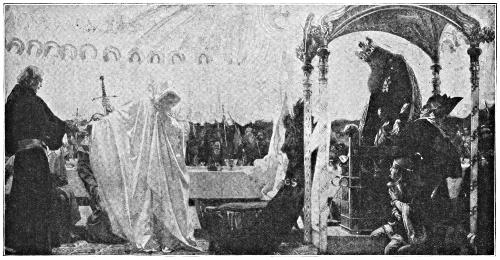
Copyright by Edwin A. Abbey (from a Copley Print, copyright by Curtis & Cameron, Boston)
THE ROUND TABLE OF KING ARTHUR
(Galahad is taking his place next to Sir Lancelot, while King Arthur rises to receive the new knight)
ADVENTURES OLD AND NEW INTRODUCTION
Along with our interest in the world of animals and the plant world and the seasons, we are curious to know about people. A good deal of our conversation is about what others say or do. And when we say of a man, “He does things,” we pay him the highest possible compliment.
Ever since man came on the earth he has been “doing things.” Centuries ago, a man found out how to make fire by striking pieces of flint together. Then other men discovered strange things that might be done by means of the mysterious flame that sprang up. Another man ventured over the hill or mountain out into the unknown world beyond, or far across the blue water that seemed to reach to the end of the world. And when the traveler returned, men listened eagerly to his stories. So from earliest days men who ventured beyond the beaten track and did things their fellows were too lazy or too timid to think of doing have been interesting to those who stayed at home. In such ways ships were built to carry voyagers to strange places. In such ways commerce sprang up, for these adventurers brought back new foods and new objects, and knowledge of men who lived in strange places. In such ways islands and continents were discovered and settled, and men made war for the possession of rich territories, and life for all men became more varied and interesting through the adventures of the daring ones. For life is full of zest and interest only in proportion as the spirit of adventure enters into it.
The men in former times who stood out above their fellows because of their deeds were the subjects of song and story. Minstrels and poets in all times have put into words the wonder and admiration of the people for the doer of great deeds. Some stories of this kind you will read in the pages that follow—just a few of the thousands of stories of adventure that men have told in song and prose tale. Some of these stories introduce King Arthur and his Round Table, in the days of chivalry, when knighthood was in flower. A few of them are old ballads, which are tales made by the people or by some of their number, and sung by the people or by minstrels, or by mothers to their children, and so handed down from one generation to another. And some of them are very recent indeed, for they spring out of the heroic deeds of men in the World War that ended in November, 1918.
This spirit of adventure that makes men willing to face danger, and even death, to get some new experience or to render some service, the spirit that makes some men explore strange places, or seek for the South Pole, or fight in great battles—this spirit of adventure never dies. Sometimes the story is of a knight clad in armor, and sometimes it is about a man in khaki who died the other day that his fellows might live—the spirit is the same. Men no longer dress like Lancelot, or like George Washington, but they do the same sort of things. And people like to read of these things or hear the stories told just as much now as they did when the first traveler returned to the little village in Greece, or when Sir Gareth and Sir Gawain won their victories, or when General Putnam or Mad Anthony Wayne, in our Revolutionary War, performed some brave act for the American cause. And now, all over the world, groups gather about the soldier who has returned from Flanders Fields with his stories of valor. Always the spirit of adventure lives; always we like to hear what it brings back to us of news about life. If we have had no chance yet to do a thing worth men’s praise, we get a larger view of life, a better sense of what life really means, from reading or hearing such stories. And we mean to do brave things ourselves, some day, so the stories thrill us with the sense of what life holds for us.
These things we must remember, then, as we read. Through these stories we become partners in all the brave deeds of the past. And, again, the spirit of adventure is ever-living and is as keen today as in the past. And, finally, by such stories our own knowledge of the fine qualities of human nature is increased and our own experience enlarged so that we become braver and better because we see what wonderful things life can bring.
THE DAYS OF CHIVALRY
KING ARTHUR STORIES
The Coming of Arthur
OF THE BIRTH OF ARTHUR AND HOW HE BECAME KING
Long years ago, there ruled over Britain a king called Uther Pendragon. A mighty prince was he, and feared by all men; yet, when he sought the love of the fair Igraine of Cornwall, she would have naught to do with him, so that, from grief and disappointment, Uther fell sick, and at last seemed like to die.
Now in those days, there lived a famous magician named Merlin, so powerful that he could change his form at will, or even make himself invisible; nor was there any place so remote but that he could reach it at once, merely by wishing himself there. One day, suddenly he stood at Uther’s bedside, and said:
“Sir King, I know thy grief, and am ready to help thee. Only promise to give me, at his birth, the son that shall be born to thee, and thou shalt have thy heart’s desire.”
To this the King agreed joyfully, and Merlin kept his word: for he gave Uther the form of one whom Igraine had loved dearly, and so she took him willingly for her husband.
When the time had come that a child should be born to the King and Queen, Merlin appeared before Uther to remind him of his promise; and Uther swore it should be as he had said. Three days later, a prince was born and, with pomp and ceremony, was christened by the name of Arthur; but immediately thereafter the King commanded that the child should be carried to the postern-gate, there to be given to the old man who would be found waiting without.
Not long after, Uther fell sick, and he knew that his end was come; so, by Merlin’s advice, he called together his knights and barons and said to them:
“My death draws near. I charge you, therefore, that ye obey my son even as ye have obeyed me; and my curse upon him if he claim not the crown when he is a man grown.”
Then the King turned his face to the wall and died.
Scarcely was Uther laid in his grave before disputes arose. Few of the nobles had seen Arthur or even heard of him, and not one of them would have been willing to be ruled by a child; rather, each thought himself fitted to be king, and, strengthening his own castle, made war on his neighbors until confusion alone was supreme, and the poor groaned because there was none to help them.
Now when Merlin carried away Arthur—for Merlin was the old man who had stood at the postern-gate—he had known all that would happen, and had taken the child to keep him safe from the fierce barons until he should be of age to rule wisely and well, and perform all the wonders prophesied of him. He gave the child to the care of the good knight Sir Ector to bring him up with his son Kay, but revealed not to him that it was the son of Uther Pendragon that was given into his charge.
At last, when years had passed and Arthur was grown a tall youth well skilled in knightly exercises, Merlin went to the Archbishop of Canterbury and advised him that he should call together at Christmas-time all the chief men of the realm to the great cathedral in London.
“For,” said Merlin, “there shall be seen a great marvel by which it shall be made clear to all men who is the lawful king of this land.” The Archbishop did as Merlin counseled. Under pain of a fearful curse, he bade barons and knights come to London to keep the feast, and to pray heaven to send peace to the realm.
The people hastened to obey the Archbishop’s commands and, from all sides, barons and knights came riding in to keep the birth-feast of our Lord. And when they had prayed, and were coming forth from the cathedral, they saw a strange sight. There, in the open space before the church, stood, on a great stone, an anvil thrust through with a sword; and on the stone were written these words:
“Whoso can draw forth this sword is rightful King of Britain born.”
At once there were fierce quarrels, each man clamoring to be the first to try his fortune, none doubting his own success. Then the Archbishop decreed that each should make the venture in turn, from the greatest baron to the least knight; and each in turn, having put forth his utmost strength, failed to move the sword one inch, and drew back ashamed. So the Archbishop dismissed the company, and having appointed guards to watch over the stone, sent messengers through all the land to give word of great jousts to be held in London at Easter, when each knight could give proof of his skill and courage, and try whether the adventure of the sword was for him.
Among those who rode to London at Easter was the good Sir Ector, and with him his son, Sir Kay, newly made a knight, and the young Arthur. When the morning came that the jousts should begin, Sir Kay and Arthur mounted their horses and set out for the lists; but before they reached the field, Kay looked and saw that he had left his sword behind. Immediately Arthur turned back to fetch it for him, only to find the house fast shut, for all were gone to view the tournament. Sore vexed was Arthur, fearing lest his brother Kay should lose his chance of gaining glory, till, of a sudden, he bethought him of the sword in the great anvil before the cathedral. Thither he rode with all speed, and the guards having deserted their posts to view the tournament, there was none to forbid him the adventure. He leaped from his horse, seized the hilt, and instantly drew forth the sword as easily as from a scabbard; then, mounting his horse and thinking no marvel of what he had done, he rode after his brother and handed him the weapon.
When Kay looked at it, he saw at once that it was the wondrous sword from the stone. In great joy he sought his father, and showing it to him, said:
“Then must I be King of Britain.”
But Sir Ector bade him say how he came by the sword, and when Sir Kay told how Arthur had brought it to him, Sir Ector bent his knee to the boy and said:
“Sir, I perceive that ye are my King, and here I tender you my homage”; and Kay did as his father. Then the three sought the Archbishop, to whom they related all that had happened; and he, much marveling, called the people together to the great stone, and bade Arthur thrust back the sword and draw it forth again in the presence of all, which he did with ease. But an angry murmur arose from the barons, who cried that what a boy could do, a man could do; so, at the Archbishop’s word, the sword was put back, and each man, whether baron or knight, tried in his turn to draw it forth, and failed. Then, for the third time, Arthur drew forth the sword. Immediately there arose from the people a great shout:
“Arthur is King! Arthur is King! We will have no King but Arthur”; and, though the great barons scowled and threatened, they fell on their knees before him while the Archbishop placed the crown upon his head, and they swore to obey him faithfully as their lord and sovereign.
Thus Arthur was made king; and to all he did justice, righting wrongs and giving to all their dues. Nor was he forgetful of those that had been his friends; for Kay, whom he loved as a brother, he made seneschal and chief of his household, and to Sir Ector, his foster father, he gave broad lands.
HOW KING ARTHUR TOOK A WIFE, AND OF THE TABLE ROUND
Thus Arthur was made king, but he had to fight for his own; for eleven great kings drew together and refused to acknowledge him as their lord, and chief amongst the rebels was King Lot of Orkney, who had married Arthur’s sister, Bellicent.
By Merlin’s advice Arthur sent for help overseas, to Ban and Bors, the two great Kings who ruled in Gaul. With their aid, he overthrew his foes in a fierce battle near the river Trent; and then he passed with them into their own lands and helped them drive out their enemies. So there was ever great friendship between Arthur and the Kings Ban and Bors, and all their kindred; and afterwards some of the most famous Knights of the Round Table were of that kin.
Then King Arthur set himself to restore order throughout his kingdom. To all who would submit and amend their evil ways, he showed kindness; but those who persisted in oppression and wrong he removed, putting in their places others who would deal justly with the people. And because the land had become overrun with forest during the days of misrule, he cut roads through the thickets, that no longer wild beasts and men, fiercer than the beasts, should lurk in their gloom, to the harm of the weak and defenseless. Thus it came to pass that soon the peasant plowed his fields in safety, and where had been wastes, men dwelt again in peace and prosperity.
Amongst the lesser kings whom Arthur helped to rebuild their towns and restore order was King Leodogran, of Cameliard. Now Leodogran had one fair child, his daughter Guinevere; and from the time that first he saw her, Arthur gave her all his love. So he sought counsel of Merlin, his chief adviser. Merlin heard the King sorrowfully, and said:
“Sir King, when a man’s heart is set, he may not change. Yet had it been well if ye had loved another.”
So the King sent his knights to Leodogran to ask of him his daughter; and Leodogran consented, rejoicing to wed her to so good and knightly a king. With great pomp, the princess was conducted to Canterbury, and there the King met her, and they two were wed by the Archbishop in the great cathedral, amid the rejoicings of the people.
On that same day did Arthur found his Order of the Round Table, the fame of which was to spread throughout Christendom and endure through all time. Now the Round Table had been made for King Uther Pendragon by Merlin, who had meant thereby to set forth plainly to all men the roundness of the earth. After Uther died, King Leodogran had possessed it; but when Arthur was wed, he sent it to him as a gift, and great was the King’s joy at receiving it. One hundred fifty knights might take their places about it, and for them Merlin made sieges, or seats. One hundred twenty-eight did Arthur knight at that great feast; thereafter, if any sieges were empty, at the high festival of Pentecost new knights were ordained to fill them, and by magic was the name of each knight found inscribed, in letters of gold, in his proper siege. One seat only long remained unoccupied, and that was the Siege Perilous. No knight might occupy it until the coming of Sir Galahad; for, without danger to his life, none might sit there who was not free from all stain of sin.
With pomp and ceremony did each knight take upon him the vows of true knighthood: to obey the King; to show mercy to all who asked it; to defend the weak; and for no worldly gain to fight in a wrongful cause; and all the knights rejoiced together, doing honor to Arthur and to his Queen. And all men of worship said it was merry to be under such a chieftain, that would put his person in adventure as other poor knights did. Then they rode forth to right the wrong and help the oppressed, and by their aid, the King held his realm in peace, doing justice to all.
OF THE FINDING OF EXCALIBUR
Now when Arthur was first made king, as young knights will, he courted peril for its own sake, and often would he ride unattended by lonely forest ways, seeking the adventure that chance might send him. All unmindful was he of the ruin to his realm if mischief befell him; and even his trusty counselors, though they grieved that he should thus imperil him, yet could not but love him the more for his hardihood.
So, on a day, he rode through the Forest Perilous where dwelt the Lady Annoure, a sorceress of great might, who used her magic powers but for the furtherance of her own desires. And as she looked from a turret window, she descried King Arthur come riding down a forest glade, and the sunbeams falling upon him made one glory of his armor and of his yellow hair. Then, as Annoure gazed upon the King, she resolved that, come what might, she would have him for her own, to dwell with her always and fulfill all her behests. And so she bade her men to lower the drawbridge and raise the portcullis, and sallying forth accompanied by her maidens, she gave King Arthur courteous salutation, and prayed him that he would rest within her castle that day, for that she had a petition to make to him; and Arthur, doubting nothing of her good faith, suffered himself to be led within.
Then was a great feast spread, and Annoure caused the King to be seated in a chair of state at her right hand, while squires and pages served him on bended knee. So when they had feasted, the King turned to the Lady Annoure and said courteously:
“Lady, somewhat ye said of a request that ye would make. If there be aught in which I may give pleasure to you, I pray you let me know it, and I will serve you as knightly as I may.”
“In truth,” said the lady, “there is that which I would fain entreat of you, most noble knight; yet suffer, I beseech you, that first I may show you somewhat of my castle and my estate, and then will I crave a boon of your chivalry.”
Then the sorceress led King Arthur from room to room of her castle, and ever each displayed greater store of beauty than the last. In some the walls were hung with rich tapestries, in others they gleamed with precious stones; and the King marveled what might be the petition of one that was mistress of such wealth. Lastly, Annoure brought the King out upon the battlements, and as he gazed around him, he saw that since he had entered the castle there had sprung up about it triple walls of defense that shut out wholly the forest from view. Then turned he to Annoure, and gravely said:
“Lady, greatly I marvel in what a simple knight may give pleasure to one that is mistress of so wondrous a castle as ye have shown me here; yet if there be aught in which I may render you knightly service, right gladly would I hear it now, for I must go forth upon my way to render service to those whose knight I am sworn.”
“Nay, now, King Arthur,” answered the sorceress mockingly, “ye may not deceive me! for well I know you, and that all Britain bows to your behest.”
“The more reason then that I should ride forth to right wrong and succor them that, of their loyalty, render true obedience to their lord.”
“Ye speak as a fool,” said the sorceress; “why should one that may command be at the beck and call of every hind and slave within his realm? Nay, rest thee here with me, and I will make thee ruler of a richer land than Britain, and satisfy thy every desire.”
“Lady,” said the King sternly, “I will hear and judge of your petition here and now, and then will I go forth upon my way.”
“Nay,” said Annoure, “there needs not this harshness. I did but speak for thine advantage. Only vow thee to my service, and there is naught that thou canst desire that thou shalt not possess. Thou shalt be lord of this fair castle and of the mighty powers that obey me. Why waste thy youth in hardship and in the service of such as shall render thee little enough again?”
Thereupon, without ever a word, the King turned him about and made for the turret stair by which he had ascended, but nowhere could he find it. Then said the sorceress, mocking him:
“Fair sir, how think ye to escape without my goodwill? See ye not the walls that guard my stronghold? And think ye that I have not servants enough to do my bidding?”
She clapped her hands and forthwith there appeared a company of squires who, at her command, seized the King and bore him away to a strong chamber where they locked him in.
And so the King abode that night, the prisoner of that evil sorceress, with little hope that day, when it dawned, should bring him better cheer. Yet lost he not courage, but kept watch and vigil the night through, lest the powers of evil should assail him unawares. And with the early morning light, Annoure came to visit him. More stately she seemed than the night before, more tall and more terrible; and her dress was one blaze of flashing gems so that scarce could the eye look upon her. As a queen might address a vassal, so greeted she the King, and as condescending to one of low estate, asked how he had fared that night. And the King made answer:
“I have kept vigil as behooves a knight who, knowing himself to be in the midst of danger, would bear himself meetly in any peril that should offer.”
And the Lady Annoure, admiring his knightly courage, desired more earnestly even than before to win him to her will, and she said:
“Sir Arthur, I know well your courage and knightly fame, and greatly do I desire to keep you with me. Stay with me and I promise that ye shall bear sway over a wider realm than any that ye ever heard of, and I, even I, its mistress, will be at your command. And what lose ye if ye accept my offer? Little enough; for never think that ye shall win the world from evil, and men to loyalty and truth.”
Then answered the King in anger: “Full well I see that thou art in league with evil and that thou but seekest to turn me from my purpose. I defy thee, foul sorceress. Do thy worst; though thou slay me, thou shalt never sway me to thy will”; and therewith, the King raised his cross-hilted sword before her. Then the lady quailed at that sight. Her heart was filled with hate, but she said:
“Go your way, proud King of a petty realm. Rule well your race of miserable mortals, since it pleases you more than to bear sway over the powers of the air. I keep you not against your will.”
With these words she passed from the chamber, and the King heard her give command to her squires to set him without her gates, give him his horse, and suffer him to go on his way.
And so it came to pass that the King found himself once more at large, and marveled to have won so lightly to liberty. Yet knew he not the depths of treachery in the heart of Annoure; for when she found she might not prevail with the King, she bethought her how, by mortal means, she might bring him to dishonor and death. And so, by her magic art, she caused the King to follow a path that brought him to a fountain, whereby a knight had his tent, and, for the love of adventure, held the way against all comers. Now this knight was Sir Pellinore, and at that time he had not his equal for strength and knightly skill, nor had any been found that might stand against him. So, as the King drew nigh, Pellinore cried:
“Stay, knight, for no one passes this way except he joust with me.”
“That is not a good custom,” said the King; “and it were well that ye followed it no more.”
“It is my custom, and I will follow it still,” answered Pellinore; “if ye like it not, amend it if ye can.”
“I will do my endeavor,” said Arthur, “but, as ye see, I have no spear.”
“Nay, I seek not to have you at disadvantage,” replied Pellinore, and bade his squire give Arthur a spear. Then they dressed their shields, laid their lances in rest, and rushed upon each other. Now the King was wearied by his night’s vigil, and the strength of Pellinore was as the strength of three men; so, at the first encounter, Arthur was unhorsed. Then said he:
“I have lost the honor on horseback, but now will I encounter thee with my sword and on foot.”
“I, too, will alight,” said Pellinore; “small honor to me were it if I slew thee on foot, I being horsed the while.” So they encountered each other on foot, and so fiercely they fought that they hewed off great pieces of each other’s armor, and the ground was dyed with their blood. But at the last, Arthur’s sword broke off short at the hilt, and so he stood all defenseless before his foe.
“I have thee now,” cried Pellinore; “yield thee as recreant or I will slay thee.”
“That will I never,” said the King; “slay me if thou canst.”
Then he sprang on Pellinore, caught him by the middle, and flung him to the ground, himself falling with him. And Sir Pellinore marveled, for never before had he encountered so bold and resolute a foe; but exerting his great strength, he rolled himself over, and so brought Arthur beneath him. Then Arthur would have perished, but at that moment Merlin stood beside him, and when Sir Pellinore would have struck off the King’s head, stayed his blow, crying:
“Pellinore, if thou slayest this knight, thou puttest the whole realm in peril; for this is none other than King Arthur himself.”
Then was Pellinore filled with dread, and cried:
“Better make an end of him at once; for if I suffer him to live, what hope have I of his grace, that have dealt with him so sorely?”
But before Pellinore could strike, Merlin caused a deep sleep to come upon him; and raising King Arthur from the ground, he stanched his wounds and recovered him of his swoon.
But when the King came to himself, he saw his foe lie, still as in death, on the ground beside him; and he was grieved, and said:
“Merlin, what have ye done to this brave knight? Nay, if ye have slain him, I shall grieve my life long; for a good knight he is, bold and a fair fighter, though something wanting in knightly courtesy.”
“He is in better case than ye are, Sir King, who so lightly imperil your person, and thereby your kingdom’s welfare; and, as ye say, Pellinore is a stout knight, and hereafter shall he serve you well. Have no fear. He shall wake again in three hours and have suffered naught by the encounter. But for you, it were well that ye came where ye might be tended for your wounds.”
“Nay,” replied the King, smiling, “I may not return to my court thus weaponless; first will I find means to possess me of a sword.”
“That is easily done,” answered Merlin; “follow me, and I will bring you where ye shall get you a sword, the wonder of the world.”
So, though his wounds pained him sore, the King followed Merlin by many a forest path and glade, until they came upon a mere, bosomed deep in the forest; and as he looked thereon, the King beheld an arm, clothed in white samite, above the surface of the lake, and in the hand was a fair sword that gleamed in the level rays of the setting sun.
“This is a great marvel,” said the King, “what may it mean?”
And Merlin made answer: “Deep is this mere, so deep indeed that no man may fathom it; but in its depths, and built upon the roots of the mountains, is the palace of the Lady of the Lake. Powerful is she with a power that works ever for good, and she shall help thee in thine hour of need.”
Anon the damsel herself came unto Arthur and said: “Sir Arthur, King, yonder sword is mine and if ye will give me a gift when I ask it of you, ye shall have it.”
“By my faith,” said Arthur, “I will give you what ye will ask.”
Then was Arthur aware of a little skiff, half hidden among the bulrushes that fringed the lake; and leaping into the boat, without aid of oar, he was wafted out into the middle of the lake, to the place where, out of the water, rose the arm and sword. And leaning from the skiff, he took the sword from the hand, which forthwith vanished, and immediately thereafter the skiff bore him back to land.
Arthur drew from its scabbard the mighty sword, wondering at the marvel of its workmanship, for the hilt shone with the elfin light of twinkling gems—diamond and topaz and emerald, and many another whose name none knows. And as he looked on the blade, Arthur was aware of mystic writings on the one side and the other, and calling to Merlin, he bade him interpret them.
“Sir,” said Merlin, “on the one side is written ‘Keep me,’ and on the other ‘Throw me away.’”
“Then,” said the King, “which does it behoove me to do?”
“Keep it,” answered Merlin; “the time to cast it away is not yet come. This is the good brand Excalibur, or Cut Steel, and well shall it serve you. But what think ye of the scabbard?”
“A fair cover for so good a sword,” answered Arthur.
“Nay, it is more than that,” said Merlin, “for so long as ye keep it, though ye be wounded never so sore, yet ye shall not bleed to death.” And when he heard that, the King marveled the more.
Then they journeyed back to Caerleon, where the knights made great joy of the return of their lord. And presently, thither came Sir Pellinore, craving pardon of the King, who made but jest of his own misadventure. And afterwards Sir Pellinore became of the Round Table, a knight vowed, not only to deeds of hardihood, but also to gentleness and courtesy; and faithfully he served the King, fighting ever to maintain justice and put down wrong, and to defend the weak from the oppressor.
NOTES AND QUESTIONS
Historical Note. The ancient Britons looked out from their little island home with its protecting seas, and pictured the great unknown world beyond as a fairyland filled with enchanted cities and wonderful forests, and peopled by friendly fairies and magicians. About the beginning of our Christian era the Romans came among them for a time, teaching them obedience to law. Later, the barbarian hordes came over the North Sea, to conquer them. But the invaders were resisted by strong leaders among whom one by the name of Arthur stands pre-eminent. Historians generally agree that a chieftain of this name actually lived about the close of the fifth century or the beginning of the sixth. Some say he was from the north, some from the south, of England. Arthur became not only the great national hero, but also the champion of Christianity against heathen invaders. He is said to have united the scattered British clans and to have defeated the invaders in twelve great battles.
In their days of distress many of the Britons fled across the Channel and settled among their kindred, the Bretons of northern France. From here Welsh bards with their harps wandered throughout all Christendom, singing of Arthur’s heroic deeds. As time went on these tales of Arthur became blended with the fairy stories of their old happy dream-life. When chivalry was at its height, from the twelfth to the fifteenth century, the strolling minstrels took up the legend, adapting it to the ideals of the times and to the tastes of their audiences in court and castle and market place.
In these songs and legends, Arthur appeared as a great king surrounded at his “Table Round” with valiant knights who, under vows of purity and holiness, went forth in daily quest of noble deeds. Early in the twelfth century the legends were carried back to England. A Welsh priest, Geoffrey of Monmouth, gave a form to these tales which became widely popular, and later from this version and others, Sir Thomas Malory wrote his story, “Le Morte D’Arthur” (The Death of Arthur). In 1485, William Caxton, the first English printer, published Sir Thomas’s story, which became the chief source of modern poets who have written on this theme. Among these, the English poet, Tennyson, in his beautiful “Idylls of the King,” has told the story of Arthur and his knights.
Britain at the time in which Arthur is supposed to have lived was a land of warring tribes. Christianity had gained little more than a foothold. It was an age in which might was greater than right. But when Arthur’s knights went forth at the command of their king, their aim was to overthrow the injustice and lawlessness then so common in the land. Wonderful deeds were done by that little company of brave men, who rode abroad “redressing wrongs.”
Discussion. 1. Is there a historical basis for the stories of Arthur? 2. How did they become interwoven with myth and legend? 3. When Arthur became king, what was the condition of the people of Britain? 4. Why did the barons oppose Arthur? 5. What reforms did Arthur introduce? 6. Read lines which show that Arthur thought of the poor as well as of the rich and the great. 7. What was the Round Table? 8. Read the lines that tell of the vows made by the knights. 9. What did the knights promise first? 10. Why do you think Arthur put this first? 11. What reason did Arthur give the sorceress for not wishing to remain longer in her castle? 12. Find a word in this speech that explains Arthur’s life. 13. Read lines which show Arthur’s generosity toward a foe. 14. What ideals of conduct did these stories uphold in times when might was greater than right? 15. Pronounce the following: joust; tournament; stanched.
Phrases
confusion alone was supreme, 92, 18
knightly exercises, 92, 30
pain of a fearful curse, 92, 37
great jousts, 93, 20
sore vexed, 93, 30
tender you my homage, 94, 10
foster father, 94, 31
of that kin, 95, 8
persisted in oppression, 95, 11
days of misrule, 95, 14
with pomp and ceremony, 96, 14
men of worship, 96, 18
put his person in adventure, 96, 19
courted peril, 96, 24
fulfill all her behests, 97, 3
raise the portcullis, 97, 4
courteous salutation, 97, 5
fain entreat of you, 97, 17
crave a boon of your chivalry, 97, 20
render true obedience, 98, 4
kept vigil, 99, 3
bear himself meetly, 99, 4
bear sway, 99, 11
in league with evil, 99, 17
petty realm, 99, 23
by mortal means, 99, 34
do my endeavor, 100, 11
to have you at disadvantage, 100, 13
dressed their shields, 100, 14
yield thee as recreant, 100, 27
stanched his wounds, 101, 9
good brand Excalibur, 102, 24
The Story of Gareth
HOW BEAUMAINS CAME TO KING ARTHUR’S COURT
King Arthur had a custom that at the feast of Pentecost he would not go to meat until he had heard or seen a great marvel. And because of that custom all manner of strange adventures came before him at that feast.
So Sir Gawain, a little before noon of the day of Pentecost, saw from a window three men on horseback and a dwarf on foot, and one of the men was higher than the other two, by a foot and a half. Then Sir Gawain went unto the King and said, “Sir, go to your meat, for here at hand come strange adventures.”
Right so came into the hall two men and upon their shoulders there leaned the goodliest young man and the fairest that ever they all saw, and he was tall and large and broad in the shoulders and the fairest and largest-handed that ever man saw.
This young man said, “King Arthur, God bless you and all your fair fellowship. For this cause I am come hither, to pray you to give me three gifts and they shall not be unreasonably asked, but you may honorably grant them me. The first gift I will ask now and the other two I will ask this day twelvemonth.”
“Now ask,” said Arthur, “and ye shall have your asking.”
“Sir,” said the young man, “this is my petition, that ye will give me meat and drink for this twelvemonth, and at that day I will ask mine other two gifts.”
“My fair son,” said Arthur, “ask better, I counsel thee, for this is but simple asking; for my heart tells me that thou shalt prove a man of right great honor.”
“Sir,” said the young man, “be that as it may, I have asked that I will ask.”
“Well,” said the King, “ye shall have meat and drink enough; I never refused that to friend or foe. But what is thy name?”
“I cannot tell you,” said the young man.
“That is strange,” said the King, “that thou knowest not thy name and thou art the goodliest young man that ever I saw.”
Then the King charged Sir Kay, the steward, that he should give the young man meat and drink of the best as though he were a lord’s son.
“There is no need of that,” said Sir Kay, “for I am sure he is of lowly birth. If he had come of gentlemen he would have asked of you horse and armor, but such as he is, so he asketh. And as he hath no name I shall name him Beaumains, that is Fair-hands, and into the kitchen I shall take him.”
Then was Sir Gawain wroth and Sir Lancelot bade Sir Kay stop his mocking of the young man. But Sir Kay bade the young man sit down to meat with the boys of the kitchen and there he ate sadly. And then Sir Lancelot bade him come to his chamber and there he should have meat and drink enough. And this Sir Lancelot did of his great gentleness and courtesy. And Sir Gawain proffered him meat and drink, but he refused them both and thus he was put into the kitchen.
So he endured all that twelvemonth and never displeased man nor child, but always he was meek and kindly. But ever when there was any jousting of knights, that would he see if he might.
So it passed on till the feast of Pentecost. On that day there came a damsel into the hall and saluted the King and prayed for succor for her lady who was besieged in her castle.
“Who is your lady and what is his name who hath besieged her?” asked the King.
“Sir King,” she said, “my lady’s name shall ye not know from me at this time, but the tyrant that besiegeth her and destroyeth her lands is called the Red Knight of the Red Lands.”
“I know him not,” said the King.
“Sir,” said Sir Gawain, “I know him well; men say that he hath seven men’s strength and from him I escaped once full hard with my life.”
“Fair damsel,” said the King, “there be knights here would do their power to rescue your lady, but because you will not tell her name, none of my knights shall go with you by my will.”
Then Beaumains came before the King and said, “Sir King, I have been this twelvemonth in your kitchen and now I will ask my two gifts.”
“Ask,” said the King, “and right gladly will I grant them.”
“Sir, these shall be my two gifts, first that ye will grant me to have this adventure.”
“Thou shalt have it,” said the King.
“Then, sir, this is the other gift, that ye shall bid Sir Lancelot to make me knight. And I pray you let him ride after me and make me knight when I ask him.”
“All this shall be done,” said the King.
“Fie on thee,” said the damsel, “shall I have none but one that is your kitchen boy?”
Then was she wroth and took her horse and departed from him.
And with that there came one to Beaumains and told him his horse and armor were come and there was the dwarf ready with all things that he needed in the richest manner. So when he was armed there were few so goodly men as he was.
Then Sir Kay said all open in the hall, “I will ride after my boy of the kitchen, to see whether he will know me for his better.” And as Beaumains overtook the damsel, right so came Sir Kay and said, “Beaumains, what, sir, know ye not me?”
“Yea,” said Beaumains, “I know you for an ungentle knight of the court and therefore beware of me.”
Therewith Sir Kay put his spear in the rest and ran straight upon him, and Beaumains came as fast upon him with his sword and thrust him through the side, so that Sir Kay fell down as if he were dead and Beaumains took Sir Kay’s shield and spear and rode on his way.
When Sir Lancelot overtook him he proffered Sir Lancelot to joust and they came together fiercely and fought for an hour, and Lancelot marveled at Beaumains’ strength, for he fought more like a giant than a knight. So Sir Lancelot said, “Beaumains, fight not so sore; your quarrel and mine is not so great but we may leave off.”
“Truly that is truth,” said Beaumains, “but it doth me good to feel your might.”
“Hope ye that I may any while stand a proved knight?” said Beaumains.
“Yea,” said Lancelot, “do as ye have done and I shall be your warrant.”
“Then I pray you,” said Beaumains, “give me the order of knighthood.”
“Then must ye tell me your name,” said Lancelot.
“Sir,” he said, “my name is Gareth, and I am brother unto Sir Gawain.”
“Ah, sir,” said Lancelot, “I am more glad of you than I was, for ever methought ye should be of great blood and that ye came not to the court for meat or drink.”
Then Sir Lancelot gave him the order of knighthood and departed from him and came to Sir Kay and made him to be borne home upon his shield and he was healed of his wound.
But when Beaumains had overtaken the damsel, she said, “What dost thou here? Thou smellest of the kitchen, thy clothes be soiled with the grease and tallow that thou gainest in King Arthur’s kitchen. Therefore, turn again, dirty kitchen boy; I know thee well, for Sir Kay named thee Beaumains.”
“Damsel,” said Beaumains, “say to me what ye will, I will not go from you, whatever ye say, for I have undertaken to King Arthur for to achieve your adventure and so shall I finish it to the end or I shall die therefor.”
So thus as they rode in the wood, there came a man flying all that ever he might. “Whither wilt thou?” said Beaumains.
“O lord,” he said, “help me, for six thieves have taken my lord and bound him, so I am afraid lest they will slay him.”
“Bring me thither,” said Beaumains.
And so they rode together until they came where the knight was bound and then he rode unto the thieves and slew them all and unbound the knight. And the knight thanked him and prayed him to ride with him to his castle and he should reward him for his good deeds.
“Sir,” said Beaumains, “I will no reward have; I was this day made knight of noble Sir Lancelot and therefore I will no reward have but God reward me. Also I must follow this damsel.”
And when he came nigh her, she bade him ride from her. “For thou smellest of the kitchen,” she said. Then the same knight which was rescued rode after the damsel and prayed them to lodge with him that night, and so that night they had good cheer and rest.
And on the morrow the damsel and Beaumains rode on their way until they came to a great forest. And there was a river and but one passage and there were two knights to prevent their crossing. “What sayest thou,” said the damsel, “wilt thou match yonder knights or turn again?”
“Nay,” said Sir Beaumains, “I will not turn again if they were six more.” And therewith he rushed into the water and they drew their swords and smote at each other and Sir Beaumains slew both the knights.
“Alas,” said the damsel, “that a kitchen boy should have the fortune to destroy two such brave knights.”
“Damsel,” said Beaumains, “I care not what ye say, so that I may rescue your lady.”
“If you follow me,” said the damsel, “thou art but slain, for I see all that ever thou dost is but by misadventure and not by might of thy hands.”
“Well, damsel, ye may say what ye will, but wheresoever ye go, I will follow you.”
So Beaumains rode with that lady till evening and ever she chid him and would not stop. And they came to a black plain and there was a black hawthorne and thereon hung a black shield and by it stood a black spear, great and long, and a great black horse covered with silk.
HOW BEAUMAINS FOUGHT WITH THE FOUR KNIGHTS
There sat a knight all armed in black armor and his name was the Knight of the Black Lands. And when the damsel came nigh he said, “Damsel, have ye brought this knight of King Arthur to be your champion?” “Nay, fair knight,” said she, “this is but a kitchen boy that was fed in King Arthur’s kitchen for alms.”
“Why cometh he,” said the knight, “in such array? It is shame that he beareth you company.”
“Sir, I cannot be delivered of him; through mishap I saw him slay two knights at the passage of the water and other deeds he did before right marvelous and by chance.”
“I marvel,” said the Black Knight, “that any man that is of honor will fight with him.”
“They know him not,” said the damsel.
“That may be,” said the knight, “but this much I shall grant you; I shall put him down upon foot, and his horse and his armor he shall leave with me, for it were shame to me to do him any more harm.”
When Sir Beaumains heard him say thus, he said, “Sir Knight, thou art full liberal of my horse and armor. I let thee know it cost thee nought, and horse nor armor gettest thou none of mine unless thou win them with thy hands.”
Then in great wrath they departed with their horses and came together as it had been thunder. When they had fought for an hour and a half the Black Knight fell down off his horse in swoon and there he died. And Beaumains armed him in his armor and took his horse and rode after the damsel.
When she saw him come nigh, she said, “Away, kitchen boy, for the smell of thy clothes grieveth me. Alas, that a kitchen boy should by mishap slay so good a knight as thou hast done.”
“I warn you, fair damsel,” said Beaumains, “that I will not flee away nor leave your company for all that ye can say; therefore, ride on your way, for follow you I will, whatsoever happen.”
Thus as they rode together they saw a knight come driving by them all in green, both his horse and his armor, and when he came nigh the damsel, he asked her, “Is that my brother, the Black Knight, that ye have brought with you?”
“Nay, nay,” she said, “this kitchen boy hath slain your brother.”
“Ah! traitor,” said the Green Knight, “thou shalt die for slaying of my brother.”
“I defy thee,” said Beaumains, “for I slew him knightly and not shamefully.”
And then they ran together with all their might and fought a long while, and at last Beaumains gave the Green Knight such a buffet upon the helmet that he fell upon his knees. And then the Green Knight cried for mercy and prayed Sir Beaumains to slay him not.
“Fair knight,” said the Green Knight, “save my life and I will forgive thee the death of my brother and forever be thy man, and thirty knights that follow me shall forever do you service.”
“Sir Knight,” said Beaumains, “all this availeth thee not unless this damsel speak with me for thy life.” And therewith he made a motion as if to slay him.
“Let be,” said the damsel, “slay him not, for if thou do thou shalt repent it.”
Then Beaumains said, “Sir Knight, I release thee at this damsel’s request.”
And then the Green Knight kneeled down and did him homage with his sword, and he said, “Ye shall lodge with me this night and tomorrow I shall help you through this forest.” So they took their horses and rode to his manor.
And ever the damsel rebuked Beaumains and would not allow him to sit at her table. “I marvel,” said the Green Knight, “why ye rebuke this noble knight as ye do, for I warn you, damsel, he is a full noble knight and I know no knight is able to match him, therefore you do great wrong to rebuke him.”
And on the morrow they took their horses and rode on their way and the Green Knight said, “My lord Beaumains, I and these thirty knights shall be always at your summons both early and late.”
“It is well said,” said Beaumains; “when I call upon you ye must yield you unto King Arthur and all your knights.”
“If ye so command us, we shall be ready at all times,” said the Green Knight. So then departed the Green Knight.
So within a while they saw a town as white as any snow and the lord of the tower was in his castle and looked out at a window and saw a damsel and a knight. So he armed him hastily. And when he was on horseback, it was all red, both his horse and his armor. And when he came nigh he thought it was his brother, the Black Knight, and he cried aloud, “Brother, what do ye here?”
“Nay, nay,” said the damsel, “it is not he. This is but a kitchen boy. He hath killed thy brother, the Black Knight. Also I saw thy brother, the Green Knight, overcome by him. Now may ye be revenged on him.”
With this the knights came together with all their might and fought furiously for two hours, so that it was wonder to see that strong battle. Yet at the last, Sir Beaumains struck the Red Knight to the earth. And the Red Knight cried mercy, saying, “Noble knight, slay me not, and I shall yield me to thee with sixty knights that be at my command. And I forgive thee all thou hast done to me, and the death of my brother, the Black Knight.”
“All this availeth not,” said Beaumains, “unless the damsel pray me to save thy life.” And therewith he made a motion as if to slay him.
“Let be,” said the damsel; “slay him not, for he is a noble knight.”
Then Beaumains bade the Red Knight stand up and the Red Knight prayed them to see his castle and rest there that night. And upon the morn he came before Beaumains with his three score knights and offered him his homage and service.
“I thank you,” said Beaumains, “but this ye shall grant me: to come before my lord King Arthur and yield you unto him to be his knight, when I call upon you.”
“Sir,” said the Red Knight, “I will be ready at your summons.”
So Sir Beaumains departed and the damsel, and ever she rode chiding him.
“Damsel,” said Beaumains, “ye are uncourteous to rebuke me as ye do, for I have done you good service.”
“Well,” said she, “right soon ye shall meet a knight who shall pay thee all thy wages, for he is the greatest of the world, except King Arthur.”
And soon there was before them a city rich and fair, and between them and the city there was a fair meadow and therein were many pavilions fair to behold.
“Lo,” said the damsel, “yonder is a lord that owneth yonder city and his custom is when the weather is fair to joust in this meadow. And ever there be about him five hundred knights and gentlemen of arms.”
“That goodly lord,” said Beaumains, “would I fain behold.”
“Thou shalt see him time enough,” said the damsel, and so as she rode near she saw the pavilion where he was. “Lo,” said she, “seest thou yonder pavilion that is all blue of color, and the lord’s name is Sir Persant, the lordliest knight that ever thou lookedst on?”
“It may well be,” said Beaumains, “but be he never so stout a knight, in this field I shall abide until I see him.”
“Sir,” she said, “I marvel what thou art; boldly thou speakest and boldly thou hast done, that have I seen; therefore I pray thee save thyself, for thou and thy horse are weary and here I dread me sore lest ye catch some hurt. But I must tell you that Sir Persant is nothing in might unto the knight that laid the siege about my lady.”
“As for that,” said Sir Beaumains, “since I have come so nigh this knight, I will prove his might before I depart from him.”
“Oh,” said the damsel, “I marvel what manner of man ye be, for so shamefully did never woman treat knight as I have done you and ever courteously ye have borne it. Alas, Sir Beaumains, forgive me all that I have said or done against thee.”
“With all my heart,” said he, “I forgive you and now I think there is no knight living, but I am able enough for him.”
When Sir Persant saw them in the field, he sent to them to know whether Beaumains came in war or in peace.
“Say to thy lord,” said Beaumains, “that shall be as he pleases.”
And so Sir Persant rode against him, and his armor and trappings were blue, and Beaumains saw him and made him ready and their horses rushed together and they fought two hours and more. And at the last Beaumains smote Sir Persant that he fell to the earth. Then Sir Persant yielded him and asked mercy. With that came the damsel and prayed to save his life.
“I will gladly,” said Beaumains, “for it were pity this noble knight should die.”
“Now this shall I do to please you,” said Sir Persant, “ye shall have homage of me and an hundred knights to be always at your command.”
And so they went to Sir Persant’s pavilion to rest that night.
And so on the morn the damsel and Sir Beaumains took their leave.
“Fair damsel,” said Sir Persant, “whither are ye leading this knight?”
“Sir,” she said, “this knight is going to rescue my sister, Dame Liones, who is besieged in the Castle Perilous.”
“Ah,” said Sir Persant, “she is besieged by the Red Knight of the Red Lands, a man that is without mercy, and men say that he hath seven men’s strength. He hath been well nigh two years at this siege and he prolongeth the time, hoping to have Sir Lancelot to do battle with him, or Sir Tristam, or Sir Lamorak, or Sir Gawain.”
“My lord, Sir Persant,” said the damsel, “I require that ye will make this gentleman knight before he fight the Red Knight.”
“I will with all my heart,” said Sir Persant, “if it please him to take the order of knighthood from so simple a man as I am.”
“Sir,” said Beaumains, “I thank you for your goodwill, but the noble knight Sir Lancelot made me knight.”
“Ah,” said Sir Persant, “of a more renowned knight might ye not be made knight, for of all knights he may be called chief of knighthood; and so all the world saith that betwixt three knights is knighthood divided, Sir Lancelot, Sir Tristam, and Sir Lamorak. Therefore, God speed ye well, for if ye conquer the Red Knight, ye shall be called the fourth of the world.”
“Sir,” said Beaumains, “I would fain be of good fame and knighthood and I will tell you both who I am. Truly then, my name is Gareth of Orkney, and King Lot was my father, and my mother is King Arthur’s sister, and Sir Gawain is my brother and so Sir Agravaine and Sir Gaheris, and I am youngest of them all: And yet know not King Arthur nor Sir Gawain who I am.”
HOW THE LADY THAT WAS BESIEGED HAD WORD FROM HER SISTER
The lady that was besieged had word of her sister’s coming by the dwarf, and also how the knight had passed all the perilous passages.
“Dwarf,” said the lady, “I am glad of these things. Go thou unto my sister and greet her well and commend me unto that gentle knight and pray him to eat and to drink and make him strong, and say ye that I thank him for his courtesy and goodness.”
So the dwarf departed and told Sir Beaumains all as ye have heard and returned to the castle again. And there met him the Red Knight of the Red Lands and asked him where he had been.
“Sir,” said the dwarf, “I have been with my lady’s sister of this castle, and she hath been at King Arthur’s court and brought a knight with her.”
“Then I count her labor but lost, for though she had brought with her Sir Lancelot, Sir Tristam, Sir Lamorak, or Sir Gawain, I would think myself good enough for them all.”
“It may well be,” said the dwarf, “but this knight hath passed all the perilous passages and slain the Black Knight and won the Green Knight, the Red Knight, and the Blue Knight.”
“Then is he one of the four that I have named.”
“He is none of those,” said the dwarf.
“What is his name?” said the Red Knight.
“That will I not tell you,” said the dwarf.
“I care not,” said the Red Knight, “what knight soever he be, he shall have a shameful death as many others have had.”
And then Beaumains and the damsel came to a plain and saw many tents and a fair castle and there was much smoke and great noise and as they came near they saw upon great trees there hung nigh forty goodly armed knights.
“Fair sir,” said the damsel, “all these knights came to this siege to rescue my sister, and when the Red Knight of the Red Lands had overcome them, he put them to this shameful death without mercy or pity.”
“Truly,” said Beaumains, “he useth shameful customs and it is marvel that none of the noble knights of my lord Arthur have dealt with him.”
And there was near by a sycamore tree and there hung a horn and this Red Knight had hanged it up there, that if there came any errant knight he must blow that horn and then he would make him ready and come to him to do battle.
“Sir, I pray you,” said the damsel, “blow ye not the horn till it be high noon, for his strength increaseth until noon, and at this time men say he hath seven men’s strength.”
“Ah, for shame, fair damsel, say ye so never more to me, for I will win honorably, or die knightly in the field.”
Therewith he blew the horn so eagerly that the castle rang with the sound.
Then the Red Knight armed him hastily and all was blood red, his armor, spear, and shield.
“Sir,” said the damsel, “yonder is your deadly enemy and at yonder window is my sister.”
With that the Red Knight of the Red Lands called to Sir Beaumains, “Sir knight, I warn thee that for this lady I have done many strong battles.”
“If thou have so done,” said Beaumains, “it was but waste labor, and know, thou Red Knight of the Red Lands, I will rescue her or die.”
Then Sir Beaumains bade the damsel go from him, and then they put their spears in their rests and came together with all their might.
Then they fought till it was past noon and when they had rested a while they returned to the battle till evening, but at last Sir Beaumains smote the sword out of the Red Knight’s hand and smote him on the helmet, so that he fell to the earth.
Then the Red Knight said in a loud voice, “O noble knight, I yield me to thy mercy.”
But Sir Beaumains said, “I may not with honor save thy life, for the shameful deaths thou hast caused many good knights to die.”
“Sir,” said the Red Knight, “hold your hand and ye shall know the causes why I put them to so shameful a death.”
“Say on,” said Sir Beaumains.
“Sir, a lady prayed me that I would make her a promise by the faith of my knighthood that I would labor daily in arms, until I met Sir Lancelot or Sir Gawain, who, she said, had slain her brother, and this is the cause that I have put all these knights to death. And now I will tell thee that every day my strength increaseth till noon and all this time have I seven men’s strength.”
Then there came many earls and barons and noble knights and prayed Sir Beaumains to save his life.
“Sir,” they said, “it were fairer to take homage and let him hold his lands of you than to slay him; by his death ye shall have no advantage, and his misdeeds that be done may not be undone, and therefore he shall make amends to all parties and we all will become your men and do you homage.”
“Fair lords” said Beaumains, “I am loath to slay this knight; nevertheless he hath done shamefully, but insomuch all that he did was at a lady’s request, I will release him upon this condition, that he go within the castle and yield him to the lady, and if she will forgive him, I will. And also when that is done, that ye go unto the court of King Arthur and there that you ask Sir Lancelot mercy and Sir Gawain, for the evil will ye have had against them.”
“Sir,” said the Red Knight, “all this will I do as ye command.”
And so within a while the Red Knight went into the castle and promised to make amends for all that had been done against the lady. And then he departed unto the court of King Arthur and told openly how he was overcome and by whom.
Then said King Arthur and Sir Gawain, “We marvel much of what blood he is come, for he is a noble knight.”
“He is come of full noble blood,” said Sir Lancelot, “and as for his might and hardiness, there be but few now living so mighty as he is.”
HOW AT THE FEAST OF PENTECOST ALL THE KNIGHTS THAT SIR GARETH HAD OVERCOME CAME AND YIELDED THEM TO KING ARTHUR
So leave we Sir Beaumains and turn we unto King Arthur, that at the next feast of Pentecost held his feast, and there came the Green Knight with thirty knights and yielded them all unto King Arthur. And so there came the Red Knight, his brother, and yielded him unto King Arthur and threescore knights with him. Also there came the Blue Knight, brother to them, with an hundred knights and yielded them unto King Arthur.
These three brethren told King Arthur how they were overcome by a knight that a damsel had with her and called him Beaumains.
“I wonder,” said the King, “what knight he is and of what lineage he is come.”
So, right as the King stood talking with these three brothers, there came Sir Lancelot and told the King that there was come a goodly lord and six hundred knights with him.
Then this lord saluted the King.
“Sir,” he said, “my name is the Red Knight of the Red Lands, and here I am sent by a knight that is called Beaumains, for he won me in battle hand for hand.”
“Ye are welcome,” said the King, “for ye have long been a great foe to me and my court and now I trust to God I shall so treat you that ye shall be my friend.”
“Sir, both I and these knights shall always be at your summons to do you service.”
“Then I shall make thee a knight of the Table Round, but thou must be no more a murderer.”
“Sir, as to that, I have promised Sir Beaumains never more to use such customs and I must go unto Sir Lancelot and to Sir Gawain and ask them forgiveness of the evil will I had unto them.”
“They be here now,” said the King, “before thee; now may ye say to them what ye will.”
And then he kneeled down unto Sir Lancelot and Sir Gawain and prayed for forgiveness for the enmity that he had against them.
HOW THE QUEEN OF ORKNEY CAME TO THE FEAST
So then they went to meat, and as they sat at the meat there came in the Queen of Orkney with ladies and knights, a great number. And then Sir Gawain, Sir Agravaine, and Sir Gaheris arose and went to her and saluted her upon their knees and asked her blessing, for in fifteen years they had not seen her.
Then she spake to her brother, King Arthur, “Where is my young son, Sir Gareth? He was here a twelvemonth, and ye made a kitchen boy of him, which is shame to you all. Alas, where is my dear son that was my joy and my bliss?”
“O dear mother,” said Sir Gawain, “I knew him not.” “Nor I,” said the King, “but thank God he is proved an honorable knight as any now living of his years, and I shall never be glad until I find him.”
“Ah, brother,” said the Queen, “ye did yourself great shame when you kept my son in the kitchen.”
“Fair sister,” said the King, “I knew him not, nor did Sir Gawain. Also, sister, ye might have told me of his coming and then, if I had not done well to him, ye might have blamed me. For when he came to my court, he asked me three gifts and one he asked the same day; that was, that I would give him meat enough for that twelvemonth, and the other two gifts he asked that day a twelvemonth and that was that he might have the adventure for the damsel, and the third was that Sir Lancelot should make him knight when he desired him. And so I granted him all his desire.”
“Sir,” said the Queen, “I sent him to you well armed and horsed and gold and silver plenty to spend.”
“It may be,” said the King, “but thereof saw we none, save the day he departed from us, knights told me that there came a dwarf hither suddenly and brought him armor and a good horse, and thereat we all had marvel from whence those riches came.”
“Brother,” said the Queen, “all that ye say I believe, but I marvel that Sir Kay did mock and scorn him and gave him that so name Beaumains.”
“By the grace of God,” said Arthur, “he shall be found, so let all this pass and be merry, for he is proved to be a man of honor and that is my joy.”
Then said Sir Gawain and his brethren to Arthur, “Sir, if ye will give us leave, we will go and seek our brother.”
“Nay,” said Sir Lancelot, “that shall ye not need, for by my advice the King shall send unto Dame Liones a messenger and pray that she will come to the court in all the haste that she may and then she may give you best counsel where to find him.”
“That is well said of you,” said the King.
So the messenger was sent forth and night and day he went until he came to the Castle Perilous. And the lady was there with her brother and Sir Gareth. When she understood the message she went to her brother and Sir Gareth and told them how King Arthur had sent for her.
“That is because of me,” said Sir Gareth. “I pray you do not let them know where I am. I know my mother is there and all my brethren and they will take upon them to seek me.”
So the lady departed and came to King Arthur, where she was nobly received and there she was questioned by the King. And she answered that she could not tell where Sir Gareth was. But she said to Arthur, “Sir, I will have a tournament proclaimed to take place before my castle and the proclamation shall be this: that you, my lord Arthur, shall be there and your knights; and I will provide that my knights shall be against yours and then I am sure ye shall hear of Sir Gareth.”
“That is well advised,” said King Arthur, and so she departed.
When the Lady Liones returned to her home, she told what she had done and the promise she had made to King Arthur. Then Sir Gareth sent unto Sir Persant, the Blue Knight, and summoned him and his knights. Then he sent unto the Red Knight and charged him that he be ready with all his knights.
Then the Red Knight answered and said, “Sir Gareth, ye shall understand that I have been at the court of King Arthur and Sir Persant and his brethren and there we have done our homage as ye commanded us. Also, I have taken upon me with Sir Persant and his brethren to hold part against my lord, Sir Lancelot and the knights of that court. And this have I done for the love of you, my lord Sir Gareth.”
“Ye have well done,” said Sir Gareth, “but you must know you shall be matched with the most noble knights of the world; therefore we must provide us with good knights, wherever we may get them.”
So the proclamation was made in England, Wales, Scotland, Ireland, and in Brittany, that men should come to the Castle Perilous and all the knights should have the choice whether to be on the one party with the knights of the castle or on the other party with King Arthur. And so there came many good knights and chose to be on the side of the castle and against King Arthur and his knights.
HOW KING ARTHUR WENT TO THE TOURNAMENT
And there came with King Arthur many kings, princes, earls, barons, and other noble knights. Then Sir Gareth prayed Dame Liones and the Red Knight and Sir Persant that none should tell his name and that they should make no more of him than of the least knight that was there.
Upon the day of the tournament the heralds sounded the trumpets to call the knights to the field. After many noble knights had encountered, Sir Gareth came upon the field. All the knights that encountered him were overthrown.
“That knight is a good knight,” said King Arthur.
Wherefore the King called unto him Sir Lancelot and prayed him to encounter with that knight.
“Sir,” said Lancelot, “when a good knight doth so well upon some day, it is no good knight’s part to prevent him from receiving honor, and therefore, as for me, this day he shall have the honor; though it lay in my power to hinder him, I would not.”
Then betwixt many knights there was strong battle, and marvelous deeds of arms were done. And two knights, who were brothers, assailed Sir Lancelot at once and he, as the noblest knight of the world, fought with them both, so that all men wondered at the nobility of Sir Lancelot. And then came in Sir Gareth and knew that it was Sir Lancelot that fought with the two strong knights. So Sir Gareth came with his good horse and hurled them apart and no stroke would he smite to Sir Lancelot.
Sir Lancelot saw this and thought it must be the good Knight Sir Gareth and Sir Gareth rode here and there and smote on the right hand and on the left hand, so that all men said he best did his duty.
“Now go,” said King Arthur unto the heralds, “and ride about him and see what manner of knight he is, for I have inquired of many knights this day that be of his party and all say they know him not.”
And so a herald rode as near Sir Gareth as he could and there he saw written upon his helmet in gold, “Sir Gareth of Orkney.” Then the herald cried and many heralds with him, “This is Sir Gareth of Orkney.” Then all the kings and knights pressed to behold him and ever the heralds cried, “This is Sir Gareth of Orkney, King Lot’s son.”
When Sir Gareth saw that he was known, then he doubled his strokes and with great difficulty made his way out of the crowd, and rode into the forest. And then fell there a thunder and rain as though heaven and earth should go together.
Sir Gareth was not a little weary, for all that day he had but little rest, neither his horse nor he, and he rode in the forest until night came. And ever it lightened and thundered but at last by fortune he came to a castle.
HOW SIR GARETH CAME TO A CASTLE WHERE HE WAS WELL LODGED
Then Sir Gareth rode into the courtyard of the castle and prayed the porter to let him in. The porter answered, “Thou gettest no lodging here.”
“Fair sir, say not so, for I am a knight of King Arthur’s, and pray the lord or the lady of this castle to give me lodging for the love of King Arthur.”
Then the porter went unto the lady and told her there was a knight of King Arthur’s would have lodging.
“Let him enter,” said the lady, “for King Arthur’s sake.”
Then she went up into a tower over the gate with great torchlight. When Sir Gareth saw the light he cried aloud, “Whether thou be lord or lady, giant or champion, I care not, so that I may have lodging this night; and if it so be that I must fight, spare me not tomorrow when I have rested, for both I and mine horse be weary.”
“Sir Knight,” said the lady, “thou speakest knightly and boldly, but the lord of this castle loveth not King Arthur nor his court, for my lord hath been ever against him and therefore thou were better not to come within this castle, for if thou come in this night, then wherever thou meet my lord, thou must yield thee to him as prisoner.”
“Madam,” said Sir Gareth, “what is your lord’s name?”
“Sir, my lord’s name is the Duke de la Rowse.”
“Well, madam,” said Sir Gareth, “I shall promise you in whatever place I meet your lord, I shall yield me unto him and to his good grace, if I understand he will do me no harm; and if I understand that he will, I will release myself if I can, with my spear and my sword.”
“Ye say well,” said the lady, and then she let the drawbridge down and he rode into the hall and there he alit, and his horse was led into a stable. And in the hall he unarmed him and said, “Madam, I will not go out of this hall this night, and when it is daylight, whoever will fight me shall find me ready.”
Then was he set unto supper and had many good dishes, and so when he had supped, he rested him all night. And on the morn he took his leave and thanked the lady for her lodging and good cheer and then she asked him his name.
“Madam,” he said, “truly my name is Gareth of Orkney and some men call me Beaumains.”
So Sir Gareth departed and by fortune he came to a mountain and there he found a goodly knight, who said, “Abide, sir knight, and joust with me.”
“What are ye called?” said Sir Gareth.
“My name is the Duke de la Rowse.”
“Ah, sir, I lodged in your castle and there I made promise unto your lady that I should yield me unto you.”
“Ah,” said the duke, “art thou that proud knight that offerest to fight with my knights? Make thee ready, for I will fight with you.”
So they did battle together more than an hour and at last Sir Gareth smote the duke to earth and the duke yielded to him.
“Then must ye go,” said Sir Gareth, “unto King Arthur, my lord, at the next feast and say that I, Sir Gareth of Orkney, sent you unto him.”
“It shall be done,” said the duke, “and I will do homage to you, and a hundred knights with me, and all the days of my life do you service wherever you command me.”
HOW SIR GARETH AND SIR GAWAIN FOUGHT EACH AGAINST OTHER
So the duke departed and Sir Gareth stood there alone and then he saw an armed knight coming toward him. Then Sir Gareth mounted upon his horse and they ran together as it had been thunder. And so they fought two hours. At last came the damsel, who rode with Sir Gareth so long, and she cried, “Sir Gawain, Sir Gawain, leave thy fighting with thy brother Sir Gareth.”
And when he heard her say so he threw away his shield and his sword and ran to Sir Gareth and took him in his arms and then kneeled down and asked for mercy.
“Who are ye,” said Sir Gareth, “that right now were so strong and so mighty and now so suddenly yield you to me?”
“O Gareth, I am your brother, Gawain, that for your sake have had great sorrow and labor.”
Then Sir Gareth unlaced his helmet and kneeled down to him and asked for mercy. Then they rose and embraced each other and wept a great while and either of them gave the other the prize of the battle. And there were many kind words between them.
“Alas, my fair brother,” said Sir Gawain, “I ought of right to honor you, if you were not my brother, for ye have honored King Arthur and all his court, for ye have sent him more honorable knights this twelvemonth than six of the best of the Round Table have done except Sir Lancelot.”
Then the damsel went to King Arthur, who was but two miles thence. And when she told him of Sir Gawain and Sir Gareth, the King mounted a horse and bade the lords and ladies come after, who that would, and there was saddling and bridling of queens’ horses and princes’ horses and well was he that was soonest ready.
And when the King came nigh Sir Gareth, he made great joy and ever he wept as if he were a child. With that came Gareth’s mother and when she saw Gareth she might not weep, but suddenly fell down in a swoon and lay there a great while, as if she were dead. And then Sir Gareth comforted his mother in such wise that she recovered and made good cheer.
Then made Sir Lancelot great cheer of Sir Gareth and he of him, for there was never knight that Sir Gareth loved so well as he did Sir Lancelot, and ever for the most part he would be in Sir Lancelot’s company.
And this Sir Gareth was a noble knight and a well-ruled and fair-languaged.
NOTES AND QUESTIONS
Discussion. 1. What classes of people are mentioned in this story? 2. Were the people of one class on terms of equality with those of another class? Do all have equal opportunities under such a system? 3. Upon what ideal was our government founded? 4. What reason can you give for Gareth’s wish to keep his name and rank secret? 5. One who wished to become a knight must first prove himself worthy of the honor; would it be easy for a kitchen boy to give this proof? 6. If, under such circumstances, he won the honor, could he feel sure that he had rightfully earned it? 7. What is the test to apply in judging others? 8. What characters in the story made rank their test? 9. Which one of these acknowledged the mistake? 10. How did Arthur, Lancelot, and Gawain judge Gareth? 11. Point out lines that help to portray the character of Gareth by showing: (1) that he wished to win knighthood through ability, not through influence of his rank and wealth; (2) that he would take no reward for helping the distressed; (3) that he was not afraid when outnumbered; (4) that he could not be turned from his purpose by ridicule or injustice; (5) that he granted mercy to those who asked it; (6) that he would not take an unfair advantage of an opponent; (7) that he was always courteous; (8) that he was ready to forgive wrongs done to him; (9) that he desired to help in righting wrongs in Arthur’s kingdom. 12. What reasons had Arthur for founding such an order as the Knights of the Round Table? 13. Is it necessary now to become a member of such an order if one wishes to help right wrongs? 14. Read the lines that tell of Gareth’s love for Sir Lancelot.
Phrases
ungentle knight, 107, 21
fight not so sore, 107, 31
your warrant, 108, 1
achieve your adventure, 108, 21
to be your champion, 109, 30
in such array, 109, 33
slew him knightly, 110, 33
be thy man, 111, 4
uncourteous to rebuke, 112, 26
errant knight, 116, 1
make amends, 117, 9
tournament proclaimed, 120, 15
to encounter with that knight, 121, 18
well-ruled and fair-languaged, 125, 8
The Peerless Knight Lancelot
THE TOURNAMENT AT WINCHESTER
King Arthur proclaimed a great joust and a tournament that should be held at Camelot, that is Winchester; and the King said that he and the King of Scots would joust against all that would come against them. And when this proclamation was made, thither came many knights.
So King Arthur made him ready to depart to these jousts, but Sir Lancelot would not ride with the King, for he said he was suffering from a grievous wound. And so the King departed toward Winchester with his fellowship and by the way he lodged in a town called Astolat.
And upon the morn early Sir Lancelot departed and rode until he came to Astolat and there it happened in the evening, he came to the castle of an old baron, who was called Sir Bernard of Astolat. As Sir Lancelot entered into his lodging, King Arthur saw him and knew him full well.
“It is well,” said King Arthur unto the knights that were with him. “I have now seen one knight that will play his play at the jousts to which we are going. I undertake he will do great marvels.”
“Who is that, we pray you tell us?” said many knights that were there at that time.
“Ye shall not know from me,” said the King, “at this time.”
And so the King smiled and went to his lodging.
So when Sir Lancelot was in his lodging and unarmed him in his chamber, the old baron came to him and welcomed him in the best manner, but the old knight knew not Sir Lancelot.
“Fair sir,” said Sir Lancelot to his host, “I would pray you to lend me a shield that were not openly known, for mine is well known.”
“Sir,” said his host, “ye shall have your desire for meseemeth ye be one of the likeliest knights of the world and therefore I shall show you friendship. Sir, I have two sons that were but late made knights and the elder is called Sir Torre and he was hurt that same day he was made knight, that he may not ride and his shield ye shall have, for that is not known, I dare say, but here, and in no place else. And my younger son is called Lavaine and if it please you, he shall ride with you unto the jousts and he is of age and strong and brave; for much my heart giveth unto you that ye be a noble knight. Therefore, I pray you tell me your name,” said Sir Bernard.
“As for that,” said Sir Lancelot, “ye must hold me excused at this time and if God give me grace to speed well at the jousts, I shall come again and tell you. But, I pray you, in any wise, let me have your son, Sir Lavaine, with me and that I may have his brother’s shield.”
“All this shall be done,” said Sir Bernard.
This old baron had a daughter that was called at that time the fair maiden of Astolat and her name was Elaine. So this maiden besought Sir Lancelot to wear upon him at the jousts a token of hers.
“Fair damsel,” said Sir Lancelot, “if I grant you that, I will do more for you than ever I did for lady.”
Then he remembered him he would go to the jousts disguised. And because he had never before that time borne the token of any lady, then he bethought him that he would wear one of hers, that none of his blood thereby might know him. And then he said, “Fair maiden, I will grant you to wear a token of yours upon mine helmet and therefore what it is, show it me.”
“Sir,” she said, “it is a sleeve of mine, of scarlet, well embroidered with great pearls.”
And so she brought it him. So Sir Lancelot received it and gave the maiden his shield in keeping, and he prayed her to keep that until he came again.
So upon a day, on the morn, King Arthur and all his knights departed, for the King had tarried three days to abide his noble knights. And so when the King had gone, Sir Lancelot and Sir Lavaine made them ready to ride and either of them had white shields, and the red sleeve Sir Lancelot carried with him. So they took their leave of Sir Bernard, the old baron, and of his daughter the fair maiden of Astolat.
And then they rode till they came to Camelot and there was a great press of kings, dukes, earls, and barons and many noble knights. But there Sir Lancelot was lodged by means of Sir Lavaine with a rich burgess so that no man in that town knew who they were. And so they reposed them there, till the day of the tournament.
So the trumpets blew unto the field and King Arthur was set on a high place to behold who did best. Then some of the kings were that time turned upon the side of King Arthur. And then on the other party were the King of Northgalis and the King of the Hundred Knights and the King of Northumberland and Sir Galahad, the noble prince. But these three kings and this duke were passing weak to hold against King Arthur’s party, for with him were the noblest knights of the world.
So then they withdrew them, either party from other, and every man made him ready in his best manner to do what he might. Then Sir Lancelot made him ready and put the red sleeve upon his head and fastened it fast; and so Sir Lancelot and Sir Lavaine departed out of Winchester and rode into a little leaved wood behind the party that held against King Arthur’s party, and there they held them still till the parties smote together.
And then came in the King of Scots and the King of Ireland on Arthur’s party and against them came the King of Northumberland, and the King with the Hundred Knights smote down the King of Ireland. So there began a strong assail upon both parties. And there came in together many knights of the Table Round and beat back the King of Northumberland and the King of Northgalis.
When Sir Lancelot saw this, he said unto Sir Lavaine, “See, yonder is a company of good knights and they hold them together as boars that were chased with dogs.”
“That is truth,” said Sir Lavaine.
“Now,” said Sir Lancelot, “if ye will help me a little, ye shall see yonder fellowship that chaseth now these men on our side, that they shall go as fast backward as they went forward.”
“Sir, spare not,” said Sir Lavaine, “for I shall do what I may.”
Then Sir Lancelot and Sir Lavaine came in at the thickest of the press and there Sir Lancelot smote down five knights and all this he did with one spear; and Sir Lavaine smote down two knights. And then Sir Lancelot got another spear and there he smote down four knights and Sir Lavaine smote one.
And then Sir Lancelot drew his sword and there he smote on the right hand and on the left hand and by great force he unhorsed three knights; and then the knights of the Table Round withdrew them back, after they had gotten their horses as well as they might.
“Oh,” said Sir Gawain, “what knight is yonder that doth such, marvelous deeds of arms in that field?”
“I know well who he is,” said King Arthur, “but at this time I will not name him.”
“Sir,” said Sir Gawain, “I would say it were Sir Lancelot by his riding and the blows I see him deal, but ever meseemeth it should not be he, for that he beareth the red sleeve upon his head, for I know he never wore token of lady at a joust.”
“Let him be,” said King Arthur; “he will be better known and do more, or ever he depart.”
Then the party that was against King Arthur was well comforted and then they held them together that beforehand were sore pressed. So nine knights of Lancelot’s kin thrust in mightily, for they were all noble knights; and they, of great hate that they had unto him, thought to rebuke that noble knight, Sir Lancelot, and Sir Lavaine, for they knew them not. And so they came charging together and smote down many knights of Northgalis and Northumberland.
And when Sir Lancelot saw them fare so, he took a spear in his hand and there encountered with him all at once, Sir Bors, Sir Ector, and Sir Lionel, and all they three smote him at once with their spears.
And with force of themselves they smote Sir Lancelot’s horse to the earth and by misfortune Sir Bors smote Sir Lancelot through the shield into the side and the spear broke and the head was left in his side.
When Sir Lavaine saw his master lie on the ground, he ran to the King of Scots and smote him to the earth; and by great force he took his horse and brought it to Sir Lancelot, and in spite of them all he made him to mount upon that horse. And then Sir Lancelot took a spear in his hand and there he smote Sir Bors, horse and man, to the earth. In the same wise he served Sir Ector and Sir Lionel.
And then Sir Lancelot drew his sword, for he felt himself so sore and hurt that he thought there to have had his death. And he smote down three knights more, but by this was Sir Bors horsed and then he came with Sir Ector and Sir Lionel and all they three smote with swords upon Sir Lancelot’s helmet. And when he felt their buffets and his wound, which was so grievous, then he thought to do what he might, while he might endure.
And then he gave Sir Bors such a buffet that he made him bow his head passing low; and therewith he smote off his helmet and might have slain him; and so pulled him down, and in the same wise he served Sir Ector and Sir Lionel. For he might have slain them, but when he saw their faces his heart might not serve him thereto, but left them there.
And so afterward he hurled into the thickest press of them all and did there the most marvelous deeds of arms that ever man saw or heard speak of, and ever Sir Lavaine, the good knight, with him. And there Sir Lancelot with his sword smote down and pulled down more than thirty knights and the most part were of the Table Round; and Sir Lavaine did full well that day, for he smote down ten knights of the Table Round.