PART IV LITERATURE AND LIFE IN THE HOMELAND (continued 2)
Reading edition
PRISCILLA
Thus for a while he stood, and mused by the shore of the ocean, Thinking of many things, and most of all of Priscilla; And as if thought had the power to draw to itself, like the load-stone, Whatsoever it touches, by subtle laws of its nature, Lo! as he turned to depart, Priscilla was standing beside him. “Are you so much offended you will not speak to me?” said she. “Am I so much to blame, that yesterday, when you were pleading Warmly the cause of another, my heart, impulsive and wayward, Pleaded your own, and spake out, forgetful perhaps of decorum? Certainly you can forgive me for speaking so frankly, for saying What I ought not to have said, yet now I can never unsay it; For there are moments in life, when the heart is so full of emotion, That if by chance it be shaken, or into its depths like a pebble Drops some careless word, it overflows, and its secret, Spilt on the ground like water, can never be gathered together. Yesterday I was shocked, when I heard you speak of Miles Standish, Praising his virtues, transforming his very defects into virtues, Praising his courage and strength, and even his fighting in Flanders, As if by fighting alone you could win the heart of a woman, Quite overlooking yourself and the rest, in exalting your hero. Therefore I spake as I did, by an irresistible impulse. You will forgive me, I hope, for the sake of the friendship between us, Which is too true and too sacred to be so easily broken!” Thereupon answered John Alden, the scholar, the friend of Miles Standish: “I was not angry with you, with myself alone I was angry, Seeing how badly I managed the matter I had in my keeping.” “No!” interrupted the maiden, with answer prompt and decisive; “No; you are angry with me, for speaking so frankly and freely. It was wrong, I acknowledge; for it is the fate of a woman Long to be patient and silent, to wait like a ghost that is speechless, Till some questioning voice dissolves the spell of its silence. Hence is the inner life of so many suffering women Sunless and silent and deep, like subterranean rivers Running through caverns of darkness, unheard, unseen, and unfruitful, Chafing their channels of stone, with endless and profitless murmurs.” Thereupon answered John Alden, the young man, the lover of women: “Heaven forbid it, Priscilla; and truly they seem to me always More like the beautiful rivers that watered the garden of Eden. More like the river Euphrates, through deserts of Havilah flowing, Filling the land with delight, and memories sweet of the garden!” “Ah, by these words, I can see,” again interrupted the maiden, “How very little you prize me, or care for what I am saying. When from the depths of my heart, in pain and with secret misgiving, Frankly I speak to you, asking for sympathy only and kindness, Straightway you take up my words, that are plain and direct and in earnest, Turn them away from their meaning, and answer with flattering phrases. This is not right, is not just, is not true to the best that is in you; For I know and esteem you, and feel that your nature is noble, Lifting mine up to a higher, a more ethereal level. Therefore I value your friendship, and feel it perhaps the more keenly If you say aught that implies I am only as one among many, If you make use of those common and complimentary phrases Most men think so fine, in dealing and speaking with women, But which women reject as insipid, if not as insulting.” Mute and amazed was Alden; and listened and looked at Priscilla, Thinking he never had seen her more fair, more divine in her beauty. He who but yesterday pleaded so glibly the cause of another, Stood there embarrassed and silent, and seeking in vain for an answer. So the maiden went on, and little divined or imagined What was at work in his heart, that made him so awkward and speechless. “Let us, then, be what we are, and speak what we think, and in all things Keep ourselves loyal to truth, and the sacred professions of friendship. It is no secret I tell you, nor am I ashamed to declare it: I have liked to be with you, to see you, to speak with you always. So I was hurt at your words, and a little affronted to hear you Urge me to marry your friend, though he were the Captain Miles Standish. For I must tell you the truth: much more to me is your friendship Than all the love he could give, were he twice the hero you think him.” Then she extended her hand, and Alden, who eagerly grasped it, Felt all the wounds in his heart, that were aching and bleeding so sorely, Healed by the touch of that hand, and he said, with a voice full of feeling: “Yes, we must ever be friends; and of all who offer you friendship Let me be ever the first, the truest, the nearest and dearest!” Casting a farewell look at the glimmering sail of the May Flower, Distant, but still in sight, and sinking below the horizon, Homeward together they walked, with a strange, indefinite feeling, That all the rest had departed and left them alone in the desert. But, as they went through the fields in the blessing and smile of the sunshine, Lighter grew their hearts, and Priscilla said very archly: “Now that our terrible Captain has gone in pursuit of the Indians, Where he is happier far than he would be commanding a household, You may speak boldly, and tell me of all that happened between you, When you returned last night, and said how ungrateful you found me.” Thereupon answered John Alden, and told her the whole of the story— Told her his own despair, and the direful wrath of Miles Standish. Whereat the maiden smiled, and said between laughing and earnest, “He is a little chimney, and heated hot in a moment!” But as he gently rebuked her, and told her how much he had suffered— How he had even determined to sail that day in the May Flower, And had remained for her sake, on hearing the dangers that threatened— All her manner was changed, and she said with a faltering accent, “Truly I thank you for this; how good you have been to me always!” Thus, as a pilgrim devout, who toward Jerusalem journeys, Taking three steps in advance, and one reluctantly backward, Urged by importunate zeal, and withheld by pangs of contrition; Slowly but steadily onward, receding yet ever advancing, Journeyed this Puritan youth to the Holy Land of his longings, Urged by the fervor of love, and withheld by remorseful misgivings.
THE MARCH OF MILES STANDISH
Meanwhile the stalwart Miles Standish was marching steadily northward, Winding through forest and swamp, and along the trend of the seashore, All day long, with hardly a halt, the fire of his anger Burning and crackling within, and the sulphurous odor of powder Seeming more sweet to his nostrils than all the scents of the forest. Silent and moody he went, and much he revolved his discomfort; He who was used to success, and to easy victories always, Thus to be flouted, rejected, and laughed to scorn by a maiden, Thus to be mocked and betrayed by the friend whom most he had trusted! Ah! ’twas too much to be borne, and he fretted and chafed in his armor! “I alone am to blame,” he muttered, “for mine was the folly. What has a rough old soldier, grown grim and gray in the harness, Used to the camp and its ways, to do with the wooing of maidens? ’Twas but a dream—let it pass—let it vanish like so many others! What I thought was a flower, is only a weed, and is worthless; Out of my heart will I pluck it, and throw it away, and henceforward Be but a fighter of battles, a lover and wooer of dangers!” Thus he revolved in his mind his sorry defeat and discomfort, While he was marching by day or lying at night in the forest, Looking up at the trees, and the constellations beyond them. After a three days’ march he came to an Indian encampment Pitched on the edge of a meadow, between the sea and the forest; Women at work by the tents, and the warriors, horrid with war-paint, Seated about a fire, and smoking and talking together; Who, when they saw from afar the sudden approach of the white men, Saw the flash of the sun on breast-plate and saber and musket, Straightway leaped to their feet, and two, from among them advancing, Came to parley with Standish, and offer him furs as a present; Friendship was in their looks, but in their hearts there was hatred. Braves of the tribe were these, and brothers gigantic in stature, Huge as Goliath of Gath, or the terrible Og, king of Bashan; One was Pecksuot named, and the other was called Wattawamat. Round their necks were suspended their knives in scabbards of wampum, Two-edged, trenchant knives, with points as sharp as a needle. Other arms had they none, for they were cunning and crafty. “Welcome, English!” they said—these words they had learned from the traders Touching at times on the coast, to barter and chaffer for peltries. Then in their native tongue they began to parley with Standish, Through his guide and interpreter, Hobomok, friend of the white man, Begging for blankets and knives, but mostly for muskets and powder, Kept by the white man, they said, concealed, with the plague, in his cellars, Ready to be let loose, and destroy his brother the red man! But when Standish refused, and said he would give them the Bible, Suddenly changing their tone, they began to boast and to bluster. Then Wattawamat advanced with a stride in front of the other, And, with a lofty demeanor, thus vauntingly spake to the Captain: “Now Wattawamat can see, by the fiery eyes of the Captain, Angry is he in his heart; but the heart of the brave Wattawamat Is not afraid at the sight. He was not born of a woman, But on a mountain, at night, from an oak-tree riven by lightning, Forth he sprang at a bound, with all his weapons about him, Shouting, ‘Who is there here to fight with the brave Wattawamat?’” Then he unsheathed his knife, and, whetting the blade on his left hand, Held it aloft and displayed a woman’s face on the handle, Saying, with bitter expression and look of sinister meaning: “I have another at home, with the face of a man on the handle; By and by they shall marry; and there will be plenty of children!” Then stood Pecksuot forth, self-vaunting, insulting Miles Standish; While with his fingers he patted the knife that hung at his bosom, Drawing it half from its sheath, and plunging it back, as he muttered: “By and by it shall see; it shall eat; ah, ha! but shall speak not! This is the mighty Captain the white men have sent to destroy us! He is a little man; let him go and work with the women!” Meanwhile Standish had noted the faces and figures of Indians Peeping and creeping about from bush to tree in the forest, Feigning to look for game, with arrows set on their bow-strings, Drawing about him still closer and closer the net of their ambush. But undaunted he stood, and dissembled and treated them smoothly; So the old chronicles say, that were writ in the days of the fathers. But when he heard their defiance, the boast, the taunt, and the insult, All the hot blood of his race, of Sir Hugh and of Thurston de Standish, Boiled and beat in his heart, and swelled in the veins of his temples. Headlong he leaped on the boaster, and, snatching his knife from its scabbard, Plunged it into his heart, and, reeling backward, the savage Fell with his face to the sky, and a fiendlike fierceness upon it. Straight there arose from the forest the awful sound of the war-whoop, And, like a flurry of snow on the whistling wind of December, Swift and sudden and keen came a flight of feathery arrows. Then came a cloud of smoke, and out of the cloud came the lightning, Out of the lightning thunder; and death unseen ran before it. Frightened, the savages fled for shelter in swamp and in thicket. Hotly pursued and beset; but their sachem, the brave Wattawamat, Fled not; he was dead. Unswerving and swift had a bullet Passed through his brain, and he fell with both hands clutching the greensward, Seeming in death to hold back from his foe the land of his fathers. There on the flowers of the meadow the warriors lay, and above them, Silent, with folded arms, stood Hobomok, friend of the white man. Smiling at length, he exclaimed to the stalwart Captain of Plymouth: “Pecksuot bragged very loud, of his courage, his strength, and his stature— Mocked the great Captain, and called him a little man; but I see now Big enough have you been to lay him speechless before you!” Thus the first battle was fought and won by the stalwart Miles Standish. When the tidings thereof were brought to the village of Plymouth, And as a trophy of war the head of the brave Wattawamat Scowled from the roof of the fort, which at once was a church and a fortress, All who beheld it rejoiced, and praised the Lord, and took courage. Only Priscilla averted her face from this specter of terror. Thanking God in her heart that she had not married Miles Standish; Shrinking, fearing almost, lest, coming home from his battles, He should lay claim to her hand, as the prize and reward of his valor.
THE SPINNING-WHEEL
Month after month passed away, and in autumn the ships of the merchants Came with kindred and friends, with cattle and corn for the Pilgrims. All in the village was peace; the men were intent on their labors, Busy with hewing and building, with garden-plot and with merestead, Busy with breaking the glebe, and mowing the grass in the meadows, Searching the sea for its fish, and hunting the deer in the forest. All in the village was peace; but at times the rumor of warfare Filled the air with alarm, and the apprehension of danger. Bravely the stalwart Miles Standish was scouring the land with his forces, Waxing valiant in fight and defeating the alien armies, Till his name had become a sound of fear to the nations. Anger was still in his heart, but at times the remorse and contrition Which in all noble natures succeed the passionate outbreak, Came like a rising tide, that encounters the rush of a river, Staying its current awhile, but making it bitter and brackish. Meanwhile Alden at home had built him a new habitation. Solid, substantial, of timber roughhewn from the firs of the forest. Wooden-barred was the door, and the roof was covered with rushes; Latticed the windows were, and the window-panes were of paper, Oiled to admit the light, while wind and rain were excluded. There too he dug a well, and around it planted an orchard; Still may be seen to this day some trace of the well and the orchard. Close to the house was the stall, where, safe and secure from annoyance, Raghorn, the snow-white bull, that had fallen to Alden’s allotment In the division of cattle, might ruminate in the night-time Over the pastures he cropped, made fragrant by sweet penny-royal. Oft when his labor was finished, with eager feet would the dreamer Follow the pathway that ran through the woods to the house of Priscilla, Led by illusions romantic and subtle deceptions of fancy, Pleasure disguised as duty, and love in the semblance of friendship. Ever of her he thought, when he fashioned the walls of his dwelling; Ever of her he thought, when he delved in the soil of his garden; Ever of her he thought, when he read in his Bible on Sunday Praise of the virtuous woman, as she is described in the Proverbs— How the heart of her husband doth safely trust in her always, How all the days of her life she will do him good, and not evil, How she seeketh the wool and the flax and worketh with gladness, How she layeth her hand to the spindle and holdeth the distaff, How she is not afraid of the snow for herself or her household, Knowing her household are clothed with the scarlet cloth of her weaving! So as she sat at her wheel one afternoon in the Autumn, Alden, who opposite sat, and was watching her dexterous fingers, As if the thread she was spinning were that of his life and his fortune, After a pause in their talk, thus spake to the sound of the spindle. “Truly, Priscilla,” he said, “when I see you spinning and spinning, Never idle a moment, but thrifty and thoughtful of others, Suddenly you are transformed, are visibly changed in a moment; You are no longer Priscilla, but Bertha the Beautiful Spinner.” Here the light foot on the treadle grew swifter and swifter; the spindle Uttered an angry snarl, and the thread snapped short in her fingers; While the impetuous speaker, not heeding the mischief, continued: “You are the beautiful Bertha, the spinner, the queen of Helvetia; She whose story I read at a stall in the streets of Southampton, Who, as she rode on her palfrey, o’er valley and meadow and mountain, Ever was spinning her thread from a distaff fixed to her saddle. She was so thrifty and good that her name passed into a proverb. So shall it be with your own, when the spinning-wheel shall no longer Hum in the house of the farmer, and fill its chambers with music. Then shall the mothers, reproving, relate how it was in their childhood, Praising the good old times, and the days of Priscilla the spinner!” Straight uprose from her wheel the beautiful Puritan maiden, Pleased with the praise of her thrift from him whose praise was the sweetest, Drew from the reel on the table a snowy skein of her spinning, Thus making answer, meanwhile, to the flattering phrases of Alden: “Come, you must not be idle; if I am a pattern for housewives, Show yourself equally worthy of being the model of husbands. Hold this skein on your hands, while I wind it, ready for knitting; Then who knows but hereafter, when fashions have changed and the manners, Fathers may talk to their sons of the good old times of John Alden!” Thus, with a jest and a laugh, the skein on his hands she adjusted, He sitting awkwardly there, with his arms extended before him, She standing graceful, erect, and winding the thread from his fingers, Sometimes chiding a little his clumsy manner of holding, Sometimes touching his hands, as she disentangled expertly Twist or knot in the yarn, unawares—for how could she help it?— Sending electrical thrills through every nerve in his body. Lo! in the midst of this scene, a breathless messenger entered, Bringing in hurry and heat the terrible news from the village. Yes; Miles Standish was dead!—an Indian had brought them the tidings— Slain by a poisoned arrow, shot down in the front of the battle, Into an ambush beguiled, cut off with the whole of his forces; All the town would be burned, and all the people be murdered! Such were the tidings of evil that burst on the hearts of the hearers. Silent and statue-like stood Priscilla, her face looking backward Still at the face of the speaker, her arms uplifted in horror; But John Alden, upstarting, as if the barb of the arrow Piercing the heart of his friend had struck his own, and had sundered Once and forever the bonds that held him bound as a captive, Wild with excess of sensation, the awful delight of his freedom, Mingled with pain and regret, unconscious of what he was doing. Clasped, almost with a groan, the motionless form of Priscilla, Pressing her close to his heart, as forever his own, and exclaiming: “Those whom the Lord hath united, let no man put them asunder!” Even as rivulets twain, from distant and separate sources, Seeing each other afar, as they leap from the rocks, and pursuing Each one its devious path, but drawing nearer and nearer, Rush together at last, at their trysting-place in the forest; So these lives that had run thus far in separate channels, Coming in sight of each other, then swerving and flowing asunder, Parted by barriers strong, but drawing nearer and nearer, Rushed together at last, and one was lost in the other.
THE WEDDING DAY
Forth from the curtain of clouds, from the tent of purple and scarlet, Issued the sun, the great High-Priest, in his garments resplendent, Holiness unto the Lord, in letters of light, on his forehead, Round the hem of his robe the golden bells and pomegranates. Blessing the world he came, and the bars of vapor beneath him Gleamed like a grate of brass, and the sea at his feet was a laver! This was the wedding morn of Priscilla the Puritan maiden. Friends were assembled together; the Elder and Magistrate also Graced the scene with their presence, and stood like the Law and the Gospel, One with the sanction of earth and one with the blessing of heaven. Simple and brief was the wedding, as that of Ruth and of Boaz. Softly the youth and the maiden repeated the words of betrothal, Taking each other for husband and wife in the Magistrate’s presence, After the Puritan way, and the laudable custom of Holland. Fervently then, and devoutly, the excellent Elder of Plymouth Prayed for the hearth and the home, that were founded that day in affection, Speaking of life and of death, and imploring divine benedictions. Lo! when the service was ended, a form appeared on the threshold, Clad in armor of steel, a somber and sorrowful figure! Why does the bridegroom start and stare at the strange apparition? Why does the bride turn pale, and hide her face on his shoulder? Is it a phantom of air—a bodiless spectral illusion? Is it a ghost from the grave, that has come to forbid the betrothal? Long had it stood there unseen, a guest uninvited, unwelcomed; Over its clouded eyes there had passed at times an expression Softening the gloom and revealing the warm heart hidden beneath them, As when across the sky the driving rack of the rain-cloud Grows for a moment thin, and betrays the sun by its brightness. Once it had lifted its hand, and moved its lips, but was silent, As if an iron will had mastered the fleeting intention. But when were ended the troth and the prayer and the last benediction, Into the room it strode, and the people beheld with amazement Bodily there in his armor Miles Standish, the Captain of Plymouth! Grasping the bridegroom’s hand, he said with emotion, “Forgive me! I have been angry and hurt—too long have I cherished the feeling; I have been cruel and hard, but now, thank God! it is ended. Mine is the same hot blood that leaped in the veins of Hugh Standish, Sensitive, swift to resent, but as swift in atoning for error. Never so much as now was Miles Standish the friend of John Alden.” Thereupon answered the bridegroom: “Let all be forgotten between us— All save the dear old friendship, and that shall grow older and dearer!” Then the Captain advanced, and, bowing, saluted Priscilla, Gravely, and after the manner of old-fashioned gentry in England, Something of camp and of court, of town and of country, commingled, Wishing her joy of her wedding, and loudly lauding her husband. Then he said with a smile: “I should have remembered the adage— If you would be well served, you must serve yourself; and moreover, No man can gather cherries in Kent at the season of Christmas!” Great was the people’s amazement, and greater yet their rejoicing, Thus to behold once more the sunburnt face of their Captain, Whom they had mourned as dead; and they gathered and crowded about him, Eager to see him and hear him, forgetful of bride and of bridegroom, Questioning, answering, laughing, and each interrupting the other, Till the good Captain declared, being quite overpowered and bewildered, He had rather by far break into an Indian encampment, Than come again to a wedding to which he had not been invited. Meanwhile the bridegroom went forth and stood with the bride at the doorway, Breathing the perfumed air of that warm and beautiful morning. Touched with autumnal tints, but lonely and sad in the sunshine, Lay extended before them the land of toil and privation; There were the graves of the dead, and the barren waste of the seashore, There the familiar fields, the groves of pine, and the meadows; But to their eyes transfigured, it seemed as the Garden of Eden, Filled with the presence of God, whose voice was the sound of the ocean. Soon was their vision disturbed by the noise and stir of departure, Friends coming forth from the house, and impatient of longer delaying, Each with his plan for the day, and the work that was left uncompleted. Then from a stall near at hand, amid exclamations of wonder, Alden the thoughtful, the careful, so happy, so proud of Priscilla, Brought out his snow-white bull, obeying the hand of its master, Led by a cord that was tied to an iron ring in its nostrils, Covered with crimson cloth, and a cushion placed for a saddle. She should not walk, he said, through the dust and heat of the noon-day; Nay, she should ride like a queen, not plod along like a peasant. Somewhat alarmed at first, but reassured by the others, Placing her hand on the cushion, her foot in the hand of her husband, Gayly, with joyous laugh, Priscilla mounted her palfrey. “Nothing is wanting now,” he said, with a smile, “but the distaff; Then you would be in truth my queen, my beautiful Bertha!” Onward the bridal procession now moved to their new habitation, Happy husband and wife, and friends conversing together. Pleasantly murmured the brook, as they crossed the ford in the forest, Pleased with the image that passed, like a dream of love through its bosom, Tremulous, floating in air, o’er the depths of the azure abysses. Down through the golden leaves the sun was pouring his splendors, Gleaming on purple grapes, that, from branches above them suspended, Mingled their odorous breath with the balm of the pine and the fir-tree, Wild and sweet as the clusters that grew in the valley of Eshcol. Like a picture it seemed of the primitive pastoral ages, Fresh with the youth of the world, and recalling Rebecca and Isaac, Old and yet ever new, and simple and beautiful always, Love immortal and young in the endless succession of lovers. So through the Plymouth woods passed onward the bridal procession.
NOTES AND QUESTIONS
For Biography, see page 80.
Discussion. 1. Read the history of the Pilgrims’ settlement at Plymouth. 2. Describe the Plymouth of the first year of the settlement. 3. How long had the Pilgrims been in their new home at the time this story opens? 4. What tells you this? 5. Find lines that tell how hard the first winter had been. 6. What tells you that the Captain had read his Cæsar many times? 7. What principle of conduct did he learn from Cæsar’s victories? 8. When did he entirely disregard this principle? 9. What excuse did he give for not acting upon it? 10. Read the words in which John Alden tells why he will undertake the Captain’s errand. 11. What ideal of friendship had he? 12. What do you think of Alden’s description of his friend’s character? 13. Read the lines in which Priscilla shows her love of truth and loyalty. 14. When does Miles Standish show himself most noble? 15. Who is the real hero of this poem? 16. Commit to memory lines which seem to you to express the moral truths and the high ideals which the poem puts before us. 17. Make a brief outline of the story. 18. Pronounce the following: athletic; sinews; memoirs; taciturn; aerial; impious; capacious; stalwart; subtle; hearth.
Phrases
corselet of steel, 427, 8
mystical Arabic sentence, 427, 9
Spanish arcabucero, 428, 7
Flemish morasses, 428, 9
brazen howitzer, 428, 25
irresistible logic, 428, 27
belligerent Christians, 429, 27
Iberian village, 430, 23
grounding his musket, 431, 19
culling his phrases, 431, 27
taciturn stripling, 432, 23
mask his dismay, 432, 25
aerial cities, 433, 25
misty phantoms, 434, 8
swift retribution, 434, 14
ravenous spindle, 435, 6
embellish the theme, 437, 10
dilated with wonder, 437, 14
apocalyptical splendors, 439, 9
fields of dulse, 439, 16
mutable sands, 439, 21
importunate pleadings, 439, 24
rattle of cordage, 440, 11
bondage of error, 440, 18
congenial gloom, 441, 3
sacked and demolished, 441, 13
sound of sinister omen, 441, 22
hand-grenade, 441, 24
implacable hatred, 442, 7
hostile incursions, 442, 12
choleric Captain, 442, 22
sinuous way, 444, 7
serried billows, 444, 20
dangers that menaced, 445, 1
lose the tide, 446, 22
on the thwarts, 447, 2
divined his intention, 447, 8
wall adamantine, 447, 14
grasping a tiller, 448, 5
heaving the windlass round, 448, 14
yards were braced, 448, 15
irresistible impulse, 450, 3
subterranean rivers, 450, 15
a more ethereal level, 451; 3
sacred professions, 451, 16
urged by importunate zeal, 452, 24
withheld by remorseful misgivings, 453, 3
to be flouted, 453, 11
scabbards of wampum, 454, 11
trenchant knives, 454, 12
chaffer for peltries, 454, 15
sinister meaning, 455, 5
breaking the glebe, 457, 5
apprehension of danger, 457, 8
timber roughhewn, 457, 17
Alden’s allotment, 457, 24
led by illusions, 458, 5
subtle deceptions of fancy, 458, 5
into an ambush beguiled, 460, 7
trysting-place, 460, 23
sanction of earth, 461, 9
a bodiless spectral illusion, 461, 21
driving rack, 461, 26
atoning for error, 462, 10
azure abysses, 464, 9
AMERICAN SCENES AND LEGENDS
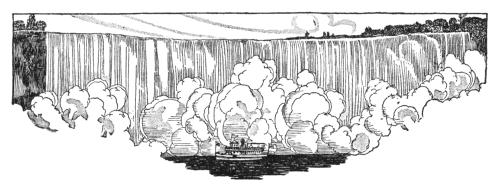
MY VISIT TO NIAGARA
NATHANIEL HAWTHORNE
Never did a pilgrim approach Niagara with deeper enthusiasm than mine. I had lingered away from it, and wandered to other scenes, because my treasury of anticipated enjoyments, comprising all the wonders of the world, had nothing else so magnificent, and I was loath to exchange the pleasures of hope for those of memory so soon. At length the day came. The stage-coach, with a Frenchman and myself on the back seat, had already left Lewiston, and in less than an hour would set us down in Manchester. I began to listen for the roar of the cataract, and trembled with a sensation like dread, as the moment drew nigh, when its voice of ages must roll, for the first time, on my ear. The French gentleman stretched himself from the window, and expressed loud admiration, while, by a sudden impulse, I threw myself back and closed my eyes. When the scene shut in, I was glad to think, that for me the whole burst of Niagara was yet in futurity. We rolled on, and entered the village of Manchester, bordering on the falls.
I am quite ashamed of myself here. Not that I ran like a madman to the falls, and plunged into the thickest of the spray—never stopping to breathe, till breathing was impossible; not that I committed this, or any other suitable extravagance. On the contrary, I alighted with perfect decency and composure, gave my cloak to the black waiter, pointed out my baggage, and inquired, not the nearest way to the cataract, but about the dinner-hour. The interval was spent in arranging my dress. Within the last fifteen minutes, my mind had grown strangely benumbed, and my spirits apathetic, with a slight depression, not decided enough to be termed sadness. My enthusiasm was in a deathlike slumber. Without aspiring to immortality, as he did, I could have imitated that English traveler who turned back from the point where he first heard the thunder of Niagara, after crossing the ocean to behold it. Many a Western trader, by the by, has performed a similar act of heroism with more heroic simplicity, deeming it no such wonderful feat to dine at the hotel and resume his route to Buffalo or Lewiston, while the cataract was roaring unseen.
Such has often been my apathy, when objects, long sought, and earnestly desired, were placed within my reach. After dinner—at which an unwonted and perverse epicurism detained me longer than usual—I lighted a cigar and paced the piazza, minutely attentive to the aspect and business of a very ordinary village. Finally, with reluctant step, and the feeling of an intruder, I walked toward Goat Island. At the toll-house, there were further excuses for delaying the inevitable moment. My signature was required in a huge ledger, containing similar records innumerable, many of which I read. The skin of a great sturgeon, and other fishes, beasts, and reptiles; a collection of minerals, such as lie in heaps near the falls; some Indian moccasins, and other trifles, made of deer-skin and embroidered with beads; several newspapers, from Montreal, New York, and Boston—all attracted me in turn. Out of a number of twisted sticks, the manufacture of a Tuscarora Indian, I selected one of curled maple, curiously convoluted, and adorned with the carved images of a snake and a fish. Using this as my pilgrim’s staff, I crossed the bridge. Above and below me were the rapids, a river of impetuous snow, with here and there a dark rock amid its whiteness, resisting all the physical fury, as any cold spirit did the moral influences of the scene. On reaching Goat Island, which separates the two great segments of the falls, I chose the right-hand path, and followed it to the edge of the American cascade. There, while the falling sheet was yet invisible, I saw the vapor that never vanishes, and the Eternal Rainbow of Niagara.
It was an afternoon of glorious sunshine, without a cloud, save those of the cataracts. I gained an insulated rock, and beheld a broad sheet of brilliant and unbroken foam, not shooting in a curved line from the top of the precipice, but falling headlong down from height to depth. A narrow stream diverged from the main branch, and hurried over the crag by a channel of its own, leaving a little pine-clad island and a streak of precipice between itself and the larger sheet. Below arose the mist, on which was painted a dazzling sunbow with two concentric shadows—one, almost as perfect as the original brightness; and the other, drawn faintly round the broken edge of the cloud.
Still I had not half seen Niagara. Following the verge of the island, the path led me to the Horseshoe, where the real, broad St. Lawrence, rushing along on a level with its banks, pours its whole breadth over a concave line of precipice, and thence pursues its course between lofty crags toward Ontario. A sort of bridge, two or three feet wide, stretches out along the edge of the descending sheet, and hangs upon the rising mist, as if that were the foundation of the frail structure. Here I stationed myself in the blast of wind, which the rushing river bore along with it. The bridge was tremulous beneath me, and marked the tremor of the solid earth. I looked along the whitening rapids, and endeavored to distinguish a mass of water far above the falls, to follow it to their verge, and go down with it, in fancy, to the abyss of clouds and storm. Casting my eyes across the river, and every side, I took in the whole scene at a glance, and tried to comprehend it in one vast idea. After an hour thus spent, I left the bridge, and by a stair-case, winding almost interminably round a post, descended to the base of the precipice. From that point, my path lay over slippery stones, and among great fragments of the cliff, to the edge of the cataract, where the wind at once enveloped me in spray, and perhaps dashed the rainbow round me. Were my long desires fulfilled? And had I seen Niagara?
Oh, that I had never heard of Niagara till I beheld it! Blessed were the wanderers of old, who heard its deep roar, sounding through the woods, as the summons to an unknown wonder, and approached its awful brink, in all the freshness of native feeling. Had its own mysterious voice been the first to warn me of its existence, then, indeed, I might have knelt down and worshiped. But I had come thither, haunted with a vision of foam and fury, and dizzy cliffs, and an ocean tumbling down out of the sky—a scene, in short, which nature had too much good taste and calm simplicity to realize. My mind had struggled to adapt these false conceptions to the reality, and finding the effort vain, a wretched sense of disappointment weighed me down. I climbed the precipice, and threw myself on the earth, feeling that I was unworthy to look at the Great Falls, and careless about beholding them again.
All that night, as there has been and will be for ages past and to come, a rushing sound was heard, as if a great tempest were sweeping through the air. It mingled with my dreams, and made them full of storm and whirlwind. Whenever I awoke, and heard this dread sound in the air, and the windows rattling as with a mighty blast, I could not rest again, till looking forth, I saw how bright the stars were, and that every leaf in the garden was motionless. Never was a summer night more calm to the eye, nor a gale of autumn louder to the ear. The rushing sound proceeds from the rapids, and the rattling of the casements is but an effect of the vibration of the whole house, shaken by the jar of the cataract. The noise of the rapids draws the attention from the true voice of Niagara, which is a dull, muffled thunder, resounding between the cliffs. I spent a wakeful hour at midnight, in distinguishing its reverberations, and rejoiced to find that my former awe and enthusiasm were reviving.
Gradually, and after much contemplation, I came to know, by my own feelings, that Niagara is indeed a wonder of the world, and not the less wonderful, because time and thought must be employed in comprehending it. Casting aside all preconceived notions, and preparation to be dire-struck or delighted, the beholder must stand beside it in the simplicity of his heart, suffering the mighty scene to work its own impression. Night after night I dreamed of it, and was gladdened every morning by the consciousness of a growing capacity to enjoy it. Yet I will not pretend to the all-absorbing enthusiasm of some more fortunate spectators, nor deny that very trifling causes would draw my eyes and thoughts from the cataract.
The last day that I was to spend at Niagara, before my departure for the Far West, I sat upon the Table Rock. This celebrated station did not now, as of old, project fifty feet beyond the line of the precipice, but was shattered by the fall of an immense fragment, which lay distant on the shore below. Still, on the utmost verge of the rock, with my feet hanging over it, I felt as if suspended in the open air. Never before had my mind been in such perfect unison with the scene. There were intervals when I was conscious of nothing but the great river, rolling calmly into the abyss, rather descending than precipitating itself, and acquiring tenfold majesty from its unhurried motion. It came like the march of Destiny. It was not taken by surprise, but seemed to have anticipated, in all its course through the broad lakes, that it must pour their collected waters down this height. The perfect foam of the river, after its descent, and the ever-varying shapes of mist, rising up, to become clouds in the sky, would be the very picture of confusion, were it merely transient, like the rage of a tempest. But when the beholder has stood awhile, and perceives no lull in the storm, and considers that the vapor and the foam are as everlasting as the rocks which produce them, all this turmoil assumes a sort of calmness. It soothes, while it awes the mind.
Leaning over the cliff, I saw the guide conducting two adventurers behind the falls. It was pleasant, from that high seat in the sunshine, to observe them struggling against the eternal storm of the lower regions, with heads bent down, now faltering, now pressing forward, and finally swallowed up in their victory. After their disappearance, a blast rushed out with an old hat, which it had swept from one of their heads. The rock, to which they were directing their unseen course, is marked, at a fearful distance on the exterior of the sheet, by a jet of foam. The attempt to reach it appears both poetical and perilous to a looker-on, but may be accomplished without much more difficulty or hazard than in stemming a violent northeaster. In a few moments, forth came the children of the mist. Dripping and breathless, they crept along the base of the cliff, ascended to the guide’s cottage, and received, I presume, a certificate of their achievement, with three verses of sublime poetry on the back.
My contemplations were often interrupted by strangers who came down from Forsyth’s to take their first view of the falls. A short, ruddy, middle-aged gentleman, fresh from Old England, peeped over the rock, and evinced his approbation by a broad grin. His spouse, a very robust lady, afforded a sweet example of maternal solicitude, being so intent on the safety of her little boy that she did not even glance at Niagara. As for the child, he gave himself wholly to the enjoyment of a stick of candy. Another traveler, a native American, and no rare character among us, produced a volume of Captain Hall’s tour, and labored earnestly to adjust Niagara to the captain’s description, departing, at last, without one new idea or sensation of his own. The next comer was provided, not with a printed book, but with a blank sheet of foolscap, from top to bottom of which, by means of an ever-pointed pencil, the cataract was made to thunder. In a little talk which we had together, he awarded his approbation to the general view, but censured the position of Goat Island, observing that it should have been thrown farther to the right, so as to widen the American falls, and contract those of the Horseshoe. Next appeared two traders of Michigan, who declared, that, upon the whole, the sight was worth looking at; there certainly was an immense water-power here; but that, after all, they would go twice as far to see the noble stone-works of Lockport, where the Grand Canal is locked down a descent of sixty feet. They were succeeded by a young fellow, in a homespun cotton dress, with a staff in his hand, and a pack over his shoulders. He advanced close to the edge of the rock, where his attention, at first wavering among the different components of the scene, finally became fixed in the angle of the Horseshoe falls, which is indeed the central point of interest. His whole soul seemed to go forth and be transported thither, till the staff slipped from his relaxed grasp, and falling down—down—down—struck upon the fragment of the Table Rock.
In this manner I spent some hours, watching the varied impression made by the cataract on those who disturbed me, and returning to unwearied contemplation, when left alone. At length my time came to depart. There is a grassy footpath through the woods, along the summit of the bank, to a point whence a cause-way, hewn in the side of the precipice, goes winding down to the Ferry, about half a mile below the Table Rock. The sun was near setting, when I emerged from the shadow of the trees, and began the descent. The indirectness of my downward road continually changed the point of view, and showed me, in rich and repeated succession, now, the whitening rapids and majestic leap of the main river, which appeared more deeply massive as the light departed; now, the lovelier picture, yet still sublime, of Goat Island, with its rocks and grove, and the lesser falls, tumbling over the right bank of the St. Lawrence, like a tributary stream; now, the long vista of the river, as it eddied and whirled between the cliffs, to pass through Ontario toward the sea, and everywhere to be wondered at, for this one unrivaled scene. The golden sunshine tinged the sheet of the American cascade, and painted on its heaving spray the broken semi-circle of a rainbow, heaven’s own beauty crowning earth’s sublimity. My steps were slow, and I paused long at every turn of the descent, as one lingers and pauses who discerns a brighter and brightening excellence in what he must soon behold no more. The solitude of the old wilderness now reigned over the whole vicinity of the falls. My enjoyment became the more rapturous, because no poet shared it, nor wretch devoid of poetry profaned it; but the spot so famous through the world was all my own!
NOTES AND QUESTIONS
For Biography, see page 348.
Discussion. 1. Why was Hawthorne at first disappointed in Niagara? 2. How did he finally come to know that it is one of the world’s wonders? 3. What feelings did Niagara produce in Hawthorne? 4. What effect on the reader did he seek to produce? 5. What does Hawthorne say is necessary in order to appreciate nature? 6. Account for the fact that Niagara grew on Hawthorne. 7. What comments of other observers does Hawthorne give? 8. What do you think determines the kind of response an observer gives to a wonderful scene in nature, such as Niagara? 9. Pronounce the following: loath; heroism; route; unwonted; minutely; reptiles; tremor; abyss; tour; idea.
Phrases
anticipated enjoyments, 466, 3
suitable extravagance, 467, 1
perverse epicurism, 467, 18
impetuous snow, 467, 34
Eternal Rainbow, 468, 3
insulated rock, 468, 6
abyss of clouds, 468, 28
native feeling, 469, 4
tributary stream, 472, 21
eddied and whirled, 472, 22
unrivaled scene, 472, 23
brightening excellence, 472, 25
FROM MORN TILL NIGHT ON A FLORIDA RIVER
SIDNEY LANIER
For a perfect journey God gave us a perfect day. The little Ocklawaha steamboat Marion had started on her voyage some hours before daylight. She had taken on her passengers the night previous. By seven o’clock on such a May morning as no words could describe we had made twenty-five miles up the St. Johns. At this point the Ocklawaha flows into the St. Johns, one hundred miles above Jacksonville.
Presently we abandoned the broad highway of the St. Johns, and turned off to the right into the narrow lane of the Ocklawaha. This is the sweetest water-lane in the world, a lane which runs for more than one hundred and fifty miles of pure delight betwixt hedge-rows of oaks and cypresses and palms and magnolias and mosses and vines; a lane clean to travel, for there is never a speck of dust in it save the blue dust and gold dust which the wind blows out of the flags and lilies.
As we advanced up the stream our wee craft seemed to emit her steam in leisurely whiffs, as one puffs one’s cigar in a contemplative walk through the forest. Dick, the pole-man, lay asleep on the guards, in great peril of rolling into the river over the three inches between his length and the edge; the people of the boat moved not, and spoke not; the white crane, the curlew, the heron, the water-turkey, were scarcely disturbed in their quiet avocations as we passed, and quickly succeeded in persuading themselves after each momentary excitement of our gliding by, that we were really no monster, but only some day-dream of a monster.
“Look at that snake in the water!” said a gentleman, as we sat on deck with the engineer, just come up from his watch.
The engineer smiled. “Sir, it is a water-turkey,” he said, gently.
The water-turkey is the most preposterous bird within the range of ornithology. He is not a bird; he is a neck with such subordinate rights, members, belongings, and heirlooms as seem necessary to that end. He has just enough stomach to arrange nourishment for his neck, just enough wings to fly painfully along with his neck, and just big enough legs to keep his neck from dragging on the ground; and his neck is light-colored, while the rest of him is black. When he saw us he jumped up on a limb and stared. Then suddenly he dropped into the water, sank like a leaden ball out of sight, and made us think he was drowned. Presently the tip of his beak appeared, then the length of his neck lay along the surface of the water. In this position, with his body submerged, he shot out his neck, drew it back, wriggled it, twisted it, twiddled it, and poked it spirally into the east, the west, the north, and the south, round and round with a violence and energy that made one think in the same breath of corkscrews and of lightnings. But what nonsense! All that labor and perilous contortion for a beggarly sprat or a couple of inches of water-snake.
Some twenty miles from the mouth of the Ocklawaha, at the right-hand edge of the stream, is the handsomest residence in America. It belongs to a certain alligator of my acquaintance, a very honest and worthy reptile of good repute. A little cove of water, dark-green under the overhanging leaves, placid and clear, curves round at the river edge into the flags and lilies, with a curve just heart-breaking for its pure beauty. This house of the alligator is divided into apartments, little bays which are scalloped out by the lily-pads, according to the winding fancies of their growth. My reptile, when he desires to sleep, has but to lie down anywhere; he will find marvelous mosses for his mattress beneath him; his sheets will be white lily-petals; and the green disks of the lily-pads will straightway embroider themselves together above him for his coverlet. He never quarrels with his cook, he is not the slave of a kitchen, and his one house-maid—the stream—forever sweeps his chambers clean. His conservatories there under the glass of that water are ever, without labor, filled with the enchantments of under-water growths.
His parks and his pleasure-grounds are larger than any king’s. Upon my saurian’s house the winds have no power, the rains are only a new delight to him, and the snows he will never see. Regarding fire, as he does not use it as a slave, so he does not fear it as a tyrant.
Thus all the elements are the friends of my alligator’s house. While he sleeps he is being bathed. What glory to awake sweetened and freshened by the sole, careless act of sleep!
Lastly, my saurian has unnumbered mansions, and can change his dwelling as no human house-holder may; it is but a flip of his tail, and lo! he is established in another place as good as the last, ready furnished to his liking.
On and on up the river! We find it a river without banks. The swift, deep current meanders between tall lines of trees; beyond these, on either side, there is water also—a thousand shallow rivulets lapsing past the bases of a multitude of trees.
Along the edges of the stream every tree-trunk, sapling, and stump is wrapped about with a close-growing vine. The edges of the stream are also defined by flowers and water-leaves. The tall blue flags, the lilies sitting on their round lily-pads like white queens on green thrones, the tiny stars and long ribbons of the water-grasses—all these border the river in an infinite variety of adornment.
And now, after this day of glory, came a night of glory. Deep down in these shaded lanes it was dark indeed as the night drew on. The stream which had been all day a girdle of beauty, blue or green, now became a black band of mystery.
But presently a brilliant flame flares out overhead: They have lighted the pine-knots on top of the pilot-house. The fire advances up these dark windings like a brilliant god.
The startled birds suddenly flutter into the light and after an instant of illuminated flight melt into the darkness. From the perfect silence of these short flights one derives a certain sense of awe.
Now there is a mighty crack and crash: limbs and leaves scrape and scrub along the deck; a little bell tinkles; we stop. In turning a short curve, the boat has run her nose smack into the right bank, and a projecting stump has thrust itself sheer through the starboard side. Out, Dick! Out, Henry! Dick and Henry shuffle forward to the bow, thrust forth their long white pole against a tree-trunk, strain and push and bend to the deck as if they were salaaming the god of night and adversity. Our bow slowly rounds into the stream, the wheel turns and we puff quietly along.
And now it is bed-time. Let me tell you how to sleep on an Ocklawaha steamer in May. With a small bribe persuade Jim, the steward, to take the mattress out of your berth and lay it slanting just along the railing that encloses the lower part of the deck in front and to the left of the pilot-house. Lie flat on your back down on the mattress, draw your blanket over you, put your cap on your head, on account of the night air, fold your arms, say some little prayer or other, and fall asleep with a star looking right down on your eye. When you wake in the morning you will feel as new as Adam.
NOTES AND QUESTIONS
Biography. Sidney Lanier (1842-1881) was a native of Georgia. When a mere lad, just out of college, he entered the Confederate army and faithfully devoted the most precious years of his life to that service. While in a military prison he contracted the dread “White Plague,” and during his few remaining years he struggled constantly with disease and poverty. He was a talented musician and often found it necessary to supplement the earnings of his pen by playing in an orchestra. His thorough knowledge and fine sense of music also appear in his masterly treatise on the “Science of English Verse.” During his last years he held a lectureship on English Literature in Johns Hopkins University, at Baltimore. He has often been compared with Poe in the exquisite melody of his verse, while in unaffected simplicity and in truthfulness to nature he is not surpassed by Bryant or Whittier. His prose as well as his poetry breathes the very spirit of his sunny southland. In the “Song of the Chattahoochee”, “The Marshes of Glynn,” and “On a Florida River,” one scents the balsam of the Georgia pines among which he lived, and the odor of magnolia groves, jessamine, and wild honey-suckle.
Discussion. 1. From this selection what do you think of the author’s power of description? 2. Mention instances in which he makes use of humor to add to his descriptive power. 3. Quote his words describing the Ocklawaha. 4. What does the author mean by saying, “We find it a river without banks”? 5. In your own words, give a description of the alligator’s home. 6. Make a list of things Lanier saw on this trip that he would not see on a trip down a river in New England. 7. What gives melody to this piece of prose? 8. What comparison do you find in lines 31 and 32, page 475? 9. Point out some examples of alliteration; for what purpose does the author use alliteration? 10. Pronounce the following: palms; leisurely; infinite.
Phrases
quiet avocations, 474, 5
day-dream of a monster, 474, 8
subordinate rights, 474, 15
perilous contortion, 474, 29
reptile of good repute, 474, 34
infinite variety, 475, 32
girdle of beauty, 475, 36
band of mystery, 475, 37
brilliant flame flares, 476, 1
sense of awe, 476, 6
I SIGH FOR THE LAND OF THE CYPRESS AND PINE
SAMUEL HENRY DICKSON
I sigh for the land of the cypress and pine; Where the jessamine blooms, and the gay woodbine; Where the moss droops low from the green oak tree— Oh, that sun-bright land is the land for me! The snowy flower of the orange there Sheds its sweet fragrance through the air; And the Indian rose delights to twine Its branches with the laughing vine. There the deer leaps light through the open glade, Or hides him far in the forest shade, When the woods resound in the dewy morn With the clang of the merry hunter’s horn. There the humming-bird, of rainbow plume, Hangs over the scarlet creeper’s bloom; While ’midst the leaves his varying dyes Sparkle like half-seen fairy eyes. There the echoes ring through the livelong day With the mock-bird’s changeful roundelay; And at night, when the scene is calm and still, With the moan of the plaintive whip-poor-will. Oh! I sigh for the land of the cypress and pine, Of the laurel, the rose, and the gay woodbine, Where the long, gray moss decks the rugged oak tree,— That sun-bright land is the land for me.
NOTES AND QUESTIONS
Biography. Samuel Henry Dickson (1798-1872) was born in Charleston, South Carolina. He was graduated at Yale College in 1814, and afterward took a course in medicine at the University of Pennsylvania. Dr. Dickson was professor of medicine successively at the medical school at Charleston, at the University of the City of New York, and at Jefferson Medical College, Philadelphia. He wrote several books on medicine. His love for his native sun-bright southland is beautifully expressed, in this poem.
Discussion. 1. What part of the country does the poet mean when he refers to the “land of Cyprus and pine”? 2. Mention the beautiful things named in the first stanza which characterize this land. 3. Have you ever seen the moss “which droops low from the green oak tree”? Where? 4. What birds does the poet mention in this selection? 5. Do you think these birds would be found in the woods of Maine or Wisconsin? 6. Note the changes of the time of day throughout the poem. In which stanza is the “morn” spoken of? The “livelong day”? The night? 7. Have you ever heard “the moan of the plaintive whip-poor-will”? 8. Do you think the poet was right in calling its note a “moan”? Do you know how this bird got its name? 9. Does the poet convince you that this is a land worth sighing for?
THE LEGEND OF SLEEPY HOLLOW
WASHINGTON IRVING
A pleasing land of drowsy head it was, Of dreams that wave before the half-shut eye; And of gay castles in the clouds that pass, Forever flushing round a summer sky. —Castle of Indolence.
THE VALLEY AND ITS SUPERSTITIONS
In the bosom of one of those spacious coves which indent the eastern shore of the Hudson, at that broad expansion of the river denominated by the ancient Dutch navigators the Tappan Zee, and where they always prudently shortened sail, and implored the protection of St. Nicholas when they crossed, there lies a small market-town or rural port, which by some is called Greensburgh, but which is more generally and properly known by the name of Tarry Town. This name was given, we are told, in former days, by the good housewives of the adjacent country, from the inveterate propensity of their husbands to linger about the village tavern on market days. Be that as it may, I do not vouch for the fact, but merely advert to it, for the sake of being precise and authentic. Not far from this village, perhaps about two miles, there is a little valley, or rather lap of land, among high hills, which is one of the quietest places in the whole world. A small brook glides through it, with just murmur enough to lull one to repose; and the occasional whistle of a quail, or tapping of a woodpecker, is almost the only sound that ever breaks in upon the uniform tranquillity.
I recollect that, when a stripling, my first exploit in squirrel-shooting was in a grove of tall walnut trees that shades one side of the valley. I had wandered into it at noon time, when all nature is peculiarly quiet, and was startled by the roar of my own gun, as it broke the Sabbath stillness around, and was prolonged and reverberated by the angry echoes. If ever I should wish for a retreat, whither I might steal from the world and its distractions, and dream quietly away the remnant of a troubled life, I know of none more promising than this little valley.
From the listless repose of the place, and the peculiar character of its inhabitants, who are descendants from the original Dutch settlers, this sequestered glen has long been known by the name of Sleepy Hollow, and its rustic lads are called the Sleepy Hollow Boys throughout all the neighboring country. A drowsy, dreamy influence seems to hang over the land, and to pervade the very atmosphere. Some say that the place was bewitched by a high German doctor, during the early days of the settlement; others, that an old Indian chief, the prophet or wizard of his tribe, held his pow-wows there before the country was discovered by Master Hendrick Hudson. Certain it is, the place still continues under the sway of some witching power, that holds a spell over the minds of the good people, causing them to walk in a continual reverie. They are given to all kinds of marvelous beliefs; are subject to trances and visions; and frequently see strange sights, and hear music and voices in the air. The whole neighborhood abounds with local tales, haunted spots, and twilight superstitions; stars shoot and meteors glare oftener across the valley than in any other part of the country, and the nightmare, with her whole nine fold, seems to make it the favorite scene of her gambols.
The dominant spirit, however, that haunts this enchanted region, and seems to be commander-in-chief of all the powers of the air, is the apparition of a figure on horseback without a head. It is said by some to be the ghost of a Hessian trooper, whose head had been carried away by a cannon-ball, in some nameless battle during the Revolutionary war; and who is ever and anon seen by the country folk, hurrying along in the gloom of night, as if on the wings of the wind. His haunts are not confined to the valley, but extend at times to the adjacent roads, and especially to the vicinity of a church at no great distance. Indeed, certain of the most authentic historians of those parts, who have been careful in collecting and collating the floating facts concerning this specter, allege that the body of the trooper having been buried in the churchyard, the ghost rides forth to the scene of battle in nightly quest of his head; and that the rushing speed with which he sometimes passes along the Hollow, like a midnight blast, is owing to his being belated, and in a hurry to get back to the churchyard before daybreak.
Such is the general purport of this legendary superstition, which has furnished materials for many a wild story in that region of shadows; and the specter is known, at all the country firesides, by the name of the Headless Horseman of Sleepy Hollow.
It is remarkable that the visionary propensity I have mentioned is not confined to the native inhabitants of the valley, but is unconsciously imbibed by every one who resides there for a time. However wide awake they may have been before they entered that sleepy region, they are sure, in a little time, to inhale the witching influence of the air, and begin to grow imaginative—to dream dreams, and see apparitions.
I mention this peaceful spot with all possible laud; for it is in such little retired Dutch valleys, found here and there embosomed in the great State of New York, that population, manners, and customs remain fixed; while the great torrent of migration and improvement, which is making such incessant changes in other parts of this restless country, sweeps by them unobserved. They are like those little nooks of still water which border a rapid stream; where we may see the straw and bubble riding quietly at anchor, or slowly revolving in their mimic harbor, undisturbed by the rush of the passing current. Though many years have elapsed since I trod the drowsy shades of Sleepy Hollow, yet I question whether I should not still find the same trees and the same families vegetating in its sheltered bosom.
ICHABOD CRANE AND KATRINA VAN TASSEL
In this by-place of nature, there abode, in a remote period of American history, that is to say, some thirty years since, a worthy wight of the name of Ichabod Crane; who sojourned, or, as he expressed it, “tarried,” in Sleepy Hollow, for the purpose of instructing the children of the vicinity. He was a native of Connecticut, a State which supplies the Union with pioneers for the mind as well as for the forest, and sends forth yearly its legions of frontier woodsmen and country school-masters. The cognomen of Crane was not inapplicable to his person. He was tall, but exceedingly lank, with narrow shoulders, long arms and legs, hands that dangled a mile out of his sleeves, feet that might have served for shovels, and his whole frame most loosely hung together. His head was small, and flat at top, with huge ears, large green glassy eyes, and a long snipe nose, so that it looked like a weather-cock, perched upon his spindle neck, to tell which way the wind blew. To see him striding along the profile of a hill on a windy day, with his clothes bagging and fluttering about him, one might have mistaken him for the genius of famine descending upon the earth, or some scarecrow eloped from a cornfield.
His schoolhouse was a low building of one large room, rudely constructed of logs; the windows partly glazed, and partly patched with leaves of old copy-books. It was most ingeniously secured at vacant hours, by a withe twisted in the handle of the door, and stakes set against the window shutters; so that, though a thief might get in with perfect ease, he would find some embarrassment in getting out; an idea most probably borrowed by the architect, Yost Van Houten, from the mystery of an eel-pot. The schoolhouse stood in a rather lonely but pleasant situation, just at the foot of a woody hill, with a brook running close by, and a formidable birch tree growing at one end of it. From hence the low murmur of his pupils’ voices, conning over their lessons, might be heard in a drowsy summer’s day, like the hum of a bee-hive; interrupted now and then by the authoritative voice of the master, in the tone of menace or command; or, peradventure, by the appalling sound of the birch, as he urged some tardy loiterer along the flowery path of knowledge. Truth to say, he was a conscientious man, and ever bore in mind the golden maxim, “Spare the rod and spoil the child.”—Ichabod Crane’s scholars certainly were not spoiled.
I would not have it imagined, however, that he was one of those cruel potentates of the school, who joy in the smart of their subjects; on the contrary, he administered justice with discrimination rather than severity, taking the burthen off the backs of the weak and laying it on those of the strong. Your mere puny stripling, that winced at the least flourish of the rod, was passed by with indulgence; but the claims of justice were satisfied by inflicting a double portion on some little, tough, wrong-headed, broad-skirted Dutch urchin, who sulked and swelled and grew dogged and sullen beneath the birch. All this he called “doing his duty by their parents” and he never inflicted a chastisement without following it by the assurance, so consolatory to the smarting urchin, that “he would remember it, and thank him for it the longest day he had to live.”
When school hours were over, he was even the companion and playmate of the larger boys; and on holiday afternoons would convoy some of the smaller ones home, who happened to have pretty sisters, or good housewives for mothers, noted for the comforts of the cupboard. Indeed it behooved him to keep on good terms with his pupils. The revenue arising from his school was small, and would have been scarcely sufficient to furnish him with daily bread, for he was a huge feeder, and, though lank, had the dilating powers of an anaconda; but to help out his maintenance, he was, according to country custom in those parts, boarded and lodged at the houses of the farmers whose children he instructed. With these he lived successively a week at a time; thus going the rounds of the neighborhood, with all his worldly effects tied up in a cotton handkerchief.
That all this might not be too onerous on the purses of his rustic patrons, who are apt to consider the costs of schooling a grievous burden, and schoolmasters as mere drones, he had various ways of rendering himself both useful and agreeable. He assisted the farmers occasionally in the lighter labors of their farms; helped to make hay; mended the fences; took the horses to water; drove the cows from pasture; and cut wood for the winter fire. He laid aside, too, all the dominant dignity and absolute sway with which he lorded it in his little empire, the school, and became wonderfully gentle and ingratiating. He found favor in the eyes of the mothers, by petting the children, particularly the youngest; and like the lion bold, which whilom so magnanimously the lamb did hold, he would sit with a child on one knee, and rock a cradle with his foot for whole hours together.
In addition to his other vocations, he was the singing-master of the neighborhood, and picked up many bright shillings by instructing the young folks in psalmody. It was a matter of no little vanity to him, on Sundays, to take his station in front of the church gallery, with a band of chosen singers; where, in his own mind, he completely carried away the palm from the parson. Certain it is, his voice resounded far above all the rest of the congregation; and there are peculiar quavers still to be heard in that church, and which may even be heard half a mile off, quite to the opposite side of the mill-pond, on a still Sunday morning, which are said to be legitimately descended from the nose of Ichabod Crane. Thus, by divers little makeshifts in that ingenious way which is commonly denominated “by hook and by crook,” the worthy pedagogue got on tolerably enough, and was thought, by all who understood nothing of the labor of headwork, to have a wonderfully easy life of it.
The schoolmaster is generally a man of some importance in the female circle of a rural neighborhood, being considered a kind of idle gentlemanlike personage, of vastly superior taste and accomplishments to the rough country swains, and, indeed, inferior in learning only to the parson. His appearance, therefore, is apt to occasion some little stir at the tea table of a farmhouse, and the addition of a supernumerary dish of cakes or sweetmeats, or, peradventure, the parade of a silver teapot. Our man of letters, therefore, was peculiarly happy in the smiles of all the country damsels. How he would figure among them in the churchyard, between services on Sundays! gathering grapes for them from the wild vines that overran the surrounding trees; reciting for their amusement all the epitaphs on the tombstones; or sauntering, with a whole bevy of them, along the banks of the adjacent mill-pond; while the more bashful country bumpkins hung sheepishly back, envying his superior elegance and address.
From his half itinerant life, also, he was a kind of traveling gazette, carrying the whole budget of local gossip from house to house; so that his appearance was always greeted with satisfaction. He was, moreover, esteemed by the women as a man of great erudition, for he had read several books quite through, and was a perfect master of Cotton Mather’s history of New England Witchcraft, in which, by the way, he most firmly and potently believed.
He was, in fact, an odd mixture of small shrewdness and simple credulity. His appetite for the marvelous, and his powers of digesting it, were equally extraordinary; and both had been increased by his residence in this spellbound region. No tale was too gross or monstrous for his capacious swallow. It was often his delight, after his school was dismissed in the afternoon, to stretch himself on the rich bed of clover, bordering the little brook that whimpered by his schoolhouse, and there con over old Mather’s direful tales, until the gathering dusk of the evening made the printed page a mere mist before his eyes. Then, as he wended his way, by swamp and stream and awful woodland, to the farmhouse where he happened to be quartered, every sound of nature, at that witching hour, fluttered his excited imagination: the moan of the whippoorwill from the hill-side; the boding cry of the tree-toad, that harbinger of storm; the dreary hooting of the screech-owl, or the sudden rustling in the thicket of birds frightened from their roost. The fire-flies, too, which sparkled most vividly in the darkest places, now and then startled him, as one of uncommon brightness would stream across his path; and if, by chance, a huge blockhead of a beetle came winging his blundering flight against him, the poor varlet was ready to give up the ghost, with the idea that he was struck with a witch’s token. His only resource on such occasions, either to drown thought, or drive away evil spirits, was to sing psalm tunes; and the good people of Sleepy Hollow, as they sat by their doors of an evening, were often filled with awe, at hearing his nasal melody, “in linked sweetness long drawn out,” floating from the distant hill, or along the dusky road.
Another of his sources of fearful pleasure was to pass long winter evenings with the old Dutch wives, as they sat spinning by the fire, with a row of apples roasting and spluttering along the hearth, and listen to their marvelous tales of ghosts and goblins, and haunted fields, and haunted brooks, and haunted bridges, and haunted houses, and particularly of the headless horseman, or galloping Hessian of the Hollow, as they sometimes called him. He would delight them equally by his anecdotes of witchcraft, and of the direful omens and portentous sights and sounds in the air, which prevailed in the earlier times of Connecticut; and would frighten them woefully with speculations upon comets and shooting stars; and with the alarming fact that the world did absolutely turn round, and that they were half the time topsy-turvy!
But if there was a pleasure in all this, while snugly cuddling in the chimney corner of a chamber that was all of a ruddy glow from the crackling wood fire, and where, of course, no specter dared to show his face, it was dearly purchased by the terrors of his subsequent walk homewards. What fearful shapes and shadows beset his path amidst the dim and ghastly glare of a snowy night!—With what wistful look did he eye every trembling ray of light streaming across the waste fields from some distant window!—How often was he appalled by some shrub covered with snow, which, like a sheeted specter, beset his very path!—How often did he shrink with curdling awe at the sound of his own steps on the frosty crust beneath his feet; and dread to look over his shoulder, lest he should behold some uncouth being tramping close behind him!—and how often was he thrown into complete dismay by some rushing blast, howling among the trees, in the idea that it was the Galloping Hessian on one of his nightly scourings!
All these, however, were mere terrors of the night, phantoms of the mind that walk in darkness; and though he had seen many specters in his time, and been more than once beset by Satan in divers shapes, in his lonely perambulations, yet daylight put an end to all these evils; and he would have passed a pleasant life of it, in despite of the devil and all his works, if his path had not been crossed by a being that causes more perplexity to mortal man than ghosts, goblins, and the whole race of witches put together, and that was—a woman.
Among the musical disciples who assembled, one evening in each week, to receive his instructions in psalmody, was Katrina Van Tassel, the daughter and only child of a substantial Dutch farmer. She was a blooming lass of fresh eighteen; plump as a partridge; ripe and melting and rosy cheeked as one of her father’s peaches; and universally famed, not merely for her beauty, but her vast expectations. She was withal a little of a coquette, as might be perceived even in her dress, which was a mixture of ancient and modern fashions, as most suited to set off her charms. She wore the ornaments of pure yellow gold, which her great-great-grandmother had brought over from Saardam; the tempting stomacher of the olden time; and withal a provokingly short petticoat, to display the prettiest foot and ankle in the country round.
Ichabod Crane had a soft and foolish heart toward the sex; and it is not to be wondered at that so tempting a morsel soon found favor in his eyes, more especially after he had visited her in her paternal mansion. Old Baltus Van Tassel was a perfect picture of a thriving, contented, liberal-hearted farmer. He seldom, it is true, sent either his eyes or his thoughts beyond the boundaries of his own farm; but within those every thing was snug, happy, and well-conditioned. He was satisfied with his wealth, but not proud of it; and piqued himself upon the hearty abundance, rather than the style in which he lived. His stronghold was situated on the banks of the Hudson, in one of those green, sheltered, fertile nooks, in which the Dutch farmers are so fond of nestling. A great elm-tree spread its broad branches over it; at the foot of which bubbled up a spring of the softest and sweetest water, in a little well, formed of a barrel; and then stole sparkling away through the grass, to a neighboring brook, that bubbled along among alders and dwarf willows. Hard by the farmhouse was a vast barn, that might have served for a church; every window and crevice of which seemed bursting forth with the treasures of the farm; the flail was busily resounding within it from morning to night; swallows and martins skimmed twittering about the eaves; and rows of pigeons, some with one eye turned up, as if watching the weather, some with their heads under their wings or buried in their bosoms, and others swelling, and cooing, and bowing about their dames, were enjoying the sunshine on the roof. Sleek unwieldy porkers were grunting in the repose and abundance of their pens, whence sallied forth, now and then, troops of sucking pigs, as if to snuff the air. A stately squadron of snowy geese were riding in an adjoining pond, convoying whole fleets of ducks; regiments of turkeys were gobbling through the farmyard, and guinea fowls fretting about it, like ill-tempered housewives, with their peevish discontented cry. Before the barn door strutted the gallant cock, that pattern of a husband, a warrior, and a fine gentleman, clapping his burnished wings, and crowing in the pride and gladness of his heart—sometimes tearing up the earth with his feet, and then generously calling his ever-hungry family of wives and children to enjoy the rich morsel which he had discovered.
The pedagogue’s mouth watered, as he looked upon this sumptuous promise of luxurious winter fare. In his devouring mind’s eye he pictured to himself every roasting-pig running about with a pudding in his belly, and an apple in his mouth; the pigeons were snugly put to bed in a comfortable pie, and tucked in with a coverlet of crust; the geese were swimming in their own gravy; and the ducks pairing cozily in dishes, like snug married couples, with a decent competency of onion sauce. In the porkers he saw carved out the future sleek side of bacon, and juicy relishing ham; not a turkey but he beheld daintily trussed up, with its gizzard under its wing, and peradventure, a necklace of savory sausages; and even bright chanticleer himself lay sprawling on his back, in a side-dish, with uplifted claws, as if craving that quarter which his chivalrous spirit disdained to ask while living.
As the enraptured Ichabod fancied all this, and as he rolled his great green eyes over the fat meadow-lands, the rich fields of wheat, of rye, of buckwheat, and Indian corn, and the orchards burthened with ruddy fruit which surrounded the warm tenement of Van Tassel, his heart yearned after the damsel who was to inherit these domains, and his imagination expanded with the idea, how they might be readily turned into cash, and the money invested in immense tracts of wild land, and shingle palaces in the wilderness. Nay, his busy fancy already realized his hopes, and presented to him the blooming Katrina, with a whole family of children, mounted on the top of a wagon loaded with household trumpery, with pots and kettles dangling beneath; and he beheld himself bestriding a pacing mare, with a colt at her heels, setting out for Kentucky, Tennessee, or the Lord knows where.
When he entered the house the conquest of his heart was complete. It was one of those spacious farmhouses, with high-ridged, but lowly-sloping roofs, built in the style handed down from the first Dutch settlers; the low projecting eaves forming a piazza along the front, capable of being closed up in bad weather. Under this were hung flails, harness, various utensils of husbandry, and nets for fishing in the neighboring river. Benches were built along the sides for summer use; and a great spinning-wheel at one end, and a churn at the other, showed the various uses to which this important porch might be devoted. From this piazza the wondering Ichabod entered the hall, which formed the center of the mansion and the place of usual residence. Here rows of resplendent pewter, ranged on a long dresser, dazzled his eyes. In one corner stood a huge bag of wool ready to be spun; in another a quantity of linsey-woolsey just from the loom; ears of Indian corn, and strings of dried apples and peaches, hung in gay festoons along the walls, mingled with the gaud of red peppers; and a door left ajar gave him a peep into the best parlor, where the claw-footed chairs and dark mahogany tables shone like mirrors; and irons, with their accompanying shovel and tongs, glistened from their covert of asparagus tops; mock-oranges and conch-shells decorated the mantelpiece; strings of various colored birds’ eggs were suspended above it; a great ostrich egg was hung from the center of the room; and a corner cupboard, knowingly left open, displayed immense treasures of old silver and well-mended china.
From the moment Ichabod laid his eyes upon these regions of delight the peace of his mind was at an end, and his only study was how to gain the affections of the peerless daughter of Van Tassel. In this enterprise, however, he had more real difficulties than generally fell to the lot of a knight-errant of yore, who seldom had anything but giants, enchanters, fiery dragons, and such like easily-conquered adversaries, to contend with; and had to make his way merely through gates of iron and brass, and walls of adamant, to the castle keep, where the lady of his heart was confined, all which he achieved as easily as a man would carve his way to the center of a Christmas pie; and then the lady gave him her hand as a matter of course. Ichabod, on the contrary, had to win his way to the heart of a country coquette, beset with a labyrinth of whims and caprices, which were forever presenting new difficulties and impediments; and he had to encounter a host of fearful adversaries of real flesh and blood, the numerous rustic admirers, who beset every portal to her heart; keeping a watchful and angry eye upon each other, but ready to fly out in the common cause against any new competitor.
BROM BONES
Among these the most formidable was a burly, roaring, roystering blade, of the name of Abraham, or, according to the Dutch abbreviation, Brom Van Brunt, the hero of the country round, which rang with his feats of strength and hardihood. He was broad-shouldered and double-jointed, with short curly black hair, and a bluff but not unpleasant countenance, having a mingled air of fun and arrogance. From his Herculean frame and great powers of limb, he had received the nickname of Brom Bones, by which he was universally known. He was famed for great knowledge and skill in horsemanship, being as dexterous on horseback as a Tartar. He was foremost at all races and cock-fights; and, with the ascendency which bodily strength acquires in rustic life, was the umpire in all disputes, setting his hat on one side, and giving his decisions with an air and tone admitting of no gainsay or appeal. He was always ready for either a fight or a frolic; but had more mischief than ill-will in his composition; and, with all his overbearing roughness, there was a strong dash of waggish good humor at bottom. He had three or four boon companions, who regarded him as their model, and at the head of whom he scoured the country, attending every scene of feud or merriment for miles round. In cold weather he was distinguished by a fur cap, surmounted with a flaunting fox’s tail; and when the folks at a country gathering descried this well-known crest at a distance, whisking about among a squad of hard riders, they always stood by for a squall. Sometimes his crew would be heard dashing along past the farmhouses at midnight, with whoop and halloo, like a troop of Don Cossacks; and the old dames, startled out of their sleep, would listen for a moment till the hurry-scurry had clattered by, and then exclaim, “Ay, there goes Brom Bones and his gang!” The neighbors looked upon him with a mixture of awe, admiration, and good will; and when any madcap prank or rustic brawl occurred in the vicinity, always shook their heads, and warranted Brom Bones was at the bottom of it.
This rantipole hero had for some time singled out the blooming Katrina for the object of his uncouth gallantries, and though his amorous toyings were something like the gentle caresses and endearments of a bear, yet it was whispered that she did not altogether discourage his hopes. Certain it is, his advances were signals for rival candidates to retire, who felt no inclination to cross a lion in his amours; insomuch, that when his horse was seen tied to Van Tassel’s paling, on a Sunday night, a sure sign that his master was courting, or, as it is termed, “sparking,” within, all other suitors passed by in despair, and carried the war into other quarters.
Such was the formidable rival with whom Ichabod Crane had to contend, and, considering all things, a stouter man than he would have shrunk from the competition, and a wiser man would have despaired. He had, however, a happy mixture of pliability and perseverance in his nature; he was in form and spirit like a supple-jack—yielding, but tough; though he bent, he never broke; and though he bowed beneath the slightest pressure, yet, the moment it was away—jerk! he was as erect, and carried his head as high as ever.
To have taken the field openly against his rival would have been madness; for he was not a man to be thwarted in his amours, any more than that stormy lover, Achilles. Ichabod, therefore, made his advances in a quiet and gently-insinuating manner. Under cover of his character of singing-master, he made frequent visits at the farmhouse; not that he had anything to apprehend from the meddlesome interference of parents, which is so often a stumbling-block in the path of lovers. Balt Van Tassel was an easy, indulgent soul; he loved his daughter better even than his pipe, and, like a reasonable man and an excellent father, let her have her way in everything. His notable little wife, too, had enough to do to attend to her housekeeping and manage her poultry; for, as she sagely observed, ducks and geese are foolish things, and must be looked after, but girls can take care of themselves. Thus while the busy dame bustled about the house, or plied her spinning-wheel at one end of the piazza, honest Balt would sit smoking his evening pipe at the other, watching the achievements of a little wooden warrior, who, armed with a sword in each hand, was most valiantly fighting the wind on the pinnacle of the barn. In the meantime, Ichabod would carry on his suit with the daughter by the side of the spring under the great elm, or sauntering along in the twilight, that hour so favorable to the lover’s eloquence.
I profess not to know how women’s hearts are wooed and won. To me they have always been matters of riddle and admiration. Some seem to have but one vulnerable point, or door of access; while others have a thousand avenues, and may be captured in a thousand different ways. It is a great triumph of skill to gain the former, but a still greater proof of generalship to maintain possession of the latter, for the man must battle for his fortress at every door and window. He who wins a thousand common hearts is therefore entitled to some renown; but he who keeps undisputed sway over the heart of a coquette is indeed a hero. Certain it is, this was not the case with the redoubtable Brom Bones; and from the moment Ichabod Crane made his advances, the interests of the former evidently declined; his horse was no longer seen tied at the palings on Sunday nights, and a deadly feud gradually arose between him and the preceptor of Sleepy Hollow.
Brom, who had a degree of rough chivalry in his nature, would fain have carried matters to open warfare, and have settled their pretensions to the lady, according to the mode of those most concise and simple reasoners, the knights-errant of yore—by single combat; but Ichabod was too conscious of the superior might of his adversary to enter the lists against him; he had overheard a boast of Bones, that he would “double the schoolmaster up, and lay him on a shelf of his own schoolhouse”; and he was too wary to give him an opportunity. There was something extremely provoking in this obstinately pacific system; it left Brom no alternative but to draw upon the funds of rustic waggery in his disposition, and to play off boorish practical jokes upon his rival. Ichabod became the object of whimsical persecution to Bones and his gang of rough riders. They harried his hitherto peaceful domains; smoked out his singing school, by stopping up the chimney; broke into the schoolhouse at night, in spite of its formidable fastenings of withe and window stakes, and turned everything topsy-turvy; so that the poor schoolmaster began to think all the witches of the country held their meetings there. But what was still more annoying, Brom took all opportunities of turning him into ridicule in presence of his mistress, and had a scoundrel dog whom he taught to whine in the most ludicrous manner, and introduced as a rival of Ichabod’s to instruct her in psalmody.
THE QUILTING FROLIC
In this way matters went on for some time, without producing any material effect on the relative situation of the contending powers. On a fine autumnal afternoon, Ichabod, in pensive mood, sat enthroned on the lofty stool whence he usually watched all the concerns of his little literary realm. In his hand he swayed a ferrule, that scepter of despotic power; the birch of justice reposed on three nails, behind the throne, a constant terror to evil doers; while on the desk before him might be seen sundry contraband articles and prohibited weapons, detected upon the persons of idle urchins; such as half-munched apples, popguns, whirligigs, fly-cages, and whole legions of rampant little paper game-cocks. Apparently there had been some appalling act of justice recently inflicted, for his scholars were all busily intent upon their books, or slyly whispering behind them with one eye kept upon the master; and a kind of buzzing stillness reigned throughout the schoolroom. It was suddenly interrupted by the appearance of a negro, in tow-cloth jacket and trousers, a round-crowned fragment of a hat, like the cap of Mercury, and mounted on the back of a ragged, wild, half-broken colt, which he managed with a rope by way of halter. He came clattering up to the school door with an invitation to Ichabod to attend a merry-making or “quilting frolic,” to be held that evening at Mynheer Van Tassel’s; and having delivered his message with that air of importance, and effort at fine language, which a negro is apt to display on petty embassies of the kind, he dashed over the brook, and was seen scampering away up the hollow, full of the importance and hurry of his mission.
All was now bustle and hubbub in the late quiet schoolroom. The scholars were hurried through their lessons, without stopping at trifles; those who were nimble skipped over half with impunity, and those who were tardy had a smart application now and then in the rear to quicken their speed or help them over a tall word. Books were flung aside without being put away on the shelves, inkstands were over-turned, benches thrown down, and the whole school was turned loose an hour before the usual time, bursting forth like a legion of young imps, yelping and racketing about the green, in joy of their early emancipation.