PART I STORIES AND POEMS OF NATURE (continued 2)
Reading edition
Discussion. 1. What bird does the poet celebrate in this poem? 2. What pictures does the first stanza give you? 3. What does the Yellow-Throat seem to say? 4. Make a list of all the names by which the poet speaks of the bird. 5. What fancy does the poet express in the third and fourth stanzas? 6. What does the poet say is wanting to make the day’s charm complete? 7. Which stanza do you like best? 8. What is the name of the “woodland maid”?
Phrases
May bedecks the naked trees, 43, 1
incantation so serene, 43, 8
befits the scene, 43, 9
living sunbeam, 43, 12
you prophet, 43, 15
blossom into melody, 43, 24
the woods are greening, 44, 1
charming lay, 44, 6
THE BELFRY PIGEON
NATHANIEL PARKER WILLIS
On the cross-beam under the Old South bell, The nest of a pigeon is builded well. In summer and winter, that bird is there, Out and in with the morning air. I love to see him track the street With his wary eye and active feet; And I often watch him, as he springs, Circling the steeple with easy wings, Till across the dial his shade has passed, And the belfry edge is gained at last. ’Tis a bird I love, with its brooding note, And the trembling throb in its mottled throat; There’s a human look in its swelling breast, And the gentle curve of its lowly crest; And I often stop with the fear I feel, He runs so close to the rapid wheel. Whatever is rung on that noisy bell, Chime of the hour, or funeral knell, The dove in the belfry must hear it well. When the tongue swings out to the midnight moon, When the sexton cheerily rings for noon, When the clock strikes clear at morning light, When the child is waked with “nine at night,” When the chimes play soft in the Sabbath air, Filling the spirit with tones of prayer, Whatever tale in the bell is heard, He broods on his folded feet unstirred, Or, rising half in his rounded nest, He takes the time to smooth his breast; Then drops again, with filméd eyes, And sleeps as the last vibration dies. Sweet bird! I would that I could be A hermit in the crowd, like thee! With wings to fly to wood and glen, Thy lot, like mine, is cast with men; And, daily, with unwilling feet, I tread, like thee, the crowded street; But, unlike me, when day is o’er, Thou canst dismiss the world, and soar; Or, at a half-felt wish for rest, Canst smooth the feathers on thy breast, And drop, forgetful, to thy nest. I would that, on such wings of gold, I could my weary heart upfold; I would I could look down unmoved (Unloving as I am unloved), And while the world throngs on beneath, Smooth down my cares and calmly breathe; And, never sad with others’ sadness, And never glad with others’ gladness, Listen, unstirred, to knell or chime, And, lapped in quiet, bide my time.
NOTES AND QUESTIONS
Biographical and Historical Note. Nathaniel Parker Willis (1806-1867) was a native of Portland, Maine, and a graduate of Yale College. He was born one year earlier than Longfellow, and lived most of his life in New York City, being one of a small group of writers known as “The Knickerbockers,” who for many years made New York the literary center of the country. His father, the Rev. Nathaniel Willis, established in Boston The Youth’s Companion.
“Old South” is the name of a church in Boston, in which public meetings were held at the time of the Revolutionary War. It is now used as a museum of historic collections.
Discussion. 1. What do the first two stanzas tell you about the bird? 2. Name the various sounds of the bell that the poet mentions. 3. What comparison is found in the fifth stanza? 4. Compare the last stanza of “The Sandpiper” with the last stanza of this poem and tell which you like the better. 5. Can you give a reason why the pigeon is made the hero of this poem?
Phrases
track the street, 45, 5
wary eye, 45, 6
easy wings, 45, 8
nine at night, 45, 23
filméd eyes, 46, 3
hermit in the crowd, 46, 6
thy lot is cast with men, 46, 8
with unwilling feet, 46, 9
dismiss the world, 46, 12
half-felt wish for rest, 46, 13
weary heart upfold, 46, 17
throngs on beneath, 46, 20
lapped in quiet, 46, 25
bide my time, 46, 25
THE SANDPIPER
CELIA THAXTER
Across the lonely beach we flit, One little sandpiper and I; And fast I gather, bit by bit, The scattered driftwood, bleached and dry. The wild waves reach their hands for it, The wild wind raves, the tide runs high, As up and down the beach we flit, One little sandpiper and I. Above our heads the sullen clouds Scud, black and swift, across the sky; Like silent ghosts in misty shrouds Stand out the white lighthouses high. Almost as far as eye can reach I see the close-reefed vessels fly, As fast we flit along the beach, One little sandpiper and I. I watch him as he skims along, Uttering his sweet and mournful cry: He starts not at my fitful song, Nor flash of fluttering drapery. He has no thought of any wrong, He scans me with a fearless eye; Stanch friends are we, well tried and strong, The little sandpiper and I. Comrade, where wilt thou be tonight, When the loosed storm breaks furiously? My driftwood fire will burn so bright! To what warm shelter canst thou fly? I do not fear for thee, though wroth The tempest rushes through the sky; For are we not God’s children both, Thou, little sandpiper, and I?
NOTES AND QUESTIONS
Biography. Celia Thaxter (1835-1894), whose father was a lighthouse keeper on White Island, one of the rocky isles known as the “Isles of Shoals,” off the coast of New Hampshire, had the ocean for her companion in her early years. She studied the sunrise and the sunset, the wild flowers, the birds, the rocks, and all sea life. This selection shows how intimate was her friendship with the bird life of the ocean.
Discussion. 1. The poet and the sandpiper were comrades; in the first stanza, what tells you this? 2. Which lines give you a picture that might be used to illustrate this poem? 3. What common experiences did the poet and the bird have? 4. Give a quotation from the poem that describes the sandpiper and his habits. 5. What effect have the repetitions of the second line of the poem at the end of the first and second stanzas and the variations of it at the end of the third and fourth stanzas? 6. Which lines express confidence in God’s care for His children? 7. What classes of “God’s children” do “little sandpiper” and “I,” respectively, represent? 8. Pronounce the following: stanch; loosed; wroth.
Phrases
silent ghosts in misty shrouds, 47, 11
close-reefed vessels, 47, 14
my fitful song, 48. 3
flash of fluttering drapery, 48, 4
loosed storm breaks furiously, 48, 10
wroth the tempest rushes, 48, 13
THE THROSTLE
ALFRED, LORD TENNYSON
“Summer is coming, summer is coming, I know it, I know it, I know it. Light again, leaf again, life again, love again!” Yes, my wild little Poet. Sing the new year in under the blue. Last year you sang it as gladly. “New, new, new, new!” Is it then so new That you should carol so madly? “Love again, song again, nest again, young again!” Never a prophet so crazy! And hardly a daisy as yet, little friend, See, there is hardly a daisy. “Here again, here, here, here, happy year!” O warble unchidden, unbidden! Summer is coming, is coming, my dear, And all the winters are hidden.
NOTES AND QUESTIONS
Biography. Alfred, Lord Tennyson (1809-1892) was poet laureate of England, succeeding Wordsworth. This means that he was appointed to write poems about matters of national interest, such as his ode on the death of the Duke of Wellington; and that he also expressed something of the national spirit of England, as in his poems about King Arthur (The Idylls of the King) and in many poems about his native land. He was born in Lincolnshire and studied at Trinity College, Cambridge. He lived a quiet life and devoted himself to poetry, in which he excelled in beauty of expression and choice of words. You will learn to know him as a teller of tales in verse, these tales being both modern ballads and romances about King Arthur; as a writer of many lovely song-poems or lyrics; and as a poet of religious faith.
Note. The song-thrush, or throstle, is found in most parts of England, and is one of the finest songsters in Europe. Its note is rich and mellow. This is the bird of which Browning wrote,
“He sings each song twice over, Lest you should think he never could recapture The first fine careless rapture!”
Discussion. 1. Which lines in the first stanza represent the song of the bird? 2. Which line gives Tennyson’s answer to the throstle? 3. Point out the words in the poem that represent the bird’s song. 4. Which lines tell you that Tennyson did not share the little bird’s hope? 5, What do the last two lines show that the bird did for the poet?
Phrases
wild little Poet, 49, 4
carol so madly, 49, 8
never a prophet so crazy, 49, 10
winters are hidden, 49, 16
TO THE CUCKOO
WILLIAM WORDSWORTH
O blithe newcomer! I have heard, I hear thee and rejoice; O cuckoo! shall I call thee bird, Or but a wandering voice? While I am lying on the grass, Thy twofold shout I hear; From hill to hill it seems to pass, At once far off and near. Though babbling only to the vale, Of sunshine and of flowers, Thou bringest unto me a tale Of visionary hours. Thrice welcome, darling of the Spring! Even yet thou art to me No bird, but an invisible thing, A voice, a mystery; The same whom in my schoolboy days I listened to; that cry Which made me look a thousand ways, In bush, and tree, and sky. To seek thee did I often rove Through woods and on the green; And thou wert still a hope, a love; Still long’d for, never seen! And I can listen to thee yet; Can lie upon the plain And listen, till I do beget That golden time again. O blesséd bird! the earth we pace, Again appears to be An unsubstantial, fairy place, That is fit home for thee!
NOTES AND QUESTIONS
Biography. William Wordsworth (1770-1850) was born in the beautiful Cumberland Highlands of northern England, which furnished the inspiration for most of his poetry. While still a young man, he retired to the beautiful Lake Country of northern England, where he lived a simple life. He was devoted to the cause of liberty; he was a believer in the beauty and charm of the humble life; he often wrote about peasants rather than about lords and ladies and knights of romance. His flower poems and bird poems show the simplicity and sincerity of his nature.
Note. The cuckoo is a European bird noted for its two-syllable whistle, in imitation of which it is named; also for its habit of laying eggs in the nests of other birds for them to hatch, instead of building a nest of its own.
Discussion. 1. Why does the poet call the cuckoo “a wandering voice”? 2. What other names does the poet call the cuckoo? 3. To what habit of the cuckoo does this poem call attention? 4. Why does the poet say a “fairy place” is a fit home for the cuckoo? 5. What “golden time” is mentioned?
Phrases
thy twofold shout, 50, 6
at once far off and near, 50, 8
tale of visionary hours, 50, 11
beget that golden time again, 51, 11
THE BIRDS’ ORCHESTRA
CELIA THAXTER
Bobolink shall play the violin, Great applause to win; Lonely, sweet, and sad, the meadow-lark Plays the oboe. Hark! Yellow-bird the clarionet shall play, Blithe, and clear, and gay. Purple-finch what instrument will suit? He can play the flute. Fire-winged blackbirds sound the merry fife, Soldiers without strife; And the robins wind the mellow horn Loudly, eve and morn. Who shall clash the cymbals? Jay and crow, That is all they know; And, to roll the deep melodious drum, Lo! the bull-frogs come. Then the splendid chorus! Who shall sing Of so fine a thing? Who the names of the performers call Truly, one and all?
NOTES AND QUESTIONS
For Biography, see page 48.
Discussion. 1. What instruments compose the birds’ orchestra? 2. Why does the poet say the jay and crow are assigned to the cymbals? 3. Explain: “fire-winged” blackbirds. 4. What leads you to think that the author knew those birds intimately? 5. Do you think the chorus would be pleasing? 6. What assignments do you think are particularly apt?
Phrases
soldiers without strife, 52, 10
wind the mellow horn, 52, 11
clash the cymbals, 52, 13
roll the deep melodious drum, 52, 15
FLOWERS AND TREES
TO THE FRINGED GENTIAN
WILLIAM CULLEN BRYANT
Thou blossom, bright with autumn dew, And colored with the heaven’s own blue, That openest when the quiet light Succeeds the keen and frosty night; Thou comest not when violets lean O’er wandering brooks and springs unseen, Or columbines, in purple dressed, Nod o’er the ground bird’s hidden nest. Thou waitest late, and com’st alone, When woods are bare and birds are flown, And frosts and shortening days portend The aged year is near his end. Then doth thy sweet and quiet eye Look through its fringes to the sky, Blue—blue—as if that sky let fall A flower from its cerulean wall. I would that thus, when I shall see The hour of death draw near to me, Hope, blossoming within my heart, May look to heaven as I depart.
NOTES AND QUESTIONS
For Biography, see page 41.
Discussion. 1. To whom is this poem addressed? 2. What words tell you the time of year that the fringed gentian blooms? 3. What words does the poet use to tell the color of the gentian? 4. When does it open? 5. What words does Bryant use to mean early morning? 6. When do violets come and in what kind of soil do they grow? 7. What words in the poem tell you this? 8. What does the poet tell you about the violets when he says they “lean,” and about the columbine when he says it “nods”? 9. What signs of approaching winter does the poet mention? 10. Why does the poet repeat “blue” in the third line of stanza 4? 11. Of what is this color a symbol? 12. To what in his life does Bryant compare the end of the year? 13. In this comparison what does the little flower represent?
Phrases
heaven’s own blue, 53, 2
quiet light succeeds, 53, 3
shortening days portend, 53, 11
cerulean wall, 53, 16
VIOLET! SWEET VIOLET!
JAMES RUSSELL LOWELL
Violet! sweet violet! Thine eyes are full of tears; Are they wet Even yet With the thought of other years? Or with gladness are they full, For the night so beautiful, And longing for those far-off spheres? Loved-one of my youth thou wast, Of my merry youth, And I see, Tearfully, All the fair and sunny past, All its openness and truth, Ever fresh and green in thee As the moss is in the sea. Thy little heart, that hath with love Grown colored like the sky above, On which thou lookest ever, Can it know All the woe Of hope for what returneth never, All the sorrow and the longing To these hearts of ours belonging? Out on it! no foolish pining For the sky Dims thine eye, Or for the stars so calmly shining; Like thee let this soul of mine Take hue from that wherefor I long, Self-stayed and high, serene and strong, Not satisfied with hoping—but divine. Violet! dear violet! Thy blue eyes are only wet With joy and love of him who sent thee, And for the fulfilling sense Of that glad obedience Which made thee all that nature meant thee!
NOTES AND QUESTIONS
Biography. James Russell Lowell (1819-1891) came of one of the oldest and most influential New England families. Born in an atmosphere of learning, in the old family home in historic Cambridge, at the very doors of Harvard College, he enjoyed every advantage for culture that inherited tastes, ample means, and convenient opportunity could offer. Besides the facilities of the college near by, his father’s library, in which he roamed at will from his very infancy, was one of the richest in the whole country. It is not strange, then, that he grew to be one of the most scholarly Americans of his time.
After leaving college he studied law and opened an office in Boston. He became deeply interested in the political issues of the times and was thus stirred to his first serious efforts in literature. In 1848 appeared his “Vision of Sir Launfal,” founded upon the legend of the Holy Grail, and one of the most spiritually beautiful poems in any literature. Few patriotic poems surpass his “Commemoration Ode.” Besides his poetical works he wrote many essays and books of travel and of criticism. He succeeded Longfellow in his professorship at Harvard, and was the first editor of the Atlantic Monthly. He served successively as Minister to Spain and to England.
Discussion. 1. In the first stanza, how does the poet account for the violet’s eyes being “full of tears”? 2. To the poet what does the violet represent? 3. What vision does the violet bring to the poet? 4. How does the poet account for the color of the violet? 5. What change in the poet’s feeling is noted in the fourth stanza? 6. From what does the poet say his soul must “take hue”? 7. How does the poet in the last lines of the poem account for the violet’s eyes being “full of tears”?
Phrases
far-off spheres, 54, 8
fair and sunny past, 55, 1
fulfilling sense, 55, 24
glad obedience, 55, 25
TO THE DANDELION
JAMES RUSSELL LOWELL
Dear common flower, that grow’st beside the way, Fringing the dusty road with harmless gold, First pledge of blithesome May, Which children pluck, and, full of pride, uphold, High-hearted buccaneers, o’erjoyed that they An Eldorado in the grass have found, Which not the rich earth’s ample round May match in wealth—thou art more dear to me Than all the prouder summer-blooms may be. Gold such as thine ne’er drew the Spanish prow Through the primeval hush of Indian seas, Nor wrinkled the lean brow Of age, to rob the lover’s heart of ease; ’Tis the spring’s largess, which she scatters now To rich and poor alike, with lavish hand, Though most hearts never understand To take it at God’s value, but pass by The offered wealth with unrewarded eye. Thou art my tropics and mine Italy; To look at thee unlocks a warmer clime; The eyes thou givest me Are in the heart, and heed not space or time; Not in mid June the golden-cuirassed bee Feels a more summer-like warm ravishment In the white lily’s breezy tent, His fragrant Sybaris, than I, when first From the dark green thy yellow circles burst. Then think I of deep shadows on the grass— Of meadows where in sun the cattle graze, Where, as the breezes pass, The gleaming rushes lean a thousand ways— Of leaves that slumber in a cloudy mass, Or whiten in the wind—of waters blue That from the distance sparkle through Some woodland gap—and of a sky above, Where one white cloud like a stray lamb doth move. My childhood’s earliest thoughts are linked with thee; The sight of thee calls back the robin’s song, Who, from the dark old tree Beside the door, sang clearly all day long, And I, secure in childish piety, Listened as if I heard an angel sing With news from heaven, which he could bring Fresh every day to my untainted ears, When birds and flowers and I were happy peers. How like a prodigal doth nature seem, When thou, for all thy gold, so common art! Thou teachest me to deem More sacredly of every human heart, Since each reflects in joy its scanty gleam Of heaven, and could some wondrous secret show Did we but pay the love we owe, And with a child’s undoubting wisdom look On all these living pages of God’s book.
NOTES AND QUESTIONS
For Biography, see page 55.
Discussion. 1. In which stanzas does the poet express his love for the dandelion? 2. Which stanzas tell why the dandelion is so dear to the poet? 3. Where must the poet have lived to learn what he tells us in these stanzas? 4. Use your own words for “rich earth’s ample round.” 5. Name some “prouder summer-blooms.” 6. What gold “drew the Spanish prow,” and through what “Indian seas”? 7. What gold wrinkles “the lean brow of age” and robs “the lover’s heart of ease”? How does the dandelion’s gold differ from it? 8. Explain the last three lines of stanza 2, and name any other common things we do not value enough. 9. How can the poet look at the dandelion, but see the tropics and Italy? 10. What “eyes are in the heart, and heed not space or time”? 11. Has a poet more vivid imagination than other people? Why? 12. Compare the expression “eyes are in the heart, and heed not space or time” with that of Wordsworth in “The Daffodils,” page 59, lines 21 and 22, “that inward eye which is the bliss of solitude,” and with that of Trowbridge in “Midwinter,” page 83, lines 15 and 16, “in my inmost ear is heard the music of a holier bird.” 13. Is there a similar idea in these expressions? 14. Which do you like best, “inward eye,” “inmost ear,” or “eyes in the heart”? 15. The dandelion is compared to gold and to sunshine; which comparison had the poet in mind in the first two lines of the last stanza? In the next four lines? 16. The flower reflects its “scanty gleam of heaven” in glowing color; how can human hearts reflect it?
Phrases
pledge of blithesome May, 58, 3
high-hearted buccaneers, 56, 5
primeval hush, 56, 11
spring’s largess, 57, 1
lavish hand, 57, 2
unrewarded eye, 57, 5
golden-cuirassed bee, 57, 10
childish piety, 57, 28
untainted ears, 57, 31
living pages, 58, 9
THE DAFFODILS
WILLIAM WORDSWORTH
I wandered lonely as a cloud That floats on high o’er vales and hills, When all at once I saw a crowd, A host, of golden daffodils; Beside the lake, beneath the trees, Fluttering and dancing in the breeze. Continuous as the stars that shine And twinkle on the milky way, They stretched in never-ending line Along the margin of a bay: Ten thousand saw I at a glance, Tossing their heads in sprightly dance. The waves beside them danced; but they Outdid the sparkling waves in glee; A poet could not but be gay In such a jocund company; I gazed—and gazed—but little thought What wealth the show to me had brought; For oft when on my couch I lie In vacant or in pensive mood, They flash upon that inward eye Which is the bliss of solitude; And then my heart with pleasure fills, And dances with the daffodils.
NOTES AND QUESTIONS
For Biography, see page 51.
Discussion. 1. What picture do the first two stanzas give you? 2. To whom does “I” refer? 3. Point out the comparison and the things compared in stanza 1; in stanza 2. 4. Why does the poet use the word “host” when he has already spoken of a “crowd”? 5. Explain the peculiar fitness of the word “sprightly.” 6. What lines particularly express life and gayety?
THE TRAILING ARBUTUS
JOHN G. WHITTIER
I wandered lonely where the pine-trees made Against the bitter East their barricade, And, guided by its sweet Perfume, I found, within a narrow dell, The trailing spring flower tinted like a shell Amid dry leaves and mosses at my feet. From under dead boughs, for whose loss the pines Moaned ceaseless overhead, the blossoming vines Lifted their glad surprise, While yet the bluebird smoothed in leafless trees His feathers ruffled by the chill sea-breeze, And snow-drifts lingered under April skies. As, pausing o’er the lonely flower I bent, I thought of lives thus lowly, clogged, and pent, Which yet find room, Through care and cumber, coldness and decay, To lend a sweetness to the ungenial day, And make the sad earth happier for their bloom.
NOTES AND QUESTIONS
Biography. John Greenleaf Whittier (1807-1892) was born near the little town of Haverhill, Massachusetts, in the same county as Salem, the birthplace of Hawthorne. The old farmhouse in which Whittier was born was built by the poet’s great-great-grandfather. It still stands to mark the site of the old home. His family were Quakers, sturdy of stature as of character. Whittier’s boyhood was in complete contrast to that of Lowell or Longfellow. He led the life of a typical New England farm boy, used to hard work, no luxuries, and few pleasures. His library consisted of practically one book, the family Bible, which was later supplemented by a copy of Burns’s poems, loaned him by the district schoolmaster. Whittier is often compared with Burns in the simple homeliness of his style, his patriotism, his fiery indignation at wrong, and his sympathy with the humble and the oppressed.
Discussion. 1. Where did the poet find “the trailing spring flower”? 2. Have you found it? Where? When? 3. What beautiful thought came to the poet while he bent over the arbutus? 4. Have you known lowly lives that made the earth happier by their presence? 5. The poet found the lowly flower that lends “sweetness to the ungenial day”; can we find the lowly person who “makes the earth happier”? 6. What does Nature teach through the lowly trailing arbutus? 7. What other selections by this author have you read?
Phrases
bitter East, 60, 2
glad surprise, 60, 9
clogged, and pent, 60, 14
ungenial day, 60, 17
TO A MOUNTAIN DAISY
ROBERT BURNS
Wee, modest, crimson-tippèd flow’r, Thou’s met me in an evil hour; For I maun[1] I crush amang the stoure[2] Thy slender stem. To spare thee now is past my pow’r, Thou bonnie[3] gem. Alas! it’s no thy neebor sweet, The bonnie Lark, companion meet, Bending thee ’mang the dewy weet,[4] Wi’ speckl’d breast! When upward-springing, blythe, to greet The purpling east. Cauld blew the bitter-biting north Upon thy early, humble birth; Yet cheerfully thou glinted forth Amid the storm, Scarce rear’d above the parent-earth Thy tender form. The flaunting flow’rs our gardens yield, High shelt’ring woods and wa’s[5] maun shield. But thou, beneath the random bield[6] O’ clod or stane, Adorns the histie[7] stibble[8]-field, Unseen, alane. There, in thy scanty mantle clad, Thy snawie bosom sunward spread, Thou lifts thy unassuming head In humble guise; But now the share uptears thy bed, And low thou lies! Such is the fate of simple Bard, On life’s rough ocean luckless starr’d! Unskillful he to note the card[9] Of prudent lore, Till billows rage, and gales blow hard, And whelm him o’er! Such fate to suffering worth is giv’n, Who long with wants and woes has striv’n, By human pride or cunning driv’n To mis’ry’s brink, Till wrench’d of ev’ry stay but Heav’n, He, ruin’d, sink! Ev’n thou who mourn’st the Daisy’s fate, That fate is thine—no distant date; Stern Ruin’s plowshare drives, elate, Full on thy bloom, Till crush’d beneath the furrow’s weight Shall be thy doom!
NOTES AND QUESTIONS
Biography. Robert Burns (1759-1796) was a Scottish poet, whose home was near Ayr, in Scotland. His life was short and filled with poverty and hardship, but he saw beauty in the common things of life and had a heart full of sympathy. He wrote this poem at a time when he was in great trouble. His farm was turning out badly, the soil was sour and wet, his crops were failures, and he saw nothing but ruin before him. Burns’s tenderness and sympathy are shown in the feeling expressed in this poem at crushing the flower.
Discussion. 1. How does the English daisy, which Burns describes in the first line of the poem, differ from the daisy that you know, the American daisy? 2. Select and give the meaning of words that illustrate Burns’s use of the Scotch dialect. 3. Picture the incident related in the first stanza. 4. What do you know about the lark that helps you to understand why it is called the daisy’s “companion” and “neebor”? 5. What comparison is made between the daisy and the garden flowers? 6. What “share” is mentioned in stanza 5? 7. What characteristic of the flower does Burns seem to like best?
Phrases
companion meet, 61, 8
purpling east, 61, 12
glinted forth, 61, 15
parent-earth, 61, 17
unassuming head, 62, 9
humble guise, 62, 10
luckless starr’d, 62, 14
prudent lore, 62, 16
SWEET PEAS
JOHN KEATS
Here are sweet peas, on tiptoe for a flight, With wings of gentle flush o’er delicate white, And taper fingers catching at all things, To bind them all about with tiny rings. Linger a while upon some bending planks That lean against a streamlet’s rushy banks, And watch intently Nature’s gentle doings; They will be found softer than ringdove’s cooings. How silent comes the water round that bend! Not the minutest whisper does it send To the o’erhanging sallows; blades of grass Slowly across the checkered shadows pass.
NOTES AND QUESTIONS
Biography. John Keats (1795-1821) was of humble birth, being the son of a London stablekeeper. He lived at the time of Wordsworth, Byron, Shelley, and Leigh Hunt, from all of whom he gathered inspiration. His years were few, and his fame did not come while he was living. He had a passion for beauty, which found expression in all his poetry. On account of failing health he went to Rome in 1820, where he died the year following.
Discussion. 1. Why does the poet say sweet peas are “on tiptoe for a flight”? 2. What are the wings of the sweet pea? 3. The poet tells of the perfect stillness of the moving water in the stream; what words does he use in lines immediately preceding to prepare you for this stillness? 4. What picture does the last sentence of the poem give you?
Phrases
rushy banks, 63, 6
ringdove’s cooings, 63, 8
o’erhanging sallows, 63, 11
checkered shadows, 63, 12
CHORUS OF FLOWERS
LEIGH HUNT
We are the sweet flowers, Born of sunny showers; Think, whene’er you see us, what our beauty saith; Utterance, mute and bright, Of some unknown delight, We fill the air with pleasure by our simple breath. All who see us love us. We befit all places. Unto sorrow we give smiles, and unto graces, graces. Mark our ways, how noiseless All, and sweetly voiceless, Though the March winds pipe to make our passage clear; Not a whisper tells Where our small seed dwells, Nor is known the moment green when our tips appear. We thread the earth in silence; In silence build our bowers; And leaf by leaf in silence show, till we laugh atop sweet flowers. See and scorn all duller! Taste how Heaven loves color! How great Nature, clearly, joys in red and green! What sweet thoughts she thinks Of violets and pinks, And a thousand flashing hues made solely to be seen; See her whitest lilies Chill the silver showers; And what a red mouth has her rose, the woman of her flowers! Uselessness divinest, Of a use the finest, Painteth us, the teachers of the end of use. Travelers, weary-eyed, Bless us far and wide; Unto sick and prisoned thoughts we give sudden truce. Not a poor town window Loves its sickliest planting, But its wall speaks loftier truth than Babylonian vaunting. Sagest yet the uses Mixed with our sweet juices, Whether man or may-fly profits of the balm. As fairy fingers healed Knights of the olden field, We hold cups of mightiest force to give the wildest calm. E’en the terror, poison, Hath its plea for blooming; Life it gives to reverent lips, though death to the presuming. And oh! our sweet soul-taker, That thief, the honey-maker, What a house hath he by the thymy glen! In his talking rooms How the feasting fumes, Till his gold-cups overflow to the mouths of men! The butterflies come aping Those fine thieves of ours, And flutter round our rifled tops like tickled flowers with flowers. See those tops, how beauteous! What fair service duteous Round some idol waits, as on their lord the Nine? Elfin court ’twould seem, And taught, perchance, that dream Which the old Greek mountain dreamt upon nights divine; To expound such wonder, Human speech avails not, Yet there dies no poorest weed that such a glory exhales not. Think of all these treasures, Matchless works and pleasures, Every one a marvel, more than thought can say; Then think in what bright showers We thicken fields and bowers, And with what heaps of sweetness half stifle wanton May. Think of the mossy forests By the bee-birds haunted, And all those Amazonian plains, lone lying, as enchanted. Trees themselves are ours; Fruits are born of flowers; Peach and roughest nut were blossoms in the spring. The lusty bee knows well The news, and comes pell-mell And dances in the bloomy thicks with darksome antheming. Beneath the very burden Of planet-pressing ocean We wash our smiling cheeks in peace, a thought for meek devotion. Who shall say that flowers Dress not heaven’s own bowers? Who its love without them can fancy—or sweet floor? Who shall even dare To say we sprang not there, And came not down, that Love might bring one piece of heaven the more? Oh! pray believe that angels From those blue dominions Brought us in their white laps down, ’twixt their golden pinions.
NOTES AND QUESTIONS
Biographical and Historical Note. Leigh Hunt (1784-1859) was an English poet, journalist, and essayist. He was a personal friend of Shelley and Byron, and an intimate friend of Keats. His poems and essays are marked by a delightful style.
The “Nine” (stanza 7) refers to the Muses, patronesses of poetry and music, whose lord is Apollo, and who assembled on Mount Parnassus or Mount Helicon, to hold learned discussions on poetry, science, or music.
Discussion. 1. What is a chorus? 2. Who are the singers? 3. What is the purpose of their song? 4. When you look at a flower, what things are you apt to notice about it? 5. Name a poem you have read that tells of the uses of a flower. 6. What poem that you have read in this book celebrates the color of the flower? 7. What familiar custom grows out of the belief that “unto sorrow we give smiles”? That “unto graces [we give] graces”? 8. For what purpose are flowers in “a thousand flashing hues”? 9. What things are compared in the last line of stanza 4? 10. What uses of flowers are pointed out in stanza 5? 11. In stanza 7 what is compared with the “Nine” muses? 12. Read the lines that tell what lesson the sea-weeds teach. 13. What does the last stanza suggest as a possible source and use of flowers? 14. Which stanza do you like best?
Phrases
born of sunny showers, 64, 2
sweetly voiceless, 64, 11
thread the earth, 64, 16
flashing hues, 65, 6
sickliest planting, 65, 17
Babylonian vaunting, 65, 18
reverent lips, 65, 27
death to the presuming, 65, 27
thymy glen, 65, 30
our rifled tops, 66, 4
Amazonian plains, 66, 22
comes pell-mell, 66, 27
darksome antheming, 66, 28
planet-pressing ocean, 66, 30
blue dominions, 67, 9
’twixt their golden pinions, 67, 9
TREES
JOYCE KILMER
I think that I shall never see A poem lovely as a tree; A tree whose hungry mouth is prest Against the earth’s sweet flowing breast; A tree that looks at God all day, And lifts her leafy arms to pray; A tree that may in Summer wear A nest of robins in her hair; Upon whose bosom snow has lain; Who intimately lives with rain. Poems are made by fools like me, But only God can make a tree.
NOTES AND QUESTIONS
Biography. Joyce Kilmer (1886-1918) was born in New Brunswick, N. J. He was one of the first Americans to be deeply moved by Germany’s challenge to humanity. He gave up his journalistic career in New York, and enlisted seventeen days after the United States declared war. He was attached to the Intelligence Department of the army, one of his duties being to precede the troops before an attack and find out the positions of the enemy guns. He served during almost the whole of the battle of the Marne until August first, 1918, when he received a mortal wound. Kilmer was the first American man of letters to be killed in the war. At the time of his enlistment he was the editor of poetry for the Literary Digest.
Discussion. 1. Do you agree with the poet’s conclusion given in the first stanza? 2. What is the most beautiful poem you have read? 3. What fact relating to the tree does the second couplet tell? The third couplet? The fourth? The fifth? 4. What does the last couplet tell you?
Phrases
hungry mouth, 68, 3
earth’s sweet flowing breast, 68, 4
looks at God all day, 68, 5
nest of robins in her hair, 68, 8
WINTER
THE GREAT BLIZZARD
HAMLIN GARLAND
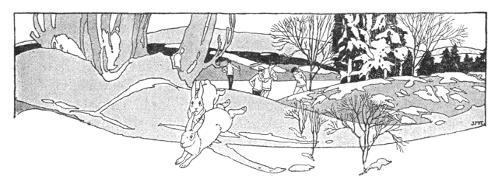
A blizzard on the prairie corresponds to a storm at sea; it never affects the traveler twice alike. Each norther seems to have a manner of attack all its own. One storm may be short, sharp, high-keyed, and malevolent, while another approaches slowly, relentlessly, wearing out the souls of its victims by its inexorable and long-continued cold and gloom. One threatens for hours before it comes, the other leaps like a tiger upon the defenseless settlement, catching the children unhoused, the men unprepared; of this character was the first blizzard Lincoln ever saw.
The day was warm and sunny. The eaves dripped musically, and the icicles dropping from the roof fell occasionally with pleasant crash. The snow grew slushy, and the bells of wood teams jingled merrily all the forenoon, as the farmers drove to their timber-lands five or six miles away. The room was uncomfortably warm at times, and the master opened the outside door. It was the eighth day of January. One afternoon recess, as the boys were playing in their shirt-sleeves, Lincoln called Milton’s attention to a great cloud rising in the west and north. A vast, slaty-blue, seamless dome, silent, portentous, with edges of silvery frosty light.
“It’s going to storm,” said Milton. “It always does when we have a south wind and a cloud like that in the west.”
When Lincoln set out for home, the sun was still shining, but the edge of the cloud had crept, or more properly slid, across the sun’s disk, and its light was growing cold and pale. In fifteen minutes more the wind from the south ceased—there was a moment of breathless pause, and then, borne on the wings of the north wind, the streaming clouds of soft, large flakes of snow drove in a level line over the homeward-bound scholars, sticking to their clothing and faces and melting rapidly. It was not yet cold enough to freeze, though the wind was colder. The growing darkness troubled Lincoln most.
By the time he reached home, the wind was a gale, the snow a vast blinding cloud, filling the air and hiding the road. Darkness came on instantly, and the wind increased in power, as though with the momentum of the snow. Mr. Stewart came home early, yet the breasts of his horses were already sheathed in snow. Other teamsters passed, breasting the storm, and calling cheerily to their horses. One team, containing a woman and two men, neighbors living seven miles north, gave up the contest, and turned in at the gate for shelter, confident that they would be able to go on in the morning. In the barn, while rubbing the ice from the horses, the men joked and told stories in a jovial spirit, with the feeling generally that all would be well by daylight. The boys made merry also, singing songs, popping corn, playing games, in defiance of the storm.
But when they went to bed, at ten o’clock, Lincoln felt some vague premonition of a dread disturbance of nature, far beyond any other experience in his short life. The wind howled like ten thousand tigers, and the cold grew more and more intense. The wind seemed to drive in and through the frail tenement; water and food began to freeze within ten feet of the fire.
Lincoln thought the wind at that hour had attained its utmost fury, but when he awoke in the morning, he saw how mistaken he had been. He crept to the fire, appalled by the steady, solemn, implacable clamor of the storm. It was like the roarings of all the lions of Africa, the hissing of a wilderness of serpents, the lashing of great trees. It benumbed his thinking, it appalled his heart, beyond any other force he had ever known.
The house shook and snapped, the snow beat in muffled, rhythmic pulsations against the walls, or swirled and lashed upon the roof, giving rise to strange, multitudinous sounds; now dim and far, now near and all-surrounding; producing an effect of mystery and infinite reach, as though the cabin were a helpless boat, tossing on an angry, limitless sea.
Looking out, there was nothing to be seen but the lashing of the wind and snow. When the men attempted to face it, to go to the rescue of the cattle, they found the air impenetrably filled with fine, powdery snow, mixed with the dirt caught up from the plowed fields by a terrific blast, moving ninety miles an hour. It was impossible to see twenty feet, except at long intervals. Lincoln could not see at all when facing the storm. When he stepped into the wind, his face was coated with ice and dirt, as by a dash of mud—a mask which blinded the eyes, and instantly froze to his cheeks. Such was the power of the wind that he could not breathe an instant unprotected. His mouth being once open, it was impossible to draw breath again without turning from the wind.
The day was spent in keeping warm and in feeding the stock at the barn, which Mr. Stewart reached by desperate dashes, during the momentary clearing of the air following some more than usually strong gust. Lincoln attempted to water the horses from the pump, but the wind blew the water out of the pail. So cold had the wind become that a dipperful, thrown into the air, fell as ice. In the house it became more and more difficult to remain cheerful, notwithstanding the family had fuel and food in abundance.
Oh, that terrible day! Hour after hour they listened to that prodigious, appalling, ferocious uproar. All day Lincoln and Owen moved restlessly to and fro, asking each other, “Won’t it ever stop?” To them the storm now seemed too vast; too ungovernable, to ever again be spoken to a calm, even by God Himself.
It seemed to Lincoln that no power whatever could control such fury; his imagination was unable to conceive of a force greater than this war of wind or snow.
On the third day the family rose with weariness, and looked into each other’s faces with a sort of horrified surprise. Not even the invincible heart of Duncan Stewart, nor the cheery good nature of his wife, could keep a gloomy silence from settling down upon the house. Conversation was scanty; nobody laughed that day, but all listened anxiously to the invisible tearing at the shingles, beating against the door, and shrieking around the eaves. The frost upon the windows, nearly half an inch thick in the morning, kept thickening into ice, and the light was dim at mid-day. The fire melted the snow on the window-panes and upon the door, while around the key-hole and along every crack, frost formed. The men’s faces began to wear a grim, set look, and the women sat with awed faces and downcast eyes full of unshed tears, their sympathies going out to the poor travelers, lost and freezing.
The men got to the poor dumb animals that day to feed them; to water them was impossible. Mr. Stewart went down through the roof of the shed, the door being completely sealed up with solid banks of snow and dirt. One of the guests had a wife and two children left alone in a small cottage six miles farther on, and physical force was necessary to keep him from setting out in face of the deadly tempest. To him the nights seemed weeks, and the days interminable, as they did to the rest, but it would have been death to venture out.
That night, so disturbed had all become, they lay awake listening, waiting, hoping for a change. About midnight Lincoln noticed that the roar was no longer so steady, so relentless, and so high-keyed as before. It began to lull at times, and though it came back to the attack with all its former ferocity, still there was a perceptible weakening. Its fury was becoming spasmodic. One of the men shouted down to Mr. Stewart, “The storm is over,” and when the host called back a ringing word of cheer, Lincoln sank into deep sleep in sheer relief.
Oh, the joy with which the children melted the ice on the window-panes, and peered out on the familiar landscape, dazzling, peaceful, under the brilliant sun and wide blue sky. Lincoln looked out over the wide plain, ridged with vast drifts; on the far blue line of timber, on the near-by cottages sending up cheerful columns of smoke (as if to tell him the neighbors were alive), and his heart seemed to fill his throat. But the wind was with him still, for so long and continuous had its voice sounded in his ears, that even in the perfect calm his imagination supplied its loss with fainter, fancied roarings.
Out in the barn the horses and cattle, hungry and cold, kicked and bellowed in pain, and when the men dug them out, they ran and raced like mad creatures, to start the blood circulating in their numbed and stiffened limbs. Mr. Stewart was forced to tunnel to the barn door, cutting through the hard snow as if it were clay. The drifts were solid, and the dirt mixed with the snow was disposed on the surface in beautiful wavelets, like the sands at the bottom of a lake. The drifts would bear a horse. The guests were able to go home by noon, climbing above the fences, and rattling across the plowed ground.
And then in the days which followed, came grim tales of suffering and heroism. Tales of the finding of stage-coaches with the driver frozen on his seat and all his passengers within; tales of travelers striving to reach home and families. Cattle had starved and frozen in their stalls, and sheep lay buried in heaps beside the fences where they had clustered together to keep warm. These days gave Lincoln a new conception of the prairies. It taught him that however bright and beautiful they might be in summer under skies of June, they could be terrible when the Norther was abroad in his wrath. They seemed now as pitiless and destructive as the polar ocean. It seemed as if nothing could live there unhoused. All was at the mercy of that power, the north wind, whom only the Lord Sun could tame.
This was the worst storm of the winter, though the wind seemed never to sleep. To and fro, from north to south, and south to north, the dry snow sifted till it was like fine sand that rolled under the heel with a ringing sound on cold days. After each storm the restless wind got to work to pile the new-fallen flakes into ridges behind every fence or bush, filling every ravine and forcing the teamsters into the fields and out on to the open prairie. It was a savage and gloomy time for Lincoln, with only the pleasure of his school to break the monotony of cold.
NOTES AND QUESTIONS
Biography. Hamlin Garland (1860-⸺) was born in Wisconsin. His father was a farmer-pioneer, who, always eager to be upon the border line of agricultural development, moved from Wisconsin to Minnesota, from Minnesota to Iowa, and from Iowa to Dakota. The hope of cheaper acres, better soil, and bigger crops lured him on.
When Hamlin Garland turned his attention to literature he was keen enough to see the literary value of his early experiences. He resolved to interpret truthfully the life of the western farmer and its great hardships and limitations, no less than its hopes, joys, and achievements. In doing this, through a succession of short stories and novels, he won fame and success. In A Son of the Middle Border, an autobiography, he has written an intensely interesting and valuable record of typical experiences in the development of the Middle West. This selection is taken from Boy Life on the Prairie.
Discussion. 1. What distinguishes a blizzard from other violent storms? 2. What are the dangers when it comes without ample warning? 3. What was the manner of attack of this blizzard? 4. What caused the early darkness? 5. What was it in the storm that “appalled” the boy’s heart and “benumbed his thinking”? 6. What effect had it upon other members of the household? 7. Has man any power to oppose the violence of such a storm? 8. What was the velocity of the wind? 9. How long did the blizzard last? How did it compare in this respect with the ordinary blizzard? 10. What name was given it because of its force, fury, and duration? 11. What results of the storm proved its violence? 12. What new idea of the prairie did the storm give the boy Lincoln? 13. Pronounce the following: recess; infinite; columns; calm; heroism; implacable.
Phrases
defenseless settlement, 69, 7
dripped musically, 69, 10
seamless dome, 70, 1
breathless pause, 70, 9
sheathed in snow, 70, 19
vague premonition, 70, 30
dread disturbance, 70, 30
implacable clamor, 71, 1
rhythmic pulsations, 71, 5
multitudinous sounds, 71, 7
invisible tearing, 72, 9
perceptible weakening, 72, 33
becoming spasmodic, 72, 33
monotony of cold, 74, 4
THE FROST
HANNAH F. GOULD
The Frost looked forth on a still, clear night, And whispered, “Now, I shall be out of sight; So, through, the valley, and over the height, In silence I’ll take my way. I will not go on like that blustering train, The wind and the snow, the hail and the rain, That make such a bustle and noise in vain; But I’ll be as busy as they!” So he flew to the mountain, and powdered its crest; He lit on the trees, and their boughs he dressed With diamonds and pearls; and over the breast Of the quivering lake, he spread A coat of mail, that it need not fear The glittering point of many a spear Which he hung on its margin, far and near, Where a rock could rear its head. He went to the window of those who slept, And over each pane like a fairy crept; Wherever he breathed, wherever he stepped, By the morning light were seen Most beautiful things!—there were flowers and trees, There were bevies of birds and swarms of bees; There were cities and temples and towers; and these All pictured in silvery sheen! But he did one thing that was hardly fair— He peeped in the cupboard, and finding there That all had forgotten for him to prepare, “Now, just to set them a-thinking, I’ll bite this basket of fruit,” said he, “And this costly pitcher I’ll burst in three! And the glass of water they’ve left for me, Shall ‘tchick’ to tell them I’m drinking.”
NOTES AND QUESTIONS
Biography. Hannah F. Gould (1789-1865) was an American poet, born at Lancaster, Mass. At the age of eleven she removed with her parents to Newburyport, Mass., where she lived the rest of her life. A collection of her poems, entitled Hymns and Poems for Children, contains many beautiful selections.
Discussion. 1. Why does the poet personify “The Frost”? 2. What pictures do the following give you: “powdered its crest”; “their boughs he dressed”? 3. What picture of the window pane does stanza 3 give you? 4. Which line tells you on what kind of night to expect frost?
Phrases
blustering train, 75, 5
in vain, 75, 7
hung on its margin, 75, 15
burst in three, 76, 3
THE FROST SPIRIT
JOHN GREENLEAF WHITTIER
He comes—he comes—the Frost Spirit comes! You may trace his footsteps now On the naked woods and the blasted fields and the brown hill’s withered brow. He has smitten the leaves of the gray old trees where their pleasant green came forth, And the winds, which follow wherever he goes, have shaken them down to earth. He comes—he comes—the Frost Spirit comes!—from the frozen Labrador— From the icy bridge of the Northern seas, which the white bear wanders o’er— Where the fisherman’s sail is stiff with ice, and the luckless forms below In the sunless cold of the lingering night into marble statues grow! He comes—he comes—the Frost Spirit comes!—on the rushing Northern blast, And the dark Norwegian pines have bowed as his fearful breath went past. With an unscorched wing he has hurried on, where the fires of Hecla glow On the darkly beautiful sky above and the ancient ice below. He comes—he comes—the Frost Spirit comes!—and the quiet lake shall feel The torpid touch of his glazing breath, and ring to the skater’s heel; And the streams which danced on the broken rocks, or sang to the leaning grass, Shall bow again to their winter chain, and in mournful silence pass. He comes—he comes—the Frost Spirit comes!—let us meet him as we may, And turn with the light of the parlor-fire his evil power away; And gather closer the circle round, when that fire-light dances high, And laugh at the shriek of the baffled Fiend as his sounding wing goes by!
NOTES AND QUESTIONS
For Biography, see page 60.
Discussion. 1. Why does the poet personify “The Frost Spirit”? 2. Why is “Fiend” personified? 3. How can one “trace his footsteps” on woods and fields? 4. Locate on a map Labrador, the pine region of Norway, and the volcano of Hecla. 5. What is “the icy bridge of the northern seas”? 6. What are “the luckless forms below”? 7. Why does the poet say “In the sunless cold of the lingering night”? 8. What does the poet mean by “the shriek of the baffled Fiend”?
Phrases
blasted fields, 76, 2
luckless forms, 77, 1
sunless cold, 77, 2
fearful breath, 77, 4
unscorched wing, 77, 5
ancient ice, 77, 6
torpid touch, 77, 8
glazing breath, 77, 8
THE SNOW STORM
RALPH WALDO EMERSON
Announced by all the trumpets of the sky Arrives the snow, and, driving o’er the fields, Seems nowhere to alight; the whited air Hides hills and woods, the river and the heaven, And veils the farmhouse at the garden’s end. The steed and traveler stopped, the courier’s feet Delayed, all friends shut out, the housemates sit Around the radiant fireplace, enclosed In a tumultuous privacy of storm. Come, see the north wind’s masonry. Out of an unseen quarry evermore Furnished with tile, the fierce artificer Curves his white bastions with projected roof Round every windward stake, or tree, or door. Speeding, the myriad-handed, his wild work So fanciful, so savage, naught cares he For number or proportion. Mockingly On coop or kennel he hangs Parian wreaths; A swan-like form invests the hidden thorn; Fills up the farmer’s lane from wall to wall, Mauger the farmer’s sighs, and at the gate A tapering turret overtops the work. And when his hours are numbered, and the world Is all his own, retiring, as he were not, Leaves, when the sun appears, astonished Art To mimic in slow structures, stone by stone, Built in an age, the mad wind’s night-work, The frolic architecture of the snow.
NOTES AND QUESTIONS
Biography. Ralph Waldo Emerson (1803-1882) was a native of Boston, born not far from Franklin’s birthplace. He was the oldest among that brilliant group of New England scholars and writers that developed under the influence of Harvard College. Emerson was a quiet boy, but that he had high ambitions and sturdy determination is shown by the fact that he worked his own way through college. He is best known for his essays, full of noble ideas and wise philosophy, but he also wrote poetry. As a poet he was careless of his meter, making his lines often purposely rugged, but they are always charged and bristling with thoughts that shock and thrill like electric batteries. In 1836 he wrote the “Concord Hymn” containing the famous lines:
“Here once the embattled farmers stood And fired the shot heard round the world!”
His poems of nature are clear-cut and vivid as snapshots. “The Humble Bee,” as a critic puts it, “seems almost to shine with the heat and light of summer.”
Discussion. 1. Picture the scene described in the first five lines. 2. Compare with the picture given you in the first stanza of “Snow-Flakes,” page 80. 3. Read in a way to bring out the contrast between the wild storm and the scene within the “farmhouse at the garden’s end.” 4. What is meant by “fierce artificer”? 5. What is the “tile” with which the poet imagines the “unseen quarry” is furnished? 6. Of what are the “white bastions” made? 7. Does the use of the word “windward” add to the picture and does such detail add to the beauty of the poem or detract from it? 8. Who is described as “myriad-handed”? 9. What is the mockery in hanging “Parian wreaths” on a coop or kennel? 10. What picture do lines 20, 21, and 22 give you? 11. What does the “mad wind’s night-work” do for Art?
Phrases
courier’s feet delayed, 78, 6
radiant fireplace, 78, 8
tumultuous privacy, 78, 9
north wind’s masonry, 78, 10
myriad-handed, 78, 15
Parian wreaths, 78, 18
tapering turret, 78, 22
hours are numbered, 78, 23
slow structures, 79, 2
frolic architecture, 79, 4
SNOWFLAKES
HENRY WADSWORTH LONGFELLOW
Out of the bosom of the Air, Out of the cloud-folds of her garments shaken Over the woodlands brown and bare, Over the harvest-fields forsaken, Silent, and soft, and slow, Descends the snow. Even as our cloudy fancies take Suddenly shape in some divine expression, Even as the troubled heart doth make In the white countenance confession, The troubled sky reveals The grief it feels. This is the poem of the air, Slowly in silent syllables recorded; This is the secret of despair, Long in its cloudy bosom hoarded, Now whispered and revealed To wood and field.
NOTES AND QUESTIONS
Biography. Henry Wadsworth Longfellow (1807-1882) was born in Portland, Maine. In “The Courtship of Miles Standish” he has made us acquainted with his ancestors, John Alden and Priscilla Mullens, passengers on the Mayflower.
Longfellow’s education was obtained in Portland and at Bowdoin College, where he had for classmates several youths who afterward became famous, notably, Nathaniel Hawthorne and Franklin Pierce. Upon Longfellow’s graduation, the trustees of the college, having decided to establish a chair of modern languages, proposed that this young graduate should fit himself for the position. Three years, therefore, he spent in delightful study and travel in France, Spain, Italy, and Germany. Here was laid the foundation for his scholarship, and, as in Irving on his first European trip, there was kindled that passion for romantic lore which followed him through life and which gave direction to much of his work. He mastered the language of each country visited, in a remarkably short time, and many of the choicer poems found in these languages he has given to us in English. After five years at Bowdoin, Longfellow was invited in 1834 to the chair of modern languages in Harvard College. Again he was given an opportunity to prepare himself by a year of study abroad. In 1836 he began his active work at Harvard and took up his residence in the historic Craigie House, overlooking the Charles River—a house in which Washington had been quartered for some months when he came to Cambridge in 1775 to take command of the Continental forces. Longfellow was thenceforth one of the most prominent members of that group of men including Sumner, Hawthorne, Agassiz, Lowell, and Holmes, who gave distinction to the Boston and Cambridge of earlier days.
For twenty years Longfellow served as a teacher, introducing hundreds of students to the literature of modern Europe. In his poetry, too, he exerted a powerful influence for bringing about a relationship between America and European civilization. He was thus a poet of culture, rendering a great service at a time when the thought of America was provincial. He was also a poet of the household, writing many poems about the joys and sorrows of home life, poems of aspiration and religious faith, poems about village characters as well as about national heroes. He excels, too, as a writer of tales in verse. “Evangeline,” a story of the Acadian exiles and their wanderings; “The Courtship of Miles Standish,” a story of early colonial life in Massachusetts; and “Hiawatha,” an Indian epic into which he put a vast amount of legendary matter belonging to the first owners of our country, are examples of his power in sustained verse narrative. His ballads, such as “The Skeleton in Armor” and “The Wreck of the Hesperus,” show his power to handle a legend in brief and stirring form. He was a writer of almost perfect sonnets, and a writer of prose of distinction. The most loved and most widely known of American poets, Longfellow helped to interpret our common life in terms of beauty.
Discussion. 1. What picture does the first stanza give you? 2. Compare this picture with that found in the first ten lines of “The Snow Storm,” page 78, and with that given in the third, fourth, and fifth stanzas of “Midwinter,” page 82. 3. To what does “her” refer in the second line? 4. Explain how “the troubled heart” makes “confession in the countenance.” 5. How does the poet fancy “the troubled sky” reveals its grief? 6. What is “the poem of the air”? 7. What are the “silent syllables” in which “the poem of the air” is recorded? 8. What is “whispered and revealed”?
Phrases
cloud-folds, 80, 2
cloudy fancies, 80, 7
secret of despair, 80, 15
cloudy bosom, 80, 16
MIDWINTER
JOHN T. TROWBRIDGE
The speckled sky is dim with snow, The light flakes falter and fall slow; Athwart the hilltop, rapt and pale, Silently drops a silvery veil; And all the valley is shut in By flickering curtains gray and thin. But cheerily the chickadee Singeth to me on fence and tree; The snow sails round him as he sings, White as the down on angels’ wings. I watch the snow flakes as they fall On bank and brier and broken wall; Over the orchard, waste and brown, All noiselessly they settle down, Tipping the apple boughs and each Light quivering twig of plum and peach. On turf and curb and bower roof The snowstorm spreads its ivory woof; It paves with pearl the garden walk; And lovingly round tattered stalk And shivering stem its magic weaves A mantle fair as lily leaves. The hooded beehive, small and low, Stands like a maiden in the snow; And an old door slab is half hid Under an alabaster lid. All day it snows; the sheeted post Gleams in the dimness like a ghost; All day the blasted oak has stood A muffled wizard of the wood; Garland and airy cap adorn The sumac and the wayside thorn, And clustering spangles lodge and shine In the dark tresses of the pine. The ragged bramble, dwarfed and old, Shrinks like a beggar in the cold; In surplice white the cedar stands, And blesses him with priestly hands. Still cheerily the chickadee Singeth to me on fence and tree; But in my inmost ear is heard The music of a holier bird; And heavenly thoughts as soft and white As snowflakes on my soul alight, Clothing with love my lonely heart, Healing with peace each bruiséd part, Till all my being seems to be Transfigured by their purity.
NOTES AND QUESTIONS
Biography. John Townsend Trowbridge (1827-1916) was an American author. His home was in Cambridge, Mass., within the shadow of Harvard College. At one time he was one of the editors of Our Young Folks’ Magazine. “Midwinter” and “Darius Green and His Flying Machine” are two of his poems most widely known.
Discussion. 1. Compare the picture that the first stanza gives you with that given you in the first stanza of “Snow-Flakes” and that given you by the first ten lines of “The Snow Storm.” 2. Compare the picture that the fourth stanza gives you with that given by lines 17-22 of “The Snow Storm.” 3. In the fourth stanza, what does the poet say the snowstorm does? 4. What does the poet mean by “muffled wizard of the wood”? 5. What pictures does the sixth stanza give you? 6. Which of these descriptions seems to you most apt? 7. What does the poet mean by “inmost ear”? 8. Compare this meaning with that of “inward eye” in Wordsworth’s “The Daffodils” and with “eyes in the heart” in Lowell’s “To the Dandelion.” 9. What do the “heavenly thoughts” suggested by the scene do for the poet?
Phrases
flickering curtains, 82, 6
ivory woof, 82, 18
paves with pearl, 82, 19
tattered stalk, 82, 20
shivering stem, 82, 21
alabaster lid, 82, 26
clustering spangles, 83, 7
surplice white, 83, 11
BLOW, BLOW, THOU WINTER WIND
WILLIAM SHAKESPEARE
Blow, blow, thou winter wind, Thou art not so unkind As man’s ingratitude; Thy tooth is not so keen Because thou art not seen, Although thy breath be rude. Heigh-ho! sing, heigh-ho! unto the green holly; Most friendship is feigning, most loving mere folly. Then heigh-ho! the holly! This life is most jolly. Freeze, freeze, thou bitter sky, Thou dost not bite so nigh As benefits forgot; Though thou the waters warp, Thy sting is not so sharp As friend remembered not. Heigh-ho! sing, heigh-ho! unto the green holly; Most friendship is feigning, most loving mere folly. Then heigh-ho! the holly! This life is most jolly.
NOTES AND QUESTIONS
Biography. William Shakespeare (1564-1616) was the greatest English poet, and was one of the greatest poets the world has ever known. He wrote for all times and all peoples. He was born at Stratford-on-Avon, where fifty-two years later he died. At the age of twenty-two he removed to London, where for twenty years he wrote poems and plays, was an actor, and later a shareholder in the theater. The last six years of his life he spent quietly at Stratford.
This song is from the comedy As You Like It, a story of the adventures of a group of courtiers and rustics in the forest of Arden. A charming element in Shakespeare’s romantic comedies is the introduction of song-poems or lyrics. All the writers of those days, the days of Good Queen Bess, wrote songs. England was “a nest of singing birds.” They were real songs, too, filled with joy and musical language, and all the people sang them to the accompaniment of the quaint musical instruments of the time. And all the people took part in games and pageants in “Merrie England,” and listened to the strange tales of seafarers, and went to the playhouse to see Shakespeare’s As You Like It.
Discussion. 1. Why is the thought of green holly appropriate in connection with the winter wind? 2. What feeling does ingratitude arouse? 3. Why does the poet say the “tooth” of the wind is not so keen as man’s ingratitude? 4. What change of feeling do you notice after line 6? 5. What do you think caused the change? 6. In the second stanza read lines that show the poet did not really think that “life is most jolly.” 7. Which lines explain the poet’s distrust of friendship? 8. Which word in stanza I is explained by line 3 of stanza 2? 9. Find a word in stanza 1 that gives the same thought as the second line of the second stanza. 10. Give the meaning of “warp” in stanza 2 (an old Saxon proverb said, “Winter shall warp water”).
Phrases
benefits forgot, 84, 13
friendship is feigning, 84, 18
WHEN ICICLES HANG BY THE WALL
WILLIAM SHAKESPEARE
When icicles hang by the wall, And Dick the shepherd blows his nail, And Tom bears logs into the hall, And milk comes frozen home in pail, When blood is nipp’d, and ways be foul, Then nightly sings the staring owl, Tu-whit; Tu-who—a merry note, While greasy Joan doth keel the pot. When all aloud the wind doth blow, And coughing drowns the parson’s saw, And birds sit brooding in the snow. And Marian’s nose looks red and raw, When roasted crabs hiss in the bowl, Then nightly sings the staring owl, Tu-whit; Tu-who—a merry note, While greasy Joan doth keel the pot.
NOTES AND QUESTIONS
For Biography, see page 85.
This is the second part of a song of four stanzas, found in the comedy Love’s Labor’s Lost. The first two stanzas are descriptive of spring, and introduce the song of the cuckoo. The last two stanzas are given here.
Discussion. 1. Do these lines describe life in the city or in the country? 2. What does the use of names, Dick, Tom, Joan, and Marian, add to the poem? 3. For what use were logs brought into the hall? 4. Can you see fitness in the use of the word “greasy”? 5. What is the song of the owl? 6. Explain the second line of stanza 2. 7. Why is the owl called “staring”?
Phrases
blows his nail, 85, 2
ways be foul, 85, 5
staring owl, 86, 1
keel the pot, 86, 4
parson’s saw, 86, 6
brooding in the snow, 86, 7