PART III IDEALS AND HEROES OF FREEDOM (continued 2)
Reading edition
But to return to the fight, the Spanish ships which attempted to board the Revenge, as they were wounded and beaten off, so always others came in their places, she having never less than two mighty galleons by her sides and aboard her. So that ere the morning from three of the clock the day before, there had fifteen several armados assailed her; and all so ill approved their entertainment, as they were by the break of day far more willing to hearken to a composition than hastily to make any more assaults or entries. But as the day increased so our men decreased; and as the light grew more and more, by so much more grew our discomforts. For none appeared in sight but enemies, saving one small ship called the Pilgrim, commanded by Jacob Whiddon, who hovered all night to see the success; but in the morning was hunted like a hare among many ravenous hounds, but escaped.
All the powder of the Revenge to the last barrel was now spent, all her pikes broken, forty of her best men slain, and the most part of the rest hurt. In the beginning of the fight she had but one hundred free from sickness, and fourscore and ten sick. A small troop to man such a ship, and a weak garrison to resist so mighty an army! By those hundred all was sustained, the volleys, boardings, and enterings of fifteen ships of war. On the contrary the Spanish were always supplied with soldiers brought from every squadron, all manner of arms and powder at will. Unto ours there remained no comfort at all, no hope, no supply either of ships, men, or weapons; the masts all beaten overboard, all her tackle cut asunder, her upper work altogether razed; and, in effect, even she was with the water, but the very foundation or bottom of a ship, nothing being left overhead either for flight or defense.
Sir Richard finding himself in this distress, and unable any longer to make resistance, having endured in this fifteen hours’ fight the assault of fifteen several armados, all by turns aboard him, and by estimation eight hundred shot of great artillery, besides many assaults and entries, and that himself and the ship must needs be possessed by the enemy, who were now cast in a ring round about him, the Revenge not able to move one way or other but as she was moved by the waves and billows of the sea—commanded the master gunner, whom he knew to be a most resolute man, to split and sink the ship, that thereby nothing might remain of glory or victory to the Spaniards, seeing in so many hours’ fight and with so great a navy, they were not able to take her, having had fifteen hours’ time, fifteen thousand men, and fifty and three sail of men-of-war to perform it withal; and persuaded the company, or as many as he could induce, to yield themselves unto God, and to the mercy of none else, but, as they had, like valiant resolute men, repulsed so many enemies, they should not now shorten the honor of their nation by prolonging their own lives for a few hours or a few days.
The master gunner readily condescended, and divers others. But the Captain and the Master were of another opinion and besought Sir Richard to have care of them, alleging that the Spaniard would be as ready to entertain a composition as they were willing to offer the same, and that there being divers sufficient and valiant men yet living, and whose wounds were not mortal, they might do their country and prince acceptable service hereafter.
And as the matter was thus in dispute, and Sir Richard refusing to hearken to any of those reasons, the Master of the Revenge (while the Captain won unto him the greater party) was convoyed aboard the General Don Alfonso Bassan. Who, finding none over hasty to enter the Revenge again, doubting lest Sir Richard would have blown them up and himself, and perceiving by the report of the Master of the Revenge his dangerous disposition, yielded that all their lives should be saved. To this he so much the rather condescended, as well, as I have said, for fear of further loss and mischief to themselves, as also for the desire he had to recover Sir Richard Grenville; whom for his notable valor he seemed greatly to honor and admire.
When this answer was returned, and that safety of life was promised, the common sort being now at the end of their peril, the most drew back from Sir Richard and the gunner, it being no hard matter to dissuade men from death to life. The master gunner finding himself and Sir Richard thus prevented and mastered by the greater number, would have slain himself with a sword had he not been by force withheld and locked into his cabin. Then the General sent many boats aboard the Revenge, and divers of our men, fearing Sir Richard’s disposition, stole away aboard the General and other ships. Sir Richard, thus overmatched, was sent unto by Alfonso Bassan to remove out of the Revenge, the ship being marvelous unsavory, filled with blood and bodies of dead and wounded men like a slaughter-house. Sir Richard answered that he might do with his body what he list, for he esteemed it not; and as he was carried out of the ship he swooned, and reviving again desired the company to pray for him. The General used Sir Richard with all humanity, and left nothing unattempted that tended to his recovery, highly commending his valor and worthiness and greatly bewailed the danger wherein he was, being unto them a rare spectacle, to see one ship turn toward so many enemies, to endure the charge and boarding of so many huge armados, and to resist and repel the assaults and entries of so many soldiers.
Sir Richard died, as it is said, the second or third day aboard the General, and was by them greatly bewailed. What became of his body, whether it was buried in the sea or on the land we know not; the comfort that remaineth to his friends is that he hath ended his life honorably in respect of the reputation won to his nation and country, and of the same to his posterity, and that, being dead, he hath not outlived his own honor.
—Abridged.
NOTES AND QUESTIONS
Biographical and Historical Note. In the autumn of 1591 a small fleet of English vessels lay at the Azores to intercept the Spanish treasure ships from the Indies. On the appearance of the Spanish war-vessels sent to convoy the treasure ships, the much smaller English fleet took flight with the exception of the Revenge, commanded by Sir Richard Grenville. Lord Bacon described the fight as “a defeat exceeding victory.”
This story of the fight of the Revenge was written by Sir Walter Raleigh (1552-1618), a cousin of Grenville’s. He was an English explorer, colonizer, and historian. He planted the first English colony in America, on Roanoke Island, off the coast of North Carolina. Later, he was interested in an attempt to form a colony in Guiana, and his account of his experiences is one of the most thrilling adventure stories in the world. His daring exploits made him a favorite at the court of Queen Elizabeth, but after her death he gained the ill-will of James I and was executed on a false charge of piracy and treason.
Discussion. 1. Describe the English fleet as it lay anchored near Flores. 2. What was the condition of the men on the Revenge and the Bonaventure? 3. What two things could Sir Richard do? 4. Which did he choose? Why? 5. How were the Spanish ships manned as compared with the English? 6. What quality of character did Sir Richard show in his treatment of the George Noble? 7. Describe the condition of the Revenge on the second day of the fighting. 8. What was Sir Richard’s order to the master gunner? 9. What was the opinion of the captain and the Master? 10. What do you think about the reasons they gave? 11. What was the Spaniard’s offer? 12. Would you have been on the side of the captain and the Master of the Revenge, or on the side of Sir Richard and the master gunner? 13. Pronounce the following: Armada; Azores; becalmed; tiers; bade; hovered; ravenous; dissuade.
Phrases
providing ballast, 330, 9
shrouded their approach, 331, 5
weigh their anchors, 331, 8
puissant ship, 331, 27
hearken to a composition, 332, 35
tackle cut asunder, 333, 17
divers sufficient, 334, 7
he esteemed it not, 334, 36
YE MARINERS OF ENGLAND
THOMAS CAMPBELL
Ye Mariners of England, That guard our native seas, Whose flag has braved, a thousand years, The battle and the breeze! Your glorious standard launch again To match another foe, And sweep through the deep, While the stormy winds do blow; While the battle rages loud and long, And the stormy winds do blow. The spirits of your fathers Shall start from every wave!— For the deck it was their field of fame, And Ocean was their grave. Where Blake and mighty Nelson fell, Your manly hearts shall glow, As ye sweep through the deep, While the stormy winds do blow; While the battle rages loud and long And the stormy winds do blow. Britannia needs no bulwarks, No towers along the steep; Her march is o’er the mountain-waves, Her home is on the deep. With thunders from her native oak She quells the floods below, As they roar on the shore, When the stormy winds do blow; When the battle rages loud and long And the stormy winds do blow. The meteor flag of England Shall yet terrific burn; Till danger’s troubled night depart, And the star of peace return. Then, then, ye ocean-warriors! Our song and feast shall flow To the fame of your name, When the storm has ceased to blow; When the fiery fight is heard no more, And the storm has ceased to blow.
NOTES AND QUESTIONS
For Biography, see page 180.
Discussion. 1. Which stanza refers to the present; which one to the past; and which one to the future? 2. Why does the poet take this view into the past and the future? 3. Notice the interesting rime in the seventh line of every stanza. 4. Compare the eighth, ninth, and tenth lines of the fourth stanza with the corresponding lines in the other stanzas. 5. Notice the pleasing effect which the poet produces by using, in one line, several words beginning with the same letter: “battle,” “breeze,” “loud and long.” 6. Find other examples. 7. Show that this poem, written long after Sir Richard Grenville’s death, expresses the spirit in which he fought.
Phrases
glorious standard, 336, 5
field of fame, 336, 13
meteor flag, 337, 11
danger’s troubled night, 337, 13
star of peace, 337, 14
ocean-warriors, 337, 15
ENGLAND AND AMERICA NATURAL ALLIES
JOHN RICHARD GREEN
Whatever might be the importance of American independence in the history of England, it was of unequaled moment in the history of the world. If it crippled for a while the supremacy of the English nation, it founded the supremacy of the English race. From the hour of American Independence the life of the English people has flowed not in one current, but in two; and while the older has shown little signs of lessening, the younger has fast risen to a greatness which has changed the face of the world. In 1783 America was a nation of three millions of inhabitants, scattered thinly along the coast of the Atlantic Ocean. It is now [1877] a nation of forty millions, stretching over the whole continent from the Atlantic to the Pacific. In wealth and material energy, as in numbers, it far surpasses the mother-country from which it sprang. It is already the main branch of the English people; and in the days that are at hand the main current of that people’s history must run along the channel not of the Thames or the Mersey, but of the Hudson and the Mississippi.
But distinct as these currents are, every year proves more clearly that in spirit the English people are one. The distance that parted England from America lessens every day. The ties that unite them grow every day stronger. The social and political differences that threatened a hundred years ago to form an impassable barrier between them grow every day less. Against this silent and inevitable drift of things the spirit of narrow isolation on either side the Atlantic struggles in vain. It is possible that the two branches of the English people will remain forever separate political existences. It is likely enough that the older of them may again break in twain, and that the English people in the Pacific may assert as distinct a national life as the two English peoples on either side the Atlantic. But the spirit, the influence, of all these branches will remain one.
And in thus remaining one, before half a century is over it will change the face of the world. As two hundred millions of Englishmen fill the valley of the Mississippi, as fifty millions of Englishmen assert their lordship over Australasia, this vast power will tell through Britain on the old world of Europe, whose nations will have shrunk into insignificance before it. What the issues of such a world-wide change may be, not even the wildest dreamer would dare to dream. But one issue is inevitable. In the centuries that lie before us, the primacy of the world will lie with the English people. English institutions, English speech, English thought, will become the main features of the political, the social, and the intellectual life of mankind.
NOTES AND QUESTIONS
Biography. John Richard Green (1837-1883) was born at Oxford, England. In his early life he entered the ministry and became not only an eloquent preacher, but an effective worker among his parishioners. Ill health caused him to resign and devote his time entirely to writing. He was a noted English historian, the author of A History of the English People and The Making of England. His vivid imagination enabled him to picture the life of the people and to make history interesting and popular.
Discussion. 1. What do you think of the reasoning in the first paragraph? 2. What victory was there in the political defeat of the British government? 3. How is the distance between England and America lessened today? 4. How are the ties between the two countries being strengthened? 5. What does the author hint at in the last part of the second paragraph? 6. What do you think of the prophecy in the first sentence of the last paragraph? 7. Is his dream any nearer reality today than when the author wrote these lines? 8. Pronounce the following: Thames; isolation; inevitable; primacy.
Phrases
unequaled moment, 338, 2
material energy, 338, 12
impassable barrier, 338, 23
inevitable drift, 338, 24
narrow isolation, 338, 24
political existences, 338, 27
assert their lordship, 339, 3
one issue is inevitable, 339, 7
primacy of the world, 339, 8
English institutions, 339, 9
ENGLAND AND AMERICA IN 1782
ALFRED, LORD TENNYSON
O Thou, that sendest out the man To rule by land and sea, Strong mother of a Lion-line, Be proud of those strong sons of thine Who wrench’d their rights from thee! What wonder, if in noble heat Those men thine arms withstood, Re-taught the lesson thou hadst taught, And in thy spirit with thee fought— Who sprang from English blood! But Thou rejoice with liberal joy, Lift up thy rocky face, And shatter, when the storms are black, In many a streaming torrent back, The seas that shock thy base! Whatever harmonies of law The growing world assume, Thy work is thine—the single note From that deep chord which Hampden smote Will vibrate to the doom.
NOTES AND QUESTIONS
For Biography, see page 49.
Historical Note. John Hampden (1594-1643) was a celebrated English statesman and patriot. When Charles I attempted to impose a tax upon his subjects without the authority of Parliament, Hampden refused to pay. The King’s government brought suit against him, and although the case was decided against Hampden, later the House of Lords ordered the judgment of the court to be canceled.
Discussion. 1. Why does the poet think England should be proud of America? 2. Name some of the rights won by those of “English blood” before this. 3. Read the lines that tell, in figurative language, what England and Englishmen will do when their rights are attacked. 4. Notice in the last stanza how the words harmonies, note, chord, smote, and vibrate all help to carry out the thought, expressed in figurative language. 5. What was the “chord which Hampden smote”? 6. Is it still “vibrating”? 7. Did the poet use the same riming scheme in each of the stanzas?
Phrases
strong mother of a Lion-line, 340, 3
wrench’d their rights, 340, 5
in noble heat, 340, 6
thine arms withstood, 340, 7
re-taught the lesson thou hadst taught, 340, 8
thy rocky face, 340, 12
harmonies of law, 340, 16
ENGLAND TO FREE MEN
JOHN GALSWORTHY
Men of my blood, you English men! From misty hill and misty fen, From cot, and town, and plow, and moor. Come in—before I shut the door! Into my courtyard paved with stones That keep the names, that keep the bones, Of none but English men who came Free of their lives, to guard my fame. I am your native land who bred No driven heart, no driven head; I fly a flag in every sea Round the old Earth, of Liberty! I am the Land that boasts a crown; The sun comes up, the sun goes down— And never men may say of me, Mine is a breed that is not free. I have a wreath! My forehead wears A hundred leaves—a hundred years I never knew the words: “You must!” And shall my wreath return to dust? Freemen! The door is yet ajar; From northern star to southern star, O ye who count and ye who delve, Come in—before my clock strikes twelve!
NOTES AND QUESTIONS
Biography. John Galsworthy (1867-⸺) was born in Coombe, Surrey, England, and has led the life of the typical English gentleman. After spending five years at Harrow he went to Oxford University. In 1890 he was admitted to the bar, but he disliked the profession of law and never practiced it. He spent several years, after leaving college, in foreign travel, and did not begin to write until he was thirty years old. He has written a number of dramas dealing with social questions, such as “Justice” and “Strife.” He is also well-known for his short stories and novels. During the recent World War, Mr. Galsworthy served several months in an English hospital for French soldiers.
The poem “England to Free Men” was written when England was for the first time about to adopt conscription as a method of recruiting an army to oppose German aggression in Belgium and France.
Discussion. 1. Who is supposed to be speaking in this poem? 2. Whom does the speaker address? 3. Of what “courtyard” does the poet speak? 4. What is the meaning of the first two lines of the second stanza? 5. What kind of flag does the poet say England “flies in every sea”? 6. Explain the “wreath” mentioned in the last stanza. 7. What does the poet mean by “before my clock strikes twelve”? 8. What has been America’s attitude toward conscription? 9. What impression of the author do you gain from this poem? 10. Tell what you know of him.
Phrases
men of my blood, 341, 1
free of their lives, 341, 7
who bred no driven heart, 341, 9
that boasts a crown, 341, 13
the door is yet ajar, 342, 7
ye who delve, 342, 9
“MEN WHO MARCH AWAY” (Song of the Soldiers)
THOMAS HARDY
What of the faith and fire within us Men who march away Ere the barn-cocks say Night is growing gray, Leaving all that here could win us; What of the faith and fire within us Men who march away? Is it a purblind prank, O think you, Friend with the musing eye, Who watch us stepping by With doubt and dolorous sigh? Can much pondering so hoodwink you! Is it a purblind prank, O think you, Friend with the musing eye? Nay. We well see what we are doing, Though some may not see, Dalliers as they be; England’s need are we; Her distress would leave us rueing: Nay. We well see what we are doing, Though some may not see! In our heart of hearts believing Victory crowns the just, And that braggarts must Surely bite the dust, Press we to the field ungrieving, In our heart of hearts believing Victory crowns the just. Hence the faith and fire within us Men who march away Ere the barn-cocks say Night is growing gray, Leaving all that here could win us; Hence the faith and fire within us Men who march away.
NOTES AND QUESTIONS
Biography. Thomas Hardy (1840-⸺) was born in Dorsetshire, England. He was educated at local schools and by private tutors. At the early age of sixteen he was apprenticed to an architect of Worcester, in which line of work he made sufficient success to win a prize for design from the Architectural Association. At the same time he was writing some verse and an occasional short story, and was at a loss to know which kind of work to follow for a profession. However, after 1870 he spent most of his time in writing. He excels as a short story writer, his “The Three Strangers” appearing in a number of lists of the one hundred best short stories. Among his other works, Laughing Stock and Other Verses, Under the Greenwood Tree, and A Pair of Blue Eyes are widely known. Mr. Hardy was given the Order of Merit in 1910. The Poem “Men Who March Away,” from Selected Poems of Thomas Hardy, was written at the time the English soldiers were entering the World War.
Discussion. 1. What “faith and fire” must the soldier have who freely enlists in the service of his country in war? 2. Whom does the poet address in the second stanza? 3. Use other words instead of “purblind prank.” 4. Explain the meaning of the fourth and fifth lines of the third stanza. 5. Why does the poet say the soldiers march away to war ungrieving? 6. What reason is given for the “faith and fire” of the soldiers? 7. In the fourth stanza, with what belief does the author accredit us? 8. What effect does the poet create by repeating the first stanza in closing the poem?
Phrases
the faith and fire within us, 343, 1
purblind prank, 343, 8
friend with the musing eye, 343, 9
dalliers as they be, 343, 17
bite the dust, 343, 25
to the field ungrieving, 343, 26
EARLY AMERICAN SPIRIT OF FREEDOM
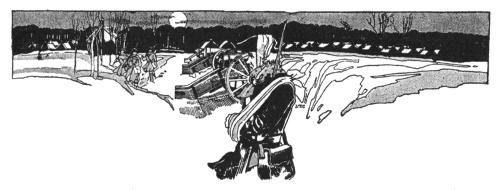
GRANDFATHER’S CHAIR
NATHANIEL HAWTHORNE
How New England Was Governed
The children had now learned to look upon the chair with an interest which was almost the same as if it were a conscious being and could remember the many famous people whom it had held within its arms.
Even Charley, lawless as he was, seemed to feel that this venerable chair must not be clambered upon or overturned, although he had no scruple in taking such liberties with every other chair in the house. Clara treated it with still greater reverence, often taking occasion to smooth its cushion and to brush the dust from the carved flowers and grotesque figures of its oaken back and arms. Laurence would sometimes sit a whole hour, especially at twilight, gazing at the chair and by the spell of his imagination summoning up its ancient occupants to appear in it again.
Little Alice evidently employed herself in a similar way, for once, when Grandfather had gone abroad, the child was heard talking with the gentle Lady Arbella as if she were still sitting in the chair. So sweet a child as little Alice may fitly talk with angels such as Lady Arbella had long since become.
Grandfather was soon importuned for more stories about the chair. He had no difficulty in relating them, for it really seemed as if every person noted in our early history had on some occasion or other found repose within its comfortable arms. If Grandfather took pride in anything, it was in being the possessor of such an honorable and historic elbow-chair.
“I know not precisely who next got possession of the chair after Governor Vane went back to England,” said Grandfather, “but there is reason to believe that President Dunster sat in it when he held the first commencement at Harvard College. You have often heard, children, how careful our forefathers were to give their young people a good education. They had scarcely cut down trees enough to make room for their own dwellings before they began to think of establishing a college. Their principal object was to rear up pious and learned ministers, and hence old writers call Harvard College a school of the prophets.”
“Is the college a school of the prophets now?” asked Charley.
“It is a long while since I took my degree, Charley. You must ask some of the recent graduates,” answered Grandfather. “As I was telling you, President Dunster sat in Grandfather’s chair in 1642 when he conferred the degree of bachelor of arts on nine young men. They were the first in America who had received that honor. And now, my dear auditors, I must confess that there are contradictory statements and some uncertainty about the adventures of the chair for a period of almost ten years. Some say that it was occupied by your own ancestor, William Hawthorne, first Speaker of the House of Representatives. I have nearly satisfied myself, however, that during most of this questionable period it was literally the chair of state. It gives me much pleasure to imagine that several successive governors of Massachusetts sat in it at the council board.”
“But, Grandfather,” interposed Charley, who was a matter-of-fact little person, “what reason have you to imagine so?”
“Pray do imagine it, Grandfather,” said Laurence.
“With Charley’s permission I will,” replied Grandfather, smiling. “Let us consider it settled, therefore, that Winthrop, Bellingham, Dudley, and Endicott, each of them, when chosen governor, took his seat in our great chair on Election day. In this chair, likewise, did those excellent governors preside while holding consultation with the chief councilors of the province, who were styled assistants. The governor sat in this chair, too, whenever messages were brought to him from the chamber of Representatives.”
And here Grandfather took occasion to talk rather tediously about the nature and forms of government that established themselves almost spontaneously in Massachusetts and the other New England colonies. Democracies were the natural growth of the new world. As to Massachusetts, it was at first intended that the colony should be governed by a council in London. But in a little while the people had the whole power in their own hands, and chose annually the governor, the councilors, and the representatives. The people of Old England had never enjoyed anything like the liberties and privileges which the settlers of New England now possessed. And they did not adopt these modes of government after long study, but in simplicity, as if there were no other way for people to be ruled.
“But, Laurence,” continued Grandfather, “when you want instruction on these points you must seek it in Mr. Bancroft’s History. I am merely telling the history of a chair. To proceed. The period during which the governors sat in our chair was not very full of striking incidents. The province was now established on a secure foundation, but it did not increase so rapidly as at first, because the Puritans were no longer driven from England by persecution. However, there was still a quiet and natural growth. The legislature incorporated towns and made new purchases of lands from the Indians. A very memorable event took place in 1643. The colonies of Massachusetts, Plymouth Connecticut, and New Haven formed a union for the purpose of assisting each other in difficulties, for mutual defense against their enemies. They called themselves the United Colonies of New England.”
“Were they under a government like that of the United States?” inquired Laurence.
“No,” replied Grandfather; “the different colonies did not compose one nation together; it was merely a confederacy among the governments. It somewhat resembled the league of the Amphictyons, which you remember in Grecian history. But to return to our chair. In 1644 it was highly honored, for Governor Endicott sat in it when he gave audience to an ambassador from the French governor of Acadia, or Nova Scotia. A treaty of peace between Massachusetts and the French colony was then signed.”
“Did England allow Massachusetts to make war and peace with foreign countries?” asked Laurence.
“Massachusetts and the whole of New England were then almost independent of the mother country,” said Grandfather. “There was now a civil war in England, and the King, as you may well suppose, had his hands full at home, and could pay but little attention to these remote colonies. When the Parliament got the power into their hands they likewise had enough to do in keeping down the Cavaliers. Thus New England, like a young and hardy lad whose father and mother neglect it, was left to take care of itself. In 1646, King Charles was beheaded. Oliver Cromwell then became Protector of England, and, as he was a Puritan himself and had risen by the valor of the English Puritans, he showed himself a loving and indulgent father to the Puritan colonies in America.”
Grandfather might have continued to talk in this dull manner nobody knows how long, but, suspecting that Charley would find the subject rather dry, he looked sidewise at that vivacious little fellow and saw him give an involuntary yawn. Whereupon Grandfather proceeded with the history of the chair, and related a very entertaining incident which will be found in the next chapter.
NOTES AND QUESTIONS
Biography. Nathaniel Hawthorne (1804-1864) was a master of the short story as a means for interpreting character. His ancestors were men of action—soldiers, seamen, and public officials. But he was unlike them; all his life he was a dreamer who loved solitude better than society. The subject of his dreaming was human character, particularly the character of the Puritan founders of New England. He told many legends of colonial times, some of them portraying the stern methods of Governor Endicott, or telling a humorous story of the Pine-Tree Shillings, or recounting the weird story of the old gray champion who defied Governor Andros. But besides these legends he wrote stories, visions of life in which one can scarcely draw the line between reality and illusion; stories of lovers who sought vainly for happiness; stories of a great stone face on the mountain side, and what it signified. Somewhat longer than these tales—Twice Told Tales he called them—are his romances, such as The Scarlet Letter, and The House of the Seven Gables. Besides his longer romances he popularized New England history in the form of stories for children. From one such book, Grandfather’s Chair, these stories have been taken.
Discussion. 1. What can you tell of the character of each of the children, Charley, Clara, Laurence, and Alice, from their treatment of the chair? 2. What interesting facts did you learn about Harvard College and President Dunster? 3. Mention some of the famous governors that sat in Grandfather’s chair. 4. What does Grandfather mean by saying that “democracies were the natural growth of the new world”? 5. Tell about the union known as the United Colonies of New England. 6. What famous governor sat in the chair in 1644? 7. What was the occasion? 8. Why was Oliver Cromwell friendly to the colonies? 9. State three interesting facts which you have learned regarding the government of New England. 10. Pronounce the following: grotesque; importuned; tediously; spontaneously; memorable; vivacious.
Phrases
a conscious being, 345, 2
venerable chair, 345, 6
grotesque figures, 345, 10
ancient occupants, 345, 13
took my degree, 346, 18
council board, 346, 31
striking incidents, 347, 24
league of the Amphictyons, 348, 2
gave audience, 348, 5
indulgent father, 348, 21
The Pine-tree Shillings
“According to the most authentic records, my dear children,” said Grandfather, “the chair about this time had the misfortune to break its leg. It was probably on account of this accident that it ceased to be the seat of the governors of Massachusetts, for, assuredly, it would have been ominous of evil to the commonwealth if the chair of state had tottered upon three legs. Being therefore sold at auction—alas! what a vicissitude for a chair that had figured in such high company!—our venerable friend was knocked down to a certain Captain John Hull. This old gentleman, on carefully examining the maimed chair, discovered that its broken leg might be clamped with iron and made as serviceable as ever.”
“Here is the very leg that was broken!” exclaimed Charley, throwing himself down on the floor to look at it. “And here are the iron clamps. How well it was mended!”
When they had all sufficiently examined the broken leg Grandfather told them a story about Captain John Hull and the Pine-tree Shillings.
The Captain John Hull aforesaid was the mint-master of Massachusetts, and coined all the money that was made there. This was a new line of business, for in the earlier days of the colony the current coinage consisted of gold and silver money of England, Portugal, and Spain. These coins being scarce, the people were often forced to barter their commodities instead of selling them.
For instance, if a man wanted to buy a coat, he perhaps exchanged a bear-skin for it. If he wished for a barrel of molasses, he might purchase it with a pile of pine boards. Musket-bullets were used instead of farthings. The Indians had a sort of money called wampum, which was made of clam-shells, and this strange sort of specie was likewise taken in payment of debts by the English settlers. Bank-bills had never been heard of. There was not money enough of any kind, in many parts of the country, to pay the salaries of the ministers, so that they sometimes had to take quintals of fish, bushels of corn, or cords of wood instead of silver or gold.
As the people grew more numerous and their trade one with another increased, the want of current money was still more sensibly felt. To supply the demand the general court passed a law for establishing a coinage of shillings, sixpences, and threepences. Captain John Hull was appointed to manufacture this money, and was to have about one shilling out of every twenty to pay him for the trouble of making them.
Hereupon all the old silver in the colony was handed over to Captain John Hull. The battered silver cans and tankards, I suppose, and silver buckles, and broken spoons, and silver buttons of worn-out coats, and silver hilts of swords that had figured at court—all such curious old articles were doubtless thrown into the melting-pot together. But by far the greater part of the silver consisted of bullion from the mines of South America, which the English buccaneers—who were little better than pirates—had taken from the Spaniards and brought to Massachusetts.
All this old and new silver being melted down and coined, the result was an immense amount of splendid shillings, sixpences, and threepences. Each had the date 1652 on the one side and the figure of a pine tree on the other. Hence they were called pine-tree shillings. And for every twenty shillings that he coined, you will remember, Captain John Hull was entitled to put one shilling into his own pocket.
The magistrates soon began to suspect that the mint-master would have the best of the bargain. They offered him a large sum of money if he would but give up that twentieth shilling which he was continually dropping into his own pocket. But Captain Hull declared himself perfectly satisfied with the shilling. And well he might be, for so diligently did he labor that in a few years his pockets, his money-bags, and his strong box were over-flowing with pine-tree shillings. This was probably the case when he came into possession of Grandfather’s chair; and, as he had worked so hard at the mint, it was certainly proper that he should have a comfortable chair to rest himself in.
When the mint-master had grown very rich, a young man, Samuel Sewell by name, came a-courting to his only daughter. His daughter—whose name I do not know, but we will call her Betsey—was a fine, hearty damsel, by no means so slender as some young ladies of our own days. On the contrary, having always fed heartily on pumpkin pies, doughnuts, Indian puddings, and other Puritan dainties, she was as round and plump as a pudding herself. With this round, rosy Miss Betsey did Samuel Sewell fall in love. As he was a young man of good character, industrious in his business, and a member of the church, the mint-master very readily gave his consent.
“Yes, you may take her,” said he, in his rough way, “and you’ll find her a heavy burden enough.”
On the wedding-day we may suppose that honest John Hull dressed himself in a plum-colored coat, all the buttons of which were made of pine-tree shillings. The buttons of his waistcoat were sixpences, and the knees of his small clothes were buttoned with silver threepences. Thus attired, he sat with great dignity in Grandfather’s chair, and, being a portly old gentleman, he completely filled it from elbow to elbow. On the opposite side of the room, between her bridesmaids, sat Miss Betsey. She was blushing with all her might, and looked like a full-blown peony or a great red apple.
There, too, was the bridegroom, dressed in a fine purple coat and gold-lace waistcoat, with as much other finery as the Puritan laws and customs would allow him to put on. His hair was cropped close to his head, because Governor Endicott had forbidden any man to wear it below the ears. But he was a very personable young man, and so thought the bridesmaids and Miss Betsey herself.
The mint-master also was pleased with his new son-in-law, especially as he had courted Miss Betsey out of pure love, and had said nothing at all about her portion. So, when the marriage ceremony was over, Captain Hull whispered a word to two of his men-servants, who immediately went out, and soon returned lugging in a large pair of scales. They were such a pair as wholesale merchants use for weighing bulky commodities, and quite a bulky commodity was now to be weighed in them.
“Daughter Betsey,” said the mint-master, “get into one side of these scales.”
Miss Betsey—or Mrs. Sewell, as we must now call her—did as she was bid, like a dutiful child, without any question of the why and wherefore. But what her father could mean, unless to make her husband pay for her by the pound (in which case she would have been a dear bargain), she had not the least idea.
“And now,” said honest John Hull to the servants, “bring that box hither.”
The box to which the mint-master pointed was a huge, square, iron-bound oaken chest; it was big enough, my children, for all four of you to play at hide-and-seek in. The servants tugged with might and main, but could not lift this enormous receptacle, and were finally obliged to drag it across the floor. Captain Hull, then took a key from his girdle, unlocked the chest, and lifted its ponderous lid. Behold! it was full to the brim of bright pine-tree shillings fresh from the mint, and Samuel Sewell began to think that his father-in-law had got possession of all the money in the Massachusetts treasury. But it was only the mint-master’s honest share of the coinage.
Then the servants, at Captain Hull’s command, heaped double handfuls of shillings into one side of the scales while Betsey remained in the other. Jingle, jingle, went the shillings as handful after handful was thrown in, till, plump and ponderous as she was, they fairly weighed the young lady from the floor.
“There, son Sewell!” cried the honest mint-master, resuming his seat in Grandfather’s chair, “take these shillings for my daughter’s portion. Use her kindly and thank Heaven for her. It is not every wife that’s worth her weight in silver.”
The children laughed heartily at this legend, and would hardly be convinced but that Grandfather had made it out of his own head. He assured them faithfully, however, that he had found it in the pages of a grave historian, and had merely tried to tell it in a somewhat funnier style. As for Samuel Sewell, he afterward became chief justice of Massachusetts.
“Well, Grandfather,” remarked Clara, “if wedding portions nowadays were paid as Miss Betsey’s was, young ladies would not pride themselves upon an airy figure, as many of them do.”
NOTES AND QUESTIONS
Discussion. 1. Describe bartering in the early colonial days. 2. When was the coinage of money established by law? 3. Who was the first mint master? 4. Upon what conditions did he manufacture the coins? 5. What do you think of Captain Hull’s bargain? 6. Where did the silver come from? 7. Describe the pine-tree shillings. 8. Tell the story of the romance between Betsey Hull and Samuel Sewell. 9. To what great position did Samuel Sewell attain? 10. Find out all you can about our government mints today. 11. Where are some of them located? 12. Where does the gold, silver, nickel, and copper come from? 13. Pronounce the following: authentic; ominous; specie.
Phrases
authentic records, 349, 1
ominous of evil, 349, 5
knocked down, 349, 9
current coinage, 350, 13
barter their commodities, 350, 15
strange sort of specie, 350, 21
English buccaneers, 351, 5
personable young man, 352, 16
bulky commodities, 352, 25
enormous receptacle, 353, 1
The Stamp Act
“Charley, my boy,” said Grandfather, “do you remember who was the last occupant of the chair?”
“It was Lieutenant-governor Hutchinson,” answered Charley. “Sir Francis Bernard, the new governor, had given him the chair instead of putting it away in the garret of the Province-house. And when we took leave of Hutchinson he was sitting by his fireside and thinking of the past adventures of the chair and of what was to come.”
“Very well,” said Grandfather, “and you recollect that this was in 1763 or thereabouts, at the close of the Old French War. Now, that you may fully comprehend the remaining adventures of the chair, I must make some brief remarks on the situation and character of the New England colonies at this period.”
So Grandfather spoke of the earnest loyalty of our fathers during the Old French War and after the conquest of Canada had brought that war to a triumphant close.
The people loved and reverenced the King of England even more than if the ocean had not rolled its waves between him and them, for at the distance of three thousand miles they could not discover his bad qualities and imperfections. Their love was increased by the dangers which they had encountered in order to heighten his glory and extend his dominion. Throughout the war the American colonists had fought side by side with the soldiers of Old England, and nearly thirty thousand young men had laid down their lives for the honor of King George. And the survivors loved him the better because they had done and suffered so much for his sake.
But there were some circumstances that caused America to feel more independent of England than at an earlier period. Canada and Acadia had now become British provinces, and our fathers were no longer afraid of the bands of French and Indians who used to assault them in old times. For a century and a half this had been the great terror of New England. Now the old French soldier was driven from the north forever. And even had it been otherwise, the English colonies were growing so populous and powerful that they might have felt fully able to protect themselves without any help from England.
There were thoughtful and sagacious men who began to doubt whether a great country like America would always be content to remain under the government of an island three thousand miles away. This was the more doubtful because the English Parliament had long ago made laws which were intended to be very beneficial to England at the expense of America. By these laws the colonists were forbidden to manufacture articles for their own use or to carry on trade with any nation but the English.
“Now,” continued Grandfather, “if King George III and his counselors had considered these things wisely, they would have taken another course than they did. But when they saw how rich and populous the colonies had grown, their first thought was how they might make more profit out of them than heretofore. England was enormously in debt at the close of the Old French War, and it was pretended that this debt had been contracted for the defense of the American colonies, and that therefore a part of it ought to be paid by them.”
“Why, this was nonsense!” exclaimed Charley. “Did not our fathers spend their lives, and their money too, to get Canada for King George?”
“True, they did,” said Grandfather, “and they told the English rulers so. But the King and his ministers would not listen to good advice. In 1765 the British Parliament passed a stamp act.”
“What was that?” inquired Charley.
“The stamp act,” replied Grandfather, “was a law by which all deeds, bonds, and other papers of the same kind were ordered to be marked with the king’s stamp, and without this mark they were declared illegal and void. Now, in order to get a blank sheet of paper with the king’s stamp upon it, people were obliged to pay threepence more than the actual value of the paper. And this extra sum of threepence was a tax and was to be paid into the king’s treasury.”
“I am sure threepence was not worth quarreling about!” remarked Clara.
“It was not for threepence, nor for any amount of money, that America quarreled with England,” replied Grandfather; “it was for a great principle. The colonists were determined not to be taxed except by their own representatives. They said that neither the King and Parliament nor any other power on earth had a right to take their money out of their pockets unless they freely gave it. And, rather than pay threepence when it was unjustly demanded, they resolved to sacrifice all the wealth of the country, and their lives along with it. They therefore made a most stubborn resistance to the stamp act.”
“That was noble!” exclaimed Laurence. “I understand how it was. If they had quietly paid the tax of threepence, they would have ceased to be freemen and would have become tributaries of England. And so they contended about a great question of right and wrong, and put everything at stake for it.”
“You are right, Laurence,” said Grandfather, “and it was really amazing and terrible to see what a change came over the aspect of the people the moment the English Parliament had passed this oppressive act. The former history of our chair, my children, has given you some idea of what a harsh, unyielding, stern set of men the old Puritans were. For a good many years back, however, it had seemed as if these characteristics were disappearing. But no sooner did England offer wrong to the colonies than the descendants of the early settlers proved that they had the same kind of temper as their forefathers. The moment before, New England appeared like a humble and loyal subject of the Crown; the next instant she showed the grim, dark features of an old king-resisting Puritan.”
Grandfather spoke briefly of the public measures that were taken in opposition to the stamp act. As this law affected all the American colonies alike, it naturally led them to think of consulting together in order to procure its repeal. For this purpose the legislature of Massachusetts proposed that delegates from every colony should meet in congress. Accordingly, nine colonies, both Northern and Southern, sent delegates to the city of New York.
“And did they consult about going to war with England?” asked Charley.
“No, Charley,” answered Grandfather; “a great deal of talking was yet to be done before England and America could come to blows. The Congress stated the rights and grievances of the colonists. They sent a humble petition to the King and a memorial to the Parliament beseeching that the stamp act might be repealed. This was all that the delegates had it in their power to do.”
“They might as well have stayed at home, then,” said Charley.
“By no means,” replied Grandfather. “It was a most important and memorable event, this first coming together of the American people by their representatives from the North and South. If England had been wise, she would have trembled at the first word that was spoken in such an assembly.”
These remonstrances and petitions, as Grandfather observed, were the work of grave, thoughtful, and prudent men. Meantime the young and hot-headed people went to work in their own way. It is probable that the petitions of Congress would have had little or no effect on the British statesmen if the violent deeds of the American people had not shown how much excited the people were. Liberty Tree was soon heard of in England.
“What was Liberty Tree?” inquired Clara.
“It was an old elm tree,” answered Grandfather, “which stood near the corner of Essex street, opposite the Boylston Market. Under the spreading branches of this great tree the people used to assemble whenever they wished to express their feelings and opinions. Thus, after a while it seemed as if the liberty of the country was connected with Liberty Tree.”
“It was glorious fruit for a tree to bear,” remarked Laurence.
“It bore strange fruit sometimes,” said Grandfather. “One morning in August, 1765, two figures were found hanging on the sturdy branches of Liberty Tree. They were dressed in square-skirted coats and smallclothes, and as their wigs hung down over their faces they looked like real men. One was intended to represent the Earl of Bute, who was supposed to have advised the King to tax America. The other was meant for the effigy of Andrew Oliver, a gentleman belonging to one of the most respectable families in Massachusetts.”
“What harm had he done?” inquired Charley.
“The King had appointed him to be distributer of the stamps,” answered Grandfather. “Mr. Oliver would have made a great deal of money by this business; but the people frightened him so much by hanging him in effigy, and afterward by breaking into his house, that he promised to have nothing to do with the stamps. And all the King’s friends throughout America were compelled to make the same promise.”
NOTES AND QUESTIONS
Discussion. 1. Describe the loyalty of the colonists to King George. 2. Give two reasons why the colonies began to feel more and more independent. 3. What were some of the laws passed by the English Parliament that made the colonies wish for independence? 4. What was the Stamp Act? 5. Would you have felt as Clara did or as Laurence felt? 6. Describe the change that these wrongs wrought in the colonists. 7. Describe the congress proposed by the Massachusetts legislature. 8. What did this congress do? 9. Why was this congress so important? 10. How did Liberty Tree get its name? 11. What “fruit” did it bear? 12. Pronounce the following: comprehend; sagacious; tributaries; effigy; Parliament.
Phrases
sagacious men, 355, 11
illegal and void, 356, 1
stubborn resistance, 356, 17
the aspect of the people, 356, 24
oppressive act, 356, 26
subject of the Crown, 356, 33
public measures, 356, 34
humble petition to the King, 357, 12
memorable event, 357, 18
remonstrances and petitions, 357, 22
violent deeds, 357, 27
hanging him in effigy, 358, 13
British Soldiers Stationed in Boston
The next evening, Clara, who remembered that our chair had been left standing in the rain under Liberty Tree, earnestly besought Grandfather to tell when and where it had next found shelter. Perhaps she was afraid that the venerable chair, by being exposed to the inclemency of a September gale, might get the rheumatism in its aged joints.
“The chair,” said Grandfather, “after the ceremony of Mr. Oliver’s oath, appears to have been quite forgotten by the multitude. Indeed, being much bruised and rather rickety, owing to the violent treatment it had suffered from the Hutchinson mob, most people would have thought that its days of usefulness were over. Nevertheless, it was conveyed away under cover of the night and committed to the care of a skillful joiner. He doctored our old friend so successfully that in the course of a few days it made its appearance in the public room of the British Coffee-house in King Street.”
“But why did not Mr. Hutchinson get possession of it again?” inquired Charley.
“I know not,” answered Grandfather, “unless he considered it a dishonor and disgrace to the chair to have stood under Liberty Tree. At all events, he suffered it to remain at the British Coffee-house, which was the principal hotel in Boston. It could not possibly have found a situation where it would be more in the midst of business and bustle, or would witness more important events, or be occupied by a greater variety of persons.”
Grandfather went on to tell the proceedings of the despotic King and ministry of England after the repeal of the stamp act. They could not bear to think that their right to tax America should be disputed by the people. In the year 1767, therefore, they caused Parliament to pass an act for laying a duty on tea and some other articles that were in general use. Nobody could now buy a pound of tea without paying a tax to King George. This scheme was pretty craftily contrived, for the women of America were very fond of tea, and did not like to give up the use of it.
But the people were as much opposed to this new act of Parliament as they had been to the stamp act. England, however, was determined that they should submit. In order to compel their obedience two regiments, consisting of more than seven hundred British soldiers, were sent to Boston. They arrived in September, 1768, and were landed on Long Wharf. Thence they marched to the Common with loaded muskets, fixed bayonets, and great pomp and parade. So now at last the free town of Boston was guarded and overawed by red-coats as it had been in the days of old Sir Edmond Andros.
In the month of November more regiments arrived. There were now four thousand troops in Boston. The Common was whitened with their tents. Some of the soldiers were lodged in Faneuil Hall, which the inhabitants looked upon as a consecrated place because it had been the scene of a great many meetings in favor of liberty. One regiment was placed in the Town House, which we now call the Old State House. The lower floor of this edifice had hitherto been used by the merchants as an exchange. In the upper stories were the chambers of the judges, the representatives, and the governor’s council. The venerable councilors could not assemble to consult about the welfare of the province without being challenged by sentinels and passing among the bayonets of the British soldiers.
Sentinels likewise were posted at the lodgings of the officers in many parts of the town. When the inhabitants approached, they were greeted by the sharp question, “Who goes there?” while the rattle of the soldier’s musket was heard as he presented it against their breasts. There was no quiet even on the Sabbath day. The pious descendants of the Puritans were shocked by the uproar of military music, the drum, fife, and bugle drowning the holy organ-peal and the voices of the singers. It would appear as if the British took every method to insult the feelings of the people.
“Grandfather,” cried Charley, impatiently, “the people did not go to fighting half soon enough! These British red-coats ought to have been driven back to their vessels the very moment they landed on Long Wharf.”
“Many a hot-headed young man said the same as you do, Charley,” answered Grandfather, “but the elder and wiser people saw that the time was not yet come. Meanwhile, let us take another peep at our old chair.”
“Ah, it drooped its head, I know,” said Charley, “when it saw how the province was disgraced. Its old Puritan friends never would have borne such doings.”
“The chair,” proceeded Grandfather, “was now continually occupied by some of the high Tories, as the King’s friends were called, who frequented the British Coffee House. Officers of the custom-house too, which stood on the opposite side of King Street, often sat in the chair wagging their tongues against John Hancock.”
“Why against him?” asked Charley.
“Because he was a great merchant and contended against paying duties to the King,” said Grandfather.
“Well, frequently, no doubt, the officers of the British regiments, when not on duty, used to fling themselves into the arms of our venerable chair. Fancy one of them a red-nosed captain in his scarlet uniform, playing with the hilt of his sword and making a circle of his brother officers merry with ridiculous jokes at the expense of the poor Yankees. And perhaps he would call for a bottle of wine or a steaming bowl of punch and drink confusion to all rebels.”
“Our grave old chair must have been scandalized at such scenes,” observed Laurence—“the chair that had been the Lady Arbella’s and which the holy apostle Eliot had consecrated.”
“It certainly was little less than sacrilege,” replied Grandfather; “but the time was coming when even the churches where hallowed pastors had long preached the word of God were to be torn down or desecrated by the British troops. Some years passed, however, before such things were done.”
Grandfather now told his auditors that in 1769 Sir Francis Bernard went to England, after having been governor of Massachusetts ten years. He was a gentleman of many good qualities, an excellent scholar, and a friend to learning. But he was naturally of an arbitrary disposition, and he had been bred at the University of Oxford, where young men were taught that the divine right of kings was the only thing to be regarded in matters of government. Such ideas were ill adapted to please the people of Massachusetts. They rejoiced to get rid of Sir Francis Bernard, but liked his successor, Lieutenant-governor Hutchinson, no better than himself.
About this period the people were much incensed at an act committed by a person who held an office in the custom-house. Some lads or young men were snowballing his windows. He fired a musket at them and killed a poor boy only eleven years old. This event made a great noise in town and country, and much increased the resentment that was already felt against the servants of the Crown.
“Now, children,” said Grandfather, “I wish to make you comprehend the position of the British troops in King Street. This is the same which we now call State Street. On the south side of the Town House, or Old State House, was what military men call a court of guard, defended by two brass cannons which pointed directly at one of the doors of the above edifice. A large party of soldiers were always stationed in the court of guard. The custom-house stood at a little distance down King Street, nearly where the Suffolk Bank now stands, and a sentinel was continually pacing before its front.”
“I shall remember this tomorrow,” said Charley, “and I will go to State Street, so as to see exactly where the British troops were stationed.”
“And before long,” observed Grandfather, “I shall have to relate an event which made King Street sadly famous on both sides of the Atlantic. The history of our chair will soon bring us to this melancholy business.”
Here Grandfather described the state of things which arose from the ill-will that existed between the inhabitants and the red-coats. The old and sober part of the townspeople were very angry at the government for sending soldiers to overawe them. But those gray-headed men were cautious, and kept their thoughts and feelings in their own breasts, without putting themselves in the way of the British bayonets.
The younger people, however, could hardly be kept within such prudent limits. They reddened with wrath at the very sight of a soldier, and would have been willing to come to blows with them at any moment. For it was their opinion that every tap of a British drum within the peninsula of Boston was an insult to the brave old town.
“It was sometimes the case,” continued Grandfather, “that affrays happened between such wild young men as these and small parties of the soldiers. No weapons had hitherto been used except fists or cudgels. But when men have loaded muskets in their hands, it is easy to foretell that they will soon be turned against the bosoms of those who provoke their anger.”
“Grandfather,” said little Alice, looking fearfully into his face, “your voice sounds as though you were going to tell us something awful.”
NOTES AND QUESTIONS
Discussion. 1. What act did Parliament pass after the repeal of the Stamp Act? 2. What did England do to compel the colonists to submit to this new act? 3. Why was it a good thing for the chair to be in the British Coffee House? 4. Describe the British soldiers in Boston, on the Common, in Faneuil Hall, and in the Old State House. 5. How was the Sabbath spent? 6. What did the chair experience during these days? 7. What happened at the custom-house? 8. What was the difference in behavior between the older townspeople and the younger ones? 9. What was the King’s purpose in stationing the British soldiers in Boston? 10. Pronounce the following: inclemency; aged; edifice; frequented.
Phrases
exposed to the inclemency, 359, 5
under cover of the night, 359, 12
committed to the care, 359, 13
skillful joiner, 359, 13
craftily contrived, 359, 33
the Common, 360, 9
pomp and parade, 360, 10
venerable councilors, 360, 22
arbitrary disposition, 362, 2
divine right of kings, 362, 4
court of guard, 362, 20
within such prudent limits, 363, 3
The Boston Massacre
Little Alice, by her last remark, proved herself a good judge of what was expressed by the tones of Grandfather’s voice. He had given the above description of the enmity between the townspeople and the soldiers in order to prepare the minds of his auditors for a very terrible event. It was one that did more to heighten the quarrel between England and America than anything that had yet occurred.
Without further preface Grandfather began the story of the Boston Massacre.
It was now the 3d of March, 1770. The sunset music of the British regiments was heard as usual throughout the town. The shrill fife and rattling drum awoke the echoes in King Street while the last ray of sunshine was lingering on the cupola of the Town House, And now all the sentinels were posted. One of them marched up and down before the custom-house, treading a short path through the snow and longing for the time when he would be dismissed to the warm fireside of the guard-room. Meanwhile, Captain Preston was perhaps sitting in our great chair before the hearth of the British Coffee House. In the course of the evening there were two or three slight commotions which seemed to indicate that trouble was at hand. Small parties of young men stood at the corners of the streets or walked along the narrow pavements. Squads of soldiers who were dismissed from duty passed by them, shoulder to shoulder, with the regular step which they had learned at the drill. Whenever these encounters took place it appeared to be the object of the young men to treat the soldiers with as much incivility as possible.
“Turn out, you lobster-backs!” one would say. “Crowd them off the sidewalks!” another would cry. “A red-coat has no right in Boston streets!”
“Oh, you rebel rascals!” perhaps the soldiers would reply, glaring fiercely at the young men. “Some day or other we’ll make our way through Boston streets at the point of the bayonet!”
Once or twice such disputes as these brought on a scuffle, which passed off, however, without attracting much notice. About eight o’clock, for some unknown cause, an alarm bell rang loudly and hurriedly.
At the sound many people ran out of their houses, supposing it to be an alarm of fire. But there were no flames to be seen, nor was there any smell of smoke in the clear, frosty air, so that most of the townsmen went back to their own firesides and sat talking with their wives and children about the calamities of the times. Others who were younger and less prudent remained in the streets, for there seems to have been a presentiment that some strange event was on the eve of taking place.
Later in the evening, not far from nine o’clock, several young men passed by the Town House and walked down King Street. The sentinel was still on his post in front of the custom-house, pacing to and fro, while as he turned, a gleam of light from some neighboring window glittered on the barrel of his musket. At no great distance were the barracks and the guard-house, where his comrades were probably telling stories of battle and bloodshed.
Down toward the custom-house, as I told you, came a party of wild young men. When they drew near the sentinel he halted on his post and took his musket from his shoulder, ready to present the bayonet at their breasts.
“Who goes there?” he cried, in the gruff, peremptory tones of a soldier’s challenge.
The young men, being Boston boys, felt as if they had a right to walk their own streets without being accountable to a British red-coat, even though he challenged them in King George’s name. They made some rude answer to the sentinel. There was a dispute, or perhaps a scuffle. Other soldiers heard the noise, and ran hastily from the barracks to assist their comrades. At the same time many of the townspeople rushed into King Street by various avenues and gathered in a crowd round about the custom-house. It seemed wonderful how such a multitude had started up all of a sudden.
The wrongs and insults which the people had been suffering for many months now kindled them into a rage. They threw snowballs and lumps of ice at the soldiers. As the tumult grew louder it reached the ears of Captain Preston, the officer of the day. He immediately ordered eight soldiers of the main guard to take their muskets and follow him. They marched across the street, forcing their way roughly through the crowd and pricking the townspeople with their bayonets.
A gentleman (it was Henry Knox, afterward general of the American artillery) caught Captain Preston’s arm.
“For Heaven’s sake, sir,” exclaimed he, “take heed what you do or there will be bloodshed!”
“Stand aside!” answered Captain Preston, haughtily. “Do not interfere, sir. Leave me to manage the affair.”
Arriving at the sentinel’s post, Captain Preston drew up his men in a semicircle with their faces to the crowd and their rear to the custom-house. When the people saw the officer and beheld the threatening attitude with which the soldiers fronted them their rage became almost uncontrollable.
“Fire, you lobster-backs!” bellowed some.
“You dare not fire, you cowardly red-coats!” cried others.
“Rush upon them!” shouted many voices. “Drive the rascals to their barracks! Down with them! Down with them! Let them fire if they dare!”
Amid the uproar the soldiers stood glaring at the people with the fierceness of men whose trade was to shed blood.
Oh, what a crisis had now arrived! Up to this very moment the angry feelings between England and America might have been pacified. England had but to stretch out the hand of reconciliation and acknowledge that she had hitherto mistaken her rights, but would do so no more. Then the ancient bonds of brotherhood would again have been knit together as firmly as in old times. The habit of loyalty which had grown as strong as instinct was not utterly overcome. The perils shared, the victories won, in the Old French War, when the soldiers of the colonies fought side by side with their comrades from beyond the sea, were unforgotten yet. England was still that beloved country which the colonists called their home. King George, though he had frowned upon America, was still reverenced as a father.
But should the King’s soldiers shed one drop of American blood, then it was a quarrel to the death. Never, never would America rest satisfied until she had torn down the royal authority and trampled it in the dust.
“Fire if you dare, villains!” hoarsely shouted the people while the muzzles of the muskets were turned upon them. “You dare not fire!”
They appeared ready to rush upon the level bayonets. Captain Preston waved his sword and uttered a command which could not be distinctly heard amid the uproar of shouts that issued from a hundred throats. But his soldiers deemed that he had spoken the fatal mandate, “Fire!” The flash of their muskets lighted up the street, and the report rang loudly between the edifices. It was said, too, that the figure of a man with a cloth hanging down over his face was seen to step into the balcony of the custom-house and discharge a musket at the crowd.
A gush of smoke had overspread the scene. It rose heavily, as if it were loath to reveal the dreadful spectacle beneath it. Eleven of the sons of New England lay stretched upon the street. Some, sorely wounded, were struggling to rise again. Others stirred not nor groaned, for they were past all pain. Blood was streaming upon the snow, and that purple stain in the midst of King Street, though it melted away in the next day’s sun, was never forgotten nor forgiven by the people.
Grandfather was interrupted by the violent sobs of little Alice. In his earnestness he had neglected to soften down the narrative so that it might not terrify the heart of this unworldly infant. Since Grandfather began the history of our chair little Alice had listened to many tales of war, but probably the idea had never really impressed itself upon her mind that men had shed the blood of their fellow-creatures. And now that this idea was forcibly presented to her, it affected the sweet child with bewilderment and horror.
“I ought to have remembered our dear little Alice,” said Grandfather reproachfully to himself. “Oh, what a pity! Her heavenly nature has now received its first impression of earthly sin and violence.—Well, Clara, take her to bed and comfort her. Heaven grant that she may dream away the recollection of the Boston massacre!”
“Grandfather,” said Charley when Clara and little Alice had retired, “did not the people rush upon the soldiers and take revenge?”
“The town drums beat to arms,” replied Grandfather, “the alarm-bells rang, and an immense multitude rushed into King Street. Many of them had weapons in their hands. The British prepared to defend themselves. A whole regiment was drawn up in the street expecting an attack, for the townsmen appeared ready to throw themselves upon the bayonets.”
“And how did it end?” asked Charley.
“Governor Hutchinson hurried to the spot,” said Grandfather, “and besought the people to have patience, promising that strict justice should be done. A day or two afterward the British troops were withdrawn from town and stationed at Castle William. Captain Preston and the eight soldiers were tried for murder, but none of them were found guilty. The judges told the jury that the insults and violence which had been offered to the soldiers justified them in firing at the mob.”
“The Revolution,” observed Laurence, who had said but little during the evening, “was not such a calm, majestic movement as I supposed. I do not love to hear of mobs and broils in the street. These things were unworthy of the people when they had such a great object to accomplish.”
“Nevertheless, the world has seen no grander movement than that of our Revolution from first to last,” said Grandfather. “The people, to a man, were full of a great and noble sentiment. True, there may be much fault to find with their mode of expressing this sentiment, but they knew no better; the necessity was upon them to act out their feelings in the best manner they could. We must forgive what was wrong in their actions, and look into their hearts and minds for the honorable motives that impelled them.”
“And I suppose,” said Laurence, “there were men who knew how to act worthily of what they felt.”
“There were many such,” replied Grandfather, “and we will speak of some of them hereafter.”
Grandfather here made a pause. That night Charley had a dream about the Boston massacre, and thought that he himself was in the crowd and struck down Captain Preston with a great club. Laurence dreamed that he was sitting in our great chair at the window of the British Coffee-house, and beheld the whole scene which Grandfather had described. It seemed to him, in his dream, that if the townspeople and the soldiers would have but heard him speak a single word, all the slaughter might have been averted. But there was such an uproar that it drowned his voice.
The next morning the two boys went together to State Street and stood on the very spot where the first blood of the Revolution had been shed. The Old State House was still there, presenting almost the same aspect that it had worn on that memorable evening one and seventy years ago. It is the sole remaining witness of the Boston massacre.
NOTES AND QUESTIONS
Discussion. 1. Describe the scene before the custom-house on the evening of March 3, 1770. 2. What do you think of the conduct of the young men of Boston? 3. How did it happen that the crowd gathered so quickly? 4. What is your opinion of Captain Preston as compared with Henry Knox? 5. Why was the situation called a crisis? 6. How could it have been avoided? 7. What was the effect of the fateful order? 8. Do you admire Governor Hutchinson’s stand? 9. What happened to Captain Preston and his soldiers? 10. What defense did Captain Preston probably make? 11. Do you sympathize with Laurence in his feeling about the Revolution? 12. In what respects do you think the dreams of the two boys expressed their natures? 13. Read the paragraphs that seem to you most thrilling and dramatic. 14. Select sentences that you think show Hawthorne’s skill at descriptive writing. 15. Pronounce the following: hearth; incivility; peremptory; villains.
Phrases
awoke the echoes, 364, 12
lingering on the cupola, 364, 13
lobster-backs, 364, 28
rebel rascals, 364, 31
peremptory tones, 365, 24
accountable to, 365, 27
fatal mandate, 367, 12
loath to reveal, 367, 18
unworldly infant, 367, 27
strict justice, 368, 14
majestic movement, 368, 22
mobs and broils, 368, 23
necessity was upon them, 368, 30
sole remaining witness, 369, 14
Some Famous Portraits
The next evening the astral lamp was lighted earlier than usual, because Laurence was very much engaged in looking over the collection of portraits which had been his New Year’s gift from Grandfather.
Among them he found the features of more than one famous personage who had been connected with the adventures of our old chair. Grandfather bade him draw the table nearer to the fireside, and they looked over the portraits together, while Clara and Charley likewise lent their attention. As for little Alice, she sat in Grandfather’s lap, and seemed to see the very men alive whose faces were there represented.
Turning over the volume, Laurence came to the portrait of a stern, grim-looking man in plain attire, of much more modern fashion than that of the old Puritans. But the face might well have befitted one of those iron-hearted men. Beneath the portrait was the name of Samuel Adams.
“He was a man of great note in all the doings that brought about the Revolution,” said Grandfather. “His character was such that it seemed as if one of the ancient Puritans had been sent back to earth to animate the people’s hearts with the same abhorrence of tyranny that had distinguished the earliest settlers. He was as religious as they, as stern and inflexible, and as deeply imbued with democratic principles. He, better than any one else, may be taken as a representative of the people of New England, and of the spirit with which they engaged in the Revolutionary struggle. He was a poor man, and earned his bread by a humble occupation, but with his tongue and pen he made the King of England tremble on his throne. Remember him, my children, as one of the strong men of our country.”
“Here is one whose looks show a very different character,” observed Laurence, turning to the portrait of John Hancock. “I should think, by his splendid dress and courtly aspect, that he was one of the King’s friends.”
“There never was a greater contrast than between Samuel Adams and John Hancock,” said Grandfather, “yet they were of the same side in politics, and had an equal agency in the Revolution. Hancock was born to the inheritance of the largest fortune in New England. His tastes and habits were aristocratic. He loved gorgeous attire, a splendid mansion, magnificent furniture, stately festivals, and all that was glittering and pompous in external things. His manners were so polished that there stood not a nobleman at the footstool of King George’s throne who was a more skillful courtier than John Hancock might have been. Nevertheless, he in his embroidered clothes and Samuel Adams in his threadbare coat wrought together in the cause of liberty. Adams acted from pure and rigid principle. Hancock, though he loved his country, yet thought quite as much of his own popularity as he did of the people’s rights. It is remarkable that these two men, so very different as I describe them, were the only two exempted from pardon by the King’s proclamation.”
On the next leaf of the book was the portrait of General Joseph Warren. Charley recognized the name, and said that here was a greater man than either Hancock or Adams.
“Warren was an eloquent and able patriot,” replied Grandfather. “He deserves a lasting memory for his zealous efforts in behalf of liberty. No man’s voice was more powerful in Faneuil Hall than Joseph Warren’s. If his death had not happened so early in the contest, he would probably have gained a high name as a soldier.”
The next portrait was a venerable man who held his thumb under his chin, and through his spectacles appeared to be attentively reading a manuscript.
“Here we see the most illustrious Boston boy that ever lived,” said Grandfather. “This is Benjamin Franklin. But I will not try to compress into a few sentences the character of the sage who, as a Frenchman expressed it, snatched the lightning from the sky and the scepter from a tyrant. Mr. Sparks must help you to the knowledge of Franklin.”
The book likewise contained portraits of James Otis and Josiah Quincy. Both of them, Grandfather observed, were men of wonderful talents and true patriotism. Their voices were like the stirring tones of a trumpet arousing the country to defend its freedom. Heaven seemed to have provided a greater number of eloquent men than had appeared at any other period, in order that the people might be fully instructed as to their wrongs and the method of resistance.
“It is marvelous,” said Grandfather, “to see how many powerful writers, orators, and soldiers started up just at the time when they were wanted. There was a man for every kind of work. It is equally wonderful that men of such different characters were all made to unite in the one object of establishing the freedom and independence of America. There was an overruling Providence above them.”
“Here was another great man,” remarked Laurence, pointing to the portrait of John Adams.
“Yes; an earnest, warm-tempered, honest, and most able man,” said Grandfather. “At the period of which we are now speaking he was a lawyer in Boston. He was destined in after years to be ruler over the whole American people, whom he contributed so much to form into a nation.”
Grandfather here remarked that many a New Englander who had passed his boyhood and youth in obscurity afterward attained to a fortune which he never could have foreseen even in his most ambitious dreams. John Adams, the second President of the United States and the equal of crowned kings, was once a schoolmaster and country lawyer. Hancock, the first signer of the Declaration of Independence, served his apprenticeship with a merchant. Samuel Adams, afterward governor of Massachusetts, was a small tradesman and a tax-gatherer. General Warren was a physician, General Lincoln a farmer, and General Knox a bookbinder. General Nathaniel Greene, the best soldier except Washington in the Revolutionary army, was a Quaker and a blacksmith. All these became illustrious men, and can never be forgotten in American history.
“And any boy who is born in America may look forward to the same things,” said our ambitious friend Charley.
After these observations Grandfather drew the book of portraits toward him, showed the children several British peers and members of Parliament who had exerted themselves either for or against the rights of America. There were the Earl of Bute, Mr. Grenville, and Lord North. These were looked upon as deadly enemies to our country.
Among the friends of America was Mr. Pitt, afterward Earl of Chatham, who spent so much of his wondrous eloquence in endeavoring to warn England of the consequences of her injustice. He fell down on the floor of the House of Lords after uttering his almost dying words in defense of our privileges as freemen. There was Edmund Burke, one of the wisest men and greatest orators that ever the world produced. There was Colonel Barré, who had been among our fathers, and knew that they had courage enough to die for their rights. There was Charles James Fox, who never rested until he had silenced our enemies in the House of Commons.
“It is very remarkable to observe how many of the ablest orators in the British Parliament were favorable to America,” said Grandfather. “We ought to remember these great Englishmen with gratitude, for their speeches encouraged our fathers almost as much as those of our own orators in Faneuil Hall and under Liberty Tree. Opinions which might have been received with doubt if expressed only by a native American were set down as true beyond dispute when they came from the lips of Chatham, Burke, Barré, or Fox.”
“But, Grandfather,” asked Laurence, “were there no able and eloquent men in this country who took the part of King George?”
“There were many men of talent who said what they could in defense of the King’s tyrannical proceedings,” replied Grandfather, “but they had the worst side of the argument, and therefore seldom said anything worth remembering. Moreover, their hearts were faint and feeble, for they felt that the people scorned and detested them. They had no friends, no defense, except in the bayonets of the British troops. A blight fell upon all their faculties because they were contending against the rights of their own native land.”
“What were the names of some of them?” inquired Charley.
“Governor Hutchinson, Chief-justice Oliver, Judge Auchmuty, the Reverend Mather Byles, and several other clergymen were among the most noted loyalists,” answered Grandfather.
“I wish the people had tarred and feathered every man of them!” cried Charley.
“That wish is very wrong, Charley,” said Grandfather. “You must not think that there was no integrity and honor except among those who stood up for the freedom of America. For aught I know, there was quite as much of these qualities on one side as on the other. Do you see nothing admirable in a faithful adherence to an unpopular cause? Can you not respect that principle of loyalty which made the royalists give up country, friends, fortune, everything, rather than be false to their king? It was a mistaken principle, but many of them cherished it honorably and were martyrs to it.”
“Oh, I was wrong,” said Charley, ingenuously. “And I would risk my life rather than one of those good old royalists should be tarred and feathered.”
“The time is now come when we may judge fairly of them,” continued Grandfather. “Be the good and true men among them honored, for they were as much our countrymen as the patriots were. And, thank Heaven! our country need not be ashamed of her sons—of most of them at least—whatever side they took in the Revolutionary contest.”
Among the portraits was one of King George III. Little Alice clapped her hands and seemed pleased with the bluff good nature of his physiognomy. But Laurence thought it strange that a man with such a face, indicating hardly a common share of intellect, should have had influence enough on human affairs to convulse the world with war. Grandfather observed that this poor king had always appeared to him one of the most unfortunate persons that ever lived. He was so honest and conscientious that if he had been only a private man his life would probably have been blameless and happy. But his was that worst of fortunes—to be placed in a station far beyond his abilities.
“And so,” said Grandfather, “his life, while he retained what intellect Heaven had gifted him with, was one long mortification. At last he grew crazed with care and trouble. For nearly twenty years the monarch of England was confined as a madman. In his old age, too, God took away his eyesight, so that his royal palace was nothing to him but a dark, lonesome prison-house.”
NOTES AND QUESTIONS
Discussion. 1. Describe the family group around the fireside. 2. What is the center of interest? 3. Contrast the pictures of Samuel Adams and John Hancock. 4. What is said about General Joseph Warren? 5. Would you have been able to recognize Hawthorne’s word picture of Benjamin Franklin without the name? 6. How does Grandfather explain the existence of these remarkable men just when they were most needed? 7. Do you know of any other time in our history when this seemed true? 8. Mention the humble origin of some of the Revolutionary patriots. 9. What do you think about them as fitting people to be founders of a great democracy? 10; What suggestion was there in this for Charley? 11. Name four famous Englishmen who took sides with the colonies. 12. What was their great service? 13. What do you think of Grandfather’s answer to Charley’s outburst against the loyalists? 14. Do you admire the quality Grandfather shows of seeing both sides of a question? 15. What was Grandfather’s comment on King George III? 16. Pronounce the following: abhorrence; gorgeous; courtier; admirable; ingenuously.
Phrases
astral lamp, 370, 1
animate the people’s hearts, 370, 20
abhorrence of tyranny, 370, 20
imbued with democratic principles, 370, 22
equal agency, 371, 3
gorgeous attire, 371, 6
skillful courtier, 371, 10
overruling Providence, 372, 12
ambitious dreams, 372, 24
tyrannical proceedings, 373, 29
blight upon their faculties, 373, 34
faithful adherence, 374, 10
principle of loyalty, 374, 11
bluff good nature of his physiognomy, 374, 26
THE GRAY CHAMPION
NATHANIEL HAWTHORNE
There was once a time when New England groaned under the actual pressure of heavier wrongs than those threatened ones which brought on the Revolution. James II, the bigoted successor of Charles the Voluptuous, had annulled the charters of all the colonies, and sent a harsh and unprincipled soldier to take away our liberties and endanger our religion. The administration of Sir Edmund Andros lacked scarcely a single characteristic of tyranny: a Governor and Council, holding office from the King, and wholly independent of the Country; laws made and taxes levied without concurrence of the people, immediate or by their representatives; the rights of private citizens violated, and the titles of all landed property declared void; the voice of complaint stifled by restrictions on the press; and, finally, disaffection overawed by the first band of mercenary troops that ever marched on our free soil. For two years our ancestors were kept in sullen submission by that filial love which had invariably secured their allegiance to the mother country, whether its head chanced to be a Parliament, Protector, or Monarch. Till these evil times, however, such allegiance had been merely nominal, and the colonists had ruled themselves, enjoying far more freedom than even yet the privilege of the native subjects of Great Britain.
At length a rumor reached our shores that the Prince of Orange had ventured on an enterprise the success of which would be the triumph of civil and religious rights and the salvation of New England. It was but a doubtful whisper; it might be false, or the attempt might fail; and, in either case, the man that stirred against King James would lose his head. Still, the intelligence produced a marked effect. The people smiled mysteriously in the streets, and threw bold glances at their oppressors; while, far and wide, there was a subdued and silent agitation, as if the slightest signal would rouse the whole land from its sluggish despondency. Aware of their danger, the rulers resolved to avert it by an imposing display of strength, and perhaps to confirm their despotism by yet harsher measures. One afternoon in April, 1689, Sir Edmund Andros and his favorite councilors, being warm with wine, assembled the red-coats of the Governors’ Guard, and made their appearance in the streets of Boston. The sun was near setting when the march commenced.
The roll of the drum, at that unquiet crisis, seemed to go through the streets, less as the martial music of the soldiers, than as a muster-call to the inhabitants themselves. A multitude, by various avenues, assembled in King Street, which was destined to be the scene, nearly a century afterwards, of another encounter between the troops of Britain and a people struggling against her tyranny. Though more than sixty years had elapsed since the Pilgrims came, this crowd of their descendants still showed the strong and somber features of their character, perhaps more strikingly in such a stern emergency than on happier occasions. There was the sober garb, the general severity of mien, the gloomy but undismayed expression, the Scriptural forms of speech, and the confidence in Heaven’s blessing on a righteous cause, which would have marked a band of the original Puritans, when threatened by some peril of the wilderness. Indeed, it was not yet time for the old spirit to be extinct; since there were men in the street, that day, who had worshiped there beneath the trees, before a house was reared to the God for whom they had become exiles. Old soldiers of the Parliament were here, too, smiling grimly at the thought that their aged arms might strike another blow against the house of Stuart. Here, also, were the veterans of King Philip’s war, who had burned villages and slaughtered young and old, with pious fierceness, while the godly souls throughout the land were helping them with prayer. Several ministers were scattered among the crowd, which, unlike all other mobs, regarded them with such reverence as if there were sanctity in their very garments. These holy men exerted their influence to quiet the people, but not to disperse them. Meantime, the purpose of the Governor, in disturbing the peace of the town, at a period when the slightest commotion might throw the country into a ferment, was almost the universal subject of inquiry, and variously explained.
“Satan will strike his master-stroke presently,” cried some, “because he knoweth that his time is short. All our godly pastors are to be dragged to prison! We shall see them at a Smithfield fire in King Street!”
Hereupon the people of each parish gathered closer round their minister, who looked calmly upwards and assumed a more apostolic dignity, as well befitted a candidate for the highest honor of his profession, the crown of martyrdom. It was actually fancied, at that period, that New England might have a John Rogers of her own, to take the place of that worthy in the Primer.
“We are to be massacred, both man and male child!” cried others.
Neither was this rumor wholly discredited, although the wiser class believed the Governor’s object somewhat less atrocious. His predecessor under the old charter, Bradstreet, a venerable companion of the first settlers, was known to be in town. There were grounds for conjecturing that Sir Edmund Andros intended, at once, to strike terror, by a parade of military force, and to confound the opposite faction by possessing himself of their chief.
“Stand firm for the old charter, Governor!” shouted the crowd, seizing upon the idea. “The good old Governor Bradstreet!”
While this cry was at the loudest, the people were surprised by the well-known figure of Governor Bradstreet himself, a patriarch of nearly ninety, who appeared on the elevated steps of a door, and, with characteristic mildness, besought them to submit to the constituted authorities.
“My children,” concluded this venerable person, “do nothing rashly. Cry not aloud, but pray for the welfare of New England, and expect patiently what the Lord will do in this matter!”
The event was soon to be decided. All this time the roll of the drum had been approaching through Cornhill, louder and deeper, till with reverberations from house to house, and the regular tramp of martial footsteps, it burst into the street. A double rank of soldiers made their appearance, occupying the whole breadth of the passage, with shouldered matchlocks, and matches burning, so as to present a row of fires in the dusk. Their steady march was like the progress of a machine, that would roll irresistibly over everything in its way. Next, moving slowly, with a confused clatter of hoofs on the pavement, rode a party of mounted gentlemen, the central figure being Sir Edmund Andros, elderly, but erect and soldier-like. Those around him were his favorite councilors, and the bitterest foes of New England. At his right hand rode Edward Randolph, our arch-enemy, that “blasted wretch,” as Cotton Mather calls him, who achieved the downfall of our ancient government, and was followed with a sensible curse, through life and to his grave. On the other side was Bullivant, scattering jests and mockery as he rode along. Dudley came behind, with a downcast look, dreading, as well he might, to meet the indignant gaze of the people, who beheld him, their only countryman by birth, among the oppressors of his native land. The captain of a frigate in the harbor, and two or three civil officers under the Crown, were also there. But the figure which most attracted the public eye, and stirred up the deepest feeling, was the Episcopal clergyman of King’s Chapel, riding haughtily among the magistrates in his priestly vestments, the fitting representative of prelacy and persecution, the union of Church and State, and all those abominations which had driven the Puritans to the wilderness. Another guard of soldiers, in double rank, brought up the rear.