PART IV LITERATURE AND LIFE IN THE HOMELAND (continued 3)
Reading edition
The gallant Ichabod now spent at least an extra half hour at his toilet, brushing and furbishing up his best, and indeed only, suit of rusty black, and arranging his locks by a bit of broken looking-glass, that hung up in the schoolhouse. That he might make his appearance before his mistress in the true style of a cavalier he borrowed a horse from the farmer with whom he was domiciled, a choleric old Dutchman, of the name of Hans Van Ripper, and, thus gallantly mounted, issued forth, like a knight-errant, in quest of adventures. But it is meet I should, in the true spirit of romantic story, give some account of the looks and equipments of my hero and his steed. The animal he bestrode was a broken-down plow-horse, that had outlived almost everything but his viciousness. He was gaunt and shagged, with a ewe neck and a head like a hammer; his rusty mane and tail were tangled and knotted with burs; one eye had lost its pupil and was glaring and spectral; but the other had the gleam of a genuine devil in it. Still he must have had fire and mettle in his day, if we may judge from the name he bore of Gunpowder. He had, in fact, been a favorite steed of his master’s, the choleric Van Ripper, who was a furious rider, and had infused, very probably, some of his own spirit into the animal; for, old and broken-down as he looked, there was more of the lurking devil in him than in any young filly in the country.
Ichabod was a suitable figure for such a steed. He rode with short stirrups, which brought his knees nearly up to the pommel of the saddle; his sharp elbows stuck out like grasshoppers; he carried his whip perpendicularly in his hand, like a scepter, and, as his horse jogged on, the motion of his arms was not unlike the flapping of a pair of wings. A small wool hat rested on the top of his nose, for so his scanty strip of forehead might be called; and the skirts of his black coat fluttered out almost to the horse’s tail. Such was the appearance of Ichabod and his steed, as they shambled out of the gate of Hans Van Ripper, and it was altogether such an apparition as is seldom to be met with in broad daylight.
It was, as I have said, a fine autumnal day, the sky was clear and serene, and nature wore that rich and golden livery which we always associate with the idea of abundance. The forests had put on their sober brown and yellow, while some trees of the tenderer kind had been nipped by the frosts into brilliant dyes of orange, purple, and scarlet. Streaming files of wild ducks began to make their appearance high in the air; the bark of the squirrel might be heard from the groves of beech and hickory nuts, and the pensive whistle of the quail at intervals from the neighboring stubble-field.
The small birds were taking their farewell banquets. In the fullness of their revelry they fluttered, chirping and frolicking, from bush to bush, and tree to tree, capricious from the very profusion and variety around them. There was the honest cock-robin, the favorite game of stripling sportsmen, with its loud querulous note, and the twittering blackbirds flying in sable clouds; and the golden-winged woodpecker, with his crimson crest, his broad black gorget, and splendid plumage; and the cedar bird, with its red-tipt wings and yellow-tipt tail, and its little montero cap of feathers; and the blue-jay, that noisy coxcomb, in his gay light-blue coat and white underclothes, screaming and chattering, nodding and bobbing and bowing, and pretending to be on good terms with every songster of the grove.
As Ichabod jogged slowly on his way, his eye, ever open to every symptom of culinary abundance, ranged with delight over the treasures of jolly autumn. On all sides he beheld vast store of apples; some hanging in oppressive opulence on the trees; some gathered into baskets and barrels for the market; others heaped up in rich piles for the cider-press. Farther on he beheld great fields of Indian corn, with its golden ears peeping from their leafy coverts, and holding out the promise of cakes and hasty pudding; and the yellow pumpkins lying beneath them, turning up their fair round bellies to the sun, and giving ample prospects of the most luxurious of pies; and anon he passed the fragrant buckwheat fields, breathing the odor of the bee-hive, and as he beheld them, soft anticipations stole over his mind of dainty slap-jacks, well buttered, and garnished with honey or treacle, by the delicate little dimpled hand of Katrina Van Tassel.
Thus feeding his mind with many sweet thoughts and “sugared suppositions,” he journeyed along the sides of a range of hills which look out upon some of the goodliest scenes of the mighty Hudson. The sun gradually wheeled his broad disk down into the west. The wide bosom of the Tappan Zee lay motionless and glassy, excepting that here and there a gentle undulation waved and prolonged the blue shadow of the distant mountain. A few amber clouds floated in the sky, without a breath of air to move them. The horizon was of a fine golden tint, changing gradually into a pure apple green, and from that into the deep blue of the mid-heaven. A slanting ray lingered on the woody crests of the precipices that overhung some parts of the river, giving greater depth to the dark-gray and purple of their rocky sides. A sloop was loitering in the distance, dropping slowly down with the tide, her sail hanging uselessly against the mast, and as the reflection of the sky gleamed along the still water, it seemed as if the vessel was suspended in the air.
It was toward evening that Ichabod arrived at the castle of the Heer Van Tassel, which he found thronged with the pride and flower of the adjacent country. Old farmers, a spare, leathern-faced race, in homespun coats and breeches, blue stockings, huge shoes, and magnificent pewter buckles. Their brisk withered little dames, in close crimped caps, long waisted short-gowns, homespun petticoats, with scissors and pincushions, and gay calico pockets hanging on the outside. Buxom lasses, almost as antiquated as their mothers, excepting where a straw hat, a fine ribbon, or perhaps a white frock, gave symptoms of city innovation. The sons, in short square-skirted coats with rows of stupendous brass buttons, and their hair generally queued in the fashion of the times, especially if they could procure an eel-skin for the purpose, it being esteemed throughout the country, as a potent nourisher and strengthener of the hair.
Brom Bones, however, was the hero of the scene, having come to the gathering on his favorite steed, Daredevil, a creature, like himself, full of mettle and mischief, and which no one but himself could manage. He was, in fact, noted for preferring vicious animals, given to all kinds of tricks, which kept the rider in constant risk of his neck, for he held a tractable well-broken horse as unworthy of a lad of spirit.
Fain would I pause to dwell upon the world of charms that burst upon the enraptured gaze of my hero, as he entered the state parlor of Van Tassel’s mansion. Not those of the bevy of buxom lasses, with their luxurious display of red and white; but the ample charms of a genuine Dutch country tea-table, in the sumptuous time of autumn. Such heaped-up platters of cakes of various and almost indescribable kinds, known only to experienced Dutch housewives! There was the doughty doughnut, the tenderer oly koek, and the crisp and crumbling cruller; sweet cakes and short cakes, ginger cakes and honey cakes, and the whole family of cakes. And then there were apple pies and peach pies and pumpkin pies; besides slices of ham and smoked beef; and moreover delectable dishes of preserved plums, and peaches, and pears, and quinces, not to mention broiled shad and roasted chickens; together with bowls of milk and cream, all mingled higgledy-piggledy, pretty much as I have enumerated them, with the motherly teapot sending up its clouds of vapor from the midst—Heaven bless the mark! I want breath and time to discuss this banquet as it deserves, and am too eager to get on with my story. Happily, Ichabod Crane was not in so great a hurry as his historian, but did ample justice to every dainty.
He was a kind and thankful creature, whose heart dilated in proportion as his skin was filled with good cheer; and whose spirits rose with eating as some men’s do with drink. He could not help, too, rolling his large eyes round him as he ate, and chuckling with the possibility that he might one day be lord of all this scene of almost unimaginable luxury and splendor. Then, he thought, how soon he’d turn his back upon the old schoolhouse, snap his fingers in the face of Hans Van Ripper, and every other niggardly patron, and kick any itinerant pedagogue out of doors that should dare to call him comrade.
Old Baltus Van Tassel moved about among his guests with a face dilated with content and good humor, round and jolly as the harvest moon. His hospitable attentions were brief, but expressive, being confined to a shake of the hand, a slap on the shoulder, a loud laugh, and a pressing invitation to fall to, and help themselves.
And now the sound of the music from the common room, or hall, summoned to the dance. The musician was an old gray-headed negro, who had been the itinerant orchestra of the neighborhood for more than half a century. His instrument was as old and battered as himself. The greater part of the time he scraped on two or three strings, accompanying every movement of the bow with a motion of the head, bowing almost to the ground, and stamping with his foot whenever a fresh couple were to start.
Ichabod prided himself upon his dancing as much as upon his vocal powers. Not a limb, not a fiber about him was idle; and to have seen his loosely hung frame in full motion, and clattering about the room, you would have thought Saint Vitus himself, that blessed patron of the dance, was figuring before you in person. He was the admiration of all the negroes, who, having gathered, of all ages and sizes, from the farm and the neighborhood, stood forming a pyramid of shining black faces at every door and window, gazing with delight at the scene, rolling their white eye-balls, and showing grinning rows of ivory from ear to ear. How could the flogger of urchins be otherwise than animated and joyous? The lady of his heart was his partner in the dance, and smiling graciously in reply to all his amorous oglings; while Brom Bones, sorely smitten with love and jealousy, sat brooding by himself in one corner.
When the dance was at an end, Ichabod was attracted to a knot of the sager folks, who, with old Van Tassel, sat smoking at one end of the piazza, gossiping over former times, and drawing out long stories about the war.
This neighborhood, at the time of which I am speaking, was one of those highly-favored places which abound with chronicle and great men. The British and American line had run near it during the war; it had, therefore, been the scene of marauding, and infested with refugees, cowboys, and all kinds of border chivalry. Just sufficient time had elapsed to enable each story-teller to dress up his tale with a little becoming fiction, and, in the indistinctness of his recollection, to make himself the hero of every exploit.
There was the story of Doffue Martling, a large blue-bearded Dutchman, who had nearly taken a British frigate with an old iron nine-pounder from a mud breastwork, only that his gun burst at the sixth discharge. And there was an old gentleman who shall be nameless, being too rich a mynheer to be lightly mentioned, who, in the battle of Whiteplains, being an excellent master of defense, parried a musket ball with a small sword, insomuch that he absolutely felt it whiz around the blade, and glance off at the hilt; in proof of which he was ready at any time to show the sword with the hilt a little bent. There were several more that had been equally great in the field, not one of whom but was persuaded that he had a considerable hand in bringing the war to a happy termination.
But all these were nothing to the tales of ghosts and apparitions that succeeded. The neighborhood is rich in legendary treasures of the kind. Local tales and superstitions thrive best in these sheltered long-settled retreats, but are trampled under foot by the shifting throng that forms the population of most of our country places. Besides, there is no encouragement for ghosts in most of our villages, for they have scarcely had time to finish their first nap, and turn themselves in their graves, before their surviving friends have traveled away from the neighborhood; so that when they turn out at night to walk their rounds they have no acquaintance left to call upon. This is perhaps the reason why we so seldom hear of ghosts except in our long-established Dutch communities.
The immediate cause, however, of the prevalence of supernatural stories in these parts was doubtless owing to the vicinity of Sleepy Hollow. There was a contagion in the very air that blew from that haunted region; it breathed forth an atmosphere of dreams and fancies infecting all the land. Several of the Sleepy Hollow people were present at Van Tassel’s, and, as usual, were doling out their wild and wonderful legends. Many dismal tales were told about funeral trains, and mourning cries and wailings heard and seen about the great tree where the unfortunate Major André was taken, and which stood in the neighborhood. Some mention was made also of the woman in white, that haunted the dark glen at Raven Rock, and was often heard to shriek on winter nights before a storm, having perished there in the snow. The chief part of the stories, however, turned upon the favorite specter of Sleepy Hollow, the headless horseman, who had been heard several times of late, patrolling the country; and, it was said, tethered his horse nightly among the graves in the churchyard.
The sequestered situation of this church seems always to have made it a favorite haunt of troubled spirits. It stands on a knoll, surrounded by locust-trees and lofty elms, from among which its decent whitewashed walls shine modestly forth, like Christian purity beaming through the shades of retirement. A gentle slope descends from it to a silver sheet of water, bordered by high trees, between which peeps may be caught at the blue hills of the Hudson. To look upon its grass-grown yard, where the sunbeams seem to sleep so quietly, one would think that there at least the dead might rest in peace. On one side of the church extends a wide woody dell, along which raves a large brook among broken rocks and trunks of fallen trees. Over a deep black part of the stream, not far from the church, was formerly thrown a wooden bridge; the road that led to it, and the bridge itself, were thickly shaded by overhanging trees, which cast a gloom about it, even in the daytime; but occasioned a fearful darkness at night. This was one of the favorite haunts of the headless horseman and the place where he was most frequently encountered. The tale was told of old Brouwer, a most heretical disbeliever in ghosts, how he met the horseman returning from his foray into Sleepy Hollow, and was obliged to get up behind him; how they galloped over bush and brake, over hill and swamp, until they reached the bridge, when the horseman suddenly turned into a skeleton, threw old Brouwer into the brook, and sprang away over the tree-tops with a clap of thunder.
This story was immediately matched by a thrice marvelous adventure of Brom Bones, who made light of the galloping Hessian as an arrant jockey. He affirmed that, on returning one night from the neighboring village of Sing Sing, he had been overtaken by this midnight trooper; that he had offered to race with him for a bowl of punch, and should have won it, too, for Daredevil beat the goblin horse all hollow, but, just as they came to the church bridge, the Hessian bolted, and vanished in a flash of fire.
All these tales, told in that drowsy undertone with which men talk in the dark, the countenances of the listeners only now and then receiving a casual gleam from the glare of a pipe, sank deep in the mind of Ichabod. He repaid them in kind with large extracts from his invaluable author, Cotton Mather, and added many marvelous events that had taken place in his native State of Connecticut, and fearful sights which he had seen in his nightly walks about Sleepy Hollow.
The revel now gradually broke up. The old farmers gathered together their families in their wagons, and were heard for some time rattling along the hollow roads, and over the distant hills. Some of the damsels mounted on pillions behind their favorite swains, and their light-hearted laughter, mingling with the clatter of hoofs, echoed along the silent woodlands, sounding fainter and fainter until they gradually died away—and the late scene of noise and frolic was all silent and deserted. Ichabod only lingered behind, according to the custom of country lovers, to have a tête-a-tête with the heiress, fully convinced that he was now on the high road to success. What passed at this interview I will not pretend to say, for in fact I do not know. Something, however, I fear me, must have gone wrong, for he certainly sallied forth, after no very great interval, with an air quite desolate and chop-fallen.—Oh, these women! these women! Could that girl have been playing off any of her coquettish tricks?—Was her encouragement of the poor pedagogue all a mere sham to secure her conquest of his rival?—Heaven only knows, not I!—Let it suffice to say, Ichabod stole forth with the air of one who had been sacking a hen-roost rather than a fair lady’s heart. Without looking to the right or left to notice the scene of rural wealth, on which he had so often gloated, he went straight to the stable, and with several hearty cuffs and kicks, roused his steed most uncourteously from the comfortable quarters in which he was soundly sleeping, dreaming of mountains of corn and oats, and whole valleys of timothy and clover.
ICHABOD’S TERRIFYING EXPERIENCES
It was the very witching time of night that Ichabod, heavy-hearted and crestfallen, pursued his travel homewards, along the sides of the lofty hills which rise above Tarry Town, and which he had traversed so cheerily in the afternoon. The hour was as dismal as himself. Far below him, the Tappan Zee spread its dusky and indistinct waste of waters, with here and there the tall mast of a sloop, riding quietly at anchor under the land. In the dead hush of midnight, he could even hear the barking of the watch dog from the opposite shore of the Hudson; but it was so vague and faint as only to give an idea of his distance from this faithful companion of man. Now and then, too, the long-drawn crowing of a cock, accidentally awakened, would sound far, far off, from some farmhouse away among the hills—but it was like a dreaming sound in his ear. No signs of life occurred near him, but occasionally the melancholy chirp of a cricket, or perhaps the guttural twang of a bull-frog, from a neighboring marsh, as if sleeping uncomfortably, and turning suddenly in his bed.
All the stories of ghosts and goblins that he had heard in the afternoon now came crowding upon his recollection. The night grew darker and darker; the stars seemed to sink deeper in the sky, and driving clouds occasionally hid them from his sight. He had never felt so lonely and dismal. He was, moreover, approaching the very place where many of the scenes of the ghost stories had been laid. In the center of the road stood an enormous tuliptree, which towered like a giant above all the other trees of the neighborhood, and formed a kind of landmark. Its limbs were gnarled, and fantastic, large enough to form trunks for ordinary trees, twisting down almost to the earth, and rising again into the air. It was connected with the tragical story of the unfortunate André, who had been taken prisoner hard by, and was universally known by the name of Major André’s tree. The common people regarded it with a mixture of respect and superstition, partly out of sympathy for the fate of its ill-starred namesake, and partly from the tales of strange sights and doleful lamentations told concerning it.
As Ichabod approached this fearful tree, he began to whistle; he thought his whistle was answered—it was but a blast sweeping sharply through the dry branches. As he approached a little nearer he thought he saw something white hanging in the midst of the tree—he paused and ceased whistling; but on looking more narrowly perceived that it was a place where the tree had been scathed by lightning, and the white wood laid bare. Suddenly he heard a groan—his teeth chattered and his knees smote against the saddle; it was but the rubbing of one huge bough upon another, as they were swayed about by the breeze. He passed the tree in safety, but new perils lay before him.
About two hundred yards from the tree a small brook crossed the road and ran into a marshy and thickly-wooded glen, known by the name of Wiley’s swamp. A few rough logs, laid side by side, served for a bridge over this stream. On that side of the road where the brook entered the wood a group of oaks and chestnuts, matted thick with wild grapevines, threw a cavernous gloom over it. To pass this bridge was the severest trial. It was at this identical spot that the unfortunate André was captured, and under the covert of those chestnuts and vines were the sturdy yeomen concealed who surprised him. This has ever since been considered a haunted stream, and fearful are the feelings of the schoolboy who has to pass it alone after dark.
As he approached the stream his heart began to thump; he summoned up, however, all his resolution, gave his horse half a score of kicks in the ribs, and attempted to dash briskly across the bridge; but instead of starting forward, the perverse old animal made a lateral movement, and ran broadside against the fence. Ichabod, whose fears increased with the delay, jerked the reins on the other side and kicked lustily with the contrary foot; it was all in vain; his steed started, it is true, but it was only to plunge to the opposite side of the road into a thicket of brambles and alder bushes. The schoolmaster now bestowed both whip and heel upon the starveling ribs of old Gunpowder, who dashed forward, snuffing and snorting, but came to a stand just by the bridge, with a suddenness that had nearly sent his rider sprawling over his head. Just at this moment a plashy tramp by the side of the bridge caught the sensitive ear of Ichabod. In the dark shadow of the grove, on the margin of the brook, he beheld something huge, misshapen, black, and towering. It stirred not, but seemed gathered up in the gloom, like some gigantic monster ready to spring upon the traveler.
The hair of the affrighted pedagogue rose upon his head with terror. What was to be done? To turn and fly was now too late; and besides, what chance was there of escaping ghost or goblin, if such it was, which could ride upon the wings of the wind? Summoning up, therefore, a show of courage, he demanded in stammering accents—“Who are you?” He received no reply. He repeated his demand in a still more agitated voice. Still there was no answer. Once more he cudgelled the sides of the inflexible Gunpowder, and, shutting his eyes, broke forth with involuntary fervor into a psalm tune. Just then the shadowy object of alarm put itself in motion, and, with a scramble and a bound, stood at once in the middle of the road. Though the night was dark and dismal, yet the form of the unknown might now in some degree be ascertained. He appeared to be a horseman of large dimensions, and mounted on a black horse of powerful frame. He made no offer of molestation or sociability, but kept aloof on one side of the road, jogging along on the blind side of old Gunpowder, who had now got over his fright and waywardness.
Ichabod, who had no relish for this strange midnight companion, and bethought himself of the adventure of Brom Bones with the Galloping Hessian, now quickened his steed, in hopes of leaving him behind. The stranger, however, quickened his horse to an equal pace. Ichabod pulled up and fell into a walk, thinking to lag behind—the other did the same. His heart began to sink within him; he endeavored to resume his psalm tune, but his parched tongue clove to the roof of his mouth, and he could not utter a stave. There was something in the moody and dogged silence of this pertinacious companion that was mysterious and appalling. It was soon fearfully accounted for. On mounting a rising ground, which brought the figure of his fellow-traveler in relief against the sky, gigantic in height, and muffled in a cloak, Ichabod was horror struck, on perceiving that he was headless!—but his horror was still more increased, on observing that the head, which should have rested on his shoulders, was carried before him on the pommel of the saddle; his terror rose to desperation; he rained a shower of kicks and blows upon Gunpowder, hoping, by a sudden movement, to give his companion the slip—but the specter started full jump with him. Away then they dashed through thick and thin; stones flying, and sparks flashing at every bound. Ichabod’s flimsy garments fluttered in the air, as he stretched his long lank body away over his horse’s head, in the eagerness of his flight.
They had now reached the road which turns off to Sleepy Hollow; but Gunpowder, who seemed possessed with a demon, instead of keeping up it, made an opposite turn, and plunged headlong down hill to the left. This road leads through a sandy hollow, shaded by trees for about a quarter of a mile, where it crosses the bridge famous in goblin story, and just beyond swells the green knoll on which stands the whitewashed church.
As yet the panic of the steed had given his unskillful rider an apparent advantage in the chase; but just as he had got half way through the hollow the girths of the saddle gave way, and he felt it slipping from under him. He seized it by the pommel, and endeavored to hold it firm, but in vain; and had just time to save himself by clasping old Gunpowder round the neck, when the saddle fell to the earth, and he heard it trampled under foot by his pursuer. For a moment the terror of Hans Van Ripper’s wrath passed across his mind—for it was his Sunday saddle; but this was no time for petty fears; the goblin was hard on his haunches; and (unskillful rider that he was!) he had much ado to maintain his seat; sometimes slipping on one side, sometimes on another, and sometimes jolted on the high ridge of his horse’s back-bone, with a violence that he verily feared would cleave him asunder.
An opening in the trees now cheered him with the hopes that the church bridge was at hand. The wavering reflection of a silver star in the bosom of the brook told him that he was not mistaken. He saw the walls of the church dimly glaring under the trees beyond. He recollected the place where Brom Bones’s ghostly competitor had disappeared. “If I can but reach that bridge,” thought Ichabod, “I am safe.” Just then he heard the black steed panting and blowing close behind him; he even fancied that he felt his hot breath. Another convulsive kick in the ribs, and old Gunpowder sprang upon the bridge; he thundered over the resounding planks; he gained the opposite side; and now Ichabod cast a look behind to see if his pursuer should vanish, according to rule, in a flash of fire and brimstone. Just then he saw the goblin rising in his stirrups, and in the very act of hurling his head at him. Ichabod endeavored to dodge the horrible missile, but too late. It encountered his cranium with a tremendous crash—he was tumbled headlong into the dust, and Gunpowder, the black steed, and the goblin rider passed by like a whirlwind.
The next morning the old horse was found without his saddle, and with the bridle under his feet, soberly cropping the grass at his master’s gate. Ichabod did not make his appearance at breakfast—dinner-hour came, but no Ichabod. The boys assembled at the schoolhouse, and strolled idly about the banks of the brook, but no schoolmaster. Hans Van Ripper now began to feel some uneasiness about the fate of poor Ichabod and his saddle. An inquiry was set on foot, and after diligent investigation they came upon his traces. In one part of the road leading to the church was found the saddle trampled in the dirt; the tracks of horses’ hoofs deeply dented in the road, and evidently at furious speed, were traced to the bridge, beyond which, on the bank of a broad part of the brook, where the water ran deep and black, was found the hat of the unfortunate Ichabod, and close beside it a shattered pumpkin.
The brook was searched, but the body of the schoolmaster was not to be discovered. Hans Van Ripper, as executor of his estate, examined the bundle which contained all his worldly effects. They consisted of two shirts and a half; two stocks for the neck; a pair or two of worsted stockings; an old pair of corduroy small-clothes; a rusty razor; a book of psalm tunes, full of dogs’ ears; and a broken pitchpipe. As to the books and furniture of the schoolhouse, they belonged to the community, excepting Cotton Mather’s History of Witchcraft, a New England Almanac, and a book of dreams and fortune-telling; in which last was a sheet of foolscap much scribbled and blotted in several fruitless attempts to make a copy of verses in honor of the heiress of Van Tassel. These magic books and the poetic scrawl were forthwith consigned to the flames by Hans Van Ripper, who from that time forward determined to send his children no more to school, observing that he never knew any good come of this same reading and writing. Whatever money the schoolmaster possessed, and he had received his quarter’s pay but a day or two before, he must have had about his person at the time of his disappearance.
The mysterious event caused much speculation at the church on the following Sunday. Knots of gazers and gossips were collected in the churchyard, at the bridge, and at the spot where the hat and pumpkin had been found. The stories of Brouwer, of Bones, and a whole budget of others, were called to mind; and when they had diligently considered them all, and compared them with the symptoms of the present case, they shook their heads, and came to the conclusion that Ichabod had been carried off by the galloping Hessian. As he was a bachelor, and in nobody’s debt, nobody troubled his head any more about him. The school was removed to a different quarter of the hollow, and another pedagogue reigned in his stead.
It is true, an old farmer, who had been down to New York, on a visit several years after, and from whom this account of the ghostly adventure was received, brought home the intelligence that Ichabod Crane was still alive; that he had left the neighborhood, partly through fear of the goblin and Hans Van Ripper, and partly in mortification at having been suddenly dismissed by the heiress; that he had changed his quarters to a distant part of the country; had kept school and studied law at the same time, had been admitted to the bar, turned politician, electioneered, written for the newspapers, and finally had been made a justice of the Ten Pound Court. Brom Bones, too, who shortly after his rival’s disappearance conducted the blooming Katrina in triumph to the altar, was observed to look exceedingly knowing whenever the story of Ichabod was related, and always burst into a hearty laugh at the mention of the pumpkin, which led some to suspect that he knew more about the matter than he chose to tell.
The old country wives, however, who are the best judges of these matters, maintain to this day that Ichabod was spirited away by supernatural means; and it is a favorite story often told about the neighborhood round the winter evening fire. The bridge became more than ever an object of superstitious awe, and that may be the reason why the road has been altered of late years, so as to approach the church by the border of the mill-pond. The schoolhouse being deserted soon fell to decay, and was reported to be haunted by the ghost of the unfortunate pedagogue; and the plowboy, loitering homeward of a still summer evening, has often fancied his voice at a distance, chanting a melancholy psalm tune among the tranquil solitudes of Sleepy Hollow.
NOTES AND QUESTIONS
For Biography, see page 424.
Discussion. 1. What was the situation of Sleepy Hollow? 2. Read all the names Irving applies to this valley. 3. What impression do these names help to give? 4. What effect upon the inhabitants had the situation of the valley? 5. In describing this effect, what comparison does Irving use? 6. Why does Irving exaggerate Ichabod’s peculiarities? 7. What stories did Ichabod enjoy? 8. What effect did these have upon him? 9. For what is the author preparing the reader when he tells this? 10. How do you account for Ichabod’s disappearance? 11. Read all the hints throughout the story which helped you to come to this conclusion. 12. Read lines which show Irving’s humor. 13. What is the spirit of this humor? 14. Read lines which show Irving’s power to describe nature. 15. What do you think is the finest description in the tale? 16. Pronounce the following: inapplicable; genius; formidable; patrons; grievous; elm; Herculean; alternative; horizon; hospitable.
Phrases
spacious coves, 479, 1
inveterate propensity, 479, 9
precise and authentic, 479, 12
prolonged and reverberated, 479, 24
pow-wows, 480, 13
legendary superstition, 481, 5
great torrent of migration, 481, 19
genius of famine, 482, 11
cruel potentates, 482, 34
comforts of the cupboard, 483, 13
dilating powers of an anaconda, 483, 18
legitimately descended, 484, 11
direful omens, 486, 3
curdling awe, 486, 19
sumptuous promise, 488, 13
utensils of husbandry, 489, 9
labyrinth of whims, 490, 6
rantipole hero, 491, 10
obstinately pacific system, 493, 3
early emancipation, 494, 19
culinary abundance, 496, 5
sequestered situation, 500, 27
ill-starred, 503, 18
diligent investigation, 507, 5
forthwith consigned, 507, 25
THE GREAT STONE FACE
NATHANIEL HAWTHORNE
One afternoon, when the sun was going down, a mother and her little boy sat at the door of their cottage, talking about the Great Stone Face. They had but to lift their eyes, and there it was plainly to be seen, though miles away, with the sunshine brightening all its features.
And what was the Great Stone Face?
Embosomed amongst a family of lofty mountains, there was a valley so spacious that it contained many thousand inhabitants. Some of these good people dwelt in log-huts, with the black forest all around them, on the steep and difficult hillsides. Others had their homes in comfortable farmhouses, and cultivated the rich soil on the gentle slopes or level surfaces of the valley. Others, again, were congregated into populous villages, where some wild, highland rivulet, tumbling down from its birthplace in the upper mountain region, had been caught and tamed by human cunning, and compelled to turn the machinery of cotton-factories. The inhabitants of this valley, in short, were numerous, and of many modes of life. But all of them, grown people and children, had a kind of familiarity with the Great Stone Face, although some possessed the gift of distinguishing this grand natural phenomenon more perfectly than many of their neighbors.
The Great Stone Face, then, was a work of Nature in her mood of majestic playfulness, formed on the perpendicular side of a mountain by some immense rocks, which had been thrown together in such a position as, when viewed at a proper distance, precisely to resemble the features of the human countenance. It seemed as if an enormous giant, or a Titan, had sculptured his own likeness on the precipice. There was the broad arch of the forehead, a hundred feet in height; the nose, with its long bridge; and the vast lips, which, if they could have spoken, would have rolled their thunder accents from one end of the valley to the other. True it is, that if the spectator approached too near, he lost the outline of the gigantic visage, and could discern only a heap of ponderous and gigantic rocks, piled in chaotic ruin one upon another. Retracing his steps, however, the wondrous features would again be seen; and the farther he withdrew from them, the more like a human face, with all its original divinity intact, did they appear; until, as it grew dim in the distance, with the clouds and glorified vapor of the mountains clustering about it, the Great Stone Face seemed positively to be alive.
It was a happy lot for children to grow up to manhood or womanhood with the Great Stone Face before their eyes, for all the features were noble, and the expression was at once grand and sweet, as if it were the glow of a vast, warm heart, that embraced all mankind in its affections, and had room for more. It was an education only to look at it. According to the belief of many people, the valley owed much of its fertility to this benign aspect that was continually beaming over it, illuminating the clouds, and infusing its tenderness into the sunshine.
As we began with saying, a mother and her little boy sat at their cottage-door, gazing at the Great Stone Face, and talking about it. The child’s name was Ernest.
“Mother,” said he, while the Titanic visage smiled on him, “I wish that it could speak, for it looks so very kindly that its voice must needs be pleasant. If I were to see a man with such a face, I should love him dearly.”
“If an old prophecy should come to pass,” answered his mother, “we may see a man, some time or other, with exactly such a face as that.”
“What prophecy do you mean, dear mother?” eagerly inquired Ernest. “Pray tell me all about it!”
So his mother told him a story that her own mother had told to her, when she herself was younger than little Ernest; a story, not of things that were past, but of what was yet to come; a story, nevertheless, so very old, that even the Indians, who formerly inhabited this valley, had heard it from their forefathers, to whom, as they affirmed, it had been murmured by the mountain streams, and whispered by the wind among the tree-tops. The purport was, that, at some future day, a child should be born hereabouts, who was destined to become the greatest and noblest personage of his time, and whose countenance, in manhood, should bear an exact resemblance to the Great Stone Face. Not a few old-fashioned people, and young ones likewise, in the ardor of their hopes, still cherished an enduring faith in this old prophecy. But others, who had seen more of the world, had watched and waited till they were weary, and had beheld no man with such a face, nor any man that proved to be much greater or nobler than his neighbors, concluded it to be nothing but an idle tale. At all events, the great man of the prophecy had not yet appeared.
“O mother, dear mother!” cried Ernest, clapping his hands above his head, “I do hope that I shall live to see him!”
His mother was an affectionate and thoughtful woman, and felt that it was wisest not to discourage the generous hopes of her little boy. So she only said to him, “Perhaps you may.”
And Ernest never forgot the story that his mother told him. It was always in his mind, whenever he looked upon the Great Stone Face. He spent his childhood in the log-cottage where he was born, and was dutiful to his mother, and helpful to her in many things, assisting her much with his little hands, and more, with his loving heart. In this manner, from a happy yet often pensive child, he grew up to be a mild, quiet, unobtrusive boy, and sun-browned with labor in the fields, but with more intelligence brightening his aspect than is seen in many lads who have been taught at famous schools. Yet Ernest had had no teacher, save only that the Great Stone Face became one to him. When the toil of the day was over, he would gaze at it for hours, until he began to imagine that those vast features recognized him, and gave him a smile of kindness and encouragement, responsive to his own look of veneration. We must not take upon us to affirm that this was a mistake, although the Face may have looked no more kindly at Ernest than at all the world besides. But the secret was that the boy’s tender and confiding simplicity discerned what other people could not see; and thus the love, which was meant for all, became his peculiar portion.
About this time there went a rumor throughout the valley, that the great man, foretold from ages long ago, who was to bear a resemblance to the Great Stone Face, had appeared at last. It seems that, many years before, a young man had migrated from the valley and settled at a distant seaport, where, after getting together a little money, he had set up as a shopkeeper. His name—but I could never learn whether it was his real one, or a nickname that had grown out of his habits and success in life—was Gathergold. Being shrewd and active, and endowed by Providence with that inscrutable faculty which develops itself in what the world calls luck, he became an exceedingly rich merchant, and owner of a whole fleet of bulky-bottomed ships. All the countries of the globe appeared to join hands for the mere purpose of adding heap after heap to the mountainous accumulation of this one man’s wealth. The cold regions of the north, almost within the gloom and shadow of the Arctic Circle, sent him their tribute in the shape of furs; hot Africa sifted for him the golden sands of her rivers, and gathered up the ivory tusks of her great elephants out of the forests; the East came bringing him the rich shawls, and spices, and teas, and the effulgence of diamonds, and the gleaming purity of large pearls. The ocean, not to be behind-hand with the earth, yielded up her mighty whales, that Mr. Gathergold might sell their oil, and make a profit on it. Be the original commodity what it might, it was gold within his grasp. It might be said of him, as of Midas in the fable, that whatever he touched with his finger immediately glistened, and grew yellow, and was changed at once into sterling metal, or, which suited him still better, into piles of coin. And, when Mr. Gathergold had become so very rich that it would have taken him a hundred years only to count his wealth, he bethought himself of his native valley, and resolved to go back thither, and end his days where he was born. With this purpose in view, he sent a skillful architect to build him such a palace as should be fit for a man of his vast wealth to live in.
As I have said above, it had already been rumored in the valley that Mr. Gathergold had turned out to be the prophetic personage so long and vainly looked for, and that his visage was the perfect and undeniable similitude of the Great Stone Face. People were the more ready to believe that this must needs be the fact, when they beheld the splendid edifice that rose, as if by enchantment, on the site of his father’s old weatherbeaten farmhouse. The exterior was of marble, so dazzlingly white that it seemed as though the whole structure might melt away in the sunshine, like those humbler ones which Mr. Gathergold, in his young play-days, before his fingers were gifted with the touch of transmutation, had been accustomed to build of snow. It had a richly ornamented portico, supported by tall pillars, beneath which was a lofty door, studded with silver knobs, and made of a kind of variegated wood that had been brought from beyond the sea. The windows, from the floor to the ceiling of each stately apartment, were composed, respectively, of but one enormous pane of glass, so transparently pure that it was said to be a finer medium than even the vacant atmosphere. Hardly anybody had been permitted to see the interior of this palace; but it was reported, and with good semblance of truth, to be far more gorgeous than the outside, insomuch that whatever was iron or brass in other houses was silver or gold in this; and Mr. Gathergold’s bedchamber, especially, made such a glittering appearance that no ordinary man would have been able to close his eyes there. But, on the other hand, Mr. Gathergold was now so inured to wealth, that perhaps he could not have closed his eyes unless where the gleam of it was certain to find its way beneath his eyelids.
In due time, the mansion was finished; next came the upholsterers, with magnificent furniture; then, a whole troop of black and white servants, the harbingers of Mr. Gathergold, who, in his own majestic person, was expected to arrive at sunset. Our friend Ernest, meanwhile, had been deeply stirred by the idea that the great man, the noble man, the man of prophecy, after so many ages of delay, was at length to be made manifest to his native valley. He knew, boy as he was, that there were a thousand ways in which Mr. Gathergold, with his vast wealth, might transform himself into an angel of beneficence, and assume a control over human affairs as wide and benignant as the smile of the Great Stone Face. Full of faith and hope, Ernest doubted not that what the people said was true, and that now he was to behold the living likeness of those wondrous features on the mountain-side. While the boy was still gazing up the valley, and fancying, as he always did, that the Great Stone Face returned his gaze and looked kindly at him, the rumbling of wheels was heard, approaching swiftly along the winding road.
“Here he comes!” cried a group of people who were assembled to witness the arrival. “Here comes the great Mr. Gathergold!”
A carriage, drawn by four horses, dashed round the turn of the road. Within it, thrust partly out of the window, appeared the physiognomy of the old man, with a skin as yellow as if his own Midas-hand had transmuted it. He had a low forehead, small, sharp eyes, puckered about with innumerable wrinkles, and very thin lips, which he made still thinner by pressing them forcibly together.
“The very image of the Great Stone Face!” shouted the people, “Sure enough, the old prophecy is true; and here we have the great man come, at last!”
And, what greatly perplexed Ernest, they seemed actually to believe that here was the likeness which they spoke of. By the roadside there chanced to be an old beggar-woman and two little beggar-children, stragglers from some far-off region, who, as the carriage rolled onward, held out their hands and lifted up their doleful voices, most piteously beseeching charity. A yellow claw—the very same that had clawed together so much wealth—poked itself out of the coach-window, and dropped some copper coins upon the ground; so that, though the great man’s name seems to have been Gathergold, he might just as suitably have been nicknamed Scattercopper. Still, nevertheless, with an earnest shout, and with as much good faith as ever, the people bellowed—
“He is the very image of the Great Stone Face!”
But Ernest turned sadly from the wrinkled shrewdness of that sordid visage, and gazed up the valley, where, amid a gathering mist, gilded by the last sunbeams, he could still distinguish those glorious features which had impressed themselves into his soul. Their aspect cheered him. What did the benign lips seem to say?
“He will come! Fear not, Ernest; the man will come!”
The years went on, and Ernest ceased to be a boy. He had grown to be a young man now. He attracted little notice from the other inhabitants of the valley; for they saw nothing remarkable in his way of life, save that, when the labor of the day was over, he still loved to go apart and gaze and meditate upon the Great Stone Face. According to their idea of the matter, it was a folly, indeed, but pardonable, inasmuch as Ernest was industrious, kind, and neighborly, and neglected no duty for the sake of indulging this idle habit. They knew not that the Great Stone Face had become a teacher to him, and that the sentiment which was expressed in it would enlarge the young man’s heart, and fill it with wider and deeper sympathies than other hearts. They knew not that thence would come a better wisdom than could be learned from books, and a better life than could be molded on the defaced example of other human lives. Neither did Ernest know that the thoughts and affections which came to him so naturally, in the fields and at the fireside, and wherever he communed with himself, were of a higher tone than those which all men shared with him. A simple soul—simple as when his mother first taught him the old prophecy—he beheld the marvelous features beaming adown the valley, and still wondered that their human counterpart was so long in making his appearance.
By this time poor Mr. Gathergold was dead and buried; and the oddest part of the matter was that his wealth, which was the body and spirit of his existence, had disappeared before his death, leaving nothing of him but a living skeleton, covered over with a wrinkled, yellow skin. Since the melting away of his gold, it had been very generally conceded that there was no such striking resemblance, after all, betwixt the ignoble features of the ruined merchant and that majestic face upon the mountain-side. So the people ceased to honor him during his lifetime, and quietly consigned him to forgetfulness after his decease. Once in a while, it is true, his memory was brought up in connection with the magnificent palace which he had built, and which had long ago been turned into a hotel for the accommodation of strangers, multitudes of whom came, every summer, to visit that famous natural curiosity, the Great Stone Face. Thus, Mr. Gathergold being discredited and thrown into the shade, the man of prophecy was yet to come.
It so happened that a native-born son of the valley, many years before, had enlisted as a soldier, and, after a great deal of hard fighting, had now become an illustrious commander. Whatever he may be called in history, he was known in camps and on the battlefield under the nickname of Old Blood-and-Thunder. This war-worn veteran, being now infirm with age and wounds, and weary of the turmoil of a military life, and of the roll of the drum and the clangor of the trumpet, that had so long; been ringing in his ears, had lately signified a purpose of returning to his native valley, hoping to find repose where he remembered to have left it. The inhabitants, his old neighbors and their grown-up children, were resolved to welcome the renowned warrior with a salute of cannon and a public dinner; and all the more enthusiastically, it being affirmed that now, at last, the likeness of the Great Stone Face had actually appeared. An aid-de-camp of Old Blood-and-Thunder, traveling through the valley, was said to have been struck with the resemblance. Moreover the school-mates and early acquaintances of the general were ready to testify, on oath, that, to the best of their recollection, the aforesaid general had been exceedingly like the majestic image, even when a boy, only that the idea had never occurred to them at that period. Great, therefore, was the excitement throughout the valley; and many people, who had never once thought of glancing at the Great Stone Face for years before, now spent their time in gazing at it, for the sake of knowing exactly how General Blood-and-Thunder looked.
On the day of the great festival, Ernest and all the other people of the valley left their work, and proceeded to the spot where the sylvan banquet was prepared. As he approached, the loud voice of the Rev. Dr. Battleblast was heard, beseeching a blessing on the good things set before them, and on the distinguished friend of peace in whose honor they were assembled. The tables were arranged in a cleared space of the woods, shut in by the surrounding trees, except where a vista opened eastward, and afforded a distant view of the Great Stone Face. Over the general’s chair, which was a relic from the home of Washington, there was an arch of verdant boughs, with the laurel profusely intermixed, and surmounted by his country’s banner, beneath which he had won his victories. Our friend Ernest raised himself on his tiptoes, in hopes to get a glimpse of the celebrated guest; but there was a mighty crowd about the tables anxious to hear the toasts and speeches, and to catch any word that might fall from the general in reply; and a volunteer company, doing duty as a guard, pricked ruthlessly with their bayonets at any particularly quiet person among the throng. So Ernest, being of an unobtrusive character, was thrust quite into the background, where he could see no more of Old Blood-and-Thunder’s physiognomy than if it had been still blazing on the battlefield. To console himself, he turned towards the Great Stone Face, which, like a faithful and long-remembered friend, looked back and smiled upon him through the vista of the forest. Meanwhile, however, he could overhear the remarks of various individuals, who were comparing the features of the hero with the face on the distant mountain-side.
“’Tis the same face, to a hair!” cried one man, cutting a caper for joy.
“Wonderfully like, that’s a fact!” responded another.
“Like! why, I call it Old Blood-and-Thunder himself, in a monstrous looking-glass!” cried a third. “And why not? He’s the greatest man of this or any other age, beyond a doubt.”
And then all three of the speakers gave a great shout, which communicated electricity to the crowd, and called forth a roar from a thousand voices, that went reverberating for miles among the mountains, until you might have supposed that the Great Stone Face had poured its thunder-breath into the cry. All these comments, and this vast enthusiasm, served the more to interest our friend; nor did he think of questioning that now, at length, the mountain-visage had found its human counterpart. It is true, Ernest had imagined that this long-looked-for personage would appear in the character of a man of peace, uttering wisdom, and doing good, and making people happy. But, taking an habitual breadth of view, with all his simplicity, he contended that Providence should choose its own method of blessing mankind, and could conceive that this great end might be effected even by a warrior and a bloody sword, should inscrutable wisdom see fit to order matters so.
“The general! the general!” was now the cry. “Hush! silence! Old Blood-and-Thunder’s going to make a speech.”
Even so; for, the cloth being removed, the general’s health had been drunk, amid shouts of applause, and he now stood upon his feet to thank the company. Ernest saw him. There he was, over the shoulders of the crowd, from the two glittering epaulets and embroidered collar upward, beneath the arch of green boughs with intertwined laurel, and the banner drooping as if to shade his brow! And there, too, visible in the same glance, through the vista of the forest, appeared the Great Stone Face! And was there, indeed, such a resemblance as the crowd had testified? Alas, Ernest could not recognize it! He beheld a war-worn and weatherbeaten countenance, full of energy, and expressive of an iron will; but the gentle wisdom, the deep, broad, tender sympathies, were altogether wanting in Old Blood-and-Thunder’s visage; and even if the Great Stone Face had assumed his look of stern command, the milder traits would still have tempered it.
“This is not the man of prophecy,” sighed Ernest to himself, as he made his way out of the throng. “And must the world wait longer yet?”
The mists had congregated about the distant mountain-side, and there were seen the grand and awful features of the Great Stone Face, awful but benignant, as if a mighty angel were sitting among the hills, and enrobing himself in a cloud-vesture of gold and purple. As he looked, Ernest could hardly believe but that a smile beamed over the whole visage, with a radiance still brightening, although without motion of the lips. It was probably the effect of the western sunshine, melting through the thinly diffused vapors that had swept between him and the object that he gazed at. But—as it always did—the aspect of his marvelous friend made Ernest as hopeful as if he had never hoped in vain.
“Fear not, Ernest,” said his heart, even as if the Great Face were whispering him—“fear not, Ernest; he will come.”
More years sped swiftly and tranquilly away. Ernest still dwelt in his native valley, and was now a man of middle age. By imperceptible degrees, he had become known among the people. Now, as heretofore, he labored for his bread, and was the same simple-hearted man that he had always been. But he had thought and felt so much, he had given so many of the best hours of his life to unworldly hopes for some great good to mankind, that it seemed as though he had been talking with the angels, and had imbibed a portion of their wisdom unawares. It was visible in the calm and well-considered beneficence of his daily life, the quiet stream of which had made a wide green margin all along its course. Not a day passed by, that the world was not the better because this man, humble as he was, had lived. He never stepped aside from his own path, yet would always reach a blessing to his neighbor. Almost involuntarily, too, he had become a preacher. The pure and high simplicity of his thought, which, as one of its manifestations, took shape in the good deeds that dropped silently from his hand, flowed also forth in speech. He uttered truths that wrought upon and molded the lives of those who heard him. His auditors, it may be, never suspected that Ernest, their own neighbor and familiar friend, was more than an ordinary man; least of all did Ernest himself suspect it; but, inevitably as the murmur of a rivulet, came thoughts out of his mouth that no other human lips had spoken.
When the people’s minds had had a little time to cool, they were ready enough to acknowledge their mistake in imagining a similarity between General Blood-and-Thunder’s truculent physiognomy and the benign visage on the mountain-side. But now, again, there were reports and many paragraphs in the newspapers, affirming that the likeness of the Great Stone Face had appeared upon the broad shoulders of a certain eminent statesman. He, like Mr. Gathergold and Old Blood-and-Thunder, was a native of the valley, but had left it in his early days, and taken up the trades of law and politics. Instead of the rich man’s wealth and the warrior’s sword, he had but a tongue, and it was mightier than both together. So wonderfully eloquent was he, that whatever he might choose to say, his auditors had no choice but to believe him; wrong looked like right, and right like wrong; for when it pleased him, he could make a kind of illuminated fog with his mere breath, and obscure the natural daylight with it. His tongue, indeed, was a magic instrument: sometimes it rumbled like the thunder; sometimes it warbled like the sweetest music. It was the blast of war—the song of peace; and it seemed to have a heart in it, when there was no such matter. In good truth, he was a wondrous man; and when his tongue had acquired him all other imaginable success—when it had been heard in halls of state, and in the courts of princes and potentates—after it had made him known all over the world, even as a voice crying from shore to shore—it finally persuaded his countrymen to select him for the Presidency. Before this time—indeed, as soon as he began to grow celebrated—his admirers had found out the resemblance between him and the Great Stone Face; and so much were they struck by it, that throughout the country this distinguished gentleman was known by the name of Old Stony Phiz. The phrase was considered as giving a highly favorable aspect to his political prospects; for, as is likewise the case with the Popedom, nobody ever becomes President without taking a name other than his own.
While his friends were doing their best to make him President, Old Stony Phiz, as he was called, set out on a visit to the valley where he was born. Of course, he had no other object than to shake hands with his fellow-citizens, and neither thought nor cared about any effect which his progress through the country might have upon the election. Magnificent preparations were made to receive the illustrious statesman; a cavalcade of horsemen set forth to meet him at the boundary line of the State, and all the people left their business and gathered along the wayside so to see him pass. Among these was Ernest. Though more than once disappointed, as we have seen, he had such a hopeful and confiding nature that he was always ready to believe in whatever seemed beautiful and good. He kept his heart continually open, and thus was sure to catch the blessing from on high when it should come. So now again, as buoyantly as ever, he went forth to behold the likeness of the Great Stone Face.
The cavalcade came prancing along the road, with a great clattering of hoofs and a mighty cloud of dust, which rose up so dense and high that the visage of the mountain-side was completely hidden from Ernest’s eyes. All the great men of the neighborhood were there on horseback; militia officers, in uniform; the member of Congress; the sheriff of the county; the editors of newspapers; and many a farmer, too, had mounted his patient steed, with his Sunday coat upon his back. It really was a very brilliant spectacle, especially as there were numerous banners flaunting over the cavalcade, on some of which were gorgeous portraits of the illustrious statesman and the Great Stone Face, smiling familiarly at one another, like two brothers. If the pictures were to be trusted, the mutual resemblance, it must be confessed, was marvelous. We must not forget to mention that there was a band of music, which made the echoes of the mountains ring and reverberate with the loud triumph of its strains; so that airy and soul-thrilling melodies broke out among all the heights and hollows, as if every nook of his native valley had found a voice, to welcome the distinguished guest. But the grandest effect was when the far-off mountain precipice flung back the music; for then the Great Stone Face itself seemed to be swelling the triumphant chorus, in acknowledgment that, at length, the man of prophecy was come.
All this while the people were throwing up their hats and shouting with enthusiasm so contagious that the heart of Ernest kindled up, and he likewise threw up his hat, and shouted, as loudly as the loudest, “Huzza for the great man! Huzza for Old Stony Phiz!” But as yet he had not seen him.
“Here he is, now!” cried those who stood near Ernest. “There! There! Look at Old Stony Phiz and then at the Old Man of the Mountain, and see if they are not as like as two twin-brothers!”
In the midst of all this gallant array came an open barouche, drawn by four white horses; and in the barouche, with his massive head uncovered, sat the illustrious statesman, Old Stony Phiz himself.
“Confess it,” said one of Ernest’s neighbors to him, “the Great Stone Face has met its match at last!”
Now, it must be owned that, at his first glimpse of the countenance which was bowing and smiling from the barouche, Ernest did fancy that there was a resemblance between it and the old familiar face upon the mountain-side. The brow, with its massive depth and loftiness, and all the other features, indeed, were boldly and strongly hewn, as if in emulation of a more than heroic, of a Titanic model. But the sublimity and stateliness, the grand expression of a divine sympathy, that illuminated the mountain visage and etherealized its ponderous granite substance into spirit, might here be sought in vain. Something had been originally left out, or had departed. And therefore the marvelously gifted statesman had always a weary gloom in the deep caverns of his eyes, as of a child that has outgrown its playthings or a man of mighty faculties and little aims, whose life, with all its high performances, was vague and empty, because no high purpose had endowed it with reality.
Still, Ernest’s neighbor was thrusting his elbow into his side, and pressing him for an answer.
“Confess! confess! Is not he the very picture of your Old Man of the Mountain?”
“No!” said Ernest, bluntly, “I see little or no likeness.”
“Then so much the worse for the Great Stone Face!” answered his neighbor; and again he set up a shout for Old Stony Phiz.
But Ernest turned away, melancholy, and almost despondent; for this was the saddest of his disappointments, to behold a man who might have fulfilled the prophecy, and had not willed to do so. Meantime, the cavalcade, the banners, the music, and the barouches swept past him, with the vociferous crowd in the rear, leaving the dust to settle down, and the Great Stone Face to be revealed again, with the grandeur that it had worn for untold centuries.
“Lo, here I am, Ernest!” the benign lips seemed to say. “I have waited longer than thou, and am not yet weary. Fear not; the man will come.”
The years hurried onward, treading in their haste on one another’s heels. And now they began to bring white hairs, and scatter them over the head of Ernest; they made reverend wrinkles across his forehead, and furrows in his cheeks. He was an aged man. But not in vain had he grown old: more than the white hairs on his head were the sage thoughts in his mind; his wrinkles and furrows were inscriptions that Time had graved, and in which he had written legends of wisdom that had been tested by the tenor of a life. And Ernest had ceased to be obscure. Unsought for, undesired, had come the fame which so many seek, and made him known in the great world, beyond the limits of the valley in which he had dwelt so quietly. College professors, and even the active men of cities, came from far to see and converse with Ernest; for the report had gone abroad that this simple husbandman had ideas unlike those of other men, not gained from books, but of a higher tone—a tranquil and familiar majesty, as if he had been talking with the angels as his daily friends. Whether it were sage, statesman, or philanthropist, Ernest received these visitors with the gentle sincerity that had characterized him from boyhood, and spoke freely with them of whatever came uppermost, or lay deepest in his heart or their own. While they talked together, his face would kindle, unawares, and shine upon them, as with a mild evening light. Pensive with the fulness of such discourse, his guests took leave and went their way; and passing up the valley, paused to look at the Great Stone Face, imagining that they had seen its likeness in a human countenance, but could not remember where.
While Ernest had been growing up and growing old, a bountiful Providence had granted a new poet to this earth. He, likewise, was a native of the valley, but had spent the greater part of his life at a distance from that romantic region, pouring out his sweet music amid the bustle and din of cities. Often, however, did the mountains which had been familiar to him in his childhood lift their snowy peaks into the clear atmosphere of his poetry. Neither was the Great Stone Face forgotten, for the poet had celebrated it in an ode, which was grand enough to have been uttered by its own majestic lips. This man of genius, we may say, had come down from heaven with wonderful endowments. If he sang of a mountain, the eyes of all mankind beheld a mightier grandeur reposing on its breast, or soaring to its summit, than had before been seen there. If his theme were a lovely lake, a celestial smile had now been thrown over it, to gleam forever on its surface. If it were the vast old sea, even the deep immensity of its dread bosom seemed to swell the higher, as if moved by the emotions of the song. Thus the world assumed another and a better aspect from the hour that the poet blessed it with his happy eyes. The Creator had bestowed him, as the last best touch to his own handiwork. Creation was not finished till the poet came to interpret, and so complete it.
The effect was no less high and beautiful, when his human brethren were the subject of his verse. The man or woman, sordid with the common dust of life, who crossed his daily path, and the little child who played in it, were glorified if he beheld them in his mood of poetic faith. He showed the golden links of the great chain that intertwined them with an angelic kindred; he brought out the hidden traits of a celestial birth that made them worthy of such kin. Some, indeed, there were, who thought to show the soundness of their judgment by affirming that all the beauty and dignity of the natural world existed only in the poet’s fancy. Let such men speak for themselves, who undoubtedly appear to have been spawned forth by Nature with a contemptuous bitterness; she having plastered them up out of her refuse stuff, after all the swine were made. As respects all things else, the poet’s ideal was the truest truth.
The songs of this poet found their way to Ernest. He read them after his customary toil, seated on the bench before his cottage-door, where for such a length of time he had filled his repose with thought, by gazing at the Great Stone Face. And now as he read stanzas that caused the soul to thrill within him, he lifted his eyes to the vast countenance beaming on him so benignantly.
“O majestic friend,” he murmured, addressing the Great Stone Face, “is not this man worthy to resemble thee?”
The Face seemed to smile, but answered not a word.
Now it happened that the poet, though he dwelt so far away, had not only heard of Ernest, but had meditated much upon his character, until he deemed nothing so desirable as to meet this man, whose untaught wisdom walked hand in hand with the noble simplicity of his life. One summer morning, therefore, he took passage by the railroad, and, in the decline of the afternoon, alighted from the cars at no great distance from Ernest’s cottage. The great hotel, which had formerly been the palace of Mr. Gathergold, was close at hand, but the poet, with his carpetbag on his arm, inquired at once where Ernest dwelt, and was resolved to be accepted as his guest.
Approaching the door, he there found the good old man, holding a volume in his hand, which alternately he read, and then, with a finger between the leaves, looked lovingly at the Great Stone Face.
“Good evening,” said the poet. “Can you give a traveler a night’s lodging?”
“Willingly,” answered Ernest; and then he added, smiling, “Methinks I never saw the Great Stone Face look so hospitably at a stranger.”
The poet sat down on the bench beside him, and he and Ernest talked together. Often had the poet held intercourse with the wittiest and the wisest but never before with a man like Ernest, whose thoughts and feelings gushed up with such a natural freedom, and who made great truths so familiar by his simple utterance of them. Angels, as had been so often said, seemed to have wrought with him at his labor in the fields; angels seemed to have sat with him by the fireside; and, dwelling with angels as friend with friends, he had imbibed the sublimity of their ideas, and imbued it with the sweet and lowly charm of household words. So thought the poet. And Ernest, on the other hand, was moved and agitated by the living images which the poet flung out of his mind, and which peopled all the air about the cottage-door with shapes of beauty, both gay and pensive. The sympathies of these two men instructed them with a profounder sense than either could have attained alone. Their minds accorded into one strain, and made delightful music which neither of them could have claimed as all his own, nor distinguished his own share from the other’s. They led one another, as it were, into a high pavilion of their thoughts, so remote, and hitherto so dim, that they had never entered it before, and so beautiful that they desired to be there always.
As Ernest listened to the poet, he imagined that the Great Stone Face was bending forward to listen too. He gazed earnestly into the poet’s glowing eyes.
“Who are you, my strangely gifted guest?” he said.
The poet laid his finger on the volume that Ernest had been reading.
“You have read these poems,” said he. “You know me, then, for I wrote them.”
Again, and still more earnestly than before, Ernest examined the poet’s features; then turned towards the Great Stone Face; then back, with an uncertain aspect, to his guest. But his countenance fell; he shook his head, and sighed.
“Wherefore are you sad?” inquired the poet.
“Because,” replied Ernest, “all through life I have awaited the fulfilment of a prophecy; and, when I read these poems, I hoped that it might be fulfilled in you.”
“You hoped,” answered the poet, faintly smiling, “to find in me the likeness of the Great Stone Face. And you are disappointed, as formerly with Mr. Gathergold, and Old Blood-and-Thunder, and Old Stony Phiz. Yes, Ernest, it is my doom. You must add my name to the illustrious three, and record another failure of your hopes. For—in shame and sadness do I speak it, Ernest—I am not worthy to be typified by yonder benign and majestic image.”
“And why?” asked Ernest. He pointed to the volume. “Are not those thoughts divine?”
“They have a strain of the Divinity,” replied the poet. “You can hear in them the far-off echo of a heavenly song. But my life, dear Ernest, has not corresponded with my thought. I have had grand dreams, but they have been only dreams, because I have lived—and that, too, by my own choice—among poor and mean realities. Sometimes even—shall I dare to say it?—I lack faith in the grandeur, the beauty, and the goodness, which my own works are said to have made more evident in nature and in human life. Why, then, pure seeker of the good and true, shouldst thou hope to find me, in yonder image of the divine?”
The poet spoke sadly, and his eyes were dim with tears. So, likewise, were those of Ernest.
At the hour of sunset, as had long been his frequent custom, Ernest was to discourse to an assemblage of the neighboring inhabitants in the open air. He and the poet, arm in arm, still talking together as they went along, proceeded to the spot. It was a small nook among the hills, with a gray precipice behind, the stern front of which was relieved by the pleasant foliage of many creeping plants that made a tapestry for the naked rock, by hanging their festoons from all its rugged angles. At a small elevation above the ground, set in a rich framework of verdure, there appeared a niche, spacious enough to admit a human figure, with freedom for such gestures as spontaneously accompany earnest thought and genuine emotion. Into this natural pulpit Ernest ascended, and threw a look of familiar kindness around upon his audience. They stood, or sat, or reclined upon the grass, as seemed good to each, with the departing sunshine falling obliquely over them, and mingling its subdued cheerfulness with the solemnity of a grove of ancient trees, beneath and amid the boughs of which the golden rays were constrained to pass. In another direction was seen the Great Stone Face, with the same cheer, combined with the same solemnity, in its benignant aspect.
Ernest began to speak, giving to the people of what was in his heart and mind. His words had power, because they accorded with his thoughts; and his thoughts had reality and depth, because they harmonized with the life which he had always lived. It was not mere breath that this preacher uttered; they were the words of life, because a life of good deeds and holy love was melted into them. Pearls, pure and rich, had been dissolved into this precious draught. The poet, as he listened, felt that the being and character of Ernest were a nobler strain of poetry than he had ever written. His eyes glistening with tears, he gazed reverentially at the venerable man, and said within himself that never was there an aspect so worthy of a prophet and a sage as that mild, sweet, thoughtful countenance, with the glory of white hair diffused about it. At a distance, but distinctly to be seen, high up in the golden light of the setting sun, appeared the Great Stone Face, with hoary mists around it, like the white hairs around the brow of Ernest. Its look of grand beneficence seemed to embrace the world.
At that moment, in sympathy with a thought which he was about to utter, the face of Ernest assumed a grandeur of expression, so imbued with benevolence, that the poet, by an irresistible impulse, threw his arms aloft, and shouted—
“Behold! Behold! Ernest is himself the likeness of the Great Stone Face!”
Then all the people looked, and saw that what the deep-sighted poet said was true. The prophecy was fulfilled. But Ernest, having finished what he had to say, took the poet’s arm, and walked slowly homeward, still hoping that some wiser and better man than himself would by and by appear, bearing a resemblance to the Great Stone Face.
NOTES AND QUESTIONS
For Biography, see page 348.
Discussion. 1. What old prophecy did Ernest hope to see fulfilled? 2. What did he see in the Great Stone Face that influenced him? 3. What did Gathergold care most for? 4. For what did he use his wealth? 5. How did Ernest know this? 6. What qualities had won the soldier his fame? 7. What qualities did he lack? 8. How were his characteristics revealed? 9. In what way did the statesman fail to meet comparison with the Great Stone Face? The poet? 10. Which failure disappointed Ernest most? Why? 11. How do you account for Ernest’s likeness to the Great Stone Face? 12. How was it that the poet could see the likeness when everyone else had failed to do so? 13. What may influence anyone as the Great Stone Face influenced Ernest? 14. If Gathergold represents riches, what is each of the other great men intended to represent? 15. Which of the things thus represented is the greatest? 16. What does Ernest represent? 17. What does the Great Stone Face represent? 18. Contrast Gathergold’s treatment of the beggars with the way Ernest felt the Great Stone Face would have treated them. 19. Apply the principle, that the life we live is reflected in our features, spirit, and actions, to Washington and Lincoln. 20. Can you tell Hawthorne’s purpose in writing this story? 21. Pronounce the following: harbingers; benign; wounds; beneficence; buoyantly; obliquely; draught.
Phrases
embosomed amongst, 510, 7
majestic playfulness, 510, 23
chaotic ruin, 511, 3
original divinity intact, 511, 6
benign aspect, 511, 16
peculiar portion, 512, 36
mountainous accumulation, 513, 13
touch of transmutation, 514, 7
sylvan banquet, 517, 31
angelic kindred, 525, 14
AMERICAN LITERATURE OF LIGHTER VEIN
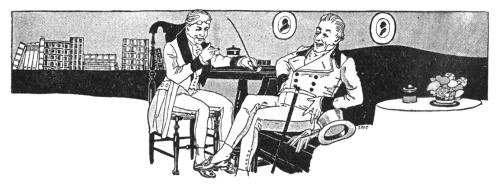
THE CELEBRATED JUMPING FROG
MARK TWAIN
In compliance with the request of a friend of mine, who wrote me from the East, I called on good-natured, garrulous old Simon Wheeler, and inquired after my friend’s friend, Leonidas W. Smiley, as requested to do, and I hereunto append the result. I have a lurking suspicion that Leonidas W. Smiley is a myth; that my friend never knew such a personage; and that he only conjectured that, if I asked old Wheeler about him, it would remind him of his infamous Jim Smiley, and he would go to work and bore me nearly to death with some infernal reminiscence of him as long and tedious as it should be useless to me. If that was the design, it certainly succeeded.
I found Simon Wheeler dozing comfortably by the bar-room stove of the old, dilapidated tavern in the ancient mining camp of Angel’s, and I noticed that he was fat and bald-headed, and had an expression of winning gentleness and simplicity upon his tranquil countenance. He roused up and gave me good-day. I told him a friend of mine had commissioned me to make some inquiries about a cherished companion of his boyhood named Leonidas W. Smiley—Rev. Leonidas W. Smiley—a young minister of the Gospel, who he had heard was at one time a resident of Angel’s Camp. I added that, if Mr. Wheeler could tell me anything about this Rev. Leonidas W. Smiley, I would feel under many obligations to him.
Simon Wheeler backed me into a corner and blockaded me there with his chair, and then sat me down and reeled off the monotonous narrative which follows this paragraph. He never smiled, he never frowned, he never changed his voice from the gentle-flowing key to which he tuned the initial sentence, he never betrayed the slightest suspicion of enthusiasm; but all through the interminable narrative there ran a vein of impressive earnestness and sincerity, which showed me plainly that, so far from his imagining that there was anything ridiculous or funny about his story, he regarded it as a really important matter, and admired its two heroes as men of transcendent genius in finesse. To me, the spectacle of a man drifting serenely along through such a queer yarn without ever smiling, was exquisitely absurd. As I said before, I asked him to tell me what he knew of Rev. Leonidas W. Smiley, and he replied as follows. I let him go on in his own way, and never interrupted him once:
There was a feller here once by the name of Jim Smiley, in the winter of ’49—or maybe it was the spring of ’50—I don’t recollect exactly, somehow, though what makes me think it was one or the other is because I remember the big flume wasn’t finished when he first came to the camp; but any way, he was the curiosest man about always betting on any thing that turned up you ever see, if he could get anybody to bet on the other side; and if he couldn’t, he’d change sides. Any way that suited the other man would suit him—any way just so’s he got a bet, he was satisfied. But still he was lucky, uncommon lucky; he most always come out winner. He was always ready and laying for a chance; there couldn’t be no solit’ry thing mentioned but that feller’d offer to bet on it, and take any side you please, as I was just telling you. If there was a horse-race, you’d find him flush or you’d find him busted at the end of it; if there was a dog-fight, he’d bet on it; if there was a cat-fight, he’d bet on it; if there was a chicken-fight, he’d bet on it; why, if there was two birds setting on a fence, he would bet you which one would fly first; or if there was a camp-meeting, he would be there reg’lar, to bet on Parson Walker, which he judged to be the best exhorter about here, and so he was, too, and a good man. If he even seen a straddle-bug start to go anywheres, he would bet you how long it would take him to get to wherever he was going to, and if you took him up, he would foller that straddle-bug to Mexico but what he would find out where he was bound for and how long he was on the road. Lots of the boys here has seen that Smiley, and can tell you about him. Why, it never made no difference to him—he would bet on any thing—the dangdest feller. Parson Walker’s wife laid very sick once, for a good while, and it seemed as if they warn’t going to save her; but one morning he come in, and Smiley asked how she was, and he said she was considerable better—thank the Lord for his inf’nit mercy—and coming on so smart that, with the blessing of Prov’dence, she’d get well yet; and Smiley, before he thought, says, “Well, I’ll risk two-and-a-half that she don’t, any way.”
Thish-yer Smiley had a mare—the boys called her the fifteen-minute nag, but that was only in fun, you know, because, of course, she was faster than that—and he used to win money on that horse, for all she was so slow and always had the asthma, or the distemper, or the consumption, or something of that kind. They used to give her two or three hundred yards start, and then pass her under way; but always at the fag-end of the race she’d get excited and desperate-like, and come cavorting and straddling up, and scattering her legs around limber, sometimes in the air, and sometimes out to one side amongst the fences, and kicking up m-o-r-e dust, and raising m-o-r-e racket with her coughing and sneezing and blowing her nose—and always fetch up at the stand just about a neck ahead, as near as you could cipher it down.
And he had a little small bull pup, that to look at him you’d think he wan’t worth a cent, but to set around and look ornery, and lay for a chance to steal something. But as soon as money was up on him, he was a different dog; his underjaw’d begin to stick out like the fo’castle of a steamboat, and his teeth would uncover, and shine savage like the furnaces. And a dog might tackle him, and bully-rag him, and bite him, and throw him over his shoulder two or three times, and Andrew Jackson—which was the name of the pup—Andrew Jackson would never let on but what he was satisfied, and hadn’t expected nothing else—and the bets being doubled and doubled on the other side all the time, till the money was all up; and then all of a sudden he would grab that other dog jest by the j’int of his hind leg and freeze to it—not chaw, you understand, but only jest grip and hang on till they throwed up the sponge, if it was a year. Smiley always come out winner on that pup, till he harnessed a dog once that didn’t have no hind legs, because they’d been sawed off by a circular saw, and when the thing had gone along far enough, and the money was all up, and he come to make a snatch for his pet holt, he saw in a minute how he’d been imposed on, and how the other dog had been in the door, so to speak, and he ’peared surprised, and then he looked sorter discouraged-like, and didn’t try no more to win the fight, and so he got shucked out bad. He give Smiley a look, as much as to say his heart was broke, and it was his fault, for putting up a dog that hadn’t no hind legs for him to take holt of, which was his main dependence in a fight, and then he limped off a piece and laid down and died. It was a good pup, was that Andrew Jackson, and would have made a name for hisself if he’d lived, for the stuff was in him, and he had genius—I know it, because he hadn’t had no opportunities to speak of, and it don’t stand to reason that a dog could make such a fight as he could under them circumstances, if he hadn’t no talent. It always makes me feel sorry when I think of that last fight of his’n, and the way it turned out.
Well, thish-yer Smiley had rat-tarriers, and chicken cocks, and tom-cats, and all them kind of things, till you couldn’t rest, and you couldn’t fetch nothing for him to bet on but he’d match you. He ketched a frog one day, and took him home, and said he cal’klated to edercate him; and so he never done nothing for three months but set in his back yard and learn that frog to jump. And you bet you he did learn him, too. He’d give him a little punch behind, and the next minute you’d see that frog whirling in the air like a doughnut—see him turn one summerset, or maybe a couple, if he got a good start, and come down flat-footed and all right, like a cat. He got him up so in the matter of catching flies, and kept him in practice so constant, that he’d nail a fly every time as far as he could see him. Smiley said all a frog wanted was education, and he could do most any thing—and I believe him. Why, I’ve seen him set Dan’l Webster down here on this floor—Dan’l Webster was the name of the frog—and sing out, “Flies, Dan’l, flies!” and quicker’n you could wink, he’d spring straight up, and snake a fly off’n the counter there, and flop down on the floor again as solid as a gob of mud, and fall to scratching the side of his head with his hind foot as indifferent as if he hadn’t no idea he’d been doin’ any more’n any frog might do. You never see a frog so modest and straightforward as he was, for all he was so gifted. And when it come to fair and square jumping on a dead level, he could get over more ground at one straddle than any animal of his breed you ever see. Jumping on a dead level was his strong suit, you understand; and when it come to that, Smiley would ante up money on him as long as he had a red. Smiley was monstrous proud of that frog, and well he might be, for fellers that had traveled and been everywheres, all said he laid over any frog that ever they see.
Well, Smiley kept the beast in a little lattice box, and he used to fetch him down town sometimes and lay for a bet. One day a feller—a stranger in the camp, he was—come across him with his box, and says:
“What might it be that you’ve got in the box?”
And Smiley says, sorter indifferent like, “It might be a parrot, or it might be a canary, maybe, but it an’t—it’s only just a frog.”
And the feller took it and looked at it careful, and turned it round this way and that, and says, “H’m—so ’tis. Well, what’s he good for?”
“Well,” Smiley says, easy and careless, “He’s good enough for one thing, I should judge—he can outjump any frog in Calaveras county.”
The feller took the box again, and took another long, particular look, and give it back to Smiley, and says, very deliberate, “Well, I don’t see no p’ints about that frog that’s any better’n any other frog.”
“Maybe you don’t,” Smiley says. “Maybe you understand frogs, and maybe you don’t understand ’em; maybe you’ve had experience, and maybe you an’t only a amature, as it were. Anyways, I’ve got my opinion, and I’ll risk forty dollars that he can outjump any frog in Calaveras county.”
And the feller studied a minute, and then says, kinder sad like, “Well, I’m only a stranger here, and I ain’t got no frog; but if I had a frog, I’d bet you.”
And then Smiley says, “That’s all right—that’s all right—if you’ll hold my box a minute, I’ll go and get you a frog.” And so the feller took the box, and put up his forty dollars along with Smiley’s, and set down to wait.
So he set there a good while thinking and thinking to hisself and then he got the frog out and prized his mouth open and took a teaspoon and filled him full of quail shot—filled him pretty near up to his chin—and set him on the floor. Smiley he went to the swamp and slopped around in the mud for a long time, and finally he ketched a frog, and fetched him in, and give him to this feller, and says: