PART II ADVENTURES OLD AND NEW (continued 2)
Reading edition
“I marvel,” said Sir Gawain, “what knight that is with the red sleeve.”
“Sir,” said King Arthur, “he will be known before he depart.”
And then the trumpets blew and the prize was given by heralds unto the knight with the white shield that bore the red sleeve. Then came the King with the Hundred Knights, the King of Northgalis and the King of Northumberland and Sir Galahad, the noble prince, and said unto Sir Lancelot, “Fair knight, God thee bless, for much have you done this day for us; therefore, we pray you that ye will come with us, that ye may receive the honor and the prize, as ye have honorably deserved it.”
“My fair lords,” said Sir Lancelot, “if I have deserved thanks, I have sore bought it; and that me repenteth, for I am like never to escape with my life; therefore, fair lords, I pray you that ye will suffer me to depart where me liketh, for I am sore hurt. I care for no honor, for I would more gladly repose me than to be lord of all the world.”
And therewithal he groaned piteously and rode away from them until he came to a wood. And when he saw that he was from the field nigh a mile, that he was sure he might not be seen, then he said, “O gentle knight, Sir Lavaine, help me that this spear were out of my side, for it slayeth me.”
“O mine own lord,” said Sir Lavaine, “I would fain do that might please you, but I dread me sore, if I pull out the spear, that ye shall be in peril of death.”
“I charge you,” said Sir Lancelot, “as ye love me, draw it out.”
And therewithal he descended from his horse and right so did Sir Lavaine; and forthwith Sir Lavaine drew the spear out of his side and he gave a great shriek and so swooned, pale and deadly.
“Alas,” said Sir Lavaine, “what shall I do?”
And so at the last Sir Lancelot cast up his eyes and said, “O Lavaine, help me that I were on my horse, for here is fast by within this two miles a gentle hermit, that sometime was a full noble knight and a great lord of possessions. And for great goodness he hath taken him to poverty and his name is Sir Baudwin of Brittany and he is a full noble surgeon. Now let see, help me up that I were there, for ever my heart telleth me that I shall never die of my cousin’s hands.”
And then with great pain Sir Lavaine helped him upon his horse. And then they rode together and so by fortune they came to that hermitage, the which was in a wood and a great cliff on the other side and fair water running under it. And Sir Lavaine beat on the gate and there came a fair child to them and asked them what they would.
“Fair son,” said Sir Lavaine, “go and pray thy lord, the hermit, to let in here a knight that is full sore wounded; and this day, tell thy lord, I saw him do more deeds of arms than ever I heard say that any man did.”
So the child went in lightly and then he brought the hermit, the which was a passing good man. When Sir Lavaine saw him, he prayed him for succor.
“What knight is he?” said the hermit. “Is he of the house of Arthur or not?”
“I know not,” said Sir Lavaine, “what is he or what is his name, but well I know I saw him do marvelously this day, as of deeds of arms.”
“On whose party was he?” said the hermit.
“Sir,” said Lavaine, “he was this day against King Arthur and there he won the prize from all the knights of the Round Table.”
“I have seen the day,” said the hermit, “I would have loved him the worse because he was against my lord, King Arthur, for sometime I was one of the fellowship of the Round Table, but I thank God, now I am otherwise disposed. But where is he? Let me see him.”
And when the hermit beheld him, he thought that he should know him, but he could not bring him to knowledge because he was so pale.
“What knight are ye?” said the hermit.
“My fair lord,” said Lancelot, “I am a stranger and a knight adventurous, that laboreth throughout many realms for to win honor.”
Then the hermit saw by a wound on his cheek that he was Sir Lancelot.
“Alas,” said the hermit, “mine own lord, why conceal you your name from me? Forsooth, I ought to know you of right, for ye are the noblest knight of the world, for well I know you for Sir Lancelot.”
“Sir,” said he, “since ye know me, help me if ye can, for I would be out of this pain at once, either to death or to life.”
“Have ye no doubt,” said the hermit, “ye shall live and fare right well.”
And so the hermit called to him two of his servants and they bore him into the hermitage and lightly unarmed him and laid him in his bed. And then anon the hermit stanched his blood and soon Sir Lancelot was well refreshed and knew himself.
Now turn we unto King Arthur and leave we Sir Lancelot in the hermitage. So when the kings were come together on both parties and the great feast should be held, King Arthur asked the King of Northgalis and their fellowship, where was that knight that bore the red sleeve.
“Bring him before me, that he may have his praise and honor and the prize as it is right.”
Then spake Sir Galahad, the noble prince, “We suppose that knight is injured and that he is never like to see you nor any of us all, and that is the greatest pity that ever we knew of any knight.”
“Alas,” said Arthur, “how may this be? Is he so hurt? What is his name?”
“Truly,” said they all, “we know not his name, nor from whence he came nor whither he went.”
“Alas,” said the King, “this be to me the worst tidings that came to me this seven year, for I would not for all the lands I possess to know that that noble knight were slain.”
“Know ye him?” said they all.
“As for that,” said Arthur, “whether I know him or not, ye shall not know from me what man he is, but God send me good tidings of him.”
“If it so be that the good knight be so sore hurt,” said Sir Gawain, “it is great damage and pity to all this land, for he is one of the noblest knights that ever I saw in a field handle a spear or a sword; and if he may be found, I shall find him, for I am sure he is not far from this town.”
Right so Sir Gawain took a squire with him and rode all about Camelot within six or seven miles, but so he came again and could hear no word of him. Then within two days King Arthur and all the fellowship returned unto London again.
And so as they rode by the way, it happened that Sir Gawain lodged with Sir Bernard where was Sir Lancelot lodged. And Sir Bernard and his daughter, Elaine, came to him to cheer him and to ask him who did best at that tournament.
“There were two knights,” said Sir Gawain, “that bore two white shields, but one of them bore a red sleeve upon his head and certainly he was one of the best knights that ever I saw joust in field. For I dare say, that one knight with the red sleeve smote down forty knights of the Table Round and his fellow did right well and honorably.”
“Now I thank God,” said Elaine, “that that knight sped so well.”
“Know ye his name?” said Sir Gawain.
“Nay, truly,” said the maiden, “I know not his name, nor whence he cometh.”
“Tell me, then, how had ye knowledge of him first?” said Sir Gawain.
Then she told him as ye have heard before, and how her father intrusted her brother to him to do him service and how her father lent him her brother’s shield, “And here with me he left his shield,” she said.
“For what cause did he so?” said Sir Gawain.
“For this cause,” said the damsel, “for his shield was too well known among many noble knights.”
“Ah, fair damsel,” said Sir Gawain, “please it you let me have a sight of that shield.”
So when the shield was come, Sir Gawain knew it was Sir Lancelot’s shield.
“Ah,” said Sir Gawain, “now is my heart heavier than ever it was before.”
“Why?” said Elaine.
“I have great cause,” said Sir Gawain; “the knight that owneth this shield is the most honorable knight of the world.”
“So I thought ever,” said Elaine.
“But I dread me,” said Sir Gawain, “that ye shall never see him in this world and that is the greatest pity that ever was of earthly knight.”
“Alas,” said she, “how may this be? Is he slain?”
“I say not so,” said Sir Gawain, “but he is grievously wounded and more likely to be dead than to be alive and he is the noble knight, Sir Lancelot, for by this shield I know him.”
“Alas,” said Elaine, “how may this be and what was his hurt?”
“Truly,” said Sir Gawain, “the man in the world that loved him best, hurt him so, and I dare say, if that knight that hurt him knew that he had hurt Sir Lancelot, it would be the most sorrow that ever came to his heart.”
“Now, fair father,” said Elaine, “I require you give me leave to ride and to seek him and my brother, Sir Lavaine.”
“Do as it liketh you,” said her father, “for me sore repenteth of the hurt of that noble knight.”
Then on the morn Sir Gawain came to King Arthur and told him how he had found Sir Lancelot’s shield in the keeping of the fair maiden of Astolat.
“All that I knew beforehand,” said King Arthur, “for I saw him when he came to his lodging full late in the evening, in Astolat.”
So the King and all came to London and there Sir Gawain openly disclosed to all the Court, that it was Sir Lancelot that jousted best.
And when Sir Bors heard that, he was a sorrowful man and so were all his kinsmen. And Sir Bors said, “I will haste me to seek him and find him wheresoever he be and God send me good tidings of him.”
SIR LANCELOT AT THE HERMITAGE
And so we will leave Sir Bors and speak of Sir Lancelot that lay in great peril. So as Elaine came to Winchester she sought there all about, and by fortune, Sir Lavaine rode forth to exercise his horse. And anon as Elaine saw him she knew him, and she called to him. When he heard her, he came to her and then she asked her brother how did his lord, Sir Lancelot.
“Who told you, sister, that my lord’s name was Sir Lancelot?”
Then she told how Sir Gawain by his shield knew him. So they rode together until they came to the hermitage. So Sir Lavaine brought her in to Sir Lancelot and when she saw him so sick and pale she said, “My lord Sir Lancelot, alas, why be ye in this plight?”
But Sir Lancelot said, “Fair maiden, if ye be come to comfort me, ye be right welcome; and of this little hurt that I have, I shall be right hastily whole by the grace of God. But, I marvel who told you my name?”
Then the fair maiden told him all, how Sir Gawain was lodged with her father, “And there by your shield he discovered you.”
So Elaine watched Sir Lancelot and cared for his wound and did such attendance to him that the story saith that never man had a kindlier nurse. Then Sir Lancelot prayed Sir Lavaine to make inquiries in Winchester for Sir Bors and told him by what tokens he should know him, by a wound in his forehead.
“For well I am sure that Sir Bors will seek me,” said Sir Lancelot, “for he is the same good knight that hurt me.”
Now turn we to Sir Bors that came unto Winchester to seek after his cousin Sir Lancelot. And so when he came to Winchester, anon there were men that Sir Lavaine had made to watch for such a man and anon Sir Lavaine had warning; and then Sir Lavaine came to Winchester and found Sir Bors and there he told him who he was and with whom he was and what was his name.
“Now, fair knight,” said Sir Bors, “I require you that ye will bring me to my lord, Sir Lancelot.”
“Sir,” said Sir Lavaine, “take your horse and within this hour ye shall see him.”
And so they departed and came to the hermitage. And when Sir Bors saw Sir Lancelot lie in his bed, pale and discolored, anon Sir Bors lost his countenance and for kindness and pity he might not speak but wept tenderly for a great while.
And then, when he might speak, he said thus, “O my lord, Sir Lancelot, God you bless, and send you hasty recovery; and full heavy am I of my misfortune and mine unhappiness, for now I may call myself unhappy. And I dread me that God is greatly displeased with me, that He would suffer me to have such a shame for to hurt you, that are our leader and our honor and therefore I call myself unhappy. Alas, that ever such a miserable knight, as I am, should have power by unhappiness to hurt the noblest knight of the world! Where I so shamefully set upon you and over-charged you, and where ye might have slain me, ye saved me; and so did not I, for I and your kindred did to you our uttermost. I marvel, that my heart or my blood would serve me, wherefore, my lord Sir Lancelot, I ask your mercy.”
“Fair cousin,” said Sir Lancelot, “ye be right welcome; and much ye say which pleaseth me not, for I have the same I sought; for I would with pride have overcome you all, and there in my pride, I was near slain and that was my own fault, for I might have given you warning of my being there. And then would I have had no hurt; for it is an old saying, there is hard battle when kin and friends do battle, either against other, for there may be no mercy but mortal war. Therefore, fair cousin, all shall be welcome that God sendeth; and let us leave off this matter and let us speak of some rejoicing, for this that is done may not be undone; and let us find a remedy how soon I may be whole.”
Then Sir Bors leaned upon his bed and told him how Sir Gawain knew him by the shield he left with the fair maiden of Astolat and so they talked of many more things. And so within three or four days Sir Lancelot was big and strong again.
Then Sir Bors told Sir Lancelot how there was a great tournament and joust agreed upon between King Arthur and the King of Northgalis.
“Is that the truth?” said Sir Lancelot. “Then shall ye abide with me still a little while, until that I be whole, for I feel myself right big and strong.”
Then were they together nigh a month and ever this maiden Elaine did her diligent labor for Sir Lancelot, so that there never was a child or wife meeker to her father or husband, than was that fair maiden of Astolat; wherefore Sir Bors was greatly pleased with her.
So upon a day, Sir Lancelot thought to try his armor and his spear. And so when he was upon his horse, he stirred him fiercely, and the horse was passing strong and fresh, because he had not been labored for a month. And then Sir Lancelot couched that spear in the rest. That courser leaped mightily when he felt the spurs and he that was upon him, the which was the noblest horse in the world, strained him mightily and kept still the spear in the rest and therewith Sir Lancelot strained himself with so great force, to get the horse forward that the wound opened and he felt himself so feeble, that he might not sit upon his horse.
And then Sir Lancelot cried unto Sir Bors, “Ah, Sir Bors and Sir Lavaine, help me, for I am come to my end.” And therewith he fell down to the earth as if he were dead.
And then Sir Bors and Sir Lavaine came to him with sorrow. Then came the holy hermit, Sir Baudwin of Brittany, and when he found Sir Lancelot in that plight, he said but little, but know ye well that he was wroth; and then he bade them, “Let us have him in.”
And so they all bare him into the hermitage and unarmed him and laid him in his bed and evermore his wound bled piteously, but he stirred no limb. Then the knight hermit put a little water in his mouth and Sir Lancelot waked of his swoon and then the hermit stanched his bleeding.
And when he might speak he asked Sir Lancelot why he put his life in jeopardy.
“Sir,” said Sir Lancelot, “because I thought I had been strong and also Sir Bors told me that there should be great jousts betwixt King Arthur and the King of Northgalis and therefore I thought to try it myself, whether I might be there or not.”
“Ah, Sir Lancelot,” said the hermit, “your heart and your courage will never be done, until your last day, but ye shall do now by my counsel. Let Sir Bors depart from you and let him do at that tournament what he may. And by the grace of God, by that the tournament be done, and ye come hither again, Sir Lancelot shall be as whole as ye, if so be that he will be governed by me.”
Then Sir Bors made him ready to depart from Sir Lancelot; and then Sir Lancelot said, “Fair cousin, Sir Bors, recommend me unto all them unto whom I ought to recommend me. And I pray you, exert yourself at the jousts that ye may be best, for my love; and here shall I abide you at the mercy of God till ye come again.”
And so Sir Bors departed and came to the court of King Arthur and told them in what place he had left Sir Lancelot.
“That grieveth me,” said the King, “but since he shall have his life we all may thank God.”
And then every knight of the Round Table that was there at that time present, made him ready to be at the jousts and thither drew many knights of many countries. And as the time drew near, thither came the King of Northgalis, and the King with the Hundred Knights and Sir Galahad, the noble prince, and thither came the King of Ireland and the King of Scots. So these three kings came on King Arthur’s party.
And that day Sir Gawain did great deeds of arms and began first. And the heralds numbered that Sir Gawain smote down twenty knights. Then Sir Bors came in the same time, and he was numbered that he smote down twenty knights and therefore the prize was given betwixt them both, for they began first and longest endured.
Also Sir Gareth did that day great deeds of arms, for he smote down and pulled down thirty knights. But when he had done these deeds he tarried not, but so departed, and therefore he lost his prize. And Sir Palomides did great deeds of arms that day for he smote down twenty knights, but he departed suddenly, and men thought Sir Gareth and he rode together to some adventures.
So when this tournament was done, Sir Bors departed, and rode till he came to Sir Lancelot, his cousin; and then he found him on his feet and there either made great joy of other; and so Sir Bors told Sir Lancelot of all the jousts, like as ye have heard.
“I marvel,” said Sir Lancelot, “at Sir Gareth when he had done such deeds of arms, that he would not tarry.”
“Thereof we marvel all,” said Sir Bors, “for except you, or Sir Tristam, or Sir Lamorak, I saw never knight bear down so many in so little a while, as did Sir Gareth, and anon he was gone, we knew not where.”
“By my head,” said Sir Lancelot, “he is a noble knight and a mighty man and well breathed; and if he were well tried, I would think he were good enough for any knight that beareth the life; and he is a gentle knight, courteous, true, bounteous, meek, and mild, and in him is no manner of evil, but he is plain, faithful, and true.”
So then they made them ready to depart from the hermit. And so upon a morn, they took their horses and Elaine with them and when they came to Astolat, they were well lodged and had great cheer of Sir Bernard, the old baron, and of Sir Torre, his son. And upon the morrow, Sir Lancelot took his leave and came unto Winchester.
And when King Arthur knew that Sir Lancelot was come whole and sound the King made great joy of him, and so did Sir Gawain and all the knights except Sir Agravaine and Sir Modred.
THE DEATH OF ELAINE
Now speak we of the fair maiden of Astolat, that made such sorrow day and night that she never slept, ate, or drank because she grieved so for Sir Lancelot. So when she had thus endured ten days, she became so feeble that she knew she must die.
And then she called her father, Sir Bernard, and her brother, Sir Torre, and heartily she prayed her father that her brother might write a letter as she did tell him, and so her father granted her. And when the letter was written, word by word as she said, then she prayed her father, saying, “When I am dead, let this letter be put in my right hand and my hand bound fast with the letter, and let me be put in a fair bed with all the richest clothes that I have about me, and so let my bed be laid with me in a chariot and carried unto the Thames. And there let me be put within a barge and but one man with me, such as ye trust to steer me thither. And let my barge be covered with black samite over and over; thus, father, I beseech you let it be done.”
So her father granted it her faithfully, all things should be done as she asked. Then her father and her brother made great sorrow, for they knew she was dying. And so when she was dead her body was placed in a barge and a man steered the barge unto Westminster, and there he rowed a great while to and fro before any saw him.
So by fortune, King Arthur and Queen Guinevere were speaking together at a window and so as they looked out on the Thames, they saw this black barge and marveled what it meant. Then the King called Sir Kay and showed it to him.
“Go thither,” said the King to Sir Kay, “and take with you Sir Brandiles and Sir Agravaine and bring word what is there.”
Then these knights departed and came to the barge and went in; and there they found the fair maiden lying in a rich bed, and a poor man sitting in the barge’s end and no word would he speak. So these knights returned unto the King again and told him what they found.
And then the King took the Queen by the hand and went thither. Then the King made the barge to be held fast and then the King and Queen entered with certain knights with them, and there they saw the fairest maiden in a rich bed, covered with many rich clothes and all was cloth of gold, and she lay as though she smiled.
Then the Queen saw a letter in her right hand and told the King. Then the King took it and said, “Now I am sure this letter will tell what she was and why she is come hither.”
So then the King and the Queen went out of the barge, and so when the King was come within his chamber, he called many knights about him, and said he would know openly what was written within that letter. Then the King opened it and made a clerk read it, and this was the letter:
“Most noble knight, Sir Lancelot, I was called the Fair Maiden of Astolat. Pray for my soul and give me burial at least. This is my last request. Pray for my soul, Sir Lancelot, as thou art a peerless knight.”
This was all the substance of the letter. And when it was read, the King, the Queen, and all the knights wept for pity. Then was Sir Lancelot sent for; and when he was come King Arthur made the letter to be read to him.
And when Sir Lancelot heard it word by word, he said, “My lord, King Arthur, I am right sorrowful because of the death of this fair damsel. She was both fair and good and much was I indebted to her for her care. I offered her for her kindness that she showed me, a thousand pounds yearly, whensoever she would wed some good knight, and always while I live to be her own knight.”
Then said the King unto Sir Lancelot, “It will be to your honor that ye see that she be buried honorably.”
“Sir,” said Sir Lancelot, “that shall be done as I can best do it.”
And so upon the morn she was buried richly, and all the knights of the Round Table were there with Sir Lancelot. And then the poor man went again with the barge.
THE TOURNAMENT AT WESTMINSTER
So time passed on till Christmas and then every day there were jousts made for a diamond, who that jousted best should have a diamond. But Sir Lancelot would not joust, but if it were at a great joust. But Sir Lavaine jousted there passing well and best was praised, for there were but few that did so well. Wherefore, all manner of knights thought that Sir Lavaine should be made Knight of the Round Table at the next feast of Pentecost. So after Christmas, King Arthur called unto him many knights and there they advised together to make a great tournament. And the King of Northgalis said to Arthur that he would have on his party the King of Ireland and the King with the Hundred Knights and the King of Northumberland and Sir Galahad, the noble prince. And so then four kings and this mighty duke took part against King Arthur and the Knights of the Table Round.
And the proclamation was made that the jousts should be at Westminster, and so the knights made them ready to be at the jousts in the freshest manner. Then Queen Guinevere sent for Sir Lancelot and said thus, “I forbid you that ye ride in jousts or tournaments, unless your kinsmen know you. And at these jousts that be, ye shall have of me a sleeve of gold, and I charge you, that ye warn your kinsmen that ye will bear that day the sleeve of gold upon your helmet.”
“Madam,” said Sir Lancelot, “it shall be done.”
And when Sir Lancelot saw his time, he told Sir Bors that he would depart and have no one with him but Sir Lavaine, unto the good hermit that dwelt in the forest of Windsor, and there he thought to repose him and take all the rest that he might, so that he would be fresh at that day of jousts.
So Sir Lancelot and Sir Lavaine departed, that no creature knew where he was gone, but the noble men of his blood. And when he was come to the hermitage he had good cheer. And so daily Sir Lancelot would go to a well, fast by the hermitage and there he would lie down and see the well spring and bubble, and sometimes he slept there.
So when the day was come Sir Lancelot planned that he should be arrayed, and Sir Lavaine and their horses, as though they were Saracens, and so they departed and came nigh to the field.
The King of Northgalis brought with him a hundred knights, and the King of Northumberland brought with him a hundred good knights, and the King of Ireland brought with him a hundred good knights ready to joust, and Sir Galahad brought with him a hundred good knights, and the King with the Hundred Knights brought with him as many, and all these were proved good knights.
Then came in King Arthur’s party, and there came in the King of Scots with a hundred knights, and King Uriens brought with him a hundred knights, and King Howel of Brittany brought with him a hundred knights, and King Arthur himself came into the field with two hundred knights and the most part were knights of the Table Round, that were proved noble knights, and there were old knights set in a high place, to judge with the Queen who did best.
Then the heralds blew the call to the field, and then the King of Northgalis encountered with the King of Scots and then the King of Scots had a fall: and the King of Ireland smote down King Uriens and the King of Northumberland smote down King Howel of Brittany. And then King Arthur was wroth and ran to the King with the Hundred Knights and there King Arthur smote him down; and after, with that same spear, King Arthur smote down three other knights. And when his spear was broken, King Arthur did exceedingly well; and so therewith came in Sir Gawain and Sir Gaheris, Sir Agravaine and Sir Modred, and there each of them smote down a knight, and Sir Gawain smote down four knights.
Then began a strong battle, for there came in the knights of Sir Lancelot’s kindred and Sir Gareth and Sir Palomides with them, and many knights of the Table Round, and they began to press the four kings and the mighty duke so hard that they were discomfited; but this Duke Galahad was a noble knight and by his mighty prowess he held back the knights of the Table Round.
All this saw Sir Lancelot and then he came into the field with Sir Lavaine as if it had been thunder. And then anon Sir Bors and the knights of his kindred saw Sir Lancelot, and Sir Bors said to them all, “I warn you beware of him with the sleeve of gold upon his head, for he is Sir Lancelot himself.”
And for great goodness Sir Bors warned Sir Gareth. “I am well satisfied,” said Sir Gareth, “that I may know him.” “But who is he,” said they all, “that rideth with him in the same array?”
“That is the good and gentle knight, Sir Lavaine,” said Sir Bors.
So Sir Lancelot encountered with Sir Gawain and there by force Sir Lancelot smote down Sir Gawain and his horse to the earth, and so he smote down Sir Agravaine and Sir Gaheris and also he smote down Sir Modred, and all this was with one spear. Then Sir Lavaine met with Sir Palomides and either met other so hard and so fiercely, that both their horses fell to the earth. And then they were horsed again, and then met Sir Lancelot with Sir Palomides and there Sir Palomides had a fall; and so Sir Lancelot, without stopping, as fast as he might get spears, smote down thirty knights and the most part of them were knights of the Table Round; and ever the knights of his kindred withdrew and fought in other places where Sir Lancelot came not.
And then King Arthur was wroth when he saw Lancelot do such deeds for he knew not that it was Sir Lancelot; and then the King called unto him nine knights and so the King with these knights made ready to set upon Sir Lancelot and Sir Lavaine.
All this saw Sir Bors and Sir Gareth.
“Now I dread me sore,” said Sir Bors, “that my lord Sir Lancelot will be hard matched.”
“By my head,” said Sir Gareth, “I will ride unto my lord Sir Lancelot, to help him, come what may; for he is the same man that made me knight.”
“Ye shall not do so by mine counsel,” said Sir Bors, “unless that ye were disguised.”
“Ye shall see me disguised,” said Sir Gareth.
Therewithal he saw a Welsh knight, who was sore hurt by Sir Gawain, and to him Gareth rode and prayed him of his knighthood to lend him his green shield in exchange for his own.
“I will gladly,” said the Welsh knight.
Then Sir Gareth came driving to Sir Lancelot all he might and said, “Knight, defend thyself, for yonder cometh King Arthur with nine knights with him to overcome you, and so I am come to bear you fellowship for old love ye have showed me.”
“I thank you greatly,” said Sir Lancelot.
“Sir,” said Gareth, “encounter ye with Sir Gawain and I will encounter with Sir Palomides and let Sir Lavaine match with the noble King Arthur.”
Then came King Arthur with his nine knights with him, and Sir Lancelot encountered with Sir Gawain and gave him such a buffet that Sir Gawain fell to the earth. Then Sir Gareth encountered with the good knight, Sir Palomides, and he gave him such a buffet that both he and his horse fell to the earth. Then encountered King Arthur with Sir Lavaine and there either of them smote the other to the earth, horse and all, so that they lay a great while.
Then Sir Lancelot smote down Sir Agravaine, Sir Gaheris, and Sir Modred, and Sir Gareth smote down Sir Kay, Sir Safere, and Sir Griflet. And then Sir Lavaine was horsed again and he smote down Sir Lucan and Sir Bedivere, and then there began a great press of good knights. Then Sir Lancelot dashed here and there and smote off and pulled off helmets, so that none might strike him a blow with spear or with sword; and Sir Gareth did such deeds of arms that all men marveled what knight he was with the green shield, for he smote down that day and pulled down more than thirty knights.
And Sir Lancelot marveled, when he beheld Sir Gareth do such deeds, what knight he might be! and Sir Lavaine pulled down and smote down twenty knights. Also Sir Lancelot knew not Sir Gareth, for if Sir Tristam or Sir Lamorak had been alive, Sir Lancelot would have thought he had been one of the two.
So this tournament continued till it was near night, for the Knights of the Round Table rallied ever unto King Arthur, for the King was wroth that he and his knights might not prevail that day. Then Sir Gawain said to the King, “I marvel where all this day Sir Bors and his fellowship of Sir Lancelot’s kindred have been. I marvel all this day they be not about you. It is for some cause,” said Sir Gawain.
“By my head,” said Sir Kay, “Sir Bors is yonder all this day upon the right hand of this field and there he and his kindred have won more honor than we have.”
“It may well be,” said Sir Gawain, “but I believe this knight with the sleeve of gold is Sir Lancelot himself. I know it by his riding and by his great strokes. And the other knight in the same colors is the good young knight, Sir Lavaine. Also, that knight with the green shield is my brother, Sir Gareth, and he has disguised himself, for no man shall ever make him be against Sir Lancelot, because he made him knight.”
“Nephew, I believe you,” said King Arthur; “therefore tell me now what is your best counsel.”
“Sir,” said Gawain, “ye shall have my counsel. Let the heralds blow the close of the tournament, for if he be Sir Lancelot and my brother, Sir Gareth, with him, with the help of that good young knight, Sir Lavaine, trust me, it will be no use to strive with them, unless we should fall ten or twelve upon one knight, and that were no glory, but shame.”
“Ye say truth,” said the King; “it were shame to us, so many as we be, to set upon them any more; for they be three good knights and, particularly, that knight with the sleeve of gold.”
So the trumpets blew and forthwith King Arthur sent to the four kings and to the mighty duke and prayed them that the knight with the sleeve of gold depart not from them, but that the King might speak with him. Then King Arthur unarmed him and rode after Sir Lancelot. And so he found him with the four kings and the duke and there the King prayed them all unto supper and they said they would, with good will.
And when they were unarmed, then King Arthur knew Sir Lancelot, Sir Lavaine and Sir Gareth.
“Ah, Sir Lancelot,” said the King, “this day ye have heated me and my knights.”
And so they went unto King Arthur’s lodging all together, and there was a great feast and the prize was given unto Sir Lancelot; and the heralds announced that he had smitten down fifty knights, and Sir Gareth, five and thirty, and Sir Lavaine, four and twenty knights.
Then King Arthur blamed Sir Gareth, because he left his fellowship and held with Sir Lancelot.
“My lord,” said Sir Gareth, “he made me a knight and when I saw him so hard pressed, methought it was my duty to help him, for I saw him do so much and so many noble knights against him; and when I understood that he was Sir Lancelot, I was ashamed to see so many knights against him alone.”
“Truly,” said King Arthur unto Sir Gareth, “ye say well, and manfully have you done and won for yourself great honor, and all the days of my life I shall love you and trust you more and more. For ever it is an honorable knight’s deed to help another honorable knight when he seeth him in great danger; for ever an honorable man will be sorry to see a brave man shamed. But he that hath no honor, and acts with cowardice, never shall he show gentleness nor any manner of goodness, where he seeth a man in any danger; for then ever will a coward show no mercy. And always a good man will do ever to another man as he would be done to himself.”
So then there were great feasts and games and play, and all manner of noble deeds were done; and he that was courteous, true, and faithful to his friend, was that time cherished.
NOTES AND QUESTIONS
Discussion. 1. What was the condition of Arthur’s kingdom when he began to reign? 2. What was Arthur’s purpose in founding the Order of the Round Table? 3. Why was a training in strength and bravery in battle necessary to these knights? 4. What way of supplying this training is described in this story? 5. Tell what you know of this custom. 6. Have we any contests of skill that bear any resemblance to this in method or purpose? 7. Give a brief account of the tournament at Winchester. 8. What plan had Lancelot for disguising himself? 9. What reasons had he for such a plan? 10. How was Lancelot’s personality shown in the impression he made on the baron? 11. What custom of the joust is indicated by Elaine’s request? 12. Picture the scene as the tournament opened; where was the King? Where were the opposing knights? 13. What knightly qualities did Lancelot show in this contest? 14. How would a “full noble surgeon” of King Arthur’s time compare with a present-day surgeon? 15. Why did Lancelot call his injury “a little hurt” when speaking to Elaine? 16. What qualities are we told were most admired in the days of chivalry? 17. Is this true of the present time? 18. What quality of Lancelot do you admire most?
Phrases
with his fellowship, 126, 9
undertake he will do marvels, 126,18
likeliest knight, 126, 31
my heart giveth unto you, 127, 7
with a rich burgess, 128, 6
a strong assail, 128, 27
might not serve him thereto, 130, 19
suffer me, 131, 6
a full noble surgeon, 131, 27
prayed him for succor, 132, 5
bring him to knowledge, 132, 21
openly disclosed, 135, 20
lost his countenance, 136, 28
mighty prowess, 144, 4
The Passing of Arthur
HOW SIR MODRED PLOTTED AGAINST SIR LANCELOT AND OF THE DEATH OF SIR GAWAIN AND TWELVE KNIGHTS
Before Merlin passed from the world of men, he uttered many marvelous prophecies and one that boded ill for King Arthur. He foretold that a son of Arthur’s sister should stir up bitter war against the King and that a great battle should be fought in the West when many brave men should find their doom.
Among the nephews of King Arthur was one most dishonorable; his name was Modred. No knightly deed had he ever done and he hated even to hear the good report of others. Of all who sat at the Round Table there was none that Modred hated more than Sir Lancelot du Lac, whom all true knights held in most honor. In his jealous rage he spoke evil of the Queen and Sir Lancelot. Now Modred’s brothers, Sir Gawain and Sir Gareth, refused to listen to these slanders, holding that Sir Lancelot, in his knightly service to the Queen, did honor to King Arthur also.
When these evil tales reached King Arthur, he rebuked the tale bearers and declared his faith in Sir Lancelot and his lady, the Queen. But Modred, enraged by the rebuke, determined to find cause against them, and not long after it seemed that the occasion had come. For when King Arthur had ridden forth to hunt far from Carlisle, where he then held court, the Queen sent for Lancelot to speak with her in her bower. Modred and his brother, Sir Agravaine, got together twelve knights, persuading them that they were doing the King a service. They waited until they saw Lancelot enter all unarmed and then called to him to come forth. The whole court echoed with their cries of “Traitor.” Lancelot, arming himself in haste, rushed out upon them and soon the entire company lay cold in death upon the earth. Only Modred escaped, for he fled, but even so he was sore wounded.
OF THE TRIAL OF THE QUEEN
When Modred escaped from Sir Lancelot he got to horse, all wounded as he was, and never drew rein until he had found King Arthur, to whom he told all that had happened.
Then great was the King’s grief. Despite all that Modred could say, he was slow to doubt Sir Lancelot, whom he loved, but his mind was filled with forebodings; for many a knight had been slain and well he knew that their kin would seek vengeance on Sir Lancelot, and the noble fellowship of the Round Table be utterly destroyed by their feuds.
All too soon it proved even as the King had feared. Many were found to hold with Sir Modred; some because they were kin to the knights that had been slain, some from envy of the honor and worship of the noble Sir Lancelot; and among them even were those who dared to raise their voice against the Queen herself, calling for judgment upon her as leagued with a traitor against the King, and as having caused the death of so many good knights. Now in those days the law was that if any one were accused of treason by witnesses, or taken in the act, that one should die the death by burning, be it man or woman, knight or churl. So then the murmurs grew to a loud clamor that the law should have its course, and that King Arthur should pass sentence on the Queen. Then was the King’s woe doubled.
“For,” said he, “I sit as King to be a rightful judge and keep all the law; wherefore I may not do battle for my own Queen, and now there is none other to help her.”
So a decree was issued that Queen Guinevere should be burnt at the stake outside the walls of Carlisle.
Forthwith, King Arthur sent for his nephew, Sir Gawain, and said to him:
“Fair nephew, I give it in charge to you to see that all is done as has been decreed.”
But Sir Gawain answered boldly: “Sir King, never will I be present to see my lady the Queen die. It is of ill counsel that ye have consented to her death.”
Then the King bade Gawain send his two young brothers, Sir Gareth and Sir Gaheris, to receive his commands, and these he desired to attend the Queen to the place of execution. So Gareth made answer for both:
“My Lord the King, we owe you obedience in all things, but know that it is sore against our wills that we obey you in this; nor will we appear in arms in the place where that noble lady shall die”; then sorrowfully they mounted their horses and rode to Carlisle.
When the day appointed had come, the Queen was led forth to a place without the walls of Carlisle, and there she was bound to the stake to be burnt to death. Loud were her ladies’ lamentations, and many a lord was found to weep at that grievous sight of a Queen brought so low; yet was there none who dared come forward as her champion, lest he should be suspected of treason. As for Gareth and Gaheris, they could not bear the sight, and stood with their faces covered in their mantles. Then, just as the torch was to be applied to the fagots, there was a sound as of many horses galloping, and the next instant a band of knights rushed upon the astonished throng, their leader cutting down all who crossed his path until he had reached the Queen, whom he lifted to his saddle and bore from the press. Then all men knew that it was Sir Lancelot, come knightly to rescue the Queen, and in their hearts they rejoiced. So with little hindrance they rode away, Sir Lancelot and all his kin with the Queen in their midst, till they came to the castle of the Joyous Garde, where they held the Queen in safety and all reverence.
But of that day came a kingdom’s ruin; for among the slain were Gawain’s brothers Sir Gareth and Sir Gaheris. Now Sir Lancelot loved Sir Gareth as if he had been his own younger brother, and himself had knighted him; but, in the press, he struck at him and killed him, not seeing that he was unarmed and weaponless; and in like wise, Sir Gaheris met his death. So when word was brought to King Arthur of what had passed, Sir Gawain asked straightway how his brothers had fared.
“Both are slain,” said the messenger.
“Alas! my dear brothers!” cried Sir Gawain; “how came they by their death?”
“They were both slain by Sir Lancelot,” said the messenger.
“That will I never believe,” cried Sir Gawain; “for my brother, Sir Gareth, had such love for Sir Lancelot that there was naught Sir Lancelot could ask him that he would not do.”
But the man said again, “He is slain, and by Sir Lancelot.”
Then, from sheer grief, Sir Gawain fell swooning to the ground. When he was recovered, he said:
“My lord and uncle, is it even as this man says, that Sir Lancelot has slain my brother Sir Gareth?”
“Alas!” said the King. “Lancelot rode upon him in the press and slew him, not seeing who he was or that he was unarmed.”
“Then,” cried Gawain fiercely, “here I make my vow. Never, while my life lasts, will I leave Sir Lancelot in peace until he has rendered me account for the slaying of my brothers.”
From that day forth, Sir Gawain would not suffer the King to rest until he had gathered all his host and marched against the Joyous Garde. Thus began the war which broke up the fellowship of the Round Table.
HOW SIR GAWAIN DEFIED SIR LANCELOT
Now it came to the ears of the Pope in Rome that King Arthur was besieging Sir Lancelot in the castle of the Joyous Garde, and it grieved him that there should be strife between two such goodly knights, the like of whom was not to be found in Christendom. So he called to him the Bishop of Rochester and bade him carry word to Britain, both to Arthur and to Sir Lancelot, that they should be reconciled, the one to the other, and that King Arthur should receive again Queen Guinevere.
Forthwith Sir Lancelot desired of King Arthur assurance of liberty and reverence for the Queen, as also safe conduct for himself and his knights, that he might bring Queen Guinevere with due honor to the King at Carlisle; and thereto the King pledged his word.
So Lancelot set forth with the Queen, and behind them rode a hundred knights arrayed in green velvet, the housings of the horses of the same, all studded with precious stones; thus they passed through the city of Carlisle openly, in the sight of all, and there were many who rejoiced that the Queen was come again and Sir Lancelot with her, though they of Gawain’s party scowled upon him.
When they were come into the great hall where Arthur sat with Sir Gawain and other great lords about him, Sir Lancelot led Guinevere to the throne and both knelt before the King; then rising, Sir Lancelot lifted the Queen to her feet and thus he spoke to King Arthur, boldly and well, before the whole court:
“My lord, Sir Arthur, I bring you here your Queen, than whom no truer nor nobler lady ever lived; and here stand I, Sir Lancelot du Lac, ready to do battle with any that dare gainsay it”; and with these words Sir Lancelot turned and looked upon the lords and knights present in their places, but none would challenge him in that cause, not even Sir Gawain, for he had ever affirmed that Queen Guinevere was a true and honorable lady.
Then Sir Lancelot spoke again: “Now, my Lord Arthur, in my own defense it behooves me to say that never in aught have I been false to you. That I slew certain knights is true, but I hold me guiltless, seeing that they brought death upon themselves. For no sooner had I gone to the Queen’s bower, as she had commanded me, than they beset the door with shameful outcry, that all the court might hear, calling me traitor and felon knight.”
“And rightly they called you,” cried Sir Gawain fiercely.
“My Lord, Sir Gawain,” answered Sir Lancelot, “in their quarrel they proved not themselves right, else had not I, alone, encountered fourteen knights and come forth unscathed.”
Then said King Arthur: “Sir Lancelot, I have ever loved you above all other knights, and trusted you to the uttermost; but ill have ye done by me and mine.”
“My lord,” said Lancelot, “that I slew Sir Gareth I shall mourn as long as life lasts. As soon would I have slain my own nephew, Sir Bors, as have harmed Sir Gareth wittingly; for I myself made him knight, and loved him as a brother.”
“Liar and traitor,” cried Sir Gawain, “ye slew him, defenseless and unarmed.”
“It is full plain, Sir Gawain,” said Lancelot, “that never again shall I have your love; and yet there has been old kindness between us, and once ye thanked me that I saved your life.”
“It shall not avail you now,” said Sir Gawain; “traitor ye are, both to the King and to me. Know that while life lasts, never will I rest until I have avenged my brother Sir Gareth’s death upon you.”
“Fair nephew,” said the King, “cease your bawling. Sir Lancelot has come under surety of my word that none shall do him harm. Elsewhere, and at another time, fasten a quarrel upon him, if quarrel ye must.”
“I care not,” cried Sir Gawain fiercely. “The proud traitor trusts so in his own strength that he thinks none dare meet him. But here I defy him and swear that, be it in open combat or by stealth, I shall have his life. And know, mine uncle and King, if I shall not have your aid, I and mine will leave you for ever and, if need be, fight even against you.”
“Peace,” said the King, and to Sir Lancelot: “We give you fifteen days in which to leave this kingdom.”
Then Sir Lancelot sighed heavily and said, “Full well I see that no sorrow of mine for what is past availeth me.”
Then he went to the Queen where she sat, and said: “Madam, the time is come when I must leave this fair realm that I have loved. Think well of me, I pray you, and send for me if ever there be aught in which a true knight may serve a lady.” Therewith he turned him about and, without greeting to any, passed through the hall, and with his faithful knights, rode to the Joyous Garde, though ever thereafter, in memory of that sad day, he called it the Dolorous Garde.
There he called about him his friends and kinsmen, saying, “Fair knights, I must now pass into my own lands.” Then they all, with one voice, cried that they would go with him. So he thanked them, promising them all fair estates and great honor when they were come to his kingdom; for all France belonged to Sir Lancelot. Yet was he loath to leave the land where he had followed so many glorious adventures, and sore he mourned to part in anger from King Arthur.
“My mind misgives me,” said Sir Lancelot, “but that trouble shall come of Sir Modred, for he is envious and a mischief-maker, and it grieves me that never more I may serve King Arthur and his realm.”
So Sir Lancelot sorrowed; but his kinsmen, wroth for the dishonor done him, made haste to depart and, by the fifteenth day, they were all embarked to sail overseas to France.
HOW KING ARTHUR AND SIR GAWAIN WENT TO FRANCE
From the day when Sir Lancelot brought the Queen to Carlisle, never would Gawain suffer the King to be at rest; but always he desired him to call his army together that they might go to attack Sir Lancelot in his own land.
Now King Arthur was loath to war against Sir Lancelot, and seeing this, Sir Gawain upbraided him bitterly.
“I see well it is naught to you that my brother, Sir Gareth, died fulfilling your behest. Little ye care if all your knights be slain, if only the traitor Lancelot escape. Since, then, ye will not do me justice nor avenge your own nephew, I and my fellows will take the traitor when and how we may. He trusts in his own might that none can encounter with him; let see if we may not entrap him.”
Thus urged, King Arthur called his army together and ordered that a great fleet be collected; for rather would he fight openly with Sir Lancelot than that Sir Gawain should bring such dishonor upon himself as to slay a noble knight treacherously. So with a great host, the King passed overseas to France, leaving Sir Modred to rule Britain in his stead.
When Lancelot heard that King Arthur and Sir Gawain were coming against him, he withdrew into the strong castle of Benwick; for unwilling, indeed, was he to fight with the King, or to do an injury to Sir Gareth’s brother. The army passed through the land, laying it waste, and presently encamped about the castle, besieging it closely; but so thick were the walls and so watchful the garrison that in no way could they prevail against it.
One day, there came to Sir Lancelot seven brethren, brave knights of Wales, who had joined their fortunes to his, and said:
“Sir Lancelot, bid us sally forth against this host which has invaded and laid waste your lands, and we will scatter it; for we are not wont to cower behind walls.”
“Fair lords,” answered Lancelot, “it is grief to me to war on good Christian knights and especially upon my lord, King Arthur. Have but patience, and I will send to him and see if, even now, there may not be a treaty of peace between us, for better far is peace than war.”
So Sir Lancelot sought out a damsel and, mounting her upon a palfrey, bade her ride to King Arthur’s camp and require of the King to cease warring on his lands, proffering fair terms of peace. When the damsel came to the camp, there met her Sir Lucan the Butler.
“Fair damsel,” said Sir Lucan, “do ye come from Sir Lancelot?”
“Yea, in good truth,” said the damsel; “and, I pray you, lead me to King Arthur.”
“Now may ye prosper in your errand,” said Sir Lucan. “Our King loves Sir Lancelot dearly and wishes him well; but Sir Gawain will not suffer him to be reconciled to him.”
So when the damsel had come before the King, she told him all her tale, and much she said of Sir Lancelot’s love and goodwill to his lord the King, so that the tears stood in Arthur’s eyes. But Sir Gawain broke in roughly:
“My lord and uncle, shall it be said of us that we came hither with such a host to hie us home again, nothing done, to be the scoff of all men?”
“Nephew,” said the King, “methinks Sir Lancelot offers fair and generously. It were well if ye would accept his proffer. Nevertheless, as the quarrel is yours, so shall the answer be.”
“Then, damsel,” said Sir Gawain, “say unto Sir Lancelot that the time for peace is past. And tell him that I, Sir Gawain, swear by the faith I owe to knighthood that never will I forego my revenge.”
So the damsel returned to Sir Lancelot and told him all. Sir Lancelot’s heart was filled with grief nigh unto breaking; but his knights were enraged and clamored that he had endured too much of insult and wrong, and that he should lead them forth to battle. Sir Lancelot armed him sorrowfully and presently the gates were set open and he rode forth, he and all his company. But to all his knights he had given commandment that none should seek King Arthur; “for never,” said he, “will I see the noble King who made me knight, either killed or shamed.”
Fierce was the battle between those two hosts. On Lancelot’s side, Sir Bors and Sir Lavaine and many another did right well; while on the other side, King Arthur bore him as the noble knight he was, and Sir Gawain raged through the battle, seeking to come at Sir Lancelot. Presently, Sir Bors encountered King Arthur and unhorsed him. This Sir Lancelot saw and, coming to the King’s side, he alighted and raising him from the ground, mounted him upon his own horse. Then King Arthur, looking upon Lancelot, cried, “Ah! Lancelot, Lancelot! That ever there should be war between us two!” and tears stood in the King’s eyes.
“Ah! my Lord Arthur,” cried Sir Lancelot, “I pray you stop this war.”
As they spoke thus, Sir Gawain came upon them and, calling Sir Lancelot traitor and coward, had almost ridden upon him before Lancelot could find another horse. Then the two hosts drew back, each on its own side, to see the battle between Sir Lancelot and Sir Gawain; for they wheeled their horses and, departing far asunder, rushed again upon each other with the noise of thunder, and each bore the other from his horse. Then they put their shields before them and set on each other with their swords; but while ever Sir Gawain smote fiercely, Sir Lancelot was content only to ward off blows, because he would not, for Sir Gareth’s sake, do any harm to Sir Gawain. But the more Sir Lancelot forebore him, the more furiously Sir Gawain struck, so that Sir Lancelot had much ado to defend himself and at the last smote Gawain on the helm so mightily that he bore him to the ground. Then Sir Lancelot stood back from Sir Gawain. But Gawain cried:
“Why do ye draw back, traitor knight? Slay ye while ye may, for never will I cease to be your enemy while my life lasts.”
“Sir,” said Lancelot, “I shall withstand you as I may; but never will I smite a fallen knight.”
Then he spoke to King Arthur: “My Lord, I pray you, if only for this day, draw off your men. And think upon our former love if ye may; but, be ye friend or foe, God keep you.”
Thereupon Sir Lancelot drew off his men into his castle and King Arthur and his company to their tents. As for Sir Gawain, his squires bore him to his tent where his wounds were dressed.
OF MODRED THE TRAITOR
So Sir Gawain lay healing of the grim wound which Sir Lancelot had given him, and there was peace between the two armies, when there came messengers from Britain bearing letters for King Arthur; and more evil news than they brought might not well be, for they told how Sir Modred had usurped his uncle’s realm. First, he had caused it to be noised abroad that King Arthur was slain in battle with Sir Lancelot and, since there be many ever ready to believe any idle rumor and eager for any change, it had been no hard task for Sir Modred to call the lords to a Parliament and persuade them to make him king. But the Queen could not be brought to believe that her lord was dead, so she took refuge in the Tower of London from Sir Modred’s violence, nor was she to be induced to leave her strong refuge for aught that Modred could promise or threaten.
This was the news that came to Arthur as he lay encamped about Sir Lancelot’s castle of Benwick. Forthwith, he bade his host make ready to move and, when they had reached the coast they embarked and made sail to reach Britain with all possible speed.
Sir Modred, on his part, had heard of their sailing and hasted to get together a great army. It was grievous to see how many a stout knight held by Modred, ay, even many whom Arthur himself had raised to honor and fortune; for it is the nature of men to be fickle. Thus it was that, when Arthur drew near to Dover, he found Modred with a mighty host waiting to oppose his landing. Then there was a great sea-fight, those of Modred’s party going out in boats, great and small, to board King Arthur’s ships and slay him and his men or ever they should come to land. Right valiantly, did King Arthur bear him, as was his wont, and boldly his followers fought in his cause, so that at last they drove off their enemies and landed at Dover in spite of Modred and his array. For that time Modred fled, and King Arthur bade those of his party bury the slain and tend the wounded.
So as they passed from ship to ship, salving and binding the hurts of the men, they came at last upon Sir Gawain, where he lay at the bottom of a boat, wounded to the death, for he had received a great blow on the wound that Sir Lancelot had given him. They bore him to his tent and his uncle, the King, came to him, sorrowing beyond measure.
“Methinks,” said the King, “my joy on earth is done; for never have I loved any men as I have loved you, my nephew, and Sir Lancelot. Sir Lancelot I have lost, and now I see you on your death-bed.”
“My King,” said Sir Gawain, “my hour is come and I have got my death at Sir Lancelot’s hand; for I am smitten on the wound he gave me. And rightly am I served, for of my wilfulness and stubbornness comes this unhappy war. I pray you, my uncle, raise me in your arms and let me write to Sir Lancelot before I die.”
Thus, then, Sir Gawain wrote: “To Sir Lancelot, the noblest of all knights, I, Gawain, send greeting before I die. For I am smitten on the wound ye gave me before your castle of Benwick in France, and I bid all men bear witness that I sought my own death and that ye are innocent of it. I pray you, by our friendship of old, come again into Britain and, when ye look upon my tomb, pray for Gawain of Orkney. Farewell.”
So Sir Gawain died and was buried in the Chapel at Dover.
OF THE BATTLE IN THE WEST
The day after the battle at Dover, King Arthur and his host pursued Sir Modred to Barham Down, where again there was a great battle fought, with much slaughter on both sides; but, in the end, Arthur was victorious, and Modred fled to Canterbury.
Now by this time, many that Modred had cheated by his lying reports, had drawn unto King Arthur, to whom at heart they had ever been loyal, knowing him for a true and noble King and hating themselves for having been deceived by such a false usurper as Sir Modred. Then when he found that he was being deserted, Sir Modred withdrew to the far West, for there men knew less of what had happened, and so he might still find some to believe in him and support him; and being without conscience, he even called to his aid the heathen hosts that his uncle, King Arthur, had driven from the land in the good years when Lancelot was of the Round Table.
King Arthur followed ever after, for in his heart was bitter anger against the false nephew who had brought woe upon him and all his realm. At the last, when Modred could flee no further, the two hosts were drawn up near the shore of the great western sea; and it was the Feast of the Holy Trinity.
That night, as King Arthur slept, he thought that Sir Gawain stood before him, looking just as he did in life, and said to him:
“My uncle and my King, God in his great love has suffered me to come unto you, to warn you that in no wise ye fight on the morrow; for if ye do, ye shall be slain and with you the most part of the people on both sides. Make ye, therefore, treaty for a month and within that time, Sir Lancelot shall come to you with all his knights and ye shall overthrow the traitor and all that hold with him.”
Therewith Sir Gawain vanished. Immediately the King awoke and called to him the best and wisest of his knights, the two brethren, Sir Lucan the Butler and Sir Bedivere and others, to whom he told his dream. Then all were agreed that, on any terms whatsoever, a treaty should be made with Sir Modred, even as Sir Gawain had said; and with the dawn, messengers went to the camp of the enemy, to call Sir Modred to a conference. So it was determined that the meeting should take place in the sight of both armies, in an open space between the two camps, and that King Arthur and Modred should each be accompanied by fourteen knights. Little enough faith had either in the other, so when they set forth to the meeting, they bade their hosts join battle if ever they saw a sword drawn. Thus they went to the conference.
Now as they talked, it happened that an adder, coming out of a bush hard by, stung a knight in the foot; and he, seeing the snake, drew his sword to kill it and thought no harm thereby. But on the instant that the sword flashed, the trumpets blared on both sides and the two hosts rushed to battle. Never was there fought a fight of such bitter enmity, for brother fought with brother, and comrade with comrade, and fiercely they cut and thrust, with many a bitter word between; while King Arthur himself, his heart hot within him, rode through and through the battle, seeking the traitor Modred. So they fought all day till at last the evening fell. Then Arthur, looking around him, saw of his valiant knights but two left, Sir Lucan and Sir Bedivere, and these sore wounded; and there, over against him, by a great heap of the dead, stood Sir Modred, the cause of all this ruin. Thereupon the King, his heart nigh broken with grief for the loss of his true knights, cried with a loud voice, “Traitor! now is thy doom upon thee!” and with his spear gripped in both hands, he rushed upon Sir Modred and smote him that the weapon stood out a fathom behind. And Sir Modred knew that he had his death-wound. With all the might that he had, he thrust him up the spear to the haft and, with his sword, struck King Arthur upon the head that the steel pierced the helmet and bit into the head; then Sir Modred fell back, stark and dead.
Sir Lucan and Sir Bedivere went to the King where he lay, swooning from the blow, and bore him to a little chapel on the seashore. As they laid him on the ground, Sir Lucan fell dead beside the King, and Arthur, coming to himself, found but Sir Bedivere alive beside him.
THE DEATH OF ARTHUR
So King Arthur lay wounded to the death, grieving, not that his end was come, but for the desolation of his kingdom and the loss of his good knights. And looking upon the body of Sir Lucan, he sighed and said:
“Alas! true knight, dead for my sake! If I lived, I should ever grieve for thy death, but now mine own end draws nigh.”
Then turning to Sir Bedivere, who stood sorrowing beside him, he said: “Leave weeping now, for the time is short and much to do. Hereafter shalt thou weep if thou wilt. But take now my sword Excalibur, hasten to the water side and fling it into the deep. Then watch what happens and bring me word thereof.”
“My Lord,” said Sir Bedivere, “your command shall be obeyed”; and taking the sword, he departed. But as he went on his way he looked on the sword, how wondrously it was formed, and the hilt all studded with precious stones; and, as he looked, he called to mind the marvel by which it had come into the King’s keeping. For on a certain day, as Arthur walked on the shore of a great lake, there had appeared above the surface of the water a hand brandishing a sword. On the instant, the King had leaped into a boat, and, rowing into the lake, had got the sword and brought it back to land. Then he had seen how, on one side the blade, was written, “Keep me,” but on the other, “Throw me away,” and sore perplexed, he had shown it to Merlin, the great wizard, who said: “Keep it now. The time for casting away has not yet come.”
Thinking on this, it seemed to Bedivere that no good, but harm, must come of obeying the King’s word; so hiding the sword under a tree, he hastened back to the little chapel.
Then said the King: “What saw’st thou?”
“Sir,” answered Bedivere, “I saw naught but the waves, heard naught but the wind.”
“That is untrue,” said King Arthur; “I charge thee, as thou art true knight, go again and spare not to throw away the sword.”
Sir Bedivere departed a second time and his mind was to obey his lord; but when he took the sword in his hand, he thought:
“Sin it is and shameful, to throw away so glorious a sword.” Then hiding it again, he hastened back to the King.
“What saw’st thou?” said King Arthur.
“Sir, I saw the water lap on the crags.”
Then spoke the King in great wrath: “Traitor and unkind! Twice hast thou betrayed me! Art dazzled by the splendor of the jewels, thou that, till now, hast ever been dear and true to me? Go yet again, but if thou fail me this time, I will arise and, with mine own hands, slay thee.”
Then Sir Bedivere left the King and, that time, he took the sword quickly from the place where he had hidden it and, forbearing even to look upon it, he twisted the belt about it and flung it with all his force into the water. A wondrous sight he saw, for, as the sword touched the water, a hand rose from out the deep, caught it, brandished it thrice and threw it beneath the surface.
So Bedivere hastened back to the King and told him what he had seen.
“It is well,” said Arthur; “now, bear me to the water’s edge and hasten, I pray thee, for I have tarried over long and my wound has taken cold.”
So Sir Bedivere raised the King on his back and bore him tenderly to the lonely shore, where the lapping waves floated many an empty helmet and the fitful moonlight fell on the upturned faces of the dead. Scarce had they reached the shore when there hove in sight a barge, and on its deck stood three tall women, robed all in black and wearing crowns on their heads.
“Place me in the barge,” said Arthur, and softly Sir Bedivere lifted the King into it. And these three queens wept sore over Arthur, and one took his head in her lap and chafed his hands, crying:
“Alas! my brother, thou hast been overlong in coming, and I fear me thy wound has taken cold.”
Then the barge began to move slowly forth from the land. When Sir Bedivere saw this, he lifted up his voice and cried with a bitter cry:
“Ah! my Lord Arthur, thou art taken from me! And I, whither shall I go?”
“Comfort thyself,” said the King, “for in me is no comfort more. I pass to the Valley of Avilion, to heal me of my grievous wound. If thou seest me never again, pray for me.”
So the barge floated away out of sight and Sir Bedivere stood straining his eyes after it till it had vanished utterly. Then he turned him about and journeyed through the forest until, at day-break, he reached a hermitage. Entering it, he prayed the holy hermit that he might abide with him and there he spent the rest of his life in prayer and holy exercise.
But of King Arthur is no more known. Some men, indeed, say that he is not dead, but abides in the happy Valley of Avilion until such time as his country’s need is sorest, when he shall come again and deliver it. Others say that, of a truth, he is dead and that, in the far West, his tomb may be seen and written on it these words:
“Here Lies Arthur, Once King and King to Be.”
HOW QUEEN GUINEVERE BECAME A NUN AT ALMESBURY AND OF THE DEATH OF SIR LANCELOT
When news reached Sir Lancelot in his own land of the treason of Modred, he gathered his lords and knights together, and rested not till he had come to Britain to aid King Arthur. He landed at Dover and there the evil tidings were told him, how the King had met his death at the hands of his traitor nephew. Then was Sir Lancelot’s heart nigh broken for grief.
“Alas!” he cried, “that I should live to know my King overthrown by such a felon! What have I done that I should have caused the deaths of the good knights Sir Gareth, Sir Gaheris, and Sir Gawain, and yet that such a villain should escape my sword!”
Then he desired to be led to Sir Gawain’s tomb, where he remained long in prayer and in great lamentation; after which, he called to him his kinsmen and friends and said to them:
“My fair lords, I thank you all most heartily that, of your courtesy, ye came with me to this land. That we be come too late is a misfortune that might not be avoided, though I shall mourn it my life long. And now I will ride forth alone to find my lady the Queen in the West, whither men say she has fled. Wait for me, I pray you, for fifteen days and then, if ye hear naught of me, return to your own lands.”
So Sir Lancelot rode forth alone, nor would he suffer any to follow him despite their prayers and entreaties.
Thus he rode some seven or eight days until, at the last, he came to a nunnery where he saw in the cloister many nuns waiting on a fair lady, none other, indeed, than Queen Guinevere herself. And she, looking up, saw Sir Lancelot and, at the sight, grew so pale that her ladies feared for her; but she recovered and bade them go and bring Sir Lancelot to her presence. When he was come, she said to him:
“Sir Lancelot, glad am I to see thee once again that I may bid thee farewell; for in this world shall we never meet again.”
“Sweet Madam,” answered Sir Lancelot, “I was minded, with your leave, to bear you to my own country, where I doubt not but I should guard you well and safely from your enemies.”
“Nay, Lancelot,” said the Queen, “that may not be; I am resolved never to look upon the world again, but here to pass my life in prayer and in such good works as I may. But thou, do thou get back to thine own land and take a fair wife, and ye both shall ever have my prayers.”
“Madam,” replied Sir Lancelot, “ye know well that shall never be. And since ye are resolved to lead a life of prayer, I, too, will forsake the world if I can find hermit to share his cell with me; for ever your will has been mine.”
Long and earnestly he looked upon her as though he might never gaze enough; then, getting to horse, he rode slowly away.
Nor did they ever meet again in life. For Queen Guinevere abode in the great nunnery of Almesbury where Sir Lancelot had found her and presently, for the holiness of her life, was made Abbess. But Sir Lancelot, after he had left her, rode on his way till he came to the cell where Sir Bedivere dwelt with the holy hermit; and when Sir Bedivere had told him all that had befallen, of the great battle in the West, and of the passing away of Arthur, Sir Lancelot flung down his arms and implored the holy hermit to let him remain there as the servant of God. So Sir Lancelot donned the serge gown and abode in the hermitage as the priest of God.
Presently, there came riding that way the good Sir Bors, Lancelot’s nephew; for, when Sir Lancelot returned not to Dover, Sir Bors and many another knight went forth in search of him. There, then, Sir Bors remained and, within a half year, there joined themselves to these three many who in former days had been fellows of the Round Table; and the fame of their piety spread far and wide.
So six years passed and then, one night, Lancelot had a vision. It seemed to him that one said to him:
“Lancelot, arise and go in haste to Almesbury. There shalt thou find Queen Guinevere dead and it shall be for thee to bury her.”
Sir Lancelot arose at once and, calling his fellows to him, told them his dream. Immediately, with all haste, they set forth toward Almesbury and, arriving there the second day, found the Queen dead, as had been foretold in the vision. So with the state and ceremony befitting a great Queen, they buried her in the Abbey of Glastonbury, in that same church where, some say, King Arthur’s tomb is to be found. Lancelot it was who performed the funeral rites and chanted the requiem; but when all was done, he pined away, growing weaker daily. So at the end of six weeks, he called to him his fellows and, bidding them all farewell, desired that his dead body should be conveyed to the Joyous Garde, there to be buried, for that in the church at Glastonbury he was not worthy to lie. And that same night he died, and was buried, as he had desired, in his own castle. So passed from the world the bold Sir Lancelot du Lac, bravest, most courteous, and most gentle of knights, whose peer the world has never seen nor ever shall see.
After Sir Lancelot’s death, Sir Bors and the pious knights, his companions, took their way to the Holy Land and there they died in battle against the Turk.
So ends this story of King Arthur and his noble fellowship of the Round Table.
NOTES AND QUESTIONS
Discussion. 1. Were Arthur and his knights successful in restoring order in the kingdom? 2. Why were they so successful? 3. What value have union and loyalty in any cause? 4. When did this union of King Arthur and his knights begin to weaken? 5. Whose unfaithfulness and treachery began its destruction? 6. What was the great fault in Modred that prevented him from being loyal? 7. How did “true knights” regard Sir Lancelot? 8. Did Arthur think it right to take the law into his own hands? 9. Read lines which show that he did not think himself greater than the law. 10. Can good government exist without respect for law? 11. Trace the progress of disunion from its beginning in Modred’s jealousy as follows: jealousy; plot; combat; deaths; vengeance; false accusation; decree of death by burning; rescue; deaths; vow of vengeance; war. 12. What proof did Sir Lancelot give of his love for the King, even while at war with him? 13. Was King Arthur at fault when he allowed himself to be persuaded by Sir Gawain to make war on Sir Lancelot? 14. Read the lines that show the King loved Lancelot, in spite of all that had come between them. 15. Read lines that show how Sir Gawain’s love and generosity triumphed over his desire for vengeance. 16. Over what did King Arthur grieve when he lay wounded after the “battle in the West”? 17. Do you think it is the fine ideals of these old legends—union for defense of the weak, mercy to all, and wrongful gain to none—that make them live?
Phrases
boded ill, 149, 2
jealous rage, 149, 11
ill counsel, 150, 33
from the press, 151, 21
rendered me account, 152, 14
safe conduct, 152, 28
housings of the horses, 152, 33
it behooves me, 153, 17
felon knight, 153, 22
under surety of my word, 154, 8
fasten a quarrel upon him, 154, 9
by stealth, 154, 13
fulfilling your behest, 155, 14
to hie us home, 156, 25
the scoff of all men, 156, 25
faith I owe to knighthood, 156, 32
noised abroad, 158, 12
idle rumor, 158, 14
as was his wont, 158, 35
Modred and his array, 159, 2
sorrowing beyond measure, 159, 10
heathen hosts, 160, 6
I charge thee, 162, 24
chafed his hands, 163, 20
donned the serge gown, 165, 31
funeral rites, 166, 15
NARRATIVES IN VERSE
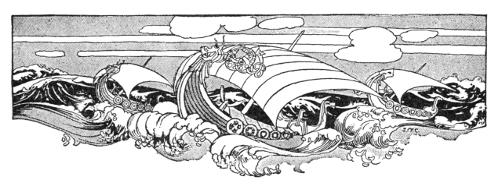
SIR PATRICK SPENS
FOLK BALLAD
The king sits in Dumferling toune, Drinking the blude-reid wine: “O whar will I get guid sailor, To sail this schip of mine?” Up and spak an eldern knicht,[10] Sat at the king’s richt kne: “Sir Patrick Spens is the best sailor That sails upon the se.” The king has written a braid[11] letter, And signed it wi his hand, And sent it to Sir Patrick Spens, Was walking on the sand. The first line that Sir Patrick red, A loud lauch lauched he; The next line that Sir Patrick red, The teir blinded his ee. “O wha is this has don this deid, This ill deid don to me, To send me out this time o’ the yeir, To sail upon the se! “Mak haste, mak haste, my mirry men all, Our guid schip sails the morne.” “O say na sae[12], my master deir, For I feir a deadlie storme. “Late, late yestreen[13] saw the new moone, Wi the auld moone in hir arme, And I feir, I feir, my deir master, That we will cum to harme.” O our Scots nobles wer richt laith[14] To weet[15] their cork-heild schoone[16]; Bot lang owre[17] a’ the play wer playd, Thair hats they swam aboone.[18] O lang, lang may their ladies sit, Wi thair fans into their hand, Or eir[19] they se Sir Patrick Spens, Cum sailing to the land. O lang, lang may the ladies stand, Wi thair gold kems[20] in their hair, Waiting for thair ain deir lords, For they’ll se thame na mair. Haf owre[21], haf owre to Aberdour, It’s fiftie fadom[22] deip, And thair lies guid Sir Patrick Spens, Wi the Scots lords at his feit.[23]
NOTES AND QUESTIONS
Historical Note. The old folk ballads, of which this one is an excellent example, have all come down to us from the far-off past. Such ballads are not the work of any one author, but like the stories of King Arthur, were preserved mainly in the memories of men. Some of them were sung or recited to the music of the harp or lute by minstrels who wandered from village to village, and from castle to castle, entertaining their hearers in return for food and lodging; or by the bards and minstrels who were maintained by kings and nobles to entertain them and to celebrate their deeds and honors. Often they were made by the people, not by professional singers, and were expressions of the folk love of adventure. Indeed, the best definition of a popular, or folk, ballad is that it is “a tale telling itself in song.” This means that a ballad always tells a story; that it has no known author, being composed by several people or by a community and then handed down orally, not in writing, from generation to generation; and finally, that it is sung, not recited. In this way such folk ballads as “Sir Patrick Spens” were transmitted for generations, in different versions, before they were written down and became a part of what we call literature, that is, something written. When the invention of the printing press made it possible to put these old ballads in a permanent form, they were collected from the recitations of old men and women who knew them, and printed. Thus they have become a precious literary possession, telling us something of the life, the history, and the standards, superstitions, and beliefs of distant times, and thrilling us with their stirring stories. The beauty of these old ballads lies in the story they tell, and in their directness and simplicity. They are almost wholly without literary ornament; their language is the language of the people, not of the court.
Many modern poets have written stories in verse which are also called ballads. Some are in imitation of the old ballads, using the old ballad meter and riming system, and employing old-fashioned words and expressions, to add to the effect. Other modern ballads are simple narratives in verse—short stories dealing with stirring subjects, with battle, adventure, etc. But while the true old ballad holds the attention upon the story only, the modern ballads often introduce descriptions of the characters.
Discussion. 1. Why did the king choose Sir Patrick Spens? 2. What did Sir Patrick say when he had read the king’s letter? 3. What signs of a storm had been noticed? 4. Point out all the ways in which the ballad tells that the ship was wrecked. 5. How have the old ballads come down to us? 6. What other old ballad have you read? 7. Tell how the old ballads came into being, and name a characteristic of them. 8. What do the old ballads tell us of the life of the early people? 9. How does a modern ballad differ from a folk, or popular, ballad?
THE SKELETON IN ARMOR
HENRY WADSWORTH LONGFELLOW
“Speak! speak! thou fearful guest! Who, with thy hollow breast Still in rude armor drest, Comest to daunt me! Wrapt not in Eastern balms, But with thy fleshless palms Stretched, as if asking alms, Why dost thou haunt me?” Then, from those cavernous eyes Pale flashes seemed to rise, As when the Northern skies Gleam in December; And, like the water’s flow Under December’s snow, Came a dull voice of woe From the heart’s chamber. “I was a Viking old! My deeds, though manifold, No Skald in song has told, No Saga taught thee! Take heed, that in thy verse Thou dost the tale rehearse, Else dread a dead man’s curse; For this I sought thee. “Far in the Northern Land, By the wild Baltic’s strand, I, with my childish hand, Tamed the gerfalcon; And, with my skates fast-bound, Skimmed the half-frozen Sound, That the poor whimpering hound Trembled to walk on. “Oft to his frozen lair Tracked I the grizzly bear, While from my path the hare Fled like a shadow; Oft through the forest dark Followed the were-wolf’s bark, Until the soaring lark Sang from the meadow. “But when I older grew, Joining a corsair’s crew, O’er the dark sea I flew With the marauders. Wild was the life we led, Many the souls that sped, Many the hearts that bled, By our stern orders. “Many a wassail-bout Wore the long winter out; Often our midnight shout Set the cocks crowing, As we the Berserk’s tale Measured in cups of ale, Draining the oaken pail, Filled to o’erflowing. “Once as I told in glee Tales of the stormy sea, Soft eyes did gaze on me, Burning yet tender; And as the white stars shine On the dark Norway pine, On that dark heart of mine Fell their soft splendor. “I wooed the blue-eyed maid, Yielding, yet half afraid, And in the forest’s shade Our vows were plighted. Under its loosened vest Fluttered her little breast, Like birds within their nest By the hawk frighted. “Bright in her father’s hall Shields gleamed upon the wall, Loud sang the minstrels all, Chanting his glory; When of old Hildebrand I asked his daughter’s hand, Mute did the minstrels stand To hear my story. “While the brown ale he quaffed, Loud then the champion laughed, And as the wind-gusts waft The sea-foam brightly, So the loud laugh of scorn, Out of those lips unshorn, From the deep drinking-horn Blew the foam lightly. “She was a Prince’s child, I but a Viking wild, And though she blushed and smiled, I was discarded! Should not the dove so white Follow the sea-mew’s flight, Why did they leave that night Her nest unguarded? “Scarce had I put to sea, Bearing the maid with me,— Fairest of all was she Among the Norsemen!— When on the white sea-strand, Waving his armèd hand, Saw we old Hildebrand, With twenty horsemen. “Then launched they to the blast, Bent like a reed each mast, Yet we were gaining fast, When the wind failed us; And with a sudden flaw Came round the gusty Skaw, So that our foe we saw Laugh as he hailed us. “And as to catch the gale Round veered the flapping sail, Death! was the helmsman’s hail, Death without quarter! Mid-ships with iron keel Struck we her ribs of steel; Down her black hulk did reel Through the black water! “As with his wings aslant, Sails the fierce cormorant, Seeking some rocky haunt, With his prey laden, So toward the open main, Beating to sea again, Through the wild hurricane, Bore I the maiden. “Three weeks we westward bore, And when the storm was o’er, Cloud-like we saw the shore Stretching to leeward; There for my lady’s bower Built I the lofty tower, Which, to this very hour, Stands looking seaward. “There lived we many years; Time dried the maiden’s tears; She had forgot her fears, She was a mother; Death closed her mild blue eyes, Under that tower she lies; Ne’er shall the sun arise On such another! “Still grew my bosom then, Still as a stagnant fen! Hateful to me were men, The sunlight hateful. In the vast forest here, Clad in my warlike gear, Fell I upon my spear, Oh, death was grateful! Thus, seamed with many scars, Bursting these prison bars, Up to its native stars My soul ascended! There from the flowing bowl Deep drinks the warrior’s soul, Skoal! to the Northland! skoal!” —Thus the tale ended.
NOTES AND QUESTIONS
For Biography, see page 81.
Discussion. 1. With which stanza does the narrative begin? 2. What may the first three stanzas be called? 3. Which of these three stanzas is descriptive? 4. In which does the Viking make himself known? 5. In what stanzas is the story told? 6. With what line does the story end? 7. What relation to the poem has the last line? 8. Describe the scene suggested by the first stanza; who is speaking? 9. Describe the guest to whom the poet speaks. 10. In using the word “fearful” to describe this guest, was the poet emphasizing only the outward appearance of his guest? 11. Can you use other words equally exact and poetical for “daunt” and “haunt”? 12. Give a name to the “flashes” that are seen when the Northern skies gleam in December. 13. To what is the voice of the skeleton compared? 14. Is it an apt comparison? 15. Does the second stanza prepare us for a story of happy things? 16. What stanzas help you to see the kind of people the Vikings were, and to imagine the life they led? 17. The Viking showed his wonderful courage in going out into the “open main” in a wild hurricane; give all the other evidences of his courage found in the poem. 18. The Introduction (pages 89 and 90) gives various motives for seeking adventures; do you think the Knights and the Vikings had the same motive? 19. How does this ballad differ from a folk ballad, such as “Sir Patrick Spens”? 20. Pronounce the following: daunt; palms; alms; haunt; launched.