PLATE XXXII.
Reading edition
THE DEATH OF EVAN DE FOIX.
The well-known catastrophe exhibited in this picture occurred in the year 1393,[19] at the Hotel St. Pol, in Paris. There was a grand entertainment on the occasion of the marriage of one of the ladies of the Queen. A certain Hugonin de Guisay proposed to the King and four others, himself making the sixth, to disguise themselves as wild men, in dresses covered all over with flax to imitate hair.[20] They entered the apartment, five chained together, dancing, the King leading them, to the great astonishment and amusement of the company, who could not guess who they were, so complete was the disguise. The Duchess of Berri, who, although the King’s aunt, was yet the youngest lady present, beckoned the King to her, and put many joking questions to him, with the view of ascertaining his name, refusing to let him leave her till he had avowed it. At this moment, the Duke of Orleans, wishing to discover one of the others, placed a torch so near that the flax caught fire, and in a moment all five were enveloped in flames, breaking their chains and uttering fearful cries of agony. The Duchess de Berri, seeing the disaster, threw her dress (“goune,” as Froissart calls it) over the King, who, crouching beneath it, was saved. The son of the Lord of Nantouillet, when his dress took fire, recollected a tub of water close at hand, in the buttery (bouteillerie), where bottles and glasses were washed, and, plunging into it, saved his life, but was much burnt. The other four, Evan de Foix (bastard son of the Count Gaston), Hugonin de Guisay, the Compte de Joigny, and Charles de Poictiers, were burnt to death. This sad event caused much to be said respecting the excesses of the Court; the King, it was rumoured, being then of an age to give up boyish sports and pastimes, and assume the severity and gravity of a great sovereign.[21]
The Gothic artist has succeeded in rendering the story with great graphic truth and completeness. The King beneath the robe of the Duchess—Nantouillet plunging into the tub of water—the agony of the four sufferers—the astonishment and grief of the Duke of Orleans—nothing, in short, is omitted; and, with all the accessories of musicians, furniture, &c. &c., the picture forms a most interesting and precious record of the manners of the time.
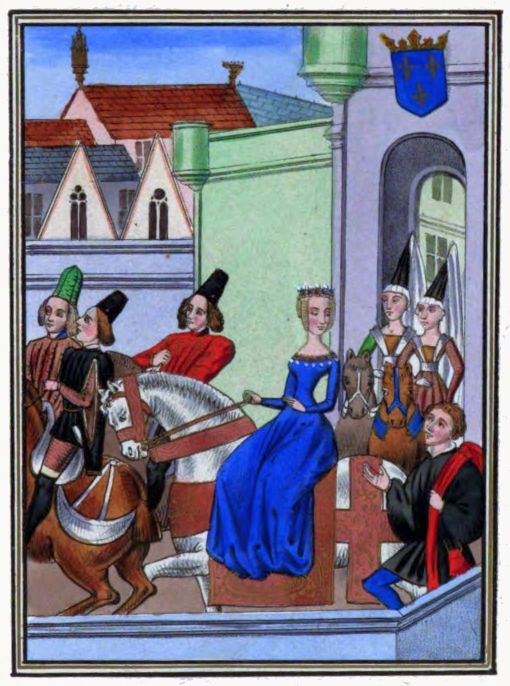
The Duchess of Orleans quitting Paris.