PLATE XXVI.
Reading edition
WILLIAM OF HAINAULT SETTING OUT ON HIS EXPEDITION AGAINST FRIESLAND.
The duke Albert of Bavaria, and his son the count d’Ostrevant, having determined to invade Friesland and attempt its conquest, proclaiming that they had a lawful claim on it, raised a large army for that purpose. The king of France sent five hundred lances to their assistance; and Richard II. of England, also anxious to show his good feeling towards his cousin the count d’Ostrevant, sent two hundred archers and a body of men-at-arms, under the command of three knights of repute, two of whom were named Colleville and Cornewall; the name of the third was unknown to Froissart[13].
The Frieslanders in the meantime had determined to die with their liberty, rather than submit to any lord whatsoever; but the odds against them were fearful, as they could only raise an army of about thirty thousand men, the greater part having no other arms than hatchets or such like rude weapons, whilst Froissart tells us, that, had the fleet which bore their enemies to their shores been ranged in a line, it would have reached from Enchysen, where they embarked, to Kuynder, whence they intended to effect their landing—a distance of twelve leagues. In fact, the army of invaders amounted to upwards of one hundred thousand men. After an obstinate battle the Frieslanders were defeated with cruel slaughter; but in consequence of that want of continuity of plan and action which characterises nearly all the European wars of the middle ages, this victory led to no important results; and, after burning a few villages, the army re-embarked and returned to Lower Friesland to pass the winter.
The simple and natural arrangement of the line of armed men and their banners, with which the Gothic artist has formed his miniature picture, might afford some useful hints to modern designers of cartoons; the simplicity is perhaps carried too far, but then it is free from the great vices of the modern schools, such as overstrained attitudes, exaggerated expression, fantastic, affected, and unnatural grouping, and artificial or rather theatrical effects of sudden light and shade. Without imitating the defects of these early practitioners of the art, a study of their earnest and unaffected simplicity of treatment might add much of that nobleness and repose of effect which is so deficient in modern historical pictures, and which ought to be one of their principal qualities. The contrivance by which the illuminator has in the small space of his miniature conveyed the idea of the passing of a large army, by means of the crowded line, or rather stream, of helmets, just seen over the steep banks of the hollow way through which they are passing, might certainly be improved to very good effect.
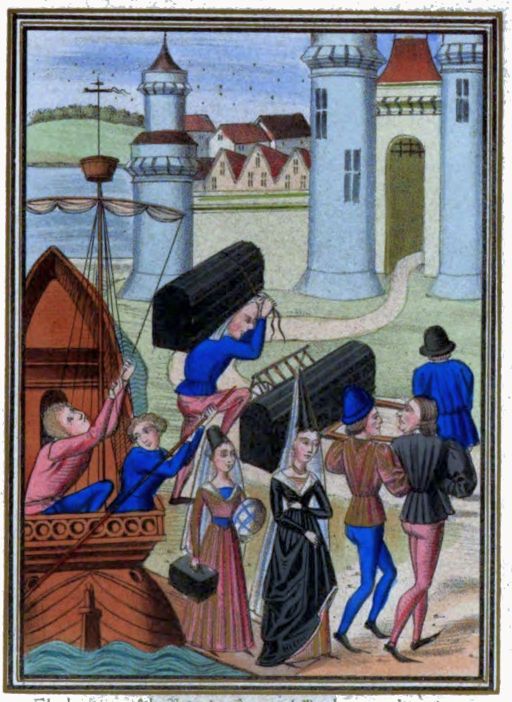
The landing of the Lady de Coucy at Boulogne, on her return from England, in the Year 1399.