PLATE XXVII.
Reading edition
THE LANDING OF THE LADY DE COUCY AT BOULOGNE ON HER RETURN FROM ENGLAND IN THE YEAR 1399.
Almost immediately after the deposition of Richard II., in 1399, the lady of Coucy, who had been in attendance upon his queen Isabella, daughter of Charles VI., returned to France, conveying the first tidings of the events which had just occurred. Rumours had already reached that country through some merchants of Bruges, but the whole truth was not known at Paris till the arrival of this lady. The grief of the king, when he heard of the misfortunes which had overtaken his son-in-law, was so great that it caused a return of his frenzy, and his uncles again resumed the government of the kingdom. The citizens of Bourdeaux, where Richard was born, were much attached to him, and, on hearing of his deposition and imprisonment were greatly excited, as were the people of all the surrounding country; for he had always been popular in that province. These circumstances gave the French great hopes that they might detach them from their allegiance to the English, and they carried on many intrigues and secret negotiations with that view; but after the first effervescence of feeling was over, the people of the Bordelais took a calm view of the question, and decided, as Froissart quaintly narrates it, that as France was at that time oppressed with heavy taxes, it would be better for them to remain true to the English, who left them frank and free; saying, “If the Londoners have deposed king Richard and crowned king Henry, what is it to us? &c. &c.—we have more commerce with the English than the French, in wines, wool, and cloth. Let us therefore be cautious how we listen to propositions which we may hereafter repent[14].”
It appears from this passage that actually more of the Bourdeaux wines were consumed in England than in France; so that an immense commerce of exchange between that district and England, equally advantageous to both, must then have flourished, which the interference of modern tariffs has, comparatively speaking, utterly destroyed.
The picture represents the disembarkation of the lady of Coucy at Boulogne-sur-Mer; and might, with slight alteration in the dresses of the principal personages, represent a party landing at Boulogne at the present time; for on the Continent, where liberal institutions and machinery have been more recent introductions than with us, habits and customs are far less changed. The form of the wheelbarrow is precisely that of the French wheelbarrows of the present day, and the blue frock of the man is still frequently worn by the barrow-men; the other porter too is carrying a trunk by means of a twisted rope, just in the manner which has descended to his successors of the present day on the quais of Calais and Boulogne, whilst the very form of the trunks is still orthodox with the manufacturers of such articles in the provincial towns of the Continent.
The respective characters of the party landing are most admirably delineated; the courtly step of the two male attendants, as they advance in earnest conversation, is cleverly contrasted with the boorish postures of the sailors and porters; and the serious propriety of the manner and expression of the lady, bearer of such evil tidings, is equally well discriminated from the pert nonchalance of the waiting-maid with her toilet-box and bundle. It is, on these accounts, one of the most interesting miniatures in the volume, though neither so richly coloured or highly finished as many others.
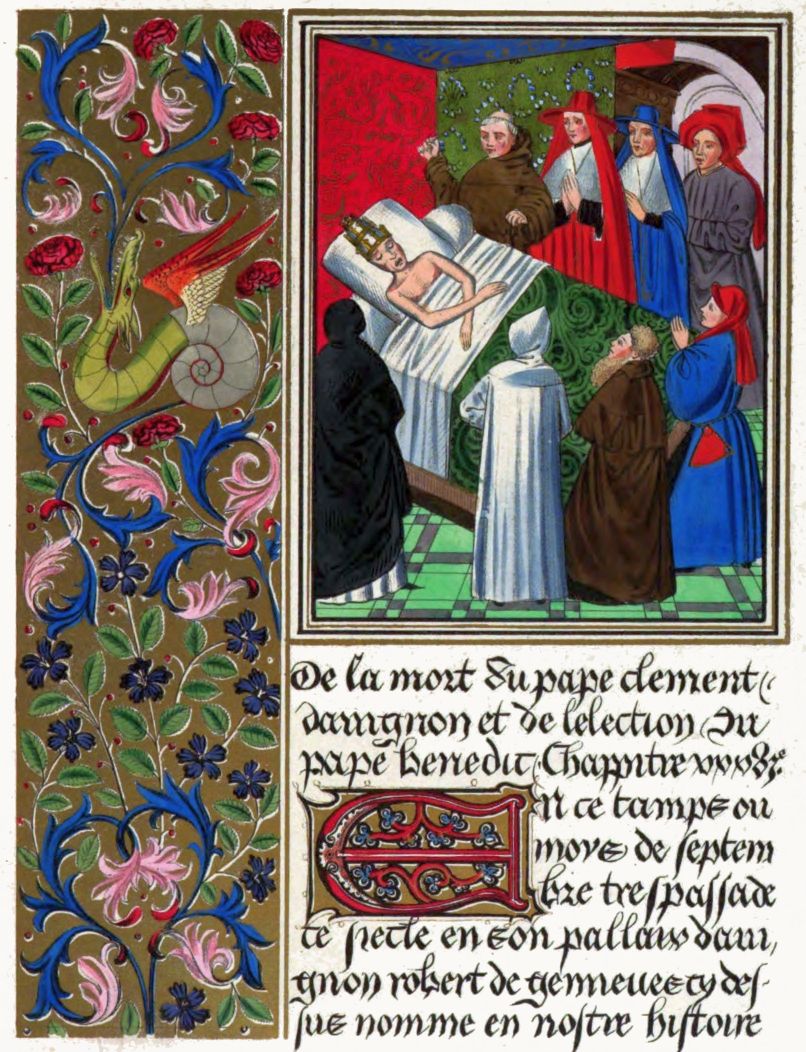
The death of Pope Clement of Avignon.