PLATE XXIII.
Reading edition
THE LORD DE LA RIVIERE.
One of the first acts of the regency of the Dukes of Burgundy and Berri was the imprisonment of nearly all the King’s late ministers and advisers, against whom many heavy charges were brought, but few proved. Sir Oliver de Clisson had the good fortune to receive timely information, and effect his escape. But the Lord de la Riviere and Sir John le Mercier were seized and thrown into prison, and all their estates confiscated. Their subsequent pardon is thus related by Froissart[11]:—
“The Lord de la Riviere and Sir John le Mercier, after having been carried from prison to prison, and to different castles, were at last given up to the provost of the Châtelet, and in daily expectation of being put to death, through the hatred of the Dukes of Berry and Burgundy and their advisers. They had been in this melancholy state for more than two years, without the King being able to assist them. He, however, would not consent to their execution; and the Dukes of Berry and Burgundy perceived that the Duke of Orleans strongly befriended them. The Duchess of Berry was incessant in her entreaties with her lord in their favour, more particularly for the Lord de la Riviere; but they could not condemn one without the other, for they were both implicated in the same accusation. The solicitations of many worthy persons, added to the justice of their cause, were of much weight; and several of the great Barons of France thought they had now sufficiently suffered, and should be set at liberty; for that Sir John le Mercier had wept so continually when in prison, his sight was weakened so, that he could scarcely see, and it was currently reported he was quite blind.
“At length there was an end put to their sufferings; for the King, although he had consented to their imprisonment, for reasons which had been given him, granted them this pardon, deferring further enquiry into what had been laid to their charge until a future opportunity, and when he should be more fully informed. All his lands and castles were restored to the Lord de la Riviere; and, in the first instance, the beautiful castle of Auneau, near Chartres, on the borders of Beauce; but he was ordered thither, and never to recross the river Seine, unless recalled by the King’s own mouth.
“Sir John le Mercier returned to his fine house of Noviant, of which he bore the title as Lord, in the Laonnois; and he had similar orders not to repass the rivers Seine, Marne or Oise, unless specially commanded by the King.
“They also bound themselves to go to whatever prison they might hereafter be ordered to by the King or his commissioners.
“The two Lords thankfully accepted this grace, and were rejoiced to be delivered from the Châtelet. On gaining their liberty, they thought they should be allowed to see the King, and thank him for his mercy; but it was not so: they were forced to quit Paris instantly, and set out for their different estates.
“They, however, gained their liberty, to the great joy of all who were attached to them.”
Among the figures in this illumination, that of the jailor is extremely characteristic; it is a happy impersonation of the jailor of all times, and might serve nearly as well for the representative of Dickens’s well-known Dennis, the hangman, with his knotted stick, as for the jailor of the Lord de la Riviere, near five centuries ago.
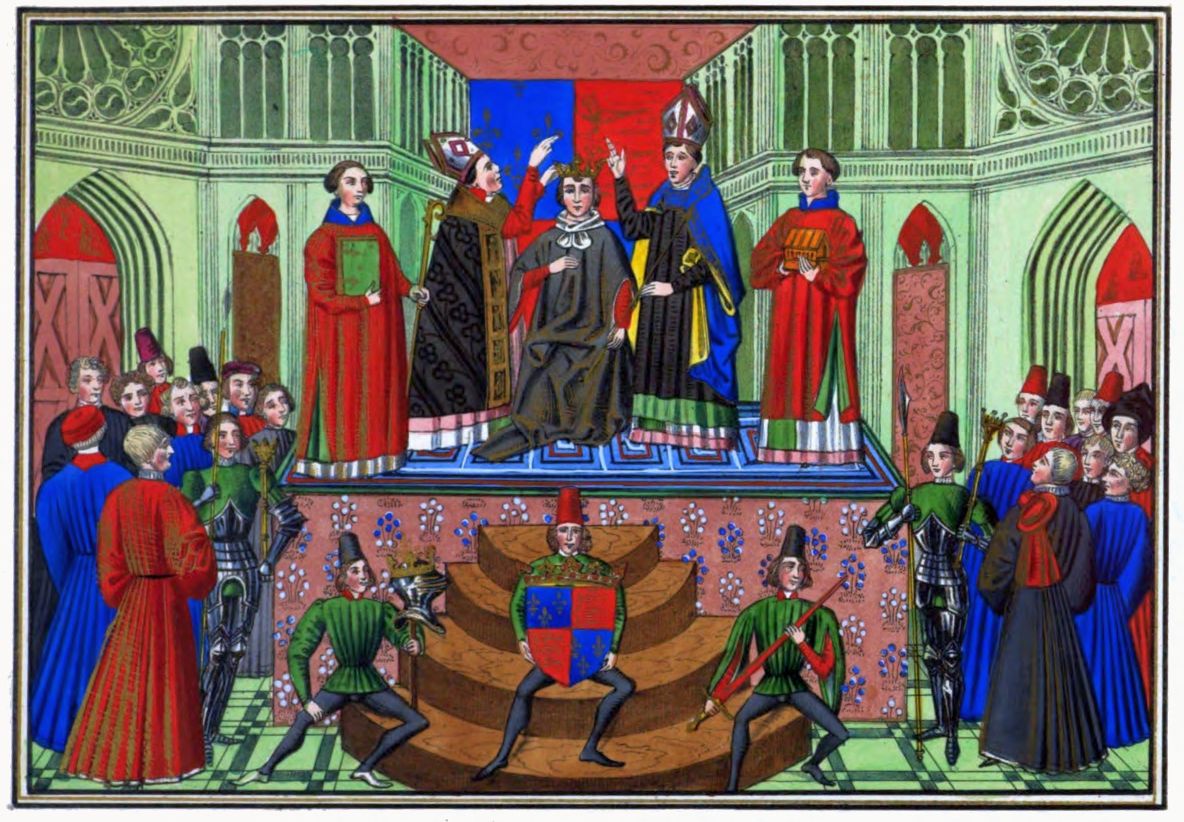
The Coronation of Henry IV.