PLATE XXII.
Reading edition
THE VISION OF ROBERT L’ERMITE.
Robert Mennot, a squire of the country of Caux, in Normandy, a man whom Froissart describes as “of religious and holy life,” caused, about this time, much discussion upon the subject of a vision which he declared he had seen during a storm at sea, on his return from Syria. He described the vision as like a figure as bright as crystal, which said, “Robert, thou shalt escape from this peril, as well as thy companions for thy sake, for God has favourably heard thy prayers: he orders thee by me to return to France as speedily as thou canst, and instantly on thy arrival to wait on the king, and relate what has befallen thee. Thou wilt tell him to listen to peace with his adversary the King of England, for their wars have lasted too long. Do thou interfere boldly when conferences shall be holden to treat of peace between King Charles and King Richard, for thou shalt be heard; and all those who shall in any way oppose or prevent peace from taking effect, shall dearly pay for their wickedness in their lifetime.”
He had several interviews upon the subject of his vision with the King of France and his Council, and was present at a conference to treat of peace, where he spoke eloquently in its favour; but the Duke of Gloucester and some others were sceptical, and declared the whole a cheat. Nevertheless, his influence was considerable; and, by order of the King of France, he passed over to England, where he was well received by the Court of Richard II. He had many private interviews with the King, and his uncles the Dukes of York, Lancaster, and Gloucester; but the latter still continued incredulous. Robert the Hermit returned to France, laden with presents, after a month’s sojourn at the English Court.
The vision is exhibited in the illumination after the true conventional style of Catholic legends. The ship and figures in the foreground, with the deeply serpentine waves, forcibly call to mind old engravings in some of our early printed Bibles, which point to the source of such illustrations in the Catholic missals and illuminated Bibles, from which, with slight alteration, they were frequently copied.
The border is taken from another part of the volume, the one attached to the present subject being very similar to one already given. In the present border the arms of De Commines occur again, and, in this instance, on “a field of France,” as though under the protection of that power.
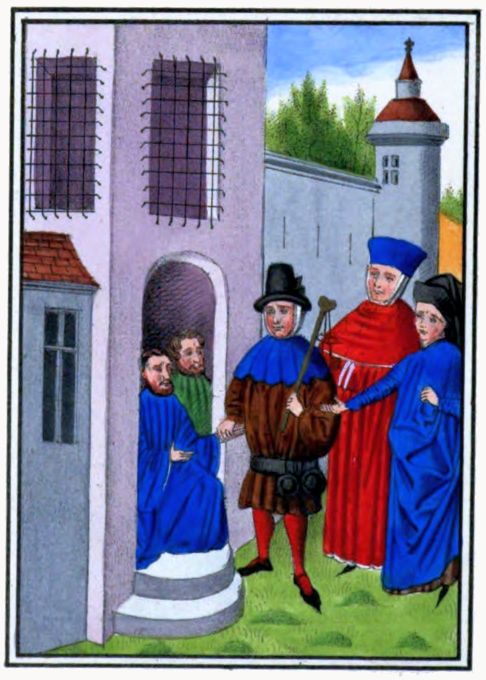
The liberation of the Lord de la Riviere.