PLATE XXV.
Reading edition
THE MEETING OF THE ARCHBISHOP OF CANTERBURY WITH THE EARL OF DERBY AT PARIS.
The Earl of Derby was still in banishment, on account of his quarrel with the Earl Marshal, when the citizens of London determined, in consequence of many grievances, to attempt the removal of King Richard from the throne; and sent the Archbishop of Canterbury as their ambassador to the Earl, who was residing at Paris, proposing to him to return to England, and assume the government of the country. Froissart states, that, when the Earl of Derby heard the proposition from the Archbishop, he did not immediately reply, “but, leaning on a window that looked into the gardens, mused a while, having various thoughts in his mind.” He at length turned, and replied somewhat evasively, in a speech which our chronicler gives at full length. The Archbishop then recommended calling a council of his most intimate friends, which advice was adopted; and the council being unanimously in favour of accepting the proposals of the citizens of London, it was determined that he should immediately leave France by way of Brittany, under pretence of a visit to the Duke, who was his uncle by marriage. “To shorten the matter,” says Froissart, “the Earl managed his affairs with much discretion, and took leave of the King and all the Lords who were then at court; and, on his departure, made very handsome presents to the King’s officers, as he was bounden to do, and to the heralds and minstrels resident in Paris, who attended the farewell supper he gave at the Hotel de Clisson, to such of the French Knights as chose to partake of it.”
The miniature, which represents the meeting of the Archbishop and the Earl, is very richly coloured and carefully executed, particularly in the gilding; the gold employed about the fire, and in representing sparks in the smoke, being introduced with remarkably happy effect. The plan of the fire-place is very accurately made out, and might suggest, perhaps, something in modern arrangements, as it seems, by means of the projecting canopy, to combine the advantages of an open grate with those of a stove, for it is not sunk in the wall like modern grates, by which much heat is lost in the chimney, but, on the contrary, stands out nearly as forward as a detached stove, by which a great economy of heat is effected.
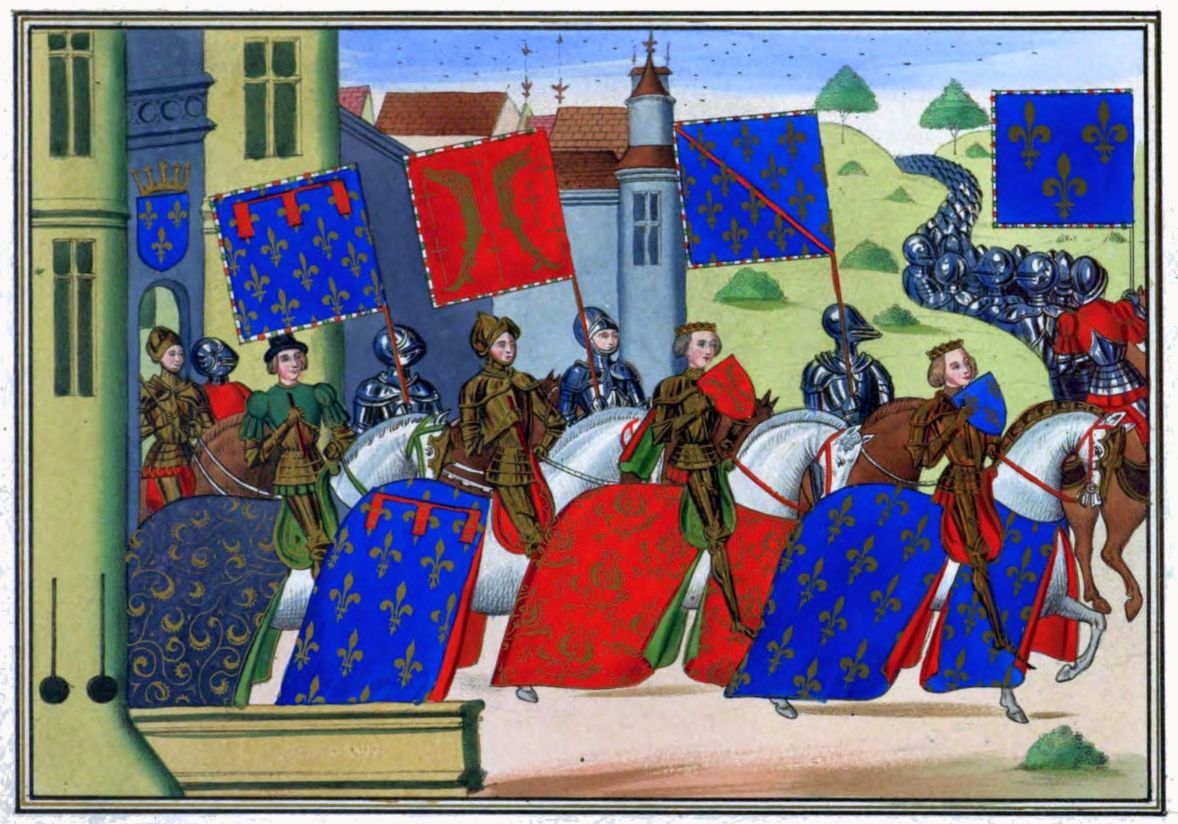
William of Hainault Count d’Ostrevant setting out on his expedition against Friesland.