PLATE IV.
Reading edition
THE EXPEDITION OF THE FRENCH AND ENGLISH TO THE COAST OF AFRICA, AT THE REQUEST OF THE GENOESE.
The Genoese, whose trade and coasts had been much annoyed by the piratical excursions of African corsairs, determined to attack them in their stronghold, a town called Africa, about seventy miles from Tunis, subsequently destroyed by Andrea Doria. In order to give effect to the expedition, the Genoese invited knights of reputation from France, England, and other countries, to take charge of it; furnishing them with vessels and provisions, and several thousand Genoese crossbowmen and infantry free of cost. The proposition being readily embraced by many French and English knights of rank, the command was assumed by the Duke de Bourbon, the uncle of the King of France, and they sailed from Genoa on St. John Baptist’s Day, 1390; and Froissart says, “It was a beautiful sight to view this fleet, with the emblazoned banners of the different lords fluttering in the wind, and to hear the minstrels and other musicians sounding their pipes, clarions, and trumpets, whose sounds were re-echoed back by the sea.” They re-assembled at the island of Commino, after having been dispersed in a great storm; and the weather being fine, the sea calm, and the coast of Africa not far distant, many advanced in rowing-boats. Froissart continues. “It was a pleasure to see the rowers force their way through the smooth surface of the sea, which seemed to delight in bearing these Christians to the shores of the infidels;” and, “it was a fine sight to view their various banners and pennons fluttering with gentle gales, and glittering in the sun.” This appears to be the moment depicted by the illuminator. The personage in the rowing-boat in the foreground appears to be the Duke de Bourbon. In the large vessel are several French knights, with probably the Count d’Eu in the centre; and in the vessel partly seen on the left is Henry de Beaufort (a natural son of the Duke of Lancaster), who was in this expedition attended by many knights and squires of rank. Although the perspective in this picture is rather barbarous, and its composition fearfully inartificial, it has much interest if not merit of detail: it displays the manner of exposing the emblazoned shields of the knights on the sides of their vessels, and many other particulars interesting to the antiquary, and the artist has displayed considerable discrimination between the regular and more refined features of the knights and gentlemen so comfortably placed within the vessels, and the ignoble expression of the poor rowers, so barbarously exposed in an open framework outside the boat of the Duke de Bourbon.
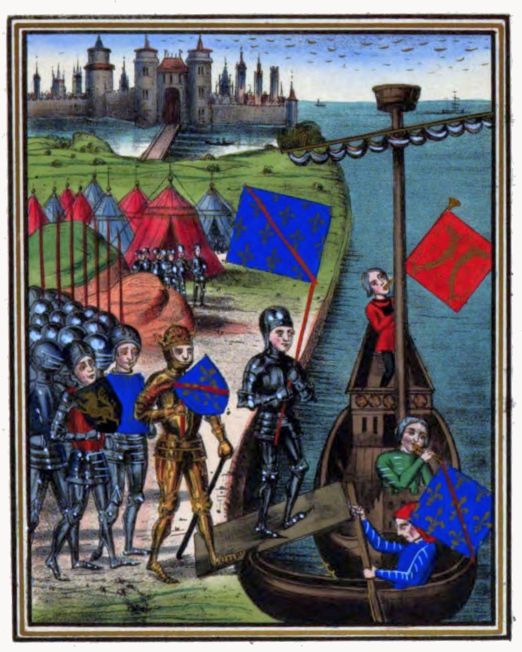
The raising of the Siege of the strong Town of Africa, and the return of the European Knights.