Part 1 — INDEX (continued 2)
Reading edition
Mahomedan: writers, 546.
Mahrat Desh: the Marátha country, 524.
Máhura: 519. See Mathura.
Maïs: Máhi river, 544.
Maithilas: 469.
Maitrakas: tribal name of Mehrs, 75 and note 6, 87–88; identified with Mhers, 135, 136, 141, 142 and note 2.
Maitreya: disciple of Nakuliśa, founder of a branch of Páśupata school, 84.
Majevádi: village, 176.
Majmudárs: district accountants, 212, 213 note 2.
Makara: fish, tribal badge of the Mehrs, 87, 135.
Makaradhvaja: chief of Mehrs, his fights with Mayuradhvaja, 87; ancestor of Mher chiefs of Porbandar, 135.
Makka: 204.
Makkah: 514, 520. See Makka.
Makrán: 508, 511, 516.
Makvánás: same as Jhálás, 140.
Malabár: port of, 515, 529, 537.
Máladeva: chief minister of Arjunadeva and Sáraṅgadeva, 204.
Málava: tribe, 28; kingdom of, 64; era, 67, 124, 465, 467, 469. See Málwa.
Málavya: lake at Dholka, built by Siddharája, 180 note 2.
Malcolm: Sir John, 180 note 3; (1820), 383.
Maleô: cape of, identification of, 539.
Malet: Mr., chief of the English at Surat, 402.
Maleus: Mount, 533.
Malhárráv: son of Khanderáv Gáikwár, retires on a pension to Naḍiád, 412; breaks out in rebellion in Káthiáváḍa; is captured by Bábáji Áppáji and Vithal Deváji, 413.
Malhárráv Gáikwár: called Dáda Sáheb, takes part in the Marátha conspiracy at Baroda (1857); escapes punishment, is imprisoned, succeeds Khanderáv, is deposed (1875), 442–443.
Malhárráv Holkar: Bájiráv Peshwa’s officer, plunders Dánta and Vadnagar and exacts tribute from Pálanpur, 317; defeats Dia Bahádur, governor of Mándu and captures Mándu, 382.
Malhárráv Khuni: Dámáji Gáikwár’s deputy at Ahmedábád, collects tribute in Gujarát (1740), 322, 323.
Máli: apparently Mália in north Káthiáváḍa, capture of, 506 and note 5; island, 509.
Mália: temple at, 153; Rája of, plunders Kachh and Sind, 422.
Máliba: identified with Málwa, expedition against, 109, 467.
Malik Báyazíd: son and successor of Shujáat Khán, Sultán of Málwa, with the title of Báz Bahádur (1565–1570), 369.
Malikhas: Nabathæan king, 542, 543.
Malik Kabir: Sultán Fírúz Sháh, deputes Ziá-ud-dín Barni to Broach, 514.
Malik Káfur: Cambay slave, rises in Dehli emperor’s favour, is sent to subdue the Dakhan, 205, 229.
Malik Mughis Khilji: minister of Sultán Hoshang (1405–1434), 359.
Malik Muîzz-ud-dín: conquers Gujarát and plunders Kambáyat, 515.
Malik Mukbil: Gujarát governor, 230.
Malik Túghán: captain of freebooters (1347), 230–231.
Mális: gardeners, 450.
Mâlindya: Mount, 533.
Malippala: town, 540.
Málkhed: capital of the later Ráshṭrakúṭas, 120. See Mányakheta.
Málkhet: Mánkir, 514; destroyed by Tailappa, Chálukya king (972), 519.
Mallikárjuna: Siláhára king of the Konkan (1160), is killed in battle by Kumárapála’s general, 185; his stone inscriptions, 186.
Mallu Khán: commandant of Mándu, assumes the title of Kádir Sháh Málwi and makes Mándu his capital, indifference of to the orders of Sher Sháh Sur; does homage to Sher Sháh at Sárangpur (1542), flies to Gujarát and attacks Mándu with Gujarát forces; the defeat of, by one of Sher Sháh’s generals, 368, 369.
Maltecoræ: tribe, 534.
Málwa: 24, 28; Gupta conquest of, 67; conquered by Govinda III. Ráshṭrakúṭa king, 123, 124; its king taken prisoner by Siddharája, 175; annexed to Chaulukya kingdom by Siddharája, 178; its king Ballála defeated by Kumárapála, 185; its king crushed by Visáladeva, 203; incorporation of, to Gujarát by Sultán Bahádur of Gujarát (1526–1536), invasion of, by the emperor Humáyún (1534), 367; under Sher Shah Sur (1542–1545), 368; under his successor Salim Shah (1545–1553), becomes independent under Shujáat in 1554, 369, 510. See Máliba.
Málwa Sultáns: (1400–1570), 356–371.
Mambaros: 543, 544.
Mámhal: 508, 509 note 3, 511. See Aṇahilaváḍa.
Mána: see Manna.
Mánáji: brother of Fatehsingh Gáikwár, assumes the government of Baroda, 410; his death, 411.
Mánáji Morár: Senápati of Rája Sháhu, 389.
Mánáṅka: early Ráshṭrakúṭa prince; Ráshṭrakúṭa family, 120.
Mánapura: city, 120, 132.
Mânas: associated with the introduction of sun-worship, 142.
Mánd: maritime island, 509.
Mandagara: identified with Mandangad, 541.
Mandagas: Sudra class of sun-worshippers, 142.
Mandagora: 546. See Mandangad.
Mándal: village near Viramgám, expedition against, 109, 518, 520 and note 2.
Mandala: kingdom, 135.
Mandali: modern Mándal, Múlanáthadeva’s temple at, 161 and note 2.
Mandalika: Chúḍásamá ruler of Junágaḍh, 70.
Mandali-nagara: temple of Muleśvara at, 161 and note 2.
Mandangad: 546.
Maṇḍapiká: gold canopy, won from Karṇa the Chedi king and presented to Somanátha, 163.
Mandasor: town in western Málwa, 77; inscription of Amśuvarman at, 81; defeat of Sultán Bahádur of Gujarát at (1534), 367.
Mandelslo: traveller (1623), 224 note 2; at Ahmedábád (1638), 279 note 2.
Mándu: expedition against (1394) 233, (1419) 237; hill fort, description of, 352–356; is made capital of Málwa by Sultán Hoshang, 358; besieged by Ahmed Sháh of Gujarát (1418–1422), 359; captured by Mehmud II. of Málwa and Muzaffar of Gujarát (1519); besieged by Sultán Bahádur of Gujarát (1526), 367; local Musalmán chiefs attempt to establish at (1536–1542), Mallu Khán the Sultán of, 368; captured by Akbar’s general Pir Muhammad (1560); re-taken by Sultán Báz Bahádur (1561); re-captured by Akbar’s general Abdullah Khán Uzbak (1562); visited by Akbar (1563); 369; Mughal province (1570–1720) 370, 371; is given to Muzaffar III. of Gujarát by Akbar, 371; described by Abul Fazl (1590), Farishtah (1610), emperor Jehángir (1617); the Reverend Edward Terry (1617) 371–381; besieged by Khán Jehán Lodi, 381; captured by Udáji Pavár (1696) and emperor Bahádur Sháh (1708); Ásaph Jáh Nizám-ul-Mulk, governor (1717–1721); Rája Girdhar Bahádur, governor (1722–1724); defeated by Chimnáji Pandit and Udáji Pavár; Bájiráv Peshwa, governor of (1734); included in the Pavár territory; Miná Bái, mother of Rámchandra Pavár, takes shelter in (1805), 382; under the Maráthás, (1720–1820), 382.
Mangalapura: establishment of a cess at, 176.
Mangalapurí: identified with Puri, 108.
Mangalarája: Gujarát Chalukya ruler (698–731), 56; his plates, 108–109; at Navsári, 110.
Mangalarasaráya: 56. See Mangalarája.
Mangalíśa: Chálukya king (600), 114.
Mángrol: Velári betelvine cultivators’ settlement at, 113 note 3; village, Siṃha era mentioned in an inscription at, 176. See Mangalapura.
Mangalor: 537.
Mangrul: port, burned by the Portuguese (1532), 347.
Mánkir: 514, 518, 519. See Málkhet.
Manoel DeSouza: same as Emanuel DeSouza, captain of the fleet of Diu, 349, 350, 351.
Mánpur: identification of, 544.
Mánsa: taken by Dámáji, 324.
Mansúra: in Central Sind, invaded by Mahmúd of Ghazni, 167.
Mansúrah: 506, 507, 511, 525. See Mansúra.
Mânthava: Báhika town, 534.
Mantrasástris: proficient in charms, 161.
Mantris: agents, 209.
Mányakheta: modern Málkhed, 120; capital of Dakhan Ráshṭrakúṭas, 128, 130, 519. See Málkhet.
Márá Śárva: king of east Málwa, submits to Govind III., 123.
Marásthalí: Márwár, 470.
Maráthás: their ascendancy in Gujarát (1760–1802), 227; raids on Surat (1664), 284; (1699), 291; threaten Surat (1700), 292; enter Gujarát under Dhanáji Jádhav (1705), 293; plunder Mahudha, enter Ahmedábád and levy tribute (1707), 295, 296; defeated at Ankleshvar (1711), 297; plunder the treasure escorted by Muhammad Tabrízí (1713), 388; yearly raids into Gujarát, 297; besiege Vadnagar (1725), 307; quarrels between their leaders Dámáji and Kántáji; under Dámáji expel the Viramgám Kasbátis; under Rangoji are defeated at Dholka by Ratansingh, 316, 317; defeat Rustam Ali governor of Surat, 305; defeated by Khánahzád at Sojitra and Kapadvanj (1725), 307; compel Mubáriz-ul-mulk to confirm his predecessor’s grants in their favour (1726), 307; make terms with the viceroy of Gujarát, 314; driven out of Baroda (1732), 394; defeat Sher Khán Bábi and capture Baroda (1734), 314–315; capture Kapadvanj (1736), 317; expelled from Viramgám fort; call in the aid of Momín Khán; take Viramgám, 323–324; take Petlád, 327; engagements with Momín Khán, 340, 341, 342; their arrangements in Ahmedábád (1758); strike coins of their own at the Ahmedábád mint, 342; levy tribute in Umeta, Bálásinor, Lunáváḍa, Visalnagar, and Pálanpur (1758), 343; their supremacy in Gujarát (1760–1819), 345, 385; help the Ráo of Kachh in an expedition against Thatta in Sind (1758), 398; join in a league against the English (1780); driven from their posts in Ankleshvar, Hánsot, and Ámod by the English (1780), 408; close of their supremacy (1819), 428–429.
Marco Polo: Italian traveller (1290), 501, 504.
Marcus Aurelius Antoninus: (161–180), 537.
Marinos: of Tyre, 537.
Markianos: geographer (b.c. 400), 546.
Marohæ: tribe, 534.
Marriages: 187 and note 1.
Maru: ancient name of Márwár, 36 and note 4, 466, 468.
Márwád: Márwár, expedition against, 109, 467.
Márwár: king of, present with Graharipu in the battle with Múlarája, 160; chiefs of, attack Lavanaprasád and are defeated, 199, 200; disturbance in (1692), 289, 464, 532.
Masálwaḍa: local name, 208 note 3.
Masudi: 469, 498. See Al Masudi.
Masulipatam: 494.
Mátar: táluka of the Kaira district, 122 and note 3.
Matarem: in the island of Java, 489.
Mátar Mahudha: made over to the English by Rávji, Baroda minister, in payment of the subsidiary force at Baroda (1803), 414.
Mátás: goddesses, 461.
Mathoæ: tribe, 534.
Mathra: modern Mathura, 519.
Mathura: king of, present at the svayamvara or choice-marriage of Durlabhadevi, 163; Prince Murád confined in (1858), 282, 533.
Matiás: with Momnas march against Broach, and murder the governor (1691); their defeat and slaughter, 288.
Mátṛi: 122. See Mátar.
Maues: northern Kshatrapa king (b.c. 70), 22.
Mauna: Puráṇic name for the Húṇas, 141 note 2, 143.
Maurya: chiefs, later (500), 15; ruling dynasty of the Konkan, 107; kingdom identified with Mauryas of Chitor, 109; of Chitor, 465; empire (b.c. 180), 535.
Mayúra: peacock, symbol of the Guptás, 135.
Mayuradhvaja: 135.
Mayurkhandi: see Morkhand.
McCrindle: Mr., 538, 541.
Meda: see Meva.
Medani Rái: commander-in-chief of Mehmud II. of Málwa (1512–1530), suppresses the revolt of Muháfiz Khán; defeats the combination of Muzáffar II. of Gujarát and Sikandar Sháh of Dehli; attempts of Mehmud II. of Málwa for the assassination of; expulsion of, with terrible slaughter by joint forces of Mehmud II. and Sultán Muzáffar of Gujarát; supported by Rána Sanga of Chitor, 366–367.
Medhs: 140; Bawárij pirates, 517. See Mehrs.
Meds: 140; Mánds, 508, 511. See Mers.
Medus Hydaspes: Virgil’s phrase for the Jhelum, 144.
Megallæ: the Mêkalas, 532, 533.
Megari: tribe, 534.
Megasthenês: ambassador of Seleukos Nikator, his account of India, 532, 533, 534, 535, 536, 537.
Mehmud II.: (1512–1530), son and successor of Násir-ud-dín of Mándu; revolt of his commandant Muháfiz Khán crushed by his Rájput commander-in-chief Medani Rái; combination by Muzáffar II. (1511–1526) of Gujarát and Sikandar Sháh of Dehli (1488–1560) baffled by Medani Rái; the attempt of, to crush the power of Medani Rái; siege of Mándu by Sultán Muzáffar of Gujarát (1511–1526); massacre of Rájputs; capture of Mándu, defeat and capture of, by Rána Sanga of Chitor; incurs the wrath of Bahádur Sháh of Gujarát by giving protection to Chánd Khán and Razi-ul-mulk; invasion and capture of Mándu by Bahádur Sháh of Gujarát; surrender and death of, 366–367.
Mehmud II.: (1526).
Mehmúdábád: town in Gujarát, 219 note 3.
Mehmud Khán: son and minister of Sultán Hoshang of Málwa (1405–1434), 359.
Mehmud Khilji: becomes Sultán of Málwa (1436); his victory over Rána Kumbha of Chitor (1443); builds his tower of victory; is defeated by Kutb-ud-dín Sháh of Gujarát (1453); makes his son Ghiás-ud-dín minister; his death (1469), 362.
Mehr: northern tribal name, 87; Hinduising of, 87.
Mehrán: the Indus, 510.
Mehtars: sweepers, 451.
Mekong: river, 504.
Melizeigara: probably Janjira, 536, 540, 546.
Menander: Baktrian king of India, 16, 17.
Menandros: (b.c. 110) conquests of, 535, 544, 545.
Mendan: town in Java, 490.
Mendang: town, built by Bhruvijaya Savelachála, 489.
Meos: Musalmán, identified with Mers, 140 and note 8.
Meroê: 542.
Mers: sun-worshipping foreigners (470–900), passed through Punjáb, Sindh, and north Gujarát into Káthiáváḍa and ruled there (770); allied to Jethvás and Jhálás, descendants of Húṇas, 135–147.
Mertha: district, conferred upon Durgádás by the emperor Aurangzib (1697), 290.
Merutunga: author of Prabandhachintámaṇi, 151, 152, 155, 156, 196.
Mesæ: tribe, 534.
Methora: modern Mathura, 533.
Mevas: name of tribe, 33.
Mewáḍ: origin of the name, 33; Kumárapála’s conquests extend to, 188; chief of, subdued by Vísaladeva, 203.
Mewár: 532, 533. See Mewáḍ.
Meyds: 142.
Mherváḍa: Mher settlement at, 136.
Mhow: Colonel Pratt, Captain Fagan, and Captain Harris murdered at, (1857); Colonel Durand, Resident, expelled from, 438.
Migration: from India to Indo-China, traces of, 499.
Mihira: king of Káthiáváḍa Mehrs; his inroads against Dhruva II., 127; tribe, 135–147, or Gurjjara conquest of Valabhi (490), 489, 490.
Mihiragas: 142 and note 5.
Mihirakula: king of the White Húṇas (508–530), 72, 74, 75, 76, 142 and note 2; son of Toramáṇa (500–540), 146, 465, 496, 497.
Mihirgulla: Indian emperor of the White Húṇas, 143.
Milizegyris: modern Janjira, 540. See Melizeigara.
Mines: of gold and silver in Gujarát, 528.
Minháj-us-Śiráj: 195 note 4.
Minnagara: ancient Greek capital, 15 note 3, 538, 540, 543, 544.
Mins: identified with Mers, 140.
Mirát-i-Ahmadi: 205; the author of, suppresses the riots at Ahmedábád and is rewarded with the title of Hassan Muhammad Khán (1730), 310; superintendent of customs, 328, 337.
Mirát-i-Sikandari: Musalmán history of Gujarát (1536), 348, 513.
Mir Fakhr-ud-din: obtains the governorship of Junágaḍh from the viceroy Abheysingh (1730), 311.
Mirkhand: 168.
Mir Muhammad Látir: minister of Ázam Khán, viceroy of Gujarát (1635–1642), 298.
Mirza Áziz Kokaltásh: Mughal viceroy, 212.
Mirza Isa Tarkhán: governor of Sorath, afterwards twenty-fourth Mughal viceroy of Gujarát (1642–1644), 212, 279.
Misáar Muhalhil: Arab traveller and writer, 510 note 1, 516, 517 note 1.
Mithankot: town, 538.
Miyánalladevi: daughter of Jayakeśi, king of the Karnátak, queen of Karṇa and mother of Siddharája Jayasiṃha; her regency; her pilgrimage to Somanátha; remits pilgrim tax, 170–172.
Mochis: shoemakers, 451.
Modása: town, capture of (1414), 236.
Modh Vasahika: Jain monastery at Dhandhuka, 191.
Modogalinga: the Calingas, 532, 533.
Modogoulla: probably Mudhol, 541.
Modura: modern Madura, 537.
Mokheráji: Gohil chief of Piram (1347), 87 note, 230.
Molindæ: Indian tribe, 533.
Momín Khán I.: is appointed governor of Surat by Nizám-ul-Mulk (1722), 303; is made governor of Cambay by Abheysingh (1730), 311, 313, 315, 316; schemes independence at Cambay (1736), 317; is appointed fifty-fourth viceroy of Gujarát (1737); assumes the title Najam-ud-dauláh Momín Khán Bahádur Fírúz Jang; asks Jawán Mard Khán Bábi to help him; his disastrous alliance with the Maráthás which gives a final blow to Mughal power in Gujarát, 318; receives secret instructions to disregard the appointment of Abheysingh fifty-fifth viceroy and to drive his Ráthoḍs from Gujarát, 319; captures Ahmedábád (1738); is appointed fifty-sixth viceroy (1738–1743), 320; is honoured with a title and dress by the emperor of Dehli (1742), 325; his death (1743); his wife seeks protection of Rangoji, 326.
Momín Khán II.: son of Momín Khán I., 207; is confirmed as governor of Cambay (1748), 330, 331; at his request Cambay is included in Peshwa’s share (1751), 334; is compelled by Raghunáthráv to pay an annual tribute of Rs. 10,000, 337, 338; takes Gogha, attacks Jambusar and besieges Borsad (1755), 339; captures Ahmedábád (1756), 339; receives compliments and a sword from the emperor of Dehli, 340; besieged in Ahmedábád, receives help from the Rája of Idar; Sháh Nur’s attempt to make peace between Momín Khán and the Peshwa fails; Ahmedábád and Gogha surrendered to the Peshwa (1758), 341, 342; oppresses and extorts money from his own followers, 342; contracts friendship with the English and visits Poona (1759), 343, 344; receives instructions from Dehli to join in driving the Maráthás out of Gujarát; is defeated (1761), 345.
Momnás: revolt of (1691), 288.
Monædes: Munda of Singbhum, 533.
Monoglosson: modern Mangrol, 538.
Mophis: river Máhi, 539.
Morbi: copperplate of Jaikadeva at, 81, 87; earliest seat of Jethvás, 136; grant of Jaikadeva at, 139.
Morkhanda: capital of the country ruled by Govinda, son of Dhruva, Ráshṭrakúṭa king, 123.
Moro Trimal: Shiváji’s general, captures the fort of Sáler in Báglán (1672), 387.
Moruni: tribe, 534.
Mostyn: Mr., resident envoy in Poona (1777), 407.
Mottaka: Bráhman settlement of, 127.
Mousopalle: provisionally identified with Karvir, 542.
Mouza: modern Musa, 543, 545.
Mozaffar: invades Somanátha, 190.
Muazzam: son of Aurangzib and commander of the Mughal army sent against Shiváji, 387.
Muazzam Sháh: Prince Muhammad, 296, 297. See Bahádur Sháh of Dehli.
Mubárak Khilji: emperor, 229.
Mubáriz-ul-Mulk: 304, 306, 307, 308, 309, 310, 311. See Sarbuland Khán.
Muftkhir Khán: son of Momín Khán, schemes of Rangoji for the assassination of; unites his forces with Fidá-ud-dín Khán, defeats Rangoji and obtains Borsad and Viramgám from him, 326; fifty-seventh viceroy (1743–1744), appoints Jawán Mard Khán his deputy; the house of, besieged by Jawán Mard Khán; his escape, joins Rangoji and retires to Cambay, 327.
Mughaira: brother of Hákam, leads an expedition to Debal, 506.
Mughals: the administration of, in Gujarát, (1573–1760), 221–227; emperors in Gujarát (1573–1760), 207, 345; at Mándu (1570–1720), 370–382.
Muháfiz Khán: commandant of Mehmúd II. of Málwa (1512–1530), the revolt of, suppressed by Medani Rái, 366.
Muhammad: prophet, his era, 204.
Muhammad: son of Fazl, sails against the Meds of Hind and captures Máli, 506.
Muhammad: son of Kásim, 506.
Muhammad IV.: (1648–1687) Turkish Sultán, an ambassador from, lands at Surat, 280.
Muhammad Aâzam Sháh: thirty-ninth viceroy of Gujarát (1703–1705), 291.
Muhammad Amin: poisons Abu Bakr, the leader and suppresses the riot at Ahmedábád (1681), 286–287.
Muhammad Amin Khán: Umdat-ul-Mulk, thirty-sixth viceroy of Gujarát (1674–1683), 285.
Muhammad Bahlol Khán Shirwáni: Mughal general, captures Idar (1679), 286.
Muhammad Bidár Bakht: forty-first viceroy of Gujarát (1705–6), 294–295.
Muhammad Ghori: raid of, into Gujarát, 195 note 4, 512; Sultán Ghazni Khán, son and successor of Sultán Hoshang of Málwa (1434–1436), poisoned by Mehmud, son of Malik Mughis, 359–360.
Muhammad Kásim: (712), 456 note 1.
Muhammad Sháh I.: (1403–1404), 234 and note 1.
Muhammad Sháh II.: Raushan Akhtar, emperor of Dehli (1721–1748), 222, 301; sends Mubáriz-ul-Mulk against Hámid Khán and the Maráthás, 306; his death (1748), 332.
Muhammad Tughlak: Sultán (1325–1351), 230, 231; at Asáwal, 513; quells the insurrection at Broach and Cambay, 514, 515; in Gondal (1349), 517; pursues Tághi, 518.
Muhammad Tughlak II.: emperor (1391–1393), 232.
Muhammad Ufi: 195 note 4.
Muharrir: secretary, 214.
Muhtasib: city censor, 214.
Muiz-ud-din: Gujarát governor (1347), 231.
Muiz-ud-din Bahrám Sháh: Sultán of Dehli (1194–1205), defeated by Viradhavala, 201.
Mukaddam: 212. See Patel.
Mukhtár Khán: thirty-seventh viceroy of Gujarát (1683–84), 287.
Muktias: crown domain officers, 209 and note 2.
Mulaka: son of Sahajiga, makes grants to Somanátha; is mentioned in the inscription at Mangrol, 176.
Mulakgiri: land-raiding system in Káthiáváḍa under the Mughals and Maráthás, 417; special rules, 418, 421.
Múlanáthadeva: temple of, at Mandali, 161 and note 2.
Múlarája: Solaṅki king, 131, 139, 153, 469, 470. See Múlarája, Chaulukya king.
Múlarája: Chaulukya king (961–996); his descent and birth; kills his maternal uncle and ascends the Chávaḍá throne; his fight with Bárappa; his war with Graharipu, ruler of Sorath; instals his son and retires; builds temples at Aṇahilaváḍa and Siddhapur; grants villages to Bráhmans, 131, 139, 153, 156–162, 164, 469, 470.
Múlarája: heir apparent of Bhíma I. of Aṇahilaváḍa, his mysterious death, 169.
Múlarája II.: Chaulukya king (1177–1179), succeeds his father Ajayapála; disperses the Turushka army, defeats Muhammad Ghori, 195, 512.
Múlaśvámi: temple of, at Aṇahilaváḍa, 161.
Mulavasatiká: Jain temple at Aṇahilaváḍa, 160, 161.
Muleśvara: temple at Maṇḍali-nagara, 161.
Muliyásar: Kshatrapa inscription at, 43.
Mulla Muhammad Ali: Ûmdá-tut-tujjár or chief of merchants, raises a disturbance at Surat (1729), fixes his head-quarters at Píram, and afterwards at Athva on the Tápti, 309; builds the fort of Athva (1730), 310; drives Sohráb Khán, governor, out of Surat (1732); kept in confinement by Teghbeg Khán, governor of Surat, 313; in correspondence with the Nizám; letters from the Nizám to Teghbeg Khán for the release of; the assassination of (1734), 315.
Müller: 512, 543.
Multán: capital of Húṇa dynasty, 143, 459, 509, 518, 528, 545.
Muna: lake at Viramgám, 180.
Mundakeśvara: holy place, 170.
Muñja: king of Málwa, deprives Chámuṇḍa of his marks of royalty, 162.
Muñjála: minister of Karṇa, Chaulukya king, 170, 171, 172.
Murád Bakhsh: Prince Muhammad, twenty-ninth viceroy of Gujarát (1654–1657); surrender of Kánji Chunvália Koli; proclaims himself emperor of Gujarát (1657); his transfer to the viceroyalty of Berár through Dárá Shikoh; collects an army and arranges to meet his brother Aurangzib; fights a battle with Mahárája Jasvatsingh and Kásam Khán, viceroys of Málwa and Gujarát (1658); Aurangzib and Murád enter Ujjain, meet Dárá Shikoh at Dholpur and defeat him; confined by Aurangzib at Mathura (1658), 281–282.
Múruj-uz-zahab: ‘Meadows of Gold,’ work of Al Masudi, 506 note 8.
Muruṇḍa: tribe, 64 and note 5.
Musa bin Is-hák: 516 and note 3.
Musalmáns: Gujarát (1297–1760), 207–384, 451, 468, 512, 514, 516, 518, 523, 526, 530.
Mushaka Vihára: temple at Pátan, built by Kumárapála, 190.
Mushrifs: revenue clerks, 212, 214.
Muslim: Arabs, first attack Broach, 513.
Muslims: dress of, 529.
Mustapha Khán: head of the Arabs at Sunth, makes the Rája prisoner; disarmed and shot by Lieutenant Alban, 441.
Mutasaddi: civil officer, 212.
Muter: Captain, arrest of, by Genl. Roberts, 440.
Mutiny: at Ahmedábád, suppression of, by the viceroy (1689) 288.
Muzgiri: 537.
Muzaffar I.: of Gujarát, (1407–1419), 210, 234–235; invades Málwa and defeats Sultán Hoshang at Dhár (1407); takes Sultán Hoshang to Gujarát as a prisoner; releases and reinstates him at Mándu (1408), 358.
Muzaffar II.: Gujarát king, attacks Somanátha, 190.
Muzaffar Khán Gárdi: Peshwa’s captain at Surat (1758–1759), 343.
Muzaffarábád: port, burned by the Portuguese (1532), 347.
Muziris: Kranganur, 537, 546.
Myos Hormos: near Rás Abu Somer, 536, 543.
Naagramma: town, 538.
Nabathæa: destruction of the kingdom of (105), 543.
Naḍiád: battle near (1412), 235; made over to the British by Rávji Apáji (1803), 413.
Nádirsháh: Persian emperor invades Hindustán, 322.
Nadol: copperplate, 181 note 3.
Nador: state in Márwár, its chief Kelhana put a man to death for his wife having offered flesh to a field-god, 193.
Nadula: modern Nándol, 198.
Nága Kings: the, 64.
Nága: see Nirihullaka, 115. Wild tribe identified with Naikdás of the Panch Maháls and the Talabdás of Broach, 115.
Nágada: minister of Visáladeva, 203.
Nágána: temple of, in Meváḍ, 133.
Nágáne: tribal guardians of the Ráthoḍs, 452.
Nagar Fárkar: rising in, 448.
Nága Rája: son of Chamuṇḍa, Chaulukya king, 162–163.
Nágariká: modern Navsári, 125.
Nagarouris: probably Poona, 541.
Nágasárika: modern Navsári, 125.
Nágavarddhana: Chálukya prince; king ruling in west Násik; grant of, at Nirpau, 108, 110, 111, 112.
Nágavarmman: 122.
Nág worship: legends of, 502 note 3.
Nagor: fort of, 174 note 1.
Nágher: district, 208 and note 3.
Nahapána: first Gujarát Kshatrapa, 24, 29.
Nahlwára: Aṇahilváḍa, 508, 509, 510, 511, 517, 518, 531.
Nahrwálá: the Rai of (Bhimdeva), 196, 511, 512.
Nahush: father of Yayati, 460.
Naikda Bhils: in revolt under Rupa and Keval Naiks (1858), 444; joined by Tátia Topi’s broken force, 445.
Náikdás: wild tribe, 115.
Náikidevi: wife of Ajayapála and mother of Múlarája II. Chaulukya kings, her fight at Gádaráraghatta, 195.
Náin Pal, slew Ajipál, Kanuj monarch (470), 120.
Náis: barbers, 451.
Náiyad: district in Sorath, 208 and note 3.
Nakhonwat: Nága’s shrine in Cambodia, begun in a.d. 825 and completed in a.d. 950, 499, 500, 504 and note 1.
Nakkabhajja: village, 127.
Nakleśvara: temple of Śiva at Kárván, 83 note.
Nakuliśa: 83 note and note 1.
Nakuliśa Páśupata: sect, 205.
Nalkántha: district, 208 and note 3.
Namados: the Narmada, 539.
Námagranth: 464.
Namnadios: the Narmada, 545.
Nánághát: inscription at, 38.
Nanagouna: supposed to be the Kálinadi, 542.
Nana Phadnis: at the head of affairs in Poona (1774); drives Rághoba from power 401; schemes of, against the English; demands the cession of Sálsette and the person of Rághoba, 408; his proposals to Govindráo Gáikwár, 411.
Nandi: bull, badge of the religion of Valabha dynasty, 80.
Nándipuri: modern Nándoḍ, 4, 85; capital of Gurjjara dynasty of Broach district, 107; palace of Gurjjara kings, 111; capital of the Gurjjars, 113. See Nándor, 113.
Nándod: capital of the Gurjjara dynasty of Broach district, 107, 108; capital of Rájpipla, 113. See Nándipuri and Nándor.
Nandol: in Márwár; its chief slain by Lavaṇaprasáda, 198.
Nándor: capital of the Gurjjaras, modern Nándoḍ, 113 and note 3. See Nándipuri and Nándod.
Naoura: 546.
Náradji: divine sage, 461.
Nárána: 507, 520. See Náráyan.
Narasimha III.: Hoysala Ballála king of Dvárasamudra (a.d. 1254), 203 note 3.
Narasimha: Karnátak king, 469.
Narasiṃhagupta: Gupta chief, 74, 77.
Naravarman: king of Málwa, at war with Siddharája, 177; his inscription, 173, 180.
Náráyana: minister of war and peace; writer of Karka’s Surat grant, 125; writer of Dhruva’s Baroda grant, 126, 511 note 12, 520; ancient capital of Gujarát, 527.
Náráyan: Bania or Bazána, battle of (1192), 195 note 4.
Náráyanráv Peshwa: murder of (1772), 401.
Narbadá: river, special holiness of, 84; its lower valley occupied by wild tribes, 114; crossed by the Maráthás for the first time (1675), 198, 387, 444; estuary of, 513.
Narbherám: Gáikwár’s deputy, 345.
Nareæ: tribe, 534.
Narmada: 545. See Narbada.
Narmaza: the Narbada, valley of, 510 and note 3.
Nármukhsarovar: see Nimbáli.
Nasarpur: town, 517.
Náro Pandit: deputy of Sadáshiv Rámchandra in Ahmedábád, 342.
Narotamdás: Rághoba’s agent for negotiating the terms of the treaty of Surat, 402.
Nárukot: Náikda Bhils in revolt at (1858), 444, 445.
Nasika: modern Násik, 540.
Násik: northern Chálukya capital, 112.
Násir-ud-dín: Abdul Kádir, son and successor of Ghiás-ud-dín (1502–1512); poisons his father, becomes Sultán, and subjects his mother Khurshíd to indignities and torture, 365. See Abdul Kádir.
Násir-ud-dín Kabáchah: Sultán (1246–1266) deputes his general to attack Nahrwála, 512, 519.
Nasmyth, Captain D., 447.
Nasrat Khán: companion of Alaf Khán in the Gujarát expedition, 205; plunders Cambay, 515.
Naulákheshwar: shrine of, 452.
Náusári: 546.
Naushahro: town, 538.
Navaghani: see Noghan.
Navánagar: town, 226; revolt of the Jám crushed by Ázam Khán viceroy (1640), 279; chiefship of, usurped by Raisinghji, captured and annexed and the name changed into Islámnagar by Kutb-ud-dín (1664), 283; restored to Tamáchi son of Raisinghji; the city remains in the hands of the Mughals till 1707, 285; quarrels of the Jám of, with the Ráo of Kachh, ejects Baroda agents (1807); British arbitration, 425; Jám’s death, 427.
Navsári: inscription of Śíláditya at, capital of Jayasiṃhavarmman, 107; copperplate of Jayabhaṭa at, 108; capital of Pulakeśi; destruction of the Chálukya kingdom of, 110; the great Arab invasion, repulsed by Pulakeśi Janáśraya at, 117; grant of Karka I. at, 124, 125; copperplate grants found at, 128; Indra’s copperplates at, 128, 130; grant of Chálukya king Pulikeśi Janáśraya at, 149, 468.
Nawábs: of Surat and Broach, 214.
Nazar Ali Khán: governor of Baroda retakes the fort of Broach from the Matiás and Momnás (1691), 288; nephew of Momín Khán viceroy of Gujarát (1738–1743), 325.
Neacyndon: Melkynda of Ptolemy and Nelkynda of the Periplus, 537.
Nearchus: 536.
Nek Álam Khán: Nizám’s lieutenant at Broach, 324; governor of Broach dies (1754), 338.
Neknám Khán Bahádur: the title of Hamid Beg, governor of Broach, 339; supports Sayad Achchan at Surat (1759), 343.
Nelkynda: Kallada, 546.
Nemáditya: minister of war and peace of Karka I., 125.
Neminátha: stone temples of, on Śatruñjaya, Ábu, and Girnár hills, 177, 202.
Nennapa: grantee in Dhruva II.’s Bagumrá grant, 131.
Nepál: inscription of Amśuvarman in, 81.
Netravati: river, 542.
Nicholas Ufflet: traveller (1610), 224 note 2.
Nicolo de Conti: traveller (1420–1444) 220, note 2.
Nihśankamalla: king of Aṇahillapáṭaka, 204.
Nikolaos: of Damascus, 535.
Nikumbhalla Śakti: Sendraka chief, his grant, 55–56, 111.
Nilakantha Mahádeva: Kumárapála’s royal god, 189.
Nilakantheśvara Mahádeva: image of, 163.
Nile: river, 510, 514.
Nili: queen of Graharipu, 160.
Nilkanth: pleasure-house at Mándu, visited by Akbar in 1574 and by Jehángir in 1617, 356; inscriptions, 370–371.
Nilkanth Mahádev: shrine of, 455.
Nimach: 539.
Nimbáli: tank, 453. See Nármukhsarovar.
Nimghoria Bhairav: 454.
Nirihullaka: grant of, 58 note 1; chieftain of a wild tribe, 114, 115. See Nága.
Nirpan: grant of Nágavarddhana Tribhuvanáśraya at, 108, 110.
Nirupama: another name of Dhruva I. and Dhruva II., 126.
Nisháda: country, 36 and note 9.
Nitra: identified with Mangalore, 542.
Nitrias: 537, 542. See Nitra.
Nityaṃvarsha Raṭṭakandarpa: 130.
Nizámsháhi rulers: of the Dakhan (1490–1595), 221.
Nizám-ul-Mulk: governor of Gujarát (1351), 231; Asafjáh, viceroy of Ujjain (1720), retires to the Dakhan, defeats and kills Sayad Diláwar Khán; retires to Aurangábád, battle of Bálápur in the Berárs and death of Álam Khán, deputy viceroy of the Dakhan, 301; appointed prime minister of the empire (1721), 302; his disagreement with Haidar Kuli Khán (1722), 303; appointed fifty-first viceroy of Gujarát (1722); appoints Hamid Khán, deputy viceroy and Momín Khán, governor of Surat, 303; defeats Rustam Ali, 390; sends Sayads Mithan and Achhan to Surat to avenge Mulla Muhammad Áli (1748), 331.
Noghan: Áhir ruler of Suráshṭra, attacked and slain by Siddharája, 176.
Nono da Cunha: Portuguese viceroy in India, 349, 351.
Northern India: conquest of, by Timur (1398–1400), 357.
Nousaripa: modern Nausari, 539.
Nuh: Noah, given as the first ancestor of the Chúḍásamá, 139.
Nur Jehán: wife of emperor Jehángir at Mándu, 375.
Núr-ud-dín Muhammad Ufi: author of Jami-ul-Hikáyat (1211), 512.
Nuzhat-ul-Mushták: work of Al Idrísi, 508 note 10.
Obollah: 545.
O-che-lo: Chinese name of the Arhat Áchára, 79.
Odonbœores: tribe, 534.
Office-bearers: under the Valabhi administration (a.d. 500–700), 81, 82.
Ohind: 468.
Okelis: modern Ghalla, 537, 543.
Okhágir: 208; Okhámandal.
Okhámandal: zillah, 208 and note 3; chiefs of, admit Sundarji Shiváji as resident on behalf of British Government, 425; chiefs of, take to piracy (1816) and are crushed by a British force; the district of, made over to the Gáikwár (1816), 427; Wághers of, besiege and plunder Dwárka Barvála and Bet (1859); expedition against Bet; capture of the forts of Bet and Dwárka, 446–448.
Ollaiyaka: grantor mentioned in Akálavarsha Kṛishṇa’s grant at Bágumra, 128.
Olokhoira: provisionally identified with Karád, 542.
Olpád: 539.
Omana: east of the Persian Gulf, 545.
Omenogara: probably Junnar, 541.
Oratæ: the Aparántakas, 532, 533, 534.
Oratura: probably Suráshṭra, 6.
Orbadarou: identification of, 539.
Orbitai: Makrán tribe, 546.
Origin: of the name of Gujarát, 2–5; of the Valabhis, 85–86; of Bhinmal, 466.
Orisa: 494.
Ormuz: shipowner of, 204.
Orostræ: tribe, 534.
Orrhotha: Sorath, 547.
Orsi: Urasa tribe, 534.
Osanpur: town, 538.
Osia: town, 463.
Osumbhala: village, 108.
Osváls: caste, 463, 464; origin of, 464 note 1.
Ounia: same as Húṇa, 146.
Oxus: river, 144.
Ozene: Ujjain, 37, 540, 543, 545.
Padmapura: city in Kâshmir, 188.
Padmávatí: wife of Kumárapála, 188.
Pagoda: coin, 219 note 2.
Pahár Khán Jhálori: governor of Pálanpur (1744), 328.
Páhini: mother of Hemachandra, 191.
Pahlavas: tribe, 35.
Paithan: town, 37, 132, 540, 541, 545.
Pakidari: modern Kávi, 539.
Pál: 216. See Vol.
Pál: village, 546.
Palai: 543.
Palaipatmai: modern Pál, 540, 546.
Palaisimoundou: Ceylon, 543.
Pálanpur: birth-place of Siddharája, Chaulukya king, 171, 310.
Palibothra: Páṭaliputra, modern Patna, 533.
Palimbothra: Páṭaliputra, 546.
Pálitána: 186.
Pallava: dynasty of Dakhan kings, 35, 58.
Palsána: village, 127 and note 3.
Pálwára: local name, 208 note 3.
Pampa: Kanarese poet (941), 466.
Panas: town, 538.
Panchál: zillah, 208 and note 3.
Pañchásar: village, Chávaḍá chiefship at its fall (696), 149, 150, 155.
Pañchásará Párasnáth: Jain temple of, 152.
Panch Maháls: rising in; siege of Dohad raised by Captain Buckle’s forces, 439; Tátia Topi in, his expulsion from, 445.
Pandæ: Páṇḍyas, 532, 534.
Pandai: Páṇḍyas, 546.
Pándavas: the, 519.
Pandion: kingdom of the Páṇḍyas, 537, 546.
Pandits: at courts of Gujarát kings, 180.
Pándurang Pandit: Peshwa’s agent in Gujarát, marches on Cambay and Ahmedábád, makes peace with Momín Khán and Jawan Mard Khán and retires to Sorath (1752), 335.
Pándurang Pant: 398. See Pándurang Pandit.
Páṇḍya: kingdom of, conquered by Pulikeśi II., 111, 534, 546.
Panjáb: kingdom of, 526, 527, 534, 545.
Páṇini: grammarian, 36, 534.
Pánipat: battle of (1761), 345.
Pánmul: village, assigned to the author of Mirat-i-Ahmedi, 322.
Pánoli: village, 328.
Papike: cape of, identification of, 539, 544, 545.
Parabali: tribe, 538.
Párahanaka: village, granted, its identity with Palsána, 127 and note 3.
Paramadeva: Rája, identified with Paramára, king of Ábu, 168 note 2.
Paramáras: Rájputs, 468; of Málwa, section of the Gurjjara or Bhinmál empire, 469; supreme in Marusthali, lose their possession, 470.
Parántij: assigned to the Maráthás (1737), 110, 319.
Parasang: lineal measure, 165.
Parasangæ: Páraśava, 533.
Párasnáth: Jain saint, 456.
Paraśuráma: son of Sajjana, finishes the temple of Nemináth, 177 note 1.
Párdi: 110.
Parganáhs: sub-divisions, 210.
Parkher: local name of Baroda, 208 note 3.
Pariah dog: passing of the (1857), in Gujarát, 433.
Parihárs: Rájputs, 465, 468.
Pariśishṭaparvan: work of Hemachandra, 193.
Pariyaya: village, granted, 110.
Park: Colonel, 445.
Párlipur: town, 119.
Parṇadatta: Suráshṭra governor of Skandagupta, 69.
Párnera: fort, captured by Shiváji (1672), 387; fort, 402; taken by Lieutenant Welsh (1780), 409.
Párpas: local name, 208 note 3.
Pársvanátha: temple of, 471.
Pársis: 194 note 1; riot of, in Broach (1857), 437, 438.
Partábpur: gathering at; destruction of, 443.
Parthians: 543, 544; empire of, 545.
Párvati: Shiv’s wife, 455.
Pasáitas: see Vartanias.
Pasipêda: town identified with Besmaid, 538.
Páśupata: sect, 83, 190.
Páśupatás: take service in army, 84.
Patala: island, 533, 534, 535; town, 538, 546.
Patale: Indus delta, 536.
Patalênê: 537. See Pattalene.
Pátáleshwar: 452.
Páṭaliputra: city, 546.
Pátan: town, 231, 232, 235; inscription at, 167 note 1, 174, 178; Sahasraliṅga lake built by Siddharája at, 179; Sabhá called at, by Siddharája, 181; stone inscription at, 190; vacated by Jháloris and Ráthoḍs and seized by Jawán Mard Khán (1737), 318, 460 and note 4.
Pátan Somnáth: zillah, 208 and note 3.
Pátálamalla: another name of Karka I., 124.
Pátdi: fort, given to Bhávsingh by the Maráthás, 323–324.
Patels: village headmen, 210.
Patika: northern Kshatrapa ruler, 23 and note 1, 33.
Pátri: Mándal, 518.
Patrias: dancing girls, 451 and note 4.
Pattabandh: investiture festival, 130.
Pattalene: Lower Sindh, 535.
Pattan: town, mosque in, 512.
Pattan Somnáth: burned by the Portuguese (1532), 347.
Pattávale: 469.
Patwári: Mughal village officer, 212.
Pausanias: (170) 499.
Pávágaḍ: hill fort, goddess Káli on, 206 note; taken from and restored to Sindia by the English (1803), 414.
Pavár: Gujar surname, 468.
Pawangad: 540.
Pearl fisheries: in the gulf of Kachh, 285.
Penth: 110.
Peperine: island, 542.
Perami: 545.
Perimula: Chaul, 533, 540.
Periplus: the, 7, 17, 535, 537, 539, 538; its author a merchant of Alexandria; the chief views about its age, 542–546.
Permádi: king, 172 and note 3; Kadamba king, 195.
Persia: country, 497, 532, 547; gulf of, 516, 536, 545.
Pertalis: capital of the Gangaridæ.
Pesháwar: stupas of, 497, 545.
Pesháwar: Kidáras established in, 144.
Peshkash: Marátha contributions, 216.
Peshwa: opens for the first time direct negotiations with the Viceroy of Gujarát (1726); appoints Udáji Pavár his deputy to levy tribute in Gujarát and to operate against Piláji; sends Chimnáji with an army through Gujarát; obtains tribute on the whole revenue of Gujarát (1728), 307, 309, 391; negotiates with the Nizám and the adherents of Trimbakráv Dábháde; recognises the Nizám’s rights to several places in Gujarát and agrees to help him in severing the Dakhan from the possessions of the emperor, 393; negotiates with Jawán Mard Khán (1750), 397; treaty of Bassein (1802), 413; his intrigue in Baroda, 426; treaty of Poona (1817); his fall (1818), 428.
Pethapángaraka: Dakshina Śiva shrine at 132.
Petirgala: probably Panagala or Hongal, 541.
Petlád: fort, captured and demolished by Rangoji (743), 327.
Peucolitæ: people of Pushkálavatí, 534.
Phôtios: 535.
Phra Tong: apparently Great Lord, 497.
Phula: king of Kachh, 160.
Phulpáda: old Surat, 539.
Phulada: father of Lákha, 160.
Piláji Gáikwár: nephew and successor of Dámáji Gáikwár, marches on Surat (1719); defeats Musalmáns; establishes himself at Songad; is secretly favored by Ajítsingh, 301, 390; marches on Surat and defeats Momín Khán; levies contribution; overruns Surat province and builds forts in Rájpipla, 303, 304, 390; obtains Baroda and Dabhoi; prevents Udáji Pavár from joining his forces with the viceroy at Baroda (1727), 308, 391; negotiates with Mustafid Khán, governor elect of Surat (1730), 311; assassinated (1732), 313, 394.
Pilgrimages: Vastupála’s, 202 note 1.
Pillar: Allahábád, inscriptions on, of Samudragupta, 63–65.
Pi-lo-mo-lo: Bhilmál or Bhinmál, 3, 466.
Pilu: Salvadora persica, 449, 456.
Pingalika: 174.
Pipal Duára: 455.
Piram: island in the gulf of Cambay, 309.
Pirate coast: 541.
Pirates: 492, note 3.
Pir Muhammad: Akbar’s general in Málwa, drives Sultán Báz Bahádur out of Mándu (1560); his defeat and death (1561), 369.
Piroz: Muhammadan shipowner of Ormuz, builds a mosque at Somanátha Pátan, 204.
Plate: forgery of, 110, 111.
Pliny: (23–79), 6, 532, 533, 535, 536, 537, 543.
Plutarch: 535.
Pokarn: 464. See Pushkar.
Polemaios: 37.
Pomponius Melo: (a.d. 43), 536.
Poona: treaty of, between the English and the Peshwa (1817), 428.
Porbandar: port, 524.
Poros: Indian king, 535, 536.
Ports: Gujarát (1513–1515), 220 and note 2.
Portuguese: affairs of the, in Diu (1529–1536), 347; send an expedition to south Káthiáváḍa and sack Tárápur, Balsár, and Surat (1531); burn the ports of Somnáth, Pattan, Mangrul, Talaja, and Muzaffarábád; destroy Bassein and burn Damán, Thána, and Bombay; send an embassy to the court of Humáyún to obtain Diu; treaty with Sultán Bahádur of Gujarát; disputes with Sultán Bahádur (1536), 347, 348; in Surat (1700–1703), 292.
Portuguese Asia: historical work by Faria-e-Souza (1650), 349.
Porwáls: caste, origin of, 464.
Poseidonios: 535.
Posina: boundary of the Vághela kingdom in 1297, 206.
Post: in Musalmán period, 214.
Postal chaukis: 214.
Potana: Patala, 535.
Poulipoula: identification of, 539.
Prabandhachintámaṇi: historical work dealing with the Chávaḍá kings, 149 and note 2, 151, 152, 154, 155, 156, 158, 159, 160, 162, 163, 169, 170, 171, 172, 173, 174, 176, 178, 179, 180, 183, 184, 185, 186, 189, 190, 193, 194, 195.
Prabandhaśata: work of Rámachandra, Kumárapála’s Pandit, 190.
Prabhákaravardhana: king of Magadh (600–606), 467, 497.
Prabhása: Múlarája’s visit to, 160; holy place, 164; inscription at, 176. See Somnáth Pátan.
Prabhútavarsha: another name of Govind Ráshṭrakúṭa, 126.
Prachanda: noble of Kṛishṇa, Dakhan Ráshṭrakúṭa king, 129.
Prajápati: daughter of, loved by the Moon, 521.
Prákrit: dialect, 533, 534.
Prárjunas: a tribe, 64 and note 3.
Praśántarága: title of Dada II. Gurjjara ruler, 115.
Praśasti: poetical eulogium on the Sahasraliṅga lake written by Śripála, 180.
Prasi: Prácyas of Palibothra, 532, 533.
Pratápamalla: son of Kumárapála’s daughter, 194. Second son of Viradhavala, 203.
Pratápráv: brother of Dámáji Gáikwár advances with Devaji Tákpar and exacts tribute and plunders the country; levies tribute from the chiefs in Sorath, dies of small-pox at Kánkar near Dholka (1737), 317.
Pratápasimha: king of Kalumbapattana, receives Kumárapála, builds a temple, and issues a coin named after Kumárapála, 183.
Prath-Nagri: local name of Dholka, 208 note 3.
Prehistoric references: to Gujarát, 11 note 2.
Premaládevi: sister of Kumárapála married to Kṛishṇadeva, Siddharája’s general, 181.
Prithiráj Chohán: king of Dehli, 470.
Pṛithivísena: ninth Kshatrapa (a.d. 222), coin of, 43.
Proklais: 545.
Protagoras: geographer, 546.
Pseudostomos: river, 540.
Ptolemy: Egyptian geographer (a.d. 150), 6, 7, 78 note 1, 137, 499, 533, 538, 539, 540, 544, 546.
Ptolemy II. Philadelphos: (died 247 b.c.), 535, 542.
Pulakeśi II. (610–640), 110, 116. See Pulakeśi Vallabha Satyáśraya, 465.
Pulakeśi Janáśraja: Gujarát Chálukya king at Navsári (738–739), 110; repulses the great Arab invasion at Navsári, 117.
Pulakeśi Vallabha Satyáśraya: Dakhan Chálukya king (610–640), 110, 111. See Pulakeśi II.
Pulikeśi: grant of, 109.
Pulikeśi II.: 107. See Pulakeśi II.
Pulikeśi Janáśraya: his grants, 149. See Pulakeśi Janáśraya.
Pulumáyi: Ándhrabhṛitya king, 38, 540.
Punáji Vithal: Peshwa’s agent in Gujarát, 329.
Pûr: town, 539.
Puragupta: Gupta chief (a.d. 470), 74.
Purána: Bhavishya, 142, 533, 534, 545.
Purandhar: treaty of (1776) between the Peshwa and the English, 406.
Puri: Konkan Mauryas of; its identity with Janjira or Elephants, 107, 108; ancient name of Broach, 159.
Pushpamal: 461.
Pushkar: holy place, 464.
Pushyagupta: Gujarát governor of Chandragupta, 14.
Pushyamitra: name of king or tribe, 69 and note 4, 73–74.
Pygmies: race of, in India, 532.
Pym: Lieutenant, 483.
Rachias: envoy, 536.
Raddi: 119. See Raṭṭa.
Rádhanpur: grant of Govind III. at, 123; disloyalty of the Nawáb of, 441; plate from, 466; grant of, 468.
Raffles: Sir Stamford, 489, 491.
Rafia-ud-Daraját: grandson and successor of the emperor Farrukhsiyar (1719); his murder by the Sayads, 301.
Rághobá: Báláji Bájiráv Peshwa’s brother, called also Raghunáthráv, levies tribute in Gujarát, takes possession of Rewa and Mahi Kántha districts and marches on Surat (1752), 334; takes Ahmedábád (1753), 336–337; compels Momín Khán to pay tribute; appoints Shripatráv his deputy at Ahmedábád and collects tribute from Limbḍi and Wadhwán chiefs, 337; acts as guardian of his nephew Mádhavráv, is joined in his intrigues by Jánoji Bhonsle and Govindráv Gáikwár, is defeated by the young Peshwa at Dhorap (1768) and confined at Poona, 399–400; is invested with the robe of Peshwa by the titular king of Sátára; reinstates Govindráv Gáikwár in title and estates of Dámáji Gáikwár (1774); sets out for Gujarát and attacks the city of Baroda (1775), 401–402; opens negotiations with the English through Mr. Gambier the chief at Surat, 401; joins Govindráv Gáikwár (1775); sends an agent to negotiate with the Bombay Council; flies to Cambay and through the help of Mr. Malet goes to Surat viâ Bhávnagar, 402; reception of by the Nawáb of Cambay, 403; abandoned by the English after the treaty of Purandhar (1776); takes refuge at Surat, 406; at Bombay; a fresh alliance of, with the English (1778), 407; handed over to Sindia; flies to Broach (1779), 408; receives a pension and goes to Kopargaon (1782), 410. See Raghunáthráv.
Rághoji: Marátha deputy, assassination of, at Ahmedábád (1756), 339.
Rághoshankar: Marátha leader, sent to subdue Kolis (1753), 338.
Raghoji Bhonsla: of Berár, joins with Dámáji in attacking the Peshwa, 395.
Raghunáthdás: Rája, Nizám’s minister, 333.
Raghunáthráv: 334, 336, 337, 398, 399, 400. See Rághoba.
Ráhada: another name of Ghaghaḍa the Chávaḍá king, 154, 155.
Rahánjur: Rándir, capital of Lárdes, 507 and note 11, 513.
Rahma: Ruhmi, apparently Burma and Sumátra, 527, 528.
Rahmi: 527.
Raht: spine of Indra, 119, 133.
Ráhtod Ráshṭraśyena: image of, 133.
Ráis: of Alor, 143.
Ráis Bhára: Samma chief of great Kachh, 518.
Raisinghji: usurps the chiefship of Navánagar, is defeated and slain in 1664, 283; Rája of Idar joins Fakhr-ud-daulah, 329, 331.
Raivata: legendary king, 8.
Raivataka: Girnár hill, 177.
Rája: chief, 215 and note 2.
Rajagharatta: title conferred on Cháhaḍa by Kumárapála, 187.
Rájahaṃsa: Prachanda’s grandfather, 129.
Rája Mahendri: 533.
Rájapitámaha: title of Siláhára kings, 185.
Rájapuri: see Puri.
Ráji: father of Múlarája, 156, 157; marries Lákha’s sister Ráyáji; is slain by Lákha, 160.
Rájpipla: 226.
Ráj-ul-mulak: special rules for conducting the mulakgiri or land-raiding system, 418.
Rájavula: northern Kshatrapa, 23.
Rákháich: son of Ráji and Lákha’s sister Ráyáji, 160.
Rákshas: division of Parihár Rájputs, 465.
Ráma: ancestor of the Chúḍásamá clan, 139.
Rámachandra: Pandit in Kumárapála’s court, writes the Prabandhaśata, 190; Jain scholar, ordered by Ajayapála to sit on a red-hot sheet of copper, 194.
Rámi: island of the Jáva group, 528.
Rám Rája: king of Sátára, appoints Khanderáv Dábháde to collect chauth and sardeshmukhi in Báglán, 388.
Rámráv Shástri: adviser of the Peshwa; decides in favour of Sayájiráv, son of Dámáji by his second wife, 400.
Rám Sen: hill range, 456.
Ran: 538.
Rána: of Chitor, 464.
Raṇagraha: Gurjjara prince (639), brother of Dadda II., his copperplate grant, 115.
Ráṇaka: chieftain, title of the Vághelás, 199.
Ránakadeví: daughter of a potter sought in marriage by Siddharája, 176.
Ránder: Ráhanjir or Rahánjur, 513, 520.
Rangáriká: district, 187.
Rangoji: is appointed agent by Dámáji Gáikwár in Gujarát; defeats Kántáji at Ánand-Mogri (1735), 316, 317; agrees to aid Momín Khán on condition of receiving half the revenues of Gujarát (1737), 318, 394; again appointed deputy by Dámáji to collect tribute in Gujarát (1741), 323, 325; defeated by Muftkhir Khán and Fidá-ud-dín; deserted by Sher Khán Bábi, is taken prisoner, his escape (1743), 326, 395; captures and demolishes the fort of Petlád; employed by the Musalmáns in the quarrels regarding the viceroyalty of Gujarát (1743–44), 327, 395; imprisoned by Khanderáv Gáikwár, is released by Umábái and appointed her agent (1745), 329, 396; expels Trimbakráv from Ahmedábád and himself collects the Marátha share of the city revenues, 329; takes shelter with Sher Khán Bábi in Kapadvanj; besieged at Kapadvanj by Fakhr-ud-daulah; requests Holkar to come to his help; the siege raised at the approach of Holkar; his interview with Jawán Mard Khán at Ahmedábád (1747), 330; captures Borsad and forces Hariba to leave the country, 331; deserted by his allies and imprisoned (1747), 332.
Rangrez: dyers, 451.
Ranmalji: Navánagar Jám (1664), 283.
Ránoji Sindia: at Idar, 315.
Ráo: title. See Ráv.
Rarungæ: tribe, 534.
Ras Fartak: in Arabia, 536.
Rashid-ud-din: Arab geographer (1310), 501; translated Al Biruni, 508, 514 note 9, 518, 529, 531.
Ráshṭrakúṭas: Gujarát branch of the, overthrow Chálukya kingdom, 117; Dakhan Branch of the, 119; dynasty (743–974), 119–134; their origin and name 119–120; their early dynasty (450–500), their main dynasty (630–972), 120; their conquest of Gujarát (750–760), 465; their grants, 466, 467, 506, 512 and note 1; in Gujarát, 525, 526, 527; their dominions, 529; their towns, 530.
Rás Mála: 146, 153.
Rasúlnagar: name given by Aurangzib to Visalnagar, 286.
Ratan Lall Pandit: Mr., 463 note 1.
Ratanmál: 461.
Ratanpur: town, 471.
Ratansingh Bhandári: deputy viceroy of Gujarát (1733–1737), 314; receives Dholka; defeats Sohráb Khán at Dholi near Dhandhuka, 315–316; enmity of, with Momín Khán, 316, 319; his attempts to oppose the Gáikwár, 317; defends Ahmedábád, 319; leaves Ahmedábád, 320.
Ratha: 119. See Raṭṭa.
Ráthoḍ: chief, at Idar, 217 note 3; dynasty, identified with Ráshṭrakúṭas, their origin, 119.
Ratl: pound (troy), 531.
Ratnáditya: Chávaḍá king, 154, 155.
Ratnágar: hill range, 456.
Ratnamálá: poetic history, 149 note 2, 150, 151, 157.
Ratnávate: Tamluk, port on the Hugli, 499.
Ratta: dynasty of kings, 7, 119.
Rauzat-us-safá: 168, 512 note 3, 523 and note 1.
Rav: village, inscription and stone well at, 204.
Ráv: title, 215 and note 2; of Kachh, makes an expedition against Sindh (1758), 342.
Rával: title, 215 and note 2.
Rávana: demon king of Lanka, builder of the silver temple of Somanáth, 190, 454 note 1.
Ravel: perhaps Ránder, 220 note 2.
Rávji: brought with his brother Bábáji Ápa to Baroda (1793) by Govindráv Gáikwár, 412; both the brothers receive from the Bombay Government the assistance of an auxiliary force under Major Walker, take the fort of Kadi by storm and compel Mulháráv to surrender, 412; his interview with Governor Duncan at Cambay, 412; death of Rávji Ápa (1803), 414.
Ráyáji: sister of Lákha, married to Ráji, 160.
Ráygad: fort, 284; stronghold of Shiváji, 386.
Reddi: Kánarese caste name, 119. See Raddi.
Red Sea: 535, 536.
Refugees: in Gujarát, 1.
Reforms: of Aurangzib, 283.
Rehbáris: herdsmen, 451.
Reinaud: 542–543.
Religion: of the Valabhi kings, 83–85.
Religious disputes: 280.
Reva: Narbada river, 467.
Revatímitra: present with Múlarája in the battle with Graharipu, 160.
Revenue: under Ahmedábád kings, 219 and note 2; in 1571, 221; in 1760, 222 note 2.
Riáyat Khán: minister of Ázam Khán, Gujarát viceroy (1635–1642), 278.
Roberts: General, 439, 443.
Roe, Sir Thomas: traveller (1615–1618), 217 note 2, 222 note 1.
Rohini: daughter of Prajápati, loved by the Moon, 521.
Roman: element in the architecture of Java and Cambodia, 496; empire, 536.
Rori: 143.
Rudradáman: fourth Kshatrapa (143–158), coins and inscriptions of, 6, 11 note 2, 13, 34–36, 80 note 1; his kingdom, 540.
Rudragaṇa: Traikúṭaka king, 58 and note 1.
Rudramahálaya: great shrine of Rudra at Siddhapura, 161; built by Siddharája, 179, 180.
Rudramálá: 172.
Rudrasena I.: eighth Kshatrapa (203–220), coins and inscription of, 42–43.
Rudrasena: seventeenth Kshatrapa (256–272), coins of, 47.
Rudrasena III.: twenty-fifth Kshatrapa (378–388), coins of, 51.
Rudrasena IV.: twenty-fourth Kshatrapa (348–376); coins of, 50–51.
Rudrasiṃha I.: seventh Kshatrapa (181–196), coins and inscription of, 41–42.
Rudrasiṃha II.: twenty-first Kshatrapa (308–311), coins of, 49.
Rúmi: 527. See Rahma.
Ruins: of Valabhi, 78, 79.
Rukn-ud-dín Amir: 204.
Rumadesa: 490; south Panjáb, 491.
Rumála: perhaps south Panjáb, 509 and note 5.
Rúmi Khán: officer of Sultán Bahádur of Gujarát (1536), 349, 350, 351.
Rúmla: country of Sindh, 520 and note 1.
Rupa Náik: leader of Náikda Bhils; surrender of (1859), 446.
Rupasundarí: wife of Jayaśekhara, gives birth to a son in the forest, 150, 151.
Rupe: quarries of, 455.
Rúp Matí: same as Rúp Mani, wife of Báz Bahádur of Málwa (1555–1570); her pavilion at Mándu, 353, 356, 371; captured by Adham Khán Atkah at Sárangpur, commits suicide (1562), 369, 371.
Rushis: sages, 461.
Rustam Ali Khán: marches on Jodhpur with Shujáat Khán and captures it (1723), 303; governor of Surat, asks Piláji Gáikwár’s aid against Hamid Khán and Kántáji; defeats Hámid Khán at Arás; his severe defeat and death by the Maráthás near Ahmedábád (1723), 305, 390.
Rustamráv: Marátha leader in the army of Abdul Aziz, 328.
Saádi: Persian poet (1200–1230), 189 note 2.
Sabalaessa: mouth of the Indus, 538.
Sabana: town, 538.
Sábarmati: river, 159, 198, 206; floods, (1683), 287; (1739), 322, 511, 517.
Sabdaliya: Chandal, 531.
Śabdánuśásana: grammatical work of Hemachandra, 193.
Sabæans: people, 535.
Sabiria: 537. See Abiria.
Sadárat: Mughal department of justice, 213.
Sadáshiv Rámchandra: Peshwa’s general, besieges and takes the town of Ahmedábád from Momín Khán (1758); helps the Ráv of Kachh, 340, 341, 342; besieges Bálásinor (1758) and levies tribute, 343, 398; defeats the chief of Dhrángadhra at Halvad and captures him, 344; appointed viceroy of Ahmedábád by the Peshwa (1760), 344.
Sadhara Jesangh: work of the Ráo Sáheb Mahipatrám Ruprám, 180 note 2.
Sadharo Jesingh: another name of Siddharája, 173.
Sadr: Mughal judge, 213.
Sadinoi: tribe, 540, 542.
Sádra: (Sháhdaráh), military post of the Mughals in Mahi Kántha (1674), 285, 433.
Sáela: fort, 180 note 2.
Sáfán: Táfán, principality next to Konkan, 527.
Safdar Muhammad Khán: successor of Teghbeg Khán, governor of Surat, 330; expelled by Sayad Achchan, 331; retires to Sind, 332; brought back to Surat by the Dutch and other merchants, 333.
Sagala-Vasahika: temple at Cambay, 190.
Sagapa: mouth of the Indus, 538.
Ságbára: forest tract, 388.
Sahajiga: father of Mulaka, mentioned in the inscription at Mangrol, 176.
Sahajigeśvara: temple at Prabhása, 176.
Sahárais: of Aror in the north of Sindh, rule over south Panjáb and north Sindh, 496; Buddhists, overthrow of, by usurping Brahmanist Chách (642), 497–498.
Sahasraliṅga: lake, built by Siddharája, 177, 179.
Saimhalaka: tribal name, 64 and note 5.
Saimúr: 507, 508, 509, 510, 513, 516, 520, 523, 528, 529. See Chaul.
Śaivism: religion of the Valabhi kings, 83.
Sajjana: Siddharája’s viceroy, in Suráshṭra, builds a temple at Girnár, his inscription, 176–177; Potter, hides Kumárapála, 182; is rewarded by Kumárapála with seven hundred villages, 184.
Śaka: tribe, 22, 67 note 2; era, 29; Yavans, 499.
Sákás: 456 note 1; branches of Bhinmál Shevaks, 464–465, 496 note 1.
Śákambhari: the Sámbhar lake; goddess; place, 158 and note 1.
Sakæa: Pausanias’ (170) name for Cochin China, 499.
Sakastene: land of the Śakas, 142 note 5.
Śakuniká Vihára: 186.
Sakvárbái: widow of Sháhu, applies to Dámáji Gáikwár and Rághunáth Bhonslé against the minister (1748), 396.
Salábat Khán: claimant to the chiefship of Junágaḍh, 425.
Salangoi: Sálankáyana, tribe, 546.
Sálankáyana: tribe, 546.
Sálbái: treaty of (1782), between the English and the Maráthás, 410.
Sáler: fort, in Báglán, captured by Moro Trimal (1672), 387.
Sálgogah: zillah, 208 and note 3.
Salike: Ceylon, 543.
Sálim Sháh: (1545–1553) Sher Sháh Sur’s successor, 369.
Sálvas: king of Mṛittikávatí, 10 and note 1.
Sálvas: tribe, 534.
Samadhigata-panchamaháśabada: title of the Gurjjars, 113.
Samandár: river port town, 519.
Sámangad: plate, 122; grant from (753–754), 467.
Sámanta: feudatory, title of the Gurjjars, 113.
Sámantádhipati: title of Jayabhaṭa III. Gurjjara king, 113 and note 6.
Sámantasimha: Chávaḍá king, defeated and slain by Múlarája, 157.
Samara: king of Suráshṭra, at war with Kumárapála, 186 and note 1.
Samarasimha: Chohán chief, 197.
Samarasimhadeva: 470.
Samatata: name of province, 64 and note 2.
Sámbhar: expedition of Cháhaḍa against, 187, 188.
Sámda: Thákor of, 441.
Samipadraka: village, gift of, 125.
Samma: tribe, 138; masters of Kachh after the fall of the Chauras, 517.
Sammatiya: school, 79.
Samprati: grandson of Aśoka, 15.
Samsám-ud-daulah: Daurán Nasrát Jang Bahádur, forty-eighth viceroy of Gujarát (1716–1719), 300.
Samudragupta: fourth Gupta king (370–395), coins, Allahábád inscription, 62–65, 67.
Samvat: Vikram era, 204.
Samvatasimha: 471.
Sanakánika: name of province, 64 and note 3, 65.
Sánchi Stúpa: Gupta inscription on, 66.
Sanchor: gate name, 449.
Sandábur: Goa, commercial town, 510.
Sandalias: Chandala, menials, 530.
Sandanes: of the Periplus, 44 note 2; envoy, 542, 543; ruler of Gujarát, 546.
Sandápur: apparently Goa, 509.
Sandhán: in Kachh, 509.
Sandur: Rándir, 509, 520.
Sángaṇa: ruler of Vanthali, killed by Viradhavala, 200.
Sangavada: village, 187.
Saṅghadáman: tenth Kshatrapa (222–226) coins of, 43–44, 546.
Sanján: in Thána, 509, 520; in Kachh, 530. See Sindán.
Sanjár: name borne by the Jȧms, 139.
Śankaráchárya: 84.
Śankaradeva: Devagiri Yádava chief, 205.
Śaṅkaragaṇa: father of Buddhavarmman, Kalachuri prince, 114. See Śaṅkaraṇa.
Śaṅkaraṇa: 114. See Śaṅkaragaṇa.
Śankaravarman: Káshmir king (890), 3, 468.
Śankh: claims Cambay; is defeated by Vastupála, Broach chieftain, 200 and note 2.
Saṅkheḍá: grant at, 118.
Sánoli: Sáonli, burning-place of Piláji Gáikwár (1732), 313.
Śántikas: a Konkan tribe, 44 note 2, 540.
Śántinátha: Jain Tirthankara, 192.
Śántu: minister of Chaulukya king Karṇa, builds a Jain temple, 170; Siddharája’s minister, 172; attacks an army of Bhils, 178.
Sántuvasahi: Jain temple, built by Sántu Karṇa’s minister, 170.
Sapádalaksha: name of the Ajmir kings, 157; Sámbhar territory, 184. See Sewálik.
Sapádalakshiya: 157.
Sapara: mouth of the Indus, 538.
Saraganes: 543; the younger and the elder, 546.
Saráj-ud-din: Maulvi, preaches jehád or religious war in Ahmedábád (1857), 434.
Sarandib: Ceylon, 516.
Sarandip: dependency of the Gujarát kingdom, 168.
Sáraṅgadeva: Vághela king (1275–1296), 203; succeeds Arjunadeva, his inscriptions, 204–205, 206.
Sárangpur: battle of (1422), 207 note; town, 368.
Saraostus: probably Suráshṭra, 6, 535.
Sarasvatí: river, 161, 173; well of talent in Dhára, 180, 511, 521.
Sarbana: town, identified with Sarwan, 539.
Sarbhon: place in Ámod táluka of Broach, Govind III. halts at, 123.
Sarbuland Khán: Khán Bahádur Mubáriz-ul mulk Diláwar Jang; is appointed deputy viceroy of Gujarát (1712–13), robbed on his way to Gujarát (1713), 297; appointed fifty-second viceroy (1723–1730); his deputy defeated (1724), 304; ordered to proceed in person with a strong army to Gujarát (1725), 306; is compelled to pay tribute to the Maráthás (1726), 307; makes alliance with the Peshwa, extorts tribute in Sorath, and marries the daughter of Jhála Prátápsingh whom he exempts from tribute (1728), 308; grants formally to the Peshwa one-fourth and one-tenth share of the revenue of the province (1729), 309; levies tribute in Káthiáváḍa (1730), 310; defeats the new viceroy at Adálaj and retires (1730), 311. See Mubáriz-ul-mulk.
Sardár Muhammad Khán: captures Bálásinor from the Maráthás, 345.
Sardhár: lake, 180 note 2.
Sardous: Mount, 532.
Sargaras: Bhil messengers, 451.
Sarika: demon, 462, 463.
Sarisabis: town, 540.
Sarkárs: Gujarát divisions, 209, 218–219.
Sarkhej: village, 438.
Sarsut: the river Sarasvatí, 510, 521.
Sarusa: apparently the river Sarasvatí, but perhaps the Sábarmati, 510.
Śarvva: Ráshṭrakúṭa or Gurjjara king, his coins, 87. See Amoghavarsha.
Sarvvamangala: village, 126.
Śátakarṇi: Ándhra dynastic name, 37, 38, 49.
Śátakarṇi: Yajñaśrí (140), 546.
Śátakarṇis: of Paithan, 541.
Satbán: son of Rásal, king of Hindustán that is Kanauj, 519.
Sati: 454.
Satka: evil spirit, 457.
Satrapa: same as Kshatrapa, 21.
Śatruñjaya: Jain hill, 78, 79 note 3, 164 note 5, 177, 186; Hemáchárya’s visits to, 189, 199; temple of Neminátha on, 202.
Satyasena: Chálukya king, 51.
Satyayug: first cycle, 461.
Saubha: name of country, perhaps Śvabhra, 10 and note 1.
Sauráshṭra: afflicted by an Arab army, 109; tribe of Káthiáváḍa, 534.
Saurs: of Sindh, 533.
Sausara: king of Suráshṭra, 186 and note 1.
Sauvíra: Upper Sindh and Multán, 537, 545.
Sávidár: gateway, 450 note 1.
Sávitrí: wife of Brahma, said to be a Gurjjara maiden, 464.
Sawánihnigárs: news-writers, 214.
Sayad: Musalmán trader, arrest of, at Cambay, 202.
Sayad Achchan: paymaster at Surat, aspires to the governorship of Surat, seeks Marátha help (1747), 396; takes the city of Surat and gets the merchants to sign a deed addressed to the emperor and the Nizám that he should be appointed governor (1748), 331–332; makes over one-third of Surat revenue to the Maráthás, 332; oppresses influential persons, surrenders citadel to the Habshi and withdraws to Bombay and thence to Poona (1750), 333; receives the governorship of Surat from the Peshwa and establishes himself in the government (1758), 343; receives a bodyguard from the Peshwa (1759), 399.
Sayads: brothers Hassan Ali and Abdulla Khan, king-makers at Delhi, 297, 301.
Sayad Imám-ud-dín: Ismáiliáh missionary in Gujarát during the reign of Máhmud Begada (1459–1513), 288.
Sayad Jelál Bhukhári: chief law officer or Sadr-us-Sudur for the whole of India (1642–1644), 279.
Sayad Miththan: marches on Surat and returns unsuccessful, his suicide, 331.
Sayad Sháhji: preceptor of Matiás of Khándesh and Momnás of Gujarát, his suicide, 288.
Sayáji Gáikwár: son of Dámáji Gáikwár, 342, 398; collects tribute in Sorath (1759), 344; appointed successor of Dámáji (1771), 400, 401.
Sáyan: village, 130.
Sáyer: land customs, 213.
Sázantion: town, 540.
Schwanbeck: 542.
Scobie: Colonel, 447.
Seal: Valabhi, 80.
Sea of Fars: the Indian ocean, 516, 518.
Sella-Vidyádharas: north Konkan Siláhárás, 129.
Seleukos Nikator: 532.
Semylla: modern Chaul, 546.
Senápati Bhaṭárka: see Bhaṭárka.
Sendraka: chief, 55; grant, 111.
Seneca: his book on India, 532.
Sese Kreienai: Burnt islands, 546.
Setæ: tribe of Mewár, 533.
Sewálik: hills, 157; king of, 194.
Sháhdádpur: town, 538.
Sháháb-ud-din Ghori: defeat of (1178), 229.
Shadhs: beggars, 451.
Shahámat Khán: forty-fifth viceroy (1713), 297.
Sháhánusháhis: Kushán dynastic name, 64 and note 5.
Sháh-bandar: harbour master, 212. Town, 538.
Shah Bhíkan: Hajrat, son of Saint Sháh-i-Álam, the tomb of, on the Sábarmati near Ahmedábád, 337 note 1.
Shah Budágh Khán: is appointed commandant of Mándu (1568); builds Nilkantha, 370.
Sháh Jehán: emperor, stays at Mándu; is defeated, his brother Sháh Parwiz retreats to Mándu (1621–1622), 381; his death (1666), 284.
Sháh Nawáz Khán Safávi: thirty-first viceroy of Gujarát, joins prince Dára in his rebellion against Aurangzib (1659), 282.
Sháh Nur: Hassan Kuli Khán Bahádur, viceroy of Oudh, sets out for Makkah; his unsuccessful attempt to arrange matters between Momín Khán and the Peshwa, 341.
Sháhi: Kushán name, 64 and note 5.
Sháhu: Rája of Sátára, appoints Khanderáv Dábháde Senápati, 389; settles the terms of agreement between the Peshwa and the Dábháde, 393.
Sháistah Khán: twenty-sixth viceroy of Gujarát (1646–1648), 280; twenty-eighth viceroy of Gujarát (1652–1654); his expedition against the Chunvália Kolis, 281.
Shakespeare: Sir Richmond, resident at Baroda, 443.
Shambhurám: Nágar Bráhman, supporter of Momín Khán at the siege of Ahmedábád, is taken prisoner by Dámáji and sent in chains to Baroda, 342.
Shámia Aliks: beggars, 451.
Shamsher Bahádur: title conferred on Dámáji by Sháhu after the battle of Bálápur (1720), 389.
Shams-ud-dín Altamsh: Sultán, 174 note 1; takes the fort of Mándu and drives away its Hindu chief (1234), 357.
Shankráji: governor of Viramgám (1753), 338.
Sharmistha: wife of Yayáti, 460.
Sharva: an animal, 508.
Shell-money: sowing of, 163, 164 and note 1.
Sher Khán Bábi: governor of Baroda; defeat of; capture of Baroda, 314; deputy governor of Sorath (1738), 321; allows Rangoji to escape to Borsad and joins Khanderáv, Dámáji’s brother, 326; joins Rangoji and marches against Fakhr-ud-daulah; wounded in the battle of Kapadvanj, 330; dispute of, with his Arab mercenaries at Bálásinor, 338; dies (1758) at Junágaḍh, 343.
Sher Sháh Sur: revolt of, in Bengal, 368; emperor (1542–1545), 368–369.
Shetuji: commander of the Ahmedábád garrison (1753), suffers a defeat, 338.
Shevaks: 450, 464.
Shivráj: Rája, commandant of Mándu (1658), 382.
Shivsingh: Rája of Idar, sends Sajan Singh to help Momín Khán at the siege of Ahmedábád by the Maráthás (1757), 341.
Sholápur: 519.
Shri Harsha: king of Magadha (610–642), defeats the Húṇas, Gurjjaras, Láṭas and the king of Sindh and Málava, 497; drives away White Húṇas, 500.
Shrimál: Bráhmans, 450, 462 and note 2; Vánis, 463; Bráhmans, their origin, 44. See Bhinmál.
Shrimális: meaning-making of the name of, 458; brought back to Bhinmál (1694), 464.
Shrimál Mahátmya: legendary account of Shrimál, 461.
Shrinagar: Shrimál, 461.
Shripatráv: deputy of the Peshwa in Gujarát, negotiates with Momín Khán for the release of Bhagvantráv; is recalled, 338.
Shripunj: another name of Jagsom, 460, 462, and note 3.
Shudras: 530. See Sudaria.
Shujáat Khán: Kártalab Khán, thirty-eighth viceroy of Gujarát (1684–1703), 287; his campaign in Jháláváḍa and Sorath and storming of the fort of Thán, 288; captures Jodhpur (1722), 303. See Kártalab Khán. One of Sher Sháh Sur’s generals in Málwa; defeats Kádir Khán at Mándu; appointed commandant of Mándu, 368–369; recovers Málwa (1554), 369.
Shujá-ud-daulah: nawáb of Lacknau, 341.
Shute: sailors of Somanáth, 204.
Siddhabhaṭṭa: grantee in Indra’s grant, 131.
Siddhachakravartin: title of Siddharája, 173.
Siddhahema: grammar by Hemachandra, 180.
Siddha Hemachandra: 191. See Siddhahema.
Siddhánta: 467. See Brahma Siddhánta.
Siddhapur: town, Vanarája’s image at, 152; holy place, Múlarája’s grants at, 161; Jain temple at, 172; Rudramahálaya temple at, 179; Kumárapála’s visits to, 183; Ahmedsháh’s march against, 237.
Siddharája: Chaulukya king (1094–1143), 156, 161, 162, succeeds Karna; regency of his mother; intrigues regarding his succession; remission of pilgrim tax; his wars with the kings of Sauráshṭra, Málwa, and Sindh; his era; his religious leanings and architectural buildings, 171–181.
Sidhpur: 152, 161, 172, 237. See Siddhapur.
Sidi Yákut: commandant of Janjira, offers to become a vassal of the emperor through the governor of Surat and receives the title of Yákut Khán from the emperor with an annual subsidy of 1½ lákhs payable from the port of Surat, 285.
Sigerdis: perhaps Ságaradvipa or Cutch, 16.
Sigertis: kingdom of, 535.
Sigerus: probably Janjira, 535, 536, 540.
Sihi Jagapura: palace, 180 note 2.
Sihor: village in Káthiáváḍa, 64 note 5, 161; reservoir at, 180 note 2.
Śíláditya: of Málwa, reigning king of Kánya Kubja, 79.
Śíláditya IV.: Valabhi king (691), 117.
Śíláditya V.: Valabhi king (722), 117.
Śíláditya Śryáśraya: Gujarát Chálukya king, 56, 108.
Silaganasuri: Jain priest, 151.
Siláhárás: of the north Konkan, 527.
Siláprastha: perhaps Sitha in Jháláváḍa, king of, present with Múlarája in the battle with Graharipu, 160 and note 2.
Silæ: tribe, 534.
Silsilát-ut-Tuwárikh: written (851–852) by the merchant Sulaiman, 505 note 2.
Silveira: James de, Portuguese captain, burns the ports of Pattan-Somnáth, Mangrul, Talája, and Muzafarábád; Thána, Bassein, and Bombay, 347.
Sim: country, king of, imprisoned by Siddharája, 179.
Siṃha: maternal uncle of king Vísaladeva, 202; era, 176, 204.
Siṃhapura: see Sihor.
Siṃhasena: twenty-sixth Kshatrapa, coin of, 51.
Simulla: modern Chaul, 533.
Simylla: modern Chaul, 540.
Sinda: Goa Kadamba chief, 173 and note 5.
Sinda: perhaps Vadnagar, 546.
Sindábur: Goa, 517, 521.
Sindán: in Kachh, conquest of, and Jama mosque founded at, 506; St. John or Sanjan in Thána near Daman, 507, 508, 509, 514, 516, 521, 523, 528, 529, 530.
Sindh: conquered by Chúḍásamás, 139; expedition against by the Ráo of Kachh, 342; Bráhmans, 432 and note 2; king of, 467, 509, 511, 513, 517, 533. See Sindhu.
Sindhu: identified with Sindh, afflicted by Arab army, 109; river, 189.
Sindhurája: killed by Siddharája, 175, 179.
Sindia: Marátha leader, his unsuccessful attack on Sinor (1781), 409; at war with the English; his treaty with the English at Sirji Anjangaon (1803), 414.
Sindságar: branch of the Indus, 517.
Sindu: Debal, 547.
Singaldip: Ceylon, 512.
Singhæ: tribe, 534.
Singhana II.: Devagiri Yádava king (1209–1247), 198; attacks Lavaṇaprasáda; his treaty, 199.
Singhar: grandson of Sumra, extends his sway (1069), 517.
Sinhanadeva: see Singhana.
Sinor: attacked by Sindia (1781), 409.
Sinthon: mouth of the Indus, 538.
Sinthos: Indus river, 544.
Sirimalaga: modern Sirnál, 541.
Siripalla: town, 540.
Siri Ptolemaios: Śri Pulumáyi, Ándhra king, 37.
Sirishapadraka: Sisodra, village, 115.
Sirohi: chief of, head of Devra Rájputs, 465.
Siroptolemaios: Śri Pulumáyi, 541.
Sirur: Amoghavarsha’s inscription at, 124.
Sisodani Ráni: queen of Kumárapála, 188.
Sisodia: Rája of Mevád, struggles with Akbar, 140.
Sisodra: village, 115.
Sitha: in Jháláváḍa, 160 note 2.
Śivachitta: Goa Kadamba king (1147–1175), 173 and note 3, 195.
Śiváji: 145; founder of the Marátha empire, plunders Surat (1664), 284, 386; plunders it for the second time (1670), 284, 386; equips his fleet at Alibág, comes to the mouth of the gulf of Cambay, carries off Mughal pilgrim-ships, 386; captures Párnera and Bagváda forts to the south of Surat (1672), 387.
Śivánanda Kumárapáleśvara: temple of, 183.
Sivasána: king of, conquered by Hammuka, 163.
Sivrájpur: success of the Náikdás at, 446.
Siwana: town, 538.
Siyájiráv Gáikwár: 342. See Sayáji Gáikwár.
Skanda: twenty-seventh Kshatrapa, 51. Another name of Amoghavarsha, Dakhan Ráshṭrakúṭa king, 126.
Skandagupta: seventh Gupta king (454–470), inscription at Bhitári and Girnár, 69; at Junágaḍh, 73, 74; coins, 70–71, 80 note 1, 86.
Skanda Purána: 461.
Skythia: Sindh, 544.
Sodhali Váv: step-well at Mangrol, 176.
Sodha Parmárs: 217 note 3.
Sofála: 522.
Sohada: ruler of Málwa, 198.
Sohráb Ali: 313. See Sohráb Khán.
Sohráb Khán: governor of Surat (1730), 310; confirmed in the appointment; driven out of Surat (1732); settles at Bhávnagar, 313; appointed governor of Viramgám (1735); is defeated at Dholi by Ratansingh Bhandári, 315–316.
Sojitra: village, battle of (1725), 307.
Solaki: see Solaṅki.
Solaṅkis: 156, 191; Rájputs, their settlements, 464; their kingdom, 465; their change of faith (743), 463 and note 2, 468; of Aṇahilaváḍa, section of the Bhinmál empire, 469; dynasty (961–1242), 526. See Chaulukyas.
Solla: son of Udaya Vánia, minister of Karna, 170.
Som: builder of the Sun temple, 452.
Soma: builds the gold temple of Somanátha, 190.
Somachandra: Hemachandra’s name after his consecration, 191.
Somáditya: Múlarája’s ancestor, 157.
Somanátha: temple, 79 note 3, 154, 164; destroyed by Mahmud of Ghazni (1024), 165–168; Miyánalladevi’s pilgrimage to, 172; Kumárapála’s pilgrimage to, 187, 190; Lavaṇaprasáda grants a village to, 200; destroyed by Muhammadans in 1297, 205. See Somnáth.
Somanátha Patan: inscription in Bhadrakáli’s temple at, 81; rebuilding of the shrine at, 189; house-tax imposed for the maintenance of a mosque at, 204.
Somarája: son of Sahajiga, builds a temple at Prabhása, 176.
Somaśarmman: Bráhmanic king of Cambodia (610) 499.
Someśvara: poet, author of Kírtikaumudí and Vastupálacharita, 174, 199, 202.
Someśvara: shrine, re-built by Kumárapála, 189 and note 2.
Someśvara: king of the Hoysala Ballálas of Dvárasamudra (1252), 203 note 3.
Somnáth: 229 and note 1, 232–233, 507, 508, 510; destruction of (1025), 512; pilgrimages to, 531; legendary origin and description of the temple of, 521, 522, 523, 529, 531. See Somanátha.
Sompuras: 464.
Sonárs: goldsmiths, 450.
Songad: head-quarters of Piláji Gáikwár, 304, 330, 390; Fort, the citadel of Mándu, captured by Humáyún in 1534, 356, 367–368.
Songara Rájputs: 451 notes 3 and 4.
Sonots: 465.
Soráb Khán: see Sohráb Khán.
Sopára: near Bassein, southern Mauryan capital, 14, 38.
Sorath: chief of, owes allegiance to Gollas, 143; annexed to the Chaulukya kingdom of Aṇahilváḍa, 176; name and extent, 208 and notes 1 and 3, 209; land-raid system of the Maráthás in, 418–419.
Soter Megas: coins of, 19.
Soubouttou: town, 541.
Souparu: modern Supára, 540.
Souppara: 546. See Supára.
Sousikana: town, 538.
Southern Skythians: 537.
Souza: Faria-e, Portuguese writer (1650), 349.
Specht: author, 145.
Spencer: Mr., chief of the English factory at and governor of the Castle of Surat, 343.
Śri Bhavana: identified with Sarbhon, 123.
Śri Chápa: dynasty, 467.
Śri Devi: 152.
Śri Gauḍas: branch of Gujarát Bráhmans, their origin, 161.
Śri Gupta: see Gupta.
Śri Harsha: king of Magadha (606–641), 467.
Śri Harshacharita: life of Śri Harsha, 467.
Śri Jayatasihadeva: 470.
Śri Lakshmí: gate name, 449.
Śri Mála: identified with Bhinmál, 160.
Śrinagara: seat of Jethva power, 138.
Śripála: Siddharája’s poet-laureate, 180.
Śristhala-Siddhapura: troubled by Rákshasás or demons, 174.
Śri Vallabha: see Amoghavarsha.
Srongdzan-gambo: (640–698), founder of Tibetan power and civilization, overruns Tarim valley and Western China, 501.
Śryáśraya Śíláditya: (669–691), his plates; 107–108; Yuvarája (691–692), 110, 111, 112.
Stambha: king, threatens Ráshṭrakúṭa kingdom in the Dakhan, 123.
Stambhatirtha: modern Cambay, 123; granted to Śrigaudás by Múlarája, 161; temple at, repaired by Kumárapála, 190.
Stephanos: of Byzantium, geographer, 546.
Sthavirás: 193.
Sthiramati: name of a Bodhisattva, 79 and note 1, 85.
St. Martin: 534, 538, 539.
Strabo: Roman geographer (b.c. 50–a.d. 20), 16, 17, 532, 535, 536.
Strangers: settlements of, in Gujarát, 1.
Suarataratæ: 532, 534.
Suari: Sávaras of Central India, 533.
Subah: province, 211.
Subahdár: Mughal viceroy, 211.
Subára: 508, 509, 514, 516, 523 note 4, 529. See Supára, Surábara, and Surat.
Subhadrá: Kṛishṇa’s sister, 9, 10.
Śubhakeśi: king of the Karnátaka, 170.
Subhaṭavarman: king of Málwa, 198.
Śubhatunga: another name of Akálavarsha, 126.
Sudaria: Shudars, husbandmen, 530.
Sudarśana: ancient lake near Girnár, 35, 36, 69.
Sudása: northern Kshatrapa king, 23.
Suddhakkumbadi: ancestor of Prachanda, 129.
Sufáráh: 514. See Supára.
Suketuvarmman: inscription at Váda of, 107.
Śuklatirtha: place on the Narbada, 162.
Sukrita Sankirtana: Sanskrit work on Chávaḍá kings, 149 and note 2, 154, 156, 159 note 3, 171, 194, 195, 196.
Sulaimán: merchant and traveller, author of Silsilat-ut-Tawárikh, 498, 505 and note 2, 525, 526, 527, 530.
Sultánganj: Stupa at, 51.
Sumátra: Hindu settlements of, 493, 527, 528.
Sumra: chief, 139; king of Sindh, 160; tribe, sovereignty of Sindh passes to, 517.
Sunda: hill range, 456.
Sunda Máta: shrine of, 455, 456.
Sungyun: Chinese ambassador (a.d. 520), 74, 76, 502.
Sun temple: 455; description of, 459–460; history, 460–461; dates, 463.
Sunth: Arab outbreak at, 441.
Sun-worship: Multán, 142 and notes 2 and 5.
Supára: near Bassein, its various names, 523, 529, 546, 547.
Surabára: apparently Surat, 514, 516; Supára, 523.
Surabáya: Surabára, Surat, 507 and note 3, 514.
Suræ: tribe, 533.
Surajmal: claimant to the Lunáváḍa gádi or chiefship, 441.
Surajpul: gateway, 450 note 1.
Surapála: brother-in-law of Jayaśekhara, 150, 151.
Suráshṭra: ancient division of Gujarát, 6, 35, 36, 135; lord of, taken prisoner by Siddharája, 175; kingdom of, 535; Verával, 547.
Surast: Káthiáváḍa, 506.
Surastra: village, 538.
Surastrene: Suráshṭra, 15–16, 537, 538.
Surat: plate of Śryáśraya Śíláditya at, 107, 108; Karka’s grant at, 124; Kírtirája’s grant at, 159, 230, 235; sacked by the Portuguese in 1531, 347; plundered by Malik Ambar in 1609, 224 and note 2; by Shiváji in 1664, 284, 386; Shiváji’s second, attack on, in 1670, 284, 386; Maráthás at; permission granted by the emperor to let pass the Portuguese ships from (1700–1703), 292; affairs at; Mulla Muhammad Ali’s success at; his imprisonment and death at, by Tegbeg Khán, the governor (1732–1734), 313; affairs at (1748), 331; cession of the revenues of Surat to the Maráthás under Kedárji Gáikwár (1747), 332; affairs at (1750), 333; attacked by Raghunáthráv (1752), 334; affairs at (1758); castle taken by the English (1759), 343; treaty of (1775), between Rághoba and the Bombay Government, negotiated by Narotumdás, 402; treaty of, declared invalid by the Supreme Government, 405–406, 514, 523.
Surat: Athávisi, plundered by the Maráthás (1780), 409.
Surbáráh: mouth of the Tápti, 523.
Suri: sage, title conferred on Hemachandra, 191; tribe, 534.
Survey: by Todar Mal (1575), 223.
Surya: gate name, 449; Sun God, 461; Purán, 464, 465.
Suvarnavarsha: another name of Karka I., 124.
Suvrittinátha: installation of, in Śakunika Vihára, 186.
Śvabhravati: see Sábarmati.
Svargárohanaprásáda: shrine, on Śatruñjaya in honour of Vastupála, 202.
Svayamvara: bridegroom-choosing, of Durlabhadevi, 162–163.
Swát: 468.
Syagrus: Rás Fartak in Arabia, 536.
Sydros: town, 538.
Syrastrene: 544.
Tabakát-i-Násiri: 196.
Tában: king of Táfak, 527.
Tabari: Arab writer (838–932), 524.
Tabasô: probably Pandharpur, 541.
Tabasoi: 541. See Tabasô.
Tabi: the Tápti, 510.
Táfak: the Panjáb, 526; women of, 527.
Táfán: apparently the Panjáb, 527.
Tagara: town, identification of, 540–541, 545.
Tághi: rebellious Gujarát noble, 513, 518.
Tahsildar: sub-divisional officer, 210.
Táilakhali: Sálva tribe, 534.
Tailapa: king of Telingana, 158, 159.
Tailappa: western Chálukya king, overthrew the Ráshṭrakúṭa dynasty (972), 120, 131, 519.
Tájikas: Arabs, 149.
Tájpur: village, 438.
Tájul Maásir: 512, 519 and note 4.
Takhat Bái: wife of Anandráv Gáikwár, 426 and 68.
Táj-ul-mulk: Gujarát governor (1320), 230.
Takkadeśa: tract of country (Panjáb), 3, 468.
Talabdás: wild tribe, 115.
Talája port: burned by the Portuguese (1532), 347.
Talbi: lake, 453.
Tale Sap: lake, 499, 504.
Talpat: state land, 215, 227.
Tamáchi: name borne by Jáms, 139.
Tamáchi: son of Raisingji, restored to Navánagar (1673), 285.
Támbra Barani: apparently the Tápti, 510.
Támhal: Anhilawára, 516.
Támbánagri: local name of Cambay, 208 note 3.
Tamluk: port on the Húgli (a.d. 100), 499, 533.
Támraliptakas: of Tamluk, 533.
Tána: modern Thána, expedition against by Usmán, 505, 508, 509, 523.
Tánah: 508. See Thána.
Tánka: country, 467 and note 7.
Tankás: coin, 222 note 1.
Tántriks: proficient in tantra (charms) branch of learning, 161.
Tappa: Bráhm-Bhát, 457, 460.
Taprobane: Ceylon, 543.
Tápti: river, 514, 523.
Tárápur: near Cambay, 337. In the Thána district, sacked by the Portuguese (1531), 347.
Tárikh-i-Alái: work of Amir Khusrao, 515 note 6.
Tárikh-i-Firuzsháhi: work of Ziá-ud-dín Barni, 514, 515, 517.
Tárikh-i-kámíl: work of Ibni Asir, 522 note 4.
Tárikh-i-Maásumi: written in 1600 a.d., 517 and notes 7, 8, and 10.
Tárikh-i-Mubáraksháhi: notices Asáwal (1403–1504), 513.
Tárikh-i-Táhiri: written a.d. 1521, 139, 517 note 12, 518.
Tarizakát: sea customs dues, 213 note 1.
Tátárkhán: Sultán of Gujarát, 513.
Tathágata: see Gautama.
Tátia Topi: rebel, enters the Panch Maháls, 441; corresponds with the chiefs of Jamkhandi and Nargund; is defeated at Chhota Udepur, 445.
Taxila: town, 490, 491, 546; Takshaśila tribe, 534.
Taylor: Captain (1857), 438.
Tazjyat-ul-Ansár: work of Abdullah Wassáf (1300), 518.
Tegbeg Khán: governor of Surat, defeats the forces of Momín Khán and contrives (1733) to become governor of Surat, 313; cruelties of, at Surat, 315; kills Mulla Muhammad Ali, 331; dies (1746), 330.
Tejahpála: minister of the first two Vághelá chieftains and famous temple-builder, 199; accompanies Víradhavala in the expedition against the rulers of Vanthali; defeats Ghughula, chief of Godhra, 201.
Telingana: Ándhras of, 533.
Telingas: Telugus, 534.
Telugus: 534.
Temples: in Gujarát, of brick and wood up to ninth century, 79 and note 3.
Tenná: village granted, 130.
Territorial divisions: under the Valabhis, their identification with the present, 82 and note 4.
Territorial limits: of Gujarát under Musalmáns, 207 and note 1, 208.
Terry: 221 note 1, 224 note 2; The Rev. Edward, chaplain to Sir T. Roe (1617), 376.
Tetal: 145.
Thákarias: caste, 530 and note 10.
Thákurs: petty chieftains, 215 note 2; High caste men, 530 note 10. See Thákariás.
Thalutæ: identified with Támraliptakas, 533.
Thán: 180 note 2; fort in Káthiáváḍa, headquarters of the Káthis, stormed by Shujáat Khán (1692), 288.
Thána: town, burned by the Portuguese (1532), 347; captured by the English (1774), 401, 523, 524, 529, 534.
Thánádárs: local officers, 210.
Thar and Párkar: district, 538.
Thatcher: Captain, 444.
Thánás: fortified outposts, 210.
Thisrong: king of Tibet (803–845), 501.
Thilsongti: king of Tibet (878–901), 501.
Thom: apparently Great Lord, 497.
Theophila: town, identification of, 539.
Thur: hill range, 456.
Tiastanes: Chashṭana, 37, 540.
Tiatoura: modern Chándor, 540.
Tibet: country, ceases to acknowledge the overlordship of China (729), spreads its power to the Yangtsekiang valley (750), confederacy formed by the king of China with Indian chiefs and Arabs against it (787), 501.
Tigris: river, 514.
Tirgars: arrowmakers, 451.
Tirhut: birthplace of Śrigaudas, 161, 456 note 1.
Tiripangalida: town, 541.
Tirthakalpa: work, 176; written by Jinaprabhasuri, 182 note 1.
Tirthankars: Jain saints, 451 note 3.
Tirupanatara: near Kochin, 533.
Tod: Colonel, 81, 145, 188, 203 note 7.
Toda girás: ready-money payment, 216, 227 and note 1.
Toramáṇa: king (471), 72, 74–75; overthrows Budhagupta, 136, 146, 465, 496.
Tower: of victory, built by Mehmud Khilji (1442) at Mándu, 354.
Traikúṭaka: era, 110; era (249–250), 113, 114; dynasty (250–450), 55–57.
Trajan: (166), 497.
Trambaksarovar: lake, 453. See Talbi.
Transoxiana: country, 139.
Trappaga: boat, 545.
Trávancore: Páṇḍyas of, 534.
Treaties: forms of, 199–200.
Treaty: conditions of, between Singhana and Lavaṇaprasáda, 200.
Tree: of Gurjjara genealogy, 114; of Ráshṭrakúṭa family, 121. See Genealogy.
Tretayuga: second cycle, 461.
Treyaṇṇa: district, 111.
Tribes: Indian, 535.
Tribhuvanapála: great grandson of Bhíma I. (1022–1064), and father of Kumárapála, murdered by Siddharája, 182. Representative of Aṇahilaváḍa Solaṅkis, 203.
Tribhuvanapálavasati: temple at Báhadapura, 186.
Trikadiba: island, 542.
Trikúṭa: perhaps Junnar, 57, 58 note 1.
Trimbak: pond, 462.
Trimbak: Pandit, deputy of Khanderáv Gáikwár at Ahmedábád; his intrigues with Fakhr-ud-daulah, 329.
Trimbakeshwar Mahádev: shrine of, 454.
Trimbakji: Dengle, appointed Sarsubhá of Ahmedábád; causes the assassination of Gangádhar Shástri (1815), 427; his escape from Thána, 428.
Trimbakráv: Dábháde, son and successor of Khanderáo Dábháde (1720), 389; advances with an army to Cambay (1725), 306, 391; his jealousy of the interference of the Peshwa in Gujarát affairs; intrigues of, against the Peshwa; intercourse of, with the Nizám; confederacy with Piláji, Kántáji, and Udáji to rescue the Marátha rája from the Bráhman minister; defeat of the allies by the Peshwa (1731) and death of, in battle, 312, 392–393.
Tripura: city, 57 note 4.
Tripurántaka: religious benefactions of, 205.
Tripurushaprásáda: Mahadeva’s temple at Aṇahilaváḍa, 161; new temple of, 169.
Trisáshthi Sálákápurushacharitra: lives of sixty-three Jain saints, compiled by Hemachandra, 193.
Tropina: Tirupanatara, 533.
Tuhfat-ul-Kirám: the, 139, 538.
Tughlik: name borne by Jáms, 139.
Tu-lu-h’o-po-tu: Chinese name of Dhruvapatu Valabhi king, 79.
Turks: 189; advance of, 497, 507.
Turushka: Mahomedan army dispersed by Múlarája II. in childhood, 195 and note 4.
Turushkas: 189. See Turks.
Tusháspa: Yavana governor of Aśoka in Suráshṭra, 14.
Tyndis: Kadalundi, 546.
Udá: see Udaya, 172.
Udáji Pavár: Peshwa’s general in Gujarát (1727); is outmanœuvred by Piláji and Kántáji; his retirement to Málwa, 308; captures Mándu (1696), 382; in Suráshṭra, 14.
Udaipur: town (Mevád), 532.
Udaleśvara: temple, 172.
Udambara: village, 182.
Udaya: minister of Chaulukya king Karṇa and builder of the temple Udaya-Varáha, 170.
Udayachandra: one of Kumárapála’s leading Pandits, 190.
Udayáditya: inscription of, at Udepur, 164; Kumárapála’s inscription in the temple of, 185.
Udayagiri caves: Gupta inscriptions at, 65–66.
Udayámatí: queen of Bhíma I., builds a step-well at Aṇahilaváḍa, 169; persuades her son Karna to marry Miyánalladevi, 171.
Udayana: Siddharája’s minister, helps Kumárapála, 183; is appointed minister by Kumárapála, 184; and is mortally wounded in the fight with the king of Suráshṭra, 186.
Udayapura: inscription of Udayáditya at, 164; Kumárapála’s inscriptions in the temple at, 185; grant to the god of, 187, 194 note 4. See Udepur.
Udaya Varáha: temple at Karṇávatí, 170.
Udayasimhadeva: Chohán king, captures Bhinmál, 470.
Udepur: 164. See Udayapura.
Ufflet: Nicholas, English merchant (1611), 224 note 2, 449 and note 2.
Ugrasena: legendary Yádava chief of Dwárka, 9.
Ujjain: 174; visited by Kumárapála in his exile, 183, 513 note 9.
Ulugh Khán: general (1297), 229, 512, 515.
Umábái: widow of Khanderáv Dábháde, goes to Gujarát to avenge Piláji’s death and marches upon Ahmedábád, 314, 393; intrigues of, against the Peshwa; recognises Dámáji as her agent in Gujarát (1736), 394; causes Rangoji to be set at liberty and reappoints him her agent in Gujarát (1745), 329, 396; dies (1748), 332, 396.
Umán: Persian Gulf, 505, 523.
Umar Ibnal Khattáb: Khalifah (634–643), 505 and note 5, 513, 523.
Umeta: copperplate grant from, 113 note 6, 117.
Umvárá: identified with Umra, 130.
Undaran: apparently Vindhya mountain, 517.
Upakeságaccha: 469.
Uparavaṭa: Viradhavala’s horse, 201.
Upton: Colonel, special envoy deputed by the Calcutta Government to negotiate with ministers in Poona, 406.
Ushavadáta: Śaka viceroy (100–120), gifts of, 25–26.
Usmán: governor of Bahrein and Persian Gulf, 505, 513, 523. Third Khalifah (643–655), 505 and note 5.
Utbah: governor of Basrah, 505 note 5.
Utsarpini: age, 193.
Uttamapurushas: Jain saints, 451 note 3.
Uttamiyár: female demon, 455.
Uzain: identified with Ujjaini; expedition against, 109, 467.
Váda: inscription of Suketuvarmman at, 107.
Váda: religious discussion, 181.
Vadapadraka: identified with Baroda, 125.
Vadgáon: convention of, disavowed by the Bombay Council (1779), 407.
Vadhiár: 149, 150.
Vadhván: 469. See Vadhwán.
Vadhwán: capital of the Chápa dynasty, 138, 139, 180 note 2, 186.
Vadnagar: town, ancient names of, 6; besieged by Antáji Bháskar, again by Kántáji, burnt (1725), 307, 467, 546.
Vágadh: local name, 208 note 3.
Vágabhava: see Báhaḍa.
Vaggháchchha: modern Vághodia, 125.
Vághela: principality of, 465; dynasty (1240–1290), 526.
Vághela hero: see Vira Vághelá.
Vághelás: branch of the Chaulukyas of Aṇahilaváḍa, help the last Chaulukya king and succeed him, 196–197; their rule and genealogy, 198–206.
Vághodia: 125.
Vágra: 129 and note 3.
Váhadhasimha: 471.
Vairisiṃha: Chávaḍá king, 154, 155.
Vaisha: 530. See Baiswia.
Vajeshankar Gavrishankar: Mr., Náib Diván of Bhávnagar; his collection of articles found in Valabhi, 78 note 1.
Vakhatsingh: fifty-ninth or the last viceroy of Gujarát appointed by the imperial court, 332.
Vala: Valabhi, 506.
Valabhi: probably Gujars, 4, 5 note 1; capital of Valabhi dynasty; identified with Valeh, 78 and note 1; history, 78–106; year, 204, 465, 466; Mihir or Gurjjara conquest of (490), 489; its great sea port and capital overthrown, 506, 524, 525.
Valabhi: Balhára or Ráshṭrakúṭa king, 516.
Valáhaka: province, mentioned by Jinaprabhasuri, 78.
Valahi: Valabhi, mentioned by Jinaprabhasuri, 78.
Valeh: modern name of Valabhi, town, its site examined (1872), 78 and note.
Vallabha: head of the Dakhan Ráshṭrakúṭas, 127, 525.
Vallabharája: is installed by his father Chámuṇḍa, marches against Málwa, dies of small-pox, 162.
Valle: De la, Italian traveller at Mándu (1623), 381.
Vámanasthali: modern Vanthali, 160.
Vámaráśi: Pandit in Kumárapála’s court, insults Hemachandra, loses his annuity, 193.
Vanarája: Chávaḍá king (720–780), born and bred in forest, founded Aṇahilaváḍa; his installation, his image, his successors, 150, 151–152, 153, 155, 512.
Van-Dindori: grant of Govind III. at, 123, 466, 468.
Vanga: modern Bengal, 124, 468.
Vánkáner: 295.
Vánki: creek near Balsár, 125.
Vankika: 125. See Vánki.
Vankund: forest pool, 454.
Vánta: share, 215.
Vántádárs: sharers, 212.
Vanthali: 136; Chúḍásamás settle at, 139; capital of Graharipu, 160; its rulers killed by Viradhavala Vághela, 200–204.
Váradapallika: village, 130.
Varáha: wild boar coin, 219 note 2; Boar god, 451.
Varáha Mihira: astronomer, 533, 534, 540.
Varalatta: tribe, 534.
Vardhamánapura: modern Vadhván, 176.
Varelatæ: see Varalatta.

Varetatæ:
Variávi: modern Variáv, 128.
Varlis: wild tribe, 534.
Vartaniás: police subordinates, 212.
Varthema: traveller (1503–1508), 220 note 2.
Varvar: 144, 174 note 1. See Barbaraka.
Varvaraka: see Barbaraka.
Vásaka: camp, 113.
Vasantasena: king of Nepál, 84.
Vashista: sage, 461.
Vásingapura: 180 note 2.
Vasishthi: river, 541.
Vastupála: Lavaṇaprasáda’s minister builds magnificent Jain temples, 199 and note 2, 200, 201, 202 and note 1.
Vastupálacharita: life of Vastupála by Someśvara, 199.
Vasudeva: Kushán king (a.d. 123–150), 37.
Vásudeva: Chohán king (780), 157.
Vásudevas: Jain saints, 451 note 3.
Vatapadrapura: probably Baroda, 183.
Vatsarája: 466, 468; Gurjjara king, his success in Bengal, 527.
Vayajalladeva: manager of Tripurushaprásáda temple, 161.
Venuthali: Vania’s Vanthali, 133.
Verával: inscription at, 81, 176, 203, 204, 521, 547.
Verisálji: of Rájpipla, 295.
Versova: fort in Sálsette, taken by the English (1774), 401.
Vicháraśreṇi: list of kings, 149 and note 2, 152, 154, 155, 156, 162, 170, 171, 183, 204.
Vidya-Sála: Sanskrit college, 453 & note 1.
Vidisá: Besnagar near Bhilsa, 65, 66.
Vidyádharás: ancestors of north Konkan Siláháras, 129.
Vigraharája: king of Ajmir, 157.
Vijayáditya: Chálukya king (696–773), 150.
Vijayapura: identified with Bijápur near Parántij, 108, 110.
Vijayarája: Chálukya prince, his grant, 108, 110, 112.
Vijayárka: Goa Kadamba king, 172 note 3.
Vijayasena: fifteenth Kshatrapa (238–249), coins of, 46–47, 49.
Vijjaladeva: Ajayapála’s doorkeeper and murderer, 195.
Vikrama: era, 204.
Vikramáditya: Dakhan Chálukya king, 56; Satyáśraya, Chálukya king (680), 107, 110, 111, 112; gives Láṭa to his brother Jayasiṃha, 117.
Vikramáditya: name of Chandragupta II., 65, 67.
Vikramasiṃha: Paramára king of Chandrávati, joins the king of Sámbhara and is dethroned by Kumárapála, 185, 188.
Village officers: Mughal, in Gujarát, 212.
Vimala: general of Bhíma I., subdues Dhandhuka chief of Ábu and builds on Ábu Jain temples, 169.
Vimalavasahi: group of Jain temples on Ábu, 169 and note 1.
Vinayáditya: Chálukya king, 56, 110; his inscriptions, 111.
Vinayáditya Mangalarája: copperplate grant at Balsár of, 108.
Vincent: 542.
Vindhya: mountain, northern limit of Dadda I.’s Gurjjara kingdom, 115; its king, 163; southern boundary of Kumárapála’s kingdom, 189, 468, 517.
Vindu: the Vindhyas, 510.
Víradáman: thirteenth Kshatrapa (a.d. 236–238), coins of, 46.
Viradhavala: Vághela king (1233–1238), 179, 196, 197; his father abdicates in his favour; his expeditions against Vanthali, Bhadreśvara, and Godhra, and his treaty with the Sultán of Dehli, 200–201, 206.
Víramatí: Jain nun, brings up Vanarája, 151.
Vírama Vísala: see Vísaladeva.
Viramgám: Muna lake at, 180 note 2; disturbance at (1734), 314; Sher Khán Bábi appointed governor of, 315; expulsion of the Maráthás from, by Bháv Singh, 323; besieged by the Maráthás; surrendered by Bháv Singh, 323, 324; given by Rangoji to the Musalmáns, 326, 513, 518.
Virpur: 180 note 2, 206.
Vira Vághela: 198 and note 6. See Viradhavala.
Vísaladeva: Vághela king (1243–1261), defeats his brother and Tribhuvanapála Solaṅki; refuses to acknowledge an overlord and lessens the miseries of a three years’ famine, 203, 206. Ruler of Chandrávati, 204.
Visalanagara: fortifications of, repaired by Vísaladeva, 203.
Vishṇu: a god, 461.
Vishṇudása: chief, 65.
Vishopaka: 169.
Vishvakarma: divine architect, 461, 462.
Vishvamitra: sage, 461.
Viśvasena: twentieth Kshatrapa (294–300), coins of, 48–49.
Viśvasiṃha: eighteenth Kshatrapa (272–278), coins of, 47.
Viśvavaráha: father of Grahári, 139.
Vitarága: title of Jayabhaṭa I., Gurjjara ruler, 115; Jain Tirthankara, 195.
Vithal Deváji: Gáikwár’s officer, captures Malhárráv Gáikwár (1803), 413; appointed Subha in Káthiáváḍa, 426.
Vithal Shukdev: lieutenant of Raghunáthráv in Gujarát, settles peace with Jawán Mard Khán (1753), 337.
Vol: exactions, 216, 227 and note 1.
Vrijjis: 456 note 1.
Vyághrapalli: Vághela, the home of Vághelás, 198.
Vyághramukha: Gurjjara king, 467.
Vyághrarája: Chápa king, 138 note 1.
Vyághrása: perhaps Vágra, 129 and note 3.
Wágher: outbreak of (1859), 446.
Wághria: castrator, 451.
Waizápur: village, 443.
Wákiáhnigár: news-writer, 214.
Walker: Major, sent by Governor Duncan to help Govindráv’s party at Baroda, 412; resident at Baroda, 413, 414; Colonel, settles the Káthiáváḍa tribute question, 416, 422, 423.
Wallace: Colonel, political agent of Rewa Kántha, 446.
Wanesa: 111. See Balisa.
Wathen: Mr., 120.
Watson: Colonel, 145, 466.
Wazifah: land grants, 212; land held on religious tenures by Hindus, confiscation of, by an order of Aurangzib between 1671 and 1674, 285.
Welsh: Lieut., takes the forts of Párnera, Indergad, and Bágvada (1780), 409.
West: the late Colonel, 110.
West Násik: connected with south Gujarát under the Chálukya rule, 110.
White Húṇas: foreigners 142–146, 459; in north Sindh and south Panjáb, 496; defeat of, by Sassanians and Turks (550–600), 497; settle in Yannang with Tibetans and Kedarites, 501. See Húṇas.
Wigged figures: 458 and note 2.
Wilfred: 541.
Wilson: Dr. John, 145.
Xoana: town, 538.
Xodrake: 539.
Yachi: capital of Kárájang or Yunnan (1290), 501, 504.
Yádava kingdom: at Dwáriká, establishment of, 8.
Yádavas: 521.
Yajanaśila: Bráhman, 461.
Yajñaśrí: Andhra king, 38.
Yajurveda: 534.
Yaksha: king, 454, 456 and note 1; statue of, described, 456–458; high day of, 458, 465.
Yamuna: river, 533.
Yaśadáman I.: fourteenth Kshatrapa (a.d. 239), coins of, 46.
Yaśadáman II.: twenty-second Kshatrapa (a.d. 320), coins of, 49.
Yashvantráv: minor son of Trimbakráv Dábháde made Senápati by Bájiráv Peshwa (1731), 393, 396.
Yaśodharman: king of Málwa, 76, 77; defeats Huns, 143; defeats Mihirakula the famous White Hun conqueror at Kárur (530), 496.
Yaśodhavala: Kumárapála’s viceroy, 187; set on his uncle’s throne by Kumárapála, 189.
Yaśovarman: king of Málwa, 160, 172, 173, 174; his war with Siddharája, is taken prisoner and kept in a cage, 177–178, 496.
Yavana: 12; people, 119; language, 160, 456 note 1; migration of, to Indo-China (100), 499.
Yavanáśva: Yavana prince of Párlipur, 119.
Yavani: handmaids, of the Indian drama, 545.
Yayáti: king, son of Nahush, asks boon from the Sun, 460 and note 2.
Yemen: country, 535.
Yesodharmman: 143. See Yaśodharman.
Ye-ta-i-li-to: 145.
Ye-tha: White Huns, 75, 142, 145. See Ye-ta-i-li-to.
Yoga: Bráhman donee, 126.
Yogarája: Aṇahilaváḍa chief (805–841), 124; mounts funeral pyre, 154, 155.
Yogaśástra: work compiled by Hemachandra, 193.
Yogeśvara: writer of Govind’s Kávi grant, 126.
Yojana: three miles, 510, 521.
Yuán-Yuán: 144.
Yuechi: foreign tribe, 144, 456 note 1; little, 500. See Kedarites.
Yuetchi: see 144. See Yuechi.
Yugs: cycles, 461.
Yukávihára: louse temple, 193.
Yule: Sir H., 499, 504, 537, 538, 539, 540.
Yunnan: settlement in, of Thisrong and his successor Thi-tsong-ti, 501.
Zafar Khán: Gujarát governor (1371), 230, 231, (1391–1403), 232, 234; confined by his son Tátár Khán at Asáwal, 513.
Zakát: a tax, 213 note 1.
Zamíndárs: landholders, 215, 216 note 1; three classes of, 226.
Zamotika: father of Kshatrapa Chashṭana, 31.
Zarmanokhêgas: Śramanácárya at Athens, 536.
Zêrogerei: town, 540.
Ziá-ud-dín Barni: annalist of Muhammad Tughlak’s reign and author of Tárikh-i-Firuz-Sháhi (1325), 513, 514, 517, 518.
Zimmis: infidels, 213.
Zôskalês: king Za Sâgal or Za Asgal or Za Hakalê, 543.
Zulfikar Beg: Mughal leader, is defeated by the Maráthás (1716), 388.
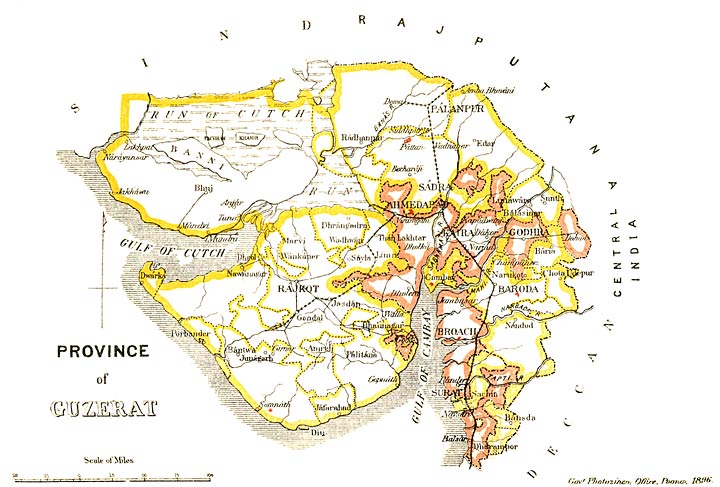
PROVINCE of GUZERAT
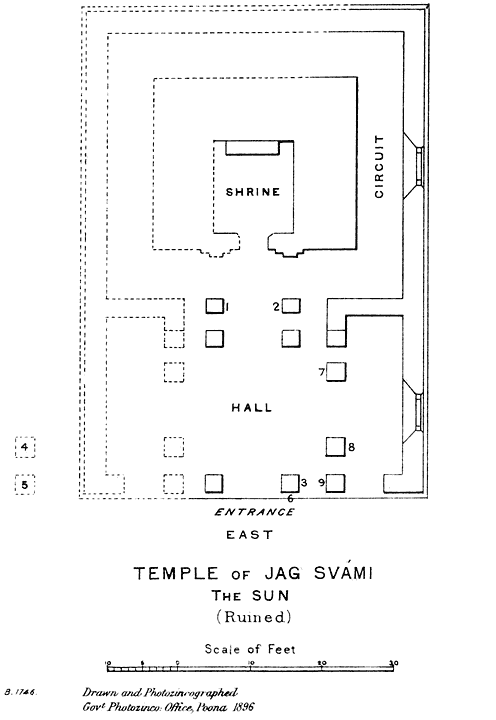
BHINMÁL
(ŚRIMÁL)
TEMPLE of JAG SVÁMI The SUN
(Ruined)
B. 1746.
Drawn and Photozincographed Govt Photozinco: Office. Poona 1896