VISUAL IRRADIATION
Reading edition
BY FOSTER PARTRIDGE BOSWELL
There are various kinds of visual irradiation, of which perhaps the best-known variety is that which appears as the enlargement of a brightly illuminated surface at the expense of a contiguous one of less intensity. This has been until recently the only form recognized, and until very lately the greater part of the literature has dealt with it alone.
The whole subject was carefully investigated by Plateau in 1831, and retinal irradiation extricated from phenomena which very often accompany it. He showed that the extent of irradiation varies with the intensity of the stimulating light and the time during which it is allowed to act. He was also the first to call attention to the phenomenon of so-called negative irradiation.
Somewhat later Volkman again called attention to negative irradiation, while Aubert, in opposing the explanation advanced by Volkman, first showed the relations existing between irradiation and contrast.
Dove was the first to investigate the influence of irradiation on stereoscopic pictures, thus calling attention to the question of binocular irradiation. Experiments in this direction, however, have in general given negative results in so far as any enlargement of the binocular portion is concerned.
Helmholtz examined the manner in which the stimulation at the border-line between a light and dark field changes in intensity, and drew a curve showing these modifications of intensity due to irradiation. Hering showed that the form of the Helmholtz intensity curve would be modified by the presence of other phenomena not strictly those of irradiation.
De Roux demonstrated the difference in the extent of a real induction on the foveal and the extra-foveal parts of the retina.
Charpentier has attempted to carry forward the general explanation by saying that this spreading of neural excitation, the existence of which he proves to be beyond question, takes the form of an undulatory excitation in the free nerve-endings of the retina. Bidwell has investigated more thoroughly in some respects than Charpentier the phenomena of the after-images of moving sources of light, which have bearing upon irradiation. The same is true with regard to McDougall, von Kries, Hess, and others. Burch has instituted investigations along these lines, especially concerning the inhibition of stimuli on contiguous portions of the retina. Hess has worked carefully upon the different phases of the stimulation derived from a moving source of light, the differences in functioning of the foveal and extra-foveal parts of the retina, the respective functions of the rods and cones, and in connection with this, made investigations in the visual perception of color-blind subjects. All these observations have important bearing on irradiation, contrast, and theories of color-vision.
In connection with some work which was being done upon the after-images of moving sources of light in the Harvard laboratory in the early winter of 1903, some phenomena were observed which I believe are due to one form or other of visual irradiation. They can be seen in various ways, perhaps most advantageously by observing with fixed eyes the passage of a luminous image over the retina. What one sees as such a figure moves by is a travelling band of light, its forefront somewhat like that of the stimulating source, the rest composed of a long train of after-images which differ very decidedly from one another in intensity and color. The advantage of this well-known method of observation lies in the fact that it enables one to translate the temporal relations between the different phases of the stimulation into spatial relations between the different portions of the moving band of light. For since the figure moves across in a plane before the observer, that which appears in his consciousness first in time will likewise appear as foremost on the plane in space. Thus by observing the train of images one practically sees the different phases of the stimulation spread out in order before one. The new phenomena we observed, however, have to do with but a single phase of the stimulation, the extreme front of the stimulating image.
The intensity of light used varied considerably with the differently colored images, and was regulated so as to give as well as possible the phenomena we wished to study. With white light the intensity was less than that of an eight-candle-power electric lamp placed about ten feet distant from the observer. When colored light was employed it was necessary to use a very much stronger source of illumination, since the colored glass which was used absorbed a great deal of light and in case of colors lying toward the violet end of the spectrum greater luminosity seemed demanded.
The apparatus used consisted of a three-foot pendulum with a screen attached. This screen swung with the pendulum. In the screen was an opening about four inches wide and three inches high, into which strips of cardboard or tin backed by a piece of ground glass could be slipped. In these strips differently shaped holes were made through which the light passed. In this manner an image of any desired form might be used. Behind the screen, between it and the lamp, was a frame in which other pieces of ground or colored glass were placed. These pieces of ground glass would reduce the intensity of the light and diffuse it evenly over the image. The observer sat ten feet away. When the pendulum was set in motion, the image would appear moving back and forth in an arc. In order to shorten this arc and to aid the observer in keeping his gaze perfectly fixed, a second screen was placed before and very close to the pendulum, between it and the observer. This screen was stationary. In it was a hole six inches long and two inches wide. The top and bottom of this hole were arcs of circles parallel with the arc in which the pendulum swung. The ends were radii.
The screen was so placed with reference to the observer that the moving image would pass directly across the middle of the opening, appearing from behind one side and disappearing behind the other. In the centre of the opening, directly in front of the place occupied by the moving image when the pendulum was at rest, were two luminous fixation-points, one above the other, below the path of the moving light. In order to measure apparent spatial differences between the phases of the stimulation, two wires were stretched vertically across the opening in the stationary screen. These wires could be moved nearer together or farther apart. Thus by measuring the apparent distances in space between the different parts of the moving figure a measure could be had of their temporal differences in coming into consciousness. The luminous image moved, during the time it was visible, at a velocity of about one and a quarter feet per second. Since the observer sat about ten feet from the instrument, this would be at an angular velocity of about seven degrees per second. In one experiment a higher and a lower velocity were also employed.
It was of course very easy to change the figures and vary them widely in form, color, and intensity. Most of those employed, however, were rather small, subtending an angular distance of not more than one degree. Since the whole opening did not subtend an angle of more than three degrees or so, nearly all the phases of the stimulation occurred at the fovea.
We noticed that the form of the stimulating images themselves seemed to suffer modification as the light swung by, not only because of the train of after-images which dragged behind them over the retina, but in other ways as well. For instance, a circular image (Plate III, Fig. 1) appeared crescent-shaped, and its forward edge possessed greater curvature than the segment of the circle which produced it. It was longer also from horn to horn than the diameter of the generating circle, and a faint haze surrounded the points extending outward and backward until lost in the blackness of the background. Von Kries remarks that a circular moving image appears cylindrical in form with a concave edge behind. By using a little higher speed we observed this phenomenon. At first we thought the crescent-shaped image to be due merely to an intensely black after-process, which Bidwell describes as following the positive image of a bright white light. This, taking place before the circular disc of light had gone forward a distance equal to its own diameter, would overlap the bright image from behind and a crescent-shaped figure would result, but the increase in width and convexity of the stimulating image as well as the laterally trailing clouds of light remained to be explained, and as this could not be done in terms of anything which might happen to the back of the image, another explanation had to be sought. In order to determine the effect of the form of the figure used as a source of light on the form of the apparent image, several differently shaped figures were employed. In place of the original circle, an oblong pointed at both ends was tried (Plate III, Fig. 2). The front of this figure appeared very convex indeed, while the ends, which, owing to the shape of the figure, were very much less effective as a stimulating source, trailed far behind the centre.
A crescent-shaped figure (Plate III, Fig. 4) gave rise to a very pretty phenomenon. When it moved toward its concave side, it appeared very much less concave on that side than the real figure, but when it moved the other way, toward its convex side, it seemed very much more curved than it was in reality.[23]
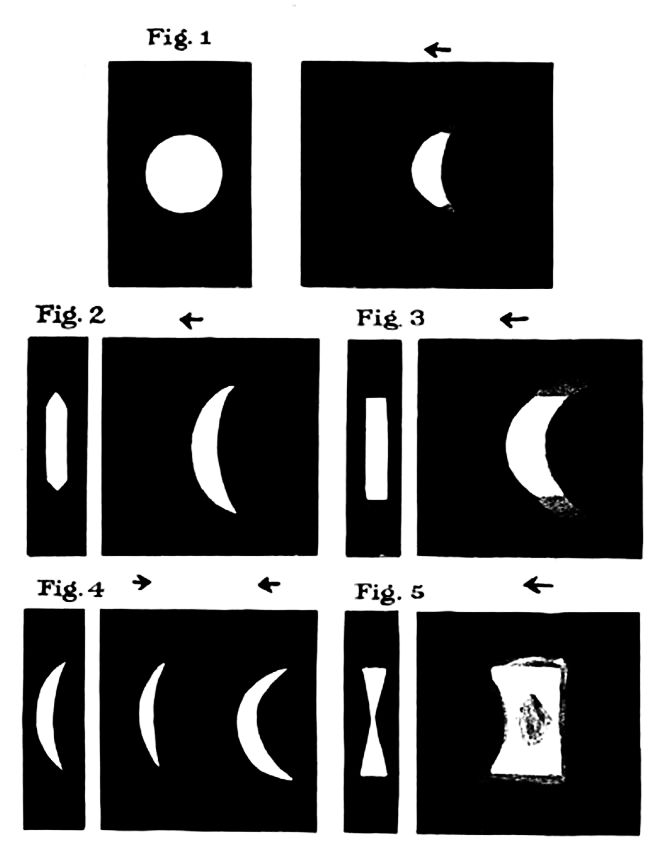
PLATE III.
No. 3, a simple oblong figure, appeared curved like the others, almost as perfect a crescent as any of them.
The idea occurred to me that perhaps all these modifications in the curvature of the figures could be explained if we assumed two things: First: that there is a spreading of excitation from one portion of the retina to another. Each point will therefore be stimulated not only by the light falling directly upon it, but it will also derive a certain reënforcement of its stimulation from the points surrounding it. Thus a point lying toward the centre of one of these figures would be more favorably situated for receiving reënforcement than one located toward the periphery, where there are few neighboring points, and those lying mostly in one direction, namely, toward the centre.
This may be represented diagramatically, as in the illustration (Plate IV, Fig. 10), where the horizontal coördinates represent the spatial dimensions of an oblong image and the vertical coördinates the intensity of the excitation due to direct stimulation and its reënforcement by surrounding points at various portions of the figure.[24] Secondly I assumed that the stimulation at one part of the figure being thus rendered more intense, that part would appear in consciousness more quickly than the others and cause a modification in the form of the figure.[25] For example, in the case of the oblong figure, the light would be rendered most intense at the centre and less and less intense toward the ends, for the points in the centre of the figure will have their intensity increased by nervous excitation spreading to them from points lying toward the ends. Those toward the ends will be reënforced by light coming only from toward the centre. Thus the intensity of the centre of the figure will be increased, and as the figure moves across before the observer, the centre, appearing first in consciousness, would likewise appear foremost in space, the points near the centre a little later and so on, until finally, the ends being the last to appear, the whole front of the figure would take the form of a convex curve, after the manner in which it was observed. The back of the figure also appears curved, probably because of the fact that the front of the negative after-image, which closely follows it, is of the same shape as the front of the positive image, as was shown in the case of the circular figure.[26]
It is of course a well-known psychological fact that a light of greater intensity will take less time in coming into consciousness than one of less intensity. In this case, however, it was necessary to find some way of showing such differences between lights which were very little different in intensity. For one is practically unable to see any difference in intensity between the parts of a stationary image. So unless it could be shown that a difference in intensity between two sources of illumination, so small as to be imperceptible to the observer, will nevertheless make its presence known by the appearance of the brighter light in consciousness before the other, the explanation which I have suggested for the curvature of the images would have to be abandoned.
The following experiments do show, as I believe, that of two sources of light not perceptibly different in intensity, the brighter will appear in consciousness before the other, and that in the case of these figures the curvature of the image is due to a heightened intensity of the light in the centre through reënforcement of the excitation there present by stimulation spreading from the ends.
EXPERIMENT I
In the first of these experiments three dots of about three sixteenths of an inch were placed in a vertical row about three eighths of an inch apart (Plate IV, Fig. 1). No change was then observed in the form of the figure. The row of dots swung across the opening in a perfectly vertical line one directly above the other (Plate IV, Fig. 2). They were presumably too far apart for irradiation to take place between them. When, however, another dot was interposed between each end dot and the centre dot (Plate IV, Fig. 3), so that the excitement could extend from one dot to the next, the front of the line of dots no longer appeared vertical, but decidedly convex, the centre dot being perhaps three eighths of an inch before the dots on the ends (Plate IV, Fig. 4).
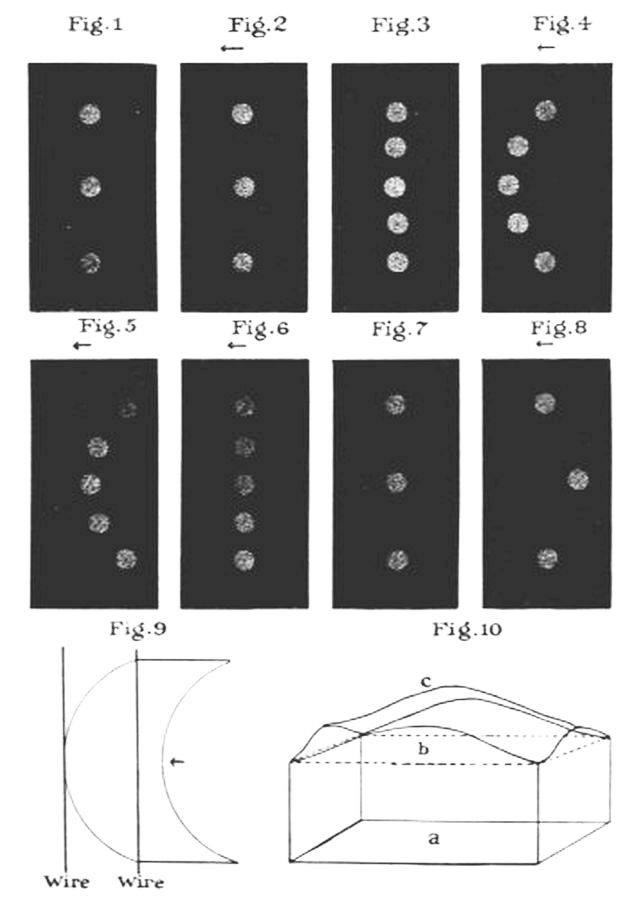
PLATE IV.
Absolutely the only difference between the two cases was that in the one, irradiation presumably could not occur, while in the other it conceivably could.
EXPERIMENT II
In the second of these experiments the curvature of a line of dots was observed and measured. Then the centre dots were slightly darkened (Plate IV, Fig. 5) by shading lightly with a lead pencil the ground glass which travelled with the pendulum and held in place the card from which the dots were cut, until the front of the image lost its curvature and appeared vertical (Plate IV, Fig. 6). The pendulum was then stopped and the row of dots observed closely, in order to see whether the dots in the centre were perceptibly of less intensity than those on the ends. No perceptible difference was found.
EXPERIMENT III
All the dots were covered, except the shaded central and the two unshaded end dots, in order that no irradiation might take place between them (Plate IV, Fig. 7). The pendulum was again set in motion, and the centre dot, instead of remaining co-linear with the dots on the ends, appeared considerably behind them (Plate IV, Fig. 3). This would show that irradiation must heighten the intensity of the excitation in the centre of the figure—for the two cases just mentioned are alike in every respect except that in the first (Fig. 6), where the dots were near enough together so that irradiation might occur between them, the intensity of the centre dot, which was objectively fainter than the end dots, was heightened enough by this induced excitation to appear in consciousness as soon as the two end dots, which were objectively of greater intensity; whereas in the second case (Fig. 7), where the dots were too far apart for irradiation to take place between them, the centre dot, being objectively of less intensity than the end dots, appeared behind them.
These experiments show that of two sources of light very little different in intensity the brighter will appear in consciousness before the other. Other things being equal, the difference in intensity may even be so small as to be imperceptible by direct comparison; it is able nevertheless to make its presence known by the order in which the lights appear. Exner made some experiments in 1868 to determine the time necessary for the perception of lights of different intensity. He used, however, stationary images of brief duration and tried to eliminate the effects of the after-image by flooding the visual field with light. This method has its disadvantages. It is incapable of measuring the minute temporal differences in latent perception of sources of light very slightly different in intensity.
While my method does not give the absolute time taken by any one light to enter consciousness, it is a very much more delicate method than Exner's for measuring differences in time of latent perception of sources of light very close to one another in intensity. It would be a very easy matter, having found the time of latent perception for a light of standard intensity, to determine by this method the time of lights of greater or less intensity.
These experiments also show that when irradiation is absent, the curvature of the images is absent; when irradiation is presumably present, curvature is present. For I find, not only in these, but also in a number of other experiments, that under all conditions in which the presence of irradiation is to be expected, the form of the images tends to be modified in precisely the manner that the assumption of its presence would lead one to anticipate. In all cases where irradiation is presumably absent, the contour of the front of the moving figure depends entirely on the amount of light proceeding from its different parts.
It is next in order to say something of the physiological causes of the phenomena we have been considering.
It is probable from what has been observed that in the case of the curved figures we are dealing with a form of visual irradiation which is due to the spreading of neural excitation over or through the layers of the retina. It is also evident from the close connection between irradiation and intensity that it must be of such a kind that the excitation produced in one part of the retina may communicate itself readily to another part. We have also seen in the case of the moving line of dots that the several dots could remain distinct from one another and yet could reënforce each other by means of communicated excitation. It must also be a very rapid form of irradiation, for the curvature of the figures does not increase very much during the time they are visible.
I think that the demands made by these different facts are best met by assuming that the spread of the nervous excitation which gives the reënforcement takes place in one of the interconnecting layers of nerve cells and fibres underlying the rods and cones. The line of dots which appeared curved and yet perfectly distinct from one another could very well communicate excitation to one another along these fibrils, and the intensity of one part be raised by the excitation of the near-lying parts. The fact that the dots remain distinct would not be contradictory. For in that case very near-lying parts might communicate excitation to one another without arousing to any very great activity the nerves that lead to the brain from the small unstimulated portions which lie between them. In this manner the intensity of the centre dots could be heightened enough to make the row appear convex, without any merging into one another on the part of the several dots. The fact that the dots do not fuse shows that the curvature is not due merely to a forward-spreading of the excitation in the retina. However, there is always a certain amount of light visible between the dots, with all the colors. This is especially noticeable with green light.
The fact that the elements of the retina form a kind of concatenated series from without inwards, a number of rods and cones corresponding to but one ganglion cell, furnishes a further bit of evidence in support of the explanation just advocated, since the irradiated excitation would tend to be "drained off" through the group of ganglion cells corresponding to the most highly stimulated portions and leave the intervening spaces comparatively free from centrally proceeding excitation. Thus also the individual dots in the five-dot figures may appear entirely distinct from one another and yet the centre ones be reënforced enough by irradiation to appear in consciousness in advance of the others.
SUBSIDIARY EXPERIMENTS
A number of other observations were made which present various exemplifications of the principles we have considered.
EXPERIMENT IV
An oblong figure, all its parts objectively of the same intensity, had its ends slightly darkened. When this was done the curvature had increased from twelve sixteenths to fourteen sixteenths of an inch.
The pendulum was stopped, and a very slight difference was perceived between the ends and the centre of the figure. This difference in intensity was greater than in the dot experiment, when the image had been darkened enough in the centre to make it appear vertical, because in this case, when the ends were darkened the centre would still be reënforced by irradiation from a considerable space which intervened between the shading and the centre.
EXPERIMENT V
The centre of the oblong figure was considerably darkened so as to counteract the effect of induction. By properly varying the amount of shading, one may make the front of the figure appear less convex, vertical, or even concave. This shows perfectly the effect of differences in intensity upon the curvature of the figure, but does not show so neatly as the similar experiments performed with the dots, the influence of the presence or absence of irradiation upon the intensity of the centre of the figure and so upon the curvature.
The illustration shows a case where the centre was too much darkened.
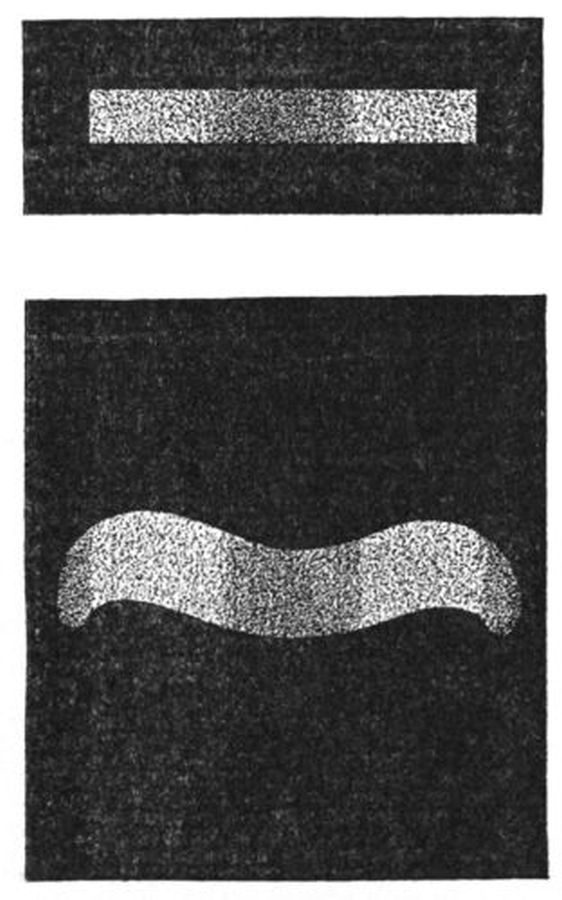
The two ends were comparatively free from shading. In each end-part irradiation took place. The points lying toward the centres of these ends received reënforcement, both from points lying toward the centre of the figure and from the extreme ends, and so the centres of the ends of the image were considerably brighter than either the extreme ends of the figure itself, or the sides of the end-parts toward the heavily shaded centre of the figure. Accordingly each end appeared convex for a short distance. The whole figure, however, being considerably brighter at the two ends than at the centre, on account of the heavy shading, the ends appeared in consciousness first and the centre afterwards, so that the figure as a whole seemed concave.
EXPERIMENT VI
An oblong figure was shaded rather heavily at one end, gradually becoming lighter toward the other, while about a third of the figure was free from shading. The shaded end always seemed to lag behind. The extreme front of the figure was at a point a little distance from the other end, before the shaded portion began. So that the front of the whole figure appeared, not like a segment of a circle, but like part of an oval with the bulge toward the brighter end.
Beyond the ends of all these images faint clouds of light were seen, as has been mentioned before, extending outward and backward, gradually decreasing in intensity, until lost in the surrounding blackness of the background.
Charpentier's bands, sometimes more and sometimes less in number, were observable in all of my figures and with all colors. Very often they appeared to be parallel to the forefront of the image, or even of a slightly greater degree of curvature.
EXPERIMENT VII
It is a well-known fact that a rotating color-disc, having colors which just fuse at a certain intensity, will show flicker at a slightly less intensity.
A color-disc was set in motion and the speed found where the colors were on the point of fusing. A piece of black cardboard, with a hole about an inch in diameter, was held close to the screen.
Around the periphery of the hole flickering appeared, while at the centre there was fusion. (The cardboard was held very close to the disc, so that there would be no shadows on the disc near its edges.) This fusion at the centre of the disc is probably due to the fact that the centre of the field is of slightly greater intensity than the edges, owing to irradiation. This difference in intensity makes the difference between the fusion at the centre and the slight flicker seen at the periphery.
Karl Marbe in a recent article mentions the difference in fusion between a point in the centre of the disc and a point near its border, and he thinks the increase of flickering in the latter is due to some influence on the part of the moving edge which separates the different parts of the disc. It would seem more probable from this last experiment that the fusion at the centre of the field of view was due to reënforcement of intensity by irradiation, and that the flicker about the periphery of the field was due to the lack of such reënforcement.
EXPERIMENT VIII
Three large dots were used and the centre one covered with tissue paper. The two end dots then appeared ahead of the centre dots. They were larger than the centre dot, due to irradiation over their borders. But this increase in size did not account for their position ahead in space. The centres of all the dots were not co-linear, but the middle dot was behind the others, thus, of course, showing the greater time necessary for the perception of the less luminous object.
EXPERIMENT IX
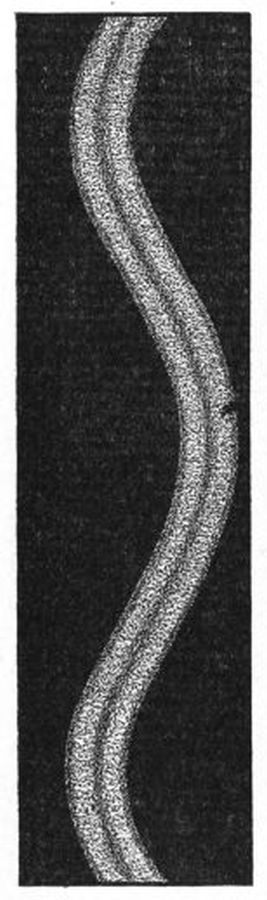
Figure observed with centre curved backward at the fovea, and ends curved forward owing to irradiation.
This was exactly similar to the preceding, except that the intensities of the various dots were reversed. The end dots were covered with tissue paper, instead of the centre one. Then the centre dot appeared first and the end dots after it.
EXPERIMENT X
Professor Hess finds that an image which, compared to those we used, was very long, subtending an angular distance of about thirty degrees, and which extends entirely across the fovea and overlaps the surrounding parts of the retina will appear curved backwards at the fovea, owing to the longer time of latent perception of the fovea and the macula. The accompanying illustration shows a modification of one of Hess's figures, in which the presence of this phenomenon and that of the convex image are both shown. The two phenomena were observed when a two-inch image was observed at a distance of about fourteen inches. The intensity of the light was that of an eight-candle-power lamp with three pieces of ground glass in front of it. (Very many of Hess's intensities are too great to give convex images.) Thus the image would be about 12° in height. About 5/12 of the figure would then fall on the macula and fovea and appear curved backwards in relation to the ends. The ends where they fell on the extra foveal parts of the retina appeared convex in front and concave at the rear as any small image of the right intensity does which falls on a homogeneous part of the retina.
EXPERIMENT XI
Charpentier, Bidwell, and others have made the observation that if a small source of light be exposed for a brief interval, excitation will proceed out in all directions over the retina, but if the light be exposed for a slightly longer period, the excitation will contract again and the light appear nearly its proper size and in its proper location at the stimulated portion of the retina. Using variously shaped figures we obtained analogous results, and the additional fact appeared that the outgoing excitation proceeds from the borders of the figures and that its form is somewhat determined by the form of the figure. An oblong image appeared vaguely elliptical, a diamond-shaped figure in the form of a more pointed ellipse, etc. These images were exposed for only a small fraction of a second, by means of a shutter. As the exposure grew longer the true form of the figures came out more and more clearly. There thus seems to be a general spreading of the stimulation in all directions over the retina from the borders of the images. Then, upon a slightly longer duration of the stimulus, this very rapid irradiation of excitation contracts and the irradiation becomes confined within the borders of the stimulated portion and affects the intensity of the different portions of the image. With strong intensities and certain colors it is, however, never wholly confined to the stimulated portion even of moving images. Charpentier speaks of "clouds of light accompanying his figures." With green light these clouds are especially noticeable. His "palm branch" phenomenon is a good instance of the irradiation of stimulation.
Besides these experiments which I have just described, several phenomena of a like sort were observed in connection with other experiments which were being performed in the laboratory at the same time. Dr. Holt was experimenting with a bright circular spot of light about one half inch in diameter, surrounded by a very faint ring about one half inch wide. When the whole image was moved about, the spot would seem to go back and forth across the less intense part so that the whole image looked like a jelly-fish swimming about in the water.
When the figure was allowed to remain stationary for a few moments it would resume its natural shape. Otherwise the bright part would seem to advance faster than the rest, sometimes even overlapping the border. This phenomenon was due to the fact that a bright light requires less time in coming into consciousness than a less intense one, and is, of course, the same in principle as those which were performed with dots when the bright dot moved ahead of the rest.
Another one of these phenomena occurred when an isosceles triangle was moved in a direction parallel to its base. The side toward which it moved appeared curved forward, with the apex bent backward. Toward the bottom, where there was the best chance for irradiation to have its effect, appeared the most advanced portion of the figure, while the bottom corner, although objectively the most advanced part of the figure, appeared rounded off and somewhat behind the part just above.
A narrow, vertical image with a large bulge behind the central part appeared with a large portion of this bulge in advance of the centre of the figure.
All these experiments show that a more intense object is, other things being equal, always located ahead of other objects co-linear with it. And I assume irradiation to account for the priority in localization of parts of the figure which are not objectively of greater intensity than others, but whose position makes them subject to reënforcement. The localization itself may be a function of more central organs, and not directly a question of the coming into consciousness more quickly of a more intense stimulation, although that seems to be the simplest explanation, but in any case priority of localization varies directly with the degree of intensity.
If the light is not bright enough to produce much irradiation the image will lose its curvature. If the light is too bright, although there may be a maximum of irradiation aroused and the absolute difference in intensity between the ends and centre of the image be at its greatest, yet this difference may not be great enough in proportion to the absolute intensity of the light to make the centre of the image appear in advance of the rest.
The curvature also varies with the angle subtended by the image and the portion of the retina upon which the image falls. If the image were too long, although all the processes which produce curvature be present, yet the front of the image would still appear vertical, because of the fact that each point in this long line would not derive reënforcement sensibly greater than that of the neighboring points. The best one could expect would be that these long figures should have their ends rounded off, which is usually the case. Most of the images which Professor Hess used in his experiments were too long to appear curved. All the images whose curvature we measured did not subtend an angle greater than 1° 10´, and were all seen on the fovea.
An image which subtends an angle of more than about 2° will hardly appear curved when it passes over the fovea.
We were sometimes able to see the curvature reversed. This happened in my own case about once in a hundred times, usually when my eyes were fatigued by the repeated passing of the moving light back and forth over the same portion of the retina. With other observers it occurred more often.
Slight vertical differences in fixation would cause the central part of the path taken by the moving light to become more fatigued than the edges and so to respond more slowly to the stimulation and reverse the curvature. It may be that some brain process which has to do with the apperception of the form and movement of visual objects becomes fatigued or does not always function properly, and so the curvature of the image may sometimes appear reversed. At any rate the more usual cases are those in which the convexity is present. The others, owing to the number of factors involved, and the vast majority of the opposite cases, may be regarded as due to temporary defects in the psycho-physical mechanism, which when properly working would give the more usual result.
QUANTITATIVE EXPERIMENTS
The object of the following experiments was to measure the amount of curvature produced by differing degrees of intensity of light at different speeds. An oblong figure was employed one fourth inch wide and two inches long. As has been mentioned, two vertical wires were stretched across the path in which the light moved. As the light swung by, it was attempted to get the wires at such a distance from one another that when one appeared tangent to the curve at the front of the figure the other would seem to cross the image at the point of intersection of the curve with the rest of the figure, as indicated in the diagram. (Plate IV, Fig. 9.)
The distance between the wires was then read off on a scale. Thus one was able to obtain a measure of the curvature of the figure when it was moving at different speeds and illuminated by different intensities of light, and to compare the observations of different subjects. The mean error in this work is surprisingly little, considering the difficulties in making the judgment as the light passed rapidly by the wires. Usually the moving light had to be observed several times before the curvature of the front of the moving image could be measured exactly. It would be perfectly obvious that the front was considerably curved, but it would often be wholly impossible to tell just how much it was curved, until the pendulum had swung back and forth four or five times. Fatigue and darkness adaptation modify the judgments considerably. If one's eyes were partially adapted to darkness some little difficulty was experienced in seeing clearly the curvature of the image. Fatigue comes on very rapidly indeed. Usually it was impossible to get more than four judgments without resting, and often only two could be made. It was sometimes impossible to measure the curvature at the exact point when the light passed under the cross-wires, so the curvature had to be observed carefully and compared with the distance between the wires, and a judgment made when the wires were not superimposed upon the image. With each intensity of light two judgments were taken, one when the cross-wires had to be brought nearer together, the other when they had to be moved farther apart. Several series of measurements were made by different observers, and the results averaged up and compared.
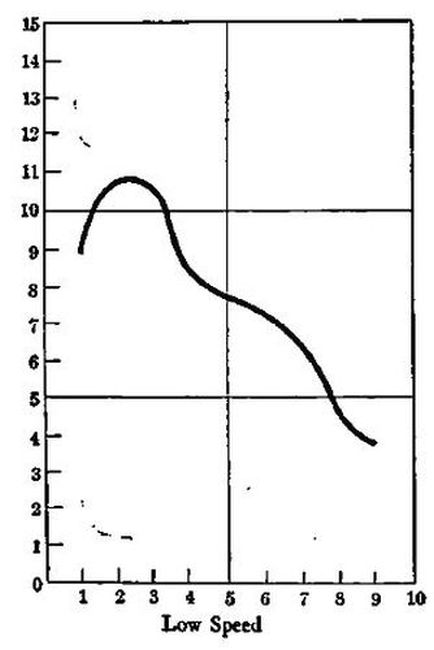
The following curves and tables give the different observations for the nine different intensities of white light,[27] and the three speeds which were used. In the case of the high speed the light moved across the opening in the screen placed before the pendulum at a velocity of about 1.5 ft. per sec. The middle speed was about 1.27 ft. per sec. and the low speed about .917 feet per sec. In all cases an oblong image was used, ¼ inch wide and 2 inches long. The numerals on the left of the plotted curves give the apparent curvature of the image in sixteenths of an inch, and were obtained by measuring the distance between the cross-wires when this distance measured the apparent curvature of the image in the way described above. The figures at the bottom designate the different intensities of light which were used. Number one is the greatest intensity, number nine the least; the others those in between.
High Speed. This curve shows very well indeed what seems to be typical of the relations between the intensity of the moving light and the apparent curvature of the front edge of the image. With the lowest degrees of intensity the amount of the curvature is very little. Sometimes it was difficult to measure it at all. The light was so faint and the speed so rapid that probably very little reënforcement or irradiation took place, although what did occur would show its presence most prominently, since, on account of the high speed at which the pendulum moved, any part of the image which should come into consciousness ahead of the rest, even by a very little time, would appear considerably in advance of the rest of the image in space. Of course a certain amount of time would be required for the stimulus to spread itself over the retina, since it has to overcome a certain amount of resistance in the nerve-layers, and if this time were not given, the curvature of the resulting image would be of course decreased. As the light brightened, however, the curvature increased rapidly, until finally, when the intensity of the light neared its highest point, the curvature ceased becoming greater, and finally decreased. The mean error in eight judgments taken by two people for each intensity of light was about .099 in.
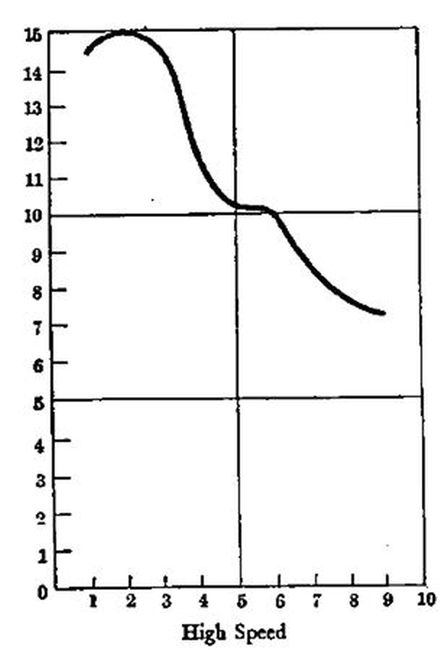
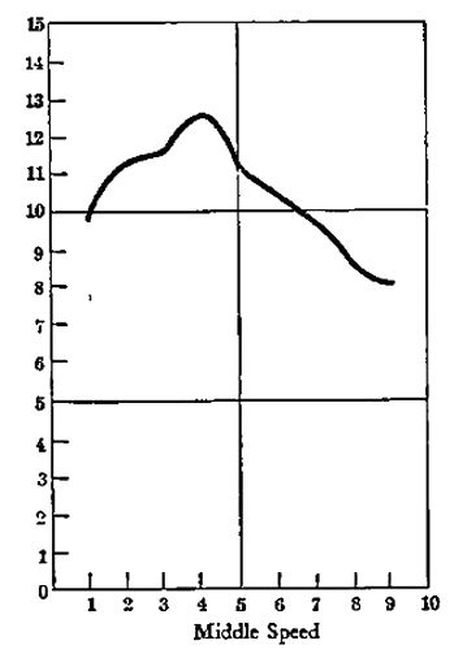
The measurements with the middle speed were very similar. The curvature with the lowest intensity of light was somewhat greater than when this same light moved with the highest speed. The maximum point of curvature was reached with a light of less intensity, and the curvature was less. When yet higher intensities were used, the curve decreased rapidly. The amount of curvature was also much less with the brightest light than with the higher speed. The following table shows the judgments of three observers for this speed:
MIDDLE SPEED
Intensities. 1 2 3 4 5 6 7 8 9
First Subject. 8 10 9 11 10 9 9 7 8
10 11 13 13 10 11 10 9 8
10 10 11 11 9 8 8 7 7
10 11 11 14 10 12 8 9 9
10 11 10 11 9 9 7 10 7
11 11 11 13 10 10 9 10 7
Second Subject. 10 9 11 11 12 8 11 7 8
12 14 13 14 15 14 10 9 9
10 14 13 13 12 11 11 10 9
11 14 13 13 13 12 12 10 9
13 11 13 14 12 12 10 9 9
13 12 13 14 12 12 11 11 9
Third Subject. 7 10 9 13 10 9 9 7 8
8 12 12 13 12 10 10 8 7
7 11 10 10 11 10 10 8 8
9 11 13 11 12 10 11 8 8
9 11 11 10 10 9 10 9 7
9 11 12 12 11 10 10 8 8
Average. 9 15⁄16 11 1⁄3 11 1⁄2 12 5⁄18 11 1⁄9 10 1⁄3 9 7⁄8 8 5⁄8 8 1⁄9
Mean Error, .075 in.
The low-speed measurements show the same general tendencies except that the curvature is smaller with this speed when the faintest lights were used than with any of the others. The maximum curvature is also less and occurs with a more intense light than with the middle speed. These modifications offer no special difficulties. Since the light moves slowly, although the centre of the image, which is reënforced by induced excitation from the ends, does appear in consciousness in time ahead of the rest of the image, yet it does not appear so far in advance of the rest of the figure in space as it would if the light moved with a higher speed. While the same difference in brightness between the centre and the ends of the image should make one part appear in consciousness just as far ahead of the rest in time with this speed as with any other, yet since the speed is slow it would not appear to be so far ahead in space. The fact that the maximum amount of apparent curvature is less would also be explained in the same manner.
When the high and middle speeds were used the results were surprisingly consistent and the variations between the observers not very great. With the low speed the individual differences are very much more prominent. Uncertainties and variations between observers and between different observations of the same observer became greater and greater as the intensity of the light decreased. One seemed to be approaching the lower limit of induction, below which, even if the spreading of light stimuli through the retina took place at all, it was to such a slight extent that it made no very marked difference in the appearance of the moving image. Individual differences are very great in this respect. For instance, my own average measurement was 15⁄64 in. of curvature for the image produced when a light of the lowest intensity moved at the lowest speed. Mr. Vaughan's measurements averaged 30⁄64 in., a measurement of just twice as much for the same light at the same speed.
So far there has been given only a general view of what happens when an oblong moving image appears convexly curved. It may be well to consider the different causes which determine a certain curvature of the image and see how they are related.
As we have seen, the curvature is a function of the difference in intensity of various excitations between the centre and the ends of the retinal area excited. This difference is modified both by the objective intensity of the light and by the speed at which the light moves. Its efficiency to produce curvature is also modified by both these factors, since it requires a certain small amount of time for the irradiation to take place. If this time is not given by the too rapid passage of the image over a certain part of the retina, the difference in intensity will be lessened and the curvature therefore be decreased. On the other hand, if the figure moves too slowly, although this difference in intensity may be as great as possible for the brightness of the light which is acting, yet the curvature may be lessened on account of the fact that, although the centre of the image does appear ahead of the ends in time, yet it does not appear so far ahead of the ends of the image in space as it would if the same difference in intensity were present and the image moved more rapidly.
It will be remembered that the intensity of the centre of the figure owes its increase to reënforcement by excitation irradiating from the surrounding points. It seems only reasonable to suppose that this added intensity due to irradiation does not increase without limit, or with exactly the required ratio to produce a curvature of the front of the image which becomes continuously greater as the intensity of the light increases, indefinitely.
If this be so, then, at a certain brightness, the difference in intensity between the ends and the centre of the image will have reached a maximum, and a further increase in brightness of the light will not serve to increase the apparent curvature of the image, but rather to decrease it.
COLOR IRRADIATION
The color of the image has a decided influence upon the amount of perceived curvature, independently of the intensity.
The following experiments were performed with lights of different colors, in order to investigate the relations between the kinds and amounts of irradiation of the different colors by comparing the amounts of the curvatures obtained. We encountered a good deal of difficulty in fixing upon a proper method of comparison between the different colors. Finally it was decided to use such intensities of light as would give a maximum amount of curvature with each of the four primary colors, to measure this amount in each case, and also to measure the amount obtained when the intensity of the light was greater and less than that required to give the maximum.
It was found that very different objective intensities of light were required to give a maximum amount of curvature with the different colors. The colored images were obtained by placing colored pieces of glass in a frame which stood before the source of light. The intensity of the light could be regulated by interposing or taking away pieces of ground glass which rested in the frame between the light and the colored glass.
The red glass gave a nearly saturated color, but its place in the spectrum was rather nearer the orange than I could have wished. It was a thick piece of glass and absorbed a great deal of light. A 32-candle-power light with four pieces of ground glass in front of it gave a maximum curve for most observers.
The yellow gave a very well-saturated color with light from the incandescent lamps which we used. The glass was thinner and absorbed less light than the red. A 32-candle-power lamp with three pieces of ground glass usually gave the maximum.
Two 32-candle-power lamps and one of 24-candle-power were required with the green.
The green glass was not quite so saturated in color as the red or yellow. It was a slightly yellowish green. Red and yellow rays were visible through it to some extent when it was examined through the spectroscope. It absorbed somewhat less light than the red and decidedly more than the yellow. The maximum curvature was obtained when the source of light was screened with four pieces of ground glass.
The blue glass was a bluish violet, very heavy, and absorbed a great deal of light; it allowed many red and violet rays to pass through. It was necessary to use with this glass two 32-candle-power lamps and one 100-candle-power. When the combined light of these lamps was reduced by interposing three thicknesses of ground glass, the maximum curvature was observed. The light which then appeared, however, seemed of greater intensity than any other which gave a maximum.
The curvature of the white light was measured again in order to compare it with the colored lights. This was necessary, since the work was done with a different set of subjects and the former work showed individual variations. An 8-candle-power light was used as before. This, reduced by four pieces of ground glass, gave the maximum in most cases.
The following curves and tables show the average of the observations of four subjects. In the table the figures under the columns numbered 1 and 2 represent the amount of curvature perceived when the intensity of light was greater than that required to give a maximum under 4 and 5, when the light was not strong enough to produce a maximum of curvature. The columns numbered 3 represent the greatest amount of curvature perceptible with each color.
The curves shown in the diagram represent these measurements plotted out.
TABLE
Intensities. 1 2 3 4 5
Red. 13.50 15.20 16.85 14.06 13.46
Yellow. 13.90 15.46 18.00 16.40 15.85
Green. 15.66 18.00 19.86 18.32 18.00
Blue. 13.00 14.15 16.85 15.50 14.09
Average for all
the colors. 14.00 15.70 17.90 15.90 15.35
The measurements were made in the same way as before, and are given in sixteenths of an inch.
In the diagram the abscissas represent the different intensities, the ordinates the amount of the curvature. To avoid confusion, the curve of the average of all the colors is left out of this diagram.
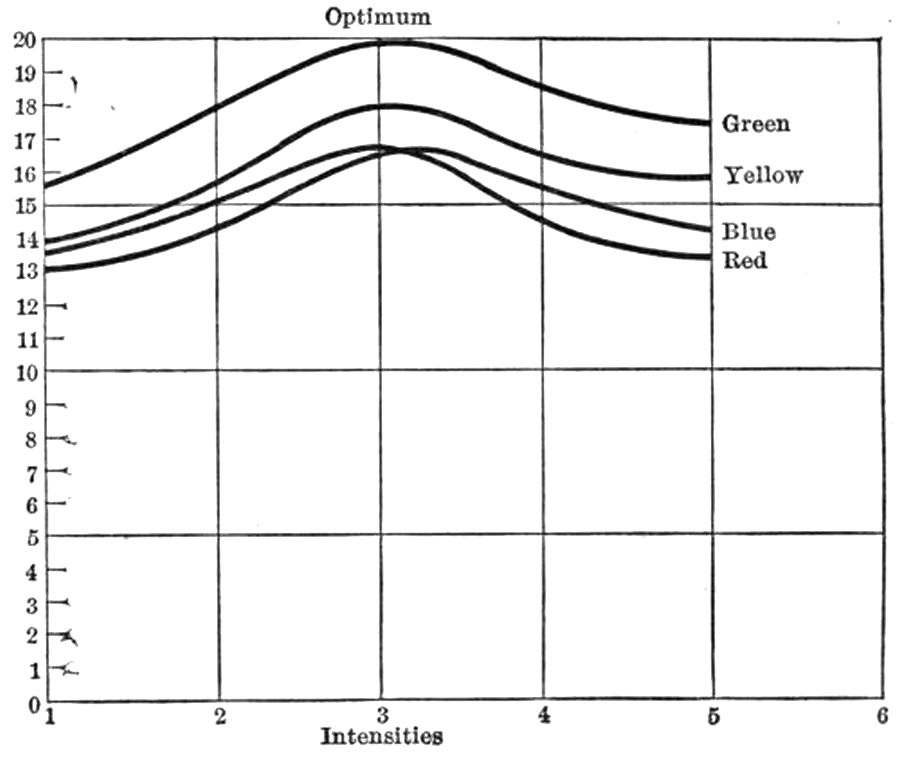
It will be noticed in these records that the different colors give very different measurements of curvature. Green gives by far the largest, being greater than any of the others at every point. Since the process of obtaining the curvature was the same with all the colors, these differences in curvature can only be due to inherent differences in the processes which give the sensations of the different colors. It cannot be due simply to one sort of intensity process, the same for all the colors, otherwise the curvature of all the colors would be the same. At the same time the curvature of the image is due to differences in intensity of excitation between one part of the image and another. There must be, therefore, a retinal excitation in some respects different for each color, capable of its different degrees of intensity. Of course these individual differences would have a decidedly limited range, for, as every one knows, if the intensity of a color be increased sufficiently its saturation vanishes and white appears in its place, while if the intensity be decreased without limit, black appears. It may be that different degrees of excitation in the different processes have different rates of time in coming into consciousness, so that an equal degree of difference in excitation between the ends and centre of the green image and the ends and centre of the red image would give decidedly different amounts of curvature, if it took a longer time after the centre of the green image had appeared in consciousness for the ends to appear than it did in the case of the red.
The time-differences might be greater with the same differences in intensities of excitation with one color and another. Or it may be that the excitation spreads in a different manner with each one of the colors, and therefore gives differing degrees of reënforcement with the different colors, and thus produces different amounts of curvature.
It is noticeable also that the amounts of curvature are related to one another in a peculiar way. Green has the greatest amount of curvature, yellow the next. Red is greater than blue with the higher intensities, they are equal at the maximum, and blue is greater than red when the lower intensities are used.
When a spectrum showing a fair degree of saturation is observed, it is seen that the point of greatest brightness lies in the yellows. As the intensity is heightened, this point moves toward the red end, and as it is lowered, it moves toward the blue.
It will be seen that the relation between the different amounts of curvature for the different colors is the same as that between the different degrees of apparent brightness when the intensity of the colors in the spectrum is decreased. It is not that of the extreme case of the phenomenon of Purkinje, but when the point of brightness has moved from the yellow into the yellowish greens or decidedly to the right of the place it occupies in the normal spectrum. In that case yellow would be the color second in brightness. In our measurements the amounts of curvature obtained from yellow images were next in size to those of green. The red and the violet-blue which we used would therefore be about equal. It is a noteworthy fact, however, that when the intensities of light (1) and (2) are too great to give a maximum of curvature the amount of curvature obtained with the red is greater than that of the blue, while with the intensities which are too small (4) and (5) to give a maximum the blue curve is greater than the red.
As yet it has not been possible for me to find an interpretation of these facts which would seem to meet all the requirements, and I should not wish to offer any explanation at present. The question of the possible connection of this phenomenon with Purkinje's is probably important for any explanation, though it is possible that the arrangement of the curves is merely a coincidence, yet this hardly seems likely, and it would seem as if an explanation of the connection would involve an attempt at explanation of Purkinje's phenomenon, and lead at once into the most doubtful problems of the theory of visual sensations.
It is also noticed that the series of numbers obtained when the amounts of curvature of the different colored images, at the different intensities given in the foregoing table, are averaged up, and the curve of the average of all colors is thus obtained, that this average curve is very like that obtained for the white light. These curves and the series of numbers which they represent are here given.
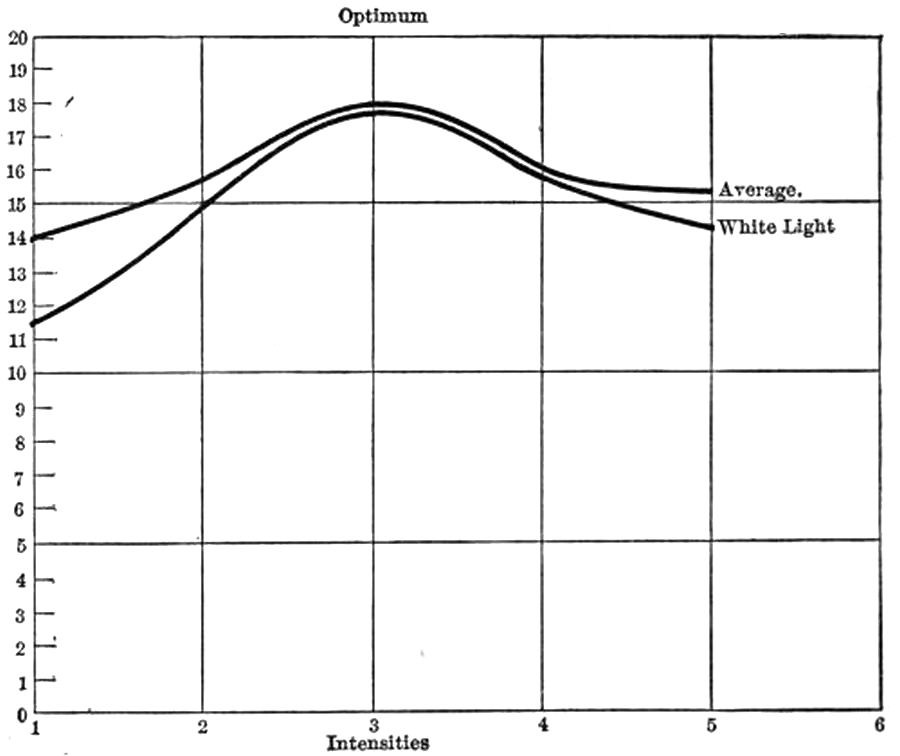
Average for all colors. 14.00 15.70 17.90 15.90 15.35
Curve for white light. 11.50 15.00 17.80 15.75 14.25
It will be noticed, however, that the curve for the white light, while nearly equal to that of the average for the colored lights at the maximum point, nevertheless falls considerably below it at each end. This may possibly be due to the fact that with white light it was only necessary to use an 8-candle-power lamp as a source of light, so that when pieces of ground glass were interposed in order to reduce the intensity of this light, very much greater reduction would occur with this comparatively weak source than would take place with an objective source of light of far greater brilliancy, as was the case with the colored lights. Hence there would be a greater difference in absolute intensity between intensities 1 and 3 with the white light than between intensities 1 and 3 with any of the colored lights, or that represented by their average. Thus the falling of the curve of the white light at each end may possibly be due to the fact that there is a greater difference in intensity represented by these parts of the curve in the case of the white light than is represented by the analogous portions of the curve of the average of the colored lights.
It will be remembered that these measurements were obtained when the image was upon the fovea, so that the white obtained was "cone white," and not due in any way to the functioning of the rods. It is interesting to note that the curve of the white is very near that of the average curve of all the colors, though I should hesitate to draw the conclusion from this that "cone white" is due to a mixture or fusion of all the excitations corresponding to the different colors.
In regard, however, to relations of the amounts of curvature of the images, there are several further considerations which ought to be noted. In the first place all three measurements were made when the images were entirely on the fovea. In the fovea there are no rods, so, whatever the connection of these facts with Purkinje's phenomenon, it is one which has to do with the functions of the cones alone.
Professor Hess, in his experiments upon totally color-blind subjects, found that exactly the same oscillatory processes in the course of the stimulation occurred with them as with normal subjects. He also found that the difference in the time of latent perception between the foveal and extra-foveal parts was the same for one set of subjects as for the other. The sole difference seemed to be in the one fact of not being able to perceive colors. From these facts it does not look as if the difference between seeing colors and color-blindness were by any means always due to the absence of cones in the color-blind eye. It may of course be true that an eye which is deficient in cones or which has a lesion of the fovea would have poor color perception. But it seems also true that an eye which, in so far as the rods and cones and their purely retinal processes were concerned, seems to be normal in every way, except perhaps that somewhat different intensities were required to give the same reactions (which might be explained by different central processes), may nevertheless belong to a person who is totally color-blind or totally unable to perceive colors with that eye.
If this should prove true, the cones would still be regarded as the end organs of color perception, but the cones would only give sensations of color when functioning in conjunction with some other more central process. The usual cases of color-blindness would be attributable, not to any deficiency in the cones or any other retinal process, but to a defect in this more central process, which, working in conjunction with the cones, gives us our sensations of color.
The usual views of the functions of the rods would not be affected by these considerations. They would continue to be regarded as end organs whose main business it is to deal with weak stimulations and to notice movement in objects whose images fall upon the periphery of the retina.
But the main difference would be that all cases of partial color-blindness and most cases of total color-blindness would be explained by lesions in the brain rather than abnormalities of retinal structure.
VARIOUS FORMS OF IRRADIATION
The endeavor to explain these phenomena of moving images which we have been considering and an examination of the literature of the subject have led me to conclude that there are five distinct types of irradiation. These are:
1. Irradiation α. The very rapid spreading of the nervous excitation over the retina, which extends far beyond the borders of the image and which occurs immediately upon stimulation. It is most distinctly observed with stationary sources of illumination of the briefest duration perceptible. This kind of irradiation has been discussed at length by Charpentier and Bidwell.
2. Irradiation β. As the apparent form of the moving image becomes distinctly perceptible, such irradiation takes place within the confines of the stimulated portion of the retina, so as to make the excitation present at favorably situated localities more intense than that of other places. The portions which are so situated as to receive this reënforcement are the first to enter consciousness. The various phenomena discussed earlier in this paper furnish examples of this process, as well as the phenomenon of the curved image.
3. Irradiation γ. After, and in part during, the rise and development of the reënforcing irradiation, emanations of nervous excitation of small intensity proceed from the borders of the stimulated portions and from the after-images, rapidly extending themselves over the retina and gradually decreasing in intensity.
4. Irradiation δ. When two fields of different intensities are brought into juxtaposition, the field having the greater intensity will enlarge itself at the expense of the other. This constitutes what has been usually termed irradiation, and is observable with stationary objects. This enlargement varies with the time during which it is observed, the absolute intensity of the light employed, and the relative differences in intensity of the two fields. Its angular extent under determinable conditions is constant, although it varies considerably from one observer to another, and with the same observer at different times. Its physiological explanation is probably similar to that of the other kinds of irradiation, viz., the spreading of nervous excitation over or through the layers of the retina, although various factors of accommodation, dispersion, achromatism, astigmatism, etc., enter in and modify the totality of the phenomenon. It will be noticed that reënforcement occurs in this kind of irradiation as well as in certain of the other forms. The sides of the dark fields upon which this form of irradiation shows itself appear curved inward at the centre, apparently showing the presence of a greater excitation in the lighter fields next to the centre of the darker ones.
5. Irradiation ε. When a luminous object has been observed for a long time (from thirty seconds to several minutes), the whole surrounding field will be flooded by a faint haze of light, which within certain limits increases in intensity the longer the stimulation is present. This phase has many characteristics of the first and most rapid kind of irradiation, and possibly represents a discontinuance of functioning, through fatigue of certain nervous mechanisms which prevent the spreading, or inhibit the perception, of this irradiatory excitation after the form of the object is distinguished clearly. It is probably largely due to such a mechanism that we are enabled to perceive as clearly and sharply as we do the outlines of objects which differ greatly in intensity from their backgrounds.
W. McDougall has developed a theory of inhibition[28] which he uses to explain the more usual kinds of irradiation. This explanation harmonizes very well with the results of my own experiments and helps to explain all the kinds of irradiation we have distinguished. Briefly stated the theory of inhibition is this: there is a transference of nervous excitation or energy through the nerves and from one neurone to another. This living nervous energy he calls neurin. The place where it crosses from one neurone to another he calls the synapse.
Of course these conceptions are not to be taken too literally. They seem to be rather, if they are to be of any value at all, a convenient way of handling certain neurological processes of which at present we know very little, but whose grosser modes of action are comprehended more easily by the use of such terms as "resistance," "neurin," etc. It is in this manner that I wish to be understood in the use I have made of Dr. McDougall's valuable contributions to the methodology of the subject.
Neurin is generated when a stimulus is applied to the afferent nerves. When a strong stimulus is applied, neurin is generated rapidly, and discharges across the synapse to the efferent neurone in a series of very rapid discharges like the multiple discharge of a Leyden jar. When the stimulus is weak the discharges take place more slowly. Consciousness occurs at the time of the discharges and occurs in pulses. When these pulses occur in very rapid succession we experience a continuous sensation, when the discharges take place at a lower rate we are conscious of a pulsative sensation, as for instance, in the visual phenomenon of Charpentier's bands.
Continuance of stimulation continues to produce neurin, but the multiple discharges caused by the incoming neurin cause fatigue in the synapses, and the neurin seeks new paths of discharge through unfatigued synapses.
The resistance of the synapses is first lowered by the incoming neurin, then raised again through fatigue. When the resistance is first lowered upon application of the stimulus, the neurin which might go through other channels of discharge is "drained off" through the synapses which have their resistance thus lowered, then as the resistance is again raised through fatigue, it again seeks discharge through synapses which are unfatigued.
Applying these conceptions to the different kinds of irradiation we have distinguished, we can bring them all under one category. One might remark in passing that, in so far as our purposes are concerned, it makes very little difference whether we regard consciousness as occurring upon the crossing of neurin from one neurone to another, or upon the charging and discharging of a cortical cell, so long as the conditions already referred to are maintained, viz., first, a lowering of resistance as the incoming nervous excitation finds its way through the cell or across the synapse, and then the gradual rise of resistance and its conduction into new channels by fatigue of the synapse, or exhaustion of the cell and a consequent turning of the excitation through fresh cells across fresh synapses before its passage into the efferent nerves.
When a light stimulation falls upon the retina, during the first one hundredth or one fiftieth of a second the nervous excitation of neurin will spread about generally through the retina for a considerable distance from the point immediately excited. Thus by means of the fibres of the retina faint excitations will go to the brain from all these different points, so that one will perceive a faint cloud of light, similar to that described under the first kind of irradiation. Moreover, since the portion of the retina directly stimulated by the light will have the most intense stimulation, this part will come to consciousness somewhat more quickly than the outlying parts, so that the cloud of light will first seem to spread outward from its source, and then, as the resistance in the synapses is lowered through the more intense stimulation of the part of the retina upon which the light directly falls, the outrunning excitation will be "drained off" from these portions of the retina outside of the borders of the image, and the halo or cloud of light will appear to contract again. This was observed by Charpentier and Bidwell, and in our own experiments.
Moreover, in case the synapses corresponding to the portions of the retina indirectly stimulated should have themselves periods of discharge and periods of charging, we might expect to see dark rings upon this halo, this was also first observed by Charpentier and Bidwell.
Secondly, as the resistance is lowered in the central organs corresponding to the end organs of the retina upon which the stimulation falls, the image tends to assume its true form, but irradiation has been, and probably still is, present through the layers of the retina, so that certain favorably located portions of the image secure reënforcement by means of this irradiation, in the manner described, and these portions appear in consciousness sooner than the others. This reënforcement, in the case of the travelling oblong image, will make it appear convex. Moreover, since the resistance of the synapses corresponding to the centre of the oblong images will be less than those corresponding to the ends, there will be a certain tendency to "drain off" the stimulation from the rest of the image, a sort of reënforcement of the reënforcement, which will also help in making the image appear curved. Of course all the conditions which we found to modify the curvature of the images will still hold good, these conceptions being used only to describe the course of events which causes the image to appear convex. Thus a very weak or a very intense or a very long or an excessively short image will not appear curved, owing to a lack of difference in intensity between the ends and the centre great enough to produce perceptible curvature.
As to the third kind of irradiation, that which proceeds from the ends of the moving image over the unstimulated portions of the retina, and which has the appearance of long streamers of light extending outward and backward from the moving image, this may be regarded as being in certain respects a form of the first and very rapid kind of excitation. It may well be that all the outrunning excitation which occurs immediately upon stimulation does not find its way to the central organs through those nerve-paths which correspond to the directly stimulated portions of the retina, even after the form of the image may be very clearly determined, but that some excitation proceeds outward from one retinal element to another, arousing fainter and fainter excitation as it proceeds. This being the case, we should expect to find these streamers of light from the ends of the image extending outward and backward over the retina. Of course the faster the image moved and the more intense it was, the longer then would be these streamers. For if the image moved very fast, very much less of the excitation would be "drained off" through the directly stimulated portion, and thus more of the excitation would be left behind, so to speak, by the image when it moved along rapidly, and this would appear to drag farther and farther behind. Of course these streamers being curved backward would appear more curved the faster the image moved, and if the pulsative processes occurred with these stimulations which occur in the course of other retinal stimulations, we should have Charpentier's "palm-branch" phenomenon.
The fourth kind of irradiation which we have defined is of course the best-known form, and is that which has been the most discussed by the many writers on the subject. It will be remembered that this form appears in stationary objects which have been observed for some little time (from four to ten seconds), and consists in the apparent enlargement of a more intensely illuminated portion at the expense of a less illuminated one. This enlargement occurs after all trace of the first kind of irradiation has vanished, and of course no trace of the third kind comes in, since the object is stationary. The course of events may then be somewhat as follows. In the first perception of the object we have the wide-spreading irradiation described. Then way is made through the synapses corresponding to the stimulated portion of the retina, and the wide-spreading irradiation is drained off through these open channels, so that the image contracts again to its proper size. But at the same time it is not likely that there will not be a slight irradiatory enlargement of the borders of the image. For irradiation is present within the confines of the image. This is shown not only in the case of moving images, but also in the fact that the edges of the less intensely illuminated portions of the field are curved inward, this being most probably due to the fact that the centres of the contiguous luminous portions are reënforced by irradiation proceeding from the direction of both the ends.
Not all of the excitation proceeds to the brain from the directly stimulated portions of the image merely, but a little irradiates over the borders and causes an apparent enlargement of the brighter field. It has also been shown by Plateau and others that the amount of irradiation increases both with the intensity of the stimulation and with the time during which it acts. Of course, as to the intensity there is no question. As to the time-element, it may be that the excitation at the border spreads rather slowly outward after the previous contraction of the image to its proper dimensions, which takes place within a very short time after stimulation, until a sort of balance is reached between the tendency of the image to enlarge itself through irradiation and the tendency for this irradiatory excitation to be drained off through the nerves corresponding to the stimulated portion of the retina, after which no further apparent enlargement takes place.
In some of our experiments with dots we found that after a dot of the proper intensity of illumination had been steadily gazed at for some time the centre would appear dark. This seems to be due to the fact that the centre of such an image was reënforced by irradiation, so that the nervous mechanism corresponding to it became fatigued more quickly and the stimulation at the centre no longer gave such intense sensations as the rest of the figure, but appeared darker.
Passing to the fifth and last variety of irradiation, this seems due to fatigue in the inhibiting apparatus which reduced the spread of the first kind of irradiation. Following out the scheme we have applied, it would seem as if the channels which were first opened by the direct stimulation became blocked through fatigue, and, therefore, the excitation produced in the retina were forced to seek new paths through to the brain by means of the nerves which proceed from the unstimulated portions of the retina. Thus if the resistance through fatigue occurs slowly, the excitation which spreads may increase in intensity and in extent. So, as the resistance increased, a portion corresponding to the directly stimulated portion and its slight irradiatory enlargement of the borders would be surrounded by a cloud of light growing in size and intensity.
Of course the limiting case would be when the external cloud of light attained as great or even greater intensity as the stimulated portion, but such a case would probably be impossible to realize because of other conditions which would prevent.
It may be that this fifth variety is caused partly at least by a cortical spreading of the excitation. But it seems to me more likely, in view of the fact that we could find no irradiatory enlargement of the binocular portions of stereoscopic images and for a number of other reasons, that the induction is retinal in character and that after the resistance through fatigue has arisen in the central organs the stimulation spreads out over the retina to the unstimulated portions of the field and proceeds from thence to the brain. This seems more probable than that the stimulation continues to be confined merely to the stimulated portion of the retina, but seeks passage from one portion to another of the brain through fresh neurones which branch only from those nerve-tracts which proceed from the directly stimulated portions of the retina.
To conclude; we have seen that there are various forms of irradiation which take place during the perception of stationary and moving sources of illumination.
That there are certain modifications in the form of a moving image which are probably due to one of these processes.
Concerning color irradiation it was found that the curvature of the images varied with the color of the light, so that a figure illuminated by a colored light of one intensity would not have the same curvature as one illuminated by a light of the same intensity but of another color. Green gives the greatest curvature, yellow the next, red and blue about the same. In other words the differences in curvature of the images follow the order of the brightness of the colors in a spectrum the intensity of which is much reduced.
From a consideration of these phenomena we were led to discuss the functions of the rods and cones in the retina of the eye, and the suggestion was made that differences in color-vision were due to central rather than retinal processes, and that in many cases of partial or total color-blindness the retina would be found normal and the defect in vision due to a lesion in some more central structure.
The various forms of visual irradiation which have been described by a number of different writers we found to be all forms of one rather simple process. Resistance, removal of resistance upon further stimulation, and recurrence of resistance through fatigue in some part of the optic tract, together with the spreading of stimulation over the retina (probably through the molecular layers) from one afferent nerve to another are assumed as the minimal requirements which are sufficient to explain the five forms of irradiation which have been considered in this paper.