Part 2 — THE MENTAL LIFE OF THE DOMESTIC PIGEON
Reading edition
AN EXPERIMENTAL STUDY OF CERTAIN EMOTIONAL AND ASSOCIATIVE PROCESSES
BY JOHN E. ROUSE
I. INTRODUCTION
Naturalists have observed the habits of pigeons, and physiologists since Flourens have subjected them to numerous experiments, but so far they seem to have received little psychological study. As a contribution to this interesting field the present paper reports an investigation of certain emotional and associative processes of the domestic pigeon. Since the literature of the subject is meagre, I shall state at the beginning a few related facts which I have gathered from various sources; then I shall discuss in detail the problems, methods, and results of my several experiments.
The brain of the pigeon is well developed, although the hemispheres are unconvoluted. When they are removed, the animal retains unaltered its reflex and vital activities, but ceases for a time at least to show evidence of mental life, for example, memory and will.[180] In the normal animal sight and hearing are acute, and touch seems keen, although the claws are not used for grasping and eating, as in the case of more intelligent birds, especially, parrots. There is considerable sensitiveness to temperature changes. Taste, and probably smell, appear to be deficient.[181] The "sense of support" is marked, even in the young.[182]
Since the pigeon seems to dream and also to miss its absent mate, some observers believe that imagery is present. There is certainly local memory, and also capacity to observe. Various intelligent acts have been reported.[183] The remarkable homing habits of the carrier pigeon have received no satisfactory explanation. While Cyon[184] suggests the stimulation of the nasal organs by air currents, Thauzièr[185] holds to the electrical theory; they agree, however, that certain higher psychical processes are probably involved.
Graber's[186] tests indicate that pigeons have no color-preference. Beebe's[187] statement concerning birds in general is peculiarly true of pigeons: "There are few species which do not show the emotions of love and sympathy, and ... one will sometimes pine and die of grief at the loss of its mate." After referring to their patient care of the young, he adds: "Indeed, sympathy is the keynote in the development of the higher mental faculties." These birds communicate, but their language consists of comparatively few sounds. As in many other birds, the play-instinct is highly developed.
II. PROBLEMS AND METHODS
My study of the pigeon's emotional life had for its object certain respiratory "expressions." These were investigated by means of a pneumographic tracing, secured while the animal was comfortably fastened in a shallow nest, partially open below. A small box was placed over the bird, and apparatus was so arranged that the time of giving various stimuli was recorded automatically on the smoked paper of the kymograph drum, below the breathing-curve. A third line indicated rate of drum movement. Although some interesting results were obtained, the chief significance of the research consists in its demonstration of the fact that this method of studying animal mind is valuable.
In the study of association I sought to determine the sense-data which the process involves, its method of formation (with due regard to social conditions), its rapidity, permanence, and modifiability, and also its probable degree of complexity. Material contributing to the subject was secured by observing the behavior of the animal when seeking to obtain food by overcoming such obstacles as labyrinths with wire passages, and latches, when the food was left in view, or by finding it when out of sight. In the latter case it was placed in a box occupying a customary place in a group of exactly similar boxes, or else in a box of color or form unlike the other members of the group and variously arranged, from time to time, with respect to them. When the animals were learning the labyrinth habits, various stimulations were given them; later the character of some of these was altered, and the resulting changes in behavior were noted. After the habits had been thoroughly learned, the birds were given a rest for some weeks, and then tested again under the old conditions. A few trials were arranged with special reference to the study of imitation; the animals here were tested as to their ability to execute simple but unfamiliar acts, after having only seen them performed by an animal previously trained. Throughout the associational tests the animals very seldom received food in their cages; but as they were tested daily and allowed to satisfy their hunger completely at the last test, they were never in a state of "utter hunger"—a condition which most experimenters think best to avoid. A series of tests, given at the conclusion of the investigation, indicated that the odor of the food had not assisted the animals in reaching it.
In the two series of experiments (emotion and association) thirty-five animals in all were used. They were confined in large cages in a fairly well lighted and ventilated room, and were fed wheat, cracked corn, and occasionally fruit, and kept well supplied with fresh water and sand. They generally remained in a healthy condition throughout the tests, especially during the winter. To exclude, as far as possible, the disturbing influence of fear, they were usually handled only after the room had been darkened. As the noise made by the curtains was objectionable, the birds were tested with the room illuminated by incandescent lamps; the light was turned off before the birds were placed in position for the trials, and again before they were removed from the apparatus to the cages. It is generally agreed that an experimenter should be out of sight when giving a test. I am convinced that it is important to avoid being seen by the animals at any time. This involves great inconvenience, especially when one employs the pneumographic method, but better results are thus obtained.
For practical suggestions as to apparatus and methods I am greatly indebted to Dr. Robert MacDougall, at the beginning of my investigation, and to Dr. Robert M. Yerkes, throughout. I also owe much to the researches of Zoneff and Meumann,[188] Thorndike,[189] Mills,[190] Small,[191] and Kinnaman.[192] Porter's[193] interesting study of sparrows was made almost simultaneously with the investigation here reported. Fewer animals were used by him, but in some instances more tests were given.
III. INVESTIGATION OF EMOTION[194]
1. Respiration in general. The normal breathing-curve in pigeons is quite similar in contour to that of the human subject, although the rhythm is more rapid and the pauses are less pronounced. When acoustical, visual, olfactory, or tactual stimuli are given, various modifications appear, for example, quickening, deepening, and minor irregularities. It was noticed that meaningless stimuli (pistol-shots) quickly lose their disturbing influence, whereas the breathing remains sensitive to those of a significant character, such as the noises made by other birds. It was also found that a stimulus which no longer affects the breathing will sometimes occasion disturbance if accompanied by a second stimulus of another order, although of a weak intensity (summation).
2. Respiratory reactions to light. As the easy control of conditions makes vision an excellent field in which to work, light reactions were investigated in detail. Two distinct series of tests were given. One sought to determine the relation between quality of light and reaction; the other, between intensity of light and reaction. Four colors of one intensity and three intensities of one color, respectively, were used. In the first series four stimuli, one for each of the colors, red, yellow, green, and blue, were given daily; in the second series five daily stimuli were given, of the same intensity for any one day, and one minute apart; this made it possible to observe also the effect of repetition. Each stimulus was given at the beginning of a respiration and continued two seconds. When the tracings were studied, various modifications were noted, but special attention was paid to alterations in rate of breathing. In the case of both sets of trials an immediate quickening usually occurred after stimulation, and occasionally shallowing[195] and minor irregularities of contour.
In the first set of tests ten animals were used for twenty-five days. Average results indicated that red and yellow are less stimulating than green and blue. To secure data that would assist in the interpretation of these results, an investigation was made of the animals' color-preference. This was done by recording, at thirty-minute intervals, the position of the birds when confined, singly, in a box one half of which was illuminated (from the side) by light of one color, and one half by light of different color but of the same intensity. A water screen excluded the heat rays. After nine records had been taken the colored glasses were interchanged, and the animal's position relatively to the two colors was observed as before. This was repeated with the other colors until each of the four had been used with each of the other three. There were far more choices of green and blue than of red and yellow, though none of the colors was avoided. It seemed a question of degree of liking, rather than of liking or disliking. As stated, Graber's experiments indicated that pigeons have no color-preference, but his results are probably untrustworthy, since he tested several animals at once and apparently was not careful to change the colored glasses regularly. Putting together our two sets of data (the latter stated first) we have the following comparison:
R Y G B
Color choices of 5 animals 72 129 167 172
Breathing-rise of 10 animals 9.94% 10.39% 10.41% 12.11%
Although the proportions do not hold, there is a direct correspondence between the two series of responses; hence it would seem that increased respiratory activity is an expression of agreeable feeling in pigeons, and this especially since the breathing, when varying at all in amplitude, usually became shallower, and also showed certain minor irregularities of contour, as often occurs in human respiration during moderate stimulation of a pleasant character.[196]
In the second series of respiratory tests four animals were used for fifteen days. Average results showed nothing as to the relation between intensity of stimulus and amount of quickening, since the three intensities used, 1, 2, and 4, produced reactions, respectively, as follows: 6.6%, 4.3%, and 6.4%. This may have been because the three intensities were employed each on different days. When the reactions are averaged according to daily succession, without regard to the intensities of the stimuli, we get the following results: first reaction, 8.0% rise in rate; second, 3.7%; third, 4.1%; fourth, 5.7%; and fifth, 6.9%. We should have expected the second daily response to be less vigorous than the first, since the animals were perhaps better prepared for the second stimulation. That the reactions increased thereafter was probably due, partially to summation, and partially to the fact that the short illuminations occasioned mental action (perception of interior of box, increased desire to escape, etc.) which involved heightened, rather than depressed, breathing activity, and thus worked directly against the dulling tendency of repetition.[197]
IV. INVESTIGATION OF ASSOCIATION
1. Labyrinth experiments. Four labyrinths in all were used (L, M, H, O). Each was constructed by attaching moveable wire partitions in a wooden box, covered with chicken wire. The pigeon was admitted through a small entrance compartment which was fastened at one end of the box, and which communicated with it by means of a lifting door, operated by pulling a cord from behind the observation curtain. Food was placed within the maze, and usually at the opposite end. Before beginning the tests the bird was allowed to become thoroughly familiar with the box without the partitions. After a few trials it learned to go to the food immediately upon entering the box. The partitions were then put into position, and the bird was tested as to the time required (except in the case of labyrinth O) and as to the method employed in reaching the food. The time was measured by means of a stop-watch, and the bird's horizontal movements were recorded on a small plot of the labyrinth; other general observations were added.
A. Habits in Labyrinth L
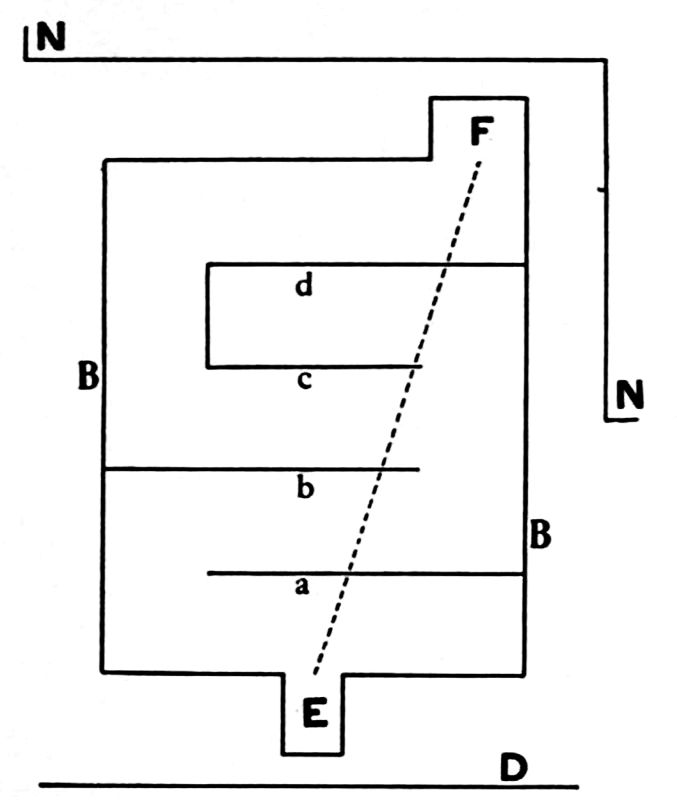
FIG. 1. Labyrinth L. BB, box 6 in. high; E, entrance; F, feeding-place; a, b, c, and d, moveable partitions 6 in. apart; NN, edge of pigeon cage; D, observation screen. The lamps which illuminated the room hung directly above the apparatus.
In this labyrinth (Fig. 1) six animals were tested once daily for thirty days, and five of these again after two and six weeks, respectively. On entering the labyrinth with the partitions in place the first time, a bird started on its usual direct course toward the food-box; running against the first partition it made vigorous efforts to push through, flying at the wire and often clinging to it for a short time; some of these random movements eventually brought it to the left of the compartment, and thence, through the opening, into the second compartment, and so on through the others, until finally it reached the food by a series of fortunate accidents.[198] The same general reaction was shown in case of the next few tests, except that fewer and fewer useless movements were made, and that the right ones were carried out with greater and greater precision. Later the animal had no difficulty in reaching the food; it did not run against the partitions, enter the blind alley, nor display such general signs of uncertainty as pausing and looking about. The process of learning in this case was obviously one of "trial and error," or the selection of useful movements. From the mass of random movements constituting the reaction to the unfamiliar environment, only those which enabled the bird to reach the food were retained and improved; the others gradually disappeared until finally the path taken became the shortest one possible, and was entered upon and pursued without hesitation by each animal as soon as it was allowed to enter the labyrinth. The time required for the tests is given in Table I.
It will be seen at a glance that the absolute time required for reaching the food varied for the individuals (see especially the results given by different birds in the case of test 1), but that the several periods for any one bird were relatively similar to those for another; and also that the time was long at first, but rapidly shortened from test to test, thus showing a steady advance in the learning process. Various lapses occurred (for example, A, 8; C, 13; E, 10) after the habit had been fairly well fixed.
In tests 18-22 the time-shortening was due principally to quickening of movements which had already become well defined. The great importance of visual data is brought out by the abrupt lengthening of the periods in the case of tests 23-25, and 26-30, where the light intensities were decreased. The lengthening was roughly proportional to the change of illumination. In the relative darkness the birds had to re-acquire the habits. The same mistakes were made as at first (running against partitions, and into the blind alley), yet here, as before, there was a ready adjustment. That the food was out of sight, or at least very much less visible, probably made no difference, since it was found that the birds would readily go to the old place after both food and food-box had been removed. In order to exclude the light entirely without making their movements invisible to me, I blindfolded the birds by means of a thin black hood, comfortably adjusted over their eyes and top of head; as a result, none was able to make the course in twenty minutes. The first turn, however, was usually made naturally, perhaps because associated with certain non-visual sense-data (sound of the lifting door, and perhaps tactual impressions of the close entrance compartment, etc.). Rats[199] seem far less dependent upon visual data than do pigeons. The great permanence of the pigeons' habits is shown by comparing the periods for tests 31-3, given after two and six weeks of rest, respectively, with those for tests 18-22.
TABLE I. TIME REQUIRED TO REACH FOOD IN LABYRINTH L
Animals
Trials, 1 daily. A B C D E F Average
' " ' " ' " ' " ' " ' " ' "
1 1) 28:50 :59 42:20 49:04 22:13 4:04 24:35

2) 7:22 :22 25:47 10:17 :48 2:02 7:46
3) 1:18 :12 8:29 12:35 :12 1:41 4:05
4) :32 :21 10:51 1:26 :19 :52 2:24
5) :24 :28 2:36 2:18 :12 1:33 1:15
6) :25 :26 1:10 :55 :12 1:50 :50
7) :15 :24 :28 :32 :15 2:09 :41
8) 1:05 :23 :33 1:19 :17 1:46 :54
9) :16 :24 :57 :58 :10 :26 :32
10) :24 :32 1:15 :51 2:12 :31 :58
11) :12 :21 1:40 :30 :17 :54 :39
12) :16 :32 :49 1:34 :22 1:18 :49
13) :13 :18 2:30 :18 :10 :42 :42
14) :29 :32 :27 :31 :25 :36 :30
15) 1:00 :24 :30 :31 :12 :35 :32
16) :19 :52 1:10 :22 :17 :24 :34
17) :14 :14 :31 :39 :13 :57 :28
2 18) :13 :09 :29 :13 :16 :29 :18

19) :10 :10 :36 :26 :07 :14 :17
20) :11 :15 :34 :17 :07 :10 :16
21) :13 :14 :34 :16 :09 :21 :18
22) :09 :16 :26 :14 :08 :11 :14
3 23) :12 :42 1:29 :39 5:53 :13 1:31

24) :20 :17 1:31 :33 :15 :13 :31
25) :15 :24 :40 :28 :19 :20 :24
4 26) 1:21 16:29 1:22 13:54 3:51 1:36 6:26

27) 3:36 4:45 :44 1:03 1:09 2:59 2:23
28) :51 1:24 :46 1:04 :56 1:09 1:02
29) :51 :41 1:10 :40 2:17 :11 :58
30) 2:04 :18 :41 :14 :07 :19 :37
5 31) :08 :33 :25 :07 :07 :16
6 32) :09 :15 :20 :08 :31 :17
1: With 18-candle-power illumination of the room.
2: Same illumination; tests given after the animals had heard four other pigeons pecking in the labyrinth.
3: With 2-candle-power illumination, other conditions the same.
4: With a slight illumination through single curtain, other conditions the same.
5: After two weeks' rest, conditions as in 2.
6: After six weeks' rest, conditions as before.
Let us now notice the gradual progress of learning in three important parts of the maze, as shown in Fig. 2. It will be seen that in the beginning the animals started upon their usual course and pressed against the first partition (stage 1), but that later they touched it less and less (stages 2 and 3), and that finally they avoided it entirely (stage 4). The adjustment here was fairly simple: the sound made by the opening of the entrance door, and the glimpse thus given of the labyrinth, gradually came to be conditions of the movements of turning to the left, on emerging from the entrance, and passing along the compartment toward the opening, where impressions, mostly visual, in the same manner determined the movements of turning to the right and entering compartment 2.
The blind alley was naturally a decided obstacle. The pigeons learned to avoid this compartment by going around it only after many unsuccessful attempts to go through it. During the first test the animals entered it many times (stage 1); on emerging they returned to the second or the first compartment, only to encounter the pen again when they re-advanced toward the food; finally, on reëmerging from the annoying enclosure, perhaps for the eighth or tenth time, they might happen to turn to the right instead of going forward as usual toward the entrance of the box, and thus make their way along the new passage and reach the food. For the next few tests they usually entered the blind alley, but less frequently, and they remained for shorter periods (stages 2-4). Later they merely entered (stage 5); and still later they passed very near the opening without entering, or only paused a moment before it (stage 6); and finally they passed it without the slightest hesitation, walking briskly, but with well-directed movements, midway between the partitions (stages 7-8). The act of turning seemed to be an especially important factor in this habit. We notice that it was a turn to the right (most probably accidental) which first enabled the animals to get beyond the opening of the blind alley; that this same act was repeated in each successive trial until, by the gradual shortening of the loop forming the path taken by the animals in passing into, and from, the labyrinth it was finally reduced to a mere pause (stage 6); and that this later disappeared entirely, leaving only the left turn, which instead was now conditioned by the visual data at that part of the labyrinth and carried the animal past the entrance of the blind alley.
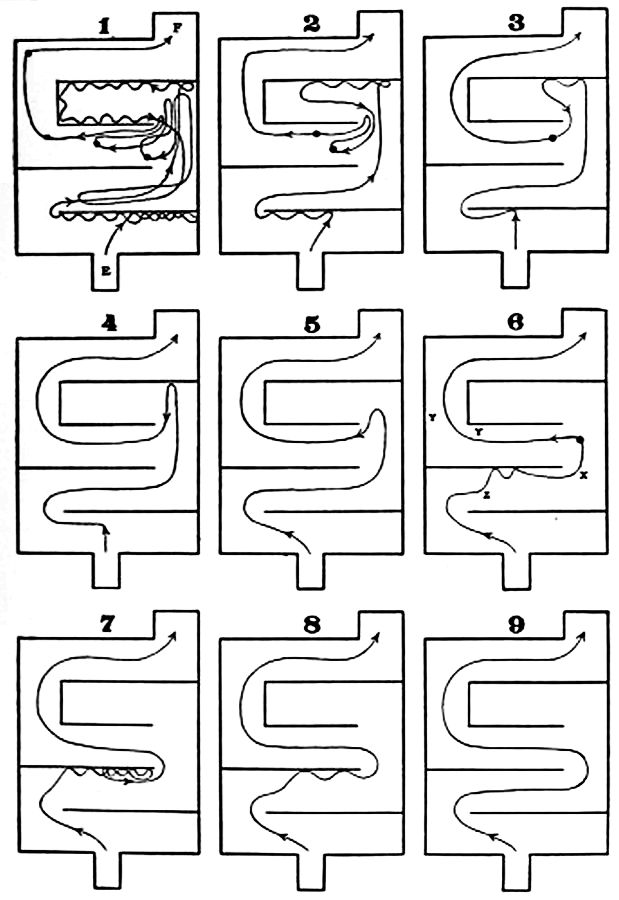
FIG. 2. Stages in learning Labyrinth L. The curves indicate the pigeon's horizontal movements. Pauses are represented by heavy dots.
The animals did not come in contact with the second partition until they had almost learned to pass the opening of the blind alley (see stage 6). This was probably because the turn to the left which was made on approaching x was associated with visual data derived from points farther along the course (y), and when the animals reached z, compartment 2, these same data were received and were sufficient to occasion the turn to the left there also, thus bringing the birds against the partition. The adjustment was made principally on the basis of new sense-data arising from running against the wire, looking at it more closely, etc. For a few trials the birds made the turn at x too quickly, and thus failed to reach the third compartment. One of my most intelligent subjects made this mistake in the third test, and again in the sixth and seventh, and retained the act almost unchanged through the tenth, eleventh, twelfth, thirteenth, fourteenth, sixteenth, seventeenth, twentieth, and twenty-first tests, so strong was the tendency to continue a movement once begun, though it was really disadvantageous.[200]
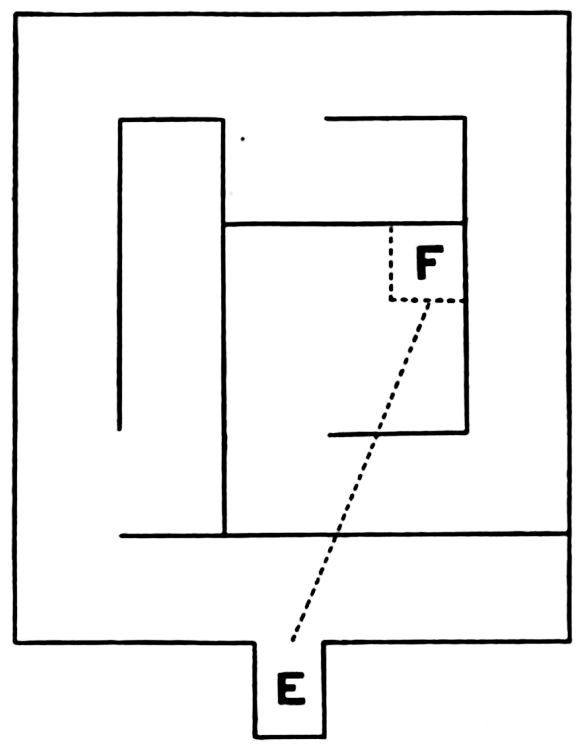
FIG 3. Labyrinth M. E, entrance; F, food-box; height of large box and width of passages the same as in Labyrinth L.
After reaching the food and satisfying their hunger, the animals often returned to the maze passages, seeking an exit; but they never "explored" passages or showed other evidence of "free curiosity" and "desire to know all their new surroundings," as Small reports concerning rats.[201]
B. Habits in Labyrinth M
Five of the animals previously used were next tested twice daily, forenoon and afternoon, for five days, in a larger, more complicated maze. It had two blind alleys, and the food-box was near the centre (see Fig. 3). The animals' general behavior was similar to that before observed. The periods are given in Table II.
TABLE II. TIME REQUIRED TO REACH FOOD IN LABYRINTH M
Animals
Trials, A B C E F Average
2 daily. ' " ' " ' " ' " ' " ' "
(1) 16:25 2:55 6:33 3:26 4:11 6:42
(2) :55 4:10 2:24 3:36 :23 2:18
(3) 1:12 :55 8:27 9:06 2:07 4:21
(4) :48 :44 2:31 :34 1:04 1:08
(5) :27 :16 :14 :16 :14 :17
(6) :18 :32 :25 :15 :27 :23
(7) :14 :11 :31 :44 :30 :26
(8) :12 :16 :57 :16 :48 :30
(9) :12 :18 :23 :16 :16 :17
(10) :10 :19 :16 :15 :28 :18
Although this maze was much more difficult, it will be seen that the animals learned the route to the food far more readily than before. The first period in this series was only about one fourth as long as the first period in the other, and the course was mastered sooner (by the fifth trial instead of by the ninth). There was less pressing against the wire than before, and unsuccessful movements were sooner discontinued. This improvement was probably due entirely to experience gained in dealing with the first maze. Thorndike speaks of the gradually increasing ability of animals to deal with successive contrivances.[202] The average results given in Tables I and II are plotted in Fig. 4, next page.
C. Habits in Labyrinth H
Since hearing is an important sense in pigeons, we should expect them to be capable of useful acoustical associations. Several things occurred in the course of the two preceding experiments which seemed to indicate that this is true; for example, although I could move about, rather noisily, in the darkened room, without apparently disturbing any of the birds, some few showed signs of fright (moving about restlessly) on hearing the low, grating noises made by lifting the hanging door of the cage, sounds which had always preceded the handling of the subjects before experimentation, and which had probably become signs to them of being taken.
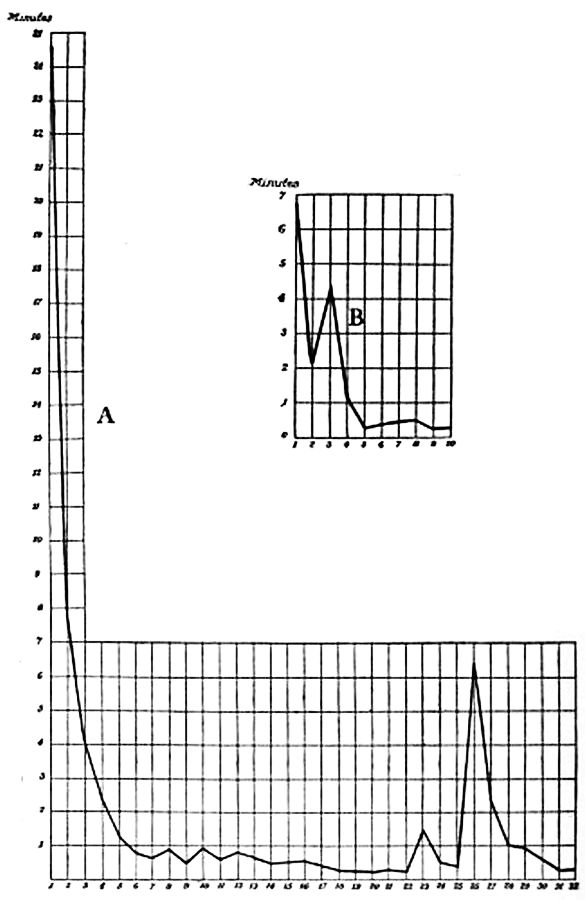
FIG. 4. Learning-curves: A, in Labyrinth L; B, in Labyrinth M. Divisions of ordinates indicate minutes; of abscissas, successive daily trials. The rise on curve A for tests 23 and 26 was due to diminution of illumination of room.
To investigate this kind of association I constructed a labyrinth (see Fig. 5) in connection with which sounds could be utilized as one form of sense-data. The passages were so arranged that along the route leading to the food there were three blind alleys, which the animals would surely enter before mastering the course. In another part of the room were placed, very close to each other, two electric gongs of the same size, but of different material. One was of metal and gave a clear ringing sound; the other was of wood and gave a low rattling noise.
When an animal was learning the route (as in the other two mazes) I sounded the gongs, the metallic, as the bird approached and entered the blind alleys, by openings M, O, and R, and the wooden, as it emerged from them and proceeded along the proper course, and occasionally after it had reached the food. The ringing sound was also given after the animal passed P and was approaching Q. When the new route was fairly well learned, I changed the order of the sound stimuli, ringing one gong at the places where the other had previously been sounded, and compared the records thus obtained with those obtained when the sounds were given in the original order. As an animal is liable to become confused by the sounds, or else quickly accustomed to them, I thought it best to give only a few trials, one trial with the usual order of sound stimulations, the next immediately following with the reversed order, and so on till four pairs of records had been secured, the series of trials being completed in a single day. Four animals were thus tested. The periods of the various trials are shown in Table III.
TABLE III. SOUND ASSOCIATION, LABYRINTH H
Time required to reach food under different sound conditions
I II
Order of gongs the same as when course was being learned. Order of gongs reversed.
Animals Animals
Trials A B E G Trials A B E G
˝ ˝ ˝ ˝ ˝ ˝ ˝ ˝
(1) 13 19 24 17 (1) 14 16 18 27
(2) 16 12 13 16 (2) 37 17 16 27
(3) 10 16 20 14 (3) 14 19 26 11
(4) 12 19 10 12 (4) 27 22 21 14
Total, 51 66 67 59 ˝ Total, 92 74 81 79 ˝
243 326
In the case of thirteen of the sixteen tests given with reversed acoustical conditions (see column II) the periods were longer than the corresponding ones given alternately with them for comparison, and there was an average time-lengthening of 5.2 seconds per trial, or 34.2%. The following is a short description of the animals' reactions to the changed conditions. It corresponds to the time-values expressed in column II of the table.
Bird A: test 1, animal undisturbed; test 2, drew back from S, turned to the left and went toward R, but later returned and passed S without pausing; test 3, paused at O for a short interval, but did not enter the blind alley; test 4, paused at O again, later drew back from S, turned to the left and entered blind alley 3; it soon escaped, and this time passed S without being disturbed, although it paused at T and U.
Bird B: tests 1 and 2, animal apparently undisturbed; test 3, a few slight pauses at openings; test 4, drew back from S, entered blind alley 3, but soon escaped and passed S without hesitation.
Bird E: test 1, undisturbed; tests 2 and 4, paused at openings; test 3, turned back from S, entered blind alley 3, and paused at several places later when passing toward F.
Bird G: test 1, many pauses; test 2, turned from S and entered blind alley 3; test 3, undisturbed; test 4, drew back from S, went toward R, but did not enter the blind alley.
As the animals gave little attention to the wooden gong, but were always sensitive to the metallic one, their observed movements probably must be accounted for chiefly on the basis of certain visual and organic sense-data now with, and now without, the ringing sound. The data governing the start (as already noticed) were probably sufficient for the avoidance of the first blind alley when the gongs were reversed. In case of the other two, however, the birds had come to depend upon acoustical data, and when these were lacking as they approached the openings O and Q, the left turn could not readily be initiated, hence certain hesitations and misdirections of movement frequently occurred. Experience with the blind alley in the first experiment assisted the animals in dealing with the second blind alley here, but mistakes were made. Visual data usually were sufficient to produce the proper turn at Q, but when the ringing sound was given just afterwards, it sometimes occasioned the left turn, thus bringing the animals toward the opening of the blind alley. While the tests given were not such as would indicate how far pigeons can discriminate sounds, they certainly show that these birds are capable of useful sound associations, although visual ones are evidently of greater importance to them.
D. Habits in Labyrinth O
I next made tests in which tactual and electrical sense-data could also be utilized. In one of the passages of a simple labyrinth was placed a board 8 in. square and 3/4 in. thick, over which were stretched copper wires which formed a series of interrupted electrical circuits. By closing a key a bird could be stimulated whenever it stepped upon the wire surface. A second key was connected with a metallic gong. When an animal on its way through the maze first stepped upon the wire surface, electrical and acoustical stimuli were given; later it was allowed to walk across the board without being thus stimulated; afterward acoustical stimuli were given it at various parts of the maze.
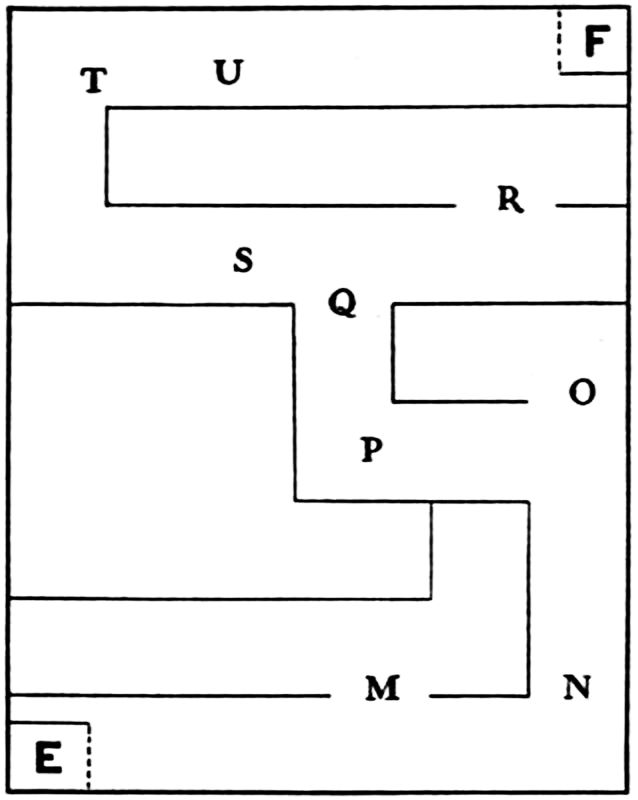
FIG. 5. Labyrinth H. For study of acoustical association. Passages 6 in. wide, as before.
Eight animals were used. All were found quite sensitive to the electrical shocks, and when next tested they avoided the board, especially if the gong sounded as they approached. Some would show signs of uneasiness anywhere in the maze on hearing the gong. When the board was so placed that they had to pass over it in reaching the food, when once on it they moved very leisurely, often lingering; and if they stepped upon the wire surface in the darkened maze, they showed no evidence of being frightened. Evidently no association had been formed between the peculiar tactual stimulus of touching the wires and the electrical shocks which had at first been given. But the tactual stimulus may have been below the threshold. Yerkes[203] saw evidence of association of this kind in the frog; this animal, however, is probably much more sensitive to tactual stimulation received from surfaces over which it passes than is the pigeon.
The results of these four experiments indicate that the pigeon easily acquires complicated labyrinth habits; that these remain fixed for some weeks at least; that acoustical, visual, and certain organic data are the most important sensory factors; and that the process of learning is one of "trial and error," in which the animal comes to form such a close connection between the sense-data of the interior of the box and those other sense-data arising from movements involved in reaching the food, that when the box impressions are again encountered the other sense-data are revived and readily condition the proper movements. How much memory of eating was involved in these tests cannot be told; but it was certainly not an essential part of the mental act.[204] Proper guidance throughout the course was the main thing, and this was determined by definite sense-data. That recognition, discrimination, and perhaps choice were to some extent present seems likely from the animal's hesitating movements at certain critical points. Thus it is highly probable that when the bird approached a blind alley which it had always entered before (see Fig. 2, stage 6), two alternatives were recognized, to enter, as before, or not to do so, as was usual thereafter, and that the pause had for its mental correlate a state closely bordering upon what in us would be deliberation.
2. Release experiments. Under this heading are included certain cage experiments in which some act, such as touching a lever, pecking, or stepping upon a platform, resulted in the opening of the door, and thus enabled the animal to escape and secure the food lying in view without. The animal was admitted to the cage through an entrance compartment as in the case of the maze trials. Before being tested it was allowed to become familiar with the cage and to reach the food directly by passing out through the open door. When first in the cage the animals did not seem to notice the release apparatus, and hence they probably did not begin learning the method of escape until later when they entered the cage and found the door closed, and the ordinary exit thus obstructed.
A. Latch Tests
The cage here employed was an 18-inch cubical box. The top was of chicken wire and the bottom and three sides of heavy boards; the fourth side was formed by narrow vertical bars and a wire door which opened inwardly and was held by a latch working on the outer surface of the bars. At first a long wooden latch was used, which the animals raised when reaching out for food. As this seemed an unnatural act, downward pressure was substituted by attaching to the latch, now made smaller and of brass, a string which ran over a pulley above the door and down into the cage. As nooses did not seem adapted to the birds, the end of the string was attached to a wooden lever which worked on the inner surface of the bars, about three inches from the floor. Eight animals were tested four times daily (twice in the forenoon and twice in the afternoon) for ten days. The time required to escape and the animals' behavior were recorded as in the case of the labyrinth tests.
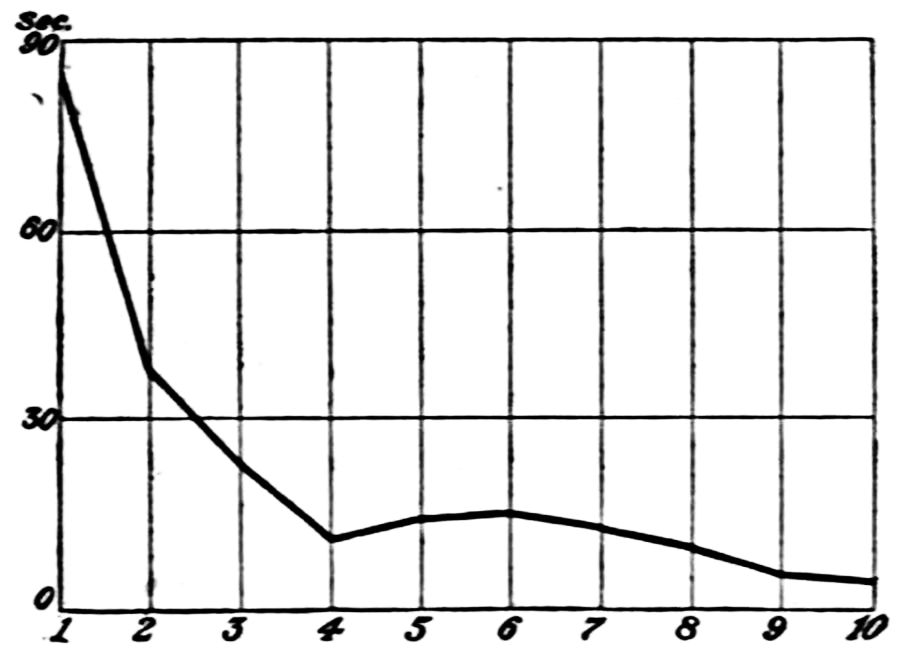
FIG. 6. Curve of learning to operate latch, plotted from last column of Table IV. Each vertical division indicates 30 sec. The horizontal divisions represent successive days.
When they first entered the box (singly as in the other experiments) and found the usual exit closed they made various attempts to push through between the bars, springing and often flying about with great force and persistency. In course of their random movements they touched the bar and opened the door and thus escaped. Later the unnecessary movements were mostly dropped and the necessary ones became highly specialized. The first association was established between the box impressions received on entering and the movements involved in approaching the front of the box and depressing the lever; later a connection was formed between the sensations of touching the lever, of hearing the sound of the opening door, of feeling the jar, etc., and the movements of turning away from the lever and passing out. The sight of the opening door seemed to be of less service to the birds than the sound and jar. Each animal soon came to touch the bar at the point of least resistance, and usually with considerable precision. The time required by the several birds is shown in Table IV, next page. The daily average results are plotted in Fig. 6, above.
TABLE IV. TIME REQUIRED TO ESCAPE FROM CAGE BY USING LATCH
Animals
Trials, 4 daily. A B C E F G H I Av. Daily Average
' " ' " ' " ' " ' " ' " ' " ' " ' " ' "
(1) :03 :06 3:20 :08 :03 1:10 4:30 :23 1:13
(2) :05 1:10 :59 1:50 2:00 :10 2:46 1:00 1:00
(3) 5:28 :29 1:04 :21 :29 :52 2:33 4:05 1:55
(4) :31 1:45 3:52 :14 :06 :23 2:40 2:30 1:30 (1:25)
(5) :15 :10 2:25 :03 :10 :07 :31 :50 :34
(6) :17 2:00 5:03 :03 :05 :15 :39 :10 1:04
(7) :08 :20 :36 :31 :03 :11 :30 :46 :23
(8) :03 :54 :47 :28 :03 :55 :06 :47 :30 (:38)
(9) 1:12 :34 :39 :17 :03 :04 :21 :20 :26
(10) :02 :19 :28 :07 :01 :03 :20 :47 :16
(11) :02 :51 :09 :14 :03 :02 1:46 :47 :29
(12) :02 :15 :24 :12 :02 :02 1:17 :27 :20 (:23)
(13) :03 :19 :22 :07 :06 :04 :48 :11 :15
(14) :02 :15 :22 :09 :02 :02 :20 :19 :11
(15) :08 :06 :12 :05 :02 :02 :03 :06 :06
(16) :03 :18 :44 :10 :02 :03 :02 :21 :13 (:11)
(17) :02 :17 :41 :03 :07 :07 :11 :06 :12
(18) :02 :42 :26 :05 :01 :03 :31 :15 :16
(19) :04 :13 :48 :04 :01 :02 :15 :14 :13
(20) :04 :32 :35 :04 :01 :02 :08 :22 :15 (:14)
(21) :03 :13 :10 :13 :09 :01 1:10 :16 :17
(22) :03 :05 :10 :11 :03 :02 :39 :26 :12
(23) :02 :07 :17 :05 :03 :15 :20 :26 :12
(24) :02 :14 :04 :02 :01 :02 :09 1:03 :12 (:12)
(25) :01 :03 :05 :04 :01 :02 :31 :24 :09
(26) :02 :04 :08 :01 :01 :05 1:34 :33 :19
(27) :02 :03 :03 :03 :10 :05 :15 :39 :10
(28) :02 :04 :03 :01 :06 :05 :23 :51 :12 (:12)
(29) :02 :04 :10 :03 :02 :06 :23 :21 :09
(30) :01 :03 :03 :02 :11 :02 :09 1:08 :12
(31) :21 :03 :11 :03 :01 :03 :28 :11 :10
(32) :03 :02 :04 :02 :01 :03 :11 :42 :09 (:10)
(33) :02 :02 :03 :10 :01 :03 :18 :17 :07
(34) :02 :02 :03 :02 :01 :03 :11 :11 :04
(35) :01 :02 :03 :02 :01 :02 :18 :09 :05
(36) :01 :03 :03 :03 :03 :02 :04 :10 :04 (:05)
(37) :01 :02 :07 :02 :04 :01 :11 :09 :05
(38) :01 :02 :02 :02 :02 :01 :08 :03 :03
(39) :02 :04 :11 :01 :02 :02 :14 :08 :06
(40) :01 :02 :03 :01 :01 :03 :10 :03 :03 (:04)
The periods here were similar to those given in the maze tests—the time was long at first, then it shortened very rapidly for a few trials, then more slowly but still constantly, until the act became thoroughly familiar. The process was one of "trial and error" throughout. As before, various lapses occurred, even although the animals were as persistent as usual in their efforts to escape. When the lever was moved to the side or back of the box, none of the animals could escape. In general, pigeons show less ingenuity in dealing with latches than do sparrows, according to Porter's[205] observations, although in some other tests they are equally apt.
B. Pecking Tests
The preceding series of trials proved the animals' ability to utilize certain touching or clawing movements, at first accidental, in making an escape, and showed that these could become highly specialized. Desiring to carry out similar tests in the case of pecking movements, which are quite as natural to pigeons, I arranged a contrivance by means of which the act of pecking at corn-grains fastened to a small piece of cardboard (placed just outside the cage, but within easy reach through an opening in the wire) would open the cage-door by making a delicate electrical contact. Four animals were tested.
On entering the cage they endeavored to escape as before; failing in this they began pecking about until they found the corn-grains and made the contact which opened the door and allowed them to escape to the food without. Three of the animals made their escape in this way several times; but the habit seemed to be one that could not be readily learned, as the successive periods showed little shortening.
Thinking that the pecking of things at a definite place perhaps complicated the matter, I removed the electrical apparatus and arranged to open the door myself by pulling a string whenever the pigeon pecked anywhere upon entering the box. Preliminary experiments with Bird J indicated some ability to profit by this kind of experience. As the act of pecking could be used to advantage in a series of imitation trials, this animal only was allowed to learn to escape by actually pecking; the others were reserved for the imitation tests next to be reported.
C. Imitation Tests
In the experiments already reported the animals were used individually and usually out of sight of the others, although in the same room and within hearing of them. When efforts were made in some of the experiments to test the animals in a separate room, signs of fear and discontent were often noticed, and it was necessary to return to the first room to continue the tests. Some instances were noticed in which a pigeon would do what it saw another doing. For example, one of my subjects would not eat one day, being ill apparently; but when I put two others into the compartment with it, and they began eating the food lying about, it also began pecking. Its act could not have been due to its only then happening to see the corn, for it had before looked toward the food when this was thrown to it.
Desiring to test, under definite conditions, the imitative ability of these animals, I arranged trials in which birds were allowed to see a useful, but simple act performed by another bird, and then were given an opportunity to execute the act themselves. Using the animal which I had trained for the purpose, I allowed its series of acts (entrance to box, pecking, release, and food-eating without) to be observed by another animal, confined in a small wire compartment (similar to the entrance compartment before used) attached to the side of the large cage. Care was taken to see that the confined bird was observing, or at least was looking toward the acting one; in case of doubt, the trial was repeated. Later the trained animal was replaced by the observing one, and the latter's reaction was noted. Five animals, in all, were tested, and each was given two opportunities to escape after having seen the trained animal perform the act ten successive times. None of them, however, showed any signs of trying to escape by repeating the movements so often performed by the bird familiar with the act, but each rushed against the sides of the cage and tried to push through at various places, just as the trained bird had done when first learning the habit.
As the act, or series of acts, was rather too complex to be easily observed and utilized by the other pigeons, I arranged two much simpler tests. In one case the leading bird was taught to open the cage-door by stepping upon a platform (the lowering of which made an electrical contact); in the other, to avoid a blind alley, enter a short passage, and ascend a wooden plane (inclined at an angle of thirty degrees) which led into another box containing food. In these tests it was more difficult for the series of acts to be viewed, but the animals, singly as before, were placed at a point of vantage and apparently saw the movements of the other animals.
Of the five birds tested in the platform experiment, four utterly failed to escape in the two trials given. The fifth, in its second test, went to the platform promptly and thus made its escape, but the success may have been accidental, or due to the animal's experience of seeing and approaching the platform in its first test. In the labyrinth experiment only one bird (second test) avoided the blind alley and went directly up the inclined plane to the food; this success was probably due to experience in the first test. There was certainly no evidence that the animals had grasped the nature of the problem; nothing to indicate that the performance of the trained animal had supplied data for the guidance of future conduct, that is, for the conditioning of the necessary movements, in this case those of pecking, stepping upon a platform, or avoiding a blind alley and ascending an inclined plane.[206]
These results are similar to those which other experimenters have secured in the case of chicks, cats, dogs, monkeys,[207] and also rats.[208] Although the method I employed is doubtless open to the criticism of being artificial,[209] some value at least should be attached to the results; if so it would seem probable that imitation in pigeons is not above the "instinctive" stage, and that learning depends entirely upon first hand experience, upon really doing the thing, and not upon merely seeing it done.
3. Position, Color and Form Tests. The apparatus used in these experiments consisted of small boxes, six inches in height, and open at the top. Sometimes they were exactly similar, and sometimes they differed in color or in form. They were moveably attached, six inches apart, to a board which was placed in a large wire-covered box, having an entrance compartment as in the case of the mazes and cages. Food was placed in one of the small boxes, and the pigeons were allowed to find it twice; later each bird was tested as to its ability to return to the food by depending upon the position of the box in the group, or upon its color or its form. Tests were given in series of six, and the box which was first approached was recorded as the animal's choice for that test. If it made a wrong selection, it was allowed to look about until it found the box containing the food, but in no case was it permitted to satisfy its hunger until the last test of the series. The animal apparently did not see the food until it approached the box, and subsequent tests demonstrated that it was not guided by odor.
A. Position Tests
In this series of trials I used at first six, later nine food-boxes, four inches square and covered with dark gray paper. The board to which the several receptacles were fastened was shifted at irregular intervals to various oblique angles; this was done to prevent the animal from being assisted by the position of the food-box in the larger box rather than in the group of similar boxes. After a bird had been tested sufficiently for one position it was then used, for a week or so, in some other experiment, and thus given an opportunity to forget, to some extent at least, the old experience before being taught to find the food in a box placed elsewhere in the group. For the positions 2, 3, and 4, in the group of six similar boxes, eight animals were each given thirty tests in series of six, as stated above. For the positions 5, 6, and 7, in the group of nine similar boxes, the experiments were shortened. Six animals were given twenty-four trials each, two animals for each of the three positions.
The animals quickly learned the position of the food-box and passed to it promptly when released from the entrance compartment. Changing the position of the board to which the food-boxes were attached did not affect the animals' ability to reach the food readily. They usually selected the proper box as before, although frequently they went around the end of the board and approached the food from the opposite side. The general distribution of choices in the case of positions 2, 3, and 4 is given in Table V; the rate of learning, in Table VI.
With a single exception (Bird B, box 3) the box containing the food was far more often chosen than any one of the empty boxes, and usually more often than all of them combined, the average right choices being: position 2, 62%; position 3, 57.7%; position 4, 53.3%. It will be seen that the animals were more successful in finding the food in the second position than in either the third or the fourth, that is, positions nearer the end were more easily located. But what is of greater interest to us is the rate of learning to go to the right box. This is indicated by the increasing number of right choices from series to series. (Table VI.) That the increase was small was due to the fact that the animals learned so quickly in the first series of six tests that little improvement could be made thereafter; what they could learn they acquired early in the experiment. There is some evidence of improvement after the first series in the case of box 4, a more difficult position, and the average for all three boxes shows a slight improvement from series 1 to series 5, although a falling-off is seen in the last series: 26, 27, 27, 31, 28. The same general features appear in the case of the incomplete tests (positions 5, 6, and 7). For each box there were, on the average, 26 right choices in the possible 48. There were more right choices in the case of box 7 than in the case of either box 6 or box 5, box 7 being nearer one end (box 9). There was little evidence of learning after the first series of trials.
TABLE V. ASSOCIATION OF POSITION: GENERAL DISTRIBUTION OF CHOICES
Choices of boxes 1 to 6 when food was placed in boxes 2, 3, and 4
Food in box 2 Food in box 3 Food in box 4
Boxes Boxes Boxes
Animals 1, 2, 3, 4, 5, 6. 1, 2, 3, 4, 5, 6. 1, 2, 3, 4, 5, 6.
(B) 1 18 4 6 1 0 1 1 8 7 8 5 0 0 2 21 4 3
(C) 2 20 6 1 1 0 0 9 19 2 0 0 0 7 2 15 6 0
(E) 4 18 2 3 2 1 0 6 18 3 3 0 2 6 2 15 3 2
(F) 5 20 1 2 2 0 1 6 18 3 2 0 0 2 5 14 8 1
(G) 0 18 5 2 2 0 0 3 13 5 7 2 0 0 3 17 9 1
(H) 0 22 4 3 1 0 1 0 18 4 6 1 0 4 8 15 3 0
(I) 4 18 3 1 3 1 0 1 23 6 0 0 0 6 7 15 2 0
(J) 1 17 7 5 0 0 3 0 21 3 2 1 1 4 3 16 6 0
Total, 17 151 32 26 12 2 6 26 138 33 28 9 3 29 32 128 41 7
TABLE VI. ASSOCIATION OF POSITION: DISTRIBUTION OF RIGHT CHOICES
Choices from series 1 to series 5 in the case of boxes 2, 3, and 4
Box 2 Box 3 Box 4
Series Series Series
Animals 1, 2, 3, 4, 5. 1, 2, 3, 4, 5. 1, 2, 3, 4, 5.
(B) 4 4 5 2 3 2 2 1 1 2 4 4 4 5 4
(C) 5 4 2 5 4 4 4 4 4 3 3 3 2 2 5
(E) 3 4 4 3 4 4 4 2 5 3 3 2 2 4 4
(F) 5 4 3 5 3 5 3 3 4 3 0 2 4 4 4
(G) 3 4 4 3 4 2 2 4 2 3 3 3 2 4 5
(H) 4 4 4 5 4 4 3 4 5 2 3 3 4 3 2
(I) 1 4 3 5 5 4 4 5 6 4 2 1 3 4 5
(J) 4 5 4 3 1 3 4 6 4 4 3 3 3 4 3
Total, 29 33 29 31 29 28 26 29 31 24 21 21 24 30 32
Average for the three boxes, 26, 27, 27, 31, 28.
The method of learning in these position tests was the same as that noticed in previous experiments, namely, building upon chance successes. When first admitted to the large box containing the row of small ones at the farther end, the animal accidentally found the receptacle containing the food, and later associated the movements involved in reaching that position with various sense-impressions of the box, especially those experienced upon entering—certain tactual impressions of the small entrance compartment, sound of the lifting door and sight given of the interior of the large box.
While the results clearly indicate that pigeons readily learn the position of objects, nothing is proved as to "counting." Some experimenters speak of similar trials as "number-tests," just as they do of "form-tests," but this is probably going too far. To investigate counting in animals, experiments should be arranged which minimize spatial responses. These tests certainly show that pigeons can discriminate positions readily, especially toward the ends of the group, but little more is certainly indicated. Porter[210] says: "If we do not find in birds the power to count, we have in their nice sense for the location of a member of a series ... something of that preliminary number-sense which Ribot describes as belonging to children and savages."
B. Color Tests
To investigate the animals' ability to utilize colors[211] in finding their food, I employed the same apparatus as before, except that six boxes were used throughout and each was covered with paper of a different color: red, yellow, green, blue (Bradley's standards, except red, RO being substituted), gray, and black. The boxes covered with black and gray paper were employed merely to complete the group of six. The same method as before was employed, except that the board to which the boxes were attached was left stationary at the end of the large box, and also that the position of all six boxes was changed irregularly for each test.
The general behavior of the animals at the beginning of these tests was quite similar to that shown in the preceding experiment; but it was soon evident that colors occasioned them far more difficulty than positions. The general distribution of choices is given in Table VII. It will be seen that the proper box was usually chosen more often than any one of the empty ones, but never oftener than the other five combined, as occurred in the position tests; also that in the case of each color there were instances in which another color was as often, or more often selected. Yet it is clear that colors may serve as valuable sense-data for these animals. In the first series of six tests (see Table VIII) there were few right choices or none, but in each succeeding series the number increased. The learning process was evidently of the same type as before observed (selection, in this case gradual, of chance but useful movements), and involved visual data largely.
TABLE VII. COLOR ASSOCIATION. GENERAL DISTRIBUTION OF CHOICES
Choices of all 6 boxes when food was placed in red, yellow, green, or blue boxes
Food in Red Box Food in Yellow Box
Animals R, Y, G, B, B'k. G'y. R, Y, G, B, B'k, G'y.
(B) 12 6 7 3 2 0 2 12 6 7 0 3
(C) 15 8 1 4 2 0 3 12 1 6 3 5
(E) 11 8 5 3 3 0 3 10 5 3 5 4
(F) 7 5 9 6 2 1 6 6 5 6 3 4
(G) 9 1 7 5 3 5 5 11 6 3 2 3
(H) 13 3 5 3 3 3 5 9 6 3 3 4
(I) 11 5 2 4 6 2 4 10 5 4 3 4
(J) 10 0 6 8 4 2 5 10 3 3 5 4
Total, 88 36 42 36 25 13 33 80 37 35 24 31
Food in Green Box Food in Blue Box
Animals R, Y, G, B, B'k, G'y. R, Y, G, B, B'k, G'y.
(B) 4 5 12 4 5 0 1 3 5 10 6 5
(C) 3 4 14 5 1 3 3 1 2 13 2 9
(E) 1 9 7 11 0 2 3 5 5 10 3 4
(F) 0 8 9 6 0 7 0 3 6 11 5 5
(G) 2 5 16 2 4 1 5 5 4 5 4 7
(H) 1 3 15 5 6 0 7 5 5 6 4 3
(I) 0 4 15 6 2 3 5 5 3 9 5 3
(J) 4 1 12 9 1 3 6 4 4 7 5 4
Total, 15 39 100 48 19 19 30 31 34 71 34 40
TABLE VIII. COLOR ASSOCIATION. DISTRIBUTION OF RIGHT CHOICES
Choices from series 1 to series 5 in the case of red, yellow, green, and blue boxes
Red Box Yellow Box
Animals 1, 2, 3, 4, 5, 1, 2, 3, 4, 5,
(B) 0 1 2 4 5 1 2 3 2 4
(C) 2 2 4 3 4 1 2 3 3 3
(E) 2 1 2 3 3 1 0 3 2 4
(F) 0 1 1 2 3 0 2 2 1 1
(G) 0 2 3 2 2 2 2 1 3 3
(H) 1 1 3 4 4 0 2 2 2 3
(I) 1 2 3 3 2 1 2 2 3 2
(J) 1 2 2 2 3 1 2 1 2 4
Total, 7 12 20 23 26 7 14 17 18 24
Green Box Blue Box
Animals 1, 2, 3, 4, 5, 1, 2, 3, 4, 5,
(B) 1 2 2 4 3 1 3 1 2 3
(C) 3 2 3 4 2 3 2 2 3 3
(E) 0 1 1 1 4 0 1 3 2 4
(F) 0 1 2 3 3 1 1 2 4 3
(G) 2 4 3 3 4 1 1 0 0 3
(H) 2 3 4 3 3 0 1 2 2 1
(I) 1 3 3 3 4 0 2 2 3 2
(J) 1 1 3 3 4 1 2 1 1 2
Total, 10 17 21 24 28 7 13 13 17 21
There is no evidence that the color-preference of the animals assisted them in choosing correctly, in fact, they were rather less successful in dealing with those colors for which they had previously shown decided preference,[212] since the whole number of right choices was less in the case of the green and blue boxes (85) than in the case of the red and yellow ones (92), and since there was a relative diminution in the rate of learning toward the last in case of the former boxes.[213]
To test the animals' ability to discriminate shades of colors in finding their food, two birds were used, with four boxes, each covered with a different shade of red paper, and two with the boxes covered with green paper. The brightness of the different shades was not measured, but to the eye it seemed to be equal in each of the cases. The food was placed in the box having the most nearly saturated color, and twenty-four trials in series of six, as before, were given each bird. The results were quite similar to those secured with different colors. With the red shades there were twenty-two choices of the best saturated shade to eight, ten, and eight, respectively, of the other three; and with green, twenty-one to nine, ten, and eight. The 43 correct choices were distributed from series 1 to series 4 as follows: 7, 11, 12, and 13, which shows learning as before. The relatively large number of right choices was probably due, partially to the fact that fewer alternative choices were possible since only four boxes were used, instead of six, and partially to the fact that the box containing the food may have been slightly brighter than the others.
Throughout these trials the position-element was a decidedly disturbing factor. When the animals were first learning to choose a box of a definite color, some would show a marked tendency to approach a receptacle occupying a certain position, and would persist in this from series to series. Others at first showed no special preference for certain positions, but, after happening to make a correct choice, they would return to that same place the next time, and thus miss the right box which had been changed for the new test.
C. Form Tests.
In this experiment the six food-boxes were each of different form: triangular, square, oblong, hexagonal, circular, and elliptical. They were of the same capacity, and were covered with light-brown paper. As in the preceding experiment, the birds were tested for only four of the boxes, and were given thirty trials each. Six animals were used, and as they were not the same as those previously employed, the square box (which had always been used before) had no advantage over the others in attracting the birds at the beginning of the trials. The tests were given as in the preceding experiment, except that it did not seem necessary to change the position of each of the six forms before giving each test; it was thought sufficient to move the food-box, and, if a wrong choice had been made in the preceding test, also the box wrongly chosen. The results are shown in Tables IX and X.
TABLE IX. FORM ASSOCIATION. GENERAL DISTRIBUTION OF CHOICES
Choices of all 6 boxes when food was placed in Tri., Sq., Hex., or Cyl. boxes
Food in Tri. Food in Sq. Food in Hex. Food in Cyl.
Animals Tri. Sq. Ob. Hx. Cyl. El. Tri. Sq. Ob. Hx. Cyl. El. Tri. Sq. Ob. Hx. Cyl. El. Tri. Sq. Ob. Hx. Cyl. El.
(U) 8 6 5 5 2 4 5 9 6 1 6 3 5 5 3 11 3 3 6 5 3 5 8 3
(V) 9 2 3 6 7 3 5 8 5 2 5 5 4 4 5 8 5 4 6 6 3 4 7 4
(W) 8 7 3 4 5 3 5 8 5 3 3 6 3 5 3 10 7 2 4 3 4 3 10 6
(X) 11 5 2 5 3 4 5 8 3 6 3 5 4 5 4 7 6 4 2 5 4 4 9 6
(Y) 11 4 5 4 2 4 4 9 5 6 3 3 3 4 2 8 6 7 3 2 5 6 9 5
(Z) 8 3 7 4 4 4 6 11 7 3 1 2 5 4 2 11 3 5 3 5 4 4 9 5
Total, 55 27 25 28 23 22 30 53 31 21 21 24 24 27 19 55 30 25 24 26 23 26 52 29
TABLE X. FORM ASSOCIATION. DISTRIBUTION OF RIGHT CHOICES
Choices from series 1 to 5 in the case of Tri., Sq., Hex., and Cyl. boxes
Food in Tri. Food in Sq. Food in Hex. Food in Cyl.
Animals 1, 2, 3, 4, 5, 1, 2, 3, 4, 5, 1, 2, 3, 4, 5, 1, 2, 3, 4, 5,
(U) 2 0 2 1 3 1 2 2 2 2 2 1 2 3 3 1 1 2 1 3
(V) 1 1 2 3 2 2 1 1 2 2 0 1 2 3 2 1 2 2 1 1
(W) 1 2 1 2 2 2 1 2 1 2 1 2 2 2 3 1 2 2 3 2
(X) 1 2 3 3 2 0 2 2 3 1 1 2 2 1 1 1 1 2 3 2
(Y) 1 2 3 2 3 2 2 2 3 2 1 1 2 1 3 0 2 2 2 3
(Z) 1 2 2 2 1 0 2 3 3 2 1 2 2 4 2 1 2 3 1 2
Total, 7 9 13 13 13 7 10 12 13 11 6 9 12 14 14 5 10 13 11 13
It will be seen that each animal chose the right box oftener than any other one box, but not oftener than all of them; also that there was a small increase in the number of right choices from series to series. No one of the four forms seemed better discriminated than the others if we may judge from the practical equality of right choices made in each case (55, 53, 55, 52) or from the similar increase in number of right choices from series to series; the hexagonal and cylindrical boxes received fewer choices in the first series than did the triangular and square, but this was exactly counterbalanced in the last series. The triangular box was more often confused with hexagonal and square, and the square with triangular and oblong, than with the others. For the hexagonal box the cylindrical was more frequently mistaken than were the other forms, especially the oblong; and with the cylindrical the elliptical was more frequently confused than were the others, especially the oblong. In this series of tests nothing new as regards general behavior or method of learning was observed.
TABLE XI. POSITION, COLOR AND FORM ASSOCIATION
Total
Right Right choices from series 1 to series 5[215]
Choices[214] 1 2 3 4 5
Position 57.9% 54.2% 55.6% 56.9% 63.2% 59.0%
Color 35.3% 16.2% 29.7% 37.0% 42.7% 51.6%
Form 29.8% 17.4% 26.4% 34.7% 35.3% 35.3%
If we compare the results obtained in these three experiments (see Table XI and Fig. 7), we shall see that the pigeons were governed much more by the position of the food-box than by either its color or its form, and that color was better associated than form. Position was a most important factor throughout, as was observed also by Porter[216] in the case of the English sparrow. Porter[217] also found that his sparrows could associate color better than form. In the position-tests the pigeons showed very little improvement from series to series (see table); almost all that the animals could learn was acquired at the beginning. The more difficult color- and form-trials, however, showed almost constant improvement, although we should have expected this to be greater in the latter case than it was. When judged entirely by the actual number of right choices in a given kind of tests, some of the birds made a very poor showing; but from the standpoint of increasing number of right choices they appeared in a wholly different light.
Thus, for example, bird F (Table VII) made only 33 right choices in a possible 120, yet their arrangement is significant, being, from series 1 to series 5, respectively, 1, 5, 7, 10, 10. It is probable that there would have been still greater improvement had the tests been continued; perhaps the animal would have become as proficient in finding its food by depending upon the color of the receptacle usually containing it, as by relying upon the position of the box in the group.
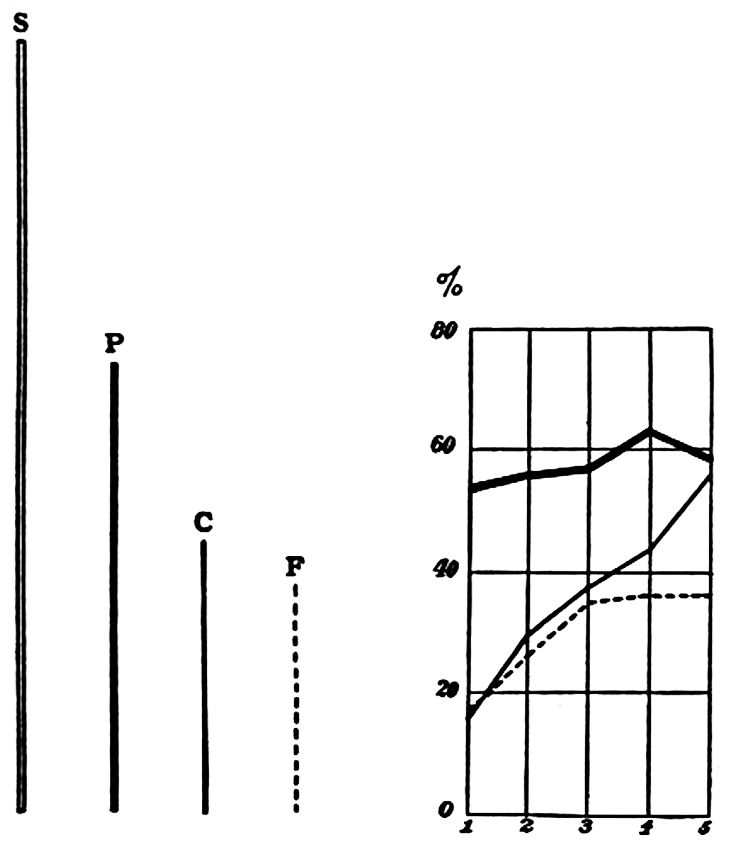
FIG. 7. Position, Color, and Form Association. If line S represent tests of a given kind, P, C, and F would represent, respectively, the number of correct choices of position, color, and form. The rate of learning in each case is shown by the corresponding curves to the right, where vertical divisions each indicate 20%, and horizontal divisions the successive series in which the tests were given.
V. SUMMARY
1. Respiration in pigeons is sensitive to various stimuli, and since its alterations of rate, amplitude, etc., can be easily recorded pneumo-graphically without frightening the animals, it may well serve as a process through which to study their mental life.
2. By repetition meaningless stimuli, for example, pistol-shots, quickly lose their disturbing influence; whereas the breathing remains sensitive to those of a significant character, such as the noises made by other birds.
3. Reaction to light of moderate intensity consists principally in an immediate quickening, the amount varying with the color; since a direct correspondence was found between color-preference and breathing-rate, it would seem that here agreeable feeling involves increased breathing activity.
4. Visual, acoustical, probably tactual, and certainly organic data, are the principal sensory factors of the associations of pigeons.
5. The animals readily form useful associations by a method of "trial and error," or the selection of successful movements which were at first accidental.
6. Apparently a pigeon does not learn by merely seeing a new act performed by another pigeon; yet there are instances of simple ("instinctive") imitation, and "trial and error" learning is not wholly independent of social conditions, since it proceeds much more satisfactorily if the animal is trained at least within hearing distance of other pigeons.
7. When a habit is being formed, the "period" required for the first test is usually very long, but learning proceeds quite rapidly during the next few trials; later it is more gradual, but it continues till the act becomes thoroughly familiar.
8. Associations are fairly permanent, and some remain practically unaltered for at least six weeks. Modification is easily accomplished, however, on the basis of new experience.
9. Pigeons differ widely both as to the ease with which they acquire associations and also as to their permanence. Difference in activity seems the chief reason for this.
10. While these birds seem mentally inferior to English sparrows and to various mammals which have been tested in a similar manner, they are capable of numerous ready adjustments. They discover circuitous labyrinth passages, they learn to manipulate latch apparatus when adapted to their natural habits and conveniently placed, and they easily reach their food by depending upon the position, color, or form of the box containing it. But the process is apparently simple association throughout. There is no evidence of higher mental activity—no looking the situation over and acting accordingly, no "reasoning" in the proper sense of the word, but only blind movements, some of which are retained and become highly specialized, merely because successful.