VISION DURING DIZZINESS
Reading edition
BY E. B. HOLT
During and after a prolonged rotation of the head, the visual field seems to spin around before one's eyes,—a phenomenon that is ordinarily called the "dizziness of Purkinje." Delage describes it as follows:[16] "In the experiment of Purkinje, while we are rotating in a positive sense, space seems possessed of a motion in the opposite direction.... This phenomenon is explained by the direction of the nystagmus."
"In the nystagmus," he continues, "the eyeballs execute two well-differentiated motions: one, a compensatory, relatively slow motion, during which images pass across the retina so as to give the appearance of a movement of space in the opposite direction; two, a swift motion opposite to the slow one, and so rapid that the images passing across the retina leave no sensation of their movement."
Now, in a previous paper[17] I have shown that there is a central anæsthesia, or central inhibition of visual sensations, during about the latter two thirds of the time occupied by every voluntary eye-jump; and in view of this I was led to enquire whether in fact, as Delage so confidently asserts, it is the speed of these more rapid movements, or some other factor, that causes them to leave no visual sensations. There can be no doubt that they do leave none, since, aside from the statement of Delage, in dizziness the visual field whirls always in only one direction; whereas it should otherwise appear to swing now to one side, now to the other, as the eyes move back and forth across the objects. I have found but one other mention of this point in the literature. In his Analyse,[18] Mach says, parenthetically, "(the jerky eye-movement leaves no optical impression)"; but he does not suggest that this is because of its greater speed.
In order to test this point, a 2 c. p. incandescent lamp was so arranged that it could be moved vertically in front of, and about four metres distant from, a rotating chair. Since after a rotation the eyes are oscillating from side to side, if the lamp is moved up and down an obliquely inclined after-image streak must be generated on the retina; and clearly there are four possible positions in which this may lie, as shown in Fig. 1.
The results were absolutely uniform (the author alone as subject); the after-image streak always lay on that side of the moving light toward which the slow eye-movements were directed, that is, the lamp appeared to drift obliquely up or down and in a lateral direction opposite to that of the slow eye-movements. Apart from its vertical displacement, then, the lamp behaved like the less intensely illumined parts of the visual field, seeming to be totally invisible during the swifter eye-movements. Now since the experiment was done in a partially darkened room and the eyes were partly adapted to darkness, the lamp should have been intense enough adequately to stimulate the retina even during the more rapid movements, and might be expected to leave an after-image streak on that side toward which these rapid movements were directed, and differing only from the streaks seen during the slow eye-movements in being inclined at a less angle from the horizontal. Yet no such streaks were visible.
These observations were made at about the same number of seconds after the rotation stopped, as the photographs were taken that are recorded in the preceding paper of this volume. The rapid movements were therefore about one sixth as long in duration as the slower ones. Since the respective amplitudes of rapid and slow must average very nearly the same, the rapid movements must have been about six times as swift as the slow movements. It needs therefore to be shown beyond a doubt that the 2 c. p. lamp was bright enough, in view of the briefness of stimulation of any one retinal element during the rapid eye-movement, to be above the threshold of perception. For this reason the experiment was not continued with other subjects.
The certainly adequate degree of illumination was realized during the photography of the eyes described in the preceding paper. Here during the post-rotary dizziness an arc lamp (of 6 amp.) was in front of the face and but a little to one side of the primary line of regard; it was 60 cm. distant from the eyes and on a level with them; a lens condensed the rays on the two eyes, and the light was diminished only just enough as not to be painful, by a dilute screen of copper ammonium sulphate about 3 cm. thick. Of course such an illumination must adequately stimulate each retinal element even during the most rapid eye-movements. Nevertheless with the four subjects that were photographed the arc lamp, like the rest of the visual field, seemed always to swim in one direction, and that opposite to the slower eye-movements. In one case where the eyes were photographed without the adiathermal screen, and the light was rather painfully intense, the lamp was still seen to drift in one and the same direction. There was never any trace of its moving to and fro, as there should have been had it been visible during both phases of the nystagmiform movements.
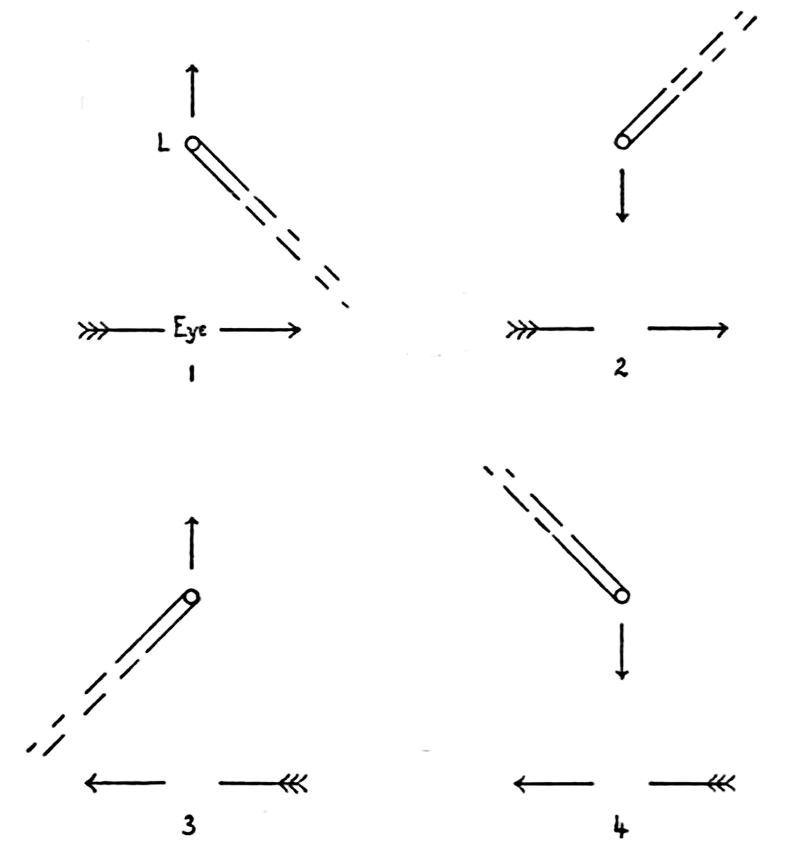
Fig. 1
This absence of visual sensation during the more rapid eye-movements might conceivably depend on either peripheral or central inhibitory factors. But the anatomy and physiology of the eye offer no point of support for the supposition that during such movements the irritability of the rods and cones is momentarily reduced, or that the retinal layers posterior to the rods and cones suffer an interruption of function during a movement of the eyeball in its socket. Indeed, during some such movements, the "pursuit" movements (Dodge's second type), vision is unimpaired.[19] In view of these facts, and of the many known cases of the mutual inhibition of sensations where undoubtedly the process is a central one, it is by far most probable that this visual inhibition is also a central process; as was certainly the visual inhibition during voluntary eye-jumps, previously reported by me.[20]
The conclusion above reported that the visual inhibition during the more rapid phase of the nystagmus in no wise depends on an inadequate stimulation of the retina, due to the greater speed of the rapid movements, and that the inhibitory process is purely central, is further supported by the following phenomenon. If before the rotation has commenced, the eyes are so strongly stimulated that a lasting after-image is obtained, this after-image will, during the rotation, always be seen to swim in the direction opposite to the rotation, that is, with the slow eye-movements; but when the rate of rotation begins to decrease, and as Mach, Breuer, and Delage have shown, the slow eye-movements reverse their direction, the after-image also reverses its direction, and now swims in the direction of rotation, that is, still with the slow eye-movements. If the after-image persists long enough, it may still be observed, after the rotation has ceased, swimming in the same direction as the surviving slow eye-movements. If, for instance, the slow movements are from left to right, the after-image (best seen with the eyes closed) swims from the left to the right hand side of the field and disappears, reappears at the left and swims again toward the right, and continues to do this until the nystagmus entirely ceases.
This experiment was repeated several times, with four subjects, and with both clockwise and anti-clockwise rotations, and the results were uniformly as described above. In order to see whether this motion of the after-image really depended on the slower nystagmiform movements, the following variation was tried. It will be recalled that if the head is rotated not about a vertical (longitudinal) axis, but about a transverse axis, as, say, one passing through the ears, a nystagmus is produced in which during the rotation the slower eye-movements are opposite to the direction of rotation, while when the rotation is checked or stopped, the nystagmus, as before, reverses. The same is true if the rotation is about a sagittal axis. These conditions were approximately realized by having the subject sit as before on the rotary chair, but during the rotation hold his head horizontally to the right or left, forward or back. With any of these positions of the head, however, the rotation produced, on all of the subjects tried, extreme dizziness and a feeling of nausea that lasted in some cases for several hours. This fact made it impossible to ask for a set of the four possible positions of the head from any of the subjects. The following are the records that were obtained:
Subject Fl. Head horizontally to left; rot. anti-clockwise.
During rot.; after-im. moved clockwise, i. e., from subject's brow to chin.
Eye-mov. not observable during rot.
After rot.; after-im. moved anti-clockwise, chin to brow.
Slow eye-mov. anti-clockwise, chin to brow.
Vis. field clockwise, brow to chin.
Subject H. Head horizontally to right; rot. anti-clockwise.
During rot.; after-im. clockwise, chin to brow.
Eye-mov. not observable.
After rot.; after-im. anti-clockwise, brow to chin.
Slow eye-mov. anti-clockwise, brow to chin.
Vis. field clockwise, chin to brow.
Subject H. Same repeated, with same results.
Subject H. Same as case of Fl., with identical results.
Subject K. Head horizontally to left; rot. anti-clockwise.
During rot.; after-im. not observed.
After rot.; after-im. anti-clockwise, chin to brow.
Slow eye-mov. anti-clockwise, chin to brow.
Vis. field not observed.
So far as these records go, they entirely confirm the results of other investigators as to the direction and the reversal of the nystagmus. In each of the cases the after-image moved with the slow eye-movements, reversing its direction with these slow movements, while the visual field whenever it was observed (the eyes were kept closed during the rotation) moved in the opposite direction to that of the after-image and the slow eye-movement. It is well known that after-images move with every involuntary eye-movement, and although they disappear during voluntary eye-jumps,[21] they reappear at the end of the jump in a position that is related to the new fixation-point exactly as the old position was to the former fixation-point. These after-images, then, are seen during the slow eye-movements whose direction they follow; but are not seen during the quick movements, when they must naturally move in the direction of these quick movements. And aside from this it is possible to observe introspectively that the after-image disappears at that side of the visual field toward which the slow eye-movements tend, and is for a moment invisible before it reappears on the other side of the field. As was shown above, the visual field always moves opposite to the direction of the slow eye-movements, as must of course be the case if there is no inhibition of vision during these movements. The simultaneous appearance of the after-image moving with, and the rest of the visual field moving contrary to, the direction of the slow eye-movements, with a uniform absence of the converse phenomena, seems to prove that vision is unimpaired during these slow movements, while it is completely inhibited during the rapid phases of the nystagmus.
Purkinje himself[22] called the slower phases "involuntary and unconscious," meaning by "unconscious" not that the visual field was not seen (for it just then is seen), but that the movement of the eyeball during the slow phases was not felt. I have observed, with the confirmation of several subjects, that this movement can also not voluntarily be inhibited; whereas the swift movement is so far voluntary that it can be inhibited at pleasure. It is possible, that is, to fix the eyes on that side of the field toward which the slow movements are directed, but not on any point at the other side of the field. The slow movements, then, during which vision is possible, are purely reflex. These slow movements, purely reflex and yielding clear vision, with the rapid movements, partly under voluntary control and attended by an inhibition of vision, present a parallelism, that may be not without significance, to the "pursuit" eye-movements (Dodge's "second type"), that are likewise relatively slow, are reflex, and yield remarkably clear vision, and the ordinary voluntary eye-jumps (Dodge's "first type"), that are relatively rapid, and are, like the rapid nystagmiform movements, attended by a central inhibition of vision.