Part 2 — THE MUTUAL RELATIONS OF STIMULI IN THE FROG RANA CLAMATA DAUDIN[139]
Reading edition
THE MUTUAL RELATIONS OF STIMULI IN THE FROG RANA CLAMATA DAUDIN[139]
BY ROBERT M. YERKES
I. ANIMAL BEHAVIOR AND THE SENSES
Since the behavior of an animal is conditioned by its senses, it is extremely important that the comparative psychologist should have accurate and detailed knowledge of the sense-impressions received by his subjects. Knowledge of the so-called "special senses" does not suffice for the satisfactory description of behavior, for there are several other kinds of sense-data of equal or even greater importance than those of the five special senses. As investigation of the subject progresses the banefulness of the notion that all sense-experience is summed up in "the five special senses" becomes more and more evident. For the comparative psychologist the senses are not five, six, eight, or ten, but as numerous as are the kinds of sense-data which condition animal activities. There can be no doubt that many of the lower animals are largely dependent upon senses which are not included in the conventional special sense list. The contention that certain organs which are commonly recognized as sensory in function, the cristæ acusticæ of the ear, for instance, are merely reflex control organs, has little weight in this connection, for every sense-organ is part of a motor control mechanism, and so far as we are able to judge from available evidence each has as an accompaniment of its functioning a mode of sensation. If there are two kinds of peripheral organs in connection with the afferent nerves, namely, those whose functioning has sensation for an accompaniment and those in which motor control is the sole phenomenon, it is high time that the fact were definitely known.
Even a thoroughly accurate knowledge of the general condition of the senses in a particular phylum, genus, or species may be of trifling value in the study of the behavior of a given individual, for within these groups the state of development and relative importance of a sense may differ strikingly. Herrick,[140] in his admirable investigation of the sense of taste in fishes, has rendered comparative psychology an important service by showing that even a highly developed sense may be of markedly different value in the associative life of different species. The cat-fish, according to Professor Herrick's observations, obtains its food primarily by the aid of taste-impressions, the hake by the aid of touch, and the sea-robin chiefly by means of vision. All three of the senses mentioned are possessed by each of the fishes, yet their values differ so widely that an understanding of the habits and associative processes of any one of the species would be impossible except in the light of just such facts as Herrick has discovered. Clearly, then, we must know the relative importance of the various sense-impressions received by an animal before we can discuss its behavior or psychic characteristics intelligently.
Furthermore, if behavior is to be serviceably described in terms of stimuli and physiological conditions it is necessary first of all to recognize that an animal responds to a situation, not to any one independent and isolated stimulus. Every situation, to be sure, may be analyzed into its component simple stimuli, but the influence of each and all of these stimuli is conditioned by the situation. Too often in our accounts of an animal's behavior we name some one stimulus as the condition of the reaction and entirely neglect the situation, without which the stimulus would have been of quite different value to the animal. For any given stimulus other external and internal stimuli constitute an environment. The complete description of a reaction demands knowledge of all the stimuli which enter into the situation and of their mutual relations of interference or supplementation. A frog which in its native habitat and undisturbed by an unusual situation would react violently to the light touch of a stick may give no sign of reaction to the same stimulus when a human being stands nearby. The influence of the tactual stimulus has been changed entirely by the simultaneous appearance of visual, olfactory, and possibly still other sense-data (man). The animal reacts not to the touch alone, but to this stimulus as part of a certain situation. The general effect of a situation we often speak of as excitement, timidity, etc. These are words for which must be substituted in our accounts of animal behavior accurate descriptions of the situations. Experimental studies prove that an animal must become thoroughly accustomed to the general situation in which it is to be observed before the influence of any particular condition can be studied to advantage.
Only a few of the important reactions of an animal to either external or internal stimuli are visible to the casual observer, and many of them can be detected only by the employment of indirect methods. Frequently the lack of a visible motor response to a new situation is good evidence of a fundamentally important reaction. The death-feigning opossum, crustacean, or insect, truly reacts by becoming motionless. As Whitman[141] has shown in the case of the leech it is as hazardous to judge of the degree of sensitiveness of another animal solely on the basis of our own as it is to maintain that lower animals possess only the senses which are ours. Varied, indirect and delicate methods are necessary in the investigation of the senses, as the results of the experiments to be described below help to prove.
It is my purpose in this paper to call attention to and emphasize the importance of studying stimuli in their mutual relations of interference and supplementation. This I shall do by presenting the results of an investigation of the behavior of the green frog. I shall discuss briefly, first, the sense-data received by the animal, their relative importance, significance, and mutual relations, and, next, the phenomena of reënforcement and inhibition.
II. THE SENSORY REACTIONS OF THE GREEN FROG
The following sensory reactions have been observed in the frog, but most of them have not been studied with care: olfactory, temperature, visual, tactual, equilibrational, and auditory. It is my purpose to investigate each of these senses in such fashion that we shall know the receptive capacity of the animal. Thus far I have completed only the work on auditory reactions, but the chemical and temperature senses and vision will be discussed in similar fashion later.
At present there is little known concerning the chemical senses. Unpublished observations made by Mr. Sherwin in this laboratory indicate the existence of olfactory sensitiveness to camphor, iodine, and several other strong stimuli. The reactions to the stimuli were slow, however, and there is no reason to believe that the sense of smell is of great importance to the animal. Of taste barely more is known than that it is present.
There is marked sensitiveness to variations in temperature, as I have demonstrated by preliminary test experiments, but the limits, distribution, and significance of this sensitiveness remain to be investigated. I am not aware that the existence of temperature spots has been determined. In connection with a study of the reactions of frogs to light Torelle[142] discovered that the animals suddenly become inactive and usually attempt to bury themselves when brought into a temperature of 8° to 10° C. This reaction is prompt and definite; its value to an animal which hibernates is evident, yet one would scarcely anticipate the suddenness and regularity with which it occurs.
My studies of habit-formation and reaction-time[143] have revealed the importance of vision in the life of the frog. Perception of movement appears to be of far greater value to the animal than perception of form or color. The spectral colors are discriminated in all probability, for the animals react very differently to those of the blue end than to those of the red. According to Torelle blue is preferred to red. There is evidence that red has a higher stimulating value than blue, and the apparent avoidance of red in Torelle's experiments may be due to this fact. None of the work with which I am familiar demonstrates that the suspected color-reactions are due to stimulation of the eye. They may be due to stimulation of the skin, for Parker[144] has shown that the reactions of Rana pipiens to light are due to stimulation of the sink as well as of the eyes, or they may even be due to intensity instead of color.
The tactual-auditory sense series is better known and also, it would appear, better developed than the chemical series. A large portion of the body surface of the green frog is keenly sensitive to mechanical stimulation, and Steinach[145] by measurement of electrical changes in the nerves of the skin has discovered the existence of "touch spots." His method, which is ingenious, promises to be of considerable value in the objective investigation of the senses, but it involves operations on the subject which inevitably destroy the normal condition of the sense.
According to Steinach we have in the negative variation in the electrical condition of nerves during stimulation a phenomenon which may be used in the determination of the threshold of stimulation as well as in the investigation of irritability. In a previous paper[146] I have discussed the associational rôle of tactual impressions as well as the tactual reaction-time. All my observations lead me to believe that touch is a highly developed and important sense in the green frog.
Of the senses intermediate between touch and hearing that of equilibration has been most discussed. Certainly there is good reason to suppose that the sense-organs of the semicircular canals of the ear furnish the animal with impressions of position, movement, and possibly also of direction. Further study of the tactual-auditory senses of frogs may indicate the existence of conditions similar to those discovered by Parker in certain fishes, in which, as he remarks, "the skin, lateral line organs and ears represent, figuratively speaking, three generations of sense-organs. The oldest is the skin stimulated by varying pressures, such as are produced by irregular currents, and capable of initiating equilibrational responses. From the skin have been derived the lateral line organs stimulated by water vibrations of low rate, and also significant for equilibration. Finally, from the lateral line organs have come the ears stimulated by water vibrations of a high rate and important for equilibration. The ear, unlike the skin and lateral line organs, is differentiated for its two functions, the sacculus for hearing, the utriculus for equilibration."[147]
The sense of hearing remains to be considered. My attention was first drawn to this subject by failure to obtain motor reactions to sounds in the investigation of the time-relations of the neural processes of the green frog. Although a large number of sounds of different qualities, pitches, and intensities were employed, no visible motor reactions were observed. This led me to seek the significance of what appeared to be either a surprising lack of sensitiveness to changes in the environment which would naturally be expected to stimulate the animal, or an interesting and important case of the inhibition of reaction to auditory stimuli. This suggested the question, Are frogs deaf, or do they under certain conditions completely inhibit their usual reactions to sound?
In the literature on the senses and reactions of frogs I have found nothing which contributes importantly to our knowledge of the sense of hearing. Most of the investigations which deal with the ear are concerned with the equilibrational and orientational functions of the labyrinth organs, and have nothing whatever to say about hearing. In the natural histories the existence of a well-developed sense of hearing is usually assumed, and numerous instances of what are supposed to be reactions to sound are cited. It is to be noted, however, that none of the observations in these popular works furnishes satisfactory proof of the exclusion of the influence of visual stimuli. Among the few references to frog audition of which I have knowledge, the only one which seems worthy of special notice is that of Gaupp in his Anatomie des Frosches. Since his few paragraphs sum up the state of our knowledge on the subject, while at the same time furnishing an illustration of the assumption of hearing on the basis of analogy, I present the substance of them in free and slightly abbreviated translation.
"The labyrinth organ has an acoustic and non-acoustic (static) function. For these two functions, according to the leading if not generally accepted view, entirely different portions of the organ are in question, and since the non-acoustic is attributed to the three Cristae acusticae ampullarum and the three Maculae (M. recessus utriculi, M. sacculi, M. lagenae), there remain for the acoustic function only the Papilla basilaris and the Macula neglecta. It is not certain, however, that the non-acoustic organs do not participate in the acoustic function.
"With regard to the acoustic sense of the frog nothing exact is known. That it exists, and that in good development, is certain. The existence of the drum and columella, and the fact that frogs have a voice are unmistakeable proofs of hearing. The participation of the Papilla basilaris in acoustic functions is rendered certain by comparative anatomical studies: the Papilla basilaris is the nerve end-organ from which, in the mammalia, the undoubtedly acoustic organ of Corti arises. From analogy of structure we may also infer an acoustic function in the Macula neglecta: on this, as on the Papilla basilaris, there is a simple tectorial membrane, and further the Pars neglecta, like the Pars basilaris, has a strong thick wall which only in a limited region, namely, where it approaches a part of the perilymphatic space, is markedly thinner." (For fish Breuer (1891) has already stated that if they really hear—which is proved—the Macula neglecta alone can come into consideration in connection with the function, for there is no Papilla basilaris in fishes, and the six other nerve end-organs apparently serve the non-acoustic function.)[148]
As the green frog does not respond visibly to sounds under experimental conditions, I found it necessary to employ indirect methods in the study of audition. By observing the influence of sounds on respiration and on the reactions to certain electrical, tactual, and visual stimuli, I obtained results which, since they have already been described in detail elsewhere,[149] may be summarized here as follows:
1. Observation of frogs in their natural habitat shows that they are stimulated by sounds, but the sense of hearing apparently serves rather as a warning sense which modifies reactions to other simultaneous or succeeding stimuli than as a control for definite auditory motor reactions.
2. Experimental tests prove that sounds modify the frog's reactions to visual and tactual stimuli. When the sound accompanies the visual or tactual stimulus it serves to reënforce the reaction to the other stimulus, but when given alone it never causes a motor reaction.
3. The green frog responds to sounds made in the air, whether the tympana be in the air or in water. There is some evidence that the influence of auditory stimuli is most marked when the drum is half-submerged in water. The influence of sounds upon tactual reactions is evident when the frog is submerged in water to a depth of 4 cm.
4. Sounds varying in pitch from those of 50 to 10,000 vibrations per second affect the frog. The most striking results were obtained by the use of an electric bell with a metal gong. With this sound in connection with a weak tactual stimulus a maximum reaction may often be obtained even when either stimulus alone causes no perceivable reaction.
5. Sounds modify the reactions of the frog after tympana and columellæ are removed. Cutting of the eighth cranial nerves causes disappearance of the influence of sound. It is clear, then, that the reactions to sounds are really auditory reactions and that the sense of hearing in the frog is fairly well developed, although there is little evidence of such a sense in the motor reactions of the animal.
6. Experiments during the spring months show marked influence of sounds for both males and females, whereas experiments made during the winter indicate a much diminished sensitiveness to auditory stimuli in both sexes, but especially in the male.
III. THE MUTUAL RELATIONS OF STIMULI
In studying the various influences of complication of stimuli in the frog, I have used two methods: the measurement of reaction-time and of the amount of reaction. The reaction-time results will be presented first.
Reaction-time to electric stimulation of the skin was studied with special attention to the influence of other stimuli which were given in definite temporal relation to the electric stimulus. A Hipp chronoscope, controlled by a Cattell's falling screen, served as a time-measuring apparatus. The other essentials of the apparatus were a reaction-box, and devices for giving the stimuli and indicating the reaction. On the bottom of the reaction-box a series of wires were so placed that an electric stimulus could be given to the frog resting upon them by the closing of a key in the hands of the experimenter. In preparation for each experiment the frog was placed upon these open circuit wires in such a position that the weight of its body pressed upon a delicate spring in the floor of the box, thus causing the chronoscope circuit to be completed. The forward jump of the frog in response to stimulation caused the breaking of this circuit by the release of the spring upon which the animal rested. When all was in readiness for an experiment the chronoscope was started, and a key closed which simultaneously gave an electric stimulus to the frog and completed a circuit which caused the chronoscope record to begin. The stimulus consisted of a current from one or more "Mesco" dry cells. The motor reaction of the frog broke the chronoscope circuit, thus causing the chronoscope record to stop. It was then possible for the experimenter to read from the dials of the chronoscope the time, in thousandths of seconds, intervening between stimulus and reaction (reaction-time). In case of additional stimuli in connection with the electric, various simple devices were introduced to meet the demands of the experiments. These will be described in connection with the statement of results in each case.
Electric and photic stimuli. A photic stimulus was given from one to two seconds before the electric stimulus by the turning on of a sixteen-candle-power incandescent light, which was placed thirty cm. in front of the frog in the case of one series of experiments and fifteen cm. above it in another. The light uniformly inhibited reaction to the electric stimulus, as is shown by the results of Table 1.
TABLE 1
Title of investigation,—Electric-Visual (Red Light). Experimented on,—Green Frog No. 4. Harvard Psychological Laboratory,—9.40 A.M., Feb. 28, 1902. Chronoscope control average, 189σ,—Electric stimulus, 1 Cell.
NO LIGHT.
Number of Experiment. Reaction-time.
1 152σ
2 145
3 221
4 327
5 263
6 271
7 329
8 215
9 225
10 216
LIGHT BEFORE ELECTRIC STIM.
11 No reaction.
12 No reaction.
13 No reaction.
14 No reaction.
15 No reaction.
NO LIGHT.
16 216
The inhibitory influence of light depends upon the intensity of the electric stimulus. Even a very strong light will not cause much retardation of reaction to a three or four cell current. As the strength of the electric stimulus decreases the delay of reaction increases, until finally there is complete inhibition. At this point, an electric stimulus, to which the frog would react almost invariably when there is no disturbing condition, will fail to cause reaction in the presence of a sudden increase in light intensity.
Merzbacher[150] states that the leg reflex of a frog, so placed that its legs hang free in the air, is greater in response to a given cutaneous stimulus in darkness than in daylight.[151]
Electric and visual stimuli (moving object). For the purpose of determining the effect upon reaction-time to an electric stimulus of stimulation of the eye by a rapidly moving object, experiments were made in which, as in the case of electric and photic stimuli, reactions to electric stimulus alone and to the visual and electric were observed alternately. Thus in the case of each pair of reactions it was possible to note whether the visual stimulus shortened or lengthened the reaction-time. The visual stimulus was given by quickly moving a finger before a window in the reaction-box.
Two series of twenty pairs of reactions each were taken with each of two frogs. In the first series the finger was suddenly moved across the window and the electric stimulus was given either simultaneously or a small fraction of a second later. It was impossible to arrange for accurate measurement of the temporal relations of the two stimuli in the case of these tests. In the second series the finger was moved back and forth before the opening in the reaction-box for an interval of at least a second before the electric stimulus was given.
These experiments, which were in the nature of preliminary tests, yielded the following results. When the stimuli were given almost simultaneously the visual reënforced the electric as was indicated by a shortening of the reaction-time. As appears in the upper part of Table 2, the average time of forty reactions, twenty for each frog, to the electric stimulus was 148σ,[152] and to the same stimulus when it followed the visual 128σ. Furthermore, examination of the several pairs of reactions shows, as is indicated in the table, that there were twenty-seven cases in which the visual stimulus caused shortening of the reaction-time (reënforcement of the electric stimulus) to thirteen in which it caused lengthening (inhibition). When the visual stimulus preceded the electric by at least a second, the reaction-time to the electric stimulus was greatly lengthened. The averages are 150σ for the electric stimulus alone, 178σ when it was preceded by the visual. In this series there are twenty-five cases of inhibition to fourteen of reënforcement.
Electric and visual stimuli (moving red disc). The indications of the importance of the temporal relations of stimuli, so far as reaction-time results are concerned, furnished by these crude preliminary observations led to a more accurate study of the subject. A revolving disc, which moved at the rate of one revolution per minute, was so arranged that at a certain point it closed an electric circuit in which a magnet had been placed. This magnet attracted a steel arm at the end of which a disc of red cardboard 12 mm. in diameter was suspended. With the making of the circuit the steel arm was drawn downward suddenly and the red disc, by reason of the vibrations of the arm moved rapidly back and forth in front of a window in the reaction-box. In this way the moving object was exposed to view about ten cm. to the right and three cm. in front of the right eye of the frog. The revolving disc, a fraction of a second later, completed the electric stimulus circuit. Thus both stimuli were given automatically, at such an interval apart as the experimenter desired. In the two series of results now to be described the intervals were 0.1 and 0.5 second respectively.
TABLE 2
Reaction-time to Electric Stimulation Alone, and to the Same when preceded for 0.1, 0.5, or 1.0 Second by Visual Stimulus.
Frog. Electric Alone. Visual 0.1˝ before elect. Number Inhibited. Number Reënforced. Number Equal. Electric Alone. Visual 1.0˝ before elect. Number Inhibited. Number Reënforced. Number Equal.
Preliminary Series. Visual Stimulus Moving Finger. Averages for 20 reactions.
No. 5. 179σ 158σ 6 14 0 163σ 206σ 14 6 0
No. 6. 116 98 7 13 0 136 150 11 8 1
Gen. Aver. 148 128 13 27 0 150 178 25 14 1
Visual Stimulus Moving Red Disc.
Visual 0.1˝ before electric. Visual 0.5˝ before electric.
Series I. Averages for 25 reactions.
No. 5. 177 163 10 15 0 170 255 15 9 1
No. 6. 148 112 6 19 0 115 178 18 7 0
Series II. Averages for 25 reactions.
No. 5. 135 120 7 18 0 155 259 24 1 0
No. 6. 128 111 6 19 0 132 227 17 7 1
Gen. Aver. 147 126 29 71 0 143 230 74 24 2
These series consisted of twenty-five pairs of reactions each, with two animals. The results of the series are presented separately, in the lower half of Table 2, because the experiments which constitute them were separated by a period of three weeks. It is to be noted that these results agree fully with those of the preliminary series. The visual stimulus of a moving red disc, given 0.1 second before a 2 cell electric stimulus, reënforces the electric reaction, i. e., it shortens the time of reaction. The same visual stimulus given 0.5 second before tends to inhibit the electric reaction, i. e., it lengthens the time of reaction.
Tactual and auditory stimuli. Since in the frog auditory stimuli under experimental conditions seldom if ever cause visible motor reactions, the study of the influence of this mode of stimulation upon the reactions to other simultaneous or succeeding stimuli is of special interest. In the investigation of the relations of auditory stimulation to other forms of reaction amount of reaction instead of reaction-time was taken as a measure of the influence of the stimulus. By a method the details of which may be most easily understood by reference to the plan of the apparatus in Figure 1, the influence of auditory stimuli on the leg-movement induced by tactual stimulation was observed.
In these experiments the frog sat astride a wooden support, held in position by linen bands over the back and a wire screen cap over the head. The hind legs hung free, and any movement of one of them in response to a stimulus could be read in millimetres by reference to a scale on the wooden support. This method of measuring the value of a stimulus in terms of leg-reflex has been used by several investigators—most recently by Merzbacher.[153] I have found it desirable, as did Merzbacher, to observe the movements of a shadow of the leg on the scale and thus read the amount of movement, rather than to watch the leg itself and attempt to project it upon the scale.
As is indicated in Fig. 1, the auditory and tactual stimuli were given automatically by means of a swinging pendulum, P, which was held in position by the magnet a until released by the experimenter. Early in its swing the pendulum turned the key, m, thus completing a circuit which caused the auditory stimulus to be given; later in the swing the key, n, was turned, and the tactual stimulus thus given through the magnetic release of the lever, l. The interval between the auditory and the tactual stimuli could be varied from 0 to 2˝ by changing the position of the key, n. For intervals over 1˝ it was necessary to arrange this key so that the tactual stimulus was given at some time during the return swing of the pendulum.
The auditory stimulus used was either the sound of a quick hammer blow (momentary stimulus of Series I), or the ringing of an electric bell for a certain length of time (prolonged stimulus of Series II). In Fig. 1 the bell is shown. It was placed eighty cm. from the frog, and in order that the influence of vibration of the experiment table might be avoided it was suspended from the pendulum frame. When the hammer was used it was placed sixty cm. from the frog, on the pendulum table. The holder for the frog and the tactual apparatus occupied a separate table which was not disturbed by the jars of the pendulum table.
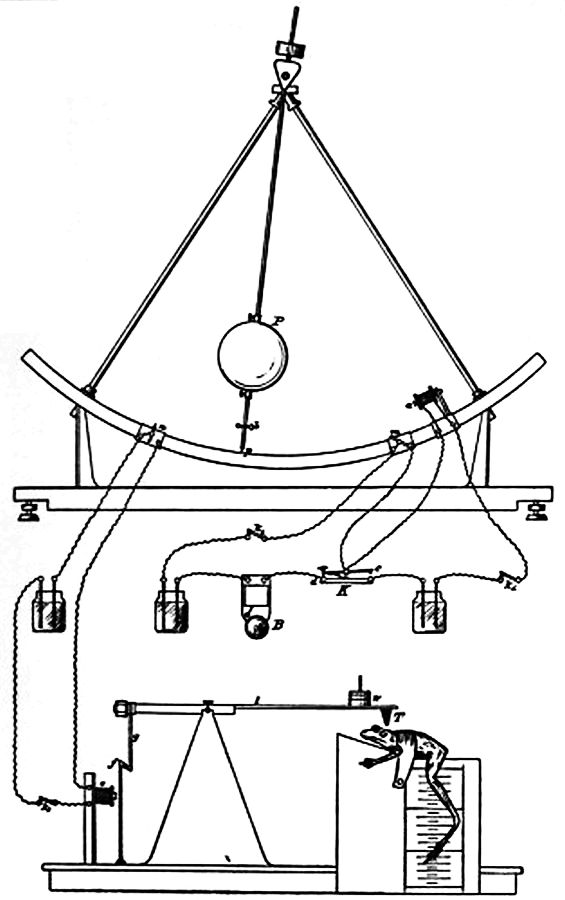
Figure 1. Auditory-tactual Reënforcement-Inhibition apparatus. P, pendulum; p, contact point of P; b, attachment for electro-magnet, a; m, key for circuit of electric bell, B; n, key for magnet circuit of tactual apparatus; K, hand-key for release of pendulum and temporary closing of electric bell circuit; k1, k2, k3, keys in circuits; e, f, g, magnetic release for tactual apparatus; l, pivoted lever, bearing rubber cone, T, and weights, w. (Drawn by Dr. Wm. E. Hocking.)
The tactual stimulus was given by a rubber cone, T, two mm. in diameter at its apex. This rubber point, after the electric release of the lever to which it was attached, struck the frog at the middle point of a line drawn between the posterior margins of the tympana. The intensity of the stimulus could be varied by weighting the lever, l, at w.
All experiments were made with the green frog, Rana clamata Daudin. The reactions were taken regularly at half-minute intervals in pairs: first, a tactual stimulus reaction, then an auditory-tactual reaction. Ten, fifty, or one hundred pairs constituted a series. So far as the condition of the frog is concerned there seems to be nothing undesirable in long series, for fatigue does not appear, and so long as the animal is kept moist and in an unconstrained position, it continues to react normally, and without frequent struggles to escape. The advantage for the purposes of this investigation of taking the reactions in pairs, rather than taking separate series of reactions for each stimulus or combination of stimuli, is obvious. It enables us to compare directly the reactions of each pair, in other words those reactions which took place under most nearly identical conditions, and to note at once whether the auditory stimulus reënforced or inhibited the tactual reaction.
During a series the intensity of the tactual stimulus was changed as conditions demanded, but for any one pair of reactions it was always the same. It not infrequently happened that an intensity which at first caused merely a slight movement of the leg, later in the series uniformly brought about a maximal contraction, or the reverse might be true, and inasmuch as a maximal reaction to the tactual stimulus alone left no opportunity for judging of the influence of the auditory stimulus, when it was given in addition to the tactual, it was always necessary in such cases so to alter the intensity of the tactual stimulus that a medium reaction resulted.
The frogs, after being placed in the saddle-like holder and held firmly for a few seconds, seldom struggled very much, but if bound tightly they became irresponsive to the stimuli.[154] It was, therefore, necessary after they had quieted down to loosen the bands which held them in position. For the purpose of excluding the influence of visual stimuli a wire screen cap covered with black cloth was put over the head; this served to keep the animal in position as well as to exclude visual stimulation.
a. Momentary auditory stimulation. Four frogs were used for a study of the influence of the momentary sound produced by a hammer blow, and for each of these animals fifty pairs of reactions were recorded in series each day. The temporal relation of the stimuli was changed daily during a week of experimentation: the results therefore consist of fifty pairs of reactions with each frog for each of the following seven intervals: (1) Auditory and tactual stimuli simultaneous, (2) auditory .25˝ before tactual, (3) auditory .45˝ before, (4) auditory .15˝ before, (5) auditory .65˝ before, (6) auditory .35˝ before, (7) auditory .90˝ before. The intervals were used in the experiments in the above order to avoid the formation of the definite habits of reaction which regular increase in the interval would have favored.
Typical of the results with all the animals are the following (Table 3) which were obtained with No. 1, a male. The figures in each case indicate the average of fifty reactions. Reënforcement and inhibition are expressed in terms of the tactual reaction, i. e., the auditory-tactual reaction is so many per cent greater (reënforcement) or less (inhibition) than the tactual. In the tables reënforcement is indicated by the + sign; inhibition by the - sign. In the last column of the table is given the number of reactions that were reënforced or inhibited. This was determined by comparing directly the reactions of each pair. Cases in which the two reactions were the same were distributed equally between the two classes: tactual reactions reënforced by auditory stimulus, and tactual reactions inhibited by auditory stimulus. Assuming that the auditory stimulus was without effect upon the tactual reaction, the number of reactions in these two classes would be approximately the same, hence all auditory-tactual reactions over half in a series, i. e., over twenty-five, which are greater than the corresponding tactual reactions, are reënforced reactions, and can be taken as a measure of the reënforcing influence of the auditory stimulus. In the same manner all reactions over half which show inhibition can be taken as a measure of the inhibitory value of the auditory stimulus.
As preliminary tests described in an earlier paper[155] furnished evidence of sex-differences, it is worth while to compare the results given by the males and females in these experiments with momentary auditory stimulation. For purposes of comparison I have presented in Table 4 the reënforcement-inhibition values given by the males and females for each interval. Column one contains the value of the auditory-tactual reaction in terms of the tactual reaction; column two, the number of reactions in excess of half which were reënforced or inhibited.
TABLE 3. FROG NO. 1. MOMENTARY AUDITORY STIMULUS, HAMMER BLOW. WEIGHT USUALLY 5 OR 10 GRAMS
Interval. Reaction to Tactual Stim. Reaction to Auditory and Tactual Stim. Amount of Reënforc'm't or Inhibition. Number of reactions Reënforced or Inhibited.
0˝ 6.84 mm. 11.08 mm. +62.0 % +17.0
.15 22.22 28.96 +30.3 +17.0
.25 16.30 21.72 +33.3 +13.0
.35 24.90 25.32 + 1.7 + 0.5
.45 17.56 13.64 -22.3 -10.0
.65 17.46 15.72 -10.0 - 6.0
.90 31.26 31.48 + 0.7 + 0.5
TABLE 4. MOMENTARY AUDITORY STIMULUS, HAMMER BLOW
Males Nos. 1 and 3. Females Nos. 2 and 4.
Interval Per centum Diff. No. of Reacts. Per centum Diff. No. of Reacts.
0˝ +82.5 % (Reënf't) +17.5 +58.0 % +12.7
.15 +58.1 +17.0 +25.4 + 8.5
.25 +32.3 +12.7 +39.8 +12.7
.35 + 4.0 + 1.2 - 9.7 - 3.2
.45 -13.5 (Inhibition) - 7.2 -13.9 - 7.2
.65 -12.5 - 6.2 -11.8 - 7.2
.90 - 0.7 - 1.5 - 2.6 - 0.5
In these results two striking differences between the males and females appear: first, the reënforcement is not so great for the females as for the males; second, inhibition appears earlier and continues longer with the females than with the males. The average reënforcement with simultaneous stimuli is 82.5% for the males against 58.0% for the females. Inhibition begins to appear in case of the females when the interval between the stimuli is .25˝ to .35˝; in case of the males it appears between .35˝ and .45˝. Finally at .90˝ interval inhibition is slightly greater for the females.
Although the exact significance of these facts is unknown, it is not improbable that they are indicative of fundamentally important sex-differences in reaction to sound. The males among frogs are usually the vocalists, although in some species the females also croak. Moreover, in case of the green frog the tympanum of the male is much larger than that of the female. The results presented would seem to indicate that certain sounds stimulate the males to activity, whereas they inhibit activity in the females.
Graphically represented, the results of the momentary auditory stimulus experiments with frogs Nos. 1, 2, 3, and 4 are as follows:
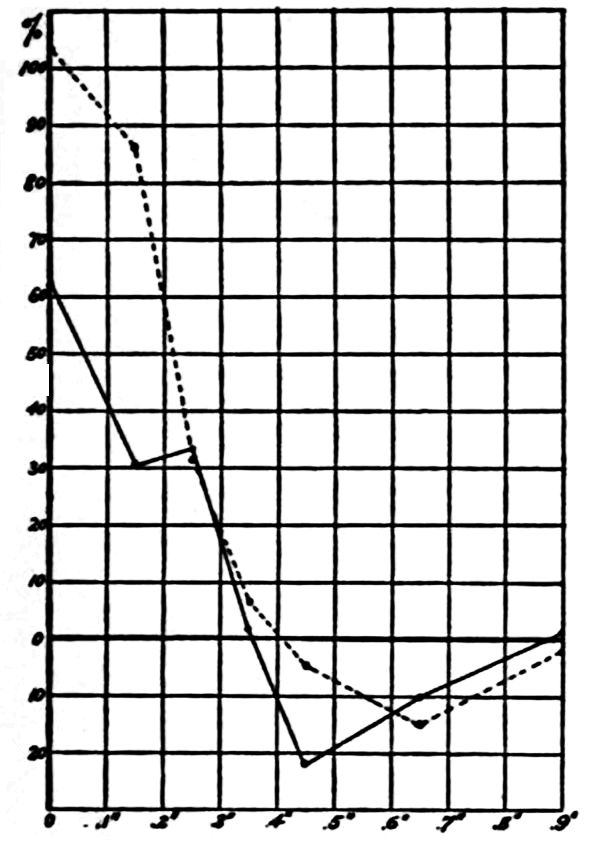
FIG. 2. Reënforcement-Inhibition curves for momentary auditory stimulation, based upon amount of reaction. Male No. 1 —— Male No. 3 ....
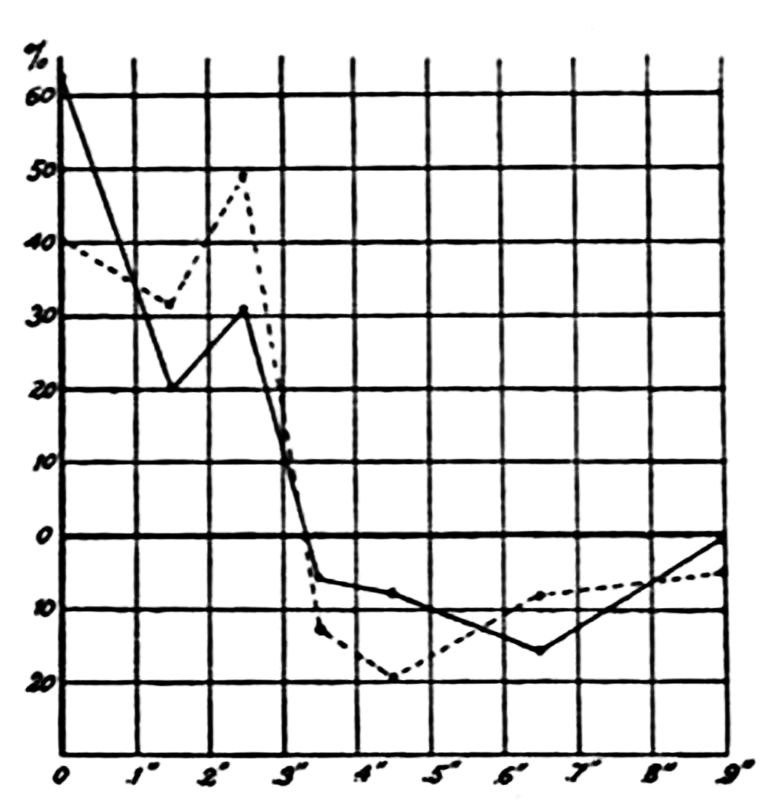
FIG. 3. Reënforcement-Inhibition curves for momentary auditory stimulation, based upon amount of reaction. Female No. 2 —— Female No. 4 ....
The curves are all plotted by the method which will now be described in connection with Fig. 2. This figure presents the reënforcement-inhibition curves for the males No. 1 (solid line in the figure) and No. 3 (broken line). If in this figure we let the zero-point on the ordinates represent the value of the reaction to the tactual stimulus when given alone, then the value of the reaction to the auditory-tactual stimuli would be represented at some point above the zero-point if this reaction was greater than the tactual reaction (reënforcement), and below the zero-point if the reaction was less than the tactual (inhibition). Since one of our chosen measures of reënforcement and inhibition is the amount, in per cent of tactual reaction, by which the auditory-tactual reaction exceeds or falls short of the tactual reaction, such a curve of reënforcement-inhibition as that of Fig. 2 (solid line) can be constructed at once from the data given in column four of Table 3. Here the auditory stimulus, when simultaneous with the tactual, caused 62% reënforcement, as is indicated in the figure. The figures in the left-hand margin of the curves indicate amount of reënforcement or inhibition in per cent of tactual reaction; those at the bottom of the curves mark the intervals. On the curves dots indicate the intervals used in the experiments. Each of the curves is plotted on the basis of 700 reactions.
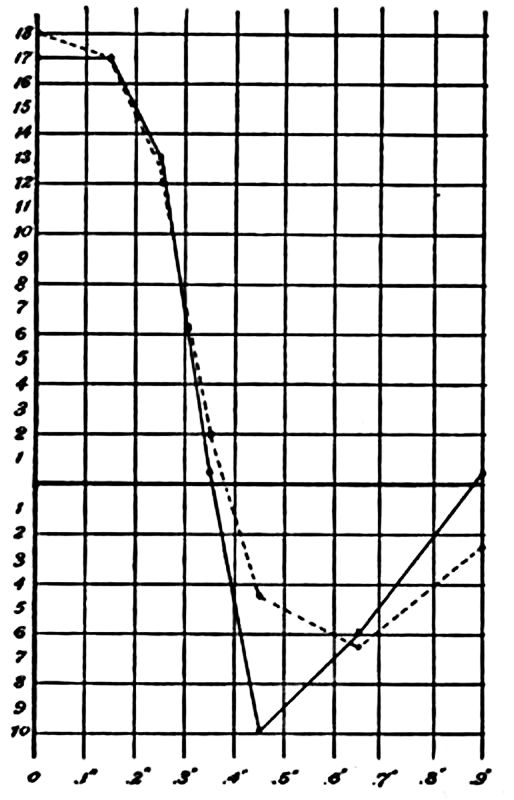
FIG. 4. Reënforcement-Inhibition curves for momentary auditory stimulation, based upon number of reactions. Male No. 1. —— Male No. 3 ....
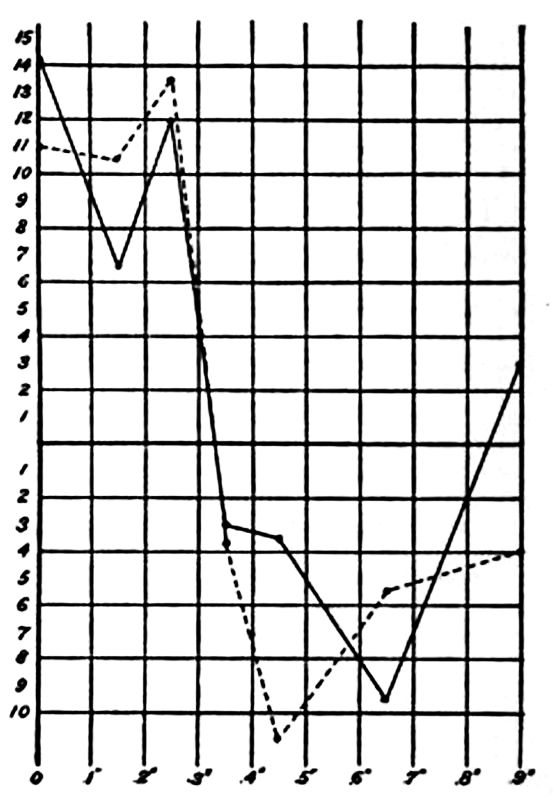
FIG. 5. Reënforcement-Inhibition curves for momentary auditory stimulation, based upon number of reactions. Female No. 2 —— Female No. 4 ....
In every way comparable with the curves for the males No. 1 and No. 3 in Fig. 2 are those for the females No. 2 and No. 4 of Fig. 3. The similarity of the two curves in each figure is noteworthy. Inasmuch as the conditions of experimentation were the same for all the animals this would seem to indicate sex-differences which are worthy of further investigation. The curves show clearly the greater reënforcement in the males, and the greater inhibition in the females.
Figures 4 and 5 are the reënforcement-inhibition curves for the same series of experiments plotted on the basis of the number of reactions in excess of half that were reënforced or inhibited. As there were fifty pairs of reactions with each frog for each interval, uniform reënforcement would be represented by twenty-five reactions above the base-line; uniform inhibition by twenty-five reactions below the base-line. The number of reactions is indicated by the figures in the left margin; the intervals, by those below the base-line. As an illustration of the application of the method of plotting, the curve for male No. 1 (solid line) of Fig. 4 is constructed from the data of column five of Table 3. With simultaneous stimuli 17 reactions in excess of half, i. e., 17 + 25, or 42, were reënforced; at .35˝ interval .5 of a reaction was the average amount of reënforcement; at .45˝ interval 10 reactions in excess of half, i. e., 35, were inhibited, therefore the curve falls to 10 below the base-line.
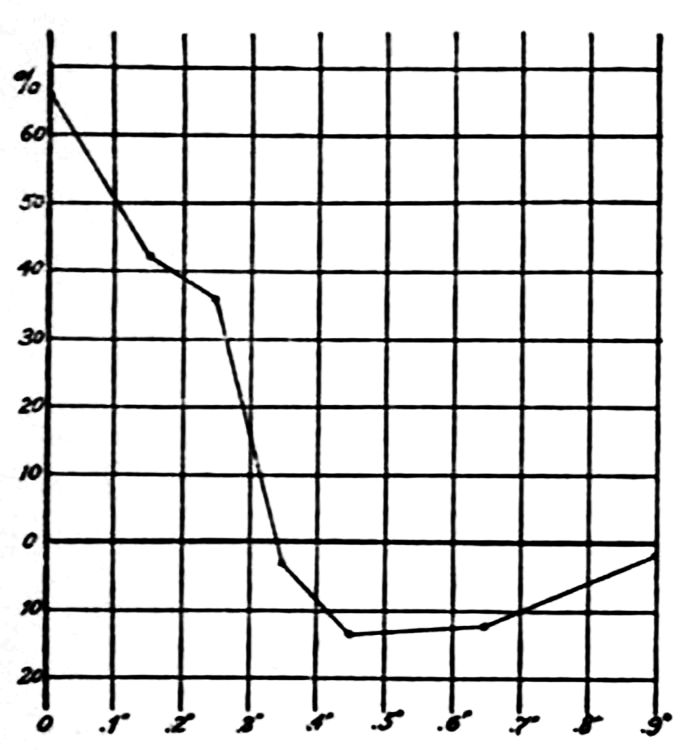
FIG. 6. Composite Reënforcement-Inhibition curve for momentary auditory stimulation, based upon amount of reaction. Frogs Nos. 1, 2, 3, 4. (Males and females.)
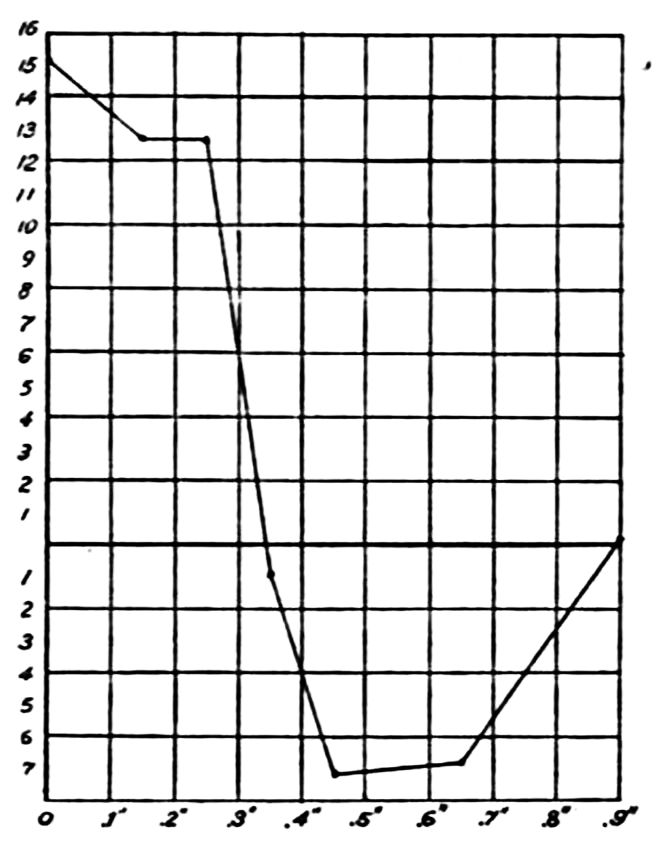
FIG. 7. Composite Reënforcement-Inhibition curve for momentary auditory stimulation, based upon number of reactions. Frogs Nos. 1, 2, 3, 4. (Males and females.)
Just as Figures 2 and 3 permit of direct comparison of the results of the measurement of the amount of reënforcement and inhibition for males and females, so Figures 4 and 5 make possible comparison in similar fashion of the number of reënforced and inhibited reactions for the sexes. It is to be noted that the two sets of curves, plotted on the bases of amount and number of reaction, agree in all important respects.
Figure 6 is the composite curve of amount of reënforcement-inhibition for the four animals; Figure 7 is the composite curve of the number of reactions reënforced and inhibited.
Summarily stated, the results of the experiments thus far described are: (1) The auditory stimulus of a quick hammer blow produces the maximum amount of reënforcement of tactual reaction when it is given simultaneously with the tactual stimulus; (2) as the interval between the auditory and the tactual stimulus approaches .35˝ the amount of reënforcement gradually decreases; (3) when given .35˝ before the tactual stimulus the auditory is practically without effect upon the tactual reaction; (4) as the interval increases above .3˝ inhibition begins to appear; (5) the inhibitory influence of the auditory stimulus is greatest when the interval is about .45˝; (6) when the interval is as long as .90˝ the auditory stimulus is again ineffective. It thus appears that the reënforcement-inhibition curve of this particular stimulus under the conditions described is representative of a neural process which completes itself, in passing through two phases, a positive phase (reënforcement) and a negative phase (inhibition), in about one second.
b. Prolonged auditory stimulation. The experiments previously described have proved that a momentary auditory stimulus, which when given alone never produces a visible motor reaction, either reënforces or inhibits the reaction to a tactual stimulus which it accompanies or precedes. The experiments now to be described were made for the purpose of ascertaining whether reënforcement and inhibition occur in the same way if the auditory stimulus is prolonged, instead of momentary.
In a trial series of experiments with frog No. 1, one hundred pairs of reactions were recorded for each of six intervals of auditory stimulation. The auditory stimulus was given by the ringing of an electric bell. For all intervals the ringing of the bell continued until the tactual stimulus was given. When the two stimuli were given simultaneously the auditory stimulus was necessarily momentary, as in the foregoing experiments, but for all other relationships of the stimuli the bell rang for a certain length of time before the tactual stimulus was given. The six relations of the stimuli were: (1) simultaneous, (2) bell .2˝ before and until tactual, (3) bell .6˝ before, (4) bell 1.05˝ before, (5) bell 1.5˝ before, and (6) bell 2.0˝ before. The other conditions of these experiments were the same as those previously described, except that the auditory stimulus was here given by the opening of the key which released the pendulum, instead of being given by the turning of a key in the course of the pendulum swing. This method of giving the auditory stimulus as the pendulum was released was found unsatisfactory because of the irregularity of the magnetic release; at one time the pendulum would start immediately, at another time there would be a delay of as much as .1˝.
The reënforcement-inhibition curve plotted on the basis of the 1200 reactions in this series is presented in Fig. 8. Before stopping to consider the important features of this curve we should note the results of certain more accurate experiments with prolonged auditory stimulation.
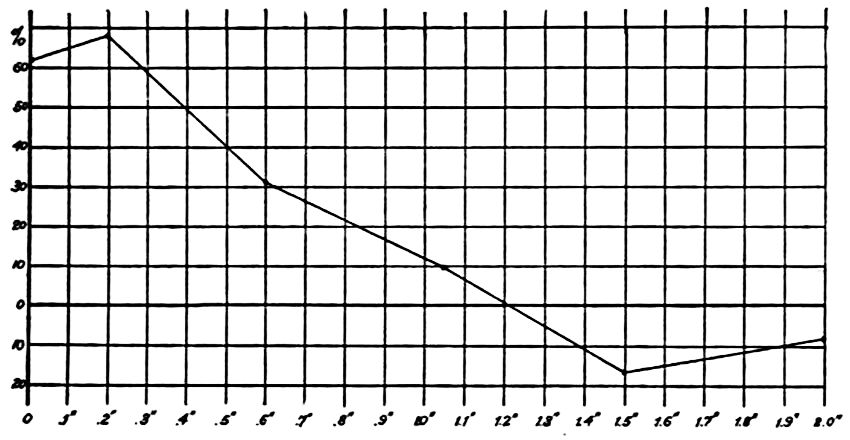
FIG. 8. Reënforcement-Inhibition curve for prolonged auditory stimulation, based upon amount of reaction. Frog No. 1.
With two animals, No. 2, a female, and No. 3, a male, fifty pairs of reactions were taken for nine different intervals (see Table 5) of auditory stimulation. Each of the curves of Figures 9 and 10 is therefore based upon 900 reactions. The conditions for these experiments were the same as those for the momentary stimulation series, save that the electric bell took the place of the electrically actuated hammer, as the mechanism for auditory stimulation.
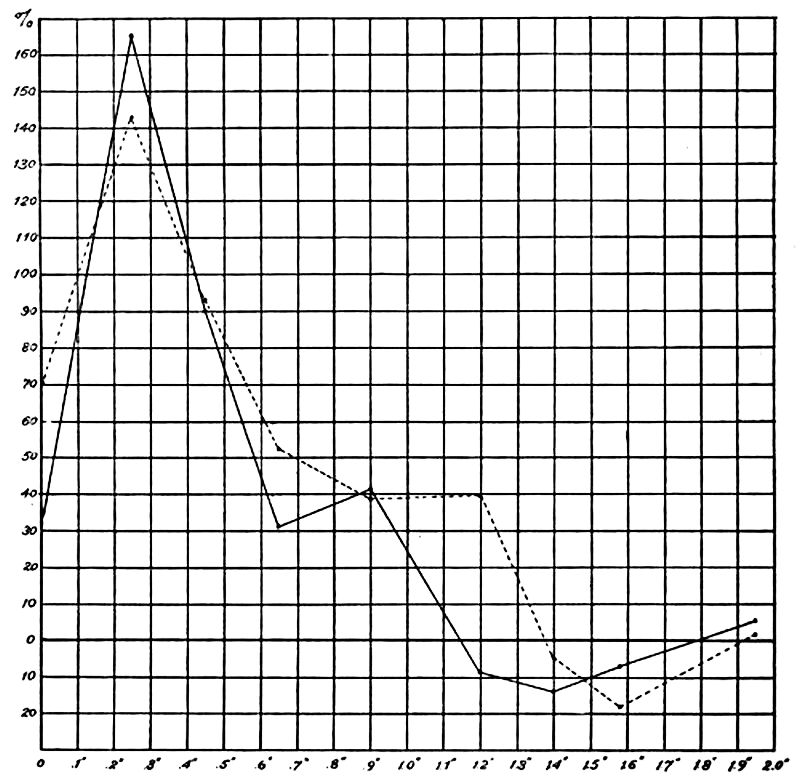
FIG. 9. Reënforcement-Inhibition curves for prolonged auditory stimulation, based upon amount of reaction. Female No. 2 —— Male No. 3 ....
The important facts exhibited by the results of these prolonged auditory stimulation experiments in contrast with those with momentary auditory stimulation are: (1) That whereas for the momentary auditory stimulus of a hammer blow the reënforcement is greatest for simultaneous stimuli, in case of the prolonged stimulation with the electric bell, reënforcement increases during an interval of .25˝ of auditory stimulation. Hence, the two conditions of stimulation give us different types of reënforcement-inhibition curve. For the momentary stimulus the maximum reënforcement appears at simultaneity, and for the prolonged stimulus at .25˝; (2) that the transition from reënforcement to inhibition occurs at 1.2˝ in the prolonged stimulation curves, while in the momentary stimulation curves it occurs at .35˝; (3) that the maximum inhibition which appears in the curves under discussion at about 1.5˝ is less in comparison with the amount of reënforcement than that of the momentary stimulation curves; (4) that the auditory stimulus becomes ineffective when the interval during which it continues before tactual stimulation is 2.0˝. The curves of Figures 8, 9, and 10 are then representations of a neural process which passes through a positive and a negative phase in about 2˝. The effect of prolongation of the auditory stimulation interval is to lengthen the period of reënforcement; the period of inhibition shows little modification.
For the purpose of showing in greater detail the nature of the results of this work the data from which the curves of Figures 9 and 10 were constructed are presented in the accompanying Table 5.
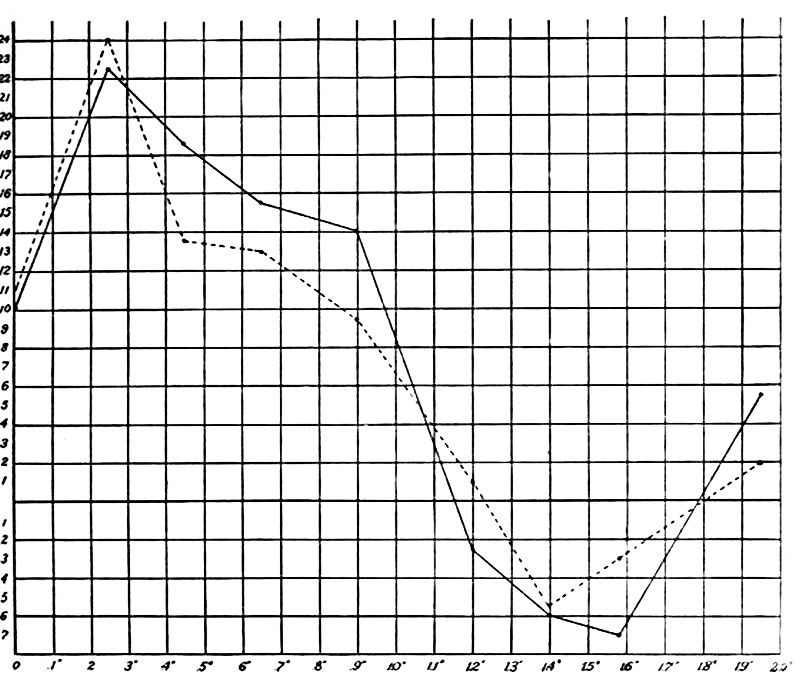
FIG. 10. Reënforcement-Inhibition curves for prolonged auditory stimulation, based upon number of reactions. Female No. 2 —— Male No. 3 ....
Having now presented the results of my own investigation I wish to call attention to certain of their relationships to the work of other investigators, and to discuss briefly their significance.
TABLE 5. PROLONGED AUDITORY STIMULATION (ELECTRIC BELL)
Frog No. 2. Female. Weight usually 25 grams.
Interval. Tactual Stimulation. Auditory and Tactual Stimulation. Amount of Reënforcement or Inhibition. Number of Reactions, Reënforced or Inhibited.
0″ 9.20 mm. 12.12 mm. + 31.7% +10.0
.25 4.56 11.88 +160.5 +22.5
.45 8.94 16.94 + 89.5 +18.5
.65 17.18 22.50 + 31.0 +15.5
.90 9.42 13.32 + 41.4 +14.5
1.20 10.54 9.64 - 8.5 - 2.5
1.40 24.00 20.64 - 14.0 - 6.0
1.58 19.16 17.80 - 7.1 - 7.0
1.95 14.50 15.40 + 6.2 + 5.5
Frog No. 3. Male. Weight usually 5 or 10 grams.
0″ 14.92 mm. 25.20 mm. + 68.9% +11.0
.25 15.88 38.54 +142.7 +24.0
.45 13.48 26.02 + 92.9 +13.5
.65 18.30 27.94 + 52.6 +13.0
.90 20.94 29.06 + 38.8 + 9.5
1.20 21.90 30.58 + 39.6 + 1.0
1.40 19.18 18.34 - 4.4 - 5.5
1.58 32.24 26.30 - 18.1 - 3.0
1.95 13.86 14.14 + 2.0 + 2.0
VI. DISCUSSION OF LITERATURE AND RESULTS
The literature on reënforcement and inhibition is large, and even that portion of it which deals especially with the importance of the temporal relations of stimuli in connection with reënforcement and inhibition is so extensive that it does not seem worth while to attempt to give a systematic résumé of it for the purposes of this paper. I shall therefore call attention merely to those investigations which have contributed directly to the solution of the problems with which we are now concerned.
Bowditch and Warren[156] discovered that knee-jerk in the human subject is reënforced when an auditory, a visual, or a tactual stimulus precedes the tendon blow by .1˝ to .5˝, whereas the same stimuli have an inhibitory influence when they are given from .5˝ to 1.0˝ before the tendon blow.
At the suggestion of Bowditch, Cleghorn[157] undertook to investigate the influence of complication of stimuli upon voluntary movements. In this research graphic records taken in connection with an ergograph indicated (1) that "a sensory stimulus" applied just as the muscle was beginning to contract (voluntarily) caused an increase in the height of the contraction, and (2) that the relaxation following a contraction with intercalated sensory stimulus is quicker and more complete than when no stimulus is given (p. 344). Cleghorn did not give special attention to the significance of the temporal relations of the stimuli which he employed, and his work was limited to the phenomenon of reënforcement of voluntary action by reason of the appearance, during the progress of his research, of an excellent paper on the interference of stimuli by Hofbauer.[158]
Hofbauer covered thoroughly the ground which Cleghorn had planned to work over. The ergographic method was employed also by Hofbauer in his very careful study of the interference of impulses in the central nervous system of man. It was noticed that while the subject was rhythmically contracting a certain group of muscles in response to some prearranged signal (e.g., the sound of a metronome) the report of a pistol caused the contraction which immediately followed it to be much greater than the average of the rhythmic series, while the next contraction was correspondingly less than the average. It thus appeared that the sudden sound caused, first, reënforcement of the voluntary movement, then, inhibition. The reënforcement is greatest, according to Hofbauer, when the voluntary movement occurs immediately after the pistol report. When the report precedes the metronome signal by .2˝ reënforcement is still marked, but thereafter it decreases rapidly in amount, until finally at .5˝ inhibition appears. When the interval between the two stimuli is 1.0˝ the first stimulus has practically no effect upon the voluntary movement in response to the second. (Hofbauer, p. 558.)
What Bowditch and Warren, not to mention other students of the subject, have described for reflex action in man, Hofbauer, Cleghorn, and others have shown to hold true also of voluntary movements. Unfortunately my own investigation was completed up to the point of the writing of this paper before I read Hofbauer's work, so I have not followed methods of dealing with my data which would make our results directly and easily comparable. But, whatever may be the relations of our results in detail, there can be no doubt that what he has demonstrated for man is true in its important aspect of the reënforcement-inhibition phenomena for the frog.
Important in their bearings upon the phenomena of reënforcement and inhibition which we are now considering, are the various studies of refractory period and rhythm of nerve cell and fibre. The existence of a refractory period in neural substance, similar to that demonstrated for certain kinds of muscle by Marey,[159] Englemann,[160] Kaiser,[161] Cushny and Matthews,[162] Woodworth,[163] and many others, has been proved by Broca and Richet.[164]
Broca and Richet found that in the normal dog the refractory period of the nerve substance is too short to be easily detectable, they therefore experimented with animals which were lightly chloralized and kept at a temperature of 30 to 34° (the mean normal temperature of the dog is about 39.5°). Under these conditions a dog, when two identical stimuli (quality and intensity the same) were applied to the cerebral cortex successively, exhibited the following reactions: (1) When the stimuli were separated by .01˝ they reënforced one another (addition); (2) when the interval was .1˝ they inhibited the reaction partially (subtraction).
Concerning this phenomenon Richet writes in his dictionary of physiology (p.5): "Marey showed, in 1890, that the heart of the frog, at certain moments of systole, was inexcitable. Now our experiments prove that the cerebral apparatus, a certain time after the excitation, also ceases to be excitable: it then has a refractory phase, and this refractory phase is much more prolonged than that of the cardiac muscle." In a later publication Richet[165] makes the somewhat startling statement that a refractory period is not exhibited by the nerves of cold-blooded animals. In the tortoise, according to his results, reënforcement occurs so long as the interval between the two stimuli is not greater than 2˝, while for longer intervals each stimulus to all appearances works independently. Richet seems to have generalized from a study of the tortoise. That his generalization is unwarranted seems to me highly probable in the light of the results of this paper, for there are many reasons for supposing that the reënforcement-inhibition phenomena with which we have been dealing in case of the frog are manifestations of the existence of the same process in the nervous system which under somewhat different conditions of experimentation exhibits itself in the so-called refractory period.
The researches of Richet and his students indicate that the time of the process which conditions the phenomena of reënforcement-inhibition is about .1˝. Stimuli given at .1˝ intervals do not interfere with one another. That the process underlying the refractory period and the reënforcement-inhibition phenomena of our experiments is a rhythmic double-phase process is made still more probable by the following results. Horsley and Schäfer[166] found that the rate of response of the monkey to cortical stimulation was 12 per second, and Schäfer[167] discovered that the maximum rate of volitional impulses in man is 10 to 12 per second.
It was shown by Exner that certain movements of the foot of a rabbit could be produced by stimulating either the cortex or the skin of the foot. Simultaneous stimulation of both regions gives reënforcement. Stimulation of the cortex, if given not more than 3˝ before subliminal stimulation of the skin, renders the latter effective. When both stimuli are subliminal each makes the subsequent one effective if the interval between them is not over 1/8˝ (Schäfer[168]). Similarly for the dog Exner[169] proved that cortical and cutaneous stimuli reënforced one another, when both were subliminal, if the interval between them was not greater than .6˝. Cortical and auditory stimuli, and auditory and cutaneous (of the skin of foot) gave similar results.
Physiologists have long been familiar with several aspects of the phenomena of reënforcement and inhibition in the frog, but I know of no detailed study of the significance of the temporal relations of stimuli in this connection. Goltz[170] called attention to the inhibition of the croaking reflex by peripheral stimulation, as well as to several similar phenomena. Nothnagel,[171] Lewisson,[172] and Wydensky[173] further contributed to our knowledge of the interference effects of stimuli in the frog. Wydensky proved that the application of an induced current to a nerve-muscle preparation may result in either contraction or relaxation of the muscle, according to the frequency of stimulation.
More recently Merzbacher[174] has dealt with the influences of complication of stimuli in the frog with the purpose of ascertaining the relations of the sense-organs to the reflex movements of the animal. His first paper is concerned especially with the functional importance of the eye in connection with reflexes. Unfortunately for the demands of this research, he did not attend particularly to the temporal relations of his stimuli. That a visual and a cutaneous stimulus were given either "at the same time or within a short interval of one another" (p. 250) is not the sort of information our problems demand.
According to Merzbacher's very interesting results a visual stimulus reënforces the reaction to a cutaneous stimulus. As the results of this paper show, this is only half a truth, for the two stimuli may either reënforce or inhibit one another's reactions. As Merzbacher observed no evidences of reaction to auditory stimulation he presumably did not attempt to study the influences of the ear in connection with reflexes.
There can be no doubt that the words reënforcement and inhibition as at present used in connection with the functions of the nervous system cover a multitude of widely differing phenomena. We can at once distinguish at least two important kinds of reënforcement or inhibition: first, that which is due to the functioning of special augmentary or inhibitory portions of the nervous system; second, that which is the result of the complication of stimuli. Any and every process in the nervous system may have either a reënforcing or an inhibiting influence upon simultaneous or succeeding processes; doubtless most processes or impulses at various times have both effects. The nervous system is constantly being modified by impulses from many sources, which suppress or strengthen one another according to their relative intensity, their temporal relations, and the motor relations of the portions of the organism which they affect.
The existence of the so-called refractory period in brain cortex and nerve indicates that every stimulus causes certain fundamentally important changes in the condition of the neural substance. These changes we may for convenience of illustration describe as modification of excitability, or of the functional capacity of central or peripheral tissues. Every stimulus causes a portion of the neural substance to pass from its normal state through a condition of increased excitability, which we may designate the positive phase, to a condition of diminished excitability, the negative phase. There is first an increase in the functional capacity of the tissues, then a decrease. If during the course of the change produced by a given stimulus a second stimulus becomes effective its result in reaction is determined by the particular phase of the tissues upon which it intrudes. If the nervous system is in the condition of increased excitability, and the two stimuli act upon sensory regions whose motor connections are not antagonistic, the reaction will be reënforced, as we say, by the previous stimulus; if, however, the second stimulus falls upon the negative phase of the nerve substance, the reaction will be partially or totally inhibited.
The facts which are most prominent as the result of this investigation are, first, that the temporal relation of stimuli is an important condition of certain forms of reënforcement and inhibition; second, that the interference effects of two stimuli cannot be studied to advantage without attention to the relations of the forms of reaction which are appropriate to each stimulus.
V. SUMMARY
1. Motor reactions of the green frog to electric stimuli are inhibited either partially or wholly by photic stimuli. The visual stimulus of a moving object has a like effect. It has been found, furthermore, that the same visual stimulus may either inhibit or reënforce the motor reaction in response to electric stimulation. When the two stimuli are given simultaneously reënforcement occurs, when the visual stimulus precedes the electric by half a second or more inhibition appears.
2. An auditory stimulus, which does not produce any visible reaction when given alone, modifies respiration and the reactions to other stimuli when given in connection with them.
3. The momentary auditory stimulus of a quick hammer blow when simultaneous with tactual stimulation reënforces the reaction to the latter stimulus. This reënforcement, or increase in the amount of reaction, ranges from 50 to 100% of the average reaction to the tactual stimulus alone. When the auditory stimulus is given before the tactual reënforcement occurs in gradually decreasing amount until the interval between the two stimuli reaches .35˝; at this point the auditory stimulus has no apparent effect upon the tactual reaction. As the interval is still further increased inhibition appears and continues for intervals between .35˝ and .9˝. Reënforcement is greatest when the two stimuli are simultaneous; inhibition is greatest when the momentary auditory stimulus precedes the tactual by .4˝ to .6˝. When the interval reaches .9˝ the first stimulus does not affect the reaction to the second.
4. Reënforcement is greater for the males than for the females; inhibition appears sooner and lasts longer in case of the females. This apparently indicates that the males are stimulated to activity by certain auditory stimuli, whereas the females are rendered passive by similar sounds.
5. Prolonged auditory stimulation by means of an electric bell causes reënforcement and inhibition, according to the temporal relations of the stimuli, as does momentary auditory stimulation, with the following differences: The maximum reënforcement occurs when the tactual stimulus is given about .25˝ after auditory stimulation has begun; reënforcement continues for a period of 1.2˝, i. e., when the electric bell continues to ring until the tactual stimulus is given, it reënforces the tactual reaction from simultaneity to 1.2˝. Inhibition then appears, and continues until 1.8˝. Both momentary and prolonged auditory stimulation cause first reënforcement, then inhibition of the appropriate reaction to a tactual stimulus.
6. The reënforcement-inhibition curves for the frog are very similar to those for man.
7. In case of the several pairs of stimuli whose interference effects have been studied reënforcement-inhibition appears. The first stimulus reënforces reaction to the second so long as the interval between them is not more than about .4˝, while it inhibits the reaction when the interval is longer. Whether this reënforcement-inhibition curve as given in the experiments described may similarly be obtained for any and every pair of stimuli, no matter what their relation to reactions, remains to be determined.
8. In connection with the study of the mutual relations of stimuli of which this paper gives an account certain facts concerning the sense of hearing have been discovered. A summary statement of the results on hearing may be found on page 551.