Part 2 — THE FEELING-VALUE OF UNMUSICAL TONE-INTERVALS
Reading edition
BY L. E. EMERSON
Modern theories of melody start always with the presupposition that the scale must be composed of tones having the simple mathematical relation to one another of 2, 3, 4, 5, 6 (and by Meyer 7) and their multiples in order to give pleasant combinations of successive tones. But the question arises whether other tone-combinations which given together appear disharmonious may not, by their mere acoustical difference, similarity, and contrast, awake definite feelings of pleasure. And if such feeling-tones exist independently from harmony it is evident that they would enter into every melody in addition to the strictly musical feelings of harmony and that they deserve consideration as a factor of music. It would not even appear impossible that if every successive tone-distance has its particular natural feeling-character, the distances of successive harmonious tones might be only through secondary factors as habit and training preëminent among the various possibilities of combinations. A tone-consciousness, which under the guidance of experiences of harmony has been trained in our musical tone-relations, must give instinctive preference to such successions as our melodies offer. But if we artificially inhibit the conscious relation to our musical system by introducing a continuous tone-series, or at least one of steps much smaller than musical intervals, do we destroy the possibility of pleasure, and if not, do we find the pleasure in the musical interval stronger than that in other instances? That even the musical subject introduced into the realm of smallest tone-steps can easily forget and inhibit his normal standards is well known; the whole acoustical perspective seems changed by the new intervals, and the subject begins at once to build up a new temporary system of relations. The experiments in Wundt's laboratory have shown that in such cases the theoretical judgment of distances is indeed quite different from the standardized one; the octave may appear equal to the higher fifth. I wanted to study in a similar way the feeling-value in such a state of musical disorientation, when all imaginative representations of our musical intervals are inhibited.
The instrument I used was an Appun Tonmesser giving reed-tones from 128 to 512 vibrations in intervals of 4 vibrations between adjacent tones. The intervals with which I experimented varied from 4 to 88 vibrations in steps of 4. The observers were all experimental psychologists, and varied in musical discrimination from a very low to a very high degree of natural ability and skill.
The observer reported his pleasure in the progression given, in the traditional grades of 1 to 7, where 1 represents the greatest degree of pleasure, 2 means very pleasant, 3 pleasant, 4 indifferent, 5 unpleasant, 6 very unpleasant, and 7 most unpleasant of all.
The immediate problem was: What is the relation between the width of interval used and the pleasure got by hearing the motive a-b-a and b-a-b, where a is always the lower tone. The method of procedure was to take a fixed tone (460 vibrations in the first case) and get a series of observations on successive progressions b-a-b where a differed from b by 4, 8, 12 ... 56 vibrations. The greatest difference thus is approximately a musical whole tone. Then a series of observations was taken on a-b-a where a similarly differed from b by 4, 8, 12 ... 52 vibrations. The progressions were given in irregular order, that there might be no chance of the observer getting into a fixed habit of replying. The intimate relation between the pleasure in successive musical tones and the pleasure in musical harmonies suggested naturally the question whether the feeling-value of these unmusical progressions was not somehow dependent upon the affective character of the simultaneous presentation of the same tones. Therefore after a progression had been given once and judgment recorded, the two tones used were given as a "harmony," that is simultaneously, and a judgment taken as to its agreeableness. This was immediately followed by the same progression, thus giving opportunity to observe the relation between the feeling-tone of the interval as it appeared in successive and in simultaneous presentation.
The results of this part of the investigation are graphically represented in the following plates. Tables I and II indicate the feeling-value of a-b-a where a, the lower tone, is 460 vibrations, and b is from 4 to 56 vibrations in addition, and the feeling-value of b-a-b where b, the higher tone, is 460 vibrations and a is from 4 to 56 vibrations less.
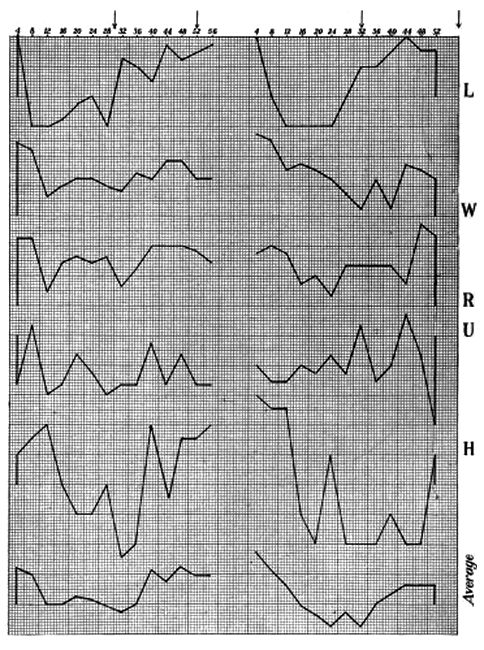
PLATE VI.
The base-lines from which the vertical lines to the curves are drawn represent the feeling-tone 4, the indifference-point. Above comes 3, 2, 1 and below 5, 6, 7; each square represents a unit. The horizontal abscissæ represent the width of the interval; the arrows indicate the musical intervals. The observers are given by initials. The first evident fact for both average curves of Plate V is that the maximum pleasure does not coincide with a musical interval, but comes with an interval four or eight vibrations less than either the half or the full tone of the musical scale. While in both cases the first elevation of the curve comes before the semi-tone, b-a-b shows a decrease of pleasure as the whole step is approached while a-b-a rises again. The order a-b-a is liked better than b-a-b.
Plate VI gives the "harmony" curve for the same tone-combinations, and it is clear at the first glance that the curves for the simultaneous tones do not correspond to those for the successive ones; in many respects they are directly the opposite. The hypothesis that the pleasure in such an amusical "melody" results from the resolution of the corresponding "harmony" is thus untenable; both are highly independent of each other. Yet, here too we notice the insignificance of the musical interval, while the strong pleasure in the tones different by 4 vibrations only refers probably to the complete fusion of the tones; there arises a direct enjoyment from the four waves of sound in every second, given by the beats. The pleasure-curve of these simultaneous tones indicates of course that the inhibition of the musical dispositions and expressions holds over from the successive to the simultaneous series. The pleasure is thus clearly different from that in real harmony.
Plate VII finally gives the "melody" curve for aba and bab with changes from four to four vibrations when the interval started with is larger than a full musical step. In aba the a is 384 vibrations and b varies from 436 to 516, the variations lying thus between the musical Second and the musical Fourth. It is evident that here again no feeling-preference is given to the musical intervals.
The question arises whether such small tone-intervals of amusical character allow the construction of more complex combinations of æsthetic value. Can we have amusical micromelodies with their own completeness and feeling of end? The following experiments represent a first step into this field. We used three tones only, a, b, c in 26 different combinations, and each of the 26 variations with intervals of 4, 8 and 12 vibrations between a-b and b-c. Each of the resulting 78 "melodies" was given repeatedly to six subjects in a time-order which allowed one second for each tone. The subject had to judge on the pleasantness of the whole progression and had further to judge whether it produced a feeling of end or not.
The combinations followed in the experiments in this order: abc, cbabc, abcb, cba, abcba, cbab, bcba, cbabcb, ababc, babc, abcbab, babcba, cbcba, bcbabc, abca, acba, acb, cbac, abcab, cabc, cbacb, acbab, cab, bca, cabcb, bac. The lowest tone was varied between 200 and 444 vibrations; b and c were thus always still less distant than the next musical tone. The chief results may be shortly characterized as follows. There are hardly any judgments of indifference, the combinations are always decidedly pleasing or unpleasing. Of course a certain training in the apperception of such small-interval melodies preceded the real experiments and produced an attitude of adjustment to amusical relation. If we are in the midst of musical tone-relations and go over directly to such miniature intervals, we are seeking for the fulfilment of the habitual expectation and feel dissatisfied, or in the best case the procession is an indifferent chance combination. But as soon as a certain training with small intervals has inhibited the strictly musical expectations, a new setting of judgments with new standards comes in and a new source of pleasantness is opened. Of course even then no extreme feelings are to be expected; while the indifference-judgment 4 is lacking, the strong pleasure and displeasure, the judgments 1 and 7 are completely lacking too; three fourths of the judgments are 3 and 5. The pleasantness is decidedly more frequent than the unpleasantness, and this relation increases with the interval. The differences of four vibrations were especially with the higher tones hardly distinct for some of the subjects. Among 288 judgments in each group there were 150 pleasant and 138 unpleasant when the distances between a-b and b-c were four vibrations, 208 pleasant and 80 unpleasant when the distances were 8 vibrations, and 226 pleasant and 64 unpleasant when the distances were 12 vibrations.
The order of pleasantness expressed by the fraction of judgments of pleasantness and unpleasantness is the following: the largest number of pleasant feelings belonged to the figures cbab and bac, immediately followed by abcb; the further order downwards in affective value was: cab, cbac, babc, abca, cbcba, ababc, abc, cabc, acba, cbabcb, bcba, acb, abcba, cba, cbabc, abcab, babcba, cbacb, acbab, bcbabc, abcbab, and cabcb as least pleasant.
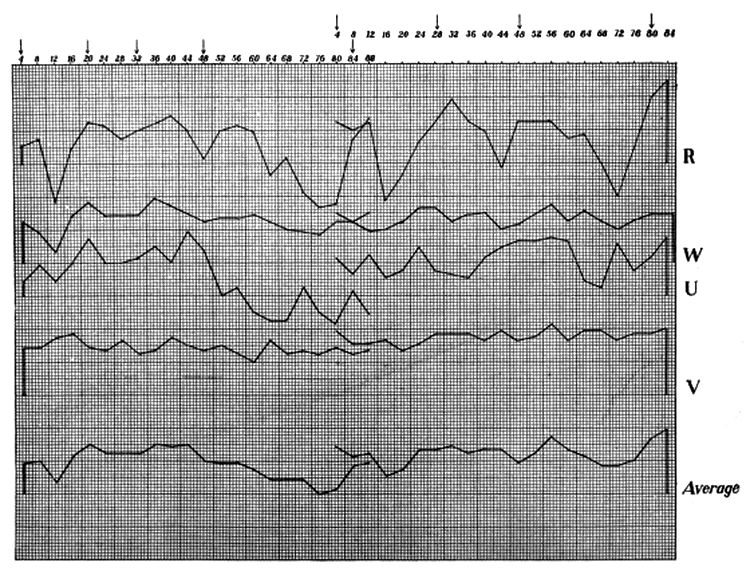
PLATE VII.
As to the feeling of end or æsthetic completeness the results are similar and yet independent. In a few cases the answer was "doubtful," but in the overwhelming majority a definite reply was given; and while the judgment of completeness was by far more frequent in the pleasant combinations than in the unpleasant ones, yet often the unpleasant processions appeared as complete and the pleasant ones as incomplete. Here again the feeling of completeness grows with the interval, being smallest for the figures with distances of four vibrations. But most characteristic seems the fact that the feeling of end is in no way as in music dependent upon the return to the starting-point. The combinations which involved such return to the "tonica" show in no way a preponderance of judgments of completeness. If we order the results according to the number of this æsthetic factor the figures acba, cbac, and cabc stand very low, giving in the majority of cases the suggestion of not-completeness in spite of their return to the beginning, while the figures of the type abcb, cbab, or cba, or even the complex babcba, suggest in a majority of judgments the feeling of an end. The feeling of an end comes, according to the subjective reports of the observers, with an "internal unity of meaning" of the phrase given. This unity of meaning is here evidently quite independent from any simple mathematical relation.
The music-like quality of the figures was emphasized frequently in the subjective records. "I just enjoyed the progressions as music." "The elements are the same as in music." A melody of 384, 392, 400 was called a "very mournful strain"; 444, 452, 460 "Wagnerian motive; Tristan and Isolde"; and the same tones in another order "Very pleasant; expressed a pathetic resignation," or "Sounds like a little piece of music"; and so in most varied forms.
The basis of these experiments is of course by far too slender to build on them a theory, yet our results suggest at least a greater interest in the æsthetics of those tone-combinations which are excluded from our regular music. This interest is reënforced by the self-observations of all participants. They felt strongly that after all our musical pleasure in melody does not belong intrinsically to the tone-perception, but is learned and acquired like the grammar of our mother tongue. Such grammar too controls completely our internal demands for expression, and yet the learning of a different language can bring a new adjustment and a new set of psychophysical dispositions for linguistic demands. That whole apparently natural demand for the tone-combinations which give fusion and consonance can be inhibited during the listening to amusical combinations as soon as a short training in miniature intervals changes the acoustical perspective.
The development of instrumental music demanded evidently the selection of distinctly separated tones and of intervals which give harmonious combinations. The external conditions of resonant chambers may have reënforced this selective process of historical music. It is certainly different with oriental nations, which produce music not in resounding chambers but in the free air and who are singers and not players, using instruments mostly for producing a mere body of tone as a background against which the melodies move; their intervals appear to our musical ear at first bizarre, and yet there too we are readjusted to the new dispositions for satisfaction with unsuspected quickness. We have no right to identify æsthetic pleasure in successive tones with the pleasure in our conventional music with the simple mathematical relations which alone give the pleasure of fusion; but being accustomed to this system of harmonies and being trained to expect it also in the resolved form of the melody, we need indeed an inhibition of habits and a certain new training till the more modest pleasure in amusical tone progressions comes to its natural right.