Part 2 — INHIBITION AND REËNFORCEMENT
Reading edition
BY LOUIS A. TURLEY
Experiments made by Ranschburg[102] on the significance of similars in the process of learning and remembering determined that when duplicates occur within a series of stimuli, one either totally or very greatly inhibits the perception of the other according as they are contiguous or are separated by other stimuli. Dr. Yerkes,[103] in testing the effect of auditory on visual and tactual stimuli in frogs, found that if the auditory stimulus preceded another stimulus by various time-intervals, it had an alternating reënforcing and inhibitory effect. A similar result was obtained by Hofbauer[104] in a similar experiment on human subjects. The question now arises,—if the time-interval were increased between a stimulus and its duplicate in a series would the inhibitory effect gradually approach zero where all effect of the preceding stimulus ceased, to which Ranschburg's experiments point, or would the inhibitory effect be alternated with one of reënforcement as the experiments of Dr. Yerkes and Hofbauer would indicate? This problem—the effect of a stimulus on its duplicate in a succeeding series of stimuli—is the problem I undertook to solve. For this purpose, it was necessary to introduce exactly determinable time-intervals between the stimulus and its duplicate. Therefore I used—as Miss Kleinknecht[105] did for other purposes—a stroboscopic arrangement instead of simultaneous presentation which Ranschburg used.
My apparatus was Professor Münsterberg's Stereoscope without Prisms or Lenses, a description and photograph of which was published in the article by that title in Psychological Review, vol. 1; or rather, I used Professor Münsterberg's attachment to Kohl's centrifugal machine, since my apparatus was not identical, except in principle, with the "Stereoscope." The "attachment" consists of two black discs about thirty inches in diameter, mounted about eight inches apart on the disc-shaft of the centrifugal machine. The back disc is of wood. The outer three inches of its face is furnished with thirty-six equidistant strips of black tin, one end of each of which is bent so as to grip a groove in the rim of the disc, and the other end of each is gripped by tiny thumb-screws so that the strips lie along radii of the face of the disc. The front disc, slightly smaller than the back disc, is of pasteboard. Between the two discs a stationary black screen with a short narrow slit was placed so that the slit revealed only the strip on the horizontal radius of the back disc. Behind this screen an eight-candle-power electric light was placed to illuminate the back disc,—as the experiment was carried on in a darkened room. By moving this light I was enabled to vary the intensity of illumination to offset the skill of the observer.
For my purpose, a small white figure—one of the ten characters of the Arabic notation—was stuck on about the middle of each of the tin strips on the back disc; and radial slits, one millimetre wide and an inch long, were cut from one sixth of the circumference of the front disc so as to come opposite six of the strips on the back disc. Similar radial slits were cut at various intervals from the remaining five sixths of the circumference of the front disc. These were covered by small pieces of cardboard fastened to niagara clips, thus making them readily removeable. By this means any desired figure could be exposed in the same revolution with the series exposed by the six slits above mentioned.
The thirty-six strips were divided into six series of six each, indicated by chalk-marks on the disc. Each of the series was often changed in whole or in part by shifting and interchanging the strips.
The figure on which the effect of a preceding stimulus was tested occupied the fourth place in the series, since this is the place where the greatest number of errors occur, as is shown by the experiments of Ranschburg and previous investigators in the Harvard Laboratory. In my experiment, 4, 5, 6, 7, 8, and 9 occupied the fourth place in the 1st, 2d, 3d, 4th, 5th, and 6th series respectively, and the effect of a preceding stimulus was tried on each of these figures for each time-interval. The preceding stimulus in each case was a duplicate of the fourth member of a series, and was a member of some other series. Thus the fourth member of each series was at all times fixed and constant while the preceding stimulus occupied successive progressive positions round the disc. The other members of each series were chosen at random, care being taken that the fourth figure was not duplicated within its series, since it would then have taken part in inhibition within the series.
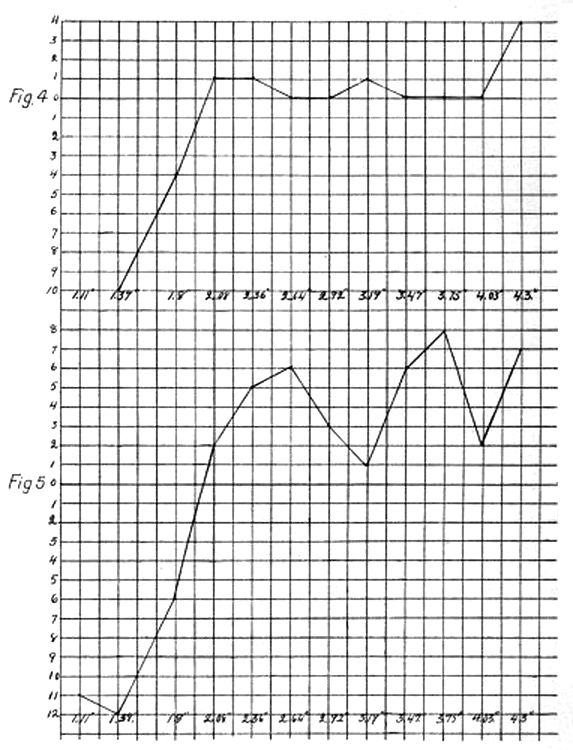
PLATE IX.
By adjusting the front disc, I exposed any one of the series desired, and by removing the cardboard blind from one of the suggestion slits, I gave a stimulus at the desired time-interval in advance of the fourth member of the series. The first interval I used was 1.11 sec. as Miss Kleinknecht had tried intervals up to 1 sec. My second interval was 1.39 sec., the third 1.8 sec., and then every .277 sec. up to 4.3 sec. In performing the experiment I exposed alternately a series without and a series with a preceding stimulus—taking from the observer three reports of each—until the six series had been seen. I then repeated this, exposing with a preceding stimulus those series that had been exposed without preceding stimulus, and without preceding stimulus those series that had been exposed with a preceding stimulus in the first instance. In this way I equalized and minimized the effects of novelty and memory.
At 1.11 sec. there was considerable inhibition in five out of six cases. In the sixth case there was slight reënforcement at this interval. With an interval of 1.39 sec., with one exception,—not the exception above mentioned,—there was a stronger inhibition than at 1.11 sec. Inhibition in all cases began to decrease from 1.39 sec. until it ceased at about 1.8 sec. The preceding stimulus then had a reënforcing effect which reached a maximum in four cases at 2.08 sec., one at 2.36 sec., and one at 2.64 sec. Then, in all cases, there was a decrease of the reënforcing effect which in three cases amounted to inhibition. In the other three cases, the preceding stimulus had no inhibitory effect for an interval greater than 1.8 sec. For one of these, Fig. 5, the preceding stimulus had a reënforcing effect for all the intervals beyond 1.8 sec. The second trough in the wave or interval of maximum inhibition was at either 2.64 sec. or 2.92 sec., except for the person for whom there was constant reënforcement beyond 1.8 sec., in which case the first interval of least reënforcement or second trough was at 3.19 sec. This was the second interval of greatest enhancement, or second crest, for four of the others. Then followed a third point of no effect or inhibition, which was 3.75 sec. or 4.03 sec. For the person for whom the preceding stimulus had least enhancing effect at 3.19 sec., the second interval of greatest reënforcement coincided with the interval of greatest inhibition for the majority of the other observers. For four of the six observers, the third interval of greatest reënforcement was 4.3 sec. In this, the observer agreed for whom the last interval of greatest reënforcement was 3.75 sec. Thus while, for this observer, the first two points of greatest reënforcement were separated by an interval of 1.11 sec., the second and third points were separated by an interval of only .55 sec. This same thing occurred in the records of two other observers, for one at this point, and for the other at another point. Of the two dissenters from the opinion of the majority that the third crest was at 4.3 sec., one was an erratic observer; and for the other, there was a slight reënforcement at 4.03 sec. and no effect at all at 4.3 sec.
Fig. 1 represents the average of the records of the six observers. The curve is based on the difference between the number of times the fourth members of the series were seen with and without preceding stimulus. The base-line represents the number of times the figure was seen without preceding stimulus, taken each day as the normal for that day. Figures above the base-line represent the greater, and those below the line, the less number of times the figure was seen with preceding stimulus, or reënforcement and inhibition, respectively. The first two points are the average of fifty-four observations; each point beyond the second is the average of 108 observations. Figs. 2, 3, 4, and 5 represent individual records constructed as Fig. 1, each point being the average of eighteen observations.
The curve in Fig. 1 is somewhat misleading in showing points of maximum reënforcement at 3.19 sec., 3.75 sec., and 4.3 sec. In no individual case was this true. The reason for the crest at 3.75 sec., or at least for its height, is that in two cases reënforcement was considerable at this interval, and there was little inhibition to offset this in the general average. At 3.19 sec., which was the second interval of greatest reënforcement, for four out of the six observers, owing to practice, the reënforcement was not great (Fig. 4), but in no case was there inhibition at this point. Thus for the lack of strong positive effect at 3.19 sec. and the lack of strong negative effect at 3.75 sec., the two crests are the same height, while the first represents the maximum effect for four and the second for two observers.
From these results, taking everything into consideration, my conclusions are:
(1) If a stimulus precedes at various time-intervals its duplicate in a series of stimuli, it will alternately inhibit and reënforce the perceiving of the duplicate stimulus.
(2) Within 4.5 sec. there are at least three points each of maximum inhibition and maximum reënforcement.
(3) The points of maximum inhibition and likewise those of maximum reënforcement are separated by intervals of from .55 sec. to 1.2 sec.—more often by one of the two extremes than by any mean.
(4) Up to 4.5 sec., as the time-interval increases, the maximum inhibition generally decreases, while the maximum enhancement correspondingly increases.
What the limit of this periodic effect is, I cannot as yet say, as up to the present I have not used time-intervals beyond 4.3 sec. But from the intensity of the effect at this interval, I do not expect the limit to be within several seconds.