EYE-MOVEMENTS DURING DIZZINESS
Reading edition
BY E. B. HOLT
It is a familiar fact that when the head is passively turned about its vertical axis, the eyes do not move with the head but lag behind, keeping their fixation on that object toward which they were directed before the head moved. The eyes move in their sockets in a direction opposite to that in which the head has moved. Now it has been proved beyond a doubt by the experiments of Mach,[2] Crum Brown,[3] and Breuer,[4] that these lagging movements of the eyes are reflex and are governed by the semi-circular canals, which are stimulated directly by the motion of the head. Similar reflex eye-movements are found when the head is turned about some other than its vertical axis, the direction of such movements being always in confirmation of the theory. All these movements, together with the theory, are well described in the summaries of Peters[5] and Nagel.[6] The present paper deals solely with the eye-movements that occur after rotation of the head about its vertical axis.
The mechanism of these lagging, reflex movements is not, then, identical with that which enables us, when the head is at rest, to fix on and follow a luminous moving object,—the "pursuit movements" of Dodge.[7] It is, however, identical with that of Dodge's "fourth type"[8] and that of the compensatory eye-movements described by Brown,[9] Nagel,[10] and Delage,[11] and recently studied by Angier.[12] This function of the semi-circular canals was first suggested by Goltz in 1870. Now if the rotary movement of the head is prolonged, the eyes lag for a while on their first fixation-point, and then dart suddenly forward to a new fixation-point on which they rest for a while as before, until they dart forward again. Therefore if the head continues to rotate, the eyes fall into a regular and well-marked nystagmus. In this the lagging movements, or those opposite to the direction of the head, are called "compensatory," and are relatively slow and long. Their rate coincides closely if not exactly with that of the head-movement. But the movements forward, in the direction of the head-movement, are short and swift. Such are the facts during the rotation of the head.
But if this rotation has been somewhat prolonged, the ocular nystagmus continues after the head and body are brought to rest. But now its phases are reversed, and the slower eye-movements are in that direction in which the head has moved; while the swifter are in what before was the lagging direction. These observations are in accord with the semicircular canal theory, and are well established by various investigators.[13]
This paper presents the results of a photographic study of the reflex eye-movements following after rotation of the head (and body) about the vertical axis.
The subject whose eyes were to be photographed sat in a chair placed on a rotating platform, in such a position that the vertical axis of rotation passed through, or just posterior to the nose. Rays from an arc-lamp of 6 amperes, placed about 60 cm. from the subject's face, were so converged by a lens that when the subject came to rest, after the rotation, his two eyes were brightly illuminated. An adiathermal screen consisting of a dilute solution of copper ammonium sulphate kept the heat from being painfully intense on the eyes. The light fell slightly from one side on the subject's face, when he was brought to rest; and directly in front of him, at a distance of about 40 cm., was a camera of which the lens was on a level with his eyes. The ordinary ground-glass screen at the back of this camera was replaced by a light-proof box, in the front of which, and in the plane which should have been that of the ground glass, was a slit 55 mm. broad and 5 mm. high. Inside the box was a Ludwig kymograph of which the drum rotated on a horizontal axis: the circumference of the drum lay tangentially to the front of the box, and the line of tangency passed horizontally through the long axis of the slit. For each photograph a photographic film of sensitometer 40 was fixed to the drum, as paper is ordinarily fastened, and in moving, the drum carried this film upwards past the slit. It follows from this arrangement that 5 mm. along the length of this film were always exposed at once. The camera was so focused that the images of both eyes were sent through the slit, and fell on the film.
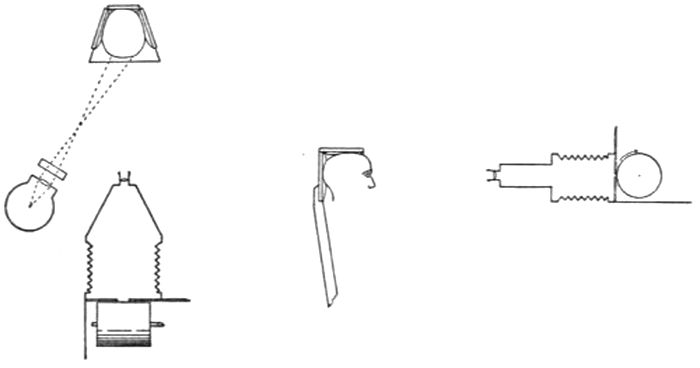
Figs. 1 and 2
The subject's head was rigidly held by a rest: this rest was adjusted, and the camera focused, before the rotation. The adjustment of the head was greatly facilitated by fastening a fine black thread to pegs that projected forward from the head-rest, on either side; the thread was stretched horizontally, and at such a height that its image in the camera coincided with the middle of the long (horizontal) axis of the open slit. If then the subject, on seating himself in the chair, had his head so adjusted that each eye was directly behind the thread, each eye would certainly be imaged on the sensitive film. Neither the shadow of this thread on the subject's face, nor its image on the film, interfered in the least with the exposure that was made after rotation. This thread was further found very useful by the subject himself, who, after the rotation and just before the exposure was made, could make sure by sighting on the thread that his eyes had not slightly changed position during the rather protracted rotation. The subject was ordinarily turned twenty-five times at about the rate of one turn in two seconds. The kymograph was set in motion and the exposure commenced as soon as the whirling chair was brought to a dead stop. This stopping always took two or three seconds, at the very time when the nystagmus was most pronounced, so that the photographs do not show the maximum eye-movements. The exposure lasted through one rotation of the drum, nine seconds.
In the strongest negatives the movements of the eyes can be fairly well made out from the undulatory curve generated on the film by the dark image of the iris as it oscillated from side to side. But this is true only of the best negatives, and almost never of these if the eyes photographed had the iris blue. In order to obtain better definition in the photographs of the eye-movements, small flecks of Chinese white were tried, as invented and described by Judd.[14] A small square of white was laid with a brush on each cornea, on the side toward the lamp, so that its image on the film should be as bright as possible. The flecks were found to adhere to the eyeball even more perfectly than Judd himself has claimed; and they produced so little discomfort that the subject ordinarily forgot their presence on the eyes. Nevertheless their image as produced on the negatives, although much better than that of the iris, was generally not clearly readable, owing to the brief exposure and the illumination by electric light. This light seems not to be well reflected by the Chinese white: but in all cases where daylight can be employed the use of these flecks must be eminently satisfactory.
Thus it was found necessary to fall back on the image of the arc as reflected from the cornea. This corneal image invariably traced a clear, strong curve on the negative, and would have been appropriated at the outset, were it not that its movements are not, as is well known, a true register of the amplitude of the corresponding eye-movements; a fact that was shown clearly from a comparison in these negatives of the curves produced respectively by the flecks of Chinese white and by the corneal image. The former showed a much greater amplitude of movement. But the corneal reflection is a perfect register of the time and direction of the eye-movements; and in the following tables these features alone are studied. This reflection traced on the film a perfectly readable curve, although in some of the films, owing to a shifting of the carbons in the lamp taking place during the rotation, one of the eyes would be badly illuminated and a good record would be obtained from the other eye alone.
The arc ran on an alternating circuit of 60 phases per second, and owing to these interruptions of the illumination the curve of the corneal image showed on the negative as a dotted line in which the distance between any two dots represented one sixtieth of a second. Since the constancy of this alternation in the current has been measured in the Jefferson Physical Laboratory (of Harvard), and found to vary within a few tenths of one per cent only, the spacing of the dots on the negatives formed the most convenient possible means for determining the durations of the nystagmiform movements. These dots are shown in Figs. 3, 4, and 5 (Plates I and II).
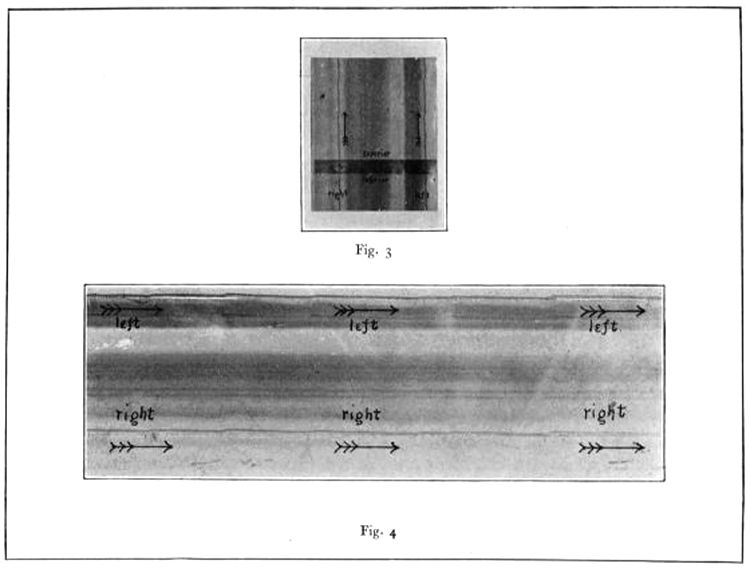
PLATE I.
(By an error Fig. 4 is shown reversed; the lettering is correct.)
Fig. 3 shows a portion of one of the films. The two curves are to be read from below upwards; but at the bottom is a photograph of the slit (showing a part of the subject's face) taken when the drum had made a little over one revolution and had come back to rest. Hence below the image of the slit, the curve of corneal reflection is doubled. "Right" and "Left" refer to the subject's right and left sides, so that the reader looks into the subject's face from in front. In the picture of the slit, the place on the cornea of the corneal reflection is shown; and also a minor reflection, which as may be seen traced no curve, from some other source of light. The fine line that crosses the slit horizontally is the image of the thread, above mentioned, which was used in adjusting the head. The time-dots are seen to be perfectly distinct, so that they could be accurately read with the help of a jeweller's eyeglass. Fig. 4 shows another part of the same negative, a portion subsequent to the single eye-curves of Fig. 3, that is, a continuation vertically upwards of Fig. 3. The rotation had been from the subject's left to his right, a direction that will be termed "clockwise" throughout this paper, and it can be seen that the quick eye-movements are toward the subject's left, while the slow are towards his right: had the photograph been taken during the rotation, the directions of the quick and slow movements would have been reversed. Two points may be observed in this figure which the tables will also bring out,—that the two eyes move together, and that as the nystagmus subsides the quick eye-movements become less frequent but endure no longer, or in other words, the slow movements alone increase in duration. The corneal reflection does not accurately show the amplitude of the movements; but direct inspection of a subject's eyes, as the nystagmus dies away, shows that generally (but perhaps not always) the amplitudes of both quick and slow movements decrease together. When this is the case, it follows that at the end of the nystagmus the rate of the slow movements decreases very much faster than that of the rapid movements.
Readable negatives were obtained from four, out of six subjects. Of such negatives there are fourteen, ten of which are of eye-movements after rotation clockwise, and four after rotation anti-clockwise. This distribution is accidental, for the rotations in each direction were about equal in number. With the exceptions to be noted later all the negatives exhibit the same features, so that of the fourteen only four examples are given in full in the tables; while for the others merely the averages of the duration of quick and slow eye-movements respectively are given.
TABLE I
Subject Film Eye Direction of the rotation. Slow movements toward Subject's Rapid movements toward Subject's Average duration in seconds of slow movements Average duration in seconds of rapid movements
C 1 left clockwise right left .32 .05
" 2 " " " " .36 .06
" 3 right anti-clock left right .26 .08
H 1 " clockwise right left .54 .07
" 2 " " " " .45 .07 }
" " left " " " .45 .07
" 3 " " " " .50 .08 }
" " right " " " .49 .08
" 4 " anti-clock left right .49 .07
" 5 left clockwise right left .53 .06
Ta 1 right " " " .73 .07
" 2 " anti-clock left right .48 .10
Tu 1 " clockwise right left .50 .06 }
" " left " " " .49 .07
" 2 " " " " .49 .12 }
" " right " " " .49 .12
" 3 left " " " .40 .07
" 4 right anti-clock left right .58 .08
Av. .48 .08
Table I gives these averages for all the fourteen negatives. In four of these (H 2, H 3, Tu 1, Tu 2) simultaneous curves for both eyes were obtained. In every curve the slow eye-movements were in the same direction as the previous rotation; the rapid in the opposite direction. The very few single movements that are exceptions to this are noted under Table II. Had the photographs been taken during (instead of after) the rotation, the directions of rapid and slow movements would undoubtedly have been reversed. It is to be noted that when both eyes were recorded, their movements were generally identical, within the accuracy of measurement (one sixtieth of a second). There are a few exceptions to this. The averages of all slow and all rapid movements merely show that in general, and for that part of the nystagmus that was photographed, the slow eye-movements lasted six times as long as the rapid ones. This ratio varies considerably from one case to another, and at best throws little light on the whole nystagmiform series, since during the very first instants after the rotation the ratio of quick to slow movements would be less than one sixth, and at the very end of the series would be considerably more; this because toward the end the slow movements become much slower, while the rapid seem to change very little. The variations from case to case arise, at least partly, because in some cases the picture was taken more promptly, after the rotation stopped, than in others.
TABLE II
All records in seconds.
Subject C. Subject H. Subject H. Subject Tu.
Film 3. Film 2. Film 3. Film 4.
anti-clockwise. clockwise. clockwise. anti-clockwise.
right eye. left eye. right eye. left eye. right eye. right eye.
slow m. fast m. slow m. fast m. slow m. fast m. slow m. fast m. slow m. fast m. slow m. fast m.
to lft. to rt. to lft. to rt. to lft. to rt. to lft. to rt. to lft. to rt. to lft. to rt.
.26
.08 .03 .05 .06 .08 .06
.2 .51 .58 .1 .1 .45
.06 .06 .06 .06 .05 .08
.05 .16 .16 .13 .13 .75
.08 .05 .06 .1 .13 .06
.19 1.01 1.05 .36 .33 .36
.05 .06 .06 .1 .06 .13
.02 .26 .26 .28 .3 .48
.05 .05 .06 .13 .13 .05
.21 .26 .26 .28 .23 .61
(.19) .06 .06 .11 .13 .1
.16 .55 .6 .35 .35 .41
.05 .1 .1 .08 .1 .05
.03 .25 .25 .33 .3 .65
.05 .06 .05 .06 .11 .06
.18 .33 .33 .25 .2 .51
.06 .1 .1 .1 .1 .05
.03 1.65 1.65 .83 .83 .66
.05 .06 .06 .1 .13 .16
.29 .26 .26 .63 .61 .66
.11 .06 .08 .06 .06 .08
TABLE II, continued.
All records in seconds.
Subject C. Subject H. Subject H. Subject Tu.
Film 3. Film 2. Film 3. Film 4.
anti-clockwise. clockwise. clockwise. anti-clockwise.
right eye. left eye. right eye. left eye. right eye. right eye.
slow m. fast m. fast m. slow m. fast m. slow m. fast m. slow m. fast m. slow m. slow m. fast m.
to lft. to rt. to lft. to rt. to lft. to rt. to lft. to rt. to lft. to rt. to lft. to rt.
.29 .78 .76 .45 .43 .68
.03 .06 .06 .05 .1 .15
.04 .16 .2 .45 .43 .23
.05 .1 .1 .06 .1 .11
.25 .38 .33 .4 .38 .36
.15 .08 .11 .08 .06 .08
.3 .58 .56 .58 .56 .35
.05 .06 .06 .06 .06 .06
.33 .78 .78 .58 .56 .38
.05 .08 .1 .08 .08 .05
.28 .71 .71 .35 .35 1.78
.11 .08 .06 .05 .06 .06
.41 .46 .45 .51 .5
.06 .05 .06 .06 .05
.43 .56 .58 .6 .61
.11 .06 .06 .08 .1
.35 .33 .31 .73 .68
.05 .1 .1 .06 .06
.23 .86 .86
.15 .08 .08
.38 .21 .21
.1 .06 .05
.43 .8 .81
.11 .08 .08
.38 1.53 1.58
.03 .06 .05
.53
.2
.23
(.18)
.36
.03
.23
.06
.45
.11
.25
Averages
.26.08.07.45.07.45.08.50.08.49.58.08
Parentheses indicate time during which the eye did not move at all.
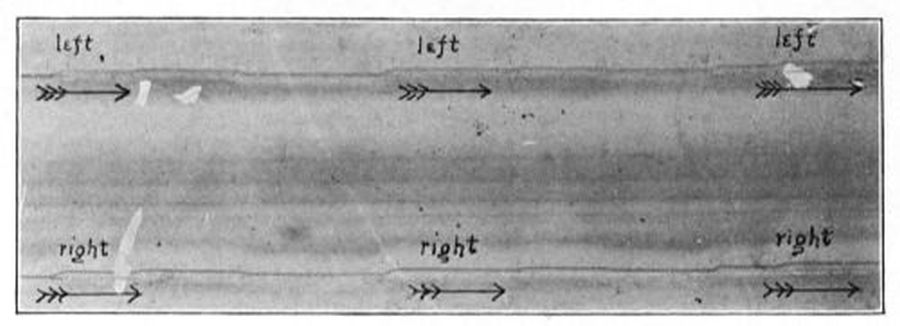
PLATE II.
Fig. 5
Table II gives in detail the data yielded by four of the most instructive films. C 3 is the longest record that was obtained; Tu 4 is among the shortest, though it is not the very shortest. H 2 and H 3 show how nearly alike are the simultaneous movements of the two eyes: .07 sec. is the greatest difference recorded on any film between simultaneous movements. All four records show how much less the duration of the slow movements is at the beginning of the record than at the end, and how little the fast movements vary in this respect.
H 2 is given because it is not typical; and about one half of the film itself is reproduced in Fig. 5 (Plate II). It will be seen that at four points there intervened between slow movements (toward the right) a rapid one that was also toward the right. This is the only record in which such a thing happened: and its explanation is problematical. With the subjects C and H, and only very rarely with these, a rapid movement sometimes took the place of a slow one, that is, occurred in the same direction as the slow movements (e. g., Table II, C 3). And a trifle more often, yet very seldom, a rapid movement was relatively slow (e. g., ibid.). With every subject there are a few cases in which the eyes stood still for a small part of a second (e. g., ibid.), and these moments of rest seem to come after a rapid or a slow movement indifferently.
McAllister[15] and others have shown that the eyes are seldom at rest even when voluntary fixation is attempted, and these anomalies in the nystagmiform series may well be the result of such random factors, which instead of being always inhibited by the afferent impulses from the semicircular canals, which govern the nystagmus, operate along with these latter, and sometimes even inhibit them. With the exception of these anomalies, the movements recorded in the photographs confirm the observations of Purkinje, Mach, Breuer, Delage, and other investigators.
In conclusion, the sensations of vertigo and of nausea seem not to be essentially connected with the nystagmus. Several subjects were so disagreeably affected by a preliminary rotation that it seemed best not to continue the experiment with them. With those, however, whose eyes were photographed, while they experienced a mild degree of vertigo and nausea during and after the first few rotations, these sensations soon wore off with further practice, while so far as could be observed their eye-movements were as ample and rapid as at first. The introspection of these subjects was that after the rotation the body seemed at rest and the stomach quite settled, while the visual field alone whirled rapidly in the direction opposite to that of the previous rotation.