WILLIAM OF NASSAU, PRINCE OF ORANGE. By JOHN LOTHROP MOTLEY.
Reading edition
[Surnamed “the Silent,” founder of the independence of the Netherlands, born 1533, assassinated 1584. Though the scion of a Protestant family, the Prince of Orange was educated to arms and diplomacy at the court of Charles V, by whom he was greatly beloved and trusted. On the accession of Philip he was made a Councilor of State to assist Margaret of Parma in her regency over the Netherlands. All ties of loyalty were gradually destroyed by his love of country, so terribly outraged by the cruelties of a bigoted king and his no less bigoted agents. On Alva’s arrival with Spanish troops the prince returned to Germany, and thus saved himself from the headsman, the fate which befell counts Egmont and Horn, two of the most eminent Flemish patriots. In the uprising of the Netherlands, which followed, the Prince of Orange was the most eminent figure, and to the consummate skill with which he guided the fate of his people their ultimate success was due. William, at the head of his brave Flemings, and with the capricious assistance of France and England, wore out three of the greatest generals of the age, the Duke of Alva, Don John of Austria, and Prince Alexander Farnese. The price put on his assassination by the King of Spain was finally earned by Baltazar Gérard, a Burgundian fanatic.]
In person, Orange was above the middle height, perfectly well made and sinewy, but rather spare than stout. His eyes, hair, beard, and complexion were brown; his head was small, symmetrically shaped, combining the alertness and compactness characteristic of the soldier, with the capacious brow furrowed prematurely with the horizontal lines of
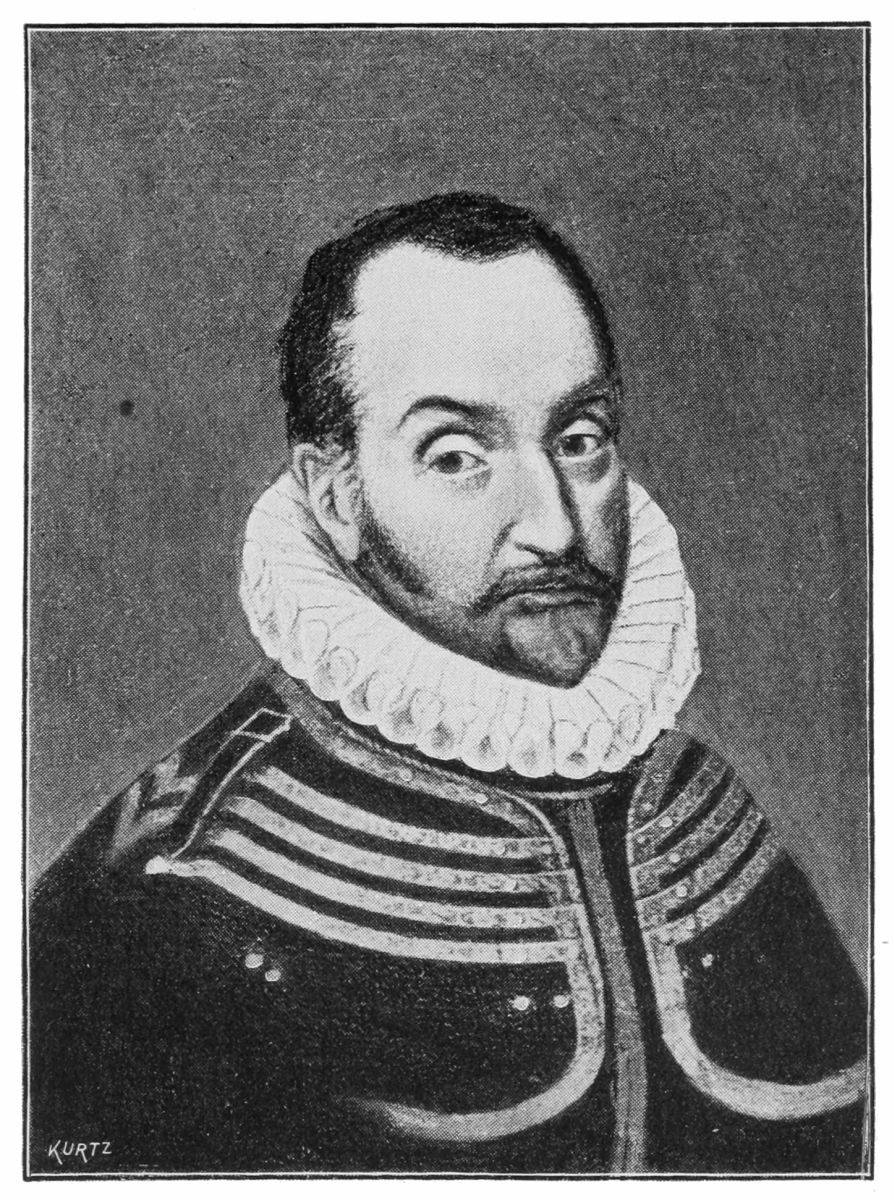
WILLIAM OF NASSAU.
thought, denoting the statesman and the sage. His physical appearance was, therefore, in harmony with his organization, which was of antique model. Of his moral qualities, the most prominent was his piety. He was more than anything else a religious man. From his trust in God he ever derived support and consolation in the darkest hours. Implicitly relying upon Almighty wisdom and goodness, he looked danger in the face with a constant smile, and endured incessant labors and trials with a serenity which seemed more than human. While, however, his soul was full of piety, it was tolerant of error.
Sincerely and deliberately himself a convert to the Reformed Church, he was ready to extend freedom of worship to Catholics on the one hand, and to Anabaptists on the other; for no man ever felt more keenly than he, that the reformer who becomes in his turn a bigot is doubly odious.
His firmness was allied to his piety. His constancy in bearing the whole weight of as unequal a struggle as men have ever undertaken, was the theme of admiration even to his enemies. The rock in the ocean, “tranquil amid raging billows,” was the favorite emblem by which his friends expressed their sense of his firmness. From the time when, as a hostage in France, he first discovered the plan of Philip to plant the Inquisition in the Netherlands, up to the last moment of his life, he never faltered in his determination to resist that iniquitous scheme. This resistance was the labor of his life. To exclude the Inquisition, to maintain the ancient liberties of his country, was the task which he appointed to himself when a youth of three-and-twenty. Never speaking a word concerning a heavenly mission, never deluding himself or others with the usual phraseology of enthusiasts, he accomplished the task, through danger, amid toils, and with sacrifices such as few men have ever been able to make on their country’s altar; for the disinterested benevolence of the man was as prominent as his fortitude.
A prince of high rank and with royal revenues, he stripped himself of station, wealth, almost, at times, of the common necessaries of life, and became, in his country’s cause, nearly a beggar as well as an outlaw. Nor was he forced into his career by an accidental impulse from which there was no recovery. Retreat was ever open to him. Not only pardon but advancement was urged upon him again and again. Officially and privately, directly and circuitously, his confiscated estates, together with indefinite and boundless favors in addition, were offered to him on every great occasion. On the arrival of Don John at the Breda negotiations, at the Cologne conferences, we have seen how calmly these offers were waved aside, as if their rejection was so simple that it hardly required many words for its signification; yet he had mortgaged his estate so deeply that his heirs hesitated at accepting their inheritance, for fear it should involve them in debt. Ten years after his death, the account between his executors and his brother John amounted to one million four hundred thousand florins due to the Count, secured by various pledges of real and personal property, and it was finally settled upon this basis.
He was, besides, largely indebted to every one of his powerful relatives, so that the payment of the incumbrances upon his estate very nearly justified the fears of his children. While on the one hand, therefore, he poured out these enormous sums like water, and firmly refused a hearing to the tempting offers of the royal government, upon the other hand he proved the disinterested nature of his services by declining, year after year, the sovereignty over the provinces, and by only accepting in the last days of his life, when refusal had become almost impossible, the limited, constitutional supremacy over that portion of them which now makes the realm of his descendants. He lived and died, not for himself, but for his country. “God pity this poor people!” were his dying words.
His intellectual faculties were various and of the highest order. He had the exact, practical, and combining qualities which make the great commander, and his friends claimed that, in military genius, he was second to no captain in Europe. This was, no doubt, an exaggeration of partial attachment, but it is certain that the Emperor Charles had an exalted opinion of his capacity for the field. His fortification of Philippeville and Charlemont, in the face of the enemy; his passage of the Meuse in Alva’s sight; his unfortunate but well-ordered campaign against that general; his sublime plan of relief, projected and successfully directed at last from his sick bed, for the besieged city of Leyden, will always remain monuments of his practical military skill.
Of the soldier’s great virtues—constancy in disaster, devotion to duty, hopefulness in defeat—no man ever possessed a larger share. He arrived, through a series of reverses, at a perfect victory. He planted a free commonwealth under the very battery of the Inquisition, in defiance of the most powerful empire existing. He was, therefore, a conqueror in the loftiest sense, for he conquered liberty and a national existence for a whole people. The contest was long, and he fell in the struggle, but the victory was to the dead hero, not to the living monarch.
It is to be remembered, too, that he always wrought with inferior instruments. His troops were usually mercenaries, who were but too apt to mutiny upon the eve of battle, while he was opposed by the most formidable veterans of Europe, commanded successively by the first captains of the age. That, with no lieutenant of eminent valor or experience save only his brother Louis, and with none at all after that chieftain’s death, William of Orange should succeed in baffling the efforts of Alva, Requescens, Don John of Austria, and Alexander Farnese—men whose names are among the most brilliant in the military annals of the world—is in itself sufficient evidence of his warlike capacity. At the period of his death, he had reduced the number of obedient provinces to two—only Artois and Hainault acknowledging Philip—while the other fifteen were in open revolt, the greater part having solemnly forsworn their sovereign.
The supremacy of his political genius was entirely beyond question. He was the first statesman of the age. The quickness of his perception was only equaled by the caution which enabled him to mature the results of his observations. His knowledge of human nature was profound. He governed the passions and sentiments of a great nation as if they had been but the keys and chords of one vast instrument; and his hand rarely failed to evoke harmony even out of the wildest storms. The turbulent city of Ghent, which could obey no other master, which even the haughty emperor could only crush without controlling, was ever responsive to the master-hand of Orange. His presence scared away Imbize and his bat-like crew, confounded the schemes of John Casimir, frustrated the wiles of Prince Chimay, and while he lived, Ghent was what it ought always to have remained, the bulwark, as it had been the cradle, of popular liberty. After his death it became its tomb.
Ghent, saved twice by the policy, the eloquence, the self-sacrifices of Orange, fell within three months of his murder into the hands of Parma. The loss of this most important city, followed in the next year by the downfall of Antwerp, sealed the fate of the southern Netherlands. Had the prince lived, how different might have been the country’s fate! If seven provinces could dilate, in so brief a space, into the powerful commonwealth which the republic soon became, what might not have been achieved by the united seventeen—a confederacy which would have united the adamantine vigor of the Batavian and Frisian races with the subtler, more delicate, and more graceful national elements in which the genius of the Frank, the Roman, and the Romanized Celt were so intimately blended. As long as the father of the country lived, such a union was possible. His power of managing men was so unquestionable that there was always a hope, even in the darkest hour; for men felt implicit reliance as well on his intellectual resources as on his integrity.
This power of dealing with his fellow-men he manifested in the various ways in which it has been usually exhibited by statesmen. He possessed a ready eloquence—sometimes impassioned, oftener argumentative, always rational. His influence over his audience was unexampled in the annals of that country or age; yet he never condescended to flatter the people. He never followed the nation, but always led her in the path of duty and of honor, and was much more prone to rebuke the vices than to pander to the passions of his hearers. He never failed to administer ample chastisement to parsimony, to jealousy, to insubordination, to intolerance, to infidelity, wherever it was due, nor feared to confront the states or the people in their most angry hours, and to tell them the truth to their faces. This commanding position he alone could stand upon, for his countrymen knew the generosity which had sacrificed his all for them, the self-denial which had eluded rather than sought political advancement, whether from king or people, and the untiring devotion which had consecrated a whole life to toil and danger in the cause of their emancipation.
While, therefore, he was ever ready to rebuke, and always too honest to flatter, he at the same time possessed the eloquence which could convince or persuade. He knew how to reach both the mind and the heart of his hearers. His orations, whether extemporaneous or prepared; his written messages to the states-general, to the provincial authorities, to the municipal bodies; his private correspondence with men of all ranks, from emperors and kings down to secretaries, and even children, all show an easy flow of language, a fullness of thought, a power of expression rare in that age, a fund of historical allusion, a considerable power of imagination, a warmth of sentiment, a breadth of view, a directness of purpose, a range of qualities, in short, which would in themselves have stamped him as one of the master-minds of his century, had there been no other monument to his memory than the remains of his spoken or written eloquence.
The bulk of his performances in this department was prodigious. Not even Philip was more industrious in the cabinet. Not even Granvelle held a more facile pen. He wrote and spoke equally well in French, German, or Flemish; and he possessed, besides, Spanish, Italian, Latin. The weight of his correspondence alone would have almost sufficed for the common industry of a lifetime; and although many volumes of his speeches and letters have been published, there remain in the various archives of the Netherlands and Germany many documents from his hand which will probably never see the light. If the capacity for unremitted intellectual labor in an honorable cause be the measure of human greatness, few minds could be compared to the “large composition” of this man. The efforts made to destroy the Netherlands by the most laborious and painstaking of tyrants were counteracted by the industry of the most indefatigable of patriots.
He went through life bearing the load of a people’s sorrows upon his shoulders with a smiling face. Their name was the last word upon his lips, save the simple affirmative, with which the soldier who had been battling for the right all his lifetime commended his soul in dying “to his great captain, Christ.” The people were grateful and affectionate, for they trusted the character of their “Father Wiliam,” and not all the clouds which calumny could collect ever dimmed to their eyes the radiance of that lofty mind to which they were accustomed, in their darkest calamities, to look for light. As long as he lived he was the guiding star of a whole brave nation, and when he died the little children cried in the streets.