MOHAMMED,[19] THE FOUNDER OF ISLAM. By EDWARD GIBBON.
Reading edition
MOHAMMED,[19] THE FOUNDER OF ISLAM. By EDWARD GIBBON.
[Born 570 or 571 A.D., died 632. Like all the upper classes of Mecca, his birthplace, the future prophet devoted himself to commercial pursuits, and in his twenty-fifth year he married the rich widow whose business he supervised. It was not till his fortieth year that he
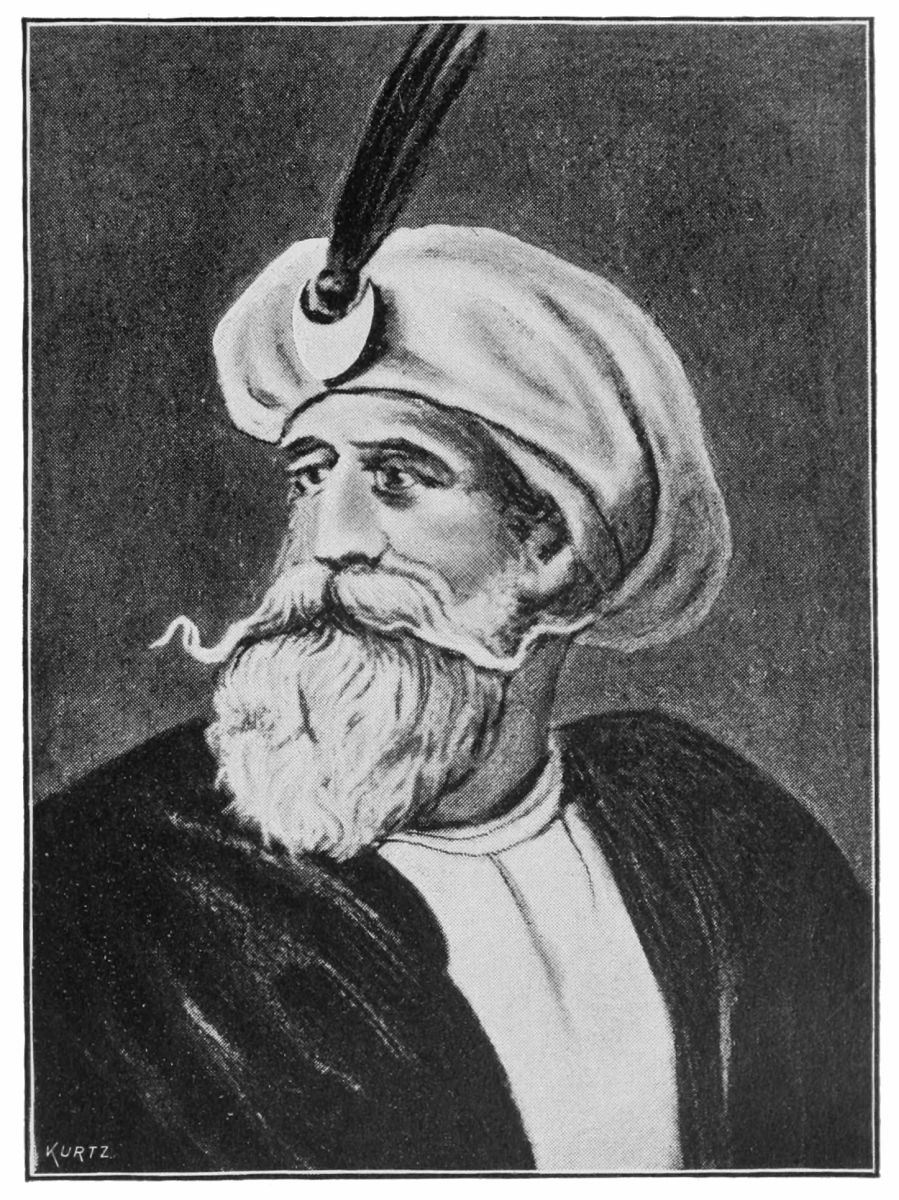
MOHAMMED.
announced to the world his heavenly mission, his first converts being his wife and his uncle Abu Taleb. He was compelled to fly from Mecca to Medina, and the year of the flight known as the “Hegira,” 622 A.D., is the foundation of the Mohammedan era. Within a decade Mohammed converted nearly the whole of Arabia to his new religion, and the dominion of his successors was spread with a rapidity which is among the marvels of history.]
The plebeian birth of Mahomet is an unskillful calumny of the Christians, who exalt instead of degrading the merit of their adversary. His descent from Ishmael was a national privilege or fable; but if the first steps of the pedigree are dark and doubtful, he could produce many generations of pure and genuine nobility; he sprung from the tribe of Koreish and the family of Hashem, the most illustrious of the Arabs, the princes of Mecca, and the hereditary guardians of the Caaba. The grandfather of Mahomet was Abdol Motalleb, the son of Hashem, a wealthy and generous citizen who relieved the distress of famine with the supplies of commerce. Mecca, which had been fed by the liberality of the father, was saved by the courage of the son. The kingdom of Yemen was subject to the Christian princes of Abyssinia; their vassal Abrahah was provoked by an insult to avenge the honor of the cross; and the holy city was invested by a train of elephants and an army of Africans. A treaty was proposed, and in the first audience the grandfather of Mahomet demanded the restitution of his cattle. “And why,” said Abrahah, “do you not rather implore my clemency in favor of your temple, which I have threatened to destroy?” “Because,” replied the intrepid chief, “the cattle is my own; the Caaba belongs to the gods, and they will defend their house from injury and sacrilege.” The want of provisions, or the valor of the Koreish, compelled the Abyssinians to a disgraceful retreat; their discomfiture has been adorned with a miraculous flight of birds, who showered down stones on the heads of the infidels; and the deliverance was long commemorated by the era of the elephant.
The glory of Abdol Motalleb was crowned with domestic happiness, his life was prolonged to the age of one hundred and ten years, and he became the father of six daughters and thirteen sons. His best beloved Abdallah was the most beautiful and modest of the Arabian youth. Mahomet, or more properly Mohammed, the only son of Abdallah and Amina, of the noble race of the Zahrites, was born at Mecca, four years after the death of Justinian. In his early infancy he was deprived of his father, his mother, and his grandfather; his uncles were strong and numerous; and in the division of the inheritance the orphan’s share was reduced to five camels and an Ethiopian maid-servant. At home and abroad, in peace and war, Abu Taleb, the most respectable of his uncles, was the guide and guardian of his youth; in his twenty-fifth year he entered into the service of Cadijah, a rich and noble widow of Mecca, who soon rewarded his fidelity with the gift of her hand and fortune. The marriage contract, in the simple style of antiquity, recites the mutual love of Mahomet and Cadijah; describes him as the most accomplished of the tribe of Koreish; and stipulates a dowry of twelve ounces of gold and twenty camels, which was supplied by the liberality of his uncle. By this alliance the son of Abdallah was restored to the station of his ancestors, and the judicious matron was content with his domestic virtues, till, in the fortieth year of his age, he assumed the title of a prophet and proclaimed the religion of the Koran.
According to the tradition of his companions, Mahomet was distinguished by the beauty of his person, an outward gift which is seldom despised, except by those to whom it has been refused. Before he spoke, the orator engaged on his side the affections of a public or private audience. They applauded his commanding presence, his majestic aspect, his piercing eye, his gracious smile, his flowing beard, his countenance that painted every sensation of the soul, and his gestures that enforced each expression of the tongue. In the familiar offices of life he scrupulously adhered to the grave and ceremonious politeness of his country; his respectful attention to the rich and powerful was dignified by his condescension and affability to the poorest citizens of Mecca; the frankness of his manner concealed the artifice of his views, and the habits of courtesy were imputed to personal friendship or universal benevolence. His memory was capacious and retentive, his wit easy and social, his imagination sublime, his judgment clear, rapid, and decisive. He possessed the courage both of thought and action; and, although his designs might gradually expand with his success, the first idea which he entertained of his divine mission bears the stamp of an original and superior genius. The son of Abdallah was educated in the bosom of the noblest race, in the use of the purest dialect of Arabia; and the fluency of his speech was corrected and enhanced by the practice of discreet and seasonable silence. With these powers of eloquence Mahomet was an illiterate barbarian; his youth had never been instructed in the arts of reading and writing; the common ignorance exempted him from shame or reproach, but he was reduced to a narrow circle of existence, and deprived of those faithful mirrors which reflect to our mind the minds of sages and heroes. Yet the book of nature and of man was open to his view; and some fancy has been indulged in the political and philosophical observations which are ascribed to the Arabian traveler. He compares the nations and the religions of the earth; discovers the weakness of the Persian and Roman monarchies; beholds, with pity and indignation, the degeneracy of the times; and resolves to unite, under one God and one king, the invincible spirit and primitive virtues of the Arabs. Our more accurate inquiry will suggest that, instead of visiting the courts, the camps, the temples of the East, the two journeys of Mahomet into Syria were confined to the fairs of Bostra and Damascus; that he was only thirteen years of age when he accompanied the caravan of his uncle; and that his duty compelled him to return as soon as he had disposed of the merchandise of Cadijah. In these hasty and superficial excursions the eye of genius might discern some objects invisible to his grosser companions; some seeds of knowledge might be cast upon a fruitful soil; but his ignorance of the Syriac language must have checked his curiosity, and I can not perceive in the life or writings of Mahomet that his prospect was far extended beyond the limits of the Arabian world.
From every region of that solitary world the pilgrims of Mecca were annually assembled by the calls of devotion and commerce; in the free concourse of multitudes, a simple citizen, in his native tongue, might study the political state and character of the tribes, the theory and practice of the Jews and Christians. Some useful strangers might be tempted, or forced, to implore the rights of hospitality; and the enemies of Mahomet have named the Jew, the Persian, and the Syrian monk whom they accuse of lending their secret aid to the composition of the Koran. Conversation enriches the understanding, but solitude is the school of genius; and the uniformity of a work denotes the hand of a single artist. From his earliest youth Mahomet was addicted to religious contemplation; each year, during the month of Ramadan, he withdrew from the world and from the arms of Cadijah; in the cave of Hera, three miles from Mecca, he consulted the spirit of fraud or enthusiasm, whose abode is not in the heavens, but in the mind of the prophet. The faith which, under the name of Islam, he preached to his family and nation, is compounded of an eternal truth and a necessary fiction, that there is only one God, and that Mahomet is the apostle of God.
It may, perhaps, be expected that I should balance his faults and virtues, that I should decide whether the title of enthusiast or impostor more properly belongs to that extraordinary man. Had I been intimately conversant with the son of Abdallah, the task would still be difficult, and the success uncertain; at the distance of twelve centuries, I darkly contemplate his shade through a cloud of religious incense; and could I truly delineate the portrait of an hour, the fleeting resemblance would not equally apply to the solitary of Mount Hera, to the preacher of Mecca, and to the conqueror of Arabia. The author of a mighty revolution appears to have been endowed with a pious and contemplative disposition; so soon as marriage had raised him above the pressure of want, he avoided the paths of ambition and avarice; and till the age of forty he lived with innocence, and would have died without a name. The unity of God is an idea most congenial to nature and reason; and a slight conversation with the Jews and Christians would teach him to despise and detest the idolatry of Mecca. It was the duty of a man and a citizen to impart the doctrine of salvation, to rescue his country from the dominion of sin and error. The energy of a mind incessantly bent on the same object would convert a general obligation into a particular call; the warm suggestions of the understanding or the fancy would be felt as the inspirations of heaven; the labor of thought would expire in rapture and vision; and the inward sensation, the invisible monitor, would be described with the form and attributes of an angel of God.
From enthusiasm to imposture the step is perilous and slippery; the demon of Socrates affords a memorable instance how a wise man may deceive himself, how a good man may deceive others, how the conscience may slumber in a mixed and middle state between self-illusion and voluntary fraud. Charity may believe that the original motives of Mahomet were those of pure and genuine benevolence; but a human missionary is incapable of cherishing the obstinate unbelievers who reject his claims, despise his arguments, and persecute his life; he might forgive his personal adversaries, he may lawfully hate the enemies of God; the stern passions of pride and revenge were kindled in the bosom of Mahomet, and he sighed, like the prophet of Nineveh, for the destruction of the rebels whom he had condemned. The injustice of Mecca and the choice of Medina transformed the citizen into a prince, the humble preacher into the leader of armies; but his sword was consecrated by the example of the saints, and the same God who afflicts a sinful world with pestilence and earthquakes might inspire for their conversion or chastisement the valor of his servants. In the exercise of political government he was compelled to abate of the stern rigor of fanaticism, to comply in some measure with the prejudices and passions of his followers, and to employ even the vices of mankind as the instruments of their salvation. The use of fraud and perfidy, of cruelty and injustice, were often subservient to the propagation of the faith; and Mahomet commanded or approved the assassination of the Jews and idolaters who had escaped from the field of battle. By the repetition of such acts the character of Mahomet must have been gradually stained, and the influence of such pernicious habits would be poorly compensated by the practice of the personal and social virtues which are necessary to maintain the reputation of a prophet among his secretaries and friends.
Of his last years ambition was the ruling passion; and a politician will suspect that he secretly smiled (the victorious impostor!) at the enthusiasm of his youth and the credulity of his proselytes. A philosopher will observe that their cruelty and his success would tend more strongly to fortify the assurance of his divine mission, that his interest and religion were inseparably connected, and that his conscience would be soothed by the persuasion that he alone was absolved by the Deity from the obligation of positive and moral laws. If he retained any vestige of his native innocence, the sins of Mahomet may be allowed as an evidence of his sincerity. In the support of truth the arts of fraud and fiction may be deemed less criminal, and he would have started at the foulness of the means had he not been satisfied of the importance and justice of the end. Even in a conqueror or a priest, I can surprise a word or action of unaffected humanity; and the decree of Mahomet that, in the sale of captives, the mothers should never be separated from their children, may suspend or moderate the censure of the historian.
The good sense of Mahomet despised the pomp of royalty; the apostle of God submitted to the menial offices of the family; he kindled the fire, swept the floor, milked the ewes, and mended with his own hands his shoes and his woolen garment. Disdaining the penance and merit of a hermit, he observed, without effort or vanity, the abstemious diet of an Arab and a soldier. On solemn occasions he feasted his companions with rustic and hospitable plenty; but in his domestic life, many weeks would elapse without a fire being kindled on the hearth of the prophet. The interdiction of wine was confirmed by his example; his hunger was appeased with a sparing allowance of barley bread; he delighted in the taste of milk and honey, but his ordinary food consisted of dates and water. Perfumes and women were the two sensual enjoyments which his nature required and his religion did not forbid. Their incontinence was regulated by the civil and religious laws of the Koran; their incestuous alliances were blamed, the boundless license of polygamy was reduced to four legitimate wives or concubines; their rights, both of bed and of dowry, were equitably determined; the freedom of divorce was discouraged, adultery was condemned as a capital offense, and fornication in either sex was punished with a hundred stripes. Such were the calm and rational precepts of the legislator; but in his private conduct Mahomet indulged the appetites of a man, and abused the claims of a prophet. The youth, the beauty, the spirit of Ayesha, gave her a superior ascendant; she was beloved and trusted by the prophet, and after his death the daughter of Abubeker was long revered as the mother of the faithful. During the twenty-four years of the marriage of Mahomet with Cadijah, her youthful husband abstained from the right of polygamy, and the pride or tenderness of the venerable matron was never insulted by the society of a rival. After her death he placed her in the rank of the four perfect women—with the sister of Moses, the mother of Jesus, and Fatima, the best beloved of his daughters. “Was she not old?” said Ayesha, with the insolence of a blooming beauty; “has not God given you a better in her place?” “No, by God,” said Mahomet, with an effusion of honest gratitude, “there never can be a better! she believed in me when men despised me; she relieved my wants when I was poor and persecuted by the world.”