MARTIN LUTHER. By THOMAS CARLYLE.
Reading edition
[Leader of the German Reformation, born 1483, died 1546. Educated at the University of Erfurt, and originally intending to become a lawyer, he was carried by religious enthusiasm into an Augustinian convent. After taking orders he became in a few years Professor of Philosophy in the Wittenberg University, and Doctor of Theology. It was not till the promulgation of indulgences for sin, issued by Pope Leo V to raise funds for the building of the Cathedral of St. Peter’s at Rome, that Luther took a stand antagonistic to the Roman Church. He posted ninety-five Latin theses on the door of the Wittenberg church as a protest, which contained the germ of the Protestant doctrine. This bold act kindled a fire throughout Europe. Luther’s celebrated disputation with Doctor Eck, and his fierce pamphlets against Rome, which were scattered broadcast by the press, added fuel to the flames, and he was soon supported by the sympathy and adherence of many of the nobles, particularly George of Saxony, the reformer’s own electoral prince, as well as by the support of large masses of the people. Luther was excommunicated in 1520, and in the same year was summoned to answer before Charles V, the German emperor,
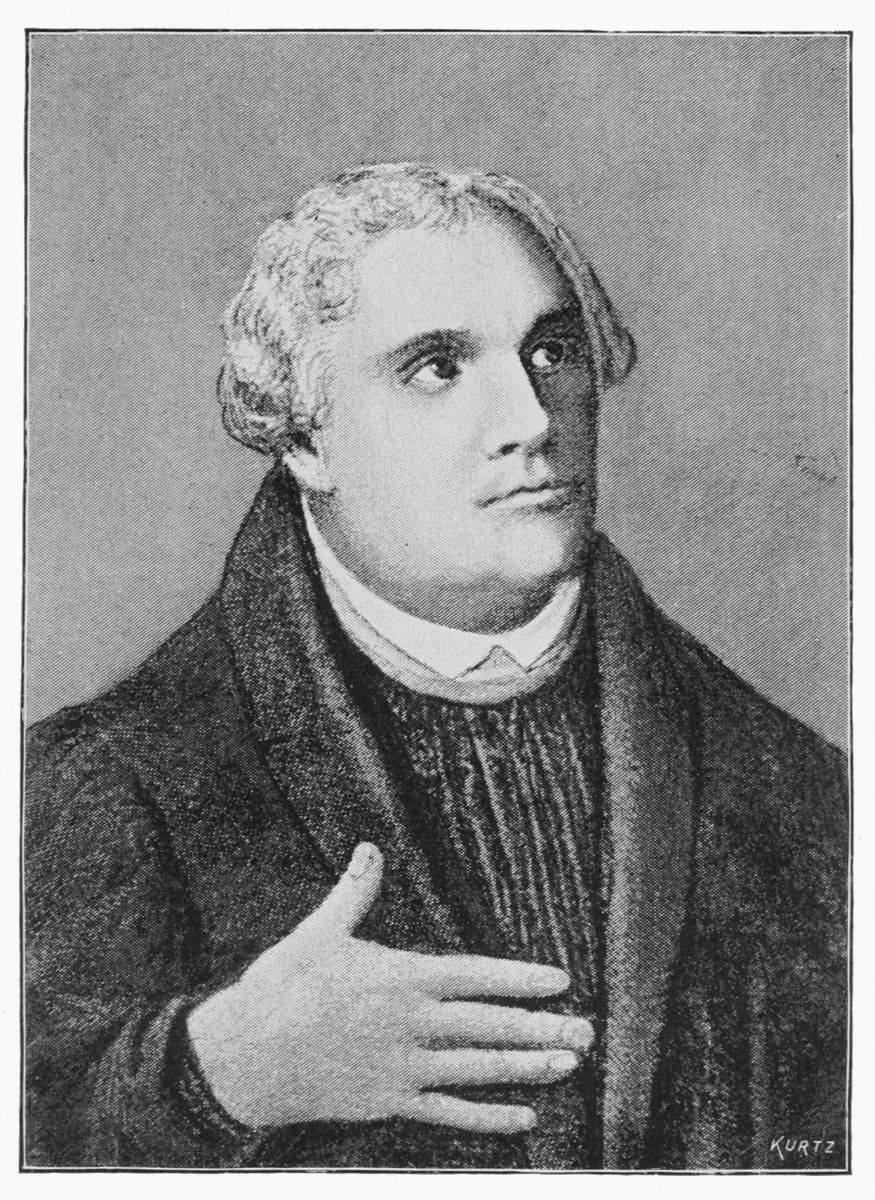
MARTIN LUTHER.
at the Diet of Worms. The reformer defended himself with great eloquence and vigor, but was placed under the ban of the Empire, and thenceforward became both a religious and political outlaw. The Lutheran reformation rapidly spread to France, Switzerland, the Scandinavian kingdoms, England, and Scotland, during the life of its apostle, and shook the power of the Roman hierarchy to its very center. Luther was protected in his work by a powerful band of German princes, and when he died the larger part of North Germany had accepted his doctrine. He was perhaps the most extraordinary figure of an age prolific in great men.]
The Diet of Worms and Luther’s appearance there on the 17th of April, 1521, may be considered as the greatest scene in modern European history; the point, indeed, from which the whole subsequent history of civilization takes its rise. After multiplied negotiations and disputations, it had come to this. The young Emperor Charles V, with all the princes of Germany, papal nuncios, dignitaries, spiritual and temporal, are assembled there: Luther is to appear and answer for himself, whether he will recant or not. The world’s pomp and power sits there on this hand; on that, stands up for God’s truth one man, the poor miner, Hans Luther’s son. Friends had reminded him of Huss, advised him not to go; he would not be advised. A large company of friends rode out to meet him, with still more earnest warnings; he answered, “Were there as many devils in Worms as there are roof-tiles, I would on.” The people, on the morrow, as he went to the hall of the diet, crowded the windows and house-tops, some of them calling out to him, in solemn words, not to recant. “Whosoever denieth me before men!” they cried to him, as in a kind of solemn petition and adjuration. Was it not in reality a petition too—the petition of the whole world lying in dark bondage of soul, paralyzed under a black spectral nightmare and triple-hatted chimera, calling itself Father in God, and what not—“Free us; it rests with thee; desert us not!”
Luther did not desert us. His speech of two hours distinguished itself by its respectful, wise, and honest tone; submissive to whatsoever could lawfully claim submission, not submissive to any more than that. His writings, he said, were partly his own, partly derived from the Word of God. As to what was his own, human infirmity entered into it; unguarded anger, blindness, many things, doubtless, which it were a blessing for him could he abolish altogether. But as to what stood on sound truth and the Word of God, he could not recant it. How could he? “Confute me,” he concluded, “by proofs of Scripture, or else by plain, just arguments. I can not recant otherwise; for it is neither safe nor prudent to do aught against conscience. Here stand I; I can do no other. God assist me!” It is, as we say, the greatest moment in the modern history of men. English Puritanism, England and its Parliaments, Americas, and the vast work done in these two centuries; French Revolution, Europe and its work everywhere at present—the germ of it all lay there. Had Luther in that moment done other, it had all been otherwise! The European world was asking him: Am I to sink ever lower into falsehood, stagnant putrescence, loathsome, accursed death; or, with what paroxysm, to cast the falsehoods out of me, and be cured and live?
Great wars, contentions, and disunion followed out of this Reformation, which last down to our day, and are yet far from ended. Great talk and crimination has been made about these. They are lamentable, undeniable; but, after all, what has Luther or his cause to do with them? It seems strange reasoning to charge the Reformation with all this. When Hercules turned the purifying river into King Augeas’s stables, I have no doubt the confusion that resulted was considerable all around, but I think it was not Hercules’s blame; it was some other’s blame! The Reformation might bring what results it liked when it came, but the Reformation simply could not help coming.
Of Luther I will add now, in reference to all these wars and bloodshed, the noticeable fact that none of them began so long as he continued living. The controversy did not get to fighting so long as he was there. To me it is a proof of his greatness in all senses, this fact. How seldom do we find a man that has stirred up some vast commotion, who does not himself perish, swept away in it! Such is the usual course of revolutionists. Luther continued, in a good degree, sovereign of this greatest revolution; all Protestants, of what rank or function soever, looking much to him for guidance; and he held it peaceably, continued firm at the center of it. A man to do this must have a kingly faculty; he must have the gift to discern at all turns where the true heart of the matter lies, and to plant himself courageously on that, as a strong, true man, that other true men may rally round him there. He will not continue leader of men otherwise. Luther’s clear, deep force of judgment, his force of all sorts—of silence, of tolerance and moderation among others—are very notable in these circumstances.
Tolerance, I say; a very genuine kind of tolerance: he distinguishes what is essential, and what is not; the unessential may go very much as it will. A complaint comes to him that such and such a reformed preacher “will not preach without a cassock.” “Well,” answers Luther, “what harm will a cassock do the man? Let him have a cassock to preach in; let him have three cassocks, if he find benefit in them!” His conduct in the matter of Carlstadt’s wild image-breaking; of the Anabaptists; of the Peasants’ war, shows a noble strength, very different from spasmodic violence. With sure, prompt insight, he discriminates what is what; a strong, just man, he speaks forth what is the wise course, and all men follow him in that. Luther’s written works give similar testimony of him. The dialect of these speculations is now grown obsolete for us, but one still reads them with a singular attraction. And, indeed, the mere grammatical diction is still legible enough. Luther’s merit in literary history is of the greatest; his dialect became the language of all writing. They are not well written, these four-and-twenty quartos of his; written hastily, with quite other than literary objects. But in no books have I found a more robust, genuine, I will say noble, faculty of a man than in these. A rugged honesty, homeliness, simplicity; a rugged, sterling sense and strength. He flashes out illumination from him; his smiting idiomatic phrases seem to cleave into the very secret of the matter. Good humor too, nay, tender affection, nobleness, and depth. This man could have been a poet too! He had to work an epic poem, and not write one. I call him a great thinker; as, indeed, his greatness of heart already betokens that.
Richter says of Luther’s words, “His words are half-battles.” They may be called so. The essential quality of him was, that he could fight and conquer—that he was a right piece of human valor. No more valiant man, no mortal heart to be called braver, that one has record of, ever lived in that Teutonic kindred whose character is valor. His defiance of the “devils” in Worms was not a mere boast, as the like might be if now spoken. It was a faith of Luther’s that there were devils, spiritual denizens of the pit, continually besetting men. Many times in his writings this turns up, and a most small sneer has been grounded on it by some.
In the room of the Wartburg, where he sat translating the Bible, they still show you a black spot on the wall, the strange memorial of one of these conflicts. Luther was translating one of the Psalms; he was worn down with long labor, with sickness, abstinence from food; there rose before him some hideous, indefinable image, which he took for the Evil One, to forbid his work. Luther started up with fiend-defiance, flung his inkstand at the specter, and it disappeared! The spot still remains there, a curious monument of several things. Any apothecary’s apprentice can now tell us what we are to think of this apparition in a scientific sense; but the man’s heart that dare rise defiant, face to face, against hell itself, can give no higher proof of fearlessness. The thing he will quail before exists not on this earth or under it. Fearless enough! “The devil is aware,” writes he on one occasion, “that this does not proceed out of fear in me. I have seen and defied innumerable devils.” Of Duke George, of Leipsic, a great enemy of his, he said, “Duke George is not equal to one devil—far short of a devil! If I had business at Leipsic, I would ride into Leipsic, though it rained Duke Georges for nine days running.” What a reservoir of dukes to ride into!
At the same time, they err greatly who imagine that this man’s courage was ferocity—mere coarse, disobedient obstinacy and savagery—as many do. Far from that. There may be an absence of fear, which arises from the absence of thought or affection, from the presence of hatred and stupid fury. We do not value the courage of the tiger highly. With Luther it was far otherwise; no accusation could be more unjust than this mere ferocious violence brought against him. A most gentle heart withal, full of pity and love, as, indeed, the truly valiant heart ever is. The tiger before a stronger foe flies. The tiger is not what we call valiant, only fierce and cruel. I know few things more touching than those soft breathings of affection—soft as a child’s or a mother’s—in this great, wild heart of Luther. So honest, unadulterated with any cant; homely, rude in their utterance; pure as water welling from the rock. What, in fact, was all this downpressed mood of despair and reprobation which we saw in his youth but the outcome of pre-eminent, thoughtful gentleness, affections too keen and pure? It is the curse such men as the poor poet Cowper fall into. Luther, to a slight observer, might have seemed a timid, weak man; modesty, affectionate, shrinking tenderness the chief distinction of him. It is a noble valor which is roused in a heart like this, once stirred up into defiance, all kindled into a heavenly blaze.
In Luther’s “Table-Talk,” a posthumous book of anecdotes and sayings collected by his friends—the most interesting now of all the books proceeding from him—we have many beautiful, unconscious displays of the man and what sort of nature he had. His behavior at the death-bed of his little daughter—so still, so great and loving—is among the most affecting things. He is resigned that his little Magdalene should die, yet longs inexpressibly that she might live—follows, in awe-struck thought, the flight of her little soul through those unknown realms. Awestruck—most heartfelt, we can see; and sincere—for, after all dogmatic creeds and articles, he feels what nothing it is that we know or can know. His little Magdalene shall be with God, as God wills; for Luther, too, that is all.
Once he looks out from his solitary Patmos, the castle of Coburg, in the middle of the night. The great vault of immensity, long flights of clouds sailing through it—dumb, gaunt, huge—who supports all that? “None ever saw the pillars of it; yet it is supported.” God supports it. We must know that God is great, that God is good; and trust, where we can not see. Returning home from Leipsic once, he is struck by the beauty of the harvest-fields. How it stands, that golden yellow corn, on its fair taper stem, its golden head bent, all rich and waving there; the meek earth, at God’s kind bidding, has produced it once again—the bread of man! In the garden of Wittenberg, one evening at sunset, a little bird has perched for the night. That little bird, says Luther; above it are the stars and deep heaven of worlds; yet it has folded its little wings; gone trustfully to rest there as in its home. The maker of it has given it, too, a home! Neither are mirthful turns wanting—there is a great, free, human heart in this man.
The common speech of him has a rugged nobleness; idiomatic, expressive, genuine; gleams here and there with beautiful poetic tints. One feels him to be a great brother man. His love of music, indeed—is not this, as it were, the summary of all these affections in him? Many a wild unutterability he spoke forth from him in the tones of his flute. The devils fled from his flute, he says. Death-defiance on the one hand, and such love of music on the other—I could call these the two opposite poles of a great soul; between these two all great things had room.
Luther’s face is to me expressive of him. In Kranach’s best portraits I find the true Luther. A rude plebeian face, with its huge, crag-like brows and bones—the emblem of rugged energy—at first, almost a repulsive face. Yet in the eyes especially there is a wild, silent sorrow; an unnamable melancholy, the element of all gentle and fine affections; giving to the rest the true stamp of nobleness. Laughter was in this Luther, as we said; but tears also were there. Tears also were appointed him; tears and hard toil. The basis of his life was sadness, earnestness. In his latter days, after all triumphs and victories, he expresses himself heartily weary of living. He considers that God alone can and will regulate the course things are taking, and that perhaps the day of judgment is not far. As for him, he longs for one thing—that God would release him from his labor, and let him depart and be at rest. They understood little of the man who cite this in discredit of him! I will call this Luther a true great man; great in intellect, in courage, affection, and integrity; one of our most lovable and precious men. Great, not as a hewn obelisk, but as an Alpine mountain; so simple, honest, spontaneous; not setting up to be great at all; there for quite another purpose than being great! Ah, yes, unsubduable granite, piercing far and wide into the heavens; yet, in the clefts of its fountains, green, beautiful valleys with flowers! A right spiritual hero and prophet; once more, a true son of nature and fact, for whom these centuries, and many that are to come yet, will be thankful to Heaven.