SERTORIUS. By PLUTARCH.
Reading edition
[Quintus Sertorius, a Roman general of Sabine extraction, born about 121 B.C., assassinated in Spain in 72. A prominent chief of the Marian party, he fled to Spain and held possession of the province against the dominant party at Rome for more than ten years. He was the one leader among the adherents of Marius, as Pompey was the one general among the followers of Sylla, who showed moderation and the spirit of clemency. His greatness was chiefly shown in his career in Spain. He displayed consummate generalship and skill in holding all the armies of Rome at bay till he was assassinated by one of his own officers.]
Sertorius at last utterly despaired of Rome, and hastened into Spain, that by taking possession there beforehand he might secure a refuge to his friends from their misfortunes at home. He armed all the Romans who lived in those countries that were of military age, and undertook the building of ships and the making of all sorts of warlike engines, by which means he kept the cities in due obedience, showing himself gentle in all peaceful business, and at the same time formidable to his enemies by his great preparations for war.
When Sertorius was called to Mauritania to assist the enemies of Prince Ascalis, and had made himself absolute master of the whole country, he acted with great fairness to those who had confided in him, and who yielded to his mercy. He restored to them their property, cities, and government, accepting only of such acknowledgments as they themselves freely offered. While he considered which way next to turn his arms, the Lusitanians sent ambassadors to desire him to be their general. For being terrified with the Roman power, and finding the necessity of having a commander of great authority and experience in war; being also sufficiently assured of his worth and valor by those who formerly had known him, they were desirous to commit themselves specially to his care.
In fact, Sertorius is said to have been of a temper unassailable either by fear or pleasure, in adversity and dangers undaunted, and no ways puffed up with prosperity. In straightforward fighting no commander of his time was more bold and daring; and in whatever was to be performed in war by stratagem, secrecy, or surprise, if any strong place was to be secured, any pass to be gained speedily, for deceiving and overreaching an enemy, there was no man equal to him in subtlety and skill.
In bestowing rewards and conferring honors upon those who had performed good service in the wars he was bountiful and magnificent, and was no less sparing and moderate in inflicting punishment. The Lusitanians having sent for Sertorius, he left Africa, and being made general, with absolute authority, he put all in order among them, and brought the neighboring parts of Spain into subjection. Most of the tribes voluntarily submitted themselves, won by the fame of his clemency and of his courage; and to some extent also, he availed himself of cunning artifices of his own devising to impose on them, and gain influence over them.
Among which certainly that of the hind was not the least. Spanus, a countryman who lived in those parts, meeting by chance a hind that had recently calved flying from the hunters, let the dam go, and pursuing the fawn took it, being wonderfully pleased with the rarity of the color, which was all milk white. At that time Sertorius was living in the neighborhood, and accepted gladly any presents of fruits, fowl, or venison that the country afforded, and rewarded liberally those who presented them.
The countryman brought him his young hind, which he took and was well pleased with at first sight; but when in time he made it so tame and gentle that it would come when he called, and follow him wherever he went, and could endure the noise and tumult of the camp, knowing well that uncivilized people are naturally prone to superstition, by little and little he raised it to something supernatural, saying it was given him by the goddess Diana, and that it revealed to him many secrets.
If he had received private intelligence that the enemies had made an incursion into any part of the district under his command, or had solicited any city to revolt, he pretended that the hind had informed him of it in his sleep, and charged him to keep his forces in readiness. Or, again, if he had notice that any of the commanders under him had got a victory, he would hide the messengers and bring forth the hind crowned with flowers, for joy of the good news that was to come, and would encourage them to rejoice and sacrifice to the gods for the good account they should soon receive of their prosperous success.
He was also highly honored for his introducing discipline and good order among them, for he altered their furious mode of fighting, and brought them to make use of Roman armor, taught them to keep their ranks, and observe signals and watch-words; and out of a confused number of thieves and robbers he constituted a well-disciplined army. That which delighted them most, however, was the care he took of their children. He sent for all the boys of noblest parentage out of all their tribes, and placed them in the great city of Osca, where he appointed masters to instruct them in the Latin and Greek learning.
His method of conducting the war against the Romans showed his military skill and foresight. By rapidly assaulting them, by alarming them on all sides, by ensnaring, circumventing, and laying ambushes for them, he cut off all provisions by land, while with his piratical vessels he kept all the coast in awe and hindered their supplies by sea. He thus forced the Roman generals to dislodge and to separate from one another at the last; Metellus departed into Gaul and Pompey wintered among the Vaccæans in a wretched condition, where, being in extreme want of money, he wrote a letter to the senate, to let them know that if they did not speedily supply him he must draw off his army. To these extremities the chiefest and most powerful commanders of the age were brought by the skill of Sertorius; and it was the common opinion in Rome that he would be in Italy before Pompey.
Sertorius showed the loftiness of his temper in calling together all the Roman senators who had fled from Rome and had come and resided with him, giving them the name of a senate. Out of these he chose prætors and quæstors, and adorned his government with all the Roman laws and institutions, and though he made use of the arms, riches, and cities of the Spaniards, yet he never would even in word remit to them the imperial authority, but set Roman officers and commanders over them, intimating his purpose to restore liberty to the Romans, not to raise up the Spaniards’ power against them.
He was a sincere lover of his country and had a great desire to return home; but in his adverse fortune he showed undaunted courage, and behaved himself toward his enemies in a manner free from all dejection and mean spiritedness. In his prosperity and the height of his victories he sent word to Metellus and Pompey that he was ready to lay down his arms and lead a private life if he were allowed to return home, declaring that he had rather live as the meanest citizen in Rome than, exiled from it, be supreme commander of all other cities together.
His negotiations with Mithridates further argue the greatness of his mind. For when Mithridates, recovering himself from his overthrow by Sylla—like a strong wrestler that gets up to try another fall—was again endeavoring to re-establish his power in Asia, at this time the great fame of Sertorius was celebrated in all places. Accordingly, Mithridates sends messengers into Spain with letters and instructions and commission to promise ships and money toward the charge of the war if Sertorius would confirm his pretensions on Asia, and authorize him to possess all that he had surrendered to the Romans in his treaty with Sylla.
Sertorius would by no means agree to it; declaring that King Mithridates should exercise all royal power and authority over Bithynia and Cappadocia—countries accustomed to a monarchical government and not belonging to Rome—but that he could never consent that he should seize or detain a province which, by the justest right and title, was possessed by the Romans. For he looked upon it as his duty to enlarge the Roman possessions by his conquering arms, and not to increase his power by the diminution of Roman territories.
When this was related to Mithridates he was struck with amazement, and said to his intimate friends: “What will Sertorius enjoin on us to do when he comes to be seated in the Palatium at Rome, who, at present, when he is driven out to the borders of the Atlantic Sea, sets bounds to our kingdoms in the East, and threatens us with war if we attempt the recovery of Asia?”
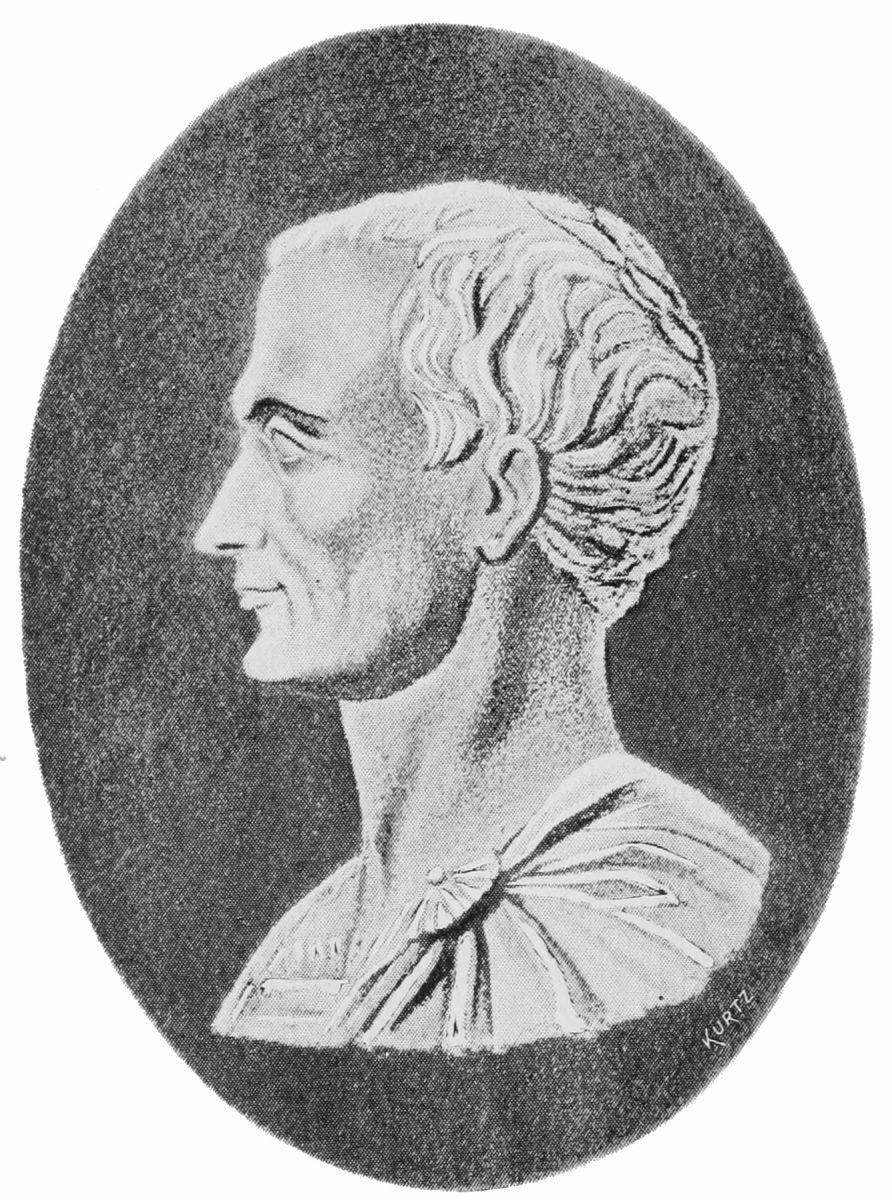
JULIUS CÆSAR.